What an Asian Name Generator Actually Does
You type a few preferences into an asian name generator, hit a button, and get a list of names. Simple enough. But here is the problem: most of these tools treat "Asia" as a single naming culture when it actually spans dozens of distinct traditions, each with its own rules for structure, meaning, and sound. The result? Names that look plausible on screen but would raise eyebrows with anyone familiar with the culture they claim to represent.
A quality culture name generator does more than shuffle syllables. It draws on real naming conventions — surname placement, character meaning, generational markers, and gender signals — to produce results that could belong to an actual person from a specific region. That distinction matters whether you are building a character, naming a child, or simply curious about what is my asian name equivalent in another tradition.
Why Asian Name Generators Matter
Asian naming systems carry layers of cultural information that random asian names pulled from a basic list cannot capture. A Japanese name encodes meaning through kanji characters. A Korean name may contain a shared generational syllable linking cousins across a family tree. A Vietnamese name signals family branch through its middle element. When an asian names generator ignores these patterns, it produces output that feels hollow — technically possible but culturally empty.
Understanding the logic behind these systems transforms a random asian name into something authentic. This guide breaks down that logic culture by culture, so you can evaluate any tool's output and make informed choices on your own.
Who Benefits from Understanding Asian Names
The use cases are broader than you might expect:
- Fiction writers crafting characters set in or inspired by Asian cultures
- Game developers building diverse, believable worlds
- Multicultural families choosing names that honor heritage across borders
- Educators and students exploring cultural literacy
- Professionals navigating cross-cultural communication — knowing which part of a name is the surname can prevent embarrassing mistakes in formal settings
Each of these groups needs more than a list of outputs. They need to understand why a name works within its culture — and that starts with knowing how naming structures differ from one Asian tradition to the next.
How Naming Structures Differ Across Asian Cultures
Imagine meeting someone named Kim Min Su. Is Kim the first name or the family name? If you guessed family name, you are right — but only because this is a Korean name. Swap the context to a Filipino name like Kim Santos, and suddenly Kim is the given name. This single example shows why treating names in asia as interchangeable leads to confusion. Each culture follows its own structural logic, and getting it wrong can mean addressing someone by the equivalent of "President Don" instead of "President Trump" — a mistake even diplomats have made publicly.
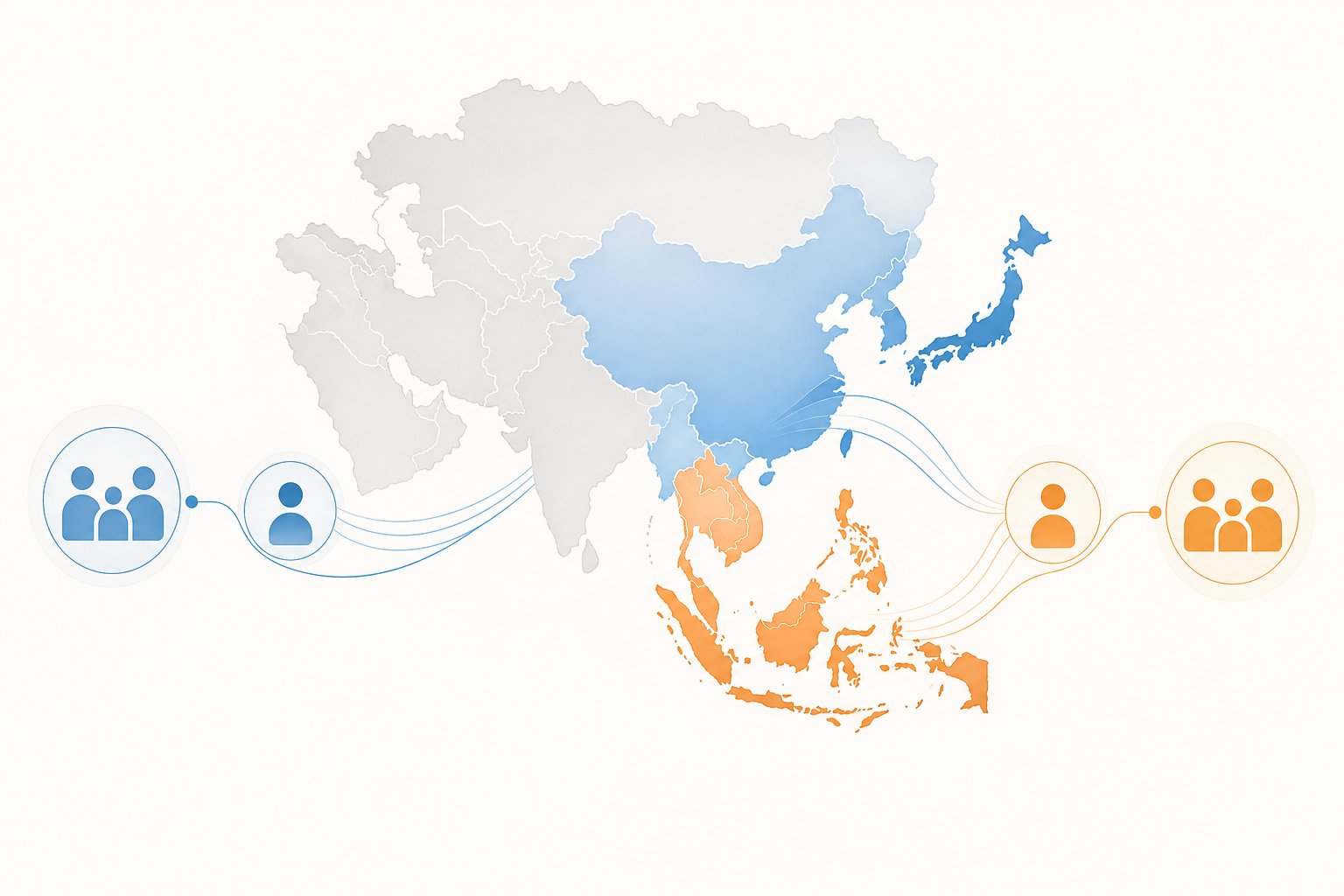
Surname-First vs Given-Name-First Traditions
The split comes down to cultural philosophy. In East Asian traditions — Chinese, Japanese, Korean, Vietnamese, and Cambodian — the family name leads. The collective identity comes before the individual. You'll notice names like Xi Jinping (family name Xi) or Nguyen Phu Trong (family name Nguyen) follow this pattern consistently.
Southeast asian names tell a different story. Thai, Filipino, Indonesian, Malaysian, and Laotian conventions place the given name first, mirroring Western order. So when you see a Thai name like Thaksin Shinawatra, Thaksin is the first name asian audiences would use in casual address — and in Thailand, people are typically referred to by their given name rather than surname even in formal contexts.
This distinction matters for anyone generating or selecting asian names and surnames. A tool that randomly pairs a Japanese surname with a given-name-first structure produces something no Japanese person would recognize as natural.
Name Length and Structure Norms by Culture
Beyond order, cultures differ sharply in how long names run and what components they include. Korean names are almost always three syllables — one for the family name, two for the given name. Japanese names vary widely because kanji characters can have multiple readings ranging from one to four syllables each. Thai names tend to be longer because surnames were only mandated in 1913, and families were required to create unique ones, pushing them toward elaborate multi-syllable constructions.
Here is a side-by-side comparison of common names in asia broken down by structural rules. This table covers the conventions most relevant when evaluating asian male names and surnames or female equivalents across cultures:
| Culture | Name Order | Typical Syllable Count | Middle Name Convention | Gendered Naming Rules |
|---|---|---|---|---|
| Japanese | Surname first | 4-6 (varies widely) | None | Distinct kanji choices signal gender; some names are unisex |
| Chinese | Surname first | 2-3 (most commonly 3) | None (generational character serves a similar role) | Character meaning often signals gender; structure is identical |
| Korean | Surname first | 3 (rarely 2 or 4) | None (generational syllable within given name) | Meaning-based gender signals; hard to determine from romanization alone |
| Vietnamese | Surname first | 3-4 | Yes — generational middle name indicates family branch and often gender | Middle name Van (male) or Thi (female) traditionally marks gender |
| Thai | Given name first | 5-10+ (surnames are often very long) | None | Some suffixes suggest gender; nicknames are used daily |
| Filipino | Given name first | 4-6 | Yes — mother's maiden name as middle name | Spanish-influenced; names are often clearly gendered |
| Indonesian | Given name first | Varies (some have only one name) | No fixed convention | Some names are gendered; many are not |
Notice the pattern: surname-first cultures cluster in East Asia, while given-name-first conventions dominate Southeast Asia. But structure alone does not make a name authentic. The real depth comes from how individual cultures layer meaning into each character or syllable — starting with the system that packs the most information into the fewest strokes: Japanese kanji naming.
Japanese Names and the Art of Meaningful Characters
A single Japanese name can carry geography, family history, and personal aspiration all within two or three characters. That density is what makes a japanese name generator so tricky to build well — and why so many get it wrong. The system relies on kanji, Chinese-derived logographic characters that each carry multiple meanings and multiple pronunciations. Pair the wrong kanji or assign an implausible reading, and the result sounds like gibberish to a native speaker.
Understanding Japanese Family Names and Their Origins
Japanese family names — called sei or myoji — trace back to a clan system that emerged as early as 300 BC. Clans used names based on geographical features or occupations, and these evolved into the uji-kabane system that eventually produced modern surnames. The Enamdict Dictionary of Japanese Proper Names lists over 138,000 japanese last names, though a handful dominate everyday life.
When you look at japanese last names and meanings, patterns emerge quickly. Most common japanese names for families reference nature, location, or historical clan ties:
- Sato (佐藤) — "help" + "wisteria," linked to the powerful Fujiwara clan
- Suzuki (鈴木) — "bell" + "tree"
- Tanaka (田中) — "center of the rice paddy"
- Takahashi (高橋) — "high bridge"
- Yamamoto (山本) — "base of the mountain"
- Watanabe (渡辺) — "crossing" or "boundary"
Notice how these surnames encode landscape — rice fields, mountains, forests, bridges. Families were literally named for where they lived or what surrounded them. Some surnames also cluster regionally; names like Chinen and Shimabukuro appear frequently in Okinawa but rarely elsewhere in Japan.
How Kanji Characters Shape Japanese Given Names
Here is where japanese name meanings get genuinely complex. Each kanji character has at least two types of readings: on'yomi (the Chinese-derived pronunciation) and kun'yomi (the native Japanese pronunciation). The character 大, for example, can be read as "dai," "tai," or "o" depending on context. A japanese name generator must pair characters with plausible readings — not just any pronunciation mapped to any character.
Given names also differ significantly by gender. Traditional japanese names for boys often reference strength, order, or ambition, while japanese girl names lean toward nature, beauty, and grace. Here are popular examples with their kanji and meanings:
Popular names for boys:
- Haruto (陽翔) — "sunlight soaring," suggesting strength and positivity
- Ren (蓮) — "lotus"
- Minato (湊) — "harbor," evoking safety and calm
- Itsuki (樹) — "tree" or "to stand firmly"
- Yamato (大和) — "great harmony," connected to Japan's ancient dynasty
Popular names for girls:
- Himari (陽葵) — "sun" + "sunflower"
- Rin (凛) — "to face a situation head-on"
- Uta (詩) — "poem" or "poetry"
- Mei (芽依) — "bud/sprout" + "dependable"
- Sakura (さくら) — "cherry blossom"
Japanese names follow the East Asian convention of surname first, given name second. So the full name Suzuki Haruto places the family identity before the individual — though in Western contexts, many Japanese people reverse this order when writing in Latin characters.
Modern vs Traditional Japanese Naming Trends
Traditional naming followed recognizable formulas. Boys received birth-order markers — Taro (first son), Jiro (second son), Saburo (third son). Girls often carried the suffix -ko (子, "child"), producing names like Hanako or Keiko. Seasonal kanji connected children to their birth time: a spring baby might be Haruko (春子, "spring child").
Then came kirakira names (キラキラネーム, or "sparkly names"), and the rules bent dramatically. Parents began choosing kanji for their visual meaning, then assigning pronunciations with no traditional connection to those characters. The most infamous example: 光宙, using kanji for "light" and "space," pronounced "Pikachu" after the Pokemon character. A 2023 survey found roughly 70% of Japanese adults view extremely unusual readings negatively, and the government has since passed guidelines making it easier for adults to legally change kirakira names.
Current japanese names and meanings sit in a middle ground. Nature kanji dominate — lotus, harbor, hollyhock. Gender-neutral options like Hinata, Sora, and Aoi are surging. Names are getting shorter and more internationally friendly, with parents increasingly picking a sound first, then searching for kanji that match. This reverses the traditional approach of choosing meaningful characters and accepting whatever pronunciation follows.
The generational shift reveals something deeper about how naming reflects cultural values — a pattern that repeats across East Asia, where Chinese character-meaning systems and Korean generational syllables encode family identity in ways that go far beyond individual preference.
Chinese, Korean, and Vietnamese Naming Traditions Explained
Japanese kanji naming packs meaning into individual characters, but it is not the only East Asian system that does this. Chinese, Korean, and Vietnamese names all build identity through deliberate character selection — yet each culture layers that meaning differently. Understanding these distinctions is what separates typical asian names generated by a basic tool from names that actually feel real.
Chinese Names and the Power of Character Meaning
In Chinese naming, every character is chosen for what it means, how it sounds, and how it pairs with the surname. A name like Wang Meiling (王美玲) combines "beautiful" and "delicate" — two characters whose meanings reinforce each other. This layered approach is why the most common asian names in Chinese culture are not random syllable combinations but carefully constructed expressions of hope.
Mandarin is a tonal language with four tones plus a neutral tone. The same syllable pronounced with different tones becomes an entirely different character with a different meaning. Take "ma": first tone (妈) means mother, third tone (马) means horse. When parents select chinese first names female or male, they consider how the tones flow across the full name. A name where all three syllables share the same tone sounds flat and awkward to native ears. The pronunciation and tonal pairing between surname and given name directly affects how a name is perceived.
Cultural philosophy also shapes character choices. Confucian values like virtue (德, de) and loyalty (忠, zhong) appear frequently in boys' names, while characters referencing beauty, nature, and grace — like flower (花, hua) or jade (玉, yu) — traditionally mark girls' names. Some families consult the Five Elements theory (wood, fire, earth, metal, water) to balance a child's elemental profile through their name's characters.
Korean Generational Syllables and Hanja Roots
Korean names look simpler on the surface — almost always three syllables, one surname and two given-name syllables. But beneath that consistency lies the dollimja (돌림자) system, where all siblings and paternal cousins of the same generation share one syllable in their given name. If the generational syllable is "Jun," you might see brothers named Jun-ho and Jun-seo, or cousins named Min-jun and Tae-jun depending on whether the shared syllable sits first or second.
Most Korean given names trace their roots to hanja — Chinese characters adapted for Korean use. Parents select hanja for meaning, then use the Korean pronunciation. The name Soo-jin (秀珍) combines "excellent" and "precious." This hanja layer means Korean names carry semantic weight invisible in romanized form, which is why generators that only shuffle Korean syllables without considering hanja meaning produce names that feel hollow to Korean speakers.
Vietnamese Naming and Generational Middle Names
Vietnamese naming faces a unique challenge: roughly 40% of the population shares the surname Nguyen. Other dominant surnames — Le, Tran, Pham, Phan, Hoang — further concentrate the pool. With so few family names in circulation, the given name and middle name carry the real weight of individual identity.
The middle name is where Vietnamese naming gets distinctive. Traditionally, "Van" marks male names and "Thi" marks female names — so Nguyen Van Nam is immediately identifiable as male, while Le Thi Lam reads as female. Some families use middle names to differentiate generations, giving all siblings the same middle element. Others choose middle names for poetic meaning: Tran Gia Hanh Phuc translates to "Happiness to the Tran family."
Given names themselves often carry literal positive meanings — Khiem (modesty), An (peace), Dung (courageous) — making Vietnamese naming one of the most transparently aspirational systems in Asia.
Here is how a full name breaks down across all three cultures, showing where the family name, generational element, and individual given name sit:
| Culture | Example Name | Family Name | Generational Element | Individual Given Name |
|---|---|---|---|---|
| Chinese | Li Guoqiang (李国强) | Li (李) | Guo (国) — shared by all male cousins of this generation | Qiang (强) — "strong" |
| Chinese | Li Guowei (李国伟) | Li (李) | Guo (国) — same generational character | Wei (伟) — "great" |
| Korean | Park Jun-ho (박준호) | Park (박) | Jun (준) — dollimja shared with siblings/cousins | Ho (호) — "vast, grand" |
| Korean | Park Jun-seo (박준서) | Park (박) | Jun (준) — same generational syllable | Seo (서) — "auspicious" |
| Vietnamese | Nguyen Van Nam | Nguyen | Van — indicates male, may also mark generation | Nam — "south" or "male" |
| Vietnamese | Nguyen Van Minh | Nguyen | Van — same middle name as brother | Minh — "bright, intelligent" |
Notice how the generational element works differently in each system. Chinese families may predetermine these characters through generation poems spanning dozens of future generations. Korean families alternate the position of the shared syllable — first in one generation, second in the next. Vietnamese families use the middle-name slot more flexibly, sometimes for gender, sometimes for generation, sometimes for poetic meaning.
These structural differences explain why a single tool cannot generate authentic names across all three cultures with one algorithm. Each system demands its own logic — and that logic extends further when these names cross into Western contexts, where romanization, name-order reversal, and bicultural identity add entirely new layers of complexity.
How Asian Names Adapt in Western Contexts
Each naming system discussed so far operates within its own cultural logic. But what happens when those names cross an ocean? The moment an Asian name appears on a Western passport, university enrollment form, or email signature, a new set of challenges emerges — name order flips, characters become letters, and identity gets filtered through romanization systems that were never designed with individual people in mind.
Name Order Reversal and Official Documents
In East Asian languages, the family name always comes first. Yet for decades, many people reversed that order when writing their names in English, placing the given name first to match Western expectations. Japan formally pushed back against this practice. In 2020, the Japanese government officially adopted surname-first order on government documents and websites, recommending that the family name be capitalized to avoid confusion — so "Shinzo Abe" became "ABE Shinzo." The justification was alignment with other East Asian nations like China, Vietnam, and South Korea, all of which already maintain family-name-first order in international contexts.
This creates a practical headache. When you encounter the name "Park Jimin," is Park the surname or given name? Without context, there is no way to tell from romanized text alone. Official documents, academic citations, and professional directories handle this inconsistently, which is why any asian name converter tool needs to account for both orderings rather than assuming one universal format.
Romanization Systems and Their Impact on Names
Romanization — turning non-Latin scripts into Latin letters — sounds straightforward until you realize each language has competing systems. Chinese uses Pinyin (the mainland standard) alongside Wade-Giles (older, still common in Taiwan). Japanese uses Romaji with minor variations. Korean has both the Revised Romanization (RR), promoted by the South Korean government since the early 2000s, and the older McCune-Reischauer (McC-R) system preferred by many academic publishers.
The result? A single Korean name can appear in wildly different forms depending on who is writing it. The surname 박 becomes "Park" in common usage, "Bak" in Revised Romanization, and "Pak" in McCune-Reischauer. A detailed analysis of Korean romanization found that even the same scholar's name can appear under multiple spellings across different journals and databases — making it nearly impossible to track citations or confirm identity from romanized text alone.
A single person's name can have six or more valid romanized spellings depending on the system used, personal preference, and institutional style guides — creating real confusion in professional settings where citation accuracy and identity verification matter.
For anyone using a chinese name generator from english inputs, this means the "English version" of a name is always an approximation. Pinyin cannot capture tonal distinctions, Romaji flattens pitch accent, and Korean romanization struggles with vowel sounds that have no English equivalent. Male asian american names like "Eugene" or "Kevin" often exist alongside a person's original name precisely because romanization feels inadequate for daily use.
Navigating Bicultural Identity Through Names
Many Asian Americans and Asian immigrants adopt English first names — not because their original names lack meaning, but because repeated mispronunciation wears people down. Interviews with international students reveal the range of motivations: one student chose "Jeff" after hearing the phrase in a movie, another picked "Stanley" from a random dictionary page, and a third switched back to his Chinese name "Botai" in college because his childhood English name "Jerry" — chosen at age seven from a cartoon — no longer felt authentic.
For mixed-heritage families, the challenge multiplies. Parents choosing wasian names — names that work across White and Asian cultural contexts — often look for sounds that exist naturally in both languages. A name like "Kai" works in Japanese (sea), Hawaiian (ocean), and English without modification. "Hana" reads as flower in Japanese and a familiar Western name. These crossover names let children move between cultures without constantly explaining or code-switching their own identity.
Families navigating blasian last names face similar decisions, balancing Black and Asian heritage through hyphenation, combined surnames, or choosing one family name while honoring the other through middle names. There is no single correct approach — only the question of which cultural signals a name should carry and in which contexts.
The choices people make about their names in Western settings — whether to reverse order, adopt an English name, or hyphenate — are deeply personal. But for writers and developers generating names for fictional characters, these real-world patterns offer a roadmap for creating asian american names girl and boy characters would actually use, grounding creative work in lived experience rather than guesswork.

Using Name Generators for Fiction Writing and Gaming
Real people navigate naming across cultures out of necessity. Fiction writers and game developers do it by choice — and that choice carries responsibility. Whether you are populating a historical drama set in feudal Japan, building an RPG roster, or writing a contemporary novel with Asian characters, the names you assign signal how seriously you have engaged with the culture you are depicting.
Creating Culturally Plausible Character Names
A culturally plausible name is one that could belong to a real person from that specific time, place, and social class. A samurai names list drawn from historical records will look different from modern Tokyo names — feudal warriors often carried names referencing loyalty, martial virtue, or clan lineage, while contemporary characters need names that reflect current trends.
The same logic applies to Chinese settings. A fantasy chinese name generator building names for a wuxia story should draw on poetic, nature-heavy characters — wind, cloud, sword, shadow — because that is the genre convention. A writer's guide to Chinese character names breaks this down by genre: contemporary fiction uses common, modern names like Zhang Wei or Li Na, while xianxia and cultivation fantasy leans toward celestial and elemental imagery. Using a chinese name generator fantasy tool without understanding these genre distinctions produces names that feel misplaced — like naming a Tang Dynasty scholar something that sounds like a modern office worker.
For game developers, the stakes are slightly different. Players encounter dozens of NPCs, so names need to be distinct from each other while still feeling cohesive within the game's cultural setting. A japanese name maker that pairs plausible surnames with era-appropriate given names will outperform one that simply randomizes from a flat list.
Anime and Fantasy Name Generation vs Realistic Names
An anime name generator and a realistic japanese names generator serve fundamentally different purposes. Anime names are often puns, references, or invented constructions that would not be used in everyday life. Sailor Moon's Tsukino Usagi is a wordplay on "the rabbit of the moon." My Hero Academia names are built from kanji that describe each character's superpower. These names work within their medium because audiences understand the convention.
Realistic names follow actual cultural rules — plausible kanji pairings, common surname pools, era-appropriate readings. If your story is set in a grounded, real-world context, an anime last name generator will produce results that feel cartoonish. If you are building a stylized fantasy world inspired by Japanese aesthetics, a japanese name gen tool with more creative latitude makes sense. The key is matching the tool to your project's tone.
Cultural Sensitivity Checklist for Creative Works
Good intentions do not prevent missteps. Here is a framework for evaluating your naming choices before they reach an audience:
- Identify the specific culture — "Asian" is not specific enough. Pin down the country, region, era, and social class your character belongs to.
- Research naming structure for that culture — surname placement, syllable count, generational conventions, and gendered patterns.
- Verify character meanings — especially for Chinese, Japanese, and Korean names where individual characters carry semantic weight. No parent names their child "Death Ghost King."
- Check era appropriateness — a name common in 2025 Japan may not have existed in 1600s Edo. Historical settings demand historical names.
- Test pronunciation — read the name aloud. If English-speaking readers cannot approximate it, consider how you will guide them.
- Consult a native speaker or sensitivity reader — automated tools cannot catch every nuance. A human review remains the gold standard.
- Avoid mixing cultures carelessly — a Japanese surname paired with a Korean given name signals ignorance, not diversity.
Writers frequently stumble on the same handful of errors. Watch for these common mistakes:
- Giving all Asian characters names that sound "exotic" to Western ears while white characters get ordinary names
- Using names that are actually words — naming a character "Sayonara" or "Kawaii" because it sounds Japanese
- Assigning names with meanings that contradict the character — a gentle healer named with kanji for violence and destruction
- Mixing naming conventions from different cultures as if they are interchangeable
- Defaulting to the five most famous surnames (Tanaka, Kim, Nguyen, Wang, Lee) for every character regardless of context
The underlying principle is straightforward: names are not decoration. They carry cultural weight, family history, and personal meaning. Treating them with the same care you give to dialogue, setting, and plot structure is what separates respectful representation from surface-level tokenism — and it is the same care that shapes how families pass naming traditions across generations.

Generational Naming Practices That Shape Identity
Names do not exist in isolation. In many Asian cultures, a person's name is a link in a chain stretching back centuries — connecting them to parents, grandparents, and cousins through shared characters or syllables that outsiders would never notice. These generational systems are precisely what most name generators miss entirely, and why their output often feels disconnected from the family structures that give Asian names their depth.
Generation Poems and Predetermined Characters in Chinese Families
Imagine a poem written hundreds of years ago that still determines what children are named today. That is the concept behind the Chinese generation poem (字辈, zibei) — a sequence of characters, often arranged as a verse, that a family clan agrees to cycle through when naming descendants. The first character of the poem is used in the names of the first generation. The second character goes to the next generation. When the poem ends, the family starts over from the beginning.
These poems were typically composed by a committee of family elders whenever a new lineage was established through emigration or social elevation. Some of the most famous examples belong to the descendants of Confucius — the Kong family — whose generation poem was honored and extended by multiple emperors across the Ming and Qing dynasties. Families sharing a common generation poem are considered to share a common ancestor and geographical origin.
Writer Wendy Chen describes how her father's family has used a generation poem for centuries. In her own name, the character "wen" is shared with her sister, marking them as the same generation while also evoking the image of clouds forming shapes in the sky. Her sister's name carries a matching floral meaning — a deliberate pairing that signals sibling connection.
Historical context shaped these names powerfully. Chen notes that her grandparents' generation (born in the 1930s) reflected social upheaval — her grandmother received the character "ming" (bright), typically reserved for sons, from a progressive mother who refused foot-binding. During the Cultural Revolution era of the 1960s, names shifted toward nationalistic fervor: characters for "red," "army," or even direct references to Mao Zedong replaced family-centered naming entirely.
Korean Dollimja and Shared Generational Syllables
Korean families use a parallel system called dollimja (돌림자) or hangnyeolja (항렬자). All siblings and paternal cousins of the same generation share one syllable in their two-syllable given name. The position of that shared syllable often alternates — first position in one generation, second position in the next.
So if the generational syllable is "Hyun" and it sits in the first position, you might see cousins named Hyun-woo, Hyun-jin, and Hyun-seo. Their children's generation might share "Min" in the second position: Jae-min, Seo-min, Tae-min. This creates an invisible family map — anyone who knows the system can identify which generation a person belongs to just from their name.
Like Chinese generation names, Korean dollimja characters are rooted in hanja (Chinese characters adapted for Korean). Families often select hanja that follow the Five Elements cycle (wood, fire, earth, metal, water), with each generation's shared character containing the radical of the next element in sequence. This practice is fading among younger Korean families, but it remains common enough that any tool generating typical asian names for Korean characters should account for it.
How Japanese Surnames Encode History and Geography
Japanese naming does not use generational syllable systems the way Chinese and Korean families do. Instead, the generational weight sits in the surname itself. Each japanese surname is a compressed piece of history — encoding where a family lived, what they did, or what natural feature defined their landscape.
Among japanese popular surnames, the patterns are consistent. Japanese family names with meanings almost always reference the physical world:
- Yamamoto (山本) — "base of the mountain"
- Tanaka (田中) — "center of the rice paddy"
- Kobayashi (小林) — "small forest"
- Nakamura (中村) — "village in the middle"
- Takahashi (高橋) — "high bridge"
These common japanese surnames tell you that the family's ancestors lived near mountains, farmed rice, or settled beside a notable bridge. The Enamdict Dictionary lists over 138,000 japanese names last names — far more variety than Chinese or Korean surname pools — because Japan's surname system expanded rapidly after the Meiji government required all citizens to register family names in the 1870s. Many families simply described their surroundings and made it official.
Japanese popular last names also cluster geographically. Names like Chinen and Shimabukuro concentrate in Okinawa. Surnames containing the "wisteria" character (藤, fuji) — Sato, Ito, Kato, Endo — trace back to branches of the ancient Fujiwara clan, one of the most powerful families in Japanese history. Understanding japanese surnames and meanings gives writers and developers a shortcut: the surname alone can signal a character's regional origin or ancestral class.
Here is how generational naming patterns look across three generations in each culture:
| Culture | Generation 1 (Grandparent) | Generation 2 (Parent) | Generation 3 (Child) | Generational Marker |
|---|---|---|---|---|
| Chinese | Li Yufeng (李裕峰) | Li Wenlong (李文龙) | Li Zhihao (李志豪) | Bold character follows the generation poem sequence: Yu → Wen → Zhi |
| Korean | Park Sung-ho (박성호) | Park Jae-min (박재민) | Park Hyun-woo (박현우) | Shared syllable alternates position: first → second → first |
| Vietnamese | Nguyen Van Duc | Nguyen Van Thanh | Nguyen Quang Minh | Middle name "Van" marks male line; newer generation may shift to poetic middle names |
These systems are evolving. Younger Chinese families in urban areas increasingly skip generation poems, choosing names for individual meaning rather than clan continuity. Korean parents — especially those raising children abroad — sometimes drop dollimja in favor of names that sound natural in English. Vietnamese families still use middle names widely, but the strict "Van for boys, Thi for girls" convention is loosening as gender norms shift.
The decline does not make these patterns irrelevant. For anyone generating names set in specific time periods, family contexts, or traditional communities, generational markers are the difference between a name that floats in isolation and one that feels rooted in a living family tree. And that sense of rootedness matters just as much when the goal shifts from understanding naming systems to actually choosing a name — whether for a baby, a character, or a deeper connection to cultural heritage.
Tips for Choosing Culturally Authentic Asian Names
Generational systems, character meanings, structural rules — you now understand the architecture behind Asian naming. The question becomes practical: how do you apply all of this when you actually need to choose a name? Whether you are figuring out how to name your asian baby, building a character roster, or simply trying to understand a colleague's name correctly, the process below turns cultural knowledge into confident action.
Gender Conventions in Asian Naming Across Cultures
Gender signals in Asian names range from obvious to nearly invisible, depending on the culture. Vietnamese naming makes it explicit: the traditional middle name "Thi" marks female names and "Van" marks male names, so even without knowing the given name, you can often identify gender from the middle element alone.
Japanese names offer moderate gender cues. As linguists at Language Log have documented, female names historically ended in suffixes like -ko (child), -mi (beauty), or -ka, while male names often ended in -ro (son) or -hiko (prince). Modern trends are blurring these lines — names like Hinata, Aoi, and Sora now appear for both genders — but the traditional patterns still hold for most people over thirty.
Chinese and Korean names present the biggest challenge. In Mandarin, you often cannot determine gender from sound alone. Characters with the "woman" radical or meanings like "fragrant" and "pretty" suggest female names, while characters meaning "martial" or "heroic" lean male — but exceptions abound. Korean names follow a similar pattern: roughly 80% of the time a native speaker can guess gender from a name, but romanized versions strip away the hanja characters that provide those clues.
For anyone using an asian name generator female mode or searching for asian girl names specifically, this means the tool needs to do more than filter by gender tags. It should select characters and syllables that carry culturally appropriate gender signals for the specific tradition you are working within. A female asian name generator that simply appends feminine-sounding syllables without considering cultural conventions will produce names that feel artificial.
Practical Steps for Verifying Name Authenticity
You have a name in mind — maybe from a generator, maybe from your own research. Here is how to confirm it works before committing:
- Identify the exact culture and era — a name appropriate for modern Seoul may not fit 1800s Joseon Korea.
- Check the character meanings individually and in combination — two beautiful characters can produce an awkward or unintentionally humorous pairing.
- Verify pronunciation with audio resources or native speakers — romanization alone cannot capture tones, pitch accent, or vowel quality.
- Search the name online to confirm real people carry it — if zero results appear, the name may be structurally possible but culturally implausible.
- Ask at least two native speakers for their impression — as Hacking Chinese emphasizes, connotations and emotional associations are nearly impossible for non-native speakers to judge alone.
- Consider how the name will function across contexts — will it be mispronounced constantly? Does it carry unintended meanings in other languages the person will encounter?
Resources and approaches that strengthen your verification process:
- University name databases and census records for frequency data on asian names for girls and asian names for boys
- Native-speaker communities on forums and social media willing to give honest feedback
- Published baby name books from the target culture — not translated Western lists, but books written for parents within that culture
- Historical records and literature for period-appropriate naming when writing fiction
- Consultation with cultural sensitivity readers who specialize in the specific tradition
Moving Beyond Random Generation to Informed Choices
An asian female name generator or any similar tool is a starting point, not a destination. The patterns covered throughout this article — surname placement, kanji readings, generational syllables, tonal flow, middle-name conventions — give you the framework to evaluate any output critically. You can look at a generated name and ask: does this follow the right structure? Are the character meanings coherent? Would a native speaker find this plausible?
For multicultural families exploring asian male names or asian girl names, the most meaningful approach combines tool-generated options with family input. FamilyEducation's guide to naming Asian babies reinforces this: ask older relatives about naming traditions, consider how the name sounds in both languages the child will use daily, and remember that the best name is one that feels meaningful to your specific family — not one that simply passed through an algorithm.
The goal was never to replace generators entirely. It was to make you a better judge of what they produce — and to give you the knowledge to build something authentic when no tool quite gets it right.
Frequently Asked Questions About Asian Name Generators
1. How do Asian name generators work?
Quality Asian name generators draw on real cultural naming conventions rather than randomly shuffling syllables. They account for surname placement, character meanings, generational markers, gender signals, and syllable count norms specific to each culture. A Japanese name generator, for example, pairs kanji characters with plausible readings (on'yomi or kun'yomi), while a Korean generator considers hanja roots and the dollimja generational syllable system. Basic tools that treat Asia as one naming culture tend to produce names that are technically possible but culturally implausible.
2. What is the difference between surname-first and given-name-first in Asian names?
East Asian cultures — Chinese, Japanese, Korean, Vietnamese, and Cambodian — place the family name before the given name, reflecting a cultural emphasis on collective identity. Southeast Asian cultures like Thai, Filipino, and Indonesian follow given-name-first order, similar to Western conventions. This distinction is critical when using or interpreting names: addressing someone by the wrong element can be equivalent to calling a president by their first name in a formal setting.
3. Why do Korean names almost always have three syllables?
Korean names follow a consistent structure: one syllable for the surname and two syllables for the given name. The two-syllable given name often includes a dollimja — a shared generational syllable that connects siblings and paternal cousins. This syllable is rooted in hanja (Chinese characters adapted for Korean) and may follow the Five Elements cycle across generations. The rigid three-syllable format makes Korean names immediately recognizable, though rare exceptions with two or four syllables do exist.
4. Can I use an Asian name generator for fiction writing without being culturally insensitive?
Yes, but the output requires verification. Start by identifying the specific culture, era, and social class of your character rather than using a generic tool. Verify that character meanings are coherent and appropriate, confirm the name follows correct structural rules for that tradition, and avoid mixing conventions from different cultures. Consulting native speakers or cultural sensitivity readers remains the gold standard for catching nuances that automated tools miss, such as unintended puns or outdated connotations.
5. How do Asian names change when used in Western countries?
Asian names undergo several adaptations in Western contexts. Name order often reverses to match given-name-first conventions, though Japan officially reverted to surname-first on government documents in 2020. Romanization systems like Pinyin, Romaji, and Revised Romanization convert characters to Latin letters but can produce multiple valid spellings of the same name. Many Asian immigrants also adopt English first names to avoid repeated mispronunciation, while mixed-heritage families often seek crossover names like Kai or Hana that function naturally in both cultural contexts.