Understanding Auspicious Characters in the Horse Zodiac Tradition
Imagine choosing a single Chinese character to represent your child's future, your home's energy, or your personal aspirations. For people born in the year of the horse, that choice carries layers of meaning most never consider. Auspicious characters, known as jixiangzi (吉祥字), are specific Chinese characters believed to resonate with the energetic signature of a person's zodiac sign. They go far beyond simple "lucky words." Each character is a compact system of meaning, visual structure, and elemental force, and when matched correctly to the chinese zodiac horse, it becomes a tool for harmony and support.
The Horse holds the seventh position in the twelve-year Chinese zodiac cycle. In traditional metaphysics, this placement connects it to the Earthly Branch wu (午), which corresponds to the hours of 11 a.m. to 1 p.m., the peak of yang energy in the day. This solar association gives Horse-year individuals a natural affinity with fire, warmth, and upward momentum. Selecting auspicious characters for horse year people means working with this inherent energy rather than against it.
What Makes a Character Auspicious for Horse Year
A character earns its "auspicious" status for Horse people when it satisfies four criteria simultaneously. As outlined in traditional Chinese naming frameworks, these dimensions include:
- Meaning (义) - The character's literary and cultural connotations must align with the Horse's positive traits.
- Radical composition (形) - The structural components, or radicals, should symbolically support Horse energy. For example, the grass radical (艹) suggests nourishment for the horse.
- Stroke count (数) - Numerological principles assign auspicious or inauspicious values to specific stroke totals.
- Elemental alignment (象) - The character's Five Elements association must complement the specific Horse year's element, whether Wood, Fire, Earth, Metal, or Water.
A character that succeeds on one dimension but clashes on another is considered incomplete. The real skill lies in finding characters where all four dimensions reinforce each other.
The Horse in Chinese Zodiac Philosophy
So what does a horse symbolize in Chinese culture? Freedom, vitality, and swift success. The Horse represents energy, independence, and charisma. Fire Horse people, for instance, are known for passion and boldness. These traits directly inform which characters are considered supportive: characters evoking movement, openness, and strength tend to harmonize with Horse energy, while those suggesting confinement or stagnation do not.
The Horse's Earthly Branch wu (午) sits at the zenith of the zodiac's daily cycle, making it the most yang of all twelve animals. Its native element is fire, and its directional association is due south. Every auspicious character selected for a Horse-year person should echo this upward, radiant quality.
What does horse signify for character selection in practice? It means prioritizing characters that mirror the animal's open-field nature. Think expansive meanings, visually balanced forms, and elemental compositions that feed rather than extinguish fire energy. The year of the horse returns every twelve years, but each cycle carries a different elemental flavor, and that variation changes which characters serve best.
This elemental variation is where most people get stuck. A horse year born under the Water element has very different character needs than one born under Fire or Metal, and understanding why requires a closer look at the Five Elements framework itself.
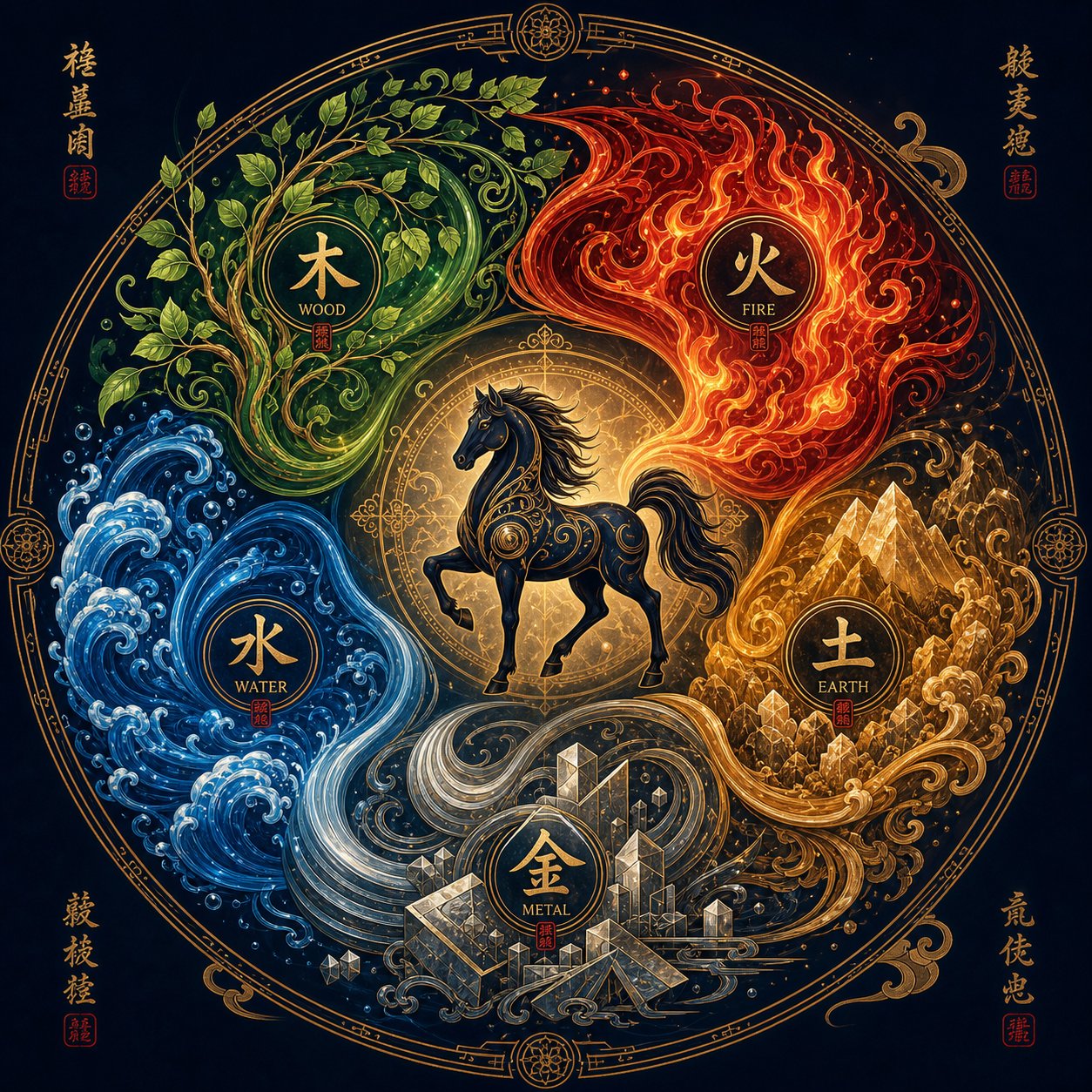
Five Elements Theory and the Horse Zodiac Sign
Not all Horse-year people share the same energetic blueprint. The Five Elements theory, or Wu Xing (五行), adds a second layer of identity that fundamentally changes which characters will support a given individual. Think of it this way: the Horse sign provides the broad archetype, but the element attached to your specific birth year fine-tunes everything, from personality tendencies to the characters that resonate most deeply with your energy.
Wu Xing consists of five fundamental forces: Wood, Fire, Earth, Metal, and Water. These are not static substances but dynamic processes. Wood represents growth and expansion, Fire embodies transformation and passion, Earth provides stability and nourishment, Metal signifies structure and precision, and Water flows with adaptability and depth. Each Horse year in the sixty-year cycle carries one of these elemental signatures, creating five distinct types of Horse people with different character needs.
How the Five Elements Shape Character Selection
The key to understanding why elements matter for character selection lies in two cycles: the productive cycle (相生) and the destructive cycle (相克).
In the productive cycle, each element nurtures the next in a continuous loop. Wood feeds Fire. Fire creates Earth (through ash). Earth produces Metal (from ore). Metal carries Water (through condensation). Water nourishes Wood (through rainfall). The element that produces is called the "mother," and the one receiving support is the "child."
Why does this matter for choosing characters? When you select a character whose elemental association sits in a productive relationship with your birth year element, you create energetic support. A character that "feeds" your element strengthens you. A character that your element "produces" gives you a constructive outlet for excess energy.
The destructive cycle works in reverse. Wood controls Earth, Earth controls Water, Water controls Fire, Fire controls Metal, and Metal controls Wood. Characters aligned with the element that destroys yours can create friction, tension, or drain. This does not mean they are always harmful, but they require careful consideration rather than casual use.
For auspicious character selection, the productive cycle is your primary guide. You want characters that either feed your element or receive your element's energy gracefully.
Elemental Variations Across Different Horse Years
Here is where things get practical. Someone born in the year of the fire horse (1966 or 2026) already carries intense yang energy. Fire on top of the Horse's native fire creates a double-fire signature. For these individuals, Earth-element characters provide the ideal outlet because fire produces earth in the productive cycle. Earth characters ground that intensity without suppressing it. Characters with radicals like tu (土) or shan (山) offer stability and balance.
The fire horse chinese zodiac personality is known for being smart, energetic, and charismatic but also stubborn. Earth-element characters help channel that fierce drive into lasting achievement rather than burnout.
Contrast this with the water horse chinese zodiac type (1942 or 2002). Water and the Horse's native fire create an internal tension, since water controls fire in the destructive cycle. These individuals benefit most from Wood-element characters because wood nourishes fire in the productive cycle, gently strengthening the Horse's core nature. The 2002 chinese zodiac Water Horse, for instance, thrives with characters containing the grass radical (艹) or wood radical (木), both of which carry Wood energy.
The 1990 chinese zodiac Metal Horse presents yet another pattern. Metal is controlled by fire (the Horse's native element), which means Metal Horse people already have strong internal fire energy melting their Metal qualities. They benefit from Water-element characters, since water is produced by metal in the productive cycle, giving their energy a smooth channel to flow through.
The table below maps each elemental Horse year to its most supportive character elements, favorable radicals, and example characters:
| Horse Type | Birth Years | Best Character Elements | Supportive Radicals | Example Characters |
|---|---|---|---|---|
| Wood Horse | 1954, 2014 | Fire, Water | 火 (fire), 氵 (water), 灬 (fire dots) | 炫 (xuan, brilliant), 淳 (chun, pure) |
| Fire Horse | 1966, 2026 | Earth, Wood | 土 (earth), 山 (mountain), 艹 (grass) | 培 (pei, cultivate), 萱 (xuan, daylily) |
| Earth Horse | 1978, 2038 | Metal, Fire | 钅/金 (metal), 火 (fire) | 铭 (ming, inscribe), 煜 (yu, radiant) |
| Metal Horse | 1990 | Water, Earth | 氵 (water), 土 (earth), 山 (mountain) | 泽 (ze, marsh/grace), 岳 (yue, mountain) |
| Water Horse | 2002 | Wood, Metal | 木 (wood), 艹 (grass), 钅 (metal) | 楷 (kai, model), 芮 (rui, flourishing) |
Notice that the "best character elements" column lists two options for each type. The first is the element produced by your birth element (the child element, which provides a constructive outlet). The second is the element that produces your birth element (the mother element, which provides nourishment). Both are supportive, but they serve different purposes. The child element helps you express energy outward. The mother element replenishes you.
A fire horse born in 2026, for example, might choose Earth characters for career-related naming (channeling ambition into tangible results) and Wood characters for health-related purposes (sustaining inner vitality). The metal horse chinese zodiac type born in 1990 might lean toward Water characters for creative pursuits and Earth characters for emotional grounding.
This elemental framework gives you the "why" behind character selection. But elements alone do not tell the full story. The visual structure of a character, specifically its radical composition, adds another dimension that connects directly to the Horse's symbolic nature and daily needs.
Chinese Character Radicals and Their Significance for Horse People
Radicals are the structural DNA of every Chinese character. Known as bushou (部首), these components serve as building blocks that carry their own meaning, and in the tradition of auspicious character selection, that meaning interacts directly with a person's zodiac energy. For the chinese zodiac sign horse, certain radicals act like symbolic nourishment, while others introduce friction or constraint.
Why do radicals matter so much? Picture a horse in its natural environment. It grazes on open grasslands, shelters beneath trees, and thrives when well-fed and free to roam. Traditional Chinese metaphysics applies this same imagery to character structure. A character containing the grass radical (艹) visually and symbolically "feeds" the Horse, suggesting abundance and sustenance. A character built around the wood radical (木) offers shelter and protection. The logic is both poetic and practical: the radical tells a story about what the Horse receives from that character's energy.
This is where the chinese horoscope horse tradition gets specific. Rather than choosing characters based solely on pleasant meanings, practitioners examine the internal architecture of each character to determine whether it genuinely supports Horse energy at a structural level.
Favorable Radicals for Horse Year Characters
Each favorable radical connects to a specific aspect of the Horse's well-being. Think of these as categories of support: food, shelter, emotional richness, and adornment. Here are the radicals most aligned with horse chinese zodiac personality traits and needs:
- Grass radical (艹) - Represents nourishment and abundance. Horses eat grass, so this radical symbolizes a life where basic needs are always met. Example characters: 芳 (fāng, fragrant), 萱 (xuān, daylily), 蕊 (ruǐ, pistil/stamen), 茗 (míng, tea sprout), 荣 (róng, glory/flourish).
- Wood radical (木) - Suggests shelter, stability, and growth. Trees provide shade and protection for horses in open fields. Example characters: 桐 (tóng, paulownia tree), 楷 (kǎi, model/standard), 柏 (bǎi, cypress), 栩 (xǔ, vivid/lifelike), 森 (sēn, forest).
- Heart/meat radical (忄/月) - Indicates a well-fed, emotionally fulfilled horse. The heart radical (忄) connects to inner richness, while the flesh/moon radical (月) in its original form relates to sustenance. Example characters: 悦 (yuè, joyful), 恺 (kǎi, cheerful), 腾 (téng, gallop/soar), 朗 (lǎng, bright/clear).
- Silk radical (糸/纟) - Symbolizes adornment and refinement. A decorated horse is one that is valued and cared for. Example characters: 绮 (qǐ, beautiful/fine silk), 纬 (wěi, latitude/weft), 绚 (xuàn, gorgeous), 缘 (yuán, fate/connection).
- Grain radical (禾) - Another food-related radical representing harvest and reward. Example characters: 秀 (xiù, elegant/outstanding), 稳 (wěn, stable), 穗 (suì, ear of grain).
You'll notice a pattern. Every favorable radical connects back to the chinese horse in its ideal state: well-fed, sheltered, adorned, and emotionally content. The year of the horse personality is defined by vitality and forward momentum, and these radicals ensure the character supports that natural drive rather than starving it.
Radicals That May Conflict with Horse Energy
Not every radical works in the Horse's favor. Some carry symbolic associations that restrict, oppose, or drain Horse energy. This does not mean characters containing these radicals are universally bad, but they require more careful evaluation before use.
The mouth radical (口) is a prime example. In the context of the chinese horoscope horse personality, the enclosed square shape of 口 resembles a corral or pen. Horses are creatures of open space, and confinement contradicts their fundamental nature. Characters heavily built around this radical, especially when it appears as the enclosure radical (囗) surrounding other components, can symbolically "trap" Horse energy.
The water radical (氵) presents a more nuanced situation. Water controls fire in the destructive cycle, and since the Horse's native element is fire, heavy water energy can dampen vitality. However, as covered in the elemental analysis, certain Horse types (like the Metal Horse) actually benefit from water. Context matters here. A Water Horse person using water-radical characters creates elemental excess, while a Metal Horse person finds balance.
Radicals associated with the Rat, the Horse's zodiac opposite, also warrant caution. The child/son radical (子) directly represents the Rat's Earthly Branch (zi), creating a clash relationship. Similarly, the ox radical (牛) connects to the Ox, which holds a "harm" relationship with the Horse in zodiac theory.
Other radicals to approach carefully include:
- Enclosure radical (囗) - Suggests confinement. Characters like 困 (kùn, trapped) visually depict restriction.
- Child radical (子) - Linked to the Rat's Earthly Branch, creating zodiac opposition.
- Ox radical (牛) - Connected to the Ox, which has a harm relationship with the Horse.
- Mountain radical used as enclosure (山 in certain formations) - Can suggest being hemmed in by terrain, though standalone mountain characters are generally neutral to positive.
The key principle for the chinese horoscope horse is openness. Any radical that visually or symbolically restricts movement deserves a second look. A character might carry a beautiful meaning on the surface, but if its radical structure tells a story of confinement, it works against the Horse's core nature.
Radical analysis gives you the structural dimension of character selection. But structure alone does not complete the picture. The total stroke count of a character introduces yet another layer of meaning, one rooted in numerological traditions that assign fortune or misfortune to specific numbers.
Stroke Count Analysis in Traditional Character Selection
Every Chinese character is drawn with a specific number of individual pen movements, and in the tradition of naming and character selection, that number is never arbitrary. Stroke count analysis, or bihua jixiong (笔画吉凶), assigns auspicious or inauspicious qualities to the total strokes in a character based on centuries-old numerological principles. When asking what does the year of the horse mean for character choice, stroke count is one of the dimensions that separates a casually chosen character from a deliberately harmonious one.
The system works like this: each stroke count carries a classification, either ji (吉, auspicious), xiong (凶, inauspicious), or ban ji ban xiong (半吉半凶, mixed). These classifications are not random. They derive from patterns observed in classical texts and refined through generations of naming practice. A character with a favorable meaning and supportive radical can still carry an unlucky number of strokes, which weakens its overall benefit.
Stroke Count Numerology in Chinese Character Tradition
In traditional Chinese naming, characters are also classified as Yin or Yang based on their stroke count. Characters with an even number of strokes are considered Yin, while odd-numbered strokes are Yang. Since the Horse is the most yang animal in the zodiac cycle, characters with odd (Yang) stroke counts naturally echo its energy.
Beyond the Yin-Yang distinction, specific totals are considered universally favorable. In the year of horse in chinese naming tradition, practitioners look for stroke counts that fall within recognized lucky number ranges. The total strokes of a complete name (called the zhong ge) should ideally equal numbers such as 3, 5, 6, 7, 8, 11, 13, 15, 16, 17, 18, 21, 23, 25, 29, 31, 32, 33, 37, 39, or 45. Individual characters within the name contribute to this total, so each character's stroke count matters both independently and as part of the whole.
For the lucky number horse connection, odd numbers like 11, 13, 15, and 21 carry particular resonance. These Yang-dominant totals mirror the Horse's fiery, outward-moving nature. Even-numbered counts like 16 and 32 can still work well when balanced against other Yang characters in the name, creating the Yin-Yang interplay that traditional naming requires.
Optimal Stroke Counts for Horse Year Characters
The Horse's dynamic energy pairs best with stroke counts that suggest momentum and expansion. In practice, this means moderate-to-high stroke counts (between 8 and 15 strokes per character) tend to align well. Very low stroke counts can feel energetically "thin" for the Horse's robust nature, while extremely high counts (above 20) may introduce heaviness that slows the Horse's natural forward drive.
The meaning of horse year energy is movement and vitality, so the ideal stroke count creates a sense of fullness without excess weight. Characters in the 11-to-15 stroke range often hit this sweet spot, offering visual complexity that matches the Horse's richness while remaining structurally balanced.
One critical consideration: stroke counts differ between Traditional and Simplified character forms. The character 马 (horse) has 3 strokes in Simplified form but 10 strokes in its Traditional form 馬. This discrepancy matters significantly for audiences across mainland China, Taiwan, Hong Kong, and Singapore. A character deemed auspicious by stroke count in one system may carry a different numerological value in the other. Practitioners in Taiwan and Hong Kong typically calculate using Traditional forms, while mainland Chinese naming conventions may use either system depending on the practitioner's school of thought. The year of the horse chinese calendar tradition does not universally favor one system over the other, so knowing which standard applies to your community is essential.
Stroke count analysis works in conjunction with radical composition and elemental alignment rather than in isolation. A character with a perfect stroke count but conflicting radicals or clashing elemental energy remains incomplete. The strongest auspicious characters satisfy all three dimensions simultaneously.
This layered approach, where element, radical, and stroke count must all align, explains why truly auspicious characters for Horse-year people are rarer than most assume. The next step is seeing how these principles come together in actual character recommendations organized by life purpose.
Best Auspicious Characters for Naming Horse Year Children
Principles are useful, but parents need actual characters they can work with. Whether you are preparing fire horse names for a 2026 baby or revisiting options for a child born in an earlier Horse cycle, the characters below have been selected because they satisfy multiple dimensions of auspiciousness simultaneously: elemental support, favorable radicals, balanced stroke counts, and meanings that echo the horse zodiac personality.
The chinese horoscope 2026 brings a Fire Horse year (丙午), where the dominant energy is intense yang fire. Naming specialists for this cycle emphasize that the priority is balancing that fiery intensity with Metal and Water characters for cooling and grounding, supplemented by Wood characters for channeling energy constructively. The recommendations below reflect this principle while remaining broadly applicable to other Horse years when adjusted for elemental context.
Auspicious Naming Characters for Wealth and Career
Career-oriented characters for Horse-year children should evoke forward momentum, achievement, and material reward without introducing excessive fire. For the year of the horse 2026, Metal-element characters are especially powerful here because metal represents precision, structure, and the refinement of raw ambition into tangible success.
Characters like 骏 (jun, fine steed/outstanding) directly reference the Horse's noble qualities, while 铭 (ming, inscribe/remember) carries the metal radical and suggests lasting legacy. The character 锦 (jin, brocade/splendid) combines metal energy with imagery of richness and reward, making it a favorite among chinese nicknames for children born in Fire Horse years.
For wealth specifically, Water-element characters channel the Horse's drive into flowing abundance. 润 (run, moist/profit) carries both the water radical and a financial connotation, while 泓 (hong, deep pool) suggests depth of resources.
| Character | Pinyin | Meaning | Element | Why It Works for Horse |
|---|---|---|---|---|
| 骏 (駿) | jun4 | Fine steed, outstanding | Metal | Directly honors Horse identity; implies excellence |
| 铭 (銘) | ming2 | Inscribe, remember | Metal | Metal radical cools fire; suggests lasting achievement |
| 锦 (錦) | jin3 | Brocade, splendid | Metal | Metal energy with imagery of adornment and reward |
| 钰 (鈺) | yu4 | Precious jade/metal | Metal | Combines preciousness with metal's grounding force |
| 润 (潤) | run4 | Moist, profit, polish | Water | Water radical tempers fire; financial connotation |
| 泓 | hong2 | Deep pool, vast | Water | Depth of resources; calms Horse's restless energy |
| 驰 (馳) | chi2 | Gallop, spread fame | Fire | Honors Horse nature; best paired with Water/Metal characters |
| 荣 (榮) | rong2 | Glory, flourish | Wood | Grass radical nourishes Horse; meaning of prosperity |
Auspicious Naming Characters for Health and Relationships
Health-oriented characters for Horse-year children focus on sustenance, emotional balance, and vitality that endures rather than burns out. The Water element dominates this category because it directly counteracts the dryness and overheating that Fire Horse constitutions are prone to.
沐 (mu, bathe/receive grace) is a standout choice. It carries the water radical and implies being nourished by blessings, like a horse drinking from a clear stream. 涵 (han, contain/cultivate) suggests inner depth and emotional intelligence, qualities that help the naturally impulsive horse zodiac personality build lasting relationships. 霖 (lin, sustained rain) evokes the image of gentle, persistent nourishment, exactly what a fiery constitution needs for long-term health.
For relationship harmony, Wood-element characters serve a dual purpose. They nourish the Horse's fire gently while also representing growth and connection. 萱 (xuan, daylily/mother's flower) carries the grass radical and traditionally symbolizes a mother's love and freedom from worry. 桐 (tong, paulownia tree) suggests partnership, since paulownia trees in Chinese culture are associated with attracting the phoenix, a symbol of harmonious union.
| Character | Pinyin | Meaning | Element | Why It Works for Horse |
|---|---|---|---|---|
| 沐 | mu4 | Bathe, receive grace | Water | Water radical; imagery of nourishment and renewal |
| 涵 | han2 | Contain, cultivate | Water | Emotional depth; tempers impulsiveness |
| 霖 | lin2 | Sustained rain | Water | Gentle, lasting nourishment for fiery constitution |
| 汐 | xi1 | Evening tide | Water | Rhythmic water energy; calming without overwhelming |
| 萱 | xuan1 | Daylily, carefree | Wood | Grass radical feeds Horse; meaning of joy and ease |
| 筠 | yun2 | Bamboo skin, resilience | Wood | Bamboo radical; flexibility balances Horse's rigidity |
| 恺 (愷) | kai3 | Cheerful, harmonious | Fire | Heart radical suggests emotional fulfillment |
| 缘 (緣) | yuan2 | Fate, connection | Wood | Silk radical implies valued relationships |
How BaZi Birth Charts Refine Character Choice
These recommendations provide a strong starting point, but they are not the final word. A child's full BaZi (八字) birth chart, calculated from the year, month, day, and hour of birth, reveals which of the five elements is truly deficient or excessive in their specific case.
Imagine two babies both born in the year of the horse 2026. One arrives in midsummer (the fourth lunar month), when fire energy peaks. The other is born in winter (the eleventh lunar month), when water dominates. The summer baby's chart is overwhelmingly fire and earth, making Water and Metal characters urgent priorities. The winter baby already has water tempering the fire, so Wood characters become more important for maintaining the productive cycle.
The birth hour adds another variable. A child born during the zi hour (11 p.m. to 1 a.m., the Rat's hour) already carries a Horse-Rat clash within their chart, which changes how water-element characters interact with their energy. A child born during the wu hour (11 a.m. to 1 p.m., the Horse's own hour) has doubled Horse energy, intensifying the need for cooling elements.
This is why professional naming consultants request the exact birth time before making final character recommendations. The general principles covered here narrow the field significantly, but the BaZi chart acts as the final filter, ensuring the chosen character addresses that specific child's energetic needs rather than just the year's broad signature. For parents planning ahead for the chinese horoscope 2026 Fire Horse year, having the birth details ready allows a practitioner to move quickly from general categories to precise, personalized selections.
Naming is the most personal application of auspicious characters, but it is far from the only one. These same characters appear in a completely different context when used for decorative blessings, seasonal greetings, and celebratory calligraphy, where the rules shift from individual balance to collective well-wishing.
Decorative Characters and Greeting Phrases for Horse Year Celebrations
Naming characters serve one person for a lifetime. Decorative characters and greeting phrases serve an entire household, a business, or a community for a season. The rules shift accordingly. Where naming demands precise elemental balance tailored to an individual's BaZi chart, decorative use prioritizes collective energy, visual impact, and cultural resonance. A character displayed on your front door during the year of the horse 2026 does not need to match your personal stroke count profile. It needs to radiate the right energy outward.
Decorative blessing characters (祝福用字) appear on Spring Festival couplets (春联) flanking doorways, on red packets (红包) exchanged during celebrations, and as standalone calligraphy hung in living spaces. Greeting phrases (贺词) fill cards, text messages, and formal correspondence. Both draw from the same pool of auspicious characters, but they follow different conventions for length, tone, and placement.
Auspicious Characters for Home Decor and Calligraphy
Three standalone characters pair especially well with Horse-year energy for display purposes:
- 福 (fu2, fortune) - The universal blessing character. During Horse years, it gains extra resonance when written in a dynamic calligraphic style that suggests movement. Traditionally displayed on the main door or living room wall. Some families hang it upside down (倒福) as a pun, since "inverted" (倒, dao3) sounds like "arrived" (到, dao4), implying fortune has arrived.
- 骏 (jun4, fine steed) - Directly references the Horse's noble qualities. Best displayed in a study or office where career energy is cultivated. The 2026 chinese symbol for the year often features this character alongside horse imagery in commercial designs.
- 腾 (teng2, soar/gallop) - Captures the Horse's upward momentum. Ideal for entryways or south-facing walls, since south is the Horse's directional association. The character's visual structure, with the flesh radical on the left and upward-moving strokes on the right, mirrors the feeling of rising energy.
Placement follows feng shui logic. The south sector of your home corresponds to the Horse's direction and the fire element, making it the strongest position for Horse-themed calligraphy. Red paper with gold or black ink is standard, since red activates fire energy and gold represents metal's refinement. For the year of the horse 2026 lucky color palette, red remains primary, complemented by green (wood feeding fire) and gold (metal providing structure).
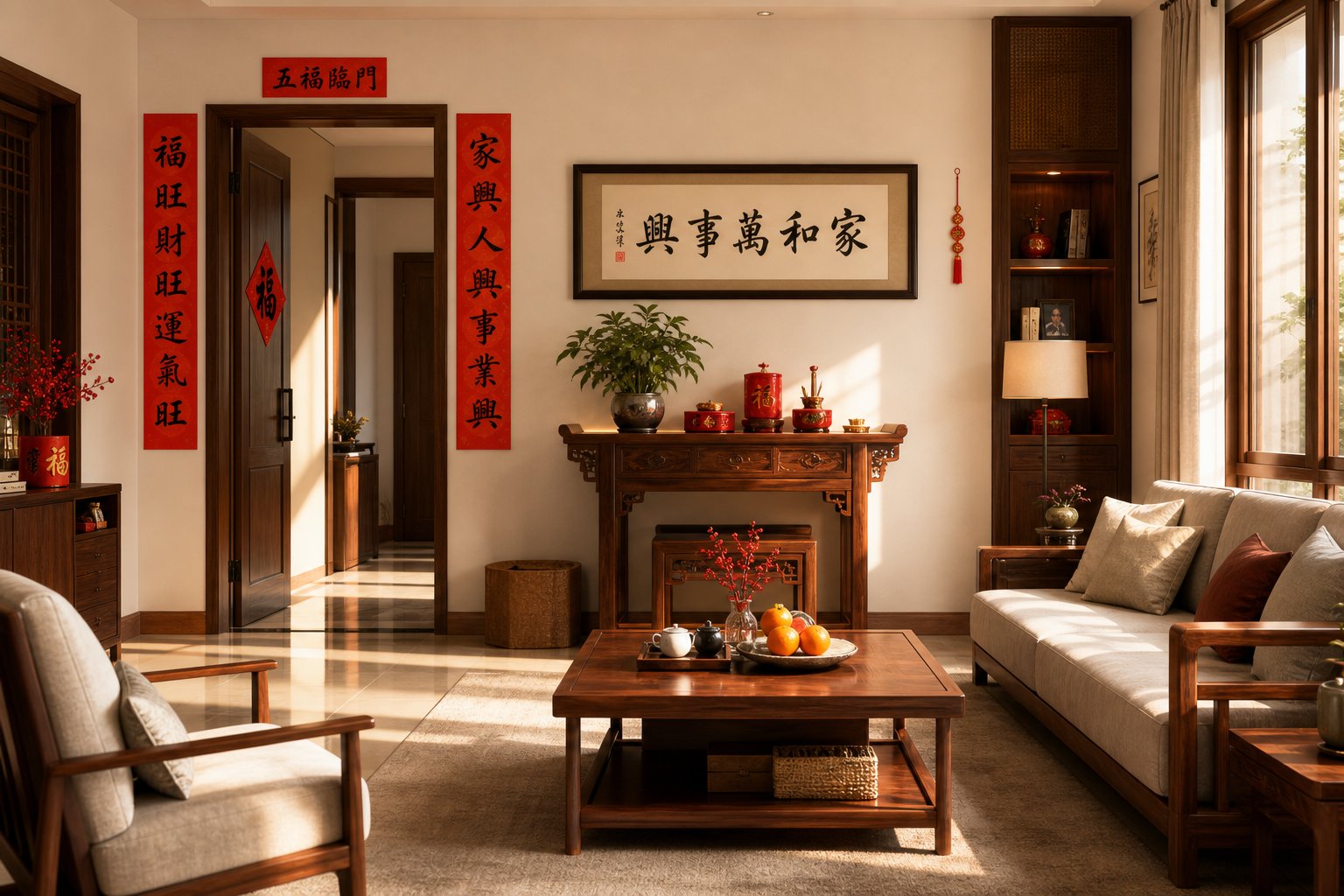
Couplets follow specific placement rules: the upper line goes on the right side of the door (from inside facing out), the lower line on the left, and the horizontal scroll sits above. The upper line traditionally ends on an oblique tone, while the lower line ends on a level tone.
Horse-Themed Greeting Phrases and Couplets
Choosing the right phrase depends on your audience. A playful pun works for friends but falls flat in a business letter. A stiff four-character idiom feels cold in a family group chat. The phrases below are ranked from casual to formal, each with a character-by-character breakdown so you can understand exactly what you are sending.
- Casual (friends, social media): 马上好运到 (ma3 shang4 hao3 yun4 dao4) - "Good luck arrives immediately." This plays on 马上 meaning both "on horseback" and "right away." Light, fun, and easy to pair with an image of the year of the horse 2026 in digital greetings.
- Warm (family, close colleagues): 马年吉祥,万事如意 (ma3 nian2 ji2 xiang2, wan4 shi4 ru2 yi4) - "Auspicious Horse Year, may everything go as wished." Balanced between warmth and respect. Works in cards, texts, and red packet inscriptions.
- Respectful (elders, mentors): 骏马迎春,福泽绵长 (jun4 ma3 ying2 chun1, fu2 ze2 mian2 chang2) - "The fine steed welcomes spring; blessings extend endlessly." The parallel structure and literary vocabulary signal respect without stiffness.
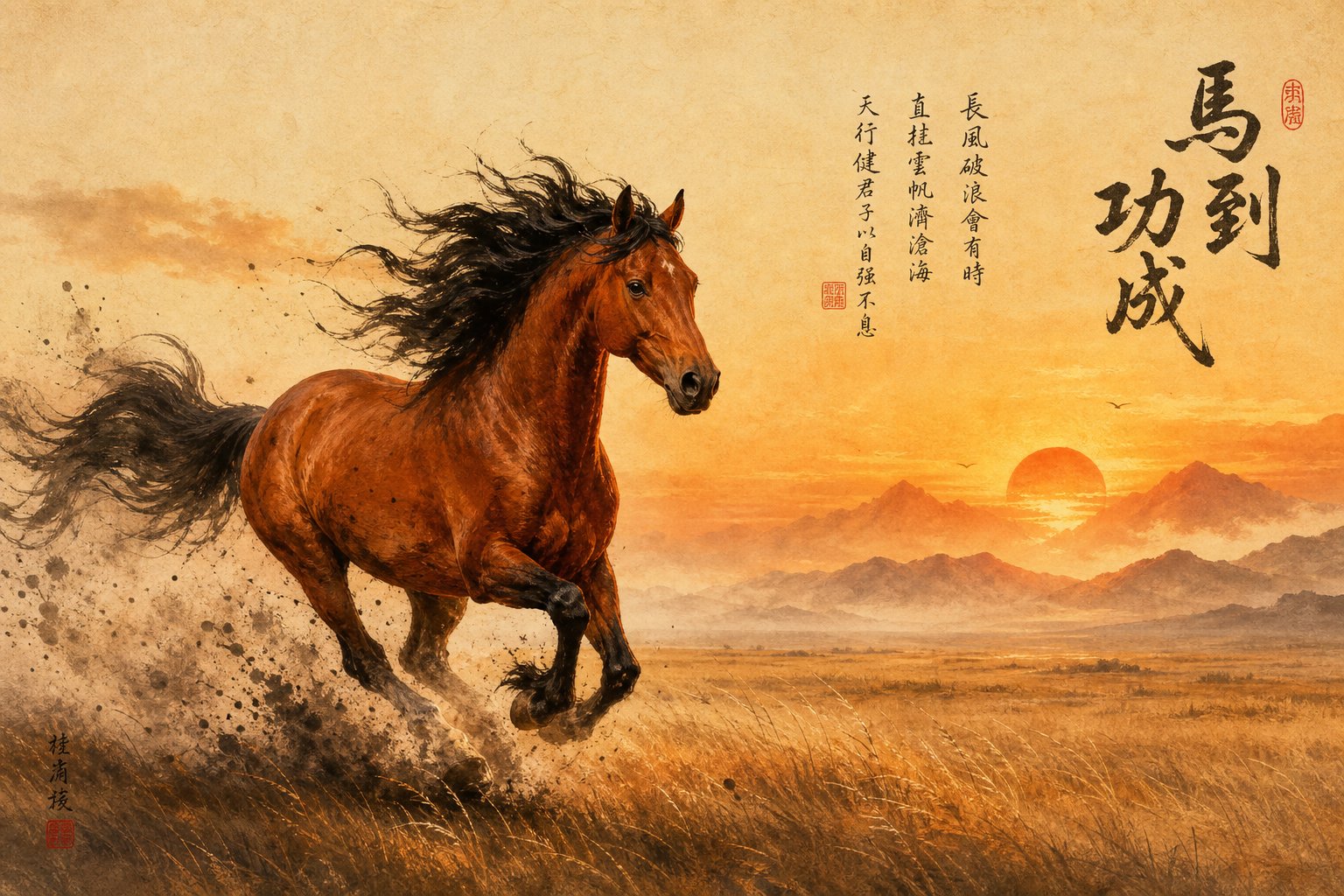
- Formal (clients, business partners): 马到成功迎春到,人心齐力创辉煌 (ma3 dao4 cheng2 gong1 ying2 chun1 dao4, ren2 xin1 qi2 li4 chuang4 hui1 huang2) - "Swift success arrives as spring comes; united hearts and effort create brilliance." This full couplet structure suits printed cards, corporate greetings, and formal displays.
- Highly formal (official correspondence, banquet scrolls): 马跃龙腾新气象,人欢马叫庆丰年 (ma3 yue4 long2 teng2 xin1 qi4 xiang4, ren2 huan1 ma3 jiao4 qing4 feng1 nian2) - "Horses leap and dragons rise bringing fresh energy; people and horses rejoice celebrating a bountiful year." Reserved for ceremonial contexts where grandeur is appropriate.
Notice how the casual options use the 马上 pun for immediacy and humor, while formal options employ parallel structure (对仗) and literary imagery. The middle options blend accessibility with cultural weight. When selecting phrases for your own use, match the formality to the relationship, not the occasion. A Lunar New Year dinner with close family calls for warmth, not ceremony.
These decorative and greeting applications assume the characters are working in your favor. But what happens when a character that looks auspicious on the surface actually carries hidden conflicts with Horse energy? The zodiac clash system reveals exactly which characters and combinations to approach with caution.
Characters and Combinations to Avoid for Horse Year People
A character can look perfect on the surface, carrying a beautiful meaning, a favorable stroke count, and even the right elemental association, yet still work against Horse energy because of a hidden zodiac conflict buried in its structure. This is the dimension most people overlook entirely. Zodiac clash theory, or chong (冲), reveals which characters carry oppositional energy that creates tension rather than support for Horse-year individuals.
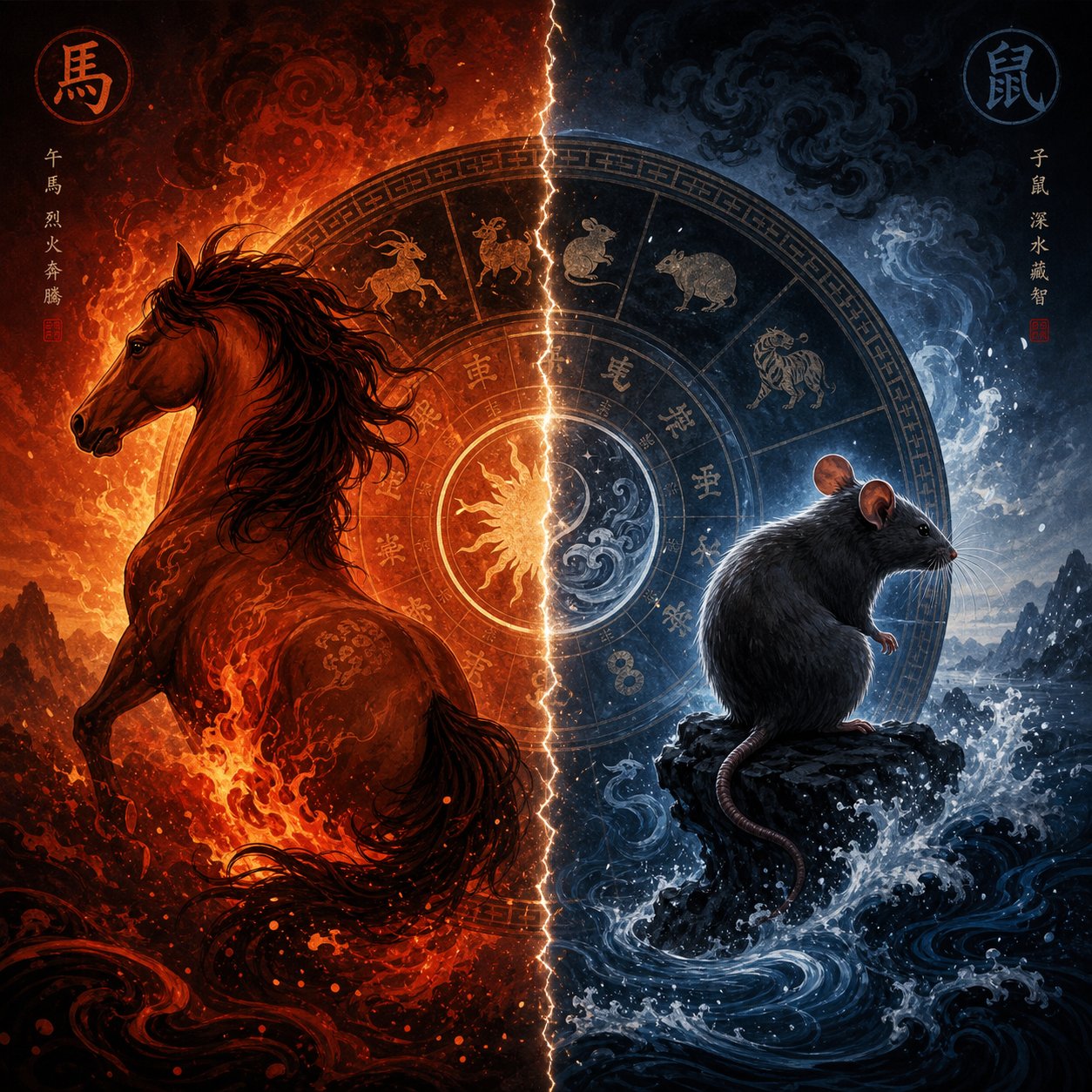
The Chinese zodiac arranges its twelve animals in a circle, and animals sitting directly opposite each other are locked in a clash relationship. For the Horse, that opposite is the Rat. The Zi-Wu clash (子午冲) pits the Rat's Water against the Horse's Fire in what practitioners call the most polar opposition in the entire system. Water extinguishes Fire, and Fire evaporates Water. Neither yields easily. This clash brings emotional tension, sudden change, and instability when activated in a BaZi chart, and the same friction applies when characters associated with Rat energy appear in a Horse person's name or environment.
Beyond the direct clash, the Horse also holds a "harm" relationship (害) with the Ox. Harm relationships are subtler than clashes but create a slow, corrosive friction, like a partnership that drains energy over time without an obvious breaking point. Characters strongly tied to Ox imagery or its Earthly Branch chou (丑) introduce this quieter form of conflict.
Characters Linked to Zodiac Clashes and Conflicts
The Rat's Earthly Branch is zi (子), which doubles as the character meaning "child" or "son." Any character built prominently around this component carries Rat-branch energy. The tricky part? Some of these characters have genuinely positive meanings that make them tempting choices. Consider 孝 (xiao4, filial piety), which contains 子 as its lower component. The meaning is admirable, but the structural presence of the Rat's branch creates an energetic tug-of-war with Horse energy.
Water-heavy characters present a similar issue. Since Water is the Rat's native element, characters loaded with water energy can amplify the clash dynamic. This does not mean every water-radical character is off-limits. As discussed in the elemental section, Metal Horse people actually benefit from water. The concern arises when water energy is excessive or when multiple water characters stack together in a name, overwhelming the Horse's fire.
Characters to watch include those with double or triple water components, like 淼 (miao3, vast water) with its three water characters stacked together, or 渊 (yuan1, abyss/deep pool) which combines the water radical with imagery of depth and containment. Both carry beautiful meanings but introduce concentrated water energy that can suppress Horse vitality, especially for Fire Horse or Wood Horse types.
For those researching year of the horse 2026 predictions and wondering is year of the horse lucky in 2026, understanding these clash dynamics is essential. The year of the fire horse 2026 doubles down on fire energy, making water-clash characters particularly impactful during this cycle. Fire horse astrology emphasizes that the 2026 Horse carries Bing Fire (丙火), the most yang expression of fire, which means clash characters hit harder because there is more fire to extinguish.
Common Mistakes in Character Selection for Horse Year
The most widespread misconception? Assuming all fire-element characters are automatically good for Horse people. Sounds logical since the Horse's native element is fire, right? The problem is excess. What type of horse is 2026? It is a Fire Horse, meaning fire is already doubled. Adding more fire-element characters on top of that creates imbalance, like throwing gasoline on a bonfire. The result is not more warmth but burnout, irritability, and instability.
Fire horse astrology practitioners distinguish between the Horse's native fire (which provides identity and drive) and excessive fire (which creates recklessness and exhaustion). A Fire Horse person loading their name with characters like 炎 (yan2, blazing), 焱 (yan4, flames), and 烈 (lie4, fierce) is not strengthening their energy. They are destabilizing it.
Another common error is ignoring the harm relationship with the Ox. People focus on the dramatic Rat clash and forget that Ox-associated characters create their own quieter problems. The ox radical (牛) appears in characters like 牧 (mu4, to herd) and 特 (te4, special), both of which seem harmless or even positive but carry Ox-branch resonance.
Here is a consolidated list of characters and radicals Horse-year people should approach with caution:
- 子 (zi3, child/son) - Directly represents the Rat's Earthly Branch. Creates a clash relationship with the Horse's wu (午) branch.
- 孝 (xiao4, filial piety) - Contains 子 as a structural component. Positive meaning but carries Rat-branch energy.
- 淼 (miao3, vast water) - Triple water structure overwhelms Horse fire, especially for Fire Horse and Wood Horse types.
- 牛 radical characters - Ox radical activates the harm relationship. Includes 牧 (mu4, herd), 特 (te4, special), 犟 (jiang4, stubborn).
- Excessive fire characters - 炎 (yan2, blazing), 焱 (yan4, flames), 燚 (yi4, fire blazing) add fire to an already fire-dominant sign, risking imbalance.
- Enclosure-heavy characters - 困 (kun4, trapped), 囚 (qiu2, imprisoned) combine confinement imagery with the Horse's need for freedom.
- 北 (bei3, north) - North is the Rat's directional association and opposes the Horse's south. Characters emphasizing northern direction carry oppositional energy.
None of these characters are universally forbidden. Context always matters. A single 子 component buried within a complex character carries less weight than 子 standing alone as a name element. A water character paired with wood characters in a multi-character name may be perfectly balanced. The point is awareness: know what conflicts exist so you can make informed decisions rather than accidentally introducing friction into a name or display meant to bring harmony.
These clash principles apply universally across Chinese-speaking communities, but how they are interpreted and weighted varies significantly by region. The character forms themselves, Traditional versus Simplified, introduce another layer of variation that changes stroke counts, radical visibility, and even cultural emphasis depending on where you are.
Regional Variations in Auspicious Character Traditions
A character deemed perfectly auspicious in Beijing may carry a different numerological value in Taipei and an entirely different phonetic resonance in Hong Kong. The principles of elemental alignment, radical harmony, and zodiac compatibility remain consistent across Chinese-speaking communities, but the practical application shifts depending on which character system is in use, which dialect shapes pronunciation, and which cultural layer a community prioritizes.
Mainland China operates primarily in Simplified characters, Taiwan and Hong Kong use Traditional forms, and Southeast Asian Chinese communities in Singapore and Malaysia navigate a blend of both. These are not just cosmetic differences. Simplification physically alters a character's stroke count and sometimes removes or replaces radicals, which directly impacts the auspicious calculations covered in earlier sections.
Traditional vs Simplified Forms in Auspicious Characters
When the People's Republic of China standardized Simplified characters in the 1950s and 1960s, the goal was literacy, not metaphysics. Many simplifications reduced stroke counts dramatically, and in doing so, shifted the numerological profile of characters that had been used in naming for centuries.
Consider the character 龙 (long2, dragon). In Simplified form, it carries 5 strokes, an auspicious Yang number. Its Traditional counterpart 龍 has 16 strokes, also auspicious but carrying Yin energy instead. A naming practitioner in Taiwan calculating stroke-based fortune would arrive at a fundamentally different assessment than one in mainland China using the same character.
The impact goes beyond stroke count. Some simplifications alter radical composition entirely. Take 华 (hua2, splendid/China), a popular naming character. The Simplified form has 6 strokes with a cross-shaped top component. The Traditional form 華 has 14 strokes and retains the grass radical (艹) at the top, which, as we covered, directly nourishes Horse energy. A Horse-year child named with 華 in Taiwan receives that grass-radical benefit. The same child named with 华 in mainland China does not, at least not visually or structurally.
Here are more examples where the two systems diverge meaningfully for Horse-year character selection:
- 马/馬 (horse) - 3 strokes Simplified vs 10 strokes Traditional. The numerological value shifts from Yang-odd to Yin-even.
- 骏/駿 (fine steed) - 10 strokes Simplified vs 17 strokes Traditional. Both are auspicious counts, but 17 carries stronger Yang energy.
- 荣/榮 (glory) - 9 strokes Simplified vs 14 strokes Traditional. The grass radical remains in both, preserving the Horse-nourishing quality regardless of system.
- 绮/綺 (fine silk) - 11 strokes Simplified vs 14 strokes Traditional. The silk radical is present in both but written differently (纟 vs 糸).
Which system is "correct" for auspicious calculations? There is no universal answer. Practitioners in Taiwan and Hong Kong almost always use Traditional stroke counts. Mainland practitioners are split: some use Simplified counts reflecting the characters as actually written, while others insist on calculating from the Traditional "original form" (康熙字典体) regardless of which version appears on paper. If you are consulting a naming specialist, clarify which standard they follow before the session begins.
Regional Naming Customs and Character Preferences
Beyond the character system itself, regional dialect shapes which characters feel auspicious at a phonetic level. This is where communities diverge most sharply.
In Cantonese-speaking Hong Kong, phonetic auspiciousness carries enormous weight. Parents avoid characters whose Cantonese pronunciation sounds like unlucky words, even if the Mandarin pronunciation is perfectly fine. The character 书 (shu1, book) is a common naming choice in Mandarin-speaking regions, but in Cantonese it is pronounced "syu1," which sounds close to 输 (lose). A Horse-year parent in Hong Kong might skip an otherwise ideal character purely because of this phonetic overlap.
Conversely, characters that sound lucky in Cantonese may not carry the same phonetic bonus in Mandarin. 发 (fa1 in Mandarin, faat3 in Cantonese) resonates powerfully in Cantonese because of its association with 发财 (get rich), a connection so strong it drives everything from phone number preferences to floor numbering in buildings.
In Singapore and Malaysia, the situation grows more complex. As documented in regional naming research, Chinese names there are romanized based on ancestral dialect pronunciation, whether Hokkien, Teochew, Cantonese, or Hakka. A family selecting auspicious characters for a Horse-year child might evaluate phonetic harmony in their heritage dialect while writing the character in Simplified form (Singapore's official standard) and calculating stroke counts from the Traditional form. Three systems operating simultaneously.
Children born in 2014, the most recent Wood Horse year, illustrate these regional patterns clearly. The chinese zodiac 2014 cycle produced a wave of naming choices that varied by community. Mainland parents favored characters like 梓 (zi3, catalpa tree) and 轩 (xuan1, lofty), reflecting modern naming trends that prioritize aesthetic appeal alongside traditional principles. Taiwanese parents for the same chinese zodiac sign 2014 cycle leaned toward characters with higher Traditional stroke counts and classical literary references, maintaining tighter connections to historical naming conventions.
The 2014 chinese zodiac symbol, the Wood Horse, also prompted different elemental strategies by region. Mainland naming consultants for the chinese zodiac of 2014 frequently recommended Fire-element characters (since Wood produces Fire), while some Cantonese-speaking practitioners weighted phonetic harmony above elemental theory, choosing characters that sounded prosperous in spoken Cantonese regardless of their Wu Xing classification.
Diaspora communities in North America, Europe, and Australia face an additional layer: the chosen character must also work as part of a name that functions in English-speaking contexts. Parents may select a character based on full auspicious analysis but then pair it with a Western given name for daily use, reserving the Chinese name for family contexts and official documents. What is the 2014 chinese zodiac's legacy in these communities? Often a compromise, where the auspicious character lives on paper while a phonetically accessible name handles everyday life.
| Character | Mainland China (Simplified) | Taiwan (Traditional) | Hong Kong | Singapore/Malaysia |
|---|---|---|---|---|
| 骏/駿 (fine steed) | 10 strokes; popular for boys; modern aesthetic | 17 strokes; classical naming choice; strong Yang count | 17 strokes; evaluated for Cantonese sound "zeon3" | Written Simplified; stroke count may follow Traditional; dialect pronunciation varies by family origin |
| 华/華 (splendid) | 6 strokes; grass radical absent in simplified form | 14 strokes; grass radical (艹) intact; Horse-nourishing | 14 strokes; Cantonese "waa4" considered neutral-positive | Simplified form standard; some families use Traditional for naming specifically |
| 荣/榮 (glory) | 9 strokes; grass radical preserved; widely used | 14 strokes; grass radical preserved; classical weight | 14 strokes; Cantonese "wing4" sounds like 永 (eternal), adding phonetic bonus | Grass radical benefit recognized across all dialect groups |
| 铭/銘 (inscribe) | 11 strokes; metal radical (钅); career-oriented | 14 strokes; metal radical (金); stronger metal energy visually | 14 strokes; Cantonese "ming4" clear and strong | Metal radical recognized in both forms; Hokkien pronunciation "beng5" evaluated separately |
The takeaway is straightforward: the same auspicious character can carry different weight depending on where and how it is used. A family in 2014 in chinese astrology circles selecting Wood Horse names needed to know not just which characters aligned with Wood Horse energy, but which version of those characters their community recognized, which pronunciation mattered, and which calculation system their chosen practitioner followed.
Regional variation does not invalidate the core principles. Elemental alignment, radical harmony, and zodiac compatibility remain the foundation everywhere. But the surface expression of those principles adapts to local linguistic and cultural realities. Understanding your own community's conventions is what transforms general knowledge into characters you can actually use, whether displayed on a wall, written on a red packet, or carried as a name through daily life.
Practical Ways to Use Auspicious Horse Year Characters
Knowing which characters align with Horse energy is one thing. Weaving them into your actual life is where the benefit materializes. Beyond naming, auspicious characters function as daily anchors, seasonal markers, and intentional design choices that keep Horse-year energy flowing through your environment. Whether you practice calligraphy, decorate your home, or simply send a Lunar New Year greeting, the characters you choose shape the energetic tone of your space and interactions.
Calligraphy practice offers the most direct, personal engagement with auspicious characters. Writing a character by hand is not passive. Each stroke requires focus, breath control, and physical intention, qualities that mirror meditation. For Horse-year individuals, practicing characters like 骏 (jun4, fine steed) or 腾 (teng2, soar) becomes a form of intention-setting. You are not just forming ink on paper. You are physically rehearsing the energy that character represents. Even ten minutes of daily brush practice with a single auspicious character builds a quiet momentum that compounds over weeks.
Displaying Auspicious Characters in Your Home
Placement matters as much as the character itself. Feng shui principles assign specific energetic qualities to each direction, and matching your character display to the right sector amplifies its effect. For the 2026 year of the horse, practitioners recommend these directional guidelines:
- South wall or sector - The Horse's native direction. Display career and fame-oriented characters here, like 骏 or 驰. This sector already resonates with Horse fire energy, so characters placed here activate quickly. However, as feng shui experts note, the south hosts the unstable 5 Yellow energy in 2026, so keep displays calm and pair them with metal accents to maintain balance.
- East or southeast sector - Wood energy zones. Characters with the grass radical (艹) or wood radical (木) thrive here because the sector's native element matches the character's radical energy. Place health and growth characters like 荣 or 萱 in these areas.
- Living room center - The heart of the home's qi circulation. Universal blessing characters like 福 (fu2, fortune) work best here, radiating outward to all family members equally.
- Study or home office - Career-focused characters belong where you do focused work. Metal-element characters like 铭 (ming2, inscribe) placed on or near your desk channel ambition into structured output.
Materials and colors enhance or dampen a character's energy. Red paper with gold ink is the classic combination for fire-element activation, ideal for Horse-year displays meant to energize. For calming balance, try black ink on cream or natural-fiber paper, which introduces earth energy. Wooden frames feed the Horse's fire gently through the productive cycle, while metal frames add structure and cooling. Avoid glass frames in the south sector, since glass carries water energy that conflicts with the Horse's fire direction.
The year of the horse for horses, meaning Horse-year people living through their own zodiac year, calls for extra attention to balance. Feng shui guidance for 2026 emphasizes that Horse individuals face "Wu Wu Self-Punishment" during their zodiac year, where doubled fire energy creates internal friction. Displaying Water-element characters like 涵 (han2, cultivate) in the north sector of your home counteracts this self-punishment pattern without suppressing your natural vitality.
Using Auspicious Characters in Modern Contexts
Traditional character wisdom adapts easily to contemporary life. You do not need a calligraphy studio or a feng shui consultation to put these principles into practice daily.
Digital applications are the most accessible starting point. Setting a phone wallpaper featuring your personal auspicious character creates a micro-reminder every time you unlock your screen. Social media profile frames incorporating Horse-year characters during the chinese year 2026 celebrations signal cultural awareness while surrounding your digital presence with supportive energy. When sending digital red packets through WeChat or Alipay, choosing a greeting that includes characters aligned with the recipient's elemental needs shows thoughtfulness beyond the monetary gift.
Personalized gifts offer another avenue. A custom seal (印章) carved with an auspicious character makes a meaningful present for a Horse-year child's first birthday or a milestone celebration. Embroidered characters on silk pouches, engraved characters on jewelry, or printed characters on ceramic tea cups all carry the character's energy into daily use. The key is selecting the character based on the recipient's specific Horse-year element, not just grabbing a generic "lucky" character off a template.
Seasonal decorations rotate with the calendar. For those wondering what is 2026 the year of and how to honor it at home, the answer is straightforward: display Horse-aligned characters from Lunar New Year through the following spring, then transition to characters that support the coming year's energy. Spring couplets go up before New Year's Eve and stay through the Lantern Festival. Standalone calligraphy pieces can remain year-round if they match your personal elemental profile rather than just the annual theme.
Whether you are selecting a character for a red packet, choosing calligraphy for your office wall, or picking a digital greeting for the chinese zodiac 2026 celebrations, the same core framework applies. Is 2026 the year of the horse? Yes, and every character choice you make during this cycle either harmonizes with or works against that energy.
The strongest auspicious character is one that balances all four dimensions simultaneously: elemental alignment with your specific Horse-year type, radical composition that symbolically nourishes Horse energy, stroke count that carries favorable numerological weight, and freedom from zodiac clash associations. A character that excels on three dimensions but fails on one is weaker than a character that scores well across all four.
This four-dimensional framework is what separates informed character selection from guesswork. Most people stop at meaning alone, choosing characters because they "sound nice" or "look good." The traditions covered throughout this article reveal that meaning is only the surface layer. Beneath it sit radical structure, numerical resonance, elemental chemistry, and zodiac harmony, each reinforcing or undermining the others. When all four align, the character does not just represent good fortune. It structurally embodies it.
Frequently Asked Questions About Auspicious Characters for Horse Year
1. What makes a Chinese character auspicious for someone born in the Year of the Horse?
A character is considered auspicious for Horse year people when it satisfies four criteria simultaneously: its meaning aligns with the Horse's positive traits like freedom and vitality, its radical composition symbolically supports Horse energy (such as the grass radical suggesting nourishment), its stroke count carries a favorable numerological value, and its Five Elements association complements the specific Horse year's element. A character that excels on only one or two dimensions but clashes on others is considered incomplete in traditional practice.
2. Which radicals are most favorable in characters for Horse year people?
The most favorable radicals for Horse year characters include the grass radical (艹) representing nourishment since horses eat grass, the wood radical (木) symbolizing shelter and protection, the heart or meat radical (忄/月) indicating emotional fulfillment and sustenance, the silk radical (糸/纟) suggesting adornment and being valued, and the grain radical (禾) representing harvest and reward. These radicals connect to the image of a horse in its ideal state: well-fed, sheltered, adorned, and free to roam.
3. Are the same auspicious characters suitable for all Horse year types?
No. Each Horse year carries a different elemental signature that changes which characters provide the best support. A Fire Horse (1966, 2026) benefits most from Earth and Wood element characters that ground intense yang energy. A Water Horse (2002) thrives with Wood and Metal element characters that strengthen the Horse's core fire nature. A Metal Horse (1990) pairs well with Water and Earth characters. The productive cycle of the Five Elements determines which character elements nourish or channel each specific Horse type's energy constructively.
4. What characters should Horse year people avoid in naming?
Horse year people should be cautious with characters containing the child radical (子), which represents the Rat's Earthly Branch and creates a direct zodiac clash. Characters with the ox radical (牛) activate a harm relationship. Excessively water-heavy characters like 淼 can suppress Horse fire energy, and overly fiery characters like 炎 or 焱 risk creating burnout rather than strength, especially for Fire Horse types. Enclosure radicals that suggest confinement also conflict with the Horse's need for freedom and open space.
5. Do Traditional and Simplified character forms affect auspiciousness differently?
Yes, significantly. Simplification changes stroke counts and sometimes removes radicals, altering a character's auspicious profile. For example, 華 (Traditional, 14 strokes) retains the grass radical that nourishes Horse energy, while its Simplified form 华 (6 strokes) loses that radical and carries a completely different numerological value. Practitioners in Taiwan and Hong Kong calculate using Traditional forms, while mainland Chinese practitioners are split between Simplified counts and Traditional-based calculations. Knowing which system your community follows is essential before selecting characters.