What Bronze Script Chinese Characters Reveal About Writing History
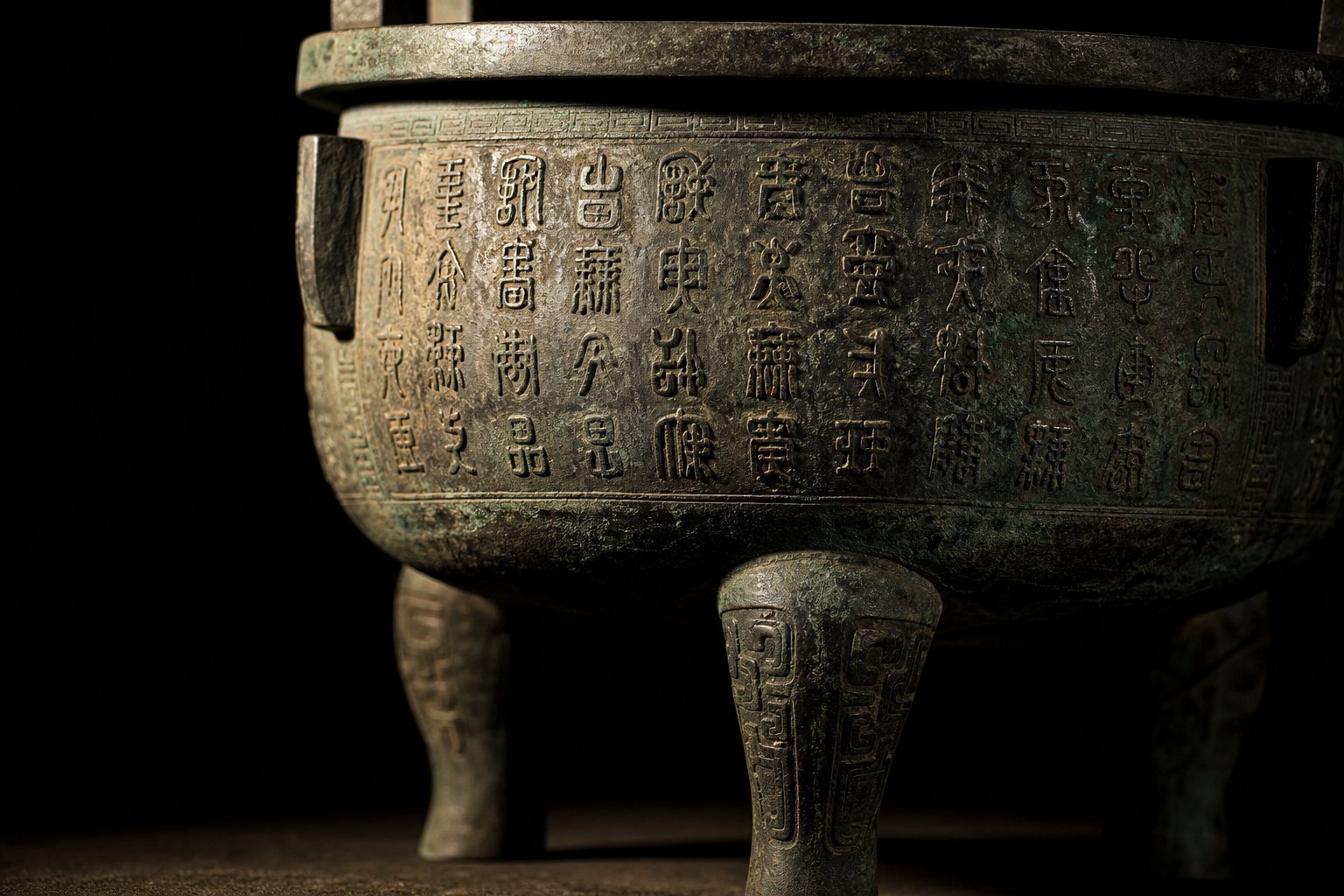
Imagine holding a 3,000-year-old bronze vessel in your hands. Cast into its surface are characters you can still partially read today. That continuity, stretching from ancient ritual objects to the text on your phone screen, is what makes bronze script one of the most remarkable chapters in the story of human writing.
What Is Bronze Script and Why It Matters
Bronze script (jinwen 金文) is the ancient Chinese writing system cast or engraved onto ritual bronze vessels primarily during the Shang dynasty (c. 1600-1046 BCE) and Zhou dynasty (1046-256 BCE), serving as a formal medium for recording royal decrees, ancestral commemorations, and legal agreements over a span of roughly 1,200 years.
So what is ancient chinese writing called when it appears on metal artifacts? Scholars use the term jinwen, literally "gold writing," because the Chinese word for bronze (jin) also means metal or gold. The term "bronze script" was formally established by scholar Rong Geng in his 1925 Compilation of Bronze Scripts, a dictionary cataloguing the archaic Chinese characters found on Shang and Zhou bronzes.
Why should you care about characters cast into metal thousands of years ago? Because bronze script is the critical middle chapter in Chinese writing evolution. It bridges the gap between the earliest scratched pictographs and the standardized forms still used by over a billion people. Every time you read a Chinese character, you're looking at a descendant of forms first refined in bronze.
Bronze Script in the Timeline of Chinese Writing
Chinese writing didn't appear fully formed. It evolved through distinct stages, each shaped by the material it was written on:
- Oracle bone script (jiaguwen 甲骨文) — carved into turtle shells and animal bones for divination, roughly 1600-1046 BCE
- Bronze script (jinwen 金文) — cast into ceremonial bronze vessels for permanent record-keeping, roughly 1400-200 BCE
- Seal script (zhuanwen 篆文) — standardized during the Qin dynasty (221-207 BCE) for official use
- Clerical and modern scripts — evolved from 200 BCE onward into the forms used today
You'll notice something striking about this timeline. Chinese bronze script spans approximately 1,200 years of continuous use, making it the longest-used writing medium in Chinese history. Oracle bone inscriptions cover a few centuries of the Shang period. Seal script served as the official standard for a relatively brief window. But bronze inscriptions were produced from the mid-Shang dynasty all the way through the Han dynasty, documenting ancient china writing across an enormous stretch of political and cultural change.
What makes this even more significant is that bronze script looks more standardized than oracle bone script. As noted by researchers at Rutgers University, the style of chinese bronze script sits "somewhere between oracle-bone writing and Da-zhuan," with squarer layouts, better symmetry, and a richer variety of calligraphic techniques than its predecessor. The medium itself, cast metal rather than scratched bone, allowed artisans to plan and refine each character before committing it to permanence.
This permanence was the point. Oracle bones were divination tools, meant to be read once and stored. Bronze vessels were meant to last forever, carrying messages to ancestors and future generations alike. That intention shaped everything about how these characters look, and it set the stage for how the physical process of casting metal would transform the aesthetics of Chinese writing itself.
From Shang Ritual Vessels to Zhou Royal Records
The shang dynasty writing system didn't begin with long texts or elaborate narratives. It started small, literally. The earliest bronze inscriptions from the Shang period were often just one to six characters: a clan emblem, an ancestor's name, or a brief dedicatory phrase. These short marks served a focused purpose, identifying who made the vessel and which ancestor it honored.
Shang Dynasty Origins of Bronze Inscriptions
Writing in the shang dynasty took two parallel forms. Oracle bone script was scratched into turtle shells and cow shoulder blades for divination, posing questions to ancestors about weather, warfare, and illness. Bronze script, by contrast, was cast into ceremonial vessels for permanence. The distinction matters: one was a conversation with the dead, the other was a monument meant to outlast generations.
The earliest bronze vessels with inscriptions come from sites near Anyang in Henan province, the last Shang capital. Harvard Art Museums notes that Shang bronze inscriptions were usually limited to clan names, written in an archaic style resembling zoomorphic or graphic icons comparable to European heraldic insignia. The tomb of Fu Hao, a consort of King Wuding discovered in 1976, contained over 440 bronze vessels, many bearing these brief dedicatory marks. These shang dynasty artifacts reveal a society where bronze was sacred, expensive, and reserved for communication with ancestral spirits.
The art of the shang dynasty in bronze casting was technically extraordinary, but the inscriptions themselves remained minimal. A typical late Shang vessel might carry a clan name enclosed in a notched square frame (called a yaxing), plus the name of the honored ancestor. That was enough. The vessel's form and decoration carried the ritual weight; the text simply identified the participants.
The Western Zhou Golden Age of Bronze Writing
Everything changed after the Zhou conquest around 1046 BCE. The shang dynasty written language on bronze had been terse and formulaic. Zhou scribes transformed the medium into something far more ambitious. Inscriptions expanded from a handful of characters to texts of a hundred or more, with some reaching nearly 500 characters. Bronze vessels became contracts, historical records, and proof of political legitimacy, all cast in a single object.
What drove this expansion? The Zhou feudal system. Kings granted land, slaves, and titles to loyal ministers, and those ministers needed permanent proof of their authority. A bronze vessel inscribed with the king's words was that proof, more durable than any bamboo document.
Here's how inscription characteristics evolved across the major periods:
- Early Shang (c. 1600-1300 BCE) — No confirmed inscriptions; vessels are plain or carry simple marks
- Late Shang / Yin period (c. 1300-1046 BCE) — Brief inscriptions of 1-6 characters; clan emblems, ancestor names, dedicatory phrases
- Early Western Zhou (c. 1046-950 BCE) — Inscriptions grow to 50-150 characters; record royal appointments and gifts
- Mid to Late Western Zhou (c. 950-771 BCE) — Inscriptions reach 200-500 characters; document land grants, legal disputes, military campaigns, and boundary treaties
- Eastern Zhou / Spring and Autumn (c. 771-476 BCE) — Regional variation increases; artistic scripts emerge in different states
So what did these longer Zhou texts actually say? They recorded the shang dynasty language of ritual obligation but expanded it into new territory. A gui food-vessel at Harvard Art Museums carries a typical example: "The King bestowed upon Uncle De ten female slaves, ten strings of shells, and one hundred sheep, thereupon this precious sacrificial vessel was made." Other inscriptions documented military victories, preserved the terms of boundary agreements between rival states, or recorded oaths of loyalty between lords and vassals.
Of roughly 12,000 inscribed bronze artifacts that survive today, approximately 6,000 date to the Zhou dynasty, making this the richest single body of writing from any period of early Chinese civilization. These shang artifacts and Zhou bronzes together form an archive that bamboo books could never provide, simply because bamboo decays and metal does not.
The shift from brief Shang marks to elaborate Zhou records wasn't just about having more to say. It reflected a fundamental change in what bronze was for. Shang vessels spoke to ancestors. Zhou vessels spoke to ancestors, to rivals, to future generations, and to history itself. That ambition demanded longer texts, and longer texts demanded more refined, more consistent characters, ones that could be planned carefully in clay before being committed to metal forever.
How Bronze Casting Shaped Character Design
Longer texts demanded more refined characters, but refinement didn't come from willpower alone. It came from the material itself. The physical process of casting bronze in the Shang dynasty fundamentally changed how characters looked, how they were planned, and how consistent they could become. To understand why bronze script appears rounder, thicker, and more decorative than oracle bone writing, you need to understand what happened inside the clay mold.
The Clay Mold Process Behind Bronze Characters
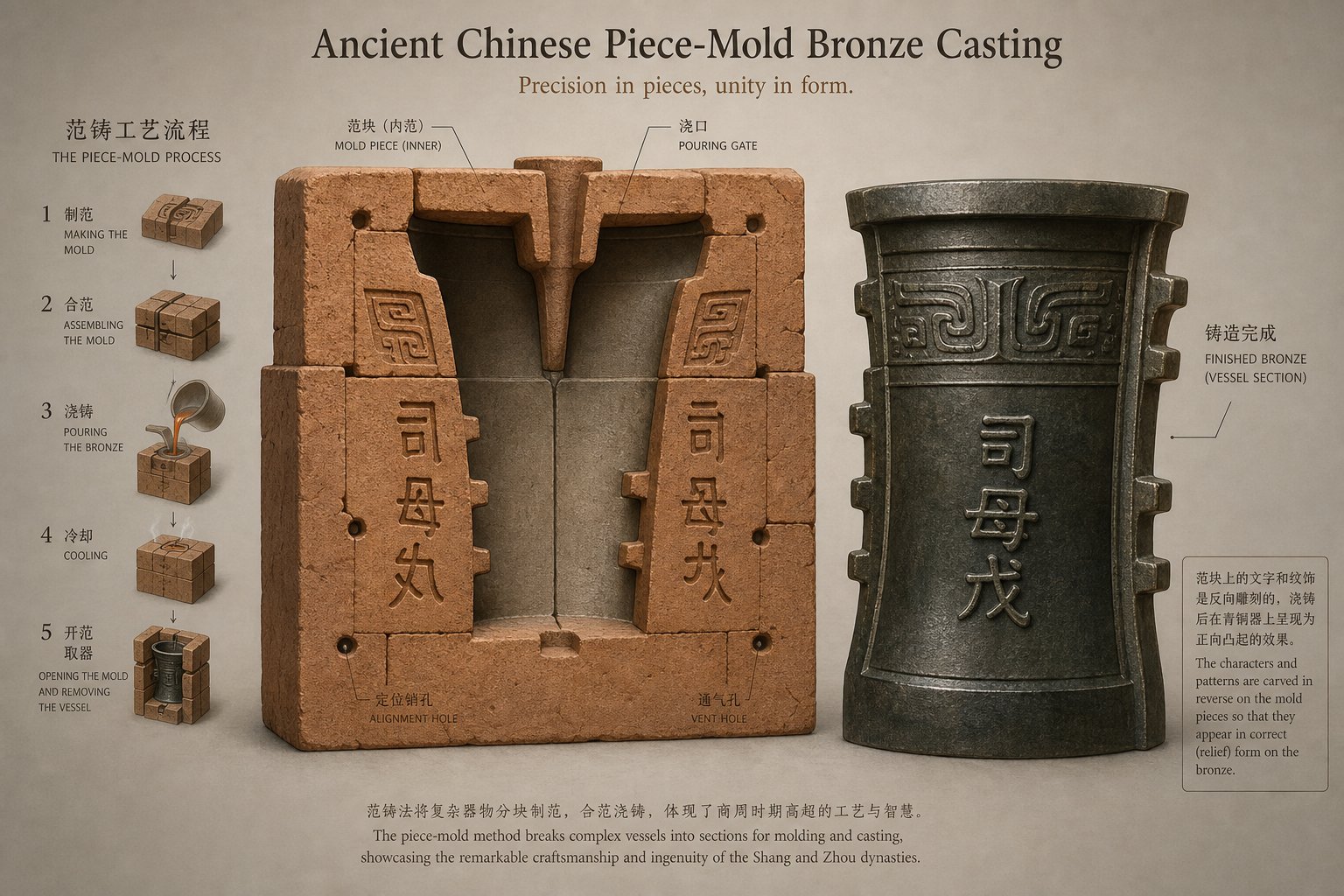
How did China make bronze vessels with writing on them? The answer lies in a technique called piece-mold casting, a method unique to ancient China. While every other Bronze Age culture used the lost-wax technique, Chinese artisans developed a completely different approach that gave them extraordinary control over surface detail, including inscribed characters.
Here's how it worked, step by step:
- Model creation — An artisan shaped the desired vessel from clay, including any surface decorations and inscriptions.
- Mold sections — A thick layer of clay was pressed over the model, then carefully cut into vertical sections (usually three or four pieces) and removed.
- Core preparation — The original clay model was shaved down to become the interior core, creating the hollow space inside the finished vessel.
- Inscription carving — Characters were carved in reverse into the inner surface of the mold sections. This is the critical step for writing: artisans could plan, adjust, and refine each character before any metal was poured.
- Reassembly and casting — The mold sections were reassembled around the shaved-down core, and molten bronze was poured into the gap between them.
- Finishing — After cooling, the clay molds were broken away and the vessel was polished to remove flaws and seam lines.
This process produced characters in two forms. When characters were carved into the mold surface, the resulting bronze text appeared raised (in relief), standing proud of the vessel's interior. When characters were added as raised elements on the mold, they appeared as countersunk (intaglio) impressions in the finished bronze. Both methods gave artisans something oracle bone carvers never had: the ability to draft, revise, and perfect characters before committing them to their final form.
As the Metropolitan Museum of Art notes, an advantage of piece-mold casting was that decorative patterns could be carved or stamped directly on the inner surface of the mold before firing, enabling bronzeworkers to achieve "a high degree of sharpness and definition in even the most intricate designs." That precision applied equally to characters.
How Metal Shaped the Look of Chinese Writing
Imagine scratching a character into a hard turtle shell with a sharp stylus. You'd naturally produce thin, angular lines. Curves are difficult because the shell resists smooth motion. Each stroke is a single committed action with no room for correction.
Shang dynasty bronze casting reversed every one of those constraints. Carving into soft, damp clay is forgiving. Curves come easily. Lines can be widened by simply removing more material. Mistakes can be smoothed over and recarved. The result? Characters that look fundamentally different from their oracle bone counterparts.
Bronze in the Shang dynasty gave scribes a planning stage that oracle bone carving lacked entirely. A diviner scratching into bone worked in real time, producing characters that varied in size, spacing, and proportion from one inscription to the next. A bronze mold artisan worked in deliberate stages, with time to ensure each character matched its neighbors in scale and style. This is why bronze script shows the first real movement toward standardization in Chinese writing.
The differences between the two scripts are visible at a glance:
| Feature | Oracle Bone Script | Bronze Script |
|---|---|---|
| Production method | Scratched with a stylus into hard bone or shell | Carved into soft clay molds, then cast in metal |
| Line quality | Thin, angular, uneven thickness | Thick, rounded, more consistent thickness |
| Stroke shape | Predominantly straight with sharp angles | Flowing curves with smooth transitions |
| Character size | Highly variable within a single inscription | More uniform, planned for visual consistency |
| Decorative quality | Minimal; purely functional marks | Often ornamental, with flourishes and balanced composition |
| Revision possibility | None; each stroke is permanent | Clay can be resmoothed and recarved before casting |
| Durability | Fragile; bone cracks and decays | Extremely durable; bronze survives millennia |
You'll notice that nearly every aesthetic difference traces back to the medium. Bronze script characters aren't rounder because scribes suddenly preferred curves. They're rounder because clay invites curves. They aren't more uniform because a king demanded consistency. They're more uniform because the mold process gave artisans time to plan layouts before casting made them permanent.
This material logic had lasting consequences. The rounded, balanced forms developed through bronze casting ancient China established visual expectations that carried forward into seal script and beyond. When Qin dynasty officials later standardized writing across the empire, they drew on the proportional harmony that bronze artisans had been refining for centuries. The clay mold, in other words, didn't just shape individual characters. It shaped the entire aesthetic trajectory of Chinese writing.
And those characters weren't abstract exercises. They appeared on specific vessels, commissioned by specific people, recording specific events. The most famous of these bronzes carry inscriptions so long and so detailed that they function as historical documents, preserving voices from a world that would otherwise be silent.
Famous Bronze Vessels and Their Inscriptions
Voices from a world that would otherwise be silent. That phrase isn't poetic exaggeration. Without chinese bronze inscriptions, entire chapters of Zhou dynasty history would simply be missing. No bamboo texts from this era survive intact. No paper existed yet. The only primary documents that have endured three millennia are the words cast into ritual bronze vessels, and a handful of these vessels carry texts so detailed they read like government archives frozen in metal.
Which vessels matter most? Scholars have long recognized a core group of ancient chinese bronze vessels whose inscriptions transformed our understanding of early Chinese civilization. These aren't just beautiful objects. They're legal contracts, royal speeches, and political records that reveal how power actually worked in Zhou society.
Mao Gong Ding and the Longest Bronze Inscription
Imagine a single bronze cauldron carrying more text than most ancient documents. The Mao Gong Ding (毛公鼎) holds exactly that distinction: 500 characters in 32 lines covering the entire belly of the vessel, making it the longest bronze inscription ever discovered.
Excavated in 1843 from Qishan County in Shaanxi Province, this late Western Zhou ding (c. 857-828 BCE) records the words of King Xuan to his uncle, the Duke of Mao. The context is dramatic. King Xuan had just inherited a kingdom in crisis. His predecessor, King Li, had misruled so badly that he was banished, triggering fourteen years of joint regency. Feudal lords were still fighting each other when the young king took the throne.
What does the inscription actually say? It divides into seven sections that read like a royal appointment letter combined with a political manifesto:
- Historical preamble — King Xuan recalls how Kings Wen and Wu received Heaven's Mandate and founded the Zhou state
- Statement of crisis — The king describes "chaos and upheavals everywhere" and his fear of failing the dynasty's legacy
- Appointment — The Duke of Mao is charged with governing all domestic and external affairs, placed "above all people in the nation but one"
- Prohibitions — A series of forceful commands: "you shall NOT," "you may NOT," "you are NOT to" reveal the urgency of reform
- Scope of authority — The Duke receives control over public clans, the three offices, royal guards, and all court officials
- Rewards — An extraordinary list of gifts: ritual jade, court garments, a gold chariot, horses, weapons, and ceremonial flags
- Dedication — The Duke expresses gratitude and commissions the ding for future generations
The Mao Gong Ding is considered one of the "Three Treasures of China" alongside the Da Ke Ding (now in Shanghai Museum) and the Da Yu Ding (in the National Museum of China). It currently resides at the National Palace Museum in Taipei, having crossed the Taiwan Strait in 1949 along with over 600,000 other artifacts when the Nationalist government relocated.
Da Yu Ding and San Shi Pan as Historical Documents
The Da Yu Ding (大盂鼎) offers a different window into Zhou governance. Dating to the reign of King Kang, the third Western Zhou king, this vessel carries 291 characters that document a formal bestowal of land and people. After King Kang appointed a minister named Yu, the grateful official commissioned this ding to honor the king's generosity and pay tribute to the virtues of Kings Wen and Wu.
What makes the Da Yu Ding historically invaluable is its explicit description of the subinfeudation system. As Professor Meng Man of Minzu University of China has noted, the inscription provides clear explanations of how feudal states were bestowed and which individuals received titles. It names specific grants: land, slaves, and resources transferred from king to minister. This is the Zhou feudal system captured in real time, not reconstructed centuries later by historians working from memory.
The calligraphic style of the Da Yu Ding also holds significance. Professor Li Gangtian of Zhengzhou University describes its inscriptions as representative of early bronze script: "majestic and grand, with a sense of solemnity, while being simple and plain in style." The characters are bold and upright, reflecting a period when bronze writing was still close to its Shang roots but growing in confidence and scale.
The San Shi Pan (散氏盤), meanwhile, serves an entirely different function. This large bronze basin contains a boundary treaty between two states, the Kingdoms of San and Ze, recording the resolution of a territorial dispute. The inscription details specific geographic markers, names of witnesses, and the terms of agreement. It functions as a legal contract, complete with the ancient equivalent of signatures. For scholars studying early Chinese law, this vessel proves that formal written agreements governed interstate relations centuries before the Warring States period.
Taken together, these chinese bronze vessels reveal a society far more complex than simple ancestor worship might suggest. Here's how the most significant inscribed bronzes rank by length and historical importance:
- Mao Gong Ding (毛公鼎) — 500 characters; royal appointment and political reform during King Xuan's reign; longest known bronze inscription
- Da Ke Ding (大克鼎) — 290 characters; records land grants and family honors bestowed by a Zhou king
- Da Yu Ding (大盂鼎) — 291 characters; documents the subinfeudation system and royal bestowals under King Kang
- San Shi Pan (散氏盤) — 357 characters; boundary treaty between two states with geographic and legal details
- Shi Qiang Pan (史墙盘) — 284 characters; traces the genealogy of both the Zhou royal house and the Wei family across generations
Each of these vessels tells us something different about Zhou society. The Mao Gong Ding reveals political structures and the anxiety of kingship. The Da Yu Ding exposes the mechanics of feudal land distribution. The San Shi Pan demonstrates a functioning legal system between rival states. Together, they form a mosaic of governance, religion, and daily power that no single text could provide.
Earlier shang bronze vessels carried only brief clan names and dedicatory marks. The Zhou transformation of bronze into a medium for extended prose created something unprecedented: a permanent, tamper-proof archive of political life. These weren't private documents hidden in a library. They were public declarations cast into sacred objects, meant to be witnessed by ancestors and descendants alike.
That public, permanent quality is precisely what makes bronze inscriptions so valuable for tracing how individual characters evolved. When a scribe carved 500 characters into the mold for the Mao Gong Ding, every stroke was deliberate, every form carefully chosen. These inscriptions preserve not just historical content but the exact shapes of characters at specific moments in time, offering a frame-by-frame record of how Chinese writing transformed from raw pictographs into the structured system still in use today.
Character Evolution from Oracle Bone to Modern Chinese
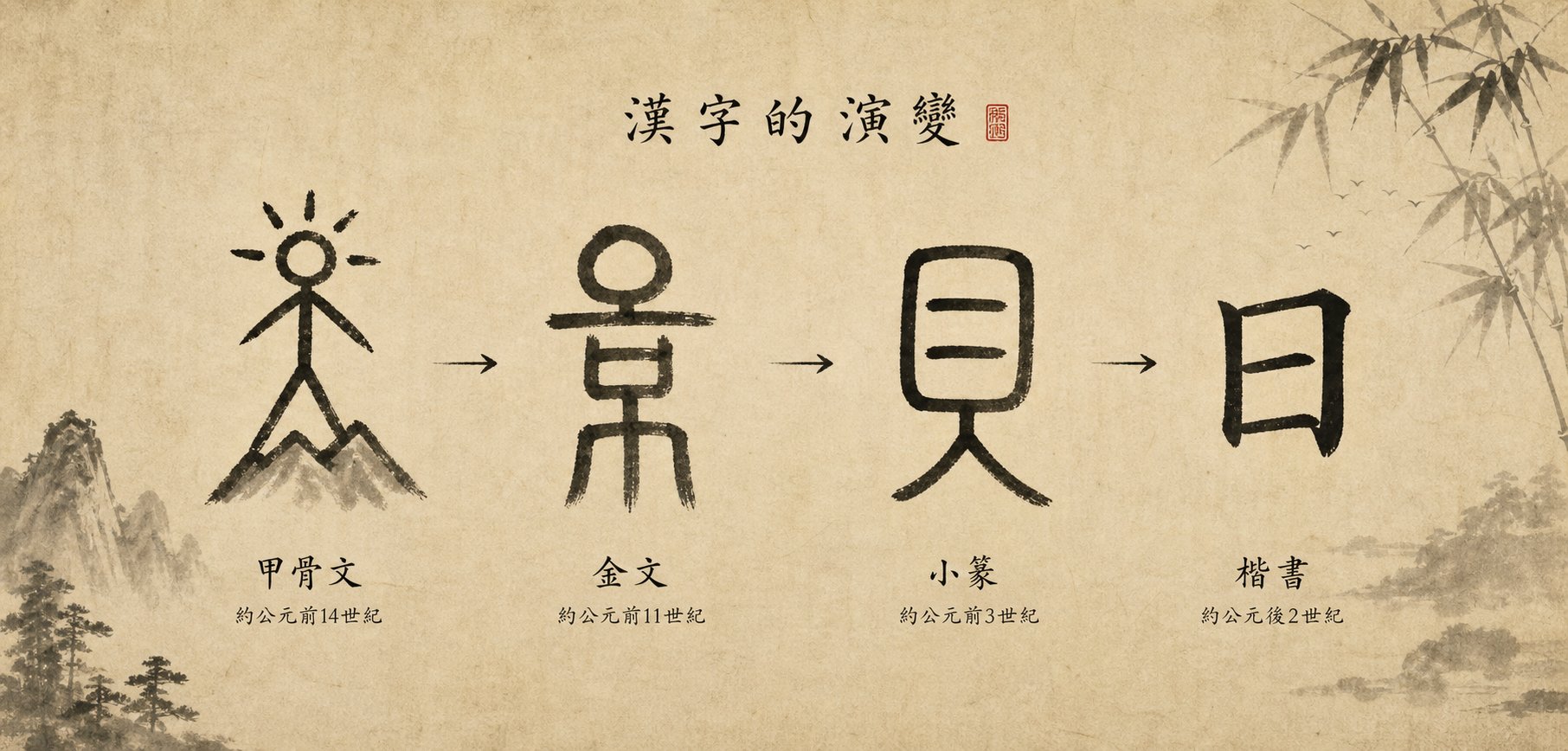
A frame-by-frame record of transformation. That's exactly what bronze inscriptions provide when you line up the same character across centuries. Chinese oracle bone script gives you the raw pictograph, the earliest attempt to capture a thing in lines. Bronze script shows that same character settling into a more disciplined form. Seal script completes the geometric regularization. And the modern character? It's the final frame, so abstracted that the original picture is invisible unless you know where to look.
Tracing this progression for specific characters is one of the most revealing exercises in understanding how Chinese writing works. It shows that simplification wasn't random. Each stage preserved the structural logic of the previous one while shedding visual detail that no longer served communication.
Tracing Characters from Oracle Bone to Modern Forms
Let's follow five common characters through their full evolution. These aren't obscure scholarly examples. They're words still used daily by over a billion people, and their journey from picture to symbol spans roughly 3,000 years.
| Modern Character | Oracle Bone Form (c. 1300 BCE) | Bronze Script Form (c. 1000-800 BCE) | Seal Script Form (c. 220 BCE) |
|---|---|---|---|
| 馬 (horse) | A recognizable horse in profile with four legs, a flowing mane on the neck, and a tail. Highly pictographic, with the mane always present as an identifying feature. | The horse shape becomes more compact. Legs simplify into parallel strokes, the mane reduces to a few marks at the top, and the body becomes a contained rectangular area. Still recognizably equine but more schematic. | Fully geometric. The mane, body, and legs become abstract stroke patterns. Four dots at the bottom represent the legs. No pictorial resemblance to a horse remains without prior knowledge. |
| 魚 (fish) | A clear fish shape viewed from above: head, body with scales indicated by crosshatch marks, fins on the sides, and a forked tail. | The fish becomes vertically oriented. The head simplifies to a triangular top, scales reduce to a few regular marks in the middle section, and the tail becomes stylized strokes at the bottom. | Symmetrical and balanced. The head, body, and tail are distinct zones but entirely abstract. Crosshatch marks in the center are the last echo of the original scale pattern. |
| 鼎 (tripod vessel) | A direct drawing of a three-legged ritual cauldron with two handles (ears) at the top and a round or rectangular body. Clearly depicts the physical object. | The vessel shape becomes standardized. Handles are symmetrical loops, the body is a clean rectangular or rounded form, and the three legs are even parallel strokes. Proportions are balanced and deliberate. | Geometric abstraction complete. The top section represents the handles and rim, the middle is the body, and the bottom strokes indicate legs. Recognizable only by convention. |
| 王 (king) | A large figure standing on a broad base line, sometimes depicted as an axe blade (a symbol of authority). The form varies between a person and a weapon. | Settles into three horizontal lines connected by a single vertical stroke. The pictographic ambiguity resolves into a stable, iconic form. Some scholars read the three lines as heaven, earth, and humanity united by the king. | Nearly identical to the bronze form. Three even horizontal strokes crossed by one vertical. The character has reached its final structure by this stage. |
| 天 (heaven/sky) | A human figure with an emphasized head or a large circle above a standing person, indicating "what is above a person." The concept is spatial: the great expanse overhead. | The human figure straightens. The head becomes a single horizontal stroke at the top, the arms extend as a second horizontal stroke, and the legs form a stable base. The character is now clearly two horizontal strokes over a spread-legged figure. | Fully regularized into two horizontal strokes above two angled strokes. The human origin is barely visible but structurally preserved in the downward-angling legs. |
You'll notice a pattern. In the bone script stage, each character is essentially a small drawing. The oracle bone form of horse always included the mane on the horse's neck as an identifying feature, just as deer always had horns and tigers always had stripes. These were visual identifiers, not abstract strokes. The oldest chinese writing relied on your ability to recognize the thing being depicted.
Bronze script begins the critical shift. The old chinese characters on Shang and Zhou vessels retain enough pictographic DNA that you can still see the original image, but the forms are tidier, more symmetrical, and more consistent from one inscription to the next. The horse's mane is still there, but it's a standardized mark rather than a flowing sketch. The fish still has scales, but they're regular geometric patterns rather than freehand crosshatching.
Why Bronze Script Is the Missing Link in Character Evolution
Here's why this matters. If you jump directly from oracle bone to seal script, the transformation looks abrupt, almost inexplicable. How did a recognizable picture of a horse become an abstract grid of strokes? The answer is that it didn't happen in one leap. Bronze script is the intermediate stage where you can watch abstraction happening gradually, character by character, generation by generation.
Several forces drove this gradual change:
- The clay mold medium — Artisans carving into molds naturally regularized curves and straightened lines for cleaner casting results
- Longer inscriptions — When you're fitting 300-500 characters onto a single vessel, each character must be compact and uniform in size
- Scribal tradition — As bronze casting became a specialized craft, workshops developed house styles that were passed from master to apprentice
- Functional pressure — Characters needed to be legible to readers across decades and regions, pushing forms toward clarity over artistry
The shang dynasty symbols on early bronzes still lean heavily toward pictographic representation. A fish looks like a fish. A horse looks like a horse. But by the late Western Zhou period, those same characters have shed most of their illustrative detail in favor of structural consistency. The pictograph hasn't disappeared; it's been disciplined into a system.
This is precisely what makes bronze script the missing link in Chinese character evolution. It shows you the mechanism of change. Oracle bone forms are raw pictographs shaped by the constraints of carving into hard material. Bronze forms are those same pictographs reshaped by the constraints of clay mold casting and the demands of longer, more formal texts. Seal script then takes the regularized bronze forms and applies one final layer of geometric standardization, producing the clean, symmetrical characters that would become the basis for all later Chinese writing.
Without the bronze stage, the story has a gap. With it, you can see that Chinese writing didn't abandon its pictographic origins. It refined them, step by step, until the pictures became invisible to everyone except those who know where to look. And that refinement wasn't driven by a single reform or a royal decree. It emerged organically from the physical act of casting characters into metal over 1,200 years, a process that also encoded deeper structural principles into the writing system itself.
Character Formation Principles Visible in Bronze Script
Structural principles encoded into the writing system itself. That phrase points to something deeper than aesthetics. Bronze inscriptions don't just show you what characters looked like at a given moment. They reveal how characters were built, what logic governed their construction, and why certain components appear where they do. If you've ever wondered whether there's a system behind the apparent complexity of chinese inscriptions, the answer is yes, and bronze script is where that system becomes most visible.
The Six Principles of Character Formation in Bronze Script
Chinese scholars have long recognized a framework called liushu (六書), or the "Six Principles of Writing," first systematized by Xu Shen in his dictionary Shuowen Jiezi published in 100 CE. This framework describes six methods by which characters were formed or used. What makes bronze script especially valuable is that it preserves clear examples of all six categories in a single historical layer, often in forms closer to the original creative logic than later scripts allow.
Here are the six categories with examples drawn from bronze marks and inscriptions:
- Pictographs (xiangxing 象形) — Characters that depict the physical form of an object. In bronze script, 日 (sun) appears as a circle with a dot or line in the center, still recognizably a picture of the sun. Other examples include 月 (moon), 山 (mountain), and 魚 (fish). These make up only about 4% of all Chinese characters, but they form the visual foundation for everything else.
- Simple ideographs (zhishi 指事) — Characters that express abstract ideas through iconic indicators. The bronze form of 上 (above) shows a short stroke above a longer horizontal line, while 下 (below) places the mark beneath it. The concept is spatial and self-explanatory: the position of the mark is the meaning.
- Compound ideographs (huiyi 會意) — Characters formed by combining two or more meaningful elements to suggest a new meaning. In bronze script, 明 (bright) combines 日 (sun) and 月 (moon), two sources of light joined to express brightness. Similarly, 休 (rest) pairs a person radical with 木 (tree), evoking someone resting in the shade.
- Phono-semantic compounds (xingsheng 形聲) — Characters built from a semantic component (indicating meaning) and a phonetic component (indicating sound). The bronze form of 河 (river) combines the water radical 氵 with the phonetic element 可 (ke/he). This category dominates the script: over 80% of all Chinese characters are phono-semantic compounds.
- Transfer characters (zhuanzhu 轉注) — Characters whose meanings evolved through mutual influence. The pair 考 (originally "deceased father," now "to test") and 老 (aged) share a semantic root and were once interchangeable. Bronze inscriptions preserve stages where these meanings had not yet fully separated.
- Loan characters (jiajie 假借) — Characters borrowed for their sound to represent a different word. The character 来 originally depicted wheat in its bronze form but was borrowed to write the verb "to come" because the pronunciation matched. A new character, 麦, was eventually created to carry the original wheat meaning.
A note of context: while the liushu framework remains the most widely taught system for understanding chinese ancient words and their formation, modern scholars have identified limitations. As Outlier Linguistics points out, the categories aren't always mutually exclusive. Some characters fit multiple categories, and the definition of zhuanzhu in particular has generated at least nine competing scholarly interpretations. Still, for understanding the structural logic visible in ancient chinese text on bronze vessels, the six principles provide a useful starting framework.
Reading Structural Patterns and Common Radicals
Sounds complex? It's actually more intuitive than it first appears, especially once you learn to spot the patterns. Bronze inscriptions are particularly helpful here because their characters are larger, more carefully composed, and more visually distinct than later compressed forms. The structural relationships between components are easier to see.
Here's the key insight for beginners: the vast majority of characters you'll encounter follow the phono-semantic compound pattern. That means most characters have two functional parts, one that hints at meaning and one that hints at sound. Recognizing which is which gives you a foothold with any unfamiliar character.
The most common structural arrangements visible in bronze script and carried forward into modern Chinese are:
- Left-right structure — Semantic component (radical) on the left, phonetic component on the right. This is the most frequent layout. Example: 河 has the water radical (氵) on the left and the phonetic 可 on the right.
- Top-bottom structure — Semantic component on top, phonetic component below (or vice versa). Example: 花 (flower) has the grass radical (艹) on top.
- Enclosure structure — One component surrounds or partially encloses the other. Example: 国 (country) has the enclosure radical 囗 surrounding the inner components.
In bronze inscriptions, these arrangements are often more spacious and visually separated than in modern printed characters. The semantic component tends to be drawn with more pictographic detail, making it easier to identify. A water radical in bronze script still looks like flowing water. A hand radical still resembles a hand. These visual clues fade in later scripts but remain legible in bronze forms.
For anyone studying chinese ancient words and their origins, a practical approach is to start with the most common radicals. Learn to recognize the bronze forms of water (氵), wood (木), metal (金), fire (火), earth (土), person (人), hand (手), and mouth (口). These eight radicals appear in hundreds of characters each. Once you can spot them, you've already decoded the meaning half of most phono-semantic compounds, whether you're reading ancient chinese hieroglyphs on a museum vessel or modern text on a screen.
The phonetic side takes more practice, but the principle is the same one native readers have always used: if you recognize the non-radical component, try reading it as a sound clue. The folk rule "if it has a side, read the side" (有边读边) captures this strategy in five characters. It doesn't work perfectly every time, since pronunciations have shifted over three millennia, but it works often enough to be genuinely useful.
What bronze script offers that later forms cannot is transparency. The structural decisions that built each character are more visible, more legible, and more connected to their pictographic origins. These same principles still govern how characters work today. The system hasn't changed. It's just been compressed, streamlined, and miniaturized until the logic became invisible to casual readers. Bronze inscriptions let you see the logic again, which is why they remain essential for anyone who wants to understand Chinese writing as a system rather than memorize it as a collection of isolated shapes.
That systematic quality didn't stay uniform forever, though. As the Zhou dynasty fragmented into rival states, regional scribes began developing their own variations on these shared principles, stretching the system in different directions and creating the diversity that would eventually demand a dramatic political solution.
Bronze Script and the Path to Writing Standardization
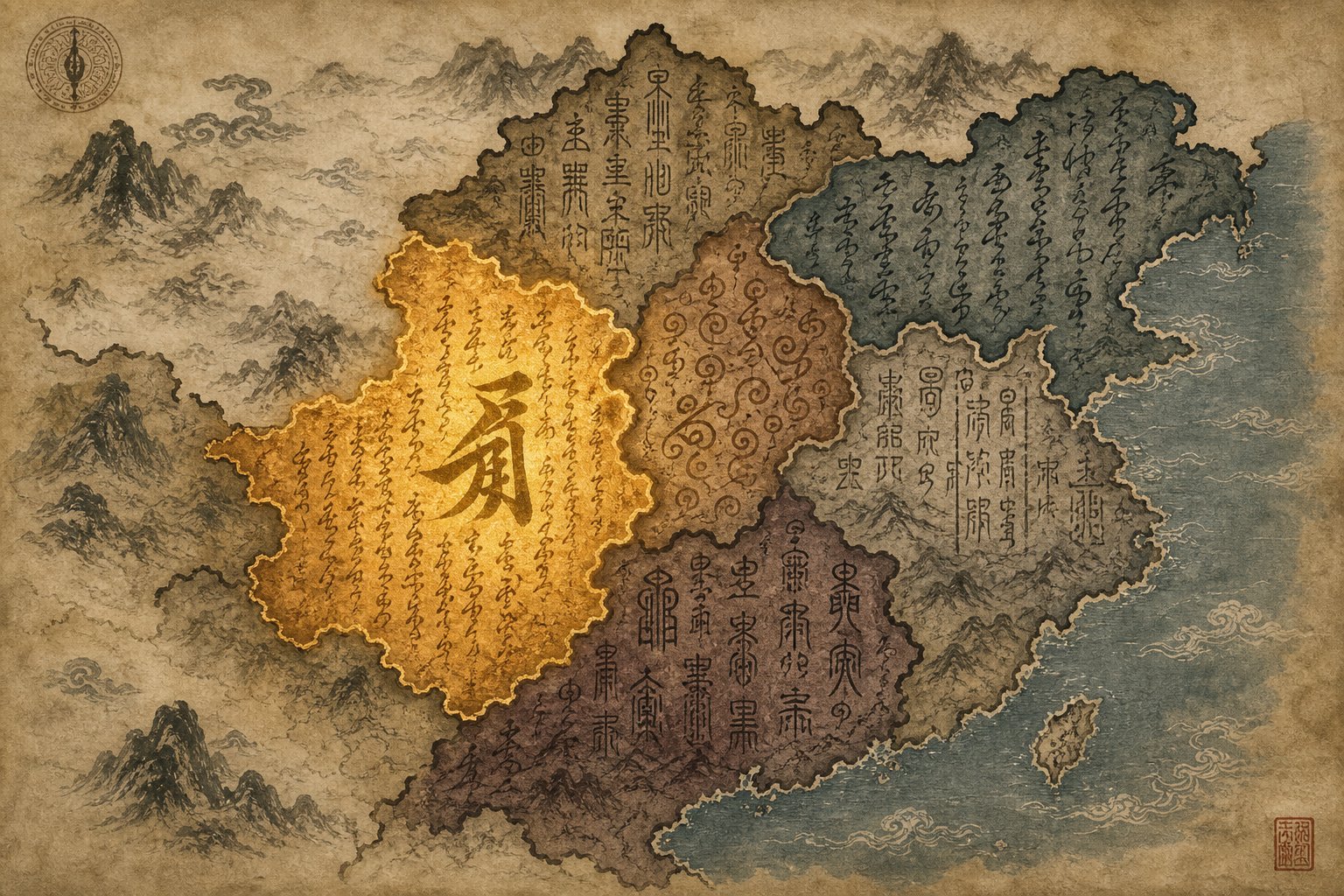
Regional scribes stretching the system in different directions. That's not a metaphor. By the Warring States period (467-221 BCE), the once-unified writing tradition inherited from the Western Zhou had splintered into scripts so visually distinct that officials from one state could struggle to read documents from another. The same character might look completely different depending on whether it was written in Chu, Qi, Yan, or Qin. This fragmentation wasn't just an inconvenience. It was a political problem that demanded a political solution.
Regional Variations in Late Bronze Script
How did a single writing system fracture so dramatically? The answer lies in geography and power. When the Zhou court lost effective control over its vassal states during the Eastern Zhou period, each region developed its own scribal traditions without central oversight. Scholars classify Warring States writing into five regional script groups: the scripts of Yan, Qi, Chu, Qin, and the Three Jin states. Each developed distinctive calligraphic features shaped by local artistic preferences and cultural exchange.
Consider the contrast. Bronze inscriptions from the eastern state of Qi featured vertically elongated characters with long, slender strokes and sharp tips, fitting each graph into an imaginary narrow rectangle. Chu script in the south took that elongation further, adding supple, sinuous curves and decorative "bird-and-insect" embellishments that turned writing into visual art. The northern state of Zhongshan produced inscriptions that blended southern Chu aesthetics with Western Zhou structural traditions. Meanwhile, Qin in the west maintained a conservative, square style that changed remarkably little over centuries.
These weren't minor cosmetic differences. Each zhou dynasty symbol could take radically different forms depending on the region. The sheer number of variant character forms exploded during this period. A single word like 信 (trust) might appear in dozens of graphic variations across different states, making cross-regional communication genuinely difficult. When you add the proliferation of new characters created independently in each state, the problem compounds further.
The shang writing system and its Western Zhou successor had been relatively unified because political authority was centralized. Once that authority collapsed, writing followed politics into fragmentation. By the late Warring States period, the "scripts of the six states" (六國文字) had diverged enough that the Qin government viewed them as a hindrance to communication, trade, taxation, and political control.
From Bronze Script to Qin Seal Script Standardization
When Qin conquered the last rival state in 221 BCE, Emperor Qin Shi Huang moved immediately to unify more than territory. He standardized weights, measures, currency, axle widths, and writing. The traditional account credits Chancellor Li Si with creating Small Seal Script (xiaozhuan 小篆) by surveying all regional scripts and synthesizing the best elements. The reality, as scholars now understand, was simpler and more revealing.
The Qin didn't invent a new script. They imposed their own. As historical sources indicate, character forms that differed from those used by Qin scribes were simply discarded, with Qin forms becoming standard across the entire empire. The variance among regional scripts "was considered unacceptable by the rising Qin dynasty, who saw it as a hindrance to timely communication, trade, taxation, and transportation, as well as being a potential vector for fomenting political dissent."
Here's the crucial point for understanding bronze script's legacy: the Qin script was the most conservative of all Warring States regional scripts. Because Qin had been a relative backwater during the Spring and Autumn period, its writing evolved much more slowly than that of the eastern and southern states. Qin characters retained the square, balanced proportions and rounded stroke endings characteristic of mid- and late Western Zhou bronze inscriptions. The Shigu wen stone drums from Qin, dating to the Spring and Autumn period, display characters in orderly columns with uniform size and arrangement "reminiscent of the inscriptions of the mid- and late Western Zhou period."
In other words, when Qin standardized writing for all of China, they were effectively selecting the shang china writing system's direct descendant, the tradition that had changed least from the Western Zhou bronze script norm. The more innovative, decorative, and divergent zhou dynasty symbols of the eastern states were swept away. The conservative western tradition won.
The Qin standardization of writing preserved the structural logic of Western Zhou bronze script for all subsequent Chinese civilization. By choosing the most conservative regional tradition as the national standard, the empire ensured that structural decisions first made by bronze artisans over a thousand years earlier would remain embedded in Chinese characters permanently.
This has profound implications for modern Chinese. Today's traditional characters aren't descended from the artistic Chu scripts or the elongated Qi forms. They descend from the Qin standard, which itself descended from Western Zhou bronze conventions with minimal alteration. When you write a traditional Chinese character, you're reproducing proportions and structural arrangements that trace back through Small Seal Script, through Qin regional script, and ultimately to the forms cast into bronze vessels during the Western Zhou golden age.
The shang dynasty symbol repertoire, refined through twelve centuries of bronze casting, didn't disappear when the last ritual vessel was made. It was absorbed into the Qin standard, carried forward through Clerical Script and Regular Script, and delivered intact into the modern era. The clay mold artisans of the Western Zhou couldn't have known it, but the structural choices they made while carving characters into soft clay would outlast every dynasty that followed.
That permanence raises a natural question: how did scholars piece this story together? The bronze vessels themselves were buried for centuries, forgotten, then rediscovered in waves of antiquarian curiosity and archaeological excavation that span a thousand years of detective work.
How Scholars Rediscovered and Deciphered Bronze Inscriptions
A thousand years of detective work. That's not an exaggeration. The bronze vessels buried in Zhou-era tombs and hoards didn't announce themselves to later generations. They were dug up by farmers, collected by emperors, catalogued by obsessive scholars, and finally decoded by modern archaeologists armed with comparative methods and digital tools. The story of how chinese bronzes went from mysterious relics to readable historical documents is itself a fascinating chapter in intellectual history.
Song Dynasty Antiquarians and Early Catalogues
Interest in ancient bronzes existed as early as the Han dynasty, when a ding tripod unearthed in 116 BCE during the reign of Emperor Wu was treated as a dynastic omen. But systematic study didn't begin until the Song dynasty (960-1279), when a new breed of scholar-officials turned their attention to collecting and cataloguing ancient objects with unprecedented rigor.
Why the Song? Two factors converged. First, Neo-Confucian scholars wanted to recover authentic knowledge of ancient ritual practices, and bronze vessels were the physical evidence. Second, the technology of ink rubbings made it possible to reproduce inscriptions on paper, allowing scholars to compare texts without physically transporting heavy metal objects across the empire.
The pioneering figure was Ouyang Xiu (1007-1072), the great statesman, historian, and literary master. His Jigu Lu (Record of Collected Antiquity) assembled some four hundred colophons written on rubbings of inscriptions stretching back to the beginnings of Chinese civilization. Ouyang Xiu was driven by what he called an addiction to antiquity. In his own words, he had "no desire whatsoever for those things that men of this present age hanker after so ardently," focusing instead on gathering inscriptions "from famous mountains and broad marshes, isolated cliffs and cut-off valleys, wild forests and ruined tombs." His collection spanned from the time of King Mu of Zhou through the Five Dynasties period.
Other Song scholars built on this foundation. Lu Dalin (1044-1091) produced the Kaogu Tu (Illustrated Study of Antiquity), a richly illustrated catalogue of ancient bronze vessels and their inscriptions that set the standard for descriptive documentation. Xue Shanggong compiled the Lidai Zhongding Yiqi Kuanzhi Fatie, a more systematic listing of chinese dynasty marks and inscriptions organized for comparative study. These works established the basic methodology: collect rubbings, transcribe characters, compare forms across vessels, and attempt to date objects by their script style and content.
The Song antiquarians couldn't read most of what they found. Their decipherment tools were limited. But they created the archives that made later breakthroughs possible, preserving records of vessels that have since been lost to war, fire, and neglect.
Modern Archaeological Discoveries and Digital Access
The Qing dynasty (1644-1911) brought a second explosion of bronze inscription research. Scholars turned away from Neo-Confucian metaphysics and toward practical textual criticism, applying rigorous philological methods to ancient inscriptions. The most important collections of this era included Ruan Yuan's Jiguzhai Zhongding Yiqi Kuanzhi, Wu Dacheng's Kezhai Jigulu, and Sun Yirang's Guzhou Shiyi. These Qing scholars developed the comparative method that remains central to decipherment: matching unknown bronze characters against known forms in transmitted texts and later script stages to establish readings.
The 20th century transformed the field entirely. Republican-era scholars like Luo Zhenyu, Wang Guowei, and Guo Moruo developed systematic criteria for dating inscriptions and using them as historiographical sources. Guo Moruo's Liangzhou Jinwen Ci Daxi organized Western and Eastern Zhou inscriptions into a chronological framework that scholars still reference. Meanwhile, controlled archaeological excavations replaced the haphazard looting that had fed earlier collections, providing crucial context about where and how vessels were buried.
Here's a timeline of the major milestones that brought shang bronzes and Zhou inscriptions from obscurity to legibility:
- 116 BCE — Han dynasty scholar Zhang Chang analyzes a ding tripod unearthed in Meiyang, one of the earliest recorded attempts to interpret chinese bronze marks on ancient vessels
- 1061-1072 — Ouyang Xiu compiles the Jigu Lu, the first major collection of inscription colophons, establishing antiquarian epigraphy as a scholarly discipline
- 1092 — Lu Dalin publishes Kaogu Tu, setting the standard for illustrated bronze vessel catalogues with detailed drawings and transcriptions
- 1144 — Xue Shanggong produces a systematic listing of chinese bronze seal marks and inscriptions organized for comparative analysis
- 1804 — Ruan Yuan publishes his major Qing-era collection, applying rigorous philological methods to bronze texts
- 1920s-1930s — Guo Moruo and Wang Guowei establish modern dating criteria, treating inscriptions as primary historical sources rather than curiosities
- 1976 — Excavation of Fu Hao's tomb at Anyang yields over 440 inscribed bronzes from a single Shang-era burial, transforming understanding of late Shang society
- 1984 — The Chinese Academy of Social Sciences publishes Yin-Zhou Jinwen Jicheng, a comprehensive compendium of approximately 14,000 bronze inscriptions with rubbings and modern transcriptions
- 2003 — Discovery of the Yangjiacun hoard in Meixian, Shaanxi, yields a set of Western Zhou bronzes with lengthy inscriptions that fill gaps in the historical record
- 2020s — Academia Sinica's open-access digital databases make searchable transcriptions, rubbings, and geographical data available to researchers worldwide, including a "Missing Graph System" for handling variant character forms
How did scholars actually decipher these ancient texts? The core method hasn't changed since the Qing dynasty: comparison. A character whose bronze form is unknown gets matched against its seal script equivalent, which is matched against its form in the Han-era dictionary Shuowen Jiezi, which connects to modern readings. When an inscription contains a passage that parallels a transmitted text like the Shangshu (Book of Documents), scholars can confirm readings by cross-reference. Each successfully decoded character then helps unlock others in the same inscription.
Today, digital tools have accelerated this process dramatically. Academia Sinica's "Shang and Zhou Bronze Inscriptions and Bronzewares Database" digitizes the full Jicheng corpus, allowing researchers to search by vessel type, excavation site, inscription length, or individual characters. A built-in geographical information system maps where each chinese bronze was found, revealing patterns of distribution and cultural exchange invisible to earlier scholars working with paper catalogues. 3D scanning now captures surface details that flat rubbings miss, and machine learning algorithms are beginning to assist with identifying damaged or partially legible characters.
The distance traveled is remarkable. Ouyang Xiu spent decades gathering four hundred rubbings through personal networks and sheer persistence. A modern researcher can search fourteen thousand inscriptions from a laptop in seconds. But the fundamental question remains the same one that drove that Song dynasty scholar nearly a thousand years ago: what do these characters say, and what do they tell us about the world that made them?
That question gains additional weight when you place bronze script alongside the other great writing systems of the ancient world. Every early civilization developed writing independently, but only one produced a script whose descendants are still read daily by billions of people.
Bronze Script in the Context of World Writing Systems
Every early civilization developed writing independently, but only one produced a script whose descendants are still read daily by billions of people. That distinction belongs to the Chinese tradition, and bronze script sits at its structural core. To appreciate what makes this continuity so extraordinary, you need to see it against the backdrop of other ancient writing systems that rose, flourished, and ultimately fell silent.
Bronze Script Among the World's Ancient Writing Systems
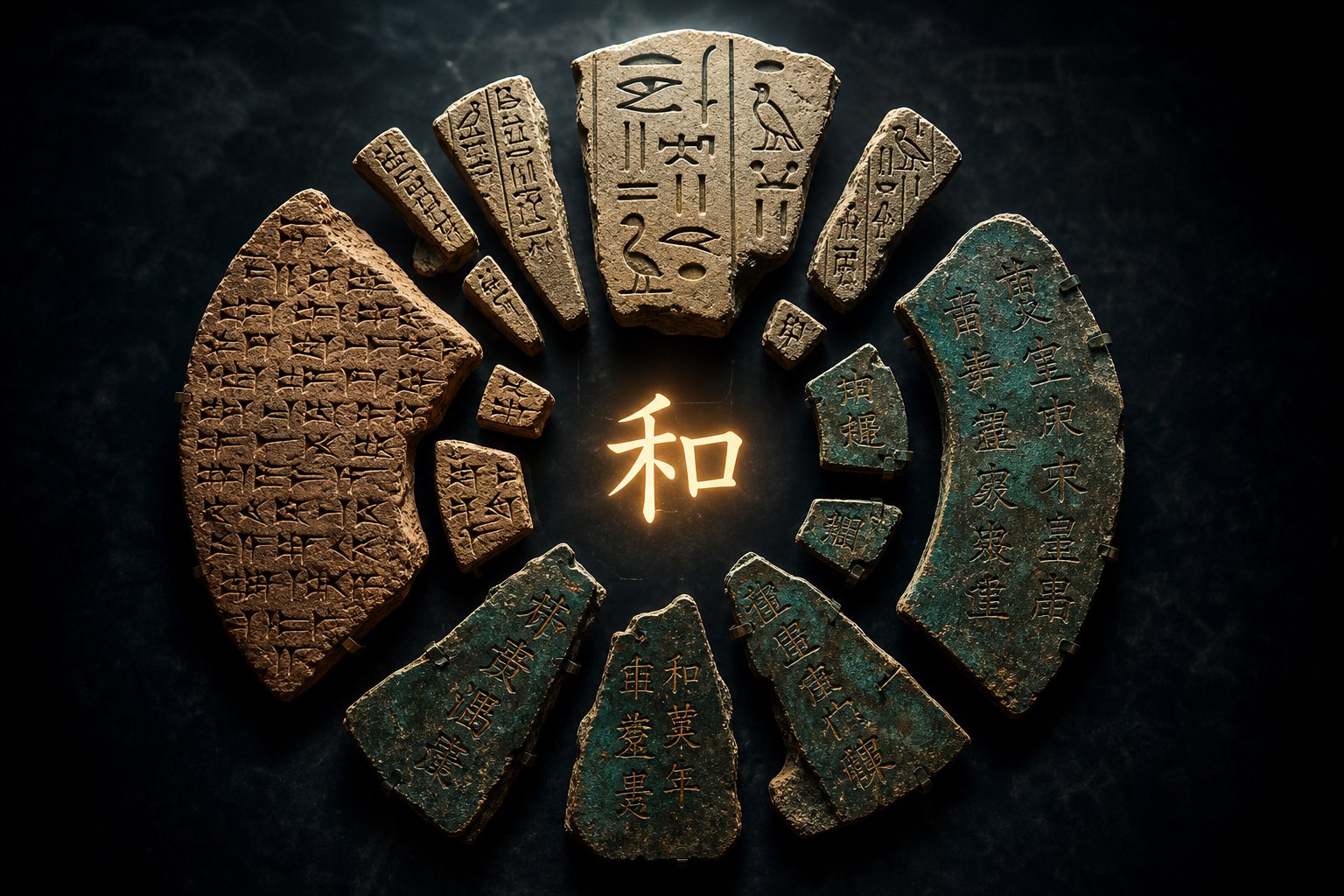
The chinese bronze age overlapped chronologically with the great literate civilizations of Egypt, Mesopotamia, and later Mesoamerica. Each developed sophisticated writing independently, each used it for comparable purposes (religion, administration, commemoration), and each inscribed its texts on durable materials meant to last. Yet their fates diverged completely.
Egyptian hieroglyphs endured for over three thousand years, from roughly 3200 BCE to the fourth century CE. Mesopotamian cuneiform lasted even longer in absolute terms, from about 3400 BCE to the first century CE. Mesoamerican glyphs, particularly Mayan writing, flourished from around 300 BCE to the Spanish conquest. All three were eventually abandoned, their reading traditions broken, their scripts becoming puzzles that required centuries of modern scholarship to crack.
The ancient chinese script followed a different path entirely. Writing that appeared on oracle bones around 1300 BCE evolved into bronze script, then seal script, then clerical and regular scripts, each stage flowing into the next without rupture. No decipherment was ever needed because no generation ever lost the ability to read what the previous generation had written. As one analysis of Chinese civilization's continuity notes, "a modern person who can read ancient books is also able to read and understand the ancient books copied by the Western Han people more than 2,000 years ago." That's a claim no other ancient writing tradition can make.
Here's how these systems compare across key dimensions:
| Writing System | Approximate Dates | Primary Medium | Script Type | Descendants Still in Use? |
|---|---|---|---|---|
| Chinese bronze script (jinwen) | c. 1400-200 BCE | Cast bronze vessels | Logographic (ideographic + phono-semantic) | Yes. Modern Chinese characters descend directly from this tradition. |
| Egyptian hieroglyphs | c. 3200 BCE - 394 CE | Carved stone, painted walls | Logographic + consonantal alphabet | No. Last known inscription: Temple of Philae, 394 CE. Coptic alphabet is a distant descendant but the script itself died. |
| Mesopotamian cuneiform | c. 3400 BCE - 75 CE | Pressed clay tablets | Logographic + syllabic | No. Died out completely. Required modern decipherment (Rawlinson, 1840s). |
| Mayan glyphs | c. 300 BCE - 1600s CE | Carved stone, painted bark | Logographic + syllabic | No. Reading tradition broken by Spanish colonization. Partially deciphered in the 20th century. |
| Indus Valley script | c. 2600-1900 BCE | Stamp seals, pottery | Undeciphered | No. Civilization collapsed; script remains unread. |
What explains the difference? Why did ancient china bronze inscriptions lead to a living tradition while Egyptian and Sumerian writing became dead scripts? Several factors converged, but the most important is what scholars call the "hyper-linguistic function" of Chinese characters. Unlike alphabetic scripts that encode speech sounds directly, Chinese characters encode meaning through visual structure. This means the same written text can be read aloud in Mandarin, Cantonese, or any other Chinese dialect and still be understood. It also means texts from 1000 BCE remain structurally legible to modern readers, even when pronunciation has shifted dramatically.
Ancient writing in china was never replaced by a foreign script because no conquering power ever imposed one. In Egypt, Greek and then Arabic displaced hieroglyphs. In Mesopotamia, Aramaic alphabetic writing gradually made cuneiform obsolete. In China, dynasties rose and fell, foreign rulers took the throne, but the writing system persisted. As the reference material explains, "historically, most of the ethnic minorities that entered the Central Plains would actively embrace Chinese culture and learn Chinese characters" rather than imposing their own scripts. The Northern Wei emperor's Sinicization reforms of the fifth century CE are a striking example: a non-Chinese ruler mandating the adoption of Chinese writing to unify his realm.
The Unbroken Thread from Bronze to Modern Chinese
Think about what this continuity means in practical terms. The characters cast into the Mao Gong Ding around 830 BCE are structurally ancestral to the characters displayed on a smartphone screen in Shanghai today. The radical system visible in bronze inscriptions still organizes modern dictionaries. The phono-semantic compound logic that dominated Zhou-era character creation still accounts for over 80% of all Chinese characters in current use. The proportional relationships between strokes, first refined by artisans carving clay molds for bronze casting, still govern how characters are written by hand and rendered in digital fonts.
No other ancient china writing system name carries this kind of living weight. Cuneiform specialists study a dead language preserved in museum collections. Egyptologists reconstruct a reading tradition that was lost for fourteen centuries before Champollion cracked the Rosetta Stone in 1822. But scholars of china ancient writing are studying the direct ancestors of a script used by 1.4 billion people every day. The tradition never broke. The thread never snapped.
This is what makes bronze script matter beyond pure historical curiosity. Every modern Chinese character carries within it structural decisions first made during the chinese bronze age: which radical to place on the left, which phonetic element to place on the right, how to balance visual weight across a square frame, how to distinguish one character from another through minimal stroke differences. These aren't fossils. They're living design principles, inherited across three millennia without interruption.
For anyone studying Chinese characters today, whether as a language learner, a calligrapher, a designer, or simply a curious reader, bronze script offers something no textbook can: a window into the logic behind the system. It reveals that Chinese writing isn't an arbitrary collection of memorized shapes. It's an engineered system with visible architecture, built by artisans who carved meaning into clay and poured molten metal over it, creating records that outlasted every empire that followed. The secrets cast in ancient metal aren't locked away in museums. They're in every character you read.
Frequently Asked Questions About Bronze Script Chinese Characters
1. What is bronze script in Chinese writing?
Bronze script, known as jinwen (金文) or 'gold writing,' refers to the Chinese characters cast or engraved onto ritual bronze vessels during the Shang and Zhou dynasties, roughly 1400 to 200 BCE. Unlike oracle bone script which was scratched into shells for divination, bronze script was cast into ceremonial vessels using piece-mold techniques, producing rounder, thicker, and more standardized characters. It served as the primary medium for recording royal decrees, land grants, military victories, and ancestral commemorations for approximately 1,200 years, making it the longest-used writing medium in Chinese history.
2. How is bronze script different from oracle bone script?
The two scripts differ fundamentally in production method and appearance. Oracle bone script was scratched with a sharp stylus into hard turtle shells and animal bones, producing thin, angular, and variable characters. Bronze script was carved into soft clay molds and then cast in metal, resulting in thicker, rounder strokes with more consistent sizing and decorative quality. The clay mold process allowed artisans to plan, revise, and refine characters before casting, which oracle bone carvers could never do. This led bronze script toward greater standardization and aesthetic harmony, serving as the bridge between raw pictographs and the geometric regularity of later seal script.
3. What is the longest known bronze inscription?
The Mao Gong Ding (毛公鼎) holds the record with 500 characters arranged in 32 lines covering the vessel's interior. Dating to approximately 857-828 BCE during the late Western Zhou period, it records King Xuan's appointment of his uncle, the Duke of Mao, to oversee all domestic and external affairs during a time of political crisis. The inscription includes a historical preamble, a statement of national emergency, detailed terms of appointment, lists of prohibitions, and an extraordinary inventory of gifts. It currently resides at the National Palace Museum in Taipei.
4. Why are bronze script characters rounder than oracle bone characters?
The rounded appearance of bronze script traces directly to the piece-mold casting technique unique to ancient China. Characters were carved into soft, damp clay molds before bronze was poured in. Unlike scratching into hard bone where curves are difficult and strokes are thin, carving into clay naturally produces smooth curves and allows wider, more even lines. The clay medium also permitted revision and refinement before the final casting, giving artisans time to balance proportions and create visual consistency. These material constraints, not aesthetic preference alone, drove the shift from angular oracle bone forms to the flowing, rounded bronze script style.
5. How did bronze script influence modern Chinese characters?
Bronze script established the structural foundations that modern Chinese characters still follow. When Qin Shi Huang standardized writing in 221 BCE, the chosen standard was the Qin regional script, which had changed least from Western Zhou bronze conventions. This means today's traditional characters descend from proportions and structural arrangements first refined by bronze artisans. The radical system, phono-semantic compound logic, and left-right or top-bottom structural layouts visible in bronze inscriptions still organize modern dictionaries and govern how over 80% of Chinese characters are constructed. The tradition never broke across three millennia.