The Art and Meaning Behind Chinese Boy Names
Imagine compressing your deepest hopes for your child into just one or two characters. That is exactly what Chinese parents do when they name a son. Chinese boy names are not chosen for sound alone. Each character is a morpheme carrying independent meaning, drawn from classical poetry, philosophical texts, natural imagery, or ancestral virtues. When two characters combine in a given name, they form a compressed wish for the child's future.
Why Chinese Names Carry Deep Cultural Weight
Chinese names are more than labels. A person's name tells the story of their parents' ideals and hopes for them, aspirations that the name's bearer often embraces throughout their life. This tradition stretches back thousands of years, shaped by Confucian philosophy, literary heritage, and folk beliefs about fortune and destiny. When a family selects unique boy names with meaning rooted in this system, they are placing their child inside a cultural conversation spanning over three millennia.
Unlike many English names where etymology is hidden or forgotten, Chinese names make the blessing explicit. A boy named 明泽 (Ming Ze) grows up knowing his parents wished him "bright grace." A boy named 志远 (Zhi Yuan) carries "far-reaching ambition" in every stroke of his written name. The meaning is not buried in Latin roots. It is right there on the surface, spoken aloud at every family gathering and written on every red envelope.
A Chinese name functions as a blessing in permanent form — a few carefully chosen characters that carry parental love, cultural wisdom, and a vision for who this child might become.
Who This Guide Is For
This guide is built for English-speaking parents navigating the rich world of Chinese names from the outside in. Maybe your partner is Chinese and you want to participate meaningfully in naming your chinese baby. Maybe you are part of the diaspora, reconnecting with heritage that feels just out of reach. Or maybe you are simply drawn to the depth and intentionality behind asian names and want your son's name to carry real weight.
Whatever brought you here, this article serves as a cultural bridge. You will learn how Chinese boy names are structured, why tones can change a name's meaning entirely, how to choose characters by theme (strength, wisdom, nature, virtue, prosperity), and how traditional systems like the Five Elements guide name selection. You will also find practical advice on pairing a Chinese name with a Western one, avoiding common pitfalls, and making a final decision with confidence.
Every name explored here includes pinyin, characters, and full meaning breakdowns, so the depth behind each choice is never lost in translation.
How Chinese Names Are Structured
Every Chinese name follows a precise architecture. Unlike English names, where given name comes first and surname trails behind, the Chinese for name order flips that sequence entirely. The surname (姓 xing) leads, followed by the given name (名 ming). This ordering reflects a core Confucian principle: family identity comes before individual identity. Your lineage anchors you first, and then your personal name distinguishes you within that lineage.
A typical Chinese name is just two or three characters total. That brevity is deceptive. Each character functions as an independent word with its own pronunciation and meaning, which means even a short name packs layers of intention into a compact space.
Surname Plus Given Name Structure
Think of a Chinese name as a simple formula: one-character surname + one- or two-character given name. Most chinese first names male are two characters in the given name, creating a three-character full name. Single-character given names do exist and carry a more formal or classical feel, but two-character given names dominate modern usage because they allow richer meaning combinations.
Here is how it works in practice. Take the name 李志远 (Li Zhiyuan):
- 李 (Li) — the surname, meaning "plum tree"
- 志 (zhi) — the first given-name character, meaning "ambition" or "will"
- 远 (yuan) — the second given-name character, meaning "far-reaching" or "distant"
Together, the given name 志远 (Zhiyuan) reads as "ambition that reaches far" — a compressed aspiration for the child's future. The surname simply identifies which family this boy belongs to.
How Two-Character Names Build Compound Meaning
This is where chinese names for boys become genuinely fascinating. Because each character is a morpheme with independent meaning, combining two characters creates compound meaning that is greater than the sum of its parts. Parents are essentially writing a two-word poem that their child will carry for life.
Consider these combinations:
- 明哲 (Mingzhe) = 明 "bright" + 哲 "wise" = brilliant wisdom
- 浩然 (Haoran) = 浩 "vast" + 然 "so, naturally" = a vast and righteous spirit
- 天宇 (Tianyu) = 天 "sky, heaven" + 宇 "universe" = the expanse of the cosmos
The character pairing is not random. Parents weigh how the two characters sound together, how they look when written side by side, and whether their combined meaning creates a coherent aspiration. A name like 浩然 (Haoran) carries extra cultural weight because it references Mencius's concept of the "vast, flowing qi" — a righteous energy that fills heaven and earth. That kind of literary resonance is exactly what many families seek.
The table below breaks down several chinese names for boys into their structural components, showing how surname, first character, and second character each contribute to the full name's meaning:
| Full Name (Pinyin) | Surname | Character 1 | Character 2 | Combined Given Name Meaning |
|---|---|---|---|---|
| 王俊凯 (Wang Junkai) | 王 (Wang) — king | 俊 (jun) — handsome, talented | 凯 (kai) — triumphant | Talented and victorious |
| 李志远 (Li Zhiyuan) | 李 (Li) — plum tree | 志 (zhi) — ambition | 远 (yuan) — far-reaching | Ambition that reaches far |
| 张明哲 (Zhang Mingzhe) | 张 (Zhang) — to stretch, bow | 明 (ming) — bright | 哲 (zhe) — wise | Brilliant wisdom |
| 陈浩然 (Chen Haoran) | 陈 (Chen) — ancient state | 浩 (hao) — vast | 然 (ran) — so, naturally | Vast and righteous spirit |
| 刘天宇 (Liu Tianyu) | 刘 (Liu) — kill (archaic) | 天 (tian) — sky, heaven | 宇 (yu) — universe | The expanse of the cosmos |
| 杨文博 (Yang Wenbo) | 杨 (Yang) — poplar tree | 文 (wen) — literature, culture | 博 (bo) — broad, learned | Broadly cultured and learned |
You'll notice that the surnames themselves carry meaning — 王 means "king," 张 relates to a bow being drawn — but in practice, surnames function purely as family identifiers. The creative work happens entirely in the given name.
Common Surnames and Their Origins
China has roughly 6,000 surnames in use, but the concentration is striking. The top 100 asian surnames cover about 85% of the population, and just five surnames — Wang, Li, Zhang, Liu, and Chen — are shared by more than 433 million people. To put that in perspective, the surname 李 (Li) alone belongs to an estimated 100 million people, more than the entire population of Germany.
These common chinese last names trace back to the Song dynasty text 百家姓 (Baijiaxing, "Hundred Family Surnames"), a classic that catalogued surnames in rhyming verse and was taught to children for centuries. The origins of asian last names vary widely: some derive from ancient kingdoms (陈 Chen from the state of Chen), some from royal titles (王 Wang from "king"), and others from natural features or occupations.
This concentration matters for naming. Because the most common chinese surnames are shared by tens of millions of people, the given name carries even more weight as the distinguishing element. A boy surnamed 王 (Wang) needs a given name distinctive enough to set him apart from the millions who share his family name. That pressure is part of why parents invest so much thought into character selection — the given name is doing all the individualization work.
Understanding this surname-plus-given-name architecture is the foundation for everything that follows. But structure alone does not tell the full story. The same pinyin syllable, spoken with a different tone, becomes an entirely different character with a completely different meaning — a reality that makes pronunciation just as critical as character choice.
A Pronunciation and Tone Guide for Every Name
Here is the reality that catches most English-speaking parents off guard: in Mandarin, every syllable is one word one syllable, and the pitch pattern you use when saying it determines which character — and which meaning — you are invoking. The same sequence of letters in pinyin can represent completely different mandarin characters depending on tone. Get the tone wrong, and you have not mispronounced your child's name. You have said a different name entirely.
Pinyin is the romanization system that spells out Chinese sounds using the Latin alphabet. The small marks above the vowels — the macron, acute accent, caron, and grave accent — are tone marks, and they are not optional decoration. They tell you exactly how to shape the pitch of each syllable. Reading pinyin without tone marks is like reading English with all the vowels removed: you might guess correctly, but you might not.
The Four Tones of Mandarin Explained
Mandarin has four tones plus a neutral (unstressed) tone. Each tone gives a syllable its identity. Here is how they work, with name-relevant examples for each:
- First tone (high and flat) — marked with ā: Hold your pitch steady at the top of your range, like singing a sustained note or saying "aah" at the dentist. The ā pronunciation sounds calm and even. Example: 天 (tiān) means "sky" or "heaven" — a popular name character. The ā meaning here signals that the vowel stays level without rising or falling.
- Second tone (rising) — marked with á: Start in the middle of your pitch range and rise to the top, like the inflection when you ask "Really?" in English. Example: 明 (míng) means "bright" or "brilliant" — one of the most beloved characters in boy names. The yuan pronunciation in 源 (yuán, meaning "source" or "origin") also uses this rising tone.
- Third tone (dipping low) — marked with ǎ: Your pitch drops low and may rise slightly at the end, like a skeptical "well..." In natural speech, it often just stays low. Example: 海 (hǎi) means "sea" or "ocean." The xiao pronunciation in 小 (xiǎo, meaning "small") follows this same dipping pattern.
- Fourth tone (sharp falling) — marked with à: Start high and drop sharply, like giving a firm command such as "Stop!" Example: 毅 (yì) means "resolute" or "determined" — a strong character for boy names conveying courage.
The neutral tone is short and unstressed, borrowing its pitch from the syllable before it. It appears in particles and suffixes rather than in given-name characters, so it is less relevant when selecting a name.
How Tones Change Name Meanings
This is where tone awareness becomes critical for parents choosing a name. Consider the yin pinyin syllable "yǔ" versus "yù." The third-tone version 宇 (yǔ) means "universe" — a grand, aspirational name character. The fourth-tone version 玉 (yù) means "jade" — beautiful, but carries a different energy entirely. Both are legitimate name characters, but they are not interchangeable.
More dramatic shifts happen with other syllables:
- 明 (míng, second tone) = "bright, brilliant" vs. 命 (mìng, fourth tone) = "fate, destiny" — one letter apart in pinyin, worlds apart in connotation
- 书 (shū, first tone) = "book, scholarly" vs. 树 (shù, fourth tone) = "tree"
- 俊 (jùn, fourth tone) = "handsome, talented" vs. 军 (jūn, first tone) = "army, military"
When you see a name written only in pinyin without tone marks — say, "Junkai" — you cannot be certain which mandarin characters are intended. A parent who selects a name based solely on how the romanization looks, without confirming the exact characters and their tones, risks choosing something unintended. Always verify the specific characters (汉字), not just the pinyin spelling.
The practical takeaway: when researching chinese boy names and meanings, never treat pinyin as the name itself. Pinyin is a pronunciation guide. The characters are the name. And the tones are what connect one to the other without ambiguity.
With tones clarified, the next question becomes which characters to choose — and that decision often starts with the meaning you want your son's name to carry.
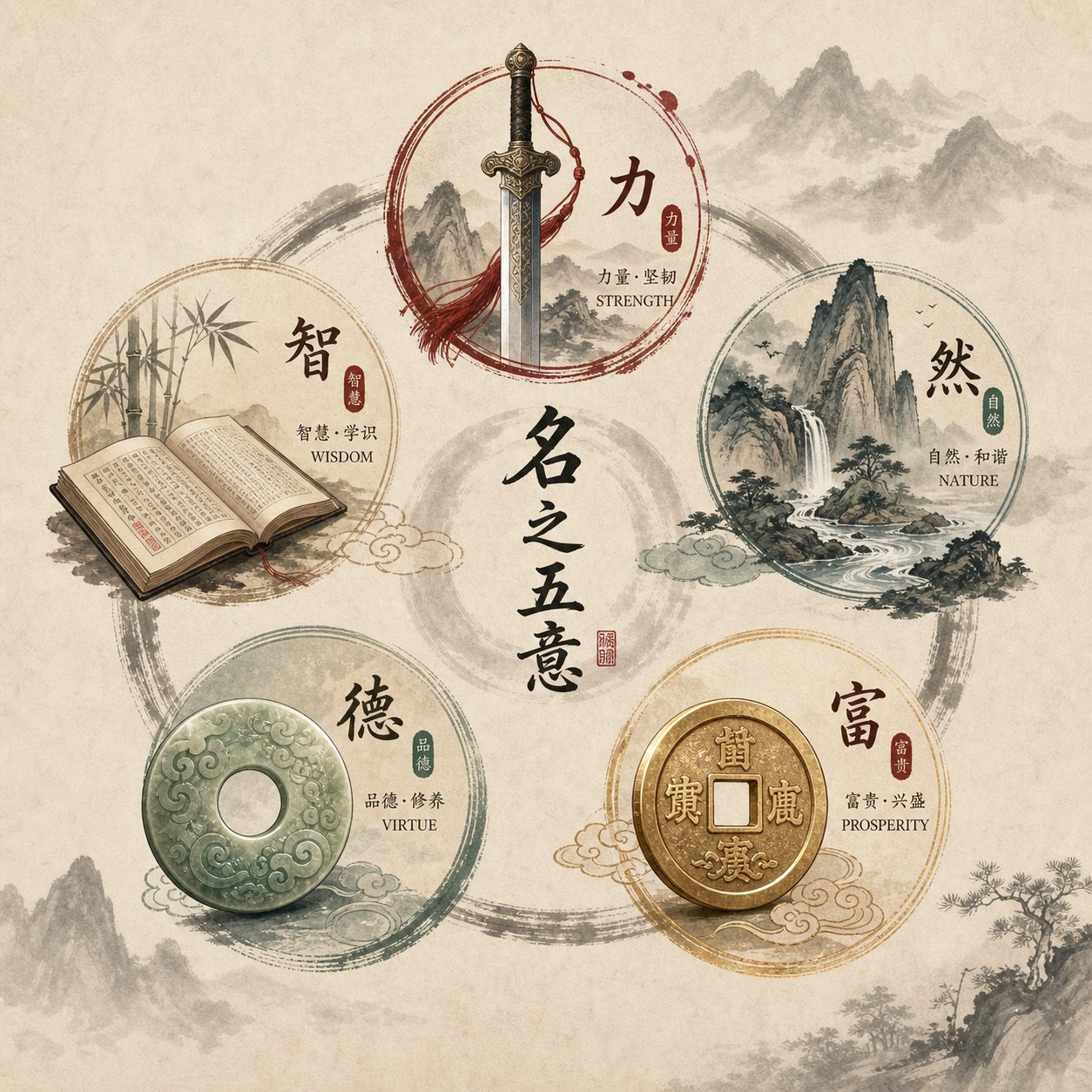
Chinese Boy Names Organized by Meaning
Meaning is the starting point for most Chinese families when naming a son. Rather than browsing alphabetical lists, parents typically begin with a question: what quality do we most want this child to embody? The answer shapes everything that follows — which characters to consider, which literary references to draw from, and which combinations sound right spoken aloud.
Below you will find boy names with meaning organized into five core themes. Each name includes full pinyin with tone marks, the Chinese characters, a breakdown of individual character meanings, and cultural context. Some of these are timeless classics that have worked for centuries. Others reflect modern preferences in China today. Both types carry genuine depth.
Names Meaning Strength and Courage
Strength-themed names remain among the most popular choices for boys across generations. These characters evoke physical power, mental resilience, and the courage to face adversity. Several overlap with the archetype of the chinese warrior — names that carry the energy of legendary generals and heroes from classical texts.
| Pinyin | Characters | Character Breakdown | Combined Meaning | Cultural Note |
|---|---|---|---|---|
| Hóngyì | 弘毅 | 弘 (hóng) "great, expand" + 毅 (yì) "resolute" | Great determination and unyielding will | From the Analerta of Confucius: "A scholar must be broad-minded and resolute" (士不可以不弘毅). Timeless classic. |
| Yìháng | 毅航 | 毅 (yì) "resolute" + 航 (háng) "voyage, navigate" | Resolute voyage through life | Modern name combining classical virtue with contemporary imagery. Trendy since the 2010s. |
| Zhènyún | 震云 | 震 (zhèn) "thunder, shake" + 云 (yún) "cloud" | Powerful as thunder among clouds | Evokes natural force and grandeur. Gender neutral names that mean brave often draw from this thunder imagery. |
| Jùnwěi | 俊伟 | 俊 (jùn) "handsome, talented" + 伟 (wěi) "great, magnificent" | Talented and magnificent | Classic pairing. 伟 was extremely popular in the 1960s-80s but remains strong in compounds. |
| Wēiháng | 威航 | 威 (wēi) "majestic, awe-inspiring" + 航 (háng) "navigate" | Majestic navigator who commands respect | Modern name. 威 carries the authority of a chinese warrior without sounding dated. |
| Yìbó | 一搏 | 一 (yī) "one, whole" + 搏 (bó) "to fight, strive" | Give everything in one bold fight | Contemporary and energetic. Popular among parents who value competitive spirit. |
| Qiánjūn | 千钧 | 千 (qiān) "thousand" + 钧 (jūn) "ancient unit of weight" | The weight of a thousand measures — immense strength | Literary reference to the idiom 千钧一发. Classic and powerful. |
From the Analects of Confucius (论语): "A scholar must be broad-minded and resolute, for the burden is heavy and the road is long" (士不可以不弘毅,任重而道远). The name 弘毅 (Hongyì) draws directly from this passage, making it one of the most culturally resonant boy names in the Chinese tradition.
Names Meaning Wisdom and Brilliance
If you are searching for names meaning bright or smart, this category delivers. Chinese culture places enormous value on intellectual achievement, and these characters reflect that priority. Many reference classical scholarship, philosophical insight, or the brightness of celestial bodies as metaphors for intelligence.
| Pinyin | Characters | Character Breakdown | Combined Meaning | Cultural Note |
|---|---|---|---|---|
| Ruìzhé | 睿哲 | 睿 (ruì) "wise, farsighted" + 哲 (zhé) "philosophical wisdom" | Wise and philosophically brilliant | 睿 is one of the most popular characters in modern Chinese boy names. Trendy and elegant. |
| Bówén | 博文 | 博 (bó) "broad, extensive" + 文 (wén) "literature, culture" | Broadly learned and cultured | References the Confucian ideal of 博学 (broad learning). Timeless across generations. |
| Sīwéi | 思维 | 思 (sī) "to think" + 维 (wéi) "dimension, maintain" | Deep and dimensional thinking | Modern name reflecting contemporary values around critical thinking. |
| Mòchéng | 墨成 | 墨 (mò) "ink, scholarly" + 成 (chéng) "to accomplish" | Scholarly accomplishment | 墨 evokes calligraphy and classical learning. Elegant and literary. |
| Chénxī | 晨熙 | 晨 (chén) "morning" + 熙 (xī) "bright, prosperous" | Bright as the morning light | Very popular in recent years. Carries warmth and optimism alongside intelligence. |
| Jǐngchū | 景初 | 景 (jǐng) "scenery, bright" + 初 (chū) "beginning" | Bright beginning, clear-minded and wise | Poetic and understated. Among the rare names for boys that feel fresh without being unusual. |
| Xuésī | 学思 | 学 (xué) "to learn" + 思 (sī) "to reflect" | One who learns and reflects deeply | Directly from Confucius: "Learning without thought is labor lost" (学而不思则罔). Classic. |
Names Inspired by Nature
Nature-inspired names connect a child to the physical world — mountains, rivers, forests, and sky. These earthy boy names ground a child's identity in something enduring and elemental. In Chinese literary tradition, natural imagery is never merely decorative. A mountain represents steadfastness. Water represents adaptability. The pine tree represents integrity through hardship.
| Pinyin | Characters | Character Breakdown | Combined Meaning | Cultural Note |
|---|---|---|---|---|
| Zéchuān | 泽川 | 泽 (zé) "marsh, grace" + 川 (chuān) "river, plain" | Graceful as flowing rivers | Combines water imagery with generosity. Modern and poetic. |
| Hàoyǔ | 浩宇 | 浩 (hào) "vast" + 宇 (yǔ) "universe" | Vast as the universe | One of the most popular names in China today. Grand in scale. |
| Tiānyì | 天翊 | 天 (tiān) "sky, heaven" + 翊 (yì) "to soar, assist" | Soaring through the heavens | 翊 is a less common character that adds distinction. Trendy and aspirational. |
| Hàochén | 昊辰 | 昊 (hào) "vast sky" + 辰 (chén) "celestial bodies, morning" | Expansive as the sky at dawn | 昊 specifically means the immensity of the sky. Popular modern choice. |
| Sōngbǎi | 松柏 | 松 (sōng) "pine" + 柏 (bǎi) "cypress" | Evergreen integrity — enduring through all seasons | Classic literary image. Pine and cypress symbolize resilience in Tang poetry. |
| Lín | 林 | 林 (lín) "forest" | Abundance, vitality, and growth | Single-character name with a classical feel. Simple yet rich in symbolism. |
| Yǔnán | 允南 | 允 (yǔn) "to allow, sincere" + 南 (nán) "south" | Warm and sincere as the southern wind | 南 evokes warmth and growth. Gentle earthy boy name with literary grace. |
Tang dynasty poet Wang Wei wrote: "In the deep forest, no one is seen; only voices echo in return" (空山不见人,但闻人语响). The character 林 (lin, forest) carries this poetic solitude and depth — a name that suggests both abundance and quiet strength.
Names Meaning Virtue and Good Character
Virtue names are the oldest category in Chinese naming tradition. Rooted in Confucian philosophy, these characters express moral ideals: benevolence, sincerity, loyalty, righteousness. Parents who choose virtue names are making a statement about what matters most — not wealth or power, but the quality of a person's character. The chinese symbol that means love (爱, ài) is rarely used directly in boy names, but its spirit runs through many virtue characters like 仁 (benevolence) and 恩 (grace), which express love through action rather than sentiment.
| Pinyin | Characters | Character Breakdown | Combined Meaning | Cultural Note |
|---|---|---|---|---|
| Jǐngchéng | 璟诚 | 璟 (jǐng) "luster of jade" + 诚 (chéng) "sincerity" | Radiant sincerity, genuine as fine jade | Modern and elegant. 璟 is a refined character gaining popularity. |
| Kūnchéng | 坤诚 | 坤 (kūn) "earth, receptive" + 诚 (chéng) "honest" | Grounded honesty and trustworthiness | 坤 references the I Ching hexagram for earth. Deep philosophical roots. |
| Xiūwén | 修文 | 修 (xiū) "to cultivate" + 文 (wén) "culture, refinement" | Cultivating wisdom and refinement | Implies lifelong self-improvement. Gentle and scholarly. |
| Bǐngdé | 秉德 | 秉 (bǐng) "to hold, uphold" + 德 (dé) "virtue" | One who upholds virtue steadfastly | From the Verses of Chu (楚辞). Ancient literary pedigree. |
| Huáijǐn | 怀瑾 | 怀 (huái) "to hold in one's heart" + 瑾 (jǐn) "fine jade" | Carrying virtue like precious jade within | From Qu Yuan's poetry in the Chu Ci. Represents inner moral beauty. |
| Chéngyǒng | 诚勇 | 诚 (chéng) "sincere" + 勇 (yǒng) "brave" | Sincere and courageous | Also from the Verses of Chu. Combines moral and physical strength. |
| Yìqín | 奕勤 | 奕 (yì) "grand, spirited" + 勤 (qín) "diligent" | Spirited diligence | Modern pairing that values hard work. Harmonious sound. |
Names Meaning Prosperity and Fortune
Prosperity names express the hope that a child will live an abundant, blessed life. These are not about material wealth alone — they encompass good fortune, auspicious circumstances, and the kind of success that benefits others. Many of these characters appear in traditional blessings and festival greetings, giving them a warm, celebratory energy.
| Pinyin | Characters | Character Breakdown | Combined Meaning | Cultural Note |
|---|---|---|---|---|
| Ruìzé | 瑞泽 | 瑞 (ruì) "auspicious" + 泽 (zé) "grace, moisture" | Auspicious blessings that nourish like rain | 瑞 is one of the most beloved fortune characters. Widely used and never dated. |
| Jiāruì | 嘉瑞 | 嘉 (jiā) "excellent, praiseworthy" + 瑞 (ruì) "auspicious" | Excellent fortune and good luck | Double-blessing name. Carries warmth and optimism. |
| Jiāyào | 嘉耀 | 嘉 (jiā) "excellent" + 耀 (yào) "to shine, glory" | Shining excellence and splendor | Modern and bright. 耀 adds radiance to the already positive 嘉. |
| Hóngyǔ | 鸿宇 | 鸿 (hóng) "grand, wild goose" + 宇 (yǔ) "universe" | Grand ambitions spanning the universe | 鸿 references the mythical Peng bird. Literary and aspirational. |
| Ruìlín | 瑞霖 | 瑞 (ruì) "auspicious" + 霖 (lín) "sustained rain" | Blessings falling like nourishing rain | 霖 specifically means rain that lasts — steady, life-giving fortune. |
| Jǐngyún | 景云 | 景 (jǐng) "bright, scenery" + 云 (yún) "cloud" | Bright clouds symbolizing splendor and auspiciousness | From the Verses of Chu. Colorful clouds were omens of imperial favor. A rare name for boys that carries deep literary weight. |
| Zélín | 泽林 | 泽 (zé) "grace, blessing" + 林 (lín) "forest" | One who brings blessings and good fortune abundantly | Combines water grace with wood vitality. Balanced and modern. |
You will notice patterns across these categories. Characters like 宇 (universe), 诚 (sincerity), and 瑞 (auspicious) appear repeatedly because they pair well with many other characters while maintaining strong meaning. The best chinese boy names and meanings emerge not from a single brilliant character, but from the relationship between two characters working together — sound complementing meaning, meaning reinforcing aspiration.
These thematic categories reflect timeless values, but naming trends are not static. The characters parents favor shift with each generation, shaped by literature, politics, popular culture, and evolving ideals of masculinity. Understanding which names feel fresh versus dated to native Chinese speakers adds another layer to the decision.
Traditional Versus Modern Chinese Naming Trends
Chinese first names are never created in a vacuum. They mirror the values, politics, and cultural currents of the era in which they are chosen. A name that sounded aspirational in 1960 can sound dated today, and a name that feels fresh right now may become the next generation's cliche. For parents choosing a name that will serve their son for a lifetime, understanding this generational context is essential.
Classical Names From Literature and Philosophy
For centuries, educated Chinese families drew names directly from canonical texts — the Analects of Confucius, the Mencius, the Book of Songs (诗经), and the books of Tang poet collections that shaped imperial Chinese literary culture. These names encoded moral philosophy into a child's identity, expressing the Confucian virtues that defined a good man: benevolence, righteousness, loyalty, and wisdom.
- 仁杰 (Renjie) — 仁 (ren, benevolence) + 杰 (jie, outstanding). Directly references the Confucian cardinal virtue. Associated with the legendary Tang dynasty judge Di Renjie.
- 义山 (Yishan) — 义 (yi, righteousness) + 山 (shan, mountain). Evokes moral steadfastness. The Tang poet Li Shangyin used 义山 as his courtesy name.
- 修远 (Xiuyuan) — From Qu Yuan's Verses of Chu: "The road ahead is long and far; I shall search high and low" (路漫漫其修远兮). A name about lifelong pursuit of truth.
- 浩然 (Haoran) — From Mencius's teaching about cultivating one's "vast, righteous qi." Also the given name of the great Tang poet Meng Haoran. This name bridges classical and modern eras seamlessly.
- 思齐 (Siqi) — From the Analects: "When you see a worthy person, think of equaling them" (见贤思齐). Expresses the aspiration to match the virtuous.
These literary names carry weight precisely because Chinese speakers recognize their sources. A boy named 浩然 carries Mencius and Tang poetry in his name simultaneously — that kind of layered resonance is what makes classical names endure.
Modern Naming Trends in China Today
The most common chinese names have shifted dramatically over the past few decades. According to data from China's Ministry of Public Security, the top boy names in 2021 were dominated by characters like 沐 (mu, bathe), 宇 (yu, universe), 泽 (ze, grace), and 辰 (chen, celestial bodies). Names like 沐宸 (Muchen), 浩宇 (Haoyu), and 奕辰 (Yichen) reflect a new aesthetic — poetic, nature-inflected, and cosmic in scale.
Several forces are driving this shift:
- Nature and cosmos imagery — Characters evoking sky, stars, rain, and light have surged. Parents favor names like 沐阳 (Muyang, "bathed in sunlight") and 宇泽 (Yuze, "universe grace") that feel expansive and luminous.
- Return to classical literature — Younger parents are drawing from ancient texts again, but with a lighter touch. The popular name 一诺 (Yinuo) comes from the idiom 一诺千金 ("a promise worth a thousand gold pieces"), blending tradition with modern brevity.
- Pop culture influence — After the TV drama Treading On Thin Ice aired in 2011, a wave of babies were named 若曦 (Ruoxi) after the heroine. Celebrity names also inspire homophonic variations — parents borrow the sound but swap in different characters for uniqueness.
- Double-character dominance — Over 93% of babies born in 2021 received two-character given names, a deliberate move away from the single-character trend of the 1970s-90s that produced millions of name duplicates.
Which Names Sound Timeless Versus Dated
This is the practical question that matters most. When a native Chinese speaker hears a name, they instinctively place it in a generational context — the same way an English speaker might associate "Gertrude" with one era and "Liam" with another. Choosing a name that sounds timeless rather than locked to a specific decade requires knowing which names fall where.
Names that now sound dated:
- 建国 (Jianguo) — "Build the country." Peak popularity in the 1950s after the founding of the People's Republic. Over 960,000 people carry this name. It signals a specific political era immediately.
- 军 (Jun) — "Army." Dominated the 1960s-70s during imperial Chinese-style military campaigns and the Cultural Revolution. Sounds generationally locked.
- 伟 (Wei) — "Great." The single most common chinese names character for boys from the 1980s through the 1990s. 张伟 (Zhang Wei) alone has 294,282 bearers. Functional but now feels generic.
- 强 (Qiang) — "Strong." Popular in the 1970s-80s. Simple and direct, but lacks the poetic layering modern parents prefer.
Names that feel current and fresh:
- 宇轩 (Yuxuan) — "Universe, elevated." Top-ten name in the 2010s and still popular. Cosmic and elegant.
- 沐宸 (Muchen) — "Bathed in celestial abode." The number-one boy name in 2021. Poetic and distinctive.
- 奕辰 (Yichen) — "Grand celestial bodies." Modern, aspirational, and phonetically smooth.
Names that transcend eras:
- 浩然 (Haoran) — Works in any decade because its Mencius reference gives it permanent literary authority. Currently a top-ten name while also being centuries old.
- 明哲 (Mingzhe) — "Brilliant wisdom." Never trendy enough to become a fad, never dated enough to feel old.
- 博文 (Bowen) — "Broadly learned." Confucian roots keep it grounded; clean sound keeps it modern.
The pattern is clear. Names tied to political movements or single-character simplicity tend to age poorly. Names rooted in philosophical texts or natural imagery tend to endure, because their source material is itself timeless. The safest path for parents seeking longevity is to choose characters with literary depth that are not currently at peak saturation — popular enough to sound natural, distinctive enough to avoid becoming the next 伟 (Wei).
Beyond era and aesthetics, though, many traditional families consider something deeper when selecting a name: the balance of elemental forces in a child's birth chart, and how specific characters can harmonize what nature left incomplete.
Five Elements and Feng Shui Naming Explained
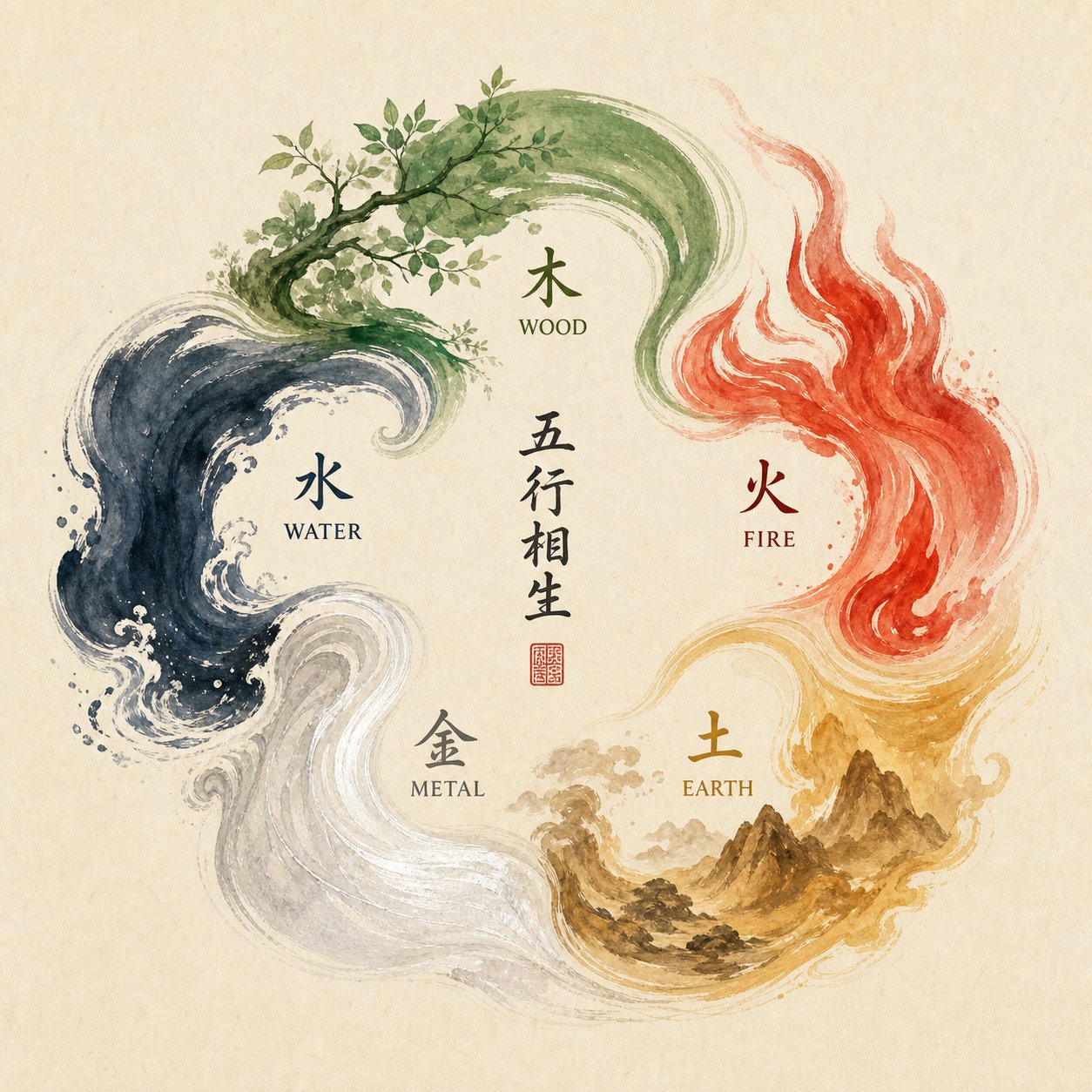
Some parents choose a name purely by meaning and sound. Others go deeper, consulting a system that has guided Chinese naming for over two thousand years. The Five Elements framework — called wǔxíng (五行) — treats a name not just as a label but as an energetic prescription, one designed to balance forces that were set in motion the moment a child was born.
The character xíng (行) is often mistranslated as "element," but it actually means "movement" or "phase." These are not static building blocks like entries on the periodic table. They are five dynamic patterns of energy — Wood, Fire, Earth, Metal, and Water — each flowing into and regulating the next. When applied to naming, the goal is to identify which phase a child's chart lacks or has in excess, then select chinese word symbols whose radicals and meanings supply what is missing.
The Five Elements and Their Name Characters
Each element carries distinct qualities and connects to specific character radicals. A radical is the structural component within a Chinese character that signals its category — think of it as a built-in tag revealing the character's elemental DNA. When parents or naming specialists look for characters with auspicious meaning tied to a particular element, they search for these radicals first.
Here is how the five phases map to naming in practice:
| Element | Energy Quality | Associated Radicals | Example Characters | Sample Boy Names |
|---|---|---|---|---|
| Wood (木 mu) | Growth, vitality, spring | 木 (wood), 艹 (grass) | 林 (lin, forest), 桐 (tong, paulownia), 荣 (rong, flourish) | 柏林 (Bailin), 梓轩 (Zixuan) |
| Fire (火 huo) | Radiance, passion, summer | 火 (fire), 灬 (fire dots) | 炎 (yan, flame), 煜 (yu, radiant), 焕 (huan, brilliant) | 煜祺 (Yuqi), 炎彬 (Yanbin) |
| Earth (土 tu) | Stability, grounding, harvest | 土 (earth), 山 (mountain) | 坤 (kun, earth), 岳 (yue, peak), 城 (cheng, city) | 坤宇 (Kunyu), 岳峰 (Yuefeng) |
| Metal (金 jin) | Precision, resilience, autumn | 金 (metal), 钅 (metal variant) | 铭 (ming, inscription), 锐 (rui, sharp), 鑫 (xin, prosperity) | 铭泽 (Mingze), 锐轩 (Ruixuan) |
| Water (水 shui) | Wisdom, adaptability, winter | 氵 (water), 雨 (rain) | 涵 (han, contain), 泽 (ze, grace), 润 (run, moist) | 浩泽 (Haoze), 涵宇 (Hanyu) |
Notice how the character 泽 (ze, meaning "grace" or "marsh") contains the water radical 氵 on its left side. That radical is not decorative — it marks the character as carrying Water energy. Similarly, 铭 (ming, "inscription") contains the metal radical 钅, making it a natural choice for charts needing Metal reinforcement. Understanding these chinese symbols and meanings at the radical level is what separates intentional naming from guesswork.
How Birth Charts Guide Name Selection
The starting point for elemental naming is the bāzì (八字), literally "eight characters." This birth chart is calculated from the child's exact year, month, day, and hour of birth, each expressed as a pair of characters from the Heavenly Stems and Earthly Branches system. Together, these eight characters reveal the distribution of Wood, Fire, Earth, Metal, and Water in the child's energetic makeup.
A naming specialist reads the chart looking for three things:
- The Day Master — the element representing the child's core self, which determines whether the chart needs support or release
- Missing or weak elements — phases entirely absent or underrepresented, which may benefit from supplementation through name characters
- Dominant elements — energies that are overly abundant and may need to be drained or controlled through the generating and controlling cycles
Imagine a boy born in autumn with a Wood Day Master. Autumn is Metal season, and Metal controls Wood in the controlling cycle. If his chart also shows little Water, his Wood self lacks nourishment (since Water feeds Wood in the generating cycle). A naming specialist might recommend characters carrying Water energy — like 涵 (han, "to contain deeply") or 泽 (ze, "grace") — to support his core element. The name becomes a quiet counterbalance to what the birth timing left incomplete.
This is not about mechanically patching a missing element. A character must still sound harmonious with the surname, carry positive meaning, and look balanced when written. The elemental dimension adds direction without overriding the other considerations. Think of it as a compass pointing toward certain characters rather than a rigid formula.
The Role of Naming Masters in Chinese Families
In many traditional families, naming is not a solo parental decision. A naming master (取名师 qǔmíng shī) is consulted — someone trained in bāzì analysis, Five Elements theory, stroke count evaluation, and classical literature. This practice is sometimes called lucky star chinese naming (吉星取名), reflecting the belief that a well-chosen name aligns a child with favorable cosmic forces.
Beyond elemental balance, naming masters evaluate two additional dimensions:
Stroke count (笔画 bǐhuà): Traditional numerology assigns significance to the total number of strokes in each character and in the full name. Certain stroke-count combinations are considered auspicious, while others are avoided. A master calculates the stroke count of the surname and tests how different given-name characters produce favorable totals.
Tonal flow and visual balance: The full name — surname plus given name — must move through tones that feel natural when spoken aloud. Three consecutive third-tone characters, for example, create an awkward rhythm. Visually, a dense surname with many strokes pairs better with lighter given-name characters, and vice versa. The written name should look balanced as a unit, whether on a document or a calligraphy scroll.
For families navigating this system from abroad, translating traditional chinese to english explanations can feel overwhelming. The core principle is simpler than it appears: a naming master is looking for harmony across sound, form, meaning, and elemental energy — all at once. Each character must satisfy multiple dimensions simultaneously, which is why the process can take weeks of deliberation rather than a single afternoon.
Whether you consult a naming master or apply these principles independently, the Five Elements framework adds a layer of intentionality that pure aesthetics cannot provide. It connects a child's name to the specific moment they entered the world — making the name not just a wish, but a personalized one.
Elemental balance operates at the individual level, but Chinese naming also carries a collective dimension. Many families use a shared character across an entire generation of children, weaving siblings and cousins into a visible thread of lineage that stretches back centuries.
Generational Naming and Family Legacy
Individual meaning and elemental balance shape a single child's name. But in many Chinese families, naming also serves a collective purpose — linking brothers, sisters, and cousins through a shared character that signals exactly which generation they belong to. This tradition is called 字辈 (zibei), and it transforms common names and surnames into a living map of family lineage.
How Generational Characters Connect Family Members
The concept is straightforward. A family designates one specific character to appear in the given names of all children — or all sons — born into the same generation. The second character then individualizes each child. When you encounter male chinese given names like 建国 (Jianguo), 建军 (Jianjun), and 建华 (Jianhua) among brothers or cousins, the shared 建 (jian, "build") instantly marks them as generational peers.
This shared character does more than signal kinship. It creates an immediate visual and phonetic bond between siblings and cousins who might live in different cities or even different countries. You can hear the family connection the moment their names are spoken together. The practice also prevents confusion across generations — a grandfather, father, and son each carry a different generational character, making their position in the family tree unmistakable.
While this tradition has declined in urban China, where smaller families and modern sensibilities favor individual expression, it remains meaningful in many clans. Among diaspora families seeking to maintain heritage connections, generational naming is experiencing a quiet revival. It offers a tangible way to preserve unique names and surnames traditions even when the family is scattered across continents.
The Generational Poem Tradition
Where do these generational characters come from? In many families, they are drawn from a 字辈诗 (zibei shi) — a generational poem composed by important ancestors, sometimes centuries ago. As novelist Wendy Chen describes, a generation poem is a poem that a clan agrees to use when naming descendants. The first word is used for the first generation, the second word for the next, and so on. When the family reaches the last word, they cycle back to the beginning.
These poems were typically composed by respected progenitors or clan elders, and occasionally even bestowed by emperors upon noble families. Each character in the poem carries its own auspicious meaning, so the sequence itself reads as a multi-generational blessing — a wish that unfolds across centuries rather than a single lifetime.
Here is how a sample three-generation naming sequence works within one family surnamed 陈 (Chen), using the generational poem characters 德 (de, "virtue"), 志 (zhi, "ambition"), and 明 (ming, "bright"):
- Generation 1 — shared character 德 (de): 陈德文 (Chen Dewen), 陈德华 (Chen Dehua), 陈德林 (Chen Delin). All brothers or male cousins carry 德 as their first given-name character, with the second character personalizing each individual.
- Generation 2 — shared character 志 (zhi): 陈志远 (Chen Zhiyuan), 陈志强 (Chen Zhiqiang), 陈志明 (Chen Zhiming). The sons of Generation 1 all share 志, immediately identifying them as the next generation.
- Generation 3 — shared character 明 (ming): 陈明轩 (Chen Mingxuan), 陈明泽 (Chen Mingze), 陈明瑞 (Chen Mingrui). The poem advances one character, and the pattern continues.
Notice how chinese given names male in this system carry dual information: the generational character tells you where someone sits in the family timeline, while the individual character tells you who they are within that generation. The result is a naming system where every name is simultaneously personal and communal — a balance that reflects the broader Chinese philosophy of individual identity existing within collective belonging.
For multicultural families, generational naming offers a powerful anchor. Even if a child primarily uses an English name in daily life, carrying a generational character in their Chinese name ties them to cousins, grandparents, and ancestors in a way that no standalone name can replicate.
That connection between Chinese and English names — how to make both work together without sacrificing either — is its own art, one that diaspora families navigate with every child born between two cultures.
Pairing Chinese and Western Names for Multicultural Families
Multicultural families face a naming challenge that single-culture families never encounter: giving a child two names that each carry full weight in their respective worlds. A Chinese name needs to satisfy grandparents, work at Chinese school, and hold its own among native speakers. An English name needs to flow naturally in classrooms, on resumes, and in everyday introductions. The question is not which name matters more — it is how to make both names feel like they belong to the same child.
Research into Chinese American naming practices confirms that parents navigate complex linguistic, cultural, and pragmatic considerations when choosing names for children growing up between two languages. The good news: there are proven strategies that create coherence between a Chinese and English name without forcing either one to compromise.
Phonetic Bridging Between Chinese and English Names
Phonetic bridging is the most intuitive approach. You choose a Chinese name and an English name that share similar sounds, creating an audible link between the two. When someone hears one name, the other feels like a natural echo rather than a completely separate identity.
The kai meaning in Chinese offers a perfect example. The character 凯 (kai, third tone) means "triumphant" or "victorious." The English name Kai — increasingly popular as an asian boy name in Western countries — sounds nearly identical. A boy named 凯文 (Kaiwen) in Chinese and Kevin in English carries a phonetic thread between both worlds. His grandparents in Shanghai and his teachers in Toronto are essentially calling him by the same sound.
Phonetic bridging works best when the shared sound maps to a Chinese character with genuinely positive meaning. Not every English name has a flattering Chinese homophone. The character matters as much as the sound — this is where many parents stumble if they rely on a chinese name generator without understanding the characters being suggested. A chinese name generator male tool might produce phonetically similar options, but only a human eye can verify that the characters carry the right connotations and avoid unfortunate homophones.
Strong phonetic bridges for asian names for boys include:
- Leo / 利奥 (Li'ao) — The English name sounds close to the pinyin, and 利 means "sharp, beneficial"
- Ryan / 睿安 (Rui'an) — 睿 means "wise" and 安 means "peaceful," creating a meaningful Chinese name that echoes the English sound
- Ethan / 逸涵 (Yihan) — A looser phonetic match, but the opening vowel sound connects them
Meaning Mirroring Across Languages
Meaning mirroring takes a different path. Instead of matching sounds, you match the underlying meaning or theme across both names. The Chinese and English names might sound nothing alike, but they express the same aspiration — creating a conceptual unity that feels intentional even when the phonetics diverge.
Imagine you want your son's name to carry the theme of light and brightness. In English, you might choose Lucas (from the Latin "lux," meaning light). In Chinese, you could pair it with 明辉 (Minghuī) — 明 meaning "bright" and 辉 meaning "radiance." The names share no sounds, but they share a soul. When your child asks "what does my name mean," both answers point in the same direction.
This strategy works especially well for parents who want each name to feel fully authentic in its own language rather than one being a transliteration of the other. The Chinese name follows Chinese naming conventions completely. The English name follows English conventions completely. The connection lives in meaning, not sound.
Common meaning themes that bridge well:
- Strength: Andrew ("manly, strong") paired with 刚毅 (Gangyi, "firm and resolute")
- Wisdom: Sage paired with 睿哲 (Ruizhe, "wise and philosophical")
- Nature: Forest paired with 林 (Lin, "forest") — here meaning and sound partially overlap
- Light: Felix ("fortunate, happy") paired with 瑞祺 (Ruiqi, "auspicious and blessed")
Practical Pairings That Work in Both Worlds
Beyond strategy, there are practical realities to consider. How will each name actually be used day to day? In most multicultural families, the pattern looks something like this: the English name handles school enrollment, medical records, and social introductions. The Chinese name appears on family registers, gets used by Chinese-speaking relatives, and anchors the child's identity at Chinese language school or cultural events. Some families put both names on legal documents — the English name as the legal first name and the Chinese name as a middle name, or vice versa.
Knowing this usage pattern helps you evaluate pairings. A Chinese name that is difficult for English speakers to approximate does not need to be "easy" — it just needs to work in the contexts where it will actually be spoken. Similarly, an English name does not need to sound Chinese. It needs to sound like the child it belongs to.
The table below shows practical pairings that real families use, with the reasoning behind each combination:
| Chinese Name (Pinyin + Characters) | English Name | Pairing Strategy | Why It Works |
|---|---|---|---|
| 凯文 (Kǎiwén) — triumphant and cultured | Kevin | Phonetic bridge | Nearly identical opening sound; 凯 carries genuine positive meaning (victory) |
| 明辉 (Mínghuī) — bright radiance | Lucas | Meaning mirror | Both names mean "light" in their respective etymologies |
| 睿安 (Ruì'ān) — wise and peaceful | Ryan | Phonetic bridge | Rui-an echoes Ryan closely; both characters are independently strong |
| 志远 (Zhìyuǎn) — far-reaching ambition | Ambrose | Meaning mirror | Ambrose means "immortal" — both names express grand aspiration |
| 浩然 (Hàorán) — vast righteous spirit | Grant | Meaning mirror | Grant means "great, large" — both carry expansive energy |
| 天乐 (Tiānlè) — heavenly joy | Felix | Meaning mirror | Felix means "happy, fortunate" — both names center on joy and blessing |
| 利奥 (Lì'ào) — sharp and proud | Leo | Phonetic bridge | Sound match is almost exact; 利 adds sharpness that complements Leo's lion imagery |
| 嘉恩 (Jiā'ēn) — excellent grace | Jason | Phonetic bridge | Jia-en approximates Jason; 嘉 and 恩 are both warm, positive characters |
| 林 (Lín) — forest | Forrest | Meaning mirror + phonetic hint | Direct translation of meaning; both names evoke natural abundance |
| 博文 (Bówén) — broadly learned | Bennett | Phonetic bridge | Bo-wen and Bennett share the opening consonant cluster; 博文 carries scholarly weight |
You will notice that some pairings blend both strategies — 林 (Lin) and Forrest share meaning and partial sound. These hybrid pairings often feel the most natural because the connection works on multiple levels simultaneously.
A study published in the Journal of Multilingual and Multicultural Development found that multilingual individuals actively seek coherence among their names across languages, often choosing names with phonological or semantic connections to maintain a unified sense of identity. The participants in that research described their different-language names as representing "different versions of me" — not separate identities, but facets of one whole person. That insight matters for parents: the goal is not to create two disconnected labels, but two expressions of the same child.
Whatever pairing strategy you choose, test the full combination spoken aloud. Say the English first name followed by the Chinese name. Say the Chinese full name (surname included) on its own. Ask yourself: does each name sound complete and dignified in its own context? If the answer is yes for both, you have found a pairing that honors both worlds without asking either to shrink.
Finding the right pairing is one challenge. Avoiding names that carry hidden problems — embarrassing homophones, unintended double meanings, or cross-dialect issues — is another, and one that trips up even well-intentioned parents who do not speak Chinese fluently.
Names to Approach with Caution and Common Pitfalls
Chinese is a language where a single misplaced tone or an overlooked homophone can turn a dignified name into a schoolyard joke. The tricky part: these problems are invisible to anyone who does not speak the language fluently. A name might look beautiful on paper, carry a lovely meaning character by character, and still produce cringes when spoken aloud in combination with certain surnames. Knowing what to avoid is just as important as knowing what to choose.
Homophones and Unintended Meanings
Mandarin has a limited number of syllables — roughly 400 — spread across four tones. That means homophones are everywhere, and certain character combinations sound identical to words you absolutely do not want as a child's name. The danger multiplies when the surname enters the picture.
- Surname + given name collisions: The surname 杨 (Yang) paired with 伟 (Wei) produces Yang Wei — which sounds identical to 阳痿, meaning "impotence." The characters are completely different, but spoken aloud, the damage is done.
- Death-adjacent sounds: Characters containing the syllable "si" in fourth tone (like 思, "to think") can echo 死 (si, "death") when combined with certain other syllables. The combination 思旺 (Siwang, "thinking of prosperity") sounds nearly identical to 死亡 (siwang, "death").
- Vulgar homophones: The character 日 (ri) means "sun" or "day," but in colloquial speech it functions as a crude expletive. Names containing ri in certain positions can trigger unintended associations.
- The shi meaning trap: The syllable "shi" maps to dozens of characters — 诗 (poetry), 石 (stone), 世 (world), 事 (matter), and 屎 (excrement). A parent who selects a name based on pinyin alone, without specifying the exact character, risks landing on the wrong shi meaning entirely.
- Cross-dialect issues: A name that sounds elegant in Mandarin may produce awkward or funny chinese names when pronounced in Cantonese, Hokkien, or Shanghainese. The character 翠 (cui, "jade green") is perfectly fine in Mandarin but sounds close to a vulgar word in Cantonese. If your family speaks multiple dialects, test the name in each one.
These are not hypothetical risks. Naming experts consistently flag homophone collisions as one of the most common and embarrassing mistakes in Chinese name selection — one that native speakers catch instantly but non-speakers never see coming.
How to Verify Your Name Choice
Before committing to any name, run it through a multi-step verification process. This is not overcautious — it is standard practice for Chinese families who take naming seriously.
- Say the full name aloud repeatedly. Surname plus given name, spoken at natural speed. Listen for any syllable combinations that echo negative words. Say it fast, say it slow, say it in a sentence.
- Check multiple dictionaries. Look up each character individually and in combination. Online dictionaries like MDBG or Pleco show all meanings, including colloquial and slang usages that a basic lookup might miss.
- Ask native speakers from different regions. A Mandarin speaker from Beijing, a Cantonese speaker from Guangdong, and a Hokkien speaker from Fujian will each hear the name differently. What sounds fine in one dialect may be problematic in another. As language educators emphasize, having multiple native speakers check your name is crucial before you finalize it.
- Search the name online. Type the full name in Chinese characters into a search engine. If the results surface weird asian names lists, jokes, or memes, reconsider.
- Test the xiao meaning context. In Chinese, adding 小 (xiao, meaning "little" or "young") before a name is a common nickname pattern. Check whether 小 + your chosen name creates any unfortunate sounds. For example, 小熊 (Xiao Xiong, "little bear") is endearing, but other combinations may not be.
Common Mistakes Non-Chinese Speakers Make
Parents who do not read Chinese face a specific set of traps that native speakers would never fall into. These mistakes stem from treating pinyin as the name rather than as a pronunciation guide for characters.
- Choosing by pinyin alone: Selecting "Chao" because it looks appealing, without knowing whether you mean 超 ("surpass"), 朝 ("dynasty"), or 吵 ("noisy"). The chow meaning question works similarly — the romanization "Chow" could represent 周 (a surname meaning "cycle"), 丑 ("ugly"), or 臭 ("smelly") depending on the character and tone.
- Mixing character genders: Some characters carry strong feminine associations. A boy named with 婷 (ting, "graceful") or 萱 (xuan, "daylily") will face constant confusion from Chinese speakers who assume the name belongs to a girl.
- Using overly literal translations: Translating an English concept directly into Chinese often produces names that sound childish or bizarre. "Strong" becomes 强 (Qiang), which is functional but dated. "Happy" becomes 快乐 (Kuaile), which no Chinese parent would use as a given name — it sounds like a brand slogan, not a person.
- Ignoring stroke balance: A surname with two strokes (like 丁, Ding) paired with a given name containing characters of 20+ strokes each creates visual imbalance. The written name looks lopsided, which matters in a culture where calligraphy and visual harmony carry weight.
- Copying celebrity names directly: Naming a child after a famous historical figure or pop star — like using 李白 (Li Bai) or 成龙 (Jackie Chan's Chinese name) — comes across as presumptuous rather than flattering. Draw inspiration from the qualities these figures represent, not their actual names.
The common thread across all these pitfalls: Chinese naming requires understanding characters, not just sounds. Pinyin is a tool for pronunciation. The characters are the name. And the full name — surname plus given name, spoken in context, heard across dialects — is what your child will actually live with. Take the time to verify thoroughly, and you will avoid the mistakes that haunt parents who rushed the decision.
With pitfalls mapped and verification steps in hand, the final challenge is pulling every consideration together — meaning, sound, tradition, elemental balance, cross-cultural pairing, and practical usability — into a single coherent decision.
How to Choose the Perfect Chinese Boy Name
You have explored meaning categories, studied tonal mechanics, learned about elemental balance, and mapped the pitfalls. The knowledge is there. The challenge now is turning all of it into one clear decision — a name that feels right when you say it, looks right when you write it, and carries the right weight when your son grows into it.
Feeling overwhelmed at this stage is normal. Chinese male names carry so many layers — literary resonance, family tradition, phonetic harmony, elemental theory — that the decision can feel paralyzing. The framework below cuts through that paralysis by giving you a sequence. Work through each step in order, and by the end, your list of hundreds will narrow to a handful of strong candidates.
A Step-by-Step Framework for Choosing the Right Name
This process works whether you are choosing from a position of deep cultural knowledge or approaching chinese names male for the first time. Each step builds on the one before it, progressively filtering your options until only the strongest names remain.
- Decide on meaning themes that reflect your hopes for your child. Start with the question every Chinese family begins with: what do you most want this name to say? Strength and resilience? Wisdom and curiosity? Connection to nature? Moral integrity? You do not need to pick just one theme, but narrowing to two or three gives you a focused pool of characters to work with. Write down five to ten characters whose meanings resonate, then look for combinations that create compound meaning greater than either character alone.
- Consider family naming traditions or generational characters. Before you fall in love with a particular combination, check whether your family follows a generational poem (字辈) or has naming conventions you should honor. If a generational character is assigned, that character becomes fixed — your creative work happens in the second character. Even if your family does not follow this tradition strictly, asking elder relatives whether they have preferences shows respect and may surface meaningful suggestions you had not considered.
- Check five-element compatibility if following traditional practice. If your family values bazi analysis, consult a naming specialist or use the child's birth date and time to identify which elements are weak or missing. Then filter your character shortlist for those containing radicals associated with the needed element. This step is optional for families who do not follow traditional metaphysics, but for those who do, it narrows the field significantly and adds a layer of personalized intention.
- Evaluate tonal harmony with your surname. Take your surname's tone and test how each candidate name flows after it. Three consecutive third tones feel clunky. A fourth-tone surname followed by two fourth-tone characters sounds aggressive. The ideal full name moves through varied tones that feel musical when spoken at natural speed. Say each combination aloud as if calling your child across a park — that everyday-use test reveals tonal problems immediately.
- Test for homophones and cross-dialect issues. For every surviving candidate, speak the full name (surname + given name) quickly and listen for accidental words. Check whether the combination sounds like anything negative in Mandarin, and if your family speaks Cantonese, Hokkien, or another dialect, test it there too. Search the full name in Chinese characters online to see if it surfaces any unfortunate associations. This single step eliminates more names than any other.
- If multicultural, assess pairing with the English name. For families using both a Chinese and English name, evaluate whether the two names connect through sound, meaning, or both. They do not need to match perfectly — many names of chinese male children work beautifully as independent identities in each language. But if a phonetic or semantic bridge exists naturally, it creates coherence that your child will appreciate as they move between cultural contexts.
- Get feedback from native Chinese speakers. This is the step that naming guides consistently emphasize as non-negotiable. Share your top two or three candidates with native speakers — ideally from different regions and age groups. Ask them what impression the name gives. Does it sound like a real person's name? Does it feel age-appropriate? Would they associate it with a particular era or social class? A native ear catches nuances that dictionaries cannot convey. If your candidates survive this test without raised eyebrows or suppressed laughter, you have found strong options.
Balancing Meaning, Sound, and Practicality
No name scores perfectly on every dimension. A character with profound literary meaning might create a tonal clash with your surname. A phonetically smooth combination might lack the depth you want. The art is in finding the name that satisfies the most important criteria without failing catastrophically on any single one.
Here is a practical way to think about priorities. Meaning is the foundation — a name your child cannot be proud of explaining is a name that will not serve them well. Sound is the daily reality — asian male names that feel awkward to say get shortened, nicknamed, or avoided. And cultural authenticity is the long game — chinese names for men that sound natural to native speakers give your son credibility and belonging in Chinese-speaking contexts for his entire life.
When two candidates feel equally strong, ask yourself one final question: which name can my son grow into? A name chosen for a baby needs to work just as well on a university application, a business card, and a wedding invitation decades from now. The best male chinese names are not cute or clever. They are spacious enough to hold an entire life.
The goal is not a perfect name. The goal is a name your child can grow into — one that carries your hopes without limiting who they become.
Trust the process, trust the people you consult, and trust that the care you are putting into this decision already honors the tradition behind it. A name chosen with this much intention is already doing what Chinese names have always done: compressing love, wisdom, and hope into a few characters that will travel with your child wherever life takes them.
Frequently Asked Questions About Chinese Boy Names
1. How are Chinese boy names structured differently from English names?
Chinese names place the surname first, followed by a one- or two-character given name. Each character functions as an independent word with its own meaning, so a two-character given name creates compound meaning — essentially a compressed wish or aspiration. For example, 志远 (Zhiyuan) combines 志 (ambition) and 远 (far-reaching) to express 'ambition that reaches far.' Most modern Chinese boy names use two given-name characters because this allows richer meaning combinations and helps distinguish the child from the millions who share common surnames like Wang, Li, or Zhang.
2. Why do tones matter when choosing a Chinese name?
Mandarin has four tones, and the same pinyin syllable pronounced with a different tone becomes an entirely different character with a completely different meaning. For instance, 明 (ming, second tone) means 'bright' while 命 (ming, fourth tone) means 'fate.' Parents who select a name based only on how the romanized spelling looks — without confirming the exact characters and tones — risk choosing a name with unintended or even negative meaning. Always verify the specific Chinese characters rather than relying on pinyin alone.
3. What are the most popular Chinese boy name themes?
The five most common meaning themes for Chinese boy names are strength and courage (characters like 毅 meaning resolute), wisdom and brilliance (characters like 睿 meaning farsighted), nature and elements (characters like 泽 meaning grace or 宇 meaning universe), virtue and character (characters like 诚 meaning sincerity), and prosperity and fortune (characters like 瑞 meaning auspicious). Parents typically start by choosing a theme that reflects their hopes for the child, then search for character combinations that create harmonious compound meanings within that theme.
4. How does the Five Elements system influence Chinese baby naming?
The Five Elements (wuxing) system uses a child's birth date and time to calculate their bazi (eight characters) chart, revealing which elements — Wood, Fire, Earth, Metal, or Water — are strong, weak, or missing. Parents or naming masters then select characters containing radicals associated with the needed element to create balance. For example, a child lacking Water energy might receive a name with the water radical 氵, such as 涵 (han, meaning 'to contain deeply') or 泽 (ze, meaning 'grace'). The name functions as an energetic prescription personalized to the child's birth moment.
5. How can multicultural families pair a Chinese name with an English name?
Three main strategies work well. Phonetic bridging matches similar sounds across languages — like pairing 凯文 (Kaiwen, meaning 'triumphant and cultured') with Kevin. Meaning mirroring connects names through shared themes rather than sound — like pairing 明辉 (Minghui, meaning 'bright radiance') with Lucas (from Latin 'lux' meaning light). Independent selection lets each name stand fully authentic in its own language. The key is testing both names in their actual usage contexts and getting feedback from native speakers in both languages.