Why Cultural Meaning Defines Chinese Brand Names
Cultural meaning in Chinese brand naming refers to the layered significance — semantic, phonetic, visual, and symbolic — embedded within every character chosen to represent a brand. Unlike alphabetic languages where letters primarily represent sounds, Chinese characters convey brand meaning through form, pronunciation, and centuries of cultural association simultaneously. This makes the process of naming a brand in Chinese fundamentally different from naming one in English, French, or any other Latin-script language.
Imagine picking a brand name where each "letter" is also a picture, a concept, and a sound all at once. That's the reality of Chinese. Because the language is character-based, every brand name can be interpreted as the sum of its parts — and consumers do exactly that, actively reading into each character's individual and combined meanings.
Why Every Character Carries Cultural Weight
Chinese brand names carry cultural weight because characters are not arbitrary symbols. A single character like 优 can mean "excellent," while 佑 means "bless" — both share the same pinyin pronunciation "you" but project entirely different brand identities. When consumers encounter a brand name, they don't just hear it. They see its visual structure, recall its historical associations, and judge whether those layers align with the product or service being offered. The cultural significance of Chinese brand names lies in this multi-dimensional interpretation that happens instantly and instinctively.
Chinese characters function as meaning-carriers, not mere phonetic symbols. Every stroke, radical, and tonal inflection communicates something — making a Chinese brand name less like a label and more like a cultural statement consumers actively decode.
The Stakes of Getting It Right or Wrong
Getting this wrong carries real consequences. Before Coca-Cola standardized its official Chinese name, local shop owners transliterated it in ways that produced meanings as absurd as "bite the wax tadpole." Getting it right, however, creates lasting equity — their eventual name, 可口可乐 (ke kou ke le), translates to "makes mouths happy," perfectly reinforcing the brand's identity. A Chinese brand name isn't just identification. It's a promise, a personality, and a cultural position — all compressed into two or three characters that consumers will judge in a fraction of a second.
What makes this process so complex isn't just meaning alone. It's the interplay between how characters look, how they sound across different dialects, and what structural elements they contain — a dimension that begins at the level of individual strokes and radicals.
How Chinese Characters Encode Meaning and Sound
Chinese is a logographic writing system. That means each character isn't built from an alphabet — it's a self-contained unit where visual form, sound, and meaning are fused together. For brand namers, this creates both opportunity and complexity. You're not just choosing a word that sounds good. You're selecting a visual symbol that consumers will see on packaging, read on screens, and pronounce across multiple dialects — all while interpreting its embedded meaning.
Understanding how Chinese character structure affects brand naming starts with knowing what each character is made of. Here are the key structural elements brand namers must consider:
- Radicals — Semantic building blocks that hint at a character's meaning category (e.g., the water radical 氵appears in characters related to liquids and flow).
- Phonetic components — Elements within a character that suggest its pronunciation, often inherited from an older character with a similar sound.
- Strokes — The individual pen or brush movements that form a character. There are 41 types of Chinese strokes, and their sequence follows strict rules.
- Tonal pronunciation — The pitch pattern assigned to a character's syllable, which changes meaning entirely (ma with a flat tone means "mother"; with a falling tone, it means "scold").
- Overall composition — How components are arranged spatially: left-right, top-bottom, or enclosed structures that affect visual weight and balance.
Radicals and Components as Meaning Builders
Most Chinese characters are compounds made of smaller meaningful components rather than indivisible pictures. Radicals serve as the semantic anchors. The radical for water (氵) appears in characters tied to liquidity and fluidity. The radical for jade (王) signals value and refinement. When a brand namer selects a character, the radical quietly communicates a category association before the consumer even processes the full character's meaning. This is why Chinese radicals and brand meaning are inseparable — they form the subconscious first impression.
Phonetic components work alongside radicals. In phono-semantic compounds — which make up the majority of Chinese characters — one part signals meaning while another hints at pronunciation. A skilled brand namer leverages both, choosing characters where the radical reinforces the brand's category and the phonetic element produces a pleasing or memorable sound.
Tonal Variations Across Mandarin and Cantonese
Tonal considerations in Chinese brand names go far beyond Mandarin's four tones. Cantonese has six to nine tones depending on classification, and a character that sounds elegant in Mandarin may land awkwardly in Cantonese — or worse, become a homophone for something undesirable. Consider that Mandarin vs Cantonese brand name pronunciation can shift a brand's entire emotional register. A name designed for Beijing consumers might sound harsh or comical to audiences in Hong Kong or Guangdong.
Brands targeting Greater China, Southeast Asian Chinese communities, or global diaspora markets can't afford to test pronunciation in only one dialect. The tonal landscape is a minefield where a single pitch shift turns aspiration into embarrassment.
Why Stroke Count and Visual Balance Matter
Stroke order importance in Chinese branding might seem like a calligraphy concern, but it directly impacts how a character looks in digital environments. Characters with high stroke counts appear dense and cluttered at small sizes — think mobile app icons, social media avatars, or e-commerce thumbnails. Simpler characters with fewer strokes scale better across devices and remain legible at a glance.
Visual balance also matters. Characters are designed to fit within an imaginary square, and consumers subconsciously judge whether a brand name looks harmonious or lopsided when its characters sit side by side. A two-character name where one character has 4 strokes and the other has 23 creates visual asymmetry that can feel unpolished. The best brand names achieve a visual rhythm — characters that complement each other in density, structure, and aesthetic weight.
These structural layers — radicals, tones, strokes, and spatial composition — don't operate in isolation. They interact to produce the total impression a brand name makes. The question becomes: which combination of these elements should lead the naming strategy? That depends on whether you prioritize sound, meaning, or a blend of both.

Four Naming Strategies and When to Use Each One
That question — whether to lead with sound, meaning, or both — isn't just theoretical. It maps directly to four distinct Chinese brand naming strategies, each with its own mechanism, strengths, and trade-offs. Choosing the best approach for Chinese brand name creation depends on your brand's phonetic structure, the cultural associations you want to trigger, and how much flexibility you have to diverge from your original name.
Here's how each strategy works in practice.
Phonetic Transliteration and When Sound Leads
Phonetic transliteration selects Chinese characters primarily for their pronunciation, aiming to echo the original brand name's sound. Nike becomes Nai ke (耐克), Starbucks becomes Xing ba ke (星巴克). The characters are chosen because they approximate the foreign syllables, though skilled transliterators still avoid characters with negative connotations.
This approach works when your brand name has strong global recognition and you want consumers to connect the Chinese version back to the original. It preserves phonetic consistency across markets. The limitation? Chinese has fewer possible syllable combinations than English, so finding characters that sound right while carrying neutral or positive meanings requires extensive iteration. You'll also notice that purely phonetic names sometimes feel "foreign" to Chinese consumers — recognizable, but not deeply resonant.
Semantic Translation and Meaning-First Approaches
Semantic translation abandons phonetic similarity entirely and instead conveys the brand's core meaning or values through character selection. BMW becomes Bao ma (宝马) — "precious horse" — with zero phonetic connection to the letters B, M, or W. Yet it perfectly captures luxury, power, and speed in a way Chinese consumers instantly understand.
When does meaning lead over sound? When your original name doesn't transliterate cleanly, when your brand values translate more powerfully than your brand sounds, or when you're willing to build a distinct Chinese identity. The trade-off is that consumers may not connect your Chinese name to your global brand without additional marketing effort.
Phonosemantic Blending as the Gold Standard
Phonosemantic translation for brand names combines both dimensions — the Chinese name sounds similar to the original and carries positive, brand-relevant meaning. Coca-Cola's Ke kou ke le (可口可乐), meaning "delicious happiness," is the textbook example. It echoes "Coca-Cola" phonetically while embedding sensory pleasure directly into the name.
Research from the University of Illinois found that younger, more educated, and cosmopolitan Chinese consumers particularly favor phonosemantic brand names. The foreign sound connects them to global identity, while the Chinese meaning reinforces their cultural identity. This dual resonance produces the strongest consumer response across studies — making phonosemantic blending the gold standard when it's achievable.
The challenge is difficulty. There can be hundreds to thousands of possible transliterations for a single English name, and finding combinations where sound and meaning align demands deep linguistic expertise. Sometimes the best name in terms of meaning isn't the closest phonetic match but comes from a secondary sound resemblance.
New Coinage for Maximum Creative Control
The fourth strategy creates an entirely new Chinese name with no phonetic or semantic connection to the original. This gives maximum creative control — you can craft characters that perfectly target your audience, industry, and brand positioning without being constrained by your existing name's sounds or meanings.
New coinage suits brands entering China with minimal existing awareness, or those whose original names are particularly difficult to transliterate. The risk is higher because you're building recognition from scratch, with no phonetic bridge back to your global identity.
So how do these four strategies actually compare when you're making a decision? Here's a side-by-side breakdown:
| Criteria | Phonetic Transliteration | Semantic Translation | Phonosemantic Blending | New Coinage |
|---|---|---|---|---|
| Brand Recognition (Global Link) | High | Low | High | Low |
| Cultural Resonance | Low to Moderate | High | High | High |
| Memorability | Moderate | High | Very High | Variable |
| Risk Level | Moderate (homophone risks) | Low (meaning is controlled) | Low (both dimensions vetted) | Moderate (no existing equity) |
| Difficulty to Execute | Moderate | Moderate | Very High | Moderate |
| Ideal Use Case | Strong global brand with clear syllables | Brand values translate better than sounds | Brands seeking maximum local and global equity | New market entry with no prior awareness |
The comparison makes one thing clear: phonetic transliteration vs semantic translation Chinese isn't a binary choice. The strongest outcomes typically emerge from phonosemantic blending — but that demands the most linguistic skill and creative iteration. How to choose a Chinese naming strategy ultimately comes down to your brand's specific constraints: how well your name transliterates, how important global consistency is, and how much you're willing to invest in the naming process.
Whichever strategy you choose, the characters you select don't just carry dictionary definitions. They carry visual weight, radical-level associations, and subconscious cultural signals that operate beneath the surface of conscious meaning — a dimension worth examining at the stroke level.
Reading Between the Strokes: How Chinese Radicals Shape Brand Associations
Every Chinese character tells a micro-story through its components — and the radical is where that story begins. When consumers glance at a brand name, they don't consciously dissect each radical. But their brains do. Radicals activate category-level associations in milliseconds, priming expectations about what a brand represents before the full meaning even registers. For brand strategists, this subconscious layer is where cultural meaning lives at its most granular level.
How Radicals Shape Subconscious Associations
Think of radicals as the DNA of a character's meaning. The complete system includes 214 radicals, each carrying a core concept that colors every character it appears in. When a brand name contains a character with the water radical (氵), consumers subconsciously associate it with flow, purity, and refreshment — ideal for beverages, skincare, or wellness brands. The jade radical (王/玉) signals value, refinement, and preciousness, making it a natural fit for luxury or jewelry positioning. The wood radical (木) connects to growth, nature, and organic vitality.
These aren't arbitrary connections. They're rooted in thousands of years of linguistic evolution where radicals categorized the physical and conceptual world. Here are some of the most strategically relevant Chinese radicals and their brand associations:
- Water (氵/水) — Flow, purity, cleansing, adaptability. Appears in characters like 海 (sea), 洁 (clean), 润 (moist/smooth). Ideal for beauty, beverage, and wellness brands.
- Jade/King (王/玉) — Value, refinement, treasure, nobility. Found in 珍 (precious), 琴 (musical instrument), 莹 (lustrous). Suits luxury, jewelry, and premium positioning.
- Wood (木) — Growth, nature, stability, rootedness. Present in 林 (forest), 本 (origin/root), 森 (lush forest). Works for eco-brands, furniture, and health products.
- Gold/Metal (金/钅) — Wealth, durability, precision, technology. Seen in 银 (silver), 钻 (diamond/drill), 鉴 (mirror/appraise). Strong for finance, tech, and automotive brands.
- Fire (火/灬) — Energy, passion, warmth, transformation. Appears in 炎 (flame), 热 (heat), 然 (so/correct). Fits energy, food, and entertainment sectors.
- Heart/Mind (心/忄) — Emotion, sincerity, thought, care. Found in 忆 (memory), 情 (feeling), 慧 (wisdom). Resonates for service brands, education, and healthcare.
- Silk (糸/纟) — Elegance, connection, refinement, craftsmanship. Present in 纯 (pure), 绮 (beautiful), 缘 (fate/connection). Effective for fashion, textiles, and relationship-oriented brands.
- Grass (艹) — Freshness, nature, herbal, vitality. Seen in 花 (flower), 茶 (tea), 芳 (fragrant). Natural choice for tea, cosmetics, and organic products.
A brand namer who understands these radical-level signals can stack the deck in their favor. Selecting characters where the radical reinforces the brand's category creates a kind of subliminal coherence — the name doesn't just mean the right thing, it looks like it belongs in its category at the structural level.
Visual Symmetry and Character Aesthetics in Branding
Meaning isn't the only thing radicals contribute. They also determine how a character looks — and visual aesthetics directly influence how character aesthetics affect brand perception. Research from The Hang Seng University of Hong Kong found that Chinese brand names possessing visual-spatial properties like symmetry and closure triggered specific aesthetic associations and enhanced brand recognition when names were presented visually rather than as logos. Characters with balanced, symmetrical structures were perceived as more appropriate for certain product categories.
Visual symmetry in Chinese brand names matters because characters occupy uniform square spaces. When you place two or three characters side by side, consumers perceive the name as a visual unit. Characters like 中 (center), 品 (quality), and 美 (beauty) have inherent visual balance — they look stable and harmonious. Compare that to asymmetrical characters with heavy left-right imbalance, and you'll notice the aesthetic difference immediately.
This visual dimension also intersects with character complexity and digital readability. Complex characters — those with 15 or more strokes — look rich and sophisticated in print or large signage. But on a smartphone screen, in a social media feed, or as an e-commerce search result, they can become illegible smudges. Research on Chinese character size and readability on smartphones confirms that character complexity interacts with display size to affect legibility. Characters with high stroke counts require larger font sizes to remain readable, which creates constraints for mobile-first brand experiences.
Consider the practical implications. A luxury brand might choose the character 鑫 (xin, meaning "prosperous" — three gold radicals stacked together, totaling 24 strokes) for its rich visual density and triple-gold symbolism. It looks impressive on a storefront. But in a WeChat message, a Douyin hashtag, or a Tmall search listing at 12-point font, those 24 strokes collapse into visual noise. Meanwhile, a simpler character like 金 (jin, also meaning "gold," with just 8 strokes) scales cleanly across every digital touchpoint.
The trade-off is real: complexity signals sophistication and depth, while simplicity ensures versatility and instant recognition. The strongest brand names find characters that balance both — visually distinctive enough to feel premium, yet clean enough to perform across screens of every size. This balance becomes especially critical as Chinese consumers increasingly discover brands through mobile search, short-video platforms, and social commerce rather than physical retail.
Radicals and visual structure give brand namers powerful tools for embedding meaning beneath the surface. But these tools operate within boundaries — cultural boundaries that dictate which characters are auspicious, which are dangerous, and which associations shift depending on who's reading them.
Cultural Taboos and Symbolism That Shape Character Choices
Those cultural boundaries aren't subtle suggestions — they're hard constraints. A character can carry perfect semantic meaning, beautiful visual balance, and ideal phonetic resonance, yet still be unusable because it triggers a taboo association that overrides everything else. Cultural superstitions affecting Chinese brand names operate like invisible guardrails, and ignoring them doesn't just weaken a name. It can make a brand feel tone-deaf or even offensive to the very audience it's trying to reach.
Numerology and Lucky Character Associations
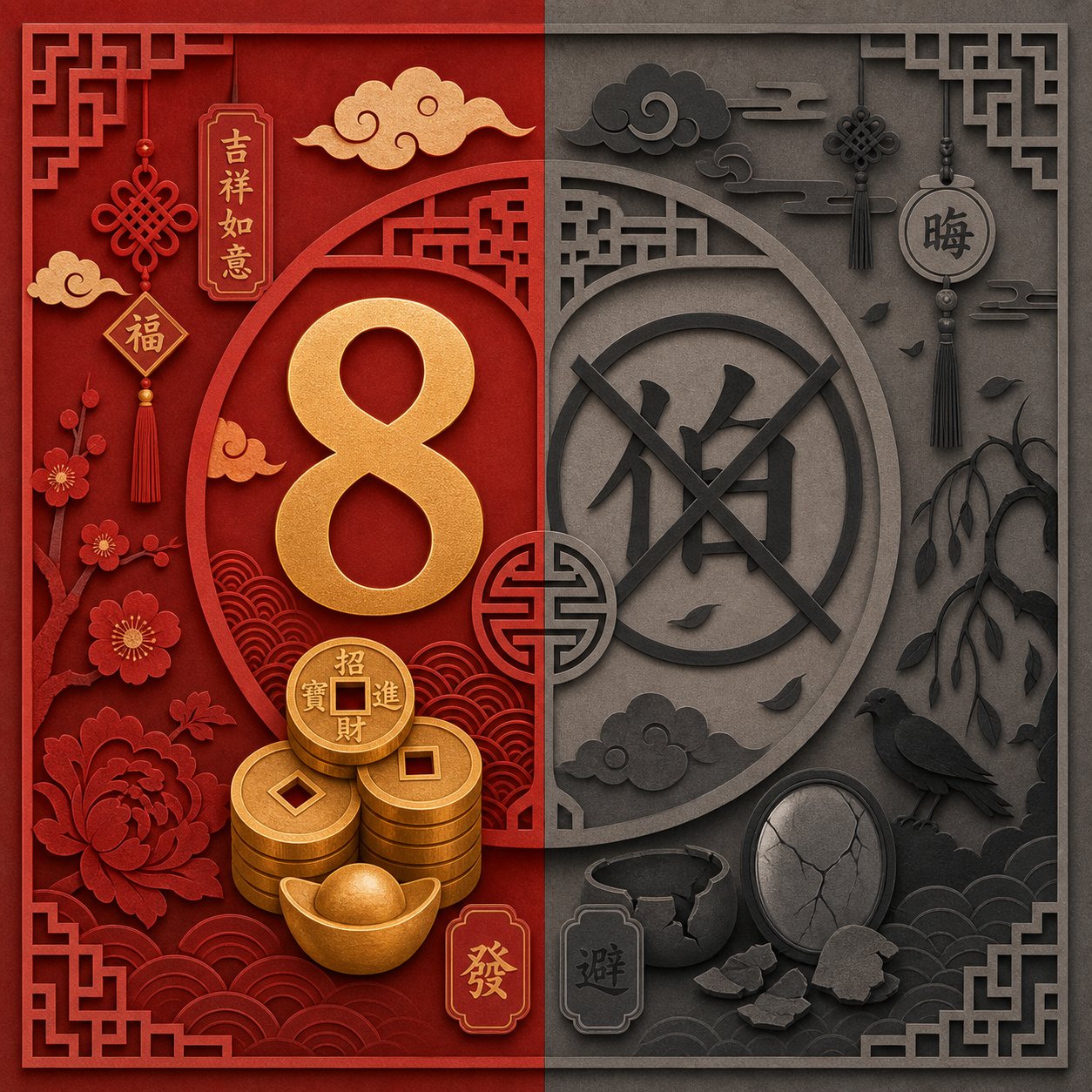
Numerology in Chinese brand naming isn't a fringe consideration — it's mainstream. Numbers carry deeply embedded cultural weight, and their influence extends beyond literal digits into characters that sound like those numbers. The number 8 (八, ba) is considered extremely auspicious because it sounds like 发 (fa), meaning "to prosper" or "to generate wealth." This is why businesses pay premiums for phone numbers, addresses, and brand names that incorporate eight. The number 6 (六, liu) signals smoothness and good fortune, while 9 (九, jiu) represents longevity because it's a homophone for "long-lasting."
On the other side, the number 4 (四, si) is widely avoided because it sounds nearly identical to 死 (si), meaning "death." This isn't a minor preference — certain numbers are considered so unlucky that buildings skip the fourth floor entirely, and brands actively avoid characters or syllable counts that evoke the number four. Characters containing four strokes, or brand names with four characters total, can trigger this association for superstition-conscious consumers.
Beyond individual numbers, the total stroke count of a brand name sometimes gets evaluated through numerological frameworks. Some naming consultants calculate whether the combined strokes produce an auspicious total — a practice rooted in traditional Chinese metaphysics that still influences business decisions.
Homophones That Can Destroy a Brand
Unlucky homophones in Chinese brand names represent the single most dangerous pitfall in character selection. Because Mandarin has only about 400 distinct syllables (compared to English's roughly 15,000), the language is dense with homophones — words that sound identical but carry wildly different meanings. A brand name that sounds fine in isolation might echo an unfortunate word or phrase when spoken aloud in context.
Here are the most common Chinese brand naming taboos to avoid, mapped to their cultural origins:
| Taboo Sound or Character | Problematic Association | Cultural Origin | Risk Level |
|---|---|---|---|
| 四 (si, fourth tone) | Death (死, si, third tone) | Homophonic superstition, pan-Chinese | Very High |
| 梨 (li, pear) | Separation (离, li) | Homophone; giving pears implies parting | High |
| 伞 (san, umbrella) | Scattering/breaking apart (散, san) | Homophone; implies dissolution | Moderate |
| 钟 (zhong, clock) | End/death (终, zhong) | "Gifting a clock" = attending a funeral | High |
| 绿帽 (lu mao, green hat) | Infidelity/cuckoldry | Historical idiom from Ming Dynasty | Very High |
| 白 (bai, white) in certain contexts | Mourning, death, funerals | White is the traditional color of mourning | Context-dependent |
| 龟 (gui, turtle) | Insult implying cuckoldry | Slang usage overriding the animal's longevity symbolism | Moderate to High |
Notice that some of these taboos are absolute — no context saves them — while others depend on pairing, industry, or regional interpretation. The character 白 (white) works perfectly in a skincare brand name suggesting purity, but paired with certain other characters, it shifts toward funeral associations. Context is everything, and selecting a name that doesn't sound like an undesirable word or phrase requires testing across multiple conversational contexts, not just in isolation.
Regional and Generational Sensitivity Differences
These taboos don't land uniformly across all Chinese-speaking populations. Regional dialects create additional homophone risks that Mandarin-only testing misses entirely. A character that's perfectly safe in Mandarin might sound like a vulgar term in Cantonese, Hokkien, or Shanghainese. Brands targeting southern China, Hong Kong, Taiwan, or Southeast Asian Chinese communities need dialect-specific vetting — not just standard Mandarin checks.
Generational differences in Chinese brand perception add another layer of complexity. Older consumers tend to hold traditional taboos more firmly. They're more likely to reject a brand name that carries even a faint echo of an unlucky association. Younger, globally connected Chinese consumers — particularly those who've studied abroad or consume significant Western media — often process brand names through dual cultural lenses. They recognize the traditional taboo but may weigh it less heavily if the name carries aspirational or cosmopolitan connotations.
This doesn't mean younger consumers ignore taboos entirely. It means their threshold is different. A Gen Z consumer in Shanghai might find a mildly taboo-adjacent name edgy or irreverent rather than offensive, while the same name would alienate a 55-year-old consumer in a tier-three city. The culture-mixing phenomenon — where bicultural consumers evaluate names through both Chinese and Western frameworks simultaneously — means that a phonosemantic name with slight taboo tension might actually resonate with younger demographics precisely because it feels boundary-pushing.
The practical implication? There's no single "safe" answer. Chinese brand naming taboos to avoid depend on your target demographic, geographic focus, and brand positioning. A luxury brand targeting affluent older consumers in mainland China should observe every traditional taboo rigorously. A streetwear brand targeting Gen Z in first-tier cities has more room to play — but still needs to know exactly which lines remain uncrossable regardless of audience.
These cultural constraints don't exist in a vacuum. They interact with industry expectations — because the same character that feels taboo in one sector might be perfectly acceptable, even powerful, in another.
How Naming Strategies Differ Across Industries
A character that signals luxury in one context can feel completely wrong in another. The character 宝 (bao, meaning "treasure" or "precious") works beautifully for BMW's Chinese name 宝马 (precious horse), reinforcing automotive prestige. Place that same character in a tech startup's name, and it suddenly feels old-fashioned — more antique shop than innovation lab. Industry-specific Chinese naming conventions exist because consumers carry different expectations depending on what they're buying, and the cultural meaning embedded in characters must match those expectations precisely.
Luxury and Fashion Brand Naming Conventions
Chinese brand naming for luxury brands demands characters that evoke elegance, rarity, and aspiration without feeling ostentatious. As Labbrand CEO Vladimir Djurovic noted, phonetically translated Chinese names tend to perform well in the luxury sector — but the characters chosen for that transliteration must carry the right emotional weight. Chanel's Chinese name 香奈儿 (Xiang Nai Er) is the gold standard: 香 means "fragrant," immediately evoking sensory refinement, while 儿 adds a soft, feminine quality. The combined effect captures the brand's essence without ever stating "expensive" directly.
Luxury names lean toward characters associated with fragrance (香), elegance (雅), orchids (兰), and precious materials. They avoid anything that sounds commercial, utilitarian, or mass-market. Louis Houdart of Creative Capital emphasized that finding a good Chinese name for luxury brands is harder than for fast-moving consumer goods because "it has to convey a sense of feeling or emotion, which is quite intangible." The name must whisper status rather than shout it.
Technology and Innovation Sector Approaches
Tech company Chinese name strategies flip the script entirely. Where luxury favors tradition and sensory beauty, technology brands prioritize modernity, intelligence, and forward motion. Characters like 科 (ke, science), 智 (zhi, wisdom/intelligence), 创 (chuang, create/innovate), and 达 (da, reach/achieve) dominate this space. They signal progress without the ornamental quality that luxury demands.
Consider how tech names often use characters with the metal radical (钅) to suggest precision and engineering, or characters implying connection and networks. The tone is clean and functional — mirroring how tech products themselves are marketed. A tech brand name that sounds too poetic or traditional risks feeling disconnected from its product category, as if a software company named itself like a tea house.
Food and Beverage Sensory Naming
Food and beverage Chinese brand naming operates on a different principle altogether: sensory immediacy. Consumers want to taste, smell, or feel the product through its name. Characters like 鲜 (xian, fresh), 甜 (tian, sweet), 香 (xiang, fragrant), and 乐 (le, joy/pleasure) appear frequently because they trigger physical associations. Coca-Cola's 可口可乐 works precisely because 可口 means "palatable" — it puts flavor directly into the name.
Natural and organic brands in this sector gravitate toward the grass radical (艹) and wood radical (木) to reinforce purity and earthiness. Tea brands, dairy companies, and health food products benefit from characters that feel clean and unprocessed. The pitfall here is choosing characters that sound medicinal rather than appetizing — a fine line when health claims and taste appeal need to coexist.
Here's how these industry priorities compare side by side:
| Industry | Naming Priority | Preferred Characters/Radicals | Common Pitfalls |
|---|---|---|---|
| Luxury and Fashion | Elegance, aspiration, sensory refinement | 香 (fragrant), 雅 (elegant), 兰 (orchid), jade radical (玉) | Sounding mass-market or overly commercial; negative dialect pronunciations |
| Technology | Innovation, intelligence, precision | 科 (science), 智 (wisdom), 创 (create), metal radical (钅) | Feeling too traditional or poetic; lacking modernity |
| Food and Beverage | Sensory pleasure, freshness, naturalness | 鲜 (fresh), 香 (fragrant), 乐 (joy), grass radical (艹) | Sounding medicinal; characters that imply artificiality |
| Automotive | Power, sophistication, reliability | 宝 (precious), 马 (horse), 驰 (gallop), 龙 (dragon) | Overemphasizing speed at the expense of safety; sounding aggressive rather than refined |
Notice how the automotive sector balances two competing impulses. Power and speed need to coexist with sophistication and trustworthiness. Mercedes-Benz's Chinese name 奔驰 (ben chi, meaning "gallop at full speed") captures dynamic energy, while the character 奔 also implies purposeful momentum rather than recklessness. An automotive name that leans too far toward raw aggression — using characters associated with violence or destruction — would alienate safety-conscious family buyers.
Target demographic sharpens these industry distinctions further. A luxury brand courting younger Chinese consumers might tolerate slightly edgier, less traditional character choices than one targeting established wealth. A tech brand aimed at enterprise clients needs gravitas that a consumer app targeting Gen Z doesn't. The same industry can demand different naming approaches depending on whether you're speaking to a 25-year-old in Shenzhen or a 50-year-old in Chengdu.
These industry and demographic considerations shape which characters make it onto the shortlist. But a name doesn't exist in a vacuum — it exists in the mouths and screens of consumers who will discover it, judge it, share it, and sometimes rename it entirely on their own terms.

How Chinese Consumers Discover and Share Brand Names
Consumers don't wait for brands to introduce themselves. In China's hyper-connected digital ecosystem, a brand name gets discovered, evaluated, and circulated — or rejected — through platforms where speed and shareability determine survival. How Chinese consumers evaluate brand names isn't a passive process of reading packaging in a store. It's an active, social, algorithm-driven experience that happens across Douyin feeds, Xiaohongshu posts, WeChat group chats, and e-commerce search bars simultaneously.
This means your Chinese brand name isn't just competing for meaning. It's competing for discoverability, typability, and virality — dimensions that traditional naming processes often overlook entirely.
How Consumers Decode and Judge Brand Names
When a Chinese consumer encounters a new brand name, they process it on multiple levels within seconds. They read the characters for literal meaning, assess whether the name sounds pleasant when spoken aloud, and judge whether it "fits" the product category. A skincare brand with characters suggesting technology might feel mismatched. A food brand with characters implying luxury might feel pretentious for an everyday snack.
But here's what matters most in practice: consumers share brand names verbally and digitally. They type them into search bars, mention them in group chats, and tag them in social posts. A name that's difficult to type on a smartphone keyboard — because it uses rare characters or complex stroke patterns — creates friction at every touchpoint. A name that's easy to confuse with another brand's characters creates search pollution. And a name that doesn't produce clean results on platforms like Xiaohongshu or Douyin essentially doesn't exist for discovery-stage consumers.
Chinese consumers also evaluate names through social proof. When they see a brand name discussed positively in user-generated content — product reviews, unboxing videos, lifestyle posts — the name gains cultural legitimacy. The characters become associated not just with their dictionary meanings but with the emotional context of how other consumers talk about them. Brand naming for Chinese social media platforms requires thinking about how a name will look as a hashtag, how it will sound in a voiceover, and whether it's distinct enough to avoid being buried under unrelated search results.
The Risk of Unofficial Names Taking Hold
Here's where things get uncomfortable for brands that delay their Chinese naming decision. If you don't provide a Chinese name, consumers will create one for you. And once an unofficial name gains traction, it becomes nearly impossible to replace.
A brand that enters the Chinese market without a proactive Chinese name isn't avoiding the naming challenge — it's outsourcing that decision to millions of consumers who will name it based on whatever association sticks first. Reactive damage control is always more expensive than proactive naming.
The unofficial Chinese brand names risk is well-documented. Chinese consumers frequently give nicknames to products and brands, especially in luxury and beauty categories. These grassroots names often reference a product's appearance, a memorable characteristic, or a phonetic approximation that may carry unintended connotations. SK-II's facial treatment essence became "神仙水" (immortal water) among consumers — a flattering nickname the brand eventually embraced and now uses in official marketing. That's a lucky outcome. Other brands end up saddled with nicknames that are unflattering, confusing, or impossible to trademark.
The pattern is consistent: consumers fill naming vacuums fast. On platforms like Xiaohongshu, where user-generated content drives product discovery, an unofficial name can become the dominant search term within weeks. Once thousands of posts reference a brand by its consumer-given nickname, the brand loses control of its own identity in Chinese search ecosystems.
Brand Names in Search and Social Sharing
Chinese brand name SEO and search performance depend on factors that don't exist in English-language markets. On Baidu, Tmall, JD.com, and Xiaohongshu, search algorithms process Chinese characters differently than alphabetic text. A brand name needs to be:
- Distinct from existing terms — Characters that form common words or phrases get buried under unrelated results. If your brand name is also a dictionary word, you're competing with every other use of that term.
- Typable without ambiguity — Chinese input methods convert pinyin to characters, often presenting multiple character options for the same syllable. If your brand name's pinyin produces dozens of alternative character combinations, consumers may select the wrong one.
- Hashtaggable — On Douyin and Xiaohongshu, brand names function as hashtags. A name that's too generic gets diluted across unrelated content. A name that's too obscure doesn't get searched at all.
- Speakable in short video — With Douyin's algorithm prioritizing completion rate and engagement, brand names mentioned in voiceovers need to be instantly recognizable by ear, not just by sight.
E-commerce platforms add another dimension. On Tmall and JD.com, consumers search by typing pinyin and selecting from character suggestions. If your brand name shares pinyin with a competitor or a common product term, you're splitting search traffic before consumers even reach your store page. The strongest Chinese brand names own their pinyin combination — meaning no other common word or brand uses the same syllable sequence.
Social sharing amplifies these dynamics. When a consumer recommends a brand in a WeChat group chat, they type the name. When they post a review on Xiaohongshu, the name appears in text that algorithms index for recommendations. Every instance of your brand name in user-generated content feeds back into platform algorithms that determine whether new consumers discover you. A name that's easy to type, visually distinctive in a text feed, and phonetically clear in video content compounds its own visibility over time.
The inverse is equally true. A name that's hard to remember, easy to misspell, or phonetically similar to a competitor bleeds discoverability at every consumer touchpoint. And unlike a logo or tagline that can be refreshed, a brand name — once established in consumer vocabulary and trademark registries — is extraordinarily difficult to change.
These consumer-facing realities reveal something important: many naming failures aren't failures of linguistic creativity. They're failures of understanding how names actually live in the wild — how they get typed, spoken, searched, and shared across a digital ecosystem that moves faster than any brand approval process. The patterns behind these failures are more systematic than most companies realize.
Why Chinese Brand Names Fail and What Goes Wrong
Those systematic patterns aren't random bad luck. When you analyze common Chinese brand name translation failures across industries and decades, clear categories emerge — each rooted in a specific cultural principle that was violated. Understanding why brands fail in Chinese naming means moving beyond the famous anecdotes and identifying the structural mistakes that keep repeating.
Here are the most common failure categories, ranked by how frequently they occur and how severely they damage brand equity:
- Phonetic disasters from unvetted homophones — The most frequent failure. A transliterated name sounds acceptable in isolation but echoes an unlucky, vulgar, or absurd phrase when spoken in natural conversation. This happens because Mandarin's limited syllable inventory creates dense homophone clusters that pure phonetic transliteration ignores.
- Unintended semantic meanings from character combinations — Characters chosen for sound produce an accidental meaning when read together. Individual characters may be neutral, but their combination creates a phrase consumers interpret literally — often with embarrassing or contradictory results.
- Cultural insensitivity and value misalignment — The name violates deep-seated social values around death, superstition, or morality. As Rouse's analysis of trademark rejections demonstrates, China's "public order and good morals" clause reflects collective ideals — trademarks function as cultural symbols judged by their historical associations and effects on social order, not just literal translation.
- Dialect conflicts across regions — A name vetted only in Mandarin carries negative connotations in Cantonese, Hokkien, or other regional dialects. Brands targeting Greater China or diaspora markets get blindsided by pronunciation shifts they never tested.
- Visual and contextual reinforcement of negative meanings — The name itself might survive scrutiny, but paired with packaging imagery or brand visuals, it anchors a negative interpretation. The UK rum brand Dead Man's Fingers experienced exactly this: its skull-adorned packaging reinforced the literal death association that might otherwise have been softened through context.
Phonetic Failures and Unintended Homophones
The first two categories account for the majority of failures — and they share a root cause. Brands that rely on pure phonetic transliteration without semantic vetting are essentially gambling. With only around 400 distinct syllables in Mandarin, every sound you choose overlaps with dozens of other characters. A name that sounds like your English brand might simultaneously sound like a word for illness, poverty, or bodily functions to native speakers.
What could have caught this? The phonosemantic blending strategy discussed earlier exists precisely to prevent these disasters. By requiring that every character satisfy both phonetic and semantic criteria, you eliminate candidates that sound right but mean wrong. A cultural vetting process that tests pronunciation in conversational sentences — not just in isolation — catches the homophones that surface only in natural speech flow.
Semantic Misfires and Cultural Blind Spots
Semantic failures run deeper because they stem from what Rouse identifies as ethnocentric orientation — the unconscious assumption that home-country values are universal. A brand name that reads as playfully rebellious in English may translate to "rogue" or "scoundrel" in Chinese, carrying no humorous redeeming quality. The New Zealand gin brand Scapegrace learned this when Beijing's High Court found its Chinese translation offensive to mainstream values.
These Chinese brand name cultural mistakes to avoid share a pattern: the brand's intent in its home market is treated as self-evident, when in reality, local moral standards operate independently of foreign cultural framing. A term's edginess, humor, or irony doesn't cross linguistic borders automatically. What reads as dark humor in a low-context Western culture reads as antisocial in China's high-context, collectivist environment.
Lessons From Systematic Failure Analysis
Every failure category maps back to a specific vetting step that was skipped:
- Phonetic disasters → Needed native-speaker homophone testing across conversational contexts
- Unintended semantics → Needed character-combination meaning review beyond individual definitions
- Cultural insensitivity → Needed cultural consultant review against absolute taboo lists (death, superstition, violence, drug references)
- Dialect conflicts → Needed pronunciation testing in Cantonese, Hokkien, and regional variants
- Visual reinforcement → Needed separate packaging and context review for the Chinese market
The lesson for how to prevent Chinese brand name disasters is structural, not creative. Failures don't happen because naming teams lack imagination. They happen because the vetting process has gaps — steps that were never built into the workflow. A brand might invest heavily in creative brainstorming but skip dialect testing entirely. Or it might vet semantics thoroughly but never test how the name performs alongside its visual identity in a Chinese context.
This is why the naming process itself — the sequence of research, vetting, legal protection, and market validation — matters as much as the creative output. A brilliant name that hasn't survived a complete lifecycle of cultural stress-testing is just a risk waiting to surface.

The Chinese Brand Name Registration Process Step by Step
A brilliant name that hasn't survived a complete lifecycle of cultural stress-testing is just a risk waiting to surface — and that lifecycle involves far more than creative brainstorming. The gap between a promising Chinese company name idea and a legally protected, market-validated brand asset is filled with research, vetting, legal maneuvering, and iterative refinement. Most naming failures don't stem from bad creativity. They stem from an incomplete process that skips critical stages.
What does a complete Chinese brand naming research and vetting process actually look like from start to finish? Here's the full sequence, from initial character exploration through final registration:
- Define strategic parameters — Establish your brand positioning, target demographic, geographic scope (mainland China, Greater China, diaspora markets), industry category, and whether you're prioritizing phonetic connection to your global name, semantic meaning, or both.
- Generate character candidates systematically — Rather than relying on intuition, use a structured Chinese company name ideas framework. Map your brand's core values to relevant radicals and character families. Identify characters whose semantic fields, tonal qualities, and visual aesthetics align with your positioning. For phonosemantic approaches, list all possible character combinations that approximate your brand's syllable structure.
- Screen for taboos and homophones — Run every candidate through the cultural filter: check for unlucky homophones, numerological conflicts, death or mourning associations, and regional dialect pronunciations. Test characters in combination, not just individually, since paired characters can produce unintended compound meanings.
- Evaluate visual and digital performance — Assess stroke complexity for mobile readability. Test how candidates look at small sizes on smartphone screens, in social media feeds, and as e-commerce search results. Check visual balance between characters in the full name.
- Conduct dialect pronunciation testing — Verify how shortlisted names sound in Mandarin, Cantonese, and any other dialects relevant to your target markets. Identify pronunciation shifts that create negative associations or awkward sounds in specific regions.
- Run preliminary trademark searches — Before investing further in cultural testing, check whether your top candidates are available for trademark registration in China. Eliminate names already registered in your product class.
- Conduct consumer perception testing — Present shortlisted names to representative consumer panels. Gather reactions to meaning, sound, visual appeal, and category fit. Test across age groups and regions to surface generational or geographic sensitivity differences.
- File trademark applications immediately — Once you've identified your top candidate, file for registration without delay. China's first-to-file system means the first applicant wins — regardless of who used the name first elsewhere in the world.
- Monitor and defend during the registration period — Track your application through China's trademark office and watch for conflicting filings. Prepare opposition strategies if needed.
- Launch with integrated brand communication — Deploy the registered name consistently across all Chinese-language touchpoints — e-commerce listings, social media profiles, packaging, and advertising — to establish ownership in consumer vocabulary before unofficial alternatives take hold.
Research and Cultural Vetting Process
Steps one through five represent the research and cultural vetting phase — and this is where most companies either invest too little time or rely too heavily on a single bilingual employee's gut feeling. A systematic approach treats naming like a design problem with constraints, not a creative exercise with unlimited freedom.
The Chinese company name ideas framework works by narrowing possibilities through successive filters rather than brainstorming in the dark. Start broad: for a phonosemantic approach, there can be hundreds or even thousands of possible character combinations that approximate a given English name's sound. A structured framework eliminates candidates methodically — first by semantic relevance, then by taboo screening, then by visual quality, then by dialect safety — until you're left with a shortlist of names that survive every dimension of scrutiny.
How to market test a Chinese brand name effectively means going beyond asking "do you like this?" Consumer testing should probe specific dimensions: What does this name make you think of? What product category does it feel like it belongs to? Would you feel comfortable recommending this brand to a friend by saying this name aloud? Does it remind you of any other word or phrase? These questions surface associations that straightforward preference ratings miss entirely.
Testing across demographics is non-negotiable. A name that resonates with 25-year-old consumers in Shanghai may fall flat with 45-year-old buyers in Chengdu. Regional and generational differences in cultural sensitivity — discussed earlier in this article — mean that a single consumer panel in one city cannot validate a name for the entire Chinese market.
Legal Registration in China's First-to-File System
Here's where the process becomes urgent. China operates a first-to-file trademark system, meaning the first entity to register a name owns it — regardless of whether another company has been using that name internationally for decades. This is fundamentally different from the "first-to-use" systems in the United States and some other Western markets. If a local competitor or trademark squatter files your Chinese brand name before you do, they own it. Full stop.
The implications are stark. Brands that delay their Chinese naming decision — waiting until they're "ready" to enter the market — often discover that their ideal name has already been registered by someone else. Trademark squatting is a well-documented phenomenon in China, where speculators register foreign brand names preemptively and then demand payment for transfer. The only reliable defense is speed: file early, file broadly across relevant product classes, and file before your market entry plans become public knowledge.
During the company registration process, applicants must submit preferred Chinese company names to the Administration of Market Regulation (AMR) for approval. The structure follows a specific format: city of registration, company name, industry descriptor, and company type. Availability determines which name gets approved, so preparing multiple ranked alternatives is standard practice.
Beyond company registration, protecting the brand name as a trademark requires separate filings with China's National Intellectual Property Administration (CNIPA). Smart brands register both their Chinese name and their English name as trademarks — and consider registering the brand logo with the English-written version as additional protection. As Acclime's guidance notes, most Chinese consumers refer to brands by a Chinese name regardless of their English proficiency, and consumers will create their own if a company doesn't provide one. Proactive registration prevents losing control of your own brand identity.
Market Testing and Iterative Refinement
Registration isn't the finish line. The strongest brands treat their Chinese name launch as an iterative process — monitoring how consumers actually use the name in the wild and adjusting their communication strategy accordingly.
What does this look like in practice? After launch, track how consumers reference your brand on Xiaohongshu, Douyin, and WeChat. Are they using your official name, or has a nickname emerged? If a nickname gains traction, you have a decision: fight it with heavier official-name marketing, or embrace it the way SK-II embraced "immortal water." Neither response is automatically correct — it depends on whether the unofficial name aligns with or undermines your brand positioning.
Monitor search performance on Baidu, Tmall, and JD.com. Is your brand name producing clean search results, or is it getting diluted by unrelated content? If search pollution is an issue, you may need to adjust your SEO strategy — pairing your brand name with category keywords in product listings to train algorithms toward the correct association.
Also watch for regional reception differences. A name that performs well in first-tier cities might need additional context or explanation in lower-tier markets where consumers have less exposure to foreign brands. Social listening tools can surface these geographic patterns before they become entrenched problems.
The complete lifecycle — from strategic definition through cultural vetting, legal protection, consumer testing, and post-launch monitoring — transforms Chinese brand naming from a creative gamble into a disciplined process. Each stage builds on the previous one, and skipping any step introduces the kind of risk that produces the failures cataloged throughout this article. The brands that succeed in China aren't necessarily the ones with the cleverest names. They're the ones that treated naming as a strategic investment deserving the same rigor as product development, market research, and legal compliance — because in a language where every character is a cultural statement, your name isn't just what consumers call you. It's what they believe about you.
Frequently Asked Questions About Chinese Brand Name Cultural Meaning
1. Why is cultural meaning so important in Chinese brand naming?
Chinese is a logographic language where each character simultaneously carries semantic meaning, phonetic value, visual form, and centuries of cultural association. Unlike alphabetic languages where letters primarily represent sounds, Chinese consumers actively interpret every character in a brand name, reading into radicals, homophones, and symbolic associations. A poorly chosen character can trigger taboo connections to death, mourning, or bad luck, while a well-chosen one can embed aspirational values directly into the brand identity. This multi-dimensional interpretation happens instantly and instinctively, making cultural meaning the foundation of effective Chinese brand naming rather than an optional consideration.
2. What is phonosemantic blending and why is it considered the best Chinese naming strategy?
Phonosemantic blending is a naming approach where the Chinese brand name both sounds similar to the original foreign name and carries positive, brand-relevant meaning in Chinese. Coca-Cola's Chinese name Ke kou ke le, meaning 'delicious happiness,' is the classic example because it echoes the English pronunciation while embedding sensory pleasure into the characters. Research shows this strategy produces the strongest consumer response because it satisfies dual needs: the foreign sound connects globally aware consumers to international identity, while the Chinese meaning reinforces cultural belonging. The main challenge is execution difficulty, as finding character combinations where both sound and meaning align requires extensive linguistic expertise and creative iteration across hundreds of possible candidates.
3. What are the most common cultural taboos to avoid in Chinese brand names?
The most critical taboos involve homophones linked to death and misfortune. The number four (si) sounds nearly identical to the word for death, making it widely avoided in brand contexts. Characters or sounds resembling words for separation (li, like the word for pear), scattering (san, like umbrella), or endings (zhong, like clock) carry negative weight. Color associations also matter: white signifies mourning in traditional Chinese culture, and green hats imply infidelity. These taboos vary by region and generation. Older consumers and those in lower-tier cities tend to observe them more strictly, while younger urban consumers may have higher tolerance, though certain associations like the death homophone remain universally avoided.
4. What happens if a brand enters China without registering a Chinese name?
When brands fail to provide an official Chinese name, consumers create unofficial ones based on whatever association sticks first, whether that is a product's appearance, a phonetic approximation, or a memorable characteristic. These grassroots names spread rapidly through platforms like Xiaohongshu and Douyin, and once thousands of posts reference a brand by its consumer-given nickname, it becomes the dominant search term. Some unofficial names work out well, like SK-II's 'immortal water,' but others can be unflattering or impossible to trademark. Additionally, China's first-to-file trademark system means speculators may register your ideal Chinese name before you do, forcing expensive buybacks or legal battles. Proactive naming and early registration are far less costly than reactive damage control.
5. How do Chinese brand naming strategies differ across industries like luxury, tech, and food?
Each industry carries distinct consumer expectations that dictate which characters and cultural associations work. Luxury brands prioritize elegance and sensory refinement, favoring characters related to fragrance, orchids, and jade while avoiding anything that sounds commercial or mass-market. Technology brands lean toward modernity and intelligence, using characters associated with science, wisdom, and innovation, often incorporating the metal radical to suggest precision. Food and beverage brands focus on sensory immediacy, selecting characters that evoke freshness, sweetness, and natural flavors, frequently using the grass or wood radicals. Automotive brands must balance power with sophistication, combining characters suggesting speed and prestige without tipping into aggression. The same character can excel in one industry while feeling completely misplaced in another.