What Every Calligraphy Practitioner Should Know About Their Tools
Pick up the wrong brush, and a stroke that should feel effortless turns into a fight against the paper. Chinese calligraphy tools are not decorative relics sitting behind glass. They are functional instruments, and the ones you choose will either accelerate your progress or quietly hold you back for months.
Whether you are exploring what is Chinese calligraphy for the first time or refining your mandarin calligraphy practice after years of study, the relationship between your hand and your tools determines what ends up on the page. A brush that is too stiff for your chosen script forces compensation in your wrist. Paper with the wrong absorbency turns controlled strokes into shapeless blots. These are not minor inconveniences. They reshape your muscle memory in ways that become difficult to unlearn.
Why Your Tools Shape Your Brushwork
A practitioner using well-matched tools at a modest price point will develop faster than one using expensive but poorly suited materials, because correct feedback from brush to paper is what trains the hand.
Every element in your setup provides tactile feedback. The resistance of the brush tip against paper, the flow rate of ink from bristle to fiber, the drag of a grinding stone under an ink stick. Your nervous system reads these signals and adjusts. When the signals are consistent and appropriate for your skill level, learning compounds. When they are erratic or mismatched, you spend energy compensating instead of improving.
Beyond the Four Treasures Framework
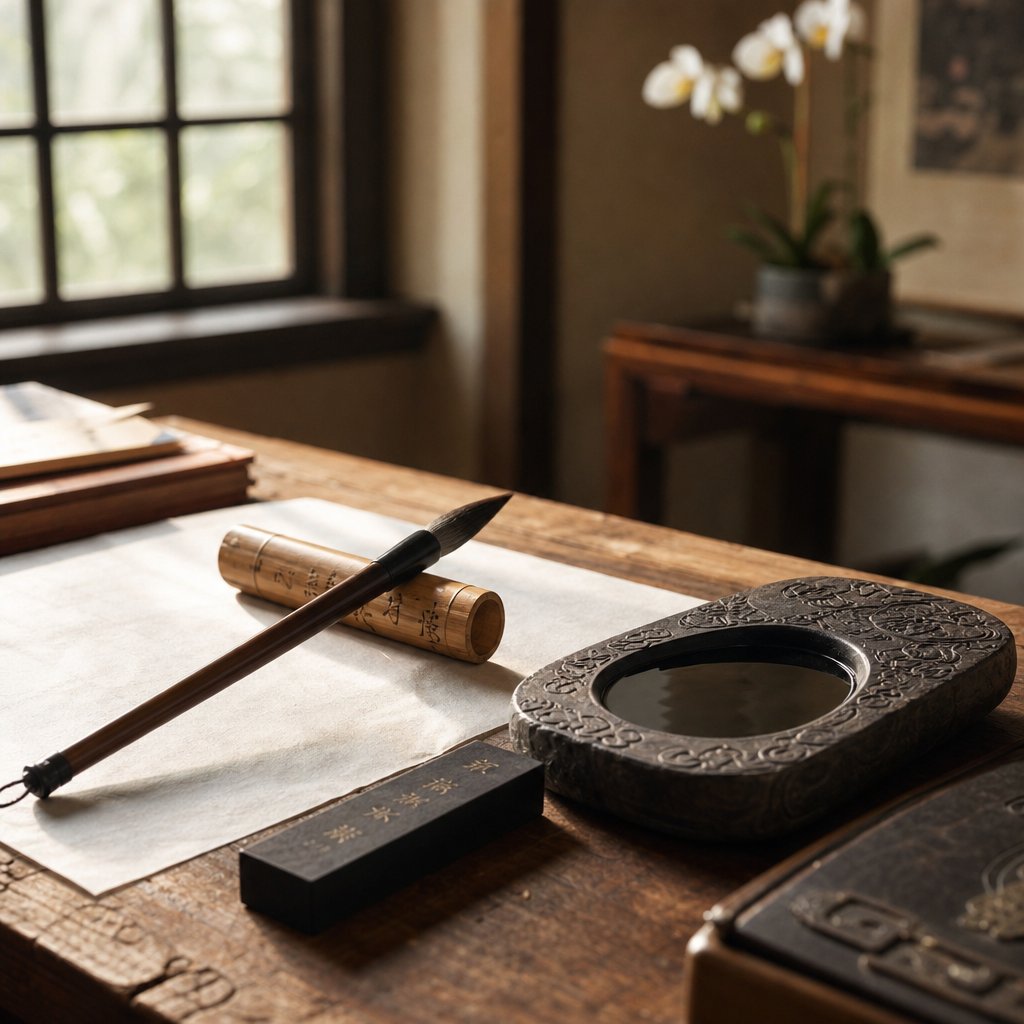
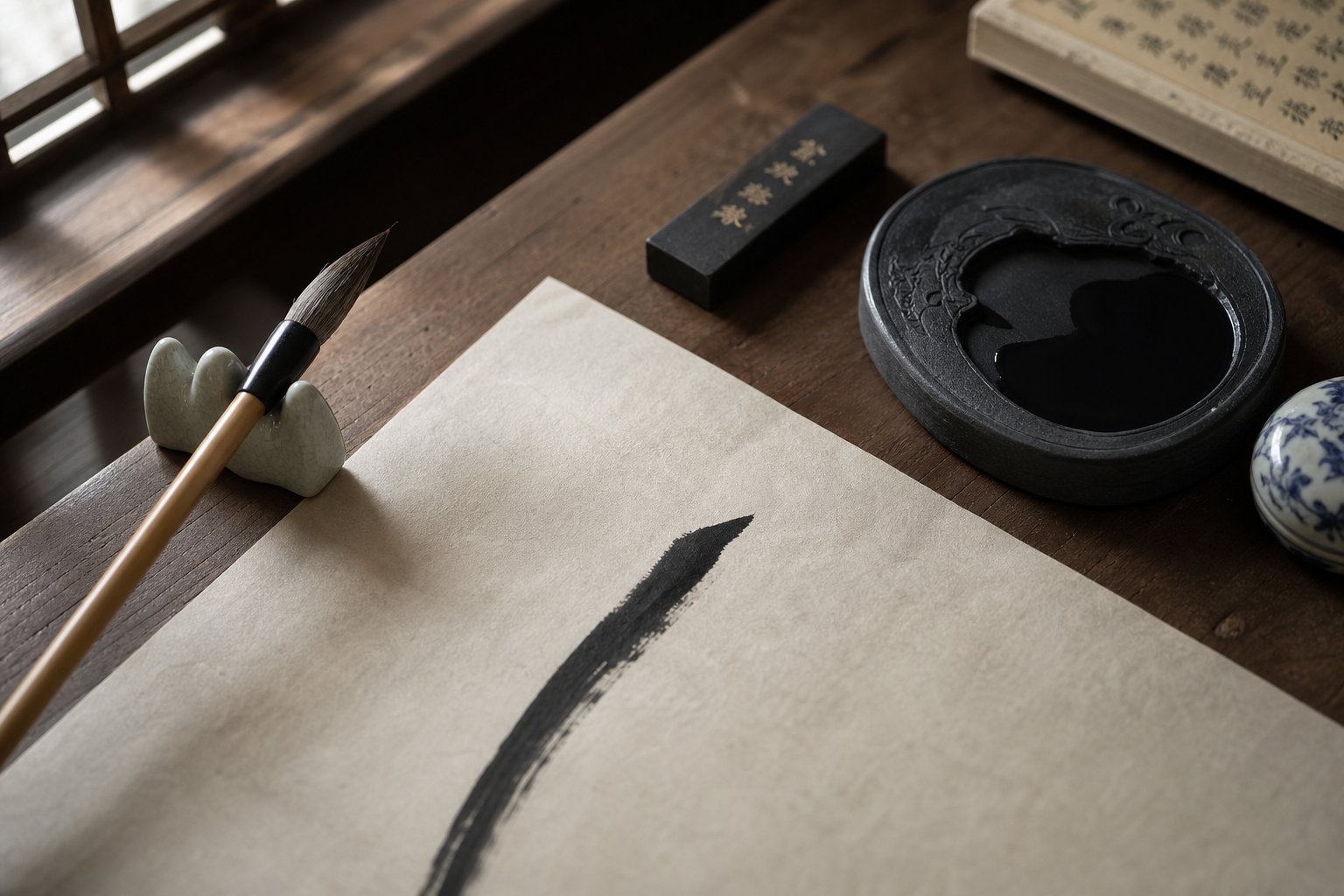
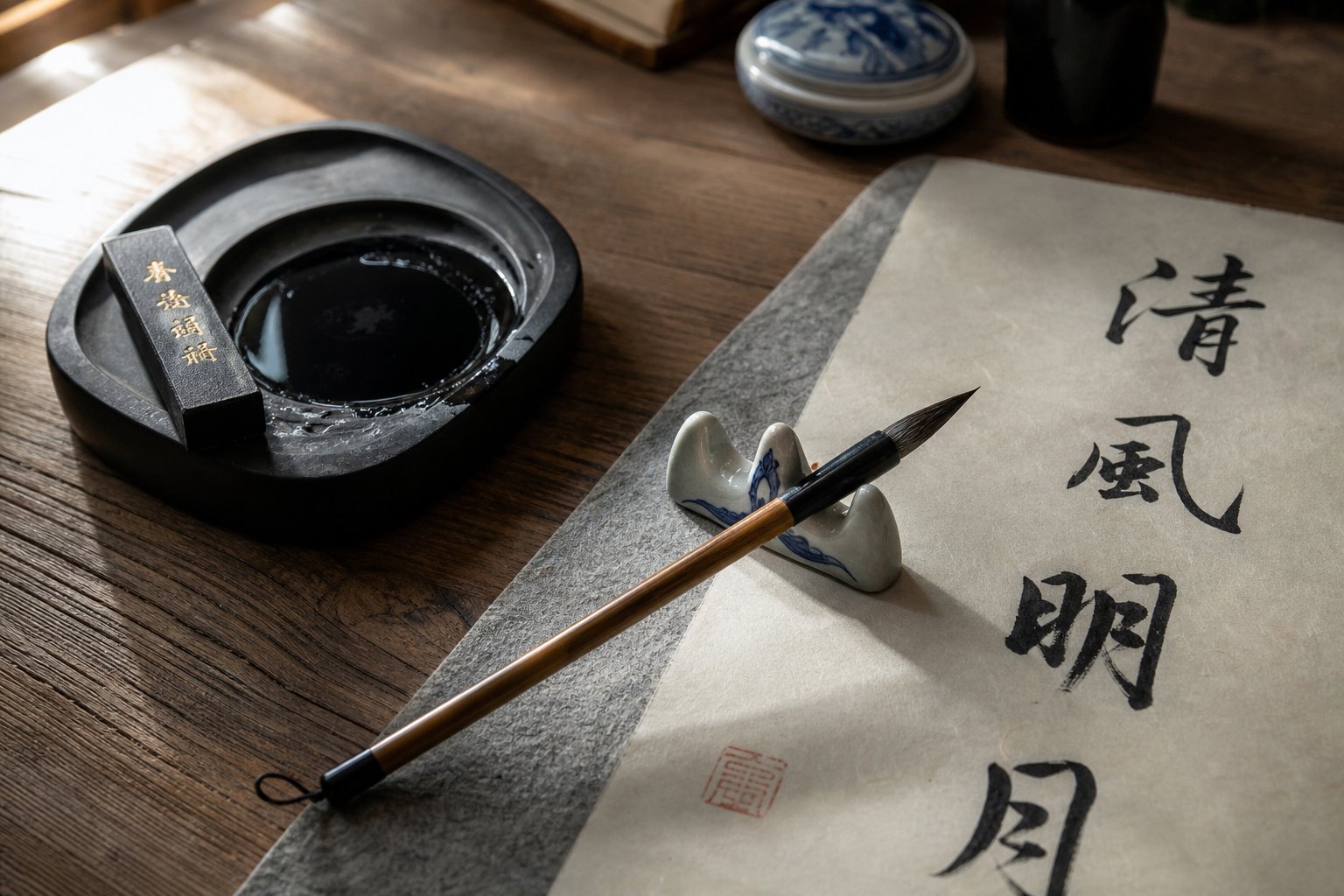
Traditional Chinese culture organizes calligraphy tools under the concept of the Four Treasures of the Study, or wenfang sibao (文房四宝). These four essentials are the brush, ink, paper, and inkstone. It is a useful starting framework, but modern practitioners need more than a poetic category list. You need a decision-making path: what do I actually need for my script style, how do I choose between options at my budget, and how do I use and maintain these tools so they perform consistently over time?
This guide walks through each of those questions in sequence. If you are studying outside Asia without access to specialty stores, you will find practical purchasing guidance here too. The goal is to move you from browsing to practicing with confidence, equipped with tools that match your intentions rather than fighting against them.
That decision process starts with the single tool that touches the paper: the brush, and the surprising differences hidden inside what looks like a simple bundle of hair.
Chinese Calligraphy Brush Types and Hair Materials Compared
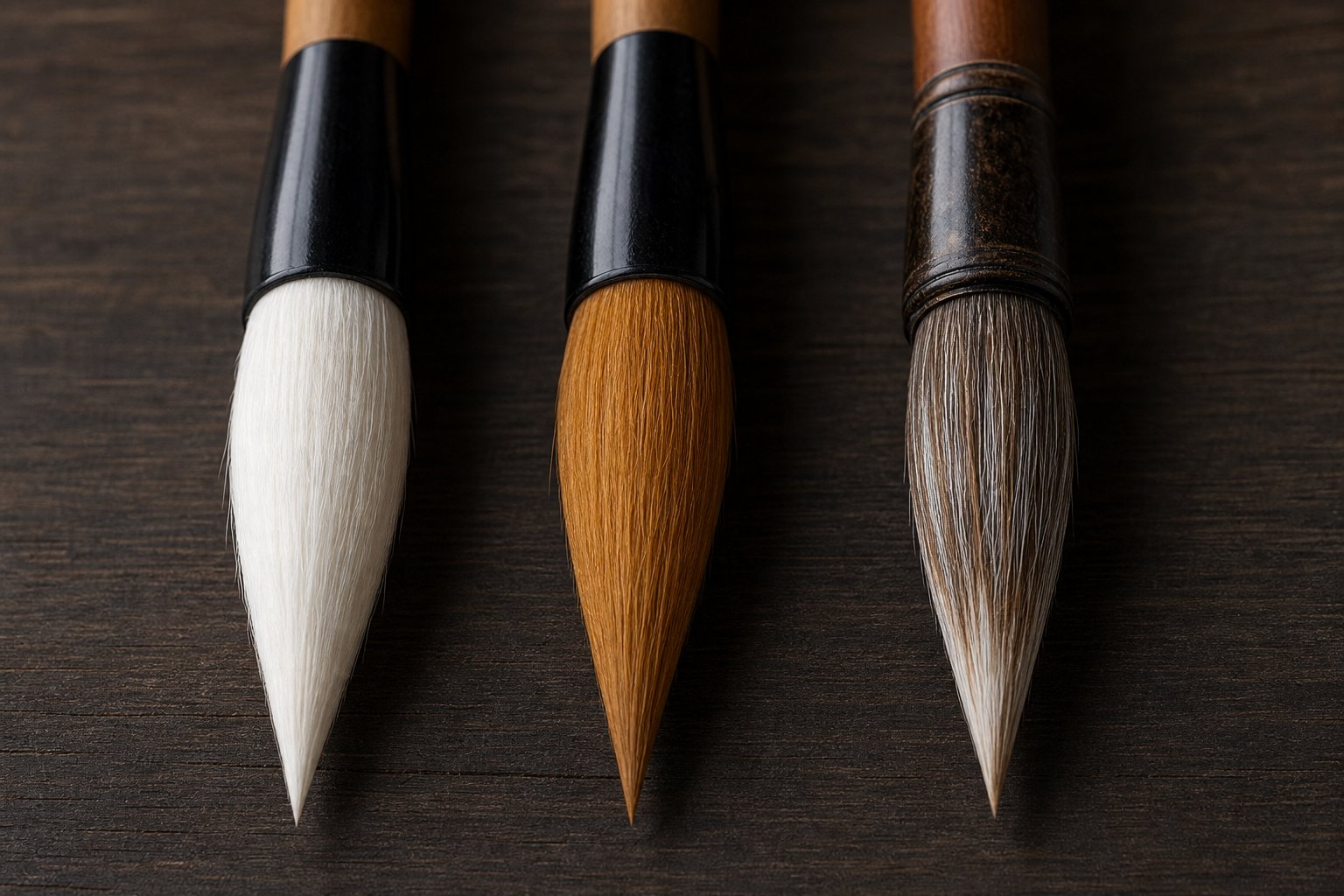
The hair inside your chinese calligraphy brush is not a minor detail. It defines how the brush responds to pressure, how much ink it carries to the paper, and how forgiving or demanding it feels in your hand. Three primary hair categories dominate the market, and each one behaves differently enough that choosing the wrong type for your script style can stall your progress before it starts.
One common source of confusion deserves clearing up immediately. When you see "wolf hair brush" in product listings, you are not buying actual wolf hair. The Chinese term langháo (狼毫) refers to hair from the Siberian weasel, specifically from its tail. The name persists because Chinese speakers historically grouped weasels under the broader "wolf" family label (huángshǔláng, 黄鼠狼, literally "yellow rat wolf"). Actual wolf hair would be far too coarse and stiff for calligraphy. Knowing this helps you evaluate product descriptions more accurately, especially when shopping for an asian calligraphy brush online.
Goat Hair Brushes for Soft Flowing Strokes
Goat hair brushes (yángháo, 羊毫) are the softest of the three main types. They hold a generous amount of ink because the individual hairs are absorbent and pliable, which means fewer trips back to the inkstone during extended writing sessions. That softness makes them ideal for expressive, flowing scripts like running script (xingshū) and cursive script (caoshū), where the brush needs to glide and change direction without abrupt resistance.
The trade-off is control. A soft brush demands more developed wrist technique to produce crisp edges and defined turning points. Beginners often find goat hair frustrating because the tip does not spring back into shape the way stiffer brushes do. Premium goat hair brushes use aged hair that has lost its natural oils, making it even more absorbent and responsive, but these are best appreciated by practitioners who already have solid foundational technique.
Wolf Hair Brushes for Sharp Precision
Wolf hair brushes (lángháo, 狼毫) made from weasel tail hair are stiffer and more resilient. You will feel the brush snap back to its point after each stroke, which gives immediate feedback on pressure and angle. This resilience makes them a natural fit for regular script (kǎishū) and detail work where each stroke needs defined entry and exit points.
A weasel hair chinese character brush holds less ink than its goat hair counterpart, so you will reload more frequently. Durability is moderate. The fine weasel hairs wear down faster than goat hair under heavy daily use, particularly if cleaning habits are inconsistent. Premium "winter wolf" brushes use hair harvested during cold months when the weasel's coat is thickest, producing extra elasticity and a finer point.
Mixed Hair Brushes for Versatile Practice
Mixed hair brushes (jiānháo, 兼毫) combine the strengths of both materials. A typical construction uses a core of weasel hair (roughly 60-65%) surrounded by an outer layer of goat hair (35-40%). The weasel core provides structure and spring, while the goat outer layer adds ink capacity and softness at the edges. This makes them a practical all-purpose brush suitable for multiple script styles and a solid starting point for anyone still exploring their preferences.
| Attribute | Goat Hair (羊毫) | Wolf/Weasel Hair (狼毫) | Mixed Hair (兼毫) |
|---|---|---|---|
| Stiffness Level | Soft | Firm | Medium |
| Ink Holding Capacity | High | Low to moderate | Moderate to high |
| Flexibility | Very flexible, slow spring-back | Less flexible, quick spring-back | Balanced flexibility |
| Durability | Long-lasting | Moderate, wears faster | Good |
| Best Script Styles | Running script, cursive script | Regular script, seal script, small characters | All styles, especially for learners |
| Skill Level Suitability | Intermediate to advanced | Beginner to advanced | All levels |
| Price Range | Budget to mid-range | Mid-range to premium | Budget to mid-range |
Beyond hair type, brush size matters relative to the characters you are practicing. A useful rule: the brush tip diameter should be roughly one-third the width of the character you intend to write. Writing 5cm characters with a tiny detail brush forces you to overload the bristles, while using an oversized brush for small characters sacrifices the precision needed for clean strokes. Most practitioners keep two or three sizes on hand, a small brush for characters under 3cm, a medium for standard practice between 4-7cm, and a large brush for expressive work above 8cm.
Hair type and size together determine how ink flows from bristle to fiber, which brings up the next critical variable: the ink itself, and whether you grind it fresh or pour it from a bottle.
Ink Sticks and Liquid Ink for Chinese Calligraphy Writing
Grinding your own ink is one of those practices that sounds ceremonial until you actually try it and realize the difference on paper. Freshly ground ink from a solid ink stick (墨/mo) has a lighter, more delicate glue content than bottled alternatives. The particles disperse more evenly, the color shows richer tonal variation, and the ink responds to your brush with a subtlety that pre-mixed liquid simply cannot replicate. Think of it as the difference between freshly ground coffee and instant granules. Beginners may not notice the gap immediately, but as your sensitivity to writing chinese calligraphy develops, the distinction becomes unmistakable.
The most celebrated ink sticks come from the historical Huizhou region in what is now Anhui province. These are known as Huimo (徽墨), and workshops like Old Hu Kai Wen have been producing them for over 250 years using recipes that date back even further. Hui inks are made from carbon soot, either pine soot for a rich matte black favored in calligraphy, or oil soot for a deeper, glossier tone preferred in painting. The ingredients are ground extensively during production so the resulting particles are extremely fine, dissolving smoothly when rubbed on an inkstone.
How to Grind an Ink Stick Properly
The grinding process is straightforward, but small technique errors compound quickly. Here is the method that produces consistent, usable ink:
- Add a small amount of clean water to the inkstone surface. Use a water dropper or pour carefully. You want just enough to moisten the flat grinding area, not fill the reservoir. A few drops is the right starting point.
- Hold the ink stick vertically. Press it upright against the wet grinding surface. Do not tilt it at an angle. Vertical contact ensures even wear on the stick and produces smoother, more uniform ink.
- Grind in slow, steady circular motions. The friction between the ink stick and the stone gradually dissolves carbon particles into the water. Keep the pressure moderate and the speed unhurried. Grinding too fast creates air bubbles and uneven consistency. This step typically takes one to three minutes depending on how much ink you need.
- Check the consistency. Lift the ink stick and observe the liquid. Well-ground ink has a subtle sheen on its surface, almost like a thin lacquer. If you drag a brush through it, the trail should close slowly rather than snapping shut immediately. If the ink looks watery and transparent, keep grinding. If it feels sluggish and pasty, add a few more drops of water.
- Guide the ink into the reservoir. Once you reach the desired thickness, gently push the ink toward the recessed pool section of the inkstone. This keeps the grinding surface clear for adjustments during your practice session.
The entire ritual takes only a few minutes, and many practitioners find it serves as a mental transition, settling the mind before the brush touches paper.
When Bottled Ink Makes Sense
Liquid ink exists for a reason. If you are practicing daily and writing large volumes of characters, grinding enough ink by hand for a full session can eat into your practice time. Bottled ink also makes sense for classroom settings, quick sketching sessions, or when traveling without a full workspace.
The trade-offs are real, though. Bottled ink contains preservatives and electrolytes to prevent settling and spoilage. It also uses higher concentrations of glue, both animal-based and increasingly synthetic, to maintain shelf stability. That extra glue makes brush movement feel slightly heavier and reduces the tonal variation you can achieve through ink loading techniques. Some processed papers that respond beautifully to freshly ground ink show only average results with bottled alternatives, likely because ground ink produces finer particles that penetrate paper fibers differently.
A practical middle ground: use bottled ink for daily drills and volume practice, then switch to freshly ground ink when working on pieces you want to keep or when practicing ink-tone variation in chinese calligraphy writing.
Judging Ink Consistency for Different Scripts
Ink thickness is not a fixed target. Different script styles demand different consistencies, and learning to adjust is part of developing your eye as a practitioner.
For regular script (kaishu) and clerical script (lishu), you want thicker ink. These scripts rely on clearly defined strokes with sharp edges and visible structure. Thicker ink sits on the paper surface with more authority, producing the dense, saturated black that makes each stroke legible and distinct. When writing in chinese calligraphy at this consistency, the ink should flow from the brush without dripping but coat the paper fully in a single pass.
For running script (xingshu) and cursive script (caoshu), thinner ink works better. These styles depend on speed, fluidity, and tonal variation. Slightly diluted ink allows the brush to glide faster and creates natural gradations from dark to light within a single character, a quality called "flying white" (feibai) that adds energy and movement to the work.
The most common beginner mistake is using too much water from the start. Watery ink lacks depth, bleeds uncontrollably on absorbent paper, and produces strokes that look washed out rather than expressive. Always start with less water than you think you need. You can thin the ink gradually, but you cannot thicken it without grinding more from the stick.
Ink quality and consistency only tell half the story. The surface that receives that ink, the paper, determines whether your carefully prepared strokes hold their shape or dissolve into formless pools.
Rice Paper Types and How They Affect Your Brushwork
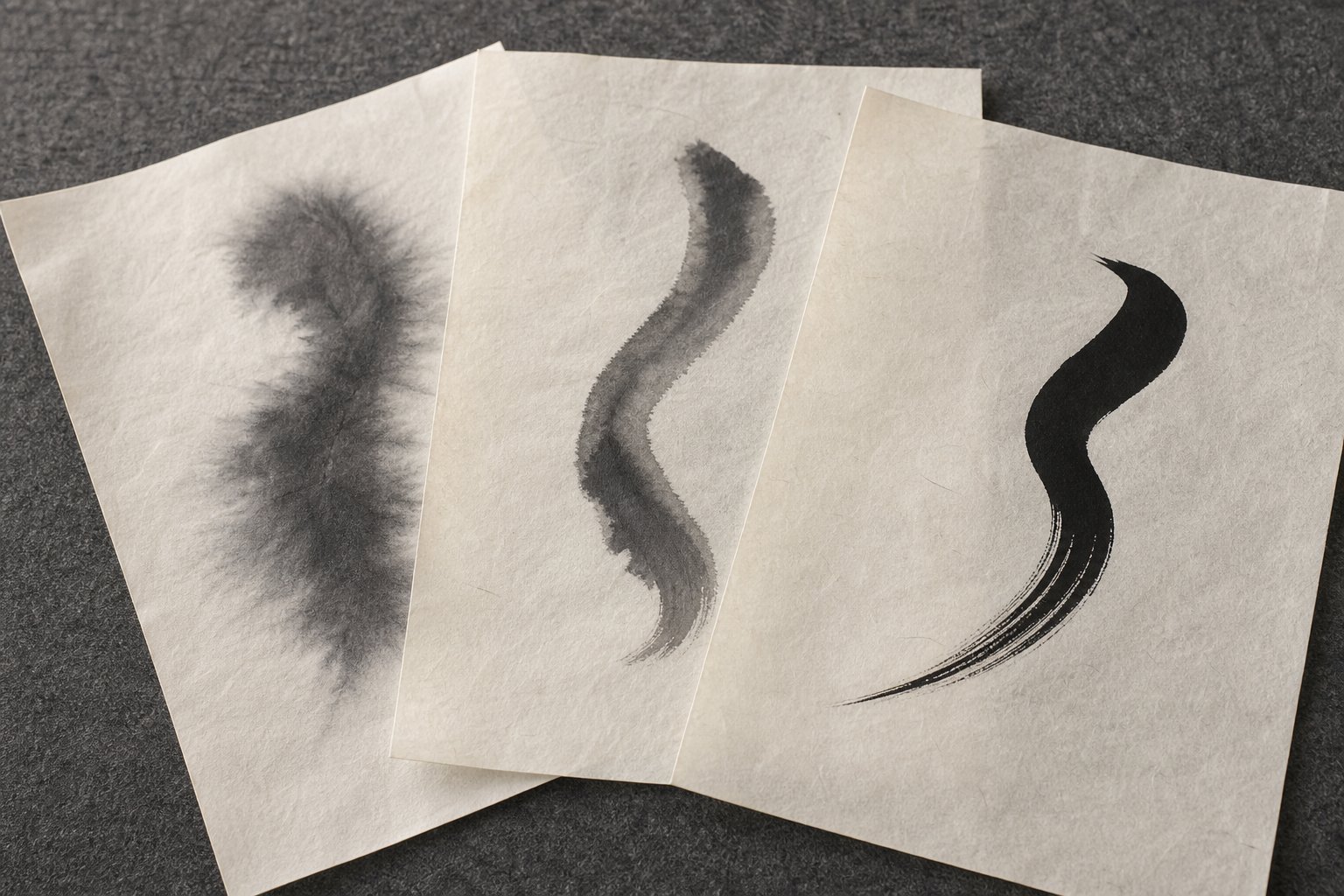
Imagine loading your brush with perfectly ground ink, executing a stroke with solid technique, and watching the ink spider outward into a shapeless blob. That frustration is not a skill problem. It is a paper problem. Xuan paper (宣纸/xuanzhi) comes in three fundamentally different preparations, and using the wrong one for your skill level or script style can make even experienced practitioners look like beginners.
Authentic xuan paper originates from Jingxian county (泾县) in Anhui province, where workshops have been producing it for over a thousand years. The paper is made primarily from the bark of the Pteroceltis tatarinowii tree (青檀/qingtan) combined with rice straw, using spring water and a production process that can take up to two years just to prepare the raw materials. Professional-grade xuan paper contains 60% or more tree bark, which gives it the fine fiber structure that responds so distinctively to ink and water. The higher the bark percentage, the more sensitive the paper becomes to every nuance of your brush movement.
What matters for your daily practice is understanding the three sizing categories and which one matches where you are right now.
Raw Xuan Paper for Expressive Calligraphy
Raw xuan paper (shengxuan, 生宣) is unsized and untreated. It absorbs ink almost instantly, pulling moisture deep into the fibers the moment your brush makes contact. Professionals love it because it records every detail of a stroke with absolute honesty. The speed of your brush, the pressure variations, the angle of entry and exit, even momentary hesitation shows up on raw xuan. This is why it is sometimes called "truth paper" in Chinese calligraphy circles.
For expressive work like large-scale running script or cursive calligraphy, raw xuan is unmatched. The rapid absorption creates natural ink gradations and the "flying white" effect that gives dynamic energy to fast brushwork. High bark-content papers, such as those in the 70-85% range, are especially responsive and produce stunning tonal variation in the hands of a skilled practitioner.
The catch? Raw xuan is brutally unforgiving. If your brush carries too much ink, the paper absorbs it all and the stroke bloats. If you hesitate mid-character, a dark pool forms at the pause point. Beginners who start on raw xuan often feel like the paper is working against them, and in a sense it is. The paper demands a level of brush control and ink management that takes months or years to develop. Starting here without guidance is one of the fastest ways to build frustration rather than skill.
Semi-Sized Paper as the Ideal Starting Point
Semi-sized paper (banshuxuan, 半熟宣) is treated with a light application of alum that partially seals the fibers. The result is a surface that still absorbs ink, but at a slower, more controllable rate. You get enough time to complete a stroke before the ink spreads, and minor technique errors do not immediately turn into disasters.
This middle ground makes semi-sized paper the most practical choice for learners and for calligraphers working across multiple script styles. It is flexible enough for both structured regular script and moderately fluid running script. The half-sized xuan paper has a lower absorption rate than raw xuan, making it significantly easier to control while still providing authentic brush-to-paper feedback that builds proper muscle memory.
If you are assembling your first set of asian calligraphy supplies and can only buy one type of paper, semi-sized xuan is the answer. It forgives small mistakes without hiding them entirely, which is exactly the feedback loop a developing practitioner needs.
Fully Sized Paper for Controlled Detail Work
Fully sized paper (shuxuan, 熟宣) receives a heavier alum treatment that creates a nearly non-absorbent surface. Ink sits on top of the paper rather than sinking in, which means virtually no bleeding or feathering. Strokes stay exactly where you place them, with crisp edges and no spread.
This makes sized xuan the standard choice for Gongbi (工笔) detail painting and for any calligraphy work requiring extremely precise, thin lines. Seal script practitioners sometimes prefer it for the clean geometric strokes the style demands. The paper is made from Eulaliopsis binata (龙须草, "dragon beard grass") rather than tree bark, which gives it a deliberately different absorption profile.
The downside is that sized paper feels less "alive" under the brush. Because ink does not interact dynamically with the fibers, you lose the tonal variation and organic texture that make Chinese calligraphy visually rich. It also dries more slowly on the surface, which can cause smearing if your hand passes over freshly written characters. For most calligraphy practice, fully sized paper is too restrictive, but for specific applications it is exactly right.
| Attribute | Raw Xuan (生宣) | Semi-Sized (半熟宣) | Fully Sized (熟宣) |
|---|---|---|---|
| Ink Absorption Speed | Very fast, nearly instant | Moderate, controlled spread | Minimal, ink sits on surface |
| Bleeding Behavior | Significant, spreads quickly | Mild, manageable feathering | Almost none |
| Best Script Styles | Running script, cursive script, expressive large characters | Regular script, running script, clerical script | Seal script, Gongbi painting, fine detail work |
| Difficulty Level | Advanced, demands strong brush control | Beginner to intermediate friendly | Moderate, requires awareness of drying time |
| Recommended Use Cases | Exhibition pieces, expressive practice, professional work | Daily practice, skill development, multi-style work | Precision work, detailed painting, formal compositions |
| Tonal Variation | Rich gradations, natural ink effects | Moderate variation possible | Limited, uniform ink tone |
A practical note for anyone building a chinese brush painting supplies collection: consider keeping both semi-sized and raw xuan on hand once you pass the beginner stage. Use semi-sized for structured practice and technique drills, then switch to raw xuan when you want to test your control under more demanding conditions. The transition between the two will show you exactly where your brush control still needs work.
Double-layer xuan paper is another option worth knowing about. It is literally twice the thickness of standard single xuan, which means it holds more moisture and gives you slightly more time before ink spreads. Some teachers recommend it as a stepping stone between semi-sized and raw paper for students who want the responsiveness of unsized paper without the full intensity.
Paper choice shapes how ink behaves after it leaves the brush. But the surface where you prepare that ink, the inkstone, has its own influence on the quality of what reaches the page.
Inkstone Selection and Regional Traditions Explained
An inkstone (砚/yan) is not just a flat surface for grinding. It is the tool that determines the fineness, smoothness, and consistency of your ink before it ever reaches the brush. The microscopic texture of the grinding surface, called fengmang (锋芒) in Chinese, works like extremely fine sandpaper. It shaves carbon particles from the ink stick and suspends them in water. A well-made inkstone produces ink with evenly dispersed particles that flow smoothly and produce rich, consistent tones. A poorly textured one creates gritty, uneven ink that clogs brush hairs and produces patchy strokes.
In chinese traditional calligraphy, the inkstone is the one tool that can last a lifetime, sometimes several lifetimes, if chosen well and maintained properly. That longevity makes it worth understanding what separates a functional inkstone from a decorative paperweight.
Choosing an Inkstone by Grinding Quality
When evaluating an inkstone for actual practice rather than display, focus on these functional attributes:
- Stone density: Denser stone resists wear and maintains its grinding texture over years of use. A stone that feels heavy relative to its size generally indicates good density.
- Surface texture: The grinding area should feel smooth to the touch but still have enough microscopic tooth to break down the ink stick efficiently. If it feels glassy, it will not grind well. If it feels rough like coarse sandpaper, it will damage your ink stick and produce grainy ink.
- Water retention: A quality inkstone holds moisture on its surface without the water evaporating too quickly. This matters because good water retention means ground ink will not dry out easily during extended practice sessions.
- Size relative to practice needs: Match the inkstone to your brush size and ink volume. A 3-5 inch stone suits small brushes and limited ink. A 6-7 inch stone handles medium brushes and average sessions. Anything 8 inches or larger is for large brushes and high-volume work.
Here is the practical truth for beginners: a simple, well-made inkstone with good grinding texture will outperform an expensive, elaborately carved decorative piece every time. Ornate carvings often reduce the usable grinding surface and add cost without improving function. Spend your budget on stone quality, not aesthetics.
Regional Inkstone Traditions and Their Differences
Chinese ancient calligraphy traditions recognize four famous inkstone types, each with distinct characteristics shaped by their geological origins.
Duan inkstone (端砚) from Zhaoqing in Guangdong province is considered the most prestigious. The stone is a type of green tuff with a Mohs hardness of approximately 3.5, making it relatively soft and easy to carve. Its fine, dense texture produces exceptionally smooth ink, and practitioners describe the sensation of grinding on a quality Duan stone as the ink stick "melting" into the surface. Different quarries within the Duan region produce stones with varying qualities. The most famous, Roko (老坑), is no longer mined, making those stones extremely rare and valuable.
She inkstone (歙砚) from Anhui province is made from slate with a Mohs hardness around 4, making it harder and denser than Duan stone. Its texture is rougher, almost like shark skin, which makes it particularly effective for grinding harder ink sticks, especially pine soot varieties (shoenmo). She inkstones are classified by their distinctive surface patterns, including gold star (jinxing), gold cloud (jinyun), and fish egg (yüzi) patterns. For calligraphy china practitioners who favor pine soot ink, a She inkstone is often the better functional match.
Tao inkstone (洮砚) from Gansu province uses stone quarried near the Tao River. It is prized for its deep green color and smooth grinding quality, though it is less widely available outside China than Duan or She varieties.
Chengni inkstone (澄泥砚) stands apart from the other three because it is not carved from natural stone. Instead, it is made from fine river sediment that is filtered, shaped, and fired in a kiln, essentially a ceramic inkstone. This gives it a uniquely uniform texture that some practitioners prefer for its predictable grinding behavior.
For maintenance, clean your inkstone with water immediately after each session. Dried ink residue builds up in the microscopic texture and gradually reduces grinding efficiency. Never use soap or abrasive cleaners. If residue accumulates over time, soaking the stone in clean water for several hours will soften deposits enough to remove them gently. Store the inkstone in a box or covered container to protect the grinding surface from dust and accidental damage.
Knowing your inkstone's character helps you prepare better ink. But ink quality is only one variable in the equation. The real question most practitioners face is how to combine all four treasures, brush, ink, paper, and stone, into a coherent setup matched to the specific script style they want to master.
Matching Tools to Calligraphy Script Styles
You understand brush hair types, ink consistency, paper absorption, and inkstone quality as individual variables. The challenge most practitioners face is combining them into a coherent setup that actually serves the script style they want to practice. A wolf hair brush paired with raw xuan paper and thin ink creates a completely different experience than the same brush on semi-sized paper with thick ink. Multiply those combinations across five major script styles, and the decision space becomes overwhelming without a clear framework.
This is where asian calligraphy practice gets practical. Each of the five major Chinese script styles has distinct stroke characteristics, speed requirements, and visual goals. Those characteristics dictate which tool combinations produce the best results and which ones fight against the style's natural demands. Think of it as matching the instrument to the music. You would not play a delicate melody on a bass drum, and you would not attempt explosive cursive script with a tiny stiff brush on non-absorbent paper.
Tool Pairings for Regular and Clerical Scripts
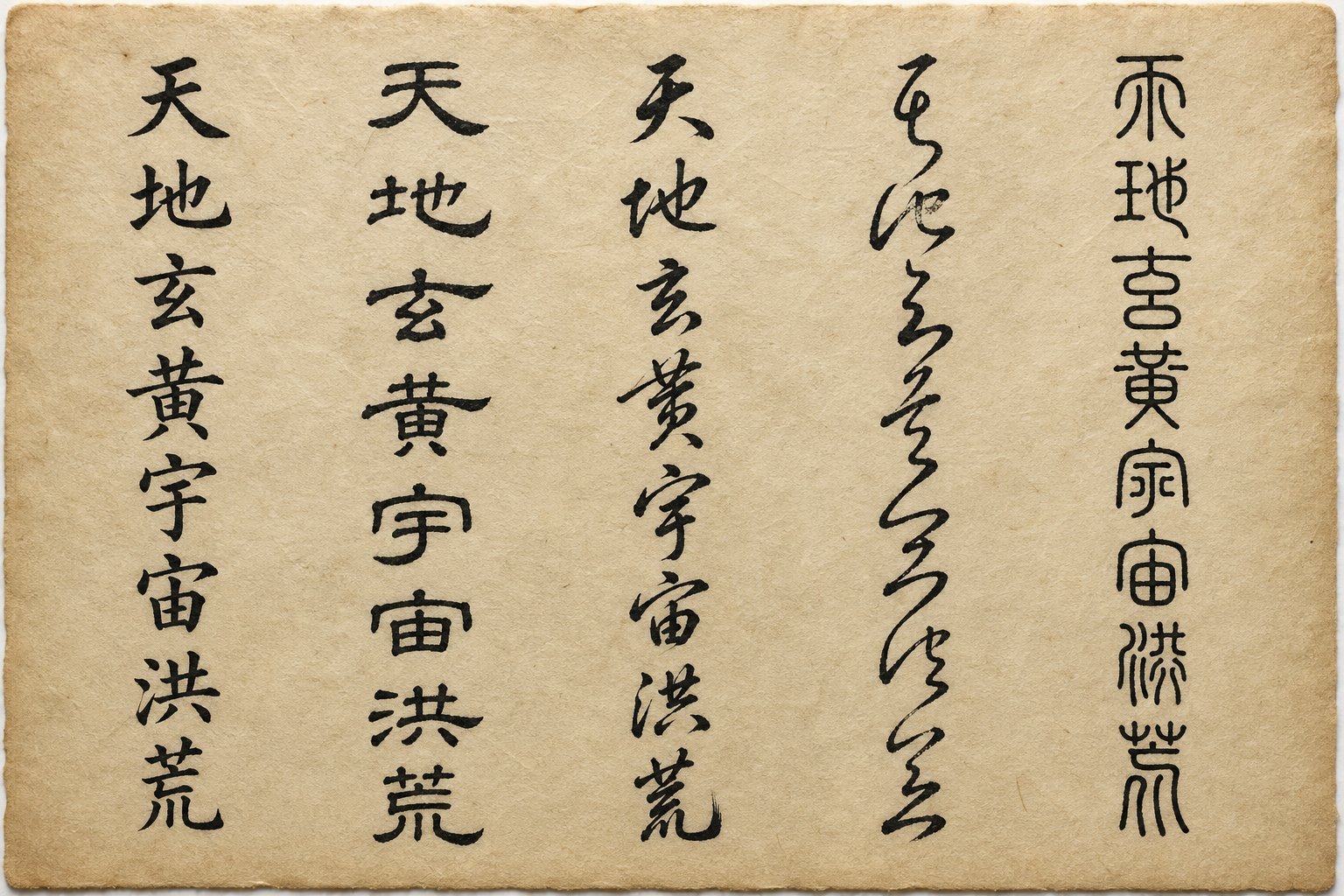
Regular script (kaishu, 楷书) is where most learners begin, and for good reason. It demands clearly defined strokes with visible entry points, turning angles, and deliberate endings. Every stroke has a specific structure that must be legible and balanced. This precision requires tools that give you control and consistent feedback.
For regular script, a wolf hair or mixed hair brush in a medium size works best. The stiffness of weasel hair provides the spring-back needed to execute the sharp turns and defined pressure changes that characterize each stroke. Brush size should match your character size, typically a medium brush for standard 5-7cm practice characters. Pair this with semi-sized paper, which absorbs ink at a controlled rate and prevents the bleeding that would destroy your stroke edges. Ink should be ground thick, producing dense, saturated black that sits with authority on the paper surface.
Famous chinese calligraphers like Yan Zhenqing and Liu Gongquan developed their iconic regular script styles during the Tang Dynasty, and their copybooks remain the standard training material today. When practicing from these models, the tool setup above gives you the best chance of reproducing the crisp, structured strokes their styles demand.
Clerical script (lishu, 隶书) shares some requirements with regular script but adds its own twist. The style features characteristically flat, wide characters with distinctive horizontal strokes that flare outward at the ends, a movement called the "silkworm head and wild goose tail" (cantou yanwei). These flaring strokes require a brush with enough softness to spread at the tip under lateral pressure, yet enough structure to maintain control during the horizontal sweep.
A mixed hair brush or a slightly softer goat-and-weasel blend handles this well. The brush needs to be slightly larger than what you would use for regular script at the same character size, because clerical characters are wider and the flaring strokes demand more bristle surface area. Semi-sized paper remains the practical choice, and ink consistency should be thick to medium, dense enough for strong blacks but fluid enough to allow the smooth lateral movements the style requires.
Brush and Paper Choices for Running and Cursive Styles
Running script (xingshu, 行书) is sometimes called semi-cursive because it sits between the strict structure of regular script and the fluid abstraction of full cursive. Characters connect partially, strokes simplify, and speed increases. The brush needs to move faster and change direction more fluidly than in regular script, which means your tools must support momentum rather than resist it.
A goat hair or mixed hair brush gives you the flexibility running script demands. The softer bristles glide across the paper without catching, and the higher ink capacity means you can write several connected characters before reloading. Paper choice opens up here. Semi-sized xuan works for controlled running script, but as your speed and confidence increase, raw xuan becomes the more expressive surface. The rapid absorption of raw paper captures the natural ink gradations that give running script its visual energy. Ink should be medium thickness, fluid enough for speed but substantial enough to avoid looking washed out.
Wang Xizhi, widely regarded as the greatest chinese calligrapher in history, achieved his legendary status largely through running script. His Preface to the Poems Composed at the Orchid Pavilion is considered the greatest masterpiece of Chinese calligraphy, and it was written in running script with tools that allowed fluid, spontaneous movement across the page.
Cursive script (caoshu, 草书) pushes everything further. Characters are drastically simplified, strokes merge and flow into each other, and the brush rarely lifts from the paper between characters. Speed is high, and the visual result is closer to abstract art than readable text. Specialized knowledge is often needed just to recognize individual characters in full cursive.
This style demands the softest, most flexible brush you can control. A pure goat hair brush or a goat-dominant mixed brush in a larger size gives you the ink capacity and flexibility to sustain long, flowing movements without interruption. Raw xuan paper is almost mandatory for serious cursive work because its instant absorption captures the dynamic energy and "flying white" effects that define the style. Ink should be thin, diluted enough to flow freely and create natural tonal variation from dark to pale within a single sweeping stroke. Zhang Xu, known as the "sage of cursive script," was famous for his explosive, uninhibited brushwork that pushed these tool combinations to their expressive limits.
Seal Script Requirements and Specialized Tools
Seal script (zhuanshu, 篆书) is the oldest of the five major styles, developed during the Zhou Dynasty and standardized under the Qin Dynasty. Its strokes are fundamentally different from the other four scripts. Lines are uniform in width, curves are smooth and geometric, and there are no flaring endings or sharp pressure changes. Every stroke maintains consistent thickness from start to finish, which requires a very specific brush technique and tool setup.
A wolf hair brush with a fine, pointed tip is the standard choice. The stiffness of weasel hair helps maintain even pressure throughout each stroke, preventing the width variations that would look like errors in this style. Brush size should be relatively small compared to the character size, because seal script strokes are thin and uniform. You need precise tip control rather than broad coverage.
Paper choice for seal script leans toward semi-sized or fully sized xuan. The controlled, geometric nature of the strokes benefits from a surface that does not absorb ink too quickly. Any bleeding or feathering disrupts the clean, even lines the style demands. Ink should be thick and consistent, ground to a density that produces uniform black without variation. Tonal gradation, so prized in cursive and running scripts, is actually undesirable in seal script where uniformity is the visual goal.
| Script Style | Recommended Brush Hair | Brush Size | Paper Type | Ink Thickness | Key Characteristic |
|---|---|---|---|---|---|
| Regular Script (楷书) | Wolf hair or mixed hair | Medium | Semi-sized xuan | Thick | Precise, structured strokes with defined edges |
| Clerical Script (隶书) | Mixed hair (goat-dominant blend) | Medium to large | Semi-sized xuan | Thick to medium | Flat, wide characters with flaring horizontal strokes |
| Running Script (行书) | Goat hair or mixed hair | Medium | Semi-sized or raw xuan | Medium | Fluid, partially connected strokes with moderate speed |
| Cursive Script (草书) | Goat hair (soft, large capacity) | Medium to large | Raw xuan | Thin | Highly simplified, fast, abstract and expressive |
| Seal Script (篆书) | Wolf hair (fine tip) | Small to medium | Semi-sized or fully sized xuan | Thick | Uniform line width, geometric curves, no pressure variation |
A few practical notes on using this table. These are starting recommendations, not rigid rules. Many experienced practitioners deliberately break these pairings for creative effect. A calligrapher might use a stiff brush on raw paper to create tension and energy in running script, or a soft brush for seal script to add subtle organic warmth to the geometric forms. The recommendations above represent the path of least resistance for each style, the combinations where your tools work with the script's natural demands rather than against them.
Also notice that mixed hair brushes appear across multiple styles. This is why they are often recommended as a first purchase. A quality mixed hair brush in a medium size can handle regular script, clerical script, and running script reasonably well. It will not be optimal for any single style, but it gives you room to explore before committing to specialized brushes for your preferred script.
Your script choice determines your ideal tool combination, but your budget determines what you can actually acquire. The gap between a functional starter setup and a premium traditional collection is significant, and knowing where to invest at each stage of your development prevents both overspending and false economy.
Building Your Chinese Calligraphy Set by Skill Level
Not everyone needs a premium ink stick from Anhui or a hand-selected Duan inkstone on day one. In fact, spending too much too early can backfire. Expensive tools do not compensate for undeveloped technique, and the anxiety of "wasting" premium paper on beginner strokes often discourages the volume of practice that actually builds skill. The smarter approach is matching your investment to your commitment level, then upgrading deliberately as your hands outgrow your materials.
Three distinct tiers cover the full spectrum from curious exploration to advanced traditional practice. Each tier has clear quality indicators that separate functional tools from decorative junk, and knowing those markers helps you spend wisely regardless of your budget.
Budget-Friendly Starter Sets for Beginners
When you are still deciding whether calligraphy will become a regular part of your life, a basic chinese calligraphy set gets you writing without a major financial commitment. The goal at this stage is not perfection. It is exposure. You want tools that function well enough to give you honest feedback without costing so much that a ruined sheet of paper feels like a loss.
A functional starter chinese writing set typically includes a mixed hair brush, a small ink stick or bottle of liquid ink, a basic inkstone or ceramic dish, and a pack of practice paper. Many beginner sets bundle these together in a gift box format, which is convenient but requires some scrutiny. Some bundled sets prioritize presentation over function, packing ornate boxes with brushes that shed hair after three uses.
- What to look for: A mixed hair (兼毫) brush that holds its point when wet, a grinding surface with visible texture rather than polished smoothness, paper that is at least semi-sized rather than plain printer paper, and an ink stick that produces color within 30-60 seconds of grinding.
- What to avoid: Brushes with synthetic fibers marketed as "calligraphy brushes" (they lack proper ink absorption), sets where the inkstone is purely decorative with a polished flat surface, extremely cheap bundled sets where every component is the lowest possible quality, and any set that does not include actual paper or a practice surface.
At this tier, expect to spend roughly the equivalent of a nice dinner out. You will not get heirloom-quality tools, but you will get materials that respond correctly to basic technique. Several beginner-oriented sets include reusable water-writing cloths alongside traditional ink tools, which lets you practice stroke mechanics without consuming paper during your earliest sessions.
Mid-Range Tools for Serious Practice
You have been practicing for a few months. Your strokes are becoming more consistent, and you are starting to notice limitations in your starter tools. Maybe the brush tip splays too easily, or the ink feels gritty no matter how long you grind. This is the natural upgrade point, where investing in better individual components produces noticeable improvements in your daily practice.
At the mid-range level, you are no longer buying a bundled asian calligraphy set. You are selecting individual tools based on your specific script preference and practice habits. This is where the tool-to-script matching from the previous section becomes directly actionable.
- What to look for: Brushes from established brush-making regions (Huzhou in Zhejiang province is the historical center), ink sticks with visible brand markings and smooth, crack-free surfaces, semi-sized xuan paper from Jingxian county, and an inkstone with consistent grinding texture across the entire surface.
- What to avoid: Overpaying for elaborate packaging or gift-box presentation, brushes with decorative handles but mediocre hair quality, ink sticks that feel lightweight or show surface crumbling, and paper sold without any indication of sizing treatment or fiber content.
A serious hobbyist chinese brush calligraphy set at this level might include two to three brushes in different sizes and hair types matched to your primary script style, a quality ink stick that will last months of regular use, a functional inkstone with good water retention, and a supply of appropriate xuan paper. The total investment is moderate but targeted, and each component earns its place through daily use rather than shelf appeal.
Upgrading makes sense when you can feel the ceiling of your current tools. If your brush cannot produce the fine tip control your script demands, or your paper is limiting the ink effects you are trying to achieve, those are signals that better materials will translate directly into better practice sessions.
Premium Traditional Tools for Advanced Work
Advanced practitioners who have committed years to their craft eventually reach a point where tool quality becomes inseparable from artistic expression. At this tier, you are not buying tools to learn on. You are selecting instruments that respond to the subtlest variations in your technique and allow you to push the boundaries of what your chosen script style can express.
Premium tools are handcrafted by specialist artisans, often using traditional methods passed down through generations. A master brush-maker in Huzhou selects and sorts individual hairs by length, thickness, and curvature before assembling them into a brush head. A premium ink stick from a heritage workshop undergoes months of drying and aging. These are not marketing stories. They are production realities that produce measurably different performance.
- What to look for: Brushes made by named artisans or established workshops with verifiable provenance, aged ink sticks (older sticks produce finer, more luminous ink), inkstones from recognized quarry regions with natural stone patterns indicating quality deposits, and high bark-content raw xuan paper for expressive work.
- What to avoid: Paying premium prices for mass-produced tools with premium branding, antique or vintage pieces that look impressive but have degraded functionally (cracked ink sticks, worn inkstone surfaces, dried-out brush hair), and collecting tools you do not actually use in regular practice.
At this level, a single brush might cost what an entire beginner set does. The difference is that every stroke you write with it carries information about your intent that a lesser brush would flatten or obscure. Premium tools reward advanced technique. They do not create it.
Practice Alternatives That Save Money Without Sacrificing Progress
Not every practice session requires premium materials, and several alternatives can dramatically reduce your ongoing costs while still building real skill.
Water-writing cloths (水写布/shuixiebu) are reusable fabric surfaces that turn dark when wet and return to their original color as the water evaporates, typically within three to five minutes. You use a regular calligraphy brush loaded with plain water instead of ink. The cloth can be reused a thousand times or more, making it essentially free after the initial purchase. For stroke mechanics, brush angle practice, and character structure drills, water cloths are genuinely useful at any skill level.
Newspaper practice is a time-honored method in Chinese calligraphy education. Old newspapers provide a slightly absorbent surface that approximates semi-sized paper behavior. The paper is essentially free, which removes any hesitation about "wasting" materials. Many calligraphy teachers in China still assign newspaper practice for daily drills, reserving proper xuan paper for finished pieces.
Grid paper templates (米字格/mizige and 田字格/tianzige) provide structural guides that help beginners maintain consistent character proportions. These grids divide the writing space into sections that correspond to the spatial relationships within Chinese characters. You can print them on regular paper for structure practice or find xuan paper pre-printed with grid lines for more authentic sessions.
Here is the important distinction: these alternatives are excellent for mechanical practice, building stroke consistency, memorizing character structure, and developing wrist control. They are not substitutes for real materials when it comes to ink behavior practice. Water on cloth does not spread, pool, or create tonal variation the way ink on xuan paper does. Newspaper does not respond to ink loading the way proper rice paper does. The tactile feedback is different enough that exclusive use of substitutes can create habits that need correction when you transition to authentic materials.
The practical balance: use water cloths and newspaper for your daily volume practice and warm-up drills, then dedicate a portion of each session to real ink on real paper. Even ten minutes of authentic practice per session builds the ink-management instincts that substitutes cannot develop. As your skill advances, gradually shift the ratio toward more time on proper materials.
Choosing the right tools at the right price point gets you started. Keeping those tools performing well over months and years of use requires a workspace and maintenance routine that most beginners never think about until something goes wrong.
Workspace Setup and Tool Maintenance for Long-Lasting Practice
A quality brush loses its point within weeks if you clean it wrong. An ink stick cracks down the middle if stored carelessly. These are not hypothetical problems. They are the quiet frustrations that push beginners away from practice before their technique ever has a chance to develop. Your tools for chinese calligraphy only perform consistently when your workspace supports proper technique and your maintenance habits preserve what you have invested in.
Setting Up Your Calligraphy Practice Space
Your desk arrangement directly affects your posture, brush angle, and stamina during practice sessions. Get this wrong, and you will compensate with your shoulder and wrist in ways that limit your stroke quality and cause fatigue within minutes.
Start with surface height. When you sit with your feet flat on the floor, the desk surface should be roughly at elbow height or slightly below. Too high forces your shoulder up. Too low makes you hunch forward. Both positions restrict the free wrist and elbow movement that calligraphy demands. If your existing desk is not adjustable, a thick felt mat (毛毡/maozhān) placed on the surface raises your working plane and simultaneously provides the soft, slightly absorbent underlayer that prevents ink from bleeding through paper onto the desk.
Arrange your tools based on your dominant hand. Right-handed practitioners should place the inkstone and ink to the upper right, with the brush rest positioned between the inkstone and the paper. Paper sits directly in front of you, anchored at the top edge with a paperweight (镇纸/zhenzhi). This layout minimizes reaching across wet ink and keeps your brush path short between loading and writing.
Lighting matters more than most beginners realize. Overhead fluorescent light creates glare on wet ink that makes it difficult to judge stroke density. A desk lamp positioned to the left (for right-handed writers) at roughly 45 degrees eliminates glare while casting enough light to see ink sheen and paper texture clearly. Natural daylight from a window to your side is even better when available.
- Felt mat: At least 2-3mm thick, large enough to extend beyond your paper on all sides
- Paperweight: Heavy enough to hold paper flat without requiring hand pressure
- Water container: A small dish or dropper for adding water to the inkstone during grinding
- Brush rest: Keeps loaded brushes off the desk surface between strokes
- Waste cloth or paper towel: For testing ink consistency and wiping excess from the brush
- Brush washing container: A wide-mouth jar or bowl filled with clean water for post-session cleaning
Keep your workspace uncluttered. Calligraphy requires focused attention, and a crowded desk creates both physical obstacles and mental distraction. Set out only what you need for the current session, and return everything else to storage.
Brush Care and Storage Techniques
Your brush is the most sensitive tool in your collection and the one most easily damaged by neglect. Proper cleaning after every session is non-negotiable. Dried ink hardens inside the bristle bundle, permanently stiffening hairs and destroying the brush's ability to hold a point. A brush that cost you good money can become unusable in a single forgotten cleaning.
Follow this sequence after each practice session:
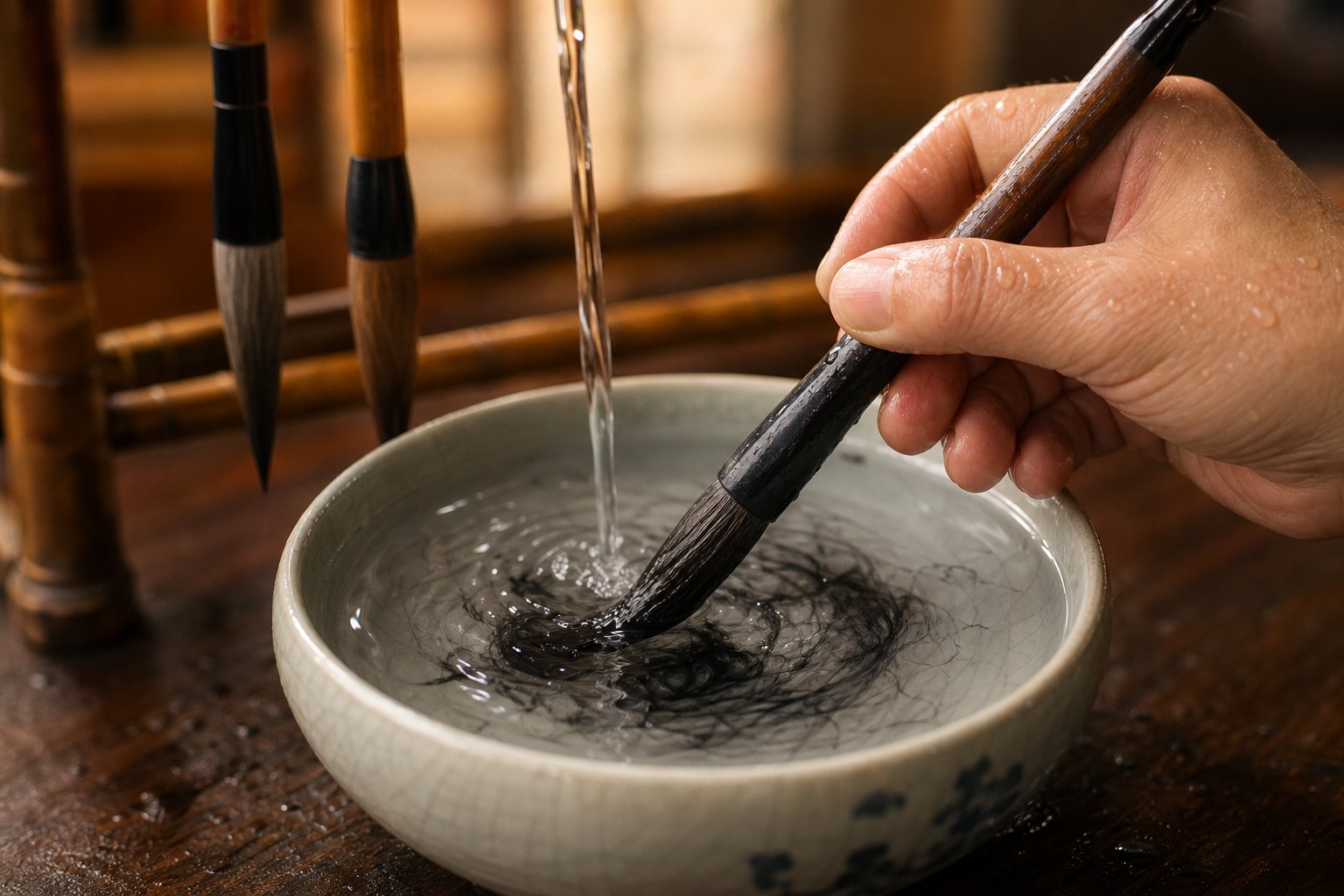
- Rinse immediately. Hold the brush under gently running lukewarm water or swirl it in a clean water container. Work the bristles with your fingers, gently squeezing from the base of the hair bundle toward the tip to push ink out from the interior. Do not pull or twist the hairs.
- Repeat until the water runs clear. Ink trapped deep inside the bundle will bleed out slowly. Change your rinse water if using a container, and continue working the bristles until no more color appears. This typically takes one to two minutes for a well-used brush.
- Reshape the tip. While the bristles are still wet, use your fingers to gently reshape the brush head into its natural point. Smooth the hairs downward from base to tip, coaxing them back into alignment. The brush should look close to its original shape when you finish.
- Remove excess water. Gently squeeze the bristle bundle with a soft cloth or paper towel to absorb remaining moisture. Do not wring or twist.
- Hang the brush tip-down to dry. Use a brush hanger (笔挂/bigua) that suspends the brush vertically with the tip pointing toward the floor. This allows residual water to drain away from the ferrule rather than pooling at the base where it can loosen the glue binding the hairs to the handle.
Never leave a brush standing upright in a holder while wet. Water migrates down into the ferrule joint, softens the adhesive, and eventually causes the entire brush head to loosen or fall off. Equally damaging is leaving a brush soaking in water between sessions. Extended soaking warps the handle, dissolves binding glue, and causes bristles to lose their natural elasticity permanently.
One mistake catches many beginners off guard: not breaking in a new brush properly. Most new brushes arrive with the bristles stiffened by a protective starch coating. Soak the brush tip in room-temperature water for five to ten minutes to dissolve this coating before first use. Do not force the bristles apart while dry, as this snaps hairs and damages the tip shape. Once the starch dissolves, gently work the bristles open with your fingers, rinse thoroughly, and the brush is ready.
For storage between sessions, once the brush is fully dry, you can hang it on a brush rack or lay it flat in a bamboo brush roll. Avoid sealed containers or plastic bags that trap residual moisture and encourage mildew growth on natural hair.
Maintaining Ink Sticks and Inkstones Long-Term
Ink sticks are surprisingly fragile despite their solid appearance. They are made from compressed carbon bound with animal glue, and that glue is sensitive to both humidity and temperature extremes. Store ink sticks in a cool, dry location away from direct sunlight. Excessive humidity causes the glue to soften and the stick to warp or develop surface mold. Excessive dryness or heat causes the glue to contract and the stick to crack, sometimes splitting completely along its length.
After grinding, always dry the contact end of the ink stick with a soft cloth before putting it away. Never leave the stick standing vertically on the inkstone after use. The wet grinding surface will bond to the stone as the ink dries, and pulling it free can damage both the ink stick and the inkstone surface. Lay the stick on its side on a dry surface or return it to its box.
Inkstone maintenance centers on one principle: keep the grinding surface clean and functional. Wash the inkstone with clean water after every session using a soft brush or high-density sponge. Dried ink residue gradually fills the microscopic texture that makes grinding effective. If you let residue accumulate over weeks, the stone becomes slick and stops producing ink efficiently. For stubborn dried ink, soak the stone in room-temperature water for several hours to soften deposits before gently scrubbing. Never use hot water, which can cause thermal stress and crack the stone, and avoid soap or chemical cleaners that may corrode the surface over time.
To maintain moisture in the stone between sessions, some practitioners keep a thin layer of clean water in the reservoir area. This prevents the stone from drying out excessively, which can affect its grinding performance. If you use this method, keep the flat grinding area dry. Water sitting on the grinding surface for extended periods creates a slippery biofilm layer that interferes with ink production.
Paper storage is simpler but still matters. Keep xuan paper flat in a dry environment, ideally wrapped in kraft paper or stored in a sealed container with a silica gel packet. Humidity causes xuan paper to absorb moisture from the air, which changes its ink absorption characteristics and can promote mold growth. Heat and direct sunlight yellow the paper and make it brittle. A closet shelf away from exterior walls works well for most home environments.
These maintenance habits take only a few minutes per session, but they compound over months into dramatically longer tool life and more consistent performance. When you learn chinese calligraphy with tools that behave predictably session after session, your progress stays on a steady upward curve rather than being disrupted by equipment failures you could have prevented.
Well-maintained tools that perform consistently are worth protecting. The final piece of the puzzle is knowing how to acquire quality replacements and additions when the time comes, especially if you are shopping online without the ability to hold a brush or feel an inkstone's texture before buying.
Buying Quality Chinese Calligraphy Supplies With Confidence
Shopping for chinese calligraphy supplies online means trusting product photos and descriptions to tell you what your hands cannot. You cannot feel the spring of a brush tip, test the texture of an inkstone, or check whether paper fibers respond correctly to moisture. That gap between screen and reality trips up buyers constantly, especially those studying outside Asia without a local specialty shop to visit. A few evaluation strategies close that gap significantly.
How to Evaluate Quality From Online Listings
Product photos reveal more than sellers sometimes intend. When browsing a calligraphy set chinese retailers offer online, train yourself to look past the styled photography and focus on functional details.
- Brush tip shape: A quality brush photographed without its protective cap should show a clean, tapered point with no stray hairs splaying outward. If the listing only shows the brush in its starch-stiffened state or inside packaging, that is less informative but not necessarily a red flag.
- Hair bundle density: Look at where the bristles meet the ferrule. A full, tightly packed bundle indicates proper hair selection. Sparse or uneven packing suggests rushed assembly.
- Inkstone surface texture: Close-up photos should show a matte, slightly textured grinding area. If the surface looks polished or glassy, it will not grind ink effectively regardless of the stone type claimed.
- Ink stick surface: Quality ink sticks have smooth, crack-free surfaces with crisp edges. Visible crumbling, surface pitting, or hairline fractures indicate poor storage or low-grade production.
- Paper specifications: Listings that state fiber content (bark percentage), sizing treatment (raw, semi-sized, or fully sized), and origin region give you far more confidence than those offering only dimensions and sheet count.
Key specifications to check include brush hair type (with the actual Chinese term, not just "natural hair"), brush head length and diameter in millimeters, inkstone dimensions and stone type, and paper weight or thickness. Vague descriptions that avoid these specifics are usually hiding mediocre quality behind attractive packaging.
- Red flags in listings: Claims of "wolf hair" at suspiciously low prices (quality weasel hair costs more than goat), bundled sets where every component is unnamed and unspecified, stock photos used across multiple unrelated products, and descriptions that focus entirely on decorative value or gift-giving rather than functional performance.
Where to Find Authentic Chinese Calligraphy Supplies
Three main channels serve practitioners shopping remotely, each with distinct advantages.
Specialty Asian art supply retailers are your most reliable option. These businesses cater specifically to calligraphers and ink painters, which means their inventory is curated for function rather than novelty. Staff typically have practice experience themselves and can answer specific questions about hair types, paper sizing, and tool compatibility. Many operate both physical storefronts in major cities and online shops with detailed product descriptions.
Direct-from-origin sellers offer tools sourced from traditional production regions like Huzhou (brushes), Jingxian (paper), and Zhaoqing (inkstones). These sellers often work directly with workshops and can provide provenance details that general retailers cannot. The trade-off is longer shipping times and occasionally less polished website experiences. For mid-range and premium purchases, the quality-to-price ratio often justifies the wait.
General online marketplaces carry enormous variety but require more buyer diligence. Sorting genuine craft products from mass-produced novelty items takes practice. Prioritize sellers with detailed product descriptions in both Chinese and English, customer review photos showing the tools in use, and return policies that allow inspection upon arrival. Avoid listings where the primary selling point is the decorative box rather than the tools inside it.
Common Purchasing Mistakes to Avoid
One persistent trap catches collectors and practitioners alike: assuming that a vintage chinese calligraphy set or antique chinese calligraphy piece will perform better than a modern equivalent. Antique sets can be beautiful, historically interesting, and genuinely valuable as collectibles. They are not necessarily better for daily practice. Ink sticks dry out and crack over decades. Brush hair loses elasticity. Inkstone surfaces wear smooth. An antique chinese calligraphy set displayed behind glass may be worth significant money while being functionally inferior to a fresh mid-range set from a working workshop.
If you are drawn to vintage pieces, appreciate them for what they are: artifacts of craft history. Keep a separate, functional set for your actual practice sessions.
The other common mistake is the opposite extreme: endless research without ever putting brush to paper. Reading about tools, comparing specifications, watching review videos, and bookmarking shops can feel productive. It is not practice. A functional set of modest quality, used daily for thirty minutes, will develop your calligraphy faster than a premium collection that sits waiting for the "right moment" to begin.
You know enough now. You understand brush hair types, ink preparation, paper behavior, inkstone function, script-to-tool matching, budget tiers, maintenance routines, and how to evaluate quality from a listing. The only remaining variable is your hand on the brush and the hours you put in. Start with what you can afford, practice with intention, and let your growing skill tell you when it is time to upgrade.
Frequently Asked Questions About Chinese Calligraphy Tools
1. What are the Four Treasures of the Study in Chinese calligraphy?
The Four Treasures of the Study (文房四宝, wenfang sibao) are the brush, ink stick, paper, and inkstone. These four tools form the foundation of traditional Chinese calligraphy practice. Each element works together to produce quality brushwork: the brush applies ink, the ink stick provides pigment when ground on the inkstone with water, and xuan paper receives the strokes with varying degrees of absorption depending on its sizing treatment.
2. What type of brush is best for beginners learning Chinese calligraphy?
A mixed hair brush (兼毫, jianháo) is the most practical choice for beginners. It combines a weasel hair core for structure and spring-back with an outer layer of goat hair for ink capacity and softness. This balance makes it forgiving enough for learners while still providing honest feedback on technique. A medium-sized mixed hair brush can handle regular script, clerical script, and running script reasonably well, giving new practitioners room to explore different styles before investing in specialized brushes.
3. Should I use an ink stick or bottled ink for Chinese calligraphy?
Both have their place depending on your goals. Freshly ground ink from a stick produces finer particles, richer tonal variation, and a more responsive feel under the brush. Bottled ink saves time and works well for daily volume practice or classroom settings. A practical approach is using bottled ink for routine drills and switching to freshly ground ink when working on pieces you want to keep or when practicing ink-tone variation techniques.
4. What is the difference between raw, semi-sized, and fully sized xuan paper?
Raw xuan (生宣) is untreated and absorbs ink almost instantly, making it ideal for expressive work but extremely unforgiving for beginners. Semi-sized xuan (半熟宣) has a light alum treatment that slows absorption to a controllable rate, making it the best option for learners and multi-style practice. Fully sized xuan (熟宣) has heavy alum treatment that prevents ink from sinking in, keeping strokes crisp with no bleeding. It suits detail work and seal script but lacks the dynamic tonal variation that makes calligraphy visually rich.
5. How do I properly clean and store a Chinese calligraphy brush?
Rinse the brush under lukewarm water immediately after each session, gently squeezing ink from the base toward the tip until water runs clear. Reshape the bristles into a point while still wet, remove excess moisture with a soft cloth, then hang the brush tip-down on a brush hanger to dry. Never leave brushes soaking in water or standing upright while wet, as moisture migrates into the ferrule and loosens the adhesive binding the hair to the handle. Once fully dry, store brushes on a rack or flat in a bamboo roll.