Understanding the Chinese Family Naming Hierarchy
When you call someone "uncle" in English, you communicate almost nothing about that person's actual position in your family. Is he older or younger than your parent? Is he on your mother's side or your father's side? Is he related by blood or by marriage? English doesn't care. Chinese does. Every single time.
The chinese family naming hierarchy is not a vocabulary list. It is a social technology, a system that encodes rank, obligation, and relationship directly into language. In a traditional chinese household, the word you use to address a relative simultaneously declares their generation, their lineage, their birth order, and their authority relative to yours. There is no neutral term. There is no generic "aunt" or "cousin" that lets you sidestep these distinctions.
What Makes Chinese Family Naming Unique
Linguists and anthropologists consistently rank Chinese kinship terminology among the most complex systems in the world. Where English uses roughly a dozen core family terms, Mandarin Chinese deploys well over a hundred, each carrying precise relational data. The system distinguishes paternal from maternal relatives, elder from younger siblings, and blood ties from marriage bonds in ways that reshape how a chinese family organizes itself socially.
Consider a simple example. In English, your father's brother and your mother's brother are both "uncle." In Chinese, your father's older brother is bofu, your father's younger brother is shufu, and your mother's brother is jiufu. These are not synonyms or regional variants. They are entirely different words carrying different cultural weight, different expectations of behavior, and different positions within the family structure. Understanding how chinese names work at the kinship level means grasping that each title is a compressed social contract.
In Chinese, you cannot name a relative without simultaneously declaring their rank in the family structure. The language offers no way to refer to family in chinese without encoding hierarchy into the act of speaking itself.
Why Hierarchy Is Built Into the Language
This precision is not accidental. The chinese hierarchy embedded in kinship terms reflects thousands of years of Confucian social philosophy, patrilineal clan organization, and a worldview in which knowing your exact place within the family is the foundation of moral behavior. The system was designed so that a child learning to speak would absorb the family's power structure through language alone, long before anyone explained it explicitly.
For learners and researchers, this means that memorizing lists of common chinese names for relatives is the wrong approach. The real skill is learning the underlying logic: the axes of distinction (paternal vs. maternal, elder vs. younger, blood vs. marriage) and the rules that generate correct terms from those axes. Once you understand the architecture, you can derive the right title for any relative you encounter, even in unfamiliar situations.
That architecture begins with a single, powerful division that shapes every branch of the chinese family hierarchy: the split between the paternal line and the maternal line, and the very different weight each carries.
Confucian Roots and Historical Origins of Chinese Family Names
That paternal-maternal divide did not emerge from thin air. It grew out of a clan system stretching back over four thousand years, one where chinese surnames carried far more than personal identity. They carried political power, inheritance rights, and proof of belonging.
Ancient Clan Systems and the Origin of Surnames
The earliest chinese last names operated as two separate categories. The character 姓 (xing) traced matrilineal ancestry and signified noble clan membership, while 氏 (shi) denoted a branch of a larger clan, often derived from official titles, fiefs, or places of origin. Over centuries, these two systems merged into the hereditary chinese family names still used today.
By the Zhou dynasty (1046-256 BCE), surnames became tightly bound to ancestral worship and clan-based social structures. Aristocratic families used them to preserve bloodlines, distinguish noble lineages, and maintain hierarchical order. The Zhou rulers incorporated patriarchal lineage into their governing structure so effectively that it shaped Chinese civilization permanently. Eldest sons formed the "Main Branch" (dazong 大宗) with higher status, while younger sons formed the "Side Branch" (xiaozong 小宗) with less privilege and power.
The Hundred Family Surnames (百家姓), a Song dynasty text, famously cataloged many of the most common chinese last names and cemented clan identity in the cultural imagination. Among the most popular chinese last names, Wang (王), Li (李), and Zhang (张) are shared by more than 20% of China's population, each tracing back to royal titles, noble clans, or ancient feudal states. These chinese surnames and meanings reveal layers of history: Wang means "king," while Li became associated with the Tang dynasty royal family.
The family registry system, known as 族谱 (zupu) or 家谱 (jiapu), gave this hierarchy its documentary weight. Before the Song dynasty, jiapu were used as official documents by the imperial court to prove the identity of ruling-class members and justify their positions. These records tracked generations, marriages, migrations, and moral precepts, tying the most common chinese surnames directly to inheritance, ancestral worship, and social standing.
Confucian Philosophy as the Engine of Naming Rules
Imagine a system where your elder brother has different moral duties than your younger brother, and the language itself enforces that distinction every time someone speaks to either of them. That is exactly what Confucianism built into Chinese kinship terminology.
Confucian teachings extended filial piety into the Five Cardinal Relationships (五伦), three of which are family-based: father and son, elder and younger brother, and husband and wife. Each relationship carried specific, asymmetric obligations. The rights and duties these relationships entailed constituted both righteousness (yi 义) and propriety (li 礼), and their fulfillment defined the principal Chinese virtue of filial piety (xiao 孝).
The core Confucian principles that directly shaped naming conventions include:
- Filial piety (孝 xiao) — Children owe obedience and care to parents and elders, reflected in terms that mark seniority and demand deference. Addressing someone by the wrong generational term was a violation of xiao itself.
- Respect for elders (悌 ti) — Elder siblings hold authority over younger ones. This is why 兄 (xiong, elder brother) and 弟 (di, younger brother) are entirely different words with different social weight, not variations of a single term.
- Patrilineal continuity (宗法 zongfa) — The male line carries the clan forward. Paternal relatives receive distinct, more elaborate terminology, while maternal relatives are linguistically marked as "outside" (外 wai) the core lineage.
- Ritual propriety (礼 li) — Correct naming is itself a ritual act. Using the proper kinship term was legally and morally enforced, with penalties for violations enshrined in the legal codes of the Ming and Qing dynasties.
These principles did not merely influence common chinese last names or how families chose given names. They determined the entire architecture of address. An elder brother commands a different term than a younger brother because Confucianism assigns them fundamentally different duties within the family. The naming system made those duties audible in every conversation, every greeting, every family gathering.
This philosophical engine powered the system for millennia. But philosophy alone does not explain why your father's brother and your mother's brother require completely different words, or why the prefix 外 marks an entire side of your family as structurally "outside." That distinction runs deeper, into the very bones of how paternal and maternal lines are separated in Chinese kinship.
Paternal vs. Maternal Naming Distinctions in Chinese Families
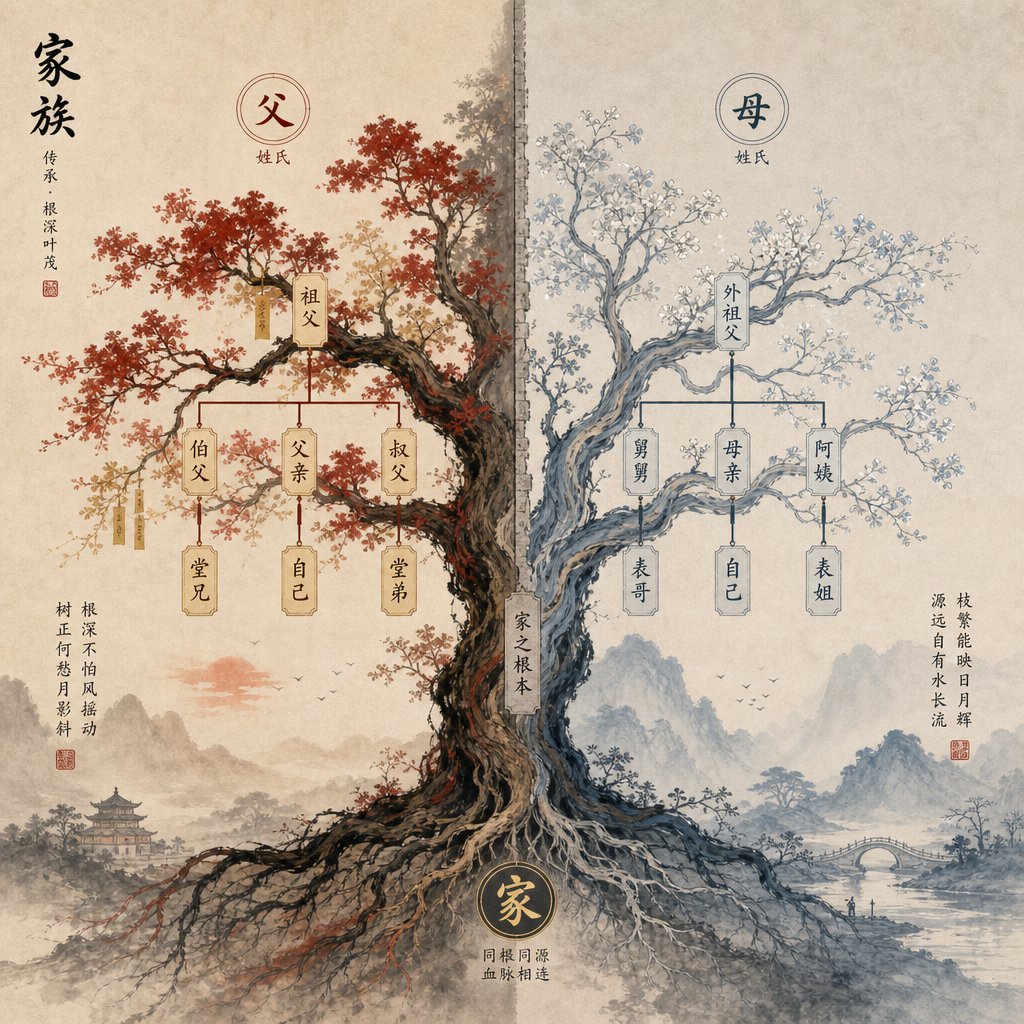
The prefix 外 (wai) means "outside." In the context of family members in chinese language, it marks every maternal relative as structurally external to the core family unit. This single character reveals the deepest architectural principle of the naming system: the paternal line is the center, and everything else orbits around it.
Consider the chinese paternal grandfather, 爷爷 (yeye). His term carries no qualifier, no prefix, no marker of distance. He simply is. The maternal grandfather, 外公 (waigong), carries that 外 prefix permanently attached to his title. He is, linguistically, the "outside grandfather." These are not two versions of the same word. They are entirely different constructions reflecting entirely different positions within the family in chinese language.
Paternal Side Terms and Their Hierarchical Weight
On the father's side, terminology is more elaborate and more finely differentiated. The paternal grandfather in chinese is 爷爷 (yeye), and the paternal grandmother is 奶奶 (nainai). These terms stand alone without any qualifying prefix because the paternal line is treated as the default, the unmarked center of the kinship universe.
The same principle extends to uncles and aunts. Your father's older brother is 伯伯 (bobo), while your father's younger brother is 叔叔 (shushu). Notice that the system even splits paternal uncles by birth order, a distinction that does not exist on the maternal side. Your father's sister is 姑姑 (gugu). Each of these terms is unique, carrying specific expectations about authority and closeness within the household.
This level of precision among family members in chinese reflects the traditional reality that paternal relatives often lived together in multi-generational compounds. You needed distinct terms because these were the people you saw daily, whose rank directly affected your life.
Maternal Side Terms and the 外 Distinction
Maternal relatives receive a parallel but structurally different set of terms. The chinese names for grandparents on the mother's side are 外公 (waigong) for grandfather and 外婆 (waipo) for grandmother. That 外 prefix is not optional or informal. It is built into the standard term itself.
Your mother's brother is 舅舅 (jiujiu), and your mother's sister is 阿姨 (ayi). Unlike the paternal side, there is no further split by birth order in everyday usage. The system treats maternal relatives with less granularity, a linguistic echo of the traditional view that a married woman becomes part of her husband's clan, making her birth family secondary in the hierarchy.
Even grandchildren are marked by this logic. A son's children are called 孙子 (sunzi) and 孙女 (sunnu), while a daughter's children become 外孙 (waisun) and 外孙女 (waisunnu). The "outside" label follows the maternal line in both directions.
Formal vs. Informal Register
Beyond the paternal-maternal axis, family in mandarin also operates across a register spectrum. Most kinship terms have both a formal written version and a colloquial spoken version. Your mother is 母亲 (muqin) in formal contexts like legal documents, eulogies, or literary writing, but 妈妈 (mama) in daily conversation. Your father is 父亲 (fuqin) formally and 爸爸 (baba) at home.
The same pattern applies to grandparents. The formal term for paternal grandfather is 祖父 (zufu), while 爷爷 (yeye) is the everyday address. Maternal grandfather is formally 外祖父 (waizufu) but spoken as 外公 (waigong). Knowing when to use which register matters. A wedding speech calls for 父亲; a phone call home calls for 爸爸. Using the wrong register does not change the meaning, but it signals either inappropriate distance or excessive casualness.
The table below maps these chinese grandparents names and core family terms across both lineage and register:
| Relationship | Simplified Chinese | Traditional Chinese | Pinyin | Register |
|---|---|---|---|---|
| Paternal grandfather | 爷爷 | 爺爺 | yeye | Informal |
| Paternal grandfather | 祖父 | 祖父 | zufu | Formal |
| Paternal grandmother | 奶奶 | 奶奶 | nainai | Informal |
| Paternal grandmother | 祖母 | 祖母 | zumu | Formal |
| Maternal grandfather | 外公 | 外公 | waigong | Informal |
| Maternal grandfather | 外祖父 | 外祖父 | waizufu | Formal |
| Maternal grandmother | 外婆 | 外婆 | waipo | Informal |
| Maternal grandmother | 外祖母 | 外祖母 | waizumu | Formal |
| Father's older brother | 伯伯 | 伯伯 | bobo | Informal |
| Father's older brother | 伯父 | 伯父 | bofu | Formal |
| Father's younger brother | 叔叔 | 叔叔 | shushu | Informal |
| Father's younger brother | 叔父 | 叔父 | shufu | Formal |
| Father's sister | 姑姑 | 姑姑 | gugu | Informal |
| Father's sister | 姑母 | 姑母 | gumu | Formal |
| Mother's brother | 舅舅 | 舅舅 | jiujiu | Informal |
| Mother's brother | 舅父 | 舅父 | jiufu | Formal |
| Mother's sister | 阿姨 | 阿姨 | ayi | Informal |
| Mother's sister | 姨母 | 姨母 | yimu | Formal |
This dual-axis system, lineage plus register, means that a single relative can be addressed in multiple ways depending on context. But regardless of which register you choose, the paternal-maternal distinction never disappears. It is permanent, structural, and non-negotiable.
Lineage and formality, however, are only two of the axes that shape how relatives are addressed. Within the same generation and the same side of the family, another force takes over: birth order. Whether you arrived first or last among your siblings changes not just what people call you, but what they expect from you.
Birth Order and Its Impact on Family Titles
Imagine two brothers standing side by side. In English, they are both simply "brother." In Chinese, they can never be the same word. The elder is 哥哥 (gege), the younger is 弟弟 (didi), and these are not interchangeable labels. They are different social positions with different expectations baked into the syllables themselves. Among all chinese kinship terms, birth order is the axis that determines your title, your authority, and your obligations within the same generation.
How Birth Order Determines Your Title
The system works through a numbering mechanism. When multiple chinese siblings share a family, each receives a rank-specific title. The eldest brother is 大哥 (dage), the second brother is 二哥 (erge), the third is 三哥 (sange), and so on. The same logic applies to sisters: 大姐 (dajie) for the eldest, 二姐 (erjie) for the second, 三姐 (sanjie) for the third. These numbered titles are not nicknames. They are the standard way to address relatives in chinese within the sibling hierarchy.
For those below you in birth order, the terms shift. A younger brother is 弟弟 (didi) and a younger sister is 妹妹 (meimei). The chinese for younger sister carries a distinct social flavor: 妹妹 implies someone you protect, guide, and occasionally indulge. The older sister in chinese language, 姐姐 (jiejie), carries the opposite weight: authority, responsibility, and the expectation of maturity beyond her years.
The hierarchical ranking among mandarin family members within a single generation follows this structure:
- 大哥 (dage) / 大姐 (dajie) — Eldest sibling: Carries the most authority among siblings. Expected to set an example, mediate disputes, and in traditional families, share financial responsibility for younger siblings' education or marriages.
- 二哥 (erge) / 二姐 (erjie) — Second sibling: Defers to the eldest but holds authority over all younger siblings. Acts as a bridge between the eldest and the rest.
- 三哥 (sange) / 三姐 (sanjie) — Third sibling and beyond: Each successive number reduces authority. Obligations lighten, but so does influence in family decisions.
- 弟弟 (didi) / 妹妹 (meimei) — Younger siblings: Owe respect and deference to all above them. In return, they receive protection and guidance. The youngest often enjoys the most leniency.
Sibling Terms and Social Expectations
These chinese familial terms are not just about address. They encode behavioral expectations. A 姐姐 who fails to look after her 妹妹 is judged more harshly than the reverse. A 大哥 who cannot manage family harmony loses face in ways a younger brother never would. The younger sister in chinese culture occupies a position of relative freedom precisely because the hierarchy places less weight on her shoulders.
In Cantonese-speaking families, the same principles apply but with phonetic differences that matter. Older brother becomes 大佬 (daai6 lou2) in casual Cantonese, while older sister is 家姐 (gaa1 ze2) rather than the Mandarin 姐姐. Younger sister is 細妹 (sai3 mui2). These are not just pronunciation shifts. Cantonese terms like 大佬 carry a colloquial weight that Mandarin equivalents lack, blending familial respect with street-level familiarity.
Cousin Terminology and the Numbering System
The numbering system extends seamlessly to cousins, layering birth order on top of the paternal-maternal split covered earlier. A cousin on your father's side who is older than you becomes 堂哥 (tangge) or 堂姐 (tangjie). A younger cousin on your mother's side becomes 表弟 (biaodi) or 表妹 (biaomei). When multiple cousins share the same category, numbers stack: 大表哥 (da biaoge) for the eldest maternal-side male cousin, 二表哥 (er biaoge) for the second.
The practical consequences of getting these terms wrong are real. Calling an elder cousin by a younger-sibling term, say addressing your 堂哥 as 堂弟, signals either ignorance or deliberate disrespect. In traditional families, it reflects poorly not just on you but on your parents, suggesting they failed to teach basic propriety. Even in casual modern settings, misusing birth-order terms among relatives in chinese conversation creates an awkward social friction that native speakers immediately notice.
Birth order, then, is not a footnote in the naming system. It is a live wire running through every sibling and cousin relationship, assigning rank and duty through language alone. But the hierarchy does not stop at what people call each other. It reaches deeper still, into the very characters of a person's given name, where an entire generation's position can be encoded in a single shared syllable.
Generational Names and the 字辈 System
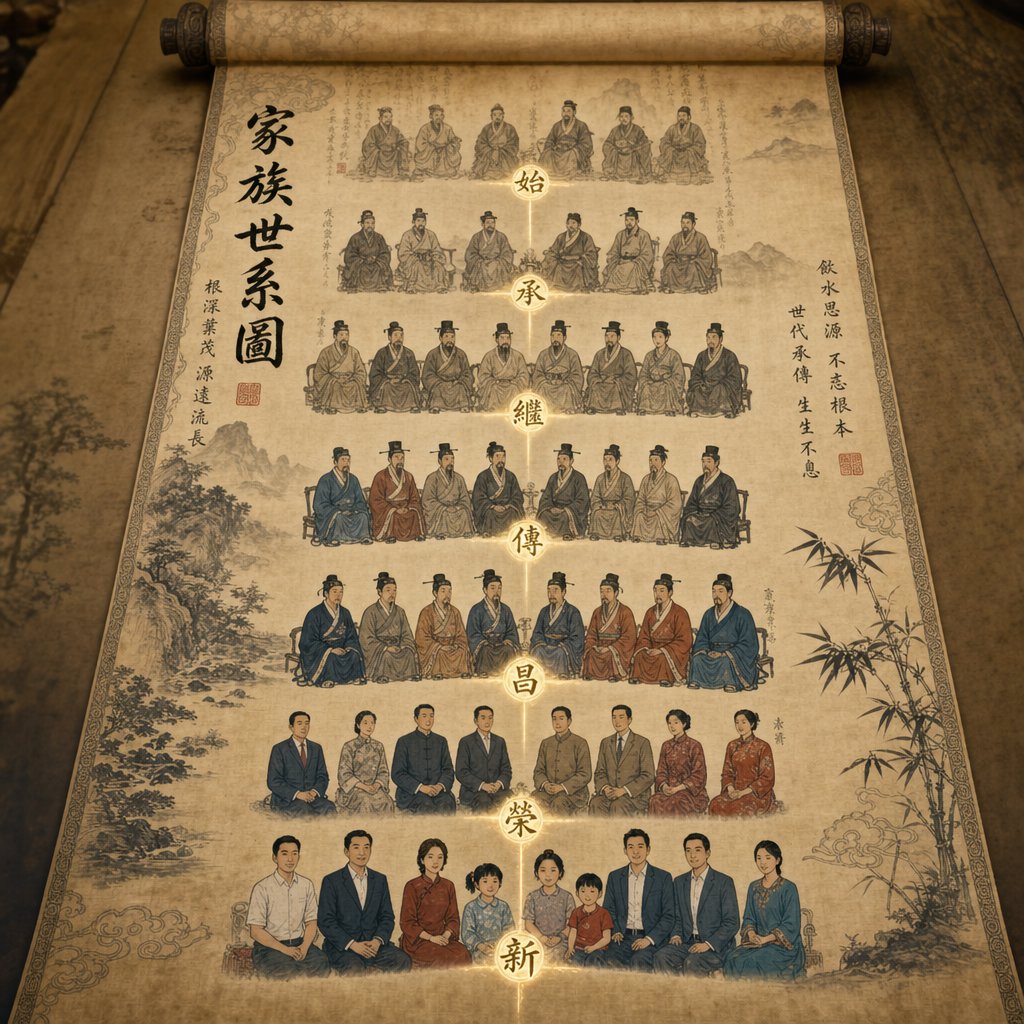
That shared syllable is not a coincidence. It is the product of a deliberate system called 字辈 (zibei), one of the most powerful mechanisms within the chinese family naming hierarchy. Where kinship titles tell you how someone relates to you, chinese generation names tell you where someone sits in the vertical timeline of an entire clan. A single character embedded in a person's given name can reveal whether they belong to your grandfather's generation, your own, or your grandchild's, even if you have never met them before.
How the 字辈 System Works
The structure is elegant. A standard Chinese name has three components: surname + generation character + individual character. The surname identifies the clan. The generation character, drawn from a predetermined sequence, identifies which generation the person belongs to. The individual character is unique to that person. Together, these three elements create a name that functions like a coordinate on a family tree in chinese culture, pinpointing both lineage and generational depth.
Consider a clan with the surname Li (李). If the generation character for the current generation is 耀 (yao), then all brothers and male cousins in that generation might be named Li Yaoming (李耀明), Li Yaojun (李耀军), Li Yaohui (李耀辉). The shared 耀 instantly marks them as belonging to the same generational tier. Their children's generation might use the character 德 (de), producing names like Li Dewen (李德文) and Li Dehua (李德华). A stranger encountering both a 耀-generation and a 德-generation Li would immediately know their hierarchical relationship without asking.
The generation character most commonly appears as the first character of the given name, though some clans place it second. Either way, the pattern remains visible to anyone who knows the sequence.
Reading Generational Rank From a Name
The sequence of generation characters is not random. Clans traditionally composed a generation poem, a string of characters arranged in ordered lines, usually in sets of five or seven. Each character in the poem corresponds to one generation, cycling through in fixed order. These poems often conveyed virtues like loyalty, wisdom, or prosperity, expressing the clan's aspirations for its descendants across centuries.
A hypothetical generation poem might read: 仁义礼智信, 忠孝廉德馨 (Ren Yi Li Zhi Xin, Zhong Xiao Lian De Xin) — Benevolence, Righteousness, Propriety, Wisdom, Trust, Loyalty, Filial Piety, Integrity, Virtue, Fragrance. Each character serves one generation, cycling back to the beginning after ten generations have passed.
Because each clan's poem is unique, even a handful of chinese generational names can act like a fingerprint. If you know that your family uses the characters 礼 and 智 in consecutive generations, you can search for your clan's genealogy records using those characters alone. This is why the 字辈 system is not merely decorative. It is a functional indexing tool for navigating a china family tree that may span dozens of generations and thousands of individuals.
The practical effect is striking. Two strangers sharing the surname Wang who meet at a clan gathering can compare their generation characters and immediately determine their relative seniority. If one carries a character that appears earlier in the poem, he belongs to a senior generation and receives the corresponding respect, regardless of actual age.
The Role of Clan Genealogies
The 字辈 system draws its authority from the clan genealogy, or 族谱 (zupu). These genealogical records, sometimes called 家谱 (jiapu), document every branch of a lineage from a common ancestor downward. Unlike Western genealogies that typically trace lineage from an individual upward, a chinese language family tree begins with the founding ancestor and maps all descendants forward through time. The generation poem is recorded at the front of the jiapu, serving as the master key for the entire document.
Ancestral halls (祠堂 citang) physically housed these records and served as the institutional home of the 字辈 system. When a new child was born, elders consulted the genealogy to determine which generation character applied, then the family selected an individual character to complete the name. This process tied every chinese family tree name directly to the clan's collective identity and historical continuity.
The system was primarily created for male descendants, giving brothers and cousins a shared character in their names. In some clans, daughters also received a generation character, either matching or distinct from the males. The generation poem structure varied as well. Some followed rhyme schemes while others did not, but all provided an unbroken sequence for naming across generations.
By the Ming dynasty (1368-1644), two-character given names shaped by clan traditions and generation poems had become standard practice. But in the mid-twentieth century, many of these traditions declined as political movements criticized genealogical practices as feudal remnants. Single-character names without a generation character grew more popular in urban areas.
Still, the system persists. Many families in rural southern China and overseas Chinese communities continue to pass on generation characters, keeping the link between a family tree chinese tradition and living practice intact. In Southeast Asia, the Americas, and other diaspora communities, the 字辈 system often preserves older naming conventions that have already shifted on the mainland. For anyone researching chinese family tree names or attempting to reconstruct a lineage, understanding the generation poem remains one of the most reliable tools available.
The 字辈 system reveals something fundamental about how the naming hierarchy operates: it is not just about how you address others, but about what your own name says about you. Your name is not fully yours. Part of it belongs to your generation, your clan, your place in a sequence stretching centuries in both directions. And if the generation character tells the world where you stand, there are equally powerful rules governing what your name must never contain, characters that belong to those above you and remain permanently off-limits.
Naming Taboos That Enforce the Chinese Family Hierarchy
Those off-limits characters are governed by one of the most powerful unwritten rules in Chinese culture: 避讳 (bihuì), the practice of naming taboos. Where the 字辈 system tells you what your name should contain, 避讳 tells you what it must never contain. Together, they form two sides of the same coin, one constructive, one prohibitive, both reinforcing the hierarchy through the act of naming itself.
The core principle is simple. You must never use the personal name characters of anyone above you in the family or social hierarchy. Not in speech, not in writing, not even in naming your children. The chinese name meaning of this practice goes beyond politeness. It treats the names of elders and ancestors as sacred territory, linguistically fenced off from everyone below them in rank.
The Rules of 避讳 in Family Context
Within a family, the naming taboo of the clan (家讳 jiahui) prohibited using the name chinese characters of one's own ancestors, typically going back seven generations. If your grandfather's name contained the character 明 (ming, meaning "bright"), no grandchild, great-grandchild, or any descendant could carry that character in their name. The prohibition extended beyond your own household. In formal correspondence between clans, each family's naming taboos were observed as a sign of mutual respect.
Violating these taboos was not a minor social misstep. It signaled a lack of education and upbringing, bringing shame both to the offender and the offended person's family. In traditional chinese family customs, a child given a name that duplicated an ancestor's character reflected poorly on the parents, suggesting they either did not know their own genealogy or did not care enough to honor it.
The categories of naming taboos operated at three distinct levels:
- Imperial taboo (国讳 guohui) — The emperor's given name and those of his ancestors were off-limits to the entire population. Using these characters in writing or speech could result in severe punishment, including execution.
- Clan taboo (家讳 jiahui) — The given names of one's own ancestors, typically spanning seven generations, could not be used by any descendant. This applied to naming children, writing documents, and even casual conversation.
- Social taboo (圣人讳 shengrenhuì) — The names of revered cultural figures, such as Confucius, were avoided out of respect. During certain dynasties, writing the name of Confucius was formally prohibited.
Historical Imperial Naming Taboos
The imperial version of 避讳 carried the most dramatic consequences. During the Qin dynasty, the first emperor's given name 政 (zheng) forced the entire population to alter the pronunciation of the first month of the year, 正月, from zhengyue to a different tone to avoid the taboo. The Kangxi Emperor's given name Xuanye (玄烨) required that the Black Warrior Gate (玄武门) of the Forbidden City be renamed the Gate of Divine Might (神武门) to avoid using a character from his name. Anyone whose name shared those characters had to change them.
The strength of this taboo was reinforced by law. In 1777, a scholar named Wang Xihou wrote the Qianlong Emperor's name in a dictionary without omitting the required stroke. The result was his execution and the confiscation of his family's property. This was not an isolated case. Throughout imperial China, writers developed three standard methods to avoid offense: substituting a synonym, leaving the character blank, or omitting the final stroke when writing it.
As the South China Morning Post notes, Chinese monarchs were never called by their names during their lifetimes, even out of earshot. Rulers were referred to as "His Majesty" or, in the late imperial period, "the Lord of 10,000 Years." Titles like "the Kangxi Emperor" are posthumous designations used only after their reigns ended.
Some emperors recognized the burden their names placed on the population. Emperor Xuan of Han, whose given name contained two extremely common characters, changed his own name to a rarer character specifically to make it easier for his subjects to avoid the taboo. This gesture reveals how deeply the practice shaped daily life across all levels of society.
How Taboos Shape Modern Name Selection
Imperial naming taboos disappeared with the fall of the Qing dynasty, but the family-level practice persists. Parents today still consult grandparents and great-grandparents' names before choosing characters for a newborn. The chinese name definition has not changed in this regard: a name remains a marker of position, and duplicating an elder's character still feels like a transgression to many families.
When parents select name chinese characters for a child, they navigate multiple constraints simultaneously. The characters must carry positive mandarin name meaning, avoid homophones with unlucky words, sound pleasing in the local dialect, and crucially, not overlap with any living elder's given name. In practice, this means families maintain mental or written lists of "forbidden" characters spanning several generations.
The chinese names meaning embedded in this practice connects to a broader truth about the naming hierarchy. Names are not arbitrary labels. They are positional markers. Every character in a name carries weight, history, and relational data. The taboo system ensures that this weight flows in one direction: upward. Elders' names remain untouchable, their characters reserved and elevated above common use. The hierarchy is not just spoken through kinship titles. It is written into the very characters that compose a person's identity.
Understanding chinese name interpretation in this context means recognizing that what a name excludes is as meaningful as what it includes. The names in chinese and meanings they carry are shaped as much by absence, by the characters deliberately avoided, as by the characters chosen. This interplay between inclusion and exclusion, between the 字辈 system and the 避讳 system, gives the naming hierarchy its full depth.
These taboos operated with remarkable consistency across the Chinese-speaking world for centuries. But "the Chinese-speaking world" is not monolithic. The same hierarchical principles that produced Mandarin kinship terms generated different phonetic forms, and sometimes different structural distinctions, in Cantonese, Hokkien, Hakka, and other regional language groups.
Regional and Dialectal Variations Across Chinese Communities
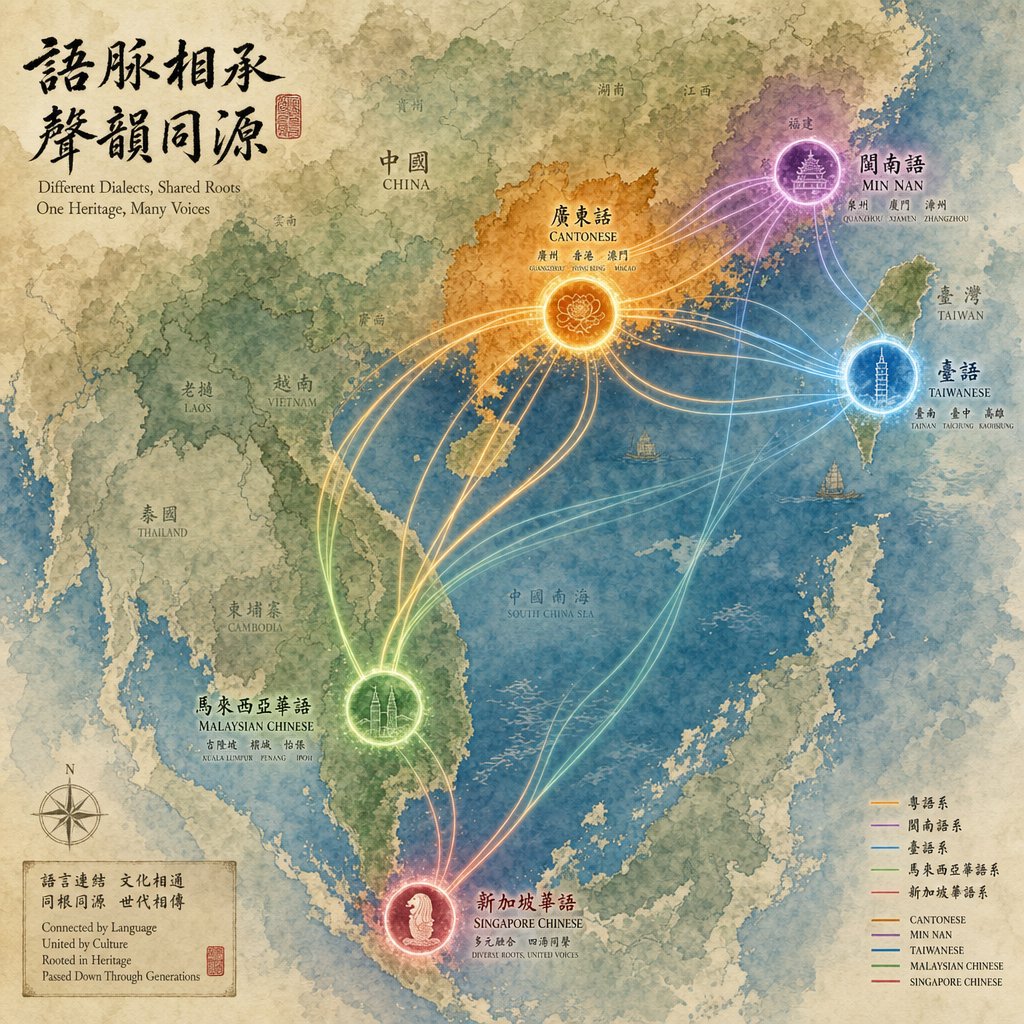
The chinese kinship system is not a single, uniform code. It is a family of systems, all built on the same hierarchical logic but realized through strikingly different sounds, and sometimes different structural choices, depending on where you are. A family tree in cantonese looks architecturally similar to one in Mandarin, yet the words filling each branch can be unrecognizable to speakers of the other variety. The underlying rules persist. The surface forms diverge.
Cantonese Family Naming Conventions
Cantonese-speaking communities in Guangdong, Hong Kong, and Macau preserve some of the most distinctive chinese family terms in the Sinophone world. The paternal grandmother, 奶奶 (nainai) in Mandarin, becomes 嫲嫲 (maa4 maa4) in Cantonese, a completely different character and sound. The paternal grandfather shifts from 爷爷 (yeye) to 爺爺 (je4 je4), phonetically closer but still distinct in tone and feel. Father moves from 爸爸 (baba) to colloquial forms like 老豆 (lou5 dau6), a term with no Mandarin equivalent at all.
The cantonese family tree also handles in-laws differently. A husband's father is 老爺 (lou5 je4) in Cantonese, while a wife's father is 外父 (ngoi6 fu6), using that same 外 ("outside") marker but in a structural position Mandarin does not replicate. Cantonese chinese honorifics within the family tend to be more colloquial and phonetically compressed, reflecting a spoken tradition that prioritizes efficiency in daily address while maintaining the hierarchical distinctions.
One notable structural difference: in Cantonese kinship usage, the 堂 (tong4) and 表 (biu2) distinction for cousins is often collapsed in everyday speech. Many Cantonese speakers use 表 for all cousins regardless of whether they are technically paternal-line (堂) or maternal-line (表). Northern Mandarin speakers, by contrast, tend to maintain this distinction more rigorously.
Hokkien and Hakka Variations
Hokkien, spoken across Fujian, Taiwan, and much of Southeast Asia, introduces its own set of divergences. The paternal grandfather becomes 阿公 (a-gong), a term shared with Hakka (a-kung). The maternal uncle's wife carries a unique Hokkien term, 阿妗 (a-kim), that has no direct equivalent in either Mandarin or Cantonese. These are not mere pronunciation shifts. They represent distinct lexical items that developed independently within the same hierarchical framework.
Hakka communities add further variation. The paternal grandmother may be called 阿婆 (a-pho), while the maternal grandfather can appear as 姐公 (ji-gung). Hakka kinship in chinese practice tends to preserve archaic forms that disappeared from Mandarin centuries ago, making Hakka-speaking villages valuable sources for historical linguists studying the evolution of the chinese kinship system.
The table below compares core family terms across three major varieties, showing how the same hierarchical position generates different linguistic forms:
| Relationship | Mandarin | Cantonese | Hokkien |
|---|---|---|---|
| Father | 爸爸 (baba) | 老豆 (lou5 dau6) | 阿爸 (a-pah) |
| Mother | 妈妈 (mama) | 阿妈 (aa3 maa1) | 阿母 (a-bu) |
| Paternal grandfather | 爷爷 (yeye) | 爺爺 (je4 je4) | 阿公 (a-gong) |
| Paternal grandmother | 奶奶 (nainai) | 嫲嫲 (maa4 maa4) | 阿嬷 (a-ma) |
| Maternal grandfather | 外公 (waigong) | 公公 (gung1 gung1) | 外公 (gua-gong) |
| Maternal grandmother | 外婆 (waipo) | 婆婆 (po4 po4) | 外嬷 (gua-ma) |
| Father's older brother | 伯伯 (bobo) | 阿伯 (aa3 baak3) | 阿伯 (a-peh) |
| Father's younger brother | 叔叔 (shushu) | 阿叔 (aa3 suk1) | 阿叔 (a-chek) |
| Mother's brother | 舅舅 (jiujiu) | 舅父 (kau5 fu6) | 阿舅 (a-ku) |
| Older brother | 哥哥 (gege) | 大佬 (daai6 lou2) | 阿兄 (a-hia) |
| Younger sister | 妹妹 (meimei) | 細妹 (sai3 mui6) | 小妹 (sio-mue) |
How Dialect Shapes Hierarchical Expression
What this variation reveals is that the hierarchy itself is the constant. The phonetic material is the variable. Whether you say family in chinese mandarin as 家人 (jiaren) or in Cantonese as 屋企人 (uk1 kei5 jan4), the structural logic underneath, the insistence on distinguishing paternal from maternal, elder from younger, blood from marriage, remains intact across every major Chinese language group.
Overseas Chinese communities add another layer. Hokkien-speaking families in Malaysia, Singapore, and the Philippines often preserve kinship terms that have fallen out of use in Fujian itself. Cantonese speakers in San Francisco's Chinatown may use forms of address that predate Hong Kong's postwar linguistic shifts. These diaspora communities function as linguistic time capsules, maintaining older versions of the naming hierarchy that mainland urbanization has eroded.
The persistence of these regional forms matters for anyone trying to understand the full scope of the chinese kinship system. A single "correct" set of terms does not exist. What exists is a shared architecture, a common set of hierarchical principles, expressed through the phonetic and lexical resources of each community's particular linguistic tradition. The hierarchy travels. The words change. The respect encoded in them does not.
Regional variation, though, is only one force reshaping how families use these terms. A far more disruptive set of pressures, urbanization, the one-child policy, cross-cultural marriages, and globalization, has begun to alter not just the sounds but the very structure of the system itself.
Modern Adaptations and the Future of the Naming System
A system built to distinguish eldest brother from second brother from third brother faces an obvious problem when there is only one child. For roughly 35 years, the one-child policy reshaped chinese family structure so fundamentally that an entire generation grew up without ever using most sibling and cousin terms in their daily lives. The vocabulary still exists in dictionaries. The social reality it described largely vanished from urban households.
One-Child Policy and the Collapse of Sibling Terms
Between 1980 and 2015, most urban chinese families consisted of two parents and a single child. Terms like 哥哥, 姐姐, 弟弟, and 妹妹 became words children learned in school rather than at home. The elaborate cousin terminology, the 堂 and 表 distinctions, the birth-order numbering, all of it became theoretical for millions of only-children who had no siblings and few same-generation relatives to address.
Research from LSE demonstrates that this was not merely a temporary disruption. Demographers Dr. Shuang Chen and Professor Stuart Gietel-Basten found that being an only child reduces one's ideal family size by 0.6 to 0.7 children, creating what they call a "low-fertility trap." Only children who grew up with exceptionally high parental investment now prefer to have just one child themselves. China's fertility rate has fallen to approximately 1.0 births per woman, well below the 2.1 replacement level. The naming hierarchy's sibling layer may not recover because the siblings themselves are not coming back.
Cross-Cultural Marriages and Naming Adaptation
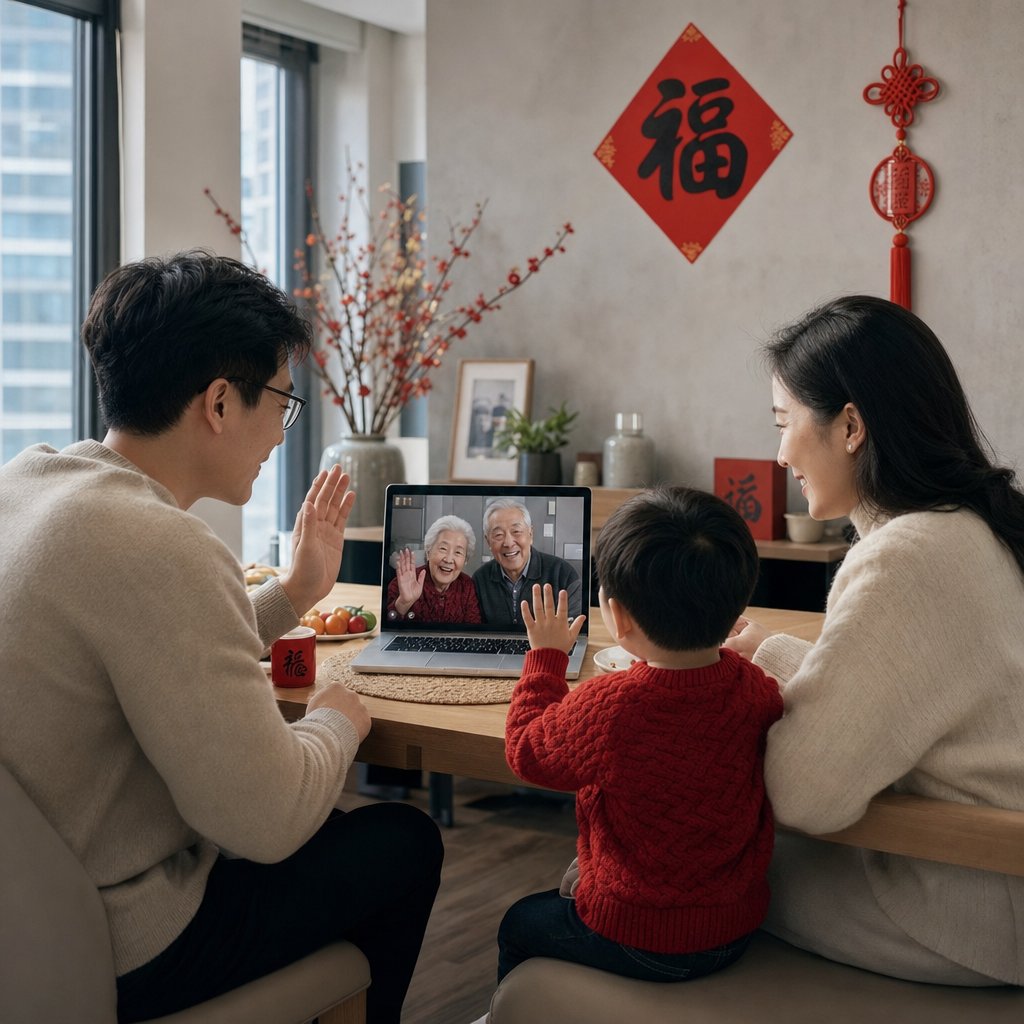
Globalization introduces a different kind of pressure. When a Chinese person marries someone from a non-Chinese background, the traditional chinese family culture of kinship address meets a system that has no equivalent framework. What does a non-Chinese spouse call their partner's 伯伯 versus 叔叔? How do bilingual children navigate two entirely different kinship logics?
In practice, many cross-cultural families adopt a hybrid approach. Chinese kinship terms are used with Chinese-speaking relatives, while English terms serve for the other side. Children may learn to say 外婆 to one grandmother and "Grandma" to the other. The hierarchy persists within its own linguistic domain but does not extend outward. English names and Chinese names coexist without fully integrating, creating families where chinese culture family roles operate in one language and dissolve in another.
Blended families and step-relationships add further complexity. The traditional system did not anticipate terms for a stepfather's brother or a half-sibling from a mother's second marriage. Chinese families in these situations often improvise, borrowing existing terms and attaching qualifiers, or simply defaulting to generic address forms like 阿姨 (ayi) for any older woman in the household.
The Hierarchy in Contemporary Urban Life
Young urban Chinese today often flatten the system in casual contexts. Research from NUS on Chinese Singaporeans found that generational naming practices have become unfamiliar to most young people, with one observer noting that "now everyone is uncle or auntie" regardless of actual kinship position. Modern parents in English-dominant environments may view long-term traditions like generation names as outdated, opting instead to name children based on aspirational values rather than clan genealogies.
The pressures reshaping the system include:
- Urbanization and nuclear families — Smaller households mean fewer relatives in daily contact, reducing opportunities to practice the full terminology.
- The one-child policy's legacy — A generation without siblings has weakened the transmission of birth-order terms and cousin distinctions.
- English-language dominance — Bilingual families often default to simpler English kinship terms in mixed-language settings.
- Digital communication — Group chats and social media flatten hierarchical address, with younger relatives sometimes using first names or nicknames.
- Geographic dispersal — Extended families spread across cities and countries interact less frequently, weakening the social enforcement of correct terminology.
Yet the hierarchy has not disappeared. It resurfaces with full force at weddings, funerals, ancestral worship ceremonies, and Lunar New Year gatherings. A traditional chinese family wedding still requires correct kinship address for every guest, and seating arrangements follow generational rank precisely. Legal documents, inheritance disputes, and clan genealogy updates all demand the formal system. Chinese family life in these high-stakes moments reverts to the full complexity of the naming hierarchy, even when daily conversation has simplified.
Family culture in china is adapting rather than abandoning the system. Some families preserve generation names within immediate siblings while dropping the broader clan poem. Others maintain formal terms for grandparents and parents while allowing cousins to address each other by given names. The chinese family values encoded in the hierarchy, respect for elders, awareness of lineage, acknowledgment of obligation, persist even as the specific vocabulary contracts.
For anyone engaging deeply with Chinese language, culture, or family relationships, understanding this naming system remains essential. The terms may simplify. The underlying logic will not. Whether you encounter it in a business meeting where seniority determines address, a family dinner where seating follows generational rank, or a genealogy record where a single character reveals centuries of lineage, the hierarchy is still there, still active, still shaping how Chinese families understand themselves.
Frequently Asked Questions About Chinese Family Naming Hierarchy
1. Why does Chinese have so many more family terms than English?
Chinese kinship terminology distinguishes relatives along multiple axes that English collapses into single words. It separates paternal from maternal relatives, elder from younger siblings, and blood ties from marriage bonds. For example, English uses one word 'uncle' for all parental brothers, while Chinese assigns different terms based on whether the uncle is on the father's or mother's side and whether he is older or younger than your parent. This precision stems from Confucian philosophy, which assigned different moral duties to each family position and required language to reflect those distinctions clearly.
2. What does the prefix 外 (wai) mean in Chinese family terms?
The character 外 means 'outside' and marks all maternal-side relatives as structurally external to the core patrilineal family unit. For instance, the maternal grandfather is called 外公 (waigong), literally 'outside grandfather,' while the paternal grandfather is simply 爷爷 (yeye) with no qualifier. This linguistic marker reflects the traditional patrilineal system where a married woman joined her husband's clan, making her birth family secondary in the hierarchy. The prefix applies consistently across maternal grandparents, grandchildren through daughters, and other maternal-line relatives.
3. How does the generational naming system (字辈) work in Chinese families?
The 字辈 system assigns a shared character to all members of the same generation within a clan. A standard name follows the structure: surname + generation character + individual character. Clans traditionally composed a generation poem where each character corresponds to one generation in sequence. Two clan members meeting for the first time can compare their generation characters to determine relative seniority instantly. While this practice has declined in urban China, it remains active in rural southern communities and among overseas Chinese families who use it to maintain clan identity across distances.
4. What are Chinese naming taboos and do they still matter today?
Chinese naming taboos, called 避讳 (bihui), prohibit using the personal name characters of anyone above you in the family or social hierarchy. Historically, this extended to emperors, ancestors spanning seven generations, and revered cultural figures. Violating these taboos could bring severe social consequences or even legal punishment during imperial times. Today, the imperial taboo no longer applies, but many families still avoid giving children names that share characters with living grandparents or great-grandparents. Parents often consult family records before selecting characters for a newborn's name.
5. How has the one-child policy affected Chinese family naming conventions?
The one-child policy (1980-2015) disrupted the naming hierarchy by eliminating the sibling and cousin relationships that much of the terminology describes. An entire generation grew up without using terms like 哥哥, 姐姐, or the elaborate cousin numbering system in daily life. Research shows this created a low-fertility trap where only children prefer smaller families themselves, meaning the sibling terminology layer may not fully recover. However, the hierarchy still surfaces at weddings, funerals, and ancestral ceremonies where formal kinship address remains required.