What Chinese Generation Names Are and Why They Exist
Imagine looking at a list of cousins in a Chinese family and noticing they all share an identical character in their given names. That shared character is not a coincidence. It is a deliberate marker, a quiet signal that tells anyone familiar with the system exactly which generation those individuals belong to within their clan.
What Are Chinese Generation Names
Chinese generation names (辈分名 or 字辈) are predetermined characters assigned to every member of the same generation within a Chinese clan, embedded in each person's given name to indicate their precise position in the family's generational hierarchy.
So what is a Chinese name, structurally? A traditional Chinese name consists of a one-character surname followed by a one- or two-character given name. When a family practices generational naming, one of those given-name characters is not chosen freely by the parents. Instead, it comes from a sequence established by ancestors, sometimes centuries earlier. All siblings and cousins of the same generation receive that same character, while the remaining character is unique to each individual.
This practice is known by several terms in Chinese, including paihang (排行), zipai (字派), and beifen (辈分). In Western scholarship, these are called generation names or generational names. They function as a built-in genealogical code, allowing any knowledgeable observer to determine how two people within a clan are related simply by examining their names.
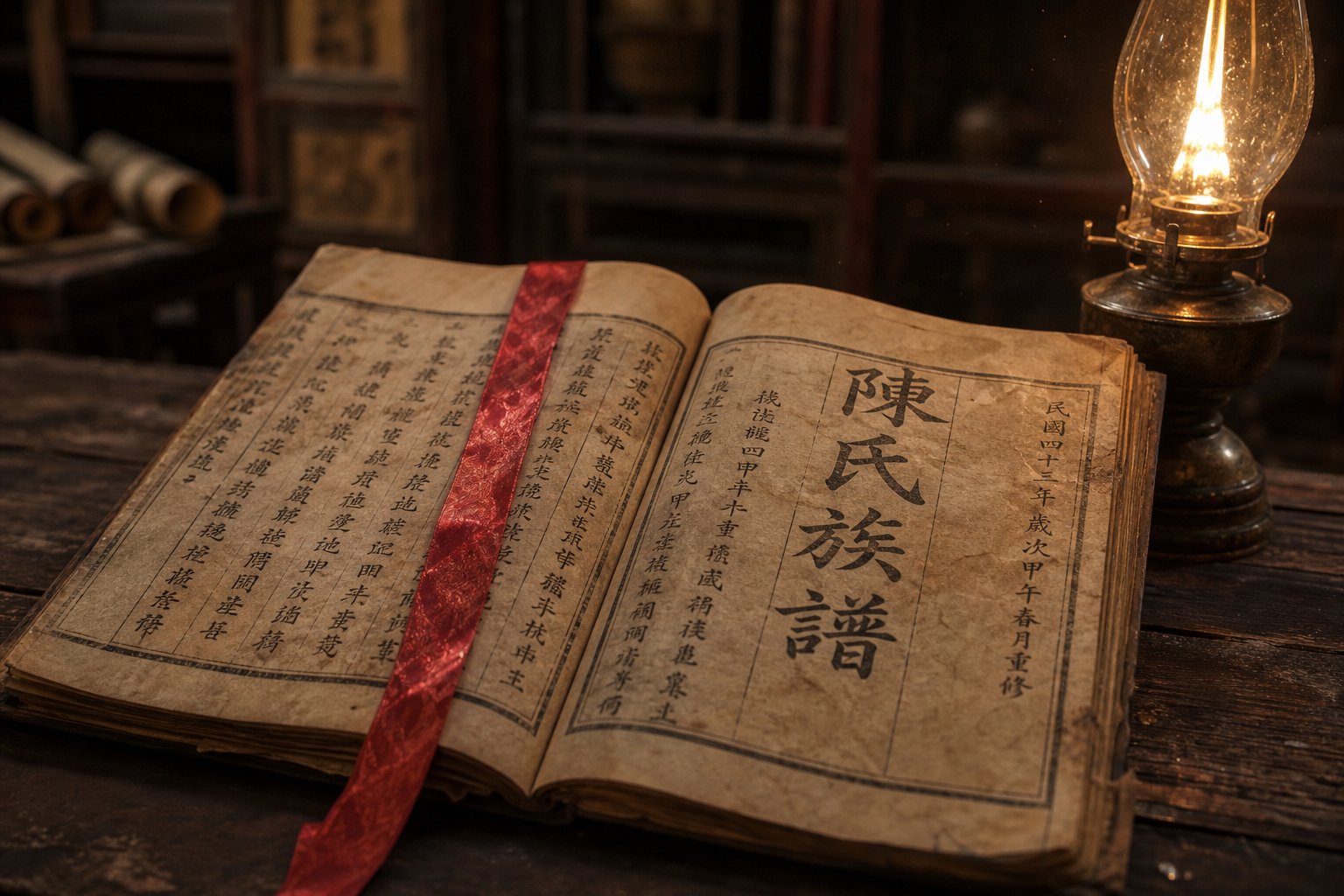
Many Chinese use generational names that are shared by people in the same lineage and generation. If two people share the same first character of their given name, they are likely siblings or first cousins. This information becomes especially powerful when paired with a family tree book, known as a jiapu (家谱) or zupu (族谱), where the full sequence of generation characters is recorded.
Why Generation Names Matter in Chinese Culture
The roots of this tradition run deep into Confucian social philosophy, which emphasized hierarchy, filial piety, and the continuity of the family line. In a society where knowing your place within the generational order was both a moral duty and a social necessity, chinese generational names served multiple purposes at once. They reinforced clan cohesion, made kinship relationships immediately legible, and honored ancestors by perpetuating a naming system those ancestors had designed.
As scholar Frank Pieke noted, genealogies, graveyards, generational naming, and ancestral halls are all elements in a cultural complex applied to mark a hierarchy of distinctions of inclusion and exclusion within Chinese clans. The generation character told you who belonged, who came before you, and who would come after. It was a thread connecting the living to the dead and to the yet unborn.
What are chinese names if not carriers of cultural meaning? Unlike Western naming conventions, where given names are chosen largely for personal taste, the Chinese system embeds social information directly into the name itself. Generation names represent perhaps the most systematic expression of that principle, turning every name in a clan into a node in a living genealogical map.
The tradition was formed, in essence, to ensure the unity of the great family and maintain its continuity and prosperity. It gave sprawling clans, sometimes numbering in the thousands, a shared identity that transcended geography and time. Cousins separated by provinces could recognize each other as kin through a single shared character.
Understanding how this system works opens a window into centuries of Chinese family organization. The mechanics behind it, from shared characters to generation poems, reveal just how deliberately families engineered their naming traditions to last across dozens of generations.
Historical Origins of Generation Naming in China
Every naming tradition has a starting point. For chinese generation names, that starting point is tangled up with the rise of organized clan genealogies, the expansion of Confucian bureaucracy, and the desire of large families to maintain order across hundreds of descendants. The practice did not appear overnight. It grew gradually, shaped by political shifts and the evolving role of the chinese family name in social life.
Early Clan Genealogies and the Birth of the Practice
During the Tang dynasty (618-907 CE), aristocratic families kept detailed records of lineage primarily to prove noble descent and secure political appointments. These early genealogies focused on surnames and official titles rather than systematic naming patterns. A list of chinese family names from this era would read like a registry of power, with clans competing for prestige through documented ancestry.
The real shift came during the Song dynasty (960-1279 CE). As the civil examination system expanded access to government positions, more families outside the old aristocracy began compiling genealogy books, known as jiapu (家谱) or zupu (族谱). Within these records, clans started assigning shared characters to members of the same generation. The practice was informal at first, often limited to a single branch of a larger lineage, but it established the core principle: a character in your name could mark your generational rank.
Dynastic Codification and Spread Across China
What began as a scattered custom among literate clans became a formalized institution over the following centuries. Here is how the timeline unfolded:
- Song Dynasty (960-1279): Prominent clans begin recording shared generation characters in genealogy books. The practice remains largely regional and voluntary.
- Yuan Dynasty (1271-1368): Mongol rule disrupts some clan structures, but southern Chinese families continue maintaining genealogies and generational naming traditions.
- Ming Dynasty (1368-1644): Two-character given names become standard, and generation poems emerge as a structured method for assigning characters across successive generations. The imperial Zhu family itself adopted a generation naming system, lending prestige to the practice.
- Qing Dynasty (1644-1912): Generation naming reaches its widest adoption. Even the most common last name in China, Wang, sees numerous branches codifying their own generation poems. Clans across dialect groups, from Cantonese to Hakka, formalize the tradition in printed genealogies.
By the late imperial period, the jiapu had become the primary document where generation poems were recorded and preserved. These genealogy books served as both a family archive and a naming guide, ensuring that even distant relatives followed the correct sequence. For many asian family names, particularly those belonging to large clans spread across provinces, the generation poem inside the jiapu was the only reliable way to maintain naming consistency.
Academic research traces this codification through centuries of Chinese clan organization, showing how a simple idea, giving cousins the same character, evolved into an elaborate literary tradition. The chinese surname anchored identity to a lineage, but the generation character pinpointed exactly where within that lineage a person stood. Understanding chinese family names and meanings requires grasping this layered structure: surname for clan, generation character for rank, personal character for individuality.
This layered architecture raises a natural question: how exactly did families decide which characters to assign? The answer lies in three distinct methods, each with its own logic and aesthetic.

Three Methods of Forming Generation Names
Not every clan followed the same formula when assigning generation characters. Families developed different approaches depending on their size, literary ambitions, and regional customs. Three primary methods emerged over the centuries, each offering a distinct way to encode generational identity into a chinese name in chinese characters. Understanding these methods helps you decode how a given name for chinese individuals carries hidden genealogical information.
The Shared Character Method
This is the most straightforward approach. Every person born into the same generation receives an identical character in the same position within their given name. Imagine a generation assigned the character 明 (ming, meaning "bright"). All cousins in that generation would have 明 as part of their two-character given name: one might be named 明德, another 明志, and a third 明华. The shared character stays constant while the second character is chosen freely by parents to individualize each child.
You'll notice this method makes generational membership instantly visible. Scan a list of names and the repeating character jumps out. It is the most common technique and the easiest to spot when examining a chinese name in chinese letters, because the identical character appears in the same position across all siblings and cousins.
The Shared Radical Method
Some clans preferred subtlety over uniformity. Instead of giving every cousin the exact same character, they required all generation members to use characters sharing a common radical, the building-block component of Chinese characters. For example, a generation might be assigned the water radical (氵). One cousin could be named 浩, another 洋, and a third 清. Each character is different, but all contain the water radical, creating a visual thread that links them on paper.
This method gave parents more creative freedom when choosing a chinese first name for their child while still preserving the generational marker. It also produced more aesthetically varied names, since no two cousins needed identical characters. The trade-off is that the connection is harder to spot unless you know what radical to look for.
The Poem Sequence Method
The most literary approach involves composing a poem, sometimes called a generation poem (字辈诗), where each character in the poem corresponds to one generation. The first generation uses the first character, the second generation uses the second, and so on through the entire poem. This method combines the shared character approach with a predetermined sequence, ensuring that the order of generations is encoded in a piece of literature the whole clan memorizes.
Think of it as a chinese middle name drawn from a poetic script that stretches across centuries. When you know the poem, you can determine someone's generational rank just by identifying which poem-character appears in their name.
| Method | How It Works | Key Characteristic |
|---|---|---|
| Shared Character | All members of one generation use the same character in the same name position | Immediately visible; identical character repeated across cousins |
| Shared Radical | All members use different characters that share a common radical component | More naming freedom; connection is visual but subtler |
| Poem Sequence | Characters are drawn sequentially from a pre-composed poem, one per generation | Encodes generational order in a literary text spanning many generations |
Each method solves the same problem, linking kin across time, but with different balances of visibility, creativity, and literary ambition. The poem sequence method, in particular, became the most celebrated form, inspiring clans to commission elegant verses designed to last dozens of generations. How those poems actually function across a living family tree reveals the full ingenuity of the system.

The Generation Poem and How Families Use It
A generation poem is, at its core, a naming script written for the future. A clan elder or respected scholar composes a short verse, typically arranged in lines of five or seven characters, and each character in that verse is assigned to one generation. The first generation born after the poem's creation takes the first character. Their children take the second. Their grandchildren take the third. The poem unfolds across decades, sometimes centuries, one character at a time.
This is the mechanism that transforms a simple naming convention into a living timeline. When you encounter full chinese names from a clan that uses a generation poem, you are looking at a sequence. The generation character in each name is not random. It is a coordinate, pointing to a specific position in a literary text that the entire clan shares.
How a Generation Poem Works Across Generations
Imagine a family surnamed Chen (陈) that adopts the following five-character generation poem: 德义礼智信 (de, yi, li, zhi, xin), meaning "virtue, righteousness, propriety, wisdom, trust." Here is how the poem plays out across five generations:
| Generation | Poem Character | Meaning | Example Names |
|---|---|---|---|
| 1st | 德 (De) | Virtue | 陈德明, 陈德华, 陈德志 |
| 2nd | 义 (Yi) | Righteousness | 陈义文, 陈义山, 陈义平 |
| 3rd | 礼 (Li) | Propriety | 陈礼国, 陈礼安, 陈礼辉 |
| 4th | 智 (Zhi) | Wisdom | 陈智勇, 陈智远, 陈智强 |
| 5th | 信 (Xin) | Trust | 陈信达, 陈信宏, 陈信杰 |
Notice the pattern. Every person in the first generation has 德 as the first character of their given name. Their children all carry 义. Their grandchildren all carry 礼. If you met someone named 陈礼辉 and another named 陈义文, you would immediately know that 义文 belongs to the older generation, because 义 comes before 礼 in the poem. No family tree consultation needed.
The characters in a generation poem are typically arranged in ordered lines, usually in sets of five or seven, and some poems follow rhyme schemes while others prioritize meaning over sound. What matters is the sequence. According to FamilySearch's research on generation poems, these characters often conveyed virtues such as loyalty, respect, or wisdom, expressing the hopes families had for each generation.
When the poem is exhausted, meaning every character has been used, the clan faces a choice. Some families cycle back to the beginning and repeat the sequence. Others commission a new poem, extending the naming tradition into fresh literary territory. Larger clans with longer poems, sometimes twenty or thirty characters, could sustain a single poem for half a millennium before needing a new one.
Famous Generation Poems From Chinese Clans
The most thoroughly documented example belongs to the Kong family, the direct descendants of Confucius. Their generation poem was not composed by a family elder. It was bestowed by emperors.
During the early Ming dynasty, Emperor Zhu Yuanzhang granted the Kong family an initial set of generation characters. Over the following centuries, as those characters were used up, additional characters were petitioned for and imperially approved. The Confucius Genealogy records that during the Tianqi era (1621-1627), the 64th-generation Duke Yansheng, Kong Yinzhi, petitioned for twenty more characters when the original ten became insufficient. In 1919, the 75th-generation Duke Yansheng, Kong Lingyi, established yet another twenty characters for the 86th through 105th generations.
The complete sequence of generation characters for the Kong family reads: Xi, Yan, Gong, Yan, Cheng, Hong, Wen, Zhen, Shang, Yin, Xing, Yu, Chuan, Ji, Guang, Zhao, Xian, Qing, Fan, Xiang, Ling, De, Wei, Chui, You, Qin, Shao, Nian, Xian, Yang, Jian, Dao, Dun, An, Ding, Mao, Xiu, Zhao, Yi, Chang, Yu, Wen, Huan, Jing, Rui, Yong, Xi, Shi, Xu, Chang.
This chinese name list spans fifty characters covering generations 56 through 105. Here is how it looks in practice across several recent generations of the Kong family:
| Generation | Poem Character | Notable Name |
|---|---|---|
| 73rd (Fan 繁) | 繁 | Kong Fanhao (孔繁豪) |
| 74th (Xiang 祥) | 祥 | Kong Xiangke (孔祥珂) |
| 75th (Ling 令) | 令 | Kong Lingyi (孔令贻) |
| 76th (De 德) | 德 | Kong Decheng (孔德成) |
| 77th (Wei 维) | 维 | Kong Weiyi (孔维益) |
| 78th (Chui 垂) | 垂 | Kong Chuizhang (孔垂长) |
| 79th (You 佑) | 佑 | Kong Youren (孔佑仁) |
The Kong family enforced this system with unusual strictness. According to the Confucius Genealogy, descendants who did not use the prescribed generation character in their name and refused to correct it could not be included in the genealogy. This made the generation poem not just a tradition but a requirement for clan membership.
What makes the Kong example especially revealing is its scale. The same generation characters are used by Kong descendants across mainland China, Taiwan, South Korea, and dozens of other countries. The 2009 revision of the Confucius Genealogy recorded over two million individuals, all traceable through this naming system. For anyone surnamed Kong who uses these characters, their generational rank within the family of Confucius is immediately legible from their name alone.
The Kong family also shares its generation characters with three other clans: the descendants of Mencius (Meng), Yan Hui (Yan), and Zengzi (Zeng). These four surnames use the same sequence nationwide, a distinction no other chinese names list can claim. This was formalized in 1744 when the Qing Ministry of Rites investigated and standardized the system with imperial approval.
Not every clan had imperial backing, of course. Most families composed their own poems through clan councils, choosing characters that reflected aspirations for future generations: prosperity, learning, moral integrity. The poem became a compact expression of a family's values, compressed into a sequence that would unfold across centuries of descendants. Each character carried weight, because it would define an entire generation's identity within the clan.
Knowing that a generation poem exists is one thing. Recognizing it inside an actual name, especially when you are looking at chinese full names without context, requires understanding exactly where the generation character sits and how to distinguish it from the personal character. That practical skill turns abstract knowledge into a usable tool.
How to Identify Generation Names in Chinese Names
You know the system exists. You understand the methods. But when you are staring at an actual Chinese name, how do you pick out the generation character from the personal one? The answer starts with understanding how chinese name order works, because the position of each element follows a consistent logic that, once grasped, makes the whole structure readable.
Understanding Chinese Name Order and Structure
Chinese names are structured differently from Western names. The family name comes first, followed by the given name. There is no middle name in the Western sense, though the generation character sometimes gets described that way in English. A typical full name has two or three characters total: one character for the surname and one or two characters for the given name.
When a family practices generational naming, the two-character given name splits into two distinct roles. One character is the generation marker, shared with all cousins of the same rank. The other is the personal character, unique to that individual. The result is a three-part structure:
- Surname (one character, occasionally two) — identifies the clan
- Generation character (one character) — identifies the generational rank within the clan
- Personal character (one character) — identifies the individual
For someone unfamiliar with the distinction between first name and last name for chinese individuals, this can be confusing. In Western naming, the given name is entirely personal. In the Chinese system, part of what looks like a "first name" is actually a shared generational code. The chinese name first name portion carries both collective and individual meaning simultaneously.
Consider the name 王德明 (Wang Deming). Wang is the surname. De is the generation character, shared by all of Wang Deming's siblings and cousins. Ming is the personal character, unique to this one person. If you met Wang Deming's cousin, that cousin might be named 王德华 (Wang Dehua), sharing both the surname and the generation character but differing in the personal character.
Spotting the Generation Character in a Name
The generation character most commonly occupies the first position of the two-character given name, immediately after the surname. So in a three-character name like 陈礼国 (Chen Liguo), the generation character is 礼 (the second character overall, first of the given name), and 国 is the personal character. This is the dominant pattern across most clans.
However, some families place the generation character in the second position of the given name instead. In that arrangement, 陈国礼 would mean 国 is the personal character and 礼 is the generation marker. The only way to know which position a particular clan uses is to consult the family's genealogy book or compare names across siblings and cousins.
Here is a practical checklist you can follow when examining a Chinese name for its generation character:
- Confirm the surname. In chinese names surname first is the rule, so the opening character is almost always the family name.
- Look at the remaining one or two characters. If the name has three characters total, the given name is two characters long, and one of them is likely the generation marker.
- Compare with known relatives. If siblings or cousins share a character in the same position, that shared character is the generation name.
- Check the family genealogy book (jiapu) if available. The generation poem or character list will confirm which character belongs to which generation.
- Note the position. Most clans place the generation character first in the given name, but verify by cross-referencing with other family members.
When you understand the order of chinese names, the pattern becomes surprisingly easy to spot. Scan a group of cousins' names, and the repeating character reveals itself. That repetition is the generation name doing its job, making kinship visible at a glance.
Latent Generation Names in Family Records
Not every generation name appears in daily life. Some individuals carry a generation name only in the pages of their family's genealogy book, using a completely different name in everyday interactions. These are sometimes called latent generation names, formal names recorded in the jiapu that fulfill the clan's naming requirements without being used socially.
This practice was especially common in cases where parents preferred a name that did not incorporate the assigned generation character, or where the generation character produced an awkward or undesirable combination with the chosen personal character. The solution was simple: register the "correct" generational name in the official clan records while using a preferred name in all other contexts.
According to Ancestry's research on Chinese generational names, many Chinese use generational names that are shared by people in the same lineage and generation, and these names are often determined by a generational poem. But the name recorded in the genealogy and the name used in public life are not always the same. For genealogical researchers, this means that the name on a government document or tombstone might differ from the name listed in the jiapu.
If you are researching your own family and trying to understand first name last name chinese conventions in historical records, keep this duality in mind. A person might appear under one name in census records and another in the clan genealogy. Both are "real" names, but they serve different purposes: one for the state, one for the family.
This layered naming reality also explains why chinese first and last names can seem inconsistent across different documents from the same era. The generation name anchored a person within their clan's internal hierarchy, while their public name served social and professional life. Recognizing that both systems coexisted helps avoid confusion when tracing lineage across generations.
The generation character's role as a kinship marker also raises questions about who received these names and who did not. Historically, the answer was not universal, and the boundaries of inclusion reveal as much about Chinese social structures as the names themselves.

Gender Dimensions and Regional Variations
The boundaries of inclusion in generational naming were never neutral. For most of Chinese history, generation names applied almost exclusively to males. If you search for chinese male last names paired with generation characters in historical genealogies, you will find page after page of entries. Search for chinese female names and surnames in those same records, and the silence is striking. This asymmetry was not accidental. It was structural.
Gender and Generation Names Through History
Traditional Chinese clans operated on patrilineal principles. Descent, inheritance, and clan membership all passed through the male line. Women, upon marriage, left their natal family and joined their husband's clan. Because generation names existed to track position within a single patrilineal lineage, daughters were often excluded from the system entirely. Their names did not need to encode generational rank within a clan they would eventually leave.
As the Asia Media Centre notes, it is often the case that males of the same generation in a traditional family share the first character of their given names. This phrasing is precise: males. Chinese last names for girls appeared in genealogies only as brief entries noting whom they married, rarely with generation characters assigned. The generation poem was, in practice, a script written for sons.
This is changing. As patrilineal clan structures loosen and gender equality gains ground, some families have begun including daughters in the generational naming system. Modern parents who value the tradition but reject its gendered exclusion now assign generation characters to children regardless of sex. The shift is gradual and uneven, more common in urban areas and among families consciously reviving genealogical practices, but it represents a meaningful departure from centuries of convention.
Regional Variations Across Dialect Groups
Chinese generation names did not develop uniformly across the country. Regional dialect groups, each with distinct cultural practices, adapted the tradition differently. The most common chinese last names appear across all these groups, but how families within those surname communities handled generational naming varied considerably.
Among the major surnames in china, the same clan could follow different generation poems depending on which province or dialect community a branch belonged to. A Wang family in Guangdong might use an entirely different poem than a Wang family in Fujian, even though both trace their ancestry to the same distant progenitor.
| Dialect Group | Generation Name Practice | Diaspora Presence | Current Status |
|---|---|---|---|
| Mandarin (Northern China) | Strong adherence to generation poems; character typically placed first in given name | Smaller diaspora historically; larger post-1980s migration | Declining in urban areas; revival interest among genealogy enthusiasts |
| Cantonese (Guangdong, Hong Kong) | Widely practiced; some clans use shared radical method | Large diaspora in Americas, Australia, Southeast Asia | Maintained in some overseas communities; fading in Hong Kong urban life |
| Hokkien (Fujian, Taiwan) | Strong tradition tied to detailed clan genealogies | Dominant Chinese group in Philippines, Indonesia, Singapore, Malaysia | Persists in Taiwan and among older diaspora families |
| Hakka (scattered across southern China) | Highly systematic; Hakka clans known for meticulous genealogy keeping | Significant presence in Malaysia, Indonesia, Mauritius | Among the most persistent practitioners due to strong clan identity |
| Teochew (eastern Guangdong) | Similar to Hokkien practice; generation poems common | Major presence in Thailand, Cambodia, Vietnam | Varies widely; stronger in communities with active clan associations |
Hakka communities, in particular, maintained generation naming with notable tenacity. Their history of migration within China, moving repeatedly across provinces, made clan cohesion a survival strategy. The generation poem served as a portable identity marker, connecting scattered Hakka branches across vast distances. Among surnames in china associated with Hakka populations, you will often find generation poems that stretch back further and are followed more strictly than in other dialect groups.
Generation Names in the Chinese Diaspora
When Chinese migrants settled abroad, they carried their genealogical traditions with them, but the new environments tested those traditions in ways the homeland never did. The question of whether generation names survive outside China depends heavily on when migration occurred, which dialect community was involved, and what pressures the host society imposed.
In Southeast Asia, home to roughly 40 million people of Chinese descent, the practice followed distinct trajectories. Prior to the formation of nation states in the region, most Chinese residents lived in communities divided along five broad linguistic groups: Hokkien, Teochew, Hainanese, Cantonese, and Hakka. These communities maintained active cultural lives, complete with clan associations, temples, and Chinese schools that reinforced traditional naming practices.
Countries like Indonesia and Vietnam eventually closed Chinese schools and pressured residents to adopt local names, disrupting generational naming traditions. Malaysia, by contrast, sustained Chinese education continuously, with over 1,300 Chinese schools operating today. This institutional support helped Malaysian Chinese families preserve genealogical practices, including generation names, more effectively than their counterparts in countries where assimilation was enforced.
For chinese american last names and naming practices, the picture is different again. Chinese immigrants to the Americas often faced confusion over name order, with given names and surnames sometimes transposed on official documents. This administrative disruption, combined with pressure to adopt English first names, weakened the transmission of generation naming across generations. Many chinese american families maintained the tradition for one or two generations before it faded, though families with strong ties to clan associations or regular contact with relatives in China sometimes preserved it longer.
The pattern is clear: generation names persist where institutional support exists, whether through clan associations, Chinese-language schools, or active genealogy maintenance. Where those structures erode, whether through government policy, assimilation pressure, or simple geographic distance, the tradition weakens within a generation or two. Last names chinese families carry abroad remain stable, but the subtler generational layer encoded within given names proves far more fragile.
This fragility is not unique to the diaspora. Back in China itself, powerful political and social forces reshaped the landscape of traditional naming during the twentieth century, pushing generation names toward a tipping point between extinction and renewal.
The Decline and Revival of Generation Names
For over a thousand years, generation names functioned as a stable feature of Chinese family life. Then, within a few decades, the practice nearly collapsed. The forces that drove this decline were not subtle. They were political, economic, and ideological, arriving in waves that reshaped how names in China were chosen and what they were allowed to mean.
Political and Social Forces Behind the Decline
Research by Li Zhonghua and Edwin Lawson, published in the journal Names, tracked the use of generation names across four time periods from 1940 to 1983. Their findings paint a stark picture. In the pre-Mao era (1940-1949), 90.4% of male respondents used their generation names. By the second Mao period (1960-1976), that figure had plummeted to 41.2%. The decline was not gradual. It was a collapse driven by identifiable forces.
Four major factors converged to erode the tradition:
- Urbanization: As millions migrated from rural villages to cities, they left behind the tight-knit clan communities where generation names had practical meaning. In a village where everyone shared a surname, the generation character told you exactly how to address your neighbor. In a city of strangers, that information became irrelevant.
- Breaking of ties to the land: Traditional farming communities depended on family cooperation across generations. The generation name reinforced the hierarchy that made this cooperation function. When people left the land, the social structure that gave generation names their purpose dissolved.
- The feudal stigma: Intellectuals and urban progressives increasingly viewed generation names as relics of a patriarchal, feudal system. Using one marked you as backward-looking. Many parents, especially educated ones, deliberately abandoned the practice when naming their children.
- The Cultural Revolution (1966-1976): This was the most devastating blow. Under political pressure, young people changed their names or dropped generation characters entirely, replacing them with revolutionary terms like 卫东 (Weidong, "protect Mao Zedong") or 红卫 (Hongwei, "Red Guard"). Fathers who dared use traditional generation names for newborns risked political persecution.
The one-child policy, introduced in 1979, added another layer of pressure. With only one child per family, the communal logic of generation naming weakened further. Generation names derive their power from connecting siblings and cousins. When there are no siblings and fewer cousins, the shared character loses its relational function. Parents with a single child often preferred to invest all naming creativity into one unique, personally meaningful name rather than follow a predetermined sequence.
A parallel trend emerged during this period: the rise of two-character names (one surname character plus one given-name character), which left no room for a generation marker at all. Research using China's 2005 population census data (N = 2.1 million) confirmed that one-character given names increased substantially from the 1960s onward, reflecting a broader move away from the traditional three-character structure that accommodated generation names. Chinese names in chinese were becoming shorter, more individualized, and less tied to clan identity.
Li and Lawson's research also documented the rise of what they called "latent generation names," names that individuals knew but chose not to use in daily life. In the pre-Mao period, only 6.8% of men had latent generation names. By the post-Mao period, that figure had risen to 24.8%, a highly significant increase. The generation name had not disappeared entirely. It had gone underground, surviving in family records while vanishing from public use.
The Modern Revival of Traditional Naming
The story does not end with decline. Li and Lawson's data revealed something unexpected: after Mao's death in 1976, generation names began recovering. In the post-Mao period (1977-1983), 53% of male respondents used generation names, a statistically significant rebound from the 41.2% low of the preceding era. The recovery was real, though it did not reach pre-1950 levels.
The fall of generation names was brought about in part by political events. The rise then owes itself to the end of those events, bringing about, in one way or another, the revival of traditional Chinese culture.
Several forces now fuel a broader renewal of interest in generational naming. The genealogy revival movement, which gained momentum in the 1990s and accelerated through the 2000s, has seen thousands of clans across China reconstruct or update their jiapu (family genealogy books). Online platforms dedicated to surname research and clan networking make it easier than ever for scattered family members to reconnect with their generational heritage. For someone trying to figure out how to get a chinese name that honors their ancestry, these resources offer a direct path back to the tradition.
The cultural climate has shifted as well. Where generation names once carried the stigma of feudalism, they now carry the prestige of heritage. Young parents interested in traditional culture sometimes seek out their family's generation poem and incorporate it into their child's name, viewing it as a connection to roots rather than a constraint on creativity. This is especially visible among chinese with english names who maintain a formal Chinese name following generational conventions alongside their everyday English name.
The tension, though, remains unresolved. Modern naming trends in China increasingly favor uniqueness and individual expression. Research confirms that unique names have become steadily more popular since the 1970s, with parents choosing rarer characters and more distinctive combinations. This individualist impulse runs directly counter to the communal logic of generation naming, which asks parents to subordinate personal preference to a collective sequence.
Whether generation names will stabilize at a reduced but sustainable level or continue their slow fade depends on factors still in motion: the strength of clan associations, the cultural weight families assign to genealogical continuity, and whether the desire for a chinese name from english name or from traditional roots wins out in each household's naming decisions. What is clear is that the tradition has survived its most hostile era and found new advocates, even if it will never again be universal.
This tension between collective tradition and individual choice is not unique to China. Neighboring cultures developed their own versions of generational naming, and comparing how those systems have fared under similar modernizing pressures reveals both shared vulnerabilities and distinct survival strategies.

Cross-Cultural Comparisons and Researching Your Heritage
China did not develop generational naming in isolation. Korea and Vietnam, both deeply influenced by Confucian social structures and Chinese literary culture, adopted strikingly similar systems. Comparing these three traditions side by side reveals how a single idea, encoding generational rank into personal names, adapted to different languages, scripts, and political histories. It also highlights what makes the Chinese version distinctive and why translating chinese names into English often strips away the generational layer entirely.
Comparing Chinese Korean and Vietnamese Generation Names
In Korea, the practice is called hangnyeolja (항렬자/行列字), literally "row-rank character." It works almost identically to the Chinese shared character method: all members of the same generation within a clan receive a common syllable in their given name. Korean clans maintain genealogy books called jokbo (족보), which record the prescribed generation characters in sequence. The structural parallel is no coincidence. Korean clans adopted the practice directly from Chinese models during the Joseon dynasty (1392-1897), when Confucian social organization became state orthodoxy.
Vietnamese generation names, known as ten dem or ten lot, follow a similar logic but with a key difference. In Vietnamese naming, the generation marker typically occupies the middle position of a three-part name (surname + generation character + personal name). The Nguyen clan, Vietnam's most common surname, maintained generation naming traditions through centuries of Chinese cultural influence, though French colonization and subsequent political upheaval disrupted many clan genealogies.
Western naming conventions offer a useful contrast. English-speaking families occasionally pass down a given name (a son named after his father, for instance), but there is no systematic, clan-wide assignment of shared name elements across an entire generation. The closest Western equivalent might be a family tradition of using names starting with the same letter, but this is informal and voluntary rather than codified in a genealogical document. When you see chinese names translated to english on official documents, the generation character typically becomes invisible, absorbed into what looks like an ordinary two-syllable given name with no apparent structural meaning.
| Tradition | Structure | Source Document | Current Status |
|---|---|---|---|
| Chinese (字辈/辈分名) | Shared character or shared radical in given name; characters drawn from a generation poem | Clan genealogy book (族谱/家谱) | Declining but experiencing cultural revival; strongest in rural areas and among genealogy enthusiasts |
| Korean (항렬자/hangnyeolja) | Shared syllable in given name; often uses Five Elements cycle for radical selection | Clan genealogy book (족보/jokbo) | Rapidly declining among younger generations; still recognized but rarely followed strictly |
| Vietnamese (ten dem/ten lot) | Shared middle name element indicating generation | Clan genealogy (gia pha) | Largely faded in urban Vietnam; some preservation in rural communities and overseas Vietnamese families |
One notable difference: Korean hangnyeolja frequently uses the Five Elements (wood, fire, earth, metal, water) to determine which radical the generation character should contain, cycling through the elements across successive generations. This adds a cosmological dimension absent from most Chinese generation poems, which tend to prioritize moral and literary meaning over elemental symbolism. Vietnamese practice, meanwhile, was more flexible in character selection but more rigid in positional placement, always using the middle slot.
All three traditions share a common vulnerability. Urbanization, smaller family sizes, and the prioritization of individual identity over clan membership have weakened each system. Korea's decline has been particularly steep. Surveys suggest that fewer than 20% of Korean children born in recent decades receive hangnyeolja names, compared to near-universal adoption just two generations ago. The Chinese and Vietnamese trajectories mirror this pattern, though at different speeds depending on local political and cultural conditions.
Researching Your Own Family Generation Name Tradition
If you are of Chinese heritage and want to discover whether your family used generation names, and if so, which poem or character sequence applies to your generation, several practical paths exist. The process requires patience, but the resources available today are far more accessible than they were even a decade ago.
Start with living relatives. Older family members, particularly grandparents or great-aunts and great-uncles, are often the most direct source. Ask whether they know their family's generation poem or whether siblings and cousins share a character in their names. Even if they cannot recite the full poem, they may remember fragments or know where a written copy exists.
Next, look for the family genealogy book. The jiapu or zupu is the primary document where generation poems are recorded. These books may be held by the eldest branch of the family, stored in ancestral halls, or deposited in local libraries and archives in China. Many have been digitized. The Shanghai Library alone holds over 30,000 genealogy volumes, and FamilySearch has microfilmed thousands more.
Online databases and clan association websites offer another avenue. Many surname associations maintain searchable records of generation poems organized by region and branch. If you know your surname, ancestral village, and approximate generation, you can often locate the relevant poem through these resources. Searching for your full name in chinese alongside your surname's known generation sequences can help confirm which character in your name, if any, is the generational marker.
For those working with chinese names english translation challenges, keep in mind that romanization can obscure the generation character. Two names that look completely different in pinyin or Wade-Giles may share an identical character in Chinese script. Always work from the original characters when possible. If you only have romanized names from immigration records or birth certificates, try reconstructing the likely characters using the context of known family names and regional pronunciation patterns.
Here is a practical sequence to guide your research:
- Interview older relatives about shared characters among siblings and cousins of the same generation
- Ask whether a written genealogy book exists and who holds it
- Search online genealogy databases using your surname and ancestral region
- Contact surname-specific clan associations, many of which operate websites and social media groups
- Check digitized genealogy collections at major libraries (Shanghai Library, National Library of China, FamilySearch)
- If working from romanized names, reconstruct original characters using dialect pronunciation guides
The effort is worth it. Discovering your family's generation poem connects you to a naming tradition that may stretch back five hundred years or more. It places your name, and your generation, within a sequence that links you to ancestors you have never met and descendants who have not yet been born. Whether you choose to continue the tradition for your own children or simply understand it as part of your heritage, the knowledge transforms a name from a label into a coordinate on a centuries-long map of kinship.
Frequently Asked Questions About Chinese Generation Names
1. What are Chinese generation names and how do they work?
Chinese generation names (辈分名 or 字辈) are predetermined characters embedded in the given names of all clan members born into the same generation. They function as a genealogical code: every sibling and cousin shares one identical character in their name, while a second character remains unique to each individual. This system allows anyone familiar with the clan's naming sequence to determine a person's generational rank simply by reading their name. The characters are typically drawn from a pre-composed generation poem recorded in the family's genealogy book.
2. Where does the generation character appear in a Chinese name?
In a standard three-character Chinese name, the surname occupies the first position. The generation character most commonly appears as the first character of the two-character given name, immediately after the surname. For example, in the name 王德明, Wang is the surname, De is the generation character shared with all cousins, and Ming is the personal character. However, some clans reverse this order and place the generation character in the final position. The only reliable way to confirm placement is by comparing names across siblings or consulting the family genealogy.
3. What is a Chinese generation poem (字辈诗)?
A generation poem is a verse composed by clan elders or scholars, where each character corresponds to one generation in sequence. The first generation after the poem's creation uses the first character, their children use the second, grandchildren the third, and so on. These poems typically contain between ten and fifty characters arranged in lines of five or seven, often expressing moral virtues or aspirations for future descendants. The Kong (Confucius) family's imperially bestowed poem spanning fifty characters is the most famous example, covering generations 56 through 105.
4. Do Korean and Vietnamese families also use generation names?
Yes. Korea uses a system called hangnyeolja (항렬자), which assigns a shared syllable to all clan members of the same generation, often cycling through the Five Elements to determine which radical the character contains. Vietnam uses a similar middle-name system called ten dem or ten lot. Both traditions were influenced by Chinese Confucian clan organization. However, all three systems are declining under modern pressures like urbanization and smaller family sizes, with Korea experiencing the steepest drop in recent decades.
5. How can I find my family's Chinese generation poem?
Start by interviewing older relatives, especially grandparents or great-aunts and uncles, who may remember shared characters among siblings and cousins. Ask whether a written genealogy book (家谱 or 族谱) exists and who holds it. Search online genealogy databases using your surname and ancestral region, and contact surname-specific clan associations that often maintain digital records. Major collections like the Shanghai Library (over 30,000 volumes) and FamilySearch have digitized thousands of genealogies that may contain your family's generation poem.