The Legacy Behind Chinese Royal Baby Names
Imagine giving your child a name that was once crafted by court scholars, vetted by imperial astrologers, and designed to channel the favor of heaven itself. That's exactly what happened inside the palaces of imperial China for over two thousand years. Chinese royal baby names weren't simply labels. They were acts of statecraft, spiritual declarations, and carefully encoded blueprints for a ruler's destiny.
When an emperor or empress ascended the throne, their name carried the weight of an entire civilization's hopes. Court officials consulted Confucian texts, astrological charts, and ancestral records before settling on characters deemed worthy of the dragon throne. Even princes and princesses received names through deliberate rituals that balanced philosophical ideals with cosmological timing. For parents today who want to give their chinese baby a name rooted in this extraordinary heritage, understanding the tradition behind these names is the first step toward choosing something truly meaningful.
Why Chinese Royal Names Carry Unique Power
Royal chinese names were never chosen casually. Each character served a purpose far beyond identification. Imperial names were engineered to invoke the Mandate of Heaven, the philosophical concept that legitimized a ruler's authority as divinely sanctioned. A well-chosen name signaled that the dynasty was cosmically aligned, that fortune would flow toward the empire, and that the ruler embodied virtue worthy of governance.
Consider how this worked in practice. The Tang dynasty emperor Li Shimin received a name meaning "to benefit the people of the world," a declaration of Confucian governance ideals embedded directly into his identity. In the Qing dynasty, Emperor Kangxi's birth name Xuanye (meaning "mysterious brilliance") reflected both Manchu tradition and Chinese cosmological thought. These weren't poetic flourishes. They were political instruments, chosen to project legitimacy and attract auspicious energy toward the ruling house.
This is what makes chinese baby names drawn from imperial history so compelling. They carry layers of intention that ordinary names simply don't possess.
What Sets Imperial Names Apart from Common Chinese Names
So what actually separates a royal name from common chinese names used by everyday families? The differences run deep.
Ordinary naming in China has always been meaningful. Parents choose characters for beauty, aspiration, or family connection. But imperial chinese naming operated on an entirely different plane. Royal names carried political weight, meaning they communicated dynastic legitimacy to millions of subjects. They held cosmological significance, aligning the bearer with elemental forces and celestial patterns. And they were governed by strict taboos. Once an emperor claimed a character for his name, that character was banned from common use across the entire empire, sometimes permanently altering the Chinese language itself.
In imperial China, a royal name was believed to shape not just one person's fate but the destiny of an entire dynasty. The wrong character could invite cosmic disorder, while the right combination was thought to secure heaven's blessing for generations.
Common families chose names freely from the full range of Chinese characters. Royal families operated within a framework of philosophical systems, generational rules, and political calculation that made naming one of the most consequential decisions in court life. Understanding this distinction is what transforms a name from merely beautiful into something with genuine imperial resonance.
The philosophy behind these choices, from elemental theory to stroke-count numerology, reveals a naming science far more intricate than most parents realize.
How Chinese Imperial Naming Philosophy Worked
Every Chinese royal name was built on a precise architecture. Understanding how do chinese names work at the imperial level means recognizing three structural layers that court scholars manipulated with extraordinary care: the family name (姓, xing), the generational name (字辈, zibei), and the personal given name (名, ming). Together, these components formed a coded identity that communicated lineage, cosmic alignment, and individual destiny in just two or three characters.
The family name anchored a person within their dynastic clan. The Zhu (朱) family ruled the Ming dynasty, the Li (李) family the Tang. But the real artistry happened in the chinese given names that followed. Court scholars selected these characters by consulting an interlocking set of philosophical systems, each contributing a different dimension of meaning. A prince's name wasn't simply chosen because it sounded pleasant. It was engineered through layers of metaphysical calculation.
Here are the key philosophical systems that governed royal name selection:
- Five Elements (五行, wuxing) - The cosmic phases of Wood, Fire, Earth, Metal, and Water. Court astrologers determined which elemental energy was missing or needed in a royal child's birth chart, then selected name chinese characters containing the corresponding radical.
- Yin-Yang Balance (阴阳) - Characters were classified as yin (even stroke count) or yang (odd stroke count). A name needed the correct yin pinyin and tonal pattern to achieve energetic harmony between opposing forces.
- Stroke Count Numerology (笔画数理) - The total number of strokes across all characters in a name had to reach specific auspicious totals. Certain numbers were considered fortunate, others dangerous for a future ruler.
- Confucian Virtue Ideals (儒家德行) - Characters embodying benevolence (仁, ren), righteousness (义, yi), wisdom (智, zhi), and propriety (礼, li) were favored to encode moral expectations directly into a royal heir's identity.
- Generational Poetry (字辈诗) - Noble families composed poems where each character designated a specific generation. Every child born into that generation incorporated the assigned character into their name, creating a lineage map readable across centuries.
The Five Elements and Yin-Yang in Royal Name Selection
When a prince or princess was born, court astrologers immediately calculated the child's BaZi (八字) birth chart, mapping the distribution of elemental energies present at the exact moment of birth. This chart revealed which of the five phases dominated and, critically, which were weak or entirely absent. The naming process then became a form of cosmic correction.
Imagine a prince born during a summer hour on a fire-dominant day. His chart might overflow with Fire energy but lack Water entirely. Left unaddressed, this imbalance was believed to produce a temperament too aggressive for wise governance. The solution? Select mandarin characters for his name containing Water radicals (氵) like ze (泽, meaning "marsh" or "beneficence") or han (涵, meaning "contain" or "encompass"). The Five Elements framework functioned as a diagnostic tool, and the name itself became the prescription.
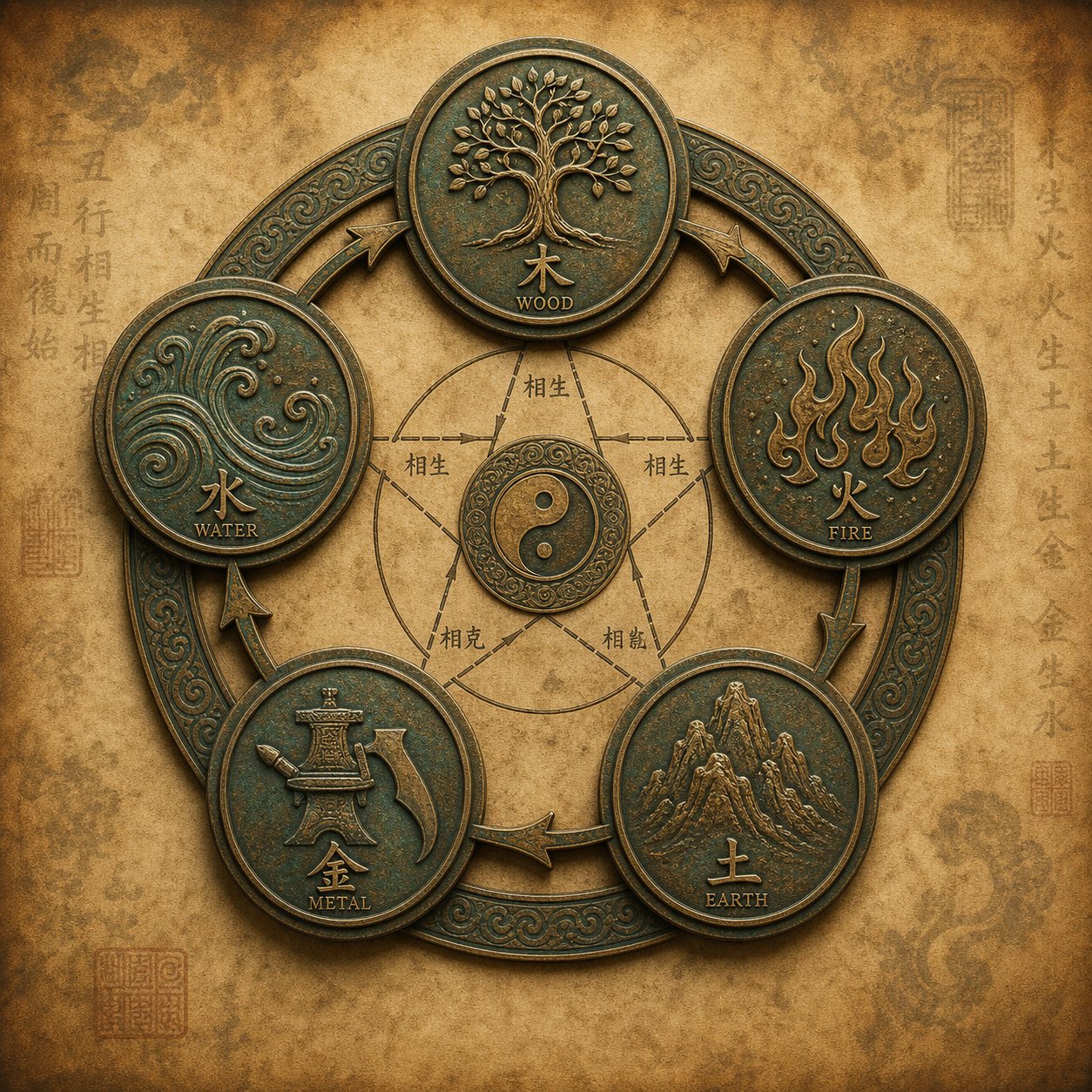
This wasn't guesswork. The generating cycle (相生) dictated that Wood feeds Fire, Fire creates Earth, Earth bears Metal, Metal collects Water, and Water nourishes Wood. The controlling cycle (相克) ensured no single element overwhelmed the system. Court scholars used both cycles to determine whether a child needed supportive elements to strengthen a weak core energy or controlling elements to temper an excess. Each radical in the chinese for name carried specific elemental weight, making character selection a matter of precise calibration rather than aesthetic preference.
Stroke Count and Radical Selection in Imperial Naming
Beyond elemental theory, imperial naming demanded attention to the physical structure of each character. Specific radicals were reserved for or strongly associated with royalty. The jade radical (玉) signified purity and imperial authority. Dragon (龙) represented the emperor himself. Phoenix (凤) was the emblem of the empress. Heaven (天), with its four strokes, connected the bearer directly to celestial power. These weren't decorative choices. Using such radicals in a commoner's name could be considered presumptuous or even treasonous during certain dynasties.
Stroke count added another layer of precision. As traditional naming practice dictates, characters are classified as yin (even strokes) or yang (odd strokes), and the complete name needed to follow specific patterns like Yang-Yang-Yin or Yin-Yang-Yang to achieve balance. The total stroke count across all names and characters in the full name also had to reach auspicious numbers. Court scholars calculated these totals meticulously, sometimes rejecting otherwise perfect characters because they pushed the count into an unfavorable range.
For royal families, the stakes were higher than personal fortune. A poorly constructed name risked signaling cosmic disapproval of the dynasty itself. This is why the process involved multiple scholars cross-checking each other's work, consulting historical precedents, and sometimes debating for weeks before presenting final candidates to the emperor. The result was a name where every stroke carried intentional weight, every radical served a philosophical purpose, and the complete composition functioned as both identity and talisman.
These structural principles didn't exist in isolation. They played out across real dynasties, producing names that shaped how emperors were perceived for centuries. The actual names of China's most famous rulers reveal exactly how theory translated into practice.
Famous Emperor and Empress Names Across Dynasties
Theory is one thing. Seeing how imperial naming philosophy produced real names for real rulers across two millennia of Chinese history is where the tradition comes alive. Each dynasty brought its own priorities to the naming process, and the most famous chinese names in imperial history reveal shifting ideals of power, virtue, and cosmic alignment.
When you look at ancient chinese names from the Han through the Qing, you'll notice patterns. Early dynasties favored single-character given names that projected martial strength or moral clarity. Later dynasties developed more complex naming systems, encoding generational identity and elemental balance into multi-layered compositions. The chinese names and meanings below represent the pinnacle of imperial naming craft, each one a deliberate statement about what kind of ruler the bearer was meant to become.
Tang Dynasty Emperor Names and Their Celestial Meanings
The Tang dynasty (618-907 CE) produced some of the most celebrated chinese dynasty names in history, and none more iconic than Li Shimin (李世民). Break this name apart and you find a governing philosophy compressed into three characters. Li (李) is the family name. Shi (世) means "world" or "generation," and min (民) means "people." Together, the shi meaning combined with min creates the phrase "to benefit the people of the world" or "to save the common people." This wasn't accidental poetry. It was a Confucian mission statement embedded directly into a prince's identity.
Li Shimin lived up to his name's promise. As Emperor Taizong of Tang, he ushered in the Reign of Zhenguan (贞观之治), a period of political stability, economic recovery, and cultural flourishing that became the gold standard for Chinese governance. He listened to advisors, practiced strict economy, and expanded Tang territory until he earned the title "Heavenly Khan" (天可汗) from neighboring peoples. His name's declaration of service to the people proved prophetic.
Other Tang royal names followed similar patterns. Li Longji (李隆基), Emperor Xuanzong, carried characters meaning "grand foundation," reflecting ambitions of dynastic permanence. The Tang preference for names invoking governance ideals rather than raw power distinguished their naming tradition from earlier dynasties that favored martial imagery.
Qing Dynasty Imperial Names and Manchu Influence
The Qing dynasty (1644-1912) introduced a fascinating complication to Chinese imperial naming. As Manchu rulers governing a predominantly Han Chinese empire, Qing emperors maintained dual naming traditions. Their personal names followed Chinese character conventions while also carrying Manchu transliterations, creating names that bridged two cultural worlds.
The Kangxi Emperor, born Aisin-Gioro Xuanye (爱新觉罗·玄烨), illustrates this blend perfectly. His Chinese given name Xuanye (玄烨) combines xuan (玄, meaning "mysterious" or "profound") with ye (烨, meaning "brilliant" or "blazing"). The result, "mysterious brilliance," evokes both the depth of Daoist philosophy and the radiance of imperial authority. His Manchu name, Hiowan Yei, was a transliteration rather than a separate meaning, showing how the Chinese naming tradition dominated even within a non-Han dynasty.
Kangxi's reign of 61 years, the longest in Chinese history, seemed to validate the cosmic promise embedded in his name. He consolidated the empire, patronized scholarship, and initiated the High Qing era of prosperity. His sons' names followed a generational pattern using the character Yin (胤), meaning "heir" or "descendant," reinforcing lineage continuity through naming structure.
The following table presents chinese names in chinese characters alongside their meanings, covering rulers from the Han through the Qing. These represent the full spectrum of imperial naming philosophy across China's major dynasties:
| Dynasty | Chinese Characters | Pinyin | Meaning | Historical Figure |
|---|---|---|---|---|
| Han | 刘彻 | Liu Che | Thorough / Penetrating | Emperor Wu of Han, expansionist ruler who opened the Silk Road |
| Han | 刘秀 | Liu Xiu | Elegant / Flourishing | Emperor Guangwu, founder of the Eastern Han dynasty |
| Tang | 李世民 | Li Shimin | Benefit the people of the world | Emperor Taizong, architect of the Reign of Zhenguan |
| Tang | 李隆基 | Li Longji | Grand foundation | Emperor Xuanzong, patron of arts during Tang golden age |
| Song | 赵匡胤 | Zhao Kuangyin | Assist and sustain | Emperor Taizu, founder of the Song dynasty |
| Song | 赵祯 | Zhao Zhen | Auspicious / Blessed | Emperor Renzong, known for benevolent governance |
| Ming | 朱元璋 | Zhu Yuanzhang | Fundamental jade ornament | Emperor Hongwu, peasant-born dynasty founder |
| Ming | 朱棣 | Zhu Di | Luxuriant / Flourishing | Emperor Yongle, builder of the Forbidden City |
| Qing | 玄烨 | Xuanye | Mysterious brilliance | Kangxi Emperor, longest-reigning emperor in Chinese history |
| Qing | 弘历 | Hongli | Vast experience / Grand calendar | Qianlong Emperor, presided over Qing territorial peak |
Notice how earlier dynasties like the Han favored single-character given names projecting singular qualities: penetration, elegance, flourishing. The Tang shifted toward compound meanings that expressed relational ideals, connecting the ruler to his people. By the Ming and Qing, names grew more philosophically layered, encoding elemental radicals and generational markers alongside aspirational meaning.
What unites all these names is intentionality. None were chosen lightly. Each represents a dynasty's highest ideals compressed into the smallest possible space. For parents exploring these traditions today, the real insight isn't about copying an emperor's exact name. It's about understanding the depth of thought that went into every character, and bringing that same deliberateness to naming your own child.
These famous rulers were all male, reflecting the historical record's bias. But imperial naming traditions applied to princes and princesses alike, with distinct conventions shaping names for boys and girls within the royal household.
Chinese Royal Boy Names with Imperial Heritage
Princes in imperial China didn't just inherit thrones. They inherited names designed to project authority before they could even walk. Chinese boy names drawn from the imperial court carry a weight that ordinary names simply can't replicate. Each one was crafted to signal martial readiness, scholarly brilliance, or divine favor, qualities that court scholars believed would manifest in the child's character as he grew into his role.
What makes these names so compelling for modern parents? They combine deep cultural resonance with genuine linguistic beauty. A name like Longwei doesn't just sound powerful. It encodes centuries of symbolism around the dragon as the supreme emblem of imperial authority. When you explore chinese boy names and meanings rooted in dynastic history, you're drawing from a tradition where every stroke was chosen to shape destiny.
Names of Princes and Heirs from the Han and Tang Eras
The Han dynasty (206 BCE - 220 CE) and Tang dynasty (618-907 CE) represent the twin peaks of Chinese imperial civilization, and their naming conventions for male heirs reflect distinct but complementary ideals. Han princes received names emphasizing martial strength and decisive action. Characters like wu (武, martial), qiang (强, strong), and sheng (胜, victory) appeared frequently among the sons of Han emperors, reflecting an era when military expansion defined imperial success.
Tang dynasty princes shifted the emphasis. While martial prowess remained valued, the Tang court prized scholarly virtue and governance wisdom equally. Names for heirs incorporated characters like xian (贤, virtuous), ming (明, bright/enlightened), and de (德, moral virtue). This produced masculine chinese names that balanced strength with refinement, the ideal of the scholar-warrior (文武双全) compressed into two or three characters.
Consider Liu Ju (刘据), Crown Prince of Emperor Wu of Han. His name character ju (据) means "to hold firmly" or "to occupy," projecting the certainty of succession and territorial command. Or take Li Chengqian (李承乾), Crown Prince of Tang Taizong, whose name combines cheng (承, to inherit/carry forward) with qian (乾, heaven/creative force). The message was unmistakable: this prince would carry forward heaven's creative power.
These weren't just aspirational labels. In a culture where chinese warrior names carried the expectation of actual battlefield leadership, a prince's name functioned as both prophecy and obligation. The character choices told the court, the military, and the people what kind of ruler this heir was being shaped to become.
Powerful Royal Boy Names with Dragon and Jade Radicals
Certain radicals and characters were so closely associated with imperial masculinity that their presence in a name immediately signaled royal status. The dragon radical (龙) stood above all others. In Chinese cosmology, the dragon represents the emperor himself, yang energy at its most concentrated, and the power to command rain, rivers, and fortune. Names containing this radical projected supreme authority.
The jade radical (玉/王) carried different but equally potent associations. Jade symbolized moral perfection, incorruptibility, and the refined gentleman (君子). A prince whose name contained jade-related characters was being marked for virtuous leadership rather than raw dominance. Characters like jun (珺, beautiful jade), rui (瑞, auspicious jade), and yu (瑜, jade's luster) appeared across dynasties in the names of male chinese given names within royal households.
Heaven-related characters formed a third category of imperial masculine naming. Tian (天, heaven), hao (昊, vast sky), and yu (宇, universe) connected the bearer directly to cosmic authority. These weren't subtle choices. A name like Tianyu (天宇) literally claims the heavenly universe as the child's domain.
The table below presents chinese names for boys drawn from imperial history, each carrying the weight of dynastic heritage while remaining usable for modern children. The suitability rating reflects how naturally each name works in contemporary contexts, both within Chinese-speaking communities and internationally.
| Chinese Characters | Pinyin | Meaning | Dynasty of Origin | Modern Suitability |
|---|---|---|---|---|
| 龙威 | Longwei | Dragon power / Imperial authority | Han (prince naming tradition) | High - strong and recognizable |
| 天宇 | Tianyu | Heavenly universe / Cosmic expanse | Tang (celestial naming pattern) | High - elegant and modern |
| 俊豪 | Junhao | Talented and heroic / Outstanding greatness | Song (scholar-official ideal) | High - popular and balanced |
| 承乾 | Chengqian | Inherits heaven's creative force | Tang (Crown Prince Li Chengqian) | Moderate - formal, deeply traditional |
| 瑞龙 | Ruilong | Auspicious dragon / Blessed power | Ming (imperial jade + dragon) | High - auspicious and bold |
| 世民 | Shimin | Benefits the people of the world | Tang (Emperor Taizong) | Moderate - iconic, carries historical weight |
| 浩然 | Haoran | Vast magnanimity / Righteous spirit | Han-Song (Confucian virtue ideal) | High - literary and widely used |
| 玄武 | Xuanwu | Mysterious warrior / Dark martial power | Han (celestial guardian naming) | Moderate - mythological, distinctive |
| 弘毅 | Hongyi | Grand perseverance / Vast resolve | Qing (generational + Confucian) | High - scholarly and strong |
| 定国 | Dingguo | Stabilizes the nation | Han (military prince tradition) | Moderate - patriotic, traditional |
| 瑾瑜 | Jinyu | Fine jade and jade luster / Dual virtue | Song (jade radical pairing) | High - refined and elegant |
| 凌霄 | Lingxiao | Reaches the clouds / Soars to heaven | Tang (celestial aspiration) | High - poetic and ambitious |
| 擎苍 | Qingcang | Upholds the heavens / Supports the sky | Han (heroic naming tradition) | Moderate - dramatic, literary |
| 睿哲 | Ruizhe | Perceptive philosopher / Wise insight | Song (scholar-emperor ideal) | High - intellectual and modern |
| 昭胤 | Zhaoyin | Illustrious heir / Brilliant successor | Qing (succession naming) | High - noble without being heavy |
You'll notice these powerful chinese male names cluster around a few core themes: cosmic authority (Tianyu, Lingxiao, Qingcang), moral virtue (Haoran, Hongyi, Ruizhe), dynastic continuity (Chengqian, Zhaoyin, Dingguo), and natural symbols of power (Longwei, Ruilong, Xuanwu). Imperial naming for boys always returned to these pillars because they represented the complete package expected of a male heir: strength tempered by wisdom, ambition grounded in virtue.
For modern parents, the names rated "High" in suitability work seamlessly in everyday life while still carrying their imperial resonance. Names like Junhao and Haoran are already among the most popular chinese male names in contemporary China, proving that royal heritage and modern practicality aren't mutually exclusive. The "Moderate" names carry heavier historical associations. Using Shimin, for instance, immediately invokes Emperor Taizong, which can feel like a bold claim. These work best when parents want a name that explicitly honors a specific historical legacy.
Imperial naming traditions didn't reserve all their artistry for boys. Empresses, consorts, and princesses received names crafted with equal philosophical care, drawing on a different but equally rich vocabulary of characters associated with feminine power, celestial beauty, and quiet authority.
Chinese Royal Girl Names from Empresses and Princesses
Most resources on chinese names for girls with imperial roots barely scratch the surface. They recycle the same handful of options while dedicating pages to male names. That imbalance misrepresents history. Chinese empresses, imperial consorts, and princesses carried names crafted with the same philosophical rigor applied to princes and emperors. The difference wasn't in quality of thought but in the vocabulary of power. Where male names invoked dragons and martial dominance, female chinese names in the royal court drew on an equally potent symbolic language: the phoenix, luminous jade, orchids, celestial beauty, and quiet authority that shaped dynasties from behind silk screens.
When you explore chinese girl names and meanings rooted in imperial tradition, you discover a naming philosophy that valued influence as much as elegance. Court scholars selecting names for princesses and consorts understood that these women would wield real power, whether openly or through strategic counsel. Their names reflected that expectation.
Empress and Imperial Consort Names from Chinese History
No discussion of imperial feminine naming is complete without Wu Zetian (624-705 CE), China's only female emperor. Her naming history reveals how names functioned as tools of reinvention within the court. Born into the Wu family, she was called Mei-Niang ("beautiful girl") by Emperor Taizong when she entered the palace as a concubine at fourteen. But when she seized the throne in 690 CE, she chose the name Zetian (则天), meaning "Ruler of the Heavens." That deliberate self-naming declared a new cosmic order. She wanted the empire to understand that a different kind of authority had arrived.
Wu Zetian went further than any ruler before her. She created entirely new Chinese characters during her reign, including a character for her own name, demonstrating that imperial feminine power could reshape language itself. Her daughter, Princess Taiping (太平), carried a name meaning "Great Peace," a political statement wrapped in apparent gentleness that masked the fierce political operator she became.
Other famous consort names reveal similar depth. Yang Yuhuan (杨玉环), the legendary consort of Tang Emperor Xuanzong, bore a name combining jade (玉) with ring/circle (环), evoking the perfection and completeness of a jade bracelet. Zhen Huan (甄嬛), a historical Qing consort name, pairs the surname Zhen (meaning "to discern") with huan (嬛, meaning "graceful" or "lithe"). These weren't decorative labels. They encoded expectations of refinement, moral discernment, and the kind of graceful influence that shaped court politics for decades.
The naming philosophy behind mandarin names female royals received centered on a specific paradox: projecting softness while encoding strength. Characters associated with flowers, jade, and moonlight carried deeper connotations of resilience, rarity, and enduring beauty. An orchid (兰) isn't just pretty. In Confucian symbolism, it represents integrity that flourishes even in isolation. A phoenix (凤) isn't merely decorative. It's the cosmic equal of the dragon, representing the empress as the dragon represents the emperor.
Princess Names with Phoenix and Orchid Imagery
Certain characters and radicals were strongly associated with imperial femininity across dynasties. Understanding them opens up a rich chinese names list female readers can draw from with confidence.
The phoenix (凤, feng) stood as the supreme feminine symbol in Chinese cosmology. Where the dragon embodied yang energy and the emperor's authority, the phoenix represented yin energy, renewal, and the empress's complementary power. Names containing feng immediately signaled royal feminine status. Fengyi (凤仪, "phoenix grace") and Fengming (凤鸣, "phoenix song") weren't available to common families without raising eyebrows.
Orchid characters (兰, lan) carried Confucian associations with hidden virtue and noble character. The orchid blooms in remote valleys, fragrant without seeking attention, a metaphor for the ideal of feminine excellence that doesn't demand recognition but commands it naturally. Princess names incorporating lan projected scholarly refinement alongside natural beauty.
Jade variants offered another rich vein. While the standard jade character (玉) appeared in both male and female names, specific jade characters were reserved almost exclusively for women: yao (瑶, precious jade), qiong (琼, fine jade), and ying (瑛, jade luster). These characters elevated a name from merely beautiful to imperially resonant.
The table below presents chinese names girl readers can consider, each drawn from imperial naming traditions across major dynasties. These represent the full range of feminine royal naming, from phoenix authority to orchid refinement to celestial beauty.
| Chinese Characters | Pinyin | Meaning | Dynasty of Origin | Modern Suitability |
|---|---|---|---|---|
| 明珠 | Mingzhu | Bright pearl / Luminous treasure | Qing (consort naming tradition) | High - classic and warm |
| 凤仪 | Fengyi | Phoenix grace / Imperial elegance | Han-Tang (empress symbolism) | High - regal yet accessible |
| 瑶华 | Yaohua | Jade splendor / Precious brilliance | Song (princess naming pattern) | High - poetic and refined |
| 兰芝 | Lanzhi | Orchid and lingzhi / Noble virtue | Han (Confucian feminine ideal) | High - elegant and timeless |
| 太平 | Taiping | Great peace / Supreme tranquility | Tang (Princess Taiping) | Moderate - historically iconic |
| 玉环 | Yuhuan | Jade ring / Perfect circle | Tang (Consort Yang Yuhuan) | Moderate - strongly associated with one figure |
| 婉清 | Wanqing | Graceful clarity / Gentle purity | Song (court lady naming) | High - soft and modern |
| 琼瑶 | Qiongyao | Fine jade and precious jade / Double treasure | Ming (jade radical pairing) | High - literary and luminous |
| 凤鸣 | Fengming | Phoenix song / Auspicious call | Han (phoenix symbolism) | High - musical and powerful |
| 紫薇 | Ziwei | Purple rose / North Star palace | Tang (celestial naming) | High - beautiful and cosmological |
| 昭华 | Zhaohua | Illustrious splendor / Radiant beauty | Han (imperial consort title) | High - dignified and bright |
| 瑾瑜 | Jinyu | Fine jade virtues / Dual radiance | Song (jade virtue pairing) | High - refined, gender-flexible |
| 月华 | Yuehua | Moonlight splendor / Lunar radiance | Tang (celestial feminine beauty) | High - romantic and ethereal |
| 嘉懿 | Jiayi | Excellent virtue / Admirable goodness | Qing (empress naming tradition) | High - scholarly and graceful |
| 瑞凤 | Ruifeng | Auspicious phoenix / Blessed renewal | Ming (phoenix + fortune) | High - bold and celebratory |
Several patterns emerge from this chinese girls names collection. The most versatile names for modern use combine one character of imperial weight (phoenix, jade, celestial imagery) with one character of accessible beauty (clarity, grace, splendor). This pairing gives a name both depth and approachability. Wanqing, for instance, carries the refinement of court language without feeling heavy for a child growing up in a contemporary world.
Names rated "Moderate" carry strong historical associations with specific figures. Calling a daughter Taiping or Yuhuan is like naming a son Shimin. It's a direct invocation of a particular historical legacy, which can feel like a bold statement. These work beautifully when parents want to explicitly honor a specific empress or princess whose story resonates with them.
The names rated "High" offer more flexibility. They use the same imperial vocabulary, the same radicals and character combinations favored by royal families, but in arrangements that feel fresh rather than borrowed. A name like Yaohua carries genuine dynastic resonance while remaining entirely her own.
Both the boy and girl names explored so far follow patterns that might seem individual, but they actually belong to a larger system. The Ming dynasty took this idea to its logical extreme, creating a generational naming structure so precise that a person's place in the imperial family tree could be read directly from the radicals in their name.
The Ming Dynasty Five-Element Naming System
The Ming dynasty (1368-1644) didn't just use the Five Elements as a loose guide for naming. Emperor Zhu Yuanzhang, the peasant-turned-ruler who founded the dynasty, encoded the entire wuxing cycle directly into his family's naming structure for all future generations. The result was a system called 五行命名法 (wuxing mingmingfa), where every imperial descendant's given name contained a radical corresponding to a specific element in the generating sequence: Wood, Fire, Earth, Metal, Water. Each generation advanced one step in the cycle, creating a lineage map you could read simply by examining the ancient chinese characters in a prince's name.
Sounds complex? The logic is elegant. If your father's generation used Wood-radical characters, your generation used Fire. Your sons would use Earth. Your grandsons, Metal. Their children, Water. Then the cycle reset. A single glance at any Ming prince's name revealed exactly which generation he belonged to and where he sat in the imperial family tree. No genealogical records needed. The chinese name meanings were built into the structure itself.
How the Ming Generational Element Cycle Worked
Zhu Yuanzhang established this system when he composed generation poems for each of his twenty-six sons' lineages. Each poem contained twenty characters, one per generation, which served as the first character of the given name. The second character then had to contain a radical matching the correct element in the wuxing cycle. This dual constraint meant every Ming prince's name encoded both his specific branch and his generational position simultaneously.
Here's how the five-element progression played out across generations, with actual names from the imperial Zhu family:
- Wood (木 radical) - First generation after Zhu Yuanzhang. Example: Zhu Biao (朱标), where biao (标) contains the wood radical. Characters like 桢 (zhen, "hardwood"), 楠 (nan, "cedar"), and 栋 (dong, "ridgepole") appeared in this generation's names.
- Fire (火 radical) - Second generation. Example: Zhu Yunwen (朱允炆), the Jianwen Emperor, where wen (炆) contains the fire radical. Other princes used characters like 煦 (xu, "warm"), 炫 (xuan, "brilliant"), and 烨 (ye, "blazing").
- Earth (土 radical) - Third generation. Example: Zhu Zhanji (朱瞻基), the Xuande Emperor, where ji (基) contains the earth radical. Characters like 坦 (tan, "level"), 培 (pei, "nurture"), and 城 (cheng, "fortress") fit this position.
- Metal (金 radical) - Fourth generation. Example: Zhu Qizhen (朱祁镇), the Zhengtong Emperor, where zhen (镇) contains the metal radical. Names in this generation featured characters like 钰 (yu, "precious metal"), 铭 (ming, "inscription"), and 锐 (rui, "sharp").
- Water (水/氵 radical) - Fifth generation. Example: Zhu Jianshen (朱见深), the Chenghua Emperor, where shen (深) contains the water radical. Characters like 洪 (hong, "vast"), 润 (run, "moist"), and 澄 (cheng, "clear") completed the cycle.
After Water, the cycle returned to Wood, and the pattern continued indefinitely. This meant the Ming imperial family's chinese first and last names functioned as a self-documenting genealogical system. Scholars could determine any prince's generational distance from the founding emperor just by identifying the elemental radical in his name.
Generational Poems and Lineage Encoding in Noble Families
The Ming system was the most elaborate expression of a broader tradition called 字辈 (zibei), or generational naming, practiced by noble and scholarly families across China. In this tradition, a family patriarch or committee of elders composed a generation poem, a sequence of characters where each successive character became the shared generational marker for all children born into that generation. Siblings and paternal cousins all carried the same generation character in their names, making family relationships immediately visible.
The descendants of Confucius offer a famous example. Their generation poem, honored by emperors from the Ming through the Qing, reads: 希言公彦承, 宏闻贞尚衍, 兴毓传继广, 昭宪庆繁祥. Each character designates one generation. A Kong family member named Kong Qingdong, for instance, belongs to the "qing" (庆) generation, and you can calculate exactly how many generations separate him from Confucius by counting characters in the poem.
For families exploring chinese names with meaning rooted in this tradition, the 字辈 system reveals something profound about how chinese family names and meanings interlock. The generation character typically occupied the position of what we might call chinese middle names, sitting between the surname and the personal character. This created a three-part structure where the surname identified the clan, the generation character identified the era, and the final character expressed individual identity.
What makes the Ming five-element system extraordinary is how it layered elemental encoding on top of generational poetry. Other noble families used generation poems alone. The Ming imperial house demanded both: the correct poem character and the correct elemental radical, simultaneously. This produced names built from ancient chinese characters selected under double constraints, a naming challenge so demanding that some later Ming princes ended up with extremely rare or even newly invented characters because common options had been exhausted by earlier cousins in the same generation.
This level of systematic control over naming reveals something essential about imperial Chinese culture: names weren't personal property. They were institutional architecture. And that institutional power extended beyond what characters you could use. It also dictated what characters everyone else was forbidden from using.
Imperial Naming Taboos and Court Rank Conventions
Here's something that reveals just how much power was invested in Chinese royal names: once an emperor claimed a character, nobody else in the empire could use it. Not in their own name, not in official documents, not even in casual conversation. This practice, called 避讳 (bihuì), or naming taboo, was enforced by law throughout imperial China. Violators faced punishments ranging from public humiliation to execution. A single character, once it appeared in a ruler's name, could vanish from everyday language for an entire dynasty's reign.
Think about what that means for naming across society. If you'd already given your child a name containing one of the emperor's characters, you had to change it. If your family surname happened to share a character with the new ruler, entire clans were forced to adopt alternative surnames. The most common chinese surnames survived intact only because emperors' chinese first names were carefully chosen from rare characters to minimize disruption. But when a ruler's name did contain common characters, the ripple effects reshaped how millions of people spoke and wrote.
This wasn't merely etiquette. It was a demonstration that the emperor's identity held cosmic priority over all other names in chinese. His characters belonged to heaven's representative on earth, and borrowing them was an act of presumption against the divine order itself.
How Imperial Naming Taboos Shaped the Chinese Language
Some naming taboos left permanent marks on the Chinese language, alterations so deeply embedded that most speakers today don't realize they originated from a single emperor's name.
The most famous example involves Qin Shi Huang, China's first emperor, whose personal name was Zheng (政). Because this character was identical in pronunciation to the word for the first month of the year, 正月 (Zhengyuè), the pronunciation of 正 was permanently shifted. What was once pronounced "zhèng" became "zhēng" in this context, and the month was further renamed 端月 (Duānyuè) to avoid any association. That pronunciation change persists in modern Mandarin, over two thousand years later.
The Tang dynasty produced equally dramatic examples. Emperor Taizong's given name, Shimin (世民), contained two extremely common characters: shi (世, "world") and min (民, "people"). Because min appeared in the government office called the Ministry of People (民部), the entire ministry was renamed Hubu (户部, Ministry of Households). The literary giant Liu Zongyuan, writing decades later, still couldn't use the word 人民 ("people") freely. He substituted 人风 ("folk customs") in his famous essay "On the Snake Catcher" to avoid the taboo character. The chancellor Li Shiji was forced to drop the "shi" from his name entirely, becoming simply Li Ji.
The Qing dynasty's Kangxi Emperor, whose birth name was Xuanye (玄烨), triggered the renaming of one of Beijing's most important landmarks. The Xuanwu Gate (玄武门) of the Forbidden City became the Gate of Divine Might (神武门) because it shared the character xuan (玄) with the emperor's name. This wasn't optional. The gate's original name simply ceased to exist in official use.
Some emperors recognized the burden their names placed on the population. Emperor Xuan of Han originally bore the name Bingyi (病已), composed of two very common characters. He deliberately changed his own name to Xun (询), a far rarer character, specifically to make it easier for his subjects to avoid the taboo. This act of consideration was recorded as a mark of benevolent governance.
In 1777, scholar Wang Xihou published a dictionary that wrote the Qianlong Emperor's name without omitting the required final stroke from each character. The punishment: Wang Xihou and his family were executed, and their property was confiscated. A single missing brushstroke was the difference between life and death.
The severity of enforcement varied by dynasty, but the underlying principle never wavered. An emperor's name was sacred territory. The chinese word symbols that composed it became, in effect, the exclusive property of heaven's chosen representative. This is why later dynasties deliberately gave princes names containing obscure or rare characters. If a prince eventually became emperor, his unusual name would disrupt fewer people's lives when the taboo took effect.
Rank-Based Naming Conventions in the Imperial Court
Naming taboos applied to the emperor's name, but the imperial court maintained a broader hierarchy of naming conventions that governed every rank. Not everyone in the palace was named the same way, and understanding chinese last names and meanings within the court system reveals how precisely status was encoded into identity.
The emperor occupied the apex. His personal name (讳, huì) was so sacred that even speaking it aloud was forbidden. Officials referred to him exclusively by his reign title (年号) or temple name (庙号). No living person would utter the emperor's birth name in conversation. This is why most people know Chinese emperors by titles like "Kangxi" or "Qianlong" rather than their actual given names Xuanye or Hongli.
Princes (皇子) received names from the emperor himself or from senior court scholars acting on his authority. Their names followed generational rules and elemental systems, as the Ming dynasty demonstrated most elaborately. But princes' names didn't trigger empire-wide taboos unless they later ascended the throne. Until that moment, their characters remained available to the general population.
Imperial consorts (妃嫔) often received new names or titles upon entering the palace. Their birth names might be replaced entirely by a palace designation reflecting their rank: Noble Consort (贵妃), Virtuous Consort (德妃), or Pure Consort (淑妃). The meaning of chinese last names mattered less here than the title characters, which were drawn from a fixed vocabulary of feminine virtues. Higher-ranked consorts received characters like de (德, virtue), xian (贤, wisdom), and shu (淑, purity). Lower ranks received more generic designations.
Princesses (公主) were typically known by their fief titles rather than personal names in official records. Princess Taiping, for instance, was formally the Princess of Taiping Commandery. Their personal names existed but were used only within intimate family contexts, shielded from public knowledge by the same reverence that protected the emperor's name.
This layered system meant that the most popular chinese last names and their associated families navigated a complex landscape of what they could and couldn't name their children. A family surnamed Li during the Tang dynasty enjoyed imperial association but also faced heightened scrutiny. A family whose surname happened to match a taboo character faced the most dramatic consequence of all: forced surname changes that altered chinese last name meanings for entire lineages. During the Han dynasty, people surnamed Zhuang (庄) were ordered to change their surname to Yan (严) because Zhuang matched the personal name of Emperor Ming.
For modern parents exploring royal naming traditions, these taboos carry an important lesson. Imperial names weren't just beautiful arrangements of characters. They were instruments of absolute authority, powerful enough to reshape language, rename landmarks, and rewrite family identities across an empire of millions. That's the depth of intention behind every character in a Chinese royal name, and it's that same intentionality, applied thoughtfully rather than imperiously, that makes these naming principles so valuable for families today.

Choosing a Chinese Royal Name for Your Modern Baby
All that history, philosophy, and cosmic engineering is fascinating. But you're probably asking the practical question: how do I actually use this for my child? Naming a baby Xuanye or Taiping carries real cultural weight, and in many cases, it's the equivalent of naming an English-speaking child "Napoleon" or "Cleopatra." The intention is admirable, but the daily reality might feel heavy for a kid learning to write their name in kindergarten.
The good news? You don't need to borrow an emperor's exact name to capture imperial resonance. The most effective approach is what we might call "royal-adjacent" naming: using the same characters, radicals, and philosophical principles that court scholars employed, but in fresh combinations that feel contemporary rather than borrowed. This is where understanding the mandarin name meaning behind individual characters becomes more valuable than memorizing a list of historical rulers.
Royal-Adjacent Names with Noble Connotations
Royal-adjacent names work by extracting the building blocks of imperial naming, jade radicals, celestial imagery, virtue characters, elemental balance, and recombining them into something original. You're not copying a dynasty. You're applying the same craft that court scholars used, just for a modern child instead of a future emperor.
Consider the difference. Naming a son Shimin (世民) directly invokes Emperor Taizong of Tang. Everyone who knows Chinese history will hear that reference immediately. But naming him Chenning (宸宁), which uses the imperial hall character chen (宸, originally reserved for describing the emperor's residence) paired with ning (宁, peace), creates something that carries royal DNA without claiming a specific throne. The character chen was historically associated with the emperor's domain, so its presence signals nobility. But the combination is fresh, modern, and entirely the child's own.
This approach also solves a practical problem. Many typical chinese names today draw from a narrow pool of popular characters, leading to classrooms full of children sharing identical names. Royal-adjacent naming pulls from a richer, less common vocabulary. Characters like xuan (璇, fine jade), yi (奕, grand/radiant), and chen (宸, imperial) appear far less frequently than standard choices, giving your child a distinctive name that still feels natural rather than invented.
The table below presents royal-adjacent names that balance imperial heritage with everyday usability. Each uses characters or radicals drawn from court naming traditions but arranged in combinations that work for a child growing up today, whether in Beijing, Toronto, or Sydney.
| Chinese Characters | Pinyin | Meaning | Imperial Connection | Gender |
|---|---|---|---|---|
| 宸宁 | Chenning | Peace within the royal halls | Chen (宸) referred exclusively to the emperor's dwelling | Unisex |
| 奕程 | Yicheng | Grand journey / Radiant path | Yi (奕) was used in imperial descriptions of dynastic splendor | Boy |
| 璇玉 | Xuanyu | Precious jade of the heavens | Xuan (璇) denoted jade used in imperial astronomical instruments | Girl |
| 景皓 | Jinghao | Bright scenery / Radiant clarity | Jing (景) appeared in imperial reign titles meaning "luminous era" | Boy |
| 瑾萱 | Jinxuan | Fine jade and daylily / Precious serenity | Jin (瑾) was a jade character favored in court naming | Girl |
| 承熙 | Chengxi | Inheriting radiance / Carrying forward light | Cheng (承) was the succession character in Tang prince names | Boy |
| 瑶安 | Yao'an | Jade peace / Precious tranquility | Yao (瑶) was reserved for describing imperial treasures | Girl |
| 泽瑞 | Zerui | Beneficent fortune / Blessings like rain | Ze (泽) appeared in imperial names meaning "grace bestowed on the people" | Boy |
| 馨雅 | Xinya | Fragrant grace / Elegant warmth | Ya (雅) was the standard for court literary refinement | Girl |
| 禹宸 | Yuchen | Great Yu's imperial domain | Yu (禹) references the legendary sage-king; chen (宸) the imperial palace | Boy |
Notice how these names feel accessible. A child named Chenning or Jinghao won't struggle with introductions, yet both names carry genuine imperial lineage in their character choices. They're also among the style of chinese names popular with educated families who want cultural depth without grandiosity. Several, like Xinya and Yicheng, already appear on modern naming lists precisely because they strike this balance between heritage and freshness.
Adapting Imperial Naming Principles for Modern Babies
You don't need a court astrologer or a chinese name generator to apply imperial naming wisdom. The core principles translate directly into a practical framework any parent can follow. What matters isn't replicating the exact process, it's adopting the same intentionality that made royal names so powerful.
Here are the key principles for adapting royal naming traditions to modern use:
- Choose characters with layered meaning. Imperial names never relied on surface-level prettiness. Select characters where the literal meaning, cultural connotation, and visual form all reinforce each other. A chinese name related to luck works best when the "luck" comes from genuine symbolic depth rather than a single obvious character.
- Balance weight with usability. Court scholars considered how a name sounded when spoken aloud, how it looked when written, and how it felt in daily use. Apply the same test: say the name out loud fifty times. Write it repeatedly. If it feels natural after that, it passes.
- Consider elemental harmony. You don't need a full BaZi chart to benefit from Five Elements thinking. Simply ensure the radicals in your chosen characters don't clash. Pairing two Fire-radical characters, for instance, creates intensity that might feel unbalanced. Mixing elements creates natural harmony.
- Think about tonal flow. Mandarin's four tones create musicality in names. Imperial scholars avoided placing two falling tones (fourth tone) adjacent to each other because it sounded abrupt. Aim for tonal variety: a rising tone followed by a falling tone, or a level tone paired with a rising tone, creates pleasing rhythm.
- Test cross-cultural pronunciation. For families navigating both Chinese and English-speaking contexts, consider how the pinyin transliteration sounds to non-Chinese speakers. Names like Chenning, Jinghao, and Yao'an are intuitive for English speakers to attempt. Names with sounds absent from English (like xu or qiong) may need a complementary English name or nickname. Many families choose chinese names for english names that share a first syllable or tonal quality.
- Respect the tradition without being imprisoned by it. Imperial naming was rigid because it served political purposes. You're free to take what resonates and leave what doesn't. Using a jade radical because you love its symbolism is honoring the tradition. Feeling obligated to match your child's birth chart element exactly is optional.
- Research character associations thoroughly. Some characters carry historical baggage that isn't obvious from their dictionary definition. The character wan (琬, fine jade) is beautiful, but wan (万) in certain combinations echoes political slogans. A native speaker or cultural consultant can flag these nuances.
One final consideration that imperial scholars understood intuitively: the best names grow with their bearer. A cute chinese names choice that works for a toddler might feel lightweight on a forty-year-old professional. Royal names were designed to carry authority across an entire lifetime. Apply the same long-view thinking. Ask yourself whether the name will serve your child equally well on a playground, a university application, and a business card decades from now.
Popular chinese names shift with generational trends, but names built on imperial principles tend to age gracefully because their meaning deepens rather than fades. The character chen (宸) won't feel dated in twenty years the way a trendy neologism might, because its roots extend back centuries. That's the real gift of drawing from royal naming traditions: you're choosing from a vocabulary that has already proven its staying power across dynasties.
Whether you select a name directly from the imperial record or craft something new using these principles, the underlying philosophy remains the same. Every character should earn its place. Every stroke should carry intention. That's what separated royal naming from ordinary naming two thousand years ago, and it's what will make your child's name resonate with the same quiet authority today.
Bringing Imperial Naming Wisdom Into Your Family
The distance between copying an emperor's name and understanding why it was chosen is the distance between imitation and genuine craft. Everything explored here, from Five Elements theory to stroke count numerology to generational poetry, points toward one truth: the power of traditional chinese names lies in their intentionality, not their historical ownership. When you grasp what a chinese name mean at its deepest level, you're equipped to create something original that carries the same weight.
A quick note on etiquette. Names like Shimin or Xuanye belong to specific historical figures the way "Shakespeare" belongs to English literature. Using them isn't forbidden, but it signals a direct claim on that legacy. In Chinese-speaking communities, this can read as either deeply respectful or presumptuous depending on context. The safer and more creative path? Apply the principles those names were built on rather than borrowing the names themselves.
Honoring Tradition While Creating Something New
The meaning chinese names carry doesn't expire. Elemental balance, radical symbolism, tonal harmony, and layered significance are tools, not artifacts. They're as available to you today as they were to Ming dynasty court scholars. The difference is freedom. You aren't constrained by generational poems or political calculation. You can select characters purely for their beauty, resonance, and personal significance to your family.
Start with what matters to you. If resilience is the quality you want your child to carry, explore characters containing that energy. If connection to nature feels right, look at radicals rooted in water, wood, or sky. The imperial approach wasn't about finding one perfect character. It was about building a name where every element reinforces a central intention. That same deliberateness, applied to your own values rather than dynastic politics, produces names in chinese and meanings that feel both ancient and entirely new.
As recent naming trends in China show, a growing number of parents are drawing from classical texts and historical traditions to name their children, not as nostalgia but as living cultural expression. A name rooted in imperial philosophy connects your child to that broader movement of reclaiming heritage as everyday identity.
Resources for Exploring Chinese Characters and Meanings
Imperial scholars spent years mastering the relationships between radicals, stroke counts, and tonal patterns. You don't need years, but you do need reliable tools. When researching a name in chinese meaning and connotation, consider these approaches: consult a comprehensive character dictionary that shows radical composition and historical usage, not just modern definitions. Check stroke counts for each candidate character and calculate the total across the full name. Say the complete name aloud repeatedly, listening for tonal flow and natural rhythm. And when possible, ask a native speaker how the combination lands culturally, because what does a chinese name mean beyond its dictionary entry often depends on associations invisible to non-native readers.
The same care that court scholars brought to naming future emperors is available to any parent willing to slow down and choose with intention. You're not selecting a label. You're composing a gift your child will carry for a lifetime.
The best Chinese royal baby names don't replicate the past. They inherit its philosophy: that a name, chosen with full awareness of what each stroke carries, becomes a quiet act of hope written in ink that never fades.
Frequently Asked Questions About Chinese Royal Baby Names
1. What makes Chinese royal baby names different from regular Chinese names?
Chinese royal baby names were crafted through elaborate processes involving court scholars, astrologers, and Confucian philosophers. Unlike ordinary names chosen freely by families, imperial names carried political weight, cosmological significance, and were subject to strict taboos. They were engineered using the Five Elements system, yin-yang balance, stroke count numerology, and Confucian virtue ideals to invoke the Mandate of Heaven and project dynastic legitimacy. Once an emperor claimed a character for his name, that character was banned from common use across the entire empire.
2. How did the Five Elements system influence Chinese imperial naming?
Court astrologers calculated a royal child's birth chart to identify which elemental energies (Wood, Fire, Earth, Metal, Water) were strong or weak. They then selected name characters containing radicals corresponding to the needed element to achieve cosmic balance. For example, a prince born with excess Fire energy might receive a name with Water radicals like ze (泽) or han (涵). The Ming dynasty took this further by encoding the entire wuxing cycle into their generational naming structure, where each successive generation used characters with radicals matching the next element in sequence.
3. Can I use an actual emperor's name for my baby?
While not forbidden, using an emperor's exact name like Shimin or Xuanye carries significant cultural weight. In Chinese-speaking communities, it can be perceived as either deeply respectful or presumptuous. A more creative approach is royal-adjacent naming, which uses the same characters, radicals, and philosophical principles from imperial traditions in fresh combinations. For instance, instead of using Shimin directly, you might use the imperial character chen (宸) paired with a modern complement like ning (宁) to create Chenning, which carries royal DNA without claiming a specific throne.
4. What are some good Chinese royal girl names with imperial heritage?
Imperial feminine names drew from a rich symbolic vocabulary including phoenix (凤), orchid (兰), precious jade (瑶), and celestial imagery. Strong options include Mingzhu (明珠, bright pearl), Fengyi (凤仪, phoenix grace), Yaohua (瑶华, jade splendor), Wanqing (婉清, graceful clarity), and Ziwei (紫薇, purple rose/North Star palace). These names balance imperial resonance with modern usability, using characters historically associated with empresses and princesses while feeling fresh enough for contemporary life.
5. What were naming taboos in imperial China and why do they matter?
Naming taboos (避讳, bihuì) meant that once an emperor claimed a character, no one in the empire could use it in names, documents, or conversation. Violations could result in punishment up to execution. These taboos permanently altered the Chinese language. For example, Qin Shi Huang's name changed the pronunciation of the character for the first month, and the Kangxi Emperor's name forced the renaming of the Xuanwu Gate. This tradition reveals the extraordinary power invested in royal names and explains why later dynasties chose rare characters for princes to minimize disruption if they became emperor.