Feng Shui Naming and Why Certain Characters Carry Negative Energy
When you hear the phrase "Chinese naming conventions," you might think of honoring family lineage, choosing characters with beautiful meanings, or following generational naming poems. These are all valid traditions. But feng shui naming operates on a different level entirely. It treats each character as an energetic unit, one that interacts with a person's birth energy, the flow of qi, and the balance of cosmic forces. Certain characters aren't avoided because they sound unpleasant or carry bad cultural associations. They're avoided because, according to metaphysical theory, they actively disrupt the energetic harmony a name is supposed to create.
What Makes Feng Shui Naming Different From General Chinese Naming
So what are Chinese names, really, from a feng shui perspective? They're more than identifiers. A Chinese name definition in this context extends beyond meaning and pronunciation into the realm of vibrational structure. Feng shui naming applies three core metaphysical principles to character selection: yin-yang balance, qi flow, and Five Elements theory (Wu Xing). A practitioner doesn't just ask "does this character mean something good?" They ask whether the character's elemental energy, stroke structure, and phonetic vibration align with the individual's birth chart.
General Chinese naming customs focus on aesthetics, family tradition, and positive meaning. Feng shui naming adds a diagnostic layer. It begins with analyzing the child's BaZi (Eight Characters) birth chart to map their elemental strengths and weaknesses, then selects characters that restore balance. A name that looks perfect on paper can still be energetically harmful if it clashes with the person's natal composition.
Cultural Taboos vs Metaphysical Principles
It helps to separate two distinct categories of avoidance. Cultural taboos in Chinese naming include rules like not using characters from an ancestor's name, avoiding names of emperors (the historical practice of bihu), or steering clear of characters shared with infamous figures. These are social conventions rooted in respect and tradition.
Feng shui-specific avoidance rules are different. They're rooted in cosmological theory. A character might be culturally acceptable, even admired, yet still be considered inauspicious for a particular person because its elemental energy overwhelms their chart. As feng shui practitioner Sean Chan explains, a chart that lacks a particular element doesn't automatically benefit from adding that element. Blindly introducing a missing element can collapse the chart's structure and make its flaws more pronounced.
This distinction matters. Some feng shui naming characters to avoid are universally problematic, carrying inherently destructive meanings no birth chart can neutralize. Others are only inauspicious for specific individuals based on their unique elemental profile.
Why Character Selection Carries Energetic Weight
Imagine each Chinese character as a small ecosystem. Its radical contributes one layer of meaning. Its stroke count produces a numerological vibration. Its pronunciation generates phonetic energy. And its semantic meaning broadcasts an intention into the world. In feng shui naming, all these layers must harmonize with the person who carries the name.
A growing number of parents are investing seriously in this process. Families pay thousands of yuan for consultations where practitioners interpret birth time according to the Five Elements and select characters that support the child's destiny rather than obstruct it.
Feng shui naming is not superstition but a structured system connecting sound, form, and meaning to personal energy. Each character either supports or disrupts the energetic blueprint a person is born with.
Understanding the meaning behind Chinese names at this level reveals why certain characters silently block luck. They don't announce their harm. They simply introduce friction, imbalance, or stagnation into the energetic field the name creates. The question isn't whether a character looks good or sounds pleasant. It's whether that character's full energetic signature aligns with the person it represents.
That alignment, or misalignment, begins with a fundamental split: characters that harm everyone versus characters that only harm certain individuals based on their birth data.
Universal vs Personalized Character Avoidance in Feng Shui
Not all inauspicious characters operate the same way. Some carry energy so inherently destructive that no birth chart, no matter how strong, can neutralize their effect. Others are perfectly fine for one person yet quietly corrosive for another. This distinction between universal and personalized avoidance is the backbone of feng shui character screening, and misunderstanding it leads to two common errors: rejecting a character that would actually help, or accepting one that silently undermines.
Characters Everyone Should Avoid Regardless of Birth Chart
Certain characters broadcast negativity through their core meaning alone. Characters directly associated with death, violence, illness, or decay emit what traditional theory describes as low-frequency energy. No amount of elemental balancing can transform a character meaning "to perish" or "to suffer" into something beneficial. These universally inauspicious characters function like energetic dead weight in a name, regardless of how the full name in Chinese is structured around them.
Think of it this way. If a character's primary semantic content involves endings, destruction, or emptiness, it introduces that vibration into the name's energetic field every time the name is spoken, written, or thought about. The feng shui reasoning here is straightforward: a name is a daily invocation, and repeatedly invoking concepts of loss or pain attracts corresponding circumstances according to the principle of energetic resonance.
Universal avoidance also extends to characters that sound identical to inauspicious words. Even when the written meaning is neutral, the phonetic overlap creates what practitioners call "shadow energy." You'll encounter this principle again in the detailed character lists ahead, but the key takeaway is simple: some characters are off-limits for everyone, full stop.
How BaZi Birth Data Determines Personal Character Avoidance
Personal avoidance is where feng shui naming becomes genuinely individualized. The system that governs this layer is BaZi (八字), also called the Four Pillars of Destiny. It maps a person's birth year, month, day, and hour into eight characters drawn from the Heavenly Stems and Earthly Branches system. Each of these eight characters carries elemental energy from the Five Elements: Wood, Fire, Earth, Metal, and Water.
The critical piece is the Day Master (日主), the Heavenly Stem of your Day Pillar. This represents your core elemental identity. If your Day Master is Yang Wood, you are fundamentally a "Wood person." A BaZi analyst then examines how the remaining seven characters distribute elemental energy around that core. Is the Day Master well-supported or overwhelmed? Which elements are excessive? Which are dangerously absent?
Here's where the given name for Chinese individuals becomes a compensating tool. A chart dominated by Fire with almost no Water suggests someone who burns intensely but lacks emotional regulation. A chart heavy in Metal but deficient in Wood points to rigidity without flexibility. The name's job is to introduce characters whose elemental energy corrects these imbalances, not worsen them.
A common misconception is that you simply count which element is missing and add it. Professional BaZi readers look for the "Useful God" or Favorable Element (用神). If a chart is already freezing cold with dominant Water energy, adding more Water would be disastrous even if another element appears numerically absent. The goal is strategic harmony, not arithmetic balance.
When the Same Character Helps One Person but Harms Another
This is the concept that surprises most people unfamiliar with how Chinese names are structured at the metaphysical level. A character like 炎 (yan, meaning "flame" or "blazing") carries strong Fire energy. For someone whose BaZi chart reveals a weak Fire Day Master struggling in a cold, Water-heavy environment, this character provides warmth and vital support. For someone whose chart already overflows with Fire and desperately needs Water to cool down, the same character pours fuel on an existing imbalance.
The table below illustrates how one character produces opposite effects depending on the person's elemental profile:
| Character | Element | Person A: Weak Fire Day Master, Cold Chart | Person B: Strong Fire Day Master, Dry Chart |
|---|---|---|---|
| 炎 (yan, "blazing") | Fire | Supportive. Strengthens the weak Day Master and adds needed warmth. | Harmful. Intensifies existing excess, increasing instability and emotional volatility. |
| 淼 (miao, "vast water") | Water | Potentially harmful. Further chills an already cold chart, weakening the Day Master. | Supportive. Provides cooling balance and emotional depth the chart lacks. |
| 森 (sen, "forest") | Wood | Supportive. Wood feeds Fire, gently strengthening the Day Master through the productive cycle. | Risky. Wood feeds Fire further, potentially worsening the excess unless Earth is present to ground it. |
This is why personalized analysis matters so much. Two children born on the same day but at different hours can have entirely different elemental profiles, meaning the same character belongs on one child's shortlist and the other's avoidance list. A character that looks universally positive, like one meaning "bright" or "prosperous," can still function as a feng shui naming character to avoid for a specific individual whose chart cannot absorb its elemental weight.
The practical implication? You cannot evaluate characters in isolation. Every character must be measured against the specific person's BaZi chart. Universal avoidance rules give you a baseline, filtering out characters no one should use. But the deeper, more consequential layer of screening requires knowing exactly which elements strengthen your chart and which ones destabilize it.
That elemental interaction doesn't stop at individual characters. When two characters sit together in a name, their elements also interact with each other, sometimes reinforcing positive energy, sometimes canceling it out entirely through destructive elemental cycles.
Categorized List of Universally Inauspicious Characters
Elemental clashes between characters depend on the individual. But certain chinese words name practitioners flag regardless of birth data. These characters carry meanings so tied to destruction, suffering, or emptiness that they broadcast negative energy into any name they occupy. Understanding the chinese meaning of names at this level means recognizing that some characters are simply off-limits for everyone.
Below is a categorized breakdown of the most commonly avoided characters in feng shui naming, organized by the type of negative energy they introduce.
Characters Linked to Death and Endings
Death-associated characters represent the most absolute category of avoidance. In traditional feng shui theory, these characters carry terminal energy. They signal finality, cessation, and the extinguishing of life force. Placing them in a name is considered equivalent to embedding an energetic full stop into a person's destiny path.
- 死 (si) - death, to die
- 亡 (wang) - to perish, to be lost
- 殁 (mo) - to die, to pass away
- 终 (zhong) - to end, final
- 殇 (shang) - to die young, premature death
- 葬 (zang) - to bury, funeral
The reasoning is direct. A name is spoken thousands of times throughout a lifetime. Each utterance, according to feng shui phonetic theory, activates the character's core vibration. Characters rooted in endings repeatedly invoke that energy, creating what practitioners describe as a ceiling on growth and forward momentum.
Illness and Suffering Characters to Avoid
Characters tied to physical or emotional suffering introduce a different kind of drag. Rather than signaling endings, they attract stagnation and pain. The name meaning chinese families assign to their children is meant to call in vitality, not invite its opposite.
- 病 (bing) - illness, disease
- 痛 (tong) - pain, ache
- 哀 (ai) - grief, sorrow
- 悲 (bei) - sadness, tragedy
- 苦 (ku) - bitterness, hardship
- 伤 (shang) - wound, injury
Feng shui theory holds that these characters emit low-frequency energy associated with depletion. They don't just describe suffering. They resonate at the frequency of suffering, and that resonance shapes the energetic environment surrounding the name bearer.
Characters associated with conflict and violence carry aggressive, disruptive energy. These include:
- 战 (zhan) - war, battle
- 斗 (dou) - to fight, to struggle
- 刀 (dao) - knife, blade
- 杀 (sha) - to kill
- 毒 (du) - poison, toxic
- 血 (xue) - blood
Characters linked to loneliness and emptiness are avoided because they attract isolation and lack of substance:
- 孤 (gu) - lonely, orphaned
- 寂 (ji) - silent, desolate
- 空 (kong) - empty, void
- 虚 (xu) - hollow, false
And characters signaling decline or loss pull energy downward:
- 衰 (shuai) - to decline, to wither
- 败 (bai) - defeat, failure
- 落 (luo) - to fall, to drop
- 散 (san) - to scatter, to disperse
Homophones That Sound Like Inauspicious Words
Here's where things get subtle. A character can have a perfectly positive written meaning yet still function as a feng shui naming character to avoid because of how it sounds. Chinese is rich in homophones, and feng shui treats phonetic energy as equally real as semantic meaning.
The classic example: 思 (si, meaning "to think" or "to miss someone") is a beautiful character on its own. But when combined with 旺 (wang, meaning "prosperous"), the resulting name 思旺 (si wang) sounds nearly identical to 死亡 (si wang), meaning death. The written intention is lovely. The phonetic reality is catastrophic.
Other common homophone traps include:
- Characters pronounced "si" in any tone, which echo 死 (si, death)
- Characters pronounced "ku," which echo 苦 (ku, bitterness)
- Characters pronounced "bai," which echo 败 (bai, failure)
- The number 四 (si, four), avoided because it sounds like death
Regional dialects add another layer of complexity. A name that sounds clean in Mandarin might produce unfortunate homophones in Cantonese, Hokkien, or other regional pronunciations. Practitioners recommend checking a name's phonetic profile across any dialects the family regularly uses.
The homophone principle reveals something important about how feng shui evaluates characters. It's not enough to analyze what a character means on paper. You must also account for what it sounds like when spoken aloud, because sound carries its own energetic signature independent of written form. This dual-layer analysis, meaning plus sound, is what separates feng shui character screening from simple dictionary lookups.
These universally avoided characters give you a reliable first filter. But screening doesn't end here. Even characters that pass the meaning and sound test can still cause problems at a structural level, specifically through how their elemental energy interacts with the Five Elements framework governing your birth chart.
Five Elements Theory and Elemental Character Clashes
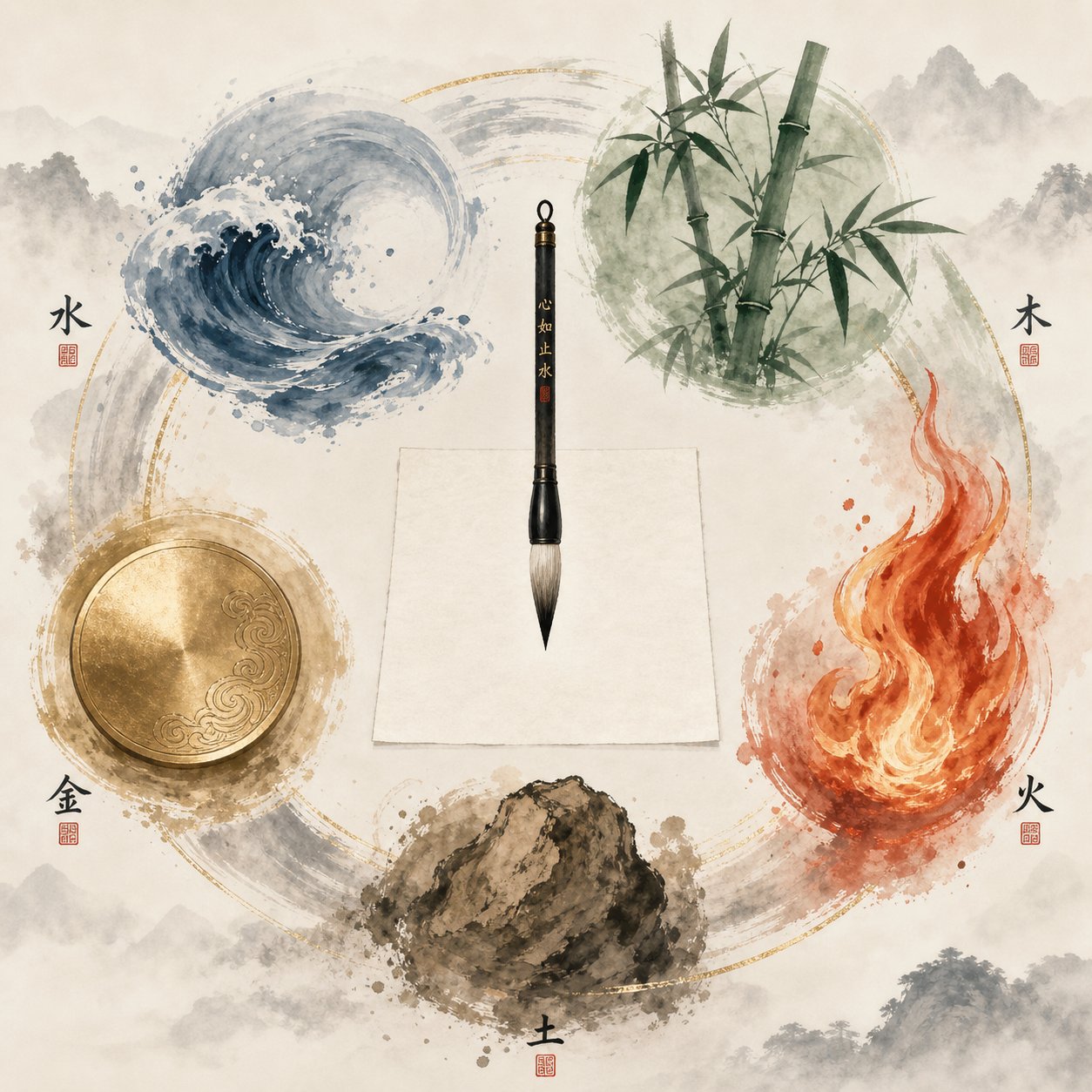
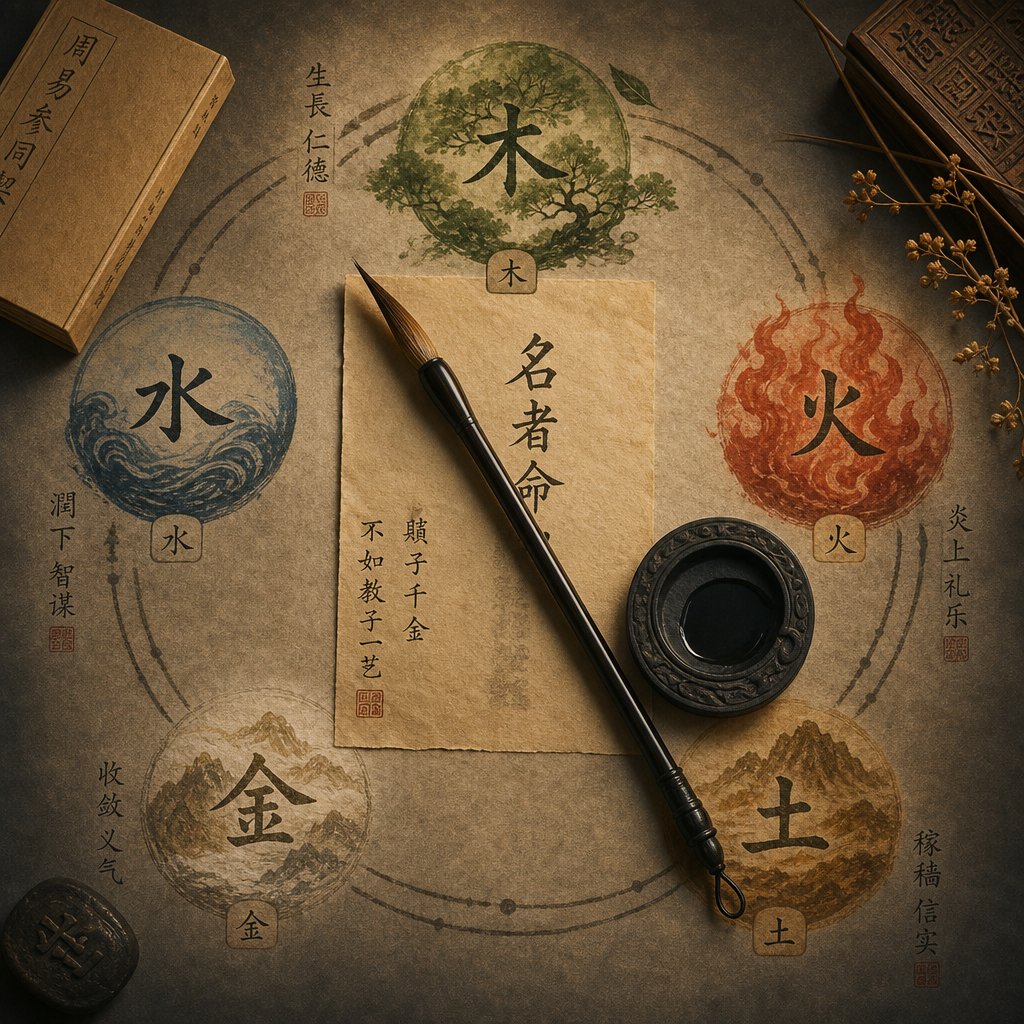
Every Chinese character carries an elemental fingerprint. Whether you realize it or not, the characters in mandarin names don't just convey meaning. They radiate one of five elemental energies: Wood, Fire, Earth, Metal, or Water. This is the Wu Xing (五行) framework, and it determines which characters strengthen a person's energetic profile and which ones quietly erode it.
How Characters Map to the Five Elements
How does a single character get assigned an element? Three factors determine its classification. First, semantic meaning. A character like 森 (sen, "forest") clearly belongs to Wood because its meaning directly references trees and growth. Second, radical composition. Characters containing the water radical 氵 carry Water energy, those with the fire radical 火 or 灬 carry Fire energy, and so on. Third, stroke structure and phonetic components can tip the balance when meaning and radical point in different directions.
The table below maps commonly used characters in chinese names with meaning to their elemental associations:
| Element | Nature | Common Name Characters | Identifying Radicals |
|---|---|---|---|
| Wood (木) | Growth, expansion, upward movement | 林 (lin), 松 (song), 柏 (bai), 梁 (liang), 楚 (chu), 栋 (dong) | 木 (tree radical) |
| Fire (火) | Passion, brightness, radiance | 炎 (yan), 煜 (yu), 熙 (xi), 晖 (hui), 昊 (hao), 晓 (xiao) | 火, 灬, 日 (sun radical) |
| Earth (土) | Stability, inclusiveness, grounding | 坤 (kun), 坚 (jian), 城 (cheng), 墨 (mo), 基 (ji), 垚 (yao) | 土 (earth radical) |
| Metal (金) | Firmness, precision, contraction | 钧 (jun), 铭 (ming), 锐 (rui), 钊 (zhao), 锋 (feng), 鉴 (jian) | 金, 钅 (metal radical) |
| Water (水) | Wisdom, fluidity, adaptability | 泽 (ze), 洋 (yang), 淼 (miao), 涵 (han), 渊 (yuan), 源 (yuan) | 水, 氵 (water radical) |
A practitioner analyzing a person's BaZi chart first identifies which elements are excessive and which are deficient. The naming principle is "support what is lacking and restrain what is excessive" (扶其不足, 抑其太过). If someone's chart overflows with Metal energy, adding characters like 锋 or 铭 compounds the rigidity. If their chart desperately needs Water, characters like 涵 or 源 provide relief.
Destructive Element Cycles and Name Conflicts
The Five Elements don't exist in isolation. They interact through two primary cycles. The Generating Cycle (相生) describes how elements nourish each other: Wood feeds Fire, Fire creates Earth, Earth bears Metal, Metal collects Water, Water nourishes Wood. This is the supportive, creative flow.
The Controlling Cycle (相克) is where naming conflicts emerge. Each element restrains another in a fixed pattern:
- Water extinguishes Fire (水克火)
- Fire melts Metal (火克金)
- Metal cuts Wood (金克木)
- Wood depletes Earth (木克土)
- Earth dams Water (土克水)
When you place two characters in a name whose elements sit in a controlling relationship, they don't cooperate. They fight. Imagine naming a child with one character carrying strong Water energy and another carrying strong Fire energy. Water extinguishes Fire. Instead of both characters contributing positive force, one actively suppresses the other. The name contains its own internal conflict.
This matters because the chinese naming convention in feng shui treats a name as a unified energetic system, not a collection of independent parts. The given name characters must work together, and they must also harmonize with the surname's elemental energy. A surname carrying Metal energy paired with a given name heavy in Wood creates a controlling dynamic right at the foundation of the name.
Zero-Sum Character Combinations That Cancel Positive Energy
The zero-sum problem is subtler than outright destruction. It occurs when two individually positive characters neutralize each other because their elements are locked in a controlling relationship. Both characters might have beautiful meanings. Both might score well on stroke count analysis. But placed together, their elemental energies cancel out rather than compound.
Consider a name pairing 森 (sen, Wood, "forest") with 坤 (kun, Earth, "vast earth"). Individually, both are strong, auspicious characters. But Wood controls Earth in the destructive cycle. Roots penetrate and break apart soil. The Wood character's expansive energy actively undermines the Earth character's stabilizing force. The result? Neither character delivers its full benefit. The name's total energetic output is less than the sum of its parts.
Practitioners avoid this by selecting character pairs whose elements either sit in a generating relationship (one feeds the other) or share the same element (mutual reinforcement). A Wood character paired with a Water character creates flow: Water nourishes Wood, and both energies amplify. A Fire character paired with a Wood character follows the same logic: Wood feeds Fire, producing synergy rather than opposition.
The practical takeaway is clear. Screening individual characters for negative meaning is only the first step. You also need to evaluate how characters interact with each other elementally. A name built from two "good" characters can still function as a feng shui naming combination to avoid if those characters' elements are locked in mutual destruction.
Elemental compatibility gives you the macro picture. But the system goes deeper still. Each character also carries a numerological vibration based on its stroke count, and certain stroke totals have been flagged as unlucky for centuries within the traditional naming framework.
Stroke Count Numerology and Unlucky Number Patterns
Elemental energy isn't the only invisible force embedded in a character. Every Chinese character also vibrates at a specific numerical frequency determined by its stroke count. This system, called 数理 (shuli, "numerical principles"), treats numbers themselves as carriers of fortune or misfortune. A character can have a beautiful meaning, belong to the right element, and still sabotage a name if its stroke count lands on an unlucky number within the traditional framework.
The 81-Number Stroke Count System Explained
The stroke count system operates on an 81-number cycle. Each number from 1 through 81 carries a fixed interpretation, ranging from highly auspicious to deeply inauspicious. After 81, the cycle resets (82 becomes equivalent to 1, 83 to 2, and so on). Practitioners don't just count the strokes of individual characters in isolation. They calculate multiple "formations" (格) from the full name, each representing a different life domain.
The Five Formations system (五格) breaks a name into five numerical readings: Heavenly Formation (天格, ancestral fortune), Human Formation (人格, core personality and main fortune), Earthly Formation (地格, early career development), External Formation (外格, social relationships), and Total Formation (总格, overall life trajectory). Each formation is calculated by combining stroke counts from different parts of the name. The Human Formation, for instance, adds the last character of the surname to the first character of the given name.
Understanding chinese surnames meaning at this level reveals why the surname isn't just a family identifier. It's a fixed numerical anchor that shapes every formation calculation. When you look at a list of chinese family names, each surname carries a specific stroke count that permanently constrains which given-name stroke combinations can produce auspicious readings. A surname with 10 strokes creates entirely different formation possibilities than one with 6 strokes. This is why chinese family names and meanings carry weight beyond heritage. They set the mathematical foundation the entire name must build upon.
Unlucky Stroke Totals and Their Associations
Within the 81-number cycle, certain totals are flagged as consistently inauspicious. These numbers are associated with hardship, instability, isolation, or decline. When any of the five formations lands on one of these numbers, practitioners consider it a warning sign.
The key unlucky stroke count numbers and their traditional associations:
- 2 - Separation and instability. Associated with disconnection, inability to establish roots, and fractured relationships.
- 4 - Hardship and stagnation. Linked to illness, frustration, and blocked progress despite effort.
- 9 - Incomplete success. Associated with reaching heights only to fall, unfulfilled potential, and volatility.
- 10 - Emptiness and endings. Represents a return to zero, loss of accumulated gains, and loneliness in later life.
- 19 - Obstacles and suffering. Linked to intelligence undermined by misfortune, health problems, and family discord.
- 20 - Hollow achievement. Associated with outward appearance masking inner emptiness, financial instability.
- 22 - Decline in middle age. Linked to early promise that deteriorates, unreliable partnerships.
- 28 - Conflict and loss. Associated with legal troubles, family separation, and volatility in relationships.
- 34 - Disaster and upheaval. One of the most avoided numbers, linked to catastrophic reversals and chronic bad luck.
- 44 - Repetitive failure. Associated with patterns of defeat that repeat across life stages despite talent.
These aren't arbitrary assignments. Each number's interpretation traces back to classical texts that correlate numerical vibrations with observable life patterns. The 81 lucky/unlucky tabulation (81数理吉凶表) has been used by practitioners for generations to screen name combinations before finalizing a choice.
Why Traditional Character Forms Determine Stroke Count
Here's a detail that trips up many people, especially those working with simplified Chinese. Stroke counts in feng shui naming must be calculated using traditional (繁体) character forms, not simplified ones. The reasoning? Traditional characters preserve the original energetic architecture. Simplified characters, introduced in the 1950s and 1960s for literacy purposes, altered stroke structures in ways that changed the numerical vibration without changing the meaning.
For example, the character 龙 (long, "dragon") has 5 strokes in simplified form. Its traditional form 龍 has 16 strokes. These two numbers fall in completely different positions on the 81-number cycle and carry different fortune readings. Practitioner Sean Chan emphasizes that stroke counts must reference the Kangxi Dictionary (康熙字典), the authoritative source for traditional character stroke values. Some characters have more strokes than they visually appear to have, making verification against this dictionary essential rather than relying on casual counting.
The chinese surname meanings you research online often list simplified stroke counts. If you're evaluating a name through the feng shui numerological lens, those numbers won't give you accurate formation readings. Always convert to traditional forms first. A name that looks numerologically sound in simplified characters might reveal problematic totals once you apply the correct traditional stroke values.
Stroke count gives you the numerical layer of screening. But characters contain yet another hidden dimension that operates below the level of whole-character meaning: the radicals that compose them. These building blocks carry their own independent energetic signatures, and some introduce conflict tied directly to a person's zodiac sign.
Radical Analysis and Zodiac-Specific Character Conflicts
You've screened for negative meanings. You've checked stroke counts. You've verified elemental compatibility. The character looks clean. But there's one more layer hiding inside it, one that operates below the surface of whole-character meaning. Radicals, the structural components that build every Chinese character, carry their own independent energetic charge. And some of them quietly introduce conflict that only becomes visible when you know where to look.
How Radicals Function as Energetic Building Blocks
Think of radicals as a character's energetic DNA. Just as genes contribute traits to a whole organism regardless of what the organism looks like on the surface, radicals contribute meaning and energy to a character regardless of its overall definition. A character might mean "brilliant" or "heroic," but if its internal structure contains a radical associated with blades, illness, or destruction, that hidden component still radiates its own frequency.
Chinese characters aren't monolithic symbols. Most are composite structures built from two or more radicals. The 214 traditional radicals cataloged in the Kangxi Dictionary each carry distinct semantic weight. When feng shui practitioners evaluate chinese name ideas, they don't just read the character as a finished product. They disassemble it, examining each radical for what it contributes to the energetic whole.
This is where many people exploring chinese names behind the name get surprised. A character that passes every other screening test, positive meaning, correct element, auspicious stroke count, can still harbor a problematic radical that introduces subtle friction into the name's energy field.
Radicals That Carry Hidden Negative Associations
Certain radicals are flagged by practitioners because their core meanings involve harm, danger, or depletion. Even when embedded inside an otherwise positive character, these radicals broadcast their own signal. Here are the primary categories:
- Blade and weapon radicals (刂, 戈, 斤) - These carry cutting, severing energy. The radical 刂 (knife/blade) appears in characters like 刚 (gang, "firm") and 利 (li, "sharp/beneficial"). While 利 seems positive, its blade radical introduces an undercurrent of sharpness that can manifest as interpersonal friction or a life marked by sudden separations.
- Illness radical (疒) - This radical literally means "sickness" and appears in characters like 痊 (quan, "to recover") and 瘦 (shou, "thin"). Even 痊, which means healing, still carries the illness radical's depleting vibration at its structural core.
- Fire radical (火, 灬) in excess - Fire energy isn't inherently bad, but when a character contains multiple fire-related components or when paired with other fire-heavy characters, it creates combustion risk. Excessive fire radicals in a name can correlate with volatility, burnout, or unstable relationships.
- Water radical (氵) in dangerous combinations - Water alone is fine. But when water radicals combine with characters suggesting overflow, flooding, or drowning (like 溺, ni, "to drown"), the radical amplifies the hazard rather than providing nourishing flow.
The key insight? You can't evaluate a chinese name with meaning by reading only the dictionary definition. You need to look inside the character itself and ask what each component is contributing energetically.
Zodiac Sign Conflicts With Specific Radicals
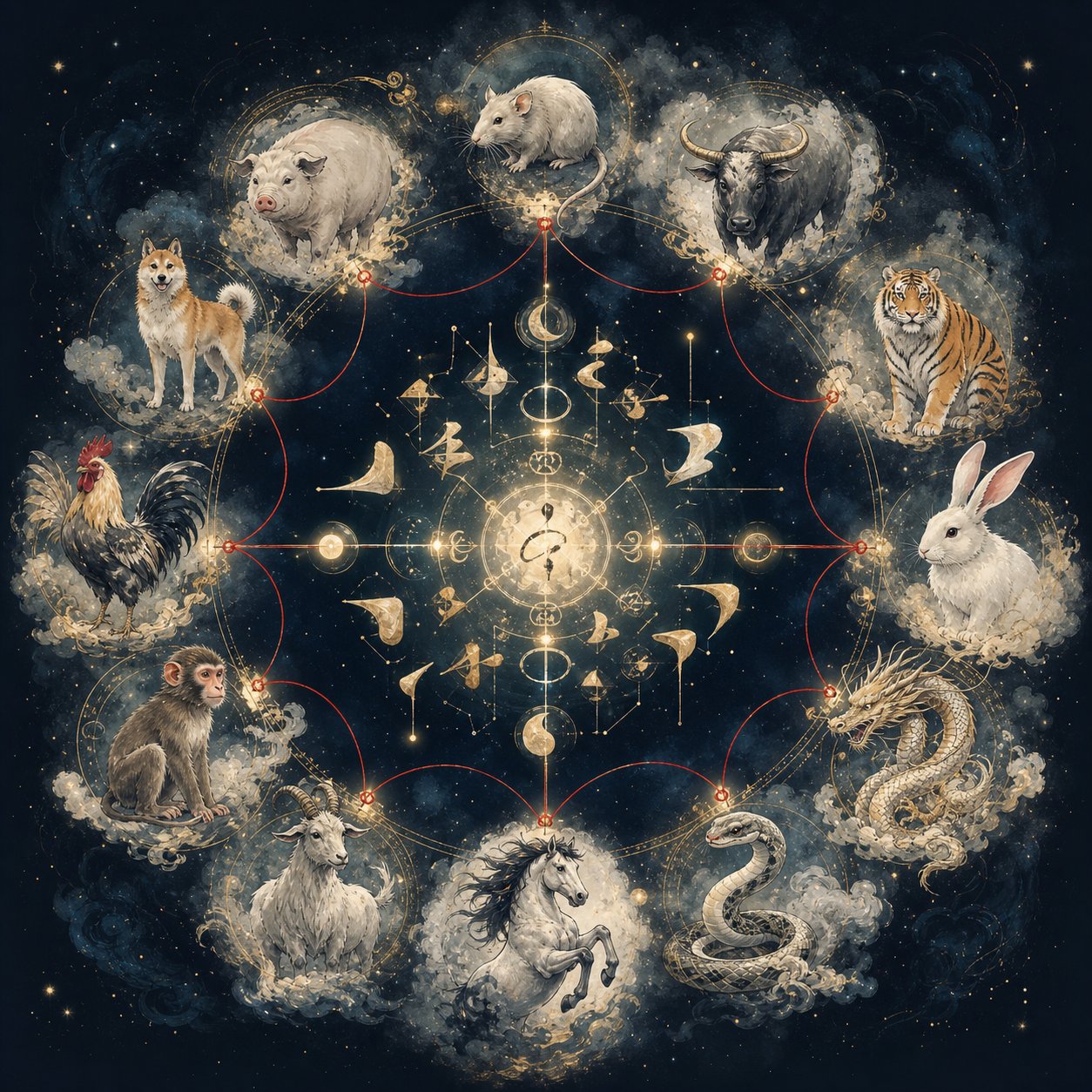
Radical avoidance becomes even more personalized when you factor in the Chinese zodiac. Each of the twelve animal signs has specific radical conflicts based on the Earthly Branch clash system (地支相冲). When your zodiac sign clashes with a particular animal, radicals associated with that animal become problematic in your name.
The logic works like this. Each zodiac animal corresponds to an Earthly Branch, and certain branches directly oppose each other. Rat (子) clashes with Horse (午). Tiger (寅) clashes with Monkey (申). Dragon (辰) clashes with Dog (戌). Zodiac nameology extends these clashes to the radical level, meaning characters containing components visually or semantically linked to your clashing animal should be avoided.
The table below maps problematic radicals to their meanings and the zodiac signs that should be most cautious:
| Radical | Meaning/Association | Zodiac Signs That Should Avoid | Reason |
|---|---|---|---|
| 午, 马 (horse) | Horse energy, midday fire | Rat (子) | Rat and Horse directly clash (子午冲) |
| 子, 鼠 (rat) | Rat energy, midnight water | Horse (午) | Horse and Rat directly clash |
| 申, 猴 (monkey) | Monkey energy, metal | Tiger (寅) | Tiger and Monkey clash (寅申冲) |
| 日 (sun) | Bright, exposed, yang fire | Snake (巳) | Snakes fear exposure and sunlight; prefer concealment |
| 戌, 犬 (dog) | Dog energy, earth | Dragon (辰) | Dragon and Dog clash (辰戌冲) |
| 未, 羊 (sheep) | Sheep energy, earth | Ox (丑) | Ox and Sheep clash (丑未冲) |
| 酉, 鸟 (rooster/bird) | Rooster energy, metal | Rabbit (卯) | Rabbit and Rooster clash (卯酉冲) |
| 亥, 豕 (pig) | Pig energy, water | Snake (巳) | Snake and Pig clash (巳亥冲) |
Imagine you're born in the Year of the Tiger. A character containing the 申 radical or monkey-related components introduces your zodiac's direct adversary into your name. According to traditional theory, this creates internal tension, a name that works against its bearer's innate animal energy rather than supporting it.
Zodiac-radical conflicts also extend to "harm" relationships (相害) and "punishment" relationships (相刑), not just direct clashes. A Rat sign, for example, should also be cautious with sheep-related radicals (未) because Rat and Sheep form a harm relationship. The full web of zodiac interactions means that thorough radical screening requires knowing not just your clash animal but your complete set of conflicting branches.
This is the deepest layer of character analysis in feng shui naming. Surface meaning, elemental energy, stroke count numerology, and now radical composition and zodiac compatibility. Each layer catches problems the others miss. But with so many variables in play, mistakes become almost inevitable for anyone navigating this system without deep expertise, especially those approaching it from outside the Chinese linguistic tradition.
Common Mistakes When Choosing a Feng Shui Name as a Non-Native Speaker
With so many layers of analysis, radicals, stroke counts, elemental mapping, zodiac clashes, it's no surprise that mistakes pile up quickly for anyone approaching this system without native fluency. English-speaking parents searching for a chinese name generator with meaning or trying to give me a chinese name through online tools face a particular set of pitfalls. The errors aren't random. They follow predictable patterns rooted in how non-native speakers interact with Chinese characters.
Mistakes Non-Native Speakers Make With Character Selection
You'll notice that most of these mistakes stem from the same root problem: evaluating characters through a single lens when feng shui naming demands multi-layered analysis. A character that looks right on one dimension can fail catastrophically on another.
The most common errors:
- Choosing characters for visual beauty alone. Non-native speakers often select characters because they look elegant when written, without understanding what's inside them structurally. A character with sweeping, balanced strokes might contain a blade radical (刂) or illness radical (疒) that introduces hidden negative energy. Aesthetic appeal tells you nothing about radical composition.
- Counting strokes from simplified characters instead of traditional forms. This is one of the most frequent technical errors. Someone using a chinese name maker with meaning that displays simplified characters will get incorrect stroke counts. The character 华 (hua, "splendid") has 6 strokes in simplified form but 14 in its traditional form 華. That difference completely changes the numerological reading. As naming experts note, characters with rare or complicated strokes are often miscounted even by those familiar with the system.
- Combining two individually positive characters without checking elemental interaction. Both 森 (sen, Wood) and 坤 (kun, Earth) are strong characters with auspicious meanings. But Wood controls Earth in the destructive cycle. Pairing them creates internal opposition. Non-native speakers tend to evaluate characters in isolation, assembling names from a list of "good" characters without testing how they interact.
- Ignoring tonal combinations that produce inauspicious sound patterns. Mandarin's four tones create meaning shifts that non-tonal language speakers often miss entirely. Two characters might look perfect on paper, but when spoken together, their tonal combination produces a sound resembling an unlucky word or phrase. A name with consecutive falling tones (fourth tone) can also sound harsh and aggressive to native ears.
- Relying on machine translation or dictionary lookups. Online tools that translate English names into Chinese characters typically prioritize phonetic approximation over energetic compatibility. The result might sound vaguely like your English name but carry elemental clashes, problematic radicals, or unlucky stroke counts that no practitioner would approve.
- Treating all avoidance rules as equally absolute. Some rules are universally agreed upon. Others are debated, regional, or school-specific. A non-native speaker reading multiple sources often can't distinguish between hard rules and soft guidelines, leading to either paralysis (rejecting every character) or false confidence (following one source that omits important considerations).
Debated Rules Where Practitioners Disagree
Not every traditional avoidance rule carries the same weight among modern practitioners. Feng shui naming isn't a monolithic system. Different schools and lineages emphasize different principles, and some classical rules have sparked genuine disagreement about whether they still apply.
As feng shui consultant perspectives suggest, the underlying principle behind a rule matters more than rigid adherence to its original form. Context evolves. What made sense in ancient China may need reinterpretation for contemporary life. The key is understanding the "why" behind each rule and adapting the "how" to your situation.
Areas where practitioners commonly disagree:
- Zodiac-radical avoidance strictness. Some practitioners treat zodiac-radical clashes as absolute deal-breakers. Others view them as secondary considerations that only matter when the character also fails on other dimensions. A Tiger-sign person using a character with a monkey-related radical might get a pass from one practitioner if the character's elemental energy strongly supports their BaZi chart.
- The weight of stroke count numerology versus elemental balance. Classical practitioners often prioritize the 81-number system as the primary screening tool. More modern practitioners argue that elemental compatibility with the birth chart matters more, and that a slightly unlucky stroke total can be offset by strong elemental support.
- Whether homophones in non-local dialects matter. A strict interpretation says you should check pronunciation across all major Chinese dialects. A pragmatic view holds that only the dialect the family actually speaks daily carries real phonetic weight. If you live in a Mandarin-speaking environment and never use Cantonese, does a Cantonese homophone problem actually affect your name's energy?
- Gender-specific character rules. Traditional feng shui naming assigns certain characters exclusively to male or female names. Some contemporary practitioners have relaxed these boundaries, arguing that the energetic quality of a character matters more than its gendered cultural associations.
These disagreements don't mean the system is unreliable. They mean it's alive, still being interpreted and refined by practitioners working with real clients in modern contexts.
Which Traditional Avoidance Rules Still Apply Today
Despite the debates, certain rules remain firmly in place across virtually all schools of feng shui naming. These are the non-negotiables that modern practitioners still enforce without exception:
- Universal character avoidance. Characters with inherently negative meanings (death, illness, violence, emptiness) remain off-limits regardless of school or lineage. No modern reinterpretation has softened this rule.
- Elemental clash avoidance within the name. Placing characters whose elements are in a direct controlling relationship still produces internal conflict. The destructive cycle hasn't changed.
- Traditional stroke count forms for numerological calculation. Even practitioners who de-emphasize numerology still use traditional character forms when they do calculate. No credible practitioner uses simplified stroke counts for feng shui readings.
- BaZi-based elemental screening. The principle that a name should support rather than destabilize the birth chart's elemental balance remains the central pillar of personalized feng shui naming. This hasn't been debated away.
- Homophone screening in the family's primary dialect. While checking every dialect is debated, screening against the language you actually use daily is universally maintained.
The balanced takeaway? Treat universal avoidance rules and elemental compatibility as hard boundaries. Treat zodiac-radical conflicts and cross-dialect homophones as important but context-dependent factors where a qualified practitioner's judgment adds real value. If you're using online tools or attempting self-guided selection, err on the side of caution with debated rules rather than dismissing them.
Knowing what to avoid is half the equation. The other half is having a structured process for actually screening characters, layer by layer, so nothing slips through the gaps.
Practical Framework for Screening Name Characters
A layered screening process turns everything covered so far into something you can actually use. Rather than juggling all the variables at once, you work through them in order of priority, each layer catching problems the previous one missed. This is how to find your chinese name candidates that are energetically sound, not just aesthetically pleasing.
Step-by-Step Character Screening Process
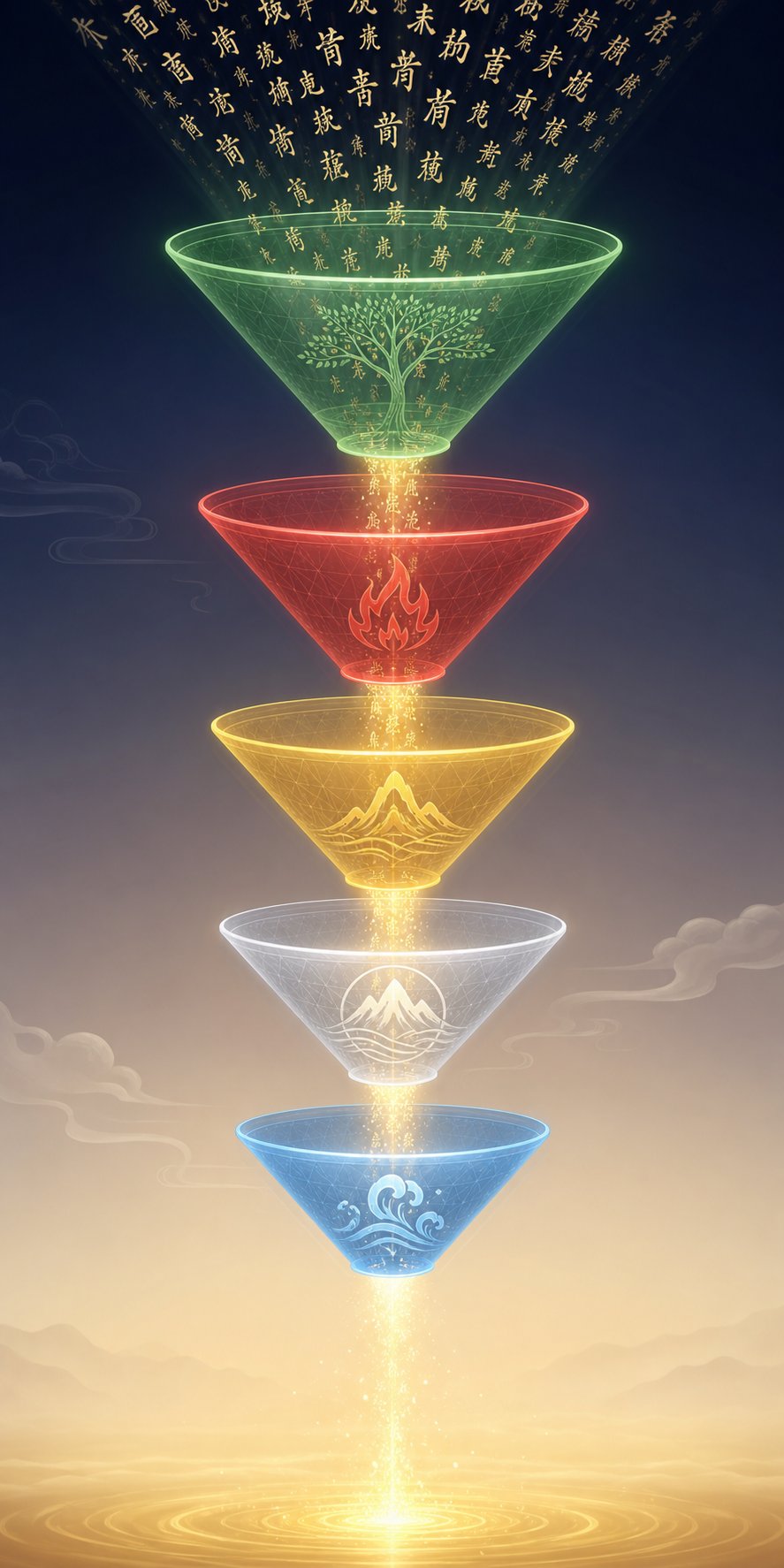
Think of this as a funnel. You start with a broad pool of characters you find appealing, then progressively filter out the ones that carry hidden problems. Each step eliminates a different category of risk.
- Screen against universally inauspicious characters. Check whether any candidate character carries meanings tied to death, illness, violence, loneliness, or decline. Also check whether the character's pronunciation creates homophone collisions with negative words in your family's primary dialect. This is the fastest filter and the most absolute. Any character that fails here gets removed immediately, no exceptions.
- Examine radical composition. Disassemble each remaining character into its component radicals. Look for blade radicals (刂, 戈, 斤), the illness radical (疒), or excessive fire components. If you know the child's zodiac sign, cross-reference against zodiac-radical clash tables to flag characters containing components linked to the opposing animal sign.
- Verify stroke count numerology. Convert each character to its traditional (繁体) form using the Kangxi Dictionary as reference. Count strokes carefully, then calculate the Five Formations (五格) by combining character strokes with the surname's stroke count. Check each formation total against the 81-number cycle for inauspicious readings. A character that produces unlucky totals in the Human Formation (人格) or Total Formation (总格) deserves extra scrutiny.
- Assess elemental compatibility with the birth chart. Identify each character's Five Element classification based on its meaning, radical, and phonetic components. Compare against the child's BaZi chart to confirm the character supports the Favorable Element (用神) rather than feeding an already excessive element or weakening the Day Master further.
- Evaluate character pairings for zero-sum conflicts. Once you have individual characters that pass all previous layers, test them together. Do their elements sit in a generating (supportive) relationship, or a controlling (destructive) one? A name where the first given-name character's element feeds the second character's element creates synergy. A name where one character's element attacks the other creates internal opposition that undermines both.
Characters that survive all five layers form your shortlist. From there, the decision becomes about personal resonance, family meaning, and aesthetic preference, all of which matter, but only after energetic safety is established.
When to Consult a Feng Shui Naming Practitioner
This framework gives you foundational screening ability. But certain steps, particularly BaZi chart interpretation and elemental compatibility analysis, involve nuances that self-guided research struggles to capture. A birth chart isn't just a list of elements to count. It's a dynamic system where timing, seasonal energy, and hidden stems all influence which element truly serves as the Favorable God.
If any of the following apply, professional consultation adds genuine value:
- The child's birth chart shows complex elemental interactions where multiple elements compete for dominance
- You're unsure whether a character's element classification leans one way or another (many characters carry mixed elemental energy)
- The surname creates numerological constraints that severely limit viable character options
- You want to verify dialect-specific homophone safety across multiple regional pronunciations
- The family has specific cultural requirements that must coexist with feng shui principles
What separates a credible practitioner from an unreliable one? Feng shui consultant Jessie Kim recommends looking for formal training from a reputable school, verifiable testimonials from past clients, and a willingness to tailor recommendations to your specific situation rather than applying cookie-cutter formulas. A practitioner who asks detailed questions about your goals, family context, and concerns is more trustworthy than one who delivers a name after only collecting birth data. Reputation and experience matter more than sponsored ratings on directory websites.
Also consider whether the practitioner explains their reasoning. A good naming consultant doesn't just hand you a name. They walk you through why specific characters were chosen and which ones were rejected, giving you confidence that the selection process was thorough. If someone cannot articulate why a character works for your child's specific chart, that's a red flag.
Building a Shortlist of Harmonious Characters
Once you've applied the screening layers and, if needed, consulted a practitioner, you'll want to narrow your candidates to a final shortlist of three to five options. Modern naming frameworks suggest validating final candidates against classical literary sources for cultural depth, running homophone checks across relevant dialects, and confirming duplication rates to avoid overly common combinations.
A practical shortlisting approach:
- Confirm each finalist character passes all five screening layers without compromise
- Test the full name (surname plus given name) spoken aloud in natural conversation. Does it flow? Does it produce any awkward sound combinations?
- Verify the name's tonal pattern creates pleasant cadence rather than monotony or harshness
- Check whether what is a common chinese name in current usage overlaps with your choice. High-frequency characters reduce distinctiveness
- Present final candidates to family members for discussion, integrating personal and cultural preferences with the energetic analysis
The goal isn't perfection on every single metric. It's ensuring no character introduces a serious energetic conflict while the overall name carries meaning that resonates with your family. Chinese name and meanings work best when technical soundness and personal significance align. A name that scores perfectly on feng shui analysis but holds no emotional weight for the parents misses something essential too.
Feng shui naming is ultimately a system of intentional care. Every layer of screening, from universal avoidance to personalized elemental matching, exists to ensure the name a child carries for life supports rather than obstructs their path. The characters you avoid matter just as much as the ones you choose.
Frequently Asked Questions About Feng Shui Naming Characters to Avoid
1. What characters should you never use in a feng shui name?
Characters directly tied to death (死, 亡, 殁), illness (病, 痛), violence (杀, 战), loneliness (孤, 寂), and decline (衰, 败) are universally avoided regardless of a person's birth chart. These characters emit low-frequency energy that attracts corresponding negative life circumstances according to traditional feng shui theory. Additionally, characters whose pronunciation sounds like inauspicious words, such as any character pronounced 'si' which echoes 死 (death), should also be screened out during the naming process.
2. How does BaZi determine which name characters are bad for a specific person?
BaZi (Four Pillars of Destiny) maps a person's birth year, month, day, and hour into elemental energies. The Day Master reveals your core element, and a practitioner then identifies which elements are excessive or deficient in your chart. Characters belonging to an element that worsens your imbalance become personally inauspicious. For example, a person with an already Fire-heavy chart should avoid Fire-dominant characters like 炎 (blazing), while the same character would strengthen someone with a weak Fire Day Master.
3. Why must stroke counts use traditional Chinese characters instead of simplified ones?
Feng shui stroke count numerology requires traditional (繁体) character forms because they preserve the original energetic architecture established over thousands of years. Simplified characters, introduced in the 1950s for literacy purposes, altered stroke structures and changed the numerical vibration. For instance, 龙 (dragon) has 5 strokes simplified but 16 strokes in its traditional form 龍, placing it at completely different positions on the 81-number fortune cycle. The Kangxi Dictionary serves as the authoritative reference for correct stroke values.
4. Can a character with a positive meaning still be bad feng shui for a name?
Yes, a character can have a beautiful dictionary meaning yet still carry negative feng shui energy through multiple hidden channels. Its radical composition might contain blade or illness components that introduce subtle harm. Its stroke count might land on an unlucky number in the 81-number cycle. Its elemental energy might clash with the person's birth chart or with the other characters in the name. Even its pronunciation might create unfortunate homophones in the family's spoken dialect. Thorough screening requires checking all these layers, not just surface meaning.
5. How do Chinese zodiac signs affect which name characters to avoid?
Each zodiac animal has direct clash relationships with other animals based on the Earthly Branch system. Characters containing radicals associated with your clashing animal introduce internal tension into your name. For example, someone born in the Year of the Rat should avoid characters with horse-related radicals because Rat and Horse directly clash (子午冲). This extends beyond direct clashes to harm and punishment relationships as well, meaning a thorough zodiac-radical screening requires knowing your complete set of conflicting branches, not just your primary opposing sign.