Understanding Five Elements Color and Name Matching
When parents in Chinese-speaking cultures choose a name for their child, they often consider far more than how it sounds. They look at the elemental energy a name carries and the colors that resonate with it. This practice, five elements color and name matching, is a system rooted in Chinese metaphysics that links Wu Xing theory to personal naming conventions and specific color associations.
What Is Five Elements Color and Name Matching
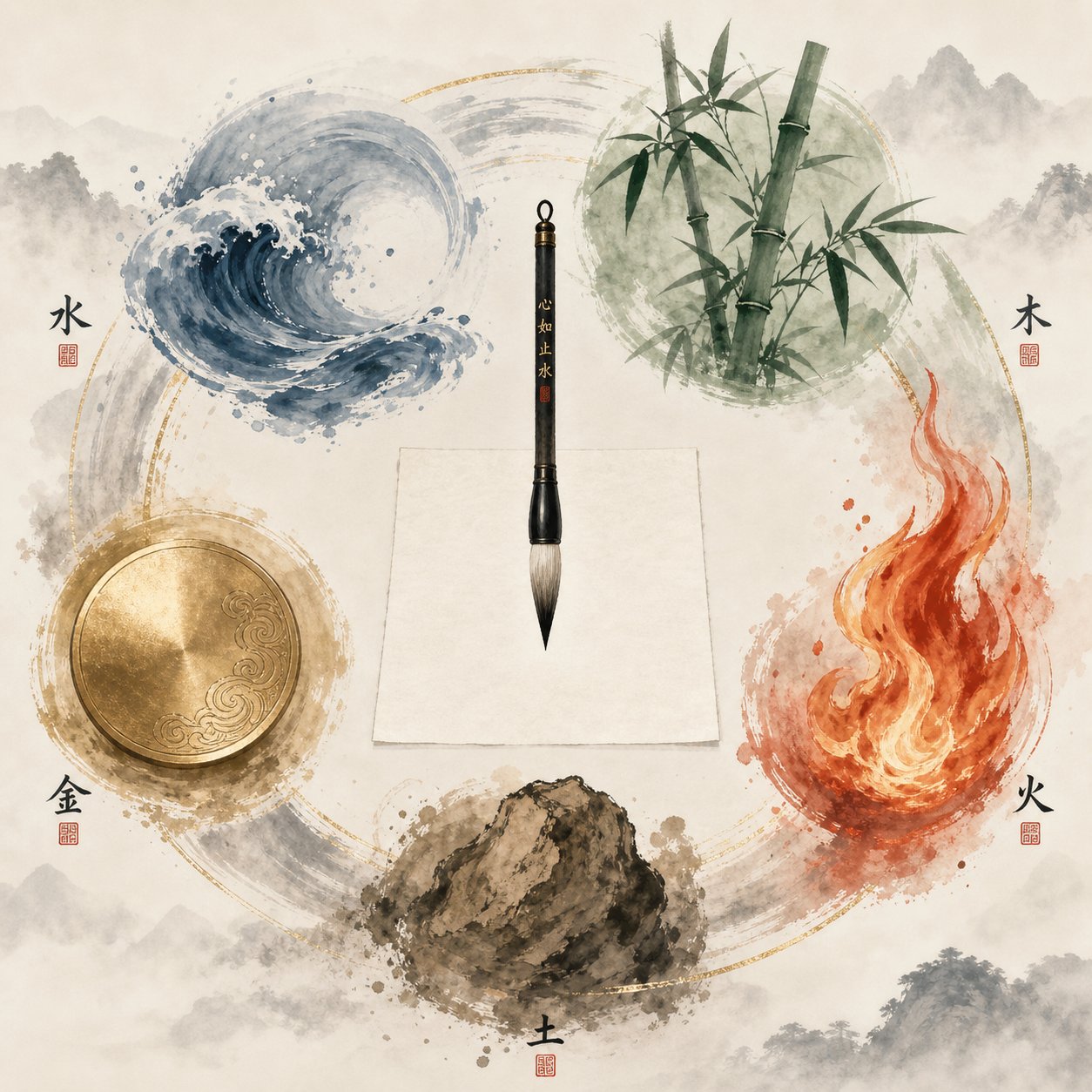
So what are the five elements in this context? They are Wood, Fire, Earth, Metal, and Water — the foundational chinese elements known collectively as Wu Xing. Each element governs a set of colors, and each Chinese character used in a name carries an elemental signature through its radical or stroke count. Five elements color and name matching brings these layers together: it identifies a person's elemental profile, selects name characters that balance or strengthen that profile, and then pairs the result with a corresponding color palette for daily life.
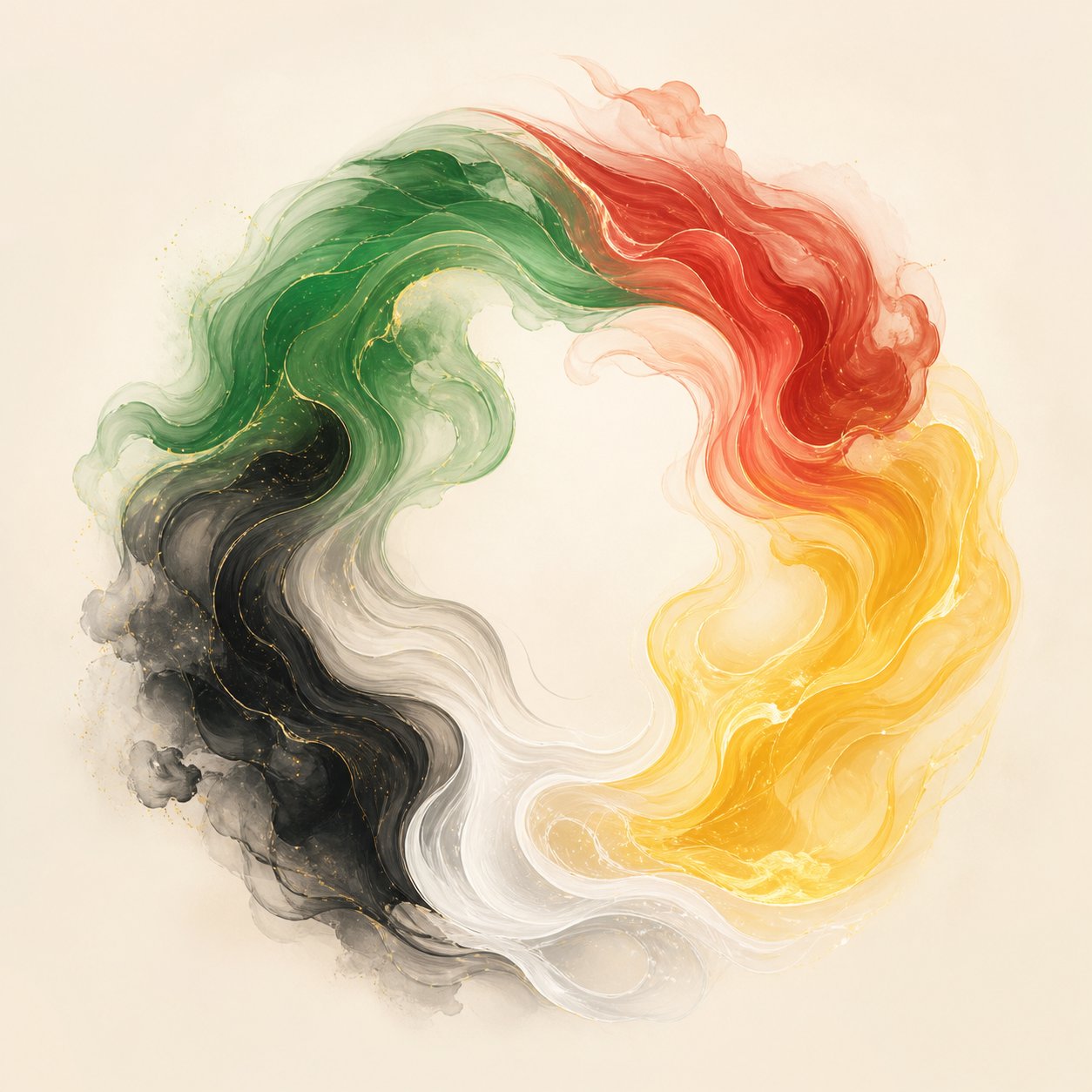
This isn't a modern invention. The Rites of Zhou documented how colors correspond to elements and directions — blue for Wood in the East, red for Fire in the South, white for Metal in the West, black for Water in the North, and yellow for Earth at the center. These chinese meanings and symbols have guided everything from imperial dress codes to architectural design for millennia. Within the broader framework of symbols Confucianism established for social harmony, color-element pairings served as a shared language for expressing one's place in the natural order.
Why These Three Components Work Together
You might wonder why elemental classification, color palettes, and character selection need to function as a single system rather than separate practices. The answer lies in coherence. A name that supplies a missing element only reaches its full potential when the person also surrounds themselves with the colors that reinforce that same energy. Imagine choosing a Water-element name for balance but dressing exclusively in Fire-element reds — the visual environment works against the name's intent.
Most resources on this topic cover only two of the three components — pairing elements with colors or elements with names, but rarely all three together. This guide addresses elemental classification, color palettes, and character selection as one unified framework.
Modern practitioners apply these principles across a surprising range of contexts. Traditional Chinese naming customs use elemental balance to promote good fortune in a child's life, while branding consultants draw on the same logic to align a company's visual identity with its founder's energetic profile. Whether you're exploring what are the 5 elements for baby naming, personal rebranding, or simply choosing a wardrobe that feels right, this system offers a structured path toward harmony.
The real depth of this practice, though, depends on understanding how Wu Xing actually works — not as five static substances, but as phases of constant transformation that govern everything from seasons to emotions.
The Wu Xing System and Its Governing Principles
Think of water freezing into ice, then melting, then evaporating into steam. The substance stays the same — what changes is its phase. The chinese five elements operate on a similar logic. Wuxing doesn't describe five fixed materials sitting in isolation. It describes five modes of energy in constant motion, each flowing into the next like seasons turning through the year.
Wu Xing as Phases of Transformation
The term Wu Xing is often translated as "five elements," but a more precise reading is "five movements" or "five phases." Some scholars even refer to them as magic phases because of how dynamically they interact — generating, controlling, and transforming one another in perpetual cycles. Wood isn't just a tree. It represents the energy of growth, expansion, and upward movement. Fire isn't just flame. It embodies peak activity, radiance, and outward expression. Earth is stabilization and centering. Metal is contraction, refinement, and inward focus. Water is stillness, storage, and the potential energy that precedes a new cycle of growth.
This phase-based understanding matters for color and name matching because it means each element isn't locked into a single rigid association. Wood energy can manifest as the fresh green of a spring shoot or the deep teal of a mature forest canopy — both are valid expressions of the same transformative phase. When you select a name character or a color palette, you're aligning with a quality of movement, not a static object.
How Chinese Five Elements Differ From Western Elements
If you grew up learning about fire, air, water, and earth elements in a Western context — the classical Greek model — you might assume the five chinese elements work the same way with an extra one tacked on. They don't. The Western four elements describe fundamental substances or states of matter. The Chinese system describes relationships and processes.
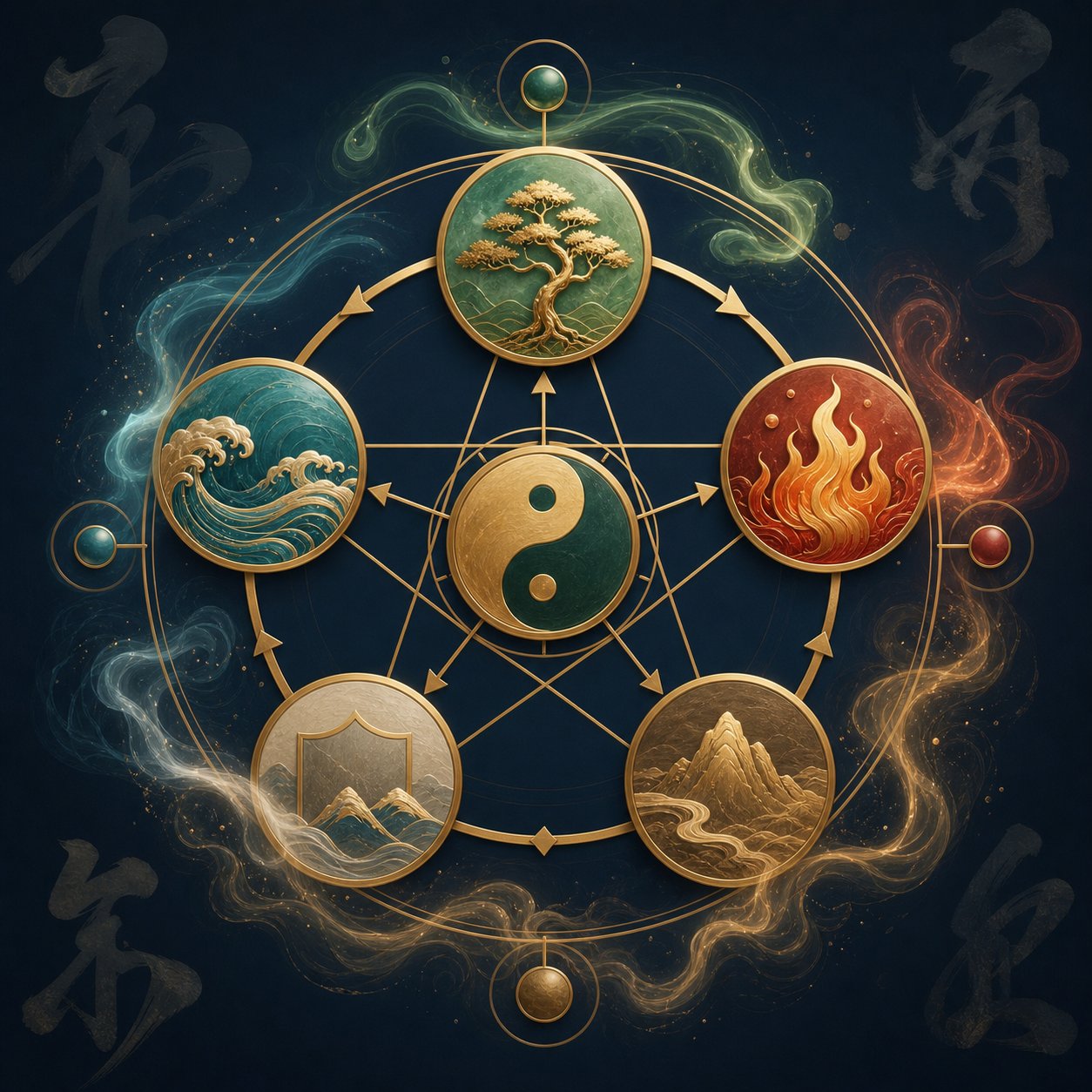
Consider a few key differences. The Western model includes Air but not Metal or Wood. The Chinese model has no Air element at all. More importantly, the fire air water earth elements of Greek philosophy exist as independent building blocks. In wuxing, no element stands alone. Each one is defined by how it generates the next and controls another. Wood feeds Fire. Fire creates Earth (ash). Earth bears Metal (minerals). Metal collects Water (condensation). Water nourishes Wood. Remove any single phase and the entire cycle breaks down.
This relational structure is exactly what makes the system so useful for name and color work. You're never just picking "a Water name" in isolation — you're positioning that name within a web of supportive and challenging relationships that extend into color, season, and emotional tone.
Each element governs specific correspondences that practitioners use as reference points. The table below consolidates the associations most relevant to naming and color selection:
| Element | Season | Direction | Yin Organ | Yang Organ | Governing Emotion |
|---|---|---|---|---|---|
| Wood | Spring | East | Liver | Gallbladder | Anger (drive) |
| Fire | Summer | South | Heart | Small Intestine | Joy (excitement) |
| Earth | Late Summer | Center | Spleen | Stomach | Worry (pensiveness) |
| Metal | Autumn | West | Lung | Large Intestine | Grief (letting go) |
| Water | Winter | North | Kidney | Urinary Bladder | Fear (caution) |
You'll notice that each element pairs with both a yin and yang organ, a seasonal rhythm, and an emotional quality. These aren't arbitrary lists — they reflect centuries of observation documented in texts like the Huangdi Neijing, dating back to roughly 300 B.C. The emotional correspondences are particularly relevant for naming: a child whose chart lacks Wood energy might receive a name reinforcing growth and decisiveness, while someone with excess Fire might benefit from characters and colors that introduce the calming, contracting quality of Metal or Water.
These governing principles — the five phases, their cycles, and their correspondences — form the theoretical backbone of element-based color and name selection. But knowing that Wood corresponds to green or that Fire governs red only scratches the surface. Each element actually commands an entire spectrum of shades, from primary tones to subtle secondary hues that shift depending on context.
Complete Color Palettes for All Five Elements
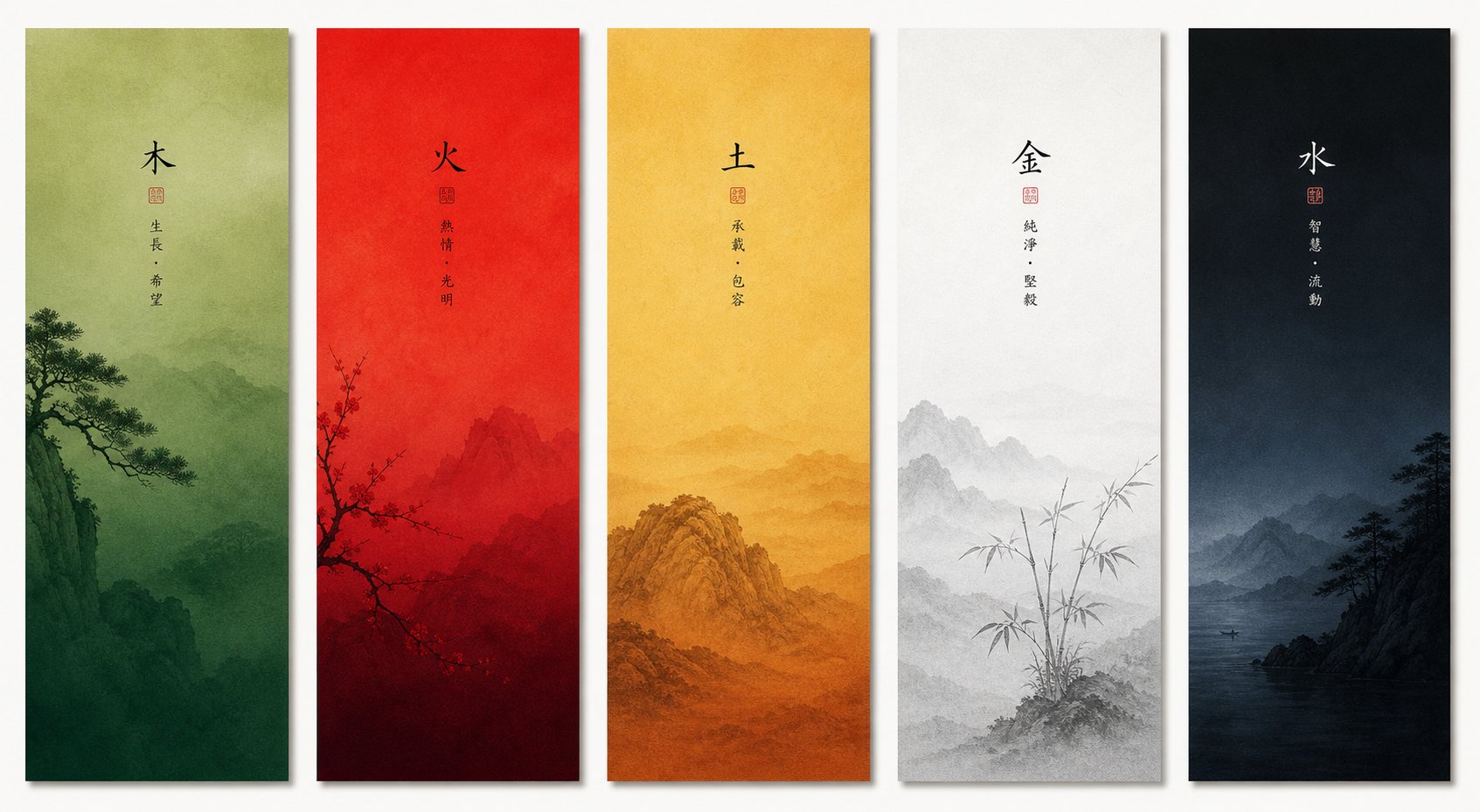
Most introductions to element colors stop at a one-to-one pairing: Wood is green, Fire is red, Earth is yellow, Metal is white, Water is black. Sounds simple? It is — too simple. In practice, the colors of the elements extend far beyond a single swatch. Each phase governs an entire family of hues, from bold primaries to muted secondary tones that shift depending on whether you're choosing a name ceremony backdrop, a brand identity, or a daily wardrobe staple.
Understanding these extended palettes is what separates a surface-level color pick from a genuinely harmonized choice. Let's break each element open and explore the full spectrum it commands.
Primary and Secondary Colors for Each Element
When you ask "what element is red," the answer is straightforward — Fire. But what elements are red when you move into deeper, cooler reds like burgundy or wine? Those shades still belong to Fire, though they carry a more subdued, inward-facing expression of that same radiant energy. The same principle applies across all five phases. A primary color represents the element at its most direct and recognizable. Secondary and complementary shades express subtler facets of the same energy — useful when you want elemental support without overwhelming a design or outfit.
Here's a consolidated reference mapping each element to its full color family and the contexts where specific shades work best:
| Element | Primary Color | Secondary Colors | Complementary Shades | Best Context |
|---|---|---|---|---|
| Wood | Green | Teal, emerald, olive | Light blue, lemon green, tan | Naming ceremonies (emerald for vitality); branding (teal for innovation); wardrobe (olive for grounded growth) |
| Fire | Red | Magenta, orange, burgundy | Bright pink, neon tones, dark yellow | Naming ceremonies (red for auspiciousness); branding (orange for energy); wardrobe (burgundy for understated passion) |
| Earth | Yellow | Ochre, beige, terracotta | Cream, mocha, coffee, warm brown | Naming ceremonies (yellow for stability); branding (terracotta for warmth); wardrobe (beige for everyday grounding) |
| Metal | White | Silver, gold, grey | Ivory, pastel tones, pewter, copper | Naming ceremonies (white for purity); branding (silver/gold for refinement); wardrobe (grey for professional clarity) |
| Water | Black | Navy, deep blue, charcoal | Dark grey, eggplant, indigo | Naming ceremonies (black for depth); branding (navy for trust); wardrobe (charcoal for versatile authority) |
You'll notice that each element's palette ranges from high-intensity primaries to softer, more wearable tones. A Fire-element name doesn't require you to dress head-to-toe in scarlet. Burgundy or a warm orange scarf can carry the same elemental signature in a way that feels natural for everyday life.
Extended Palettes Beyond the Basics
Where things get interesting — and where most guides fall short — is in the territory of blended hues. Colors like pink, purple, and teal don't map neatly onto a single element because they sit at the intersection of two elemental energies.
So what element is pink? Pink blends Fire's red with Metal's white. It carries Fire energy in a softened, more receptive form. Practitioners typically classify pink under Fire for naming and color-matching purposes, though its gentler quality makes it useful when full-strength red feels too intense. Feng Shui wardrobe guides often list bright pink alongside red and orange as Fire-element choices, while softer blush tones lean toward Earth's nurturing warmth.
And what element is purple? Purple combines Fire's red with Water's blue — two elements that actually oppose each other in the destructive cycle. This gives purple a complex, somewhat paradoxical energy. In practice, vivid purples and magentas are classified under Fire, while deep eggplant and plum shades lean toward Water. If your name carries a Fire element and you love purple, lean toward the brighter, warmer end of the spectrum. If your name is Water-dominant, the darker, cooler purples will feel more aligned.
Here's a quick reference for other commonly asked blended colors:
- Teal — a blend of Wood's green and Water's blue. Classified under Wood when it leans green, under Water when it leans deep blue.
- Gold — despite its warm tone, gold is traditionally a Metal-element color. Its brightness connects to Metal's association with precious minerals and refinement.
- Brown — sits between Wood and Earth. Light tan and beige belong to Earth; deeper, bark-like browns lean toward Wood.
- Coral and peach — Fire-Earth blends. Useful when you want to bridge both elements simultaneously.
The key principle here is that element colors exist on a spectrum, not in rigid boxes. When selecting colors to complement a name's elemental energy, consider the dominant hue. If a shade is more than 60% red-based, treat it as Fire. If it's more than 60% blue-based, treat it as Water. This practical rule helps you navigate the grey areas — literally — without overthinking every choice.
Context also shapes which shade within an element's palette you should reach for. Traditional Chinese color theory distinguishes between zheng se (primary, correct colors) and jian se (secondary, mixed colors), with primary colors holding stronger elemental resonance. For formal naming ceremonies or significant branding decisions, lean toward the primary color of the target element. For daily wardrobe choices or living space accents, secondary and complementary shades offer the same elemental support with more versatility.
With a full color palette mapped to each element, the next question becomes practical: how do you determine which element a specific name character actually belongs to? The answer lives inside the character itself — in its radical structure and stroke composition.
How Chinese Character Radicals Reveal Name Elements
Every Chinese character carries a built-in clue about its elemental identity. That clue is the radical — a structural component embedded within the character that often signals its meaning category. When you're working with five elements color and name matching, the radical system is your primary tool for classifying any given name character as Wood, Fire, Earth, Metal, or Water.
Think of radicals as elemental DNA. Just as a biologist reads genetic markers to identify traits, a naming practitioner reads radicals to identify which phase of energy a character belongs to. Once you know how to spot them, the elemental classification of most name characters becomes surprisingly transparent.
Identifying Element Radicals in Chinese Characters
Chinese characters are built from approximately 214 radicals, but only a handful directly correspond to the five elements. These are the ones that matter most for name analysis:
- Water (氵or 水): The three-dot water radical 氵appears in characters like 海 (hai, sea), 河 (he, river), 洁 (jie, clean), 涵 (han, contain), and 淳 (chun, pure). Water in Chinese — 水 (shui) — also appears as a standalone radical in characters like 泉 (quan, spring). In Mandarin, water in mandarin naming contexts often uses characters like 沐 (mu, to bathe) or 润 (run, moist) for their elegant sound and Water-element energy.
- Wood (木): The tree radical 木 shows up in 林 (lin, forest), 桐 (tong, paulownia tree), 柏 (bai, cypress), 梓 (zi, catalpa), and 楠 (nan, phoebe wood). Characters with the grass radical 艹 — like 芳 (fang, fragrant) and 蕊 (rui, stamen) — also carry Wood energy since vegetation belongs to this phase.
- Fire (火 or 灬): Fire in Chinese — 火 (huo) — transforms into the four-dot radical 灬 when it sits at the bottom of a character. Common Fire-element name characters include 炎 (yan, flame), 烨 (ye, brilliant), 煜 (yu, radiant), 灿 (can, splendid), and 熙 (xi, prosperous). The character 火 itself appears in compound names, and its radical form is recognizable in characters like 烟 (yan, smoke) and 灯 (deng, lamp). Interestingly, the kanji for fire in Japanese shares the same character 火, reflecting the shared origin of these writing systems — a useful note for anyone considering a chinese word tattoo that bridges both cultures.
- Earth (土): The earth radical 土 appears in 城 (cheng, city), 坤 (kun, earth/feminine), 培 (pei, cultivate), 垚 (yao, high ground), and 墨 (mo, ink). Characters with the mountain radical 山 — like 岚 (lan, mountain mist) and 峰 (feng, peak) — also carry Earth associations.
- Metal (金 or 钅): The metal radical simplifies to 钅 on the left side of characters. Examples include 铭 (ming, inscribe), 锐 (rui, sharp), 鑫 (xin, prosperous — three 金 stacked), 银 (yin, silver), and 钰 (yu, precious jade-metal). The full form 金 appears in names directly as well.
The process for analyzing a character is straightforward. First, identify the radical — it's usually positioned on the left side, top, or bottom of the character. If the radical is one of the five elemental radicals listed above (or a recognized variant), the character's element is determined. For instance, 浩 (hao, vast) has the 氵radical on its left, immediately classifying it as a Water-element character.
Stroke Count Methods for Element Classification
What happens when a character doesn't contain an obvious elemental radical? This is where the secondary method comes in: stroke count classification. In this system, you count the total number of strokes in a character and map the final digit to an element:
| Last Digit of Stroke Count | Element | Example |
|---|---|---|
| 1 or 2 | Wood | 一 (1 stroke), 丁 (2 strokes) |
| 3 or 4 | Fire | 子 (3 strokes), 文 (4 strokes) |
| 5 or 6 | Earth | 玉 (5 strokes), 宇 (6 strokes) |
| 7 or 8 | Metal | 辰 (7 strokes), 明 (8 strokes) |
| 9 or 0 | Water | 奕 (9 strokes), 恩 (10 strokes) |
This method is useful as a fallback, but most practitioners consider it less precise than radical analysis. When a character has a clear elemental radical, that radical takes priority over the stroke count. The stroke method fills the gap for characters whose radicals don't directly correspond to any element — characters built from radicals like 口 (mouth), 宀 (roof), or 心 (heart) that don't map to a specific Wu Xing phase.
Phonetic Components and Their Elemental Associations
Beyond radicals and strokes, some practitioners also consider a character's phonetic component. In Chinese, many characters are phono-semantic compounds — one part signals meaning (the radical) and another part signals pronunciation. Occasionally, the phonetic component itself carries elemental weight. For example, the phonetic component 丰 (feng) appears in characters across different radical groups, but its own Wood-element energy (as a pictograph of a lush plant) can subtly influence the overall character's elemental reading.
However, phonetic-based classification is the least standardized of the three methods. Most naming practitioners rely on it only when radical and stroke count methods produce ambiguous results. Think of it as a tiebreaker rather than a primary tool.
One critical distinction to keep in mind: the element of a name character is not the same as the element of a person. A character's element is fixed — 浩 is always Water, 森 is always Wood. But a person's element is determined by their birth chart, specifically the Four Pillars of Destiny (BaZi). The purpose of name-element analysis is to find characters whose elemental energy complements or balances the person's chart. You're matching the name's element to the person's needs, not assuming the name defines who they are.
This distinction raises an important question: how do you accurately determine a person's element in the first place? The answer is more nuanced than most online calculators suggest — and getting it wrong can lead to mismatched names and colors that work against the very balance you're trying to create.
Determining Your Personal Element Accurately
Here's where many people stumble. You search "what is five elements" online, find a calculator that asks only for your birth year, and receive a neat label: "You are a Wood person." You then pick Wood-element name characters and green color palettes based on that single data point. The problem? That label might be completely wrong — and the name and color choices built on it would work against your actual elemental balance rather than supporting it.
Two competing systems exist for determining your zodiac element, and understanding the difference between them is essential before you make any naming or color decisions.
Nayin Five Elements and the 60-Year Cycle
The Nayin (Na Yin) system maps each pair of years in the traditional 60-year Jiazi cycle to a poetic elemental label. You'll see names like "Sea Gold," "Furnace Fire," or "Great Forest Wood" — vivid, memorable, and often the source of statements like "I'm a Metal life" or "I'm a Fire person." This is the system most pop-culture zodiac calculators use. If someone tells you their chinese dragon zodiac characteristics include being a "Wood Dragon" based on their birth year, they're likely referencing Nayin.
The issue is that Nayin is a symbolic naming layer attached to stem-branch combinations — not a structural analysis of your full chart. As practitioners note, it doesn't read the whole chart, skips month branches and hidden stems, and doesn't replace the Day Master for determining elemental identity. Treating "Sea Gold" as proof that you're a Metal person is like judging a book entirely by its cover art.
Day Master Method in BaZi Analysis
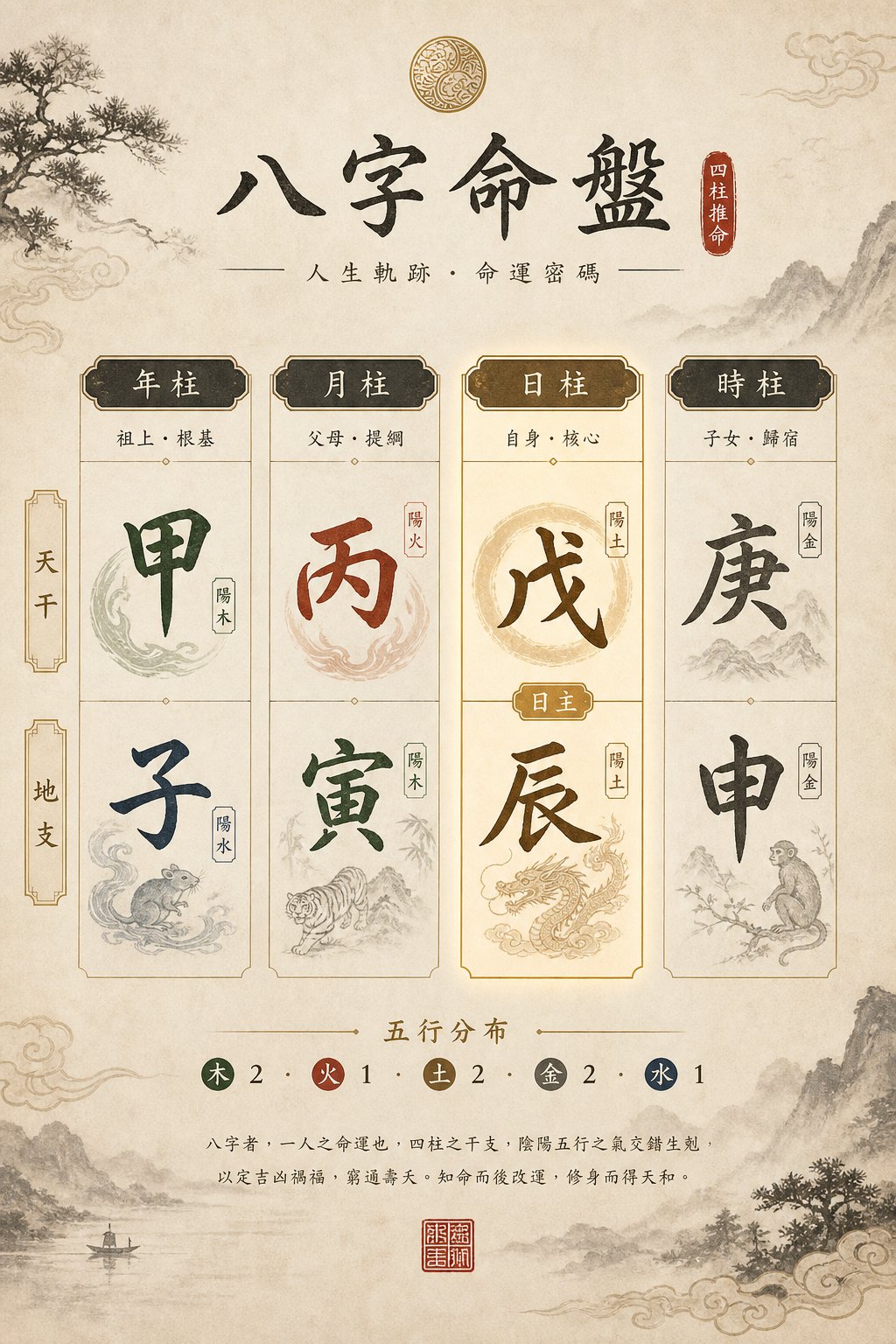
The more precise approach uses the Four Pillars of Destiny (BaZi) — year, month, day, and hour of birth. Each pillar contains a Heavenly Stem and an Earthly Branch, producing eight characters total. Your personal element is identified through the Day Master: the Heavenly Stem of your day pillar.
For example, if your Day Master is Jia Wood (甲), your core identity is Yang Wood. If it's Gui Water (癸), you're Yin Water. The Day Master reflects your inner self and serves as the reference point for determining which elements support you and which ones challenge you. When comparing chinese zodiac elements wood vs earth in a chart, the Day Master tells you which side you actually stand on — and therefore which chinese 5 elements your name and color palette should reinforce.
Why Birth Year Alone Is Insufficient
Imagine two people born in the same year. Under the Nayin system, they'd receive identical elemental labels. But one was born in a summer month with a Fire Day Master, while the other arrived in winter with a Water Day Master. Their elemental needs — and therefore their ideal name characters and color palettes — are completely different.
Relying on birth year alone for element determination can lead to incorrect elemental assignments and mismatched color recommendations. Accurate five elements color and name matching requires the full Four Pillars, with the Day Master as the true indicator of personal element.
The birth year pillar does carry information — it reflects heritage and early influences — but it represents only one-quarter of the picture. The month pillar reveals seasonal energy and career direction. The hour pillar uncovers hidden potential. And the day pillar, through its Heavenly Stem, defines who you fundamentally are in elemental terms.
For anyone serious about aligning their name and color choices with their actual energetic profile, the path is clear: obtain a full BaZi chart calculated from your complete birth data (year, month, day, and hour), identify your Day Master, and use that as your starting point. Only then can you determine which elements are strong, which are weak, and which ones your name and daily colors should supply. This elemental map of strengths and deficiencies is exactly what drives the productive and destructive cycles — the engine behind every practical color recommendation.
Productive and Destructive Cycles in Color Selection
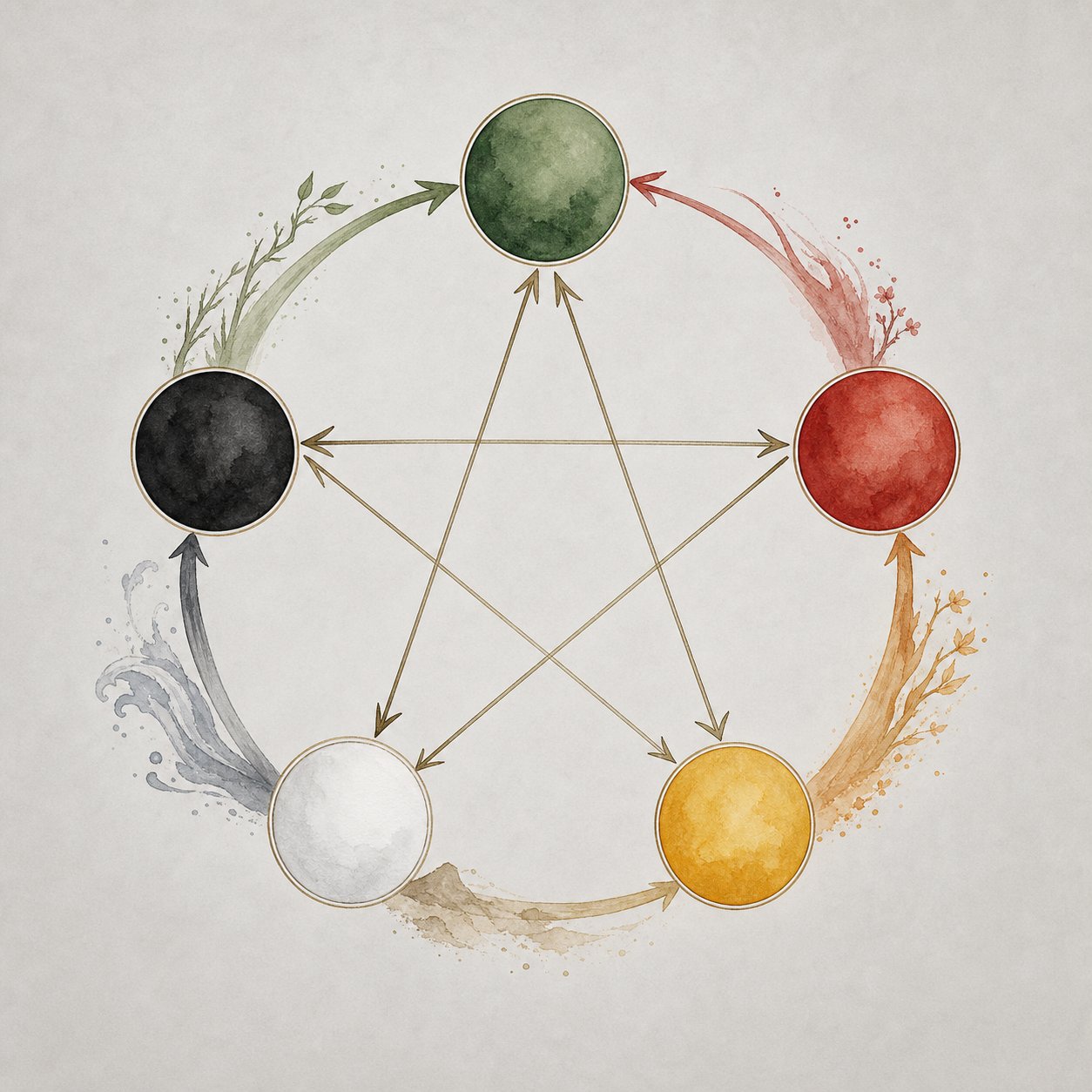
The elemental wheel doesn't spin in isolation. Every element exists in relationship with the others — feeding some, controlling others, and being fed or controlled in return. These relationships are encoded in two fundamental cycles: the productive cycle (相生, xiangsheng) and the destructive cycle (相克, xiangke). Together, they form the logic of 五行相生相克 — the mutual generation and overcoming of the five phases — and they're the reason certain colors feel supportive while others create friction when paired with your name's element.
Understanding this order of transformations is what turns color selection from guesswork into a deliberate, personalized strategy.
Using the Productive Cycle for Supportive Color Choices
In the productive cycle, each element nourishes the one that follows it. Think of it as a parent-child relationship — the "mother" element generates and supports its "child." The sequence runs like this:
- Water nourishes Wood (water feeds roots so trees grow)
- Wood feeds Fire (wood fuels combustion)
- Fire creates Earth (ash and volcanic matter become soil)
- Earth bears Metal (minerals form within rock)
- Metal collects Water (metal surfaces attract condensation)
For color selection, this means the colors of your parent element — the one that generates yours — are your strongest allies. They supply energy to your name's element without competing with it. If your name carries Wood energy, the element that produces Wood is Water. So Water colors (black, navy, deep blue, charcoal) actively support and strengthen your name's elemental signature. The wood & water relationship is one of the most intuitive pairings in the system — picture rain nourishing a forest, and you'll feel why navy and deep green sit so comfortably together.
You can also use colors from your own element to reinforce its presence. A Fire-element name benefits from reds and oranges directly, plus Wood-element greens that feed Fire from behind. This layered approach — combining self-element colors with parent-element colors — creates a palette that feels both grounded and energized.
Avoiding Destructive Cycle Color Clashes
The destructive cycle (五行 相生相克 includes both generation and control) works differently. Here, each element restrains another, keeping the system from spiraling out of balance. The controlling sequence runs:
- Metal chops Wood (axes fell trees)
- Wood parts Earth (roots break soil apart)
- Earth absorbs Water (dams and levees contain floods)
- Water quenches Fire (water extinguishes flame)
- Fire melts Metal (intense heat liquefies ore)
In a balanced system, this control is healthy — it prevents any single element from dominating. But when you're trying to strengthen a name's elemental energy through color, introducing the controlling element's colors works against you. A Wood-element name surrounded by Metal colors (white, silver, gold) encounters resistance. The visual environment is energetically "cutting" the very element the name was chosen to cultivate.
This doesn't mean you can never wear white if your name is Wood-dominant. It means that in contexts where you want maximum elemental support — an important meeting, a branding photoshoot, a naming ceremony — you'd consciously lean away from the controlling element's palette and toward the productive one.
Balancing Elemental Deficiencies Through Color
The real power of these cycles emerges when you combine them with your BaZi chart analysis. If your chart shows a Water deficiency and your name was chosen to supply Water energy (characters with the 氵radical, for instance), then surrounding yourself with Water and Metal colors amplifies that correction. Metal produces Water in the productive cycle, so silver and white actually generate more Water energy — they're allies in this specific context, even though Metal controls Wood.
This is why context matters so much. The same color can be supportive or disruptive depending on which element you're trying to strengthen. The table below maps each name element to its productive (supportive) colors and its destructive (conflicting) colors:
| Name Element | Supportive Colors (Parent + Self) | Colors to Avoid (Controller) | Also Beneficial (Child Element) |
|---|---|---|---|
| Wood | Black, navy, deep blue (Water) + green, teal, emerald (Wood) | White, silver, gold (Metal) | Red, orange, burgundy (Fire) |
| Fire | Green, teal, olive (Wood) + red, magenta, orange (Fire) | Black, navy, charcoal (Water) | Yellow, ochre, beige (Earth) |
| Earth | Red, burgundy, orange (Fire) + yellow, ochre, terracotta (Earth) | Green, teal, emerald (Wood) | White, silver, grey (Metal) |
| Metal | Yellow, beige, terracotta (Earth) + white, silver, gold (Metal) | Red, magenta, orange (Fire) | Black, navy, deep blue (Water) |
| Water | White, silver, grey (Metal) + black, navy, deep blue (Water) | Yellow, ochre, terracotta (Earth) | Green, teal, emerald (Wood) |
Notice the "Also Beneficial" column. Your child element — the one your element produces — can also appear in your palette, though it gently drains rather than feeds your energy. A little draining isn't harmful; it represents output and expression. A Wood person wearing some red (Fire, the child of Wood) is expressing their creative energy outward. Just avoid making the child element's colors dominant over the parent element's colors in your overall palette.
Here's a practical example. Imagine someone named 林浩 (Lin Hao) — both characters carry strong Wood and Water energy respectively. Their name already embodies the wood & water productive relationship. For daily color choices, this person would lean into blacks, navies, and greens as their core palette. They'd minimize white and metallic gold in high-stakes situations. For a business card or personal brand, deep teal (Wood-Water blend) becomes an ideal anchor color — it reinforces both elements present in the name simultaneously.
These cycle-based color strategies work whether you're dressing for a job interview, painting a nursery, or selecting a logo palette. The cycles themselves are fixed and universal. What changes is how you apply them based on your specific name element and chart needs — which brings us to the practical, step-by-step process of putting all these pieces together into a coherent naming and color strategy.
Practical Guide to Choosing Names and Colors for Balance
Theory is useful, but at some point you need to sit down and make decisions. Which characters go into the name? Which colors fill the wardrobe, the nursery, the brand kit? The five elements function as a living system — and applying them well means following a clear sequence rather than picking characters and colors at random based on what "feels right."
Whether you're naming a newborn, rebranding yourself professionally, or building a business identity from scratch, the process follows the same structural logic. The 5 elements of life — Wood, Fire, Earth, Metal, and Water — each play a role, and your job is to identify which ones need reinforcement and then supply them through both language and color.
Step-by-Step Name Selection for Element Balance
Imagine you've just received a full BaZi chart for a baby born in late autumn. The chart shows a Yin Fire Day Master surrounded by strong Metal and Earth, with almost no Water or Wood present. The fire is small — a candle in a dry, metallic room — and it desperately needs fuel (Wood) and regulation (Water) to thrive. How do you translate that diagnosis into a name?
Here's the process, laid out in the order practitioners actually follow:
- Determine the personal element via Day Master. Calculate the full Four Pillars using the birth year, month, day, and hour. Identify the Heavenly Stem of the day pillar — this is the core elemental identity. In our example, the Day Master is Yin Fire (丁).
- Identify elemental strengths and weaknesses in the chart. Count how each of the five elements appears across all eight characters, including hidden stems within the Earthly Branches. Look for the "Useful God" (用神) — the element that most benefits the Day Master's balance. For our Yin Fire baby, Wood is the priority (it feeds Fire directly), with Water as a secondary need (it prevents the chart from becoming too dry).
- Select name characters that supply the deficient element. Choose characters whose radicals correspond to the needed element. For Wood support: 梓 (zi, catalpa tree), 桐 (tong, paulownia), 林 (lin, forest), or 芷 (zhi, angelica — grass radical, Wood energy). For Water support: 涵 (han, contain), 淳 (chun, pure), 沐 (mu, bathe), or 润 (run, moist). A two-character given name can address both needs — one Wood character and one Water character — creating a productive chain where Water feeds Wood feeds Fire.
- Adopt the corresponding color palette for wardrobe, branding, or living spaces. Once the name's elemental direction is set, extend that same energy into the visual environment. The name supplies the element linguistically; color supplies it sensorially. Both channels reinforce the same correction.
This numbered sequence applies universally. A parent naming a baby follows it. An adult choosing a professional alias follows it. A founder selecting a business name follows it. The scale changes, but the logic stays constant — because the five elements operate the same way regardless of context.
Notice that step two is where most people go wrong. Simply counting elements and adding whatever is missing sounds logical, but as BaZi practitioners emphasize, the goal isn't raw numerical balance. It's identifying which element actually helps the Day Master thrive. A chart frozen with excess Water doesn't need more Water just because Fire is also low — it needs Fire and Wood for warmth. The spiritual meaning of 5 in this system isn't about equal distribution; it's about dynamic harmony where each phase supports the whole.
Matching Your Balanced Name to a Personal Color Palette
Once you've selected name characters that address elemental deficiencies, the color palette practically builds itself. The element your name supplies becomes the anchor of your visual identity.
Let's return to our example. The baby's name includes a Wood character (梓) and a Water character (涵). The primary color palette should center on:
- Wood colors as the dominant tone: green, teal, emerald, olive — these reinforce the name's primary corrective element
- Water colors as strong support: black, navy, deep blue, charcoal — these feed Wood through the productive cycle and echo the Water character in the name
- Fire colors as accents: touches of red or warm orange honor the Day Master's own element without overwhelming the corrective palette
For a baby, this translates into nursery design choices — sage green walls, navy textiles, a few warm-toned accents. For an adult undergoing personal rebranding, it shapes wardrobe staples, LinkedIn banner colors, and presentation templates. For a business, it informs logo design, website color schemes, and packaging.
Here's how the same framework adapts across three common use cases:
| Use Case | Name Application | Color Application | Practical Examples |
|---|---|---|---|
| Baby naming | Given name characters chosen to balance the birth chart | Nursery decor, clothing, accessories in supportive element colors | Wood-deficient chart: name with 木 radical + green/teal nursery palette |
| Personal rebranding | Courtesy name, pen name, or social media handle with balancing characters | Wardrobe core colors, personal branding materials, workspace design | Water-deficient chart: name with 氵radical + navy/charcoal professional wardrobe |
| Business identity | Company name characters aligned with founder's chart or business goals | Logo, website, packaging, office interior in corresponding element palette | Earth-deficient founder: brand name with 土 radical + warm beige/terracotta visual identity |
The principle connecting all three cases is consistency. A name and a color palette are two expressions of the same elemental intention. When they align, they create a coherent energetic signature that practitioners of five elements acupuncture, feng shui, and naming theory all recognize as balanced. When they contradict each other — a Water-element name paired with a Fire-dominant visual environment — the correction works at cross purposes with itself.
You don't need to be rigid about this. The five elements aren't a prison; they're a compass. Wear your supportive colors as a baseline, not a uniform. Let your name's element guide your defaults while leaving room for context and personal taste. A Metal-element name paired with a white-and-silver core palette can still incorporate a red scarf on a cold day — you're adding a spark of Fire, not dismantling your entire elemental strategy.
What matters is that your dominant visual environment — the colors you see most often, wear most frequently, and brand yourself with most consistently — echoes the elemental work your name is doing. That's where the real alignment lives. And while this framework is rooted specifically in the Chinese Wu Xing tradition, it's worth noting that other cultures have developed their own element-color systems with overlapping but distinct mappings — differences that can cause confusion if you're drawing from multiple sources without realizing they don't agree.
Cross-Cultural Variations in Element Color Associations
Different cultures developed their own systems of magical elements long before the internet made it easy to stumble across all of them simultaneously. The result? Conflicting color assignments that confuse anyone researching elemental powers and their visual correspondences without realizing they're mixing separate traditions. A color listed as "Earth" in one system might belong to an entirely different element in another.
Chinese Wu Xing Color Traditions
The Chinese system ties its color assignments directly to cosmological observation. Green belongs to Wood because spring vegetation is green. Red belongs to Fire because flame is red. These aren't arbitrary — they emerge from centuries of naturalistic philosophy encoded in taoism symbols, Confucian ritual texts, and medical classics. The five elements form a closed loop where each color reinforces a specific phase of transformation, and each phase connects to naming conventions through the radical system covered earlier.
This internal consistency is what makes Wu Xing so effective for name-color work. The colors, the characters, and the cycles all reference the same underlying framework.
Tibetan and Bhutanese Element-Color Variations
Tibetan and Bhutanese traditions also work with five elements, but the lineup differs. Wood disappears entirely, replaced by Space (sometimes called Ether or Wind). The wind symbols and imagery associated with this element have no direct equivalent in the Chinese model. Color assignments shift accordingly — and sometimes dramatically.
| Element Category | Chinese Wu Xing | Chinese Color | Tibetan Byung Ba | Tibetan Color |
|---|---|---|---|---|
| Growth/Air | Wood | Green | Wind (Lung) | Green |
| Heat | Fire | Red | Fire (Me) | Red |
| Stability | Earth | Yellow | Earth (Sa) | Yellow |
| Refinement | Metal | White | Space (Nam mkha) | White |
| Flow | Water | Black | Water (Chu) | Blue |
Notice the critical difference in the Water row. Chinese tradition assigns black to Water; Tibetan tradition assigns blue. Someone following Tibetan color logic for a Chinese character-based name would apply the wrong corrective color — blue instead of black — undermining the entire alchemy circle of productive and destructive relationships that Wu Xing depends on.
Choosing the Right Framework for Your Practice
The practical rule is simple: pick one system and stay consistent. If you're working with Chinese characters, radicals, and BaZi charts, use Chinese Wu Xing color mappings exclusively. The naming conventions, the radical classifications, and the cycle-based color logic all belong to the same tradition. Mixing in Tibetan or Bhutanese color assignments introduces contradictions that no amount of intuition can resolve.
This doesn't make one system superior to another. It means each framework is internally coherent and externally incompatible. Respect the boundaries, and the system you choose will serve you reliably — especially when you move from theory into the daily, tangible applications where element-aligned colors actually shape your environment.

Applying Element Colors From Your Name to Everyday Life
Knowing your name's element and its corresponding color palette is one thing. Living it is another. The real value of five elements color and name matching shows up in the small, repeated choices you make daily — what you put on in the morning, how you arrange your desk, what colors anchor your online presence. These aren't dramatic overhauls. They're subtle alignments that compound over time, much like how a feng shui bagua map guides energy flow through a home one room at a time.
Wardrobe and Accessory Color Choices by Element
Your wardrobe is the most personal and immediate way to carry your element's energy with you. Think of it as a wearable extension of your name's intent. You don't need to dress monochromatically — you need a dominant baseline that reflects your supportive palette, with room for accent colors that express range.
- Wood-element names: Build around forest green, teal, and olive as staples. Add navy or black accessories (Water feeds Wood). Reserve white and metallic silver for minimal use.
- Fire-element names: Anchor with warm reds, burgundy, and burnt orange. Layer in green or teal pieces (Wood fuels Fire). Minimize black and deep navy in high-stakes settings.
- Earth-element names: Lead with ochre, terracotta, beige, and warm browns. Introduce red or coral accents (Fire produces Earth). Limit dominant greens.
- Metal-element names: Center on white, silver, grey, and soft gold. Support with cream and sandy tones (Earth generates Metal). Reduce heavy reds and oranges.
- Water-element names: Default to black, charcoal, navy, and deep blue. Strengthen with white or silver accessories (Metal produces Water). Avoid dominant yellows and browns.
What does water represent in this wardrobe context? Depth, adaptability, and quiet authority. A Water-element name paired with a charcoal suit and silver watch carries that energy without announcing it — the alignment works beneath the surface, like an undercurrent.
Home and Workspace Color Applications
Your living space and workspace are environments you inhabit for hours daily. The colors surrounding you there exert a steady, ambient influence — more sustained than clothing, which changes day to day. Applying your element palette here creates a consistent energetic backdrop that supports your name's corrective work.
Imagine someone whose name carries a Fire element. Their professional workspace might feature warm-toned wood furniture and a green plant arrangement — Wood-element colors that continuously feed Fire energy throughout the workday. Their living room, meanwhile, could incorporate deeper greens and natural textures for sustained nourishment, while a few red or orange accent pieces (a throw pillow, a piece of art) keep the Fire element visibly present without overwhelming the space.
For workspace design specifically, the bagua map offers additional guidance. The career area (front of your desk arrangement) benefits from Water colors like deep blue and black. The fame and reputation zone (the wall behind you on video calls) responds well to Fire tones. Layering these positional recommendations over your personal element palette creates a workspace that supports both general energy flow and your specific elemental needs — a thunder bagua approach where directional energy and personal energy reinforce each other.
Digital Branding and Personal Identity Colors
Your digital presence — social media profiles, personal websites, email signatures, presentation decks — is where element-color alignment becomes visible to the widest audience. This is also where consistency matters most, because scattered color choices dilute recognition.
- Profile photos and banners: Wear or background your supportive element colors. A Metal-element name benefits from clean white backgrounds with silver or grey accents.
- Website and portfolio: Use your parent element's color as the primary brand tone and your self-element color as the accent. This mirrors the productive cycle visually.
- Presentation templates: Anchor slides in your supportive palette. Avoid controller-element colors as dominant backgrounds.
- Logo and business cards: If your business name also carries elemental intent (as discussed in the naming section), align the logo palette with that element. A brand name containing a chinese strength sign like 鑫 (triple Metal) pairs naturally with silver, white, and gold visual identity.
The yin yang tattoo meaning many people search for reflects a desire to carry symbolic balance on the body permanently. Element-aligned branding works on the same principle — it's a visible, ongoing commitment to energetic coherence, just expressed through professional channels rather than ink.
Here's the essential takeaway: five elements color and name matching is a living practice, not a rigid formula. Seasons shift, life circumstances change, and your relationship with different elements evolves over time. Use the tables and frameworks throughout this article as reference tools you return to — not rules you follow anxiously. Let your name's element set the compass direction, let your colors reinforce that heading, and trust that small, consistent alignment creates more harmony than any single dramatic gesture ever could.
Frequently Asked Questions About Five Elements Color and Name Matching
1. How do I determine my personal element for name and color matching?
Your personal element is best determined through the Day Master method in BaZi (Four Pillars of Destiny) analysis. This requires your full birth data — year, month, day, and hour. The Heavenly Stem of your day pillar reveals your core elemental identity. Avoid relying solely on birth year calculators, which use the less precise Nayin system and can produce incorrect assignments that lead to mismatched name characters and color recommendations.
2. What element is pink and what element is purple in the five elements system?
Pink is a blend of Fire's red and Metal's white, so it is generally classified under the Fire element in a softened form. Purple combines Fire's red with Water's blue — two elements that oppose each other in the destructive cycle. Vivid purples and magentas lean toward Fire, while deep eggplant and plum shades are categorized under Water. Choose the warmer or cooler end of the purple spectrum based on whether your name carries Fire or Water energy.
3. Can I use colors from the destructive cycle element in my daily life?
Yes, but with awareness. The destructive cycle indicates which element's colors create energetic resistance against your name's element. This does not mean those colors are forbidden. In everyday casual settings, wearing a controller-element color occasionally causes no harm. However, in high-stakes contexts like important meetings, branding materials, or naming ceremonies, prioritize colors from the productive cycle that actively support and strengthen your name's elemental energy.
4. What is the difference between a name's element and a person's element?
A name's element is fixed and determined by the Chinese character's radical structure or stroke count — for example, any character with the water radical is permanently a Water-element character. A person's element comes from their birth chart and reflects their innate energetic makeup via the Day Master. The purpose of five elements naming is to select characters whose fixed elemental energy complements or balances the person's chart-based needs, not to label the person with the name's element.
5. Should I mix Chinese and Tibetan element-color systems when choosing colors?
No. Chinese Wu Xing and Tibetan Byung Ba are internally coherent but externally incompatible systems. They assign different colors to similar elemental categories — for instance, Water is black in Chinese tradition but blue in Tibetan tradition. If you are working with Chinese characters, radicals, and BaZi charts for naming, use Chinese Wu Xing color mappings exclusively. Mixing frameworks introduces contradictions that undermine the productive and destructive cycle logic your color choices depend on.