What the Hanyu Pinyin Name Standard Actually Prescribes
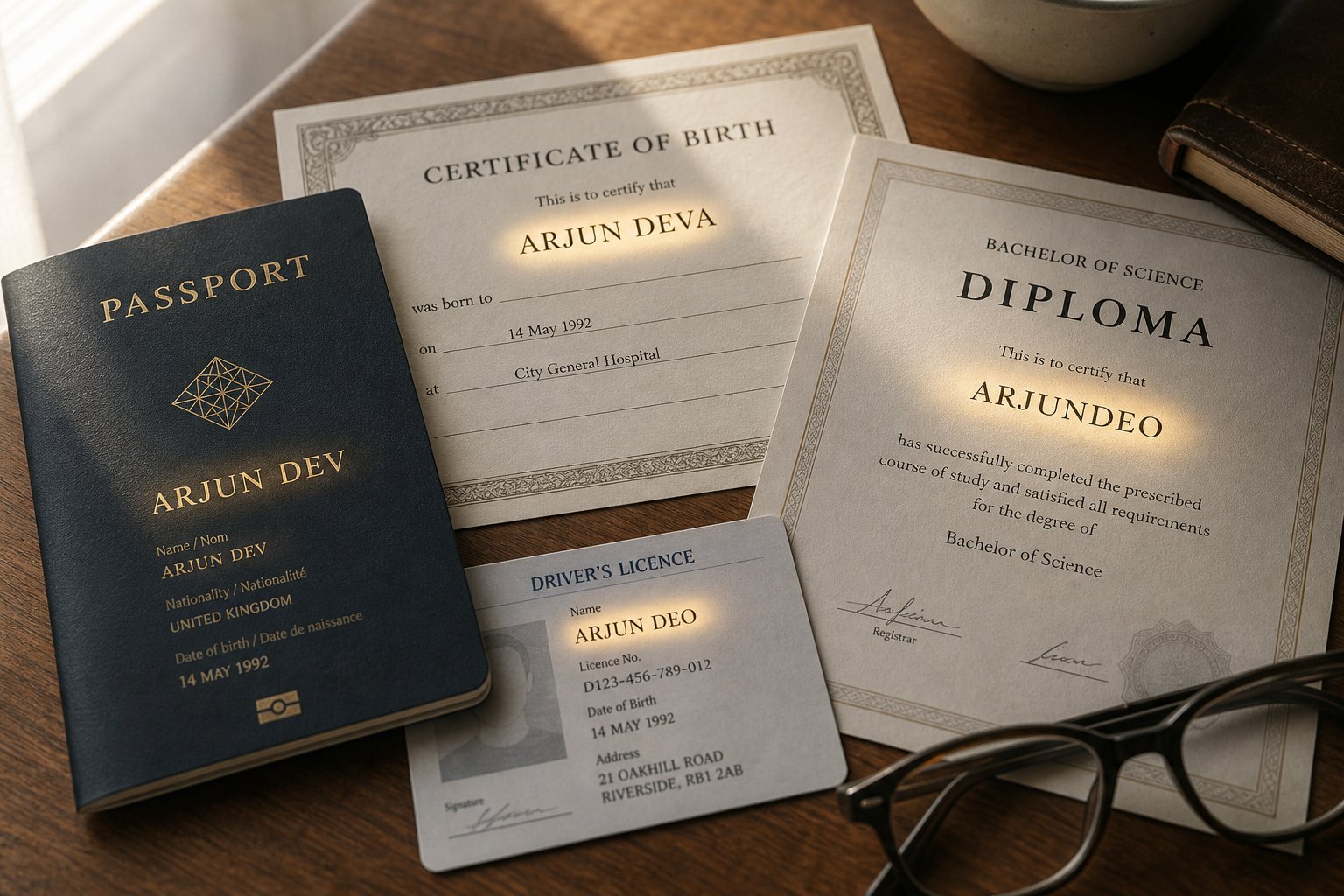
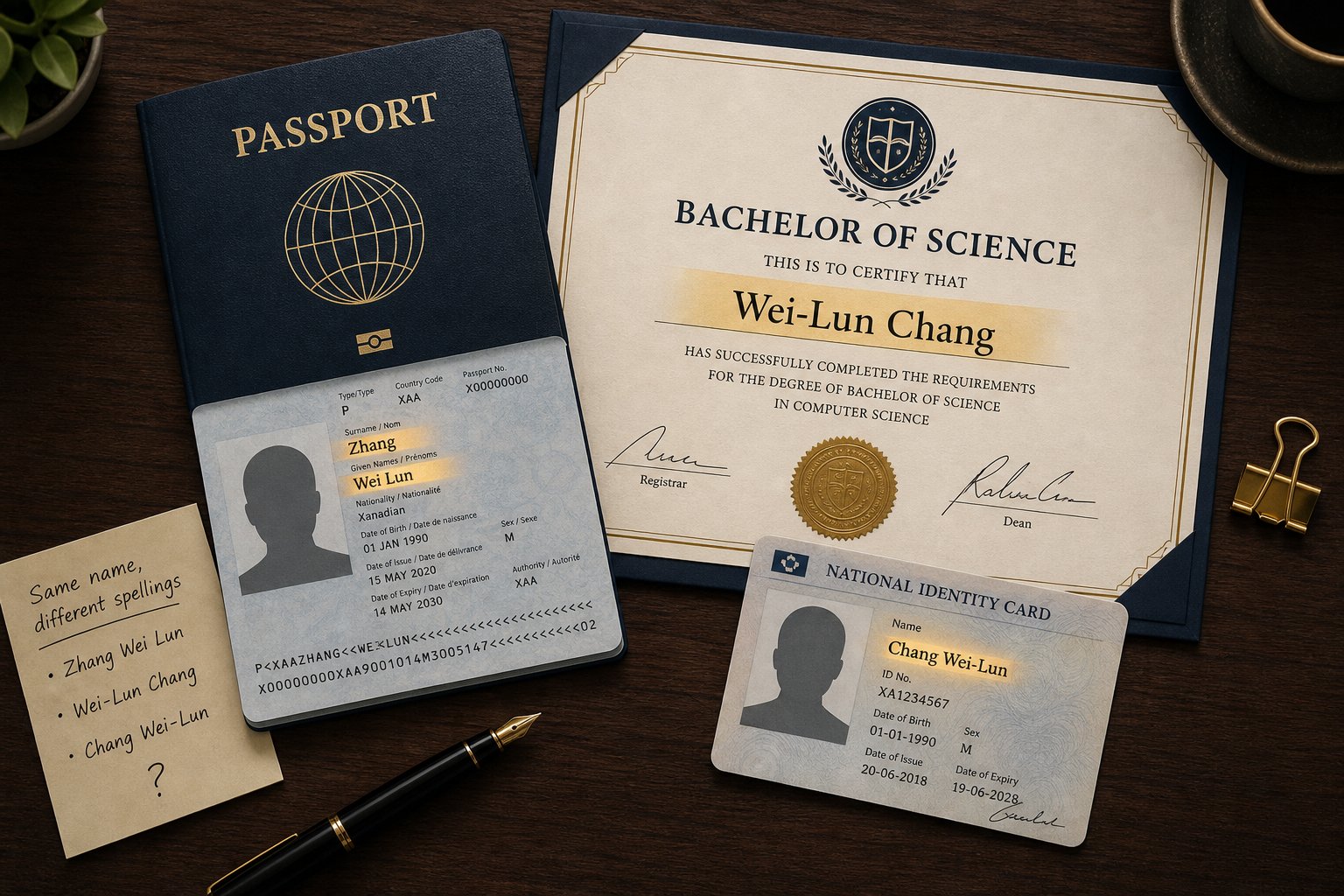
You look at your passport, your university diploma, and your bank account. Three documents, three different spellings of your name. Which one is correct? The answer lives inside a standard most people have never read.
The Hanyu Pinyin name standard is the official set of rules governing how Chinese personal names are romanized into Latin letters, codified in the national standard GB/T 28039-2011 (Chinese Phonetic Alphabet Spelling Rules for Chinese Names). It prescribes specific formatting for surname-given name order, capitalization, and character joining.
Defining the Hanyu Pinyin Name Standard
So what is Pinyin in the context of personal names? Most people encounter Pinyin as a pronunciation guide, a tool for learning Mandarin sounds. You might recognize it from a pinyin chart hanging in a classroom or a pinyin table in a textbook. But the system that converts Chinese characters to a romanized name on official documents operates under a separate, more specific ruleset.
GB/T 28039-2011, implemented in 2012, regulates the use of Chinese Pinyin letters to spell Chinese names in the form of a national standard. It stipulates that the family name comes first, followed by the given name, and that the Scheme of the Chinese Phonetic Alphabet governs the spelling. This is not a general phonetics guide. It is a formatting specification for identity.
Why Personal Names Need Their Own Rules
General Pinyin orthography tells you how to romanize any Chinese text. Names, however, carry unique challenges. When you convert chinese to han yu pin yin for a sentence, word boundaries are guided by meaning. Personal names lack that semantic scaffolding. Is "zhiming" one given name or two separate characters that should be split? Does the surname come first or last in international contexts?
These questions demanded a dedicated standard because names appear on passports, legal contracts, academic citations, and databases where inconsistency creates real problems. A misspelled word is an inconvenience. A misspelled name is a denied visa, a failed background check, or a lost publication credit.
The confusion most people experience, though, is not really about the standard itself. It is about the gap between what the official rules prescribe and what institutions actually do with those rules. That gap is where names go wrong, and it is exactly what the rest of this article unpacks.
Historical Evolution of Chinese Name Romanization Rules
That gap between official rules and real-world application did not appear overnight. It grew over decades of policy revisions, international negotiations, and shifting priorities. Understanding why the current standard looks the way it does requires tracing its origins back to a time when Chinese romanization itself was a radical political act.
From 1958 Adoption to Modern Codification
On February 11, 1958, the People's Republic of China officially introduced Hanyu Pinyin as its national system for rendering Chinese in Latin letters. The original goal was not formatting names on passports. It was literacy. Tens of millions of schoolchildren began learning Mandarin romanization through this new system, and cities like Peking became Beijing in international usage.
But a phonetic teaching tool and a name-formatting standard are very different things. It took nearly two decades before anyone addressed the specific question: how should Chinese names be spelled in Pinyin on official documents?
In 1976, the Chinese Characters Reform Committee issued the first dedicated rules for spelling Chinese names in Pinyin. These early guidelines established the foundational principle that Chinese names consist of a surname placed first and a given name placed after, with spelling governed by standard Mandarin pronunciation. For ethnic minority names, the rules deferred to the phonetics of their respective languages.
International recognition followed. In 1982, the International Organization for Standardization adopted Hanyu Pinyin as the basis for ISO 7098, the international standard for chinese romanization. The United Nations followed in 1986, making Pinyin the global reference for romanizing Chinese text. Suddenly, a domestic literacy tool carried the weight of international identity documentation.
The most recent milestone came in 2011 with GB/T 28039-2011, which consolidated decades of fragmented guidance into a single, comprehensive national standard specifically for personal names. This document resolved ambiguities that earlier rules had left open, particularly around capitalization, hyphenation, and the treatment of compound surnames.
Key Regulatory Documents and Their Scope
Here is the full timeline of how chinese romanized name rules developed from a classroom aid into a binding identity standard:
| Year | Milestone | Significance |
|---|---|---|
| 1958 | Hanyu Pinyin officially adopted by the PRC | Established the Latin-letter system for Mandarin romanization, primarily as a literacy and pronunciation tool |
| 1976 | Chinese Characters Reform Committee issues name-spelling rules | First dedicated guidance on personal name formatting: surname first, given name after, spelled according to Mandarin |
| 1982 | ISO adopts Pinyin as ISO 7098 | Gave Hanyu Pinyin international legitimacy as the standard method for romanizing Chinese, including names |
| 1986 | United Nations adopts Pinyin for Chinese romanization | Cemented Pinyin as the global default for Chinese names in diplomatic and international contexts |
| 2011 | GB/T 28039-2011 published | Consolidated all personal name rules into one national standard, addressing capitalization, spacing, and compound surnames |
What this timeline reveals is a pattern: each milestone expanded the scope of Pinyin from phonetics into identity. The 1958 system told you how to pronounce a character. The 1976 rules told you how to arrange a name. The 2011 standard told you exactly how to format that name for legal and official use.
Yet even with this progression, the standard remained a domestic Chinese document. International bodies like ISO endorsed Pinyin as the romanization method but left specific formatting details, such as name ordering for international contexts, to national authorities. That split between domestic prescription and international flexibility is precisely where the formatting rules get complicated.
Core Formatting Rules Under GB/T 28039-2011
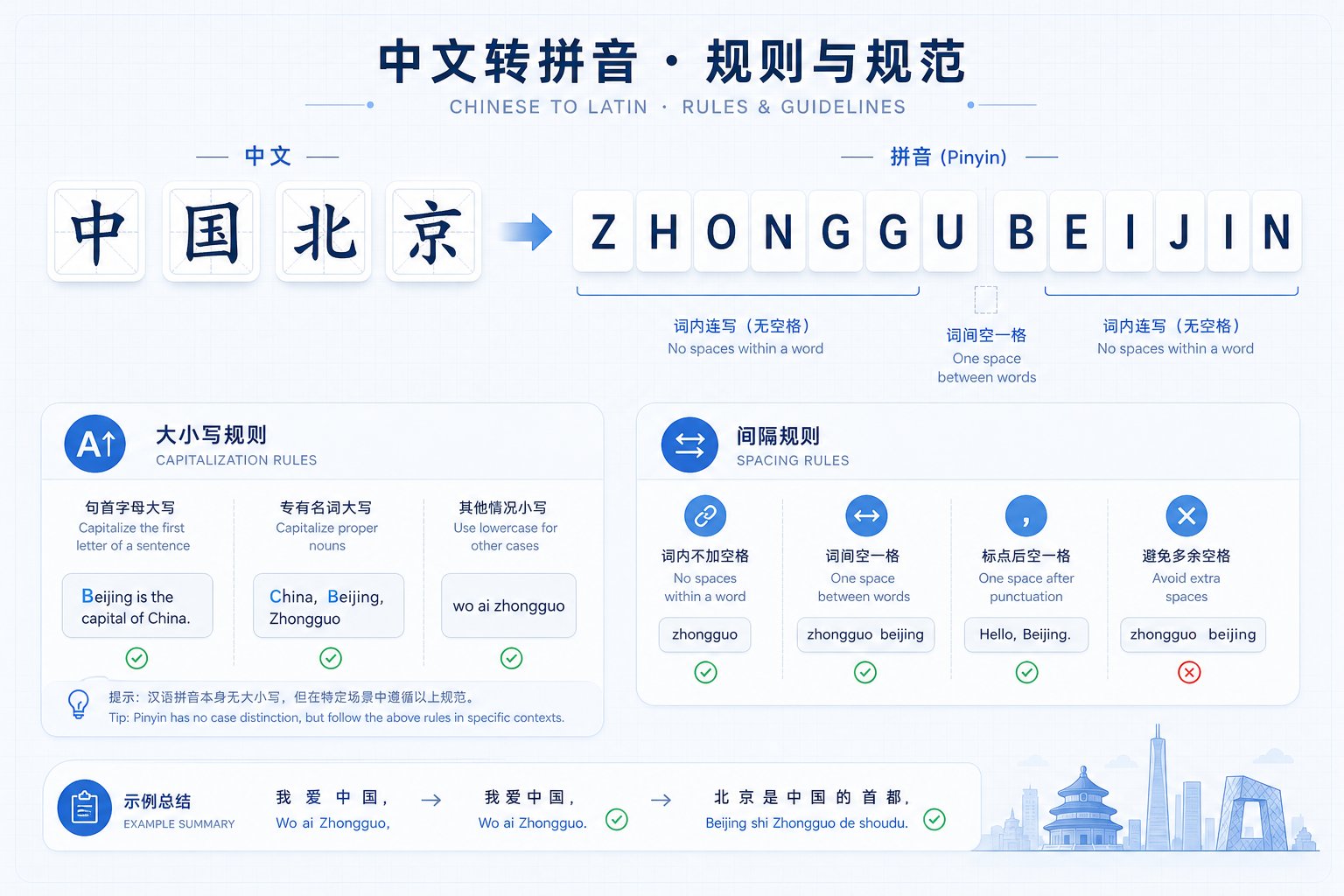
So how complicated do the formatting rules actually get? Less than you might expect. The core principles of writing Chinese names in Pinyin boil down to three areas: capitalization, spacing, and ordering. The problem is not that the rules are complex. It is that they have never been consolidated into a single, clear English-language reference. Until now.
Capitalization Rules for Surnames and Given Names
The capitalization logic follows one simple principle: treat the surname and the given name as two distinct units, and capitalize the first letter of each unit. Nothing more.
Imagine the name 王秀英. The surname is 王 (Wang) and the given name is 秀英 (Xiuying). Under GB/T 28039-2011, the correct romanization is:
Wang Xiuying
The "W" in Wang is capitalized because it begins the surname. The "X" in Xiuying is capitalized because it begins the given name. The second syllable of the given name, "ying," stays lowercase because it is not a separate word. It is part of the same given-name unit.
This rule applies regardless of how many characters make up the given name. Whether the name pinyin consists of one syllable or two, the principle holds: capitalize only the initial letter of each name unit.
What about all-caps formatting? You will see names written as WANG XIUYING on passports and machine-readable documents. This is not a violation of the standard. It is a separate institutional convention for specific document types. The standard itself prescribes mixed-case as the baseline form.
Spacing and Joining Rules with Examples
Here is where most people get it wrong. The chinese name structure in Pinyin requires exactly one space, and it goes between the surname and the given name. That is the only space in the entire name.
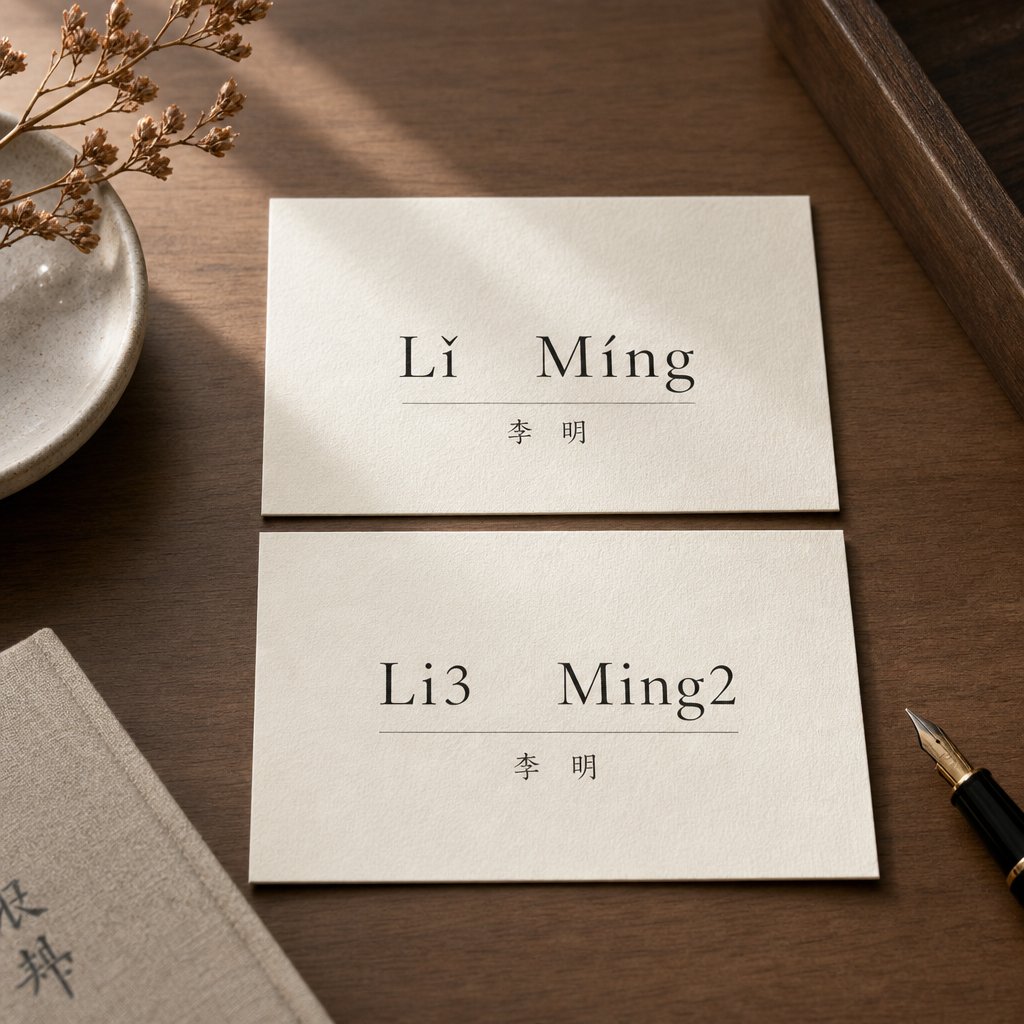
A two-character given name is written as a single joined unit with no space, no hyphen, and no intercaps between its syllables. This is the rule that trips up nearly everyone, because in the chinese writing system, each character occupies its own visual space on the page. When you see 志明 written as two distinct characters, the instinct is to separate them in romanization too. The standard says no.
Why? Because in Pinyin orthography, a given name functions as one semantic unit. Splitting it into separate syllables creates ambiguity. A reader unfamiliar with Chinese name conventions might interpret "Zhi Ming" as a middle name and a first name, or two separate words entirely. Joining them as "Zhiming" signals clearly: this is one given name.
For compound surnames like 欧阳 (Ouyang) or 司马 (Sima), the same joining logic applies. The compound surname is written as one unit with only its first letter capitalized. So 欧阳修 becomes Ouyang Xiu, not Ou Yang Xiu or OuYang Xiu.
Single-character given names are straightforward. 李白 becomes Li Bai. There is no joining needed because the given name is already a single syllable. The space between surname and given name remains the only separator.
Correct vs Incorrect Formatting Reference
The table below consolidates the rules into a quick-reference format. When writing chinese names in Pinyin, use this as your checklist:
| Chinese Name | Correct Format | Incorrect Formats | Why It Is Wrong |
|---|---|---|---|
| 陈志明 | Chen Zhiming | chen zhiming | Missing capitalization on both name units |
| 陈志明 | Chen Zhiming | Chen Zhi Ming | Given name split into two words; creates ambiguity |
| 陈志明 | Chen Zhiming | Chen ZhiMing | Intercaps not permitted within a name unit |
| 陈志明 | Chen Zhiming | Chenzhiming | No space between surname and given name |
| 王秀英 | Wang Xiuying | Wang Xiu Ying | Given name incorrectly split into two words |
| 欧阳修 | Ouyang Xiu | Ou Yang Xiu | Compound surname split; treated as two separate names |
| 欧阳修 | Ouyang Xiu | OuYang Xiu | Intercaps within compound surname not standard |
| 李白 | Li Bai | LI BAI (as default) | All-caps is context-specific, not the baseline standard form |
Notice the pattern. Every error stems from one of three mistakes: failing to capitalize the start of a name unit, inserting spaces where they do not belong, or removing the one space that does belong. The process of naming chinese characters in romanized form is mechanical once you internalize these three checkpoints.
A practical way to remember the rule: count the name units, not the characters. A standard Chinese name has two units (surname + given name). A name with a compound surname still has two units. Each unit gets one capital letter at the start, and the units are separated by exactly one space. Everything else stays joined and lowercase.
These baseline rules cover the vast majority of Chinese names. But one formatting question generates more debate than all the others combined: should a two-character given name be joined solid, hyphenated, or spaced? The standard gives a definitive answer, though history and institutional habit tell a different story.
The Hyphenation and Name Order Debate Resolved
Three people romanize the name 陈志明. One writes Chen Zhiming. Another writes Chen Zhi-ming. A third writes Chen Zhi Ming. Each person is confident they are correct. Only one of them is right according to the official standard, but the other two are not making the mistake up from nowhere.
Joined Form as the Official Standard
GB/T 28039-2011 is unambiguous on this point. A two-character given name is written as a single joined unit, no hyphen, no space. The 1976 name-spelling rules established this principle, and the reference text states it plainly: "The given name is a single entity and should not be broken up; moreover, use of the hyphen to clarify syllable boundaries is entirely superfluous."
Here is how each variant stands under the current standard:
- Zhiming (joined, no hyphen) — Standard-compliant. This is the prescribed form under GB/T 28039-2011. The given name is treated as one indivisible unit in chinese to romanization.
- Zhi-ming (hyphenated) — Historically accepted but no longer standard. You will encounter this form in older publications and in systems influenced by Wade-Giles or early Pinyin practice. Some institutions, particularly in Taiwan, still use it.
- Zhi Ming (spaced as two words) — Non-standard. This format treats each syllable as a separate word, which misrepresents the chinese name structure and creates confusion about whether the name contains a middle name.
The logic is straightforward. When you see chinese letters for names on a document, the given name functions as a single semantic unit regardless of how many characters compose it. Splitting it visually undermines that unity and invites misreading by people unfamiliar with Chinese naming conventions.
When Hyphens Appear and Why
So why does the hyphenated form persist? History. Before GB/T 28039-2011 consolidated the rules, earlier romanisation systems like Wade-Giles routinely hyphenated multi-syllable given names. Zhōu Ēn-lái was standard practice for decades. Institutions that adopted romanised chinese names during that era, particularly passport offices and university registrars, often locked in the hyphenated format and never updated.
Taiwan's passport system still permits hyphenation as an acceptable variant, which means millions of documents in circulation use it. Academic publishers sometimes allow author preference, perpetuating the form further. The hyphen is not wrong in the sense of being unintelligible. It is simply not what the current mainland standard prescribes.
The name order question generates equal confusion. Should it be Chen Zhiming or Zhiming Chen when writing for an international audience? The official standard prescribes surname first, consistent with Chinese convention. For situations where confusion might arise, the standard endorses writing the surname in all capitals: CHEN Zhiming. This technique, recognized in international circles, signals which element is the surname without reversing the natural order.
You will notice that a chinese name in chinese letters always places the surname first. The Pinyin standard preserves that order. Reversing it to match Western given-name-first conventions is an accommodation some individuals choose, but it is not what the governing document prescribes. When someone writes their name as Zhiming Chen on an English-language business card, they are exercising personal preference, not following the hanyu pinyin name standard.
This distinction between what the standard says and what people actually do extends far beyond mainland China. Different countries with large ethnic Chinese populations have developed their own conventions for chinese name letters, and those conventions do not always align with Beijing's rules.
Regional Differences Across Countries and Systems
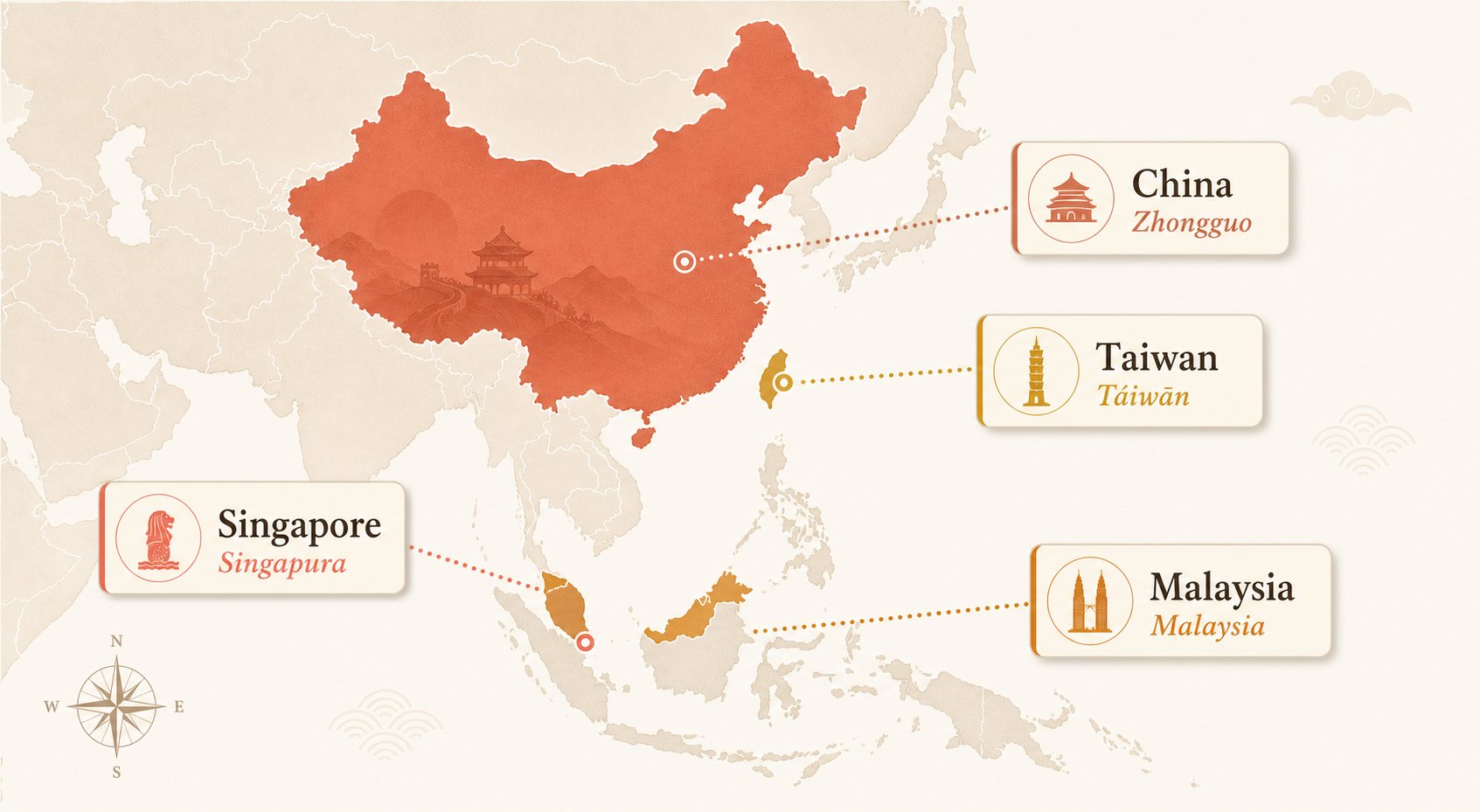
Imagine two people share the exact same Chinese name: 黄克群. One lives in Beijing. The other lives in Singapore. The Beijing resident's passport reads Huang Kequn. The Singaporean's reads Wee Kek Koon. Same characters, completely different romanizations. Neither is a typo. Both are correct within their respective systems.
This is the reality of chinese name transliteration across the Chinese-speaking world. There is no single global authority dictating how every ethnic Chinese person must spell their name in Latin letters. Instead, multiple countries maintain their own conventions, shaped by colonial history, dialect diversity, and political identity.
Mainland China and the National Standard
Mainland China's position is the most straightforward. GB/T 28039-2011 is the binding national standard. All official documents, passports, and identity cards issued by the PRC use Hanyu Pinyin with surname first, given name joined, and no hyphens. There is no opt-out. A person named 陈志明 will appear as Chen Zhiming on every government-issued document, regardless of personal preference or ancestral dialect.
The governing authority is the State Language Commission, and the system reflects standard Mandarin pronunciation exclusively. Whether your family speaks Cantonese, Shanghainese, or Hakka at home, your official romanized name follows Mandarin phonetics. This uniformity makes chinese transliteration predictable within the PRC system, but it also erases dialect-based name pronunciations that families carried for generations.
Taiwan's Modified Approach
Taiwan officially adopted Hanyu Pinyin for romanization in 2009, but personal names operate under a critical exception. The Guidelines for Transliteration of Chinese issued by Taiwan's Ministry of Education state that Hanyu Pinyin is the official system, but they also include a decisive clause: "In romanizing personal names, the choice of the concerned party shall override the above-mentioned principles."
This means Taiwanese citizens can choose their own romanization. Many still use Wade-Giles spellings established decades earlier, which is why you see "Tsai" instead of "Cai" and "Hsieh" instead of "Xie" on Taiwanese passports. The Enforcement Rules of the Passport Act, administered by the Ministry of Foreign Affairs, formally permit alternative romanizations. Citizens are "encouraged" to use Hanyu Pinyin but not required to.
Taiwan's guidelines also allow hyphenation in given names. The example in the official document shows "Chen Zhi-ming" as an acceptable postal format, even though mainland China's standard rejects the hyphen. This creates a situation where two people with identical Chinese characters can hold passports with visibly different romanizations, both issued by legitimate government authorities.
Singapore and Malaysia Conventions
Singapore and Malaysia present the most complex picture. Neither country mandates Hanyu Pinyin for personal names. Instead, names are romanized based on the individual's ancestral dialect, a practice rooted in the diverse origins of their Chinese populations.
As documented by writer Wee Kek Koon, the naming convention for people of Chinese descent in Singapore and Malaysia romanizes names according to the pronunciation in the person's ancestral dialect. A Hokkien family named 黄 spells it "Wee" or "Ng." A Cantonese family with the same character writes "Wong." A Teochew family might use "Ooi." None of these are Mandarin-based, and none follow Hanyu Pinyin.
This system predates the PRC entirely. Chinese immigrants arrived in Southeast Asia speaking Hokkien, Teochew, Cantonese, Hakka, and Hainanese. Colonial-era registration systems recorded names phonetically based on whatever dialect the person spoke. Those spellings became fixed on identity documents and passed down through generations. To transliterate chinese names in these countries is to engage with a living record of migration history.
The comparison below shows how the same practice of chinese transliteration produces radically different outcomes depending on where you are:
| Region | Official System | Name Order | Hyphenation Policy | Governing Authority |
|---|---|---|---|---|
| Mainland China | Hanyu Pinyin (mandatory) | Surname first | No hyphen; given name joined | State Language Commission / GB/T 28039-2011 |
| Taiwan | Hanyu Pinyin (recommended); personal choice permitted | Surname first | Hyphen permitted in given names | Ministry of Education / Ministry of Foreign Affairs |
| Singapore | Dialect-based romanization (default); Hanyu Pinyin available | Surname first (typically) | Varies by family convention | Immigration & Checkpoints Authority |
| Malaysia | Dialect-based romanization | Surname first (typically) | Varies by family convention | National Registration Department |
What this comparison reveals is a fundamental tension. Mainland China treats transliteration chinese name rules as a matter of national standardization, where uniformity serves administrative efficiency. Taiwan balances standardization with individual autonomy. Singapore and Malaysia treat name romanization as a reflection of cultural heritage, where dialect identity takes precedence over phonetic consistency.
For diaspora communities, these non-Pinyin spellings are not errors to be corrected. They are identity markers. A Singaporean named "Tan" (Hokkien for 陈) is not using a misspelling of "Chen." They are preserving a linguistic lineage that connects them to a specific ancestral community. Asking them to switch to Pinyin would be like asking an Irish person named "Sean" to spell it "John" because that is the standardized English form.
This patchwork of regional systems means that no single romanization standard governs all Chinese names globally. The hanyu pinyin name standard is authoritative within the PRC and influential internationally, but it coexists with legitimate alternatives that serve different cultural and administrative priorities. The question then becomes: when these systems collide in international contexts, which one wins? That depends on which international body is making the rules.
ISO 7098 and International Standard Alignment
When these regional systems collide at border crossings, in academic journals, or inside UN databases, someone has to decide which romanization wins. That arbiter, at least on paper, is ISO 7098.
ISO 7098 and Its Relationship to GB/T 28039
ISO 7098 is the international standard for the romanization of Chinese. First published in 1982 and revised most recently in 2015 (third edition), it formally endorses Hanyu Pinyin as the method to romanize chinese text into Latin script. If you need to convert chinese to pinyin for any internationally recognized purpose, this is the document that gives that conversion global legitimacy.
But here is the critical nuance most people miss: ISO 7098 is a romanization standard, not a name-formatting standard. It tells you which Latin letters correspond to which Chinese sounds. It does not prescribe whether your given name should be hyphenated, whether your surname goes first or last on an international form, or how capitalization should work in a passport's visual zone.
Those formatting details live in GB/T 28039-2011, the domestic Chinese standard. The relationship between the two works like this: ISO 7098 establishes Hanyu Pinyin as the internationally recognized system to convert chinese to mandarin pinyin spellings. GB/T 28039-2011 then layers personal name formatting rules on top of that phonetic foundation. One handles the sound-to-letter conversion. The other handles the presentation.
Where they align is absolute: both agree that Hanyu Pinyin is the correct system. Where they diverge is practical: ISO 7098 deliberately avoids dictating name-specific formatting, deferring instead to national authorities on questions of ordering, spacing, and capitalization. This deference is not an oversight. It is a design choice that acknowledges the regional variation covered in the previous section.
International Academic and Publishing Conventions
So how do international bodies actually handle this in practice? It depends on the institution and its purpose.
The United Nations adopted Pinyin in 1986 for all official romanization of chinese geographic and personal names. UN documents follow surname-first ordering consistent with the Chinese national standard. ICAO, which governs passport machine-readable zones, requires names in all capitals without tone marks or diacritics, a format that strips away most of the nuance in GB/T 28039-2011 but remains compatible with its underlying phonetic spellings.
Academic publishers occupy a middle ground. Major citation styles like APA and Chicago recognize Pinyin as the default system to romanize chinese names but often allow authors to choose their preferred presentation. A researcher might publish as "Zhiming Chen" (Western order) in one journal and "Chen Zhiming" (Chinese order) in another, depending on editorial policy. The Library of Congress uses Pinyin for cataloging but applies its own set of formatting conventions that differ slightly from GB/T 28039-2011.
What emerges is a layered system. ISO 7098 provides the phonetic foundation, the agreed-upon method for converting characters to letters. National standards like GB/T 28039-2011 add formatting rules for specific use cases. Individual institutions then interpret or adapt those rules based on their operational needs. The standard tells you how to spell the name. The institution decides how to display it. That distinction between spelling and display is where most real-world confusion originates, and it explains why your name can be "correct" in Pinyin yet still appear differently across every document you own.
Official Standards vs Real-World Institutional Policies
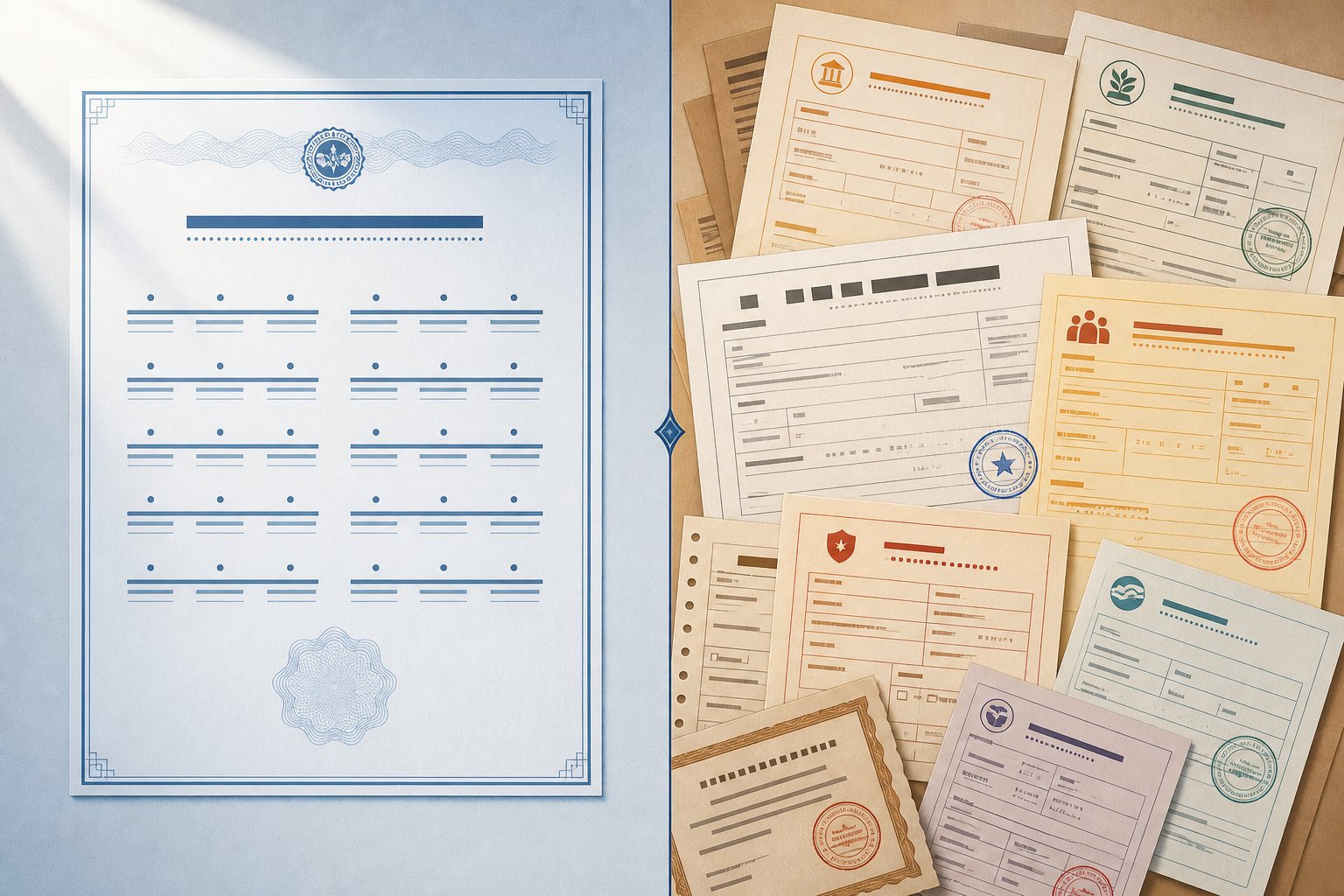
Your name is spelled correctly according to GB/T 28039-2011. You know the rules. Surname first, given name joined, proper capitalization. And yet your passport shows something different. Your university transcript shows something else. Your bank account in China shows a third variation. Are all these institutions breaking the rules?
Not exactly. They are following their own rules, which override, adapt, or simply ignore the romanization standard in favor of operational requirements. This is the single biggest source of confusion for anyone trying to maintain a consistent romanized name across documents: the hanyu pinyin name standard tells you how to spell your name, but it cannot force every institution to display it the same way.
What the Standard Says vs What Institutions Do
Think of it as two separate layers. The first layer is the romanization standard itself, which governs the conversion of Chinese characters into Pinyin letters. It answers the question: what is the correct spelling? The second layer is institutional policy, which governs how organizations choose to record, format, and display that spelling within their systems. These two layers frequently produce different outputs from the same input.
The standard prescribes "Chen Zhiming" as the correct form. But a passport machine-readable zone displays "CHEN This is not a failure of the standard. It is a consequence of the standard operating in a world where different systems have different technical constraints, different cultural assumptions, and different regulatory frameworks. The chinese pronunciation of a name stays the same. The way that name appears on paper changes depending on who is holding the pen. Here are the most frequent ways institutions deviate from what GB/T 28039-2011 prescribes, and why each deviation exists: Each of these deviations has a rational explanation. ICAO prioritizes machine readability over typographic elegance. Immigration systems prioritize document consistency over linguistic accuracy. Academic publishers prioritize author autonomy over standardization. Banks are constrained by legacy software and manual processes. None of them are wrong in their own context. They are simply solving different problems than the one the romanization standard addresses. The tones of chinese language, for instance, are a core part of accurate Pinyin representation. The standard includes tone marks as part of correct spelling. But virtually no institutional system outside of language education uses them. Passports cannot display them. Databases cannot process them. Email systems cannot reliably transmit them. So the tonal dimension of chinese and pinyin disappears entirely from official documents, even though it is technically part of the complete standard form. What does this mean for you practically? If your passport does not match the textbook standard, it is almost certainly not an error you can simply correct by pointing to GB/T 28039-2011. Passport formatting follows ICAO rules, not linguistic standards. If your name appears differently across a Chinese bank account, a work permit, and a tax record, the issue is not that one system got the pinyin to english transliteration wrong. It is that each system recorded your name independently, with no automated bridge ensuring consistency. For individuals seeking consistency across documents, the realistic approach is not to demand that every institution follow the standard. It is to understand which institution controls which format, and to ensure that the underlying spelling, the actual chinese transliteration to english, remains consistent even when the display formatting varies. Your passport MRZ will always be all-caps with no tone marks. Your academic publications can follow your preference. Your legal documents should match your passport. The standard gives you the correct spelling. What you do with that spelling across different contexts is a series of informed choices, not a single rule that overrides everything else. Knowing the correct spelling is one thing. Knowing which format to use on which document is where the practical value lives. If you have ever asked yourself "how do i write my name in chinese for a passport versus a journal article?" the answer depends entirely on the document type and the institution behind it. The table below consolidates the recommended format for each major document context, giving you a single reference to check before submitting any form: Your passport is the anchor document. Every other romanized form of your name should trace back to it. For PRC passports, the format is fixed: all capitals, no tone marks, no hyphens, surname separated from given name by a machine-readable filler character. You cannot add diacritics, and you cannot choose an alternative romanization. Should tone marks appear on official documents? The standard technically includes them as part of complete Pinyin spelling. In practice, no passport system in the world supports them. ICAO restricts the character set to the 26 basic Latin letters. Tone marks exist for linguistic accuracy, not for identity documentation. If you are figuring out how to write your name in chinese for a visa application, leave the tones off. Academic contexts offer the most flexibility. Most publishers accept either Chinese order (Chen Zhiming) or Western order (Zhiming Chen), depending on the journal's style guide. The key is consistency across your publication record. Pick one format and use it everywhere so citation databases can link your work correctly. If you are wondering how to write name in mandarin for an English-language journal, the safest approach is Pinyin without tone marks, surname first, given name joined. This aligns with the standard and avoids the ambiguity that hyphens or spaces introduce in bibliographic databases. For legal documents, contracts, and notarized translations, the rule is simple: match your passport. Courts and notaries treat any discrepancy between documents as a potential identity mismatch. If your passport says "CHEN ZHIMING," your contract signature block should read "Chen Zhiming" (the mixed-case equivalent), not "Zhi-Ming Chen" or any creative variation. Business cards occupy a more relaxed space. As professional formatting guides recommend, place Chinese characters prominently with Pinyin beneath them, preserving surname-first order. This answers the common question of how can i write my name in chinese for professional use: characters for Chinese-speaking contacts, Pinyin for everyone else, both on the same card. For anyone asking how to write your name in mandarin consistently across all these contexts, the practical strategy is straightforward. Start with your passport spelling as the baseline. Use that exact Pinyin spelling on legal documents and government forms. Allow yourself flexibility on name order in academic and business contexts, but keep the underlying spelling identical. Understanding the standard does not mean rigidly applying one format everywhere. It means knowing which format each context demands and making deliberate, informed choices rather than inconsistent guesses. Under GB/T 28039-2011, a two-character given name must be written as a single joined unit without a hyphen or space. For example, the name 志明 is written as 'Zhiming,' not 'Zhi-ming' or 'Zhi Ming.' The joined form treats the given name as one indivisible semantic unit, preventing confusion with middle names or separate words in international contexts. While hyphenated forms appear in older documents and Taiwanese passports, the current mainland standard only recognizes the joined form as correct. The official hanyu pinyin name standard prescribes surname first, followed by the given name, preserving the traditional Chinese naming order. So 陈志明 becomes 'Chen Zhiming,' not 'Zhiming Chen.' For international contexts where confusion may arise, the standard endorses writing the surname in all capitals (CHEN Zhiming) to signal which element is the family name without reversing the natural order. Writing the given name first is a personal accommodation for Western audiences, not a standard-compliant format. Passport formatting follows ICAO Doc 9303 rules, which override linguistic standards for machine readability. ICAO restricts names to uppercase Latin letters only, with no tone marks, hyphens, or diacritics. Your passport displays 'CHEN ZHIMING' rather than the mixed-case 'Chen Zhiming' because the machine-readable zone requires this format. The underlying Pinyin spelling remains correct, but the visual presentation is governed by aviation security standards rather than GB/T 28039-2011. ISO 7098 is the international standard that endorses Hanyu Pinyin as the correct system for romanizing Chinese text, establishing which Latin letters correspond to which sounds. GB/T 28039-2011 is the domestic Chinese standard that adds specific personal name formatting rules on top of that phonetic foundation, covering capitalization, spacing, name order, and hyphenation. ISO 7098 handles the sound-to-letter conversion while deliberately deferring to national authorities on name-specific presentation details. No. Only mainland China mandates Hanyu Pinyin for all official name romanization. Taiwan officially recommends Hanyu Pinyin but allows citizens to choose alternative systems like Wade-Giles on passports. Singapore and Malaysia do not use Hanyu Pinyin for personal names at all. Instead, they romanize names based on ancestral dialect pronunciation, so the surname 黄 might appear as 'Wee' (Hokkien), 'Wong' (Cantonese), or 'Ooi' (Teochew) rather than the Mandarin-based 'Huang.'Common Deviations and Their Reasons
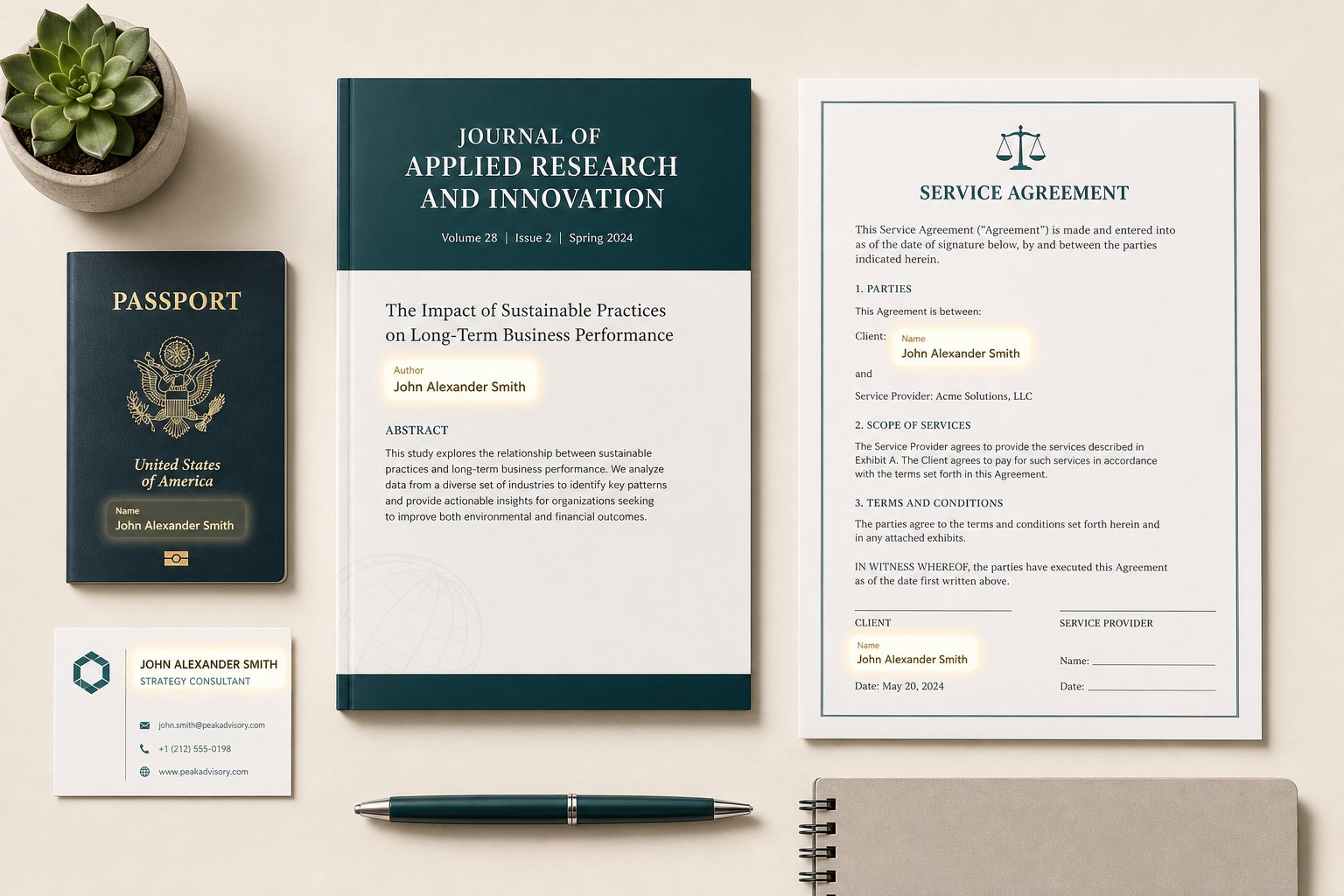
How to Write Your Name in Chinese Pinyin Across Documents
Document Type Recommended Format Name Order Special Considerations Passport (PRC) CHEN ZHIMING (all caps, no tone marks) Surname first Follows ICAO Doc 9303; no hyphens or diacritics permitted in MRZ Academic publications Chen Zhiming or Zhiming Chen Author preference / journal style APA and Chicago accept Pinyin; some journals allow hyphenation for readability Legal documents (domestic) Chen Zhiming Surname first Must match passport spelling exactly; inconsistencies can invalidate contracts Business cards 陈志明 / Chen Zhiming Surname first (Chinese convention) Include characters above Pinyin; professional guides recommend clean sans-serif fonts for Pinyin International correspondence CHEN Zhiming or Chen Zhiming Surname first (capitalized surname signals order) All-caps surname technique avoids confusion without reversing name order Passport and Travel Document Formatting
Academic Publications and Citation Standards
Legal Documents and Business Contexts
Frequently Asked Questions About the Hanyu Pinyin Name Standard
1. How should a two-character Chinese given name be written in Pinyin?
2. Does the surname or given name come first in Pinyin name formatting?
3. Why does my Chinese passport name look different from standard Pinyin formatting?
4. What is the difference between GB/T 28039-2011 and ISO 7098 for Chinese names?
5. Do all Chinese-speaking countries use Hanyu Pinyin for personal names?