Why Your Surname Is the Master Key to Chinese Genealogy
When you trace Western ancestry, you typically start with yourself and work backward, generation by generation, through parish records, census data, and civil registrations. Your surname helps, but it is just one identifier among many. Chinese ancestry works differently. Your surname is not merely a label. It is a direct link to a clan-based record-keeping system that has been documenting lineages for over two millennia.
Why Surnames Matter More in Chinese Genealogy
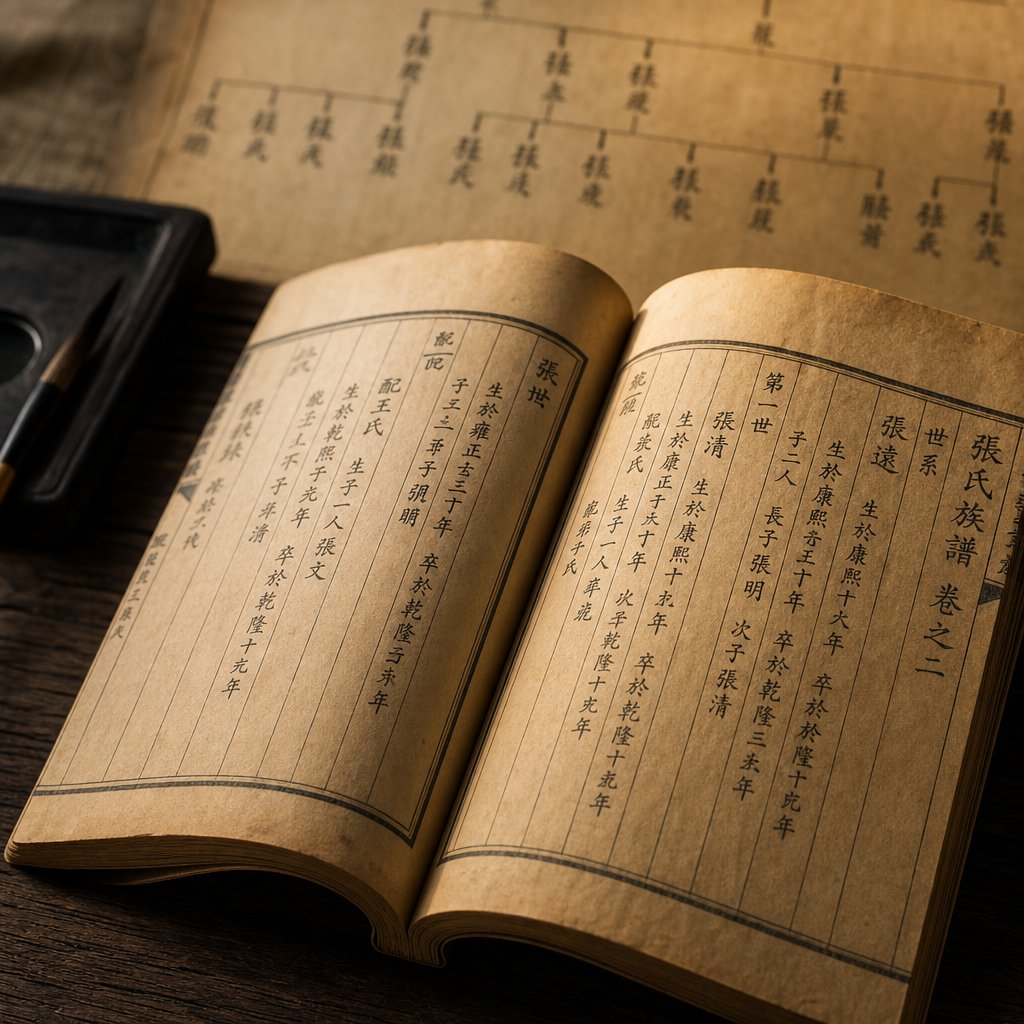
In China, families and clans kept all the documentation rather than churches or state authorities. These records, known as jiapu or zupu, were organized entirely around the surname. Each clan compiled and maintained its own genealogy, tracing every male descendant from a founding ancestor downward through the centuries. As research from the Cambridge Group for the History of Population and Social Structure highlights, Chinese genealogies begin with a common ancestor and document all descendants downward, reflecting the deep socioeconomic role these records played in village life, business networks, and collective property management.
This means your Chinese family tree is not something you build from scratch. In many cases, it already exists, compiled by your clan over generations. The challenge is finding it and connecting yourself to it. And the single most powerful key to that connection is your surname.
Chinese clans maintained genealogical records organized by surname for over 2,000 years, making your surname the single most powerful research key.
Chinese surnames have a history dating back more than 4,000 years. Out of roughly 12,000 family names recorded throughout history, about 25 percent remain in use today. Each surname carries its own origin story, migration patterns, and clan distribution. When you identify your exact surname character, you gain access to centuries of compiled genealogical data that may already document your direct ancestors.
What This Guide Will Help You Accomplish
This guide uses the surname as the organizing principle for every research step, whether you are building a family tree Chinese relatives have never documented or reconnecting with records your clan compiled generations ago. It is designed for two starting points:
- Complete beginners who only know a romanized spelling like "Chan," "Lee," or "Wong" and need to identify the correct Chinese character
- Researchers who have identified their surname character but are stuck on locating clan records, reading classical genealogies, or connecting with living clan networks
Each step ahead builds on the one before it, moving from surname identification through record location, data extraction, and verification. The process mirrors how Chinese genealogical records themselves are structured: surname first, then branch, then individual.
The first obstacle most diaspora researchers face is deceptively simple. A romanized surname like "Chan" could represent entirely different Chinese characters depending on which dialect your ancestors spoke. Resolving that ambiguity is where the real work begins.
Step 1 - Identify Your Exact Chinese Surname Character
A romanized surname can be a misleading starting point. The spelling on your passport, birth certificate, or family documents was likely transcribed by an immigration official who wrote down whatever sounds they heard. Without a standardized system, the same Chinese character ended up with dozens of different romanized spellings, and different characters ended up sharing the same one. Before you can search any genealogical database, you need to resolve this ambiguity and pin down the exact Chinese character your surname represents.
Resolving Romanization Ambiguity Across Dialects
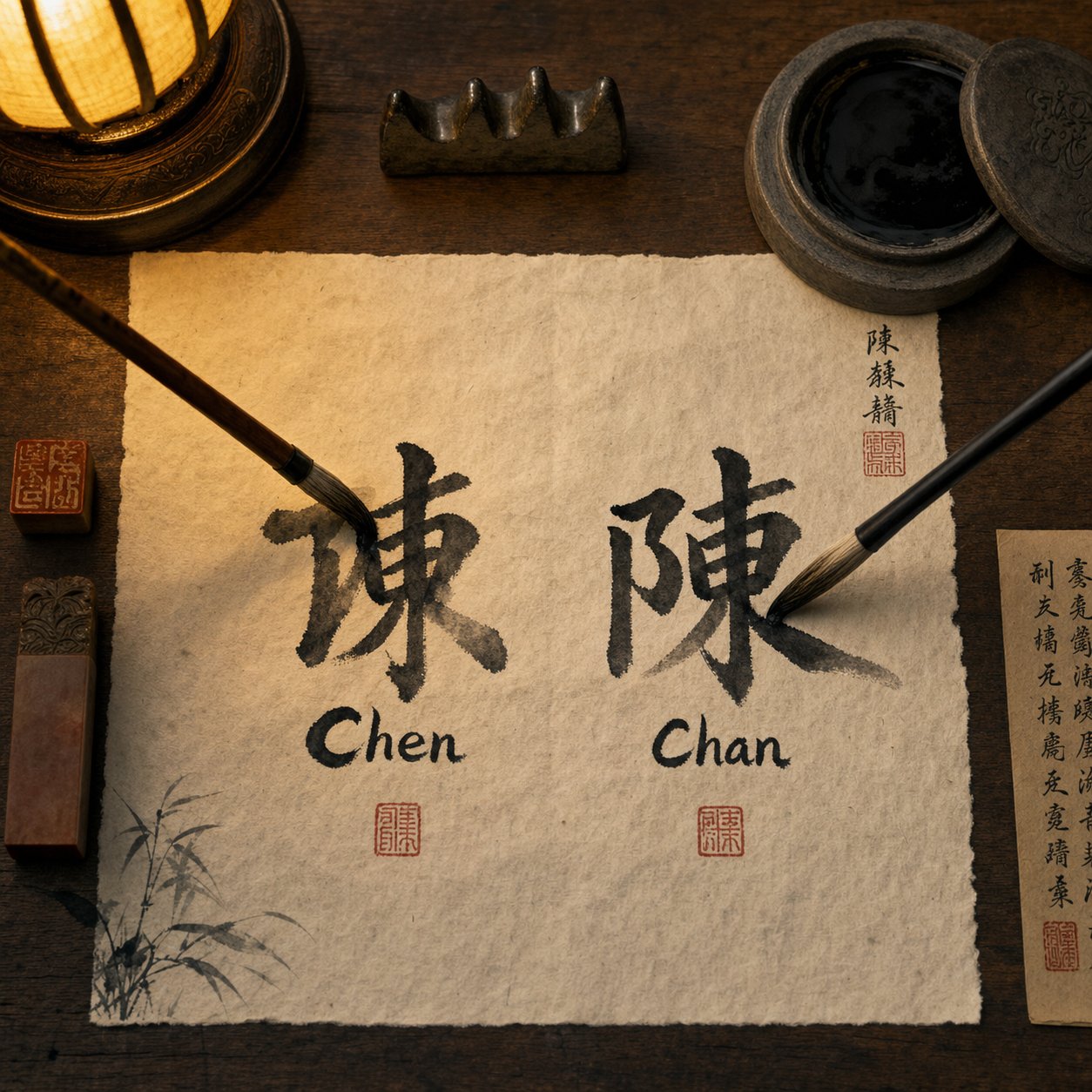
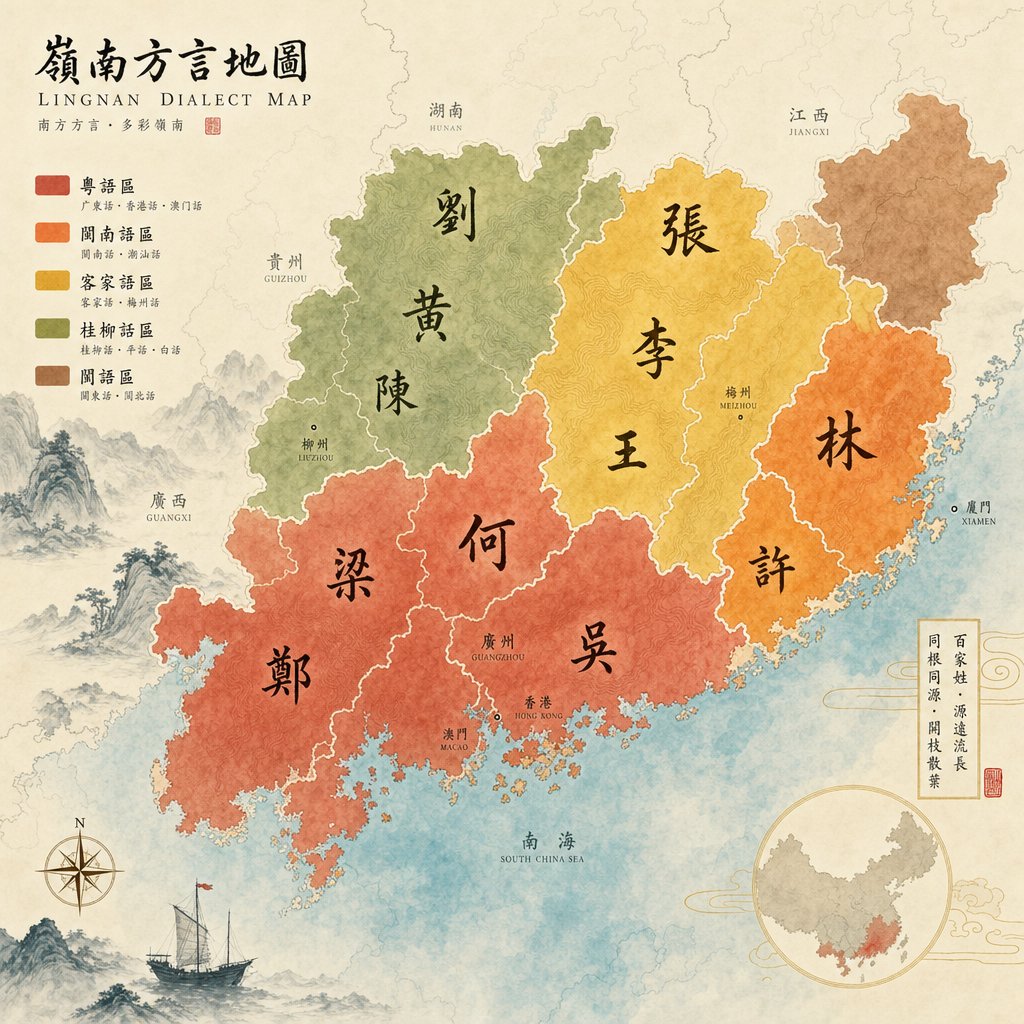
The Chinese language splits into seven to ten major dialect groups, each pronouncing the same written character in completely different ways. Your ancestors likely spoke Cantonese, Hokkien, Teochew, Hakka, or Hainanese rather than Mandarin. When they arrived in a new country, officials transcribed their spoken surname into Roman letters based on local phonetics. The result? A single character like 陈 has been romanized as Chen, Chan, Chin, Chinn, Tan, Tang, Zan, Zen, Tin, Ting, Tjin, and Jin, among others.
The reverse problem is equally common. A single romanized spelling can point to multiple unrelated characters. "Lee" might be 李 (meaning "plum tree") or 黎 (meaning "many" or "black"). "Wong" could be 黄 (yellow) or 王 (king). "Ng" might trace to 黄 in Hokkien or 吴 in Cantonese. Each character connects to a completely different clan with its own genealogical records, ancestral villages, and migration history. Picking the wrong one sends your entire research down the wrong path.
Using Dialect Clues to Pinpoint Your Surname Character
The most reliable method for narrowing down your correct character is working backward from dialect. Here is a practical approach:
- Identify your ancestral dialect group. Ask older relatives what language was spoken at home. Was it Cantonese, Hokkien, Teochew, Hakka, or something else? If no one remembers, check where your ancestors emigrated from. Guangdong Province typically means Cantonese, Hakka, or Teochew. Fujian Province usually means Hokkien.
- Use a surname search tool. My China Roots' surname finder lets you enter a romanized spelling and narrow results by dialect and geography. FamilySearch also offers Chinese surname lookup resources that cross-reference romanizations with characters.
- Cross-reference with regional spelling patterns. Malaysian Chinese surnames preserve dialect pronunciations from the colonial era. Singaporean records do the same. If your family passed through these regions, the spelling itself reveals dialect origin. For example, "Tan" almost always traces to 陈 through Hokkien or Teochew pronunciation, while "Chan" points to the same character through Cantonese.
- Confirm with family artifacts. Old letters, ancestral tablets, tombstone inscriptions, or clan association membership cards often display the Chinese character directly. Even a single document with the character written out eliminates all guesswork.
Common Surname Romanization Overlaps
The table below shows how widely a single romanized spelling can diverge in meaning depending on dialect origin. When building your family tree in Chinese names, matching the correct character is the difference between finding your clan's records and hitting a dead end.
| Romanized Spelling | Possible Characters | Dialect Origin | Meaning |
|---|---|---|---|
| Chan | 陈 (Chén) | Cantonese | To display / arrange |
| Chan | 曾 (Zēng) | Cantonese | Once / formerly |
| Lee | 李 (Lǐ) | Cantonese, Hakka, Hokkien | Plum tree |
| Lee | 黎 (Lí) | Cantonese | Many / black |
| Wong | 黄 (Huáng) | Cantonese | Yellow |
| Wong | 王 (Wáng) | Cantonese | King |
| Ng | 黄 (Huáng) | Hokkien, Teochew | Yellow |
| Ng | 吴 (Wú) | Cantonese | State of Wu |
| Lim | 林 (Lín) | Hokkien, Teochew, Hakka | Forest |
| Lam | 林 (Lín) | Cantonese | Forest |
Notice how the family tree Lee researchers encounter splits into two entirely separate clans. 李 traces back to a minister named Gao Yao and gained prestige as the imperial surname of the Tang Dynasty, while 黎 has a completely different origin story and clan genealogy. The same applies to every overlapping romanization in the table above.
Once you have confirmed your exact Chinese surname character, you hold the first real key to unlocking clan records. The next step is gathering the additional details, like ancestral village, province of origin, and generation name, that will let you search those records with precision.
Step 2 - Gather Family Knowledge and Build Your Research Checklist
Your confirmed surname character opens the door, but walking through it requires more than a single key. Chinese genealogical databases and clan records are organized by layers of specificity: surname, then region, then branch, then generation. The more layers you can identify before searching, the faster you narrow millions of potential matches down to your actual lineage. Think of it like searching for a book in a library. The surname gets you to the right floor. Everything else gets you to the right shelf.
The Essential Pre-Research Checklist
Gather as much of the following as possible before diving into record searches. Each item dramatically improves your chances of locating the correct clan genealogy and tracing your chinese roots back through the centuries.
- Surname in Chinese characters (姓氏) - You completed this in Step 1. This is your primary search filter in every genealogical database and clan record repository.
- Ancestral village name (祖籍 / zǔjí) - Your ancestral village is where your paternal line settled, often three or more generations back. As FamilySearch notes, this is the key to unlocking family records like jiapu and zupu, along with traditions and stories passed down for generations. Many clans sharing the same surname maintained separate genealogies by village, so the village name distinguishes your branch from thousands of others.
- Province and county of origin (省/县) - If you cannot identify the exact village, knowing the province and county still narrows your search significantly. Guangdong, Fujian, and Zhejiang each contain hundreds of distinct clan branches for common surnames.
- Generation poem (字辈 / zìbèi) - This is a sequence of characters prescribed for naming all members born in the same generation. If your family remembers even a few characters from the poem, you can search FamilySearch's jiapu catalog using it as a filter. It also reveals your exact generational position within the clan.
- Ancestral hall name (堂号 / tánghào) - Clans often identified themselves by a hall name tied to their original place of origin or a notable ancestor. This functions as a sub-identifier within your surname group and appears in jiapu title pages, ancestral tablets, and temple inscriptions.
- Approximate immigration date and route - For diaspora researchers, knowing when and how your ancestors left China helps locate ship manifests, immigration interviews, and exclusion-era files that often recorded village names and family details.
How to Recover Lost Information from Family and Documents
Missing several items on that list? Most researchers are. Here is where to look:
- Interview elderly relatives. Grandparents, great-aunts, and older cousins often hold fragments of oral history they have never been asked about directly. Ask about the dialect spoken at home, any village name mentioned during holidays, and whether names in the family follow a pattern. Even partial memories, like "grandfather always said we came from a village near Taishan," give you a geographic starting point.
- Examine immigration and exclusion-era documents. Chinese Exclusion Act files, coaching papers, and immigration interviews frequently recorded ancestral village names, family members left behind, and even generational details. These records are available through the U.S. National Archives and FamilySearch's Chinese-American collections.
- Check tombstone inscriptions. Chinese gravestones often display the surname character, ancestral village or county, and sometimes the generation name. FamilySearch offers a gravestone guide to help you decode these inscriptions even without reading Chinese fluently.
- Look through old letters, photos, and keepsakes. Addresses on envelopes, handwritten notes, remittance receipts sent back to China, and clan association membership cards can all reveal village names, hall names, or Chinese character spellings you did not know existed.
You do not need every item on the checklist to make progress. Even two or three confirmed details, your surname character plus a province and a partial generation poem, can be enough to locate a matching jiapu. The goal is to arm yourself with as many search filters as possible before approaching the records themselves.
With your checklist assembled, the next layer of context comes from understanding how Chinese names themselves encode genealogical information. The three-part naming structure and generation poems built into those names function as a hidden index, one that reveals family connections the moment you know how to read it.
Step 3 - Decode Chinese Naming Conventions and Generation Poems
Every Chinese name carries genealogical data baked right into its structure. When you look at a name in a mandarin family tree or any Chinese dialect record, you are not just seeing a label. You are seeing a coded reference to surname, generation, and individual identity, all packed into two or three syllables. Learning to read that code transforms a page of unfamiliar names into a map of family relationships.
The Three-Part Chinese Name Structure
A traditional Chinese name follows a consistent pattern: surname + generation character + personal character. Take the name Li Yaoming (李耀明) as an example. "Li" (李) is the surname, placing this person within the Li clan. "Yao" (耀) is the generation character, shared by all siblings and cousins born in the same generation. "Ming" (明) is the personal character, unique to the individual.
Why does this matter for genealogy research? Imagine you are scanning a family tree in mandarin and you spot three names: Li Yaoming (李耀明), Li Yaohui (李耀辉), and Li Yaowen (李耀文). Even without any prior knowledge of this family, the shared "Yao" character immediately tells you these three people belong to the same generation. They are likely siblings or cousins. This pattern makes it possible to identify family connections at a glance, even in records containing hundreds of names.
As the Asia Media Centre explains, males of the same generation in a traditional family share the first character of their given names, and these generation names are worked out long in advance. They cannot be changed because they are written into the history of the family. The generation character was most often placed first in the given name, though some clans positioned it second, creating variation while preserving the shared link across relatives.
Generation Poems as a Built-In Lineage Index
The generation characters across a clan are not random. They follow a predetermined sequence called a generation poem (字辈, zibei). Think of it as a built-in indexing system for the entire chinese family hierarchy. Each character in the poem corresponds to one generation, and the poem cycles through in order as new generations are born.
A generation poem is typically arranged in lines of five or seven characters, sometimes rhyming, sometimes not. Here is what one might look like:
仁义礼智信 (Ren Yi Li Zhi Xin) - Benevolence, Righteousness, Propriety, Wisdom, Faithfulness. In this poem, the first generation uses 仁 in their names, the second uses 义, the third uses 礼, and so on. Each character acts like a generational timestamp.
FamilySearch describes generation poems as functioning like a fingerprint for a clan. Because each clan's poem is unique, even a handful of generation characters can help you identify and locate your family's jiapu in genealogical databases. The poem also conveys the values a clan hoped to instill: characters often represent virtues like loyalty, respect, or wisdom, expressing hopes for each successive generation.
How to Find Your Position in a Generation Poem
If you know your generation character, or the generation character of a parent or grandparent, you can pinpoint your exact position in the clan's lineage. Here is how to work it out:
- Check your father's or grandfather's Chinese given name. Look for the character that repeats among siblings or cousins of the same generation. That repeating character is the generation character.
- Match it against the poem. If your family's generation poem is known, find where that character falls in the sequence. Every character before it represents an older generation; every character after it represents a younger one.
- Count your position. If your grandfather's generation character is the fifth in the poem and yours is the seventh, you know exactly how many generations separate you from the clan's founding ancestor who used the first character.
Even if your family never recorded the poem formally, you can often reconstruct it. Look for repeating characters across names of people you know are in the same generation. Children and cousins sharing a character acts like a hidden poem even when it was never written down as a formal sequence.
By the Ming Dynasty, two-character given names shaped by generation poems had become standard practice. In the mid-20th century, many families moved away from this tradition, and single-character names without a generation character grew more common. Still, many families, especially in rural southern China and overseas communities, continue passing on generation characters today.
Understanding this naming structure gives you a powerful lens for reading genealogical records. But recognizing names on a page is only useful if you know what kind of record you are looking at. Chinese genealogical documents come in several distinct formats, each with different scope, content, and research applications.
Step 4 - Understand the Types of Chinese Genealogical Records
Not all Chinese genealogical records serve the same purpose or cover the same ground. When you search for your clan's documentation, you will encounter three main categories, each compiled by different people, for different reasons, at different scales. Knowing which type you are looking at, and which type you actually need, saves you from spending weeks reading through a massive clan compendium when your direct lineage sits in a smaller branch record, or vice versa.
Zupu vs Jiapu vs County Gazetteers
The terms zupu and jiapu are sometimes used interchangeably in casual conversation, but they represent different scopes of documentation. A zupu (族谱) is a clan genealogy. It covers an entire surname group within a region, sometimes documenting dozens of branches descended from a common ancestor who settled in that area centuries ago. A jiapu (家谱) is a family genealogy, narrower in focus, tracking a specific branch or household line within the larger clan. As FamilySearch explains, a jiapu records one clan's generational heritage starting from the founding ancestor and continuing generation by generation, preserving the family's bloodline heritage often tracing back hundreds of years.
County gazetteers (县志, xianzhi) are a different animal entirely. These are local government records compiled by county officials, documenting geography, administration, notable residents, and significant events within a jurisdiction. They were not genealogical records by design, but they frequently include biographical entries for prominent families, lists of degree holders, and references to local clans that can fill gaps when a jiapu is missing or incomplete.
Which one do you need? That depends on where you are in your research:
- If you are trying to establish broad clan connections and understand how your branch relates to the wider surname group in a region, start with a zupu.
- If you want direct lineage detail, names, birth and death dates, marriage records, and generation-by-generation descent, a jiapu is your primary target.
- If your family's jiapu has been lost or destroyed, county gazetteers can provide fragments: mentions of ancestors who held office, passed imperial examinations, or contributed to local projects.
The following table breaks down how these three record types compare across the dimensions that matter most for genealogy in chinese research:
| Feature | Zupu (族谱) | Jiapu (家谱) | County Gazetteer (县志) |
|---|---|---|---|
| Scope | Entire surname clan in a region | Single branch or household line | All notable families in a county |
| Compiled by | Clan elders or appointed editors | Family branch leaders | County government officials |
| Typical content | Origin myths, migration routes, all branch charts, ancestral hall records, generation poems | Direct lineage charts, biographies, family rules, property records, portraits | Biographies of officials, degree holders, local events, geographic descriptions |
| Where to find them | Shanghai Library, FamilySearch, clan associations, local archives | Family members, ancestral villages, Shanghai Library, university collections | National Library of China, provincial libraries, FamilySearch microfilm |
| Best use case | Establishing your branch's place within the larger clan network | Tracing your direct ancestors generation by generation | Filling gaps when clan records are lost; verifying dates and events |
What a Jiapu Actually Contains When You Find One
Imagine locating your family's jiapu for the first time. What are you actually holding? Far more than a list of names. A traditional chinese family book is a comprehensive record of clan identity, compiled and updated across centuries. The Vancouver Public Library's genealogy guide describes a classic Chinese genealogy as containing family rules and instructions, portraits and biographies of important clansmen, genealogical charts, a list of donors to the book, and much more.
FamilySearch's jiapu resource breaks the typical contents into three categories:
- Introductions and origins: Preface, surname origin story, migration history, and table of contents. These sections explain where the clan came from, when they settled in their current region, and which ancestor founded the local branch.
- Ancestral and family details: Ancestral portraits, cemetery maps, ancestral hall descriptions, family rules (家训), and family teachings. These reveal the values, property, and physical landmarks tied to your clan.
- Records and charts: Pedigree charts (世系图), biographical tables, individual biographies of notable ancestors, the generation poem, and a postscript documenting when and why the jiapu was compiled or updated.
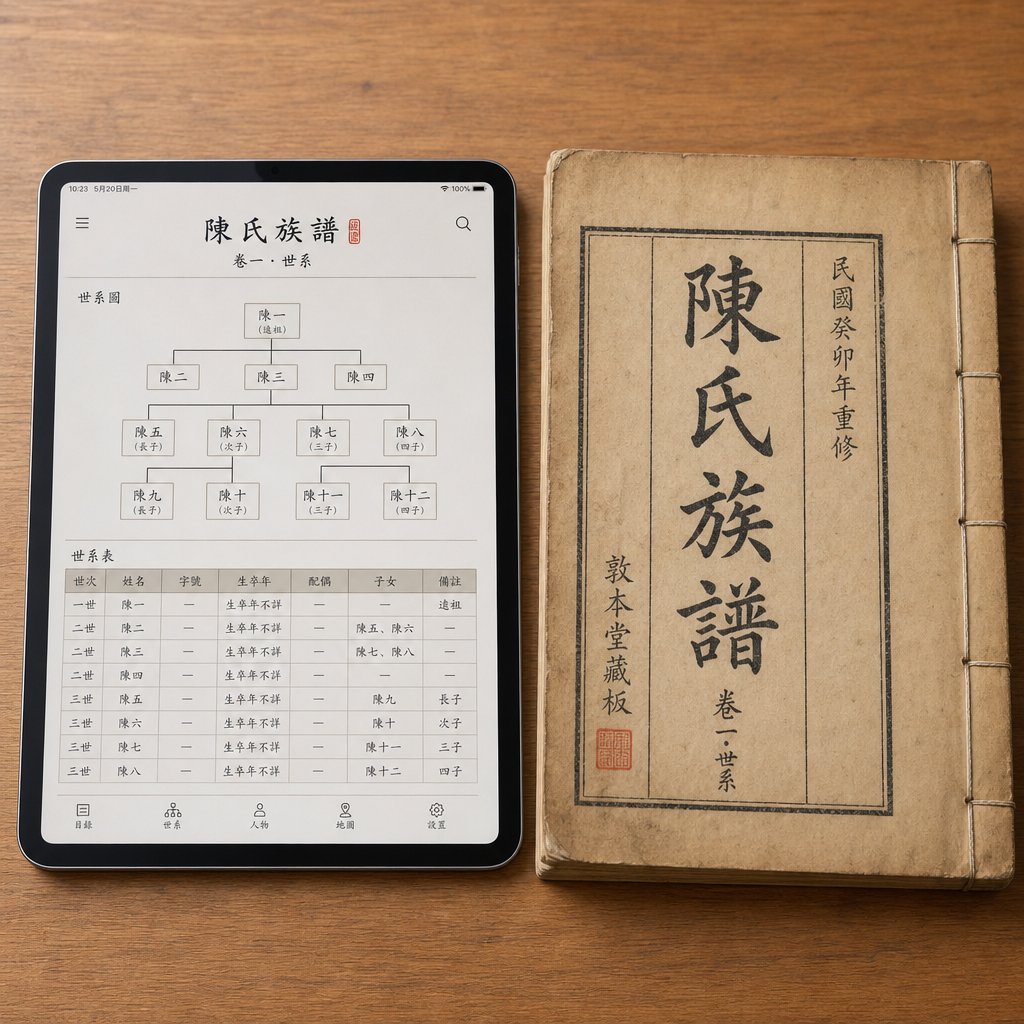
The pedigree chart is where most researchers spend their time. It maps every male descendant from the founding ancestor downward, generation by generation, with entries noting birth dates, death dates, burial locations, wives' surnames, number of sons, and sometimes occupations or examination achievements. Women are typically recorded only by maiden surname, and daughters are rarely included, a limitation worth noting when reconstructing complete family histories.
A jiapu is also a living document. Clans traditionally updated their genealogies every 20 to 30 years, adding new generations and sometimes correcting earlier entries. This means multiple editions may exist for the same clan, each capturing a different snapshot in time. If you find one edition, it is worth searching for others, as later versions may extend the record forward while earlier ones preserve details that were later lost or abbreviated.
Knowing what these records contain and how they differ gives you a clear target. The next challenge is practical: where do these documents actually live, and how do you access them from outside China?

Step 5 - Locate and Access Surname-Based Records
Chinese genealogical records are scattered across libraries, archives, clan associations, and digital platforms spanning multiple continents. Some sit in climate-controlled reading rooms in Shanghai. Others live on microfilm reels in Salt Lake City. Still others remain in the hands of village elders or locked in temple storage rooms across Southeast Asia. The good news? More of these records are accessible remotely than at any point in history. The challenge is knowing where to look based on your surname, ancestral region, and current location.
Major Repositories for Chinese Genealogical Records
Several institutions hold massive collections of surname-organized genealogies. Each has different strengths, access policies, and coverage gaps. Here are the most important ones for chinese genealogy research:
- Shanghai Library (上海图书馆) - The world's largest collection of Chinese genealogies, holding approximately 30,000 titles. About half are available internally at the on-site reading room, and 8,565 are accessible through their online platform. The library's Chinese Genealogy Knowledge Service Platform provides the most comprehensive online genealogy catalog, containing bibliographical information, locations, and availability for records across China. Access is free for on-site visitors with a Shanghai Library ID, and the institution has been steadily increasing the number of genealogies available online.
- FamilySearch (familysearch.org) - The best starting point for researchers based outside China. FamilySearch holds scanned copies of tens of thousands of Chinese genealogies, most produced in the 19th and 20th centuries. Their China Collection of Genealogies (1239-2014) is available as images online for free registered users. The collection includes acquisitions from the Chinese Academy of Social Sciences, the Library of Hebei University, the Xunyuan Center for Surname Culture, and several U.S. university libraries. Resources unavailable online can be accessed at FamilySearch centers worldwide.
- My China Roots - A specialized platform with records covering over 200 million individuals in Mainland Chinese collections and 5 million in Overseas Chinese collections. Their surname database includes over 400 surnames with 9,400 recorded spelling variants, plus 31 searchable ancestral village regions containing 700,000 place names. Some public libraries offer free access through institutional subscriptions.
- National Library of China (中国国家图书馆) - Holds a significant genealogy collection and provides access through their Zhonghua guji ziyuanku (Chinese Ancient Books Resource Database). Less accessible remotely than the Shanghai Library, but contains records not found elsewhere.
- Library of Congress - Their Chinese Rare Book Digital Collection includes at least 15 genealogies, most from the Ming Dynasty, digitized in high quality and freely accessible online.
- University collections - Harvard-Yenching Library, Columbia University, UC-Berkeley, Stanford, University of Chicago, University of Hawaii, and the University of British Columbia all hold Chinese genealogies. Many have been digitized through partnerships with FamilySearch.
- Online genealogy databases - Platforms like jiapu.org and zupu.cn aggregate digitized clan records searchable by surname and region. Quality and completeness vary, but they can surface records not cataloged in major institutional collections.
- Local county archives (县档案馆) - County-level archives in your ancestral region often hold genealogies, land records, and household registrations that never made it into national collections. Accessing these typically requires a local contact or hired researcher.
A practical note: the Shanghai Library acquired much of its collection from paper factories where peasants sold old genealogies as scrap. Many are incomplete as a result. FamilySearch's collection, while extensive, represents only a fraction of what the Shanghai Library holds because their cooperation was limited. These gaps mean you may need to check multiple repositories to chinese find the specific jiapu matching your surname and region.
Research Pathways by Ancestral Region and Diaspora Location
Your research strategy shifts depending on where your ancestors lived and where you are searching from. Each region has distinct record-keeping traditions and access points.
Mainland China
County archives and local genealogy societies are your primary targets beyond the major libraries. Many counties have established genealogy research centers that catalog local clan records. Provincial libraries in Guangdong, Fujian, Zhejiang, and Jiangxi hold regional collections particularly rich in southern Chinese genealogies. If your ancestral village is known, contacting the village committee directly sometimes yields results, as families in rural areas still maintain physical copies of their jiapu.
Taiwan
Taiwan's Japanese colonial-era household registration system (户籍) created detailed family records from 1906 onward. These registers document births, deaths, marriages, adoptions, and addresses for every household member. They are held at local household registration offices and can be requested by descendants. The Academia Historica in Taipei also holds genealogical materials, and many Taiwanese families maintain their own jiapu tracing back to ancestors who migrated from Fujian or Guangdong.
Hong Kong
Clan associations (宗亲会) are the backbone of genealogy chinese research in Hong Kong. Major surname groups like Chan, Wong, Lee, and Lam maintain active associations that preserve clan records, operate ancestral halls, and sometimes publish updated genealogies. Hong Kong Public Libraries hold genealogical materials as well. The New Territories, where many lineage villages remain intact, is particularly rich in preserved clan documentation.
Southeast Asian Chinese Diaspora
For descendants of Chinese who settled in Malaysia, Singapore, Indonesia, Thailand, or the Philippines, temple records and clan association archives are essential. Chinese temples across Southeast Asia maintained birth, death, and membership records for their communities. Clan associations organized by surname, such as the Hokkien Huay Kuan or Teochew Poit Ip Huay Kuan, often hold genealogical records linking members back to specific villages in China. The University of Malaya holds relevant collections, and Singapore's National Archives contain Chinese community records dating to the colonial period.
Regardless of your starting location, the search pattern remains the same: identify your surname and ancestral region, then work outward from the most specific repository (a local clan association or county archive) to the broadest (Shanghai Library or FamilySearch). Many researchers find success by combining digital searches with a single well-placed inquiry to a clan association or local contact in the ancestral region.
Locating a record is only half the battle. A jiapu written in classical Chinese, using traditional characters and genealogical notation unfamiliar to modern readers, presents its own set of challenges. The real work begins when you open the document and start extracting names, dates, and relationships from its pages.
Step 6 - Read and Extract Data from Chinese Genealogies
You have located a jiapu connected to your surname and ancestral region. You open it, and you are staring at columns of classical Chinese characters arranged in an unfamiliar layout. Sounds intimidating? It does not have to be. Generation charts follow a consistent internal logic, and once you understand the structure, extracting your chinese ancestors from the page becomes a methodical process rather than a guessing game.
Reading a Generation Chart in a Jiapu
The generation chart (世系图, shixitu) is the core of any jiapu. It maps every descendant from the founding ancestor downward, organized by generation. Traditional charts are read from right to left and top to bottom. The rightmost column typically labels each generation by number, with the first generation (the founding ancestor) at the top and subsequent generations descending below.
A key structural concept borrowed from the Zhou Dynasty's lineage system shapes how entries are arranged. As research from the National Library of Singapore explains, the eldest son's name appears directly below his father's in larger text at the beginning of the second column, forming the "Main Branch" (大宗). Younger sons branch off to the side, forming "Side Branches" (小宗). This visual hierarchy makes it possible to trace the primary line of descent at a glance, while collateral branches fan outward.
Most traditional charts limit each page to five generations, a convention established during the Song Dynasty by genealogy pioneers Ouyang Xiu and Su Xun. Their methodology became the standard template that clans followed for centuries. When you reach the bottom of one chart, the next chart picks up where the previous one ended, continuing the lineage forward.
Here is a step-by-step process for extracting names, dates, and relationships from a typical generation chart entry:
- Identify the generation number. Look at the rightmost column or margin notation. It tells you which generation the entry belongs to, counting from the founding ancestor.
- Locate the individual's name. The name appears prominently, usually in larger characters. Remember the three-part structure: surname + generation character + personal character. The surname may be omitted since the entire jiapu belongs to one surname group.
- Read the biographical notation. Below or beside the name, you will find compressed biographical details in classical Chinese. Common elements include: courtesy name (字), birth year using the traditional reign-year calendar, death year, burial location, wife's maiden surname (氏), and number of sons.
- Trace the descent line. Follow the vertical line downward from a father's entry to find his sons. The eldest son appears first (closest to the father's column), with younger sons listed in birth order moving leftward.
- Note cross-references. When a side branch becomes too large to fit on the current chart, the entry will include a notation directing you to a separate chart page where that branch continues in detail.
- Record wife and mother information. Women are typically listed only by maiden surname followed by 氏 (shi, meaning "of the clan"). For example, 配林氏 means "married a woman of the Lin clan." Occasionally, her father's name or native village is noted.
Imagine you spot an entry reading: 耀明,字文光,生于乾隆三十年,卒于嘉庆十五年,配陈氏,生二子. This tells you the ancestor chinese researchers would record as: name Yaoming, courtesy name Wenguang, born in the 30th year of Qianlong (1765), died in the 15th year of Jiaqing (1810), married a woman surnamed Chen, and had two sons. Each entry follows this compressed pattern, making extraction systematic once you recognize the formula.
Overcoming Language and Access Barriers
The biggest obstacle for most diaspora researchers is not the structure. It is the language. Classical Chinese genealogical notation uses abbreviated grammar, archaic vocabulary, and traditional (unsimplified) characters that even native Mandarin speakers may struggle with. Add in variant character forms used in different historical periods, handwritten entries with inconsistent calligraphy, and physical damage from age or poor storage, and the challenge compounds quickly.
Here are practical approaches for working through these barriers:
- Hire a local researcher or translator. Professional genealogists based in China specialize in reading classical jiapu. Services like My China Roots connect diaspora researchers with on-the-ground experts who can visit archives, photograph records, and translate entries. County-level genealogy societies in your ancestral region sometimes offer similar services for a modest fee.
- Use OCR and translation tools strategically. Modern optical character recognition tools can digitize printed genealogies, though handwritten ones remain difficult. Once digitized, machine translation provides a rough framework, but classical Chinese requires human review for accuracy. Use automated tools to identify names and dates, then verify critical details with a knowledgeable reader.
- Work with Chinese genealogy societies. Organizations like the Shanxi Genealogical Research Centre and local clan associations often have members experienced in reading historical records. Posting specific questions with photographs of entries to genealogy forums or clan association contacts can yield surprisingly detailed help.
- Learn key recurring characters. You do not need fluency in classical Chinese to extract basic data. A working vocabulary of roughly 50 to 100 characters covers most genealogical notation: terms for birth (生), death (卒), marriage (配), son (子), daughter (女), eldest (长), second (次), and common reign-year names. Pattern recognition does the rest.
Damaged or incomplete records present a different kind of challenge. Gaps in a generation chart, missing pages, or water-damaged entries mean some ancestors in chinese records simply cannot be recovered from a single source. Cross-referencing multiple editions of the same jiapu, checking county gazetteers for corroborating mentions, or locating a related branch's genealogy can sometimes fill these holes.
Extracting raw data from a jiapu is only the beginning. The real complexity emerges when you start organizing that data into a coherent family tree, reconciling conflicting information across sources, and handling the historical realities of multiple marriages, adopted heirs, and name changes that make Chinese genealogy uniquely layered.
Step 7 - Construct and Verify Your China Family Tree
Raw data extracted from a jiapu is not yet a family tree. It is a collection of names, dates, relationships, and biographical fragments that need to be organized, cross-checked, and structured into something coherent. This step is where many researchers hit unexpected friction, not because the data is missing, but because Chinese genealogical records reflect historical family structures that do not map neatly onto modern family tree software defaults.
Organizing Multi-Generational Chinese Family Data
Start by choosing a tool that handles Chinese characters natively. This sounds obvious, but many genealogy programs were built for Western naming conventions and struggle with CJK character encoding, two-character given names, or the absence of a middle name field. You need software that lets you store both the Chinese characters and romanized versions of each name without corrupting either.
Several platforms handle this well. FamilySearch's Family Tree supports Chinese characters directly and lets you attach scanned jiapu pages as source documents, linking images to specific ancestors. RootsMagic offers Chinese character support in its desktop application with web publishing capabilities. MyHeritage provides an international database with Chinese record integration. For researchers who want full control over their data structure, the open-source platform Webtrees allows custom fields and privacy controls that work well for multi-generational Chinese genealogies.
Whichever tool you choose, follow these practices from the start:
- Record names in both Chinese and romanized form. Enter the full Chinese name (e.g., 李耀明) as the primary name and the romanized version (Li Yaoming) as an alternate. This ensures searchability in both languages and prevents duplicate entries when relatives contribute data using different scripts.
- Tag each person with their generation number and generation character. Most software has a custom field or notes section where you can record this. It becomes invaluable when sorting large datasets or identifying where someone fits in the lineage.
- Attach source citations to every entry. FamilySearch encourages users to attach the jiapu itself as a source, whether by linking scanned images already on their platform or by uploading copies as memories. This practice adds credibility and helps future researchers verify your work.
- Convert reign-year dates to the Western calendar immediately. Classical Chinese records use reign years (e.g., "Qianlong 30th year"). Convert these to CE dates (1765) at the point of entry to avoid confusion later. Online reign-year converters make this straightforward.
Handling Historical Naming and Family Structure Complexities
Chinese genealogical data reflects centuries of social customs that differ significantly from modern Western family structures. When you encounter these patterns in your records, here is how to handle them without losing information or creating misleading connections.
Consider the bruce lee family tree as a practical example of these complexities in action. Bruce Lee's lineage traces through the Lee (李) clan, but his family history includes adopted relationships, stage names versus birth names, and cross-cultural naming conventions that required careful documentation to keep straight. The bruce lee lineage illustrates how even well-known families require meticulous attention to naming variants and relationship types when constructing an accurate tree.
Here are the most common data conflicts researchers encounter and how to resolve each one:
- Multiple wives recorded for one ancestor. Historical Chinese families practiced polygyny. A jiapu typically lists the primary wife (妻 or 配) first, followed by concubines (妾). Record each relationship separately with its correct designation. Most genealogy software supports multiple spouse entries. Note which children belong to which mother, as jiapu usually specify this with notations like 嫡出 (legitimate heir) or 庶出 (born of a concubine).
- Adopted heirs (嗣子 or 过继). When a branch had no male heir, clans adopted a nephew or cousin's son to continue the line. The jiapu marks these with terms like 嗣 (heir by adoption) or 继 (to continue). Record the adopted individual under both their biological parents and adoptive parents, noting the adoption clearly. This person may appear in two different branch charts within the same jiapu.
- Name changes across a lifetime. A single ancestor might have a childhood name (乳名), a formal given name (名), a courtesy name (字), a literary name (号), and possibly an official title. Record all variants in your software's alternate name fields. The formal given name is your primary identifier, but the courtesy name often appears more frequently in biographical sections of the jiapu.
- Conflicting information between jiapu editions. Clans updated their genealogies every generation or two. A 1780 edition and an 1850 edition of the same clan's jiapu may record different birth years, different numbers of sons, or even different wives for the same ancestor. When editions conflict, note both versions with their source dates. Generally, the edition compiled closest to the ancestor's lifetime is more reliable for biographical details, while later editions may correct errors discovered through cross-referencing.
- Missing generations or broken lineage links. Wars, famines, and migrations caused gaps. If a jiapu jumps from generation 12 to generation 15, do not fabricate connecting ancestors. Record the gap explicitly and note which source documents the break. County gazetteers or a related branch's jiapu may eventually fill the hole.
- Simplified versus traditional characters. Post-1950s mainland Chinese records use simplified characters, while older jiapu and records from Taiwan, Hong Kong, and overseas communities use traditional forms. Your software should handle both, but be aware that the same name may look different depending on the character set. 陈 and 陳 are the same surname; do not create duplicate entries.
Verification is the final layer. Cross-reference your assembled china family tree against multiple independent sources whenever possible. A name appearing in both a jiapu and a county gazetteer carries more weight than one found in a single source. Immigration records, tombstone inscriptions, and clan association membership rolls each provide independent confirmation points. When three sources agree on a date or relationship, you can treat it as established. When they conflict, document all versions and flag the discrepancy for future resolution.
A well-constructed and verified family tree is not a finished product. It is a living framework, one that grows as new records surface, as DNA results confirm or challenge paper trails, and as connections with living clan members open doors to documentation you never knew existed.
Step 8 - Connect with Living Clan Networks and Digitization Efforts
Your family tree does not end with the last entry in a historical jiapu. Across China and throughout the diaspora, clan associations and surname groups are actively digitizing centuries-old genealogies, adding new generations to existing records, and building online platforms that connect scattered branches of the same lineage. These living networks represent both a research resource and a community you can join, turning a solitary paper trail into a collaborative effort.
Connecting with Active Clan Digitization Projects
Since the early 2000s, a wave of genealogy revival has swept through Chinese communities. Village committees in Guangdong, Fujian, and Zhejiang are photographing fragile paper jiapu and uploading them to searchable databases. Clan associations in major cities fund professional transcription projects that convert handwritten classical Chinese into indexed digital text. Some of these efforts are massive in scale. The Shanghai Library's ongoing digitization program continues expanding its online catalog beyond the 8,500 titles already accessible. Platforms like My China Roots aggregate digitized records covering over 200 million individuals, with collections spanning Mainland China, Southeast Asia, North America, and the Caribbean.
How do you find chinese digitization projects connected to your specific surname? Start with these approaches:
- Search surname-specific websites. Many large clans maintain dedicated genealogy portals. The Chen (陈) clan, the Wang (王) clan, and the Li (李) clan each have multiple active online communities compiling and sharing digitized records. A search combining your surname character with 宗亲网 (clan network) or 族谱数据库 (genealogy database) often surfaces these.
- Join online surname forums. Platforms like Baidu Tieba host active surname-based discussion groups where members share jiapu photographs, compare generation poems, and help each other identify branch connections. WeChat groups organized by surname and ancestral region are another active channel, though finding the right group often requires an introduction from a clan association contact.
- Contact your ancestral village directly. If you know your village of origin, reaching out to the village committee or a local genealogy enthusiast can connect you with digitization projects already underway. Many villages have appointed a genealogy coordinator who maintains updated records and welcomes inquiries from overseas descendants.
DNA testing adds another dimension to these connections. Services like 23andMe and WeGene (a platform designed for East Asian populations) can confirm surname-based research by identifying genetic matches who share your patrilineal line. When DNA results align with a pu family record placing you in a specific branch, the combination of genetic and documentary evidence creates a particularly strong chain of proof.
Finding Surname-Based Clan Associations in Your Country
Clan associations organized by surname have operated in diaspora communities for over a century. Originally founded as mutual aid societies for immigrants from the same clan, many have evolved into genealogy-focused organizations that maintain records, fund china roots research trips, and facilitate connections between overseas members and ancestral villages. Here is where to find them based on your location:
- United States - Major Chinatowns in San Francisco, New York, Los Angeles, and Honolulu host surname associations like the Lee Family Association, Wong Family Benevolent Association, and Chan Family Council. The My China Roots database, available through some public library systems, includes Chinese association membership records and immigration case file indexes covering North America. FamilySearch centers across the country provide free access to their Chinese genealogy collections.
- Southeast Asia (Malaysia, Singapore, Indonesia, Thailand, Philippines) - Clan associations here are among the most active in the world. Singapore's Chinese Clan Associations Directory lists hundreds of surname-based organizations. Malaysia's Federation of Chinese Associations coordinates regional groups. Many maintain their own genealogical archives linking members to specific villages in Fujian and Guangdong. Temple records and cemetery registries in these countries often contain genealogical data not found elsewhere.
- Canada - Vancouver and Toronto host active clan associations, many with roots in the Gold Rush and railway-building eras. The Chinese Canadian Museum and local historical societies maintain immigration records. The University of British Columbia holds Chinese genealogies accessible to researchers, and Vancouver Public Library's genealogy guide provides a structured pathway for Chinese Canadian family history research.
- Australia - The Chinese Museum in Melbourne, the Chinese Heritage Association of Australia, and state-based Chinese historical societies maintain records of early Chinese settlers. The National Archives of Australia holds immigration files from the White Australia Policy era that often document ancestral villages and family connections in detail.
- United Kingdom - The British Chinese Heritage Centre and regional Chinese associations in London, Liverpool, and Manchester preserve community records. The National Archives at Kew hold colonial-era documents from Hong Kong and other territories that include genealogical information for Chinese families.
Reaching out to these organizations does not require fluency in Chinese. Many diaspora clan associations operate bilingually and welcome inquiries from descendants at any stage of research. Some charge modest membership fees; others are entirely volunteer-run and free to join. The key is identifying the association that matches your specific surname and dialect group, since a Cantonese Lee association and a Hokkien Lee association may serve entirely different clan networks despite sharing a romanized name.
Building a chinese family tree by surname is not a project with a fixed endpoint. Each new connection, whether a digitized jiapu page, a DNA match, or a conversation with a clan association elder, extends the tree further. The surname that started as your single research key becomes a living thread linking you to a network of relatives, records, and shared history stretching back centuries and still growing forward.
Frequently Asked Questions About Building a Chinese Family Tree by Surname
1. Why is the surname so important in Chinese genealogy research?
Chinese clans organized all genealogical records around the surname for over 2,000 years. Unlike Western genealogy where churches or governments kept records, Chinese families maintained their own documentation called jiapu or zupu, tracing every descendant from a founding ancestor. This means your surname connects you directly to an existing record-keeping system. Identifying your exact surname character gives you access to centuries of compiled clan data, migration histories, generation poems, and ancestral village information that may already document your direct lineage without you needing to build everything from scratch.
2. How do I find the correct Chinese character for my romanized surname?
Start by identifying your ancestral dialect group, whether Cantonese, Hokkien, Teochew, Hakka, or another. The same romanized spelling can represent entirely different Chinese characters depending on dialect. For example, 'Lee' could be either 李 or 黎, each connecting to a separate clan. Use tools like My China Roots' surname finder or FamilySearch's lookup resources to cross-reference your romanized spelling with dialect-specific character matches. Confirm your result by checking family artifacts such as old letters, tombstone inscriptions, or clan association membership cards that display the character directly.
3. What is a generation poem (字辈) and how does it help trace my family tree?
A generation poem is a predetermined sequence of characters assigned to consecutive generations within a clan. Each character in the poem corresponds to one generation and appears as part of every family member's given name born in that generation. For instance, if the poem reads 仁义礼智信, the first generation uses 仁 in their names, the second uses 义, and so on. Knowing even a few characters from your family's poem helps you pinpoint your exact generational position, identify relatives in records, and locate your clan's specific jiapu in genealogical databases since each clan's poem is unique.
4. Where can I find Chinese genealogical records (jiapu) online?
The Shanghai Library holds the world's largest collection with over 30,000 titles, and about 8,565 are accessible through their online platform. FamilySearch offers free access to their China Collection of Genealogies (1239-2014) for registered users, including scanned copies of tens of thousands of genealogies. My China Roots covers over 200 million individuals across Mainland Chinese and Overseas Chinese collections. Additional resources include the Library of Congress Chinese Rare Book Digital Collection, university libraries like Harvard-Yenching and Columbia, and online platforms such as jiapu.org and zupu.cn that aggregate digitized clan records searchable by surname and region.
5. How do I connect with clan associations in the Chinese diaspora?
Clan associations organized by surname operate in major diaspora communities worldwide. In the United States, look for surname associations in Chinatowns of San Francisco, New York, Los Angeles, and Honolulu. Southeast Asia hosts some of the most active associations, listed in directories like Singapore's Chinese Clan Associations Directory. Canada, Australia, and the UK each have heritage centers and regional Chinese associations that maintain immigration records and community archives. Most operate bilingually and welcome inquiries from descendants at any research stage. Match your specific surname and dialect group when reaching out, as associations serving the same romanized name may represent different clan networks.