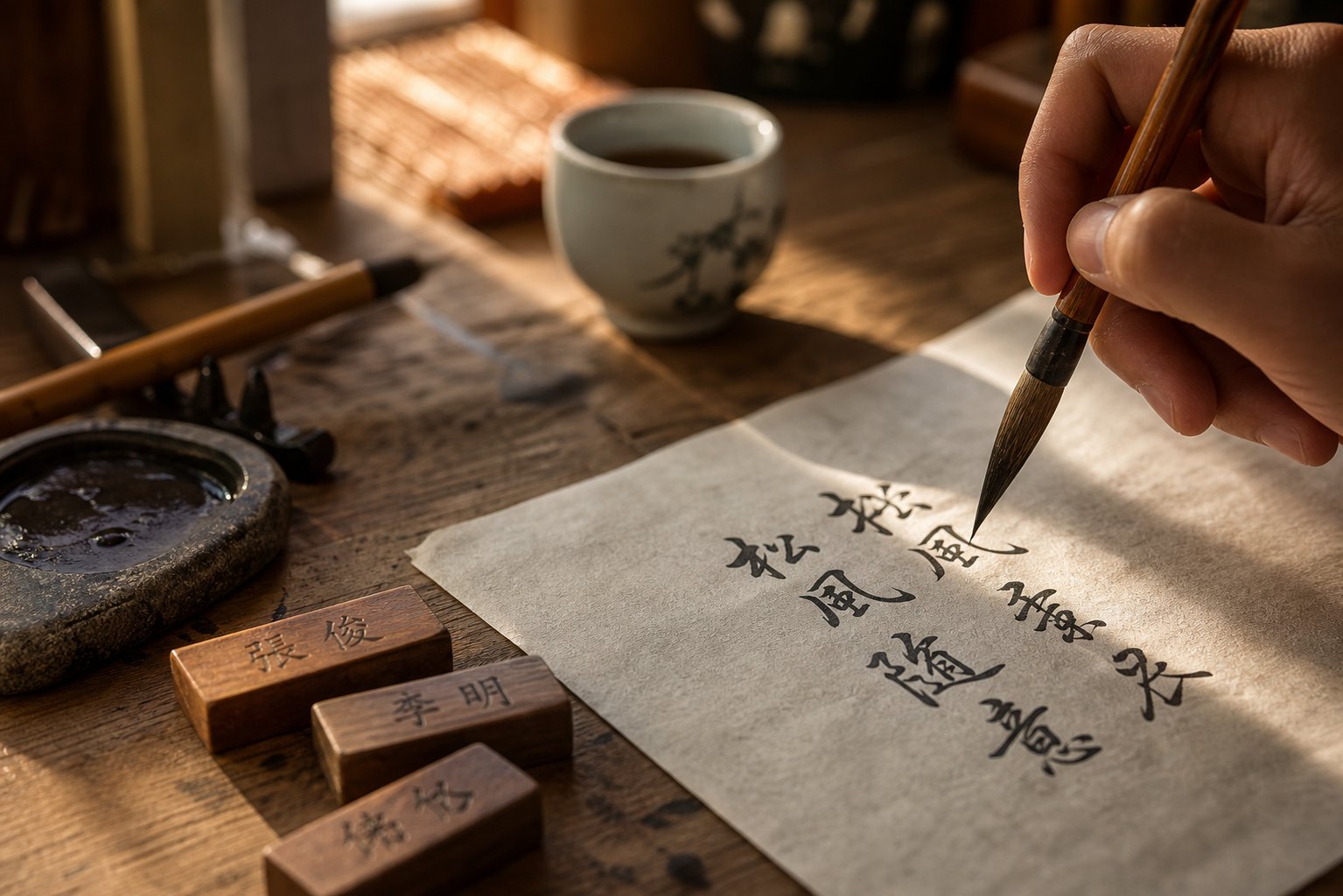
Why Every Foreigner Should Have a Chinese Nickname
You want a Chinese nickname that sounds natural, carries real meaning, and doesn't make native speakers cringe. Good. You're already ahead of most people who type "what is my chinese name" into a random asian name generator and call it a day.
A well-chosen Chinese nickname does more than look cool on a WeChat profile. It opens doors that stay shut for foreigners who never bother. Whether you're doing business in Shanghai, studying Mandarin at a language school, building a following on Xiaohongshu, or simply deepening a personal cultural connection, having your own Chinese name changes how people interact with you.
Why Foreigners Need a Chinese Nickname
Chinese people deeply appreciate when foreigners make the effort to adopt a Chinese name, as it signals cultural respect and a genuine willingness to connect.
This isn't just politeness. As Tandem notes, a Chinese name makes your Chinese friends remember you better and shows you're making an effort to fit into the culture. Not all of your Chinese contacts will pronounce your English name correctly or even remember it easily. A thoughtful Chinese nickname solves that problem instantly and tells people something about who you are before you even speak.
Among the world of asian names, Chinese names are unique because each character carries its own meaning. That means your nickname isn't just a label. It's a statement of identity.
What This Guide Will Help You Achieve
This guide walks you through three proven approaches to creating your Chinese nickname:
- Phonetic transliteration - converting your existing name's sounds into Chinese characters
- Meaning-based naming - choosing characters based on qualities you value
- Hybrid approach - blending a phonetic surname with a meaningful given name
You won't need a chinese name generator or a chinese name gen tool to get this right, though those can be useful starting points. By the end, you'll have a personalized nickname you actually understand, one you can explain to native speakers and use with confidence in any context.
The process starts with understanding how Chinese names are actually structured, because the rules are nothing like what you're used to in English.
Step 1 - Understand How Chinese Names Are Structured
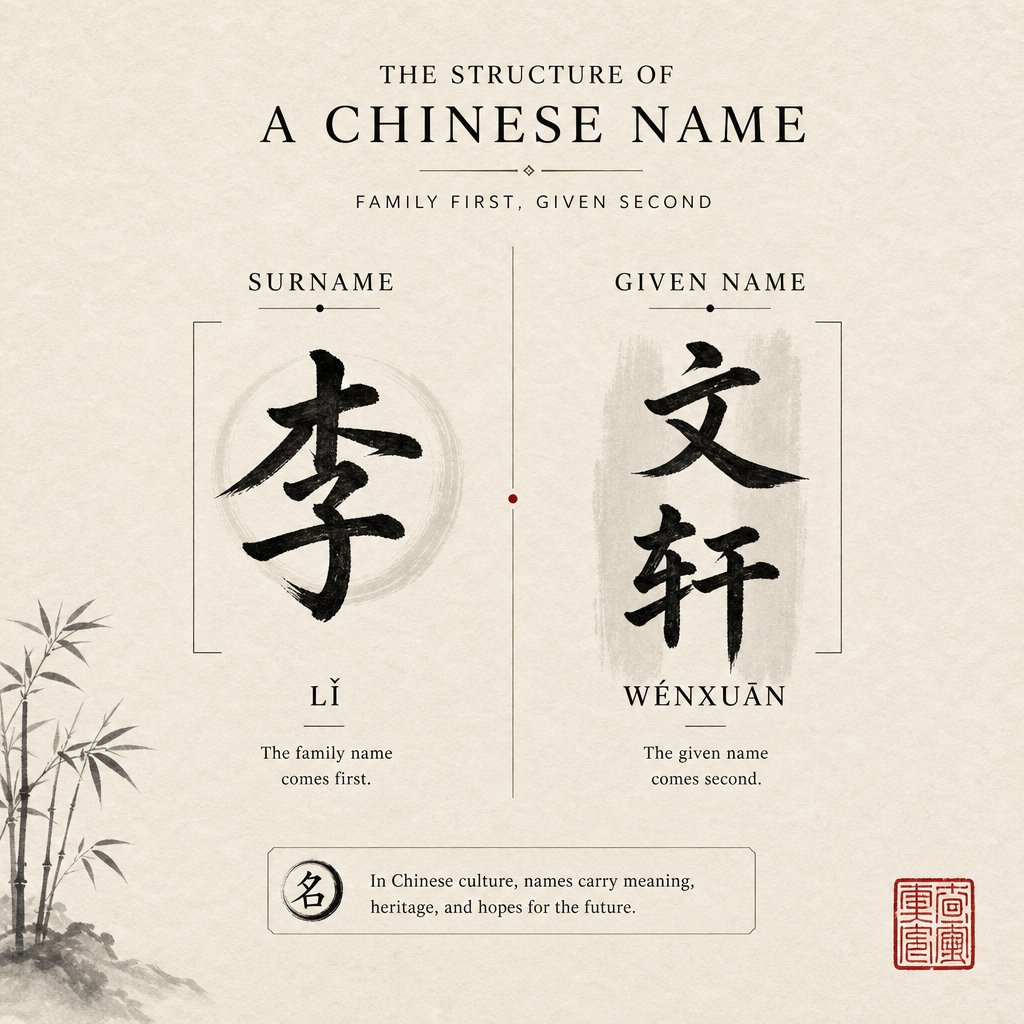
In English, your first name chinese speakers would call your "given name" comes before your family name. In Chinese, it's the opposite. The surname (姓, xing) always leads, followed by the given name (名, ming). So when you hear "Li Ming," Li is the family name and Ming is the personal name. This reversal isn't just a quirk. It reflects a cultural priority: family identity comes before individual identity.
The Surname Plus Given Name Structure
Chinese surnames are overwhelmingly one syllable. The Asia Media Centre reports that the top 100 chinese family names all have a single syllable, and these cover roughly 85 percent of China's population. There are only about 400 different chinese surnames in active use, with Li (李), Wang (王), and Zhang (张) being the most common chinese last names, shared by over 270 million people.
Given names, on the other hand, are typically one or two characters. A two-character given name is more common in modern China, giving parents room to layer meaning. Each character is chosen deliberately. Some express hopes for the child, like Kang (健康, healthy) or Yong (勇, brave). Others mark the era a person was born in or follow generational naming patterns within a family.
The meaning of chinese last names often traces back to ancient kingdoms, occupations, or legendary figures. Wang (王) literally means "king." Zhang (张) combines the symbols for "bow" and "long," linked to the mythical inventor of the bow and arrow. Understanding this depth helps you appreciate that a chinese surname is never just a random sound. It carries centuries of history.
Historical Naming Layers: Ming, Zi, and Hao
Historically, Chinese people could accumulate multiple names throughout their lives. Beyond the given name (名, ming), educated individuals received a courtesy name (字, zi) upon reaching adulthood, typically around age 20 for men. The zi functioned as a public-facing name. Using someone's ming directly was reserved for parents, teachers, or very close intimates. Calling an acquaintance by their ming was considered rude.
There was also the art name or pseudonym (号, hao), which a person could choose for themselves. The hao often referenced a place, aspiration, or personal philosophy. The famous poet Li Bai, for example, had the hao "Qing Lian Ju Shi" (青莲居士). These layered naming traditions are no longer practiced in everyday modern life, but they reveal how seriously Chinese culture treats the act of naming.
For foreigners creating a nickname, you don't need a zi or hao. But knowing they exist gives you cultural context and shows native speakers you understand naming as more than a surface-level exercise.
How Nicknames Differ from Formal Chinese Names
A chinese name first name (given name) is what appears on official documents. A nickname, or 小名 (xiao ming), is far more casual. Nicknames in Chinese often follow simple patterns: doubling a single character from the given name, or adding the prefix 小 (xiao, meaning "little") before the surname or given name. Think of it like turning "Robert" into "Bobby," but with its own set of conventions.
Here's how formal names relate to their nickname forms:
| Full Name | Surname | Given Name | Nickname Form |
|---|---|---|---|
| 李明 (Li Ming) | 李 (Li) | 明 (Ming) | 小明 (Xiao Ming) |
| 王娜 (Wang Na) | 王 (Wang) | 娜 (Na) | 娜娜 (Nana) |
| 张伟 (Zhang Wei) | 张 (Zhang) | 伟 (Wei) | 小伟 (Xiao Wei) |
| 陈乐 (Chen Le) | 陈 (Chen) | 乐 (Le) | 乐乐 (Lele) |
As a foreigner, you'll typically start by picking a common chinese surname that sounds similar to your own last name. Someone named "Lee" might naturally choose 李 (Li). A person named "Wang" already has a perfect match. From there, you craft a given name of one or two characters that sounds good, carries positive meaning, and pairs well with your chosen surname中文.
The nickname layer comes after. Once you have a full Chinese name, you can derive a casual nickname from it using the same patterns native speakers use. That's what makes your name feel authentic rather than forced.
With the structure clear, the real creative decision begins: which approach will you use to build your name from scratch?
Step 2 - Choose Your Naming Approach
Every foreigner who picks a Chinese name faces the same fork in the road: do you want people to hear your original name in the Chinese version, or do you want something that sounds entirely native? Your answer shapes everything that follows. There are three distinct approaches, and each one serves a different goal.
Here's a quick decision framework to guide your choice:
- If you want Chinese speakers to recognize your original name when they hear it, choose phonetic transliteration.
- If you want to blend in culturally and express personal values through your chinese for name, choose a meaning-based name.
- If you want the best of both worlds, a recognizable surname paired with a meaningful given name, choose the hybrid approach.
Phonetic Transliteration of Your Existing Name
This is the most straightforward method. You find Chinese characters whose pronunciation approximates the sounds of your English name, syllable by syllable. The result is a name that Chinese speakers can hear and connect back to your original identity.
Mark Zuckerberg's Chinese name is 扎克伯格 (Zhakeboge), a pure transliteration. Nobody mistakes it for a native Chinese name, but everyone knows exactly who you're talking about. Similarly, "Sarah" becomes 莎拉 (Shala) and "David" becomes 大卫 (Dawei). An english to chinese name converter or mandarin name generator tool will typically produce this type of result by default.
The tradeoff? Characters chosen purely for sound often carry random or neutral meanings. 扎克伯格 doesn't mean anything poetic. It's functional, like a phonetic label. For official documents and international business where name recognition matters most, transliteration works well. For building personal connections in Chinese, it can feel a bit flat.
Choosing a Fully Meaning-Based Chinese Name
The opposite end of the spectrum: you abandon any phonetic link to your English name and instead choose characters entirely for their chinese name meaning. This is what serious Mandarin speakers and long-term residents often do when they want a name that feels genuinely Chinese.
The most famous example is Canadian comedian Mark Rowswell, known across China as 大山 (Dashan, meaning "big mountain"). As Rowswell himself explained, the name stuck because it's simple, memorable, and carries a down-to-earth quality that matched the public image he wanted to project. He noted that most foreigners get "very proper and cultured, even kind of poetic" names in Chinese class, so taking a plain, earthy name felt refreshingly different. He even dropped the surname entirely, treating 大山 like a standalone stage name, similar to "Sting."
A meaning-based name lets you express qualities you value: strength, wisdom, grace, resilience. You're not limited by what your English name sounds like. The challenge is that it requires deeper cultural knowledge to pull off without sounding awkward or grandiose. Names in chinese and meanings are tightly linked, so every character choice carries weight.
The Popular Hybrid Approach
Most long-term expats and serious learners land here. You keep a Chinese surname that phonetically echoes your real last name, then pair it with a given name chosen for meaning. This gives you a name that sounds natural to Chinese ears while maintaining a thread back to your identity.
Imagine your surname is "Harris." You might choose the common Chinese surname 何 (He), which sounds similar and is a real surname shared by millions. Then you select a meaningful given name like 志远 (Zhiyuan, "aspiration reaches far"). The result, 何志远, sounds completely natural and carries genuine meaning, yet your English-speaking friends can still see the "H" connection.
This hybrid method is the preferred approach for foreigners integrating into Chinese professional or academic life. It balances cultural authenticity with personal identity. Whether you use a chinese name generator male tool or work with a native speaker, the hybrid framework gives you the most flexibility.
A china names generator can help you brainstorm initial options for any of these three approaches, but treat automated suggestions as raw material rather than finished products. The real work begins when you start mapping specific English sounds to Chinese syllables and evaluating which characters carry the right connotations.
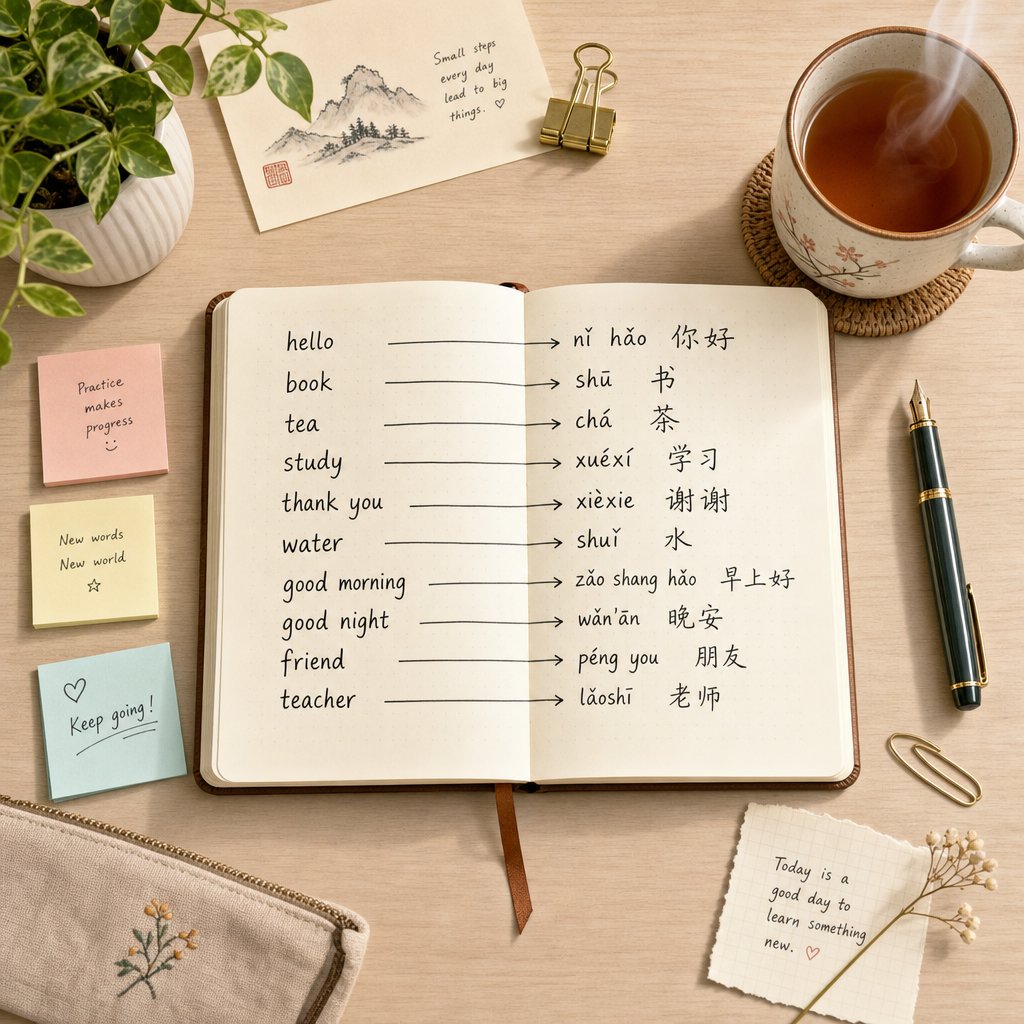
Step 3 - Map Your English Sounds to Chinese Syllables
Here's where things get practical. You've picked your naming approach. You know whether you're going full transliteration, hybrid, or meaning-based. If your plan involves any phonetic element at all, you need to understand how English sounds translate into pinyin to chinese characters. And the first thing to accept? Mandarin has roughly 400 possible syllables. English has thousands. Exact matches are rare. The goal is approximation, not perfection.
Think of it like fitting a square peg into a round hole, except you have a whole drawer of slightly different round holes to choose from. Some fit better than others. The art of converting your english to chinese name lies in picking the closest available sounds while keeping the result natural and pleasant.
Common English-to-Pinyin Sound Mappings
Chinese syllables follow a strict structure: an optional leading consonant, a vowel (or vowel combination), and an optional trailing consonant that can only be "n" or "ng." That's it. No final "k," no final "m," no consonant clusters like "str" or "nk." As Rhapsody in Lingo explains, when Mandarin encounters a foreign syllable ending in a consonant like "k" or "m," it has to add an extra syllable to preserve that sound. This is why transliterated names often end up longer than the original.
Here's a reference table mapping common English sounds to their closest pinyin equivalents. Use this as your starting point when building your name in characters:
| English Sound | Pinyin Equivalent | Character Example | Character Meaning |
|---|---|---|---|
| Ma- | ma | 马 (mǎ) | horse |
| Da- / De- | da | 达 (da) | to reach, to achieve |
| Li- / Lee | li | 李 (lǐ) | plum (also a common surname) |
| An- / Ann | an | 安 (an) | peace, tranquility |
| Mi- / Me- | mi | 米 (mǐ) | rice |
| Ke- / Ca- | ke | 克 (ke) | to overcome |
| Sa- / Sha- | sha | 莎 (sha) | a type of grass (used in female names) |
| Ai- / Eye | ai | 爱 (ai) | love |
| Wei- / Way | wei | 威 (wei) | power, authority |
| En- / An | en | 恩 (en) | grace, kindness |
| Si- / See | si | 思 (si) | to think, to ponder |
| Lu- / Loo | lu | 路 (lu) | road, path |
| Tai- / Ty | tai | 泰 (tai) | great, peaceful |
Notice that some English sounds map cleanly ("Ma" to "ma" is nearly perfect), while others require compromise. The English "r" sound, for instance, doesn't exist in Mandarin the way you're used to hearing it. As the Pinyin Cheatsheet notes, the Mandarin "r" actually sounds closer to the "s" in "vision" than the "r" in "root." So if your name is "Robert," you won't find a clean match for that opening sound. You'll need to adapt.
Building Your Phonetic Name Step by Step
Let's walk through a complete example. Imagine your name is Michael and you want to find my name in mandarin using phonetic transliteration.
Break the name into syllable chunks that Mandarin can handle:
- "Mi-" maps to the pinyin syllable "mai" (closer to the actual vowel sound in "Michael" than "mi"). Character option: 麦 (mai, meaning wheat).
- "-chael" contains a "k" sound followed by a vowel. This maps to "ke." Character option: 克 (ke, meaning to overcome).
- "-el" at the end is a weak syllable. It maps to "er" or can be represented by 尔 (er, a classical particle often used in transliterations).
Result: Michael becomes 麦克尔 (Maikeěr). Three syllables instead of two, because Mandarin needs that extra syllable to capture the final consonant sounds. You'll notice this is a functional chinese name converter process: break, match, assemble.
Here's the thing, though. 麦克尔 is three characters long, which already pushes the boundary of what feels natural for a Chinese name. A native Chinese name is almost always two or three characters total, surname included. If you're using this as a full transliteration for media or formal contexts, three or four characters is fine. But for a casual nickname? It's too much.
When to Simplify: Less Is More
This is where many foreigners go wrong. They try to translate english to simplified chinese characters for every single syllable of their name, and the result sounds clunky. A name like "Christopher" becomes 克里斯托弗 (Kelisituofu), six characters that no Chinese person would naturally use as a name. It reads like a news headline transliteration, not something a friend would call you.
The better strategy: focus on the first one or two syllables of your name and let the rest go. "Chris" becomes 克里斯 (Kelisi) or even just 克里 (Keli). "Michael" can shorten to 麦克 (Maike). "Jessica" might become 杰西 (Jiexi). You're aiming for something that sounds like a name, not a phonetic transcription of a passport.
Consider these simplified examples:
- Alexander - Full transliteration: 亚历山大 (Yalishanda, 4 characters). Nickname-friendly: 亚历 (Yali) or 山大 (Shanda).
- Elizabeth - Full transliteration: 伊丽莎白 (Yilishabai, 4 characters). Nickname-friendly: 丽莎 (Lisha).
- Jonathan - Full transliteration: 乔纳森 (Qiaonasen, 3 characters). Nickname-friendly: 乔纳 (Qiaona) or simply 乔 (Qiao).
An english to chinese converter tool will usually give you the full transliteration. That's useful as raw material. But for a nickname you'll actually use in conversation, trim it down. Two characters for the given name portion is the sweet spot. It fits the natural rhythm of Chinese speech and doesn't announce "I'm a foreign name" every time someone says it.
One more practical tip: say your candidate name out loud several times in a row. Does it flow? Can you imagine a Chinese friend calling you that across a crowded restaurant? If it feels like a mouthful, it probably is. Shorten it further or try different character combinations for the same sounds.
Sound mapping gets you the raw phonetic material. But identical pinyin syllables can correspond to dozens of different characters, each with wildly different meanings. Picking "ma" for your name could give you 马 (horse), 妈 (mother), 麻 (hemp), or 骂 (to scold), depending on which character you choose. The next critical step is selecting characters that carry the right meaning and avoid unintended associations.
Step 4 - Select Characters with the Right Meaning
You've identified which pinyin syllables match your name. The temptation now is to grab the first character that fits the sound and move on. Don't. In Chinese, a single syllable like "li" can map to over 30 different chinese hanzi, each carrying a completely different meaning. The character you pick determines whether your name in chinese meaning reads as "elegant" or "sharp knife." Same sound, wildly different impression.
Every Chinese character is a standalone unit of meaning. Unlike English letters, which are phonetic building blocks, mandarin characters function more like tiny words. When Chinese parents name a child, they spend weeks weighing the connotations, visual balance, and cultural resonance of each character. You should bring the same intentionality to your nickname.
How to Pick Characters with Positive Meanings
Start by listing the pinyin syllables you need, then explore which characters are available for each sound. Look for characters associated with nature, virtues, aspirations, or beauty. These are the same themes Chinese families draw from when choosing chinese names girl options or chinese names male options for their children.
Here's a reference table showing how the same sound opens up very different meaning possibilities:
| Pinyin Sound | Character Option A | Meaning A | Character Option B | Meaning B |
|---|---|---|---|---|
| an | 安 | peace, tranquility | 岸 | shore, riverbank |
| mei | 美 | beautiful, fine | 梅 | plum blossom (resilience) |
| li | 丽 | elegant, radiant | 力 | strength, power |
| zhi | 志 | aspiration, will | 智 | wisdom, intellect |
| ya | 雅 | refined, graceful | 亚 | second, sub- (neutral) |
| wei | 伟 | great, magnificent | 威 | authority, power |
| xue | 雪 | snow (purity) | 学 | learning, study |
Notice how each sound gives you a choice between different flavors of meaning. For the syllable "mei," you could go with 美 (beautiful) or 梅 (plum blossom, symbolizing perseverance through hardship). Both are positive, but they project different qualities. This is where your personal values shape the name.
Gender Conventions in Character Choice
Chinese names aren't grammatically gendered the way Romance languages enforce gender, but strong cultural patterns exist. Traditional female chinese names tend to feature characters evoking beauty, nature, and grace: 美 (beautiful), 玉 (jade), 秀 (elegant), 花 (flower), 雪 (snow). Male names lean toward strength, ambition, and grandeur: 伟 (great), 强 (strong), 军 (military), 鹏 (mythical great bird).
That said, many characters work across genders. 智 (wisdom), 安 (peace), and 乐 (joy) appear in both male and female names without raising eyebrows. If you prefer a gender-neutral nickname, these versatile characters give you flexibility. The key is awareness: if you're a man choosing 美丽 (beautiful and elegant) as your given name, native speakers will find it jarring. Context matters.
Characters to Avoid and Why
Choosing the wrong character can undermine your name entirely. AL Language Cafe highlights several categories of characters to steer clear of:
- Characters with negative homophones. The character 思 (si, to think) is positive alone, but paired with 旺 (wang, prosperous), the combination 思旺 sounds dangerously close to 死亡 (siwang, death). Always say your full name aloud and listen for unfortunate sound-alikes.
- Characters with vulgar colloquial meanings. The character 日 (ri) officially means "sun" or "day," but in spoken slang it carries a profane meaning in many regions. Similarly, 草 (cao, grass) has vulgar connotations in casual speech. Dictionary definitions won't warn you about these.
- Overly rare or complex characters. A character with 20+ strokes might look impressive in calligraphy, but it becomes a daily inconvenience. People struggle to write it, type it, or remember it. For a nickname especially, simpler characters with fewer strokes are preferred. Aim for characters in the 5-12 stroke range for readability.
- Characters associated with numbers 4 or 250. The number 4 (四, si) sounds like 死 (death), and 250 (二百五) is slang for "idiot" in northern China. Avoid characters or combinations that evoke these associations.
The chinese symbols and meanings you choose also affect how your name looks visually. Chinese names are written, displayed on business cards, and used in calligraphy. A name with balanced stroke counts across characters looks more harmonious on paper. Two characters of roughly equal visual weight feel more polished than pairing a 3-stroke character next to a 17-stroke one.
Think of character selection as the difference between choosing a name that means something versus one that just sounds like something. The phonetic mapping gave you the raw sounds. The characters you attach to those sounds determine whether your nickname carries weight, elegance, and cultural fluency, or whether it reads like a random string of syllables pulled from a dictionary.
Even with the perfect characters chosen, there's one more layer that can make or break your name: the tones those characters carry and how they sound when spoken together in sequence.

Step 5 - Get the Tones Right So Your Name Sounds Natural
A name can look perfect on paper and still make native speakers wince the moment you say it out loud. Why? Because Mandarin is a tonal language. The pitch pattern you use when pronouncing a syllable changes the word entirely. Pick characters with clashing or awkward tone combinations, and your carefully crafted nickname becomes an unintentional joke every time someone says it.
If you've never studied a tonal language before, this concept might feel abstract. Imagine if the English word "present" meant something completely different, not just shifted emphasis, but an entirely unrelated word, depending on whether your voice went up or down. That's everyday reality in Mandarin. When you convert to mandarin from English, tones are the invisible layer most foreigners overlook.
Understanding the Four Tones of Mandarin
Mandarin has four main tones plus a neutral (unstressed) tone. Each one gives a syllable its identity. As Hacking Chinese explains, tones are differences in pitch that change the meaning of a spoken syllable, much like vowel length differentiates "bid" from "bead" in English, except the stakes are higher.
Here's how each tone works, using the syllable "ma" as the classic example:
- First tone (high and flat) - ma with macron (mā): Your voice stays steady at a high pitch, like saying "aah" at the dentist. 妈 (mā) means "mother."
- Second tone (rising) - ma with acute accent (má): Your pitch rises from middle to high, like asking a surprised "Huh?" in English. 麻 (má) means "hemp" or "numb."
- Third tone (low/dipping) - ma with caron (mǎ): Your voice drops low and may rise slightly at the end. 马 (mǎ) means "horse."
- Fourth tone (falling) - ma with grave accent (mà): A sharp drop from high to low, like firmly saying "Stop!" 骂 (mà) means "to scold."
There's also a neutral tone, which is short, light, and unstressed. It doesn't carry its own pitch but borrows from the syllable before it. You'll encounter it in particles and repeated-character nicknames like 妈妈 (māma, mom) where the second syllable is soft and quick.
Sounds complex? Here's why it matters for your nickname specifically: if you choose the character 马 (mǎ, horse) as part of your name, you need to pronounce it with the third tone. Say it with the fourth tone and you're calling yourself "scold." The michael pronunciation challenge many English speakers face when adopting Chinese names comes down to exactly this: the sounds feel familiar, but the pitch patterns are foreign territory.
How Tone Combinations Affect Your Name
Individual tones are manageable. The real challenge is how tones interact when placed next to each other. A two-character name creates a tone pair, and some pairs flow naturally while others feel clunky or create unfortunate sound associations.
Certain combinations are considered more melodic in Chinese. A second tone followed by a fourth tone (rising then falling) creates a satisfying arc. A first tone paired with a fourth tone (high flat then sharp drop) sounds decisive and clean. Two third tones in a row actually trigger a pronunciation rule called tone sandhi: the first third tone shifts to a second tone in natural speech. So if both characters in your given name carry the third tone, you'll never actually pronounce them both as third tones together.
Problematic combinations to watch for:
- Two fourth tones in sequence can sound abrupt and aggressive, like barking commands.
- Three third tones in a row (across surname and given name) create a pronunciation tangle that even native speakers find awkward.
- Tone combinations that form existing words. Your two-character given name, when spoken aloud, might sound identical to a common word with an embarrassing meaning. This is where a mandarin chinese translator tool alone won't save you. You need a human ear.
For example, imagine choosing characters that individually mean "wisdom" and "grace," but whose tone combination when spoken quickly sounds like a word for "hemorrhoids" or a brand of instant noodles. The written name looks elegant. The spoken name gets laughs. This is exactly the kind of problem a chinese mandarin translator or dictionary can't flag for you, because the issue lives in the sound, not the text.
Before committing to any Chinese nickname, listen to it spoken aloud by a native speaker. A name that reads beautifully can sound unfortunate if the tone combination creates an unintended homophone.
Practical Steps for Beginners with No Tonal Experience
You don't need to master all four tones before choosing your nickname. But you do need to hear your candidate names pronounced correctly and verify they sound natural together. Here's how to approach this even as a complete beginner in english to chinese mandarin pronunciation:
- Use a phonetic pronunciation generator or pinyin chart with audio. Sites like HanziStroke and Yabla's pinyin chart let you click any syllable and hear it spoken with each tone. Type in your candidate characters and listen to how they sound in sequence.
- Record a native speaker saying your name. Ask a Chinese friend, tutor, or language partner to say your candidate name naturally, as if introducing you to someone. Save the recording on your phone so you can practice mimicking it.
- Test the name in a sentence. A name that sounds fine in isolation might clash with common phrases around it. Ask someone to say "This is my friend [your name]" in Chinese and listen for anything that sounds off.
- Try exaggerating the tones at first. When practicing, make the first tone extra high, the second tone really rise, the third tone dip low, and the fourth tone fall sharply. You can soften later once the patterns feel natural.
The tone layer is what separates a nickname that sounds like it belongs from one that marks you as someone who picked characters from a list without ever hearing them spoken. You've now handled structure, approach, sound mapping, character meaning, and tonal flow. The next challenge is more subtle and arguably more dangerous: cultural pitfalls that no dictionary or tone chart will warn you about.
Step 6 - Avoid These Common Cultural Pitfalls
Tones and character meanings are technical problems you can solve with research. Cultural pitfalls are different. They live in the unspoken rules that native speakers absorb growing up but rarely explain to outsiders. A name can be phonetically correct, carry positive individual character meanings, and still make every Chinese person in the room cringe. Understanding what a chinese name mean to native ears, beyond the dictionary definition, is what separates a thoughtful nickname from an embarrassing one.
Names That Sound Grandiose or Presumptuous
When foreigners browse lists of cool chinese names reddit threads recommend or scroll through chinese word symbols looking for inspiration, they often gravitate toward the most powerful-sounding characters. Dragon. Phoenix. Emperor. Jade Emperor. The logic makes sense: these symbols feel iconic and culturally significant. The problem? Using them in your own name comes across as wildly presumptuous.
- Using 龙 (long, dragon) or 凤 (feng, phoenix) in your name feels like naming yourself "King" or "Goddess" in English. These characters carry immense cultural weight and are traditionally reserved for emperors, mythological contexts, or very specific family naming traditions. A foreigner casually adopting them signals a lack of awareness.
- Choosing characters like 帝 (di, emperor) or 圣 (sheng, saint/holy) reads as laughably self-important. No modern Chinese person would use these in a personal name without irony.
- Picking names identical to famous historical figures. As Chinese Name Translator points out, naming yourself after Li Bai or Zhuge Liang is the equivalent of a Chinese person moving to the West and introducing themselves as "Shakespeare." It feels disrespectful and out of place, no matter how much you admire the figure.
- Using overly literary or archaic characters that no modern person would put in a name. Characters pulled from classical poetry or ancient texts might look beautiful in a calligraphy generator chinese tool, but they sound pretentious in everyday conversation, like naming yourself "Bartholomew Thaddeus" in English when everyone else goes by two syllables.
The chinese name definition of "appropriate" skews toward modesty. Chinese naming culture values subtlety. You suggest virtues through implication, not declaration. A name meaning "aspires to wisdom" works. A name meaning "I am the wise dragon king" does not.
Accidental Homophones and Vulgar Meanings
This is the pitfall that catches even careful researchers. You've checked each character individually. Both meanings are positive. But spoken together as a full name, the syllable combination sounds identical to something unfortunate.
- Characters that form slang terms when combined. The characters 思 (si, to think) and 旺 (wang, prosperous) look great individually, but 思旺 spoken aloud sounds nearly identical to 死亡 (siwang, death). Similarly, 采花 (caihua, "picking flowers") is a euphemism for sexual assault in Chinese slang.
- Names that sound like brands or products. If your chosen name sounds like a popular instant noodle brand, a cleaning product, or a fast food chain, you'll never live it down. Chinese speakers will hear the brand association every single time.
- Characters with hidden vulgar meanings in regional dialects. A character that's perfectly neutral in standard Mandarin might carry crude connotations in Cantonese, Shanghainese, or other regional varieties. The character 日 (ri, sun/day) is the classic example: innocent in writing, profane in colloquial speech across much of China.
- Names that are too childish for an adult. Choosing something like 开心 (kaixin, happy) or 旺财 (wangcai, prosperous wealth) might seem cheerful, but these read as pet names or toddler nicknames. Using them in a professional context would be like a 40-year-old executive introducing himself as "Buddy" or "Sunshine."
People who get tattoo chinese writing without verification face the same risk on a permanent scale. The lesson applies equally to nicknames: never trust your own research alone when homophones and slang are involved.
Context Mistakes That Make Native Speakers Cringe
Beyond character choice, there's a social layer to using a Chinese nickname. When is it welcomed, and when does it feel performative?
Chinese speakers genuinely appreciate foreigners who adopt a Chinese name in contexts where it serves communication: business meetings, language classes, social gatherings with Chinese friends, or living in a Chinese-speaking environment. The effort signals respect and makes interaction smoother for everyone.
It becomes awkward when someone adopts a Chinese nickname purely as an accessory without any real engagement with the language or culture. If you can't pronounce your own name correctly, don't know what the characters mean when asked, or only use it to seem interesting at parties with other Westerners, native speakers will notice. The name stops being a bridge and starts feeling like a costume.
The sweet spot: choose a name you can explain, pronounce, and use consistently in Chinese-speaking contexts. Treat it as a living part of your identity rather than a novelty. That authenticity is exactly what makes the difference between a name that opens doors and one that raises eyebrows.
With these pitfalls mapped out, the natural question becomes: how do you actually confirm your chosen name doesn't fall into any of these traps? The answer isn't more solo research. It's getting real feedback from real native speakers.

Step 7 - Verify Your Nickname with Native Speakers
You've done the research. You've mapped sounds, chosen characters with positive meanings, checked the tones, and avoided the obvious cultural landmines. Your candidate name looks solid on paper. Here's the uncomfortable truth: paper isn't enough. A chinese name translation that reads well in a dictionary can still carry subtle connotations, regional associations, or generational baggage that only a native speaker would catch. Verification isn't optional. It's the step that separates a name you can use with confidence from one that quietly makes people uncomfortable without telling you why.
Why can't you just rely on your own research? Because Chinese is spoken across a vast geographic and generational landscape. A character that feels neutral to a 25-year-old in Beijing might remind a 50-year-old in Guangzhou of a disgraced politician or a dated slang term. Regional dialects and generational differences shape how people hear and interpret names in ways that no single dictionary or tool can capture. When you translate name chinese characters into a nickname, you're entering a living language with layers of association that shift by region, age group, and social context.
Where to Find Native Speakers for Feedback
You need at least three native speakers to review your candidate names, ideally from different regions and age groups. Where do you find them? More places than you might think:
- Language exchange partners. Apps like HelloTalk, Tandem, and Speaky connect you with Chinese speakers who are learning your language. They're already motivated to help, and you can return the favor by checking their English. This is one of the most accessible ways to get your name in chinese language reviewed by real people.
- Chinese tutors. A professional Mandarin tutor has likely helped dozens of students choose names and knows exactly what pitfalls to flag. Even a single paid session focused on name verification is worth the investment.
- University Chinese departments or cultural associations. If you're near a university, Chinese student associations often welcome cultural exchange. Many members enjoy helping foreigners with naming because it's a fun, low-stakes conversation starter.
- Online communities. Subreddits like r/ChineseLanguage, Chinese learning Discord servers, and Facebook groups dedicated to Mandarin learners all have native speakers willing to give quick feedback on name candidates.
- Colleagues or friends who are native speakers. If you already have Chinese contacts in your professional or personal life, ask them directly. Most people find it flattering to be consulted on something this personal.
The key is diversity. One person's opinion isn't enough. A speaker from Shanghai might miss a connotation that's obvious to someone from Chengdu. Someone in their twenties might not catch an association that's immediately apparent to their parents' generation.
What Questions to Ask When Verifying Your Name
Don't just show someone your name and ask "Is this okay?" That's too vague. People will often say it's fine out of politeness. You need specific questions that draw out honest reactions. Here's a structured verification process:
- Write down 2-3 candidate names. Having multiple options gives your reviewers something to compare and makes it easier for them to express preferences without feeling like they're rejecting your one choice.
- Ask at least 3 native speakers from different regions for their gut reaction. Show them the characters and ask: "What's the first thing that comes to mind when you see this name?" Their immediate, unfiltered response tells you more than any careful analysis.
- Ask specifically about homophones and unintended associations. Say: "Does this name sound like any word, brand, or phrase that might be funny or inappropriate?" Give them permission to be blunt. Remind them you'd rather hear the truth now than discover the problem later.
- Ask them to use your name in a sentence. Request something like: "Can you introduce me to an imaginary friend using this name?" Hearing your name embedded in natural speech reveals flow issues that isolated pronunciation doesn't. If they stumble or hesitate, that's a signal.
- Listen to their pronunciation and practice repeating it. Record them saying your name. Play it back. Try to match their tones and rhythm exactly. If you can't reproduce it after several attempts, the name might be too phonetically complex for you at your current level.
A few additional questions worth asking: "Does this name sound like it belongs to a man or a woman?" "How old does this name sound, like a child's name or an adult's?" "Would this name feel strange on a business card?" These questions surface assumptions you might not have considered when you chose to name translate in chinese characters.
Ask speakers of different ages. A character that feels fresh and modern to a college student might sound dated or carry political associations for someone over 50.
Pay attention to body language too. If someone pauses, tilts their head, or suppresses a smile before saying "it's fine," dig deeper. Chinese communication culture often avoids direct criticism, especially with foreigners making an effort. You may need to explicitly say: "Please be honest. I won't be offended. I'd rather fix this now."
Once you've gathered feedback and settled on a name that passes verification, you'll notice something shift. You'll feel ownership over it. You'll be able to explain my name in chinese language to anyone who asks, tell them what the characters mean, and pronounce it with the confidence that comes from knowing real people have confirmed it works. That confidence changes how you carry the name into actual use, which brings up the final practical question: where and how do you actually deploy your new nickname in daily life?
Step 8 - Know When and How to Use Your New Nickname
You have a verified Chinese nickname. Native speakers gave it the thumbs up. You can pronounce it without wincing. The question now isn't whether your name works. It's where and how to use it. Because just like you wouldn't introduce yourself as "Bobby" in a boardroom or "Dr. Williams" at a backyard barbecue, Chinese naming has its own context rules. Using the wrong form in the wrong setting can undercut all the careful work you've done.
Chinese culture distinguishes sharply between formal and casual address. Your name in chinese isn't a single fixed label. It's a flexible tool you deploy differently depending on who you're talking to, where you are, and what impression you want to make.
Formal vs Casual Naming Contexts in China
Think of your Chinese identity as having three layers: your full formal Chinese name (surname plus given name), your casual nickname, and your transliterated legal name. Each one belongs in specific situations. Using a playful nickname in a contract negotiation feels as off as putting your legal passport name on a WeChat sticker.
Here's how to match your name for chinese contexts:
| Situation | Recommended Name Form | Example |
|---|---|---|
| Business meeting or formal introduction | Full formal Chinese name (surname + given name) | 何志远 (He Zhiyuan) |
| WeChat display name or social media | Nickname or given name only | 志远 or 小何 |
| With close friends or classmates | Nickname with 小 (xiao) prefix or doubled character | 小何 (Xiao He) or 远远 (Yuanyuan) |
| Official documents, visa applications, bank accounts | Transliterated legal name (passport spelling) | Harris (哈里斯) |
| Ordering coffee or making reservations | Simplified given name or nickname | 志远 or just 何 |
| Language class or tutoring sessions | Full Chinese name (practice opportunity) | 何志远 |
Notice the pattern: formality increases with the stakes. A business card gets your full name. A group chat with friends gets the casual version. Official paperwork always uses your legal transliteration because Chinese institutions need the name that matches your passport. Mixing these up rarely causes serious problems, but getting them right signals fluency beyond just language. It shows you understand social dynamics.
One practical note about WeChat usernames: many users, both Chinese and foreign, choose creative display names for chinese social media that differ from their real names. Your Chinese nickname works perfectly here. It's personal, culturally engaged, and gives Chinese contacts an easy way to remember and tag you. Some foreigners use their Chinese nickname as their WeChat display name and their English name in parentheses, making it easy for both audiences.
How to Introduce Yourself Using Your Chinese Nickname
Knowing how to say my name is in chinese is the moment your nickname becomes real. You've built it, verified it, and practiced the tones. Introducing yourself is where it comes alive. There are two key phrases you need:
- 我叫... (Wo jiao...) - "My name is..." This is the most natural, everyday way to state your name. It literally means "I am called..." and works in virtually any context, from meeting your partner's parents to chatting with a taxi driver.
- 你可以叫我... (Ni keyi jiao wo...) - "You can call me..." This is slightly more casual and works perfectly when you want to offer your nickname specifically. It signals warmth and approachability, like saying "Just call me..." in English.
In practice, a smooth introduction might sound like this: "你好, 我叫何志远. 你可以叫我小何." (Hello, my name is He Zhiyuan. You can call me Xiao He.) You've given them your full in chinese name for formal reference and immediately offered the casual version for daily use. This mirrors exactly how Chinese people introduce themselves to new acquaintances.
For business settings, keep it simple and formal: "你好, 我是何志远." (Hello, I am He Zhiyuan.) Using 我是 (wo shi, "I am") instead of 我叫 (wo jiao) carries a slightly more professional tone, as Chinese language educators note. Both are correct, but 我是 feels more like a business card while 我叫 feels more like a handshake.
What about when people ask about your "real" name? It happens. Chinese colleagues might be curious about your English name too. A natural response: "我的英文名是 [English name], 但是你可以叫我 [Chinese nickname]." (My English name is [English name], but you can call me [Chinese nickname].) This bridges both worlds without making either feel secondary.
Here's something that eases the pressure: native speakers will help you. If you stumble over the tones or hesitate mid-introduction, most Chinese people will gently repeat your name back to you with correct pronunciation. They're not correcting you to embarrass you. They're helping you get it right because they appreciate the effort. Names for chinese people carry deep personal significance, and seeing a foreigner take naming seriously earns genuine goodwill.
The first few times you introduce yourself with your Chinese nickname will feel awkward. That's normal. By the tenth time, it rolls off your tongue. By the fiftieth, it feels like yours. And that's the whole point: a name you built with intention, verified with care, and use with confidence becomes part of how you move through Chinese-speaking spaces. Not as a tourist performing culture, but as someone who took the time to show up properly.
Frequently Asked Questions About Creating a Chinese Nickname
1. Can I just use a Chinese name generator to get my nickname?
Online Chinese name generators can provide useful starting points by matching English sounds to pinyin syllables, but they rarely account for tone combinations, regional slang associations, or cultural connotations. Treat generator results as raw material. You should still verify character meanings, check for unfortunate homophones, and get feedback from native speakers before committing to any generated name.
2. How many characters should a Chinese nickname have?
A natural-sounding Chinese nickname typically has two to three characters total, including the surname. For the given name portion, one or two characters is the sweet spot. Longer transliterations of four or more characters sound like news headline translations rather than personal names. If your full English name produces too many syllables, focus on the first one or two syllables and let the rest go.
3. What is the difference between a Chinese name and a Chinese nickname?
A formal Chinese name (surname plus given name) appears on documents and business cards. A nickname, or xiaoming, is the casual version used among friends and in everyday settings. Nicknames often add the prefix xiao (little) before the surname or double a character from the given name. As a foreigner, you build the formal name first, then derive a casual nickname from it using the same patterns native speakers follow.
4. Do I need to pick a Chinese surname or can I skip it?
For a complete Chinese name, a surname is expected in formal contexts like business introductions or language classes. Most foreigners choose a common Chinese surname that phonetically resembles their real last name, such as choosing Li for Lee or He for Harris. However, for purely casual nicknames used on social media or among close friends, some people skip the surname entirely and use just a two-character given name or a standalone nickname like Dashan.
5. How do I know if my chosen Chinese name has an embarrassing meaning?
The only reliable method is asking multiple native Chinese speakers from different regions and age groups. Show them your candidate names and ask specifically about homophones, slang associations, brand similarities, and whether the name sounds age-appropriate. Request that they use the name in a sentence aloud. Pay attention to hesitation or suppressed smiles, as Chinese communication culture often avoids direct criticism with foreigners.