The Real Skill Behind Reading Chinese Radicals
You have probably heard that Chinese radicals are the building blocks of characters. Maybe you have even seen a chart listing all 214 of them. Yet when you encounter an unfamiliar character in the wild, you freeze. You know radicals exist, but you cannot actually use them to decode what you are reading. Sound familiar?
This gap between knowledge and action is where most learners get stuck. Understanding what are Chinese radicals is one thing. Actively reading them inside complex characters is an entirely different skill. It is the difference between knowing the periodic table exists and being able to identify elements in a chemical compound on sight.
Why Reading Radicals Is a Skill, Not Just Knowledge
Chinese radicals function as semantic and structural clues embedded within characters. The Kangxi radicals number 214 in total, a system dating back to the 18th-century Kangxi Dictionary. That number intimidates beginners into thinking they need to memorize every single one before they can start reading. They don't. Research into character frequency shows that roughly 30 to 50 high-frequency radicals appear in the vast majority of common characters. Learning to spot these few dozen unlocks pattern recognition across hundreds of words.
Reading radicals is about pattern recognition, not memorization of all 214.
What You Will Learn in This Guide
This guide walks you through a step-by-step framework for reading radicals in Chinese characters. You will learn how to tell radicals apart from other components, prioritize the most common ones, recognize them when they change shape, locate them by position, and ultimately decode unfamiliar characters on the spot. Each step builds on the last, turning passive knowledge into an active reading skill you can apply every time you open a book, scan a menu, or scroll through Chinese text.
Step 1: Understand What a Chinese Radical Actually Is
Before you can read radicals inside characters, you need a clear picture of what the word "radical" actually means. This is where most learners hit confusion early, because three related terms get tossed around interchangeably: radicals, components, and bushou. They overlap, but they are not the same thing. Getting this distinction straight gives you a mental model that makes every later step easier.
Radicals vs Components vs Bushou Explained
So what is a radical in Chinese? Technically, a radical (部首, bushou) refers to the specific component under which a character is indexed in a dictionary. The Chinese term 部首 literally translates to "section head" because it heads a section of characters sharing that element. It is a classification tool invented for organizing dictionaries, not a label describing how characters were originally built.
A component (偏旁, pianpang), on the other hand, is any structural building block within a character. Every character that is not a standalone pictograph can be broken into two or more components. Some of those components happen to serve as the radical for dictionary purposes. Others do not.
Here is the key insight: all radicals can function as components, but not all components are radicals. When you look at the character 你 (you), it contains two components: 亻 (person) and 尔. The radical is 亻 because that is the element a dictionary uses to file this character. The component 尔 is just a component in this context, not a radical.
| Term | Chinese | Definition | Example | When It Applies |
|---|---|---|---|---|
| Radical | 部首 (bushou) | The component used to index a character in a dictionary | 氵 in 河 (river) | Dictionary lookup and classification |
| Component | 偏旁 (pianpang) | Any meaningful building block within a character | Both 日 and 月 in 明 (bright) | Anytime you break a character into parts |
| Bushou | 部首 | Same as radical; the Chinese term used in both contexts | 木 in 林 (forest) | Traditional dictionary organization |
Why This Distinction Matters for Reading
You might wonder why this matters in practice. Imagine you see the character 明 (bright). It has two components: 日 (sun) and 月 (moon). The radical here is 日, the element dictionaries use to categorize it. But 月 is not just filler. It carries meaning too. If you treat only the radical as important and ignore the other component, you lose half the information the character offers.
Many learning resources conflate these terms because, for quick explanations, the difference seems academic. But when you are actively reading radicals in Chinese characters, the distinction keeps you from making a common mistake: assuming every piece of a character is "the radical" or that a character has multiple radicals. It has one radical and potentially several components.
The element 大 (big) illustrates this perfectly. In the character 天 (sky), 大 serves as the radical. In the character 美 (beautiful), 大 is present as a component but the radical is actually 羊. Same element, different role depending on the character. As Outlier Linguistics points out, the concept of radicals (部首) did not even exist when the majority of Chinese characters were first created. Characters were designed around functional components expressing sound and meaning, and the radical system was layered on afterward for dictionary organization.
With this framework in place, you can approach any character knowing exactly what to look for: identify the components first, then determine which one serves as the radical. That two-step habit is what separates someone who knows about radicals in Chinese (radicals 中文) from someone who can actually use them while reading.
Of course, identifying components is only useful if you know which ones to learn first. Not all 214 carry equal weight, and a frequency-based approach saves enormous time.
Step 2: Prioritize the Most Common Radicals First
Trying to memorize all Chinese radicals before you start reading is like memorizing the entire dictionary before writing your first sentence. It sounds logical, but it stalls progress. A frequency-based approach works far better: learn the radicals that show up most often, and you immediately gain partial reading ability across hundreds of characters.
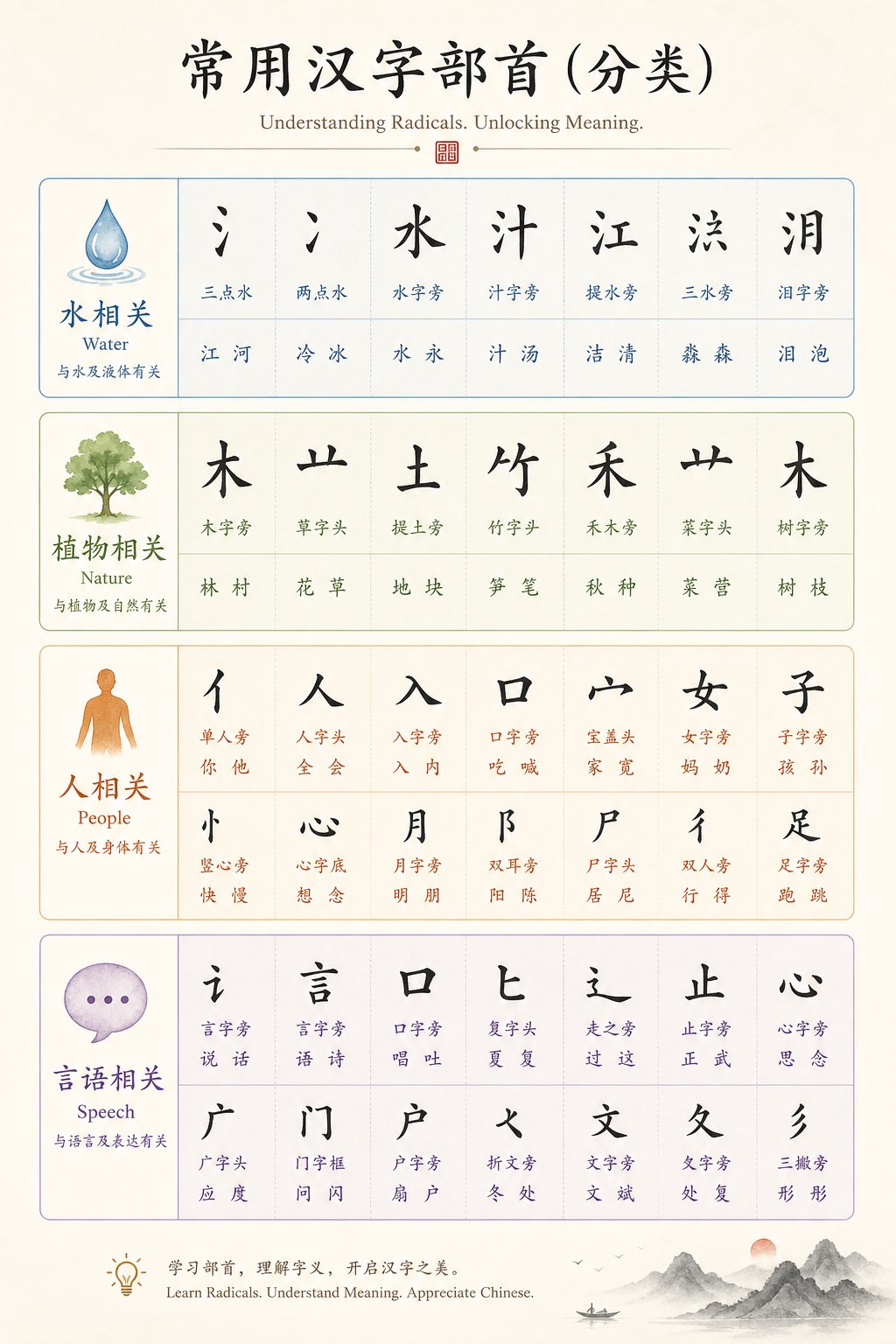
The 50 Radicals That Unlock Most Characters
Here is the reality most chinese radical list resources won't tell you upfront. Frequency data based on the 2,000 most commonly used characters shows that roughly 50 radicals account for the vast majority of everyday characters you will encounter. A frequency analysis by Hacking Chinese found that many radicals from the full 214 barely appear in common usage. The radical 鸟 (bird), for example, occurs in fewer than ten of the top 2,000 characters, mostly in bird species names that beginners will never need.
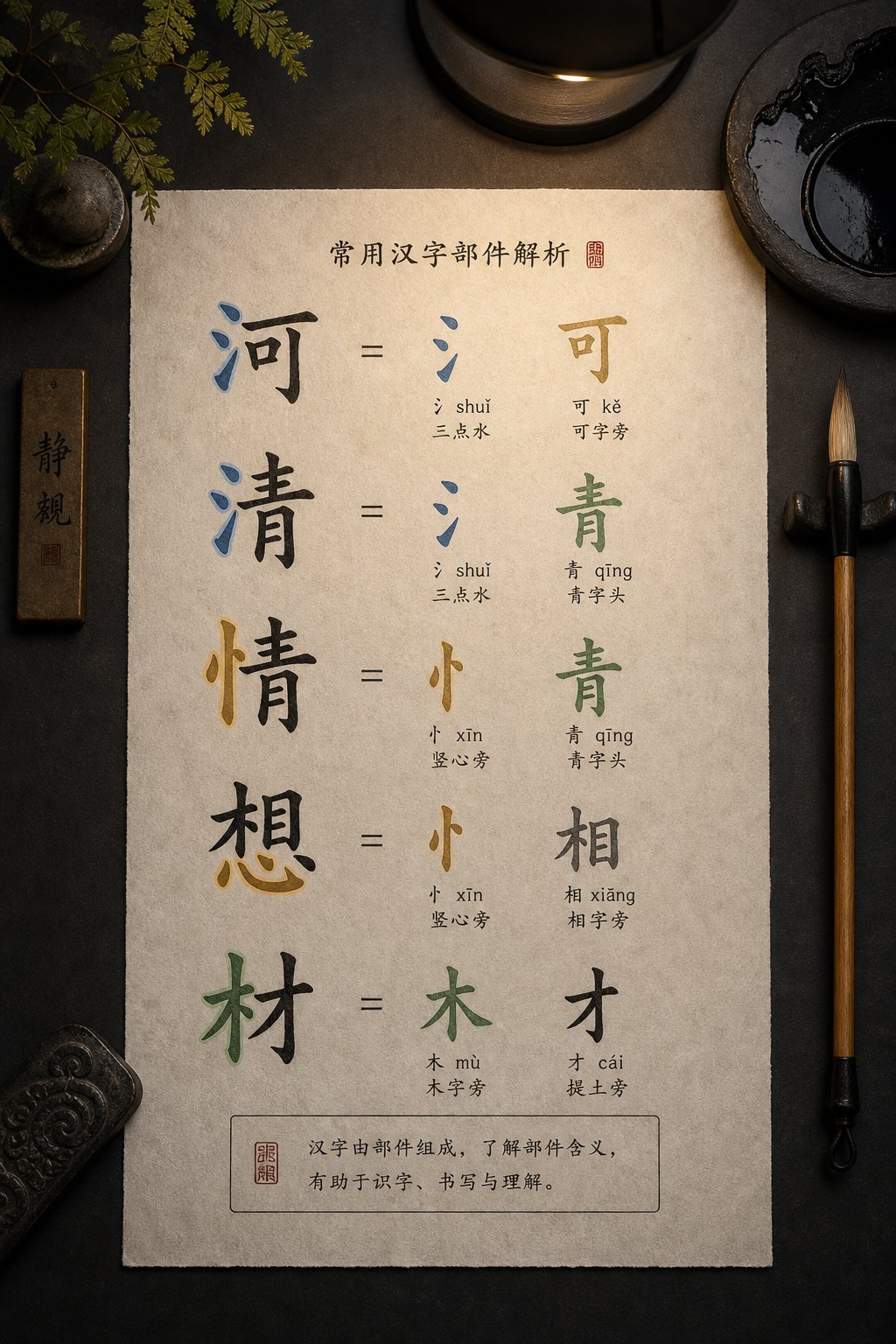
This means you do not need to study all chinese radicals before you start decoding characters. You need the ones that actually appear in the words you read every day. Think of it as a compounding investment: each high-frequency radical you learn unlocks reading clues for dozens of characters at once. Learn 氵 (water) and you can immediately make educated guesses about 河, 湖, 海, 洋, 洗, and many more.
The most common chinese radicals, based on frequency within everyday characters, include elements like 人/亻 (person), 口 (mouth), 土 (earth), 女 (woman), 心/忄 (heart), 手/扌 (hand), 日 (sun), 月 (moon), 木 (tree), 氵 (water), 火/灬 (fire), and 讠 (speech). These twelve alone appear in a staggering number of characters you will encounter at HSK 1 through 4 levels.
How to Group Radicals by Meaning Category
Random lists are hard to remember. When you group radicals into semantic families, your brain forms natural associations that make recall faster. Instead of memorizing a chinese radicals list in numerical order, cluster them by the type of meaning they signal:
- People and body: 人/亻 (person) in 他, 你, 们; 女 (woman) in 妈, 好, 姐; 心/忄 (heart/emotion) in 想, 快, 忙. These radicals flag characters related to humans, relationships, and feelings.
- Nature and elements: 氵 (water) in 河, 海, 洗; 火/灬 (fire) in 灯, 热, 然; 木 (tree) in 林, 根, 本. Spot one of these and you know the character likely relates to the natural world.
- Communication and thought: 口 (mouth) in 吃, 叫, 品; 讠 (speech) in 说, 话, 语; 目 (eye) in 看, 眼, 睛. These point toward perception, language, and expression.
- Materials and objects: 金/钅 (metal) in 银, 铁, 钟; 石 (stone) in 破, 硬, 码; 木 (tree/wood) in 板, 桌, 椅. Characters with these radicals often name physical things or substances.
- Movement and place: 辶 (walk) in 过, 远, 道; 土 (earth) in 地, 城, 场; 门 (gate) in 间, 闪, 闭. These signal location, direction, or motion.
- Living things: 艹 (grass/plants) in 花, 茶, 草; 虫 (insect) in 蛇, 蚊, 蛋; 犭 (animal) in 狗, 猫, 狂. Any character with these radicals likely names or describes a living organism.
Notice the pattern: each radical you learn does not just help with one character. It gives you a reading foothold across an entire family. This is the frequency principle at work. A list of chinese radicals sorted by how often they appear in daily text is far more practical than the traditional numerical ordering from 1 to 214.
Start with 20 from the categories above. Practice spotting them in characters you already know. Then expand to 50. By that point, you will rarely encounter a common character where you cannot identify at least one familiar piece. The compounding effect is real, and it accelerates everything that follows, especially when those familiar radicals start showing up in unfamiliar shapes.
Step 3: Recognize Radicals When They Change Shape
You have learned to spot 氵 as the water radical and 亻 as the person radical. But here is the problem: those are not what 水 and 人 look like when you study them as standalone characters. If nobody tells you that 水 becomes 氵 when squeezed into the left side of a compound, you might stare at a character like 池 (pond) and see nothing familiar at all. This shapeshifting behavior trips up learners constantly, and it is one of the biggest gaps in most chinese character radicals guides.
Common Radicals That Change Shape
Why do radicals change form? The answer is practical: Chinese characters must fit inside a uniform square block. When a radical character shares space with another component, it gets compressed, narrowed, or restructured to maintain visual balance. A wide element like 水 simply cannot sit beside another component at full width without the character looking lopsided. So it shrinks into 氵, three quick strokes that still signal "water" but take up far less horizontal space.
This is not random. The changes follow consistent rules based on where the radical sits within the character. Left-side radicals get narrowed vertically. Bottom radicals get flattened horizontally. Right-side radicals lose strokes that would crowd the left component. Once you learn the pattern for each position, you can predict how a radical will look before you even encounter it in a new character.
Here is a reference table consolidating the most common radical chinese characters that change form. Bookmark this one:
| Full Form | Meaning | Compressed Form | Position | Example Characters |
|---|---|---|---|---|
| 人 | Person | 亻 | Left | 他, 你, 休, 们 |
| 水 | Water | 氵 | Left | 河, 池, 没, 洗 |
| 火 | Fire | 灬 | Bottom | 热, 煮, 黑, 然 |
| 刀 | Knife | 刂 | Right | 别, 刻, 到, 刖 |
| 心 | Heart | 忄 | Left | 快, 忙, 情, 怕 |
| 心 | Heart | ⺗ | Bottom | 慕, 恭, 忝 |
| 手 | Hand | 扌 | Left | 打, 把, 拉, 扔 |
| 犬 | Dog | 犭 | Left | 狗, 猫, 狂, 狙 |
| 玉 | Jade | 王 | Left | 玩, 现, 球, 理 |
| 衣 | Clothes | 衤 | Left | 裤, 被, 裙, 补 |
| 食 | Food | 饣 (simp.) / 飠 (trad.) | Left | 饭, 饿, 饮, 馆 |
| 金 | Metal | 钅 (simp.) / 釒 (trad.) | Left | 钱, 银, 铁, 钟 |
| 示 | Altar/Spirit | 礻 | Left | 视, 神, 祝, 社 |
| 言 | Speech | 讠 (simp.) / 訁 (trad.) | Left | 说, 话, 语, 读 |
How to Recognize Alternate Radical Forms
The table above covers the trickiest cases, but how do you actually internalize these connections? A few strategies help:
First, learn the pairs together. When you study the radical character 水, immediately associate it with 氵. Think of them as the same element wearing different outfits depending on the occasion. Hacking Chinese calls these "shapeshifting characters" and recommends that simply seeing the pair side by side once with full attention is often enough for the easier cases.
Second, notice the position pattern. The vast majority of shape changes happen when a radical moves to the left side of a chinese character radical compound. If you see an unfamiliar slim element on the left, ask yourself: could this be a compressed version of a standalone character I already know? That single question will solve most mysteries.
Third, pay attention to stroke count differences. Compressed forms almost always have fewer strokes than their full versions. The radical 食 has nine strokes on its own but only three as 饣 in simplified characters. Fewer strokes in a tight space is the whole point of the transformation.
One tricky detail worth noting: the shape 阝 represents two completely different radicals depending on which side it appears on. On the left, it is a compressed form of 阜 (mound/hill), as in 陆 (land). On the right, it represents 邑 (city), as in 都 (metropolis). Same visual shape, different meaning based purely on position. This is rare, but it shows why position awareness matters when reading radical chinese characters.
With these alternate forms mapped out, you can now recognize a radical whether it appears in its full standalone shape or its compressed compound form. The next challenge is knowing where to look for it inside a character, because position is not random either.
Step 4: Locate the Radical by Character Structure
Every Chinese character fits into a square block, but the internal arrangement of components follows predictable structural patterns. When you encounter an unfamiliar character, you do not need to guess randomly at which piece is the radical. Position tells you. Characters arrange their components in consistent layouts, and the radical in chinese almost always occupies a specific spot depending on that layout.
The Five Radical Positions and What They Signal
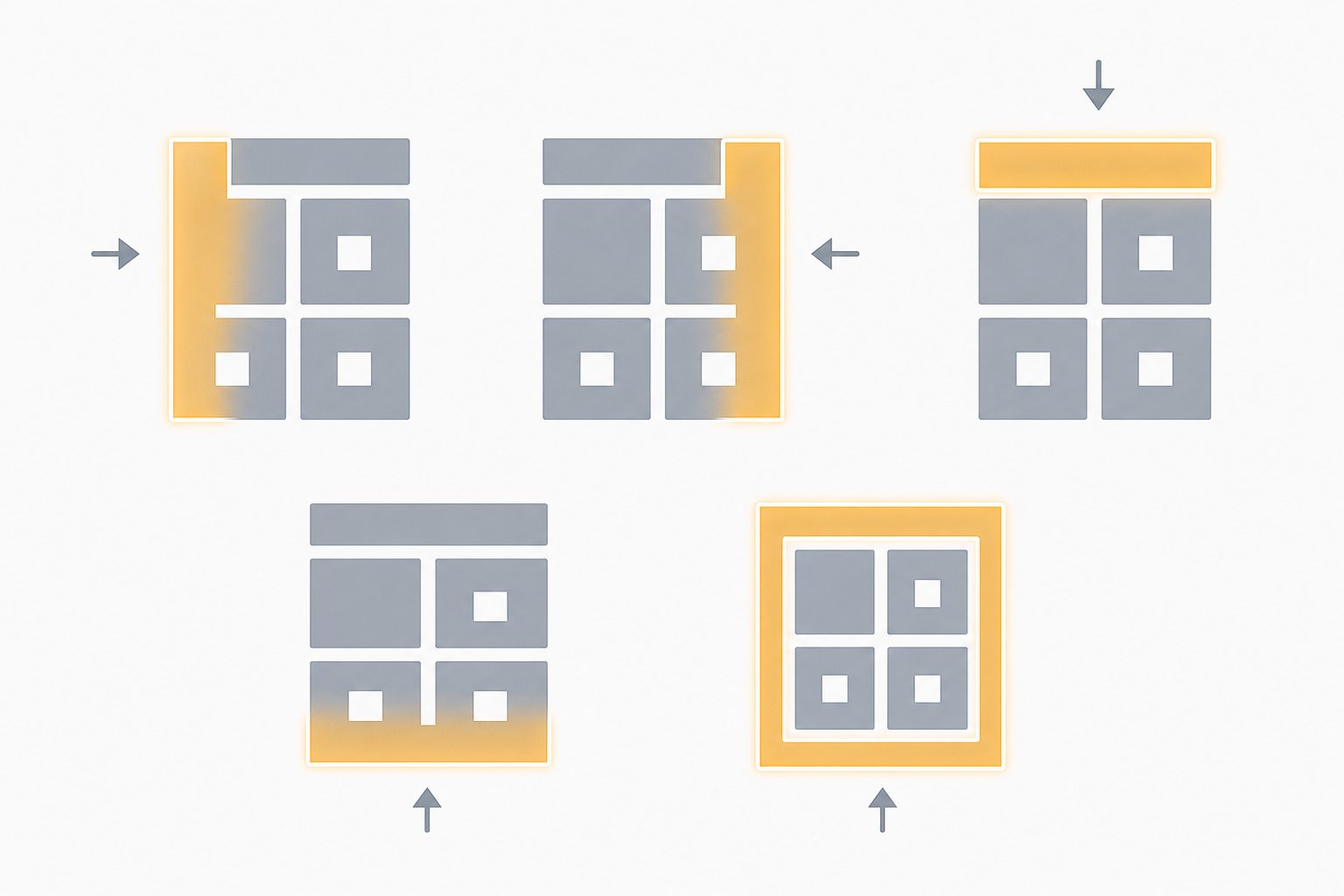
Radicals in chinese can appear in five main positions within a character. Each position carries a different signal about the role that component plays:
- Left side (most common): The majority of compound characters place their radical here. Left-side components typically carry semantic meaning, telling you the category the character belongs to. In 说 (speak), the radical 讠 sits on the left, signaling the character relates to speech.
- Right side: Less common for radicals, but it happens. When the radical is on the right, the left component often serves as the phonetic hint. In 期 (period), the radical 月 appears on the right.
- Top: Top-position radicals often indicate broad categories like plants (艹), weather (雨), or shelter (宀). In 花 (flower), the grass radical 艹 sits on top, immediately flagging a plant connection.
- Bottom: Bottom radicals are less frequent but appear in characters like 想 (think), where 心 at the bottom signals emotion or thought. Fire as 灬 also commonly appears here.
- Enclosing: Some radicals wrap around other components. The enclosure 囗 surrounds the interior in 国 (country). The walking radical 辶 cradles the bottom and left in 道 (road).
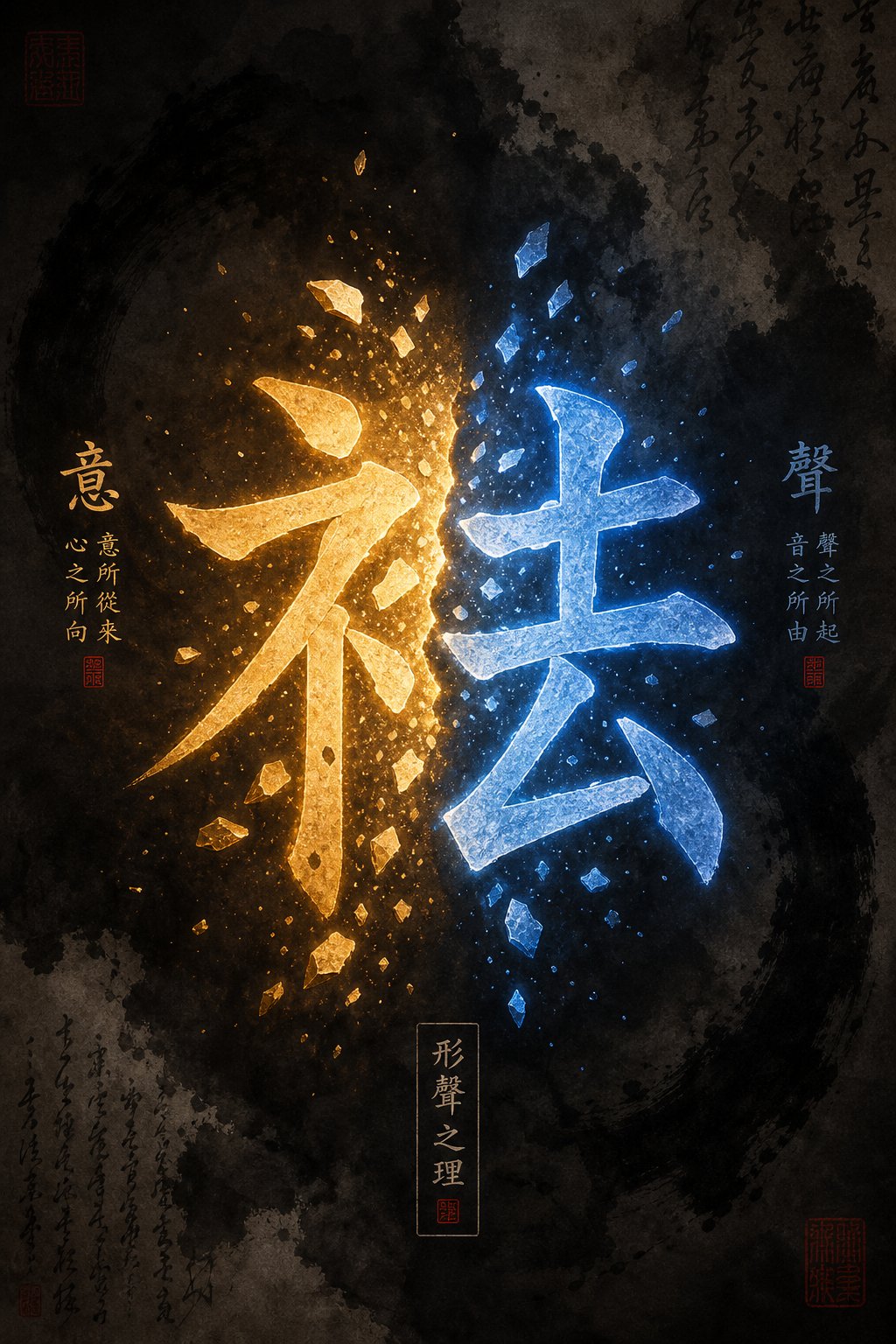
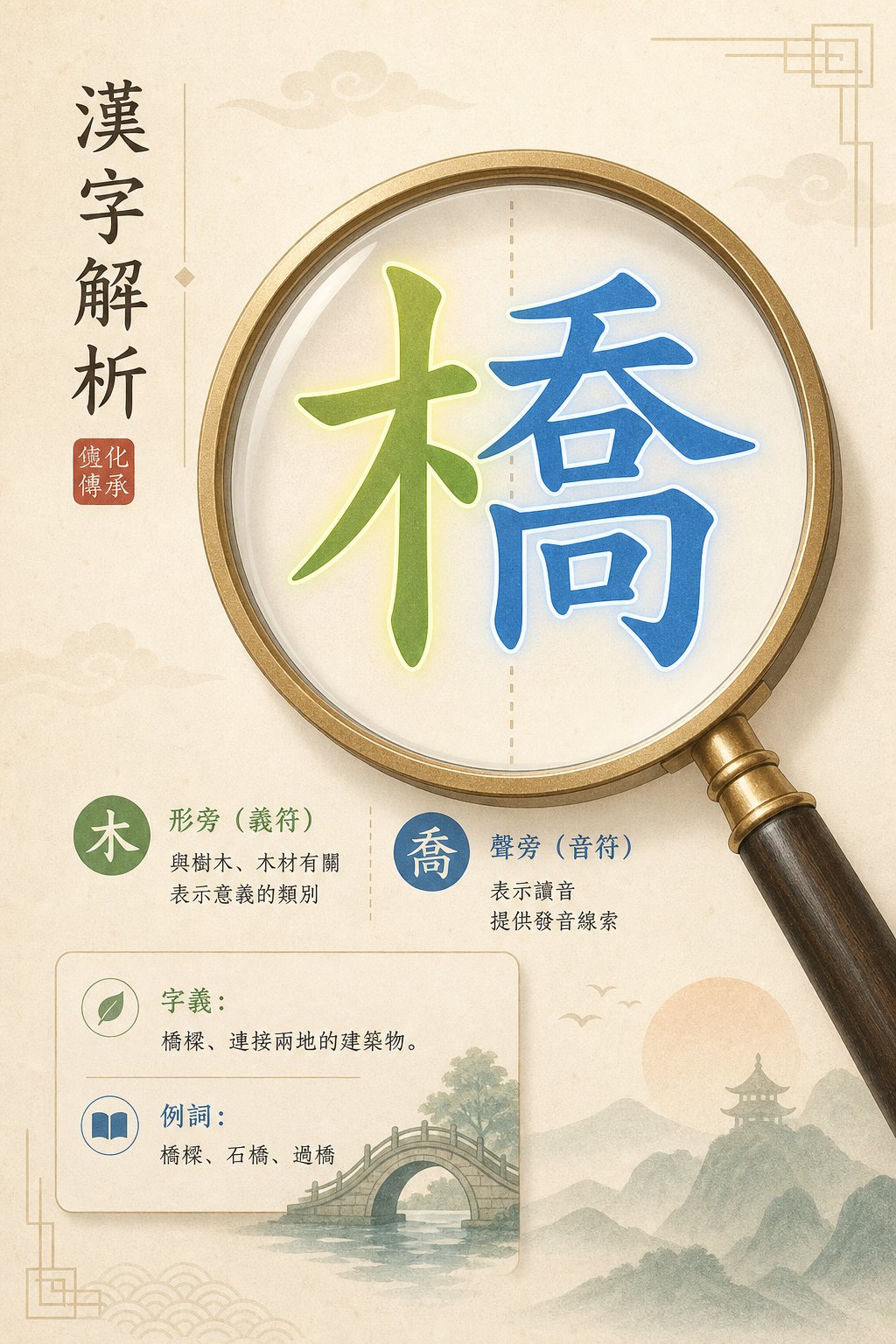
Here is the critical insight for reading: in over 80% of Chinese characters, which are phono-semantic compounds, the semantic component (usually the radical) sits on the left or top, while the phonetic component occupies the right or bottom. This means when you spot a left-right structure, the left piece likely tells you meaning and the right piece hints at radicals pronunciation. When you see a top-bottom structure, the top piece often carries meaning while the bottom suggests sound.
This pattern is not absolute. Exceptions exist. But as a first guess, it is remarkably reliable and gives you a starting framework every time you face an unknown character.
A Decision Tree for Finding the Radical
When you see a character you cannot read, run through this process. It takes seconds once you have practiced it a few times:
- Identify the structure type. Is the character split left-right, top-bottom, or does one component enclose another? If it looks like a single indivisible block, it may be a standalone radical itself (like 山 or 日).
- Check the left side first. If the character has a left-right split, the left component is the radical for the majority of cases. Look for familiar shapes like 氵, 亻, 扌, 讠, or 木.
- Check the top if there is no left-right split. For top-bottom characters, the top component is your best first guess for the radical. Look for 艹, 宀, 雨, or 竹.
- Check for an enclosing element. If a component wraps around the others (on two or three sides), that enclosing piece is almost certainly the radical. Examples include 囗, 辶, 广, and 门.
- Check the bottom or right as a fallback. If none of the above positions contain a recognizable radical, look at the bottom (心, 灬, 皿) or the right side (刂, 阝). These are less common radical positions but still valid.
- Use the phonetic component to confirm. Once you have identified a candidate radical for meaning, the remaining piece should hint at pronunciation. If the remaining component is a character you already know how to say, that confirms your radical guess is likely correct. This relationship between radicals pronunciation and meaning is the core logic of phono-semantic characters.
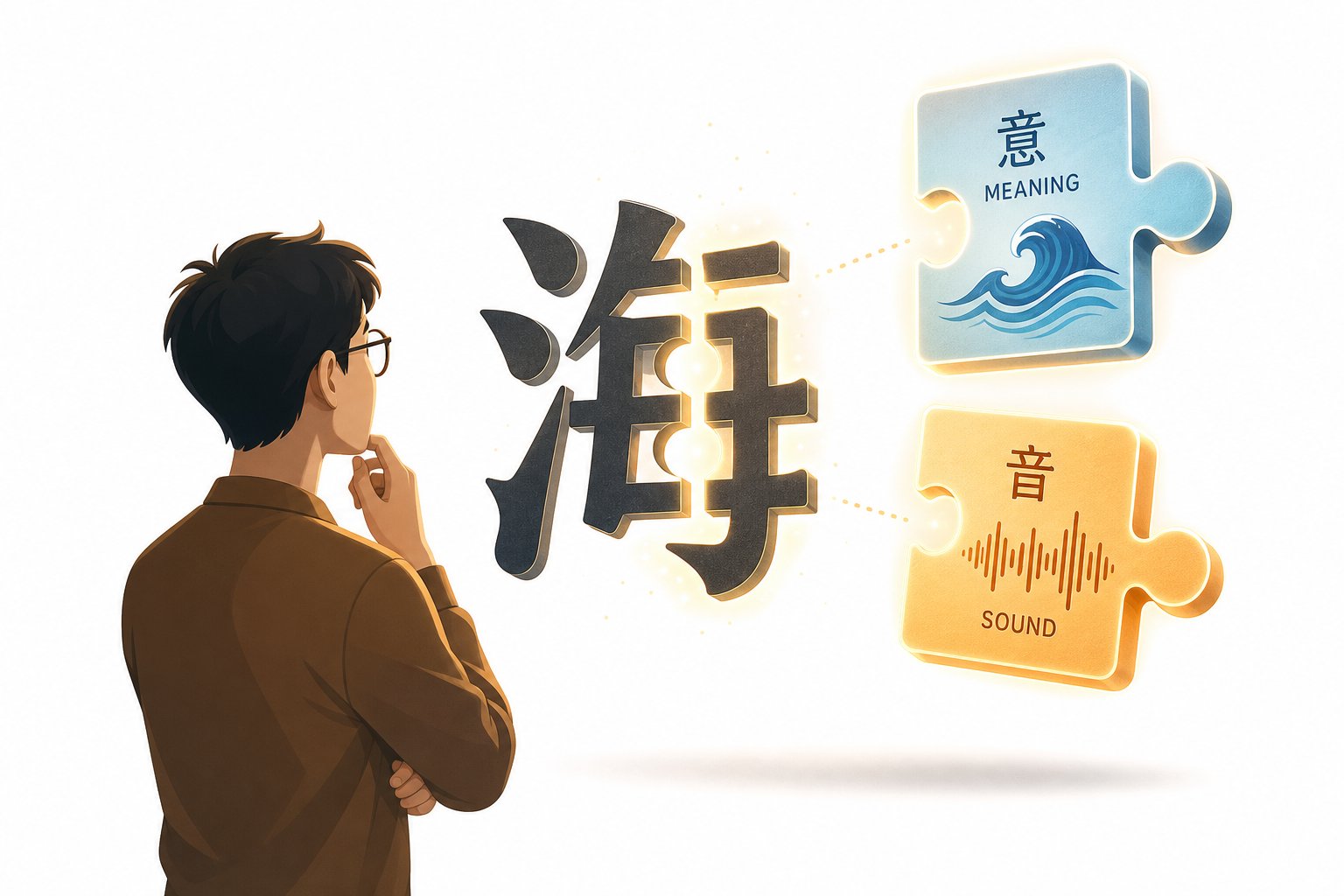
Imagine you encounter the character 湖. You see a left-right structure. The left piece is 氵, which you recognize as the compressed water radical. That gives you a meaning clue: something water-related. The right piece is 胡 (hu), which hints at pronunciation. You now know this character probably sounds like "hu" and relates to water. It means "lake."
This decision tree works because Chinese character structure is not random. Thousands of years of evolution produced consistent compositional logic. The radical for any given character almost always sits in a predictable spot based on how the character is built. Practice this process with characters you already know, and it becomes automatic when you face ones you don't.
Step 5: Decode Unfamiliar Characters Using Chinese Radicals and Meanings
Knowing where radicals sit and what they look like is preparation. The real payoff comes when you face a character you have never seen before and can extract useful information from it in seconds. This is where the meaning of chinese radicals becomes a practical tool rather than trivia. Let's walk through three real character breakdowns, narrating the exact thought process you should replicate every time you encounter something unfamiliar.
Decoding 洋 — Water Radical in Action
Imagine you are reading a text and you hit the character 洋. You have never formally studied it. What do you do?
I see a left-right structure. The left piece is 氵, the compressed water radical. That tells me this character relates to water or liquid somehow. The right piece is 羊, which I know means sheep and is pronounced yang. So this character probably sounds like yang and has something to do with water.
That internal monologue takes about three seconds once you have practiced it. And the conclusion is correct: 洋 is pronounced yang (second tone) and means "ocean" or "vast." The water radical gave you the meaning category. The phonetic component 羊 gave you the sound. You did not need to memorize this character from a flashcard to extract that information.
This example is especially clean because the phonetic component 羊 (yang) matches the character's pronunciation almost perfectly. As Hacking Chinese notes, phonetic-semantic compounds make up roughly 80% of all Chinese characters, and many phonetic components are highly regular. The 羊 component, for instance, also appears in 样 (yang, manner), 养 (yang, to raise), and 氧 (yang, oxygen), all sharing that same sound.
Reading 想 — Meaning Meets Sound in a Top-Bottom Structure
Not every character splits left-right. When you see 想, the layout is different. Here is how to think through it:
This character has a top-bottom structure. The top piece is 相, and the bottom piece is 心, the heart radical. Heart signals emotion, thought, or mental activity. So this character probably relates to thinking or feeling. The top component 相 is pronounced xiang. That gives me a pronunciation clue. This character likely sounds like xiang and involves the mind.
Correct again. 想 means "to think" or "to miss someone," pronounced xiang (third tone). The heart radical 心 at the bottom tells you the character lives in the domain of thoughts and emotions. The component 相 (xiang, first tone) on top provides the sound hint, even though the tones differ slightly.
Notice something important here: the radical is not on the left. It is on the bottom. If you only checked the left side, you would miss it entirely. This is why the decision tree from the previous step matters. For top-bottom characters, the semantic radical often sits at the bottom (心, 灬, 皿) or at the top (艹, 宀, 雨). In 想, the bottom position signals meaning while the top signals sound, which is the reverse of the most common top-bottom pattern. Context and familiarity with the heart radical help you identify it quickly regardless.
Reading 铜 — Metal Radical Reveals the Category
Here is one more breakdown, this time with a radical you might not have encountered yet:
I see a left-right structure. The left piece is 钅, which I recognize as the compressed form of 金 (metal). So this character relates to metal or metallic objects. The right piece is 同, pronounced tong. That gives me the sound. This character is probably pronounced tong and names some kind of metal.
The character 铜 means "copper," pronounced tong (second tone). The metal radical 钅 immediately narrows the meaning to a metallic substance. The phonetic component 同 (tong, second tone) delivers the pronunciation with perfect accuracy in this case.
This pattern repeats across dozens of chinese characters radicals in the metal family: 银 (silver, with phonetic 艮 gen), 铁 (iron, with phonetic 失 shi), 钟 (bell/clock, with phonetic 中 zhong). Once you recognize 钅 on the left, you know you are dealing with metal, and the right side gives you the sound. The chinese radical meanings become a reliable filter for narrowing down what a character refers to.
The Pattern You Should Internalize
All three breakdowns follow the same cognitive sequence:
- Identify the character's structure (left-right or top-bottom).
- Locate the radical and determine its meaning contribution.
- Examine the remaining component for a pronunciation clue.
- Combine both pieces into an educated guess: "sounds like X, relates to Y."
This four-step process is the core skill behind reading radicals of chinese characters. It will not give you a perfect translation every time. Some phonetic components have drifted in pronunciation over centuries, and some semantic radicals point to archaic meaning categories that feel unintuitive today. But even a partial clue, knowing a character relates to water or sounds like "tong," is vastly better than staring at an opaque block of strokes with zero information.
The more characters you decode this way, the faster the process becomes. Eventually you stop consciously running through the steps. You simply see 氵 and your brain registers "water-related" without effort, the same way a native reader does. That automatic recognition is what transforms radical knowledge into genuine reading fluency, and it opens the door to using this skill in everyday situations beyond textbook exercises.
Step 6: Apply Radical Reading to Real Situations
Decoding characters on paper is satisfying, but the real test is whether you can use radical reading when it actually matters. Three practical situations come up constantly for learners: guessing the meaning of unknown characters while reading, looking up characters you cannot type or pronounce, and building memory hooks that make new vocabulary stick. Each situation demands the same underlying skill but applies it differently.
Reading Radicals for Meaning Inference
Imagine you are scrolling through a Chinese news article and you hit a character you have never studied. You cannot copy-paste it easily, and you do not want to break your reading flow. This is where radical reading pays off most directly.
When you spot a recognizable radical, you can make an educated guess about the character's general category without knowing its exact definition. You see 氵 on the left? The word probably involves water, liquid, or flow. You notice 疒 wrapping the top-left? Something related to illness or physical discomfort. You catch 钅 on the left? A metal or metallic object.
That partial information is often enough to keep reading. If a sentence says someone went to the hospital because of a character containing 疒, you do not need the precise diagnosis to follow the story. Context plus the radical clue fills the gap. This is not guessing blindly. It is informed inference, and native readers rely on it more than most learners realize.
- Reading articles or books: Spot the radical, infer the meaning category, and let sentence context do the rest. You maintain reading momentum instead of stopping to look up every unknown character.
- Scanning menus or signs: A character with 饣 (food radical) on a restaurant menu is almost certainly an ingredient or cooking method. A character with 木 on a furniture tag names a type of wood or wooden item.
- Watching subtitles: When characters flash by quickly, recognizing even one radical gives you a foothold for comprehension before the next line appears.
Using Radicals with Digital Dictionaries and Apps
Sometimes inference is not enough. You need the exact meaning or pronunciation. This is where a chinese radical dictionary lookup becomes essential, especially when you encounter a character you cannot type because you do not know its pinyin.
Modern dictionary apps like Pleco offer a dedicated radical input method. You tap the radical search icon, select the radical you recognize from a grid of all 214 Kangxi radicals sorted by stroke count, and then the app displays every character containing that radical, organized by the number of remaining strokes. Find your target character, tap it, and you have the full definition and pronunciation instantly.
This process relies on two skills working together: identifying the radical visually and knowing its approximate stroke count. A chinese dictionary radical search is essentially the digital version of the paper dictionary method, but dramatically faster. In a traditional paper dictionary, you would identify the radical, count its strokes to find it in the radical index, then count the remaining strokes in the full character to locate the entry. The logic is identical in apps. The interface just removes the page-flipping.
Handwriting input offers another path. Apps like Pleco and Hanping let you draw a character stroke by stroke on your screen. The recognition engine matches your input against its database and suggests candidates. Here is where radical awareness helps indirectly: knowing correct stroke order, which is closely tied to understanding how radicals are structured, improves your handwriting recognition accuracy. When you understand that 氵 is always drawn as three left-falling strokes before the right component begins, your drawn input becomes cleaner and the app identifies the character faster. Chinese dictionary strokes knowledge and radical knowledge reinforce each other.
Web-based tools like MDBG also support radical-based lookup and provide detailed breakdowns showing each character's radical, stroke order, and component structure. YellowBridge offers the option to search by character or radical directly from its interface. These resources turn radical reading into a practical lookup strategy you can use anytime you are stuck on an unfamiliar character at your computer.
- Cannot type the character: Use radical input in a chinese dictionary with radicals support. Identify the radical, select it, count remaining strokes, and find your character.
- Cannot draw it accurately: Knowing the radical helps you get the first few strokes right, which is often enough for handwriting recognition to suggest the correct match.
- Building mnemonics for retention: When you look up a new character, note its radical and phonetic component. Create a mental story linking the radical's meaning to the word's definition. For 湖 (lake), the story writes itself: water (氵) plus the sound hu (胡). For 铜 (copper), metal (钅) plus the sound tong (同). These radical-based associations stick far better than rote repetition because they give your memory a logical structure to hang onto.
The common thread across all three use cases is that radical reading is not a classroom exercise. It is a daily tool. Whether you are inferring meaning on the fly, navigating a mandarin radical dictionary to find an unknown character, or anchoring new vocabulary in long-term memory, the same pattern recognition skill drives the process. And the more characters you decode this way, the more radical families you start to notice, clusters of characters sharing the same radical that reinforce each other every time you encounter a new member of the group.

Step 7: Build Reading Speed with Radical Families
Every time you learn a new character that shares a radical with ones you already know, something clicks faster. That is not coincidence. It is the compounding effect of radical families at work. A radical family is simply the cluster of characters that all contain the same radical, and thinking in terms of families rather than isolated characters is one of the fastest ways to accelerate your reading ability in mandarin chinese radicals.
How One Radical Unlocks Dozens of Characters
Consider the water radical 氵. The moment you internalize that three short strokes on the left side of a character signal "something related to water or liquid," you gain partial reading ability for an entire family: 河 (river), 湖 (lake), 海 (ocean), 洗 (wash), 泳 (swim), 汁 (juice), 汗 (sweat), 泪 (tears), 沙 (sand), 温 (warm). That is ten characters decoded at the category level from a single radical. Expand to less common characters and the family grows to well over fifty members.
This is why frequency-based radical learning compounds so powerfully. Each radical you add to your toolkit does not just help with one character. It hands you a semantic key that works across dozens. After learning 30 high-frequency mandarin radicals and recognizing their families, you can make educated guesses about hundreds of characters you have never formally studied. You will not know exact definitions, but you will know the neighborhood each character lives in, and that is often enough to keep reading without breaking flow.
The effect is especially noticeable when you encounter chinese language radicals in context. If a sentence mentions someone doing something at a 湖 and you know 氵 means water, the surrounding words help you land on "lake" even without prior memorization. Each new family member reinforces the radical's meaning, making future encounters with unfamiliar siblings even easier to decode.
Radical Families to Practice With
Below are four high-frequency radical families worth practicing. For each one, try covering the meaning column and guessing the general category based on the radical alone. Then check whether the individual characters fit that category:
| Radical | Meaning | Family Members |
|---|---|---|
| 氵 (water) | Water, liquid, flow | 河 (river), 湖 (lake), 海 (ocean), 洗 (wash), 泳 (swim), 汁 (juice) |
| 木 (tree) | Wood, trees, plants | 林 (forest), 桌 (table), 椅 (chair), 板 (board), 根 (root), 松 (pine) |
| 讠 (speech) | Language, speaking, words | 说 (speak), 话 (words), 语 (language), 读 (read), 课 (lesson), 谢 (thank) |
| 钅 (metal) | Metals, metallic objects | 银 (silver), 铁 (iron), 铜 (copper), 钟 (clock), 钱 (money), 锁 (lock) |
Notice how each family shares a clear thematic thread. Every character under 木 relates to wood or things made from it. Every character under 讠 involves communication or language. This consistency is what makes radicals in mandarin so useful for reading. You are not memorizing random associations. You are learning a system where meaning clusters naturally.
A practical way to build these families is to pick one radical per week and actively hunt for its members in whatever you are reading. Keep a running list. By the end of the week, you will have encountered enough family members that the radical's meaning becomes automatic. Repeat with a new radical, and within a few months you will have built a mental web connecting hundreds of characters through their shared roots. That web is what separates a reader who decodes characters one by one from someone who sees patterns across an entire page. Of course, building speed also means knowing which habits slow you down, and a few common mistakes can quietly undermine all this progress if left unchecked.
Step 8: Avoid Common Mistakes and Keep Progressing
Radical reading is a skill that rewards consistent practice, but certain habits and misconceptions can quietly stall your progress for months. Learners who hit a plateau often share the same handful of mistakes. Recognizing them early saves you from spinning your wheels and lets you channel that energy into the practice that actually builds fluency.
Mistakes That Slow Down Radical Reading
These are the errors that come up most frequently among intermediate learners who understand the basics but struggle to apply them consistently:
- Assuming every component is a radical. A character like 想 contains three components (木, 目, 心), but it has only one radical: 心. Calling every piece a radical confuses the system and makes dictionary lookup harder. Remember: one character, one radical. The rest are components.
- Confusing simplified and traditional radical forms. The speech radical looks like 讠 in simplified characters but 訁 in traditional. The food radical is 饣 in simplified and 飠 in traditional. If you study a table of radicals from one system and then encounter text in the other, familiar radicals suddenly look foreign. Pick one system to master first, then learn the alternate forms as a secondary layer.
- Expecting the radical to always sit on the left. Left-side placement is the most common position, but radicals also appear on top (艹 in 花), bottom (心 in 想), right (刂 in 到), and as enclosures (辶 in 道). If you only scan the left, you miss radicals in roughly 30-40% of characters.
- Trying to memorize all 214 before practicing reading. This is the biggest time trap. Many learners download a list of chinese radicals pdf, drill all 214 entries, and still cannot identify radicals inside actual characters. Memorization without application does not build the pattern recognition you need. You are better off learning 20 radicals deeply and practicing them in context than memorizing 200 in isolation.
- Ignoring phonetic components entirely. Radical reading is not just about meaning. The non-radical component often hints at pronunciation. Learners who focus exclusively on the semantic radical miss half the information a character offers. Train yourself to examine both pieces every time.
Each of these mistakes shares a common root: treating radical reading as a knowledge problem rather than a recognition skill. You do not solve it by accumulating more facts. You solve it by practicing the act of looking at characters and identifying their parts in real time.
Your Progression Path from Beginner to Fluent Reader
Knowing what to avoid is half the equation. The other half is a clear sequence of milestones that builds your ability in manageable stages. Here is the progression that works, based on how frequency and repetition interact with radical learning:
- Learn 20 high-frequency radicals and their alternate forms. Start with the ones that appear in the most common characters: 氵, 亻, 口, 木, 扌, 心/忄, 讠, 女, 土, 日, 月, 火/灬, 钅, 艹, 犭, 目, 辶, 门, 饣, and 衤. Study both the full and compressed shapes. Use a radical chart or table of radicals as a quick-reference tool during this phase.
- Practice identifying those 20 radicals inside characters you already know. Go through your existing vocabulary and tag the radical in each character. This is not new memorization. It is reframing knowledge you already have. You will start seeing patterns you never noticed before.
- Expand to 50 radicals using semantic grouping. Add radicals in meaningful clusters (nature, body, materials, movement) rather than numerical order. A chinese characters radicals list organized by meaning category is far more memorable than one sorted by stroke count.
- Start decoding unfamiliar characters actively. When you encounter unknown characters in reading, pause and run the decision tree: identify structure, locate the radical, check the phonetic component. Do this deliberately for two to four weeks until it becomes automatic.
- Build radical families for your top 30 radicals. For each radical you know well, collect five to ten characters that share it. Notice how the radical's meaning threads through the entire family. This is where compounding acceleration kicks in and your reading speed noticeably increases.
- Use radical-based lookup as your default dictionary method. Whenever you hit an unknown character, look it up by radical rather than relying solely on copy-paste or handwriting input. This reinforces your radical identification skill with every lookup.
This progression is not linear in the sense that you finish one stage and never return. You will cycle back through earlier steps as you encounter new radicals or realize a familiar one has an alternate form you missed. That cycling is normal and productive.
The key insight behind this entire framework is that radical reading fluency does not require encyclopedic knowledge. You do not need a radicals chinese list of all 214 entries memorized before you start. You need a small, high-frequency set learned deeply, practiced in context, and expanded gradually through the radical families you encounter in real reading. Fifty radicals, actively used, will take you further than 214 passively memorized. Start with twenty. Practice them this week. The compounding begins immediately.
Frequently Asked Questions About Reading Chinese Radicals
1. How many Chinese radicals do I actually need to learn?
You do not need all 214 Kangxi radicals to start reading effectively. Roughly 50 high-frequency radicals appear in the vast majority of everyday characters. Starting with just 20 of the most common ones, such as the water radical, person radical, and speech radical, gives you partial reading ability across hundreds of characters. Each radical you learn unlocks an entire family of related characters, so the returns compound quickly as you expand your set.
2. What is the difference between a radical and a component in Chinese?
A radical (部首) is the specific component used to index a character in a dictionary. It serves as a classification tool. A component (偏旁) is any structural building block within a character. Every radical can function as a component, but not every component is a radical. Each character has only one official radical, even if it contains multiple components. Understanding this distinction prevents confusion when breaking down characters or using dictionary lookup tools.
3. Why do Chinese radicals change shape inside characters?
Radicals change form to fit within the uniform square block that all Chinese characters occupy. When a radical shares space with another component, it gets compressed to maintain visual balance. For example, 水 (water) becomes 氵 when placed on the left side, and 火 (fire) becomes 灬 when placed at the bottom. These changes follow consistent rules based on position: left-side radicals narrow vertically, bottom radicals flatten horizontally, and right-side radicals lose strokes that would crowd the left component.
4. How can I find the radical in a Chinese character I don't recognize?
Use a position-based decision tree. First, identify whether the character splits left-right, top-bottom, or has an enclosing element. For left-right characters, check the left side first since most radicals sit there. For top-bottom characters, check the top. For enclosed characters, the wrapping element is usually the radical. In over 80% of Chinese characters, the semantic radical carries meaning while the other component hints at pronunciation, so confirming both pieces helps verify your identification.
5. Can I use radicals to guess the pronunciation of a Chinese character?
Radicals themselves typically signal meaning rather than sound. However, the non-radical component in a character often serves as a phonetic hint. In phono-semantic compounds, which make up about 80% of all Chinese characters, the radical tells you the meaning category while the other component suggests pronunciation. For example, in 洋 (ocean), the water radical gives the meaning and the component 羊 (yang) provides the sound. Training yourself to read both pieces together gives you meaning and pronunciation clues simultaneously.