The Hundred Family Surnames and Why They Still Matter
Imagine a single poem so deeply woven into a civilization that billions of people can trace their identity back to its lines. That poem exists. It is called the Bai Jia Xing, or the Hundred Family Surnames, a classical Chinese text compiled during the early Northern Song Dynasty (976-984 AD). Written as a four-character rhymed verse, it catalogs Chinese surnames into a rhythmic, memorizable format that served as one of the most important literacy primers in Chinese educational history.
What Is the Bai Jia Xing
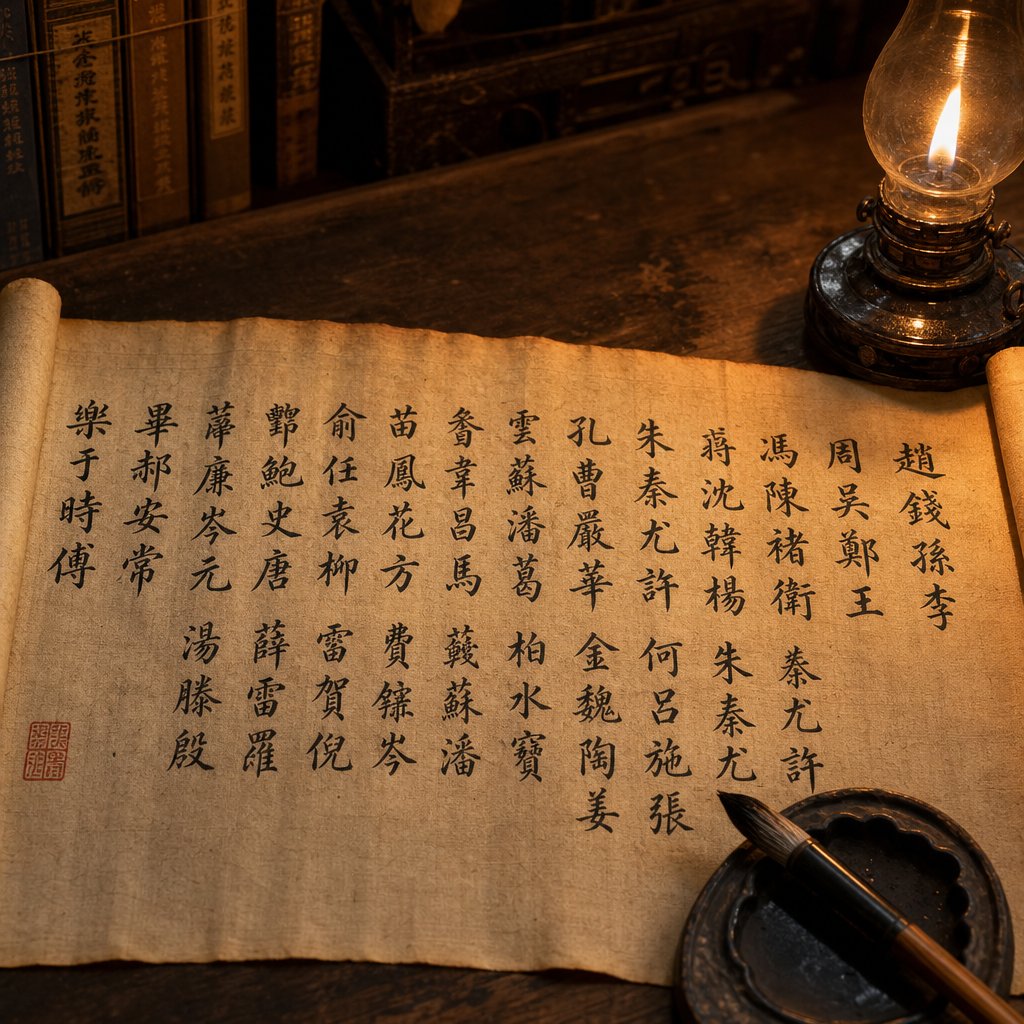
At its core, the Bai Jia Xing is a rhyming poem that lists Chinese family names. It is not a reference book or a genealogical database. It is verse, designed to be chanted aloud by young children learning to read. The text arranges 504 surnames into groups of four characters per line, creating a musical cadence that made memorization almost effortless. Its opening lines are among the most recognized phrases in the Chinese-speaking world:
Zhao, Qian, Sun, Li. Zhou, Wu, Zheng, Wang.
These eight chinese surnames are not arranged alphabetically or by population. Their order is political, reflecting the power structures of tenth-century China. Every Chinese surname in the text carries a story, a lineage, and a place in the social fabric.
Why This Text Shaped Chinese Identity
For over a thousand years, the Hundred Family Surnames functioned as a child's first introduction to the concept of clan and belonging. In Chinese culture, your last name is not just a label. It connects you to an ancestral village, a genealogy book, and a community of people who share your lineage. The phrase "lao bai xing" (old hundred surnames) literally means "common people" in Mandarin, a testament to how deeply this text embedded itself into the language itself.
For English-speaking readers exploring Chinese last names and their origins, the Bai Jia Xing offers something rare: a single entry point into a naming tradition that predates most Western surname systems by centuries. It bridges encyclopedic knowledge and lived cultural identity, revealing how chinese family names carry political history, regional roots, and social meaning in every syllable.
The question that follows naturally is: why were these particular surnames placed in this particular order? The answer lies in a specific political moment that shaped the text from its very first character.
Historical Origins and the Politics Behind the Order
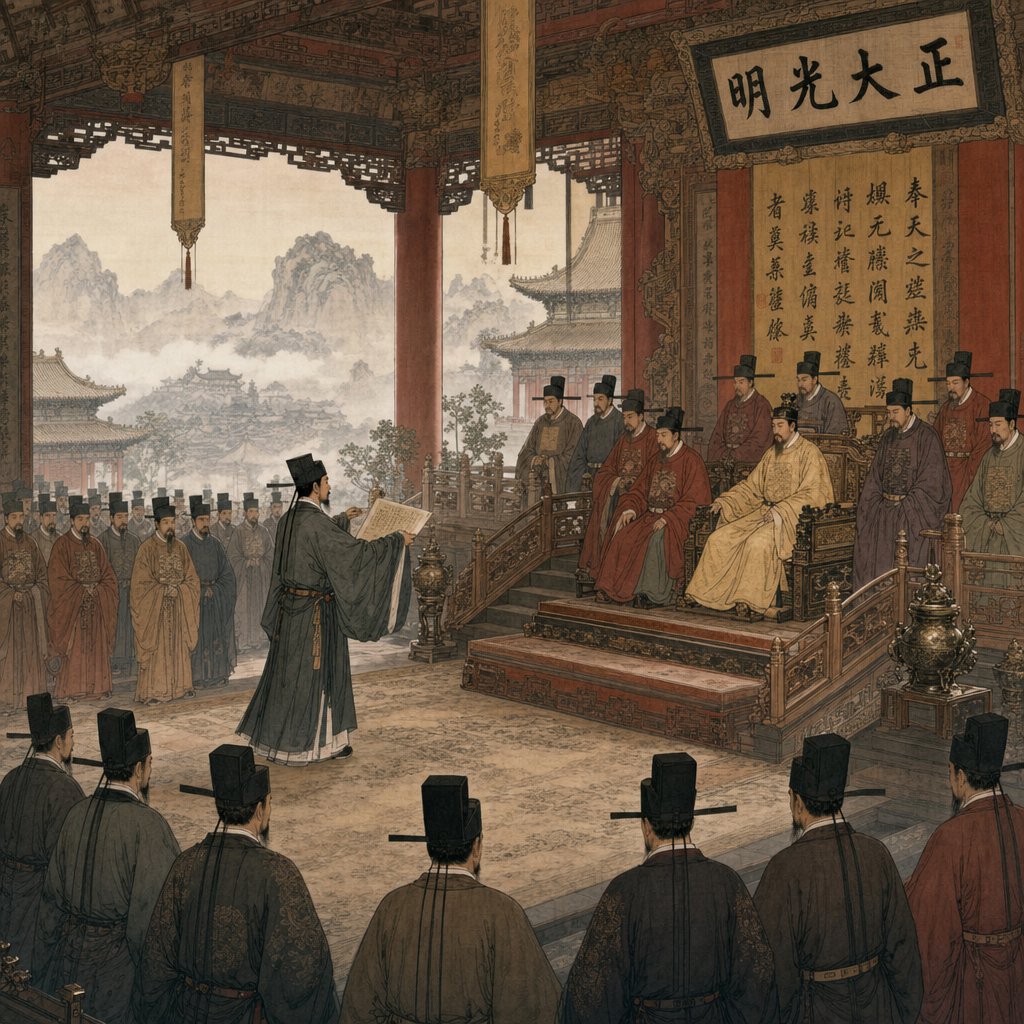
The Bai Jia Xing was not born in a vacuum. It emerged during the Taiping Xingguo period of the Northern Song Dynasty (976-984 AD), a time when China was being stitched back together after decades of fragmentation. Regional kingdoms were surrendering their sovereignty to the new Song emperor, and a scholar in Qiantang, modern-day Hangzhou, saw an opportunity to encode this shifting political landscape into a children's primer.
The Song Dynasty Origins and Author
Who actually wrote the text? The honest answer is that no one knows for certain. Academic consensus points to a Confucian scholar from the Wuyue region, though the specific identity remains debated. The Southern Song scholar Wang Mingqing recorded in his work Yuzhao Xinzhi that the text "seems to have been written by a commoner during the time when the Qian clan ruled the Two Zhe regions." Another theory, proposed by the Korean official Li Demao, suggests the author may have been Sun Chengyou, the brother-in-law of Qian Hongchu, the last King of Wuyue. Sun was both literate and politically connected, having served as a diplomat between Wuyue and the Northern Song court.
Regardless of the exact author, the political context is clear. In 978 AD, Qian Hongchu carried out the "surrender of territory to the Song Dynasty," peacefully incorporating thirteen prefectures into the new empire. The text was compiled in this narrow window when royal chinese surnames still carried the weight of recent sovereignty, and the compiler needed to acknowledge multiple power centers without offending any of them.
Political Power Encoded in Surname Order
You might assume a list of chinese surnames would follow some logical pattern, perhaps alphabetical or ranked by population. The Bai Jia Xing does neither. Its ordering is purely political, following the principle of "first the imperial family, then the feudal lords, and finally the prominent clans."
Here is what the first four surnames actually represent:
- Zhao - the imperial surname of the Song Dynasty emperors
- Qian - the surname of the rulers of the Wuyue Kingdom, who peacefully surrendered to Song
- Sun - the surname of the principal consort (queen) of the King of Wuyue
- Li - the surname of the kings of the Southern Tang dynasty
This was not a neutral chinese surname list. It was a diplomatic document disguised as a children's rhyme. By placing Zhao first, the compiler acknowledged Song supremacy. By placing Qian second, the text honored the Wuyue rulers who had chosen peace over war. These were the great surnames of the era, and their arrangement told every child exactly where power resided.
Later dynasties understood this logic perfectly. The Ming Dynasty produced its own version, the Huangming Qianjia Xing, which began with "Zhu," the Ming imperial surname. The Qing Dynasty created the Yuzhi Baijiaxing, opening with "Kong" to honor Confucius. Yet neither replacement gained lasting traction. The Northern Song original, with its list of chinese surnames frozen in tenth-century politics, remains the version people recite today.
As for how many ancient chinese surnames the text actually contains, sources vary. The original compilation recorded 411 surnames, with 444 single-character surnames and 60 compound surnames in later expanded editions, bringing the total to 504. Some versions count as many as 507. The most commonly referenced edition today is the expanded 504-surname version, though the four-character rhyming structure and the original ordering remain unchanged from the Song Dynasty compilation.
What made this text endure was not just its political cleverness but its form. The compiler chose a structure so rhythmically satisfying that children could absorb it before they understood a word of its meaning.
A Poem Designed for Memorization
Think about how you learned the alphabet. You probably sang it. The melody made twenty-six letters stick in your memory before you could spell a single word. The Bai Jia Xing works on the same principle, except instead of letters, children absorbed an entire chinese surnames list through rhythm and repetition.
The Four-Character Rhyming Structure
The text is organized into lines of eight characters, grouped into pairs of four. Each four-character unit forms a natural rhythmic beat, almost like a musical measure. When recited aloud, the pattern sounds like this: da-da-da-da, da-da-da-da. That steady pulse turns over 100 surnames into something closer to a song than a reference document.
This was deliberate. Unlike a flat list you might scan with your eyes, the Bai Jia Xing was built for the voice. The rhyming scheme links the end of each line to the next, creating a forward momentum that pulls the reciter along. You do not stop and think about individual characters. You ride the rhythm, and the hundred characters flow out almost automatically.
How Rhythm Served as a Memory Tool
In Song Dynasty China, most children did not have access to printed books at home. Oral transmission was the primary vehicle for learning, and rhythm was the engine that made it work. A child as young as three could begin chanting the text alongside a teacher or parent, absorbing the sounds long before understanding what each surname meant or which clan it represented.
This is the pedagogical genius of the format. The compiler encoded practical social knowledge, the ability to recognize and recall surnames, inside a musical structure that bypasses the need for comprehension. Children memorized first and understood later. By the time a student could read the characters independently, the entire sequence was already stored in memory, ready to be matched to written forms.
Compare this to how Western children learn nursery rhymes. "Jack and Jill" teaches narrative structure. The alphabet song teaches letter sequence. The Bai Jia Xing taught something arguably more socially powerful: the names of the clans that made up Chinese civilization. Every child who recited it internalized a map of surname中文 identity, a sense of who belonged and where they fit within the broader social order.
Rhythm alone, though, does not explain why this text endured for a millennium. It survived because it was part of something larger: a carefully sequenced curriculum that built literacy character by character, text by text.
The Traditional Chinese Education System Behind the Text
That larger curriculum had a name: San Bai Qian. Three characters, each drawn from the title of a different text, representing the complete foundation of traditional Chinese literacy. In the dynasties following the Song, the Three Character Classic (San Zi Jing), the Hundred Family Surnames (Bai Jia Xing), and the Thousand Character Classic (Qian Zi Wen) became the almost universal introductory texts for young students across China. Together, they formed a system so effective that it remained the standard approach to early education for roughly a thousand years.
The San Bai Qian Curriculum Explained
Each text in the San Bai Qian served a distinct purpose, and their combination was deliberate rather than accidental. Here is what each one contributed:
- San Zi Jing (Three Character Classic) - Traditionally attributed to the Southern Song scholar Wang Yinglin (1223-1296), this text of roughly 1,248 characters arranged in three-character verses taught moral values, natural knowledge, and historical overview. It covered everything from the Five Agents and the four seasons to the dynastic succession of Chinese history.
- Bai Jia Xing (Hundred Family Surnames) - The chinese family name list we have been exploring. It provided social knowledge, teaching children the order of chinese names and clan identities that structured their world.
- Qian Zi Wen (Thousand Character Classic) - Composed by Zhou Xingsi during the Liang Dynasty (502-549 AD), this poem contains exactly one thousand unique characters, each used only once, arranged into 250 lines of four characters. It introduced cosmology, geography, ethics, and governance through elegant verse.
The genius of this trio was coverage without redundancy. When a student had memorized all three, he could recognize and pronounce roughly 2,000 characters, since there was some duplication among the texts. In a writing system with no alphabet, this was the most efficient "crash course" in character recognition available before moving on to reading comprehension and writing.
How Three Texts Built Complete Literacy
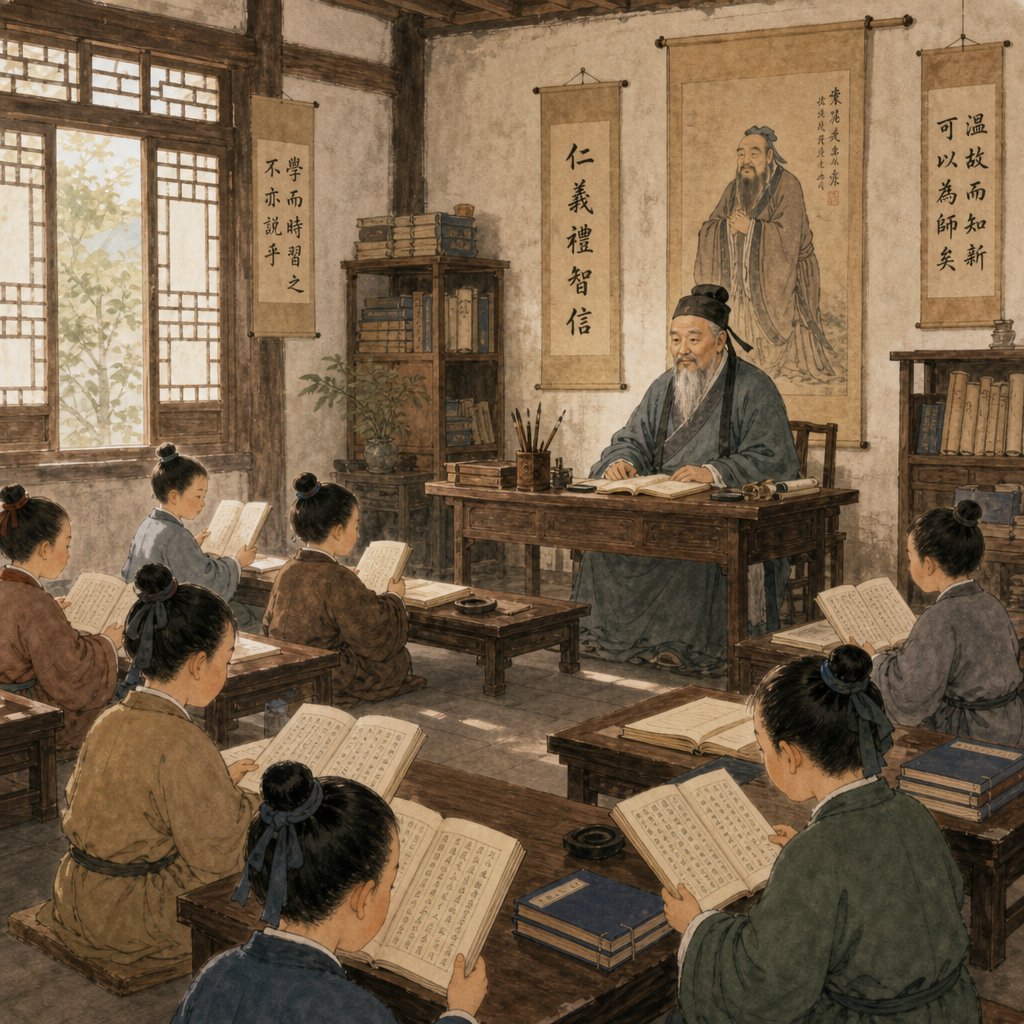
Imagine a child of three or four entering a sishu, a traditional private school. The classroom was small, often just a teacher with a handful of students at different levels sharing the same space. The youngest would begin with oral recitation, chanting the San Zi Jing line by line after the teacher. The moral lessons embedded in its verses, concepts like filial piety, diligence, and the importance of learning, set the ethical framework before anything else.
The Bai Jia Xing typically came next or alongside it. Where the Three Character Classic taught a child why to learn, the list of chinese family names taught a child who they were. It grounded abstract moral instruction in concrete social reality: these are the clans, these are the names, this is where you belong.
The thousand character classic rounded out the sequence with breadth. Its thousand unique characters, covering heaven and earth, history and agriculture, gave students the widest vocabulary base of the three texts. By the time a child finished all three, the foundation was set. Not for understanding, necessarily, but for recognition. Comprehension came later, built on top of a memorized scaffold that students could revisit with deepening insight as they matured.
This approach, memorize first, understand later, strikes modern Western educators as counterintuitive. But in a logographic writing system where each character must be individually learned, rote memorization was not mindless repetition. It was the necessary groundwork. These texts were printed cheaply, available to students from elite backgrounds and ordinary villages alike, and they never became superseded because nothing more efficient replaced them.
The San Bai Qian gave every literate Chinese person a shared starting point. And within that shared foundation, the Bai Jia Xing held a unique position: it was the only text that connected literacy directly to identity, linking the act of reading to the question of who your people were. That connection between surname and selfhood runs far deeper than a classroom exercise. It shaped how Chinese civilization organized itself around family names for centuries.
Common and Rare Surnames in the Bai Jia Xing
The Bai Jia Xing lists over 500 surnames, but modern China does not distribute its population evenly across them. A handful of names dominate so thoroughly that just five surnames cover more people than the entire population of Indonesia. Meanwhile, dozens of surnames from the original text have dwindled to near extinction. The gap between the most common chinese last names and the rarest tells a story of migration, politics, and survival.
The Most Common Chinese Surnames Today
Which is the most common chinese last name? According to China's Ministry of Public Security, Wang holds the top spot with over 95 million bearers. Li and Zhang follow close behind, each exceeding 89 million. These three surnames alone account for roughly 21% of the country's population. Add Liu and Chen, and you reach over 400 million people sharing just five names.
The concentration is striking. The top 100 chinese common last names account for approximately 84.77% of China's entire population. That means fewer than 3% of all existing surnames cover the vast majority of 1.4 billion people. Here are the ten most popular chinese last names ranked by population:
| Rank | Character | Pinyin | Approx. Population | Origin / Meaning |
|---|---|---|---|---|
| 1 | 王 | Wáng | 95.2 million | Means "king"; derived from royal descendants of the Zhou Dynasty |
| 2 | 李 | Lǐ | 93.4 million | Means "plum tree"; linked to the Tang Dynasty imperial family |
| 3 | 张 | Zhāng | 89.6 million | Means "to draw a bow"; traced to the legendary inventor of archery |
| 4 | 刘 | Liú | 67.7 million | Means "to kill" (archaic); the Han Dynasty imperial surname |
| 5 | 陈 | Chén | 61.3 million | Means "to display"; from the ancient state of Chen |
| 6 | 杨 | Yáng | 42.7 million | Means "poplar tree"; from a fief granted during the Zhou Dynasty |
| 7 | 黄 | Huáng | 32.6 million | Means "yellow"; from the ancient state of Huang |
| 8 | 吴 | Wú | 26.8 million | From the ancient state of Wu in the Yangtze Delta |
| 9 | 赵 | Zhào | 26.7 million | From the ancient state of Zhao; the Song Dynasty imperial surname |
| 10 | 周 | Zhōu | 25.2 million | From the Zhou Dynasty royal house, China's longest-ruling dynasty |
Notice that Zhao, which opens the Bai Jia Xing, ranks only ninth by actual population. Its first-place position in the poem reflects political prestige, not demographic reality. The most common chinese last names today, Wang and Li, appear much later in the original text.
Rare and Extinct Surnames from the Text
At the other end of the spectrum sit rare chinese surnames that have nearly vanished. China currently has a little over 4,000 surnames in active use, but the Chinese Calligraphy Dictionary of Surnames records over 23,000 that have existed historically. Many extinct surnames from the Bai Jia Xing disappeared through specific mechanisms:
- Imperial taboo avoidance - When a new emperor took the throne, subjects sharing his surname sometimes changed theirs to avoid the appearance of claiming royal status.
- Forced assimilation - Ethnic minorities absorbed into Han Chinese culture often adopted common Han surnames, abandoning their original rare chinese last names.
- Political persecution - Clans associated with defeated factions sometimes changed their surnames entirely to escape retribution.
- Simplification of compound surnames - Many two-character surnames like Sima or Ouyang were shortened to single characters over generations, effectively erasing the original form.
Some of the rarest surviving surnames in China include "Die" (found mainly in northwestern China, derived from Xianbei ethnic minorities), "Nan" (meaning "difficult," concentrated in four small villages in Henan province), and "Si" (meaning "death"). These belong to what researchers call the three most special surnames in China, each carried by only a few hundred or thousand people.
Surnames vanish quietly. A clan with no male heirs in a patrilineal system loses its name in a single generation. A family fleeing persecution adopts a neighbor's surname and never looks back. Over a thousand years, these small erasures accumulate until entire lineages exist only as characters in the Bai Jia Xing, with no living bearers to claim them.
Yet even among the common chinese last names that thrive today, the same written character can sound completely different depending on where in China, or the world, you encounter it. That variation created a fascinating puzzle for the Chinese diaspora.
Regional Pronunciations and Diaspora Surname Variations
A person named Wong in Hong Kong, a person named Huang in Beijing, and a person named Ng in Singapore may all share the exact same written character: 黄. They belong to the same clan, trace back to the same ancestral origin, and would find their surname in the same position within the Bai Jia Xing. Yet their names look and sound nothing alike on paper. How did one character become so many different names?
Mandarin vs Cantonese vs Hokkien Readings
The Chinese language is not a single language. It is a family of related but often mutually unintelligible dialect groups, sometimes described as seven to ten major branches with over 300 individual languages. Mandarin, Cantonese, Hokkien, Teochew, Hakka, and Shanghainese all share the same writing system but pronounce characters in completely different ways. When it comes to surnames in Asia, this means a single character from the Bai Jia Xing can generate half a dozen romanized spellings depending on which dialect group is speaking it.
Consider the character 陈. In Mandarin, it is pronounced "Chen." In Cantonese, it becomes "Chan." Hokkien speakers say "Tan." Teochew speakers also use "Tan" but with a slightly different tone. Hakka speakers may say "Chin" or "Chun." Each pronunciation is equally legitimate, rooted in centuries of independent phonological development within each dialect group.
The same pattern repeats across dozens of china last names. The character 林 is "Lin" in Mandarin, "Lam" in Cantonese, and "Lim" in Hokkien. The character 王 is "Wang" in Mandarin, "Wong" in Cantonese, "Ong" in Hokkien, and "Heng" in Teochew. These are not misspellings or corruptions. They are faithful transcriptions of how real people actually pronounced their own surnames.
| Character | Mandarin | Cantonese | Hokkien | Hakka | Teochew |
|---|---|---|---|---|---|
| 陈 | Chen | Chan | Tan | Chin | Tan |
| 黄 | Huang | Wong | Ng / Ooi | Vong | Ng |
| 林 | Lin | Lam | Lim | Lim | Lim |
| 王 | Wang | Wong | Ong | Wong | Heng |
| 李 | Li | Lee / Lei | Lee | Li | Lee |
| 张 | Zhang | Cheung | Teo / Teoh | Chong | Teo |
| 刘 | Liu | Lau | Low | Liew | Lau |
| 叶 | Ye | Yip | Iap | Yap | Hiap |
You will notice that some of the most famous asian last names, like Wong, Chan, and Lee, are actually Cantonese readings of characters that Mandarin speakers would pronounce as Wang, Chen, and Li. The spelling you encounter depends entirely on which dialect community the bearer's ancestors belonged to.
How Dialect Shaped Overseas Surname Spellings
When Chinese migrants left their homeland, they carried their dialect with them. And here is the critical detail: they did not leave from the same places. Migration patterns from specific regions created distinct surname landscapes across the diaspora.
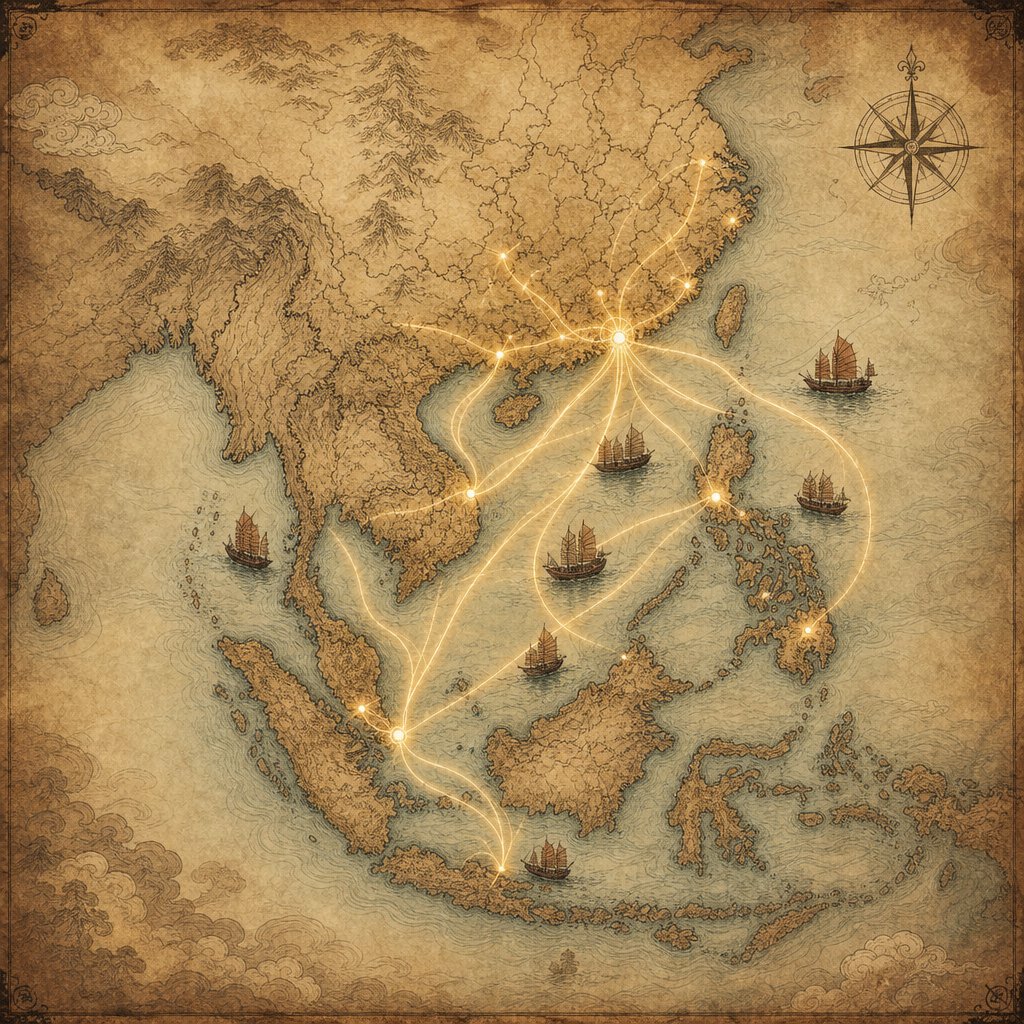
Cantonese speakers from Guangdong province dominated early migration to Hong Kong, North America, and Australia. That is why hong kong surnames and hong kong last names follow Cantonese pronunciation almost exclusively. A person surnamed 陈 in Hong Kong is always "Chan," never "Chen." Similarly, early Chinese communities in San Francisco, Vancouver, and Sydney were overwhelmingly Cantonese-speaking, which is why names like Wong, Lee, and Chan became the recognizable "Chinese surnames" in Western countries.
Southeast Asia tells a different story. Hokkien and Teochew speakers from Fujian province and eastern Guangdong migrated heavily to Singapore, Malaysia, the Philippines, and Indonesia. In these countries, the same character 陈 becomes "Tan" rather than "Chan." The surname 黄 appears as "Ng" or "Ooi" rather than "Wong." If you meet someone in Singapore with the surname Tan, you can reasonably infer Hokkien or Teochew ancestry. A person surnamed Chan in the same city likely has Cantonese roots.
Hakka communities added another layer. As Wayne Yeh describes in his family history, the surname 叶 is "Ye" in Mandarin, "Yip" in Cantonese, and "Yap" in Hakka. His grandfather romanized it the Taiwanese way as "Yeh" when the family immigrated to the United States. Three different spellings, one character, one clan.
Compounding the confusion, immigration officials in receiving countries had no standardized system for transcribing Chinese sounds. They simply wrote down what they heard. The result was extraordinary variation. The character 陈 alone has been romanized as Chen, Chan, Chin, Chinn, Ching, Chun, Chang, Chance, Dan, Zan, Zen, Tan, Tang, Tchen, Tin, Ting, Tjin, and Jin. One surname, over a dozen spellings, each one a fossil record of a specific dialect spoken at a specific immigration counter at a specific moment in history.
Today, mandarin surnames dominate mainland China's official records because Mandarin pinyin became the national standard. But across the global diaspora, Cantonese, Hokkien, and Hakka spellings persist as identity markers. In places like Singapore and Malaysia, the way a family name is spelled remains a signifier of which region a person's ancestors came from. Your surname spelling is not just a name. It is a dialect fingerprint, a geographic clue, and a piece of migration history compressed into a few letters.
This connection between surname and place runs even deeper than pronunciation. In Chinese culture, your family name does not just tell people what to call you. It tells them where you belong, which ancestral hall holds your genealogy, and which village your clan calls home.
Surnames as the Foundation of Chinese Clan Culture
In Western cultures, a last name is mostly administrative. It appears on your passport, your tax forms, your mail. You share it with your immediate family and maybe some distant cousins you have never met. In China, surnames function on an entirely different level. Your surname is an organizational principle, a social institution, and a spiritual bond that connects you to a specific place, a specific lineage, and a community of people stretching back dozens of generations.
Clan Identity and Ancestral Halls
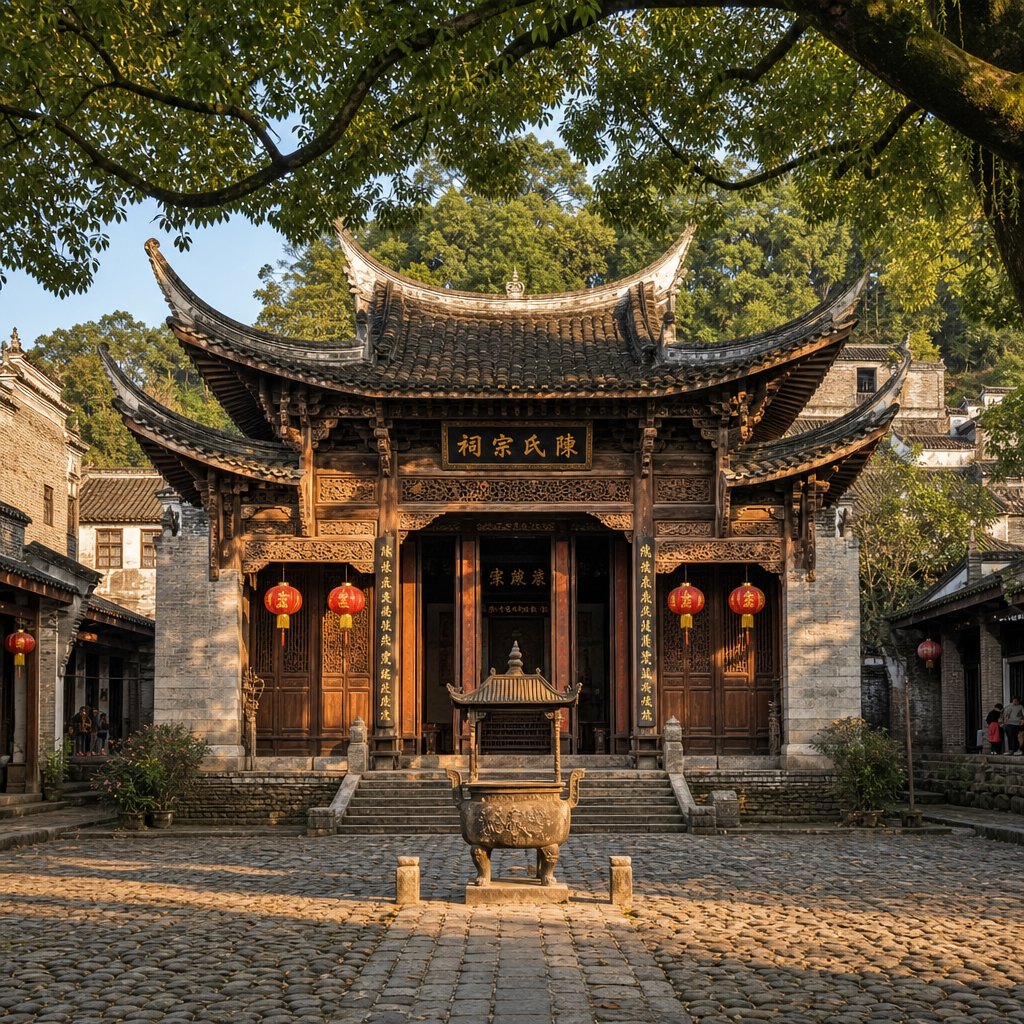
At the center of this system sits the ancestral hall, or citang (祠堂). Picture a building in a village, often the largest and most ornate structure in the settlement, where everyone inside shares the same surname. These halls were not churches or government offices. They were clan headquarters, places where families gathered to honor ancestors, settle disputes, celebrate weddings, and make collective decisions about land, education, and finances.
Each hall carried a tanghao (堂号), a clan hall name that functioned like a family motto and geographic marker combined. For example, a family with the kong last name might trace their tanghao back to Qufu in Shandong province, the ancestral home of Confucius. A family with the hong last name might identify with a specific hall name tied to their clan's historical seat of power. These tanghao were symbols of family identity, reminders of ancestral values and the legacy passed down through generations.
Surnames in China were never just labels. They were membership cards to a living institution with property, rules, and collective memory.
Genealogy Books and Surname Villages
The most tangible expression of this clan consciousness is the zupu (族谱), the genealogy book. Unlike a Western family tree that might trace four or five generations, a zupu can record lineages spanning a thousand years or more. According to Legacy Tree Genealogists, these documents typically contain detailed lineage records, prominent ancestors' biographies, clan migration histories, membership rules, and generation poems used for naming children.
Generation poems deserve special attention. As FamilySearch explains, Chinese families assigned a shared character to everyone in the same generation, and these characters formed a poem that guided naming across centuries. Brothers and cousins would share the same generation character in their names, making it immediately clear who belonged to which generation within the clan. If you know your family's generation poem, you can use it as a fingerprint to locate your specific zupu among thousands.
Consider the last name Tan origin story as an example of how these systems interlock. A person surnamed Tan (the Hokkien reading of 陈) can trace their clan back to the ancient state of Chen, identify their junwang (regional prestige) as Yingchuan, locate their ancestral hall in Fujian province, and find their specific branch within the zupu using their generation character. One surname unlocks an entire institutional network.
Here are the key elements that make up this surname culture:
- Ancestral halls (citang) - Physical gathering places for clan worship, celebrations, and governance
- Genealogy books (zupu) - Written records tracing lineage, migration, and clan rules across centuries
- Surname associations - Organizations in diaspora communities that connect people sharing the same surname
- Ancestral village pilgrimages - Journeys back to the original village where a clan first settled
- Generation naming poems - Poetic sequences that assign shared characters to each generation, linking names to lineage position
The Bai Jia Xing reinforced all of this from the earliest age. When a child of three chanted those four-character lines, they were not just learning to read. They were absorbing the idea that surnames matter, that every name in the poem represents a clan with its own hall, its own book, its own village. The sun family name, the kong last name, every surname in the text pointed to a real community with real institutions behind it.
Even today, many villages in southern China remain single-surname settlements where every resident shares one family name and one ancestral hall. These surname villages are living fossils of the clan system, places where the social structure encoded in the Bai Jia Xing still operates in daily life.
This deep infrastructure of clan identity did not stay frozen in the past. It adapted, migrated, and found new expression in the modern world, where overseas Chinese communities and digital genealogy tools are giving ancient surname traditions an unexpected second life.
Modern Relevance for Genealogy and Cultural Identity
Clan halls still stand in southern Chinese villages, but the search for surname origins no longer requires a physical journey to an ancestral hometown. Digital platforms, DNA testing, and diaspora networks have transformed how people connect their last name chinese heritage to living history. The Bai Jia Xing, once a children's primer, now serves as a gateway into a growing ecosystem of genealogy tools and cultural recovery projects.
Genealogy Research and the Modern Diaspora
For overseas Chinese families, reconstructing a lineage often starts with a single question: where did my surname come from? Platforms like My China Roots have built massive databases specifically designed to answer that question. The platform contains over 7 million overseas Chinese records covering 5 million individuals, a Chinese surname database with more than 400 surnames and 9,400 recorded spelling variants, and an ancestral village database spanning 31 regions of China with 700,000 place names. To compile its mainland Chinese collections, the platform digitized and made searchable over 1,000 zupu (genealogy books), turning handwritten clan records into searchable digital archives.
DNA genealogy adds another layer. Services that combine genetic testing with surname research can help people with uncommon chinese surnames identify clan connections that paper records alone cannot reveal. A person surnamed "Ng" in Malaysia and a person surnamed "Huang" in Shanghai may discover through DNA matching that they share a common ancestor, confirming what the Bai Jia Xing implied all along: these are the same clan, separated by dialect and distance but linked by blood.
This kind of research resonates beyond China. Every culture has systems for tracking lineage. European heraldry encoded family identity through coats of arms and crests. Japanese families used kamon, stylized family emblems passed down through generations. Korean clans maintained jokbo, detailed genealogy registers that tracked patrilineal descent across centuries. The Bai Jia Xing occupies a similar cultural space, but with one key difference: it was never restricted to nobility. It cataloged everyone, from imperial families to ordinary farmers, making it a democratic record of an entire civilization's naming structure.
The Text in Contemporary Chinese Education
Heritage learners, people of Chinese descent growing up outside China, often encounter the text as their first structured connection to Chinese culture. Language schools in diaspora communities from San Francisco to Sydney still use it as a teaching tool, not because children need to memorize 504 surnames, but because the rhythmic structure makes it an effective vehicle for character recognition and tonal practice. For a student assembling their first chinese full names from family stories and half-remembered conversations with grandparents, the text provides a framework: your name is in here, your clan is part of this tradition.
In mainland China, the text appears in elementary curricula and popular media. Television programs explore the origins of the most common chinese names, tracing Wang back to Zhou Dynasty royalty and Li back to Tang Dynasty emperors. Children's apps gamify the memorization process, pairing each surname with animated origin stories. The format has changed, but the function remains identical to what it was a thousand years ago: teaching young people that surnames carry meaning, history, and belonging.
Even uncommon family names and unusual surnames benefit from this renewed attention. Families bearing rare names that appear in the original text but have few living carriers can now connect with others through online surname associations and social media groups. A person with an unusual surname that once felt isolating can discover its place within the poem and trace its history back to a specific state, a specific era, a specific story of survival.
The Bai Jia Xing was written to teach children how to read. A thousand years later, it teaches their descendants how to remember. Whether you are searching a digital database for your last names chinese ancestors left behind, reciting the poem in a weekend language class, or simply wondering why your family spells its name the way it does, the text remains what it has always been: a map of belonging, compressed into four-character lines, waiting to be read aloud.
Frequently Asked Questions About the Hundred Family Surnames
1. How many surnames are in the Bai Jia Xing?
The most commonly referenced edition of the Bai Jia Xing contains 504 surnames, including 444 single-character surnames and 60 compound (two-character) surnames. The original Song Dynasty compilation recorded approximately 411 surnames, but subsequent editions expanded the count. Some versions list as many as 507 entries, though the 504-surname version remains the standard text used in education and cultural references today.
2. Why is Zhao the first surname in the Hundred Family Surnames?
Zhao appears first because it was the imperial surname of the Song Dynasty emperors who ruled China when the text was compiled (976-984 AD). The ordering follows a political hierarchy rather than alphabetical or population-based logic. The principle was 'first the imperial family, then the feudal lords, and finally the prominent clans.' Qian comes second to honor the Wuyue Kingdom rulers who peacefully surrendered to Song, Sun third for the Wuyue queen's family, and Li fourth for the Southern Tang dynasty kings.
3. What is the most common Chinese surname today?
Wang (王) is the most common Chinese surname, with over 95 million bearers according to China's Ministry of Public Security. Li (李) follows with approximately 93.4 million, and Zhang (张) ranks third at 89.6 million. Together, these three surnames alone account for roughly 21% of China's entire population. Notably, Wang ranks first by population but does not appear first in the Bai Jia Xing, where its position reflects Song Dynasty political considerations rather than demographic size.
4. Why do Chinese surnames have different spellings in different countries?
Chinese surnames vary in spelling because the Chinese language comprises multiple dialect groups, including Mandarin, Cantonese, Hokkien, Hakka, and Teochew, each pronouncing the same written character differently. When Chinese migrants settled overseas, they romanized their names according to their spoken dialect. Cantonese speakers who migrated to Hong Kong and North America produced spellings like Wong and Chan, while Hokkien speakers in Southeast Asia created spellings like Ong and Tan for the same characters. Immigration officials also transcribed names inconsistently, adding further variation.
5. What is the San Bai Qian curriculum in traditional Chinese education?
San Bai Qian refers to the three foundational texts used in traditional Chinese literacy education for roughly a thousand years. The name combines one character from each title: San Zi Jing (Three Character Classic) taught moral values and general knowledge, Bai Jia Xing (Hundred Family Surnames) taught social identity through clan names, and Qian Zi Wen (Thousand Character Classic) introduced a thousand unique characters covering cosmology, history, and governance. Together, these texts helped children recognize approximately 2,000 characters through rhythmic memorization before advancing to reading comprehension.