Understanding Gender in Chinese Characters
When you look at a Chinese character, you're reading more than a word. You're reading layers of meaning compressed into strokes, and sometimes those layers carry gender. Unlike Romance languages where nouns are grammatically masculine or feminine, Chinese encodes gender differently. It lives inside the building blocks of characters themselves: the radicals, the semantic components, and centuries of cultural context baked into each composition.
Whether you're choosing a female Chinese name, researching a Chinese name male relatives once carried, or simply trying to decode vocabulary in Mandarin, recognizing these gender signals gives you a sharper understanding of how the language works beneath the surface.
Why Chinese Characters Have Gender Associations
Chinese script is built from pictographic components called radicals. These radicals carry or suggest meaning, and two of them are explicitly gender-marked: the female radical (女) and the person/male radical (亻). The Gender in Language Project notes that while Mandarin is not grammatically gendered the way Spanish or French are, it carries gendered meanings through its radical system and through the positive or negative connotations tied to binary gender terms.
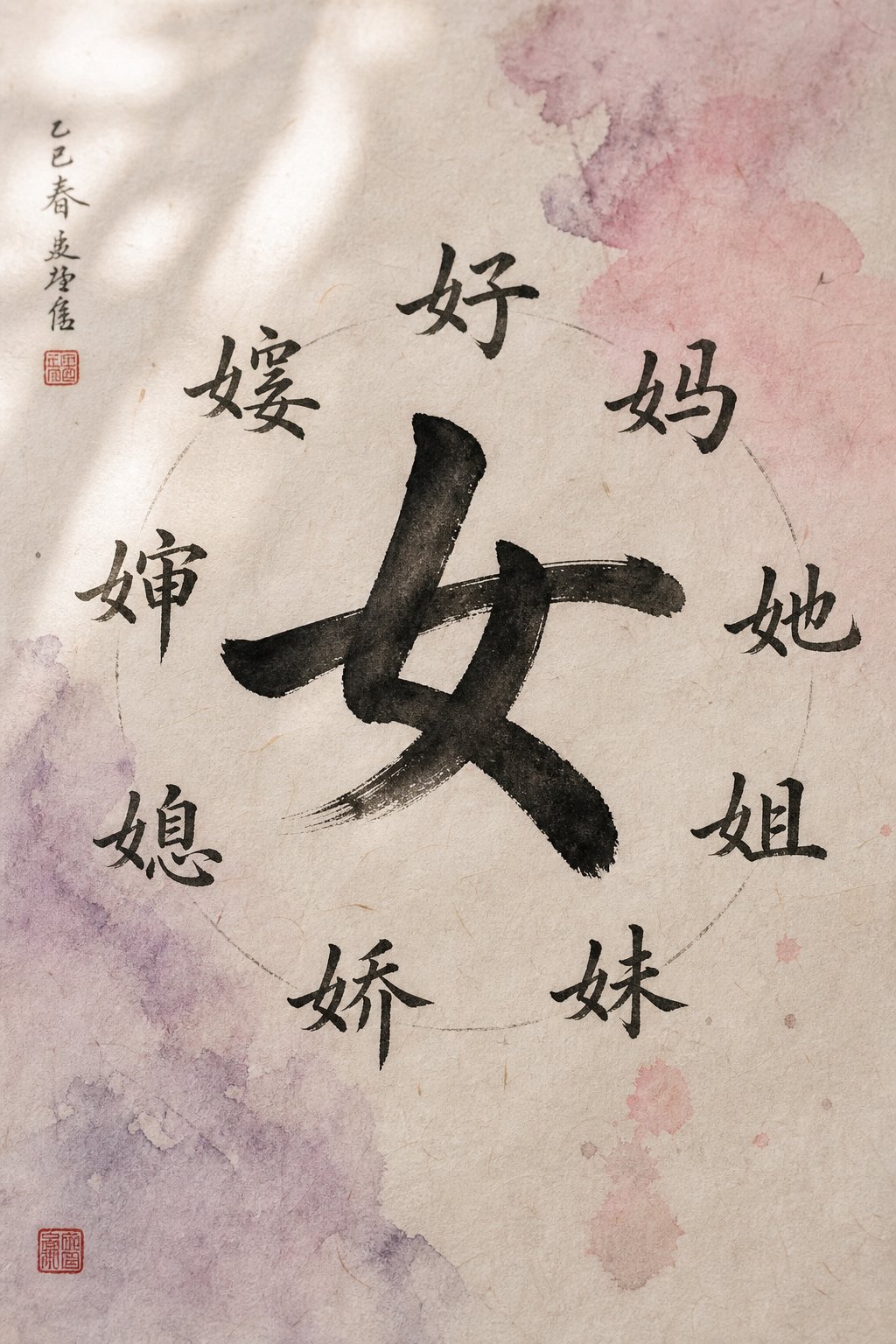
The 女 radical is the most immediately recognizable feminine marker in Chinese writing. You'll spot it in characters for mother (妈), older sister (姐), younger sister (妹), and even the pronoun she (她). Its presence almost always signals a connection to women or femininity.
In Chinese writing, radicals act as gender signals hidden in plain sight. The 女 radical marks femininity explicitly, while masculine characters rely on structural cues tied to strength, ambition, and natural power rather than a single dedicated radical.
This asymmetry is important. Feminine characters cluster around one visible radical, making them easy to identify. Masculine characters, on the other hand, draw from radicals like 力 (power), structural references to mountains, dragons, or martial themes, and semantic associations with achievement. The cues are there, but they're distributed across a wider set of components.
How This Guide Is Organized
This article serves as a dual-list reference, giving equal depth to both sides of the equation. You'll find comprehensive breakdowns of feminine characters built with the 女 radical, popular characters used in female names, top masculine characters and their structural cues, and the most common characters chosen for male names. Beyond the binary lists, we also cover gendered pronouns, their surprisingly recent history, and the growing trend of gender-neutral characters in modern naming.
Each section includes pinyin, meanings, radical analysis, and cultural context so you can move from recognition to real understanding. Whether you're a language learner building character literacy or a parent exploring naming traditions, the goal is the same: decode the gender hidden in strokes and use that knowledge with confidence.
How These Characters Were Selected and Ranked
Not every character with a 女 radical belongs exclusively to women, and not every character referencing strength belongs exclusively to men. So how do you decide which characters genuinely carry gender weight? The lists in this guide are built on measurable criteria rather than gut feeling.
Ranking Criteria for Gendered Characters
Each character was evaluated against five factors, ordered here by how heavily they influenced placement:
- Frequency in modern naming data - Characters that appear overwhelmingly in chinese given names female or chinese male given names carry stronger gender signals. A dataset of over 30 million Chinese individuals published in Scientific Data shows that more than 80% of people can be assigned a gender based on their given-name characters alone when using a 0.9 confidence threshold.
- Radical composition - The presence of explicitly gendered radicals like 女 (female) or semantically masculine components like 力 (power) provides structural evidence of gender association.
- Etymological origins - How the character was originally constructed in oracle bone or bronze script reveals what concept it was designed to express.
- Cultural significance - Some characters carry gender weight through literary tradition, idioms, or philosophical texts rather than through their radicals alone.
- Consistency across generations - Characters that have maintained their gender association from the pre-1960s cohort through the 2000s rank higher than those with shifting usage.
Sources and Linguistic Basis
The categorization draws on naming frequency research, radical analysis from traditional lexicography, and observed patterns in chinese feminine given names across multiple decades. Research into Chinese name-gender prediction confirms that gender in Chinese names operates as a semantic type, meaning the characters' meanings, not just their sounds, encode gender information.
Worth noting: some characters have drifted over time. A character like 文 (cultured) once appeared almost exclusively in male names but now shows up frequently for daughters as well. Where historical and modern usage conflict, modern frequency data took priority, with the historical context noted for learners who encounter these characters in classical texts or older family records.
Top Feminine Characters Built with the 女 Radical
The 女 radical is the single clearest gender marker in the entire Chinese writing system. When you spot it on the left side or bottom of a character, you're looking at a component that has signaled femininity for over three thousand years. For anyone studying the chinese character female category, this radical is your starting point and your most reliable guide.
What makes 女 so distinctive? As a standalone character, it means "woman" or "female" (nǚ). As a radical embedded inside other characters, it tells you the word relates to women, femininity, family relationships involving women, or concepts historically associated with the female role in society. The word for woman in mandarin, 女人 (nǚ rén), uses this character directly.
Essential 女 Radical Characters Every Learner Should Know
The characters below represent the most frequently encountered 女-radical words in modern Chinese. You'll find them in everyday conversation, family vocabulary, and across naming traditions. Many mandarin women learners encounter these characters within their first few months of study because they appear in such fundamental vocabulary.
| Character | Pinyin | Meaning | Radical Breakdown |
|---|---|---|---|
| 好 | hǎo | Good, well | 女 (woman) + 子 (child/son) = having both a daughter and son is "good" |
| 妈 | mā | Mother, mom | 女 (woman) + 马 (horse, phonetic component for "ma" sound) |
| 姐 | jiě | Older sister | 女 (woman) + 且 (phonetic component suggesting seniority) |
| 妹 | mèi | Younger sister | 女 (woman) + 未 (not yet, suggesting youth/immaturity) |
| 她 | tā | She, her | 女 (woman) + 也 (phonetic component for "ta" sound) |
| 安 | ān | Peace, calm | 宀 (roof) + 女 (woman) = a woman under a roof brings peace |
| 婚 | hūn | Marriage, wedding | 女 (woman) + 昏 (dusk, when weddings traditionally occurred) |
| 娘 | niáng | Woman, mother | 女 (woman) + 良 (good/virtuous, phonetic element) |
| 妻 | qī | Wife | 女 (woman) at the base, with a hand reaching for her hair (original pictograph of a bride) |
| 妙 | miào | Wonderful, clever | 女 (woman) + 少 (young/few) = the wonder of youth |
Etymological Breakdowns of Key Feminine Characters
The compositions above are not random pairings. Each one encodes a cultural assumption from ancient China, and understanding those assumptions helps you remember the characters while also revealing how gender was conceptualized thousands of years ago.
Take 好 (hǎo). Its logic is straightforward: place 女 (woman/daughter) beside 子 (son/child), and you get "good." The implication? A complete family with both a daughter and a son represented the ideal. As Chinese4kids notes, 好 symbolizes the traditional wish that having both a daughter and a son makes a perfect family.
Then there's 安 (ān), meaning peace or safety. Here, the 女 radical sits beneath 宀, the roof radical. A woman under a roof equals tranquility. This reflects the ancient domestic ideal where a woman's presence in the home signified stability and order. Whether you read that as protective or restrictive depends on your lens, but the etymological logic is unmistakable.
婚 (hūn) tells a different story. The right component 昏 means "dusk" or "twilight," and ancient Chinese weddings were traditionally held at sunset. Combine that timing with the 女 radical, and you get the character for marriage. The character literally encodes the historical moment when a bride would arrive at her new household.
妹 (mèi) uses 未 as its phonetic and semantic partner. 未 means "not yet," carrying a sense of something incomplete or still developing. Paired with 女, it creates "younger sister," the female family member who has not yet reached the maturity of 姐 (older sister). The contrast between the two characters teaches you relative age through radical logic.
Even 妈 (mā), the word every child learns first, has a structural story. The right side 马 (horse) serves purely as a phonetic indicator, providing the "ma" sound. The Written Chinese resource on the female radical confirms that 马 contributes only pronunciation here, not meaning. The 女 radical carries all the semantic weight, marking this as a female family role.
These etymologies reveal a pattern. Feminine characters built with 女 tend to define women through relationships (mother, sister, wife), domestic settings (peace under a roof), or life events centered on family (marriage). The radical system doesn't just label gender. It preserves an entire worldview about where women belonged in ancient society, frozen into strokes that billions of people still write daily.
Feminine Characters Popular in Chinese Names
The 女 radical marks femininity at the structural level, but many of the most beloved female chinese names don't contain that radical at all. Instead, they draw on nature, beauty, and inner virtue to signal femininity through meaning rather than through visible components. If you're browsing any chinese names list female resources, you'll notice the same characters appearing again and again across generations and regions.
Why do certain characters dominate? Because each one encodes a specific quality that Chinese parents traditionally wished for their daughters. These aren't arbitrary picks. They represent a cultural vocabulary of femininity built over centuries.
Most Popular Characters in Female Chinese Names
The table below covers the characters you'll encounter most frequently in chinese names for female children, from classic choices that have endured for decades to those still thriving in modern naming. Data from the Chinese name database covering 1.2 billion Han Chinese individuals confirms that characters like 丽, 芳, and 玉 have appeared consistently in female given names across every birth cohort from the pre-1960s through the 2000s.
| Character | Pinyin | Meaning | Cultural Significance |
|---|---|---|---|
| 美 | měi | Beautiful | Represents physical and moral beauty; one of the most direct expressions of aesthetic value in chinese first names women have carried for generations |
| 丽 | lì | Elegant, lovely | Connotes refined, polished beauty rather than raw attractiveness; popular across all decades |
| 花 | huā | Flower | Symbolizes youth, natural beauty, and the fleeting preciousness of life; deeply tied to feminine imagery in poetry |
| 玉 | yù | Jade | Represents purity, moral integrity, and preciousness; jade is the most valued stone in Chinese culture |
| 雪 | xuě | Snow | Evokes purity, cleanliness, and quiet elegance; suggests a character untouched by worldly corruption |
| 月 | yuè | Moon | Associated with feminine yin energy, gentleness, and beauty; the moon goddess Chang'e reinforces this link |
| 芳 | fāng | Fragrant | Implies virtue that others can sense without effort, like a natural perfume; one of the most enduring china female names characters |
| 婷 | tíng | Graceful | Describes elegant posture and movement; contains the 女 radical, making its femininity both structural and semantic |
| 静 | jìng | Quiet, serene | Values inner calm and composure; reflects the traditional ideal that women should embody stillness and reflection |
| 慧 | huì | Intelligent, wise | Celebrates intellectual sharpness; signals that parents value their daughter's mind alongside other qualities |
Cultural Meanings Behind Feminine Name Characters
Look at the table closely and you'll notice a pattern. These characters cluster around four themes: physical beauty (美, 丽), nature imagery (花, 雪, 月), moral purity (玉, 芳), and inner qualities (静, 慧, 婷). Together, they paint a portrait of the ideal daughter as Chinese culture traditionally imagined her: beautiful but not vain, pure but not fragile, intelligent but composed.
The names of females in China reflect these layered expectations. A parent choosing 玉 isn't just saying "precious." They're invoking jade's cultural weight as a stone that is hard, smooth, and warm to the touch, a material that improves with careful handling over time. Similarly, 芳 doesn't just mean "fragrant." It suggests a person whose goodness radiates outward naturally, without force or performance.
Some of these characters have remained remarkably stable across generations. Research into naming trends shows that 丽 and 芳 dominated chinese names female parents chose throughout the 1960s and 1970s, while 婷 and 慧 surged in popularity during the 1980s and 1990s as educational aspirations for daughters grew. Characters like 静 remain popular today, though they now compete with gender-neutral options that reflect shifting cultural values.
What's changing? Modern parents increasingly pair these traditional feminine characters with more assertive or intellectual companions. A name like 慧婷 (wise and graceful) or 静雪 (serene snow) still reads as unmistakably female, but the emphasis has shifted. Intelligence and inner strength now share equal billing with beauty and gentleness, a quiet evolution visible in the characters parents reach for when naming their daughters.
These feminine naming characters operate on a different principle than the 女-radical vocabulary covered earlier. They don't announce gender through their structure. They signal it through cultural association, through the accumulated weight of millions of women who have carried these characters in their names. That distinction matters when you move to the other side of the spectrum, where masculine characters rely on an entirely different set of references.
Top Masculine Characters and Their Structural Cues
Feminine characters have the 女 radical as a clear, unified marker. Masculine characters don't work that way. There's no single "male radical" that flags masculinity the way 女 flags femininity. Instead, the man in chinese character traditions draws from a scattered set of structural cues: radicals tied to physical force, semantic references to nature's most powerful creatures, and components that encode ambition or martial prowess.
This asymmetry is exactly why masculine characters get overlooked in most guides. They're harder to categorize neatly. But once you learn the patterns, you'll recognize them just as quickly as you spot a 女 radical on the left side of a character.
Key Masculine Characters and Their Radicals
The table below presents the ten most strongly gendered masculine characters in Chinese, ranked by their frequency in male chinese names and the clarity of their structural masculinity signals. For each, you'll find the radical or component that carries the gender weight.
| Character | Pinyin | Meaning | Radical/Structure |
|---|---|---|---|
| 力 | li | Strength, power | Standalone radical; pictograph of an ancient plow requiring great physical force to operate |
| 刚 | gang | Firm, hard, unyielding | 刂 (knife radical) + 冈 (ridge); the knife radical signals sharpness and cutting force |
| 强 | qiang | Strong, powerful | 弓 (bow radical) + 虽 (phonetic); the bow radical references a weapon requiring strength to draw |
| 勇 | yong | Brave, courageous | 甬 (phonetic) + 力 (strength); bravery is literally built on the strength radical |
| 伟 | wei | Great, mighty | 亻 (person radical) + 韦 (phonetic); a person of extraordinary stature and achievement |
| 龙 | long | Dragon | Standalone pictograph; represents the most powerful creature in Chinese mythology, once reserved for emperors |
| 武 | wu | Martial, military | 止 (stop) + 戈 (halberd/weapon); the ability to stop a weapon, meaning mastery of combat |
| 雄 | xiong | Heroic, male (of animals) | 厷 (arm/strength) + 隹 (bird); a powerful bird, used broadly to mean "male" or "heroic" |
| 壮 | zhuang | Robust, magnificent | 丬 (bed/side radical) + 士 (scholar/warrior); 士 historically referred to the warrior class |
| 志 | zhi | Ambition, will | 士 (warrior/scholar) + 心 (heart); a warrior's heart, meaning determination and purpose |
Why These Characters Signal Masculinity
Look at the structural patterns and three clusters emerge immediately.
Physical force. The 力 radical is the closest thing masculine characters have to a unified marker. As a Daily Zhongwen analysis explains, the oracle bone script for 力 resembles an ancient plow used to cultivate land, and characters built with this radical relate to actions requiring strength. You'll find 力 embedded in 勇 (brave) and standing alone as one of the most common chinese names for man choices. Pandanese's research on Chinese strength symbols confirms that 力 functions as a pictograph of a plow, linking the character directly to the physical labor that defined male roles in agrarian society.
Weapons and combat. Characters like 武 (martial) and 刚 (firm) incorporate weapon-related radicals. The 戈 in 武 is a halberd. The 刂 in 刚 is a blade. The 弓 in 强 is a bow. These components don't just suggest masculinity abstractly. They reference the specific tools of warfare and hunting that were historically male domains.
Natural power and ambition. 龙 (dragon) draws on mythology rather than radical logic. The dragon in Chinese culture represents ultimate power, strength, and good fortune, and was historically associated with the Emperor himself. Meanwhile, 志 (ambition) pairs the warrior radical 士 with 心 (heart), encoding the idea that true masculinity lives in purposeful determination, not just physical bulk.
Notice what's absent from this list. Unlike feminine characters, which often define women through relationships and domestic settings, masculine characters almost never reference family roles. The word for male in mandarin, 男, combines 田 (field) and 力 (strength), literally meaning "strength in the field." Masculinity in Chinese characters is defined by what a man does and achieves, not by who he is in relation to others.
This distinction carries directly into naming. Parents selecting characters for sons aren't choosing words that describe appearance or temperament. They're choosing aspirations: be strong, be brave, be great, rise like a dragon. The next section explores exactly which of these aspirational characters dominate real naming data across generations.
Masculine Characters Popular in Chinese Names
Strength, bravery, and dragon imagery define the structural DNA of masculine characters. But which of those characters actually end up in a chinese man's name? The gap between what a character means in isolation and how often parents choose it for their sons is worth examining. Some powerfully masculine characters rarely appear in real naming data, while others show up millions of times across birth registries.
Most Popular Characters in Male Chinese Names
The characters below represent the most frequently used options in chinese male names across multiple generations. According to That's Mandarin's research on popular Chinese boy names, characters like 伟, 杰, and 龙 consistently rank among the top choices, while LingoAce's naming data confirms that characters such as 浩, 宇, and 瑞 are rising in modern usage. The table focuses on the ten characters with the strongest track record in male chinese names over the past several decades.
| Character | Pinyin | Meaning | Aspirational Quality |
|---|---|---|---|
| 伟 | wei | Great, mighty | Greatness of character and achievement; parents wish for a son who accomplishes extraordinary things |
| 强 | qiang | Strong, powerful | Physical and mental resilience; the ability to overcome obstacles through sheer force of will |
| 磊 | lei | Open, upright | Moral transparency and integrity; three stones stacked together suggest a person who is solid and honest |
| 军 | jun | Army, military | Discipline, loyalty, and service to the nation; reflects collective duty over individual desire |
| 杰 | jie | Outstanding, remarkable | Excellence that rises above the ordinary; a person who stands out in any field they enter |
| 鹏 | peng | Roc (mythical bird) | Limitless ambition and soaring potential; drawn from Zhuangzi's fable of the giant bird that flies 90,000 li |
| 涛 | tao | Great wave, billow | Unstoppable momentum and power; suggests a force of nature that cannot be contained |
| 明 | ming | Bright, intelligent | Clarity of mind and moral brightness; combines sun (日) and moon (月) for total illumination |
| 建 | jian | Build, establish | The drive to create something lasting; strongly tied to nation-building ideals in post-1949 naming |
| 峰 | feng | Peak, summit | Reaching the highest point in one's field; the mountain radical (山) grounds this in natural imagery |
Aspirational Meanings in Masculine Name Characters
Imagine naming your son with a single character that carries your entire hope for his future. That's exactly what these choices represent. Chinese names for men aren't descriptions of who a child is at birth. They're blueprints for who parents want that child to become.
The aspirations fall into distinct categories. Characters like 伟, 杰, and 峰 express a desire for personal excellence, the hope that a son will rise to the top of whatever he pursues. Characters like 军 and 建 reflect collective duty, particularly popular during the 1950s through 1970s when China's Ministry of Public Security data shows names like 建国 (build the country) dominated male naming. There are apparently 21.3 million people in China whose names contain the character 国 alone.
Then there are characters rooted in nature's raw power: 涛 (great wave), 鹏 (roc bird), and 峰 (mountain peak). These draw on the natural world not for its beauty, as feminine names do with flowers and moonlight, but for its overwhelming force. A wave doesn't ask permission. A mountain peak doesn't bend. That's the message encoded in a china name male parents select from this category.
Generational shifts tell a revealing story. The 1950s-1970s favored nation-oriented characters like 建 and 军, reflecting the political climate. The 1980s and 1990s saw a pivot toward individual achievement with 杰, 伟, and 磊 rising sharply. Today's parents increasingly blend traditional masculine strength with intellectual refinement. Modern compound names like 浩然 (vast and virtuous) or 梓轩 (resilient and elegant) pair a strong character with a more nuanced companion, suggesting that the definition of masculinity encoded in chinese names for men is itself evolving.
Still, the core pattern holds. Whether a parent chooses 强 in 1965 or 睿 in 2025, they're projecting forward. Masculine naming characters are less about what a boy is and more about what he should strive to be. That forward-looking quality connects directly to how Chinese handles gender at the grammatical level, where pronouns tell a surprisingly different story about when and why gender distinctions were drawn in the first place.
Gendered Pronouns in Chinese and Their History
Masculine and feminine naming characters encode gender through meaning and aspiration. But what about the most basic grammatical level, the pronouns themselves? Here's something that surprises most learners: pronouns in chinese are gendered on paper but completely identical in speech. Say "tā" out loud and you've just said "he," "she," and "it" simultaneously. No tone difference, no vowel shift, nothing. The distinction exists only in writing, and it didn't exist there either until about a century ago.
The Origin of 她 and the Pronoun Split
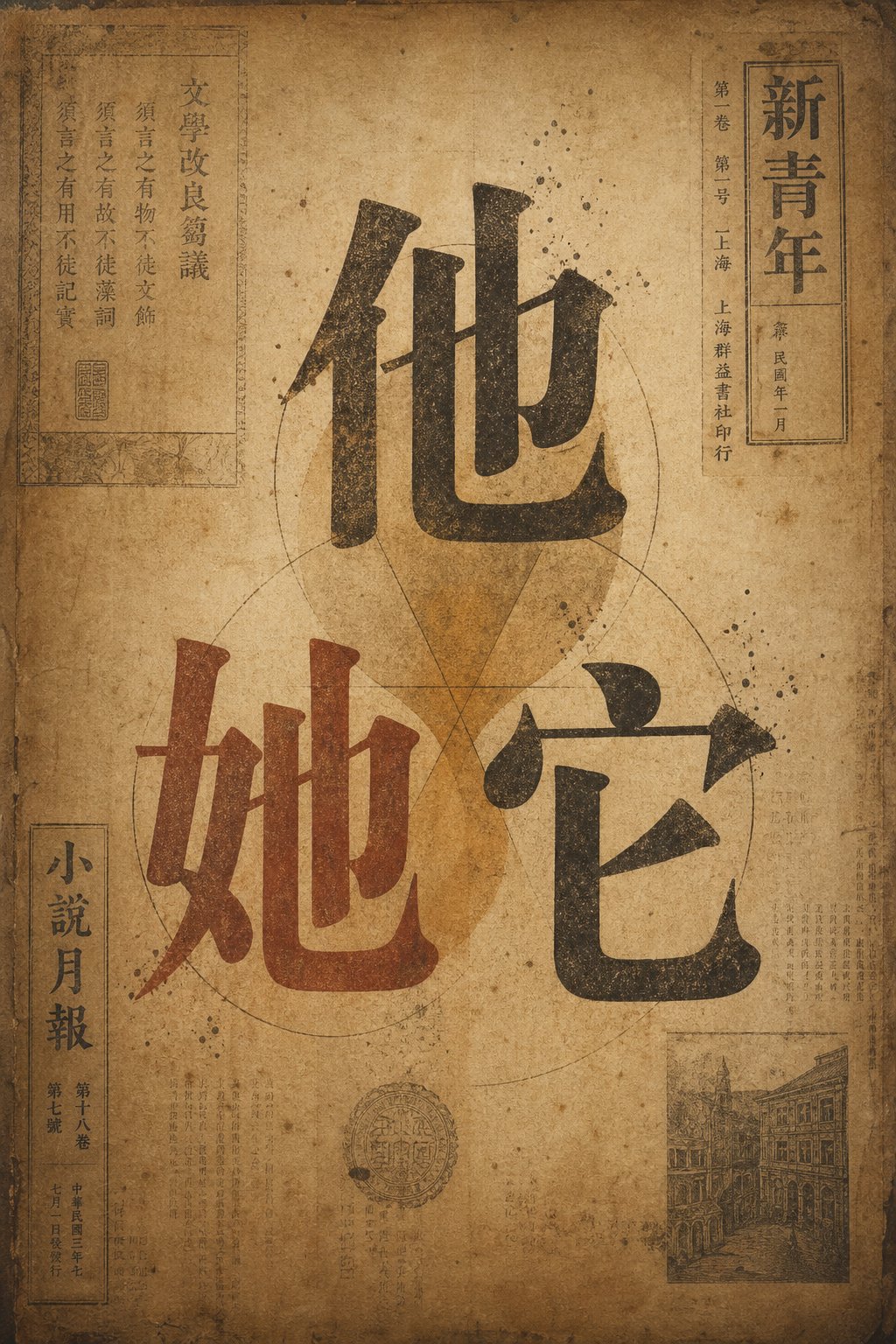
For most of Chinese literary history, there was only one third-person pronoun: 他 (tā). In classical novels like Romance of the Three Kingdoms (14th century) and Dream of the Red Chamber (18th century), authors used 他 to refer to both male and female characters without distinction. The character's radical, 亻(person), carried no gender weight. It simply meant "that other person."
The split came during the New Cultural Movement following the fall of the Qing Dynasty. Chinese intellectuals, deeply influenced by Western languages, noticed that English and other European languages distinguished between "he" and "she." Translators found it frustrating to render English texts into Chinese without a way to mark gender in writing. In 1920, poet and linguist Liu Bannong proposed a solution: repurpose the obscure character 她, originally a variant for "older sister," as a dedicated female pronoun.
Liu Bannong's 1920 creation of 她 as a female pronoun was not merely a linguistic innovation. It was part of the broader effort to emancipate Chinese women from Confucian patriarchy by giving them visible, distinct representation in the written language.
The proposal sparked immediate debate. Some male critics argued that 他 already encompassed both genders and that splitting it would introduce unnecessary division. Female critics raised a sharper objection: by replacing the 亻(person/human) radical with 女 (woman), the new pronoun implied that women were somehow less human than men. The women's publication Women's Resonance Monthly released a notice in 1934 stating that using 人 for men and 女 for women "is an insult to women because it implies they are not human."
Despite the criticism, prominent female writers like Bing Xin and Lu Yin adopted 她 in their fiction published in 1921, and the character gradually became standard. Meanwhile, 他 shifted from a universal pronoun to a primarily masculine one. A third form, 它 (with the radical for "roof" or "cover"), took over for inanimate objects and animals. All three remained pronounced identically: tā.
Linguist David Moser points out the missed opportunity: no one at the time suggested creating a new specifically masculine character while preserving 他 as gender-neutral. Poet Liu Dabai did propose exactly that system in the 1930s, with three distinct characters for person, man, and woman, but his alternative never gained traction. The result is the asymmetrical system Chinese uses today: 他 serves as both "he" and the default for unknown gender, while 她 is specifically female.
Modern Pronoun Usage and Gender-Neutral Alternatives
In spoken Mandarin, none of this matters. When you hear someone say "tā," you genuinely don't know which character they mean. You can have an entire conversation about a person without ever specifying their gender, and both speakers might not even register the ambiguity. This is why native Chinese speakers famously mix up "he" and "she" in English. Mandarin pronouns don't train your brain to track gender the way English does.
The plural forms work the same way. Add 们 (men) to any pronoun and you get the plural: 他们 (they, masculine or mixed), 她们 (they, all female), 它们 (they, objects). When people ask how to say they in chinese, the answer is technically 他们, but in speech it's just "tāmen" with no audible gender marker at all.
This spoken neutrality has become newly relevant as conversations about transgender in chinese communities evolve. Since there's no universally agreed-upon non-binary pronoun in written Chinese, several alternatives have emerged:
- TA — Written in Latin letters, pronounced the same as all other third-person pronouns. The Transgender Resource Center in Hong Kong advocates this form, and mainstream companies including China Central Television have used it in contexts where gender is irrelevant.
- X也 — An invented character replacing the gendered radical with the letter X. Created in 2015 by the intersex platform The Missing Gender 0.972, it visually resembles a Chinese character but faces practical barriers since it cannot be typed on standard keyboards.
- 佢 (qú) — A gender-neutral pronoun used in spoken Cantonese and informal written contexts in Hong Kong, sometimes adopted by non-binary individuals.
- Reverting to 他 as gender-neutral — Some activists argue for reclaiming 他's original inclusive meaning rather than inventing new forms. As transgender activist Joanne Leung explains: "Why can't we make people understand that 他 was originally a gender-neutral pronoun?"
Each option carries tradeoffs. TA is already widely used online but remains informal. X也 is visually creative but practically limited. Reclaiming 他 is linguistically sound but risks being read as masculine by default. The conversation remains open, shaped by the reality that non-binary communities in China are still developing and haven't reached consensus on preferred terms.
What's clear is that Chinese occupies a unique position among major world languages. Its spoken form never gendered pronouns in the first place. The written distinction was imported from Western linguistic norms barely a hundred years ago. That history makes the current search for inclusive mandarin pronouns less about inventing something new and more about deciding whether to keep, modify, or undo a relatively recent change. Gender in Chinese characters, it turns out, isn't always ancient. Sometimes it's barely older than your grandparents.
Gender-Neutral Characters and Unisex Naming Trends
The pronoun debate reveals something fundamental: Chinese has always had a gender-neutral streak in its spoken form. That same impulse is now reshaping how parents name their children. Across mainland China, Hong Kong, and Taiwan, gender neutral chinese names are rising fast, driven by parents who want a name's meaning to speak louder than its gender signal.
Rising Gender-Neutral Characters in Modern Names
What makes a character genuinely unisex? It needs to carry positive meaning without leaning on radicals or semantic themes tied exclusively to one gender. No 女 radical, no 力 radical, no flowers-and-moonlight imagery, no weapons-and-warfare references. The characters below meet that standard and appear frequently in both male and female naming data from the 1990s onward:
- 宇 (yu) — Universe, space. Suggests vastness and limitless potential. Contains the roof radical 宀, referencing shelter rather than gender.
- 晨 (chen) — Morning, dawn. Evokes fresh beginnings and hope. Built with 日 (sun) and 辰 (celestial), both gender-neutral components.
- 瑞 (rui) — Auspicious, lucky. Carries connotations of good fortune and blessings without any gendered structural cue.
- 嘉 (jia) — Excellent, praiseworthy. Celebrates quality and virtue in a way that applies equally to any child.
- 睿 (rui) — Wise, perceptive. Emphasizes intellectual depth. Increasingly popular as parents prioritize intelligence over gendered traits.
- 思 (si) — Think, contemplate. Values the inner life of the mind. Contains 心 (heart) at its base, linking thought to feeling.
- 辰 (chen) — Celestial, stars, time. References the cosmos and natural cycles rather than human gender roles.
Research from the 2005 China mini-census study confirms that the genderedness of both male and female names has converged over the past century, with female names showing the most dramatic shift toward neutrality. Characters like 文 (cultured), once almost exclusively male, now appear regularly in daughters' names. Meanwhile, characters like 嘉 and 睿 entered naming trends without ever developing a strong gender lean in either direction.
Why Unisex Names Are Gaining Popularity
What's pushing parents toward chinese unisex names? Several forces are working together.
Urbanization and education. As naming trend research notes, the shift toward gender-neutral names is especially prevalent in urban areas. City-dwelling parents with higher education levels tend to choose names that emphasize universal qualities like wisdom, auspiciousness, and ambition rather than gender-specific beauty or strength.
Global cultural influence. Exposure to Western naming conventions, where unisex names like "Alex" or "Jordan" are common, has normalized the idea that a name doesn't need to declare gender. Chinese parents active on international social media encounter this flexibility daily.
The one-child policy's legacy. For decades, many families had only one child regardless of gender. Parents poured identical aspirations into sons and daughters alike, and naming practices followed. A daughter could be 睿 (wise) just as easily as a son could be 思 (thoughtful).
Changing attitudes toward gender roles. The Chinese name database analysis shows that after the 1980s, even radicals with gendered connotations began appearing more loosely across the sexes. Daughters are now expected to be "excellent" (佳) and "cultured" (文), while the roof radical 宀 appears in boys' names like 宇 (universe) and 家 (family), hinting at greater acceptance of family-oriented masculinity.
Some traditionally gendered characters are being actively reclaimed. 明 (bright), once a staple of chinese gender neutral names by accident rather than design, now appears intentionally in girls' names. 静 (quiet), historically feminine, shows up in boys' compound names where it signals contemplative depth rather than passive silence. The boundaries are softening, not because the characters have changed, but because the cultural expectations attached to them have.
This blurring doesn't erase the masculine-feminine spectrum. It adds a middle ground. Parents choosing unisex chinese names aren't rejecting tradition. They're selecting from a growing pool of characters whose meanings transcend the old binary, characters that say "we want our child to be wise, fortunate, and boundless" without saying "because they are a boy" or "because they are a girl." That middle ground is exactly where a direct comparison between the two poles becomes most useful.
Complete Comparison of Masculine and Feminine Characters
Gender-neutral characters occupy the expanding middle, but the two poles still define the majority of naming and vocabulary patterns in Chinese. Seeing them side by side makes the structural logic unmistakable. Whether you're trying to decode a woman chinese name you've encountered in a novel or figure out why a particular character "feels" masculine, this comparison gives you the framework to work from.
Masculine vs Feminine Characters at a Glance
The table below maps the key differences across five dimensions. Think of it as a cheat sheet for recognizing gendered characters in the wild, whether you're reading female names in chinese texts, scanning a family registry, or studying vocabulary lists.
| Category | Feminine Characters | Masculine Characters |
|---|---|---|
| Common Radicals | 女 (woman), 艹 (grass/flower), 王/玉 (jade), 心/忄 (heart) | 力 (power), 刂 (knife), 弓 (bow), 戈 (halberd), 山 (mountain) |
| Semantic Themes | Beauty, nature imagery (flowers, moon, snow), purity, grace, inner calm | Physical strength, ambition, combat, natural force (waves, peaks, dragons) |
| Name Frequency | Characters like 丽, 芳, 婷, 静, and 慧 dominate female names china registries across all generations | Characters like 伟, 强, 杰, 军, and 峰 appear most frequently in male naming data |
| Cultural Values | Elegance, moral virtue, gentleness, wisdom expressed through composure | Achievement, resilience, duty to nation, excellence that rises above others |
| Modern Trends | Shifting toward intellectual qualities (慧, 睿); blending with gender-neutral options | Moving from collective duty (军, 建) toward individual refinement (睿, 宇); softer pairings emerging |
Notice the asymmetry in the radicals row. Feminine characters cluster around one dominant radical (女), making them easy to spot structurally. Masculine characters scatter across multiple radicals tied to weapons, force, and terrain. This means identifying a chinese name for woman is often faster at a glance than confirming a male name, simply because the 女 radical is so visually distinctive.
Practical Tips for Recognizing Gendered Characters
You don't need to memorize every character on these lists. Radical recognition alone gets you surprisingly far. Here's a quick-reference checklist of radicals and components that signal gender when you encounter unfamiliar characters:
Radicals that signal femininity:
- 女 (nǚ) — The clearest marker. If it appears on the left side, the character almost certainly relates to women or femininity.
- 艹 (cǎo) — Grass/flower radical. Common in woman chinese names drawn from nature: 芳, 莉, 花, 蓉.
- 王/玉 (wáng/yù) — Jade radical. Signals preciousness and purity: 珍, 琳, 瑶.
Radicals that signal masculinity:
- 力 (lì) — Power/strength. Appears in 勇, 劲, 功, and stands alone as a name character.
- 刂/刀 (dāo) — Knife/blade. Found in 刚, 剑, 利. References sharpness and decisive action.
- 山 (shān) — Mountain. Grounds characters like 峰, 岳, 崇 in imagery of immovable natural power.
- 戈 (gē) — Halberd/weapon. Embedded in 武, 战, 成. Signals martial strength.
- 弓 (gōng) — Bow. Found in 强, 张. References weaponry requiring physical force.
When you encounter an unfamiliar character in a name, scan for these radicals first. A character containing 艹 on top in a woman's name likely references a plant or flower. A character with 山 on the left in a man's name probably references height or grandeur. The system isn't foolproof, as some characters have shifted gender associations over time, but it gives you a reliable starting point for decoding female names from china or male names you haven't seen before.
One final pattern worth internalizing: feminine characters tend to describe what someone is (beautiful, graceful, pure), while masculine characters tend to describe what someone does or achieves (builds, conquers, rises). That semantic split runs deeper than any single radical. Once you see it, you'll recognize it everywhere, from ancient poetry to the baby name lists parents browse today.
Frequently Asked Questions About Masculine and Feminine Chinese Characters
1. How can you tell if a Chinese character is masculine or feminine?
The most reliable method is radical recognition. Feminine characters often contain the 女 (woman) radical on the left side, the 艹 (grass/flower) radical on top, or the 玉 (jade) radical. Masculine characters tend to incorporate 力 (power), 刂 (knife), 山 (mountain), 戈 (halberd), or 弓 (bow). Beyond radicals, semantic themes also signal gender: feminine characters reference beauty, nature, and inner calm, while masculine characters reference physical strength, ambition, and natural force like waves or mountain peaks.
2. What are the most common Chinese characters used in female names?
The most frequently used characters in female Chinese names include 丽 (elegant), 芳 (fragrant), 婷 (graceful), 静 (serene), 慧 (intelligent), 美 (beautiful), 玉 (jade), 雪 (snow), 月 (moon), and 花 (flower). These characters reflect cultural values of beauty, moral purity, and inner grace. Naming data from over a billion individuals shows that 丽 and 芳 dominated from the 1960s through the 1970s, while 婷 and 慧 surged in the 1980s and 1990s as parents placed greater emphasis on intellectual qualities for daughters.
3. Why does Chinese have gendered pronouns if they all sound the same?
Chinese originally had only one third-person pronoun, 他 (ta), used for all genders. The female pronoun 她 was created in 1920 by poet Liu Bannong during the New Cultural Movement, influenced by Western languages that distinguish between he and she. All three written forms (他, 她, 它) are still pronounced identically as 'ta' in spoken Mandarin, making the language effectively gender-neutral in conversation. The written gender distinction is less than 105 years old, making it one of the newest features of the Chinese writing system.
4. What Chinese characters work for both male and female names?
Popular gender-neutral characters include 宇 (universe), 晨 (morning), 瑞 (auspicious), 嘉 (excellent), 睿 (wise), 思 (think), and 辰 (celestial). These characters carry positive meanings without relying on gendered radicals or themes tied exclusively to one gender. Their rise in popularity is driven by urbanization, global cultural influence, the legacy of the one-child policy, and evolving attitudes toward gender roles. Characters like 文 (cultured) and 明 (bright) have also shifted from predominantly male usage to genuinely unisex status.
5. What is the 女 radical and why is it important in Chinese?
The 女 radical is a semantic component meaning woman or female that appears inside hundreds of Chinese characters. It is the single clearest gender marker in the writing system, dating back over 3,000 years to oracle bone script. When you see 女 on the left side of a character, it almost always indicates a connection to women, femininity, or family relationships involving women. Examples include 妈 (mother), 姐 (older sister), 她 (she), 婚 (marriage), and 好 (good). The radical also preserves ancient cultural attitudes, as many 女-radical characters define women through domestic roles and family relationships.