What the Red Marks on Chinese Art Really Mean
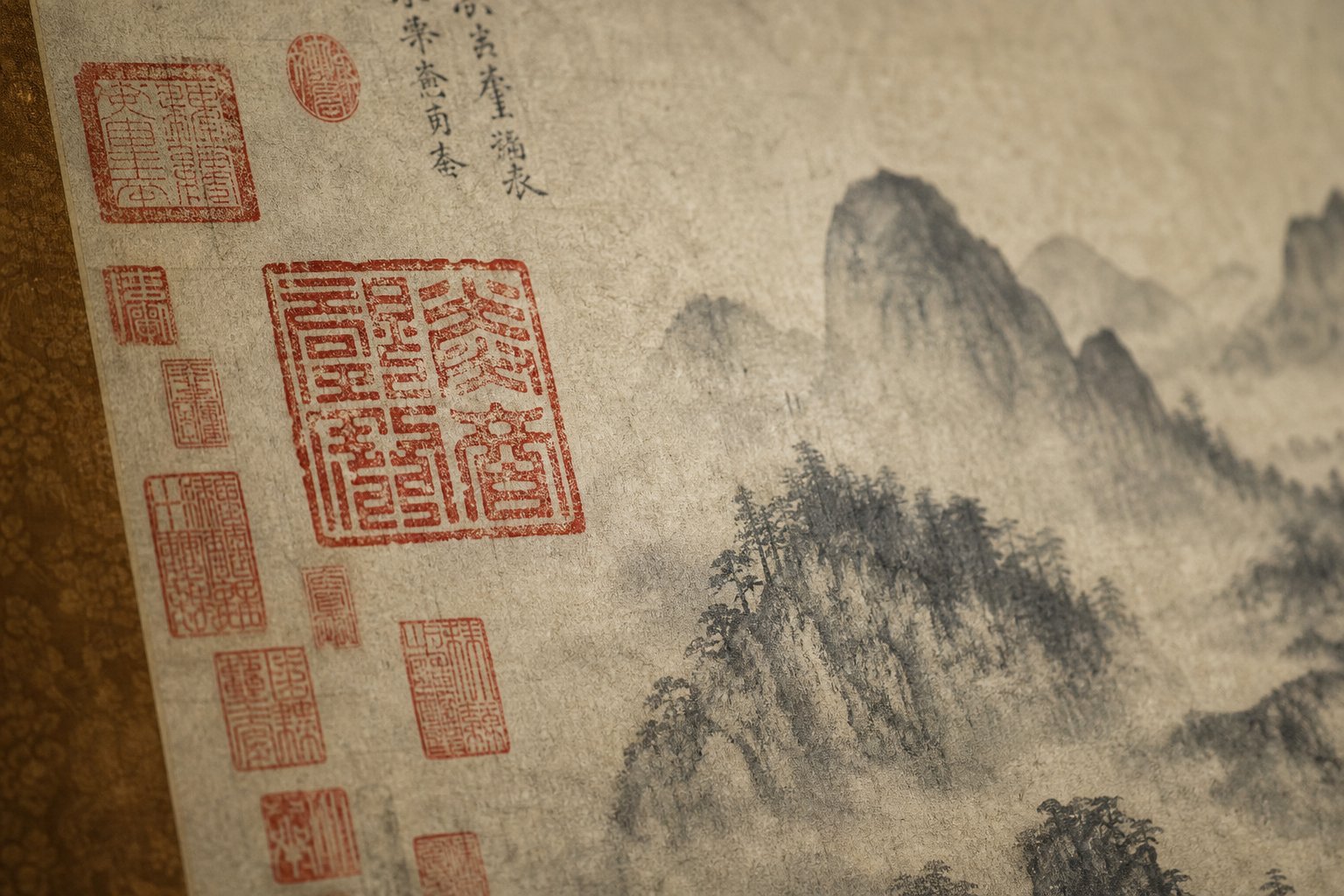
Imagine you are standing in front of a Song dynasty landscape scroll at a museum. The brushwork is stunning, the ink washes are layered with quiet precision, and then you notice them: small, vivid red marks pressed into the paper, sometimes clustered near a corner, sometimes scattered across the margins. They look deliberate, even authoritative. But what are they saying?
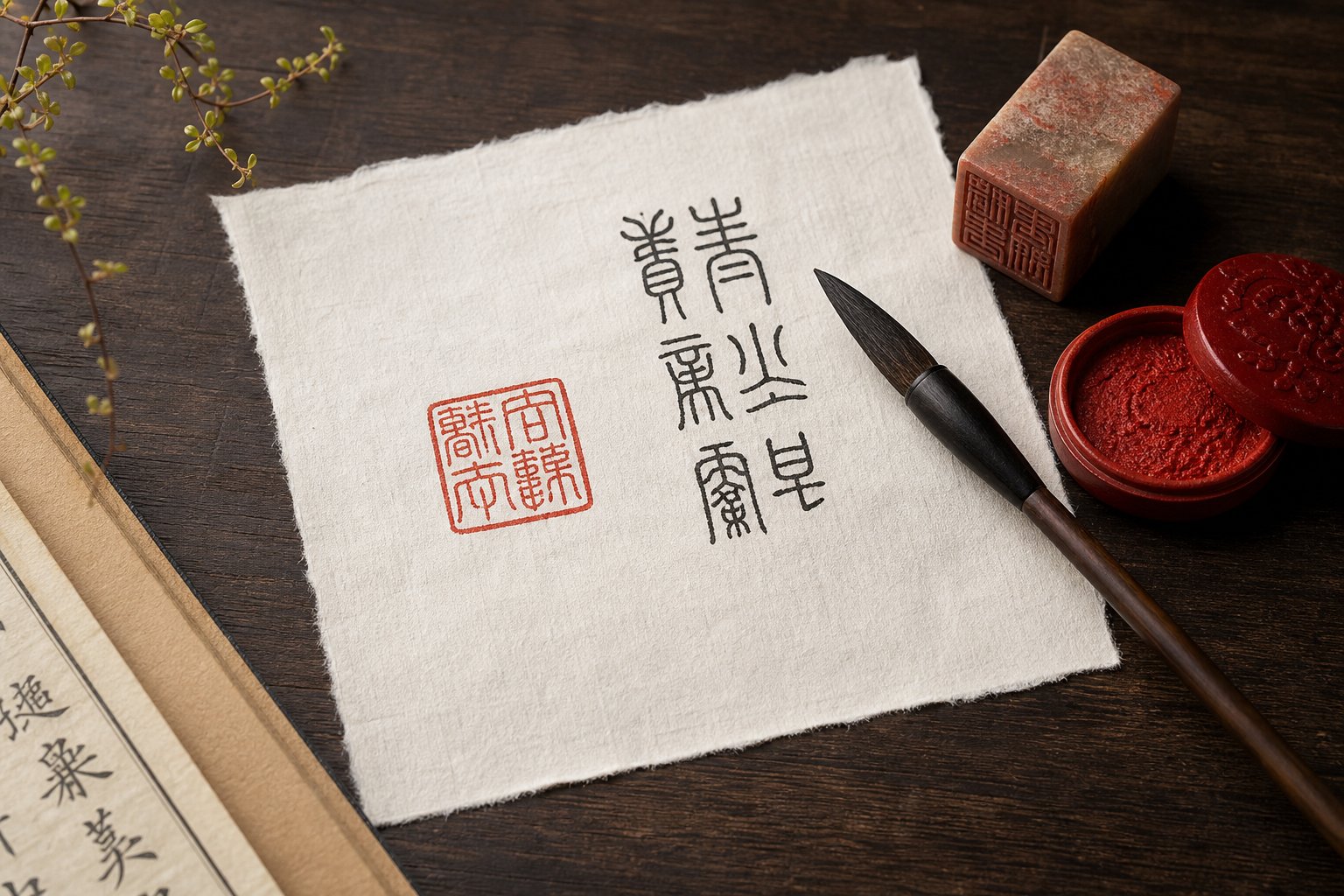
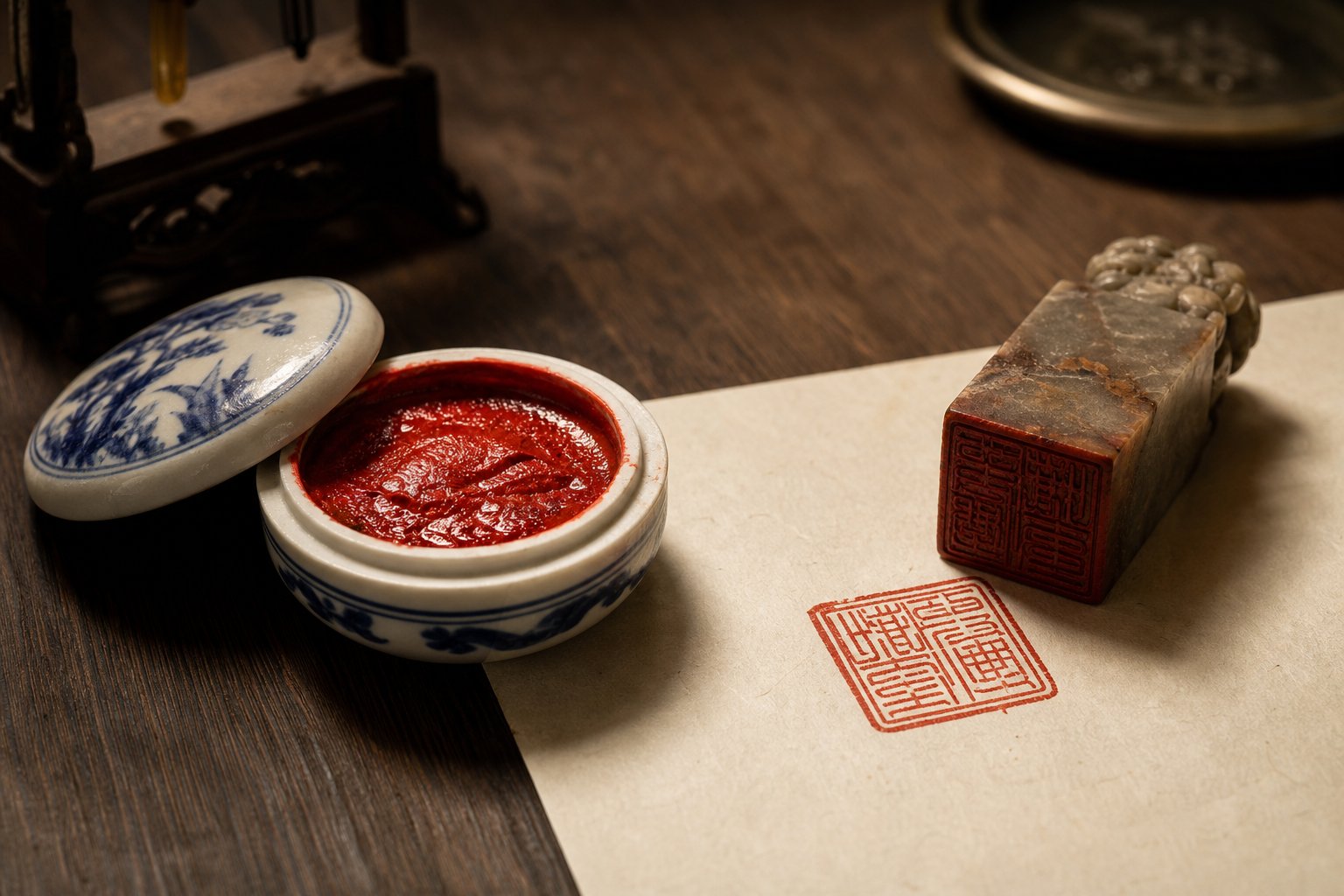
Those red marks are Chinese seals, and they are far more than decorative flourishes. Each one is a carved stamp pressed into vermilion paste and applied directly onto the artwork. They function as signatures, ownership records, and artistic statements all at once. On a single piece of asian calligraphy art or a painted scroll, you might find seals from the original artist, from collectors who treasured the work across centuries, and from scholars who studied it and deemed it worthy.
What Those Red Marks on Chinese Paintings Actually Are
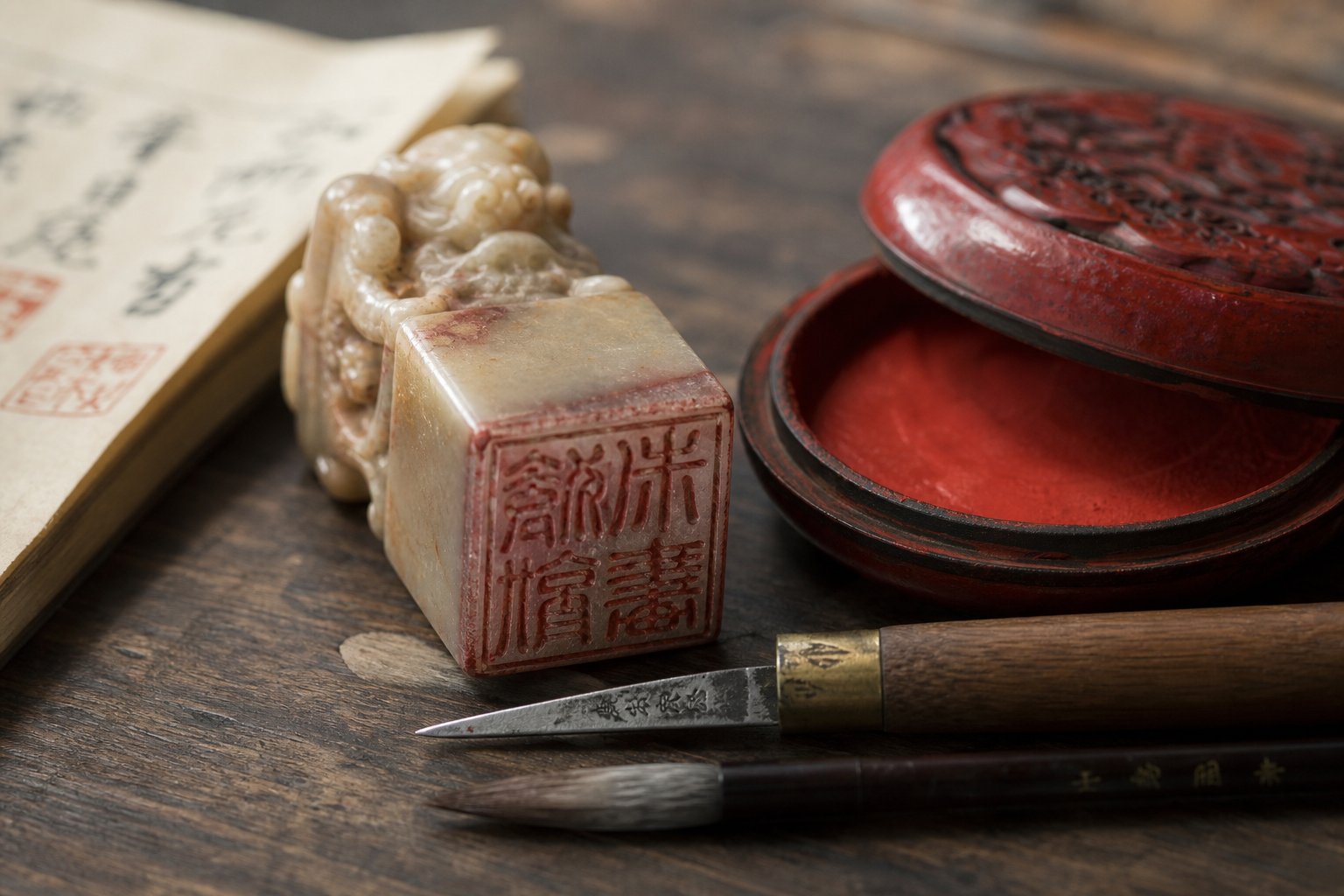
A Chinese seal (印章, yinzhang) is a small block of stone, jade, or wood with characters carved into its base. The carver presses it into red paste and stamps it onto the surface of a painting, calligraphy piece, or document. Unlike a quick pen signature, a seal is a physical object that produces a consistent, recognizable imprint every time it touches paper. This is why Chinese art stamps have served as the primary method of authentication in East Asian art for over three thousand years.
A seal impression (印章, yinzhang) is a carved stamp pressed into red paste to leave an imprint that authenticates, personalizes, and enriches a work of art.
When you look at chinese drawings or painted scrolls in any major collection, you will notice that some works carry just one or two seals while others are covered in dozens. Each red impression is a timestamp of cultural engagement. The artist's chinese seal says "I made this." A collector's seal says "I owned this and found it valuable." A scholar's seal says "I studied this and judged it worthy." Together, they form a provenance ledger written directly onto the artwork itself.
Why Seals Matter More Than Signatures in Chinese Art
In Western art, a handwritten signature is the standard proof of authorship. But signatures have a weakness: they can be forged by anyone with enough skill and patience. Chinese civilization arrived at a different solution. A chinese stamp carved from stone carries unique irregularities in its lines, depth, and edges that are extremely difficult to replicate without the original object in hand. The pressure pattern, the paste consistency, and the micro-texture of the carving all create a fingerprint that experts can verify.
More importantly, a seal carries symbolic weight that a simple stamp with signature cannot match in Western tradition. Chinese art signatures made through seals communicate layers of meaning simultaneously: the artist's formal name, their literary identity, their philosophical outlook, and even their mood at the time of creation. A painter might use one seal during their youth and a completely different set in old age, making seals essential tools for dating works and tracing an artist's creative evolution.
This layered richness is what makes understanding the meaning of red seals on chinese art so rewarding. They are not bureaucratic marks imposed on a finished piece. They are integral compositional elements, placed with the same care a painter gives to every brushstroke, and they unlock stories that the image alone cannot tell.
Why Chinese Seals Are Always Red
Every chinese red stamp you encounter on a painting or calligraphy scroll shares that same unmistakable hue. It is not a coincidence, and it is not simply because red ink was the only option available. The choice of red reaches deep into Chinese cultural symbolism, material science, and artistic logic. Understanding why these seals are red reveals as much about Chinese civilization as the characters carved into the stone itself.
Cinnabar and the Cultural Power of Red in China
Red in Chinese culture is the color of life force, authority, and auspiciousness. It represents the sun, blood, fire, and the vital energy that sustains all living things. For thousands of years, red has been the color of celebration, prosperity, and protection against evil spirits. The Smithsonian's National Museum of Asian Art notes that in China, red is associated with life-generating energy and remains the color of festivities and happiness to this day.
This cultural weight made red the only logical choice for seal impressions. When a scholar-artist pressed a chinese red signature stamp onto a finished painting, that mark carried the symbolic force of imperial authority, permanence, and cosmic vitality. The specific red used in seals comes from cinnabar (朱砂, zhusa), a naturally occurring mineral composed of mercuric sulfide. Cinnabar was mined in China for millennia and prized not only for its vivid color but also for its associations with immortality in Daoist alchemy and its use in imperial court documents.
There is also a practical artistic reason. Throughout Chinese history, scholar-artists considered black and white calligraphy the supreme form of expression. Bright colors were often viewed as vulgar and associated with folk art. A small vermilion red seal, however, provided striking contrast against black ink without overwhelming the composition. As the Seal Society explains, red is one of the few colors that can be stamped directly over solid black ink and still remain legible. This dual function, symbolic and visual, cemented red as the standard centuries ago.
How Seal Paste Is Made and Why It Matters
The substance that produces these impressions is not ordinary stamp pad ink. Chinese seal paste (印泥, yinni) is a handcrafted compound with a recipe refined over millennia. Traditional high-quality seal paste is made from three core ingredients:
- Cinnabar (朱砂, zhusa) — finely ground mercuric sulfide that provides the vivid red pigment
- Castor oil (蓖麻油, bimayou) — a binding agent that gives the paste its smooth, creamy consistency
- Artemisia argyi fiber (艾草, aicao) — commonly known as Chinese mugwort or moxa, this plant fiber holds the pigment together and helps it bind to paper
Unlike modern ink pads for stamping that use synthetic dyes, traditional seal paste is a physical mixture of natural materials. High-grade formulations may include additional ingredients such as gold, silver, pearl, or silk, with closely guarded recipes passed down through generations. The best seal pastes are produced in Shanghai, Hangzhou, Zhangzhou, and Suzhou, where artisan workshops have operated for centuries.
Paste quality directly affects how a seal impression looks on paper. Fresh, high-quality cinnabar paste produces a bright, vivid orange-red that remains stable for centuries without fading. Lower-grade paste or aged paste that has not been properly maintained tends to produce darker, brownish tones. You will notice this difference when examining artworks in museums: impressions from premium paste appear luminous even after hundreds of years, while cheaper alternatives smudge ink or lose their clarity over time.
The texture matters too. Good seal paste should feel like thick cream when stirred, smooth and moderately moist. If the paste is too oily, it bleeds into the paper fibers and blurs the carved details. If it is too dry, the impression appears patchy and incomplete. This is why serious calligraphers and painters treat their ink for stamps with the same reverence they give their brushes and inkstones, storing paste in ceramic containers, stirring it every few months to prevent separation, and never allowing metal tools to touch it.
The color itself was never arbitrary. Cinnabar resists fading far better than organic dyes, which is why seal impressions from the Song dynasty still glow red on paper that has yellowed with age. It visually contrasts with black ink on white or cream-colored paper, making seals both functional identification marks and aesthetically integral elements of the composition. A single red seal in the corner of a monochrome ink landscape does not just authenticate the work. It completes it, adding a point of warmth and energy that the eye naturally seeks out.
This interplay between color, material, and meaning explains why collectors and connoisseurs pay close attention to the shade and texture of every impression. The paste tells a story of its own: when it was made, how it was stored, and whether the person who applied it understood the craft. And the seals themselves, beyond their color, come in distinct types that reveal very different kinds of information about the artwork they mark.
Five Types of Seals You Will Find on Chinese Artwork
Not every red impression on a painting says the same thing. Some identify the artist. Others record who owned the piece centuries later. Still others express a philosophical idea that has nothing to do with names or ownership at all. Learning to distinguish these categories is the first real step toward reading chinese painting signatures and understanding the layered stories embedded in every scroll.
The seals on Chinese artwork fall into five main types, each with its own purpose, placement conventions, and visual character. Here is a practical breakdown:
| Type (Chinese + English) | Purpose | Typical Placement | Example Content |
|---|---|---|---|
| 姓名印 (xingming yin) — Name Seal | Identifies the artist by personal name | Below or beside the artist's inscription at the end of the work | Artist's surname and given name, e.g., "Zhang" or "Zhang Daqian" |
| 字号印 (zihao yin) — Courtesy-Name Seal | Records the artist's literary or courtesy name | Paired with the name seal, usually directly above or below it | A scholar's chosen literary name, e.g., "Bada Shanren" |
| 室名印 (shiming yin) — Studio Seal | Declares the artist's studio or study name | Near the inscription or used as an introduction seal at the start | "Hall of Ink Clouds" or "Studio of the Quiet Pine" |
| 收藏印 (shoucang yin) — Collector Seal | Records ownership by a collector or institution | Margins, mounting areas, or blank spaces that do not disrupt the composition | Collector's name plus "treasured" or "examined," e.g., "Treasured by the An family" |
| 闲章 (xianzhang) — Leisure/Motto Seal | Expresses a philosophical idea, poetic phrase, or personal motto | Opening position (upper right), corners, or edges for compositional balance | "Mountains high, waters long" or "Follow nature" |
Name Seals and Studio Seals of the Artist
The chinese name seal is the most fundamental mark on any artwork. If a painting carries only one seal, it will be this one. It tells you who made the piece. In traditional practice, a single artist typically owns multiple name seals: one carved in relief (red characters on white background) and one in intaglio (white characters on red background). These are used as a pair, placed together near the painters signatures at the end of the work.
The renowned painter Zhang Daqian held strong opinions about seal shapes. He believed that a chinese name stamp should always be square, with round being acceptable as a secondary option. Any other shape, whether oval, irregular, or a circle stamp, was unsuitable for name seals in his view. This preference reflects a broader convention: the square form echoes the structure of Chinese characters themselves and conveys stability and formality.
Studio seals (室名印 or 斋号印, zhaihao zhang) became popular during the Tang dynasty, when scholars began naming their private studies. A studio seal might read something like "Hall of Ten Thousand Volumes" or "Pavilion of Autumn Waters." These seals add personality without revealing the artist's actual name, and they often appear in irregular, natural stone shapes that contrast with the strict geometry of name seals.
Collector Seals That Tell an Ownership Story
Collector seals (收藏印) transform a painting into a historical document. Each stamp signature from a collector marks a moment when the artwork changed hands or was formally cataloged into a private treasury. This tradition began during the Tang dynasty and reached its peak in the Song and Qing periods, when connoisseurs competed to assemble legendary collections.
The principle governing collector seals is restraint: you should never damage the original composition's balance. A thoughtful collector places their seal in a margin, on the mounting silk, or in an area of blank space that does not compete with the brushwork. However, as many museum visitors notice, this principle was not always respected. Some works carry so many collector seals that the margins are nearly full, each one a chapter in the artwork's journey through time.
Leisure Seals and Their Poetic Messages
Leisure seals (闲章, xianzhang) are where chinese artist signatures give way to something more personal and philosophical. The character 闲 means "leisure" or "idle," but these seals are anything but trivial. They carry poetic phrases, Confucian maxims, Buddhist insights, or personal mottos that reveal the artist's inner world. A painter might carve "Between heaven and earth, a brief traveler" or "Old eyes still love autumn mountains."
These seals serve a dual purpose. Emotionally, they express the artist's philosophy and mood. Visually, they function as compositional tools. The influential modern painter Pan Tianshou (潘天寿) observed that leisure seals, when placed properly, carry the same weight as brushstrokes in balancing color and structure across the entire work. A chinese signature stamp placed at the opening of a handscroll can energize a composition that feels too restrained, while a corner seal can anchor a painting that leans visually to one side.
This is what makes reading seals so rewarding. A name seal gives you a fact. A collector seal gives you a date and a story. But a leisure seal gives you a window into someone's mind, carved in stone and pressed in red, centuries before you stood in front of the painting. Each type contributes a different layer of meaning, and together they form a visual language as rich as the brushwork itself. The question that follows naturally is how to tell these seals apart at a glance, and that depends on understanding the carving techniques and ancient script forms that give each impression its distinctive look.
Reading Seal Script Styles and Carving Techniques
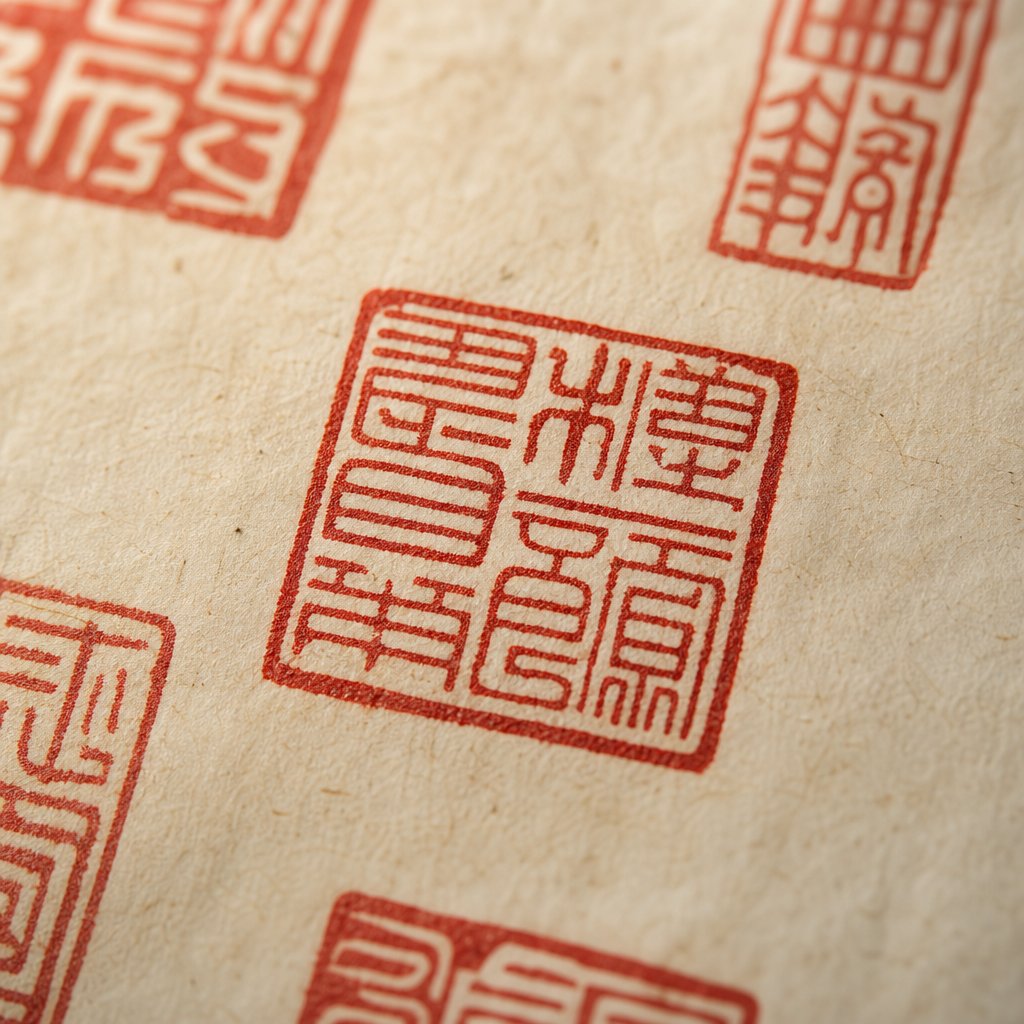
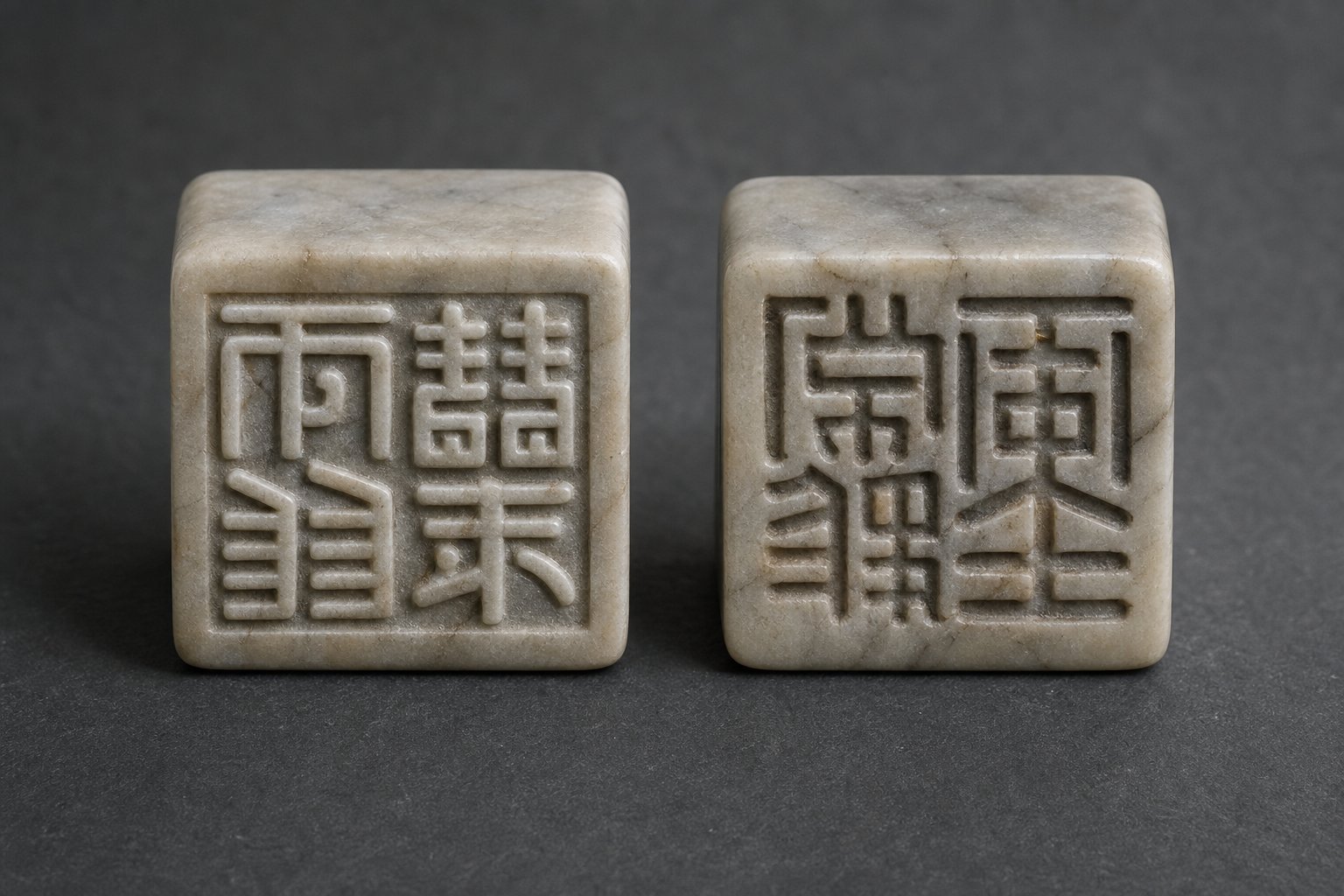
Every chinese stamp seal you encounter on a painting falls into one of two visual categories, and once you know what to look for, you can identify them instantly. The difference comes down to how the carver removes material from the stone: either cutting away the background to leave characters standing in relief, or cutting into the characters themselves so they appear as voids. These two approaches produce strikingly different impressions on paper.
Zhuwen Relief Seals with Red Characters
Imagine looking at a seal impression where the characters themselves are red and the surrounding space is blank white paper. This is zhuwen (朱文, also called 阳文 or yang carving). The carver has cut away everything except the strokes of the characters, leaving them raised on the seal face like tiny ridges. When pressed into paste and stamped, only those raised lines transfer color to the paper.
The result is elegant and open: thin red lines forming characters against an untouched background. Zhuwen seals tend to feel lighter and more refined, which is why artists often choose them for leisure seals and poetic inscriptions where delicacy suits the content. You will notice that the red lines in a zhuwen impression are relatively thin, because the carver must leave enough surrounding material intact to support the raised strokes without crumbling.
Baiwen Intaglio Seals with White Characters
The opposite approach produces a dramatically different look. In baiwen (白文, also called 阴文 or yin carving), the carver cuts directly into the character strokes, leaving the background surface intact. When this chinese seal stamp is pressed into paste, the background transfers red while the carved-out characters remain white, the bare paper showing through.
Baiwen impressions appear bolder and more substantial: white characters floating within a solid red field. This style carries a sense of weight and authority, which is why it has been the traditional choice for formal name seals and official chinese chop stamp marks throughout history. The China Online Museum notes that characters carved in intaglio appear white against the inked ground, creating a visual density that commands attention on the page.
Many artists use both styles together as a deliberate pairing: one name seal in zhuwen and another in baiwen, placed side by side. This contrast creates visual rhythm and demonstrates the carver's versatility.
Why Seal Script Is Deliberately Archaic
Here is something that puzzles many viewers: the chinese character stamps on artwork are often unreadable, even to native Chinese speakers. This is intentional. Seal carvers primarily use seal script (篆书, zhuanshu), an ancient writing system that predates modern Chinese characters by over two thousand years.
The Smithsonian's National Museum of Asian Art explains that seal script exists in two major forms. The earlier form, large-seal script (大篆, dazhuan), derived from symbols cast on bronze ritual vessels from the Shang and Zhou dynasties of the eleventh to third century BCE. The later form, small-seal script (小篆, xiaozhuan), was devised as a standardized writing system under the first emperor of the Qin dynasty, who reigned from 221 to 209 BCE. Small-seal script is characterized by symmetrical structure formed with thin, even lines executed with balanced movements.
Why choose a script that most people cannot read? Three reasons converge:
- Geometric balance — Seal script characters are built from evenly weighted, curving strokes that fill a square frame with natural symmetry, making them ideal for the confined space of a seal face
- Aesthetic of antiquity — Using an archaic script connects the artist to thousands of years of scholarly tradition, signaling cultural depth and reverence for the past
- Scholarly cultivation — The deliberate difficulty of reading seal script marks both maker and viewer as educated participants in a refined cultural practice
Beyond these two primary forms, you may encounter several other script styles on chinese character stamps:
- Greater seal script (大篆, dazhuan) — irregular, organic forms derived from bronze inscriptions, with varied line thickness
- Lesser seal script (小篆, xiaozhuan) — the standardized Qin dynasty form with uniform, flowing lines
- Clerical script variants (隶书, lishu) — occasionally used for a more angular, accessible appearance
- Bird-worm seal script (鸟虫篆, niaochong zhuan) — a decorative style where strokes are embellished with bird heads, fish tails, or insect-like flourishes
Each script choice tells you something about the seal's era, the carver's artistic intent, and the formality of the occasion. A bird-worm seal suggests playfulness and decorative flair. A strict small-seal script impression signals classical restraint. Together, carving technique and script form give every seal its unique visual fingerprint, one that reveals not just who made the mark but how they wanted to be perceived. And where that mark lands on the artwork itself carries yet another layer of meaning entirely.
Where Seals Are Placed and What Position Reveals
A seal's carving style and script tell you who made the mark and when. But where that mark sits on the artwork tells you something equally important: why it was placed there and what role it plays in the composition. Seal placement in Chinese art is not random. It follows conventions refined over centuries, and breaking those conventions, whether through ignorance or imperial ego, has sparked debate among scholars for just as long.
Where Artists Place Their Own Seals
When a painter finishes a work, their chinese chop goes near the inscription, the written text where they sign their name, record the date, or dedicate the piece to a friend. On a hanging scroll, you will typically find the artist's seals at the lower left or lower right, directly beneath or beside the calligraphic signature. On a handscroll, which unrolls horizontally, chinese signatures appear at the end of the composition, the last thing the viewer encounters as they finish reading the scroll from right to left.
The standard practice calls for a pair of seals: one name seal and one courtesy-name or studio seal, placed close together. Their combined visual weight anchors the corner of the painting. As Kiln & Ink notes, painters did not place seals randomly. The placement is part of the painting's composition, usually balancing a heavy area of brushwork on the opposite side, anchoring an empty corner, or extending a calligraphic stroke into the lower edge of the frame.
Beyond the signature pair, artists often use two specialized placement seals:
- Introduction seal (引首印, yǐnshou yin) — placed at the upper right of a painting or the very beginning of a handscroll. This seal "opens" the composition. It is typically not square but rather rectangular or irregularly shaped, and its function is to energize the starting point of the work. If the composition feels too heavy at the end, an introduction seal at the beginning restores balance.
- Corner seal (押角印, yajiao yin) — placed at the lower corner diagonally opposite the introduction seal. This creates a visual axis across the entire work, framing the composition between two red anchor points.
Think of it this way: the introduction seal and corner seal act like bookends. They define the boundaries of the visual space and keep the viewer's eye circulating within the composition rather than drifting off the edges.
How Collectors Added Seals Without Damaging Composition
Every collector who acquired a treasured painting faced the same dilemma: where to place their own chinese seal chop without disrupting what the artist built. The guiding principle, as Inkston's seal guide explains, is simple: do not destroy the original painting balance.
In practice, thoughtful collectors placed their seals in specific zones:
- The mounting silk or paper borders surrounding the painted area
- Blank margins at the top or bottom of a hanging scroll
- The colophon sections of a handscroll, where written commentary already lives
- Small areas of empty space within the composition that do not compete with brushwork
On chinese silk painting seals from major collections, you can often trace the chronological order of ownership by reading collector marks from the outermost margins inward. The earliest collectors had the most space to choose from. Later owners had to find increasingly creative positions, sometimes squeezing their impressions into narrow gaps between existing seals.
A famous example is the Tang dynasty copy of Wang Xizhi's Lantingji Xu (兰亭序), which bears dozens of collector seals accumulated over more than a thousand years. Each collector respected the calligraphy itself, placing their marks in the surrounding space rather than over the brushstrokes.
Seal Placement as Artistic Statement
Not everyone exercised restraint. The Qianlong Emperor, who ruled during the Qing dynasty and amassed one of history's largest art collections, applied his chinese chops with extraordinary enthusiasm. He owned over 1,800 seals and stamped them prolifically across paintings he admired, sometimes placing dozens of impressions on a single work. Scholars have long debated whether his additions enhanced provenance value or overwhelmed the original artist's careful composition.
The criticism is not merely aesthetic. When a collector's seal lands in the middle of a painted sky or across a passage of delicate brushwork, it permanently alters the visual experience the artist intended. Pan Tianshou (潘天寿) emphasized that seals carry the same compositional weight as brushstrokes. A well-placed seal strengthens a painting. A poorly placed one fractures it.
This tension reveals something fundamental about how Chinese art functions. A painting is not a finished, sealed object the way a framed Western oil painting is. It is a living document that accumulates meaning over time. Each new seal is a conversation between the person stamping and everyone who came before. The best collectors understood this and placed their marks where they would add to the dialogue without shouting over it. The result is that seal placement itself becomes a record of taste, restraint, and cultural sensitivity stretching across generations, a timeline you can read if you know where to look.
How Chinese Seals Evolved Across Dynasties
The seals you see on paintings today did not start as artistic marks. They began as administrative tools, pressed into lumps of wet clay to secure government documents and verify official authority. The journey from bureaucratic clay stamps to the luminous red impressions on Song dynasty landscapes took roughly two thousand years, and each dynasty added a new chapter to the story. Tracing that evolution helps you understand why old chinese seals carry so much weight when they appear on artwork.
From Administrative Stamps to Artistic Marks
The earliest seals appeared during the Shang dynasty, around 1200 BCE. The Shanghai Museum's Chinese Seal Gallery confirms that bronze seals from the late Shang period had already taken on the mature form we recognize today. These were not decorative objects. They functioned as identity credentials, pressed into soft clay to mark ownership or authenticate a message. Think of them as letter stamps for clay: a courier would bind bamboo slips with cord, press a lump of wet clay over the knot, and stamp it with a seal to prevent tampering. If the clay arrived broken, the recipient knew the document had been opened.
During the Shang and Zhou dynasties, most seals identified a person or clan through fixed impressions, serving as physical credentials for authority and identity. Some early examples carry swirl patterns that match motifs found on bronze ritual vessels, which is why scholars sometimes refer to these earliest marks as chinese bronze seal marks. The connection between bronze casting and seal carving ran deep: both required precision, both conveyed status, and both used the same decorative vocabulary of the era.
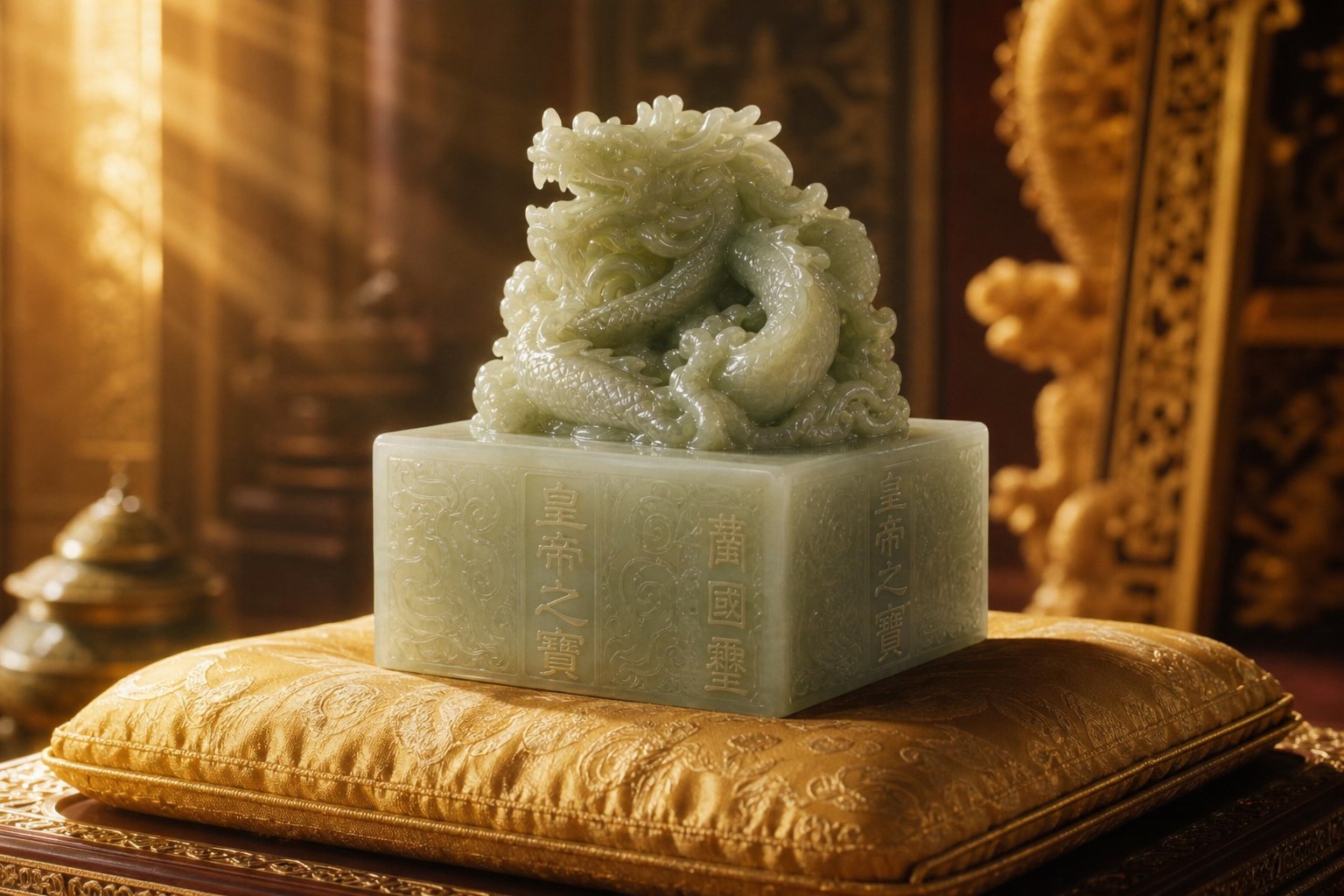
The Qin dynasty (221-207 BCE) transformed seals from regional tools into a standardized national system. When the First Emperor unified China, he established strict rules governing who could use what material and what size. The most famous seal in Chinese history, the imperial jade seal of China (传国玉玺, chuanguo yuxi), was reportedly carved from the legendary He Shi Bi jade on the emperor's orders. It bore the inscription "Having received the Mandate of Heaven, may the emperor's reign be long and prosperous." This single object became the ultimate symbol of legitimate rule, passed from dynasty to dynasty for centuries. Its existence elevated the ancient chinese stamp from a practical device to a sacred emblem of sovereignty.
The Song Dynasty Revolution in Collector Seals
The Han dynasty (206 BCE - 220 CE) expanded seal use across every level of government. Official seals were manufactured according to precise specifications: material, form, and knob shape all corresponded to the holder's rank. Gold seals with turtle-shaped knobs went to generals. Silver seals went to regional officials. Bronze seals served lower-ranking bureaucrats. Private citizens also used personal seals for correspondence and contracts, embedding seal culture into daily life.
A pivotal shift occurred during the late Northern and Southern Dynasties (420-589 CE). For over a millennium, seals had been pressed into clay. But as paper replaced bamboo slips, the old method became obsolete. The Shanghai Museum documents this transition clearly: the millennium-old practice of stamping seals on lumps of clay gave way to stamping seals on paper using red ink paste. This single material change, from clay to paper, fundamentally altered the relationship between seals and artwork. Suddenly, a seal impression could sit directly on the same surface as a painting or calligraphy piece, becoming part of the visual composition rather than a separate security device attached to a package.
The Tang dynasty (618-907) formalized this new reality. Official seals grew larger, switched to relief-style characters, and were applied directly with red ink paste on paper documents. More importantly for art history, literati during the Tang period began using personal seals with studio names and poetic inscriptions, functions that went beyond simple verification. The seeds of the seals of chinese civilization as artistic elements were planted here.
The Song dynasty (960-1279) brought the true revolution. Collectors began stamping their seals onto paintings and calligraphy they owned, creating a visible record of provenance. Scholars designed seals inscribed with family names, literary names, studio names, and philosophical phrases. This trend, as the Shanghai Museum notes, "gradually distanced seals further away from their verification function and prompted seal engraving to become an art genre." The seal was no longer just a lock on a document. It was a statement of taste, identity, and cultural participation.
Ming and Qing Dynasties When Seals Became Art
By the Ming dynasty (1368-1644), seal carving had become a recognized art form in its own right. The discovery that soft stones like Qingtian and Shoushan could be carved directly by literati, without needing professional craftsmen, democratized the practice. Wen Peng, active in the mid-sixteenth century, is widely credited as the founder of literati seal engraving. He carved primarily in Qingtian stone and inspired generations of artist-carvers who treated seal design with the same seriousness as painting or calligraphy.
The Qing dynasty (1644-1911) saw seal culture reach its most elaborate expression. Multiple schools of seal engraving emerged, each with distinctive styles rooted in the study of ancient Qin and Han models. Artists like Deng Shiru and Zhao Zhiqian pushed the boundaries of what a seal could express, integrating calligraphic innovation with carving technique. Seals from this period came in extraordinary variety: square, round, rectangular, oval, and gourd-shaped, with knobs sculpted into dragons, lions, and mythological figures.
Here is a condensed timeline showing how seal function and form shifted across major periods:
| Dynasty | Period | Key Development | Seal Characteristics |
|---|---|---|---|
| Shang / Zhou | ca. 1200-256 BCE | Seals originate as identity credentials pressed into clay | Bronze or jade; small; pressed into clay; patterns related to bronze vessel motifs |
| Qin | 221-207 BCE | First Emperor standardizes seal system nationwide; imperial jade seal created | Strict material hierarchy; small seal script standardized; official seals tied to rank |
| Han | 206 BCE - 220 CE | Bureaucratic seal use reaches peak; private seals become common | Gold, silver, bronze by rank; turtle and camel knobs; bird-worm decorative scripts appear |
| Sui / Tang | 581-907 | Transition from clay to red ink on paper; literati begin personal seals | Larger size; relief characters; red paste replaces clay; studio-name seals emerge |
| Song | 960-1279 | Collector seals appear on artwork; seal engraving becomes cultural practice | Seals applied to paintings and calligraphy; philosophical inscriptions; connoisseur culture |
| Ming | 1368-1644 | Literati carve their own seals; seal engraving recognized as independent art | Soft stone materials; diverse shapes; Wen Peng founds first engraving school |
| Qing | 1644-1911 | Multiple engraving schools flourish; seals reach highest artistic complexity | Archaic Qin-Han revival; elaborate knob sculptures; calligraphic innovation in carving |
What this timeline reveals is a consistent pattern: each era expanded what a seal could mean. In the Shang dynasty, a seal said "this belongs to me." By the Qing dynasty, a seal could say "I studied the ancients, I hold this philosophy, I belong to this artistic lineage, and I place this mark here to complete the composition." The physical object barely changed in size, but its cultural density multiplied a hundredfold.
No single figure illustrates this accumulated power more vividly than the Qianlong Emperor, whose personal collection of over 1,800 seals turned every artwork he touched into a canvas for imperial self-expression.
The Qianlong Emperor and the Power of Imperial Seals
Picture a delicate Tang dynasty horse painting, over a thousand years old, its ink lines still graceful on aged silk. Then imagine someone stamping it with seal after seal after seal, filling the margins, crowding the colophon, pressing red impressions into every available inch of space. That someone was the Qianlong Emperor, and his obsessive stamping habit has made him one of the most debated figures in the history of Chinese art collecting.
The Qianlong Emperor and His 1800 Seals
The Qianlong Emperor (reigned 1735-1796) ruled China for six decades and lived to the age of 88, making him one of the longest-reigning monarchs in Chinese history. He was also, by any measure, one of history's most prolific collectors. His imperial treasury grew to include thousands of paintings, calligraphy works, bronzes, jades, and ceramics. He composed over 40,000 poems, sponsored the monumental encyclopedia Siku Quanshu (Complete Library of the Four Treasures), and cultivated an image of himself as the ultimate scholar-emperor.
His seal collection matched this ambition. Qianlong owned more than 1,800 chinese seals, ranging from formal imperial authority marks to personal motto seals expressing his philosophical ideals. When he encountered paintings and calligraphy he admired, he would stamp his seals on those artworks multiple times. Not once or twice, but sometimes dozens of impressions on a single piece. Some works in the imperial collection bear so many Qianlong seals that they resemble a red mosaic more than a painting with incidental ownership marks.
His seals fell into two broad categories. Personal seals carried his names, titles, and poetic phrases. Cataloguing seals indicated that a work had been officially recorded, described, and included in one of the imperial collection catalogs. The most famous of these catalogs is the Shiqu Baoji (石渠宝笈), a comprehensive inventory of the finest paintings and calligraphy in the palace collection. A work bearing the Shiqu Baoji seal had been formally vetted and deemed worthy of inclusion in the imperial canon. As art historian Bob Mowry explains, many works bear several different cataloguing seals as well as personal seals, each one marking a separate occasion when the emperor viewed and appreciated the piece.
When Imperial Seals Overwhelm the Original Art
Qianlong's enthusiasm created a paradox that scholars still debate. On one hand, his seals provide extraordinary provenance documentation. An old chinese seal bearing the Shiqu Baoji mark tells researchers that the painting was in the imperial collection during the eighteenth century, that it was examined by court connoisseurs, and that it was considered authentic and significant enough to catalog. For authentication purposes, these impressions are invaluable.
On the other hand, the sheer volume of his stamping has drawn sharp criticism. Hajni Elias, a scholar of Chinese art, has noted that Qianlong "had no qualms having his poems inscribed on beautiful objects" and that his literary output was, in the assessment of the late Professor Frederick Mote, largely substandard. She has challenged students to find a piece from the Imperial collection that does not bear Qianlong's signature, calling him "an insufferable egotist." Chinese internet users have given him the nickname "stamp boy" for his relentless marking habit.
Consider what this looks like in practice. The Tang dynasty painting Night-Shining White (照夜白图) by Han Gan, now in the Metropolitan Museum of Art, depicts a single spirited horse straining against its tether. The original painting occupies a modest area of silk. But the surrounding space is dense with seals and inscriptions accumulated over twelve centuries of ownership, with Qianlong's impressions prominently among them. The Met's catalog entry lists every seal and colophon on the work, revealing the layers of imperial engagement.
Reading Qianlong's motto seals reveals how he saw himself. Beyond simple ownership marks, his antique chinese stamp seal impressions carried phrases that projected imperial identity:
"五福五代堂古稀天子宝" (Treasure of the Son of Heaven who has reached seventy years of age in the Hall of Five Blessings and Five Generations)
This single seal text communicates longevity, dynastic continuity, divine mandate, and personal achievement all at once. It is not merely a china seal marking ownership. It is a political statement carved in stone and pressed in vermilion, declaring that the emperor's reign is blessed by heaven itself.
The scholarly debate ultimately comes down to a question of values. If you view a painting as a fixed aesthetic object, Qianlong's seals are intrusions that damage visual integrity. If you view a painting as a living cultural document that accumulates meaning across centuries, his seals are simply the loudest voice in an ongoing conversation. Most modern scholars land somewhere in between: acknowledging the provenance value while wincing at the aesthetic cost.
For museum visitors, Qianlong's seals offer a practical benefit. They are among the most recognizable and well-documented chinese seals in existence. Once you learn to spot his characteristic large square impressions and distinctive motto texts, you gain an instant reference point for identifying imperial collection works in museums worldwide, from the Palace Museum in Beijing and Taipei to the Met, the British Museum, the Freer Gallery, and the Museum of Fine Arts in Boston. His marks are a starting point for reading the full provenance story that every seal-covered artwork carries, a story that unfolds through careful observation and the right identification techniques.
How to Read Seals as a Provenance Timeline
Qianlong's seals are easy to spot because they are large, well-documented, and everywhere. But most artworks carry a quieter, more complex story told through a mix of smaller impressions from artists, private collectors, dealers, and institutions spanning centuries. Reading those seals as a connected narrative, rather than isolated red marks, is how scholars and collectors reconstruct the biography of a painting. It is also how you can begin to identify chinese artist signatures and ownership records on any work you encounter.
Tracing Centuries of Ownership Through Seal Impressions
Think of a painting's seals as a passport full of stamps. Each impression records a moment when someone held the work, valued it, and chose to leave their mark. The artist's seal is the birth certificate. Collector seals are the visa stamps, each one documenting a new chapter in the artwork's journey. Colophons, the handwritten notes that collectors and scholars add to handscrolls, provide context that seals alone cannot: dates, opinions on authenticity, stories about how the work was acquired, and dedications to future owners.
Together, seals and colophons allow researchers to trace an artwork's path from the artist's studio through private collections, imperial treasuries, wartime dispersals, and eventually into the museum where you stand today. A painting with an unbroken chain of documented collector seals from the Song dynasty to the present carries far greater scholarly and market value than one with gaps in its record. This is why chinese artist seal identification is not just an academic exercise. It directly affects how works are authenticated, valued, and understood.
Practical Steps for Reading Seals on Artwork
When you stand in front of a painting covered in red impressions, the visual complexity can feel overwhelming. A systematic approach helps. Here is how specialists in chinese seal identification work through the marks on a single piece:
- Locate the artist's seals by position. Look near the inscription or signature text at the end of the composition. The seals closest to the calligraphic signature almost always belong to the artist. These typically appear as a pair: one name seal and one courtesy-name or studio seal.
- Distinguish collector seals from artist seals. Collector seals sit in margins, mounting borders, or blank spaces away from the main composition. If a seal appears in the upper corner, on the mounting silk, or clustered with other marks far from the signature, it is likely a collector's impression.
- Note the carving style for period clues. Relief seals (red characters on white) became dominant after the Tang dynasty. Intaglio seals (white characters on red) are more common on earlier works. The script style also helps: strict small-seal script suggests a more formal or archaic context, while freer carving with varied line thickness points to Ming or Qing dynasty literati traditions.
- Examine paste color and condition. Fresh high-quality cinnabar paste produces a bright orange-red that remains vivid for centuries. Older impressions may darken slightly but retain clarity. If a seal impression looks dramatically different in color or texture from others on the same work, it may have been added at a different time.
- Cross-reference with published seal dictionaries. Major collectors and artists have their seals cataloged in reference works like the Zhongguo Shuhua Jia Yinqian Kuan Shi (中国书画家印鉴款识), a comprehensive dictionary of chinese painters signatures and seal impressions. Matching a seal impression against these published records confirms identity and helps identify unknown marks.
- Read colophons for supporting context. Handwritten notes on handscrolls often mention when and how a collector acquired the work, providing dates that anchor the seal chronology.
This process is how experts identify chinese artist signature marks and build a complete ownership history. Even without reading seal script fluently, you can gather significant information from position, color, style, and relative placement alone.
Spotting Forgeries and Later Additions
Provenance seals add value, which means forgers have strong incentives to add fake impressions to inflate a painting's history. Knowing how to identify chinese artist seals also means knowing when something looks wrong. Here are the warning signs that specialists watch for:
- Inconsistent paste aging. If most seals on a Song dynasty painting show the expected darkening and absorption into aged paper, but one impression looks suspiciously fresh and bright, it was likely added much later.
- Anachronistic script styles. A seal claiming to belong to a Tang dynasty collector but carved in a style that only emerged during the Qing dynasty is an immediate red flag. Script fashions changed over time, and knowledgeable forgers sometimes get the period wrong.
- Seals overlapping existing damage. If a seal impression sits on top of a crease, tear repair, or worm hole that clearly predates it, the seal was applied after the damage occurred. Genuine early seals would show the damage cutting through them, not the other way around.
- Mismatched dimensions or carving quality. Published seal dictionaries record the exact dimensions of known seals. A chinese signature that matches a famous collector's text but differs by several millimeters in size is almost certainly a copy carved from a printed reproduction rather than the original stone.
- Implausible provenance chains. If a painting bears seals from three famous collectors who lived in different centuries but no seals from anyone in between, the gaps suggest that some impressions were added retroactively to create a more impressive lineage.
None of these signs alone proves forgery. Paste color can vary due to storage conditions. Damage patterns can be ambiguous. But when multiple warning signs appear together on the same work, experienced scholars treat the provenance claims with skepticism. Authentication is always a cumulative judgment, weighing seal evidence alongside painting style, materials analysis, and documentary records.
The ability to read seals as a provenance timeline transforms how you experience Chinese art. A painting is no longer just an image. It becomes a physical object that passed through specific hands at specific moments in history, each owner leaving a trace you can decode. This layered richness is unique to the Chinese tradition, though it shares some surface similarities with seal practices in neighboring cultures, particularly Japan, where stamps serve a related but distinctly different purpose.
Chinese Seals Compared to Japanese Hanko
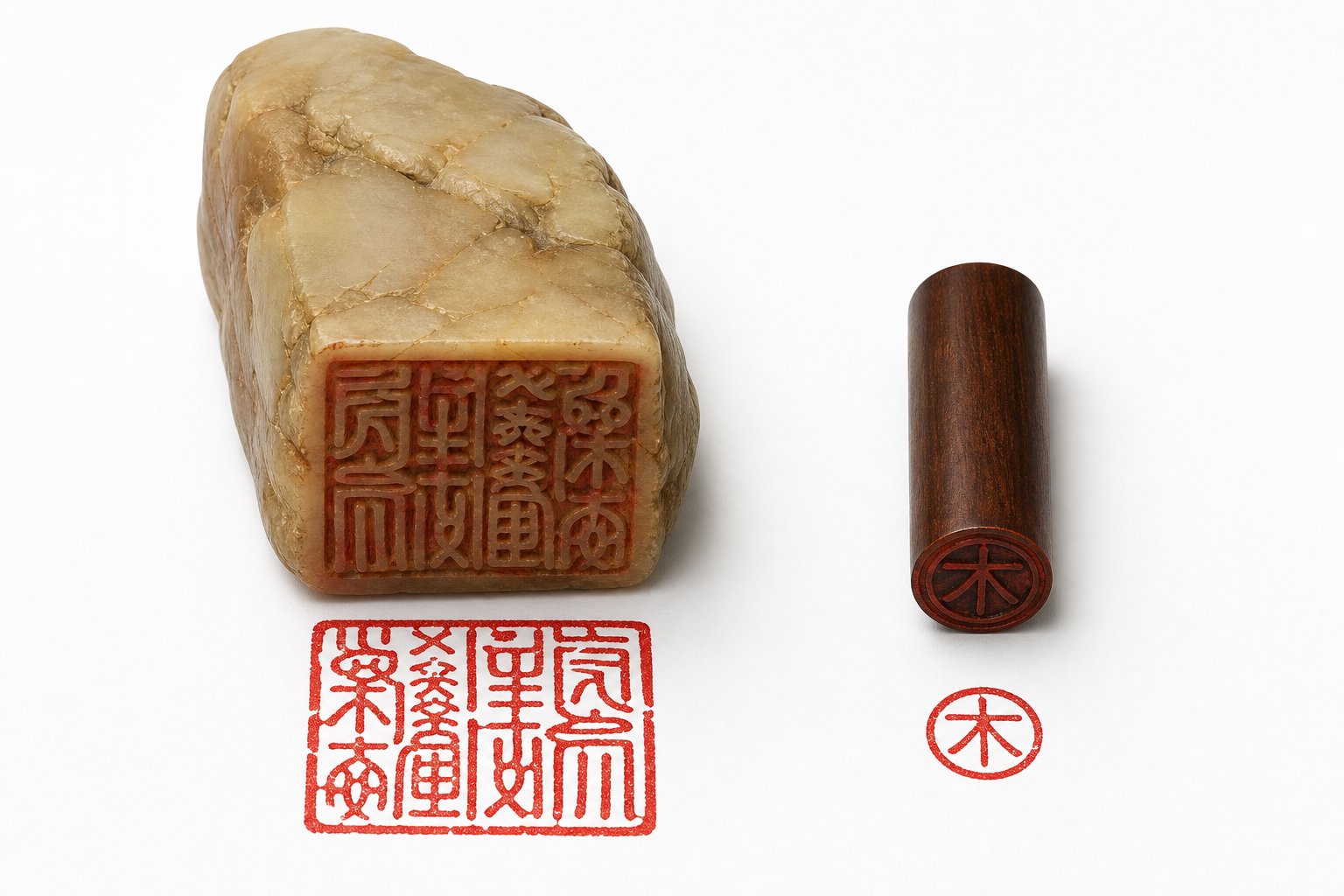
If you have spent time looking at both Chinese paintings and Japanese woodblock prints, you have probably noticed red stamp impressions on both. They look similar at first glance: carved characters pressed in red onto paper. This visual overlap leads many people to assume they serve the same purpose. They do not. While seals in Japan share a common ancestor with Chinese seals, the two traditions diverged dramatically over the centuries, and understanding the difference sharpens your ability to read the meaning of red seals on chinese art with real precision.
Shared Origins of Chinese and Japanese Seal Culture
Japan adopted seal culture directly from China. The oldest known japanese seal on Japanese soil is a gold seal given by Emperor Guangwu of the Han dynasty to a Japanese king in 57 CE, now preserved as a national treasure. Seals arrived in Japan as symbols of political authority, and for centuries only government officials and high-ranking samurai were permitted to use them. It took nearly a thousand years before ordinary Japanese citizens gained access to personal seals.
The Meiji government formalized the system in the early 1870s, passing laws that required citizens to register a personal hanko stamp for use on legal documents. From that point forward, the japanese hanko became embedded in everyday life: signing rental agreements, opening bank accounts, buying cars, receiving packages. No other country uses seals in as many daily situations as Japan. This functional saturation is precisely what separates the japanese signature stamp from its Chinese artistic counterpart.
Visual Differences Between Chinese Seals and Japanese Hanko
When you encounter a red impression on a Chinese painting, you are looking at something designed to be unique, expressive, and aesthetically integrated into the artwork. When you see a hanko stamps impression on a Japanese document, you are looking at a standardized identity tool, closer in spirit to a Western signature than to a philosophical statement. Here is how the two compare across key dimensions:
| Dimension | Chinese Seals (on artwork) | Japanese Hanko (daily use) |
|---|---|---|
| Primary use | Authentication, artistic expression, provenance, philosophical statement | Legal identity verification, contract signing, everyday transactions |
| Typical material | Stone (Shoushan, Qingtian, Balin), jade, crystal, horn, wood | Wood, horn, metal (titanium, steel), plastic, rubber |
| Script style | Archaic seal script (zhuanshu) deliberately difficult to read | Multiple fonts available (tensho, reisho, insotai); tensho most common for registered seals |
| Ink color | Vermilion red (cinnabar-based paste, handcrafted) | Red or vermilion (commercial ink pads, standardized) |
| Shape | Square, rectangular, oval, gourd-shaped, irregular natural stone forms | Round for personal use; square for corporate seals |
| Size | Varies widely, from under 1 cm to over 10 cm for imperial seals | Standardized: typically 12-18 mm diameter for personal use |
| Cultural status | High art form; seal carving is a recognized discipline alongside painting, calligraphy, and poetry | Practical tool; valued for durability and clarity rather than artistic merit |
| Content | Names, literary names, studio names, poetic phrases, philosophical mottos | Surname only (most common) or full name for formal registration |
A few differences stand out immediately. Chinese seals on artwork carry poetic phrases, studio names, and philosophical mottos that have nothing to do with legal identity. Japanese seals are almost exclusively name-based. Chinese seal carving uses deliberately archaic script that even native speakers struggle to read, treating difficulty as a mark of scholarly cultivation. Japanese hanko stamps use a range of fonts, but the goal is always legibility and official recognition rather than aesthetic mystery.
Material choice reflects this divide too. A Chinese artist might spend months selecting a piece of Shoushan stone with the right color, texture, and natural markings, then carve it personally as an act of creative expression. A Japanese citizen typically orders a hanko from a shop or online retailer, choosing from standardized options based on durability and price. Metal hanko made with titanium or steel have become popular in Japan precisely because they resist chipping during heavy daily use, a concern that rarely applies to an artist's seal pressed gently onto rice paper a few times per year.
The cultural trajectory tells the deeper story. In China, seals moved from bureaucratic tools toward art. In Japan, they moved from symbols of elite authority toward universal daily utility. Both paths are valid, but they produce fundamentally different objects with different meanings when you encounter them on paper.
Japanese seals also appear on artwork, particularly on traditional paintings and calligraphy. In that context, they function more similarly to Chinese seals, identifying the artist and sometimes expressing a studio name. But even here, the artistic depth tends to be narrower. Chinese leisure seals can carry entire philosophical worldviews in four characters. The equivalent practice in Japanese art exists but never developed the same layered complexity or the centuries-long tradition of collector seals building provenance narratives across a single work.
If you want to deepen your understanding of how Chinese seals function on artwork, three paths are especially productive. First, visit museum collections with strong Chinese painting holdings: the Palace Museum in Taipei, the Met, the Freer Gallery, the British Museum, and the Shanghai Museum all display works where you can practice identifying seal types, placement conventions, and carving styles in person. Second, consult published seal catalogs like the Zhongguo Shuhua Jia Yinqian Kuan Shi, which reproduces thousands of documented artist and collector seals with translations and provenance notes. Third, handle actual seal stones if you get the opportunity. Carving workshops and calligraphy supply shops often let visitors try pressing a seal into paste and stamping it onto paper, and that tactile experience makes the visual language click in a way that reading alone cannot.
Chinese seals remain one of the most layered elements in any art tradition worldwide. A single red impression can simultaneously function as a signature, a philosophical declaration, a compositional element, and a historical timestamp. No other mark in visual art carries that density of meaning in so small a space. Learning to read them transforms a museum visit from passive viewing into active decoding, turning every scroll and hanging painting into a puzzle whose red clues reward patience, curiosity, and the willingness to look closely.
Frequently Asked Questions About Red Seals on Chinese Art
1. What do the red stamps on Chinese paintings mean?
Red stamps on Chinese paintings are carved seals pressed into vermilion paste. They serve multiple purposes simultaneously: authenticating the artist's identity, recording ownership history across centuries, and expressing philosophical ideas. An artwork may carry seals from the original painter, multiple collectors, and scholars who studied it. Each impression acts as a historical timestamp, together forming a provenance ledger written directly onto the work itself.
2. Why are Chinese seals always red and not another color?
Chinese seals use red because of cinnabar, a mineral pigment with deep cultural significance. Red symbolizes life force, imperial authority, auspiciousness, and protection in Chinese tradition. Practically, cinnabar resists fading far better than organic dyes, which is why seal impressions from the Song dynasty still appear vivid today. Red also provides maximum visual contrast against black ink on white paper, making seals both legible and aesthetically complementary to monochrome compositions.
3. How can I identify different types of seals on Chinese artwork?
Position is your strongest clue. Artist seals appear near the calligraphic signature at the end of a composition, usually as a paired set. Collector seals sit in margins, mounting borders, or blank spaces away from the main brushwork. Leisure seals carrying poetic phrases often appear at the upper right as opening marks or in corners for compositional balance. Carving style also helps: relief seals show red characters on white, while intaglio seals show white characters within a solid red field.
4. What is the difference between Chinese seals and Japanese hanko stamps?
Though they share a common origin, Chinese seals and Japanese hanko serve fundamentally different purposes today. Chinese seals on artwork function as artistic expressions, philosophical statements, and provenance records, often carved in archaic script on fine stone. Japanese hanko are primarily legal identity tools used for signing contracts, opening bank accounts, and daily transactions. They prioritize legibility and standardization over artistic complexity, typically carrying only a surname in a round format.
5. How do experts use seals to authenticate Chinese paintings?
Experts examine multiple factors: paste color and aging consistency across all impressions on a work, script style appropriate to the claimed period, seal dimensions matched against published dictionaries of documented artist and collector seals, and whether impressions sit over or under existing damage. They also check that the provenance chain makes chronological sense. When multiple warning signs appear together, such as fresh-looking paste on aged paper or anachronistic carving styles, scholars treat authenticity claims with skepticism.