What Makes a Chinese Character Overused in Names
Imagine walking into a classroom and calling out "Zi Han" only to have five kids raise their hands. In China, this scenario is not a joke. It is a daily reality for teachers, parents, and the name-holders themselves. With 1.4 billion people drawing from a finite pool of characters, name repetition reaches a scale that most other languages simply cannot produce.
A name in Chinese characters typically consists of a one-character surname followed by a one- or two-character given name. That structure sounds flexible until you realize that the vast majority of the population shares a handful of surnames, and the characters considered appropriate for given names are far fewer than the total number of characters in the language. The result is a bottleneck where millions of parents independently arrive at the same combinations.
What Does Overused Actually Mean in Chinese Naming
"Popular" and "overused" are not the same thing. A popular character appears frequently because parents find its meaning appealing. An overused character crosses a threshold where it generates social friction: identity confusion in schools and workplaces, mockery on social media, and a cultural label that sticks. In Chinese internet culture, these trending combinations are called 爆款名字 (baokuan mingzi), literally "viral hit names," a term borrowed from e-commerce to describe products everyone buys at the same time.
The phenomenon exists because Chinese characters used in names must carry unambiguously positive meanings. Characters with even slightly negative or neutral connotations get filtered out, leaving a surprisingly small set of "safe" options. When tens of millions of parents all reach for the same short list of aspirational characters, duplication becomes inevitable.
The Scale of Name Repetition in China
How big is the problem? Research using data from China's National Citizen Identity Information Center (NCIIC), covering approximately 1.2 billion Han Chinese, reveals that only 2,614 distinct characters appear in given names across the entire database. That is a tiny fraction of the roughly 80,000 characters in the Chinese writing system. The common chinese characters in names cluster even more tightly: a few dozen account for the majority of all given names in any generation.
Out of approximately 1.2 billion Han Chinese registered in the national identity database, given names draw from just 2,614 distinct characters, meaning the entire population's naming creativity funnels through less than 3% of commonly known characters.
A study analyzing 2.1 million names from China's 2005 population census confirmed that name uniqueness remained relatively flat before 1970, then began rising steadily as individualism grew. Yet even with that upward trend, the sheer population size ensures that common characters in chinese names still produce enormous overlap. The pattern is clear: limited supply of positive-meaning characters plus massive demand equals millions of people sharing identical names.
This article breaks down the most overused chinese characters in names by gender and era, drawing on census data, government naming reports, and academic research. You will see exactly which characters dominated each generation, why they became so popular, and how cultural forces keep funneling parents toward the same choices decade after decade.
How Political Eras Shaped Chinese Naming Trends
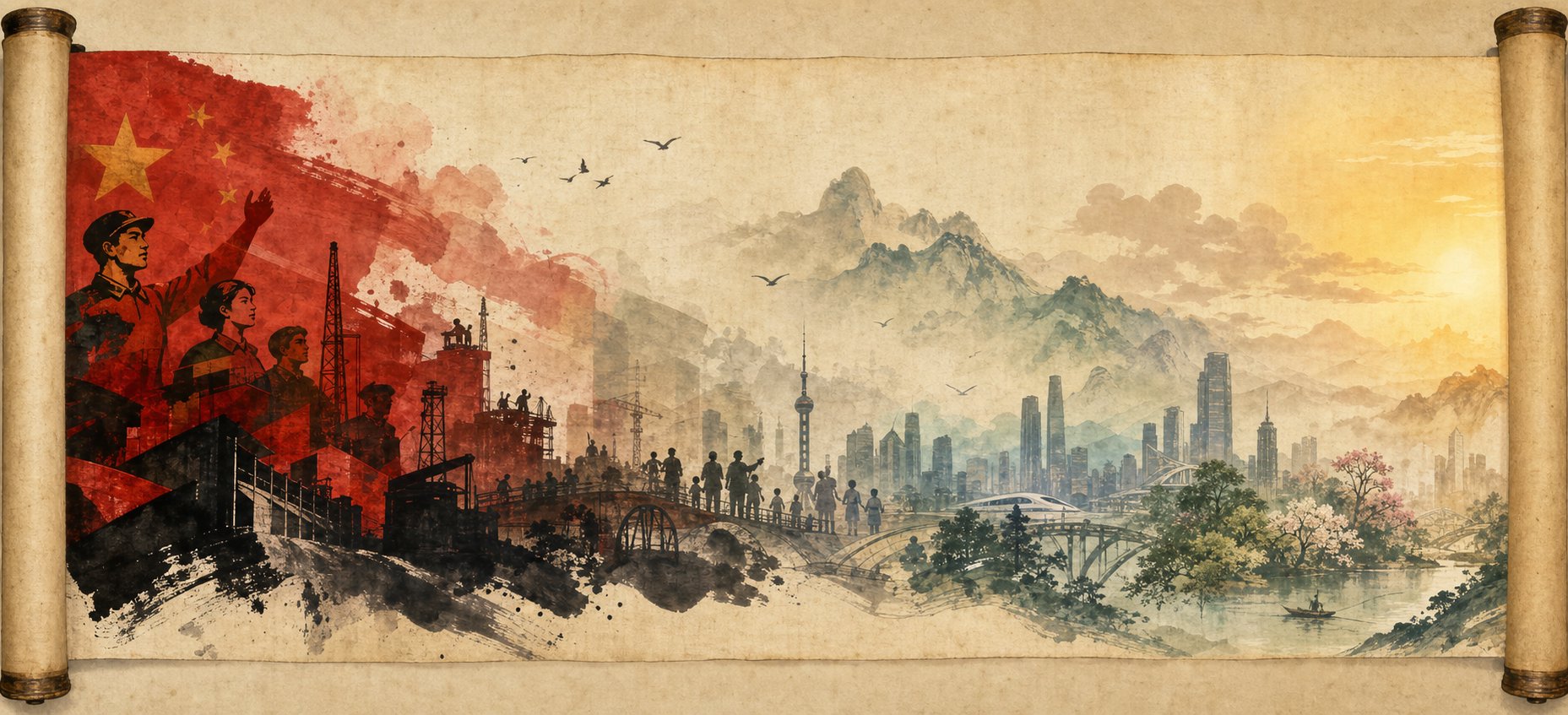
Chinese names in chinese characters are never chosen in a vacuum. They reflect the political mood, cultural aspirations, and collective psychology of an entire generation. Track the most common characters used in chinese names decade by decade, and you are essentially reading a compressed history of modern China, from revolutionary fervor to economic ambition to pop-culture fantasy.
Patriotic Era Names of the 1950s Through 1970s
When Mao Zedong proclaimed the People's Republic in 1949, a wave of patriotic naming swept the country. Parents reached for characters that expressed loyalty to the new state. The character 国 (guo, nation) became almost unavoidable. Combinations like 建国 (Jianguo, "build the country"), 卫国 (Weiguo, "guard the country"), and 爱国 (Aiguo, "love the country") appeared on birth registrations by the millions. Famous actors born in this era illustrate the pattern perfectly: Tang Guoqiang (born 1952) carries the name 国强, meaning "the country is powerful," while Zhang Guoli (born 1955) bears the name 国立, meaning "the country is founded."
The Great Leap Forward in 1958 added another layer. Some parents literally named their children 跃进 (Yuejin, "leap forward"), directly borrowing the campaign's slogan. By the 1960s, the Cultural Revolution pushed naming even further into ideological territory. The characters 红 (hong, red), 兵 (bing, soldier), and 革 (ge, revolution) dominated. Even Wendi Deng, later known internationally as a businesswoman, was originally named 邓文革 (Deng Wenge), with 文革 being shorthand for the Cultural Revolution itself.
Reform Era and the Rise of Elegant Characters
After Reform and Opening Up in the late 1970s, the political grip on naming loosened dramatically. Economic development became the national priority, and 富 (fu, wealth) briefly surged in popularity. More significantly, parents began favoring concise single-character given names as a modern, streamlined style. Chinese names in characters shifted from collective ideology toward personal aspiration.
The 1980s brought even bigger changes. With greater exposure to the outside world, Western-influenced names appeared. A girl surnamed 苏 (Su) might become 苏珊 (Susan), and 安娜 (Anna) entered the naming pool. Double-character names where the same character repeats, like 冰冰 or 诗诗, became a popular feminine style meant to sound lighthearted and cute. The common chinese characters in given names during this period leaned toward beauty, gentleness, and individuality rather than political strength.
The One-Child Policy, enforced strictly from 1980 onward, intensified all of this. When parents could only have one child, the pressure to choose a "perfect" name multiplied. Every character had to carry maximum meaning, maximum aspiration, maximum hope. That concentrated pressure pushed even more families toward the same small set of proven, positive characters, paradoxically making overuse worse even as parents tried harder to be unique.
The Internet Age and Drama-Inspired Naming Waves
The 2000s and 2010s introduced an entirely new force: pop culture at internet speed. When the time-travel drama Treading On Thin Ice (步步惊心) aired in 2011, newborn girls named 若曦 (Ruoxi) after the heroine spiked immediately. TV dramas, web novels, and social media created naming waves that spread faster than any political campaign ever could.
By the 2020s, the most popular boy's name for newborns became 浩然 (Haoran), a term from the Confucian classic Mencius describing an upright and noble spirit. The top girl's name became 梓萱 (Zixuan), combining the catalpa tree with the daylily. These choices reflect a generation of parents drawing from classical literature and nature imagery rather than politics, yet the convergence effect remains the same: millions arriving at identical names through shared cultural touchpoints.
| Era | Dominant Cultural Influence | Top Overused Characters |
|---|---|---|
| 1950s | Founding of PRC, patriotic fervor | 国 (nation), 建 (build), 华 (China/splendid) |
| 1960s | Cultural Revolution ideology | 红 (red), 兵 (soldier), 革 (revolution) |
| Late 1970s | Reform and Opening Up, economic ambition | 富 (wealth), 伟 (great), single-character trend |
| 1980s | Western influence, individualism | 丽 (beautiful), 静 (quiet), doubled characters (冰冰, 诗诗) |
| 1990s | One-Child pressure, rising creativity | 杰 (outstanding), 颖 (clever), mother's surname as given name |
| 2000s-2020s | TV dramas, internet culture, classical revival | 梓 (catalpa), 浩 (vast), 萱 (daylily), 轩 (lofty) |
You will notice a clear arc in this timeline. The common characters in chinese names migrated from collective political identity to personal aspiration to aesthetic elegance. Yet the underlying mechanism never changed: whatever the dominant cultural force of the moment, it funnels millions of parents toward the same handful of characters. The specific characters rotate with each generation, but the pattern of mass convergence remains constant. The question then becomes which individual characters have dominated most stubbornly within each gender, and what masculine or feminine ideals they encode.
The Most Overused Characters in Male Chinese Names Ranked
Every generation of Chinese parents wants their son's name to project strength, ambition, and promise. The characters they reach for reveal exactly what "ideal masculinity" meant at the time. Some characters dominated for decades before fading, while others surged recently and show no signs of slowing down. If you are exploring chinese boy names in chinese characters, you will encounter these eight characters over and over again, because they have collectively appeared in tens of millions of registered names.
Classic Overused Male Characters and Their Meanings
The older generation of overused male characters reflects a China focused on nation-building, military strength, and collective power. Parents born in the 1950s through 1970s overwhelmingly chose characters that signaled physical toughness and patriotic duty. Here is the ranked list of the most dominant characters across all eras, starting with the classics:
- 伟 (wei, great/mighty) - Peak popularity: 1970s-1980s. One of the single most common characters in chinese male names in chinese characters for over three decades. It conveys grandeur and ambition without being overtly political, which helped it survive the transition from Mao-era naming into the Reform period.
- 强 (qiang, strong) - Peak popularity: 1960s-1980s. A direct expression of physical and national strength. Paired with surnames like 王 or 李, it produced millions of identical full names across China.
- 军 (jun, army/military) - Peak popularity: 1960s-1970s. Born from an era when military service was the highest civic virtue. The character carried honor and discipline, making it a default choice for boys during the Cultural Revolution years.
- 明 (ming, bright/brilliant) - Peak popularity: 1970s-1990s. A versatile character suggesting intelligence and clarity. Its balanced stroke count and clean pronunciation with nearly any surname made it a perennial favorite that bridged multiple generations.
- 杰 (jie, outstanding/heroic) - Peak popularity: 1980s-2000s. As China opened up, parents shifted from collective strength toward individual excellence. 杰 captured that aspiration perfectly. Celebrity names like Jay Chou's (周杰伦) reinforced its appeal.
These five characters share a common thread: they encode masculine ideals rooted in power, duty, and exceptionalism. A father named 建国 ("build the nation") might name his son 伟杰 ("great and outstanding"), softening the political edge while keeping the aspirational intensity.
Modern Male Naming Trends and New Overused Favorites
Something shifted around the year 2000. The characters parents chose for baby boy names in chinese characters moved away from raw strength toward expansiveness, elegance, and cosmic scale. The new favorites suggest a different masculine ideal: not a soldier or a strongman, but a cultured, broad-minded individual with limitless potential.
- 浩 (hao, vast/immense) - Peak popularity: 2000s-present. Suggests boundless energy and moral grandeur. China's 2020 national naming report shows 浩 appearing in two of the top ten newborn boy names: 浩宇 (rank 3) and 浩然 (rank 8).
- 宇 (yu, universe/space) - Peak popularity: 2010s-present. The single most dominant character in recent male naming. In 2020, it appeared in four of the top ten boy names: 宇轩 (rank 2), 浩宇 (rank 3), 宇辰 (rank 5), and 宇航 (rank 7). Parents love its suggestion of limitless horizons.
- 轩 (xuan, lofty/elevated) - Peak popularity: 2010s-present. Originally describing a high-windowed pavilion, 轩 carries connotations of refinement and aesthetic taste. Combined with 宇 or 梓, it forms some of the most common chinese names for boys in chinese characters today, including the wildly popular 梓轩 (Zixuan).
The contrast between generations tells a story about evolving masculine ideals in China. Here is how the old guard compares with the new wave:
| Aspect | Older Overused Characters (伟, 强, 军) | Newer Overused Characters (浩, 宇, 轩) |
|---|---|---|
| Core Ideal | Physical strength, military honor, national duty | Vastness, cosmic ambition, cultural refinement |
| Tone of Aspiration | Collective power, serving the state | Individual potential, limitless horizons |
| Typical Pairings | 建伟, 国强, 志军 | 浩宇, 宇轩, 梓轩 |
| Era of Dominance | 1960s-1990s | 2000s-present |
| Cultural Influence | Political campaigns, military culture | Classical literature, space exploration, TV dramas |
You will notice that the newer characters are not less overused, just differently overused. The character 宇 alone saturates recent birth registries to a degree that 军 never achieved even at its peak, partly because China's internet culture now synchronizes parental taste at unprecedented speed. A name like 宇轩 sounds elegant and unique to each individual parent choosing it, yet millions arrive at the same conclusion simultaneously.
This pattern raises an obvious question: do chinese names for boys in chinese character follow different overuse dynamics than female names? The answer is yes, and the contrast reveals just as much about shifting gender expectations as the male list reveals about evolving masculinity.
The Most Overused Characters in Female Chinese Names Ranked
Female naming in China tells a parallel but distinct story. Where male names tracked political power and cosmic ambition, female chinese names in chinese characters have traced a path from quiet virtue to natural beauty to intellectual confidence. The characters parents chose for daughters reveal what each generation considered the ideal woman, and those ideals shifted dramatically across just a few decades.
If you browse any list of chinese girl names in chinese characters, certain characters appear so frequently they almost feel mandatory. Some dominated for forty years before fading. Others exploded in the last decade and now saturate kindergarten rosters nationwide. Here is the full ranked breakdown.
Traditional Overused Female Characters Reflecting Virtue and Beauty
The older generation of overused female characters reflects a society that valued women primarily for grace, beauty, and moral composure. Parents born in the 1950s through 1980s overwhelmingly chose characters encoding these qualities:
- 芳 (fang, fragrant/virtuous) - Peak popularity: 1950s-1980s. One of the most enduring female naming characters in Chinese history. The grass radical (艹) signals botanical beauty, while the meaning extends metaphorically to moral purity. Research covering 1.2 billion Han Chinese names confirms 芳 as a top character for women across every cohort from pre-1960 through the 1980s.
- 丽 (li, beautiful) - Peak popularity: 1960s-1990s. The most direct expression of physical beauty available in a single character. Its simplicity and unmistakable meaning made it a default choice for decades. Paired with 美 (mei, beautiful) or used alone, it produced millions of women named some variation of "beautiful."
- 静 (jing, quiet/serene) - Peak popularity: 1970s-1990s. This character encodes a behavioral expectation: the ideal daughter is calm, composed, and reflective. It represents the Confucian feminine virtue of inner stillness and was so widely used that it became almost synonymous with a certain generation of women.
- 婷 (ting, graceful/elegant) - Peak popularity: 1980s-2000s. With the woman radical (女) built directly into its structure, 婷 signals femininity at the visual level. It describes a graceful bearing and poised demeanor, bridging the gap between the older virtue-based characters and the newer aesthetic ones.
These four characters share a worldview: a daughter should be beautiful, quiet, fragrant, and graceful. Notice how three of the four relate to appearance or demeanor rather than intellect or achievement. That was the norm for anyone choosing a chinese name for girls in chinese character before the 1990s. The naming pool for women was essentially a catalog of beauty and obedience.
The Modern Wave of Overused Female Name Characters
Something fundamental changed as China modernized. Parents who grew up during Reform and Opening Up wanted different things for their daughters. The characters they chose reflect rising expectations for women's education, independence, and inner depth:
- 颖 (ying, clever/outstanding) - Peak popularity: 1990s-2010s. A turning point in female naming. For the first time, intelligence rather than beauty became the primary aspiration encoded in a girl chinese name in chinese character. 颖 suggests sharp wit and exceptional talent, marking a generational shift in what parents wished for their daughters.
- 涵 (han, contain/cultivated) - Peak popularity: 2000s-present. This character implies depth of knowledge and emotional richness. It carries the water radical (氵), suggesting something that runs deep rather than merely looking pretty on the surface. Its popularity signals parents valuing inner cultivation over outward appearance.
- 萱 (xuan, daylily/carefree) - Peak popularity: 2010s-present. The daylily traditionally symbolizes a mother's love and freedom from worry in Chinese culture. Parents choosing 萱 want their daughters to live joyful, unburdened lives. It combines nature imagery with emotional aspiration rather than physical description.
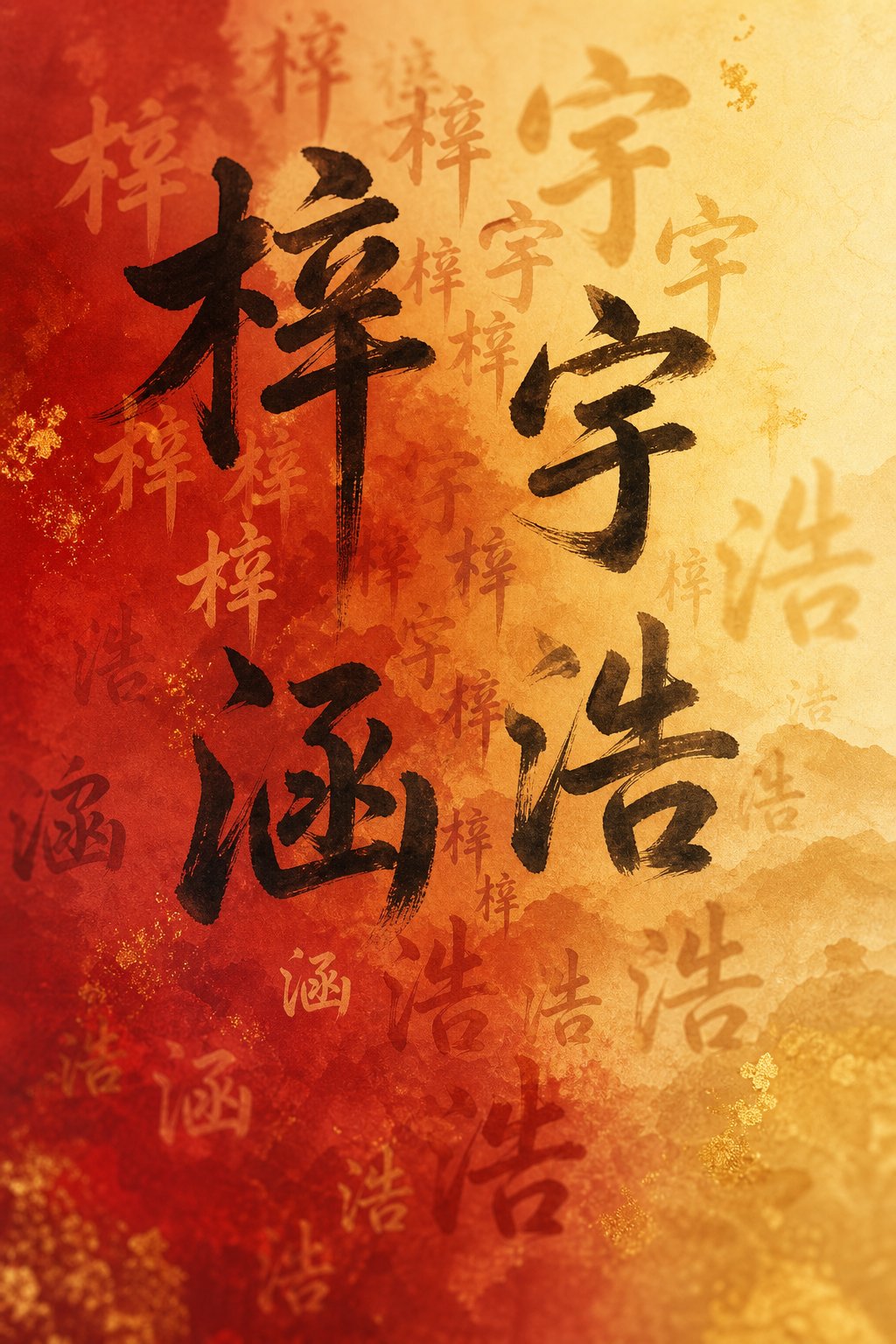
- 梓 (zi, catalpa tree) - Peak popularity: 2010s-present. Perhaps the single most overused character in contemporary baby girl names in chinese characters. China's 2020 national naming report shows 梓 appearing in the top-ten girl name 梓涵 (Zihan, rank 4), and it dominates boy names too with 梓豪 (Zihao, rank 9). The character originally refers to the catalpa tree, symbolizing hometown and rootedness, but its modern popularity stems largely from its pleasant sound and classical literary associations.
The dominance of 梓 deserves special attention. In the 2020 data, the character appears across both genders at rates that dwarf any single character from previous decades. Combined with 涵, 萱, or 桐, it forms names like 梓涵, 梓萱, and 梓桐 that fill entire kindergarten class rosters. Parents perceive these combinations as elegant and literary, yet the sheer volume of families making the same choice has turned them into the new "market names" of this generation.
| Aspect | Traditional Female Characters (芳, 丽, 静, 婷) | Modern Female Characters (颖, 涵, 萱, 梓) |
|---|---|---|
| Core Ideal | Beauty, virtue, quiet grace | Intelligence, depth, natural joy |
| What Parents Wished For | A beautiful, well-behaved daughter | A smart, cultivated, free-spirited daughter |
| Dominant Radicals | 女 (woman), 艹 (grass/flower) | 氵 (water), 木 (wood/tree), 艹 (grass) |
| Gender Specificity | Exclusively feminine | Often gender-neutral (梓, 涵 used for boys too) |
| Era of Peak Use | 1960s-1990s | 2000s-present |
| Cultural Source | Confucian feminine virtues | Classical poetry, nature symbolism, TV dramas |
The shift from exclusively feminine characters to gender-neutral ones is itself revealing. Characters like 涵 and 梓 appear in both female names in chinese characters and male names with equal frequency. This blurring reflects broader social changes: as women's roles expanded in Chinese society, the naming vocabulary expanded with them. Daughters no longer needed characters that explicitly marked femininity.
Yet the overuse problem persists regardless of which ideals drive the choices. Whether a parent in 1975 chose 芳 or a parent in 2020 chose 梓涵, the underlying dynamic is identical: a limited set of culturally approved characters funnels millions of independent decisions toward the same outcome. The specific characters rotate, but the convergence never stops. Understanding why requires looking beyond cultural trends and into the structural mechanics of the Chinese language itself, where phonetic constraints, stroke-count preferences, and tonal harmony quietly narrow the naming pool even further.
Why Certain Characters Dominate Chinese Naming
Cultural trends explain which characters become fashionable, but they do not explain why the naming pool stays so small in the first place. The deeper answer lies in the structure of the Chinese language itself. Every chinese name in chinese character must satisfy multiple linguistic constraints simultaneously, and those constraints act like a series of filters that eliminate the vast majority of the writing system from consideration.
Think of it this way: Chinese has roughly 80,000 characters in its full inventory. A literate adult knows around 6,000 to 8,000. Yet only about 2,600 ever appear in registered names. That is not a cultural accident. It is a structural inevitability created by the way Chinese characters carry meaning, sound, and visual weight all at once.
The Limited Pool of Positive-Meaning Characters
In English, a name like "Calvin" does not force most people to think about its Latin root meaning "bald." The meaning has faded behind the sound. Chinese does not work that way. Every character in a chinese name in characters is immediately readable as a word with a dictionary definition. Name your son 病 (bing, illness) and every person who sees his name will read the word "illness." There is no phonetic abstraction to hide behind.
This transparency creates enormous pressure. Parents can only use characters whose meanings are unambiguously positive in every context. Characters with dual meanings get eliminated. For example, 落 (luo) can mean "to fall" or "to settle," but the negative reading (falling, declining) makes it too risky. Characters that are positive in some compounds but negative in others, like 破 (po, breakthrough or broken), never appear in names because the negative reading is too accessible.
The result is a drastically reduced character set. Out of thousands of characters a parent might know, only a few hundred carry meanings that are purely positive, contextually safe, and aspirationally appropriate. When millions of families all filter through the same criteria, they inevitably land on the same short list.
Phonetic and Tonal Constraints in Name Selection
A chinese name in chinese character is not just read silently. It is spoken aloud thousands of times across a lifetime, and it must sound pleasant when combined with the family name in chinese characters that precedes it. Mandarin's four tones add a layer of complexity that alphabetic languages simply do not have.
The tonal harmony principle requires that the full name move through different tones to create a natural rhythm. Three consecutive third-tone syllables, for instance, produce an awkward stumbling effect. Since the most common surnames already lock in a specific tone (王 is second tone, 李 is third tone, 张 is first tone), the given-name characters must complement that fixed starting point.
Beyond tones, homophones create hidden traps. Chinese is full of words that sound identical but carry wildly different meanings. A name that sounds like a common word for something embarrassing or unlucky gets rejected immediately. The surname 史 (Shi, history) paired with a given name pronounced "zhen" could sound like 真 (true) or 珍 (precious), but it could also echo less flattering homophones. Parents instinctively avoid any combination that invites wordplay, which eliminates even more otherwise-positive characters from the pool.
These phonetic filters hit hardest with the most common surnames. When your last name in chinese characters is 王, 李, or 张, shared by hundreds of millions of people, the given-name characters that sound harmonious with those specific surnames become even more concentrated. Everyone with the same surname is filtering through the same tonal constraints, amplifying convergence.
Stroke Count and Visual Balance Preferences
Chinese characters are visual objects as much as they are linguistic units. A first and last name in chinese character must look balanced when written together. Parents and naming consultants consider stroke count carefully: a surname with very few strokes (like 丁, two strokes) paired with a highly complex given-name character looks top-heavy on paper. Conversely, a dense surname like 魏 (seventeen strokes) paired with a minimalist given name like 一 (one stroke) feels visually lopsided.
The sweet spot for given-name characters tends to fall between seven and twelve strokes. Characters in this range look substantial without being illegible in small print, and they balance well with the most common surnames. This preference quietly eliminates both the simplest and most complex characters from practical naming use.
Radicals also play a filtering role. Characters containing the grass radical (艹) or flower-related components signal femininity. Characters with the metal radical (金) or strength-related components lean masculine. Parents selecting a name unconsciously reach for characters whose visual structure matches the gender signal they want to send, further narrowing the options within each gender category.
Here are the key linguistic factors that collectively drive character overuse:
- Meaning transparency: Every character is immediately readable as a word, so only unambiguously positive characters qualify
- Context sensitivity: Characters with any negative secondary meaning get eliminated regardless of their primary meaning
- Tonal harmony: Given-name characters must complement the fixed tone of the surname, reducing options for each surname group
- Homophone avoidance: Any character whose pronunciation echoes an unlucky or embarrassing word is rejected
- Stroke count balance: Characters must be visually proportionate to the surname, favoring a middle range of complexity
- Radical signaling: Gender-appropriate radicals further subdivide the already-small pool into male and female subsets
- Surname interaction: The most common surnames share tones and structures, meaning millions of families face identical constraints simultaneously
Each filter alone would be manageable. Stacked together, they reduce the practical naming pool from thousands of characters to a few hundred, and from a few hundred to a few dozen favorites within any given generation. The language itself creates a funnel, and cultural trends merely determine which characters emerge from the narrow end.
These structural constraints operate at the level of individual character selection. But there is another force that narrows choices even further: traditional belief systems that prescribe specific characters based on a child's birth time, elemental composition, and cosmological profile. Where linguistics limits the pool passively, these systems actively direct parents toward the same small set of "auspicious" options.
Cultural Beliefs That Drive Character Selection
Linguistic constraints narrow the naming pool passively. Traditional Chinese metaphysics narrows it actively, prescribing specific characters based on a child's birth time, elemental profile, and cosmological balance. For millions of families choosing a baby name in chinese characters, these belief systems are not optional folklore. They are the primary decision-making framework, and they funnel enormous numbers of parents toward identical character choices.
Five Elements Theory and Character Selection
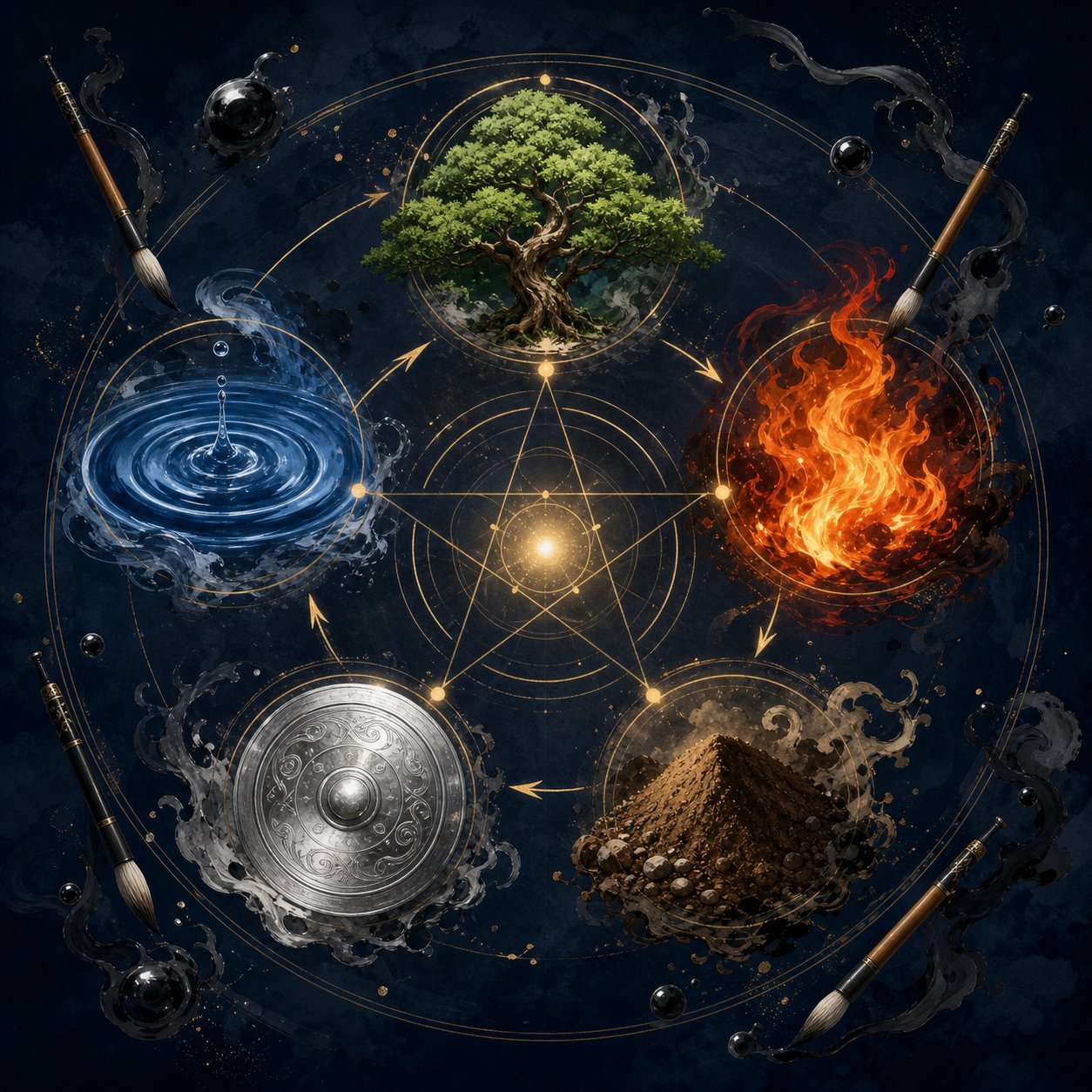
The 五行 (wuxing, Five Elements) system assigns every person an elemental composition based on their birth date and time. The five elements are Wood (木), Fire (火), Earth (土), Metal (金), and Water (水). When a child's chart shows a deficiency in one element, parents seek characters containing the corresponding radical or meaning to restore balance. A child lacking Water might receive a name with the water radical (氵), pushing parents toward characters like 涵 (han, cultivated), 浩 (hao, vast), or 泽 (ze, marsh). A child lacking Wood gets characters with the wood radical (木), like 梓 (zi, catalpa) or 桐 (tong, paulownia).
Sounds logical in isolation. The problem is that birth dates cluster. Children born in the same year and season often share similar elemental profiles, meaning thousands of families receive the same prescription simultaneously. When an entire cohort of babies "needs Water," the same handful of water-radical characters floods that year's birth registrations.
How Fortune-Telling Systems Narrow the Character Pool
The 八字 (bazi, Eight Characters) system goes deeper. A practitioner analyzing a child's bazi chart determines which elements are beneficial (喜神) and which would destabilize the chart's structure. This analysis then feeds into the 五格 (wuge, Five Structures) system, a numerological framework that evaluates names based on stroke count. The five structures are 天格 (Heaven), 地格 (Earth), 人格 (Person), 外格 (Outer), and 总格 (Total), each representing a different period and aspect of life.
Every character must have an auspicious number of strokes as counted in the 康熙字典 (Kangxi Dictionary), not modern simplified forms. The character 王, for instance, appears to have four strokes but officially counts as five. Once the required stroke counts are determined, parents must find characters that simultaneously satisfy the elemental prescription, hit the correct stroke numbers across all five structures, and produce a harmonious 三才 (sancai) relationship between Heaven, Earth, and Human expressed through elemental interactions.
When a naming system requires characters to satisfy elemental balance, stroke-count numerology, and cosmological harmony all at once, the number of characters that pass every filter shrinks to a tiny set. Millions of parents consulting these same systems inevitably converge on the same answers.
Here are the major belief systems and how each one drives convergence:
- 五行 (Five Elements): Prescribes characters with specific radicals (水, 木, 火, 土, 金) based on elemental deficiency, clustering children born in similar periods toward the same radical families
- 八字 (Eight Characters): Identifies beneficial elements through birth-chart analysis, further restricting which radicals and meanings are "allowed"
- 五格 (Five Structures): Requires specific stroke counts for each positional structure, eliminating characters that do not hit the right numbers
- 三才 (Three Talents): Demands harmonious elemental relationships between the name's structural components, rejecting combinations where elements clash
- Yin-yang balance: Requires character pairings to balance active and passive energies, favoring well-known characters with clear yin or yang associations
Professional naming masters (起名师) amplify this convergence further. When parents hire a consultant to choose a chinese name for baby in chinese characters, the consultant applies these same systems rigorously. Because the methodology is standardized, different consultants working from the same birth chart often recommend nearly identical character sets. One practitioner described choosing the name 林威辰 for a client's son, noting that the 三才 structure of 水金土 (Water-Metal-Earth) was "one of the best structures to have" and that it complemented the baby's chart. That specific combination of favorable structures and elements produces a short list of qualifying characters that any trained practitioner would identify.
The irony is sharp. Parents invest significant money and effort in these systems precisely to give their child a distinctive, auspicious name. Yet the systems themselves are deterministic: given the same inputs (birth time, surname, elemental needs), they produce the same outputs. When millions of families born under similar conditions consult the same frameworks, mass duplication is mathematically inevitable. Some parents who later discover their child shares a name with hundreds of thousands of others even choose to change name in chinese characters, seeking a new combination that might thread the needle between auspicious and unique.
These belief systems do not operate in a cultural vacuum, of course. They interact with social pressure, peer comparison, and the very human desire to fit in while standing out. That tension between conformity and individuality plays out most visibly in the social consequences of having an overused name, where the abstract problem of character convergence becomes a daily lived experience.
The Social Stigma of Having an Overused Name
Belief systems and linguistic filters explain how millions of parents arrive at the same names. But what happens to the people who actually carry those names? The consequences are not abstract. They show up in roll calls, job applications, hospital records, and social media profiles every single day.
Classroom Chaos and Workplace Confusion
Imagine a first-grade teacher calling out "Zi Han" and watching three children stand up simultaneously. This is routine in Chinese elementary schools. Teachers resort to creative workarounds: numbering students with the same name (大子涵, 小子涵), using full name in chinese characters on every assignment, or inventing nicknames to keep track. Some classrooms report four or five students sharing identical given names, turning attendance into a daily comedy of errors.
The problem follows people into adulthood. In workplaces, colleagues with the same first name in chinese character get distinguished by department, desk number, or physical description. Hospital mix-ups involving patients with identical names have made national news. Government offices processing paperwork for common name-surname combinations like 王伟 or 李静must rely entirely on ID numbers because the names alone identify no one.
When your my name in chinese characters is shared by hundreds of thousands of others, the name stops functioning as an identifier. It becomes background noise, a label so generic it requires constant supplementary information to do its basic job.
Internet Culture and the Mocking of Overused Names
Chinese internet culture has turned overused names into a full-blown meme. The term 菜市场名字 (caishichang mingzi, "vegetable market names") captures the sentiment perfectly: names so common they sound like something you would hear shouted across a crowded market stall. The phrase is not affectionate. It carries a sting of class judgment, implying the parents lacked creativity or education.
On platforms like Weibo and Zhihu, threads mocking 爆款名字 regularly go viral. Users share screenshots of kindergarten class lists where half the children are named some variation of 梓轩, 梓涵, or 浩宇. One widely shared post imagined a future workplace meeting: "Zixuan, please pass the report to Zihan, then ask Haoyu to confirm with Yuxuan." The joke landed because it felt inevitable.
For the people carrying these names, the experience is more complicated than funny. Many describe the moment they first searched "what is my name in chinese characters" on a government duplication-check tool and discovered their name was shared by 290,000 others. The realization hits differently than simply knowing your name is common. Seeing the raw number creates a strange feeling of erasure, as if your name in chinese characters belongs to everyone and therefore to no one.
Social media compounds the problem. Try registering "Wang Wei" as a username on any Chinese platform and you will find it taken, along with WangWei1 through WangWei9999. People with overused names learn early to build identity through handles, nicknames, and online personas that have nothing to do with their legal names. Some joke that the first thing they do on any new platform is check "what's my name in chinese characters" availability, already knowing the answer.
The surname factor makes everything worse. China's surname distribution is extremely top-heavy: the three most common surnames (王, 李, 张) alone cover over 270 million people. Pair those surnames with overused given-name characters and you get duplication at a scale that breaks systems. Your name in chinese characters might be shared by so many people that even adding a middle character barely helps. A 王浩宇 born in 2015 shares his full name with tens of thousands of other boys born the same year.
This lived experience of name-based anonymity has created a cultural backlash. Parents who grew up as one of five 李静s in their school are now determined to give their own children something different. That determination drives the counter-trend explored next: the strategies modern parents use to escape the overuse trap without falling into the opposite problem of choosing characters so rare that no one can read them.
How Modern Parents Avoid Overused Characters
Growing up as one of four 李静s in a classroom leaves a mark. Parents who lived that experience are now actively strategizing to spare their own children the same fate. The good news: practical tools and creative approaches exist to find your name in chinese characters that feels both meaningful and distinctive.
Strategies for Avoiding Overused Characters
The most effective approach starts with data. Before committing to a name, savvy parents now run candidates through frequency-checking tools. China's public security bureaus in several provinces offer online name-duplication queries, letting parents see exactly how many people already carry a given combination. Some parents treat this step the way they would a domain-name search: if the number comes back in the tens of thousands, they move on.
Beyond database checks, here are the core strategies modern families use:
- Consult government naming reports: Annual reports from China's Ministry of Public Security list the year's most registered names, giving parents a real-time "avoid" list
- Combine common characters in uncommon pairings: Individual characters like 明 or 涵 may be overused, but pairing them with less typical partners creates combinations that feel familiar yet distinctive
- Explore different radical families: Moving beyond the usual grass (艹), water (氵), and wood (木) radicals opens up characters that carry positive meanings but sit outside the standard naming vocabulary
- Hire consultants who check duplication rates: Professional naming services now advertise uniqueness verification as a core feature, cross-referencing recommendations against national databases
- Use three-character given names: Adding a second given-name character exponentially increases possible combinations, making duplication far less likely
For parents outside China who want to translate name in chinese characters or write name in chinese characters for a child with cross-cultural roots, these same frequency tools help avoid accidentally choosing a combination that sounds elegant abroad but registers as generic domestically.
Drawing From Classical Literature for Unique Names
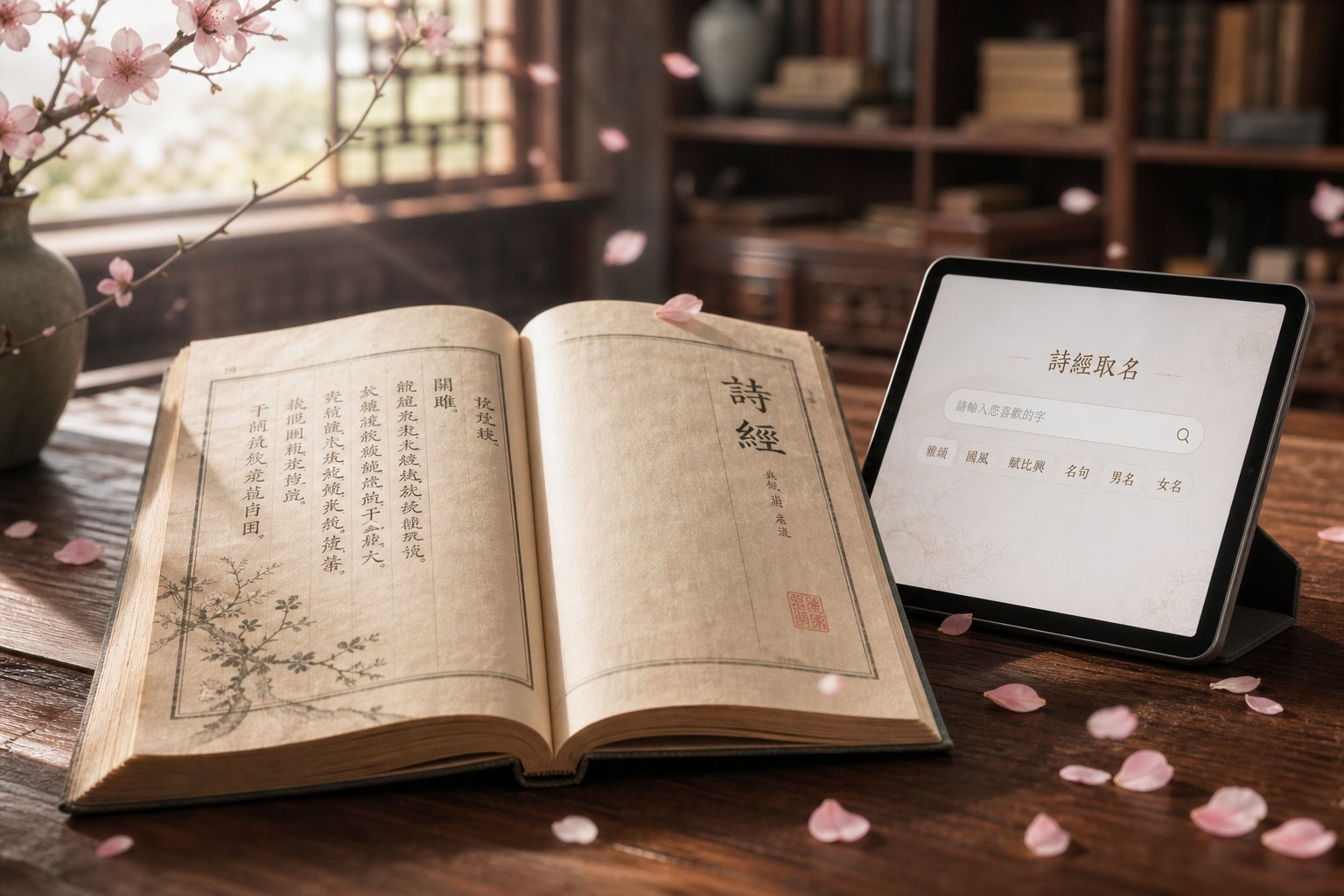
The richest vein of distinctive naming material sits in China's classical literary canon. The 诗经 (Shijing, Book of Songs) and 楚辞 (Chuci, Songs of Chu) have supplied beautiful, lesser-known characters for centuries. A traditional saying even prescribes the method: "女诗经, 男楚辞" (girls from the Shijing, boys from the Chuci).
Characters drawn from these texts carry built-in cultural weight without the overuse problem. A name like 蘅芜 (hengwu, a fragrant plant from the Chuci) or 攸宁 (youning, meaning peaceful and settled, from the Shijing) sounds literary and intentional rather than trendy. Parents who take this route often discover characters they never encountered in daily life but that carry centuries of poetic resonance.
The approach works because classical texts contain thousands of characters with positive meanings that simply fell out of common use. They are not rare in the sense of being obscure or illegible. Most educated Chinese readers can recognize them. They are rare only in the naming context, which is exactly the sweet spot parents are looking for. Anyone curious enough to translate my name in chinese characters back to its literary source will find a story behind it rather than a trend.
The Risks of Going Too Rare
The quest for uniqueness has a ceiling, and some parents crash into it. Choosing extremely rare or archaic characters creates a different set of problems that can follow a child for life. Characters outside the standard GB2312 or GB18030 encoding sets may not display correctly in government databases, banking systems, or airline booking platforms. Some families have discovered that their child's name literally cannot be typed into official forms, forcing them to write my name in chinese characters by hand on documents that everyone else fills out digitally.
Social friction is another cost. A name no one can read becomes a conversation starter in the worst way. Teachers stumble over it. Classmates cannot write it. The child spends years spelling out and explaining a name that was meant to signal sophistication but instead signals inconvenience. Understanding how to write a name in chinese characters that others can actually reproduce matters as much as the meaning behind it.
The best name sits in the space between instantly recognizable and numbingly common. It should be readable by any literate adult but not predictable by any algorithm.
The practical principle is straightforward: choose characters that educated people recognize but do not immediately associate with naming trends. A character from classical poetry that appears in high-school textbooks hits this target. A character so archaic it requires a dictionary lookup overshoots it. Parents who want to how to write my name in chinese characters with pride rather than frustration should aim for that middle ground, where meaning, sound, and distinctiveness align without sacrificing daily usability.
Naming a child in any language involves balancing aspiration with practicality. In Chinese, where every character carries visible meaning and where 1.4 billion people draw from the same finite set, that balance demands more deliberate effort than most parents expect. The tools exist. The literary resources are vast. The key is resisting both the gravitational pull of trending characters and the temptation to overcorrect into illegibility.
Frequently Asked Questions About Overused Chinese Characters in Names
1. What is the most overused character in Chinese names right now?
The character 梓 (zi, catalpa tree) is arguably the single most overused character in contemporary Chinese names. China's 2020 national naming report shows it appearing in top-ten names for both boys and girls, including 梓涵, 梓萱, 梓轩, and 梓豪. Its pleasant sound and classical literary associations drive its popularity, but the sheer volume of families choosing it has made combinations like 梓涵 the new generation's equivalent of 'vegetable market names.'
2. Why do so many Chinese names use the same characters?
Multiple forces converge to create this pattern. First, Chinese characters carry transparent meanings, so only unambiguously positive characters qualify for names, limiting the pool to roughly 2,614 out of 80,000 total characters. Second, tonal harmony with common surnames eliminates further options. Third, traditional belief systems like Five Elements theory and stroke-count numerology prescribe specific characters based on birth time, funneling parents born in similar periods toward identical choices. Finally, cultural trends spread faster than ever through social media and TV dramas, synchronizing parental taste nationwide.
3. How can I check if a Chinese name is too common?
Several practical tools exist. China's public security bureaus in multiple provinces offer online name-duplication queries where you can enter a full name and see how many registered citizens share it. The Ministry of Public Security also publishes annual reports listing the most registered newborn names each year, functioning as a real-time avoid list. Professional naming consultants now include uniqueness verification as a standard service, cross-referencing recommendations against national databases before finalizing suggestions.
4. What Chinese characters were popular in names during the 1950s and 1960s?
The 1950s and 1960s were dominated by patriotic characters reflecting loyalty to the new People's Republic. The character 国 (guo, nation) was nearly unavoidable, appearing in combinations like 建国 (build the country), 卫国 (guard the country), and 国强 (the country is powerful). During the Cultural Revolution in the 1960s, ideological characters took over: 红 (hong, red), 兵 (bing, soldier), and 革 (ge, revolution) became standard choices, with some parents even naming children 文革 (Wenge) directly after the political movement.
5. How do Chinese parents choose unique names without picking unreadable characters?
The most effective strategy draws from classical literary texts like the Shijing (Book of Songs) and Chuci (Songs of Chu), which contain thousands of characters with beautiful meanings that fell out of common daily use but remain recognizable to educated readers. Other approaches include combining familiar characters in uncommon pairings, using three-character given names to increase combinatorial possibilities, and exploring radical families outside the typical grass, water, and wood groups. The key principle is choosing characters that literate adults can read but would not immediately predict from current trends.