Start With How Chinese Names Flowers
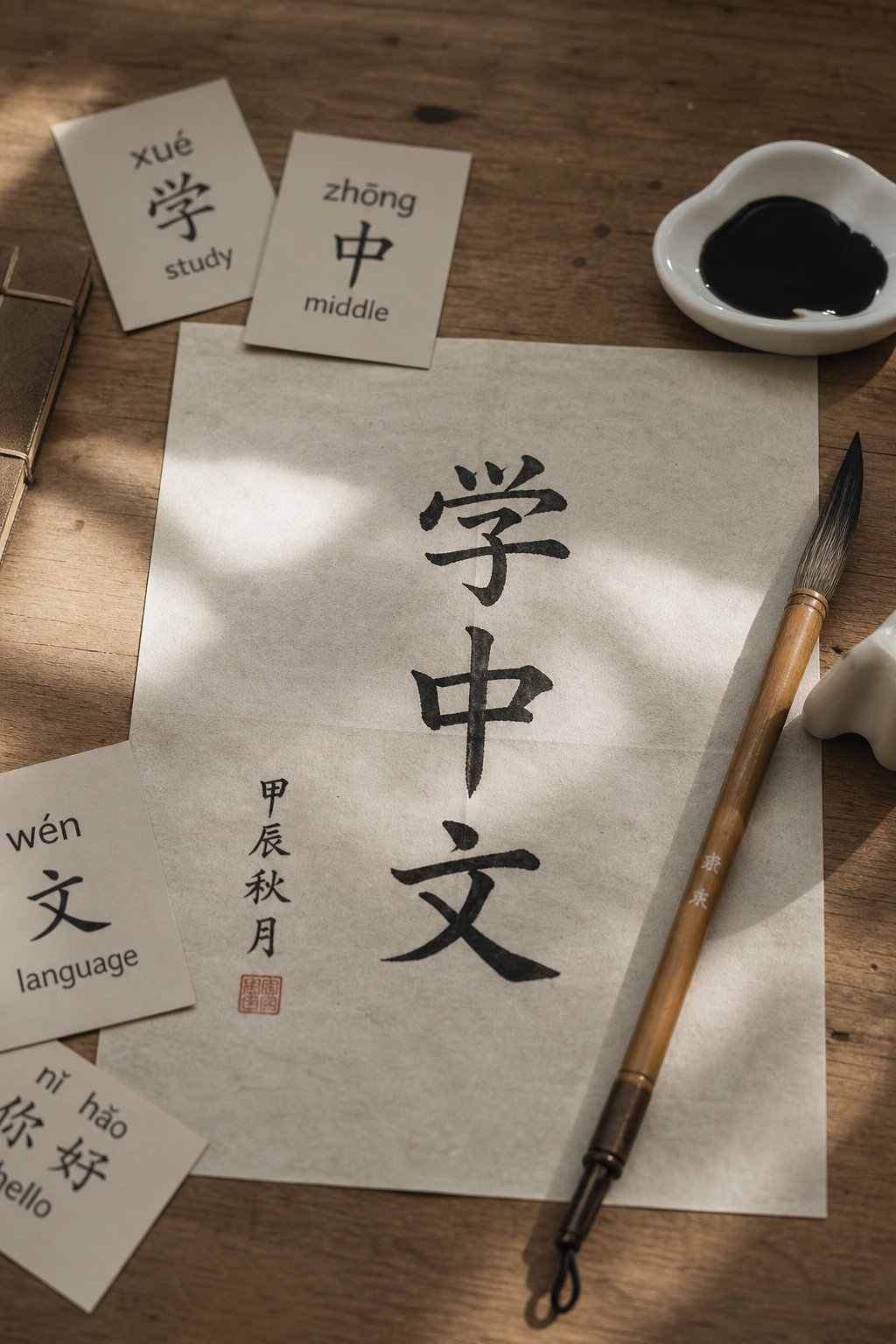
Ever looked at two lookalike characters and wondered why one means a plant and the other a color? When you study names of flowers in Chinese, you are learning three things at once: script, sound, and meaning. The core flower in Chinese language word is the character 花 huā, a building block you will see again and again in floral terms.
How to say flower in Chinese clearly
The basic Chinese word for flower is 花, pronounced huā in first tone. Think of huā as "hwah" to anchor the vowel. The character combines the plant clue 艹 on top with a sound component below, a common pattern of semantic plus phonetic parts noted in character studies of 花 Chinese etymology. If you came here asking how to say flower in Chinese, start with huā and its tone, then build outward to specific species.
Reading and writing the character for flower
You will notice the 艹 grass radical at the top. It often signals a plant-related meaning. Write strokes top to bottom, left to right. Place 艹 first, then the lower component. Many dictionary apps show animated stroke order you can follow. This makes the flower chinese character easier to memorize and recognize inside longer words.
| Character | Pinyin | Literal idea | Notes |
|---|---|---|---|
| 花 | huā | flower | huā = hwah. Core morpheme in floral terms. |
| 朵 | duǒ | classifier for blossoms | duǒ = dwoh. Used when counting blossoms. |
| 莲 | lián | lotus | lián = lyehn. Common in names and motifs. |
Common pronunciation pitfalls to avoid
- Ignoring tones. méi vs měi both sound like mei in English but mean different things. Train your ear early.
- Mixing up 兰 lán orchid and 蓝 lán blue. They look and sound close in Mandarin, but one names a plant and the other a color.
- Dropping the classifier. In Mandarin, counting usually needs a classifier, so practice with blossoms using 朵.
- Over-smoothing vowels. Keep huā as a single syllable, not two like "hoo-wah".
Traditional and simplified forms you will see
Expect to encounter both simplified and traditional scripts in signage, dictionaries, and art captions. Focus on recognizing the core shape of 花 first, then check trusted dictionaries for alternate forms of other plant characters as you expand your list of names of flowers in Chinese.
Quick tone tip you can use today: the number 一 changes tone in connected speech. Before a 4th-tone syllable it becomes yí, and before 1st, 2nd, or 3rd tones it becomes yì. Apply that rule when you count blossoms, then say 花 afterward for a smooth rhythm. Start simple: practice flower in Mandarin with short phrases, then add species names as you go.
Mastering the sounds, the shapes, and the classifier pattern here prepares you to explore symbolism, art, and etiquette with confidence.
Symbols That Shape Chinese Floral Culture
Why do the same few plants keep showing up on scrolls, porcelain, and seals? Because a small set of classic motifs gives you a compass for reading flowers in Chinese culture. If you are learning names of flowers in Chinese, these anchors help you decode scenes, inscriptions, and even seal carvings across media.
The Four Gentlemen in art and poetry
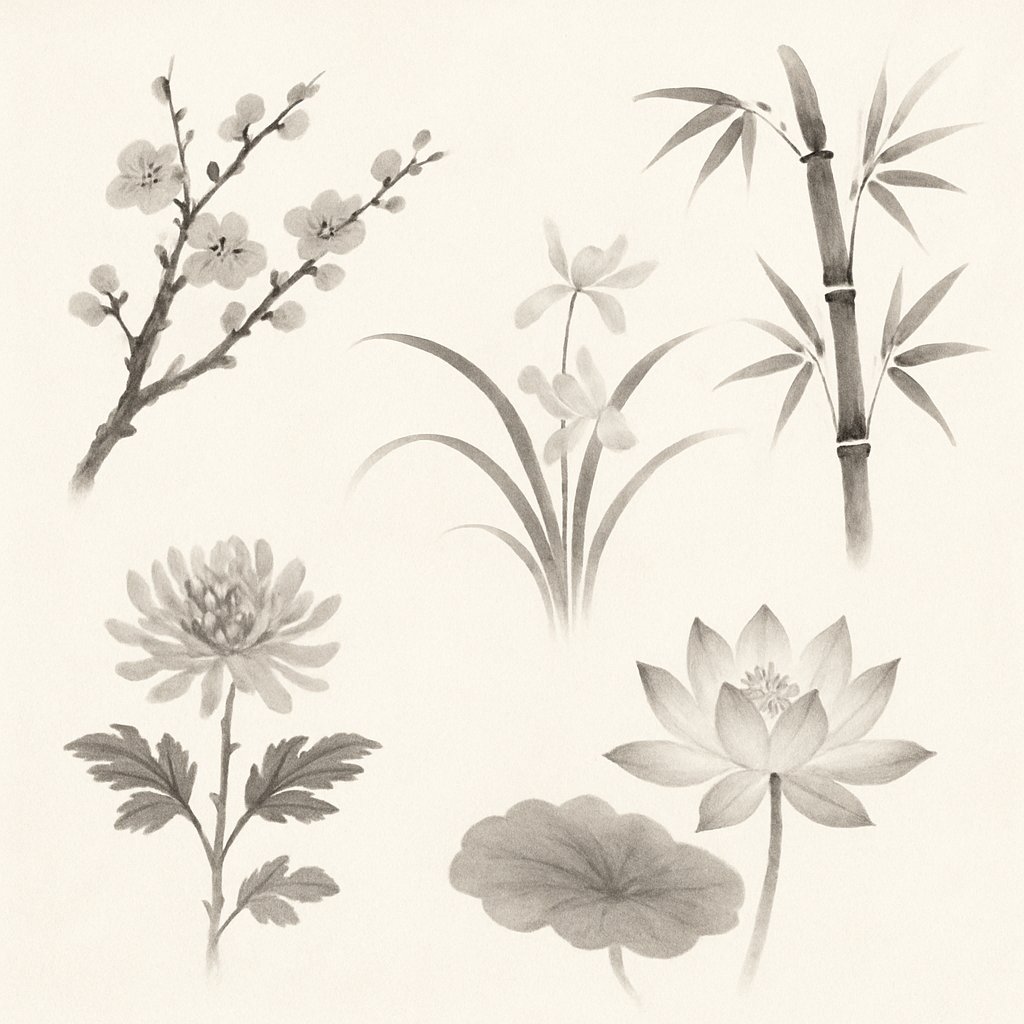
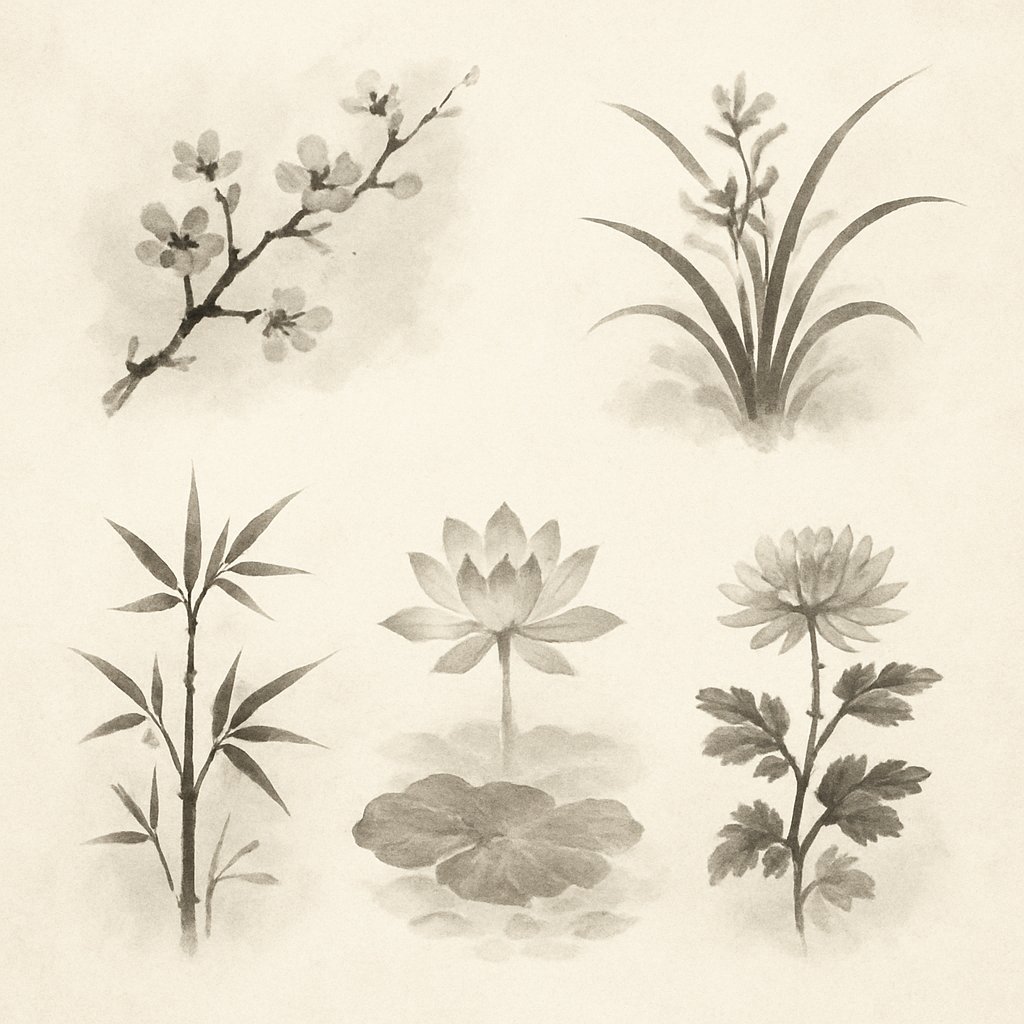
The Four Gentlemen 四君子 Sì Jūnzǐ are plum blossom 梅 méi, orchid 兰 lán, bamboo 竹 zhú, and chrysanthemum 菊 jú. They are core subjects in bird-and-flower painting and ink wash, valued for seasonal and moral resonance. Each plant marks a season and collectively signals virtues such as uprightness, purity, humility, and perseverance. See the overview of the theme and its long use in painting here Four Gentlemen.
- 梅 méi plum blossom – winter and perseverance in the cold
- 兰 lán orchid – spring and refined, modest character
- 竹 zhú bamboo – summer and upright strength
- 菊 jú chrysanthemum – autumn and a calm, retiring spirit
From the eastern hedge, I pluck chrysanthemum flowers. — Tao Qian, Drinking Wine
That single image made chrysanthemums a touchstone for the recluse ideal in later readings, a good example of how chinese flower symbolism grows from poetry into painting.
Lotus symbolism beyond the pond
Add the lotus 莲 lián, and you have another guiding star. As a motif and symbol, the lotus appears on Ming and Qing porcelain vases, bowls, and even snuff bottles. When you spot scrolling lotus on a meiping or a bowl rim, you are seeing how flowers in Chinese art carry ethical and aesthetic meanings across everyday objects.
Plum blossoms bloom in winter and are used to speak of endurance in the cold (see Four Gentlemen for background).
Regional and seasonal variations to know
The Four Gentlemen frame the four seasons in a single visual language, so artists combine them to mark time within a scroll. The theme began in Chinese painting and was later adopted in Korea, Japan, and Vietnam, with variations in ceramics and decorative arts noted in historical surveys of the motif via the same Four Gentlemen source. This is why you will notice the same chinese flower symbols repeating on brushwork panels, porcelains, and seals.
- 梅 méi plum – virtue: perseverance; context: winter landscapes and seal designs
- 兰 lán orchid – virtue: modest refinement; context: scholar studio subjects and calligraphy pairings
- 竹 zhú bamboo – virtue: uprightness; context: ink wash studies and brushwork practice
- 菊 jú chrysanthemum – virtue: simplicity and distance from bustle; context: autumn garden scenes
Keep these anchors in mind as you encounter flowers depicted in Chinese art. Next, scan the master list to match characters, pinyin, and meanings at a glance.
The Definitive Flower Name Reference Table
Want one place to connect characters, sounds, and meanings fast? Use this master list of chinese flower names. It ties together names of Chinese flowers, pinyin, and chinese flower meanings you can trust at a glance. If you ever need to check rose in chinese or lotus in chinese quickly, scan the table below.
Scan the master list of flower names
| English name | Simplified | Traditional | Pinyin | Literal & components | Symbolic meanings | Latin name | Recommended occasions | Learner tag | Usage tip |
|---|---|---|---|---|---|---|---|---|---|
| Peony | 牡丹 | 牡丹 | mǔdān | species name | prosperity, honor | Paeonia spp. | congratulations, spring decor | Advanced | Often used on festive designs symbolizing wealth. |
| Lotus | 莲花 | 蓮花 | liánhuā | lotus + flower | purity, spiritual growth | Nelumbo nucifera | weddings, spiritual gifts | Common | Also written 荷花 héhuā in many texts. |
| Plum blossom | 梅花 | 梅花 | méihuā | plum + flower | endurance, hope | Prunus mume | New Year, winter cards | Common | Pairs well with snow motifs in art. |
| Orchid | 兰花 | 蘭花 | lánhuā | orchid + flower | elegance, friendship | Orchidaceae | teacher thanks, studio decor | Common | Great anchor when learning orchid in chinese tones. |
| Bamboo | 竹 | 竹 | zhú | bamboo | integrity, flexibility | Bambusoideae | study gifts, calligraphy | Common | Not a blossom but core to the Four Gentlemen. |
| Chrysanthemum | 菊花 | 菊花 | júhuā | chrysanthemum + flower | longevity, autumn | Chrysanthemum spp. | Double Ninth, birthdays | Common | White bouquets may signal mourning in some regions. |
| Jasmine | 茉莉 | 茉莉 | mòlì | aromatic jasmine | grace, elegance | Jasminum spp. | summer gifts, tea themes | Advanced | Common in tea names and summer decor. |
| Rose | 玫瑰 | 玫瑰 | méiguī | species name | love, romance | Rosa spp. | Qixi, anniversaries | Common | Red is the safest color for romance. |
| Azalea | 杜鹃花 | 杜鵑花 | dùjuānhuā | azalea + flower | passion, femininity | Rhododendron spp. | spring congratulations | Advanced | Vivid colors read cheerful in most settings. |
| Lily | 百合 | 百合 | bǎihé | hundred + union | purity, motherhood | Lilium spp. | weddings, births | Common | Avoid all white for upbeat events in some locales. |
Understand each name by its characters
- Many entries add 花 huā to mark a blossom, as in 梅花, 兰花, 莲花.
- Orthography shifts by region: 兰花 vs 蘭花 and 莲花 vs 蓮花 are common pairs.
- Quick recall aid: orchid in chinese is 兰花 lánhuā; lily in chinese is 百合 bǎihé.
Match meanings to occasions with care
- Weddings and new beginnings: peony, lotus, lily.
- Longevity birthdays and autumn themes: chrysanthemum.
- Romance and admiration: rose, orchid.
For a concise overview of popular symbolism used above, see this summary of traditional meanings Traditional Chinese flowers and meanings. Keep this table handy as the cross reference hub, then move on to tone coaching so you can pronounce every row with confidence.
Pronounce Chinese Flower Names With Confidence
Nervous about saying a flower name out loud? This quick masterclass shows you how to keep tones steady, link words smoothly, and avoid lookalike traps. If you have wondered how do you say flower in Chinese in a full phrase, start with huā in first tone, then layer on species so your flower in mandarin chinese sounds natural in real conversations.
Master tones for the most common flower names
- 花 huā 1st tone – the base word for flower. Respelling: huā = hwah.
- 兰花 lánhuā 2nd + 1st – orchid in mandarin. Respelling: lán = lahn, huā = hwah.
- 菊花 júhuā 2nd + 1st – chrysanthemum. Respelling: jú = jyu, huā = hwah.
- 玫瑰 méiguī or méi gui – rose in mandarin. Many references mark the second syllable as neutral in speech; you will also hear full tones as méiguī. Respelling: méi = may, guī = gway.
- 百合 bǎihé 3rd + 2nd – lily flower in chinese. Respelling: bǎi = bye (dipped), hé = huh-eh.
- 莲花 liánhuā 2nd + 1st – lotus. Respelling: lián = lyehn, huā = hwah.
- 竹 zhú 2nd – bamboo. Respelling: zhú = joo.
Tip on accents: you will notice some regional speech softens finals slightly, but keep standard pinyin tones as your reference when practicing.
Minimal pairs that trip learners
| Word | Pinyin with tones | Common mispronunciation | Fix |
|---|---|---|---|
| 梅 plum blossom | méi | měi | Keep a smooth rising 2nd tone. méi = may↑; měi dips then rises. |
| 美 beauty | měi | méi | Do a clear 3rd-tone dip then rise. Respelling: měi = may-uh-rise. |
| 菊 chrysanthemum | jú | jiǔ or jù | jú is 2nd tone jyu↑. jiǔ is 3rd tone jyohˇ. Do not drop the tone. |
| 九 nine | jiǔ | jú | Give jiǔ a full 3rd-tone contour. Do not flatten to 2nd tone. |
| 兰花 orchid | lánhuā | 蓝花 | Sound is the same for lán, but read the character. 兰 = orchid, 蓝 = blue. |
| 玫瑰 rose | méiguī or méi gui | méiguì | Keep guī as 1st tone or neutral, not 4th. |
| 百合 lily | bǎihé | bàihé or bǎihè | Third then second tone. Keep the final syllable rising. |
| 竹 bamboo | zhú | zhū or untoned zhu | Make it 2nd tone. Respelling cue: zhú = joo↑. |
Tone sandhi and connected speech
Counting blossoms uses the measure word 朵 duǒ 3rd tone. The number 一 changes before it. According to a standard description of the rule, 一 becomes yì before 1st, 2nd, or 3rd tones, and yí before a 4th tone tone changes of 一. So say 一朵花 as yì duǒ huā and 一朵玫瑰 as yì duǒ méiguī. In connected speech, keep tones intact but link syllables smoothly. Many speakers also pronounce the second syllable of 玫瑰 lightly in fast speech, which you can mirror once your full-tone control is solid.
- Do mark tones on every new word, especially names from the master table.
- Do use sound cues: ju = jyu, zhú = joo, lián = lyehn, huā = hwah.
- Do keep classifiers like 朵 when counting blossoms.
- Don’t flatten 2nd tones into a monotone. Let them rise.
- Don’t turn guī in 玫瑰 into a 4th tone.
- Don’t rely only on sound for lán. Check the character to avoid mixing orchid with blue.
Quick practice drill. Say the same noun with different colors and adjectives to lock tones:
- 一朵红玫瑰 yì duǒ hóng méiguī
- 一朵白玫瑰 yì duǒ bái méiguī
- 一朵粉百合 yì duǒ fěn bǎihé
- 一朵香兰花 yì duǒ xiāng lánhuā
Repeat with any term you know, from orchid in mandarin to sunflower in chinese, and your tone patterns will stick. With pronunciation under control, you are ready to choose flowers wisely in real-world gifting, which we cover next in etiquette and phrases.
Gifting Etiquette And Real World Phrases
Ever wondered if a white bouquet is always safe? When you move from learning names of flowers in Chinese to gifting, context matters. Color, occasion, and region shape chinese flowers meaning. Use the quick rules, table, and phrases below to get it right the first time.
What to give for birthdays and weddings
For celebrations, lean festive. A practical guide to sending flowers in China highlights safe picks such as roses for romance, tulips for Qixi, sunflowers and carnations for teachers, and bright peonies for New Year. If your note needs wording like flowers meaning rebirth or flower that symbolizes rebirth, write it on the card rather than relying on one species to carry that meaning.
- Celebrations prefer vivid tones. Red Chinese flowers read most festive.
- Romance and anniversaries favor roses or tulips in red or pink.
- Teachers and mentors often receive sunflowers or carnations.
| Occasion | Appropriate flowers | Colors | Notes |
|---|---|---|---|
| Romance, Qixi | 玫瑰 méiguī, 郁金香 yùjīnxiāng | red, pink | Signals deep love and thoughtful regard. |
| Teacher thanks | 向日葵 xiàngrìkuí, 康乃馨 kāngnǎixīn | yellow, warm reds | Shows respect and gratitude. |
| Chinese New Year | 牡丹 mǔdān, 大丽花 dàlìhuā, 富贵竹 fùguì zhú, 红蝴蝶兰 hóng húdiélán | bright red | Festive colors are preferred for luck. |
| Funeral or condolence | 白或黄菊花 báihuò huáng júhuā; some regions use white iris | white, yellow | Families may choose red flowers when the deceased was 80+; practices vary Chinese funeral traditions. |
What to avoid for condolences and hospital visits
- Chrysanthemums are tied to mourning in many settings, so do not send them as a thank-you gift; choose alternatives noted above.
- For chinese flowers for funeral, white or yellow mums are common. Red may appear only when honoring an elder over 80 per some customs.
- Watch regional caveats: 剑兰 jiànlán can echo hardship by homophone in some dialects, and 梅花 méihuā can hint at bad luck for business contexts. Ask a local florist if unsure.
- Hospitals vary. If the family prefers flowers that symbolize hope, keep the message hopeful on the card and confirm fragrance policies in advance.
Ready phrases you can use today
Use 您 for formal respect, and soften requests with 请 or 麻烦. For condolences, these lines are widely accepted in formal cards and messages.
- [Formal] 请节哀顺变,保重身体。
Qǐng jié'āi shùnbiàn, bǎozhòng shēntǐ.
Please accept our condolences and take good care. - [Formal] 让我们一起追思她的美好时光。
Ràng wǒmen yìqǐ zhuīsī tā de měihǎo shíguāng.
Let us remember her beautiful moments together. Use 追思 for flowers that mean remembrance. - [Polite to florist] 请帮我搭配一束向日葵和康乃馨,表达敬意。
Qǐng bāng wǒ dāpèi yí shù xiàngrìkuí hé kāngnǎixīn, biǎodá jìngyì.
Please arrange a bouquet of sunflowers and carnations to show respect. - [Casual romance] 请包一束红玫瑰,并写卡片。
Qǐng bāo yí shù hóng méiguī, bìng xiě kǎpiàn.
Please wrap a bouquet of red roses and add a card.
- Buying a bouquet
你: 请推荐适合新年的花。
Nǐ: Qǐng tuījiàn shìhé Xīnnián de huā.
店员: 牡丹和红蝴蝶兰很喜庆。
Diànyuán: Mǔdān hé hóng húdiélán hěn xǐqìng. - Sending apologies with flowers
你: 不好意思,这束花表达我的歉意。
Nǐ: Bù hǎoyìsi, zhè shù huā biǎodá wǒ de qiànyì.
对方: 谢谢你的心意。
Duìfāng: Xièxie nǐ de xīnyì. - Expressing remembrance
你: 我们对您的损失深表哀悼。
Nǐ: Wǒmen duì nín de sǔnshī shēnbiǎo āidào.
家属: 谢谢您来送别。
Jiāshǔ: Xièxie nín lái sòngbié.
With these choices and lines, you can gift with tact. Next, see how the same blooms carry layered meaning in painting and poetry so your eye matches your etiquette.
Literature And Art That Bring Flowers To Life
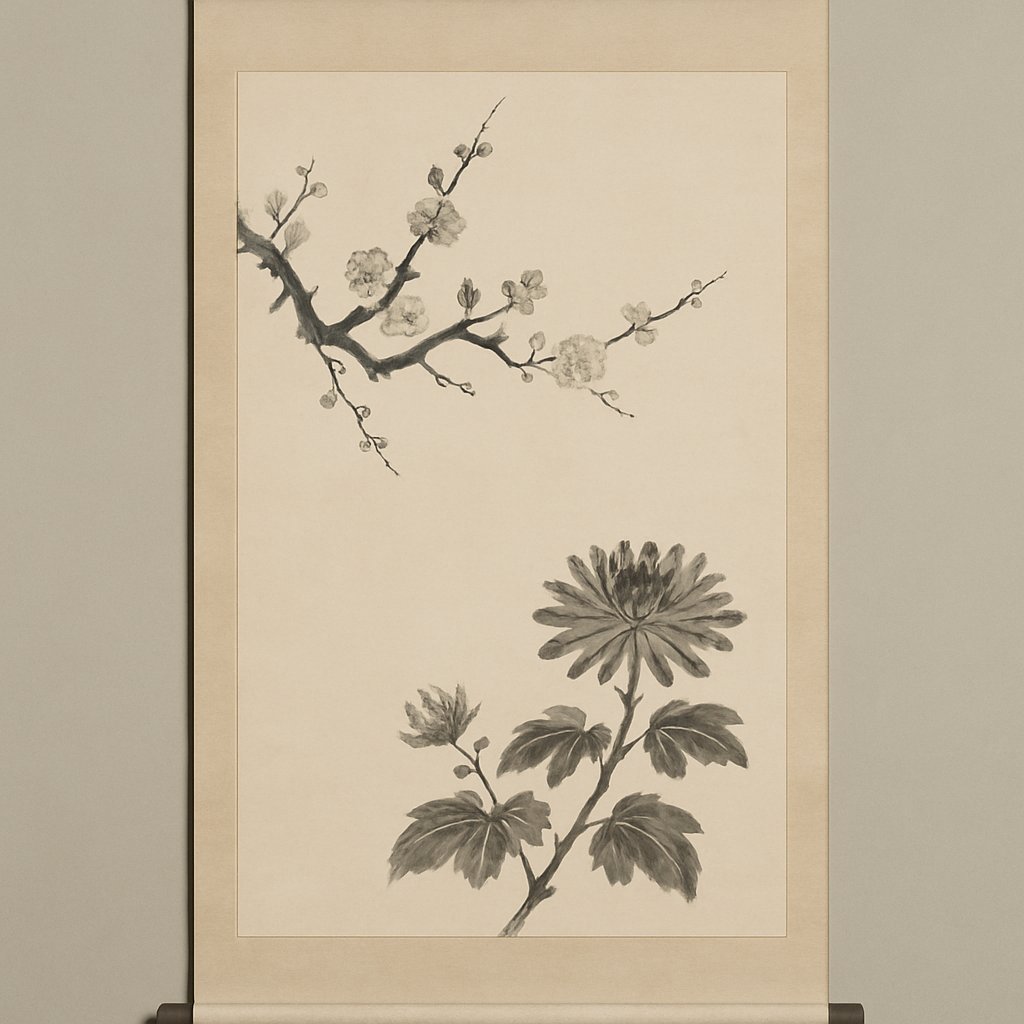
When you stand before a handscroll of plum blossoms or spot an orchid brushed in ink, what are you really reading? In chinese flower painting, names, seasons, and virtues meet on paper, porcelain, and seals. Use the master table above to keep characters and pinyin straight, then read the scenes like a story of flowers depicted in classical Chinese art.
Peony across periods and festive imagery
Imagine a bright peony 牡丹 mǔdān anchoring a celebratory panel. Even though peony sits outside the Four Gentlemen, knowing that codified set helps you contrast moral-allegorical themes with more decorative subjects. Manuals and histories explain how梅、蘭、竹、菊 became the teaching core for bird-and-flower painting, shaping how viewers read other blooms by comparison.
- Case study 1: On a festive scroll, peony’s name tag 牡丹 next to a seal can cue celebration, while the absence of a seasonal virtue poem separates it from the Four Gentlemen frame.
- Case study 2: On decorative wares, you will see peony motifs repeated as patterns, while captions are minimal or absent, unlike literati panels with long inscriptions.
Chrysanthemum and the hermit ideal
Chrysanthemum 菊 jú moves between custom and character. Research on Tang poetry shows three enduring strands that later painters echoed in captions and subjects: Double Ninth festival scenes, moral personality like noble seclusion, and life-circumstance reflection that turns setbacks into meaning study of chrysanthemum images in Tang poetry.
Chrysanthemum in verse links festival custom, recluse virtue, and life’s trials, which painters echo in autumn scenes.
- Case study 1: An autumn album leaf labeled 菊花 júhuā plus a short note about 重阳 signals the festival strand.
- Case study 2: A studio hanging scroll pairs 菊 with a quiet cottage inscription to stage the recluse ideal common in flowers in classical Chinese art.
Plum blossom and winter endurance
Plum 梅 méi is the winter anchor of classical chinese art flowers. Literati sources and painting histories trace how the Four Gentlemen formed over time, and how ink-plum methods evolved from early experiments to Southern Song and Yuan innovations, giving viewers a shared code to read endurance and upright spirit across media.
Plum, orchid, bamboo, and chrysanthemum became a literati set taught through manuals, cementing their moral readings.
- Case study 1: An ink-plum album with swift, ring-like petals pays homage to Southern Song techniques mentioned in painting notes.
- Case study 2: A winter landscape vignette places 梅花 near rocks to cue hardship and renewal, a common flower in Chinese art pairing.
How captions and seals complete the picture
- Inscriptions 题款 deepen theme and balance composition; long or multiple inscriptions can stabilize a sparse bamboo or plum layout, and the red seal impressions also help with visual balance.
- Look for the quartet poetry–calligraphy–painting–seal working together; when you see it on a chrysanthemum panel, you are in literati territory rather than pure decoration.
- Crossword memory cue: when a clue hints at winter “flowers in Chinese art crossword,” think 梅 méihuā.
As you browse chinese art flowers across scrolls and ceramics, keep checking characters against the master table to avoid mix-ups and to connect names with seasons and virtues. Next, turn these insights into a two-week study routine so tones, meanings, and contexts stick.
Study Plan And Practice To Lock It In
Want a simple plan that turns lists into real speech and writing? Use this two-week routine to move from recognizing names of flowers in Chinese to using them clearly in conversation, notes, and gifts. The word choices below draw from an HSK-focused flower list, with core items like 花 huā and high-frequency species such as 玫瑰 méiguī, 菊花 júhuā, 百合 bǎihé, 向日葵 xiàngrìkuí, and more you can verify in the HSK Flower Vocabulary List AllSet Learning.
Two week plan to master key flower names
- Day 1: Foundations. Learn the flower in Chinese character 花 huā and the classifier 朵 duǒ. Note the 艹 grass radical to tag plant words. Build two short phrases like 一朵花 and 一朵兰花.
- Day 2: Four Gentlemen set. 梅花 méihuā, 兰花 lánhuā, 竹 zhú, 菊花 júhuā. Say each with tones, then read them aloud in one line.
- Day 3: Romance set. 玫瑰 méiguī, 郁金香 yùjīnxiāng. Practice colors and numbers with 朵. Write two compliment sentences.
- Day 4: Purity set. 莲花 liánhuā or 荷花 héhuā, 百合 bǎihé. Compose a wedding card line.
- Day 5: Color collocations. 红 red, 粉 pink, 白 white. Build 6 mini noun phrases with flowers listed alphabetically in your notes.
- Day 6: Gratitude set. 向日葵 xiàngrìkuí, 康乃馨 kāngnǎixīn. Role-play a thank-you bouquet request.
- Day 7: Review and record. Read all items out loud, focusing on rising vs dipping tones. Consistent daily practice beats cramming for pronunciation accuracy.
- Day 8: Fragrance set. 茉莉 mòlì, 桂花 guìhuā, 薰衣草 xūnyīcǎo. Add usage notes, like tea or festival links.
- Day 9: Art and culture pass. Match each name to a virtue or season. Say one sentence about where it appears in painting or decor.
- Day 10: Synonyms and forms. Compare 莲花 vs 荷花. Compare 兰 orchid vs 蓝 blue in writing. Add a mnemonic using 艹 plus a sound component from your deck, inspired by radical study tips.
- Day 11: Numbers and tone sandhi. Drill 一 with 朵 and your top six species. Keep tones steady.
- Day 12: Etiquette recap. Build two do and dont lists for hospital visits and condolences using your vocabulary for flowers.
- Day 13: Dialogues. Practice a florist exchange and a gift note using two flower words and one color.
- Day 14: Self-test. From English to Chinese and back. Write a 3 line card for a birthday and read it aloud.
Drills that lock tones and meanings
- Flashcard prompts front side: flower in Chinese character plus pinyin, eg 花 huā, 玫瑰 méiguī, 菊花 júhuā.
- Flashcard prompts back side: meaning, short symbolism, occasion tag, and a radical note, eg 艹 for plants in your chinese plant names list.
- Listening drill: contrast méi vs měi using plum 梅 and 美 beauty. Contrast jú vs jiǔ using 菊 and 九.
- Writing drill: trace characters top to bottom, left to right. Mark 艹 on top when present. Say tones while you write.
| Word set | Times reviewed | Accuracy | Next review |
|---|---|---|---|
| Set A Core 花 huā, 朵 duǒ | enter | enter | enter |
| Set B Four Gentlemen | enter | enter | enter |
| Set C Romance and purity | enter | enter | enter |
From vocabulary to confident conversations
- Sort your deck two ways: by theme and with flowers listed alphabetically. You will notice faster recall both in reading and speaking.
- Create mnemonics: imagine 艹 as a green tag for flora in Chinese, then link the lower part to a sound hint.
- Self-tests: read a shop label and say the bouquet you want. Then write one sentence that explains the choice.
- Micro compositions: 2 line gift notes for romance, congratulations, and remembrance. Keep tones clean as you read them aloud.
Keep cycling pronunciation traps and etiquette rules during weekly reviews. Ready to turn these building blocks into tasteful personal names using flower morphemes? Up next, you will combine them to craft elegant, culturally grounded name ideas.
Crafting Flower Inspired Chinese Names
Naming a character, gamer tag, or pen name and want it to feel right? Start with structure, then layer in meaning. In Chinese naming, family name comes first, followed by a 1–2 character given name that often expresses virtues or nature imagery. For flower motifs, pick characters whose symbolism is clear and positive, then check tones and flow.
Need a quick meaning map? Peony 牡丹 mǔdān signals prosperity, lotus 莲 lián purity, orchid 兰 lán refined beauty, chrysanthemum 菊 jú resilience and longevity, rose 玫瑰 méiguī love and elegance, lily 百合 bǎihé purity and grace.
Building tasteful flower themed given names
- Pick a motif and a value. Example patterns: 兰 + virtue, 莲 + clarity, 梅 + endurance.
- Keep it compact. Most given names use one or two characters for balance and readability.
- Check tones for ease. Rising tones next to each other can sound lively; mix with level tones for smoothness.
- If you want a chinese name meaning flower literally, Huā 花 can appear in nicknames or creative handles. Many prefer implicit imagery using 兰, 莲, 梅, 菊 for chinese names that mean flower by association.
| Name element | Meaning cue | Tone pattern | Style note |
|---|---|---|---|
| 梅 méi | winter endurance | 2nd | Evokes strength in adversity. |
| 兰 lán | refined beauty | 2nd | Elegant, scholarly aura. |
| 莲 lián | purity, renewal | 2nd | Calm, serene imagery. |
| 菊 jú | resilience, longevity | 2nd | Autumnal, steadfast feel. |
| 牡丹 mǔdān | prosperity, honor | 3rd + 1st | Festive, regal color. |
| 百合 bǎihé | purity, union | 3rd + 2nd | Gentle and bright. |
| 玫瑰 méiguī | love, elegance | 2nd + 1st or neutral | Romantic nuance. |
Balancing tradition and modern style
Pros
- Clear symbolism that readers recognize across art, poetry, and decor.
- Compact characters that pair well with virtue or nature terms.
- Useful for creative briefs like chinese flower names girl lists or themed teams.
Cons
- Overly literal combinations can feel on the nose. Subtle pairings read better.
- Some pairings may sound awkward in tone flow. Say names aloud before finalizing.
- Context matters. Avoid mixing mournful and celebratory cues in one name.
Want structured brainstorming without guessing? One option is the CNG Chinese Name Generator at oldwesthistory.net. It lets you explore male or female styles by meaning and tone, generating authentic-sounding ideas to refine. Treat it as a starting point, then validate characters, tones, and connotations with native speakers or dictionaries.
Examples of feminine and masculine aesthetics
These templates are for creative projects. They illustrate tone flow and imagery, not rigid gender rules. They also help when browsing mandarin names female or scanning chinese female first names lists for inspiration.
- Gentle or lyrical feel often sought in chinese flower names girl queries
- 兰心 Lánxīn 2+1 orchid heart
- 雅兰 Yǎlán 3+2 elegant orchid
- 清莲 Qīnglián 1+2 clear lotus
- Upright or resilient feel for stoic or adventurer characters
- 梅雪 Méixuě 2+3 plum snow
- 秋菊 Qiūjú 1+2 autumn chrysanthemum
- 丹莲 Dānlián 1+2 cinnabar lotus
- Nickname or handle using 花 for a direct chinese name flower vibe
- 花珂 Huākē 1+1 flower gem
- 花宁 Huāníng 1+2 flower tranquility
Tip to wrap up this step. If you want chinese names that mean flower explicitly, try a Huā 花 nickname; if you prefer subtlety, build with 兰, 莲, 梅, 菊 and pair a virtue or mood. In the next section, we will condense key takeaways and share practical next steps to keep you moving.
Key Takeaways And Next Steps
Ready to put all this into action? When you look up names of flowers in Chinese, you want clean tones, accurate characters, and culturally aware choices. Use the pointers below to move from recognition to confident use in speech, gifting, design, and name crafting.
Key takeaways you can use immediately
1) Say tones accurately. 2) Match flower to occasion and region. 3) Verify names and meanings with trusted sources.
- Keep basics tight: say 花 huā with first tone, and use classifiers like 朵 duǒ for single blossoms and 束 shù for bouquets. For color and number etiquette, even numbers are favored and 4 is often avoided, and white bouquets can be sensitive on happy occasions per this summary of customs Shanghai Learn Chinese guide.
- Chrysanthemums 菊花 júhuā are closely tied to remembrance in many contexts, so check the occasion first, especially for birthdays or romance; roses, lilies, and tulips are safer celebratory picks per the same guide above.
- Know a key symbolic flower of China: the plum blossom 梅花 méihuā, widely read as resilience and hope.
- When you need a china flower name with a Latin match for packaging or study, look it up in an authoritative database such as Flora of China before you print.
- Search habits matter. If you are researching a chinese new year flower name, verify color and number choices locally, then pair the exact character and pinyin so your label reads clearly.
- As you move through flowers from China in poetry, porcelain, and painting, keep a running index that links each character to tone marks and a short chinese flower meaning. Over time, this becomes your personal map of the flowers of China.
Where to go next in your learning
- Explore flower-based name ideas with the CNG Chinese Name Generator at oldwesthistory.net. Treat it as a neutral brainstorming aid to combine motifs like 兰, 莲, 梅 with values, then validate choices before public use.
- Revisit the master reference table above to match each character to pinyin, symbolism, and occasions at a glance.
- Follow the two week study plan to lock tones, measure words, and card-ready phrases. Short daily drills beat marathon sessions.
- Use the Shanghai Learn Chinese guide to double check gifting color and numerology conventions for your city, especially when choosing birthday or hospital bouquets.
- Confirm scientific names and regional species variants in Flora of China when Latin labeling or classroom materials are required.
- Note seasonal anchors in your calendar. Around Lunar New Year, if you cite any chinese new year flower name in a message or design, cross check characters, tones, and connotations, and remember that 梅花 also signals renewal as a key symbolic flower of China.
With these steps, you will pronounce clearly, choose appropriately, and reference reliably. Keep your master table and drills close, and let context guide how you use each bloom across speech, gifts, and creative names.
FAQs about names of flowers in Chinese
1. How do you say flower in Chinese?
The basic word is hua, written with the character for flower and pronounced in the first tone. When counting a single blossom, pair it with the measure word duo, for example yi duo hua. Keep tone changes for yi in mind when speaking connected phrases.
2. What flowers symbolize love in China?
Red roses are the standard for romance, while lilies and tulips also work for admiration and commitment. Chrysanthemums are often reserved for remembrance, so avoid them for dates or birthdays. Regional habits vary, so check with a local florist if unsure.
3. What is the measure word for a single blossom in Chinese?
Use duo for individual blossoms. Say yi duo followed by the flower name, such as yi duo meigui for one rose. In connected speech, yi changes tone based on what follows, so practice the full phrase for natural rhythm.
4. What are the Four Gentlemen in Chinese art?
They are plum blossom, orchid, bamboo, and chrysanthemum. Each carries a seasonal and moral theme: winter endurance, refined elegance, upright integrity, and autumnal simplicity. These motifs appear across painting, porcelain, and seals, making them useful anchors when learning flower names.
5. How can I create a flower inspired Chinese name without missteps?
Pick a clear motif and pair it with a positive value, keep the name to one or two characters, and check tone flow out loud. For brainstorming, you can try the CNG Chinese Name Generator at oldwesthistory.net to explore male or female styles by meaning, then confirm character choices with dictionaries or native speakers.