Why Pinyin Names Rarely Sound the Way You Expect
Imagine you meet a colleague named Zhang. You carefully studied the pinyin, practiced the "zh" sound, nailed the rising-falling tone. Then she introduces herself, and it sounds nothing like what you rehearsed. The "zh" lands closer to a "z," the tone contour feels flatter, and you wonder if you learned the wrong name entirely. You didn't. You just encountered the gap between pinyin on paper and Chinese pronunciation in the real world.
This disconnect is not a fluke. It is the rule. Pinyin name regional accents shape how hundreds of millions of people actually say their own names, and understanding this phenomenon is essential for anyone working across cultures.
What Pinyin Actually Represents
So what is pinyin, exactly? It is a romanization system developed in 1958 to represent the sounds of Standard Mandarin, known in China as Putonghua. Each Chinese character maps to a pinyin syllable made up of an initial consonant, a final vowel combination, and a tone mark. As a pronunciation guide from DigMandarin explains, pinyin transcribes Chinese characters so people can pronounce them, but its letters do not correspond exactly to English sounds.
Here is the critical detail: pinyin encodes one specific pronunciation standard, the Beijing-based prestige dialect codified by the government. It does not capture how Chinese speakers in Chengdu, Taipei, Guangzhou, or Singapore actually speak. When you see a name written in pinyin, you are looking at an idealized phonetic target that the majority of native speakers do not hit in everyday speech.
The Gap Between Written Names and Spoken Names
Think of pinyin as an imperfect map. It shows you the official route, but most travelers take regional shortcuts, detours, and alternate paths. A person whose name is romanized as "Liu" in pinyin might pronounce it with a merged n/l initial if they are from Sichuan. Someone named "Shi" from southern China might say something closer to "Si." The written form stays the same. The spoken reality shifts depending on geography, generation, and context.
Pinyin standardizes a pronunciation that is rarely standard in practice. It represents how names should sound in textbook Mandarin, not how they do sound across China's vast linguistic landscape.
This matters for professionals, academics, and anyone navigating Chinese names cross-culturally. When you attempt a pinyin to English approximation of someone's name, you are already working with a simplified version of a complex reality. The person standing in front of you may speak with tonal patterns, consonant shifts, or vowel qualities that diverge significantly from what standard pinyin predicts.
Understanding the relationship between chinese and pinyin on one hand, and regional spoken variation on the other, transforms how you approach name pronunciation. Instead of treating pinyin as a guaranteed pronunciation key, you begin to see it as a starting point, one that regional accents reshape in predictable, learnable ways.
The question then becomes: what exactly are these regional patterns, and how do they systematically alter the sounds that make up Chinese names? That starts with a distinction most people overlook, the difference between an accent and a dialect.
Understanding the Difference Between Accents and Dialects
When someone says a name "sounds different," are they hearing a chinese accent layered over standard Mandarin, or are they hearing an entirely separate language? The answer changes everything about how you interpret pinyin name variation.
Accent Versus Dialect in Chinese Linguistics
Chinese linguistics draws a line between two concepts that English often blurs together. An accent (口音, kǒuyīn) modifies the pronunciation of standard Mandarin. A speaker with a Sichuan accent is still speaking Mandarin, just with regional sound substitutions, merged consonants, or shifted tones. The pinyin spelling of their name stays valid; it simply does not predict the exact sounds they produce.
A dialect, or more precisely a fāngyán (方言), operates at a different level entirely. As linguist Victor Mair has argued, many Chinese fāngyán are better understood as separate languages within the Sinitic group, comparable to the distance between Spanish and Italian. Cantonese, Hokkien, and Shanghainese are not modified Mandarin. They are distinct linguistic systems with their own phonologies, grammars, and vocabularies. The chinese writing system unites them on paper, but spoken forms diverge so far that mutual intelligibility often drops below functional levels.
Research by Tang and van Heuven (2009) on mutual intelligibility among Chinese dialect groups confirmed this experimentally: listeners from one major dialect group frequently cannot understand speakers from another without prior exposure, even when both groups read the same characters.
How Each Category Affects Name Romanization
This distinction matters for names because accents and dialects produce different kinds of variation:
- Accents alter pronunciation within pinyin. A speaker with a southern accent might say "Si" instead of "Shi" for the surname 施, but the pinyin romanization remains "Shi." The written form is unchanged; only the spoken delivery shifts.
- Dialects generate entirely different romanizations. The character 陈 is "Chen" in Mandarin pinyin but "Chan" in Cantonese and "Tan" in Hokkien. These are not pronunciation quirks. They reflect separate phonological systems that require different chinese transliteration methods altogether.
- Accents are predictable and systematic. Once you know a regional accent's sound rules, you can anticipate how any pinyin name will shift. Dialects, by contrast, require learning a different sound-to-spelling mapping from scratch.
- Both coexist in the same speaker. A person from Guangdong might speak accented Mandarin at work and Cantonese at home, meaning their name has two legitimate spoken forms depending on context.
Recognizing which type of variation you are encountering, an accent reshaping Mandarin sounds or a dialect producing a fundamentally different pronunciation, determines whether pinyin remains a useful reference point or whether you need an entirely different romanization framework to make sense of the name you are hearing.
How Regional Sound Shifts Transform Pinyin Names
Knowing that accents reshape Mandarin in systematic ways is one thing. Seeing exactly which sounds shift, and how those shifts land on real names, makes the pattern concrete. Three major sound changes account for much of the variation you will encounter when pinyin names are spoken aloud.
The N and L Merger in Southwestern Mandarin
Across Sichuan, Guizhou, Hubei, and parts of Hunan, speakers routinely merge the initials "n" and "l." These two sounds become interchangeable, sometimes collapsing entirely into one. The practical result? The surname 李 (Li) may sound identical to 倪 (Ni), and 刘 (Liu) can land closer to "Niu" in casual speech.
Imagine meeting someone whose name card reads "Li Wei." In southwestern Mandarin, you might hear something like "Ni Wei" and wonder if you misread the pinyin. You didn't. The speaker's regional accent simply does not distinguish between these two initials. If you consult a standard pinyin chart, "n" and "l" occupy separate rows. In Sichuan, they share one.
Retroflex Versus Flat Sounds in Southern Accents
Southern Mandarin speakers across Guangdong, Fujian, Zhejiang, and parts of Jiangsu frequently flatten the retroflex initials "zh," "ch," and "sh" into their non-retroflex counterparts "z," "c," and "s." This is one of the most widespread accent features in China, and it directly transforms how initial sh words and their zh/ch counterparts sound in names.
Consider how to pronounce zhou in standard Mandarin: the tongue curls back for the retroflex "zh." In southern-accented speech, that same surname 周 (Zhou) comes out closer to "zou." Similarly, the surname 沈 (Shen) may sound like "Sen," and 张 (Zhang) shifts toward "Zang." The zhou pronunciation you practiced from a textbook simply does not match what a speaker from Hangzhou or Fuzhou produces.
The same flattening affects finals. When you look up how to pronounce yuan in standard Mandarin, you get a clean "yu-en" combination. Speakers with strong southern accents may reduce or shift the vowel quality, making it harder to recognize the syllable if you are expecting textbook precision. To pronounce yuan chinese-style in these regions, you need to account for subtle vowel fronting that no pinyin table fully captures.
Beijing Er-hua and Its Effect on Names
Beijing Mandarin adds a retroflex "r" coloring, known as er-hua (儿化), to many syllables. While er-hua most commonly appears in everyday vocabulary, it also surfaces in informal name usage. A person named 小明 (Xiao Ming) might be called "Mingr" (明儿) by family or close friends, with the retroflex suffix blending into the final syllable. This affectionate pattern extends to given names broadly: if your name is 张芳 (Zhang Fang), a Beijing speaker might warmly call you "Fangr" in casual settings.
Er-hua rarely changes official pinyin spellings, but it alters the acoustic shape of names in conversation. For listeners unfamiliar with this feature, the added "r" coloring can obscure the original final sound, making a name momentarily unrecognizable.
Regional Sound Shifts at a Glance
| Standard Pinyin | Surname Example | Southwestern (Sichuan) | Southern (Guangdong/Fujian) | Beijing (Er-hua context) |
|---|---|---|---|---|
| Li (李) | 李 | Ni (n/l merged) | Li (unchanged) | Li (unchanged) |
| Liu (刘) | 刘 | Niu (n/l merged) | Liu (unchanged) | Liu (unchanged) |
| Zhou (周) | 周 | Zhou (unchanged) | Zou (retroflex lost) | Zhou (unchanged) |
| Zhang (张) | 张 | Zhang (unchanged) | Zang (retroflex lost) | Zhang (unchanged) |
| Shen (沈) | 沈 | Shen (unchanged) | Sen (retroflex lost) | Shen (unchanged) |
| Shi (施) | 施 | Si (retroflex often lost) | Si (retroflex lost) | Shi (unchanged) |
| Ning (宁) | 宁 | Ling (n/l merged) | Ning (unchanged) | Ning (unchanged) |
| Ming (given name) | 明 | Ming (unchanged) | Ming (unchanged) | Mingr (er-hua added informally) |
These shifts are not random. They follow regional rules that apply consistently across all syllables sharing the same initial or final. Once you recognize the pattern, a single accent feature unlocks predictions for dozens of names at once.
Still, consonant shifts tell only half the story. The other half, often more disorienting for listeners, involves the tones themselves. When regional accents reshape not just which consonant you hear but the pitch contour riding on top of it, even a familiar syllable can become unrecognizable.
When Tones Shift and Names Become Unrecognizable
You learned the consonant. You nailed the vowel. But the name still sounds wrong. Why? Because chinese tones carry as much identity information as the segments themselves, and regional accents reshape tone contours in ways that pinyin marks cannot warn you about.
In standard Mandarin, four tones plus a neutral tone distinguish meaning. The surname 马 (Mǎ, third tone) means "horse," while 妈 (Mā, first tone) means "mother." Swap the pitch pattern and you swap the person. Tones in chinese are not optional melody; they are structural. And when regional accents alter those pitch patterns, a name that looks perfectly clear in pinyin becomes acoustically unrecognizable to someone expecting textbook contours.
Tone Contour Variations Across Mandarin Regions
Standard Beijing Mandarin defines four tones using a five-point pitch scale (1 = lowest, 5 = highest): Tone 1 is high-level (55), Tone 2 rises (35), Tone 3 dips low then rises (214), and Tone 4 falls sharply (51). These are the values encoded behind every pinyin tone mark, including the á pronunciation you see in dictionaries for Tone 2.
Regional speakers do not abandon tones entirely. They shift the contours. A Tone 2 syllable still rises in most dialects, but it may start lower, rise less steeply, or end at a different pitch ceiling. Multiply these subtle shifts across every syllable in a name, and the cumulative effect can make a two-syllable name sound like it belongs to a different tonal language altogether.
Merged Tones in Sichuan and Their Impact on Names
Sichuan Mandarin presents the most dramatic tonal restructuring. Where standard Mandarin maintains four distinct tones, many Sichuan speakers operate with only two or three functional contrasts. The most common merger collapses Tone 2 (rising) and Tone 3 (dipping) into a single low or falling-rising contour. Some speakers also neutralize the distinction between Tone 1 and Tone 4.
What does this mean for names? Consider the surname 王 (Wáng, Tone 2) versus 汪 (Wāng, Tone 1). In standard Mandarin, the tones of chinese language keep these clearly apart. In Sichuan speech, the pitch difference between them may shrink to nearly nothing. A listener trained on Beijing-standard tones hears ambiguity where the Sichuan speaker perceives none, because context and familiarity compensate for the merged contours.
For outsiders, this merger creates a disorienting experience. You hear a name, try to match it against your mental pinyin inventory, and find two or three possible characters where standard tones would have narrowed it to one.
Taiwanese and Singapore Mandarin Tone Patterns
Taiwanese Mandarin preserves all four tone categories but reshapes their contours. Tone 2 often starts lower (from pitch level 2 rather than 3), and Tone 3 frequently simplifies to a low-level tone (21 or 22) rather than the full dipping contour (214) heard in Beijing. The result is a flatter, more compressed tonal space. Names do not lose their tonal identity, but the pitch distances between tones shrink, making distinctions subtler to untrained ears.
Singapore Mandarin shows a similar compression, influenced by contact with Hokkien, Cantonese, Malay, and English. Tone 2 and Tone 3 can overlap significantly in casual speech, and overall pitch range tends to be narrower than Beijing norms. A Singaporean speaker saying the name 林 (Lín, Tone 2) may produce a contour that a Beijing listener initially parses as Tone 3.
Northeastern Mandarin, by contrast, tends to exaggerate rather than compress. Tone 3 often carries a more pronounced dip, and Tone 4 may fall with extra emphasis. Names spoken in a northeastern accent can sound more animated or emphatic to southern ears, even though the tonal categories remain intact.
Tone Contour Comparison Across Regions
| Tone | Beijing Standard | Taiwanese Mandarin | Sichuan Mandarin | Northeastern Mandarin |
|---|---|---|---|---|
| Tone 1 (e.g., 张 Zhāng) | 55 (high level) | 44 (mid-high level) | 45 (mid-rising) or 55 | 55 (high level) |
| Tone 2 (e.g., 王 Wáng) | 35 (mid-rising) | 24 (low-rising) | 21 (low falling) *merged with Tone 3 | 35 (mid-rising) |
| Tone 3 (e.g., 马 Mǎ) | 214 (dipping) | 21 (low level) | 21 (low falling) *merged with Tone 2 | 213 (deep dipping) |
| Tone 4 (e.g., 赵 Zhào) | 51 (high falling) | 53 (mid-high falling) | 13 (low-rising) or 53 | 52 (sharp falling) |
Look at the Sichuan column. Tones 2 and 3 share the same pitch value (21), meaning the surnames 王 (Wáng) and 马 (Mǎ) lose their tonal contrast entirely in that region. A listener expecting standard distinctions simply cannot tell them apart by tone alone.
In Taiwanese Mandarin, Tone 3 flattens from a dramatic dip (214) to a low murmur (21). The surname 李 (Lǐ) still carries Tone 3, but its acoustic shape differs enough that someone trained exclusively on Beijing pronunciation may hesitate before recognizing it.
These tonal shifts compound with the consonant and vowel changes covered earlier. When a southern speaker flattens both the retroflex initial and the tone contour of a name like 赵 (Zhào), the result can diverge from standard pinyin on two dimensions simultaneously, making recognition genuinely difficult without regional awareness.
Tones, then, are not a fixed property of a pinyin name. They are a living feature that bends with geography. And if tones and consonants both vary by region, it raises a deeper question: what happens when entirely different romanization systems enter the picture, each encoding a different regional pronunciation of the same character from the start?
One Character Many Spellings Across Romanization Systems
Regional accents reshape how a pinyin name sounds in conversation. But what happens when the name was never written in pinyin to begin with? Across the Chinese-speaking world, the same chinese character can appear as completely different spellings on passports, business cards, and academic papers, not because of typos or inconsistency, but because different romanization systems encode different regional pronunciations from the ground up.
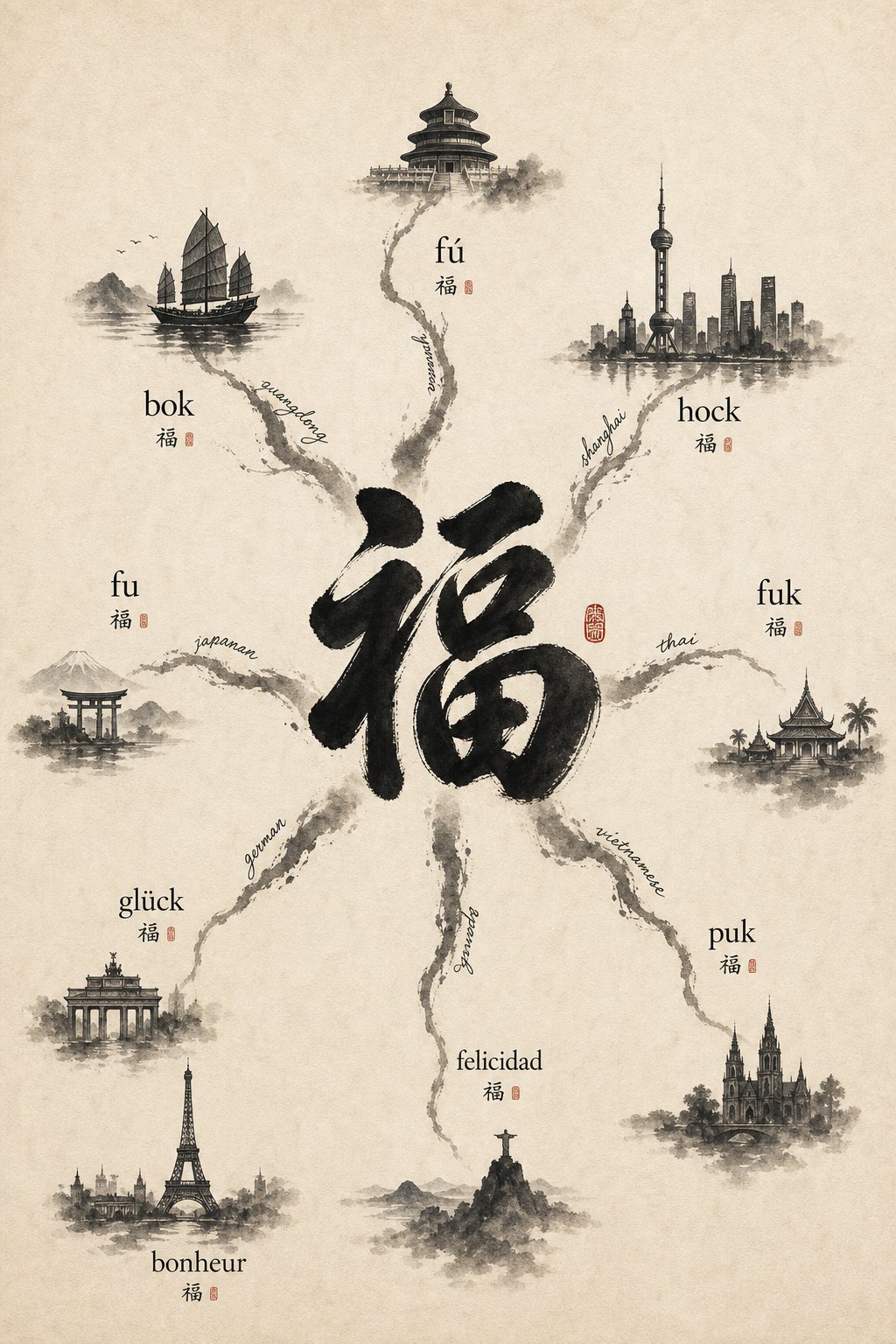
If you have ever wondered why one colleague spells their surname "Wong" and another spells it "Wang" when both write the same character 王, you are looking at the visible surface of a much deeper system. Converting chinese to pinyin gives you the Mandarin reading. But millions of Chinese speakers never used pinyin as their romanization standard, and their name spellings reflect that history.
Why Wang Becomes Wong and Li Becomes Lee
Each romanization system captures a specific regional pronunciation. Pinyin records Mandarin as spoken in Beijing. Cantonese romanization, whether the Jyutping system developed by the Linguistic Society of Hong Kong in 1993 or the older Hong Kong government system, records how characters sound in Cantonese. Hokkien romanization (Pe̍h-ōe-jī, or POJ) captures the pronunciation used by Hokkien speakers in Fujian, Taiwan, and Southeast Asia.
The character 王 is pronounced "wáng" in Mandarin, "wong4" in Cantonese, and "Ong" in Hokkien. These are not accent variations of the same sound. They are entirely different phonological outputs from separate linguistic systems reading the same written character. When someone converts chinese to mandarin pinyin, they get "Wang." When a Cantonese speaker romanizes the same character using their native pronunciation, they get "Wong." Neither is wrong. They simply encode different spoken realities.
The same logic explains why 李 appears as "Li" in pinyin but "Lee" in Cantonese and older Wade-Giles contexts, why 陈 is "Chen" in Mandarin but "Chan" in Cantonese and "Tan" in Hokkien, and why 吴 registers as "Wu" in pinyin but "Ng" in Cantonese, a spelling that baffles English speakers who cannot imagine pronouncing a word starting with "Ng."
Romanization Systems and Regional Identity
In territories with large Chinese diaspora communities, the way a family name is spelled signals regional heritage. A person surnamed "Wong" is understood to have Cantonese roots, likely tracing ancestry to Guangdong province or Hong Kong. Someone surnamed "Ong" for the same character 王 signals Hokkien heritage, often connected to Fujian province or Southeast Asian communities in Singapore and Malaysia. The surname "Heng" for that same character points to Teochew origins.
This means that when you encounter a romanized Chinese name, you are not just reading a phonetic transcription. You are reading a compressed record of regional origin, migration history, and linguistic identity. Converting chinese to han yu pin yin gives you one layer. The actual spelling someone carries may encode an entirely different layer.
Surname Romanization Across Four Systems
| Chinese Character | Pinyin (Mandarin) | Wade-Giles | Cantonese (HK Romanization) | Hokkien (POJ) |
|---|---|---|---|---|
| 王 | Wang | Wang | Wong | Ong |
| 李 | Li | Li | Lee / Lei | Li |
| 张 / 張 | Zhang | Chang | Cheung / Cheong | Teo / Teoh |
| 刘 / 劉 | Liu | Liu | Lau / Low | Lau |
| 陈 / 陳 | Chen | Ch'en | Chan / Chun | Tan |
| 吴 / 吳 | Wu | Wu | Ng | Goh |
| 黄 / 黃 | Huang | Huang | Wong | Ng / Ooi |
| 林 | Lin | Lin | Lam | Lim |
| 梁 | Liang | Liang | Leung | Niu / Liang |
| 周 | Zhou | Chou | Chow / Jau | Chiu |
Notice how dramatically the spellings diverge. "Zhang" in pinyin becomes "Cheung" in Hong Kong and "Teo" in Hokkien, three spellings that share almost no visual resemblance despite representing the same character. Research from the International Journal of Population Data Science demonstrates this challenge in data linkage contexts, where the surname 张 appears as "zoeng1" in Jyutping, "zhang1" in pinyin, and "CHEUNG" in Hong Kong government romanization, all for the same person.
Historical Context Behind Coexisting Systems
These systems did not emerge randomly. Each reflects a specific political and historical moment:
- Wade-Giles (1867): Developed by British diplomats Thomas Wade and Herbert Giles for transcribing Mandarin. It dominated Western sinology for over a century and remains embedded in older Taiwanese names and classical academic references.
- Hong Kong Government Romanization (1800s onward): Based on 19th-century British missionary systems adapted for Cantonese. As Lam et al. (2025) note, linguists have identified substantial inconsistencies within this system, where the same vowel sound can be represented multiple ways.
- Hanyu Pinyin (1958): Created by Chinese linguists as part of a national language reform. The PRC government promoted it internationally, and the United Nations adopted it in 1986 as the official romanization standard.
- Hokkien POJ (1830s onward): Developed by Presbyterian missionaries in Fujian and later spread to Taiwan and Southeast Asia. It captures a tonal system with seven or eight tones, far more than Mandarin's four.
The coexistence of these systems means that pinyin to chinese conversion works cleanly only for names originally romanized in pinyin. A name spelled "Cheung" does not map back through pinyin rules. You need to recognize it as Cantonese romanization for 张 and then identify the corresponding Mandarin reading separately.
This layered history explains why a single extended family might carry three different surname spellings depending on when and where each branch emigrated. A grandfather who left Guangdong in the 1950s carries "Cheung." His nephew who grew up in Beijing uses "Zhang." A cousin in Taipei might have "Chang" from the Wade-Giles era. Same character, same family, three spellings, each one a fossil record of a specific place and time.
With this romanization landscape mapped out, a natural question follows: can you look at a specific spelling and work backward to identify which regional system produced it? The phonological fingerprints of each major accent group make that detective work surprisingly systematic.
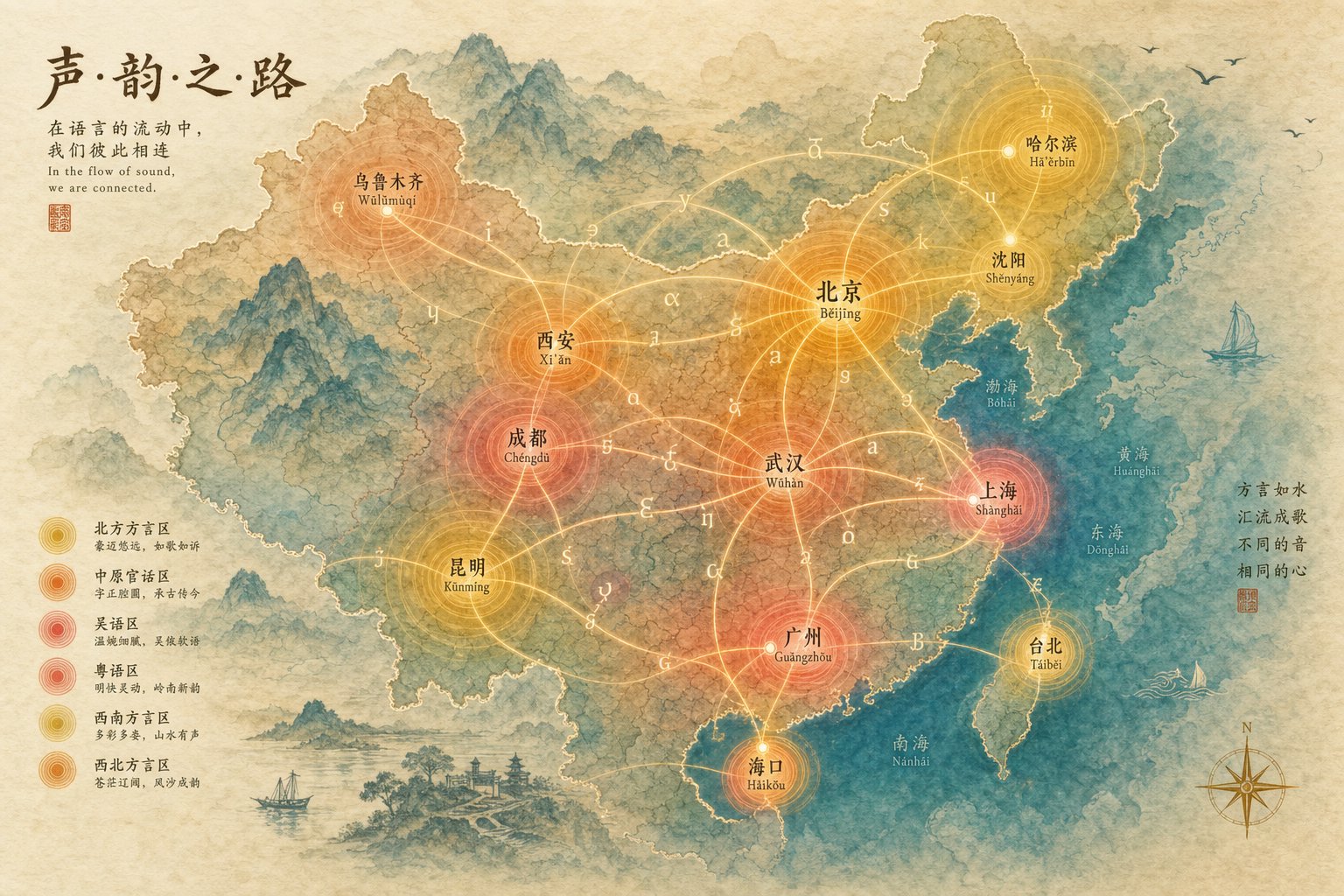
A Phonological Map of Major Regional Accent Groups
Each regional accent leaves a distinct fingerprint on mandarin name pronunciation. If you know what to listen for, you can often identify a speaker's home region within seconds of hearing them say their name. Below is a practical breakdown of six major accent groups, each with the specific phonological features that reshape how pinyin names sound in real conversation.
Beijing and Northeastern Accent Features
Beijing Mandarin is the prestige standard, yet even native Beijing speakers deviate from textbook pinyin in characteristic ways. If you have ever looked up how to pronounce chinese xi in a dictionary and then heard a Beijing local say the surname 习 (Xí), you may notice the overall delivery carries features absent from any pronunciation guide.
Beijing accent markers:
- Pervasive er-hua (儿化): Retroflex "r" coloring attaches to finals in casual speech, turning names like 芳 (Fāng) into "Fāngr" and blurring the original vowel quality.
- Swallowed syllables: Unstressed syllables in given names compress or disappear. A two-character name may sound nearly monosyllabic at conversational speed.
- Strong retroflex initials: The zh, ch, sh sounds are pronounced with heavy tongue curling, making them acoustically distinct from any other region.
Northeastern Mandarin (东北话) shares Beijing's retroflex inventory but adds its own flavor:
- Exaggerated Tone 3 dip: The low-dipping tone drops deeper and recovers more dramatically, giving names a sing-song quality.
- Tone 4 emphasis: Falling tones carry extra force, making surnames like 赵 (Zhào) sound more emphatic than in standard speech.
- Occasional j/z confusion: Some northeastern speakers merge "j" toward "z" in specific phonetic environments, subtly shifting names like 金 (Jīn) toward "Zīn."
Southwestern and Sichuan Mandarin Patterns
Sichuan and broader southwestern Mandarin cover a massive population across Sichuan, Chongqing, Yunnan, Guizhou, and parts of Hubei. The accent features here are among the most distinctive in China, and they reshape names so thoroughly that outsiders sometimes mistake the speech for a separate dialect entirely.
- N/L merger: The initials "n" and "l" are freely interchangeable. The surname 牛 (Niú) and 刘 (Liú) may sound nearly identical. The deng xiaoping pronunciation familiar from news broadcasts reflects standard Mandarin, but in Deng's native Sichuan speech, surrounding syllables would carry this merger in connected conversation.
- Retroflex loss: Many southwestern speakers flatten zh, ch, sh to z, c, s, though this feature is less universal here than in the deep south.
- Tone merger (Tones 2 and 3): As covered in the previous section, the rising and dipping tones collapse into a single low contour, reducing tonal contrast in names.
- F/H confusion: Some Sichuan sub-regions swap "f" and "h" initials, so 黄 (Huáng) becomes "Fuáng" and 冯 (Féng) shifts toward "Héng."
Southern Cantonese-Influenced and Taiwanese Mandarin
Southern Mandarin, spoken by people whose native language is Cantonese, carries interference patterns from that tonal system. When discussing qing dynasty pronunciation of historical names or qin shi huang pronunciation in documentaries, you will often hear standard Mandarin delivery. But in everyday southern-accented speech, the patterns diverge sharply:
- Complete retroflex elimination: All zh/ch/sh become z/c/s without exception. The chinese president xi jinping pronunciation in standard broadcasts uses a clear "sh" in Shì (市) and retroflex initials throughout, but a Cantonese-influenced speaker would flatten every one of these.
- Final -n and -ng confusion: The distinction between "in" and "ing" or "an" and "ang" blurs. The name 陈 (Chén) might sound closer to "Chéng" and vice versa.
- Reduced tone range: Cantonese has six to nine tones, but when these speakers switch to Mandarin, they often compress the four-tone system into a narrower pitch band.
Taiwanese Mandarin carries its own signature, shaped by decades of contact with Hokkien and Japanese:
- Softened retroflex: Rather than full elimination, zh/ch/sh are produced with minimal tongue curling, landing somewhere between retroflex and flat.
- Tone 3 simplification: The full dipping contour (214) flattens to a low-level tone (21), giving names a gentler melodic profile.
- Distinct rhythm: Syllable timing tends toward even spacing, unlike Beijing's tendency to swallow unstressed syllables. A name like the science fiction author cixin liu pronunciation in Taiwanese Mandarin would carry more evenly weighted syllables than a Beijing rendering.
Singapore and Malaysian Mandarin add yet another layer. Contact with Malay, English, Hokkien, and Cantonese produces a hybrid accent where tone contrasts compress further, code-switching mid-sentence is normal, and name pronunciation may shift depending on whether the speaker is addressing a Mandarin-dominant or English-dominant listener. The surname 林 (Lín) might be pronounced with Mandarin tones in one sentence and switch to the Hokkien "Lim" in the next, depending on audience and context.
These phonological fingerprints do more than satisfy linguistic curiosity. They function as a practical decoding tool. When you hear a name spoken with flattened retroflexes and compressed tones, you can reasonably infer a southern or Taiwanese background. When er-hua colors every syllable, Beijing or the northeast is likely. And when tones merge and n/l swap freely, you are probably hearing southwestern Mandarin. The question that follows naturally: can you reverse-engineer this process from a written name alone, reading regional and generational clues directly from how someone has chosen to romanize their name?
Decoding Regional Origins From Name Romanization
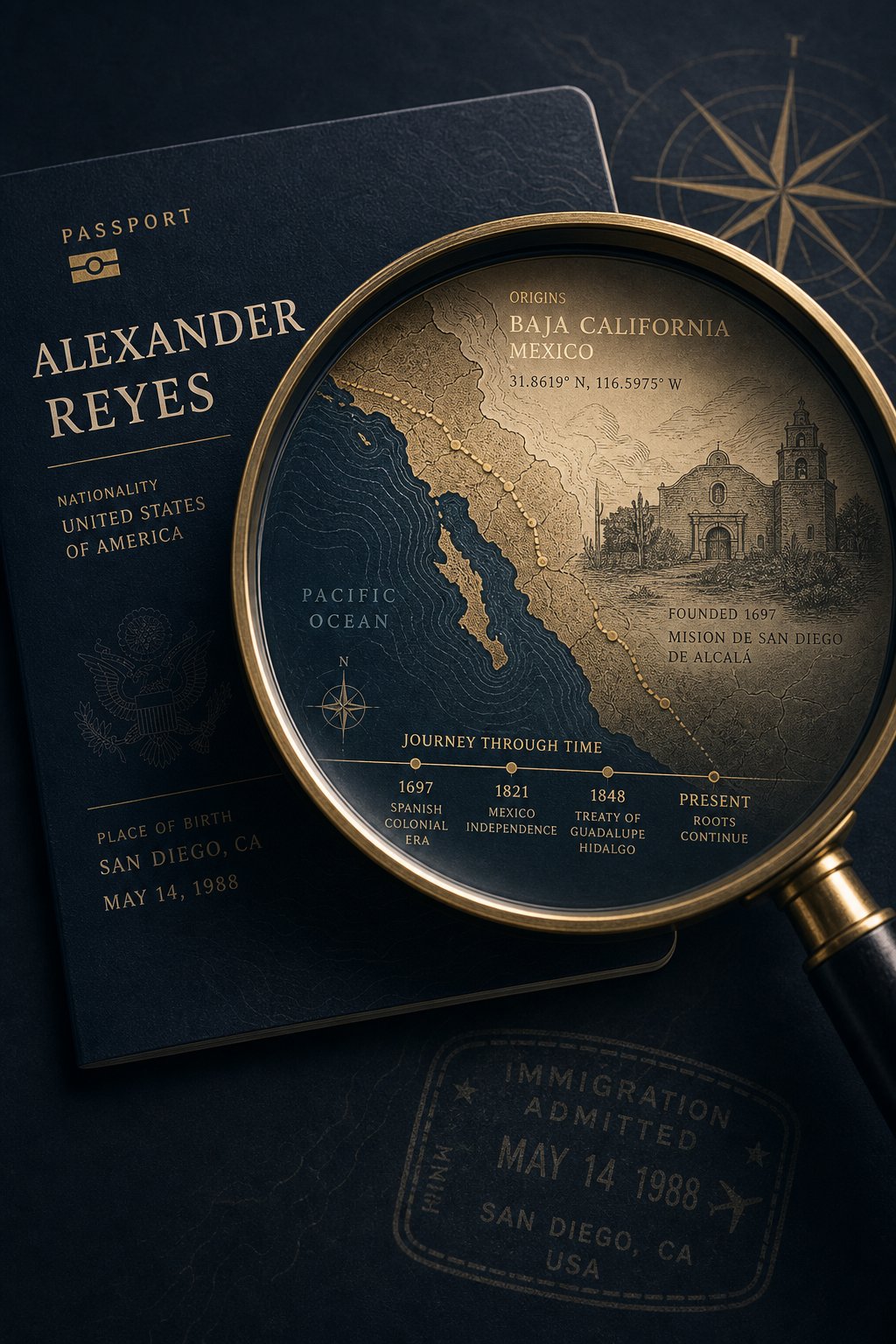
You can. A romanized Chinese name is not just a phonetic label. It is a compressed artifact of geography, generation, and political context. With a simple framework, you can read these clues and make informed guesses about where someone's family comes from and when they emigrated, all before hearing a single spoken syllable.
Reading Regional Clues in Name Spellings
The logic is straightforward: surname spelling reveals the romanization system, and the romanization system reveals regional origin. When you see the surname "Tan," you are almost certainly looking at a Hokkien romanization of 陈, pointing toward Fujian province or Southeast Asian Chinese communities in Singapore, Malaysia, or the Philippines. The same character romanized as "Chan" signals Cantonese heritage, likely Hong Kong or Guangdong. And "Chen" tells you the person uses Mandarin pinyin, suggesting a mainland Chinese or younger Taiwanese background.
This pattern holds across dozens of common surnames. "Lim" is Hokkien for 林, while "Lam" is Cantonese and "Lin" is pinyin. "Goh" is Hokkien for 吴, "Ng" is Cantonese, and "Wu" is pinyin. Each spelling is a regional fingerprint hiding in plain sight.
Here is a step-by-step framework for identifying likely regional origin from the pronunciation of chinese names in their written form:
- Identify the surname spelling. Isolate the family name, typically the first element in a Chinese name.
- Match it against known romanization systems. Does it follow pinyin conventions (Zhang, Chen, Wu), Wade-Giles patterns (Chang, Ch'en), Cantonese forms (Cheung, Chan, Ng), or Hokkien spellings (Teo, Tan, Goh)?
- Infer the regional origin. Pinyin points to mainland China or younger-generation Taiwanese. Wade-Giles suggests Taiwan (especially pre-2000s) or older academic contexts. Cantonese romanization indicates Hong Kong, Macau, or Guangdong diaspora. Hokkien spellings signal Fujian, Taiwan, Singapore, Malaysia, or the Philippines.
- Check the given name format for confirmation. A hyphenated given name (e.g., Hsiao-ming) is a strong Taiwanese formatting convention. Separated given name syllables without a hyphen (e.g., Hsien Loong) suggest Singaporean or Malaysian style. A solid two-syllable given name (e.g., Xiaoming) follows PRC pinyin conventions.
- Consider the overall combination. A surname in one system paired with a given name in another (e.g., "Lee" with pinyin-style given name) often indicates a diaspora family that preserved a legacy surname spelling while adopting modern conventions for given names.
Generational and Political Signals in Romanization Choices
Chinese names and pronunciation choices also encode generational information. In Taiwan, older public figures carry Wade-Giles spellings: Lee Teng-hui, Ma Ying-jeou, Tsai Ing-wen. Younger Taiwanese increasingly adopt pinyin for international documents, though the hyphenated given-name format often persists as a marker of Taiwanese identity distinct from PRC naming style.
Consider how this plays out within a single family. A grandfather who left Guangdong in the 1960s carries the surname "Cheung" on his Hong Kong identity card. His daughter, raised in Hong Kong but educated in the UK, keeps "Cheung" as well. But his grandson, born in Shanghai and holding a PRC passport, romanizes the same character 张 as "Zhang." Three generations, one character, three spellings, each reflecting the political and linguistic environment where the document was issued.
The same pattern appears across Southeast Asia. A Singaporean family surnamed "Tan" (陈 in Hokkien) may have cousins in Taiwan who spell it "Chen" and relatives in Hong Kong who write "Chan." None of them are misspelling anything. Each is faithfully recording the chinese pronunciation of names as filtered through their local system.
These clues are not foolproof. People change spellings when they immigrate, adopt anglicized forms for convenience, or inherit inconsistent romanizations from colonial-era documents. But as a starting framework, reading the romanization system behind a name gives you a remarkably reliable window into someone's regional and generational background, context that proves invaluable when you move from analyzing names on paper to pronouncing them face to face.
Practical Strategies for Getting Names Right
Reading regional clues from a written name is useful background knowledge. But eventually you are standing in front of a real person, and the question becomes immediate: how do you actually pronounce chinese names when the pinyin spelling may not match what the speaker expects to hear?
The good news is that getting names right does not require mastering six accent systems. It requires a shift in mindset and a few practical habits.
Asking About Preferred Pronunciation Without Awkwardness
The simplest strategy is also the most effective: ask. A direct question like "Would you mind telling me how you pronounce your name?" signals respect without drawing uncomfortable attention. As workplace communication research confirms, this approach builds rapport because it shows genuine investment in the person rather than assumptions about their background.
A person's name is pronounced however they choose. Pinyin spelling is a starting point, not a guarantee. The authority on any name's pronunciation is always the person who carries it.
Many Chinese speakers code-switch between regional and standard pronunciation depending on context. Someone might introduce themselves with textbook Mandarin tones in a formal meeting but use their native Sichuan or Cantonese pronunciation with family. Asking which version they prefer in your shared context removes guesswork entirely.
Navigating Names in International Professional Settings
If you want to prepare before a meeting, resources exist to help. Searching for pronounce chinese names audio online yields video channels and databases dedicated to name pronunciation across regional variants. Tools offering chinese names audio pronunciation can give you a baseline, though they typically default to standard Mandarin rather than regional forms. Use them as a starting reference, not a final answer.
When you do attempt a name, follow up with a check: "Am I saying that correctly?" If corrected, repeat the corrected version immediately and use it consistently. People notice when you make the effort, and they notice even more when you retain it over time. If a colleague's name proves difficult, a chinese name pronunciation audio recording, whether a voice memo or a short clip they share, can serve as a personal reference you revisit before meetings.
Equally important: become an ally. If you hear someone else mispronounce a colleague's name, a gentle correction normalizes accuracy without putting the name's owner in the exhausting position of correcting people repeatedly.
Building Pronunciation Awareness Over Time
How to pronounce chinese names well is not a one-time skill. It develops through pattern recognition. The more you understand about how regional accents reshape sounds, the faster you adapt when encountering new names. You start hearing the flattened retroflex and thinking "southern accent" rather than "wrong pronunciation." You notice a merged tone and recognize Sichuan patterns rather than feeling confused.
How do you pronounce chinese names with confidence? By treating each encounter as data. Over time, you build an internal library of regional patterns that makes every new name easier to approach. You stop expecting pinyin to deliver a single correct answer and start listening for the person behind the spelling.
Understanding pinyin name regional accents does not just prevent awkward mispronunciations. It transforms how you relate to the people those names belong to. Every name carries geography, history, and identity compressed into a few syllables. When you learn how to say chinese names with awareness of that depth, you move from confusion to connection, one name at a time.
Frequently Asked Questions About Pinyin Name Regional Accents
1. Why does the same Chinese name sound different depending on who says it?
Chinese names written in pinyin represent standard Beijing Mandarin pronunciation, but most speakers use regional accents that systematically alter consonants, vowels, and tones. A speaker from Sichuan may merge n and l sounds, making Li sound like Ni. Southern speakers often flatten retroflex initials, turning Zhou into Zou. These are not errors but consistent regional patterns that affect how hundreds of millions of people pronounce their own names in daily conversation.
2. What is the difference between a Chinese accent and a Chinese dialect when it comes to names?
An accent (kǒuyīn) modifies standard Mandarin pronunciation while keeping the same language structure, so pinyin remains a valid reference with predictable sound shifts. A dialect (fāngyán), such as Cantonese or Hokkien, is a separate linguistic system that produces entirely different pronunciations requiring different romanization methods. The character 陈 is Chen in accented Mandarin but Chan in Cantonese and Tan in Hokkien, each reflecting a distinct phonological system rather than a pronunciation variation.
3. Why are there so many different spellings for the same Chinese surname?
Different romanization systems encode different regional pronunciations of the same character. Pinyin captures Mandarin (Wang), Cantonese romanization captures Hong Kong pronunciation (Wong), and Hokkien POJ captures Fujian and Southeast Asian pronunciation (Ong), all for the character 王. These systems emerged at different historical moments: Wade-Giles in 1867, Hokkien POJ in the 1830s, and Hanyu Pinyin in 1958. A family's surname spelling often reflects when and where they emigrated.
4. Can you tell where someone is from based on how their Chinese name is spelled?
Often yes. Surname spelling reveals the romanization system used, which signals regional origin. Tan typically indicates Hokkien heritage from Fujian or Southeast Asia, Chan points to Cantonese roots in Hong Kong or Guangdong, and Chen suggests mainland Chinese pinyin usage. Given name formatting provides additional clues: hyphenated names suggest Taiwanese convention, while solid two-syllable names follow PRC style. These patterns are reliable though not absolute, as families sometimes change spellings after immigration.
5. How should I pronounce a Chinese colleague's name if I am unsure about their regional accent?
Ask directly with a simple question like 'Would you mind telling me how you pronounce your name?' This signals respect and avoids assumptions about their background. Many Chinese speakers code-switch between standard and regional pronunciation depending on context, so their preferred version may differ from what pinyin or any pronunciation guide suggests. After receiving a correction, repeat the name immediately and use it consistently. The authority on any name's pronunciation is always the person who carries it.