What Are Pinyin Name Tattoos and Why Choose Them
When you think of a Chinese tattoo, your mind probably jumps to bold brushstroke characters inked across someone's shoulder blade. And for good reason. Chinese symbol tattoos have dominated the body art world for decades. But there is another option hiding in plain sight, one that carries the same cultural depth without the same risk of getting a character that actually means "refrigerator" instead of "warrior."
That option is pinyin. Pinyin is the official romanization system for Mandarin Chinese, developed in the 1950s and adopted internationally by the ISO in 1982 and the United Nations in 1986. It uses the Latin alphabet paired with diacritical tone marks to represent Mandarin sounds. And as a tattoo medium, it occupies a space that most guides completely overlook.
What Makes Pinyin Name Tattoos Different
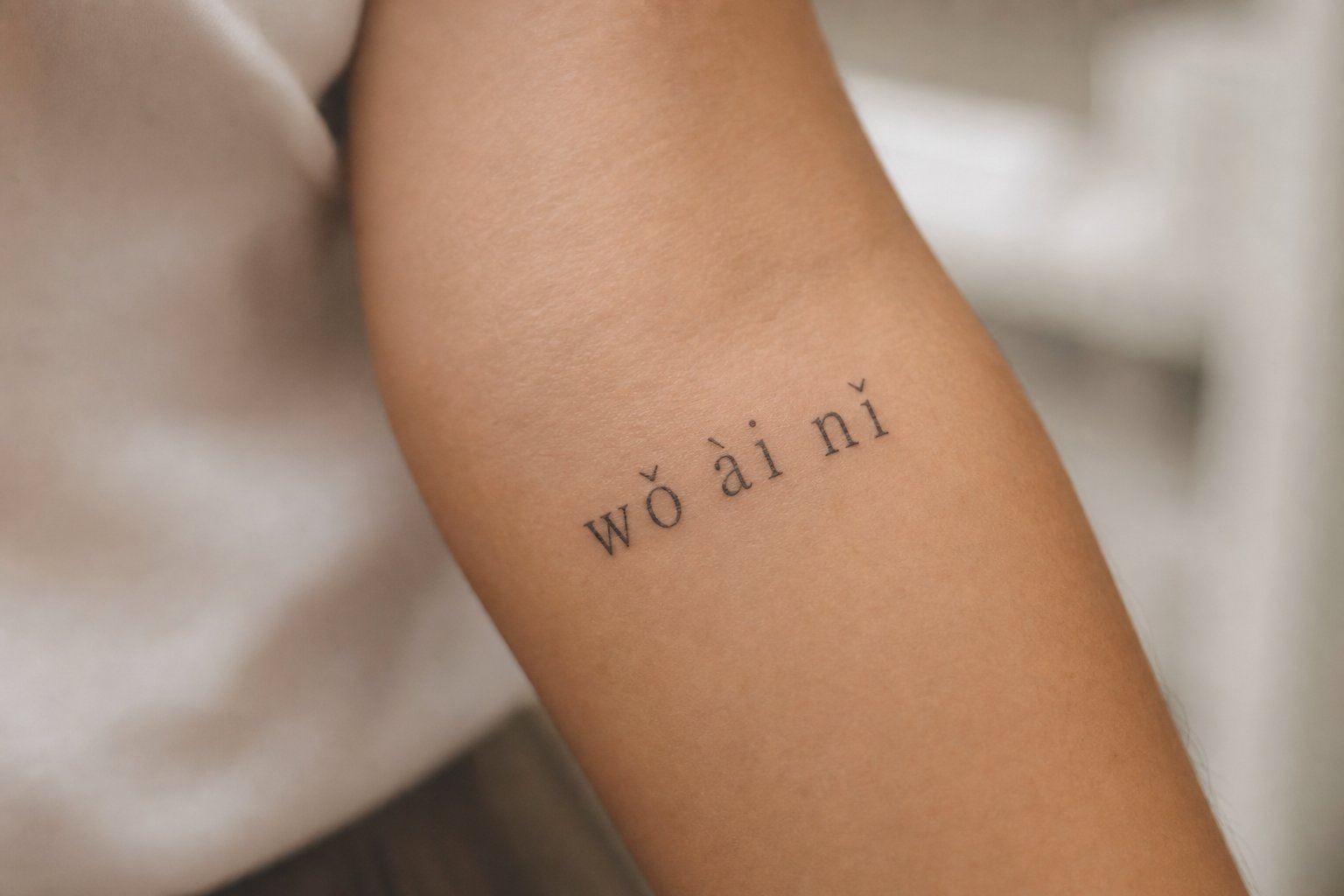
A Chinese name tattoo rendered in pinyin uses familiar Roman letters, which means anyone in the Western world can read and pronounce it. Yet the tone marks sitting above the vowels and the phonetic structure itself are unmistakably tied to the Chinese language. You get readability and cultural identity in a single line of text. Unlike tattoos with Chinese letters or full characters, pinyin does not require your audience to read a logographic writing system to understand what is on your skin. It is accessible without losing its roots.
This also means the margin for catastrophic error shrinks dramatically. A misplaced stroke in a Chinese character can change "love" into "receive." Pinyin, while still requiring accuracy, does not carry that same structural fragility.
Why Pinyin Tattoos Are Growing in Popularity
The appeal spans several groups. People with Chinese heritage use pinyin to honor family names in a form that bridges their dual cultural identity. Mandarin learners choose it as a nod to a language that shaped their worldview. Others simply want a meaningful connection to Chinese culture through tattoo Chinese writing styles that they can verify and understand themselves, rather than trusting a translation app with permanent body art.
Pinyin exists at the intersection of two writing systems. It is Chinese in sound and structure, Western in script. That duality makes it one of the few tattoo forms that speaks fluently to both worlds at once.
Most resources on Chinese writing tattoos focus exclusively on characters, leaving pinyin unexplored as a design choice. The sections ahead change that, walking you through transliteration, tone marks, font styles, and placement so your pinyin name tattoo says exactly what you intend.
Understanding Pinyin Before You Get Inked
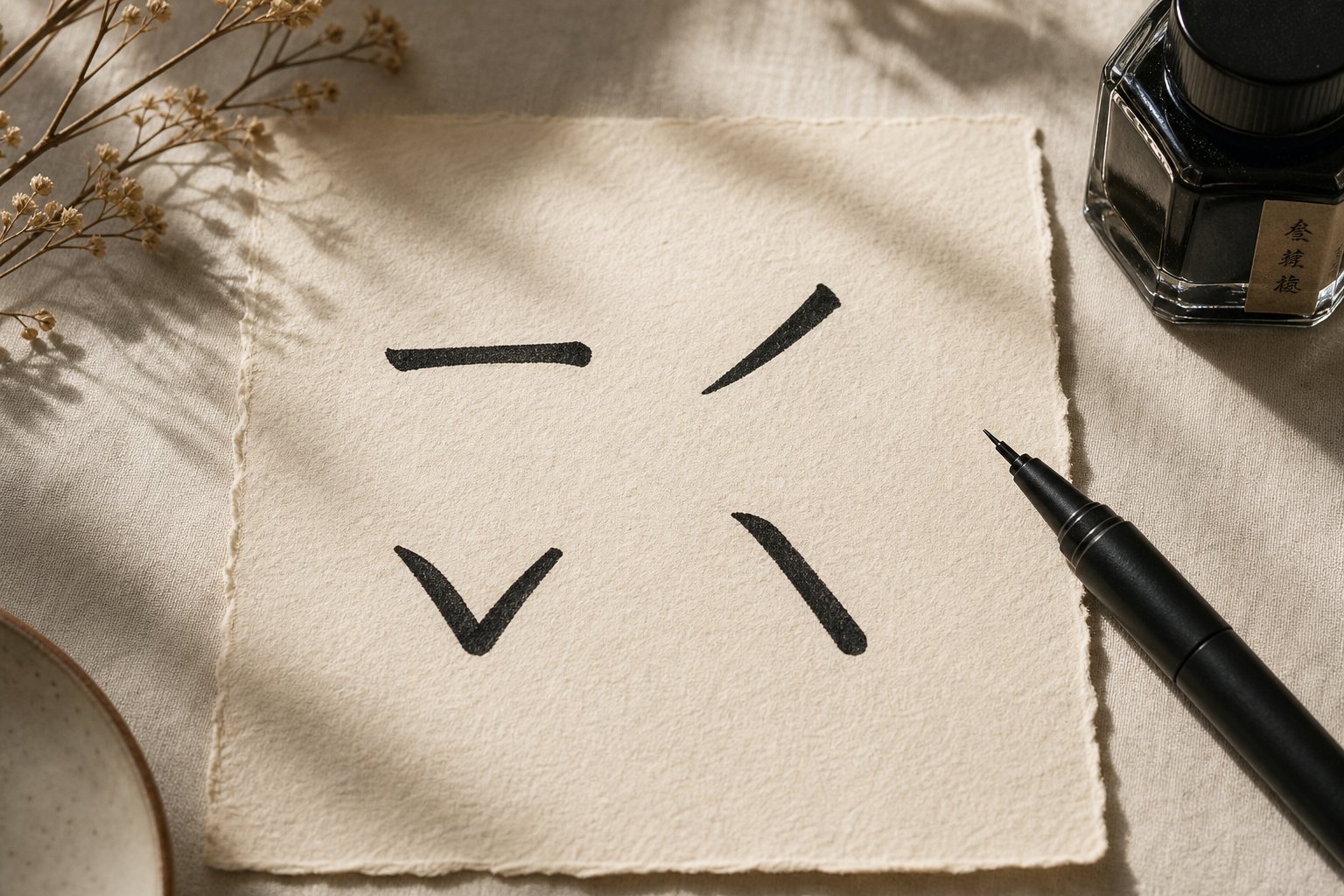
A mandarin tattoo that looks beautiful but carries the wrong tone mark is not just a linguistic slip. It is a permanent misstatement etched into your skin. Before you settle on a design, you need a working understanding of how pinyin actually functions, because the system has rules that directly affect what your tattoo will mean.
Pinyin was developed in the 1950s as the standard romanization system for Mandarin Chinese. It maps Mandarin sounds onto the Latin alphabet, making pronunciation accessible to non-Chinese speakers. But here is the catch: Mandarin is a tonal language. The same sequence of letters can represent completely different words depending on which tone you apply. And those tones are represented by small diacritical marks placed above vowels.
The Four Tones and What They Mean for Your Tattoo
Imagine the syllable "ma" sitting on your wrist. Without a tone mark, it is just two letters. With a tone mark, it becomes a specific word with a specific meaning. Mandarin has four primary tones plus a neutral tone, and each one transforms the meaning entirely.
- First tone (mā) - a flat, high-pitched mark (macron). Means "mother." The line above the vowel is level and steady.
- Second tone (má) - a rising mark (acute accent). Means "hemp" or "numb." The mark angles upward from left to right.
- Third tone (mǎ) - a dipping mark (caron). Means "horse." The mark dips down then rises, like a small checkmark.
- Fourth tone (mà) - a falling mark (grave accent). Means "scold" or "curse." The mark drops sharply from left to right.
So a tattoo reading "mā" honors your mother. A tattoo reading "mǎ" puts a horse on your body. And "mà" permanently brands you with the word for scolding. The visual difference between these marks is subtle, sometimes just a matter of angle, but the tattoo chinese meaning shifts dramatically. This is why precision matters more than aesthetics when choosing whether and how to include tone marks in your design.
From a design perspective, these diacriticals add a distinctive visual element that sets pinyin apart from plain English text. The marks create rhythm and texture across a word, giving even short names an elegant, scholarly quality that signals intentionality to anyone who recognizes the system.
Pinyin vs Wade-Giles and Other Romanization Systems
When you search for a china language tattoo or look up chinese words tattoo meanings, you will encounter multiple romanization systems without always realizing it. Pinyin is not the only way Mandarin has been written in Roman letters, and confusing these systems is one of the most common mistakes people make before getting inked.
Wade-Giles is the older system, developed in the 19th century and widely used in Western academia until the late 20th century. You have seen it even if you did not know it. "Peking" is Wade-Giles; "Beijing" is pinyin. "Mao Tse-tung" is Wade-Giles; "Mao Zedong" is pinyin. The Library of Congress identifies key visual differences: Wade-Giles uses apostrophes to indicate aspiration and hyphens between syllables of personal names, while pinyin joins syllables together and avoids those marks entirely.
Why does this matter for your tattoo? If your family name was romanized decades ago using Wade-Giles, it may look different from the modern pinyin version. "Ch'en" in Wade-Giles becomes "Chen" in pinyin. "Wang T'ieh-jen" becomes "Wang Tieren." Getting the wrong system tattooed is not necessarily incorrect, but it signals a different era and context. Pinyin is the modern standard used in mainland China, taught in schools worldwide, and recognized by international organizations. For most people researching china tattoo meaning and wanting a current, universally understood result, pinyin is the right choice.
There is also Yale romanization, used primarily for Cantonese, and Jyutping for the same dialect. If your name or word comes from Cantonese rather than Mandarin, pinyin will not represent it accurately. Knowing which Chinese dialect you are working with is the first step before any romanization decision gets made.
The tonal system and the romanization method you choose form the linguistic foundation of your tattoo. They determine not just how your design looks, but what it actually says. And that distinction between sound and meaning is exactly where the next decision lives: should your tattoo capture the sound of your name, the meaning behind it, or both?
Pinyin vs Characters and How to Decide
Sound or meaning. That is the fundamental fork in the road for anyone considering a Chinese name tattoo. Pinyin captures how a name is pronounced in Mandarin. Chinese tattoo characters capture what a name means through carefully selected symbols. Both are legitimate paths, but they produce very different results on your skin and carry different cultural weight.
Phonetic Transliteration vs Semantic Name Selection
When a foreign name like "Michael" gets rendered in pinyin, it becomes a phonetic approximation: Mài kè ěr. The goal is to preserve the original sound as closely as Mandarin phonetics allow. The result is recognizable to anyone who speaks the language, but it does not carry inherent meaning beyond the sound itself.
A semantic Chinese name works differently. Instead of matching sounds, a native speaker selects chinese characters for tattoos based on their individual meanings, combining them into something that reads as a real name with intentional significance. Someone named Michael might receive a Chinese name like 明凯 (Míng Kǎi), where 明 means "bright" and 凯 means "triumphant." The sounds are different from the English original, but the name carries personal meaning shaped by 5,000 years of linguistic tradition.
As Yoyo Chinese points out, transliteration often produces results that sound neither like the original name nor like an authentic Chinese name. Common names like "Thomas" become 托马斯 (tuō mǎ sī), which is phonetically close but linguistically awkward to native ears. This is why many people with genuine connections to Chinese culture opt for semantically chosen names instead.
So which approach works for a tattoo? That depends on what you want the ink to communicate.
| Factor | Pinyin (Phonetic) | Chinese Characters (Semantic) |
|---|---|---|
| Visual impact | Clean, minimal, modern. Uses familiar Latin letters with tone marks. | Bold, artistic, visually dense. Each character is a self-contained design element. |
| Cultural authenticity | Represents the romanization system used in mainland China. Linguistically accurate but not traditional body art. | Deeply rooted in Chinese calligraphic and literary tradition. Carries centuries of cultural context. |
| Readability | Readable by Western audiences immediately. Mandarin speakers recognize the pronunciation. | Requires knowledge of Chinese to read. Meaning is opaque to non-readers. |
| Risk of error | Lower. Spelling and tone marks can be verified with standard references. | Higher. A single misplaced stroke changes chinese characters tattoo meaning entirely. Requires expert verification. |
| Personal connection | Preserves the sound of your birth name or a loved one's name exactly as spoken. | Creates a new identity rooted in meaning. Feels like receiving a name rather than translating one. |
Neither approach is inherently superior. A phonetic pinyin tattoo says "this is who I am, spoken in Mandarin." A chinese character tattoo says "this is what my name means within Chinese culture." The emotional resonance depends entirely on your relationship to the language and what story you want your body to tell.
Combining Pinyin with Chinese Characters in One Design
You do not have to choose one or the other. Some of the most compelling designs pair both systems together, giving viewers two entry points into the same name. Think of it like subtitles: the characters deliver visual drama and cultural depth, while the pinyin beneath them provides pronunciation and accessibility.
This combination approach is common in Chinese textbooks, signage, and children's books, where pinyin appears as a phonetic guide above or below characters. Translating that layout into tattoo design requires attention to a few key principles.
First, visual hierarchy. The chinese kanji tattoos or characters typically serve as the dominant element, set larger and bolder. Pinyin sits secondary, usually smaller and in a lighter weight, functioning as an annotation rather than competing for attention. A common layout places characters vertically in a traditional reading direction with pinyin running horizontally beneath, creating an L-shaped or stacked composition.
Second, font pairing. Research on bilingual Chinese-Latin typography shows that Hanzi characters appear visually larger than Latin letters at the same point size because they occupy the em square more fully. Latin typefaces with larger x-heights tend to harmonize better with Chinese text. For tattoo purposes, this means your pinyin lettering needs to be sized up slightly relative to what looks "matched" on paper, or the characters will visually overpower the romanized text.
Third, density balance. A single Chinese character can contain anywhere from one to over sixty strokes, creating a dense, textured block. Pinyin, by contrast, is airy and open. Placing them side by side without adjustment can feel visually lopsided. Skilled tattoo artists address this by giving pinyin slightly more letter-spacing or choosing a heavier font weight to increase its visual mass relative to the characters above.
The combination approach works particularly well for memorial tattoos or parent-child name designs, where you want both the poetic meaning of chosen characters and the recognizable sound of a name that family members actually use. It also sidesteps the readability problem entirely: even someone who cannot read Chinese characters can sound out the pinyin and understand whose name they are looking at.
Whether you go with pinyin alone, characters alone, or both together, the next practical question is mechanical: how does your specific name actually get converted into pinyin in the first place?
How to Transliterate Your Name into Pinyin
Turning an English name into pinyin is not as simple as swapping letters. Mandarin has a fixed set of possible syllables, roughly 400 without tones, and your name has to fit within those boundaries. Some sounds transfer cleanly. Others require creative approximation. Understanding this process is what separates a name chinese tattoo that reads naturally from one that confuses every Mandarin speaker who sees it.
How Foreign Names Are Converted to Pinyin
Chinese can only represent syllables as concrete blocks of sound, not as fluid combinations of letters the way English does. A name like "Christopher" contains consonant clusters ("chr," "st") and sounds ("th") that simply do not exist in Mandarin phonetics. The transliteration process breaks your name into Mandarin-compatible chunks, matching each piece to the closest available pinyin syllable.
Here is how the conversion typically works:
- Break the name into syllable-sized sound units. Identify the core vowel sounds and surrounding consonants. "Jessica," for example, splits into three sound groups: Jie-xi-ka.
- Map each sound unit to a valid pinyin syllable. Mandarin has no "th," no "v," no final consonants like "-ck" or "-lf." Each English sound gets replaced by the nearest Mandarin equivalent. "Th" often becomes "s" or "t." "V" becomes "w" or "f."
- Assign appropriate tones. Since the original name has no tonal value, tones are typically chosen based on the Chinese characters selected to represent each syllable. This is where transliteration intersects with character selection.
- Check the result against established conventions. Many common Western names already have standardized Chinese transliterations used in news media and official documents. "Shakespeare" becomes Shāshìbǐyà. "Washington" becomes Huáshèngdùn. If your name has a recognized form, use it rather than inventing your own.
- Verify with a native Mandarin speaker. Even technically correct transliterations can sound awkward or carry unintended connotations. A native ear catches problems that phonetic charts cannot.
The result of this process gives you the chinese letters for names that will appear in your tattoo. Keep in mind that the pinyin you see is actually a romanized representation of the characters chosen to approximate your name's sound, not a direct letter-for-letter swap from English.
Common Pitfalls When Transliterating Names
Getting tattoos names in chinese wrong often comes down to a handful of recurring mistakes. People assume pinyin works like English phonetics, or they skip verification because the Latin letters look familiar and "close enough." Here are the errors that show up most often:
- Treating pinyin like English pronunciation. The letter "c" in pinyin sounds like "ts," not like the "c" in "cat." The letter "q" sounds like "ch," not like "k." Writing your name using pinyin letters as if they follow English pronunciation rules produces gibberish.
- Ignoring syllable structure rules. Pinyin syllables follow strict patterns. Not every consonant-vowel combination is valid. "Ti" exists, but "tee" does not. Forcing invalid syllables into your design marks it as incorrect to any Mandarin reader.
- Assigning random or no tones. Leaving tones off entirely creates ambiguity. Assigning them arbitrarily can produce syllables that mean something unfortunate. One writer's experience choosing characters based on a "rudimentary grasp of Chinese and a brief sojourn through a dictionary" resulted in a name so awkward it embarrassed everyone who had to use it.
- Using online translators without cross-referencing. Automated tools often produce multiple conflicting results for the same name. They cannot account for cultural connotations, gender appropriateness, or phonetic naturalness.
- Confusing Mandarin pinyin with Cantonese romanization. If your family connection is to Hong Kong or Guangdong, your name may belong in Jyutping or Yale Cantonese, not Mandarin pinyin. Using the wrong system misrepresents the linguistic heritage you are trying to honor.
The safest path for any tattoo in chinese letters is straightforward: work with a qualified translator or native speaker who understands both the phonetic constraints and the cultural weight of character selection. A tattoo is permanent. The consultation is not the place to cut corners.
With your transliteration locked down, the next design question becomes purely visual: should those tone marks stay in the final tattoo, or can you leave them out without losing meaning?
Should Your Pinyin Tattoo Include Tone Marks
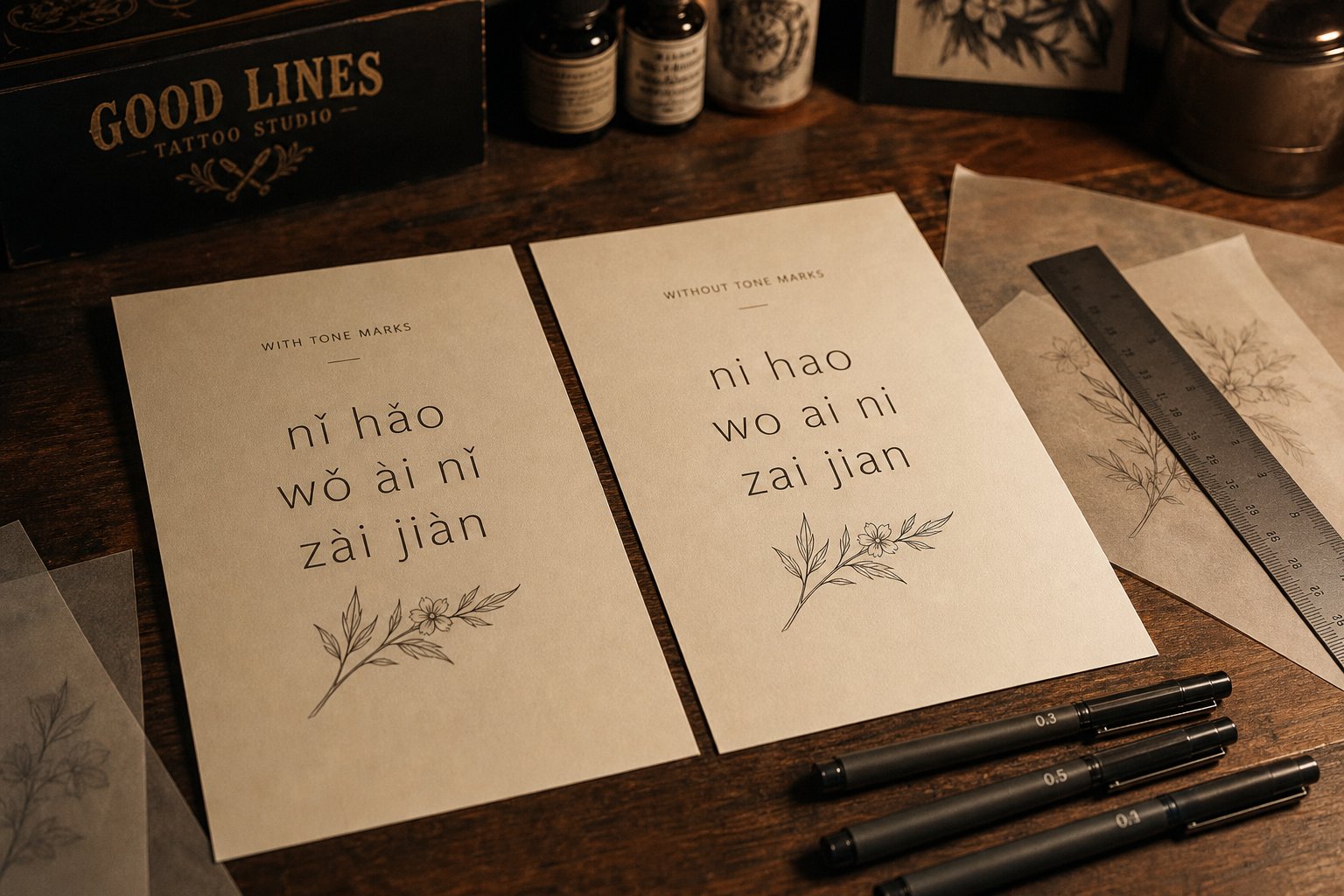
Those small marks hovering above the vowels in pinyin are not decoration. They are the difference between a tattoo that says "mother" and one that says "horse." Yet plenty of designs leave them out entirely, opting for a cleaner visual line. So which approach is right for your skin? The answer depends on whether you prioritize linguistic precision or minimalist aesthetics, and how much ambiguity you are willing to live with permanently.
Including Tone Marks for Linguistic Accuracy
Tone marks are diacritical symbols placed above vowels to indicate one of Mandarin's four pitch contours. Visually, they are small but distinctive: a flat line, a rising slash, a dipping caron, or a falling stroke. When included in a pinyin tattoo, they do two things simultaneously. They lock the text to a specific meaning of chinese tattoos you intended, and they signal to anyone literate in Mandarin that you understand the language beyond surface level.
Think of it this way. A tattoo reading "ai" without marks could mean love (ài), sorrow (āi), cancer (ái), or short (ǎi). Add the falling fourth-tone mark and it becomes unambiguously "love." That single diacritical eliminates dozens of competing interpretations. For anyone getting a name tattooed, this precision matters even more. The chinese writing tattoo meanings shift with every tone, and a name rendered without marks becomes a phonetic shell that could belong to hundreds of different characters.
From a design perspective, tone marks add visual texture and rhythm to what would otherwise look like plain English text. They create a subtle pattern of rising and falling shapes across the word, giving the eye something to follow. A name like "Lì Míng" has a visual cadence that "Li Ming" simply does not. The marks act as a quiet declaration: this is not English, this is Mandarin rendered in Roman letters, and the wearer knows the difference.
There is also a scholarly elegance to including them. As UC San Diego linguist David K. Jordan argues, omitting tone marks from romanized Chinese is a convention born of editorial convenience, not linguistic logic. Including them in a tattoo positions the design as linguistically complete rather than casually approximate.
Leaving Tone Marks Out for Cleaner Aesthetics
Some designs genuinely look better without diacriticals. Certain font styles, particularly thin sans-serifs and delicate scripts, lose visual balance when small marks crowd the space above letters. In very small tattoos, like behind-the-ear or finger placements, tone marks can blur together as the ink ages, becoming unreadable smudges rather than precise indicators. If the marks cannot be rendered clearly at your chosen size, leaving them off may be the more honest choice.
There is also an argument from simplicity. If your tattoo is primarily for personal meaning and you already know the correct pronunciation, the marks serve no functional purpose for you as the wearer. Some people treat their pinyin tattoo the way English speakers treat unmarked text: context fills in what the letters leave out.
But here is the risk you accept. Without tone marks, a single pinyin syllable can correspond to dozens of chinese tattoo meanings. The syllable "shi" alone maps to over forty common characters, ranging from "ten" to "poetry" to "death" to "lion." A name like "Li Wei" without tones could be hundreds of different people with hundreds of different name meanings. You are essentially tattooing a phonetic placeholder rather than a specific word.
Jordan's research highlights real-world consequences of this ambiguity. He documents a student who confused two toneless romanized words, bǎo (guarantees) and bào (retribution), because both appeared as "bao" without marks. Similarly, the Jìn dynasty and the Jīn dynasty are separated by nearly a thousand years of history, yet both become "Jin" when tones are stripped away. In a tattoo context, this kind of ambiguity is permanent.
Tone marks in pinyin are not ornamental flourishes. They carry the same functional weight as the difference between "b" and "d" in English. Removing them does not simplify your tattoo. It removes meaning.
If you decide to include tone marks, your next consideration is how they interact with your chosen font. If you leave them out, you need a design strong enough in other elements, like layout, sizing, or accompanying imagery, to compensate for the lost specificity. Either way, the typography you select will shape how those chinese letters and meanings tattoo choices actually look on skin, which brings us to the question of font and calligraphy style.
Font and Calligraphy Styles for Pinyin Tattoos
Pinyin lives in an unusual typographic space. It uses Latin letters, which means the entire universe of Western font design is available to it. But it represents a Chinese language, which opens the door to calligraphic traditions that most Roman-letter tattoos never touch. Choosing the right chinese tattoo fonts for your pinyin design is not just an aesthetic decision. It determines whether your tattoo reads as generic English text or as something unmistakably tied to Mandarin.
Serif and Sans-Serif Options for Pinyin Tattoos
Serif fonts add small strokes at the terminals of each letter, giving text a formal, grounded quality. For pinyin tattoos, a well-chosen serif like Garamond or a transitional face creates a timeless, literary feel. The serifs also help guide the eye along the word, which improves readability at smaller sizes. If your design includes tone marks, serif fonts tend to integrate diacriticals more naturally because the existing ornamentation makes the marks feel like part of the letter rather than an afterthought.
Sans-serif fonts strip away those terminal strokes for a clean, modern look. Think Futura, Helvetica, or similar geometric faces. These work well for minimalist chinese lettering tattoos where you want the pinyin to feel contemporary and understated. The tradeoff is that sans-serif designs at very small sizes can lose definition as ink spreads over time. Tattoo font research consistently shows that bolder stroke weights age better on skin, so if you go sans-serif, lean toward medium or semi-bold weights rather than light or thin variants.
Font weight matters more than most people realize. A light-weight font that looks elegant on a screen can become illegible on skin within a few years as lines naturally spread. For pinyin specifically, the tone marks are already small details. Pairing them with an ultra-thin typeface creates two layers of fragility. A medium-weight font gives both the letters and the diacriticals enough substance to hold their shape over a decade or more.
Brush-Style and Handwritten Pinyin Lettering
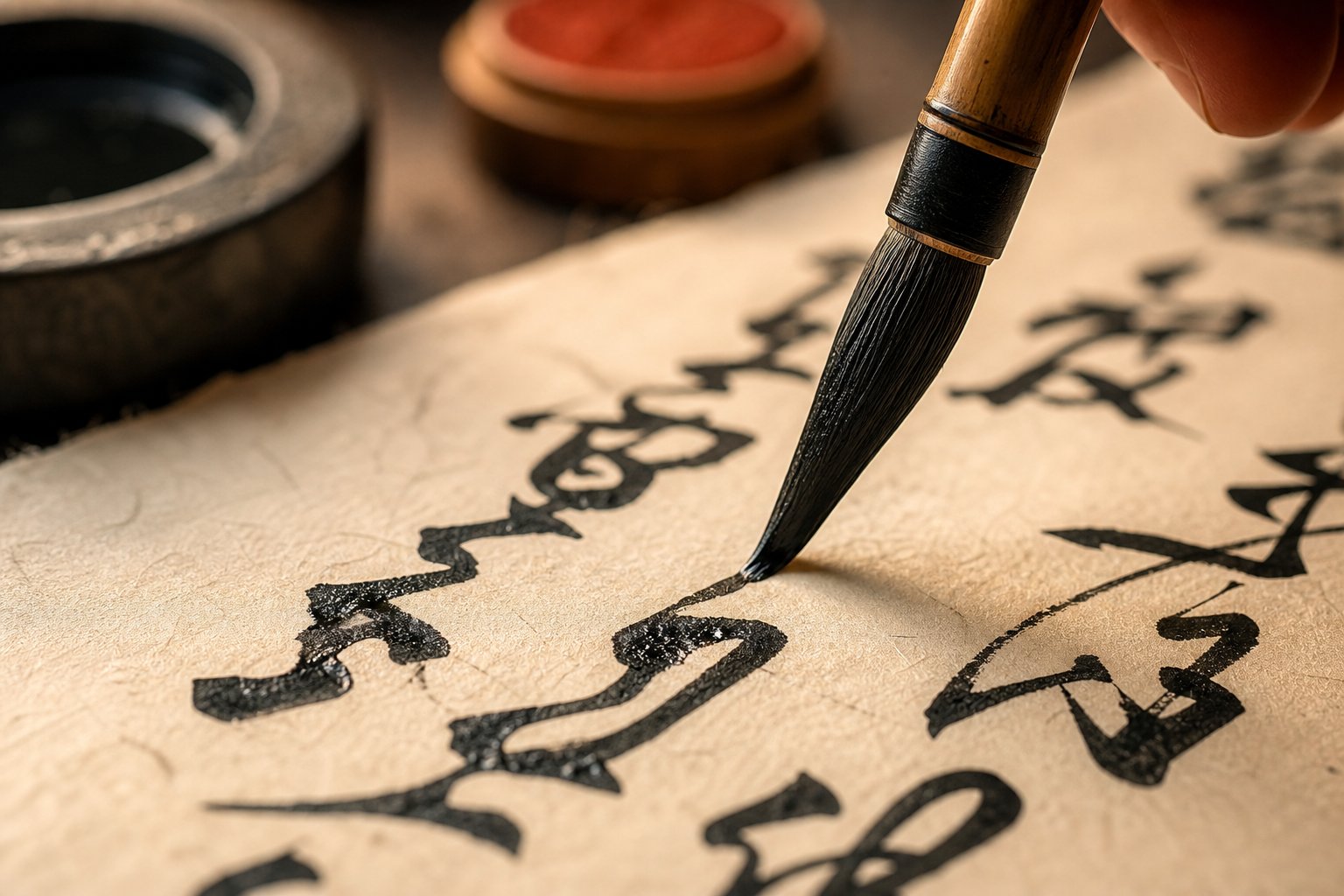
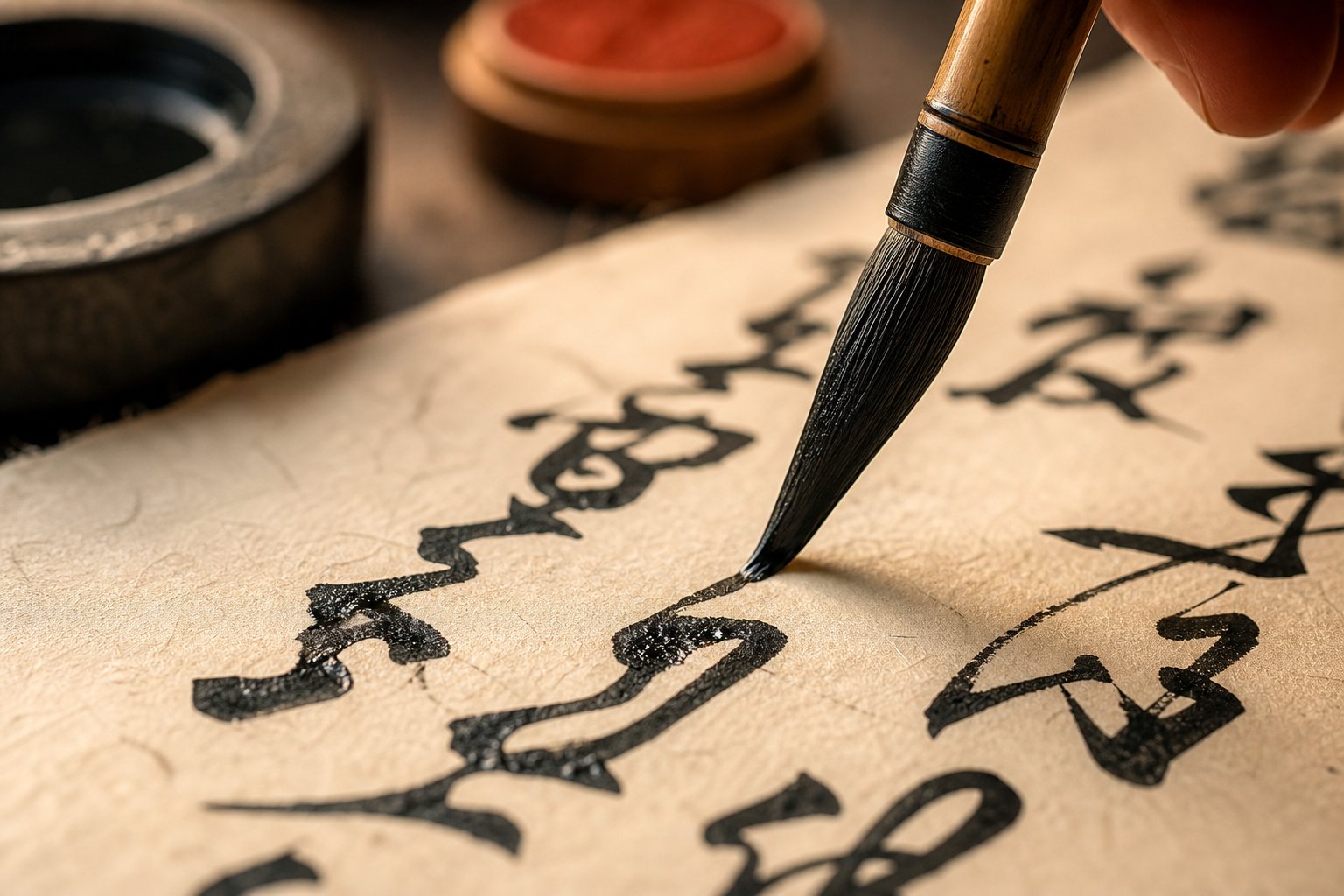
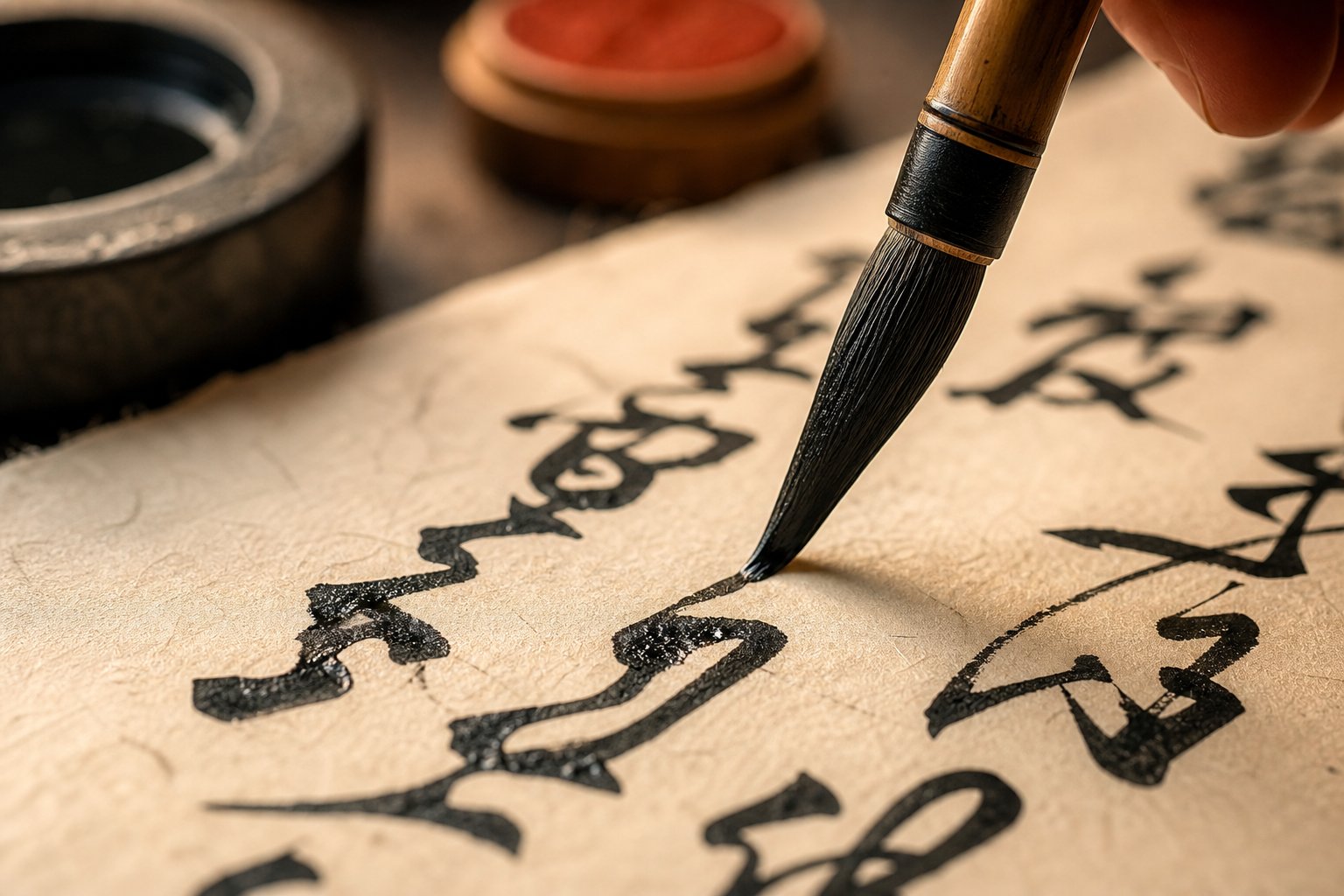
Here is where pinyin tattoos get genuinely interesting. Imagine taking the fluid, expressive energy of a chinese calligraphy tattoo and applying it to Roman letters instead of Hanzi characters. The result is a fusion style that honors both writing traditions simultaneously. Brush-style lettering brings varied stroke widths, dynamic pressure changes, and organic movement to letters that are normally rigid and uniform.
This approach works because Chinese brush calligraphy and Latin lettering share fundamental principles: thick downstrokes, thin upstrokes, and deliberate rhythm. When a skilled artist renders pinyin with a brush aesthetic, the letters gain a visual weight and expressiveness that connects them to East Asian artistic tradition without pretending to be something they are not. The calligraphy chinese tattoo style signals cultural awareness through technique rather than through script alone.
Practically, brush-style pinyin requires a tattoo artist comfortable with both calligraphic variation and Latin letterforms. The principles of pairing Chinese and Latin typography apply here too. Bold, expressive brush strokes on pinyin letters can echo the energy of traditional Hanzi calligraphy while remaining fully readable to Western eyes. The tone marks in this style often get rendered as natural brush flicks, integrating them into the flow rather than treating them as separate mechanical additions.
Script and Decorative Font Approaches
Cursive and script fonts bring a personal, handwritten quality to pinyin designs. They are popular for name tattoos because they feel intimate, like a signature or a love letter. But script fonts introduce a specific challenge for pinyin: the more elaborate the letterforms, the harder it becomes to distinguish tone marks from decorative flourishes. A reader might mistake a swash for a tone indicator, or miss a genuine tone mark buried in ornamental loops.
Decorative and display fonts push this tension further. They can make a bold visual statement, but as tattoo typography experts note, highly stylized fonts risk becoming illegible when translated to skin, especially as the tattoo ages. For pinyin, where readability is part of the point, decorative choices need to be weighed carefully against clarity.
When selecting a chinese font for tattoo work involving pinyin, consider matching the font category to your placement and purpose:
- Serif (Garamond, Baskerville, Caslon) - Best for medium to large placements like the forearm or ribcage. Formal tone, strong aging characteristics, and natural integration with tone marks.
- Sans-serif (Futura, Helvetica, Avenir) - Best for minimalist designs on the wrist, collarbone, or behind the ear. Clean and modern, but use medium weight or heavier for longevity.
- Brush and calligraphic (custom hand-lettered) - Best for larger placements like the back, shoulder, or upper arm. Creates a fusion aesthetic that bridges Chinese and Western visual traditions. Requires an artist skilled in both styles.
- Script and cursive (Copperplate, Spencerian-inspired) - Best for personal name tattoos in visible areas. Romantic and intimate, but keep flourishes restrained so tone marks remain distinguishable.
- Custom hand-lettering - Best for any placement where you want a one-of-a-kind design. A tattoo artist can tailor stroke weight, spacing, and mark integration specifically to your skin and chosen location.
Whatever category you choose, bring your finalized pinyin text, complete with correct tone marks, to your artist before discussing font style. The typography should serve the language, not the other way around. And once the lettering style is locked in, the real creative work begins: building a complete design concept around those words that makes the tattoo uniquely yours.
Creative Pinyin Name Tattoo Design Ideas
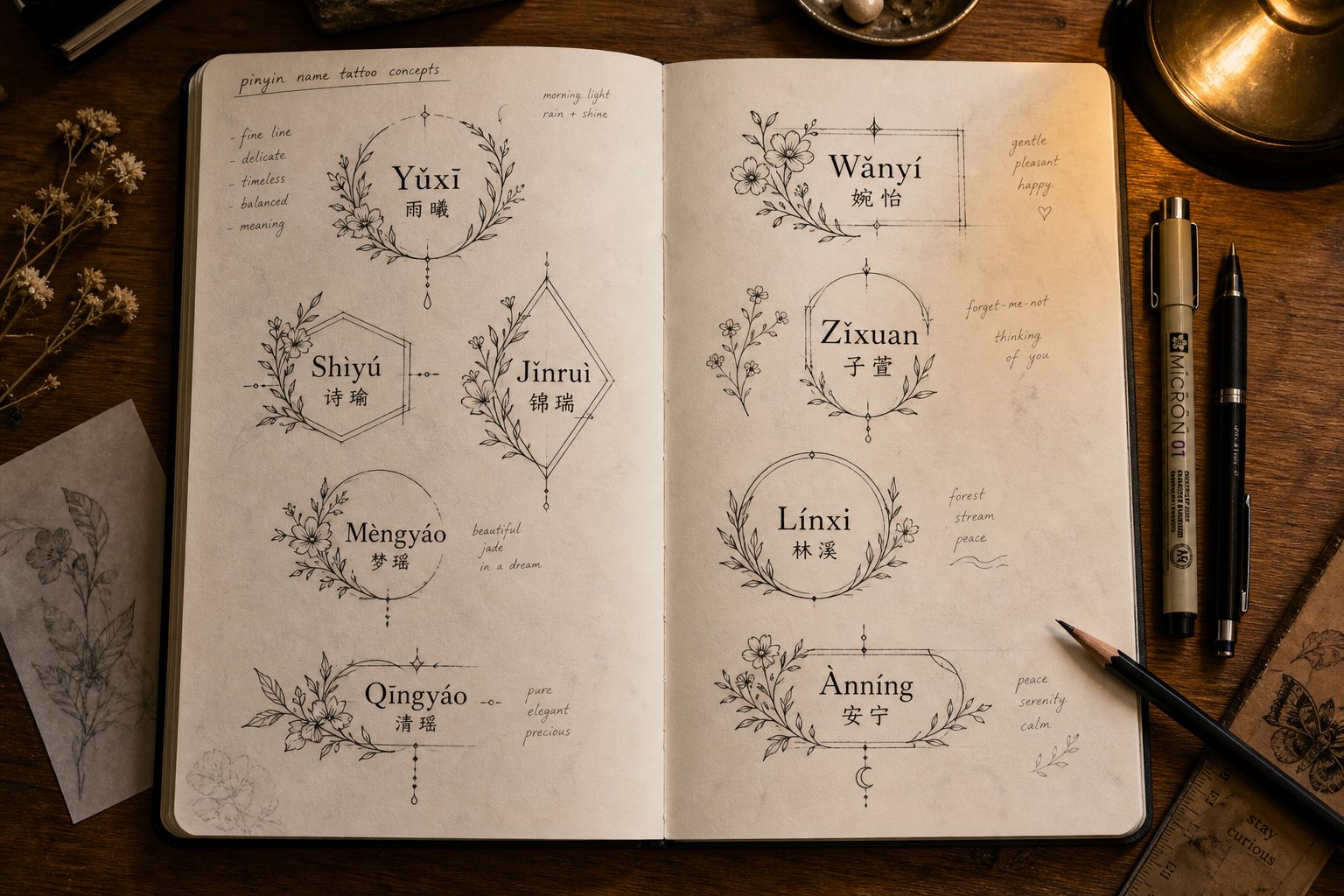
Lettering style sets the visual tone, but the design concept around those letters is what transforms a pinyin tattoo from text on skin into a piece of personal art. The same name rendered in the same font can feel completely different depending on whether it sits inside a geometric frame, wraps around a birth flower, or stands alone with nothing but negative space to give it weight. What follows are chinese tattoo designs organized by purpose, each one built around the unique properties of romanized Mandarin text.
Personal Name Tattoo Designs
Tattooing your own name in pinyin is a statement of identity. It says: this is who I am, spoken in a language that shaped me. Whether you carry a Chinese name given by family or a transliterated Western name you adopted while living abroad, the design possibilities extend far beyond plain text on a line.
Consider pairing your pinyin name with your birth flower. Each month carries a specific bloom, from January's carnation to December's narcissus, and weaving that flower around or beneath your name creates a design that encodes both identity and time. The organic curves of petals and stems contrast beautifully with the structured geometry of Latin letters, giving the composition visual tension that holds the eye.
Chinese zodiac animals offer another layer of personalization. If you were born in the Year of the Tiger, a minimalist tiger silhouette framing your pinyin name connects two cultural systems in a single piece. The zodiac animal adds visual mass and narrative depth without competing with the text for readability. Some designs position the animal as a background watermark, subtle enough that the pinyin remains the focal point while the creature provides context.
Geometric frames work for people who want structure and symmetry. A hexagonal border, a thin diamond outline, or concentric circles radiating outward from your name can give a pinyin tattoo an almost emblem-like quality. This approach suits minimalist chinese words tattoo designs where the lettering itself is clean and modern. The frame signals intentionality, telling viewers this is not random text but a deliberate mark of identity.
Memorial and Family Name Designs
Pinyin name tattoos carry particular emotional weight when they honor someone else. A parent's name, a child's name, a grandparent who passed down a family surname across generations. These designs ask you to hold another person's identity on your body, and the design choices should reflect that relationship.
Parent-child name pairings are among the most requested meaningful chinese tattoos in this category. Imagine your child's pinyin name rendered in a delicate script with their birth flower intertwined, or their name stacked beneath yours with a thin connecting line between them, visually representing the bond. As tattoo design specialists note, combining a child's name with elements like birth flowers or heartbeat lines creates a personalized tribute that radiates individuality.
For multiple children, you can create a unified composition where each name occupies its own line with a unique accompanying element. One child's pinyin name paired with a peony, another with a lotus, a third with bamboo. The names share a consistent font and size while the botanical elements differentiate each child. This approach scales gracefully whether you have two children or five.
Generational tributes work beautifully in pinyin because Chinese family names carry forward unchanged across generations. A vertical design listing a surname in pinyin at the top, with given names of grandparent, parent, and child descending below, creates a visual family tree in miniature. The shared surname becomes the root, and each generation branches from it. Some people add birth years in small numerals beside each name for additional context.
Memorial tattoos for those who have passed deserve special care. A loved one's pinyin name rendered in their own handwriting style, or paired with coordinates of a meaningful location, transforms the tattoo into something deeply personal. Family tattoo research shows that coordinates of a birthplace, childhood home, or significant gathering spot add a layer of meaning that only you and your family truly understand.
Meaningful Words and Phrases in Pinyin
Not every pinyin tattoo needs to be a name. Single words and short phrases rendered in romanized Mandarin carry the same cultural connection while expressing values, aspirations, or personal mantras. A chinese word tattoo in pinyin form gives you something that sounds distinctly Mandarin when spoken aloud but remains accessible to anyone reading your skin.
Some of the most impactful chinese words tattoo ideas draw from concepts that carry deep cultural resonance in Chinese philosophy and daily life. Words like yǒng (courage), rěn (endurance), and ài (love) are single-syllable powerhouses. As Language Trainers documents, these characters represent concepts with centuries of philosophical weight behind them. Rendering them in pinyin with tone marks preserves that weight while making the pronunciation immediately clear.
Here are design concept categories to consider when building your pinyin tattoo around words or phrases:
- Single virtue words with character accompaniment - Pair a pinyin word like "yǒng" with its corresponding character 勇 in a stacked or side-by-side layout. The character provides visual drama while the pinyin ensures anyone can pronounce and research the meaning.
- Personal mantras in short phrases - Phrases like "wú wèi" (fearless) or "zì yóu" (freedom) work as two-syllable compositions that fit neatly on a wrist or collarbone. Keep the phrase short enough to read in a single glance.
- Dual-language pairings - Place the English meaning on one line and the pinyin on another, creating a bilingual design that reads as a translation of itself. This works well for concepts like "mèng" (dream) where the English word adds immediate clarity.
- Pinyin integrated with symbolic imagery - Wrap a word like "lì" (strength) around a mountain outline, or nest "měi" (beauty) inside a lotus silhouette. The image reinforces the word's meaning without requiring the viewer to read Mandarin.
- Date and name combinations - Pair a loved one's pinyin name with a significant date in Chinese numeral format or standard numerals. This anchors the name to a specific moment: a birthday, an anniversary, or a day that changed everything.
- Zodiac and elemental pairings - Match your pinyin name or word with your Chinese zodiac animal or one of the five elements (wood, fire, earth, metal, water) rendered as a subtle background texture or framing device.
The key to personalizing any of these approaches is restraint. Pinyin text is visually lightweight compared to Chinese characters or elaborate illustrations. The complementary elements you choose should enhance the text without overwhelming it. A single well-chosen image beside a clean pinyin name creates more impact than a busy composition where the words get lost in visual noise.
Whatever concept you land on, the design still needs to live on a specific part of your body. And pinyin text, because it reads horizontally in Latin letters rather than vertically in characters, behaves differently than traditional Chinese tattoos when it comes to placement and sizing.
Placement and Sizing Guide for Pinyin Text Tattoos
Pinyin reads left to right in Latin letters. Chinese characters stack vertically or sit as compact squares. That fundamental difference in how the text occupies space changes everything about where a pinyin tattoo works on your body and where it fights against anatomy. A single Chinese character fits neatly behind an ear. A two-syllable pinyin name like "Lì Míng" needs horizontal room that the same spot may not offer. Placement decisions for tattoos in chinese letters made of characters do not automatically transfer to romanized text.
Best Placements for Short Pinyin Names
Short pinyin names, one or two syllables, give you the most flexibility. A name like "Wèi" or "Ān Ní" is compact enough to fit in intimate spaces where longer text would feel cramped. But even short names carry a critical constraint: tone marks need vertical clearance above the letters to remain legible as the tattoo ages.
Here is where short pinyin names work best:
- Inner wrist - A flat, relatively stable surface that offers natural horizontal space. The wrist accommodates one to two syllables comfortably at a readable size. You will see it daily, making it ideal for names that serve as personal reminders. The tradeoff is sun exposure and friction from sleeves and watchbands, which can accelerate fading over time.
- Collarbone - Elegant and visible with open necklines, the collarbone follows a gentle curve that complements short horizontal text. Two-syllable names sit naturally along this line. Pain is moderate to high due to proximity to bone, but the area ages well because skin here stays relatively taut.
- Behind the ear - Discreet and intimate, this placement works for single-syllable names or very short two-syllable names. Space is limited, so sizing becomes critical. Go too small and tone marks blur into indistinct dots within a few years. A minimum letter height of roughly 1 centimeter keeps diacriticals distinguishable as the ink naturally spreads.
- Finger - Trendy but high-maintenance. Finger tattoos fade faster than almost any other placement due to constant friction and skin cell turnover on the hands. For pinyin, the added challenge is that tone marks at finger-appropriate sizes are nearly impossible to render with lasting clarity. If you choose this spot, consider omitting tone marks and accepting the ambiguity, or go with a bolder font weight to buy time against fading.
Sizing is the non-negotiable factor for all of these placements. Tattoo artist Gabby Pignanelli notes that fine-line tattoos on high-friction areas risk "falling out a little bit and needing some touch-ups." For pinyin specifically, tone marks are the most vulnerable detail. They are smaller than the letters themselves, which means they hit the threshold of illegibility first. A general rule: if the tone mark above a vowel would be smaller than 2 millimeters in the final design, it will likely blur into a shapeless dot within five to ten years. Size up accordingly, or choose a placement with less friction.
Placement Options for Longer Pinyin Phrases
Multi-syllable names and phrases need room to breathe. A full Chinese name in pinyin, like "Zhāng Xiǎo Lóng," runs significantly wider than the same name written in three compact characters. Longer phrases like personal mantras or family name groupings demand even more horizontal real estate. These designs gravitate toward body areas that offer either a long horizontal canvas or enough width to accommodate text without shrinking it into illegibility.
The chinese tattoo forearm placement is one of the strongest options for longer pinyin text. The inner forearm provides a flat, elongated surface that naturally accommodates horizontal reading direction. Text flows from wrist toward elbow in a way that feels intuitive to Western reading habits. The forearm also ages relatively well because the skin maintains tension and sees less dramatic stretching than areas like the ribcage or stomach.
The ribcage offers a more private canvas. Longer quotes and multi-name compositions fit along the side of the torso, following the curve of the ribs. Placement specialists describe ribcage tattoos as "elegant and sensual, following the body's natural curves," though they warn that this area is among the most painful due to thin skin over bone. For pinyin, the ribcage works well when text is oriented horizontally, running parallel to the ribs rather than perpendicular.
Back tattoos chinese style traditionally run vertically, with characters stacked top to bottom. Pinyin can technically be oriented vertically too, with each syllable on its own line reading downward along the spine. But here is the catch: Latin letters were not designed for vertical reading. Unlike Chinese characters, which are self-contained squares that read naturally in any direction, pinyin syllables are horizontal units. Stacking them vertically forces the eye to reset at each line break, creating a reading experience that feels choppy rather than flowing. If you want a spine placement, consider rotating the entire text 90 degrees so it reads sideways along the vertebrae, or limit the design to a very short name where the vertical stacking does not disrupt comprehension.
The upper back and shoulder blade area works for back tattoos chinese enthusiasts who want pinyin as part of a larger composition. A horizontal pinyin name centered between the shoulder blades reads cleanly and offers enough space for generous letter sizing. This placement also pairs well with complementary design elements above or below the text.
| Placement | Visibility | Pain Level | Aging Quality | Ideal Text Length |
|---|---|---|---|---|
| Inner wrist | High, always visible | Low to moderate | Moderate; sun and friction cause fading | 1-2 syllables |
| Collarbone | Medium; depends on clothing | Moderate to high | Good; skin stays relatively taut | 2-3 syllables |
| Behind the ear | Low; hidden by hair | Moderate | Good if sized adequately | 1 syllable |
| Finger | High | Moderate | Poor; fastest fading of any placement | 1 syllable, no tone marks |
| Inner forearm | Medium to high | Low to moderate | Very good; stable skin surface | 3-5 syllables or full phrases |
| Ribcage | Low; hidden by clothing | High | Good; minimal sun exposure | 3-6 syllables |
| Spine (vertical) | Low; back-facing | High | Good; limited stretching | 2-3 syllables max for vertical pinyin |
| Upper back / shoulder blade | Low to medium | Moderate | Very good; stable area | 4-8 syllables or multi-name compositions |
One final sizing consideration applies across all placements. As tattoo professionals emphasize, "bold will hold." Fine-line chinese letters tattoos look stunning when fresh, but every tattoo spreads slightly over time as ink migrates beneath the skin. For pinyin, where tone marks and letter spacing carry meaning, starting slightly larger than your instinct suggests protects legibility for years to come. A tattoo that reads perfectly at year one but becomes an indistinct blur by year ten has failed its primary purpose.
Placement and sizing lock in the physical parameters of your design. But before you book that appointment, there is one more layer to consider: the cultural context surrounding your choice and the verification steps that ensure your pinyin tattoo is both linguistically accurate and culturally respectful.
Cultural Sensitivity and Accuracy Checklist
Tattoos exist in cultural context. In China, that context is complex. Historically, permanent ink was one of the "Five Punishments" in ancient Chinese law, alongside execution and amputation. Confucian values held that preserving the body inherited from your parents was an act of filial piety, making tattoos a mark of the uncivilized. Even today, Chinese state media has linked tattoo culture to "harmful ideas" and "overseas culture," and tattooed individuals face restrictions in public sector employment. Understanding this backdrop matters when you are choosing to wear Chinese language on your body as a non-Chinese person.
Cultural Respect and Avoiding Appropriation
The line between appreciation and appropriation is not always sharp, but a few principles help you stay on the right side of it. Cultural appropriation, as sociological research describes it, involves adopting aspects of a culture that is not your own while stripping away their original meaning or context. The blog Hanzi Smatter has documented years of traditional chinese tattoo disasters where characters meant "noodles" instead of "loyalty" or "disaster" instead of "beautiful," illustrating what happens when symbols are fetishized without understanding.
Pinyin tattoos carry less risk on this front. Because pinyin uses Latin letters, you are not borrowing a visual script that belongs exclusively to another writing tradition. You are using a romanization system specifically designed to make Mandarin accessible to non-Chinese speakers. The system was built as a bridge, and using it as one is not appropriation. It is using the tool for its intended purpose.
That said, cultural awareness still applies. If you have no personal connection to Chinese language or culture, ask yourself why pinyin rather than plain English. If the answer is purely aesthetic exoticism, that is worth examining. But if you are honoring a relationship, a heritage, a language you studied, or a name that belongs to someone you love, your intent aligns with respect rather than superficial borrowing. People researching chinese tattoos and meanings or chinese tattoo symbol meanings often start from genuine curiosity. The key is following through with the same diligence you would bring to any permanent decision.
One practical distinction: getting a tattoo of someone else's cultural symbols for "mystery" or because they look cool to an audience that cannot read them is the pattern that draws criticism. Getting a pinyin tattoo because you understand what it says, can pronounce it correctly, and have a meaningful reason for choosing it positions you as an informed participant rather than a casual tourist.
Verification Steps Before Your Tattoo Appointment
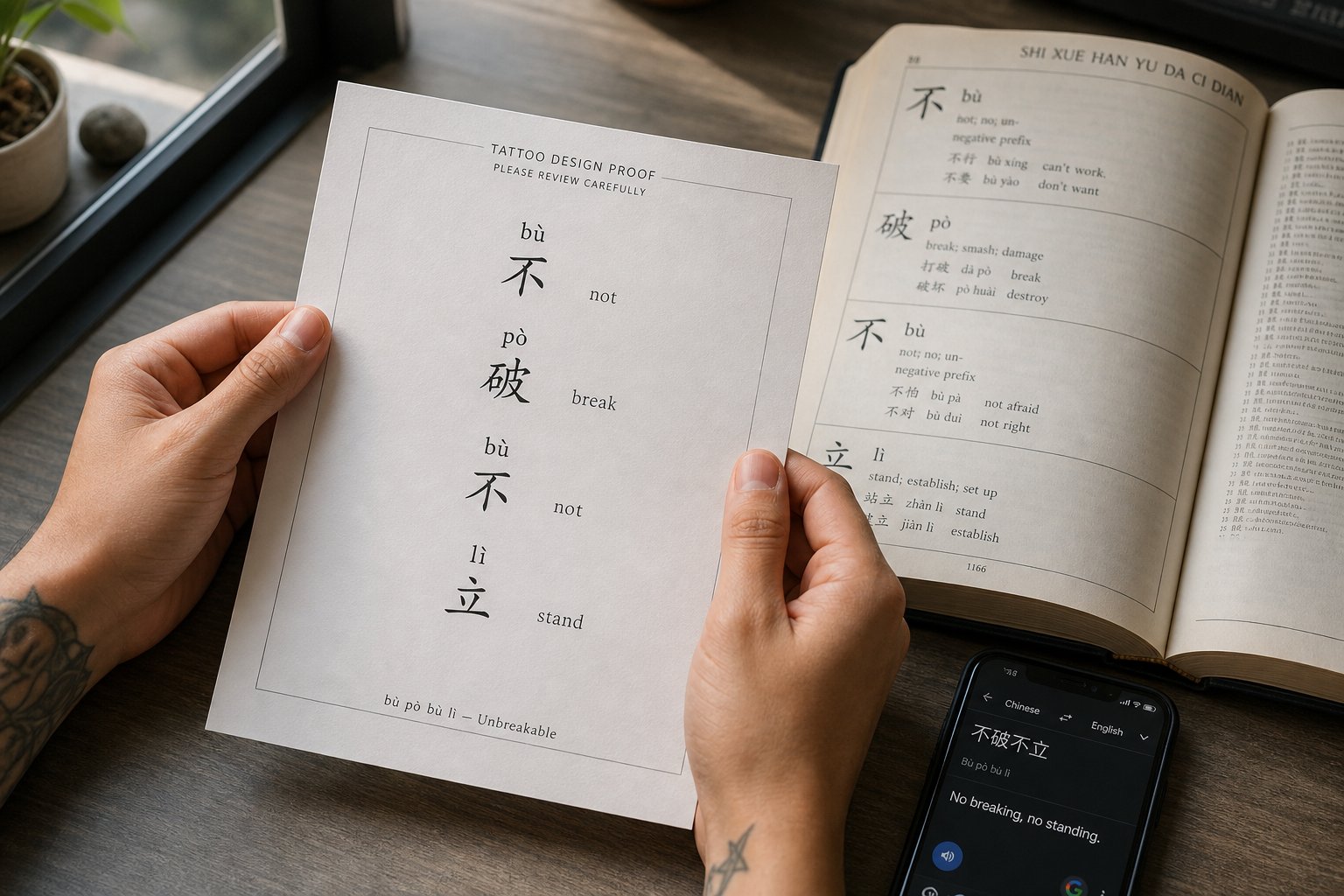
Even pinyin, which looks deceptively simple because it uses familiar letters, has rules that non-speakers routinely violate. A misplaced tone mark, an invalid syllable combination, or a spacing error can make your tattoo chinese symbols and meanings read as nonsense to anyone literate in Mandarin. The verification process below protects you from permanent mistakes.
- Confirm the correct romanization system. Verify that your text is actually pinyin and not Wade-Giles, Yale, or Jyutping. If your family name was romanized decades ago, it may use an older system. Decide intentionally which standard you want on your skin.
- Verify tone marks with at least two independent sources. Cross-reference your pinyin against a reputable dictionary like MDBG or Pleco. Do not rely on a single online tool. Confirm that each tone mark corresponds to the specific character and meaning you intend.
- Consult a native Mandarin speaker. Show them the complete pinyin text with tone marks and ask whether it reads naturally, whether the tones are correct, and whether any syllable carries an unintended or embarrassing connotation. A native ear catches problems that dictionaries miss.
- Check syllable structure against pinyin rules. Every syllable in pinyin follows specific initial-final combinations. Not all consonant-vowel pairings are valid. Confirm that each syllable in your design actually exists in the pinyin system.
- Review spacing and capitalization conventions. Pinyin has official rules for how names are written: surname and given name are separated by a space, each is capitalized, and multi-syllable given names are written as one word without hyphens. Getting these details right signals literacy.
- Have your tattoo artist produce a final proof at actual size. Check that tone marks are clearly distinguishable from each other and from decorative elements. Confirm that the diacriticals will survive aging at the chosen size and placement.
- Get a second opinion on the proof. Show the final design to your native speaker consultant one more time. Tattoo artists, however skilled, may inadvertently alter a tone mark angle or letter spacing during the design process. Catch errors before the needle touches skin.
This checklist takes time. It requires reaching out to people, waiting for responses, and possibly revising your design more than once. But consider the alternative: a permanent mark on your body that broadcasts a linguistic error to every Mandarin speaker who sees it. The chinese tattoo symbols and meanings you intend deserve the same care you would give any irreversible decision.
Pinyin name tattoos occupy a thoughtful middle ground in the world of chinese words tattoos and meaning. They honor a language without pretending to be something they are not. They remain readable across cultures without sacrificing their connection to Mandarin. And when executed with proper research, cultural respect, and linguistic precision, they become exactly what the best tattoos should be: a permanent statement that says precisely what you mean, nothing more and nothing less.
Frequently Asked Questions About Pinyin Name Tattoos
1. What is a pinyin name tattoo and how is it different from a Chinese character tattoo?
A pinyin name tattoo uses the official romanization system for Mandarin Chinese, rendering names in Latin letters with diacritical tone marks above vowels. Unlike Chinese character tattoos that use logographic symbols requiring knowledge of the writing system to read, pinyin is immediately readable by Western audiences while retaining its connection to the Chinese language through its phonetic structure and tone indicators. This makes pinyin tattoos less prone to catastrophic translation errors since a misplaced stroke in a character can completely change meaning, whereas pinyin errors are easier to catch and verify.
2. Should I include tone marks in my pinyin tattoo?
Including tone marks is strongly recommended for linguistic accuracy. Without them, a single pinyin syllable like 'shi' can correspond to over forty different characters with entirely different meanings, from 'poetry' to 'death.' Tone marks eliminate this ambiguity and signal that you understand Mandarin at a deeper level. However, if your chosen placement is very small, such as behind the ear or on a finger, tone marks may blur over time as ink spreads. In those cases, ensure your design is sized large enough for the diacriticals to remain distinguishable, or accept the trade-off of reduced specificity for cleaner aesthetics.
3. How do I convert my English name into pinyin for a tattoo?
Converting an English name to pinyin involves breaking it into Mandarin-compatible syllable units, mapping each sound to a valid pinyin syllable, and assigning appropriate tones based on the Chinese characters selected to represent each sound. Since Mandarin lacks certain English sounds like 'th' and 'v,' approximations are necessary. Many common Western names already have standardized Chinese transliterations used in media and official documents. The safest approach is to consult a native Mandarin speaker or qualified translator rather than relying solely on automated tools, which often produce conflicting or culturally awkward results.
4. Where is the best placement for a pinyin name tattoo?
The best placement depends on the length of your pinyin text. Short one-to-two syllable names work well on the inner wrist, collarbone, or behind the ear. Longer names and phrases suit the inner forearm, ribcage, or upper back where there is enough horizontal space for Latin letters to read naturally. Unlike Chinese characters that stack vertically as self-contained squares, pinyin reads horizontally, so vertical spine placements can feel choppy. For any placement, ensure tone marks are at least 2 millimeters in the final design to prevent them from blurring into indistinct dots as the tattoo ages.
5. Is it culturally appropriate for a non-Chinese person to get a pinyin tattoo?
Pinyin tattoos carry less appropriation risk than character tattoos because pinyin uses Latin letters and was specifically designed to make Mandarin accessible to non-Chinese speakers. The system was built as a bridge between languages. However, cultural awareness still matters. If your motivation is genuine, whether honoring a relationship, heritage, a language you studied, or a loved one's name, your intent aligns with respect. The key is following through with proper research, consulting native speakers for verification, and understanding what your tattoo actually says rather than treating Chinese language as purely decorative.