What Makes a Chinese Name Poetic
Imagine condensing an entire poem into just two or three syllables. That is exactly what Chinese parents do when they name a child. Unlike most Western naming traditions, where sound or family continuity drives the choice, Chinese naming is a literary art. Parents compose meaning through deliberate character selection, tonal arrangement, and allusion to classical texts. The result is less a label and more a miniature verse, carrying aspiration, imagery, and philosophy in a handful of brushstrokes.
Why Chinese Names Are a Form of Poetry
What makes Chinese names poetic goes far deeper than pleasant sounds. Each Chinese character is a layered unit of meaning. It contains a visual structure built from radicals and components, a specific tonal value that shapes how it feels when spoken aloud, and centuries of literary association accumulated through poetry, philosophy, and history. A single character like 梅 (mei, plum blossom) does not merely denote a flower. It evokes winter resilience, scholarly integrity, and an entire tradition of verse stretching back thousands of years.
Every Chinese character carries three dimensions of meaning simultaneously: its radical composition reveals elemental origins, its phonetic tone creates musicality, and its literary history connects the bearer to centuries of cultural memory. Western names rarely operate on all three levels at once.
Parents often spend weeks weighing these dimensions against one another. They consider how characters look side by side on paper, whether the tones rise and fall in pleasing contrast, and what classical resonance a reader might hear beneath the surface. The meaning behind Chinese character names is never accidental. It is composed.
The Art of Meaning in Two Characters
This compositional depth is what separates poetic Chinese names from ordinary ones. A name like 雨桐 (Yu Tong, rain + paulownia tree) paints a scene. You can almost hear droplets striking broad leaves. The poetic elements in Chinese names work together the way imagery, meter, and allusion work together in verse. Tone, meaning, and visual form reinforce one another.
Understanding how this system works requires exploring its sources: the classical poetry collections that serve as naming reservoirs, the linguistic mechanics that create phonetic harmony, and the thematic categories that give parents a palette of imagery to draw from. Each layer reveals why this tradition has endured for millennia and continues to shape how families name their children today.
Classical Poetry Sources Behind Chinese Names
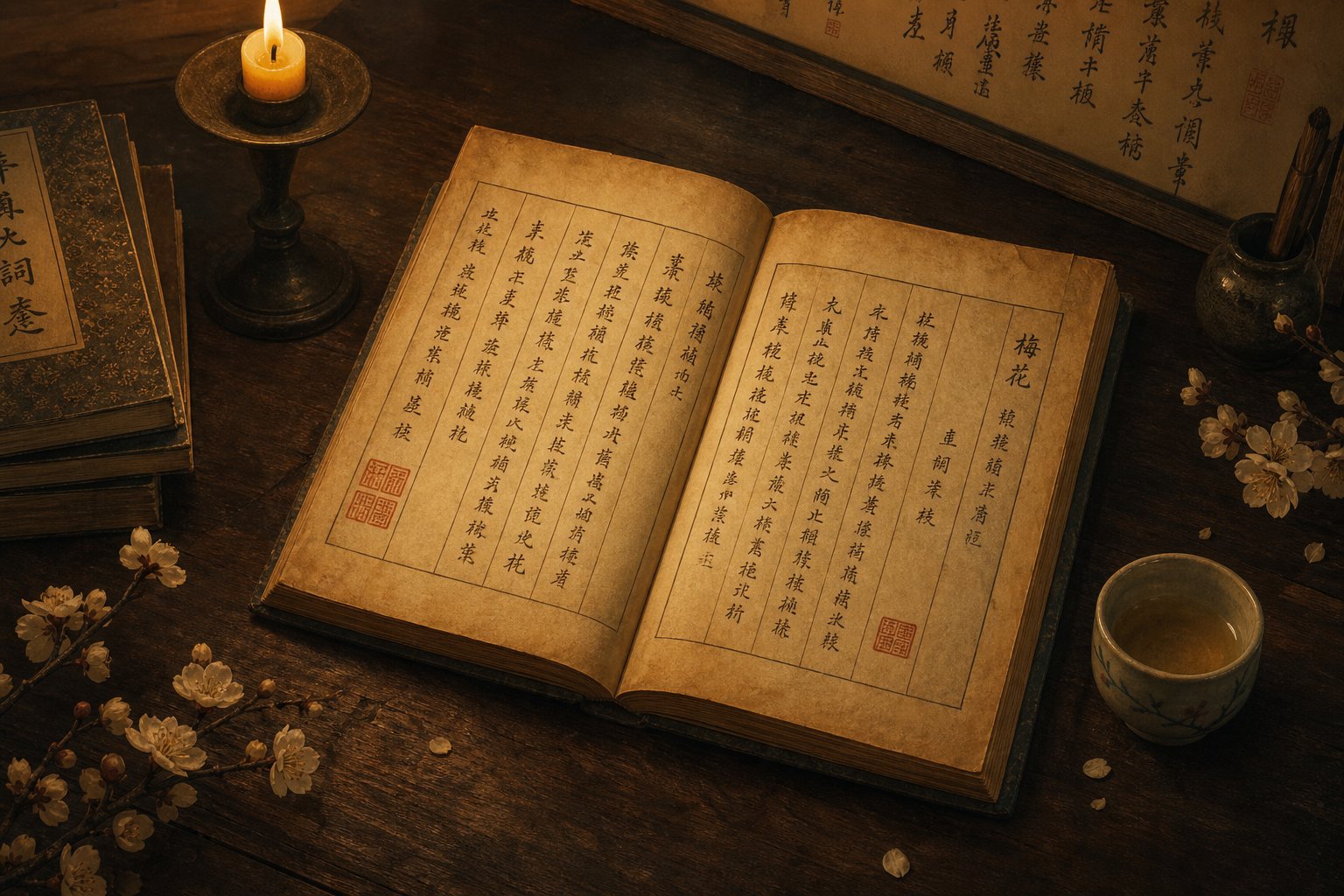
Four ancient literary collections form the bedrock of the classical Chinese poetry naming tradition. For centuries, parents have turned to these texts the way a jeweler turns to a vault, selecting characters polished by time and layered with cultural weight. A well-known saying captures the principle neatly: "女诗经, 男楚辞" (nu Shijing, nan Chu Ci), meaning girls draw names from the Shijing and boys from the Chu Ci. In practice, the tradition extends well beyond these two sources, reaching into Tang dynasty verse and Song dynasty lyrics as well.
The Shijing and Chu Ci as Naming Reservoirs
The Shijing (Book of Songs) is the earliest collection of Chinese poetry, dating back roughly 3,000 years. Its 305 folk songs and ceremonial hymns overflow with nature imagery, gentle emotion, and moral ideals. Because many poems celebrate feminine beauty through botanical metaphors, the Shijing became the go-to source for Chinese names from the Book of Songs, especially for daughters. A parent might find a line describing orchids by a riverbank and lift a character directly into a child's name.
The Chu Ci (Songs of the South), compiled around the 3rd century BCE, carries a different energy. Written largely by the poet Qu Yuan, these verses pulse with ambition, spiritual longing, and vivid mythological imagery. Chu Ci names for boys tend to evoke grandeur, moral resolve, and cosmic scale. Characters drawn from this collection often suggest a person reaching toward something larger than themselves.
Tang and Song Dynasty Poetry in Modern Names
Tang dynasty poetry, often called the golden age of Chinese verse, offers a vast palette of landscape imagery, philosophical reflection, and emotional precision. Tang dynasty poetry inspired names carry a refined elegance, pulling from poets like Wang Wei, Li Bai, and Du Fu. A single couplet about autumn moonlight or mountain mist can yield a name that feels both timeless and vivid.
Song dynasty ci lyrics, written to musical patterns, introduced a more intimate and nuanced emotional vocabulary. These lyric poems explored longing, memory, and subtle beauty in ways that translate naturally into personal names. Parents drawn to understated grace often find their inspiration here.
The table below shows how names derived from ancient Chinese poems connect directly to their source lines:
| Poetry Source | Original Line | Translation | Derived Name | Meaning |
|---|---|---|---|---|
| Shijing (Book of Songs) | 桃之夭夭, 灼灼其华 | The peach tree is young and elegant, brilliant are its flowers | 灼华 (Zhuo Hua) | Radiant splendor, blooming beauty |
| Chu Ci (Songs of the South) | 苟余情其信芳 | If my inner feelings are truly fragrant | 信芳 (Xin Fang) | Genuine virtue, inner integrity |
| Tang Poetry (Wang Wei) | 明月松间照, 清泉石上流 | Bright moon shines among the pines, clear spring flows over stones | 明松 (Ming Song) | Clarity and steadfastness, like moonlit pines |
| Song Ci (Li Qingzhao) | 暗香浮动月黄昏 | A subtle fragrance drifts in the yellow dusk of moonlight | 暗香 (An Xiang) | Hidden fragrance, quiet elegance |
You'll notice each name does not merely borrow a word. It transplants an entire scene, an emotional atmosphere, from the poem into a person's identity. The parent is not just picking a sound. They are selecting a moment from literary history and asking it to accompany their child through life.
These four reservoirs give families an enormous range of imagery and tone to work with. But choosing the right characters from a poem is only the beginning. The real craft lies in how those characters interact once placed side by side, how their tones rise and fall, how their radicals balance visually on paper, and what deeper resonance emerges from their combination.
Anatomy of a Poetic Chinese Name
Picking characters from a classical poem is only the first step. The real artistry emerges in how those characters behave together, how their strokes balance on paper, how their tones dance off the tongue, and how their internal components whisper elemental meaning beneath the surface. To understand the Chinese name character breakdown meaning at every level, you need to dissect a name the way a literary critic dissects a couplet.
Deconstructing a Name Layer by Layer
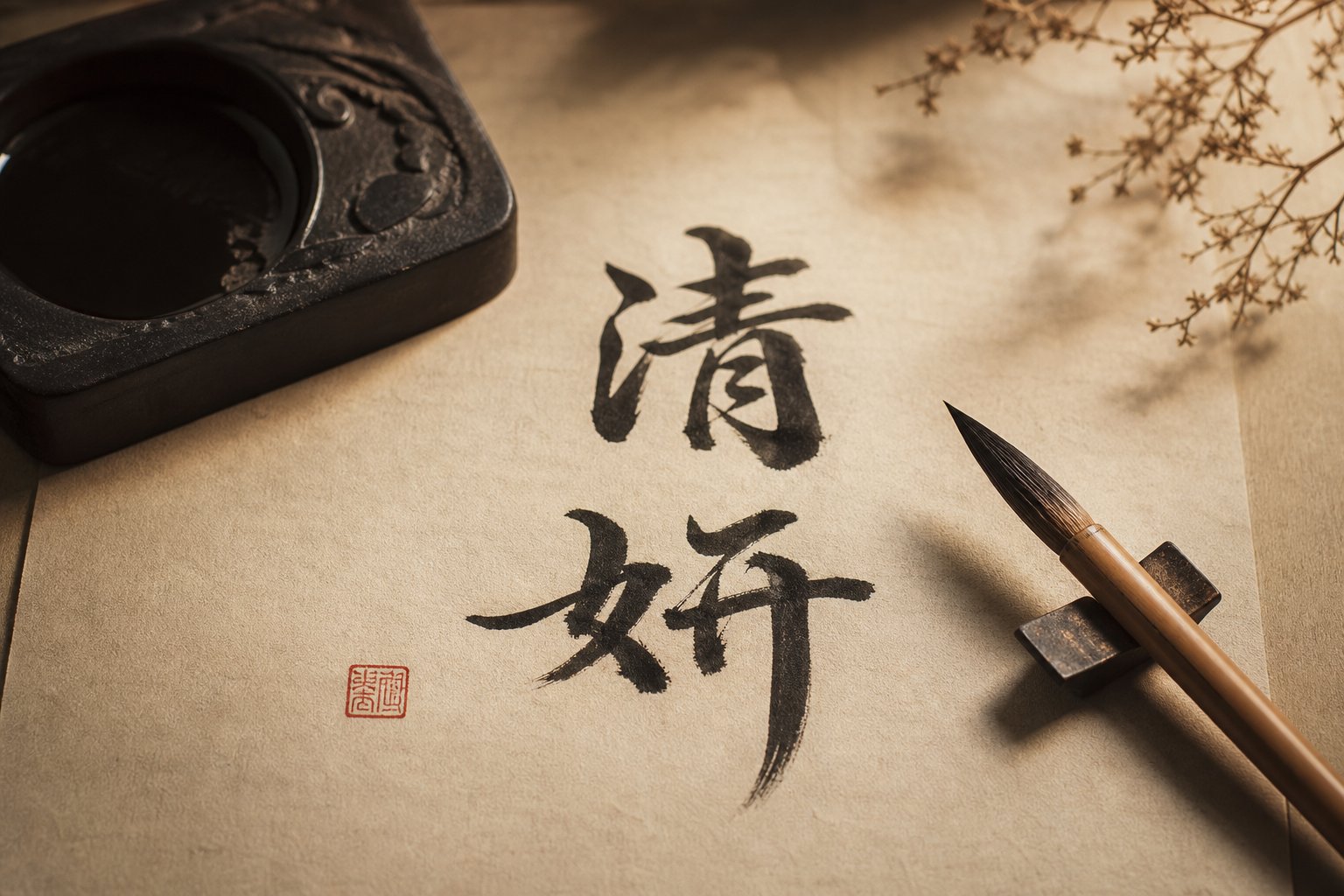
Consider the name 清婉 (Qīng Wǎn), drawn from the Shijing line "有美一人, 清扬婉兮" (there is a beautiful one, clear-browed and graceful). Here is what a parent weighs when composing this name:
- Radical composition: 清 contains the water radical 氵alongside 青 (blue-green), suggesting clarity like a mountain stream. 婉 pairs the woman radical 女 with 宛 (winding, soft), evoking gentle grace. Together, the radicals ground the name in water and femininity.
- Visual stroke balance: 清 has 11 strokes and 婉 has 11 strokes, creating a symmetrical visual weight when written side by side. Neither character overwhelms the other on paper.
- Tonal pattern: Qīng is first tone (level, 平) and Wǎn is third tone (oblique, 仄), producing a 平仄 contrast that feels musically resolved.
- Literary allusion: The Shijing source poem celebrates a woman whose beauty is both physical and moral, lending the name an association with inner refinement.
- Cultural connotation: 清 carries overtones of incorruptibility and intellectual clarity. 婉 suggests diplomacy and warmth. The combination implies someone both principled and approachable.
A second example: 浩然 (Hào Rán), rooted in the Mencius passage "吾善养吾浩然之气" (I am skilled at cultivating my vast, righteous spirit).
- Radical composition: 浩 carries the water radical 氵beside 告 (to declare), suggesting an ocean-scale expansiveness. 然 contains the fire dots 灬 at its base, originally meaning "to burn" before evolving into "thus, naturally." Water and fire radicals in one name create elemental tension and completeness.
- Visual stroke balance: 浩 (11 strokes) and 然 (12 strokes) sit nearly equal in density, giving the written name a stable, grounded appearance.
- Tonal pattern: Hào is fourth tone (oblique, 仄) and Rán is second tone (level, 平), producing a 仄平 pattern. The voice drops sharply then rises, mirroring the sense of gathering force.
- Literary allusion: Mencius used 浩然之气 to describe a moral courage so vast it fills the space between heaven and earth.
- Cultural connotation: This name has been carried by the Tang poet Meng Haoran (孟浩然), reinforcing its association with literary greatness and upright character.
A third example: 云舒 (Yún Shū), echoing the poetic image of clouds drifting at ease, found across multiple classical texts including Tao Yuanming's line "云无心以出岫" (clouds drift from the peaks without intention).
- Radical composition: 云 (simplified from 雲) originally depicted swirling vapor. 舒 combines 舍 (shelter) with 予 (to give), meaning to unfurl or stretch out leisurely. The radical composition in Chinese naming here suggests openness and generosity of spirit.
- Visual stroke balance: 云 is just 4 strokes while 舒 is 12, creating deliberate asymmetry. This mirrors the visual contrast of a small cloud against a wide sky, a compositional choice rather than a flaw.
- Tonal pattern: Yún is second tone (level, 平) and Shū is first tone (level, 平), producing a 平平 pattern. Both tones float at a high, even pitch, reinforcing the name's feeling of calm suspension.
- Literary allusion: Tao Yuanming's clouds represent freedom from worldly ambition, a Daoist ideal of effortless being.
- Cultural connotation: The name suggests someone unhurried and at peace, moving through life with natural ease rather than forced striving.
How Tonal Patterns Create Phonetic Harmony
You'll notice that tonal harmony in Chinese names follows the same logic as 平仄 (píngzè) rules in classical regulated verse. In poetry, level tones (平, corresponding to modern Mandarin first and second tones) alternate with oblique tones (仄, corresponding to third and fourth tones) to prevent monotony and create rhythmic tension. The pattern in one line is often the inverse of the next, as seen in Du Fu's "Spring View" where 仄仄平平仄 is answered by 平平仄仄平.
Names work the same way. A surname in a level tone pairs best with a given name that introduces oblique contrast, or vice versa. 陈浩然 (Chén Hào Rán) moves 平仄平, creating a satisfying rise-fall-rise when spoken aloud. 林清婉 (Lín Qīng Wǎn) flows 平平仄, ending on a descending note that feels conclusive. Parents attuned to how Chinese name tones work will test a full name aloud dozens of times, listening for the same musicality that classical poets demanded of their couplets.
This tonal awareness separates a merely meaningful name from one that truly sings. A name where all three characters share the same tone can feel flat and monotonous, no matter how beautiful the individual meanings. Contrast gives a name its rhythm, its breath, its sense of movement through the air.
These mechanical layers, radical, stroke, tone, allusion, and connotation, operate simultaneously in every well-crafted name. But the specific imagery parents choose varies dramatically depending on whether they are naming a daughter or a son, and which thematic traditions they draw from.
Poetic Chinese Girl Names From Literary Tradition
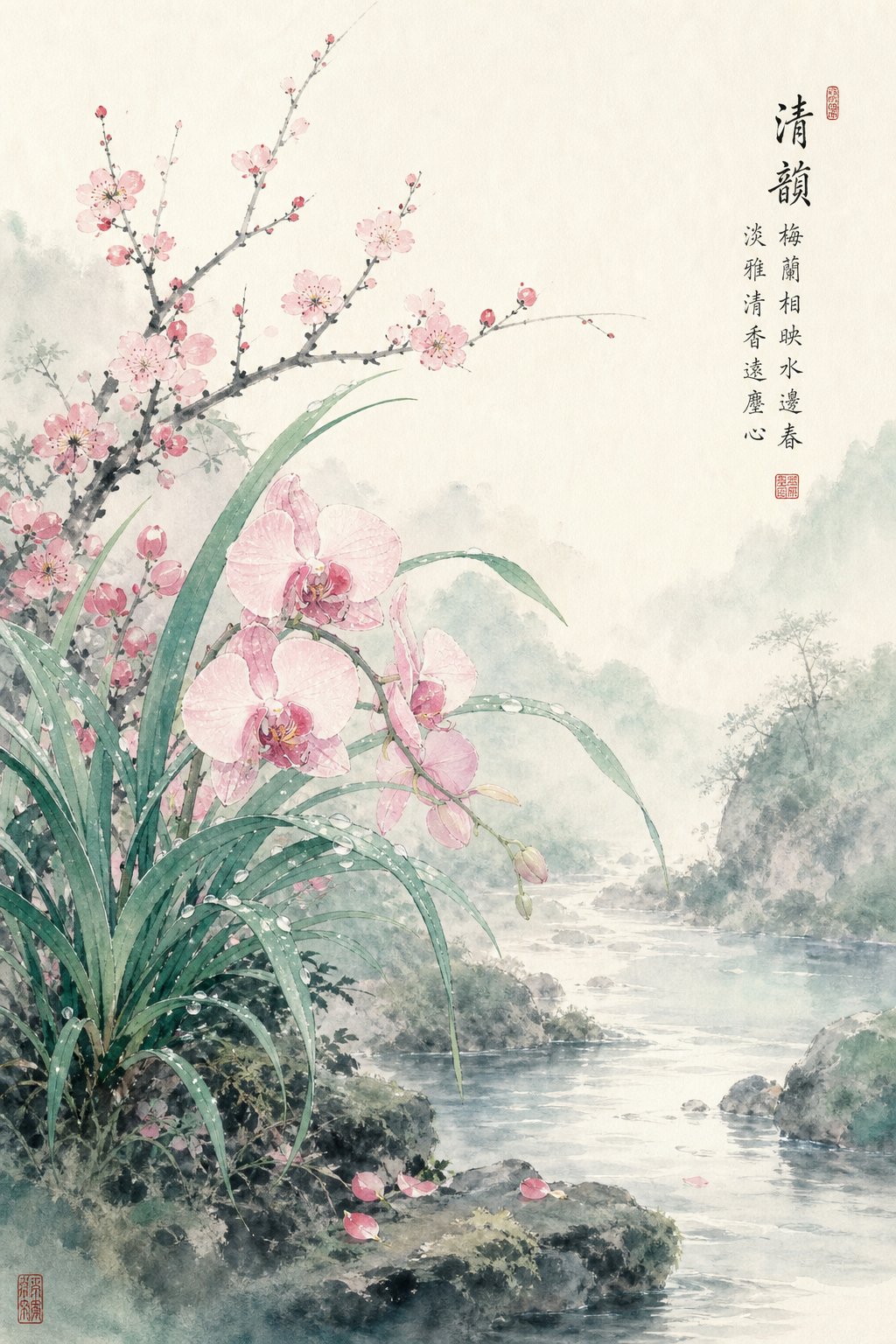
Classical Chinese poetry brims with feminine imagery: orchids in hidden valleys, moonlight on still water, jade pendants catching the light. These images were never merely decorative. In the Shijing and Chu Ci traditions, nature metaphors served as the primary language for expressing feminine beauty, virtue, and inner strength. That same language flows directly into poetic Chinese girl names with meaning that resonates across centuries.
The Shijing tradition particularly shapes Chinese female names from classical poetry through its consistent use of botanical metaphors. When a Shijing poem compares a woman to a peach tree in full bloom or to willows swaying by a river, it establishes an equation between natural beauty and human character. Parents drawing from this tradition are not simply choosing pretty words. They are placing their daughter within a poetic lineage where flowers represent moral qualities, not just appearances.
Floral and Nature Names From Classical Verse
Flower inspired Chinese girl names carry a specific cultural weight that goes beyond aesthetics. In the Chu Ci, the poet Qu Yuan famously used fragrant plants to symbolize loyalty and moral integrity. As the early commentator Wang Yi explained, "good birds and fragrant plants represent loyal ministers, while evil birds and foul plants symbolize sycophants." Characters like 兰 (lan, orchid), 蕙 (hui, melilotus), and 芷 (zhi, angelica) were not chosen for their scent alone. They stood for cultivated personality and lofty character in the original texts.
When these characters appear in a girl's name, they carry that entire symbolic tradition with them. A name containing 蕙 does not just mean "a type of grass." It means someone whose inner nature is fragrant, whose virtue is evident without being announced.
The table below presents beautiful Chinese names for girls from literature, organized by their dominant imagery:
| Name (Characters) | Pinyin | Literal Meaning | Poetic Source / Connotation |
|---|---|---|---|
| 蕙兰 | Hui Lan | Melilotus + orchid | Chu Ci: fragrant plants representing inner virtue and moral purity |
| 芷若 | Zhi Ruo | Angelica + pollia | Chu Ci (Li Sao): two fragrant herbs symbolizing noble character |
| 静姝 | Jing Shu | Quiet + beautiful | Shijing ("Jing Nu"): a gentle, serene beauty admired from afar |
| 琇莹 | Xiu Ying | Lustrous + luminous gem | Shijing: brilliance of precious stones, suggesting radiant talent |
| 嘉卉 | Jia Hui | Beautiful + flora | Shijing: celebration of flourishing plants in spring |
| 依依 | Yi Yi | Swaying gently | Shijing ("Cai Wei"): willow branches in the wind, evoking nostalgia |
| 婉如 | Wan Ru | Graceful + like | Shijing: gentle and beautiful, with effortless elegance |
Notice how the Shijing-derived names tend toward gentleness and natural imagery, while the Chu Ci names carry a sharper edge of moral symbolism. Both traditions offer parents a way to encode aspiration into sound and brushstroke.
Names Evoking Grace and Inner Beauty
Beyond floral imagery, a second category of poetic girl names draws on moonlight, water, jade, and music to express qualities like wisdom, clarity, and refined character. These names move away from botanical metaphor and toward luminous, fluid imagery:
| Name (Characters) | Pinyin | Literal Meaning | Poetic Source / Connotation |
|---|---|---|---|
| 徽音 | Hui Yin | Virtue + beautiful sound | Shijing ("Si Qi"): moral reputation that resonates like music |
| 琼琚 | Qiong Ju | Exquisite jade pendant | Shijing ("Mu Gua"): precious jade given as a token of deep affection |
| 令仪 | Ling Yi | Elegant + manner | Shijing: dignified bearing and graceful deportment |
| 淑慎 | Shu Shen | Kind + careful | Shijing: gentle virtue paired with thoughtful restraint |
| 如云 | Ru Yun | Like clouds | Shijing: abundant beauty, as plentiful and soft as clouds |
| 德音 | De Yin | Virtue + sound | Shijing: a person whose moral character speaks for itself |
You'll notice a pattern here. Names like 徽音 (Hui Yin) and 德音 (De Yin) use the character 音 (sound, reputation) to suggest that a person's virtue should be heard and felt by others, not merely possessed in silence. The famous architect and poet Lin Huiyin (林徽因) carried exactly this name, drawn from the Shijing line about beautiful music and moral reputation. Her name was itself a small poem about how inner character radiates outward.
Names built on jade imagery, like 琼琚 (Qiong Ju), work differently. Jade in Chinese culture represents durability, warmth to the touch, and a luster that deepens with time rather than fading. A jade name tells a daughter she is valued not for surface brilliance but for qualities that endure.
What connects all these names, whether floral, luminous, or mineral, is a shared philosophy: feminine beauty in the classical tradition is never purely physical. It is always also moral, intellectual, and spiritual. The poetry encodes this belief, and the names carry it forward into living people.
The same classical sources that yield these feminine names also contain an entirely different register of imagery, one built on mountain peaks, soaring ambition, and martial spirit, that shapes how parents name sons.
Poetic Chinese Names for Boys With Literary Depth
Mountain peaks, soaring dragons, righteous spirit filling the space between heaven and earth. The imagery that shapes literary Chinese names for boys draws from a different emotional register than the floral and luminous vocabulary of feminine names. Where girl names tend toward subtlety and inner radiance, poetic Chinese boy names with meaning often reach outward and upward, evoking ambition, moral courage, and the grandeur of the natural world.
This distinction is not arbitrary. It traces directly back to the source texts. The Chu Ci, with its mythological scale and political passion, became the primary reservoir for strong Chinese names from classical poetry. Tang dynasty verse, with its landscape mastery and heroic sensibility, offers a second major source. And Confucian philosophical texts supply a vocabulary of moral aspiration that has shaped naming for over two millennia.
Names of Strength and Aspiration From Chu Ci
The Chu Ci pulses with a restless energy. Its primary author, Qu Yuan, was a statesman in exile, and his verses overflow with cosmic imagery, mythological journeys, and fierce moral conviction. Chinese male names from Chu Ci tend to carry that same intensity. They suggest someone who refuses to compromise, who reaches toward greatness even at personal cost.
Here are names grouped by their dominant thematic imagery:
Celestial imagery:
- 齐光 (Qi Guang) - as bright as the sun and the moon. From the Chu Ci line describing radiance that rivals celestial bodies. Suggests brilliance and moral clarity on a cosmic scale.
- 景云 (Jǐng Yun) - colorful, auspicious clouds. Symbolizes brightness, glory, and magnificence in one's future path.
- 青云 (Qīng Yun) - cyan clouds. Represents high social status, exceptional achievements, and soaring ambition.
Moral virtues:
- 怀瑾 (Huai Jin) - holding beautiful jade within. Represents inner morality and virtue that one carries without display. The jade metaphor suggests warmth, durability, and quiet integrity.
- 秉德 (Bǐng De) - to hold fast to virtue. Implies staying moral and principled regardless of external pressure.
- 信芳 (Xin Fāng) - genuine fragrance, inner integrity. From the line "if my inner feelings are truly fragrant," suggesting innocence, purity, and a beautiful heart.
Martial spirit and ambition:
- 飞龙 (Fēi Long) - flying dragon. Evokes power, transformation, and the mythological energy of dragon boats and imperial aspiration.
- 诚勇 (Cheng Yǒng) - sincere and brave. Pairs honesty with courage, suggesting someone whose bravery is rooted in genuine conviction rather than recklessness.
- 广志 (Guǎng Zhi) - to broaden one's ambition. A name that literally commands its bearer to expand their horizons and aim higher.
Mountain and water landscapes:
- 承宇 (Cheng Yǔ) - floating clouds connecting to mountain eaves. Paints a scene of mist clinging to peaks, suggesting someone who bridges heaven and earth.
- 峻茂 (Jun Mao) - towering and lush. Evokes steep mountains covered in exuberant vegetation, combining strength with vitality.
- 嘉树 (Jiā Shu) - tall, beautiful trees. Suggests someone who grows upright and provides shelter to others.
Scholarly and Heroic Names From Tang Poetry
Chinese boy names inspired by Tang poetry carry a different flavor. Where Chu Ci names burn with mythological intensity, Tang-derived names tend toward refined observation and philosophical depth. A Tang poet gazing at mountains did not merely describe them. He located himself within the landscape and found meaning in the relationship between human consciousness and natural form.
Names drawn from this tradition often pair a landscape element with an emotional or intellectual quality: 明远 (Ming Yuǎn, bright + far-reaching), suggesting clarity of vision that extends to the horizon; 逸风 (Yi Fēng, unrestrained + wind), evoking the freedom celebrated in poets like Li Bai; or 思远 (Sī Yuǎn, contemplation + distance), capturing the reflective spirit of Wang Wei's mountain poems.
The Tang dynasty also gave rise to a naming tradition that connects directly to poetic identity: the courtesy name (字 zi) and literary name (号 hao). These were not birth names but chosen names, adopted in adulthood to express one's aspirations or philosophical stance. Li Bai, China's most celebrated romantic poet, carried the courtesy name Taibai (太白, great whiteness), referencing the planet Venus and suggesting celestial brilliance. His literary name, Qinglian Jushi (青莲居士, the Householder of Green Lotus), drew on Buddhist lotus imagery to frame his identity as both worldly and spiritually refined.
Su Shi, the Song dynasty polymath, chose the literary name Dongpo Jushi (东坡居士, the Householder of the Eastern Slope), naming himself after the hillside farm where he lived during political exile. The name transformed a place of banishment into a poetic identity, turning hardship into literary legend.
These courtesy and literary names reveal something essential about the broader poetic naming tradition. A name was never just a label assigned at birth. It was understood as a living statement of character, one that could be composed, revised, and deepened over a lifetime. When modern parents select literary Chinese names for boys from classical sources, they participate in this same tradition of naming as self-definition, choosing words that will shape how their son understands himself and how the world receives him.
The imagery available to parents, whether celestial, botanical, mineral, or elemental, does not exist in isolation. It connects to a deeper structural system where nature themes recur in patterns, and where the ancient Five Elements theory offers yet another layer of meaning to guide character selection.
Nature Themes and Elemental Balance in Poetic Names
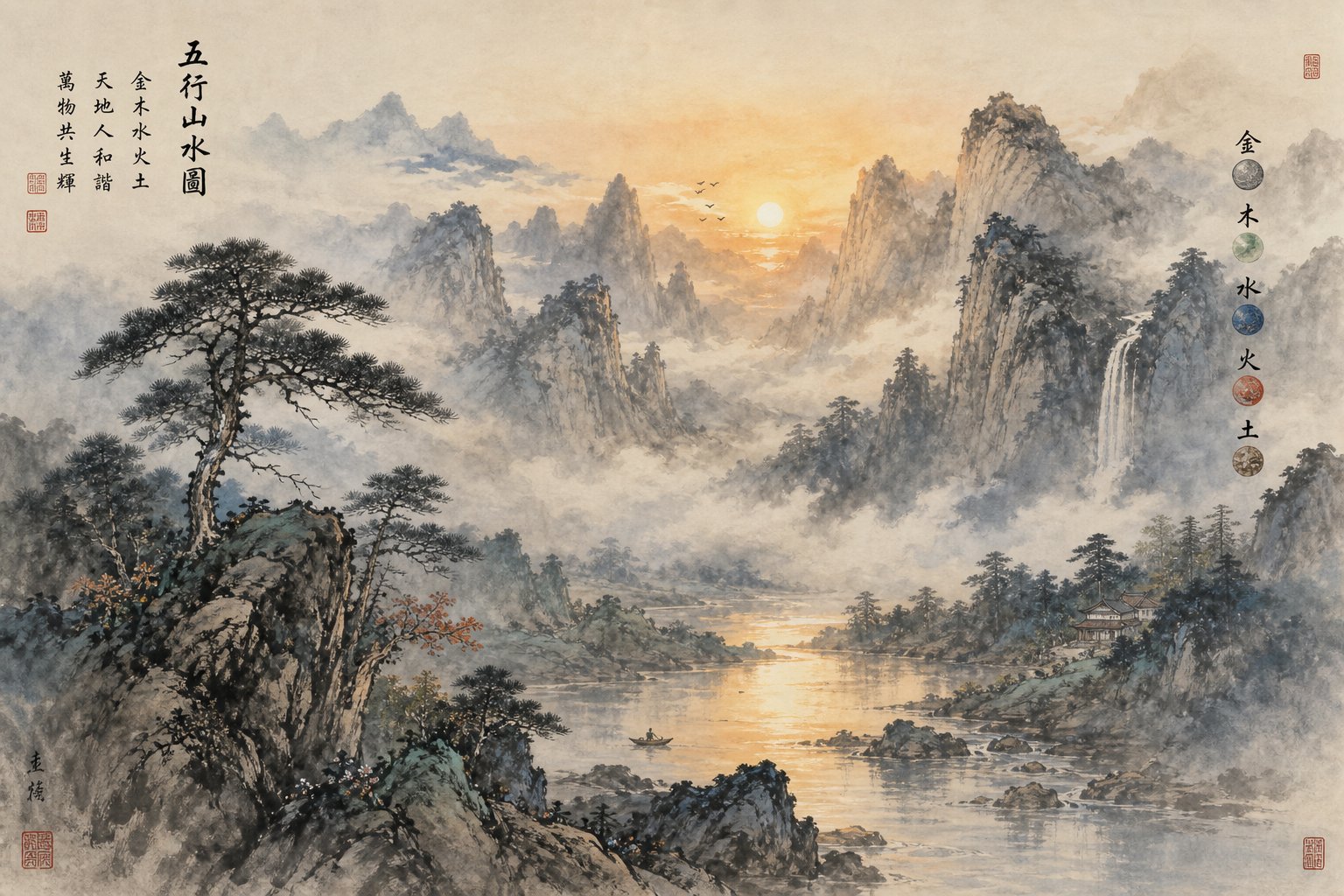
Classical Chinese poetry returns obsessively to a handful of natural images: dawn breaking over rivers, autumn moonlight on still water, cranes rising above bamboo groves, mist dissolving against mountain peaks. These are not random preferences. They form a shared vocabulary that poets refined over three millennia, and that same vocabulary feeds directly into Chinese names with nature meanings. When parents select a character like 霜 (shuang, frost) or 岚 (lan, mountain mist), they are drawing from a reservoir of imagery that every educated reader recognizes instantly.
Seasonal and Celestial Name Imagery
Seasonal references anchor a name in a specific emotional atmosphere. Spring characters like 晨 (chen, morning) and 曦 (xi, first sunlight) carry the energy of new beginnings, that moment when darkness surrenders to day. Autumn imagery works differently. Characters like 秋 (qiu, autumn) and 霜 (shuang, frost) evoke clarity, maturity, and the quiet beauty of things reaching completion. Chinese names inspired by seasons and landscapes borrow not just the season itself but the emotional philosophy attached to it in verse.
Celestial imagery in Chinese names operates at an even grander scale. The character 云 (yun, cloud) suggests someone who drifts above worldly concerns, comfortable with ambiguity and change. 星 (xing, star) implies brilliance that endures through darkness. 霄 (xiao, the highest sky) appears in phrases about lofty aspirations, aiming beyond conventional success toward something more rarefied. Parents choosing these characters are placing their child within a cosmic frame, connecting a single life to the rhythms of the sky.
Water, Mountain, and Landscape Names
Water and mountain characters form perhaps the richest category. As one exploration of nature elements in Chinese names notes, a character like 泽 (ze, marsh or beneficence) does not merely denote a body of water. It evolved to represent accumulated kindness, grace spreading outward like water filling a basin. Similarly, 涵 (han, to contain) suggests depth and inclusiveness, while 润 (run, to moisten) captures rain's ability to soften what has become hard and dry without forcing change.
Mountain characters carry a different weight. 峻 (jun, towering) implies moral uprightness as much as physical height. 岳 (yue, great peak) suggests permanence and grandeur. Flora and fauna round out the palette: 鹤 (he, crane) represents longevity and transcendence, 梅 (mei, plum blossom) embodies resilience in winter, and 竹 (zhu, bamboo) stands for integrity that bends without breaking.
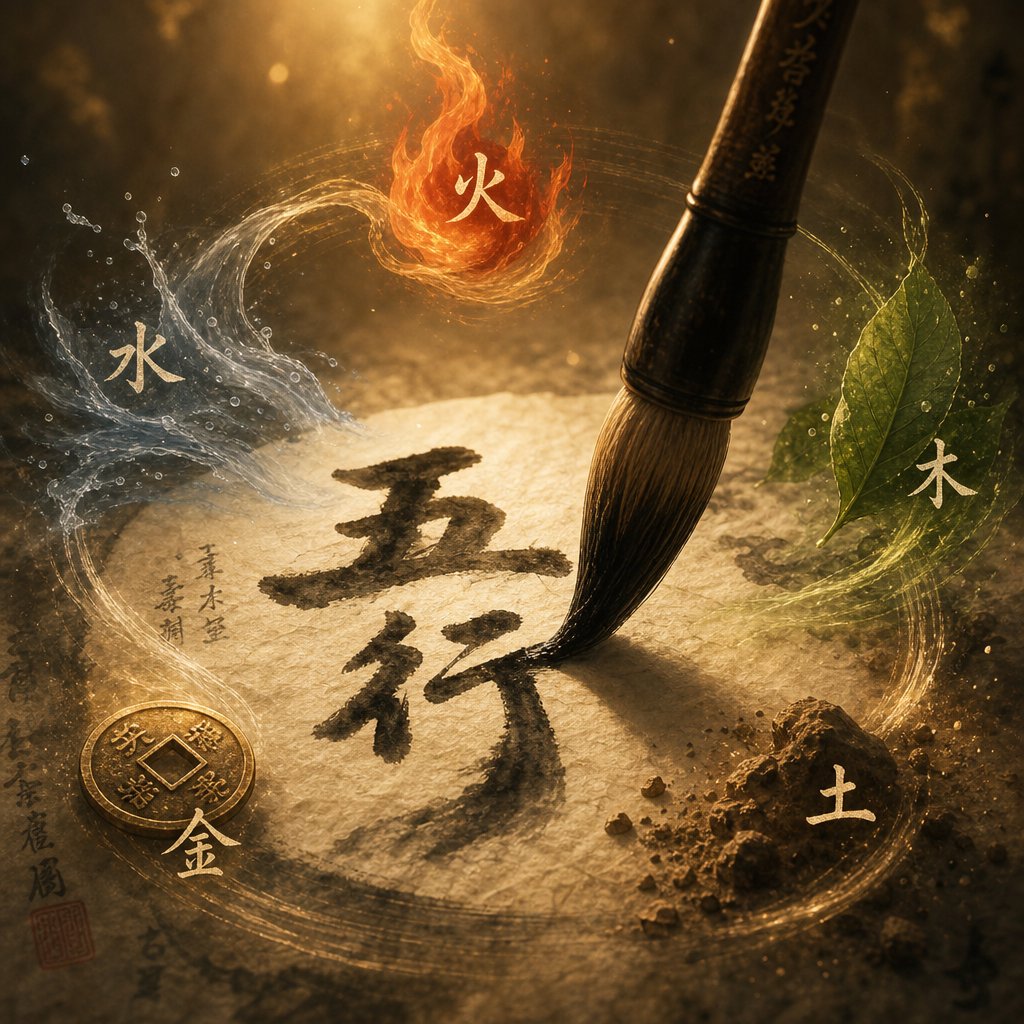
What connects all these nature themes is something deeper than aesthetics. In the five elements Chinese naming tradition, every character carries an elemental signature through its radical, the structural component that reveals its energetic category. Parents do not choose nature imagery purely for poetic beauty. They also consider whether a child's BaZi (八字) birth chart needs supplementation in a specific element. A child whose chart lacks Water might receive a name containing 泽 or 润, characters that are both poetically resonant and elementally corrective.
The table below maps each element to its associated radicals, the nature imagery it governs, and example names that satisfy both poetic and elemental requirements:
| Element | Common Radicals | Associated Nature Imagery | Example Poetic Names |
|---|---|---|---|
| Wood (木 mu) | 木 (wood), 艹 (grass) | Forests, bamboo, spring growth, flowering plants | 林溪 (Lin Xi, forest stream), 芳菲 (Fang Fei, fragrant blossoms), 桐雨 (Tong Yu, paulownia in rain) |
| Fire (火 huo) | 火 (fire), 灬 (fire dots) | Sunlight, dawn, stars, radiance | 煜明 (Yu Ming, brilliant light), 晨曦 (Chen Xi, morning rays), 炜彤 (Wei Tong, glowing red) |
| Earth (土 tu) | 土 (earth), 山 (mountain) | Mountains, valleys, plains, stability | 峻岳 (Jun Yue, towering peak), 坤宁 (Kun Ning, earth's tranquility), 岚清 (Lan Qing, mountain mist) |
| Metal (金 jin) | 金 (metal), 钅 (metal variant) | Autumn, frost, moonlight, sharpness | 铭远 (Ming Yuan, engraved distance), 锦书 (Jin Shu, brocade letter), 鑫瑞 (Xin Rui, triple gold auspice) |
| Water (水 shui) | 氵 (water), 雨 (rain) | Rivers, rain, mist, clouds, snow | 涵清 (Han Qing, containing clarity), 泽润 (Ze Run, marsh's moisture), 雨霏 (Yu Fei, misty rain) |
You'll notice that the most skillful names satisfy both dimensions simultaneously. A name like 涵清 (Han Qing) is poetically evocative, painting an image of deep water so still it becomes transparent, while also delivering Water element energy through the 氵 radical in both characters. The parent achieves elemental balance without sacrificing literary beauty. This dual function is what separates the five elements tradition from mere superstition. It operates as a creative constraint, much like poetic meter, channeling the namer's choices rather than limiting them.
Of course, these elemental and thematic choices do not happen in a vacuum. Every family navigates a web of cultural rules, generational conventions, and naming taboos that further shape which characters are available and which are off-limits.
Cultural Rules That Shape Poetic Name Choices
A parent might find the perfect two characters, tonally balanced, rich with literary allusion, elementally aligned, only to discover the name violates a rule older than the poetry itself. Cultural rules for choosing Chinese names act as a second layer of constraint on top of aesthetic and elemental considerations. Far from stifling creativity, though, these restrictions function much like meter in verse. They force the namer to think harder, reach further, and ultimately arrive at something more inventive than an unconstrained choice might produce.
Generational Naming and Family Traditions
One of the most distinctive generational naming rules in Chinese culture is the practice of sharing a character across all children, or all male children, within the same generation of a family. Imagine a grandfather who composed a generational poem decades ago. Each line of that poem supplies one character to be used by a successive generation. All cousins born in the same generation share that designated character as part of their given name, while the second character remains unique to each individual.
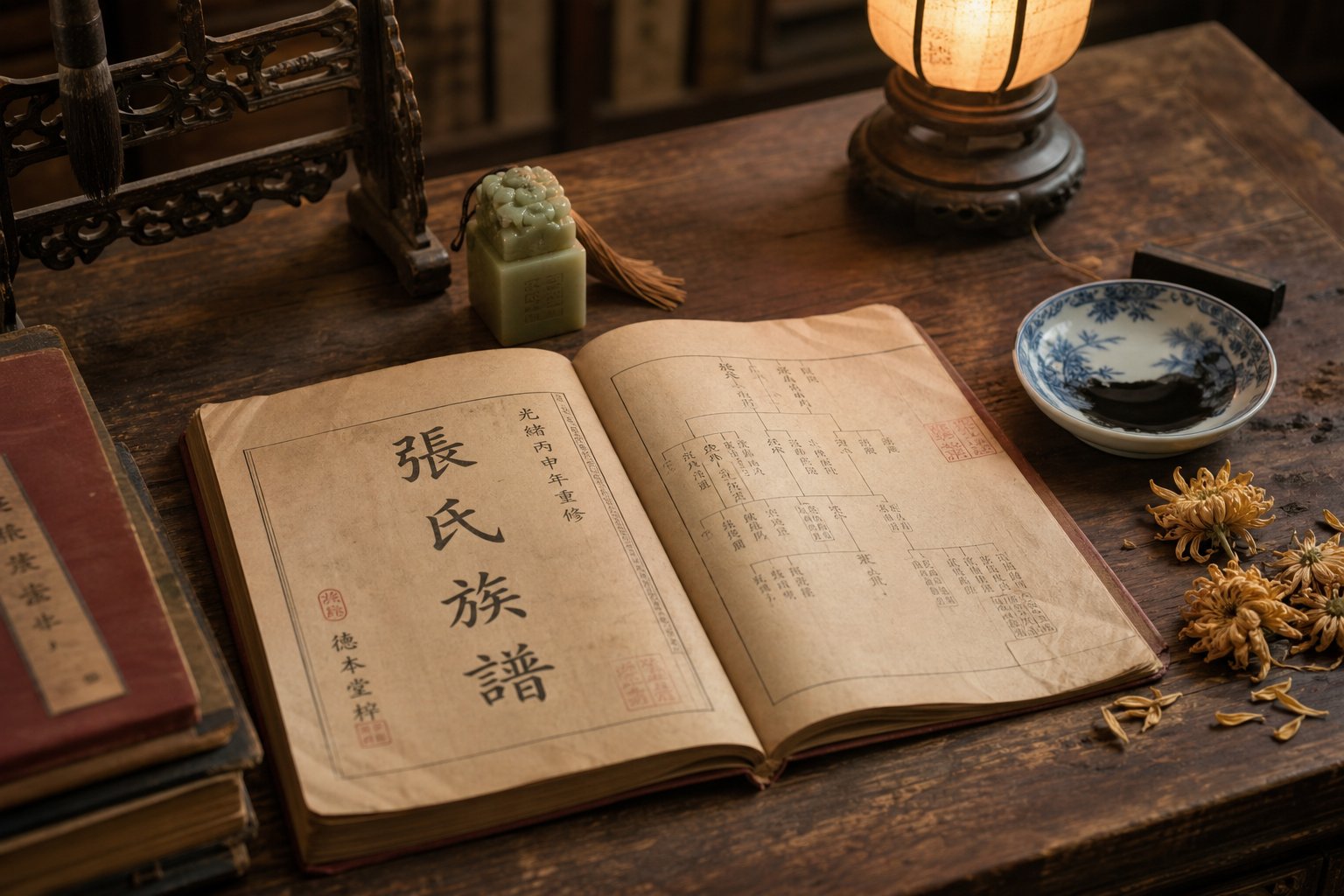
This system, documented in family genealogy books called jiapu (家谱), serves a practical purpose: if two people share the same first character in their given name, they are likely siblings or first cousins. The shared character anchors each person within the family tree, while the unique character provides individual identity. For poetic naming, this means one character is already fixed. The parent's creative work concentrates entirely on the second character, which must harmonize tonally, visually, and semantically with a character they did not choose.
Taboos and Homophone Pitfalls to Avoid
Beyond generational conventions, several Chinese naming taboos to avoid can eliminate otherwise beautiful characters from consideration:
- Ancestral name avoidance (避讳 bìhuì): Using the same character as a direct ancestor, especially a grandparent or great-grandparent, is considered deeply disrespectful. Even a character that merely sounds identical to an ancestor's name character may be rejected. This single rule can remove dozens of otherwise poetic options from the table.
- Death and misfortune homophones: Characters or syllable combinations that overlap with 死 (sǐ, death), 丧 (sàng, mourning), or 病 (bìng, illness) get rejected immediately. The risk extends to full-name combinations. A refined name like 杜紫藤 (Dù Zǐténg, purple wisteria) sounds nearly identical to 肚子疼 (dùzi téng, stomachache) when spoken quickly, turning elegance into a schoolyard joke.
- Dialect cross-checking: Mandarin uses roughly 1,300 distinct syllables mapped to over 8,000 common characters, making homophone collisions statistically inevitable. A name that reads cleanly in Mandarin can produce an unfortunate meaning in Cantonese, Hokkien, or Wu Chinese. Multilingual families run the read-aloud test in two or three dialects before committing.
- Overly rare or complex characters: A beautifully literary character that no one can read or type becomes a daily inconvenience. Modern parents balance poetic ambition with practical recognizability, avoiding characters so obscure they require explanation at every introduction.
- Stroke count and 八字 (bāzì) compatibility: Many families consult traditional numerology to verify that a name's total stroke count aligns favorably with the child's birth chart. A character with perfect poetic resonance may still be swapped if its stroke count clashes with the child's elemental balance.
These constraints interact with one another. A generational character might limit tonal options, which narrows the pool of harmonious second characters, which then must pass through homophone screening and ancestral avoidance. The result is a naming process that resembles writing a poem under strict formal rules: the constraints do not diminish the art. They define it.
One additional consideration affects the visual dimension of poetic names. The simplification of Chinese characters in mainland China during the 1950s and 1960s altered the written form of many characters. A character like 雲 (cloud), with its rain radical above and swirling strokes below, was simplified to 云, losing much of its visual complexity. For families who value the calligraphic beauty of a name's written form, the choice between traditional and simplified characters is itself a poetic decision, one that determines whether the name's visual poetry survives on paper or lives primarily in its sound and meaning.
These rules and constraints are not abstract principles. They have shaped the names of real historical figures whose naming stories illuminate how the tradition works in practice.
Famous Names That Embody Poetic Tradition
Tonal patterns, radical composition, literary allusion, elemental balance, ancestral avoidance. These principles can feel abstract until you see them alive in the names of real people. Some of the most celebrated figures in Chinese history carry names that read like compressed verses, names whose stories reveal exactly how the poetic naming tradition works when a parent sits down with a classical text and composes a child's identity from its lines.
Historical Figures With Poetically Crafted Names
Perhaps the most frequently cited example is Lin Huiyin (林徽因), the twentieth-century architect, poet, and writer. Her father drew her given name from the Greater Odes of the Shijing, specifically a poem praising the virtuous wife of King Wen of Zhou. The original line reads:
大姒嗣徽音, 则百斯男 — The great lady Si carried on a reputation for virtue, and so bore a hundred sons.
The character 徽 (hui) means splendid or emblematic, while 音 (yin, later changed to 因 to avoid sharing a name with a male writer of the era) means sound or reputation. Together, the Lin Huiyin name meaning and origin point to moral character so refined it resonates outward like music. Her father was not merely picking pleasant syllables. He was encoding an aspiration: that his daughter's inner virtue would speak for itself, audible to anyone who encountered her. The name proved prophetic. Lin Huiyin became one of China's most influential creative minds, her reputation enduring long after her lifetime.
Nobel laureate Tu Youyou (屠呦呦) carries a name with equally deep roots. Her given name, Youyou, echoes a line from the Shijing's Minor Odes: "呦呦鹿鸣, 食野之苹" (the deer call youyou, eating the wild grasses). The poem describes a scene of peace and harmony, where deer graze contentedly and a host welcomes guests with music. Her parents selected a sound that is simultaneously onomatopoeia, the gentle cry of deer, and a symbol of communal well-being. Decades later, Tu Youyou's discovery of artemisinin, derived from a plant used in traditional medicine, saved millions of lives. The connection between her botanical name and her botanical breakthrough feels almost scripted by the poetry itself.
The Tang poet Meng Haoran (孟浩然) offers a different angle on the tradition. His given name, drawn from the Mencius passage about cultivating one's "vast, righteous spirit" (浩然之气), demonstrates how philosophical texts served the same naming function as poetry. 浩 (hao, vast like an ocean) paired with 然 (ran, naturally, thus) creates a name suggesting someone whose moral grandeur is effortless rather than forced. Meng Haoran grew into a poet celebrated for exactly that quality: verse that feels unforced, landscapes rendered with natural clarity rather than ornamental excess.
How Literary Names Shaped Cultural Legacy
What connects these historical Chinese names from poetry is a shared understanding of naming as a parent's first creative act on behalf of their child. The name is not a prediction. It is an invitation, a set of qualities the parent hopes the child will grow toward. When Lin Huiyin's father opened the Shijing and selected 徽音, he was writing his daughter's first poem before she could speak her own.
A name drawn from classical verse is a parent's earliest aspiration made visible — the first poem written for a child, composed before the child can read it.
This framing explains why the tradition persists. Famous Chinese people with poetic names did not succeed because of their names. But the names reveal something about the families that produced them: households where classical literacy was valued, where language was treated as a living inheritance, and where a child's identity began with a careful act of literary composition. The Chinese literary figures naming stories we can trace show parents engaging with ancient texts not as museum artifacts but as active resources for shaping the future.
These examples also demonstrate that the tradition is not frozen in the distant past. Lin Huiyin was born in 1904, Tu Youyou in 1930. Their parents applied the same principles, drawing from the same Shijing, that families had consulted for centuries before them. The poetry endures because it continues to offer language precise enough and resonant enough to carry a person through an entire life.
For families outside China, or for heritage learners reconnecting with the tradition, these stories raise a practical question: how do you participate in this naming culture with both confidence and cultural sensitivity?
How to Choose a Poetic Chinese Name With Confidence
Knowing the history, the literary sources, and the cultural rules is one thing. Actually selecting a name, especially if you did not grow up speaking Mandarin, is another challenge entirely. Whether you are a heritage learner reconnecting with family tradition, a non-Chinese-speaking parent choosing a name for a child with Chinese heritage, or someone adopting a Chinese name for personal or professional reasons, the process requires both linguistic precision and cultural awareness.
The good news: this guide to picking a poetic Chinese name does not require fluency. It requires patience, the right resources, and a willingness to listen.
A Pronunciation Guide for Non-Native Speakers
Tones are not optional decoration in Mandarin. They are structural. The same syllable pronounced with a different tone becomes a completely different word. As Temple University's Center for Chinese Language Instruction explains, mispronouncing a tone in someone's name can accidentally transform its meaning into something embarrassing or offensive. Wang Wen (王问) in the fourth tone means "inquisitive." Shift to the second tone and you get Wang Wen (王蚊), meaning "mosquito."
Here is a brief Chinese name pronunciation tones guide covering the four tones in Mandarin:
- First tone (ā) — high and level: Your voice stays at a steady high pitch, like sustaining a musical note. Think of humming a single tone without letting it waver. Characters like 清 (qīng, clear) and 舒 (shū, unfurl) sit in this tone.
- Second tone (á) — rising: Your pitch climbs from middle to high, similar to the inflection at the end of an English question. Characters like 兰 (lán, orchid) and 然 (rán, naturally) use this tone.
- Third tone (ǎ) — dipping: Your voice drops low and then rises slightly, creating a brief valley. In natural speech it often just stays low. Characters like 婉 (wǎn, graceful) and 美 (měi, beautiful) carry this tone.
- Fourth tone (à) — falling: A sharp drop from high to low, like a firm command. Characters like 浩 (hào, vast) and 月 (yuè, moon) use this tone.
Why does this matter for naming? When you select characters for a poetic name, you are also selecting a tonal sequence. Two third-tone characters in a row create an awkward pronunciation shift that native speakers instinctively avoid. A name that alternates between level and oblique tones, as discussed in the anatomy section above, will feel more natural and musical when spoken aloud. If you cannot hear the difference between tones yet, that is perfectly normal. Use audio resources like pinyin pronunciation guides to train your ear before finalizing a name.
Selecting a Poetic Name With Cultural Sensitivity
Choosing a Chinese name with cultural respect means treating the process with the same seriousness that Chinese families bring to it. A name pulled carelessly from a translation app or a random character generator misses the entire point of the tradition. The steps below offer a practical path for how to choose a Chinese name for non-native speakers while honoring the cultural weight behind each character:
- Start with meaning, not sound. Decide what qualities, imagery, or aspirations you want the name to carry. Are you drawn to resilience? Clarity? Natural beauty? The thematic categories explored earlier in this article, from floral imagery to celestial references, give you a starting vocabulary.
- Identify candidate characters from classical sources. Use the Shijing, Chu Ci, or Tang poetry as your reservoir. A name rooted in a specific literary line carries more cultural legitimacy than one assembled from a dictionary. If you cannot read classical Chinese, bilingual anthologies and annotated translations can guide you toward characters with established poetic resonance.
- Verify meanings with a native speaker. Characters carry connotations that dictionaries do not always capture. A character might be technically beautiful but culturally dated, overly common, or associated with a specific historical figure in ways you would not expect. Ask at least one native Mandarin speaker, ideally someone with classical literacy, to review your shortlist.
- Run the homophone test. Say the full name aloud, quickly and casually, the way it would be spoken in conversation. Does it sound like any unfortunate word or phrase? One writer choosing a Chinese name in Taiwan nearly named himself the equivalent of "euthanasia" before a fluent friend caught the resemblance. Test in Mandarin at minimum, and in Cantonese or other relevant dialects if the name will be used in those communities.
- Check tonal flow with the surname. Write out the full name in pinyin with tone marks. Look for awkward clusters: three consecutive third tones, or a flat sequence of all first tones. Read it aloud several times. A well-composed name should feel rhythmically satisfying, not monotonous or tongue-twisting.
- Confirm stroke count and visual balance. Write the characters by hand or view them in a calligraphic font. Do they look balanced side by side, or does one character visually overwhelm the other? For families who observe stroke-count numerology, verify compatibility with the child's birth details.
- Respect the naming taboos. Check that no character duplicates an ancestor's name. Confirm the name does not inadvertently violate generational naming conventions if the family uses them. When in doubt, ask older family members directly.
- Practice pronunciation before committing. Record yourself saying the name and compare it to a native speaker's pronunciation. A name you cannot pronounce comfortably will create friction in daily life. As one expat in Taiwan discovered, even a meaningful name becomes a barrier if you struggle to say it clearly in conversation.
One final consideration: choosing a poetic Chinese name is not cultural appropriation when done with genuine respect, research, and guidance from native speakers. The tradition itself has always been open to composition and reinvention. What matters is approaching it as the literary and cultural act it has always been, not as a decorative accessory, but as a small poem you are writing for a life.
Frequently Asked Questions About Poetic Chinese Names
1. What makes a Chinese name poetic compared to Western names?
A poetic Chinese name operates on three levels simultaneously: its radical composition reveals elemental origins (water, wood, fire, earth, metal), its tonal value creates musicality when spoken aloud, and its literary history connects the bearer to centuries of classical verse. Western names typically carry meaning through etymology alone, while Chinese names function as compressed poems where visual stroke aesthetics, phonetic harmony, and allusion to ancient texts all reinforce one another. Parents compose these names by weighing how characters look side by side in calligraphy, whether tones rise and fall in pleasing contrast, and what resonance a reader familiar with classical literature might perceive beneath the surface.
2. What classical texts do Chinese parents use to find poetic names?
Four major literary collections serve as the primary naming reservoirs. The Shijing (Book of Songs), dating back 3,000 years, provides nature imagery and gentle emotion especially suited for girls' names. The Chu Ci (Songs of the South) offers mythological grandeur and moral intensity favored for boys' names. Tang dynasty poetry supplies refined landscape imagery and philosophical depth from poets like Wang Wei and Li Bai. Song dynasty ci lyrics contribute intimate emotional vocabulary and understated grace. The traditional saying '女诗经, 男楚辞' (girls from Shijing, boys from Chu Ci) captures this cultural principle, though modern parents draw freely from all four sources regardless of gender.
3. How do tones affect the beauty of a Chinese name?
Mandarin Chinese has four tones: high-level, rising, dipping, and falling. In poetic naming, these tones follow the same alternation rules (平仄 pingze) used in classical regulated verse. Level tones (first and second) should alternate with oblique tones (third and fourth) to prevent monotony and create rhythmic tension. For example, a surname in a level tone pairs best with a given name that introduces oblique contrast. A name where all characters share the same tone feels flat regardless of how beautiful the individual meanings are. Parents test full names aloud repeatedly, listening for the same musicality that classical poets demanded of their couplets.
4. What naming taboos should you avoid when choosing a poetic Chinese name?
Several cultural rules can eliminate otherwise beautiful characters. Ancestral name avoidance (避讳 bihui) prohibits using the same character as a direct ancestor, especially grandparents. Homophone awareness is critical because characters sounding like 死 (death) or 病 (illness) get rejected immediately, and even elegant names can sound like embarrassing phrases when spoken quickly. Dialect cross-checking matters because a name clean in Mandarin may produce unfortunate meanings in Cantonese or Hokkien. Overly rare characters that cannot be typed or read easily create daily inconvenience. Finally, stroke count compatibility with the child's birth chart (八字) may require swapping a poetically perfect character for one with more favorable numerology.
5. Can non-Chinese speakers choose a poetic Chinese name respectfully?
Yes, with proper research and guidance. Start by identifying the qualities or imagery you want the name to carry, then find candidate characters from classical poetry sources rather than random generators. Always verify meanings with a native Mandarin speaker who has classical literacy, since dictionaries miss cultural connotations. Run the homophone test by saying the full name aloud quickly to catch unintended resemblances to unfortunate words. Check tonal flow with the surname to ensure rhythmic harmony, and practice pronunciation using audio resources. The key is treating the process as the literary and cultural act it has always been, approaching it with the same seriousness Chinese families bring to naming.