The Chinese Character for Rain 雨 Explained
What does 雨 mean in Chinese? It means rain, and it is one of the most visually intuitive characters in the entire writing system. Pronounced yu in the third tone (yǔ), this single character carries thousands of years of history inside its eight strokes.
雨 (yǔ) = rain; a pictographic character depicting water droplets falling from the sky.
If you have ever wondered how to say rain in Chinese, this is your answer. But 雨 is far more than a vocabulary word. It belongs to a special category called pictographs, one of the oldest character types in Chinese writing. A pictograph directly depicts the thing it represents, and 雨 does exactly that. The horizontal line across the top represents the sky, the outer frame suggests a layer of clouds covering the world, and the dots inside represent raindrops falling down.
What Does 雨 Mean in Chinese
At its most basic level, 雨 is a noun meaning rain. You will encounter it in everyday phrases like 下雨 (xia yu, "it's raining") and in compound words describing every type of precipitation imaginable. Its meaning and pronunciation remain consistent across both simplified and traditional Chinese, so learners of either system can apply the same knowledge.
Why This Character Matters for Learners
Here is what makes 雨 especially powerful: it doubles as a radical, a building-block component used to form dozens of other characters. When you spot 雨 sitting at the top of an unfamiliar character, you immediately know that character relates to weather or atmospheric phenomena. Characters like 雪 (snow), 雷 (thunder), 雾 (fog), and 霜 (frost) all carry the rain radical as their roof, signaling their connection to the sky.
Learning this one character effectively hands you a key to recognizing and understanding over 30 related words. In the sections ahead, you will explore its ancient pictographic origins, master its stroke order, navigate its two distinct pronunciations, and discover the rich cultural symbolism rain holds in Chinese philosophy and poetry. Whether you are a beginner memorizing your first characters or an intermediate learner building vocabulary through radicals, 雨 rewards close study at every level.
How Ancient Chinese People Drew Rain
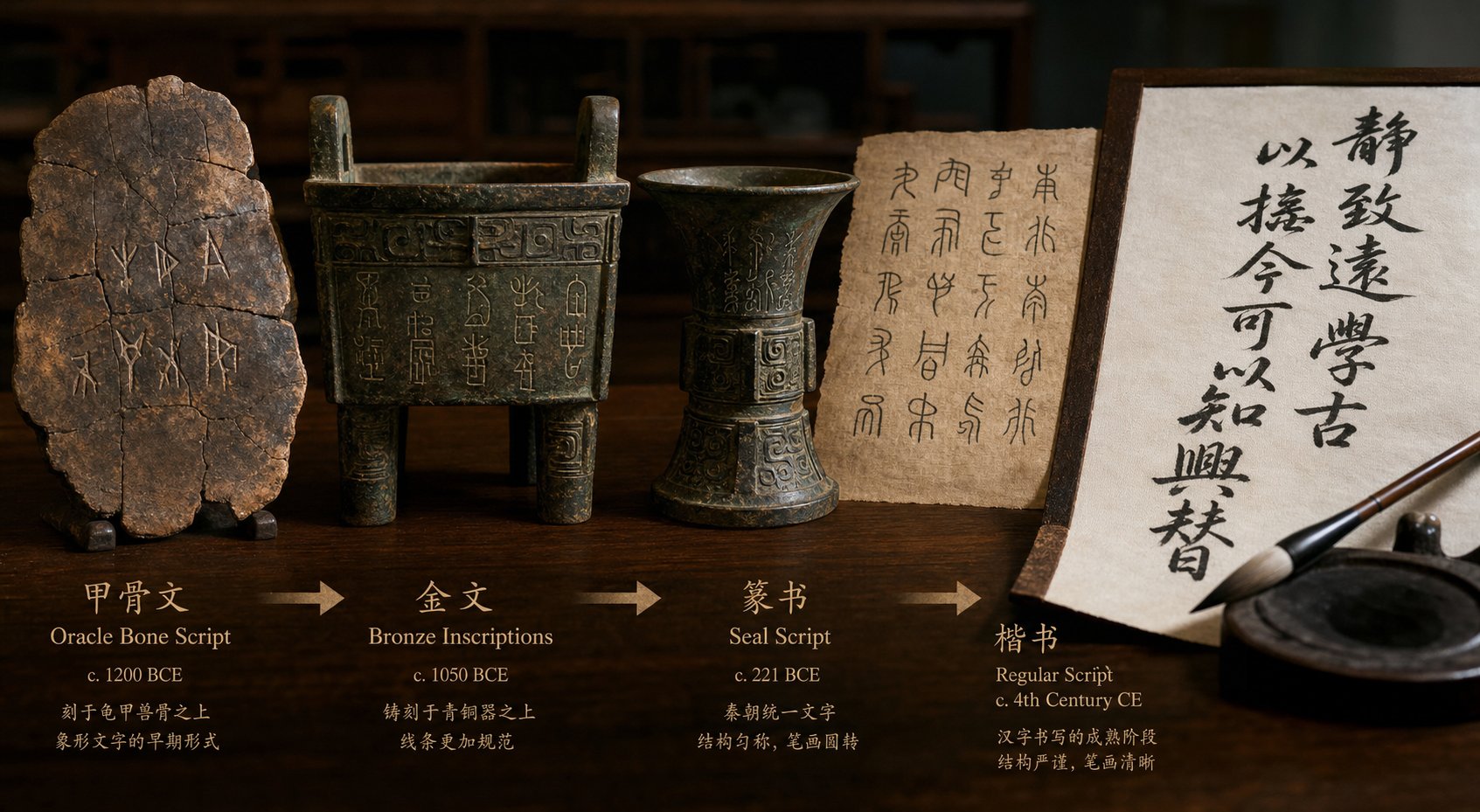
Imagine standing outside over 3,000 years ago, watching rain fall from the sky, and trying to capture that scene with a few scratches on a piece of bone. That is exactly what early Chinese scribes did. The evolution of the Chinese rain character is a visual story you can trace across centuries, and the remarkable thing is how little the core image has changed.
Oracle Bone and Bronze Script Origins
The oldest known form of 雨 appears in oracle bone script (甲骨文), dating back to the Shang Dynasty around 1200 BCE. In this earliest version, a single horizontal line stretches across the top, representing the sky or the heavens. Below that line, short vertical strokes and scattered dots hang downward, depicting water droplets falling through the air. Some oracle bone variants include a slight curved element suggesting clouds gathering above the rain. The overall impression is unmistakable: water descending from the sky.
The bronze script (金文) form, inscribed on ritual vessels during the late Shang and Zhou dynasties, keeps this same pictographic logic but adds more structure. The sky element becomes more defined, and the separation between the upper "cloud" area and the lower "raindrop" area grows clearer. The droplets are more evenly spaced, reflecting the increasing standardization of writing during this period. You can still read the image intuitively: a canopy overhead, water streaming down beneath it.
From Seal Script to Modern 雨
By the time seal script (小篆) emerged during the Warring States period and was later standardized under the Qin Dynasty, 雨 had settled into a more rectangular frame. The horizontal sky line remained on top, but the overall shape became boxier, with the raindrop elements arranged symmetrically inside an enclosed space. The four dots and a central vertical stroke illustrated water falling from clouds, maintaining the character's pictographic clarity even as the writing system grew more formal.
The transition into regular script (楷书) during the Han Dynasty gave us the modern form we use today. The top horizontal stroke still represents the sky. The 冂 shape beneath it forms a frame suggesting clouds or the atmosphere. And inside that frame, four dots sit in two rows, representing raindrops. The pictographic origin remains visible to anyone who looks: a sky above, rain falling below.
What makes this evolution fascinating is how little the core concept shifted. Unlike many Chinese characters that became abstract over millennia, 雨 kept its visual logic intact. As The Learning Lotus Project notes, there are very few differences between the current character and its pictographic oracle bone form. You can still "see" rain clouds in the modern character if you know where to look.
| Era | Approximate Period | Visual Description | Key Changes |
|---|---|---|---|
| Oracle Bone Script | c. 1200-1050 BCE | Horizontal line (sky) on top; vertical strokes and dots below depicting falling raindrops; sometimes a curved cloud element | Earliest recorded form; freehand, organic shapes |
| Bronze Script | c. 1050-500 BCE | Clearer horizontal sky line; more structured separation between cloud area and evenly spaced raindrop strokes | Greater symmetry and regularity |
| Seal Script | c. 500-200 BCE | Rectangular frame enclosing the character; four dots and a vertical line inside representing rain beneath a sky line | Standardized proportions; enclosed frame shape |
| Modern Simplified | Han Dynasty onward | Top horizontal stroke (sky) + 冂 frame (clouds) + four interior dots (raindrops) | Angular strokes replace curved lines; identical to traditional form |
| Modern Traditional | Han Dynasty onward | Same as simplified: 雨 | No difference; character was never simplified |
One detail worth noting: 雨 is one of those rare characters that looks exactly the same in both simplified and traditional Chinese. It was never altered during the simplification reforms of the 1950s, likely because its eight-stroke structure was already compact and efficient. Whether you are reading a text from Taiwan, Hong Kong, or mainland China, the character appears identical.
This pictographic continuity is what makes 雨 such a satisfying character to learn. You are not memorizing an arbitrary symbol. You are learning a miniature drawing of rain that scribes refined over three thousand years without ever losing its original meaning. And that same visual logic carries forward into every character built with the rain radical, a topic that becomes especially useful once you know how to write 雨 yourself.
How to Write 雨 Stroke Order Step by Step
Knowing the pictographic history behind 雨 gives you a mental image to work with. The next step is putting pen to paper. So how many strokes in 雨? Exactly eight. That makes it a moderately simple character, manageable for beginners yet requiring attention to proportion and sequence.
Chinese characters follow strict stroke order rules, and writing 雨 correctly means building it from top to bottom, outside to inside. Think of it this way: you are constructing a window frame first, then placing raindrops inside it.
Complete Stroke Order for 雨
Here is the full breakdown for writing the Chinese character rain step by step. Each stroke has a specific direction and placement:
- Horizontal stroke (横 heng) — Draw a straight horizontal line across the top, moving left to right. This represents the sky and forms the roof of the character. Make it the widest element.
- Vertical stroke (竖 shu) — Starting from the center of the horizontal line, draw a short vertical stroke downward. This anchors the middle of the frame and does not extend to the bottom.
- Left-side turning stroke (横折竖钩 or 竖折) — Begin slightly below the left end of the top horizontal stroke. Draw downward along the left side, then turn at the bottom-left corner to form the base of the frame's left portion. This creates the left wall and part of the floor.
- Right vertical stroke (竖 shu) — Drop a vertical stroke down from the right end of the top horizontal line, completing the right wall of the frame. The frame is now enclosed on three sides with the top bar connecting everything.
- First dot (点 dian), upper-left — Inside the frame, place a small dot in the upper-left area. Angle it slightly downward to the right, mimicking a falling raindrop.
- Second dot (点 dian), upper-right — Place a matching dot in the upper-right interior, keeping it level with the first dot.
- Third dot (点 dian), lower-left — Add a dot in the lower-left interior, positioned below and slightly offset from the first dot.
- Fourth dot (点 dian), lower-right — Complete the pattern with a final dot in the lower-right area, forming a balanced two-by-two grid of raindrops.
The overall sequence follows the standard Chinese writing principle: top before bottom, outside before inside. You build the enclosure first, then fill it with the interior elements. This is the same logic used for characters like 国 (country) and 回 (return), where outer frames always come before inner content.
Memory Tricks for Writing 雨 Correctly
Mnemonics make the difference between struggling with a character and writing it from memory after a few practice sessions. Here are approaches that work:
- The window frame method: Imagine drawing a window (the top bar and three-sided frame), then watching four raindrops land on the glass inside. Frame first, drops second.
- Sky-cloud-rain logic: The top horizontal stroke is the sky. The vertical and side strokes form the cloud layer. The four dots are rain falling from those clouds. You are literally drawing the weather from top to bottom.
- Two rows of two: The four interior dots always follow a grid pattern, two on top and two on the bottom, left before right in each row. Never write them as a single column or diagonal.
A few proportion tips will keep your character looking balanced. The outer frame should be slightly wider than it is tall, giving the character a stable, grounded appearance. The four dots inside need even spacing. Crowding them together or pushing them too close to the frame walls makes the character look cramped. Leave breathing room, as if the raindrops are genuinely falling through open air.
One practical advantage worth repeating: 雨 is identical in both simplified and traditional Chinese. It was never modified during China's script reform, so whether you are studying for the HSK exam, reading traditional texts from Taiwan, or practicing calligraphy, you only need to learn this character once. That universality, combined with its role as a radical in dozens of weather-related characters, makes mastering the stroke order here a high-value investment of your practice time.
With the physical writing down, the next question learners face is pronunciation. And 雨 has a subtle twist that most textbooks gloss over: it carries not one but two distinct readings depending on context.
Two Pronunciations of 雨 and When to Use Each
Most learners pick up the third-tone reading early on and never look back. But 雨 actually carries two distinct pronunciations, each tied to a different grammatical role. Understanding both gives you a clearer picture of how this character behaves in modern conversation versus classical texts.
雨 as yǔ in Everyday Mandarin
The pronunciation you will use 99% of the time is yǔ, spoken in the third tone (the dipping tone that falls then rises). In this reading, 雨 functions as a noun meaning "rain." It appears in virtually every common compound word related to rainfall:
- 下雨 (xia yu) — "it's raining." Here, the verb 下 (to fall, to descend) does the action work, while 雨 simply names what is falling. This is the most frequent rain-related phrase in daily Mandarin.
- 大雨 (da yu) — "heavy rain." The adjective 大 (big) modifies the noun 雨.
- 雨天 (yu tian) — "rainy day." The noun 雨 acts as a modifier for 天 (day).
- 雨季 (yu ji) — "rainy season." Again, 雨 as a noun modifying another noun.
Notice the pattern: whenever 雨 names the substance or phenomenon of rain, whether standing alone or combining with other characters, it takes the third tone. This covers all modern spoken Mandarin and the vast majority of written Chinese you will encounter in textbooks, news, and everyday life.
The Classical Verb Pronunciation yù
The second reading is yù, spoken in the fourth tone (the sharp falling tone). In this pronunciation, 雨 shifts from a noun into a verb meaning "to rain," "to rain upon," or "to fall like rain." As EWC Center notes, this verbal usage belongs to classical Chinese, where 雨 alone could express the action of raining without needing a helper verb like 下.
You will encounter yù primarily in:
- Classical texts and poetry — Ancient writers used 雨 (yù) as a standalone verb. A line like 天雨雪 (tian yù xuě) means "the sky rained snow" (it snowed), where 雨 acts as the verb "to rain down."
- Fixed literary expressions — Phrases like 雨我公田 (yù wǒ gōng tián, "rain upon our public fields") from the Book of Poetry use the fourth-tone verbal form.
- Metaphorical usage — When something "rains down" figuratively, such as grace or blessings falling upon people, classical writers employed yù to convey that image.
In modern Mandarin, you will rarely need to produce this pronunciation yourself. But recognizing it helps when reading classical poetry, studying chengyu (four-character idioms), or encountering literary references where 雨 carries verbal force.
Here is a side-by-side comparison to keep the two readings straight:
| Pinyin | Tone | Grammatical Function | Frequency of Use | Example |
|---|---|---|---|---|
| yǔ | Third tone (dipping) | Noun — "rain" | Extremely common; used in all modern contexts | 下雨了 (xia yǔ le) — "It's raining." |
| yù | Fourth tone (falling) | Verb — "to rain upon / to fall as rain" | Rare; classical Chinese, literary expressions, some idioms | 天雨雪 (tian yù xuě) — "The sky rained snow." |
A helpful way to remember: if 雨 is the thing falling, it is yǔ. If 雨 is the action of falling, it is yù. In practice, modern Chinese handles the action side with the verb-noun pair 下雨, making the fourth-tone reading largely a relic of literary tradition.
For learners focused on conversational fluency and HSK preparation, mastering yǔ in the third tone is the priority. Lock that in first. The fourth-tone yù becomes relevant later, when you begin reading classical texts or want to understand the deeper layers of certain idioms where rain acts as a verb rather than a noun.
This dual nature hints at something broader about 雨: it is not just a word but a system. The same character that functions as a standalone noun and an archaic verb also serves as a structural component inside dozens of other characters. That radical function is where 雨 truly multiplies your vocabulary.
Characters Built from the Rain Radical
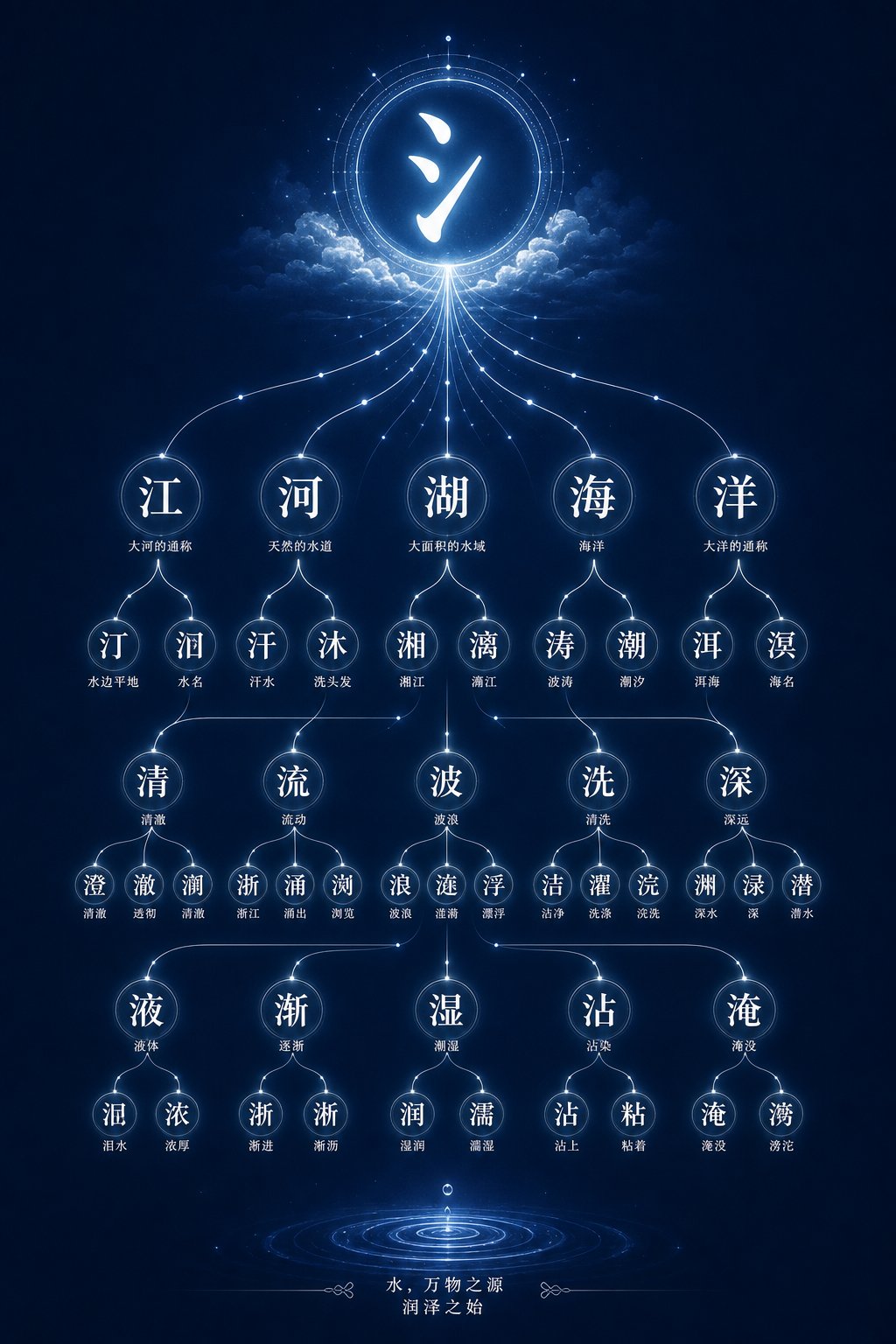
You already know 雨 as a standalone word for rain. But its real power lies in what happens when it sits on top of another component. In that position, 雨 stops being a word and becomes a signal, a semantic label telling you: "this character has something to do with weather, the sky, or atmospheric water." That single insight turns one memorized character into a decoder ring for dozens more.
Understanding 雨 as Radical 173
In the traditional Kangxi radical system, 雨 is classified as Radical 173, one of 214 radicals used to organize Chinese dictionaries. It belongs to the 8-stroke radical group, and the Kangxi Dictionary lists 298 characters under it. That is a substantial family of words, nearly all connected to weather, precipitation, or atmospheric phenomena.
When 雨 appears as an upper component in a compound character, it slightly compresses into the form ⻗, becoming a bit flatter to make room for the element below it. But its shape remains recognizable: the horizontal sky line, the frame, and the four dots. If you can spot that rain-shaped roof on an unfamiliar character, you have already narrowed down its meaning to the domain of weather.
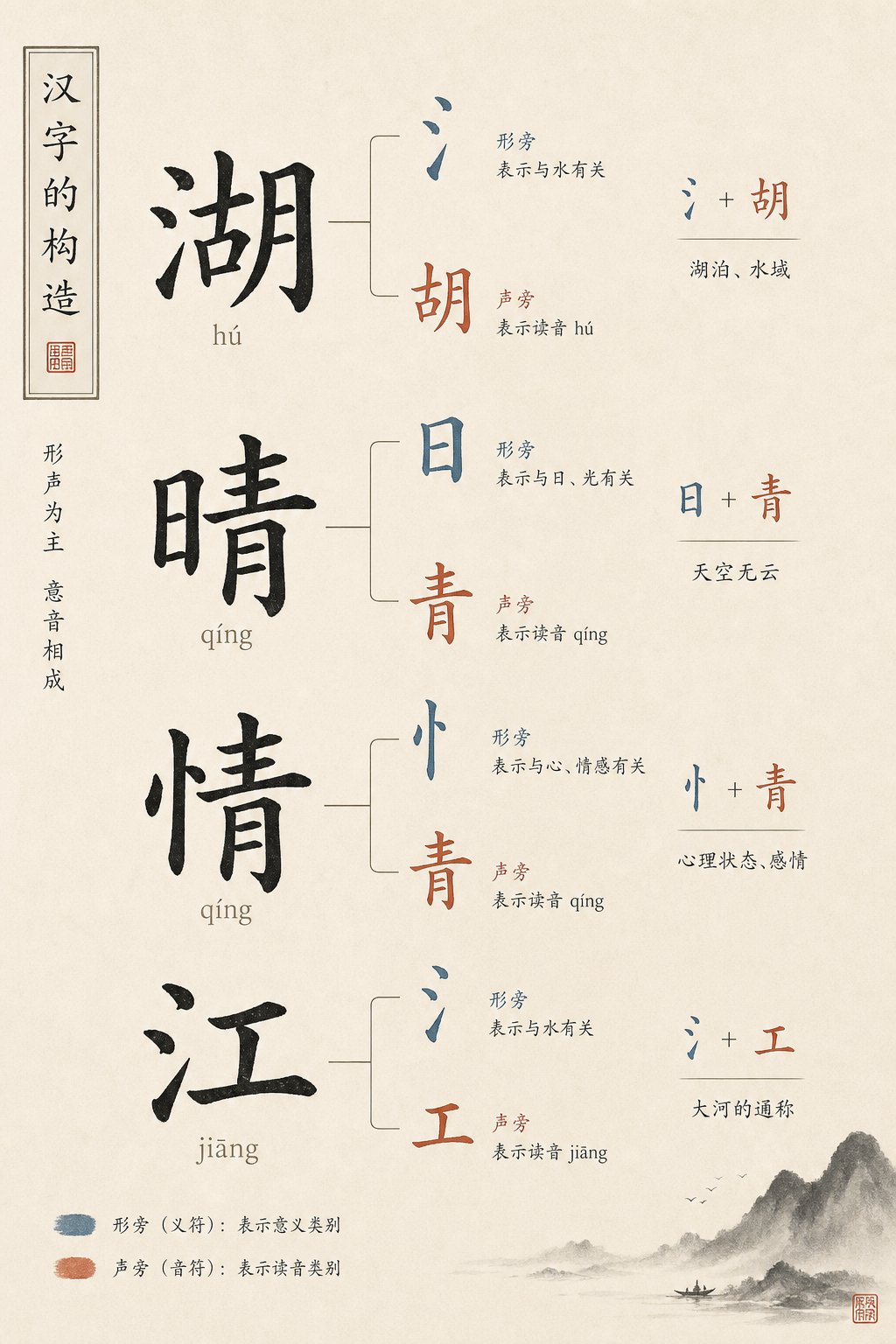
This is the radical system working as designed. Rather than memorizing hundreds of characters in isolation, you learn to read them as combinations of meaningful parts. The top part (雨) tells you the semantic category. The bottom part often hints at pronunciation or adds a secondary layer of meaning. Together, they form a logical package.
Weather Characters Built from the Rain Radical
Here is where things get practical. The characters with the rain radical cover nearly every weather phenomenon you might want to describe in Chinese. Many follow a semantic-top, phonetic-bottom structure, where 雨 provides the meaning category and the lower component provides a pronunciation clue. But several also carry mnemonic logic that makes them easier to remember visually.
Let's break down the most important ones:
| Character | Pinyin | Meaning | Component Breakdown | Memory Logic |
|---|---|---|---|---|
| 雪 | xue (third tone) | Snow | 雨 (rain) + 彐 (hand/broom) | Rain that can be swept away like powder |
| 雷 | lei (second tone) | Thunder | 雨 (rain) + 田 (field) | The rumbling sound that rolls across open fields during a storm |
| 電 / 电 | dian (fourth tone) | Lightning; electricity | 雨 (rain) + 申 (to extend) | A bolt extending and stretching down from storm clouds |
| 霜 | shuang (first tone) | Frost | 雨 (rain) + 相 (mutual) | Atmospheric water that appears paired on surfaces; phonetic hint from 相 (xiang) |
| 霧 / 雾 | wu (fourth tone) | Fog | 雨 (rain) + 務/务 (affairs) | Weather that obscures affairs and visibility; phonetic match with 务 (wu) |
| 露 | lu (fourth tone) | Dew | 雨 (rain) + 路 (road/path) | Moisture found along the path at dawn; phonetic match with 路 (lu) |
| 霖 | lin (second tone) | Prolonged rain | 雨 (rain) + 林 (forest) | Rain that falls long enough to soak an entire forest; phonetic match with 林 (lin) |
| 霞 | xia (second tone) | Rosy clouds; sunset glow | 雨 (rain) + 叚 (xia) | Colorful atmospheric light after rain clears; phonetic component provides the sound |
| 雹 | bao (second tone) | Hail | 雨 (rain) + 包 (to wrap) | Rain wrapped into solid ice balls; phonetic match with 包 (bao) |
| 霰 | xian (fourth tone) | Sleet; graupel | 雨 (rain) + 散 (to scatter) | Icy precipitation that scatters as it falls |
| 雲 / 云 | yun (second tone) | Cloud | 雨 (rain) + 云 (to say; cloud) | The atmospheric water mass from which rain falls; 云 is both phonetic and semantic |
| 零 | ling (second tone) | Zero; drizzle; to fall (of rain) | 雨 (rain) + 令 (command) | Light rain falling as if on command; phonetic match with 令 (ling) |
| 震 | zhen (fourth tone) | To shake; earthquake; shock | 雨 (rain) + 辰 (celestial body) | The shaking force of a thunderstorm; originally linked to thunder's trembling power |
| 霾 | mai (second tone) | Haze; smog | 雨 (rain) + 貍 (raccoon-like animal) | Atmospheric obscurity; now commonly used for air pollution (雾霾 wu mai) |
| 霆 | ting (second tone) | Thunderbolt | 雨 (rain) + 廷 (court) | A thunderclap as commanding as a royal court decree; phonetic match with 廷 (ting) |
| 需 | xu (first tone) | To need; to require | 雨 (rain) + 而 (and/whiskers) | Originally meant "waiting for rain" (a farmer's need); meaning extended to general necessity |
A few patterns emerge from this list. Characters describing precipitation that falls from the sky, like snow, hail, and prolonged rain, tend to have components suggesting downward motion or accumulation. Characters for phenomena that form in the atmosphere without falling, like fog and frost, often pair 雨 with phonetic components that happen to carry meanings related to obscurity or surface contact. Research in linguistic ontology has shown that the radical 雨 encodes a fundamental distinction between weather events involving downward movement (rain, snow, hail) and those involving condensation or lateral formation (fog, dew, frost), a distinction reflected in how Chinese speakers choose verbs to describe these phenomena.
You will also notice that some characters have drifted from their original weather meanings. 電 (lightning) now primarily means "electricity" and appears in words like 电话 (telephone) and 电脑 (computer). 零 (drizzle) became the word for "zero." 震 (thunder-shaking) extended to earthquakes and emotional shock. These semantic expansions happened over centuries, but the rain radical at the top still whispers the original atmospheric connection.
The practical takeaway is straightforward: whenever you encounter an unfamiliar character with ⻗ sitting on top, you can confidently guess it relates to weather, the atmosphere, or something that once did. That educated guess narrows your options dramatically and often lets you infer meaning from context without reaching for a dictionary. One radical, learned well, becomes a vocabulary multiplier that keeps paying dividends as your reading expands into new territory.
Common Words and Compounds with 雨
Recognizing the rain radical inside other characters is one skill. Building your active vocabulary with Chinese words that contain 雨 is another. The good news? Many of these compounds follow predictable patterns. A descriptive word placed before or after 雨 creates a new term whose meaning you can often guess on the spot.
Below is a practical 雨 compound words list organized by difficulty. Whether you are preparing for HSK 1 or reading Chinese news articles, you will find common rain vocabulary in Mandarin that matches your current level.
Essential 雨 Vocabulary for Beginners
If you are just starting out, these are the compounds to lock in first. They appear constantly in daily conversation, weather apps, and basic reading materials. Most follow a simple structure: an adjective or verb paired directly with 雨.
Want to know how to say heavy rain in Chinese? It is 大雨 (da yu), literally "big rain." Light rain? 小雨 (xiao yu), or "small rain." The logic is refreshingly direct.
The most essential phrase of all is 下雨 (xia yu), meaning "to rain" or "it's raining." The verb 下 (to fall, to descend) combines with the noun 雨 to describe the action of rainfall. You will hear this in weather forecasts, casual conversation, and text messages every time clouds roll in. A related term from the TouchChinese vocabulary system is 毛毛雨 (mao mao yu), meaning drizzle, literally "hair-hair rain," describing rain so fine it feels like tiny hairs brushing your skin.
Here is the full beginner set:
| Characters | Pinyin | Literal Meaning | Natural English Translation | Usage Notes |
|---|---|---|---|---|
| 下雨 | xia yu | fall + rain | To rain / It's raining | Spoken and written; the most common rain phrase in Mandarin |
| 大雨 | da yu | big + rain | Heavy rain | Daily conversation and weather reports |
| 小雨 | xiao yu | small + rain | Light rain / drizzle | Daily conversation and weather reports |
| 中雨 | zhong yu | middle + rain | Moderate rain | Weather forecasts; less common in casual speech |
| 雨天 | yu tian | rain + day | Rainy day | Spoken and written; used to describe weather conditions |
| 雨水 | yu shui | rain + water | Rainwater | General use; also the name of a traditional solar term |
| 毛毛雨 | mao mao yu | hair-hair + rain | Drizzle / fine rain | Conversational; vivid and commonly used in speech |
| 雨衣 | yu yi | rain + clothing | Raincoat | Everyday vocabulary for clothing and weather gear |
| 雨伞 | yu san | rain + umbrella | Umbrella | High-frequency daily word |
Notice how the beginner compounds split into two structural patterns. In 下雨, the verb comes first and 雨 acts as the object. In 大雨 and 小雨, the adjective comes first and modifies 雨 as a noun. And in 雨天, 雨衣, and 雨伞, the character 雨 flips to the front, acting as a modifier itself ("rain-type day," "rain-type clothing"). Recognizing these patterns helps you decode new compounds before you even look them up.
Intermediate and Advanced Rain Compounds
Once the basics feel comfortable, you can expand into terms that appear in news broadcasts, literature, and more formal contexts. These compounds often combine 雨 with other weather characters or use it in multi-syllable expressions that carry richer descriptive power.
| Characters | Pinyin | Literal Meaning | Natural English Translation | Usage Notes |
|---|---|---|---|---|
| 暴雨 | bao yu | violent + rain | Torrential rain / downpour | Weather alerts, news reports, daily speech during storms |
| 雷雨 | lei yu | thunder + rain | Thunderstorm | Weather forecasts; also the title of a famous Chinese play |
| 雨季 | yu ji | rain + season | Rainy season / monsoon season | Geography, travel planning, written Chinese |
| 梅雨 | mei yu | plum + rain | Plum rain season (East Asian monsoon) | Regional term for the June-July rainy period in the Yangtze River area |
| 酸雨 | suan yu | acid + rain | Acid rain | Scientific and environmental contexts |
| 阵雨 | zhen yu | burst + rain | Shower (brief rainfall) | Weather forecasts; very common in meteorological language |
| 暴风雨 | bao feng yu | violent + wind + rain | Storm / tempest | News, literature, and figurative use ("weathering a storm") |
| 雷阵雨 | lei zhen yu | thunder + burst + rain | Thundershower | Standard weather forecast terminology |
| 风雨无阻 | feng yu wu zu | wind + rain + no + obstruction | Rain or shine / regardless of obstacles | Idiomatic; used in both speech and writing to express determination |
| 雨过天晴 | yu guo tian qing | rain + pass + sky + clear | The sky clears after rain | Figurative: things improve after difficulty; literary and conversational |
A few of these deserve extra attention. 梅雨 (mei yu, "plum rain") refers to the prolonged rainy season that hits eastern China, Taiwan, Korea, and Japan roughly from mid-June through July. It gets its name because the rains coincide with the ripening of plums. If you travel to Shanghai or Nanjing during this period, you will hear the term constantly.
暴风雨 (bao feng yu) is worth breaking down character by character: 暴 (violent, sudden) + 风 (wind) + 雨 (rain) = a storm with both wind and rain. Berlitz's weather vocabulary guide lists this as one of the essential extreme weather terms for Chinese learners. It also works figuratively, much like "storm" does in English, to describe turbulent situations in life or business.
风雨无阻 (feng yu wu zu) crosses the line from vocabulary into idiom territory. Literally "wind and rain, no obstruction," it means something will happen regardless of bad weather or difficult circumstances. You will see it on delivery service ads, event announcements, and motivational posters. It is one of those expressions that bridges everyday speech and literary Chinese, comfortable in both registers.
One practical pattern to notice across both tables: Chinese weather vocabulary scales intensity through simple word substitution. The progression from 毛毛雨 (drizzle) to 小雨 (light rain) to 中雨 (moderate rain) to 大雨 (heavy rain) to 暴雨 (torrential rain) follows a clean intensity ladder. Each step swaps one modifier while keeping 雨 constant. This makes the system easy to learn and easy to use in real time when describing conditions outside your window.
These compounds give you the building blocks for talking about weather in practical terms. But Chinese speakers do not stop at description. They weave rain into proverbs and four-character idioms that carry centuries of cultural wisdom, turning a weather word into a vehicle for philosophy, advice, and emotional expression.
Chinese Idioms and Proverbs About Rain
Four-character idioms, known as 成语 (chengyu), are where the Chinese language gets truly poetic. These compact expressions pack entire stories, moral lessons, and cultural attitudes into just four syllables. And rain shows up in them constantly, not as a simple weather description but as a metaphor for everything from political turmoil to gentle mentorship.
Why does rain carry so much figurative weight? In an agricultural civilization that depended on seasonal rainfall for survival, rain was never just water falling from the sky. It represented fate, hardship, nourishment, and timing. Too much rain meant floods and disaster. Too little meant famine. Rain arriving at the right moment meant prosperity. These lived realities crystallized into idioms that Chinese speakers still use daily, thousands of years later.
Here are four essential rain-related chengyu, each with the depth of explanation they deserve.
Classical Idioms Featuring 雨
风调雨顺 (feng tiao yu shun) — Harmonious winds and timely rains
Character-by-character: 风 (wind) + 调 (harmonious, well-regulated) + 雨 (rain) + 顺 (smooth, favorable)
Figurative meaning: Favorable conditions; a peaceful and prosperous era. Everything is going well.
Cultural context: In ancient China, whether the harvest succeeded or failed depended entirely on weather patterns. When winds blew gently and rains arrived on schedule, crops thrived and people ate. This idiom originally described ideal agricultural weather but expanded to mean any period of smooth, untroubled circumstances. It frequently appears in official language and New Year greetings, expressing hope for national stability and good fortune.
Modern example: 今年风调雨顺,农民们都很高兴。(Jinnian feng tiao yu shun, nongminmen dou hen gaoxing.) — "This year the weather has been favorable, and the farmers are all happy."
未雨绸缪 (wei yu chou mou) — Repair the window before it rains
Character-by-character: 未 (not yet) + 雨 (rain) + 绸缪 (to bind tightly, to repair)
Figurative meaning: To prepare for trouble before it arrives. Plan ahead.
Cultural context: This idiom carries one of the richest origin stories in the chengyu canon. After the death of King Wu of the Zhou Dynasty, his young son King Cheng inherited the throne, with the king's brother, the Duke of Zhou, serving as regent. When political enemies spread rumors to divide the uncle and nephew, the duke wrote to the young king warning him to prepare defenses: "Before it rains, I will repair the door and the window." Eventually King Cheng recognized the wisdom, invited his uncle back, and together they suppressed a revolt. The duke's foresight became this idiom, a reminder that the best time to fix a problem is before it becomes one.
Modern example: 公司应该未雨绸缪,提前做好应对经济下行的准备。(Gongsi yinggai wei yu chou mou, tiqian zuohao yingdui jingji xiaxing de zhunbei.) — "The company should plan ahead and prepare for an economic downturn before it hits."
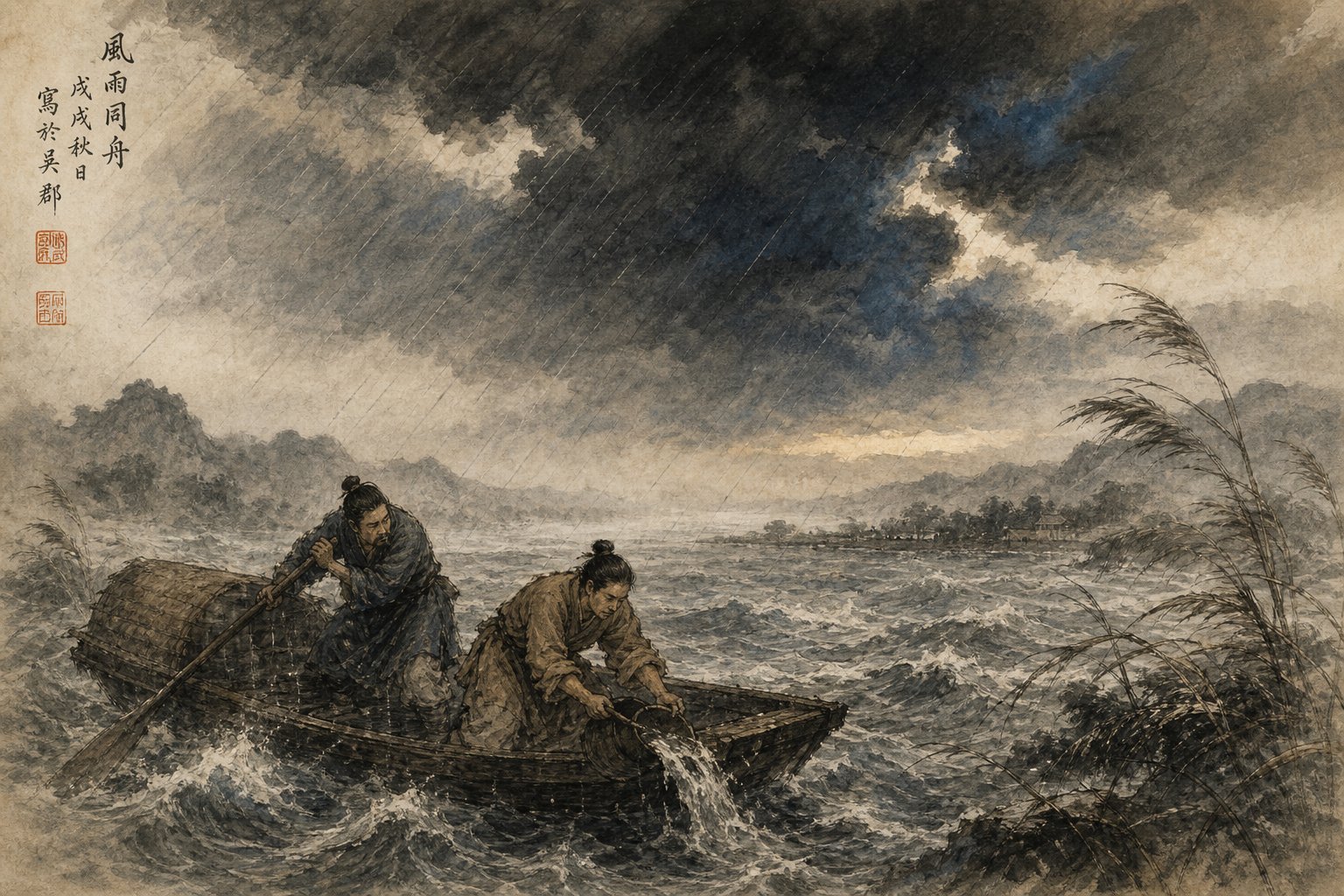
风雨同舟 (feng yu tong zhou) — Wind and rain, same boat
Character-by-character: 风 (wind) + 雨 (rain) + 同 (same, together) + 舟 (boat)
Figurative meaning: To weather hardship together; to stand by each other through difficult times.
Cultural context: The image is vivid: two people sharing a small boat in a storm, with no choice but to cooperate and endure together. This idiom traces back to Sun Tzu's Art of War, where he observed that even enemies from the rival states of Wu and Yue would help each other if caught in the same boat during a storm. The expression has since become one of the most commonly used Chinese idioms about rain, appearing in wedding speeches, business partnerships, and political rhetoric whenever solidarity is the theme. The related idiom 同舟共济 (tong zhou gong ji) carries a nearly identical meaning.
Modern example: 这对夫妻风雨同舟三十年,感情非常深厚。(Zhe dui fuqi feng yu tong zhou sanshi nian, ganqing feichang shenhou.) — "This couple has weathered storms together for thirty years, and their bond is incredibly deep."
春风化雨 (chun feng hua yu) — Spring wind transforms into rain
Character-by-character: 春 (spring) + 风 (wind) + 化 (to transform, to nurture) + 雨 (rain)
Figurative meaning: Gentle, nurturing influence, especially in education. Teaching that transforms students naturally, without force.
Cultural context: This poetic metaphor draws from agricultural wisdom: spring breezes and gentle rains nurture plants without forcing growth. The imagery was applied to education during the Han Dynasty, where the ideal teacher was compared to spring weather that coaxes life from the soil rather than demanding it. Tang Dynasty scholar Han Yu popularized the concept, describing how effective mentors influence students subtly and naturally. Modern educators still reference this idiom when discussing student-centered approaches that prioritize gentle guidance over rigid instruction.
Modern example: 王老师春风化雨的教学方式深受学生喜爱。(Wang laoshi chun feng hua yu de jiaoxue fangshi shen shou xuesheng xi'ai.) — "Teacher Wang's gentle, nurturing teaching style is deeply loved by students."
How to Use Rain Idioms in Context
A pattern runs through all four idioms: rain never means just rain. It functions as a stand-in for larger forces acting on human life. In 风调雨顺, rain represents the conditions for prosperity. In 未雨绸缪, it represents approaching trouble. In 风雨同舟, it represents shared hardship. And in 春风化雨, it represents the quiet power of nurturing influence.
This dual symbolism, rain as both challenge and blessing, reflects the worldview of an agricultural society that could not control the weather but had to live intelligently within its rhythms. The same rain that destroyed one farmer's crops saved another's. Context determined whether rain was a gift or a threat, and Chinese idioms preserve that ambiguity beautifully.
A few practical tips for using these expressions naturally:
- 风调雨顺 works best in formal contexts: speeches, written blessings, and official statements about national conditions.
- 未雨绸缪 fits both casual and professional settings. You can use it in a business meeting or in advice to a friend.
- 风雨同舟 carries emotional weight. Reserve it for relationships and partnerships where genuine hardship has been shared.
- 春风化雨 is almost exclusively used to praise teachers, mentors, or leaders whose influence feels effortless and kind.
These idioms also reveal something about how deeply rain is woven into Chinese philosophical thought. The character 雨 is not merely a weather label in this tradition. It is a cultural symbol with layers of meaning that shift depending on context, season, and the human situation it describes. That symbolic richness extends well beyond idioms into poetry, philosophy, and the traditional calendar itself.
Rain in Chinese Culture, Philosophy, and Poetry
Idioms compress cultural attitudes into four syllables, but the rain symbolism in Chinese culture runs far deeper than any single expression. For thousands of years, rain shaped how Chinese thinkers understood the cosmos, how rulers justified their power, and how poets gave voice to emotions too complex for plain speech. Understanding this cultural layer transforms 雨 from a vocabulary word into a window on Chinese civilization itself.
Rain in Chinese Philosophy and Religion
In Daoist thought, rain embodies the principle of natural circulation. Water rises from rivers and lakes as vapor, gathers in clouds, and returns to earth as rain, only to flow back into rivers and begin again. This endless cycle mirrors the Dao itself: giving without depleting, returning without demanding. The Dao De Jing compares the highest virtue to water, which benefits all things without competing. Rain, as water in its most generous form, falling freely on everything below, became a natural symbol for this selfless nourishment.
Confucian philosophy took a different angle. Here, timely rain symbolized good governance. A ruler who brought prosperity to the people was compared to rain arriving at the perfect moment for crops. The logic was straightforward: just as farmers depend on seasonal rainfall they cannot control, citizens depend on wise leadership they cannot provide for themselves. When a dynasty enjoyed 风调雨顺 (harmonious winds and timely rains), it was read as heaven's endorsement of the emperor's virtue. Drought or flood, by contrast, signaled moral failure at the top. This connection between rainfall and political legitimacy persisted for millennia in Chinese political thought.
On the religious side, rain was never left to chance. In traditional Chinese folk religion, the Dragon King (龙王, Long Wang) controlled rainfall from his underwater palace. Communities across China built Dragon King temples and performed elaborate rain prayer rituals (祈雨, qi yu) during droughts. These ceremonies involved processions, offerings of food and incense, and sometimes theatrical performances meant to please the dragon and coax him into releasing water. The practice reflects how sacred rain was in agricultural Chinese society: it was not merely weather but a divine gift that required proper spiritual relationships to receive.
Even the traditional Chinese calendar encodes this reverence. 雨水 (Yushui), literally "Rain Water," is one of the 24 solar terms that divide the Chinese agricultural year. Falling around February 18-20, it marks the moment when temperatures rise enough for precipitation to shift from snow to rain. Ice melts, rivers flow more vigorously, and the earth softens for plowing. The traditional proverb 春雨贵如油 ("spring rain is as precious as oil") captures the farmer's attitude perfectly: early spring rainfall was not just welcome but essential, the difference between a full harvest and an empty one.
Rain as Poetic Symbol in Chinese Literature
Chinese poets did not simply describe rain. They used it as an emotional vocabulary, assigning different feelings to different types of rainfall depending on season, time of day, and setting. If you read classical Chinese poetry with any regularity, you will notice these patterns repeating across centuries:
- Spring rain suggests renewal, gentle love, and quiet hope. It falls softly, nurturing new growth without violence. Du Fu's famous couplet captures this perfectly: the rain "knows" the right season to come and slips in silently on the spring breeze.
- Autumn rain evokes melancholy, separation, and the passage of time. As leaves fall and temperatures drop, rain becomes a backdrop for loneliness and nostalgia. Poets separated from loved ones frequently set their grief against a curtain of autumn rain.
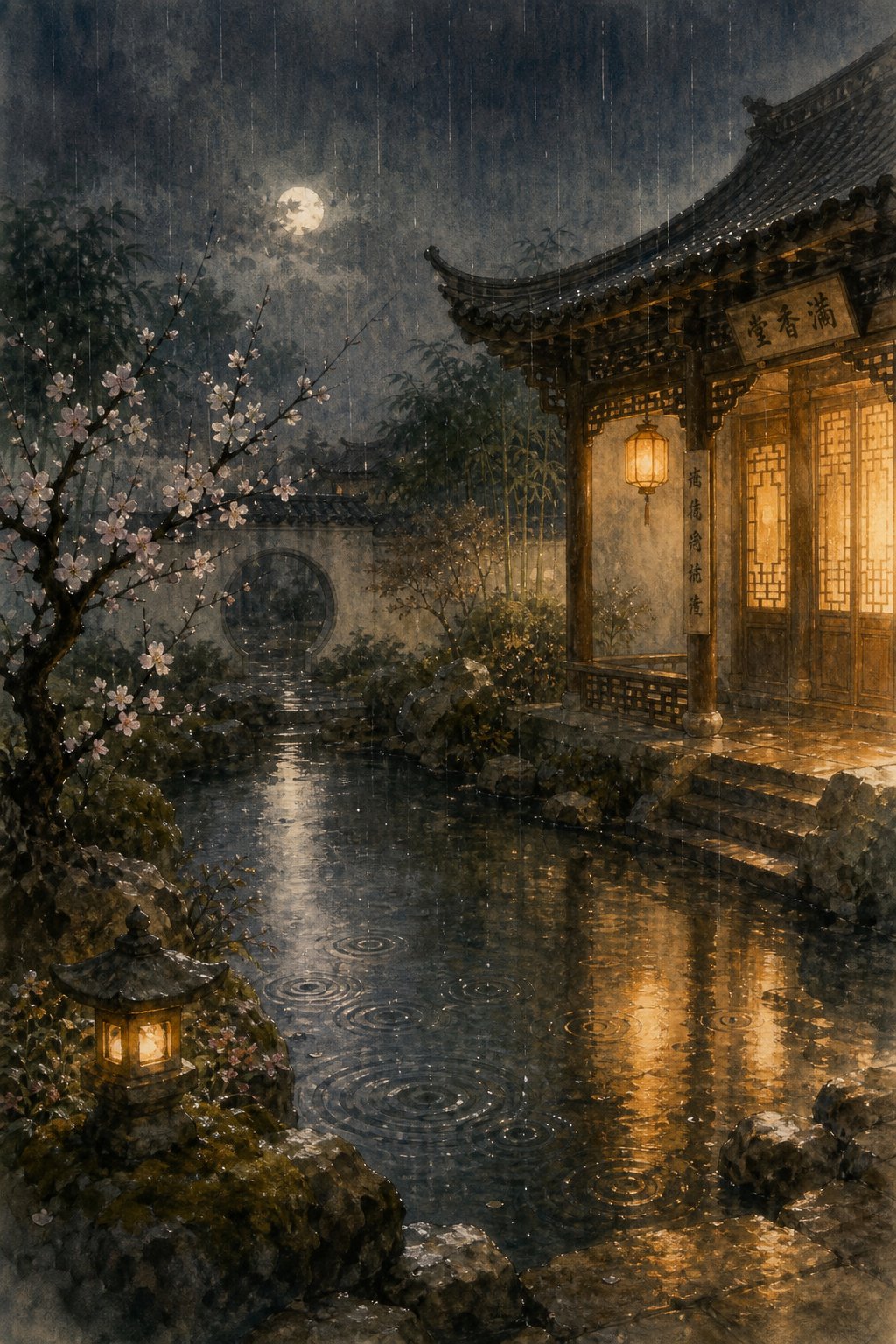
- Night rain implies solitude and longing. The sound of rain on a roof in darkness, when the world is quiet and the mind wanders, became one of the most emotionally charged images in Chinese verse.
- Sudden rain represents unexpected change, disruption, or the dramatic turns of fate. A storm breaking over a landscape mirrors upheaval in human affairs.
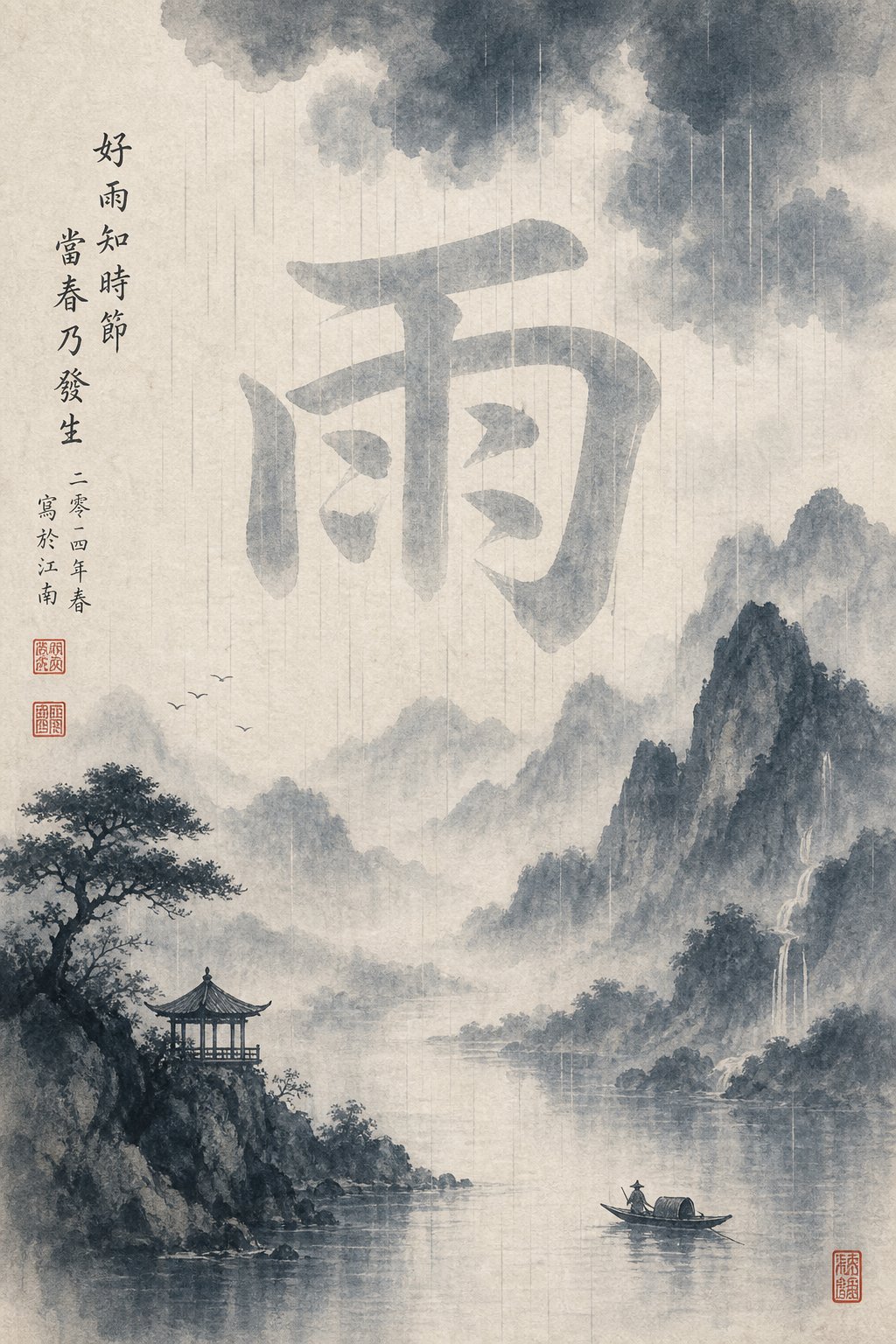
One of the most celebrated rain poems in Chinese literature comes from the Tang Dynasty poet Du Fu (杜甫). His "Spring Night Rejoicing in Rain" (春夜喜雨) opens with lines that every Chinese student memorizes:
好雨知时节,当春乃发生。(Hao yu zhi shijie, dang chun nai fasheng.) — "Good rain knows its season; when spring arrives, it comes to life."
The genius of these lines lies in personification. Du Fu treats rain as a conscious being that understands timing, arriving precisely when the earth needs it most. The poem continues to describe rain falling silently at night, moistening everything without fanfare, and the poet waking to find flowers heavy with water in the morning. It is a celebration of quiet, perfectly timed generosity, the same quality Daoists admired in water and Confucians admired in good rulers.
Another iconic example comes from the late Tang poet Li Shangyin (李商隐), whose "Night Rain: A Note to the North" (夜雨寄北) uses rain to express the ache of separation. Writing to his wife from a distant posting, he describes listening to autumn rain fill the pools outside his window while imagining a future night when they will sit together, trimming candle wicks and talking about this very rainy evening. The rain in Chinese poetry meaning here is layered: it is both the present loneliness and the imagined future comfort, the distance and the hope of reunion held in a single image.
This poetic tradition did not end with the Tang Dynasty. Song Dynasty ci poets, Ming Dynasty dramatists, and modern Chinese writers all inherited the same symbolic vocabulary. Rain remains one of the most emotionally versatile images in Chinese literature, capable of expressing joy, sorrow, hope, and resignation depending entirely on context. When you encounter 雨 in a poem or literary passage, ask yourself: what season is it? What time of day? Is the speaker alone or with others? The answers will tell you what the rain means far more precisely than any dictionary definition.
This cultural depth is what separates truly understanding the Chinese character for rain from merely knowing its translation. The character carries an entire civilization's relationship with the sky, encoded in eight strokes. And that relationship extends beyond China's borders. The same character, with the same radical function and much of the same cultural resonance, traveled across East Asia into Japanese and Korean writing systems, where it continues to build vocabulary and carry meaning in parallel traditions.
雨 Across Chinese and Japanese Writing Systems
The rain character in East Asian languages did not stop at China's borders. When the Chinese writing system spread to Japan, Korea, and Vietnam centuries ago, 雨 traveled with it, carrying its meaning, its radical function, and much of its cultural symbolism intact. For anyone studying more than one East Asian language, this shared heritage is a genuine advantage: learn 雨 once, and you have a head start in multiple writing systems.
雨 in Japanese as Kanji
In Japanese, 雨 functions as a kanji (漢字, literally "Chinese character") with the same core meaning: rain. The character looks identical, carries the same 8-stroke count, and uses the same stroke order you already know from Chinese. What changes is pronunciation. Japanese kanji typically carry two types of readings, and 雨 is no exception.
The on'yomi (音読み, "sound reading") is う (u). This reading derives from the original Chinese pronunciation that Japanese scholars imported along with the character itself. You will find it in formal, Sino-Japanese compound words like 雨天 (うてん, uten, "rainy weather") and 雨量 (うりょう, uryou, "amount of rainfall"). These compounds mirror the structure of Chinese vocabulary, combining two kanji to form a meaning, and the on'yomi reading signals that Chinese-origin layer.
The kun'yomi (訓読み, "meaning reading") is あめ (ame). This is the native Japanese word for rain, which existed in the spoken language long before Chinese characters arrived. When 雨 stands alone or appears in native Japanese compounds, it takes this reading. Saying "it's raining" in Japanese uses this form: 雨が降る (ame ga furu). The kun'yomi also appears in a modified form, あま (ama), when 雨 acts as a prefix in compound words like 雨雲 (あまぐも, amagumo, "rain cloud") and 雨戸 (あまど, amado, "storm shutter").
This dual-reading system is unique to Japanese. In Chinese, 雨 has its two tonal variants (yǔ and yù), but in Japanese, the split runs along a completely different axis: Chinese-origin pronunciation versus native Japanese pronunciation. Knowing which reading to use depends on the word's structure and origin, something that becomes intuitive with exposure.
As a radical, 雨 behaves identically in Japanese. It sits atop weather-related kanji like 雪 (yuki, snow), 雷 (kaminari, thunder), and 雲 (kumo, cloud), signaling the same atmospheric meaning category. The JLPT N5 kanji list includes 雨 as one of the foundational characters Japanese learners must master early, precisely because of its high frequency and radical productivity.
Shared Usage Across Chinese and Japanese
What makes this cross-linguistic connection practical? Many compounds built with 雨 share both their written form and their meaning across the two languages, even though pronunciation differs completely. If you already know the Chinese word, you can often read and understand the Japanese equivalent on sight, and vice versa.
| Character / Compound | Chinese Pronunciation | Japanese Pronunciation | Meaning |
|---|---|---|---|
| 雨 | yǔ | あめ (ame) / う (u) | Rain |
| 雨天 | yǔ tian | うてん (uten) | Rainy weather |
| 大雨 | da yǔ | おおあめ (ōame) | Heavy rain |
| 雷雨 | lei yǔ | らいう (raiu) | Thunderstorm |
| 梅雨 | mei yǔ | つゆ (tsuyu) / ばいう (baiu) | Plum rain / rainy season |
| 雨量 | yǔ liang | うりょう (uryō) | Rainfall amount |
| 風雨 | feng yǔ | ふうう (fūu) | Wind and rain |
| 雨季 | yǔ ji | うき (uki) | Rainy season |
Notice how 梅雨 is particularly interesting. In Chinese, it reads mei yǔ and refers to the plum rain season along the Yangtze River valley. In Japanese, the same characters describe the same meteorological phenomenon (Japan's June-July rainy season) but take the exceptional reading つゆ (tsuyu), a native Japanese word whose etymology likely connects to 露 (tsuyu, dew) or 潰ゆ (tsuiyu, to rot), reflecting how the persistent moisture causes mold and decay. As Imabi's extensive rain vocabulary guide notes, 梅雨 may also be read with its on'yomi as バイウ (baiu), especially in meteorological compounds like 梅雨前線 (baiu zensen, "seasonal rain front").
Japanese also developed an extraordinarily rich vocabulary of rain-related words that goes far beyond what exists in Chinese. Words like 時雨 (しぐれ, shigure, intermittent late-autumn rain), 五月雨 (さみだれ, samidare, early summer rain), and 夕立 (ゆうだち, yūdachi, sudden summer evening shower) describe specific types of rainfall with a precision that reflects Japan's wet climate and its literary tradition of seasonal awareness. Many of these words use 雨 either as a kanji component or as a suffix read as -ame or -same, demonstrating how the rain character remains productive in Japanese word formation centuries after its adoption.
Korean also inherited 雨 through the hanja (漢字) system, where it carries the reading 우 (u). While modern Korean primarily uses its native alphabet (hangul) for everyday writing, hanja knowledge remains important for academic and legal contexts, and the character 雨 appears in Korean vocabulary like 우천 (ucheon, rainy weather) and 우산 (usan, umbrella) in exactly the same semantic patterns.
The practical takeaway for language learners is clear: mastering the rain kanji meaning in Japanese or the Chinese character for rain gives you transferable knowledge. The character's shape, its radical function, and its core meaning remain constant across borders. Only the pronunciation changes. If you are studying both Chinese and Japanese, or considering adding one to the other, 雨 is a perfect example of how shared kanji create bridges between the two languages rather than barriers. One character, learned deeply in either language, pays dividends in both.
Frequently Asked Questions About the Chinese Character for Rain
1. What does the Chinese character 雨 mean and how is it pronounced?
The character 雨 means rain in Chinese. Its primary pronunciation is yǔ (third tone), functioning as a noun in everyday Mandarin. It also has a rare classical pronunciation yù (fourth tone) used as a verb meaning 'to rain upon,' found mainly in ancient texts and literary expressions. For modern learners, yǔ is the essential pronunciation to master first, as it appears in all common compounds like 下雨 (xià yǔ, it's raining) and 大雨 (dà yǔ, heavy rain).
2. How many strokes does 雨 have and what is the correct stroke order?
雨 consists of exactly 8 strokes. The correct order follows the top-to-bottom, outside-to-inside principle: (1) horizontal stroke across the top representing the sky, (2) short vertical stroke from center, (3) left-side turning stroke forming the frame's left wall, (4) right vertical stroke completing the frame, and (5-8) four dots inside arranged in a two-by-two grid representing raindrops. A helpful mnemonic is to draw the window frame first, then place four raindrops inside it.
3. Why is 雨 important as a radical in Chinese characters?
雨 serves as Radical 173 in the Kangxi system, appearing at the top of characters to signal a connection to weather or atmospheric phenomena. The Kangxi Dictionary lists 298 characters under this radical. Recognizing the rain radical lets you immediately identify weather-related characters like 雪 (snow), 雷 (thunder), 霜 (frost), 雾 (fog), 露 (dew), and 雹 (hail). This makes 雨 a vocabulary multiplier — learning one radical helps you decode dozens of related characters on sight.
4. Is the rain character 雨 the same in simplified and traditional Chinese?
Yes, 雨 is identical in both simplified and traditional Chinese writing systems. It was never modified during China's script simplification reforms of the 1950s because its 8-stroke structure was already compact and efficient. This means learners only need to memorize one form regardless of whether they study mainland Chinese (simplified), Taiwanese (traditional), or Hong Kong (traditional) materials. The character also appears unchanged as a kanji in Japanese.
5. What are the most common Chinese idioms about rain and what do they mean?
Four widely used rain idioms include: 风调雨顺 (fēng tiáo yǔ shùn) meaning favorable conditions and prosperity; 未雨绸缪 (wèi yǔ chóu móu) meaning to prepare before trouble arrives; 风雨同舟 (fēng yǔ tóng zhōu) meaning to weather hardship together; and 春风化雨 (chūn fēng huà yǔ) meaning gentle, nurturing education. In Chinese idioms, rain rarely refers to literal weather — it symbolizes hardship, nourishment, or the forces of fate acting on human life.