The Sima Surname and Its Ancient Military Origins
Sima is a two-character Chinese compound surname derived from an ancient military office responsible for managing horses and commanding armed forces. The name traces back to the Western Zhou dynasty, where it designated one of the highest-ranking positions in the imperial bureaucracy. Over centuries, this bureaucratic title transformed into a hereditary family name, producing emperors, historians, and strategists who shaped the course of Chinese civilization.
Imagine a job title so powerful that it eventually replaced your family's original name. That is exactly what happened with Sima, and the story of how it unfolded reveals a fascinating window into how Chinese surnames actually formed.
What Does Sima Mean as a Surname
The Sima surname origin and meaning is rooted in two Chinese characters that together describe a specific governmental role.
Sima (司马) combines "si" (司), meaning "to manage" or "to control," with "ma" (马), meaning "horse." Its literal translation is "administrator of the horses," though its actual function encompassed far broader military authority, equivalent to a Master of Horse or Minister of War.
In practice, the Sima office first appears in texts dating from the Western Zhou dynasty and continued through the Spring and Autumn period and Warring States period. The role was not simply about managing cavalry stables. Holders of this title oversaw military logistics, commanded armed forces, and sat among the most powerful officials in the realm. During the Eastern Han dynasty, the expanded title "Grand Sima" (大司马) formally meant Minister of War, one of the Three Ducal Ministers serving directly under the emperor.
Because horses were the backbone of ancient military power, controlling them meant controlling the state's capacity for war. The person who held the Sima title wielded influence comparable to a modern defense minister. When descendants of these officeholders needed a surname, the title they were known by became the obvious choice.
Why Compound Surnames Matter in Chinese Culture
Most Chinese surnames consist of a single character. Compound surnames, those with two or more characters, represent a rare and culturally significant category. China currently has fewer than 100 active compound surnames, down from over 1,000 in ancient times. They carry a sense of historical weight and poetic beauty that single-character names often lack.
Among these surviving compound surnames, Sima stands out for the sheer scale of its historical impact. Consider what this single name connects to:
- The foundational text of Chinese historiography (Sima Qian's Records of the Grand Historian)
- An entire imperial dynasty (the Jin dynasty, 265-420 CE)
- Major works of political philosophy and military strategy
The most popular compound surname today is Ouyang, used by over 1.1 million people. Sima ranks further down the list, yet its cultural footprint dwarfs many more common names. This gap between population size and historical significance makes the Chinese compound surname Sima history one of the most compelling stories in East Asian genealogy.
The real question is not just what the name means, but how a government job title made that leap into a permanent family identity, one that would eventually sit on an imperial throne.
How a War Office Title Became a Hereditary Name
The leap from job title to family name did not happen overnight. It unfolded across generations within a specific institutional framework, one that gave certain officeholders so much visibility that their titles became inseparable from their personal identities. To understand how Chinese official titles became surnames, you need to look at the bureaucratic architecture of the Zhou dynasty and the social mechanics that turned a position into a bloodline marker.
The Three Excellencies and Military Administration
During the Zhou dynasty, the highest tier of government below the Son of Heaven was organized around three paramount offices collectively known as the Three Excellencies (San Gong). These three positions divided the essential functions of the state:
- Sima (司马) - the Minister of War, presiding over military affairs and "Heaven"
- Situ (司徒) - the Minister of Education, presiding over civil affairs and "men"
- Sikong (司空) - the Minister of Works, presiding over land, water, and construction
Notice the shared character "si" (司) in all three titles. It means "to administer" or "to preside over," signaling that each holder managed a critical domain of governance. Together, these officials formed the backbone of Zhou dynasty administration, with all three holding equal status beneath the ruler.
The Sima office carried particular weight because it controlled the state's military capacity. In an era when cavalry determined the outcome of wars and the survival of kingdoms, the Sima was responsible for managing horses, overseeing military logistics, and commanding armed forces in the field. The role first appears in texts from the Western Zhou and continued through the Spring and Autumn and Warring States periods, adapting its scope as political structures evolved. By the Eastern Han dynasty, the expanded title "Grand Sima" had become synonymous with supreme military authority, one of the Three Ducal Ministers serving directly under the emperor.
What made this office different from a modern cabinet position? Permanence. These were not rotating appointments in the way we think of elected officials. Families associated with a particular office often held it across multiple generations, creating a deep identification between the role and the lineage occupying it.
How an Official Title Became a Family Name
So how exactly did a bureaucratic designation crystallize into a hereditary surname? The process of hereditary surname formation in ancient China followed a recognizable pattern, driven by social convention rather than any single decree. Here is the step-by-step transformation:
- Appointment and identification. An individual was appointed to the Sima office. In daily life, court records, and public discourse, this person was referred to by their title rather than their personal name. "Sima" became how others knew them.
- Generational repetition. The officeholder's sons or grandsons inherited the position, or at minimum inherited the social association with it. People in the community continued to call the family "the Sima household" regardless of whether the current generation still held the post.
- Title displaces original surname. Over time, the original single-character surname of the family faded from common use. The title-based identifier became the primary way to distinguish this clan from others, effectively functioning as their surname in all social contexts.
- Formal adoption as hereditary name. Once several generations had passed, the association became permanent. Descendants who had never held the office still carried the name Sima as their fixed, hereditary surname. The bureaucratic origin was forgotten by most, and the compound word simply meant "our family."
This pattern was not unique to the Sima office. The same mechanism produced the Situ and Sikong surnames from the other two Excellencies. Families associated with the Minister of Education became surnamed Situ, and those linked to the Minister of Works became Sikong. All three compound surnames share identical structural origins in the Zhou dynasty Three Excellencies system.
Yet among these title-derived names, Sima became by far the most prominent. Why? Partly because military authority carried greater prestige and visibility than civil or engineering roles. Partly because Sima-surnamed individuals went on to achieve extraordinary things, from writing the foundational texts of Chinese history to founding an imperial dynasty. The name accumulated cultural weight that Situ and Sikong never matched.
The Sima, Situ, and Sikong surname origins all illustrate a broader truth about Chinese naming conventions: surnames are not arbitrary labels. They are compressed histories, encoding information about what a family once did, where they stood in the social order, and how political structures shaped personal identity across centuries.
Of course, saying "the Sima surname comes from the Sima office" simplifies a more complex reality. Multiple unrelated families arrived at the same compound surname through entirely different historical paths, and tracing those separate lineages reveals just how tangled Chinese genealogy can become.
Multiple Origins of the Sima Family Name
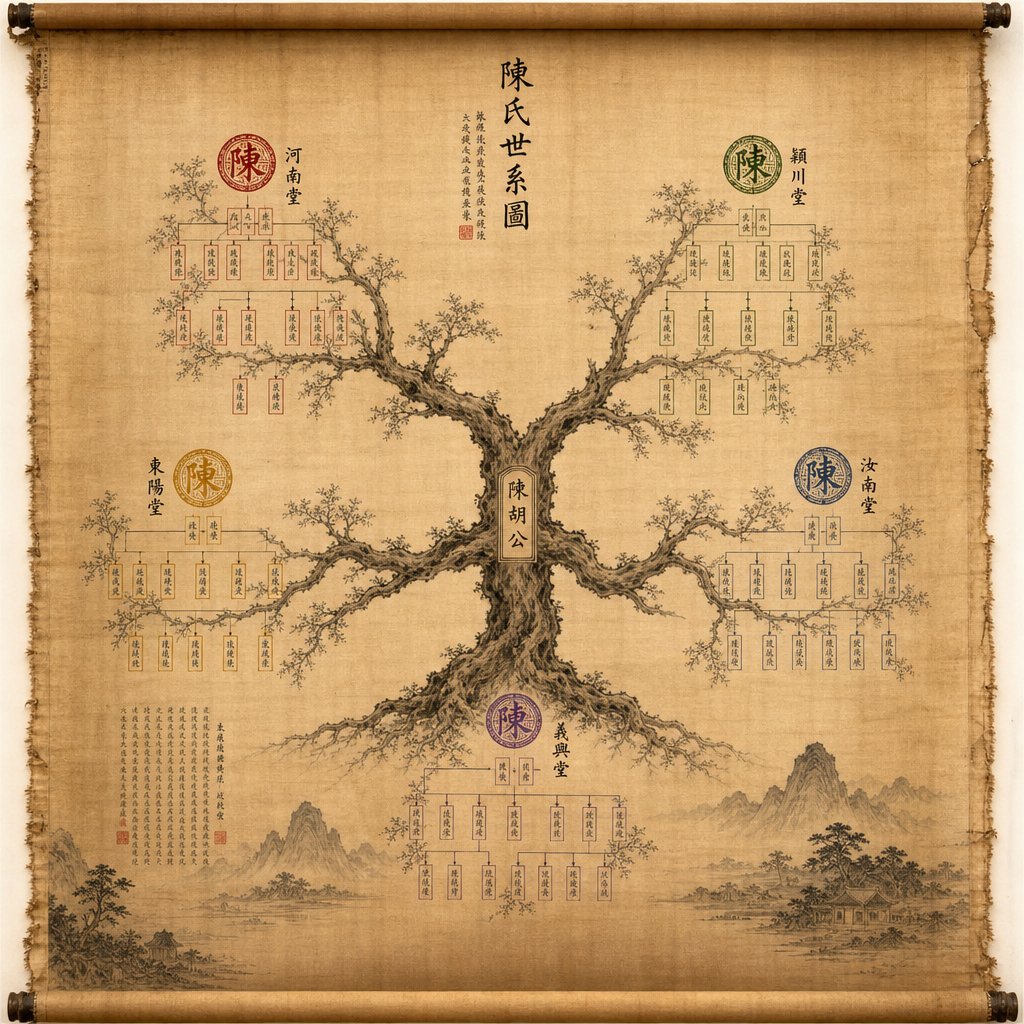
One surname, many roots. That is the reality of Sima surname genealogy and lineages. While the title-to-name mechanism was consistent, the families who underwent that transformation were not all related to each other. Across different states, different centuries, and different ancestral lines, unrelated clans independently adopted the same compound surname because they each held the same military office. Chinese genealogical scholarship identifies at least four major origin streams, each with its own founding ancestor, geographic base, and historical context.
Think of it this way: if every family whose ancestor served as "Secretary of Defense" eventually took that title as their last name, you would end up with many unrelated "Secretaries" sharing a surname. That is essentially what happened with Sima across the Spring and Autumn and Warring States periods.
The Primary Lineage From Cheng Boxiufu
The most widely recognized origin traces to Cheng Boxiufu, a high minister during the reign of King Xuan of Zhou (reigned approximately 827-782 BCE). According to the Tongzhi (Comprehensive Records) and the Jin Shu (Book of Jin), Cheng Boxiufu descended from the legendary figure Chongli (Zhurong), whose family had served in military offices since the mythological reigns of Emperors Yao and Shun. By the Western Zhou period, this lineage held the hereditary position of Sima.
Cheng Boxiufu distinguished himself by successfully suppressing a rebellion in the Xu region, a significant military achievement. King Xuan of Zhou rewarded him by formally granting permission to adopt his official title as a hereditary surname. This royal sanction made the Cheng Boxiufu Sima ancestor line the "orthodox" origin, the one most genealogical texts cite first.
His descendants split into two branches. The elder son, Zhong Geng, succeeded his father as Grand Minister of War, and his line became the Sima clan. The younger son, Zhong Xin, inherited the title of Marquis of Anding, and his descendants retained the Cheng surname. This shared root means the Sima and Cheng clans trace back to the same ancestor, a connection with over 2,700 years of documented history.
The Cheng Boxiufu lineage is also the one that produced the most famous bearers of the name. Sima Ang, a late-Qin general who became King of Yin with his capital at Henei, was a direct descendant. Eight generations after Sima Ang came Sima Yi, the strategist whose family would eventually found the Jin dynasty.
Secondary Lineages and Adopted Origins
Beyond the primary line, several other clans arrived at the Sima surname through parallel but independent paths. Each held the Sima office in a different state during the Spring and Autumn period, and each eventually adopted the title as a hereditary name.
The Chen Tian clan lineage traces to Sima Rangju, a military leader of the state of Qi. Rangju was a member of the Tian family that had gradually taken control of Qi from its original ruling house. His military prowess earned him the Sima title, and his descendants adopted it as their surname. He is also credited with authoring The Methods of the Sima, an early military treatise.
The Mi surname branch from the state of Chu connects to Sima Zifan (also known as Xiong Ce or Prince Ce), who served as Grand Minister of War under King Gong of Chu (reigned approximately 590-560 BCE). Zifan commanded the Chu army and made significant contributions to the state. His descendants, along with those of numerous other Chu officials who held the Sima title, adopted the office name as their surname. This branch shares ancestral origins with the royal Mi-surnamed Xiong clan of Chu, giving it a history exceeding 2,500 years.
The Ji surname branch from the state of Jin traces to Han Jue (posthumously titled Han Xianzi), who served as Grand Minister of War of the Jin army during the Spring and Autumn period. Han Jue was the fifth-generation leader of the Han family in Jin and an extremely influential political figure. His descendants who adopted the Sima title share ancestral origins with the Han clan, the same family that later participated in the famous Partition of Jin.
A fourth notable lineage derives from the Zi surname through Kong Fujia, Grand Minister of War of the state of Song. Kong Fujia was the sixth-generation ancestor of Confucius, adding yet another layer of historical significance to the multiple origins of the Sima family name.
| Lineage | Ancestral State | Approximate Era | Founding Ancestor | Connection to Sima Office |
|---|---|---|---|---|
| Cheng surname (Primary) | Zhou royal court | ~827 BCE (Western Zhou) | Cheng Boxiufu | Granted surname by King Xuan after military victory as Minister of War |
| Chen/Tian surname | Qi | ~500 BCE (Spring and Autumn) | Sima Rangju | Held Sima title as Qi military commander |
| Mi surname | Chu | ~570 BCE (Spring and Autumn) | Sima Zifan (Xiong Ce) | Served as Grand Minister of War under King Gong of Chu |
| Ji surname | Jin | ~570 BCE (Spring and Autumn) | Han Jue (Han Xianzi) | Held Grand Minister of War position in Jin army |
| Zi surname | Song | ~720 BCE (Spring and Autumn) | Kong Fujia | Appointed Grand Minister of War by Duke Shang of Song |
Distinguishing Lineages Through the Junwang System
With so many unrelated families sharing one surname, how did Sima clans historically tell each other apart? The answer lies in the Chinese surname junwang ancestral system, a method of identifying which geographic commandery a family claimed as its ancestral seat. Each major lineage associated itself with a specific commandery (jun) where its ancestors had concentrated, and this "ancestral commandery" (junwang) functioned as a secondary identifier alongside the surname itself.
For the Sima surname, the most prestigious ancestral commandery was Henei Commandery, located in what is now northern Henan province, southwest of modern Wuzhi County. The Henei commandery Sima clan traces its presence there to Sima Ang, who established his capital in the region during the late Qin dynasty. When the Han dynasty converted his territory into a commandery, his descendants settled permanently in the area.
During the Eastern Han dynasty, the Sima family of Henei rose to prominence as a cultural and political clan. By the Three Kingdoms period, Sima Yi emerged from Wen County within Henei Commandery, and his grandson's founding of the Jin dynasty cemented Henei as the definitive Sima ancestral seat. The clan's ancestral hall names reflect this geography: "Henei Hall" (河内堂) remains the primary hall name, while "Taishi Hall" (太史堂) honors the family's contributions to historiography through figures like Sima Qian and Sima Guang.
Other commanderies associated with Sima branches include Yanshi County (site of Western Jin imperial tombs) and Wen County (the specific hometown of the Jin dynasty founders). But when a Sima family claimed Henei as its junwang, it signaled connection to the most powerful and historically significant branch, the one that produced emperors.
This system of ancestral commanderies was not unique to the Sima surname. It operated across all Chinese surnames as a way to organize genealogical identity in a civilization where millions of people might share the same family name. For Sima bearers specifically, stating your junwang was a way of saying: "Yes, we share a surname, but here is which Sima family we actually belong to."
The concentration of so much historical weight in a single lineage, the Henei branch, set the stage for something unprecedented: a surname-bearing clan accumulating enough power to seize the imperial throne itself.
Rise to Imperial Power During the Jin Dynasty
A surname born from a military office eventually claimed the military's ultimate prize: the throne itself. The Sima clan's ascent from regional gentry in Henei to rulers of a unified empire is one of the most dramatic power consolidations in Chinese history. It unfolded across three generations, driven by patience, strategic brilliance, and ruthless political maneuvering. Understanding how the Sima clan became emperors means tracing a family that turned bureaucratic influence into dynastic authority.
Sima Yi and the Path to Imperial Power
The story begins with Sima Yi (179-251 CE), a man whose name would become synonymous with long-game political strategy. Born into the Henei branch of the Sima clan, he entered service under Cao Cao, the warlord who dominated northern China during the late Han dynasty and founded the kingdom of Cao Wei. Sima Yi proved himself an exceptional military strategist and administrator, eventually rising to become one of the most powerful officials in the Wei court.
His patience was legendary. While other ambitious officials overplayed their hands and fell, Sima Yi waited. He served loyally through the reigns of Cao Cao and his son Cao Pi, accumulating trust and institutional knowledge. His military campaigns against Zhuge Liang of Shu Han and the Gongsun family in Liaodong demonstrated both tactical skill and the ability to command large armies over extended campaigns.
The decisive moment came in 249 CE. After decades of quiet power-building, Sima Yi launched a coup known as the Incident at the Gaoping Tombs. While the young Wei emperor and his regent Cao Shuang were away from the capital paying respects at the imperial tombs, Sima Yi seized control of the armory and key government buildings in Luoyang. Cao Shuang surrendered and was subsequently executed along with his entire clan. From that point forward, the Sima family effectively controlled Cao Wei, though they maintained the fiction of serving the Cao emperors for another sixteen years.
Sima Yi died in 251, but his sons continued the family's consolidation of power. His eldest son Sima Shi served as regent, suppressing rebellions and deposing one Wei emperor in favor of a more pliable successor. When Sima Shi died in 255, his younger brother Sima Zhao took over. Sima Zhao directed the conquest of Shu Han in 263, eliminating one of Wei's rival kingdoms and earning himself the title King of Jin. His ambitions were so transparent that a contemporary saying emerged: "Sima Zhao's intentions are known to everyone on the road."
The final step fell to Sima Zhao's son, Sima Yan. In 265, after inheriting his father's position as King of Jin and regent, Sima Yan forced the last Cao Wei emperor to abdicate. On February 4, 266 CE, he declared himself Emperor Wu of the new Jin dynasty. The surname that had once designated a military office now sat on the imperial throne.
You'll notice the significance of this moment extends beyond one family's ambition. It marked the first time in Chinese history that a compound surname clan achieved supreme political authority. The name Sima, which had spent centuries as a marker of military administrative heritage, was now the name of the ruling house of all China.
The Jin Dynasty as the Sima Surname Peak
The Jin dynasty (266-420 CE) represented the absolute zenith of Sima influence. In 280, Emperor Wu completed the reunification of China by conquering Eastern Wu, ending the Three Kingdoms period and bringing the entire realm under Sima rule for the first time since the fall of the Han dynasty. At its peak, the Western Jin controlled approximately 3.1 million square kilometers of territory.
For over 150 years, every emperor of China bore the surname Sima. Fifteen emperors across the Western Jin (266-316) and Eastern Jin (317-420) carried the name, making it synonymous with imperial authority for an era that shaped the political, cultural, and demographic landscape of China for centuries to come.
The dynasty is often divided into two phases. The Western Jin, with its capital at Luoyang, enjoyed a decade of peace and prosperity after reunification. Emperor Wu established one of China's earliest legal codes in 268 and presided over a court of considerable cultural achievement. Buddhist philosophy, art, and architecture flourished under Jin patronage.
The Eastern Jin, established in 317 at Jiankang (modern Nanjing) after northern invaders overran the original capitals, lasted another century. Though politically weaker, it produced remarkable cultural achievements. The painter Gu Kaizhi, widely considered China's first great artistic genius, worked at the Jiankang court. Wang Xizhi, the greatest early master of Chinese calligraphy, also belonged to this era. The dynasty's cultural legacy extended far beyond its political boundaries.
Yet this period of dominance carried a dark underside. The Western Jin collapsed partly because Emperor Wu distributed too much power among Sima princes, leading to the devastating War of the Eight Princes (291-306 CE). Sima fought Sima in a fratricidal conflict that weakened the dynasty beyond recovery and opened the door to nomadic invasions from the north. The Eastern Jin survived through military skill and southern geography, but its emperors held limited real power, often overshadowed by powerful generals and aristocratic clans.
The dynasty's fall in 420 CE, when General Liu Yu forced the last Sima emperor to abdicate and later had him killed, ended the family's political supremacy. But the consequences of having held the throne lingered. The Sima name now carried both immense prestige and a target. Future bearers inherited a surname that everyone recognized, one associated with imperial ambition, civil war, and the loss of northern China to foreign invaders. That combination of fame and political danger would shape the surname's trajectory for centuries, driving many descendants to abandon the very name that had once crowned them rulers of the world's largest empire.
The Sima Legacy in Chinese Historiography
Political power fades. Dynasties collapse. But the written word endures. While the Jin dynasty gave the Sima surname its most dramatic political chapter, the family's deepest mark on Chinese civilization may actually lie in historiography. Across more than a thousand years, famous Sima historians in China produced works so foundational that they defined how an entire civilization understood its own past. No other surname comes close to matching this intellectual footprint.
What makes this pattern so striking? Sima Qian lived during the Han dynasty, roughly 145-87 BCE. Sima Guang lived during the Song dynasty, 1019-1086 CE. Over a millennium separates them, yet both produced landmark historical texts that remain essential reading today. Whether this reflects inherited cultural expectations, coincidence, or something about the scholarly traditions within Sima-surnamed families, the result is undeniable: the Sima surname contribution to Chinese scholarship is unmatched in the field of history.
Sima Qian and the Records of the Grand Historian
Sima Qian was born around 145 BCE in Longmen, Shaanxi province, the son of Sima Tan, who served as Grand Historian at the Han court. The office of Grand Historian combined astronomical observation, calendar regulation, and the recording of state events. When his father died in 110 BCE, Sima Qian inherited both the position and an unfulfilled ambition: to write a definitive history of the Chinese past.
The result was the Shiji (Records of the Grand Historian), completed around 85 BCE. This was not merely another court chronicle. It was the first general history ever attempted in China, covering approximately 2,000 years of events across 130 chapters and more than 520,000 words. Sima Qian organized this vast material into a revolutionary five-part structure:
- Basic Annals - chronological outlines centered on paramount rulers
- Chronological Tables - parallel timelines of independent feudal kingdoms
- Treatises - monographs on crucial aspects of government
- Hereditary Houses - detailed accounts of each feudal state
- Biographies - portraits of famous individuals as exemplars of conduct
This organizational model set the pattern for every subsequent dynastic history in China. For over two millennia, historians followed the template Sima Qian established. His work also broke new ground in scope: unlike later court-centered histories, the Shiji included merchants, bandits, actors, and foreign peoples alongside emperors and generals.
The personal cost was enormous. Sima Qian offended Emperor Wudi by defending a disgraced general and was sentenced to castration rather than execution, reportedly so he could finish his masterwork. That he persevered through such humiliation speaks to the depth of his commitment. As Britannica notes, his history has been acknowledged since its completion as the great historical masterpiece in Chinese, a standard against which all later histories would be measured.
Sima Guang and the Comprehensive Mirror for Aid in Government
Fast forward over a thousand years. In 1019 CE, another Sima was born in Guangshan, Henan province. Sima Guang rose through the civil service examinations to become one of the Song dynasty's most prominent scholar-officials, known for his moral uprightness and conservative Confucian principles.
His monumental contribution was the Zizhi Tongjian (Comprehensive Mirror for Aid in Government), a general chronicle covering Chinese history from 403 BCE to 959 CE. Where Sima Qian had pioneered the biographical-thematic approach, Sima Guang chose a strictly chronological format, creating a continuous narrative that emperors could consult as a "mirror" for governance decisions.
The Sima Guang Comprehensive Mirror history was no casual project. He compiled it with chosen associates over nineteen years, critically evaluating contradictory sources with such rigor that he produced a separate companion work, the Kaoyi (Scrutiny), documenting discrepancies in his sources and explaining his editorial choices. The result covered diverse subjects including rites, music, astronomy, geography, and economy, all evaluated through Confucian moral principles.
Sima Guang's political life was equally significant. Between 1069 and 1085, he led the conservative faction opposing Wang Anshi's radical reforms, arguing for good government through moral leadership and tested institutions rather than drastic structural changes. Shortly before his death in 1086, he succeeded in dislodging Wang's faction and became the leading minister.
A Pattern Beyond Two Giants
Sima Qian and Sima Guang are the most celebrated, but they are not the only bearers of this surname who shaped Chinese intellectual life. The Sima surname contribution to Chinese scholarship extends across multiple fields and centuries:
- Sima Tan (died 110 BCE) - Sima Qian's father, Grand Historian who began the research that became the Shiji and authored an influential essay classifying the six major schools of Chinese philosophy
- Sima Rangju (c. 500 BCE) - military theorist credited with The Methods of the Sima, one of China's earliest treatises on military strategy and discipline
- Sima Xiangru (179-117 BCE) - Han dynasty poet considered the greatest master of the fu (rhapsody) form, whose works set literary standards for centuries
- Sima Biao (c. 240-306 CE) - Western Jin historian who compiled the Xu Hanshu (Continuation of the Book of Han), preserving crucial records of the Eastern Han period
- Sima Chengzhen (647-735 CE) - Tang dynasty Daoist master, calligrapher, and author whose writings on meditation and spiritual cultivation influenced both religious practice and literary aesthetics
Is this concentration of scholarly talent coincidence? Possibly. But consider the alternative explanation: in a culture where surnames carried deep ancestral meaning, bearing the name Sima may have created implicit expectations. Sima Qian's father explicitly passed down the mission of historical writing as a family obligation. Sima Guang consciously modeled his work in emulation of the Chunqiu, the same classical text that inspired Sima Qian. The surname itself, with its association to record-keeping and governance, may have channeled talented individuals toward scholarly pursuits, particularly historiography.
Whatever the cause, the pattern is clear. A surname that began as a military title produced China's two most important historians, its greatest rhapsody poet, influential military theorists, and significant religious thinkers. The intellectual legacy runs parallel to the political one, and in many ways has proven more durable. Emperors are overthrown, but the Shiji and the Zizhi Tongjian remain in print.
That durability stands in sharp contrast to the surname's demographic trajectory. The same name that produced emperors and master historians would, over the following centuries, steadily shrink in population, its bearers scattered and diminished by forces both political and cultural.
A Dynasty-by-Dynasty Timeline of Sima Surname Prominence
Tracking the Sima surname history by dynasty reveals a clear arc: slow emergence, steady accumulation of prestige, explosive political dominance, and then a long, painful decline. No other Chinese compound surname follows quite this trajectory, rising from bureaucratic obscurity to imperial supremacy and then nearly vanishing from the population registers. Laying out the full timeline makes the pattern unmistakable.
From Western Zhou Through the Warring States
The surname's earliest phase spans roughly a thousand years, from its formal creation around 827 BCE to the unification of China under the Qin in 221 BCE. During this long incubation period, the Sima name spread geographically but remained associated primarily with military service and local governance rather than national prominence.
When King Xuan of Zhou granted Cheng Boxiufu permission to adopt his official title as a hereditary surname, the Sima name existed in only one lineage at the Zhou royal court. Over the following centuries, as the Zhou dynasty fragmented and independent states competed for dominance, the name multiplied. Sima-surnamed families appeared in the states of Qi, Chu, Jin, Song, and eventually Qin, each tracing their name to a different ancestor who held the Minister of War office.
By the Warring States period (475-221 BCE), the Sima clan had migrated to the states of Wei, Zhao, and Qin. The Qin branch produced notable military figures: Sima Cuo commanded the conquest of Shu, and his grandson Sima Jin fought alongside the legendary general Bai Qi at the Battle of Changping in 260 BCE. These were accomplished individuals, but the surname had not yet achieved the kind of civilizational impact it would later claim.
Think of this era as the root system growing underground. The name was spreading, the families were establishing themselves in positions of military authority, but nothing yet signaled the extraordinary chapters ahead.
Han Through Tang Dynasties and Beyond
The Han dynasty (206 BCE - 220 CE) marked the Sima surname's first leap into cultural immortality. Sima Qian's Records of the Grand Historian gave the name permanent association with scholarship and historical writing. Meanwhile, the Henei branch quietly built its local power base, transitioning from military service into the broader world of Eastern Han gentry politics. The Sima family of Henei rose through local social networks and strategic marriage alliances, positioning themselves for the dramatic events of the Three Kingdoms period.
The Jin dynasty (265-420 CE) was the absolute peak. Fifteen Sima emperors ruled across the Western and Eastern Jin, and the surname became synonymous with imperial authority. But this zenith contained the seeds of collapse. The War of the Eight Princes, the loss of northern China to nomadic invaders, and the dynasty's eventual overthrow by Liu Yu in 420 all transformed the Sima name from a symbol of power into a mark of political danger.
What happened to the Sima clan after the Jin dynasty fell? The answer is grim. Liu Yu, founder of the Liu Song dynasty, systematically persecuted Sima clan members. He assassinated the last Jin emperor, Sima Dewen, in 421 CE and hunted down potential rivals bearing the surname. Some Sima descendants fled north to the Northern Wei dynasty, where they received titles and protection as political pawns against the southern regime. Sima Chuzhi, for instance, held the title of Prince of Langya under Northern Wei and raised troops to resist Liu Yu's forces.
During the late Northern and Southern Dynasties period, the Sima family during Tang dynasty preparations was already in steep decline. Sima Xiaonan, one of the last prominent members of the Henei lineage, served the Northern Qi before surrendering to Northern Zhou. He joined Yuchi Jiong's rebellion against Yang Jian (the future Sui dynasty founder) and, after defeat, fled to the Chen dynasty in the south. When the Sui conquered Chen in 589, Sima Xiaonan died, and with him the Henei Sima clan's presence as a recognizable political force effectively ended.
The Sui-Tang reunification (581-907 CE) brought stability to China but offered no revival for the Sima surname's political fortunes. The name carried too much imperial baggage. Tang dynasty rulers, themselves from the Li surname, had no interest in elevating a clan associated with a previous dynasty. Individual Sima-surnamed figures achieved distinction, most notably the Daoist master Sima Chengzhen (647-735 CE), but the surname no longer commanded political influence as a collective clan identity.
It was not until the Northern Song dynasty (960-1127 CE) that a major Sima figure re-emerged. Sima Guang, the historian and statesman, came from a branch descended from Sima Fu (Sima Yi's younger brother) that had settled in Sushui Township, Xia County, Shanzhou, far from the original Henei heartland. His prominence was individual rather than clan-based, a scholar rising through the examination system rather than a family wielding hereditary power.
| Dynasty/Period | Approximate Era | Sima Surname Status | Key Events Affecting Bearers |
|---|---|---|---|
| Western Zhou | 1046-771 BCE | Newly established | Cheng Boxiufu granted the surname by King Xuan (~827 BCE) |
| Spring and Autumn | 770-476 BCE | Spreading across multiple states | Independent Sima lineages emerge in Qi, Chu, Jin, and Song |
| Warring States | 475-221 BCE | Established military families | Sima Cuo commands Qin conquest of Shu; clan migrates to Wei, Zhao, Qin |
| Qin Dynasty | 221-206 BCE | Regional political power | Sima Ang becomes King of Yin with capital at Henei |
| Han Dynasty | 206 BCE - 220 CE | Cultural prominence; rising gentry | Sima Qian writes Shiji; Henei branch builds local power |
| Three Kingdoms | 220-265 CE | Dominant political force | Sima Yi's coup (249); Sima family controls Cao Wei |
| Jin Dynasty (Western/Eastern) | 265-420 CE | Imperial ruling house (peak) | 15 Sima emperors; reunification of China (280); War of Eight Princes; loss of north |
| Northern and Southern Dynasties | 420-589 CE | Persecuted and scattered | Liu Yu assassinates last emperor; survivors flee north; Sima Xiaonan's failed rebellion |
| Sui-Tang Dynasties | 581-907 CE | Politically marginal; individual achievers | Sima Chengzhen gains fame as Daoist master; no clan-level influence |
| Song Dynasty | 960-1279 CE | Scholarly revival (individual) | Sima Guang writes Zizhi Tongjian; prominence through examination system |
| Yuan-Ming-Qing | 1271-1912 CE | Rare and declining | Continued surname simplification; population shrinks steadily |
This timeline of Sima surname prominence in China reveals something important: the surname's political power was concentrated in a remarkably narrow window. Out of roughly 2,800 years of documented history, the Sima name held real collective political influence for perhaps 200 years, from Sima Yi's coup in 249 to the clan's dispersal after 420. Everything before was preparation; everything after was aftermath.
The sharpness of that decline raises an obvious question. How does a surname go from ruling an empire of millions to numbering fewer than 30,000 bearers in the modern era? The answer involves not just political persecution but a combination of forces that systematically eroded the Sima population over fifteen centuries.
Why So Few Sima Surname Bearers Remain Today
From fifteen emperors to fewer than 28,000 living bearers. That is the staggering demographic collapse of the Sima surname, a decline so severe that it ranks among the most dramatic surname contractions in Chinese history. Why is the Sima surname so rare today? The answer is not a single catastrophe but a layered process spanning fifteen centuries, combining violent persecution, survival-driven name changes, and the slow grinding pressure of cultural simplification.
Consider the math. At its peak during the Jin dynasty, the Sima imperial clan numbered in the tens of thousands just among the direct royal lineage, not counting the broader clan network. The Ministry of Public Security's 2021 National Name Report places the current Sima surname population at approximately 28,000, with Henan remaining the province of highest concentration. That figure ranks the surname 549th nationally, far below what its historical significance would suggest.
So what happened? The decline operated through multiple mechanisms, some sudden and violent, others gradual and almost invisible across generations.
Forced Surname Changes and Political Persecution
The most immediate cause was political. When the Jin dynasty fell in 420 CE, bearing the surname Sima became genuinely dangerous. Liu Yu, the general who overthrew the Eastern Jin and founded the Liu Song dynasty, viewed every Sima clan member as a potential rallying point for loyalist resistance. He assassinated the abdicated Emperor Gong (Sima Dewen) in 421 and pursued a broader campaign against the former imperial family.
But the persecution did not begin with Liu Yu. It started within the Sima family itself. The War of the Eight Princes (291-306 CE) was essentially Sima fighting Sima, a fratricidal civil war among eight princes of the blood that devastated the clan's own numbers. Entire branches were exterminated by their own relatives in the struggle for regency power. By the time external enemies arrived, the family had already bled itself nearly dry.
Then came the Uprising of the Five Barbarians. As nomadic peoples swept into northern China during the early fourth century, they specifically targeted Sima clan members. The surname was too recognizable, too associated with the regime these invaders were replacing. Massacres of Sima-surnamed individuals during this period further reduced the population.
Faced with this triple threat, survival demanded a practical response: abandon the name. Forced surname changes after the Jin dynasty became widespread among Sima descendants. The most common strategy was splitting the compound surname into its component characters, producing two new single-character surnames from one original name:
- Ma (马) - taking the second character of Sima
- Si (司) - taking the first character of Sima
- Tong (同) - a phonetic adaptation used by some branches
- Feng (冯) - adopted by certain lineages fleeing to new regions
- Cheng (程) - reverting to the original pre-Sima ancestral surname
The Sima name change to Ma or Si was not a casual decision. It was a survival mechanism. Imagine carrying a surname that every new regime, every local warlord, and every ambitious general recognized as belonging to the former ruling house. In an era without identity documents or photographs, changing your surname was the simplest way to disappear into the general population. A Sima who became a Ma was suddenly just another common family, invisible and safe.
Some branches went further. The Wuwei Commandery branch, descended from Sima Shun, formally changed their surname to Ma and established an entirely new genealogical identity. Others adopted the surname Tong, reportedly because the character contains elements that could be read as an encoded reference to the Sima origin without openly declaring it. These were families trying to preserve some thread of identity while erasing the target from their backs.
Voluntary Simplification and Cultural Pressures
Political persecution explains the initial sharp drop, but it does not account for the surname's continued decline across the following thousand years. After the Sui-Tang reunification stabilized China, active persecution of Sima descendants largely ceased. Yet the population never recovered. Why?
The answer lies in broader structural forces that affected all Chinese compound surnames, not just Sima. Compound surname decline reasons are multiple and reinforcing, creating a slow but relentless demographic erosion that continues to the present day.
The principle of linguistic economy worked against two-character surnames in everyday life. In a culture where most people had single-character surnames, compound surnames were cumbersome. They required extra characters in official documents, created awkwardness in forms designed for one-character entries, and made their bearers conspicuous in ways that were not always welcome. Over centuries, many families simply dropped one character for convenience.
Intermarriage played a quieter but equally powerful role. When a Sima-surnamed woman married into a single-surname family, her children took their father's name. When a Sima-surnamed man married, his children kept the name, but if his line produced only daughters for a generation, the surname disappeared from that branch entirely. In a population where compound surnames were already rare, the statistical odds favored absorption into the much larger pool of single-surname families.
Administrative pressure added another layer. During various dynasties, local officials responsible for census records and tax rolls found compound surnames inconvenient. Some actively encouraged simplification. The Ming dynasty founder Zhu Yuanzhang reportedly issued orders restricting certain compound surnames, though the specific scope of these edicts remains debated among historians.
Here is the full picture of mechanisms that drove the Sima surname population in modern China to its current low:
- Internal clan warfare - the War of the Eight Princes physically eliminated thousands of Sima clan members before external threats even arrived
- External political persecution - targeted killings by the Five Barbarians, Liu Yu's purges, and hostility from successor dynasties
- Forced surname changes - deliberate adoption of Ma, Si, Tong, Feng, or Cheng to escape identification as former royals
- Voluntary simplification - individual families dropping one character for social convenience across generations
- Administrative simplification - bureaucratic pressure from census systems and official records designed for single-character surnames
- Intermarriage absorption - gradual demographic dilution as compound-surname families married into the vastly larger single-surname population
- Geographic dispersal - scattering of clan members across distant provinces, weakening the community bonds that help preserve distinctive surnames
Each mechanism alone might have been survivable. Together, operating across fifteen centuries, they reduced an imperial surname to a demographic footnote. The 2020 National Name Report data shows that 30.28% of remaining Sima bearers are concentrated in Henan, the province containing the ancient Henei Commandery heartland. This geographic clustering suggests that the families who stayed closest to their ancestral seat were the ones most likely to preserve the original compound form, while those who migrated further afield faced stronger pressure to simplify.
Modern genetic research using Y-chromosome testing adds a fascinating dimension. Studies show that the Sima surname's genetic composition is highly homologous with Han Chinese of the Central Plains, while also bearing imprints of integration with northern ethnic groups. The dominant haplogroup, O2a2b1a1-F1765, accounts for approximately 57.6% of tested Sima males, confirming deep Central Plains roots. A secondary component, C2c1a2-F845 at 24.3%, corroborates the history of ethnic fusion during the Northern and Southern Dynasties period when some non-Han families adopted the Sima name.
The irony is sharp. A surname that once meant you ruled the empire now means you belong to one of China's smallest surname communities. Yet that very rarity has created renewed interest. Genealogical societies, DNA testing services, and online surname communities have given modern Sima descendants new tools to reconnect with their heritage and with each other, potentially stabilizing a population that spent centuries in free fall.
The Sima story is extreme, but it is not unique. It fits within a broader pattern of compound surname attrition that has reduced China's active compound surnames from over a thousand to fewer than a hundred. Understanding how the Sima name contracted helps illuminate what happened to all those vanished two-character surnames, and why the survivors look the way they do today.
Sima Among Other Chinese Compound Surnames
The Sima surname did not decline in isolation. It belongs to a family of title-derived surnames in Chinese culture that all emerged from the same bureaucratic machinery, yet followed wildly different demographic paths. Some thrived. Some shrank. Some vanished entirely. Comparing their fates reveals what actually determines whether a compound surname survives across millennia.
Parallel Origins With Situ Sikong and Shangguan
Remember the Zhou dynasty's Three Excellencies? The same system that produced the Sima surname also generated Situ (Minister of Education) and Sikong (Minister of Works). All three share identical structural DNA: a government title beginning with "si" (司, to administer), held by a family across generations, eventually crystallizing into a hereditary name. Shangguan (上官, literally "upper official") followed a similar pattern, originating from a high-ranking position in the state of Chu during the Warring States period.
These surnames started from the same place. Yet look at where they ended up. Shangguan has approximately 88,000 bearers today, making it China's second most popular compound surname. Situ ranks below that but still above Sima. Meanwhile, Sikong has nearly disappeared from modern registers. Same origin mechanism, dramatically different outcomes.
The divergence extends beyond title-derived names. Ouyang, which originated as a geographic designation (south of Mount Ou), commands over 1.1 million bearers. Zhuge, associated with the legendary strategist Zhuge Liang, maintains a modest but stable population. Each compound surname's survival depended on factors that had nothing to do with how it was originally formed.
Why Some Compound Surnames Survived While Others Faded
So which Chinese compound surnames still exist in meaningful numbers, and what separates survivors from the vanished? The comparison table below tells a revealing story:
| Surname | Original Office or Meaning | Peak Period of Influence | Approximate Modern Population |
|---|---|---|---|
| Ouyang (欧阳) | Geographic: south of Mount Ou | Song dynasty (Ouyang Xiu) | ~1,100,000 |
| Shangguan (上官) | Title: upper official in Chu state | Tang dynasty (Shangguan Wan'er) | ~88,000 |
| Huangfu (皇甫) | Title: imperial guardian lineage | Han-Jin dynasties | ~70,000 |
| Zhuge (诸葛) | Geographic: Zhuge village in Langya | Three Kingdoms (Zhuge Liang) | ~50,000 |
| Situ (司徒) | Title: Minister of Education | Han dynasty | ~40,000 |
| Sima (司马) | Title: Minister of War | Jin dynasty (imperial house) | ~28,000 |
| Sikong (司空) | Title: Minister of Works | Zhou-Han dynasties | <10,000 |
A clear pattern emerges. The surnames that survived best are those that never held imperial power. Ouyang thrived precisely because it never became politically dangerous. No dynasty fell under the Ouyang name, so no successor regime had reason to persecute its bearers. Shangguan and Zhuge carried prestige without the existential risk of being associated with a deposed ruling house.
Sima's imperial period, paradoxically, was the very thing that nearly destroyed it. The higher you climb, the harder you fall, and in Chinese political culture, a fallen dynasty's surname became a liability for everyone who bore it. Sikong, which never achieved comparable prominence, declined for different reasons: it simply lacked the cultural anchors, the famous bearers and literary associations, that give a surname staying power in collective memory.
Geographic concentration also mattered. Ouyang families maintained dense clusters in Jiangxi and Hunan provinces, creating self-reinforcing communities where the compound form felt normal rather than unusual. Scattered surnames faced constant pressure from the single-character majority around them.
China's fewer than 100 remaining compound surnames represent the survivors of a mass extinction event that eliminated over 900 two-character names from active use. The Ouyang, Zhuge, and Sima surname populations today reflect three different survival strategies: demographic mass (Ouyang), cultural prestige without political danger (Zhuge), and sheer tenacity against overwhelming odds (Sima). Each tells a different story about what it takes for a name to persist across three thousand years of upheaval.
What unites all these survivors is something less tangible than population numbers: cultural meaning. These names endure partly because people recognize them, remember the historical figures who bore them, and attach value to their preservation. That sense of cultural significance is what now drives modern efforts to protect compound surnames as living artifacts of Chinese heritage.
The Sima Surname as a Living Cultural Artifact
Cultural meaning keeps a name alive long after political power fades. For the roughly 28,000 people who carry the Sima surname today, the name is not a relic sealed behind museum glass. It is a living identity marker, one that connects modern individuals to military offices, imperial thrones, and foundational works of historiography spanning nearly three millennia. Sima surname modern descendants today navigate a unique position: bearing a name that virtually every educated Chinese person recognizes, yet belonging to one of the country's smallest surname communities.
The Sima Name in Modern Chinese Identity
How do modern bearers relate to a surname this heavy with history? For many, it begins with curiosity. A child notices their name is two characters when classmates have one. A family elder mentions a connection to Sima Guang or the Jin dynasty. That spark often leads to genealogical research, clan association membership, or participation in online surname communities where scattered Sima descendants reconnect across provincial boundaries.
Genealogical societies dedicated to Sima family cultural heritage preservation have grown more active in recent decades. Annual gatherings at ancestral sites in Henan province, particularly around the ancient Henei Commandery region, draw participants from across China. These events serve a dual purpose: maintaining clan identity and documenting oral histories before they disappear with aging generations.
The broader cultural climate helps. Compound surnames are romanticized today as names carrying antique and poetic beauty, a perception reinforced by their frequent appearance in wuxia novels and historical dramas. This cultural cachet gives modern Sima bearers a sense of pride that counteracts the demographic pressure to simplify. Some families that had previously shortened their name to Ma or Si have even explored reverting to the original compound form, though this remains rare.
Digital tools have accelerated these reconnections. DNA testing services now allow Sima descendants to confirm lineage connections that paper records lost centuries ago. The Y-chromosome haplogroup data mentioned earlier provides a scientific framework for verifying whether scattered Sima families share genuine biological ancestry or merely a common surname adopted independently.
Understanding Chinese Surname Origins Through the Sima Example
Step back from the specific details, and the Sima story becomes something larger: a case study in how Chinese civilization encoded its institutional history into personal identity.
Studying a single compound surname like Sima reveals layers of Chinese political, military, and cultural history that no single dynasty or event can capture alone. It is simultaneously a record of Zhou bureaucracy, Warring States fragmentation, imperial ambition, dynastic collapse, ethnic conflict, and the quiet persistence of family memory across thirty centuries.
For anyone interested in Chinese compound surname genealogy research, the Sima example illustrates the key tools and approaches that apply broadly:
- Identify your junwang (ancestral commandery) - this narrows which branch of a surname your family likely belongs to and points toward specific geographic regions for further research
- Locate clan genealogy books (jiapu) - these handwritten family records, where they survive, contain generational charts, migration histories, and generation poems that encode birth order across centuries. FamilySearch's guide to jiapu offers a step-by-step introduction to reading these documents
- Trace your ancestral village - Chinese surnames cluster geographically, and identifying the village your family originated from often unlocks local records, ancestral halls, and gravestone inscriptions that paper trails miss
- Use surname finder tools - resources like FamilySearch's Surname Finder help connect surname variants, simplified forms, and regional pronunciations back to their compound origins
- Interview living relatives - oral histories often preserve knowledge of surname changes, migration routes, and lineage connections that never made it into written records
The Sima case also teaches a broader lesson about how to trace Chinese surname origins. Surnames are not static labels. They are compressed narratives, shaped by political upheaval, geographic migration, administrative convenience, and deliberate choice. A modern Ma-surnamed family in Henan might actually be Sima descendants who changed their name for survival after 420 CE. A Si-surnamed family might carry the same hidden history. Understanding these transformations is essential for anyone doing serious genealogical work in Chinese family history.
What began as a military office title over 2,800 years ago became a dynasty, a scholarly tradition, and ultimately a small but tenacious community of modern bearers who keep the name alive. The Sima compound surname history is, in miniature, the history of Chinese civilization itself: bureaucratic origins, political ambition, cultural achievement, violent disruption, and quiet endurance. Every compound surname that survives today carries a story of similar depth. Sima just happens to be the one where all the threads, war, empire, scholarship, and survival, converge most dramatically in a single name.
Frequently Asked Questions About Sima Compound Surname History
1. What does the Sima surname mean in Chinese?
Sima (司马) combines two characters: 'si' (司) meaning 'to manage or control' and 'ma' (马) meaning 'horse.' While its literal translation is 'administrator of horses,' the title functioned as a Minister of War position during the Zhou dynasty. Holders oversaw military logistics, commanded armed forces, and managed cavalry, which was the backbone of ancient Chinese military power. Over generations, descendants of officeholders adopted this title as their permanent hereditary surname.
2. How did the Sima family become emperors of China?
The Sima clan's rise to imperial power unfolded across three generations. Sima Yi served as a strategist under Cao Wei and seized real power through a coup in 249 CE. His sons Sima Shi and Sima Zhao continued consolidating control, with Sima Zhao conquering the rival kingdom of Shu Han. Finally, Sima Zhao's son Sima Yan forced the last Cao Wei emperor to abdicate in 265 CE, declaring himself Emperor Wu of the Jin dynasty. This made the Sima clan the first compound-surname family to achieve supreme political authority in Chinese history.
3. Why is the Sima surname so rare in modern China?
The Sima surname declined from imperial dominance to roughly 28,000 bearers through multiple reinforcing factors. After the Jin dynasty fell in 420 CE, successor regimes persecuted Sima clan members, forcing many to change their names to Ma, Si, or Tong for survival. The fratricidal War of the Eight Princes had already killed thousands of clan members internally. Over subsequent centuries, compound surname simplification pressure, intermarriage absorption into single-surname families, and administrative inconvenience further eroded the population. Today about 30% of remaining bearers concentrate in Henan province near the ancient Henei Commandery heartland.
4. What is the connection between the Sima surname and Chinese historiography?
The Sima surname produced China's two most important historians, separated by over a thousand years. Sima Qian (c. 145-87 BCE) wrote the Records of the Grand Historian, creating the organizational template followed by every subsequent dynastic history for two millennia. Sima Guang (1019-1086 CE) compiled the Comprehensive Mirror for Aid in Government, a rigorous chronological history spanning 1,362 years. Beyond these two giants, the surname also produced Sima Xiangru (greatest Han dynasty rhapsody poet), Sima Rangju (early military theorist), and Sima Chengzhen (influential Tang dynasty Daoist master).
5. How many origin lineages does the Sima surname have?
Chinese genealogical scholarship identifies at least five major origin lineages that independently adopted the Sima surname. The primary lineage traces to Cheng Boxiufu at the Western Zhou royal court around 827 BCE. Secondary lineages include the Chen/Tian clan from the state of Qi, the Mi surname branch from Chu state, the Ji surname branch from Jin state, and the Zi surname branch from Song state. Each family held the Minister of War office in their respective states and eventually adopted the title as a hereditary name. The junwang (ancestral commandery) system helped distinguish these unrelated branches, with Henei Commandery being the most prestigious Sima ancestral seat.