What Are Single Character Chinese Names
Imagine condensing your entire identity, your parents' hopes, and a cultural legacy into a single written symbol. That is exactly what single character Chinese names do. In a naming system where every stroke carries meaning, choosing just one character for a given name is both a creative constraint and a deliberate statement.
Chinese names follow a surname-first structure, typically consisting of two or three characters total. The family name (姓, xing) comes first, followed by the given name (名, ming). While most modern Chinese given names use two characters, a single-character given name pairs one surname character with one given-name character, creating a full name of just two syllables. When people refer to single character Chinese names, they mean this given name portion, not the surname.
What Makes a Chinese Name Single Character
A given name in Chinese can be either one or two characters. Two-character names allow parents to layer meanings, combining concepts like "bright" and "virtue" or "jade" and "cloud" into a compact phrase. A single-character name strips that option away. There is no second character to clarify, modify, or complement the first. The one character you choose must do all the work alone.
Think of it this way: a two-character name is a sentence fragment, while a single-character name is a single word asked to carry the weight of a whole sentence. That limitation is precisely what gives these names their power. Parents who select one character are making a bold, focused choice about what matters most.
A single character must carry the full weight of personal identity that two characters normally share, making the selection process more deliberate and the result more concentrated in meaning.
How Chinese Names Are Structured
If you are new to how Chinese names work, the basics are straightforward. The surname comes first and is almost always one character, drawn from a pool of a few hundred common options like Wang (王), Li (李), or Zhang (张). The given name follows, and this is where families exercise creative freedom. Chinese names and characters are deeply intertwined because each character is not just a sound but a visual symbol loaded with meaning, history, and cultural resonance.
So a name like Yao Ming (姚明) breaks down simply: Yao is the surname, and Ming, meaning "bright" or "brilliant," is a single-character given name. The full name is just two syllables, two characters, yet it carries a complete identity. The name chinese characters chosen for a given name reflect parental aspirations, whether that is wisdom, strength, beauty, or moral character.
What makes single-character Chinese first names distinctive is not just brevity. It is the cultural signal they send and the philosophical weight they carry. Throughout Chinese history, these names have risen and fallen in popularity, shaped by imperial edicts, population pressures, and shifting aesthetic tastes. Understanding why one character can hold so much meaning requires looking at where this tradition came from and how it evolved across dynasties.
Historical Evolution Across Chinese Dynasties
That cultural signal did not emerge overnight. Single-character given names have a long, layered history stretching back more than two thousand years, shaped by imperial politics, philosophical ideals, and the practical realities of a growing population. To understand why these names carry the weight they do, you need to trace their arc from dominance to decline and back again.
Single Character Names in Ancient China
During the Zhou, Qin, and Han dynasties, single-character given names were not just common. They were the norm. If you look at historical records from these periods, the vast majority of documented figures carry names of just one character. Confucian naming conventions reinforced this pattern, emphasizing simplicity and restraint as virtues that should extend even to what you call a person.
The most dramatic push came during the Xin Dynasty (9-23 AD), when the reformist emperor Wang Mang issued an edict effectively mandating single-character given names. Wang Mang saw two-character names as a deviation from classical ideals and used naming policy as part of his broader effort to restore what he considered ancient social order. Under his rule, a typical chinese name consisted of exactly two syllables total: one surname, one given name. Though his dynasty lasted only fifteen years, the cultural preference he reinforced persisted for centuries.
The Shift Toward Two Character Names
By the Tang and Song dynasties, the landscape had changed. China's population was growing rapidly, and with a limited pool of surnames and single characters, name duplication became a serious problem. Two-character given names offered exponentially more combinations, making it easier to distinguish individuals in official records, examinations, and daily life. Traditional chinese names gradually shifted toward this longer format as a practical solution.
Chinese name conventions also evolved alongside literary culture. The flourishing of poetry and prose during the Tang dynasty encouraged more expressive, layered naming. Parents began pairing characters to create meaning that a single character could not achieve alone, and two-character names became the dominant standard for most of the next millennium.
Modern Revival and Current Trends
The pattern reversed again in the 1980s. When China's one-child policy took effect in 1979, generation names, where siblings share a character, lost their purpose for only-child families. Many parents opted for single-character given names as a more direct, concentrated expression of their hopes for one child.
This revival was short-lived in its peak form. Parents quickly discovered that millions of others had the same idea, creating a generation of people with so-called "market names," where calling out a common name in a crowded space would turn dozens of heads. Two-character names regained popularity through the 1990s and 2000s as families sought greater uniqueness. Still, single-character names remain a meaningful choice for parents drawn to their classical elegance and the deliberate simplicity of chinese traditional names.
Here is a simplified timeline showing how popularity shifted across major periods:
- Zhou and Qin Dynasties (1046-206 BC): Single-character names dominant among recorded figures
- Han Dynasty (206 BC-220 AD): Single-character names near-universal, reinforced by Wang Mang's edict
- Tang Dynasty (618-907 AD): Gradual shift toward two-character names as population grows
- Song Dynasty (960-1279 AD): Two-character names become the clear majority
- Ming and Qing Dynasties (1368-1912): Two-character names standard, often incorporating generation characters
- 1980s China: Single-character names surge due to one-child policy
- 1990s to present: Two-character names regain dominance, but single-character names persist as a deliberate stylistic choice
What emerges from this timeline is a recurring tension. Single-character names offer elegance and classical resonance, but they struggle against the mathematics of a massive population sharing a limited character set. That tension between beauty and practicality is not just historical. It shapes how these names are perceived and valued in Chinese society right now.
Why Single Character Names Carry Unique Cultural Weight
That tension between beauty and practicality is not merely a logistical problem. It reflects something deeper about how Chinese culture thinks about meaning itself. When a parent chooses a single character to represent their child's entire identity, they are engaging with a philosophical tradition that values concentration over elaboration, essence over explanation.
The Philosophy of One Character Identity
Consider what happens when you remove the second character from a name. With two characters, you can qualify, contrast, or build a phrase. You might pair "bright" with "virtue" to create a specific aspiration. A single character offers no such safety net. There is no modifier, no companion to soften or redirect the meaning. What remains must stand entirely on its own.
This is not a limitation. It is a creative discipline. In Chinese aesthetics, the concept of leaving space, known as "liu bai" (留白) in painting and calligraphy, treats emptiness as an active element. What you leave out shapes meaning just as much as what you include. A name in chinese meaning is never just the dictionary definition of a character. It is also the space around that character, the associations it invites, the interpretations it leaves open.
When naming chinese characters for a single-character name, parents must distill their hopes into one concentrated symbol. The character 明 (ming, bright) does not just mean "intelligent." It carries the image of sun and moon together, the idea of clarity cutting through darkness, the aspiration toward understanding. A two-character name might narrow that meaning. A single character lets it breathe.
In Chinese naming philosophy, constraint creates meaning. The fewer characters you use, the more each one must hold, and the more space remains for the name to grow with the person who carries it.
This principle connects to broader ideas in Confucian and Daoist thought. The Dao De Jing opens with the line "the name that can be named is not the eternal name," suggesting that true identity resists being pinned down completely. A single-character name honors that idea. It gestures toward meaning without exhausting it. The chinese meaning of names, especially those compressed into one character, is always partly open, always partly becoming.
Social Perceptions and Modern Attitudes
In practice, how do people in modern China actually perceive single-character names? The associations are layered and sometimes contradictory.
On one hand, these names carry a sense of classical elegance. They echo the naming patterns of ancient scholars, emperors, and literary figures. A person with a single-character given name can seem refined, understated, or deliberately traditional. The name signals that the family values restraint over ornamentation, that they trust one character to say enough.
On the other hand, there is a practical stigma. In a country of 1.4 billion people sharing roughly 6,000 common surnames, single-character names produce staggering rates of duplication. Research using China's 2005 population census data found that one-character given names rose sharply from the 1960s through the 1980s, peaking at around 30% of all names. That surge meant millions of people sharing identical full names, creating headaches in schools, workplaces, and government databases.
This duplication problem shapes how a chinese name can mean something socially beyond its literal definition. A single-character name might read as elegant on paper but feel generic in a crowded classroom where three other students share it. Parents today weigh this tradeoff carefully. Some resolve it by choosing rarer mandarin characters and meanings, selecting characters that are beautiful but uncommon enough to reduce overlap. Others decide the risk is not worth it and opt for two characters instead.
There is also a generational dimension. Research on Chinese naming trends shows that unique name choices have increased steadily since the 1970s, reflecting broader cultural shifts toward individualism. Single-character names occupy an interesting position in this trend. They deviate from the two-character norm, which itself can signal uniqueness. Yet the most popular single characters are so widely shared that they paradoxically become the least unique names in practice.
For families who navigate this carefully, choosing chinese characters with meanings that are distinctive but not obscure, a single-character name remains a powerful statement. It says: we believe one well-chosen symbol is worth more than two ordinary ones. That belief, rooted in centuries of philosophical and aesthetic tradition, is what gives these names their enduring cultural weight, even as practical concerns push naming trends in other directions.
The question then becomes: which characters actually carry that weight well? The answer depends on what a family wants to express, whether that is moral virtue, connection to nature, ambition, or grace.
Popular Single Character Names Organized by Meaning
Moral virtue, connection to nature, ambition, or grace. Each of these themes draws from a distinct well of characters, and the best way to explore them is to see real examples of chinese names grouped by what they express. The following chinese character names list organizes popular single-character given names into four meaning categories, giving you a clear reference for understanding what each character brings to a name.
Names Expressing Virtue and Wisdom
Characters in this category reflect moral aspirations. Parents choosing from this group want the name to remind their child, and everyone who speaks it, of an ethical ideal worth pursuing.
| Character | Pinyin | Meaning | Cultural Notes |
|---|---|---|---|
| 明 | ming | Bright, wise | Combines sun (日) and moon (月); symbolizes clarity and justice |
| 信 | xin | Trust, integrity | A core Confucian virtue; implies reliability in relationships |
| 德 | de | Virtue, moral character | One of the most classical name characters; echoes Daoist philosophy |
| 仁 | ren | Benevolence, kindness | Central to Confucian ethics; suggests compassion toward others |
| 智 | zhi | Wisdom, intellect | Implies both knowledge and sound judgment |
Names Drawn from Nature
Nature-themed characters connect a person's identity to the physical world. These names in chinese and meanings often carry metaphorical weight beyond their literal definitions.
| Character | Pinyin | Meaning | Cultural Notes |
|---|---|---|---|
| 林 | lin | Forest | Symbolizes abundance, vitality, and growth; a wood-element character |
| 海 | hai | Sea, ocean | Represents vastness and depth of character; a water-element name |
| 泽 | ze | Marsh, moisture | Suggests nurturing and generosity; among the most popular characters for boys born in 2020 |
| 梅 | mei | Plum blossom | Blooms in winter; symbolizes resilience through hardship |
| 云 | yun | Cloud | Evokes freedom and lightness; gender-neutral in usage |
Names Conveying Strength and Ambition
These characters project power, determination, or the drive to achieve. They appear frequently in common chinese names for boys, though some have crossed gender lines in recent decades.
| Character | Pinyin | Meaning | Cultural Notes |
|---|---|---|---|
| 强 | qiang | Strong, powerful | Direct and unambiguous; among the most popular male names in the 1980s |
| 志 | zhi | Aspiration, willpower | Denotes determination and life direction; a fire-element character |
| 伟 | wei | Great, magnificent | The single most common male given name in the 1980s and 1990s per census data |
| 勇 | yong | Brave, courageous | Implies physical and moral courage; carries a martial tone |
| 鹏 | peng | Mythical great bird | From Zhuangzi's philosophy; represents soaring ambition and vision |
Names Reflecting Beauty and Grace
Characters in this group emphasize elegance, preciousness, or aesthetic refinement. They appear often in the chinese names list for girls, though several work beautifully across genders.
| Character | Pinyin | Meaning | Cultural Notes |
|---|---|---|---|
| 婷 | ting | Graceful, elegant | The most popular female single-character name in the 2000s according to census rankings |
| 瑶 | yao | Precious jade | Connotes rarity and beauty; associated with mythical jade palaces |
| 雅 | ya | Refined, cultured | Suggests classical taste and sophistication |
| 玥 | yue | Mythical pearl | A divine pearl given to a wise emperor in legend; implies nobility |
| 秀 | xiu | Elegant, outstanding | Bridges beauty and talent; historically used for both genders |
This list of chinese names is far from exhaustive, but it captures the range of intentions parents bring to single-character naming. You will notice that many sample chinese names overlap in tone or theme. That overlap is not accidental. It reflects shared cultural values about what qualities deserve to be carried in a name for an entire lifetime.
What the tables above do not show is how these characters split along gender lines, or how those lines are shifting. The same character can read differently depending on whether it names a son or a daughter, and modern families are increasingly questioning those assumptions.
Gender Patterns in Single Character Name Selection
A character like 伟 (wei, great) reads as unmistakably masculine, while 婷 (ting, graceful) signals femininity through its very structure. The radical 女 (female) is literally embedded in the character. But not every name falls so neatly into one category, and the boundaries between male chinese given names and female ones are less rigid than they might first appear.
Chinese naming traditions have long used specific visual and semantic cues to signal gender. Understanding these patterns helps whether you are choosing a name, reading a character list, or trying to identify gender from an unfamiliar name.
Traditional Male Single Character Names
Characters chosen for boys tend to emphasize strength, ambition, vastness, or moral fortitude. You will often find the radicals for tree (木), metal (钅), or man (亻) in chinese boy names with characters that lean masculine. The meanings skew toward action, power, and large-scale imagery.
- 伟 (wei) - Great, magnificent. The most common single-character male name across multiple decades.
- 强 (qiang) - Strong, powerful. Direct and physical in its connotation.
- 勇 (yong) - Brave, courageous. Carries a martial, heroic tone.
- 宏 (hong) - Grand, expansive. Suggests broad vision and ambition.
- 鹏 (peng) - Mythical great bird. Evokes soaring aspiration from Daoist philosophy.
- 磊 (lei) - Stacked rocks. Implies openness and upright character.
These names project outward. They describe what a person does or becomes in the world, not how they appear or feel. That outward orientation is the defining feature of traditional male naming.
Traditional Female Single Character Names
Female names tend to draw from beauty, grace, preciousness, and nature. The chinese character female radical (女) appears frequently, as do the radicals for jade (王), flower (艹), and water (氵). Where male names project outward, female names traditionally describe inner qualities or aesthetic refinement.
- 婷 (ting) - Graceful, elegant. Contains the female radical and remains one of the most common chinese first names for women.
- 娜 (na) - Graceful, delicate. Also carries the female radical.
- 瑶 (yao) - Precious jade. Connotes rarity and mythical beauty.
- 莉 (li) - Jasmine. Features the flower radical; fragrant and refined.
- 雪 (xue) - Snow. Pure, clean, and visually striking.
- 丽 (li) - Beautiful. One of the most widely used female name characters across generations.
The presence of certain radicals like 女, 艹, or 王 in a character is often the quickest visual cue that a name is traditionally feminine. If you see these structural elements, you are likely looking at a female name.
Gender Neutral Options Growing in Popularity
Here is where things get interesting. A growing number of families are choosing unisex chinese names that refuse to signal gender at all. These characters tend to describe abstract qualities, natural phenomena, or intellectual virtues rather than gendered traits.
- 明 (ming) - Bright, clear. Works equally well for any gender.
- 宁 (ning) - Peaceful, tranquil. Calm without being soft.
- 睿 (rui) - Wise, perceptive. Intellectual rather than physical.
- 晨 (chen) - Morning. Fresh and forward-looking.
- 安 (an) - Safe, peaceful. Simple and universally positive.
- 瑞 (rui) - Auspicious, lucky. Carries the jade radical but is used across genders.
This trend toward gender neutral chinese names reflects broader cultural shifts. As naming conventions evolve, particularly in urban and more modern households, the old rules about which characters belong to which gender are loosening. Some characters have even shifted associations over time. The character 俊 (jun, handsome/talented) was historically male but now appears in female names. Similarly, 安 (an, peaceful) was once coded feminine but is now thoroughly unisex.
What remains constant is that single-character names make gender signaling more visible. With only one character to work with, the choice either leans clearly into gendered territory or deliberately steps away from it. There is less room to hedge. That clarity is part of what makes these names so revealing about a family's values, not just what they hope for their child, but how they think about identity itself.
Gender is one dimension of choosing a name. But the practical differences between single-character and two-character names extend far beyond gender cues, touching everything from official paperwork to how a name sounds when paired with a title.
Single Character vs Two Character Names Compared
Paperwork, classroom roll calls, calligraphy scrolls, and casual greetings all treat these two name types differently. A full name in chinese is typically two or three characters total, meaning the given name portion is either one or two characters. That single-character difference reshapes how a name functions across nearly every context in daily life.
Practical Differences in Daily Life
The most immediate distinction is duplication. A 3 letter chinese name (one surname character plus one given-name character) draws from a much smaller pool of possible combinations than a three-character name. With roughly 6,000 surnames and several thousand commonly used given-name characters, single-character names produce far more collisions in databases, school rosters, and workplace directories. Two-character given names multiply the possibilities exponentially, which is why they dominate among common chinese full names registered in recent decades.
Documentation is another friction point. Government systems, bank accounts, and airline tickets all handle two-character and three-character chinese full names without issue. But when a full name is only two characters total, automated systems occasionally flag it as incomplete or misparse the surname-given name boundary. This is a minor annoyance, not a dealbreaker, but it adds up over a lifetime of form-filling.
Cultural and Aesthetic Considerations
Beyond logistics, the two types carry different cultural signals. Single-character names echo classical antiquity, the naming style of Han dynasty scholars and Tang dynasty poets. Two-character names feel more contemporary and expressive, offering space for layered meaning. Neither is inherently better, but each sends a distinct message about a family's aesthetic sensibility.
Visually, calligraphic balance matters. A chinese first name and last name written together should feel proportional. A complex, stroke-heavy surname like 魏 (Wei, 17 strokes) paired with a simple single character like 一 (yi, 1 stroke) creates dramatic visual contrast. Some families find that striking. Others prefer the fuller visual weight of long chinese names where a two-character given name balances a dense surname more evenly on paper, seals, and formal documents.
How Each Type Interacts with Titles and Honorifics
Chinese social conventions add another layer. In formal address, you attach a title after the surname: 王先生 (Wang Xiansheng, Mr. Wang). The given name disappears entirely, so its length does not matter. But in semi-formal contexts, people often use the full name. A two-syllable full chinese name like 李明 (Li Ming) can sound abrupt when called out, almost too brief for the social weight of the moment. A three-syllable name like 李明远 (Li Mingyuan) carries more rhythmic presence in introductions.
Nicknames work differently too. Two-character given names lend themselves to the common pattern of doubling one character (e.g., 明明 from 明) or adding 小 (xiao, little) before the surname. Single-character names already feel compact, so the nickname options are narrower. Close friends might simply use the bare given name, which in a two-character system would feel overly intimate but with a single character feels natural.
| Dimension | Single Character Given Name | Two Character Given Name |
|---|---|---|
| Uniqueness | Higher duplication risk; fewer possible combinations | Far more combinations; easier to create a distinctive name |
| Formality | Classical, restrained; echoes ancient naming conventions | Contemporary standard; feels complete and modern |
| Cultural Tone | Elegant, minimalist; signals deliberate simplicity | Expressive, layered; allows richer meaning construction |
| Nickname Flexibility | Fewer natural nickname patterns; bare character often used directly | Multiple options: doubling, shortening, or adding prefixes |
| Documentation | Occasionally flagged as incomplete in automated systems | Standard format; rarely causes processing issues |
| Visual Balance | Lighter on the page; may feel sparse with complex surnames | Fuller visual weight; easier to balance calligraphically |
| Rhythmic Flow | Two syllables total; crisp but can sound abrupt | Three syllables total; more natural spoken cadence |
These differences are not abstract. They shape real decisions every day, from how a teacher calls attendance to how a name looks on a business card. The tradeoff comes down to what you value more: the concentrated elegance of brevity or the practical flexibility of an extra character. Either way, the choice only works if the name sounds right when spoken aloud, and that depends heavily on how the tones of your given name interact with your surname.
Tonal Harmony When Pairing Names with Surnames
With only two syllables in the entire name, every tonal relationship is exposed. There is no third syllable to smooth things out or redirect the melody. A name in mandarin is not just meaning on paper. It is a sound pattern that people will speak thousands of times over a lifetime, and that pattern either flows or stumbles depending on how the tones of surname and given name interact.
Understanding Tonal Flow in Two-Syllable Names
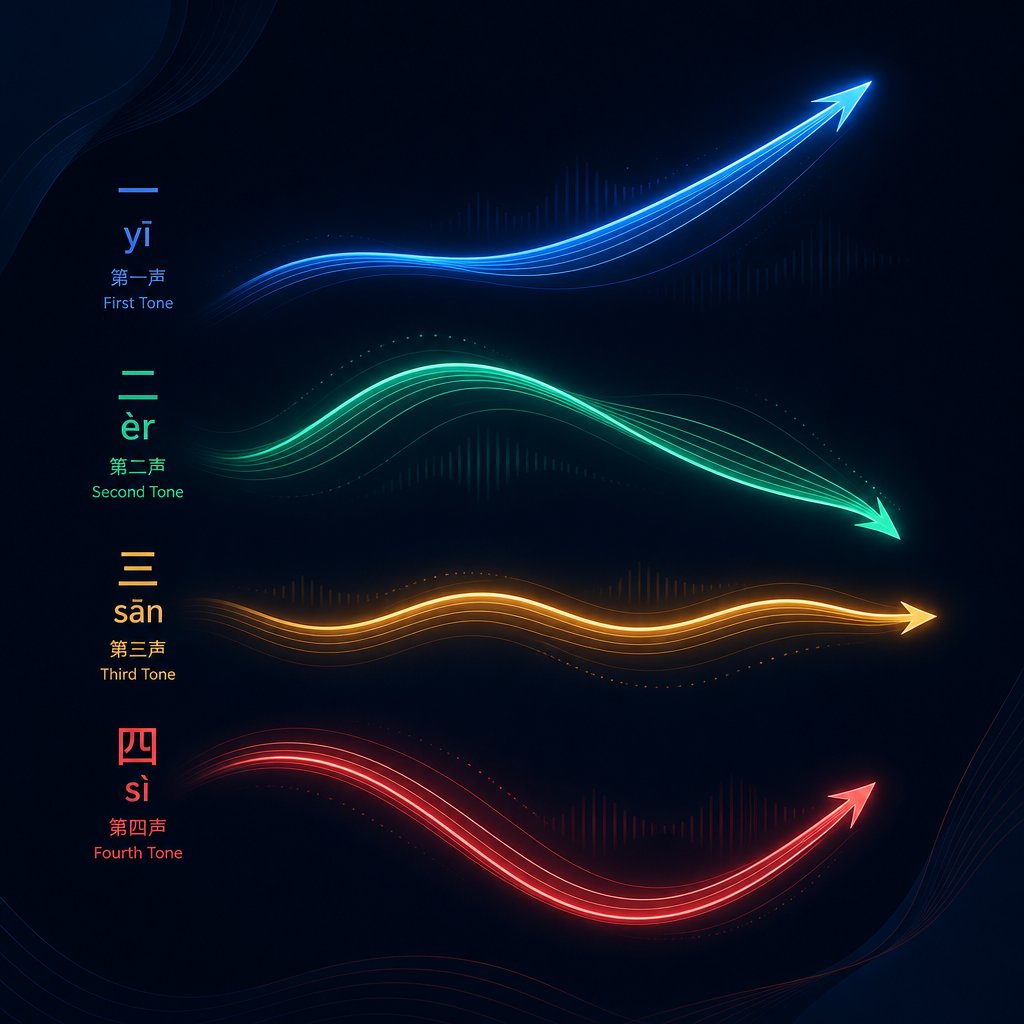
Mandarin has four tones: the first tone (high and flat), the second tone (rising), the third tone (low or dipping), and the fourth tone (falling). When you pair a surname with a single-character given name, you create a tone pair, and some combinations feel more natural to say than others.
The general principle is contrast. Tone pairs that move in different directions or shift between pitch levels create a sense of movement and musicality. Pairs that sit at the same pitch level or repeat the same contour can feel flat or awkward. For example, two consecutive first tones (high-high) sound monotone and stiff. Two consecutive third tones trigger a sandhi rule where the first one shifts to a rising tone, which changes how the name is actually pronounced versus how it is written.
Combinations that work well for mandarin names tend to pair a level tone with a moving tone, or a rising tone with a falling tone. The ear enjoys the contrast. A fourth tone followed by a second tone (falling then rising) creates a satisfying dip-and-lift. A second tone followed by a fourth tone (rising then falling) produces a clean arc. These patterns give mandarin chinese names a sense of completeness in just two syllables.
Combinations that feel less natural include two fourth tones in a row (falling-falling), which can sound abrupt and harsh, or a first tone followed by another first tone, which lacks dynamic movement. These are not wrong, but they require more deliberate articulation to sound pleasant.
Surname Pairings That Work Well
Since you cannot change your surname, the practical question is: given your family name's tone, which given-name tones will pair most harmoniously? Here are examples using common surnames paired with popular single-character names in mandarin:
| Surname | Given Name | Tone Pattern | Flow |
|---|---|---|---|
| 王 (Wang, 2nd) | 睿 (Rui, 4th) | Rising + Falling | Smooth, natural arc |
| 李 (Li, 3rd) | 明 (Ming, 2nd) | Low + Rising | Lifts upward; energetic |
| 张 (Zhang, 1st) | 伟 (Wei, 3rd) | High + Low | Strong contrast; grounded |
| 刘 (Liu, 2nd) | 强 (Qiang, 2nd) | Rising + Rising | Repetitive; less dynamic |
| 陈 (Chen, 2nd) | 志 (Zhi, 4th) | Rising + Falling | Clean arc; decisive |
| 赵 (Zhao, 4th) | 瑞 (Rui, 4th) | Falling + Falling | Abrupt; can sound harsh |
| 周 (Zhou, 1st) | 宁 (Ning, 2nd) | High + Rising | Gentle lift; pleasant |
| 林 (Lin, 2nd) | 安 (An, 1st) | Rising + High | Settles smoothly; calm |
You will notice that the most natural-sounding chinese mandarin names tend to pair contrasting tones. Rising-falling and low-rising combinations consistently produce names that feel complete and easy to say. Same-tone pairings are not forbidden, but they demand more from the speaker and can lack the melodic quality that makes names in mandarin memorable.
One important caveat: these guidelines apply specifically to Standard Mandarin (Putonghua). In Cantonese, which has six tones, the tonal landscape is far more complex, and a name that flows beautifully in Mandarin might sound awkward in Cantonese or vice versa. Hokkien, Shanghainese, and other regional varieties each have their own tonal systems and sandhi rules. Families who use multiple dialects at home often test a name across all of them before committing, ensuring it sounds right no matter which language is being spoken at the dinner table.
Tonal harmony is one piece of the puzzle. But names do not exist in a single location or a single dialect. They travel with people across borders, languages, and writing systems, raising a different set of questions about how single-character names adapt when they move beyond mainland China.
Single Character Names Across the Chinese Diaspora
A name that sounds elegant in Mandarin, looks balanced in calligraphy, and carries deep meaning in Chinese characters still has to function when it crosses a border. For the millions of Chinese-speaking people living in Taiwan, Hong Kong, Singapore, and Western countries, a single-character given name encounters different romanization systems, different cultural expectations, and different bureaucratic realities. How a name in chinese characters translates into daily life depends heavily on where that life is lived.
Regional Differences Across Chinese-Speaking Societies
Each major Chinese-speaking region has its own relationship with single-character names, shaped by local regulations, linguistic norms, and cultural attitudes.
- Mainland China (PRC): Naming laws require all names to be written in Chinese characters, with simplified characters advised. There are no restrictions on given-name length, so single-character names are fully legal. However, the character must be supported by government computer systems. As of 2009, approximately 32,232 characters were available for digital input, meaning rare or archaic characters that might appeal to parents seeking uniqueness can be rejected at registration. The practical effect is that single-character names in the PRC tend to draw from a well-known pool of characters, which contributes to the duplication problem discussed earlier.
- Taiwan: Traditional characters are standard, and naming conventions tend to favor two-character given names. Single-character names exist but are less common than on the mainland. When romanized, Taiwanese names often use a hyphen between given-name characters (e.g., Ming-yuan), a convention that becomes irrelevant for single-character names. The result is a clean, short romanized name like "Lin Ming" that reads simply in both Chinese and international contexts.
- Hong Kong: Cantonese pronunciation governs how names sound and how they are romanized. Hong Kong uses a non-standardized romanization system that can represent the same character in multiple ways. For example, the character 周 might appear as "Chow," "Chau," or "Chiau" depending on the individual or the clerk who registered the name. This inconsistency means a chinese name in chinese characters might have a stable written form but an unpredictable English spelling. Single-character names are particularly affected because there is only one given-name syllable to identify a person, and if that syllable is romanized inconsistently, it creates confusion in official records.
- Singapore: A multilingual environment where Mandarin, English, Malay, and Tamil all have official status. Chinese Singaporeans typically have both a Chinese name and an English name, and Pinyin is the standard romanization. Single-character names function smoothly here because the system is consistent, but many families opt for two-character names to maintain distinctiveness in a diverse naming landscape.
- Diaspora communities (Western countries): Overseas Chinese families face a layered decision. They must choose a name that works in the name in chinese language tradition while also functioning in English-speaking schools, workplaces, and legal systems. Single-character names produce very short romanized forms, sometimes just one syllable like "Ming" or "Wei," which can feel incomplete to Western ears accustomed to multi-syllable first names.
Single Character Names in International Contexts
When a single-character name leaves the Chinese-speaking world, it encounters a set of practical challenges that two-character names handle more easily.
The first is romanization itself. A name written in names in chinese writing has a fixed, unambiguous form. But the moment it enters a Latin-alphabet system, choices multiply. Which romanization system do you use? Pinyin produces one spelling, Jyutping another, and the older Wade-Giles system yet another. Research from University College London found that standardized systems like Jyutping and Pinyin achieved over 95% recall in data-linkage blocking strategies, while Hong Kong's non-standardized romanization reached only 68.8%. For people with single-character names, where there is only one syllable to match on, inconsistent romanization can make it genuinely difficult to link records across databases.
The second challenge is name order. Chinese names place the surname first, but Western systems expect given name first. A chinese name with english name conventions means flipping the order. Someone named 李明 (Li Ming) becomes "Ming Li" in Western contexts. With only two total characters, it is easy for systems or people to confuse which part is the surname and which is the given name. As one reference notes, overseas Chinese people working in Western countries always use Western naming customs when communicating with non-Chinese audiences, placing their given name first because that is what people and IT systems expect.
The third challenge is the adoption of English names. Many Chinese people living abroad take an additional English name to ease pronunciation and social interaction. This practice is especially common in Hong Kong, where names like "Johnny Chan" or "Emily Wong" combine an English given name with a romanized Chinese surname. For someone whose chinese name in chinese language is a single character, the English name often becomes the primary identifier in professional settings, while the Chinese name retreats to family use and official documents. The single-character name does not disappear, but it occupies a more private space.
Diaspora families choosing a single-character name today often think in both directions simultaneously. They want a character that carries meaning in the Chinese tradition and a romanized form that sounds natural in English. A name like 安 (An, peaceful) works well because "An" reads as a plausible Western name. A name like 强 (Qiang, strong) is harder to bridge because the romanized form is unfamiliar to English speakers and difficult to pronounce without tonal context.
This cross-cultural navigation is not just about convenience. It reflects a deeper question about identity: how much of a name's meaning survives translation? A character like 瑞 (rui, auspicious) carries centuries of cultural resonance in Chinese. Romanized as "Rui," it becomes a pleasant sound with no inherent meaning to non-Chinese speakers. The name still functions, but it functions differently. For families who want their child's name to communicate something in both worlds, that gap matters.
Whether a family is navigating PRC naming databases, Hong Kong romanization inconsistencies, or the bilingual reality of life abroad, the core question remains the same: how do you choose a single character that works not just in one context but across all the contexts a modern life demands? That question leads naturally to practical guidance, the kind of step-by-step thinking that helps parents, language learners, and writers make a confident choice.
How to Choose the Right Single Character Name
Whether you are a parent weighing chinese name ideas for a newborn, a professional preparing to work in Shanghai, or a novelist building a character from scratch, the selection process shares the same core logic. The difference is context, not method. A good single-character name must pass the same tests regardless of who is choosing it or why.
Before diving into audience-specific advice, here is a universal step-by-step process that applies across all situations:
- Define your intent. What quality, value, or aspiration should the name express? Write down three to five concepts that matter most, whether that is resilience, wisdom, beauty, or calm.
- Generate a character shortlist. Look up characters that match your intent. Use dictionaries, naming databases, or the meaning tables earlier in this article. Aim for five to ten candidates among simple chinese names that are readable and recognizable.
- Check homophones. Say each candidate aloud with the surname. Does the combination sound like an existing word or phrase with negative meaning? The character 思 (si, to think) paired with certain surnames can echo 死 (si, death). Homophone collisions are one of the most common pitfalls in Chinese naming.
- Test tonal flow. Speak the full name at natural speed. Does it feel smooth or does it stumble? Refer back to the tonal harmony principles covered earlier and avoid same-tone pairings that sound flat.
- Verify stroke count traditions. Some families follow numerological conventions where the total stroke count of a name should fall within auspicious ranges. If this matters to the family, count strokes for each candidate and eliminate those that fall outside preferred numbers.
- Check for unintended associations. Search the name online. Does it belong to a controversial public figure, a fictional villain, or a brand name? A name that seems perfect in isolation can carry baggage you did not anticipate.
- Confirm with native speakers. This step is non-negotiable. As experienced learners emphasize, connotations and emotional resonance are nearly impossible for non-native speakers to judge alone. Ask at least two or three native speakers from different regions for their honest reaction.
Guidance for Parents Choosing a Name
Parents face the highest stakes because the name is permanent and the child has no say. A few additional considerations apply beyond the universal steps above.
First, think about how the name will age. A character that sounds adorable for a baby needs to still command respect on a business card forty years later. Simple chinese names like 安 (an, peaceful) or 明 (ming, bright) carry this versatility well because their meanings are timeless rather than trendy.
Second, consider the generational context. If you are naming a child in the 2020s, check recent popularity data. Characters like 泽 (ze) and 睿 (rui) have surged in popularity, meaning your child may share a name with several classmates. If uniqueness matters to you, look one layer deeper into less common but still recognizable characters.
Third, align with family values. In many families, naming is a collaborative process involving grandparents or even a naming master who considers the child's birth date and the five elements (wuxing). Even if you do not follow these traditions strictly, understanding them helps you navigate family expectations gracefully.
Selecting a Single Character Name for Yourself
If you are a language learner or professional wondering "what is my name in chinese?" or "what is my mandarin name?", the process is different from naming a child. You are choosing for yourself, which means you can prioritize personal resonance over family tradition.
The most common question people ask is how to spell name in chinese or how do you write names in chinese when starting from an English name. The honest answer: direct transliteration rarely works well. Mandarin has roughly 400 syllables compared to English's 10,000-plus, so phonetic accuracy is almost impossible. A name that sounds vaguely like your English name but means nothing coherent in Chinese will mark you as an outsider immediately.
A better approach is to convert your name to chinese characters by meaning rather than sound. If your English name means "strong," consider 强 (qiang). If it means "grace," consider 雅 (ya). You can also choose a character that reflects your personality or aspirations independent of your English name entirely. The goal is a name that feels natural when a Chinese speaker says it, not one that preserves your English phonetics at the cost of sounding awkward.
One practical tip from expats who have gone through this process: choose a name you can actually pronounce. A beautiful character is useless if you stumble over it every time you introduce yourself. Practice saying the full name, surname included, until it feels as natural as your birth name. If you cannot get the tones right after repeated practice, consider a different character with easier phonetics.
Creating Authentic Names for Fiction
Fiction writers face a unique challenge. You need a name that communicates something to readers, potentially readers who do not speak Chinese, while still being authentic enough that Chinese-speaking readers will not wince.
Start by deciding what era and region your character comes from. A Han dynasty scholar would almost certainly have a single-character given name. A modern Shanghainese professional might have one, but it would be a deliberate stylistic choice by their parents. Getting this historical context right signals to knowledgeable readers that you have done your research.
Next, use the name to characterize. A character named 刚 (gang, hard/unyielding) reads differently from one named 宁 (ning, tranquil). You can use naming conventions to telegraph personality without exposition. But avoid being too on-the-nose. A villain named 恶 (e, evil) would feel cartoonish. Real Chinese names express aspirations, not descriptions.
Finally, verify that your fictional name does not accidentally belong to a famous real person. A quick search of my name in chinese characters databases or social media platforms will reveal whether your invented name is already strongly associated with a public figure. If it is, change one element to avoid confusion.
Across all three audiences, the underlying principle is the same: a single-character name succeeds when it balances meaning, sound, and social function. The character must mean something worth carrying. It must sound right with the surname. And it must work in the real contexts where the name will be spoken, written, and remembered. Get those three elements right, and one character is more than enough.
Frequently Asked Questions About Single Character Chinese Names
1. Why are single character Chinese names less common today?
Single character given names create high duplication rates in a population of 1.4 billion. With only a few thousand commonly used characters and a limited surname pool, millions of people end up sharing identical full names. This causes practical issues in schools, workplaces, and government databases. Two-character given names offer exponentially more combinations, making it easier to create a distinctive identity. While single character names peaked at around 30% during the 1980s one-child policy era, most modern parents now prefer two-character names for uniqueness while still appreciating the classical elegance that single character options provide.
2. What is the difference between a single character and two character Chinese given name?
A single character given name creates a full name of just two syllables (one surname plus one given name), while a two character given name produces three syllables total. Beyond length, they differ in uniqueness potential, cultural tone, and practical function. Single character names echo classical antiquity and signal deliberate simplicity, but they offer fewer nickname patterns and occasionally trigger automated system errors. Two character names allow layered meaning construction, provide better calligraphic balance with complex surnames, and produce a more natural three-syllable spoken rhythm that suits formal introductions.
3. How do I choose a good single character Chinese name for myself?
Start by identifying qualities or values you want the name to express rather than trying to transliterate your English name phonetically. Mandarin has only about 400 syllables compared to English's 10,000-plus, so sound matching rarely produces natural results. Choose a character based on meaning, then test it with your chosen surname for tonal harmony. Avoid homophone collisions where the name sounds like negative words. Most importantly, verify your choice with two or three native speakers from different regions, as connotations and emotional resonance are nearly impossible for non-native speakers to judge independently.
4. Which single character names work for both boys and girls?
Gender-neutral single character names typically describe abstract qualities, natural phenomena, or intellectual virtues rather than gendered traits. Popular unisex options include 明 (ming, bright), 宁 (ning, peaceful), 睿 (rui, wise), 晨 (chen, morning), 安 (an, safe), and 瑞 (rui, auspicious). These characters avoid the visual gender markers found in traditionally gendered names, such as the female radical 女 in feminine names or martial imagery in masculine ones. The trend toward gender-neutral naming is growing, particularly in urban Chinese households.
5. Do single character Chinese names work well internationally?
They function but face specific challenges abroad. A single character name romanizes to just one syllable, which can feel incomplete to Western ears and creates confusion about which part is the surname versus given name. Inconsistent romanization systems compound this issue, particularly for Hong Kong Cantonese names. Some characters bridge cultures well because their romanized forms resemble Western names, like 安 (An) which reads naturally in English. Diaspora families often choose characters that carry meaning in Chinese tradition while producing a romanized form that sounds accessible to non-Chinese speakers.