What Are Three Character Chinese Nicknames
When a Chinese parent leans in close and calls their child 小宝贝 (xiǎo bǎobèi) or a friend teases you with 小胖子 (xiǎo pàngzi), you're hearing something specific: a three-character Chinese nickname, or 三字小名 (sān zì xiǎo míng). These aren't formal names. They're intimate, playful labels born from affection, and they follow patterns that have shaped Chinese naming culture for centuries.
A nick name in Chinese can take many forms, from a single repeated syllable to a four-character phrase. But three characters occupy a sweet spot. They carry enough weight to feel personal, enough brevity to roll off the tongue, and enough structure to sound like they belong together. Think of them as the intersection of identity, emotion, and linguistic rhythm.
What Makes Three Character Nicknames Distinct
Mandarin is a tonal language with a natural preference for rhythmic phrasing. Two syllables can feel abrupt. Four can drag. Three syllables create a cadence that mirrors how Mandarin speakers naturally group sounds in speech. Say 小明明 (xiǎo míngmíng) out loud. You'll notice the rising-level-level tone pattern gives it a lilting, musical quality that feels complete without being heavy.
This isn't accidental. A Chinese nickname built on three characters allows for a prefix, a core meaning, and a softening element to coexist in a single breath. The structure gives speakers room to layer affection (through prefixes like 小), identity (through a meaningful character), and playfulness (through reduplication or suffixes) all at once.
Why Three Characters Matter in Chinese Culture
The number three carries deep resonance in Chinese thought. Laozi's Tao Te Ching states that "三生万物" (sān shēng wàn wù), meaning "three gives birth to all things." In Taoist philosophy, three represents harmony, the point where opposing forces resolve into completeness. This concept of balance and wholeness echoes in how nickname chinese conventions developed. Three characters feel neither sparse nor excessive. They feel right.
A three-character nickname signals a specific level of intimacy. It tells the listener: I know you well enough to name you with care, but casually enough to keep it warm rather than formal.
That emotional calibration is what separates these nicknames from standard given names or generic terms of address. They exist in a space reserved for people who share genuine closeness, whether that's a parent and child, close friends, or romantic partners.
The patterns behind these names, however, aren't random. Each one follows a specific formation logic that determines how it sounds, what it conveys, and who would use it.
Every Formation Pattern for Chinese Character Names Explained
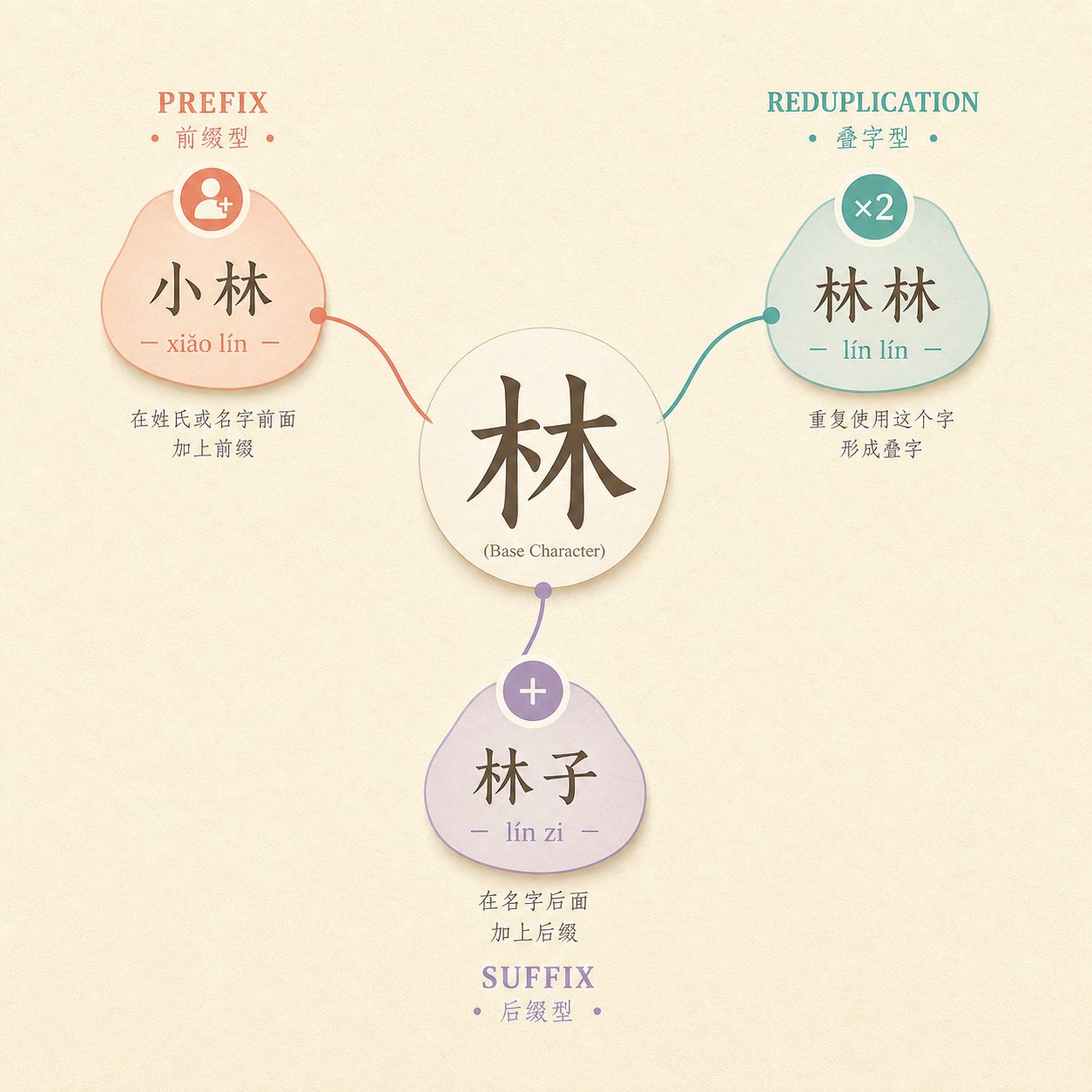
Each three-character nickname follows a specific structural formula. Understanding the chinese name structure behind these nicknames reveals why some combinations feel natural and others sound forced. There are three core formation methods: prefix-based, reduplication-based, and suffix-based. Every common three-character nickname you'll encounter fits into one of these categories.
Prefix-Based Patterns Like 小+X+X and 阿+X+X
The most productive way to build a three-character nickname is to attach a diminutive prefix to a two-character base. Two prefixes dominate this pattern:
小 (xiǎo) + two characters. The character 小 literally means "small" or "little," but in nicknames it functions as a marker of affection and familiarity. When placed before a two-character element, it transforms ordinary words into endearments. For example, 小宝贝 (xiǎo bǎobèi, "little treasure") takes the common term of endearment 宝贝 and softens it further. Similarly, 小胖墩 (xiǎo pàngdūn, "little chubby one") turns a physical description into something warm rather than critical.
阿 (ā) + two characters. The prefix 阿 carries a similar affectionate function but with a different regional flavor. You'll hear 阿毛毛 (ā máomao, "little fuzzy") or 阿宝贝 (ā bǎobèi) in southern Mandarin and Cantonese-influenced speech. Where 小 feels universally Mandarin, 阿 signals a more colloquial, often southern warmth.
Both prefixes accomplish the same goal: they mark the name as informal and intimate. The difference lies in regional preference and the subtle emotional coloring each prefix carries.
Reduplication Patterns Like 小+X+X and X+X+子
Reduplication, the doubling of a syllable, is deeply embedded in Chinese naming conventions. As linguist Victor Mair notes in his research on diminutives and reduplicatives in Chinese, young children often have nicknames consisting of repeated syllables like Bǎobao, Máomao, and Méimei. This babbling-inspired repetition carries into three-character forms through two main approaches.
Prefix + reduplicated character (小+X+X). This combines the diminutive prefix with a doubled syllable. Think of 小明明 (xiǎo míngmíng) or 小乐乐 (xiǎo lèlè, "little happy-happy"). The prefix anchors the name while the reduplication adds rhythmic playfulness. This pattern is especially common for children's nicknames because the repetition mimics the way babies naturally babble, making it feel instinctively tender.
Reduplicated character + suffix (X+X+子/儿). Here the doubled syllable comes first, followed by a grammatical suffix. Examples include 豆豆儿 (dòudòur, "little bean") and 果果子 (guǒguǒzi, "little fruit"). The suffix grounds the playful reduplication, giving it a slightly more structured feel.
What makes reduplication so effective in chinese name characters? Perry Link's An Anatomy of Chinese observes that repetition in Chinese can suggest smallness or endearment rather than intensification. A chubby child described as 胖嘟嘟的 (pàngdūdūde) isn't "more fat" but rather "cutely plump." The same softening principle applies to reduplicated nicknames.
Suffix-Based and Compound Patterns
The third major formation method attaches a suffix to a two-character base. Three suffixes appear most frequently:
- 儿 (ér) — adds a casual, northern Mandarin flavor. It softens the preceding characters and signals everyday intimacy.
- 子 (zi) — a neutral suffix that gives the nickname a slightly more structured feel without adding formality.
- 仔 (zǎi) — common in Cantonese and southern dialects, carrying a youthful, affectionate tone similar to "kid" or "little one."
Compound patterns also exist where three meaningful characters combine without a clear prefix or suffix. Names like 甜蜜蜜 (tiánmìmì, "sweet as honey") blend meaning and sound into a single unit. These tend to be more creative and less formulaic, often drawn from songs, idioms, or pop culture.
| Pattern Type | Structure | Example (Characters) | Pinyin | Meaning |
|---|---|---|---|---|
| Prefix (小) | 小 + two-character word | 小宝贝 | xiǎo bǎobèi | Little treasure |
| Prefix (小) | 小 + two-character word | 小胖墩 | xiǎo pàngdūn | Little chubby one |
| Prefix (阿) | 阿 + two-character word | 阿毛毛 | ā máomao | Little fuzzy |
| Prefix + Reduplication | 小 + X + X | 小明明 | xiǎo míngmíng | Little Mingming |
| Prefix + Reduplication | 小 + X + X | 小乐乐 | xiǎo lèlè | Little happy one |
| Reduplication + Suffix | X + X + 儿 | 豆豆儿 | dòudòur | Little bean |
| Reduplication + Suffix | X + X + 子 | 果果子 | guǒguǒzi | Little fruit |
| Suffix (儿) | Two characters + 儿 | 花朵儿 | huāduǒr | Little blossom |
| Suffix (仔) | Two characters + 仔 | 肥猫仔 | féi māo zǎi | Chubby kitty |
| Compound | Three meaningful characters | 甜蜜蜜 | tiánmìmì | Sweet as honey |
These patterns aren't rigid rules. They're templates that native speakers mix and adapt instinctively. A parent might start with a 小+X+X form for a toddler, then shift to a suffix-based version as the child grows. The formation pattern itself carries social information about the speaker's intent, their relationship to the person named, and the emotional register they want to strike.
Knowing the structure, though, is only half the picture. What determines whether a specific combination of characters actually sounds good together comes down to tonal harmony and meaning compatibility, the invisible rules that separate a nickname that clicks from one that falls flat.
Linguistic Rules Behind Natural-Sounding Nicknames
Some three-character nicknames roll off the tongue effortlessly. Others feel clunky the moment you say them aloud. The difference isn't random. Mandarin's tonal system and deep-rooted cultural associations around name chinese characters create an invisible filter that native speakers apply instinctively, even if they can't articulate the rules consciously.
Tonal Harmony and Sound Flow Rules
Mandarin has four main tones plus a neutral tone, and the way these tones sequence across three syllables determines whether a nickname sounds musical or jarring. The core principle: tonal variety creates flow, while tonal monotony creates friction.
Imagine stacking three fourth tones (falling tones) in a row. A nickname like 大力士 (dà lì shì) sounds choppy and aggressive because each syllable drops sharply without relief. Compare that to 小明明 (xiǎo míngmíng), where the third-tone-to-second-tone-to-second-tone pattern creates a gentle rising contour that feels warm and approachable.
There's a phonological reason this works. As tone sandhi rules demonstrate, Mandarin naturally avoids certain consecutive tone patterns in connected speech. When two third tones appear together, the first shifts to a second tone in pronunciation. This means a nickname like 小宝宝 (xiǎo bǎobao) is actually pronounced with a rising tone on 小, creating the smooth contour xiáo bǎobao in natural speech. The language itself reshapes awkward sequences into something more fluid.
Here's what separates pleasant combinations from awkward ones:
- Tonal contrast between syllables creates a sense of movement. Mixing rising and falling tones (like tone 2 + tone 4, or tone 1 + tone 3) produces a melodic contour that feels dynamic rather than flat.
- Three consecutive same-tone syllables feel monotonous. Three first tones in a row (high-high-high) sound robotic. Three fourth tones (fall-fall-fall) sound harsh. Variety is the default preference.
- Ending on a neutral or light tone softens the nickname. Suffixes like 子 (zi) and reduplicated second syllables often carry a neutral tone, which lets the name trail off gently rather than ending abruptly.
- Third-tone sandhi works in your favor. Because consecutive third tones automatically shift in pronunciation, patterns like 小 (tone 3) + a third-tone character actually produce a rising-then-dipping contour that sounds naturally affectionate.
- Open vowel endings (a, o, e) feel softer than closed ones (n, ng). A nickname ending in an open syllable like 宝 (bǎo) or 乐 (lè) sounds more tender than one ending in a nasal like 冰 (bīng).
Consider the contrast: 小甜甜 (xiǎo tiántián) flows beautifully because the third tone shifts upward before two smooth second tones, creating a wave-like rise. Meanwhile, something like 大壮壮 (dà zhuàngzhuàng) feels heavier and more forceful, with its falling tone followed by two strong fourth-tone syllables. Neither is wrong, but each carries a completely different emotional weight.
Character Meaning Compatibility
Tonal flow gets a nickname past your ear. Meaning compatibility gets it past your mind. When choosing a chinese given name or nickname, speakers instinctively avoid character combinations that clash semantically or carry inauspicious associations.
The most fundamental rule: never combine characters whose meanings contradict each other in ways that create confusion or bad luck. A nickname pairing 福 (fú, fortune) with 哭 (kū, cry) would feel deeply wrong to any native speaker, not because of how it sounds, but because of what it suggests. Similarly, characters that are homophones of unlucky words get filtered out. Any syllable that echoes 死 (sǐ, death), 苦 (kǔ, suffering), or 散 (sàn, to scatter or separate) raises immediate red flags in a naming context.
Characters that pair well together tend to share a semantic field or create a coherent image:
Commonly paired together: 甜 (sweet) + 蜜 (honey), 宝 (treasure) + 贝 (shell/precious), 星 (star) + 月 (moon), 花 (flower) + 朵 (blossom). These combinations reinforce each other, building a single clear impression.
Typically avoided together: 火 (fire) + 水 (water), 笑 (laugh) + 哭 (cry), 美 (beautiful) + 丑 (ugly). These pairings create internal tension that makes the nickname feel unstable or contradictory.
There's also a subtler layer. When constructing a given name for chinese children, parents consider the five elements (五行 wǔxíng) and whether the characters' elemental associations harmonize with the child's birth chart. A child born in a year associated with water might receive nickname characters containing the water radical (氵), like 小溪溪 (xiǎo xīxī, "little stream"). This isn't mere superstition for many families. It's an active cultural practice that shapes which combinations feel appropriate.
The interplay between sound and meaning is what makes three-character nicknames so culturally rich. A nickname that passes both filters, tonal harmony and semantic coherence, doesn't just sound right. It feels inevitable, as though those three characters were always meant to sit together. And the specific characters people choose reveal something else entirely: the relationship between the namer and the named.
Popular Three Character Nicknames by Relationship
The same formation pattern can produce wildly different emotional effects depending on who's speaking and who's being named. A parent calling a toddler 小胖墩 (xiǎo pàngdūn) radiates warmth. A stranger using the same nickname would feel intrusive. Context is everything, and three-character nicknames encode relationship information as precisely as they encode affection.
What follows is a practical breakdown of chinese terms of endearment organized by the relationship they belong to, with pinyin, meaning, and notes on when each one fits naturally.
Family Nicknames Parents Give Children
Chinese nicknames for children tend to be the most creative and emotionally layered category. Parents and grandparents use these names from infancy, and many stick well into adulthood within the family circle. The tone is universally tender, but the specific nickname often reflects something about the child's appearance, personality, or the parents' hopes.
Here are some of the most common three-character 小名 you'll hear in Chinese households:
小宝贝 (xiǎo bǎobèi) — "little treasure." This is perhaps the most universal pet name in chinese for a child. Gender-neutral and age-neutral, it works from newborn through elementary school without feeling forced. Parents, grandparents, aunts, and uncles all use it freely. The term 宝贝 already means "treasure" or "darling," and the 小 prefix intensifies the affection while signaling that the speaker is addressing someone small and precious.
小胖墩 (xiǎo pàngdūn) — "little chubby one." This nickname is overwhelmingly used for babies and toddlers with round cheeks and plump limbs. It carries zero negative connotation in context. In Chinese culture, a chubby baby is a healthy baby, so calling a child 小胖墩 is closer to a compliment than a critique. You'll notice this one fades as children grow older, typically replaced by something less appearance-focused by school age.
小不点 (xiǎo bùdiǎn) — "little tiny one." Reserved for the smallest family members, this nickname emphasizes how delicate and small a child is. It's especially common for premature babies or children who are petite for their age. Grandparents favor this one.
小汤圆 (xiǎo tāngyuán) — "little rice ball." Named after the sweet glutinous rice dessert eaten during the Lantern Festival, this nickname suggests roundness, sweetness, and warmth. It works for both boys and girls and carries a cozy, food-related affection that's very common in Chinese naming culture.
小吃货 (xiǎo chīhuò) — "little foodie." For the child who's always hungry, always reaching for snacks, always excited about meals. This one is playful and slightly teasing, used by parents who find their child's appetite endearing rather than problematic.
Gender associations exist but aren't rigid. Names like 小公主 (xiǎo gōngzhǔ, "little princess") skew heavily female, while 虎子 (hǔzi, "tiger cub") is almost exclusively for boys. But most three-character family nicknames, especially those built on food or size imagery, cross gender lines without issue.
Romantic Three Character Pet Names
Pet names in chinese between couples operate on a different register. They're less about cuteness and more about claiming intimacy. The formality level varies significantly: some are whispered in private, others are used openly on social media or in front of friends.
小傻瓜 (xiǎo shǎguā) — "little silly melon." This is one of the most popular romantic nicknames in Mandarin. It sounds teasing on the surface, but the affection underneath is unmistakable. Calling someone a "silly melon" implies you find their naivety or clumsiness adorable rather than annoying. It's casual enough for daily use and works in both directions between partners.
小哥哥 (xiǎo gēge) — "little big brother." Used by women to address boyfriends or romantic interests, this nickname plays on a gentle contradiction. The 小 makes it diminutive and affectionate, while 哥哥 (older brother) implies protectiveness and reliability. It gained massive popularity through Chinese social media and dating culture.
小甜甜 (xiǎo tiántián) — "little sweetie." Straightforwardly affectionate, this one is used for girlfriends or wives. The reduplication of 甜 (sweet) doubles the sentiment, and the 小 prefix keeps it intimate rather than generic. It's common in text messages and voice calls between couples.
亲爱的 (qīn'ài de) — "dear one" or "darling." While technically three characters (or two characters plus the particle 的), this functions as a complete term of address. It's the closest Mandarin equivalent to "darling" or "my dear" in English. Couples use it both in private and in public without embarrassment, making it one of the more socially acceptable romantic nicknames.
The key distinction between romantic and family nicknames is reciprocity. Family nicknames flow downward, from older to younger. Romantic nicknames flow in both directions, and couples often develop matching or complementary pairs.
Friendship and Peer Nicknames
Among friends and classmates, three-character nicknames lean playful, irreverent, and sometimes deliberately absurd. The goal isn't tenderness but camaraderie. These names often reference inside jokes, physical traits, or personality quirks that only the friend group would understand.
小机灵 (xiǎo jīlíng) — "little clever one." For the friend who always has a quick answer or a sneaky solution. It's complimentary but carries a hint of "you're too smart for your own good."
老头子 (lǎo tóuzi) — "old man." Used for a friend who acts older than their age, whether through cautious behavior, early bedtimes, or a preference for tea over nightlife. It's affectionate teasing, not an insult.
小吃货 (xiǎo chīhuò) — "little foodie." This one crosses relationship boundaries. Among friends, it targets whoever always suggests restaurants, always finishes their plate first, or always has snacks in their bag.
大长腿 (dà chángtuǐ) — "long legs." A physical-trait nickname for a tall friend. It's lighthearted and often used with a mix of envy and admiration.
| Nickname (Characters) | Pinyin | Literal Meaning | Relationship Context | Tone of Use |
|---|---|---|---|---|
| 小宝贝 | xiǎo bǎobèi | Little treasure | Parent to child | Tender, universal |
| 小胖墩 | xiǎo pàngdūn | Little chubby one | Parent to toddler | Warm, affectionate |
| 小不点 | xiǎo bùdiǎn | Little tiny one | Family to young child | Gentle, protective |
| 小汤圆 | xiǎo tāngyuán | Little rice ball | Parent to child | Sweet, cozy |
| 小公主 | xiǎo gōngzhǔ | Little princess | Parent to daughter | Doting, adoring |
| 小傻瓜 | xiǎo shǎguā | Little silly melon | Between couples | Teasing, loving |
| 小哥哥 | xiǎo gēge | Little big brother | Girlfriend to boyfriend | Flirty, affectionate |
| 小甜甜 | xiǎo tiántián | Little sweetie | Between couples | Romantic, soft |
| 亲爱的 | qīn'ài de | Dear one / Darling | Between couples | Warm, public-appropriate |
| 小机灵 | xiǎo jīlíng | Little clever one | Between friends | Playful, admiring |
| 老头子 | lǎo tóuzi | Old man | Between friends | Teasing, humorous |
| 小吃货 | xiǎo chīhuò | Little foodie | Family or friends | Lighthearted, fun |
| 大长腿 | dà chángtuǐ | Long legs | Between friends | Envious, playful |
You'll notice a pattern across all three categories: the relationship determines not just which nickname is appropriate, but how the same structural pattern gets interpreted. A 小+X+X form used by a parent feels nurturing. The same structure used by a friend feels like banter. And between lovers, it becomes a private language. The characters stay the same, but the emotional charge shifts entirely based on who's speaking.
These relationship-specific conventions also vary depending on where in China you are. A nickname that sounds perfectly natural in Beijing might land differently in Guangzhou or Taipei, because regional dialect traditions shape which patterns feel local and which feel borrowed.
Regional and Dialect Variations Across China
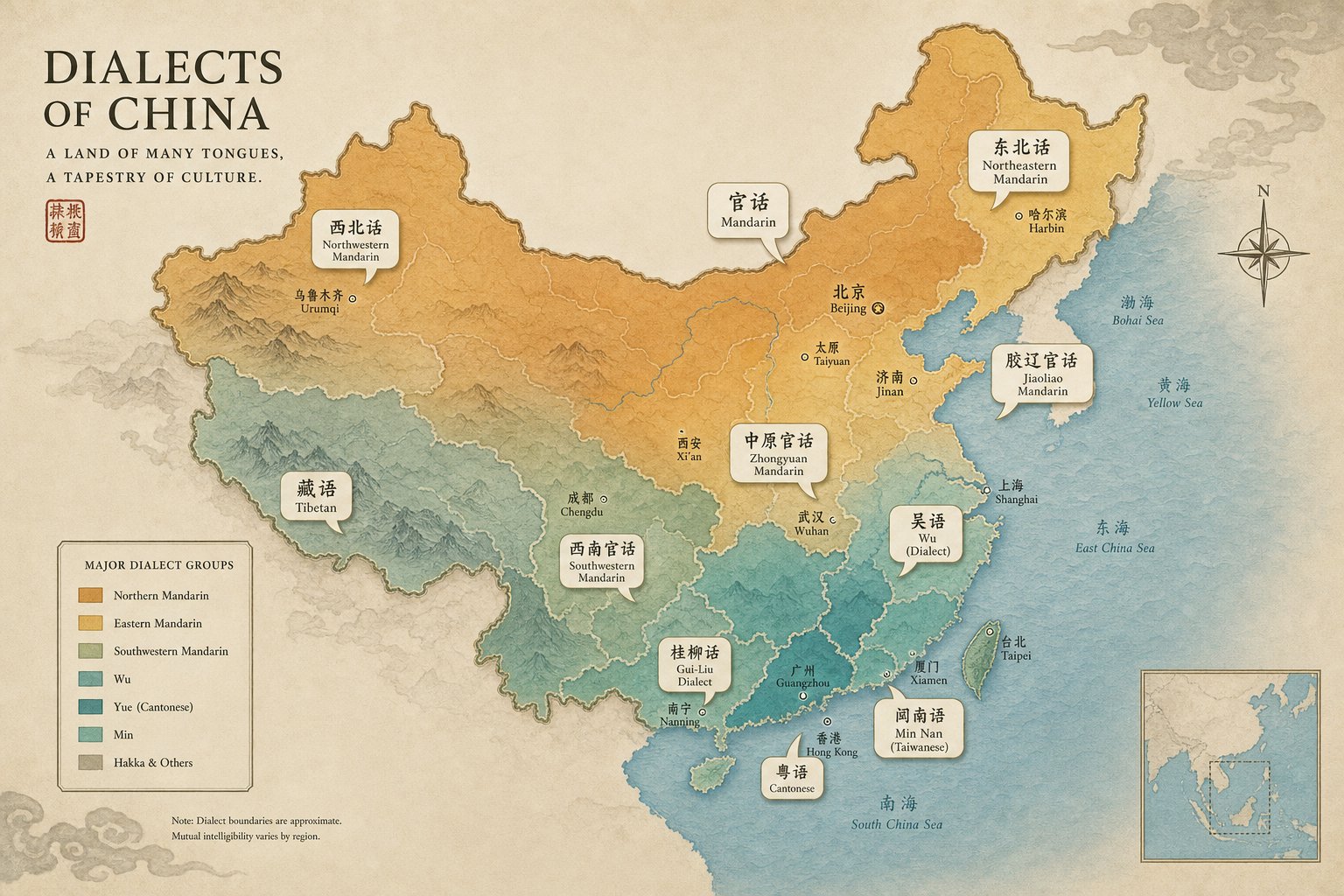
A nickname that sounds perfectly cozy in a Beijing apartment might land flat in a Hong Kong tea house. That's because three-character nickname patterns aren't uniform across Chinese-speaking regions. They shift based on dialect, geography, and local linguistic tradition. The same impulse toward affection and intimacy gets expressed through different structural preferences depending on where you are.
People sometimes ask what is the nickname of china itself, and the answer (中国, Zhongguó, the "Middle Kingdom") reflects how naming conventions run deep in Chinese culture at every level. Personal nicknames follow the same principle: they encode identity and belonging, and regional variation is part of what makes them feel authentic rather than generic.
Mandarin 小+X+X Versus Cantonese 阿+X+X Patterns
The clearest regional divide in three-character nickname formation is the prefix split between north and south. In northern Mandarin, particularly in Beijing, Tianjin, and the northeastern provinces, 小 (xiǎo) dominates as the default affectionate prefix. Walk into any Beijing household and you'll hear 小宝贝, 小明明, 小胖墩 rolling naturally off tongues. The 小-prefix feels so standard in Mandarin that many northern speakers don't even register it as a regional choice.
Travel south to Guangdong, Hong Kong, or Macau, and the landscape shifts. Cantonese speakers lean heavily toward the 阿 (aa3) prefix, which carries a warmth bred through familiarity and time rather than the "little" diminutive quality of 小. A child called 小明明 in Beijing becomes 阿明明 (aa3 mìhng mìhng) in Cantonese contexts. The emotional intent is identical, but the sound signature is completely different.
Here's how the same concepts play out in each dialect's preferred pattern:
| Concept | Mandarin Pattern | Pinyin | Cantonese Pattern | Jyutping |
|---|---|---|---|---|
| Affectionate name for a child named Ming | 小明明 | xiǎo míngmíng | 阿明明 | aa3 ming4 ming4 |
| Cute name for a chubby baby | 小胖胖 | xiǎo pàngpang | 阿肥肥 | aa3 fei4 fei4 |
| Endearment for a precious child | 小宝贝 | xiǎo bǎobèi | 阿宝贝 | aa3 bou2 bui3 |
| Playful name for a lively child | 小皮蛋 | xiǎo pídàn | 阿蛋蛋 | aa3 daan2 daan2 |
The distinction goes beyond mere prefix swapping. In Cantonese, 阿 can attach to just one character of a multi-character name, creating a two-character form (阿明), but when extended to three characters through reduplication (阿明明) or compound attachment (阿宝贝), it produces a softer, more drawn-out cadence that matches Cantonese's broader tonal range. Cantonese has six tones compared to Mandarin's four, which means three-character nicknames in Cantonese have more melodic possibilities and more potential pitfalls.
Taiwanese and Hokkien Variations
Cross the Taiwan Strait and the picture gets more complex. Taiwanese Mandarin shares vocabulary with mainland Mandarin but carries distinct phonetic preferences shaped by decades of contact with Hokkien (also called Minnan or Taiwanese). This creates a hybrid nickname culture where patterns from both languages coexist.
In Hokkien, the prefix 阿 (a) is even more deeply embedded than in Cantonese. Hokkien honorific traditions use 阿 as a standard familial prefix: 阿公 (a-kong, grandfather), 阿媽 (a-má, grandmother), 阿兄 (a-hiaⁿ, elder brother). This prefix-first structure extends naturally into three-character nicknames, where Hokkien speakers might say 阿宝仔 (a-pó-á) using the distinctly southern suffix 仔 (á in Hokkien, zǎi in Mandarin).
The suffix 仔 deserves special attention here. While Mandarin speakers occasionally use 仔 in three-character forms, it's in Hokkien and Cantonese where this suffix truly thrives. It carries a youthful, diminutive quality, roughly equivalent to "kid" or "little one," and it combines naturally with both reduplicated and compound bases:
- 阿猫仔 (a-niau-á) — "little kitty," a common Hokkien pet name for small children
- 阿狗仔 (a-káu-á) — "little puppy," used affectionately despite the humble imagery
- 肥肥仔 (pûi-pûi-á) — "chubby little one," with reduplication plus the 仔 suffix creating a distinctly southern three-character form
Taiwanese Mandarin speakers often blend these systems. A parent might use 小宝贝 in Mandarin-dominant contexts but switch to 阿宝仔 when speaking Hokkien with grandparents. This code-switching is natural and reflects how nickname mandarin conventions interact with local dialect traditions rather than replacing them.
Regional Preferences and Cultural Nuances
Geography doesn't just influence which prefix you use. It shapes the entire emotional register of what feels appropriate. A nickname for china's diverse regions needs to account for local sensibilities about formality, humor, and intimacy.
In Shanghai and the surrounding Wu dialect region, three-character nicknames often incorporate local pronunciation quirks. The Shanghai dialect softens many consonants and adds a lilting quality that makes even standard Mandarin nicknames sound different when spoken with local phonology. A 小宝宝 spoken with Shanghainese intonation carries a different texture than the same characters spoken in crisp Beijing Mandarin.
Northeastern Mandarin (东北话) takes a different approach entirely. Speakers in Heilongjiang, Jilin, and Liaoning favor bold, humorous nicknames that might sound too blunt elsewhere. Three-character forms like 小破孩 (xiǎo pòhái, "little rascal") or 小犊子 (xiǎo dúzi, "little calf," used affectionately for mischievous boys) carry a rougher warmth that's characteristic of northeastern directness.
The same three characters can signal affection in one region and confusion in another. A Cantonese speaker hearing 小明明 might understand it intellectually but feel it lacks the warmth of their native 阿明明. Regional patterns aren't interchangeable — they carry the emotional weight of home.
This regional dimension matters for anyone choosing or using three-character nicknames across dialect boundaries. If you're creating a nickname for someone from Guangdong, an 阿-prefix form will feel more natural to them than a 小-prefix one. If they're from Beijing, the reverse is true. And if they're from Taiwan, you might find that both prefixes coexist comfortably depending on which language the family speaks at home.
What's consistent across all regions, though, is the underlying impulse: three characters provide enough space to be specific, affectionate, and rhythmically satisfying regardless of which dialect shapes the surface form. The patterns adapt, but the function remains the same. And increasingly, these regional distinctions are finding new life in digital spaces where speakers from every corner of China interact daily.

Three Character Nicknames in Digital and Gaming Culture
Regional dialect traditions shaped three-character nicknames for centuries within families and friend groups. But digital platforms collapsed those geographic boundaries overnight. On WeChat, Weibo, and Douyin, a user from Guangzhou interacts with someone from Harbin under display names that need to work without any regional context at all. This is where three-character nicknames found a second life, not as intimate family labels, but as chinese usernames built for screens.
Three Character Names on Social Media Platforms
Why do three characters work so well as display names? It comes down to visual balance and cognitive load. On Chinese social platforms, names appear in compact UI elements: comment sections, chat lists, notification banners. Two characters can feel generic and easily confused with other users. Four or more characters get truncated or crowd the interface. Three characters hit the visual sweet spot, distinctive enough to recognize at a glance, short enough to fit cleanly in any layout.
Traditional nickname patterns adapt naturally to this environment. A user might register as 小确幸 (xiǎo quèxìng, "little certainty of happiness"), borrowing the 小-prefix structure but filling it with a modern concept from popular culture. Others use reduplication patterns like 甜甜圈 (tiántiánquān, "donut," literally "sweet-sweet-circle") that echo the playful doubling of childhood nicknames while functioning as a standalone online identity.
Platform policies add another layer. Major Chinese platforms like Douyin and Weibo now require popular accounts to display real names, but casual users still enjoy creative freedom with their display names. For everyday users sharing daily life content, three-character handles remain a way to project personality without revealing formal identity.
Gaming Handles and Esports Nicknames
Gaming is where three-character naming gets truly creative. Chinese gamertags need to accomplish something specific: they must be readable in fast-paced team communication, memorable enough for opponents to recognize, and cool enough to build a reputation around. Three characters check all three boxes.
In competitive titles like Honor of Kings (王者荣耀) and League of Legends, you'll see chinese names for games that draw on classical imagery: 剑无痕 (jiàn wú hén, "traceless sword"), 夜未央 (yè wèiyāng, "endless night"), 风无声 (fēng wú shēng, "silent wind"). These borrow the three-character rhythm but replace affectionate prefixes with dramatic, literary language. The structure is familiar. The tone is completely different.
Esports professionals often adopt three-character stage names that function as personal brands. The appeal is practical: teammates can call out a three-syllable name in voice chat faster than a four-syllable one, and audiences remember it more easily during broadcasts. The same rhythmic principle that makes 小宝贝 feel natural in a family kitchen makes 剑无痕 feel natural in a tournament arena.
Creating Cool Online Identities with Three Characters
Modern internet culture blends classical nickname structures with slang, pop culture, and aesthetic trends. You'll find users combining traditional formation patterns with completely contemporary content: 摸鱼王 (mō yú wáng, "slacking king," from the internet slang 摸鱼 meaning to slack off at work), 干饭人 (gān fàn rén, "rice-eating person," meaning someone who lives to eat), or 打工仔 (dǎgōng zǎi, "working kid," a self-deprecating label for young workers).
These names use recognizable three-character structures, suffix patterns, compound forms, but fill them with vocabulary that didn't exist a decade ago. The result feels both rooted and fresh.
When choosing a three-character name for digital platforms, consider these platform-specific factors:
- WeChat: Names appear in intimate chat contexts. Warmer, more personal three-character names (小太阳, "little sun") fit the private messaging environment better than edgy ones.
- Weibo and Douyin: Public-facing platforms reward memorable, personality-driven names. Humor and wordplay (如花似玉 shortened to 如花哥, "Brother Ruhua") perform well in comment sections.
- Gaming platforms: Prioritize readability under pressure. Avoid characters with complex strokes that blur at small sizes. Classical imagery (龙, 剑, 风, 月) remains popular because these characters are instantly recognizable even in fast-scrolling kill feeds.
- Xiaohongshu (RED): Aesthetic and lifestyle-oriented names work best. Three-character combinations using 小, nature imagery, or food references (小栗子, "little chestnut") align with the platform's visual culture.
- Bilibili: Anime, meme, and subculture references dominate. Three-character handles often riff on character names or internet catchphrases, rewarding in-group recognition.
The digital migration of three-character nicknames reveals something interesting: the structural patterns developed over centuries for family intimacy turned out to be perfectly optimized for screen-based communication too. Three syllables are quick to type, easy to scan, and satisfying to say aloud in voice chat. What started as a naming convention for babies became, almost accidentally, ideal for the constraints of modern interfaces.
But these digital adaptations didn't appear from nowhere. They're the latest chapter in a naming tradition that stretches back through dynasties, carrying superstitions, protective instincts, and evolving social norms along the way.
Historical Evolution of Chinese Words of Endearment
Every three-character nickname spoken today carries echoes of a much older impulse. Long before WeChat display names or esports handles, chinese endearments served a purpose that had nothing to do with cuteness. They were shields.
Traditional 小名 Conventions and Their Three Character Forms
In ancient China, infant mortality was devastatingly high. Parents believed evil spirits targeted children who seemed valuable or beloved, so they developed a counterintuitive strategy: give the child a name so humble, so unappealing, that no spirit would bother with them. As Yoyo Chinese explains, parents gave their kids 小名 like 狗剩 (gǒu shèng, "dog's leftovers") or 臭蛋 (chòu dàn, "stinky egg") so that evil spirits "wouldn't care to pay attention to a child who is so lowly."
Many of these protective nicknames followed three-character patterns. A parent might call a son 小狗剩 (xiǎo gǒu shèng, "little dog-leftovers") or 阿臭蛋 (ā chòu dàn), layering the affectionate prefix onto the deliberately ugly core. The three-character structure served double duty: the prefix signaled parental love while the base characters performed their protective deception. Chinese boy names with characters like 铁 (tiě, iron), 石 (shí, stone), or 牛 (niú, ox) were also common in these formations, chosen for their toughness and low status rather than beauty.
This wasn't limited to peasant families. Historical records show that even aristocratic households used humble childhood names within the family, reserving elegant formal names for public life. The 小名 existed in a private sphere where superstition and love coexisted without contradiction.
From Classical to Contemporary Usage
The protective function faded gradually as infant mortality declined and modern medicine replaced folk superstition. By the mid-twentieth century, most urban Chinese families had shifted the purpose of 小名 entirely. Instead of warding off spirits, three-character nicknames became vehicles for expressing hopes, marking personality traits, or simply sounding adorable.
Modern parents blend traditional structures with contemporary sensibilities. The 小+X+X pattern remains identical to what families used centuries ago, but the content has transformed. Where a Qing dynasty grandmother might have called her grandson 小石头 (xiǎo shítou, "little rock") for protection, a parent today might choose 小星星 (xiǎo xīngxīng, "little star") to express aspiration. The architecture is ancient. The vocabulary is fresh.
You can hear this evolution in everyday speech. Imagine a mother picking up her toddler from daycare:
"小汤圆, 今天乖不乖?" (Xiǎo tāngyuán, jīntiān guāi bu guāi?) — "Little rice ball, were you good today?"
Or a grandfather bouncing a baby on his knee:
"来, 小胖墩, 笑一个!" (Lái, xiǎo pàngdūn, xiào yī gè!) — "Come on, little chubby one, give me a smile!"
These moments sound completely natural in modern Mandarin, yet the three-character rhythm and prefix structure are inherited directly from centuries-old conventions. The words of endearment changed, but the emotional grammar stayed the same.
What also shifted is scope. Traditional 小名 belonged exclusively to the family circle. They were deeply personal, used only by parents, grandparents, and very close relatives. Calling someone by their 小名 outside the family was either a sign of extraordinary intimacy or a social violation. Today, three-character nickname patterns have migrated outward into friendships, romantic relationships, and even public personas, while still retaining their core signal of closeness.
This expansion didn't erase the old rules. It layered new ones on top. A modern speaker intuitively understands that 小宝贝 from a parent carries different weight than 小宝贝 from a partner, even though the characters are identical. The historical DNA of family-only intimacy still shapes how these names land emotionally, even as their social range has widened.
That widening raises a practical question. If three-character nicknames now serve so many different purposes across so many contexts, what makes speakers choose three characters specifically, rather than two or four? The answer lies in how different lengths feel in the mouth and what each length communicates about the speaker's intent.
Why Three Characters Instead of Two or Four
Say 小明 (xiǎo míng) out loud. Then say 小明明 (xiǎo míngmíng). You'll feel the difference immediately. The two-character version is quick, functional, almost like a label. The three-character version lingers, carrying warmth and rhythm that the shorter form simply can't hold. This isn't a matter of personal taste. It reflects how Mandarin speakers instinctively calibrate nickname length to match emotional intent.
Every nickname length, from a single syllable to four or more characters, occupies a distinct communicative niche. Three characters aren't universally "better." They're specifically suited to a particular balance of expressiveness and brevity that other lengths can't replicate.
When Speakers Choose Three Characters Over Two
Two-character nicknames like 小明, 阿华 (ā huá), or 宝宝 (bǎobao) are the workhorses of Chinese informal address. They're fast, easy, and universally understood. So why would anyone add a third character?
The answer is specificity. A two-character nickname is generic by nature. 小明 could refer to any child named Ming. It's a placeholder, almost a default. But 小明明 adds the reduplication that transforms a generic label into something personal, something that belongs to one specific child in one specific family. The extra syllable creates space for personality to enter the name.
Consider the difference in these pairs:
- 小胖 (xiǎo pàng) vs. 小胖墩 (xiǎo pàngdūn) — "Little fatty" is blunt and borderline unkind. "Little chubby one" adds the affectionate 墩 (a rounded shape), softening the description into something endearing.
- 宝贝 (bǎobèi) vs. 小宝贝 (xiǎo bǎobèi) — "Treasure" is a term of endearment anyone might use. "Little treasure" narrows the focus, making it feel directed at someone small and specific rather than tossed out casually.
- 甜甜 (tiántián) vs. 小甜甜 (xiǎo tiántián) — The reduplicated form alone works as a name, but adding 小 frames it as a nickname given by someone older or closer, adding a layer of relational context.
Two-character forms also suffer from a crowding problem. Because they're so common, they lack distinctiveness. In a classroom of thirty children, multiple kids might answer to 小明 or 宝宝. A three-character form like 小汤圆 or 小皮蛋 (xiǎo pídàn, "little rascal egg") is specific enough to belong to one person. The third character acts as a differentiator, a fingerprint that two characters can't provide.
There's a tonal dimension too. As discussed in the structure of Chinese names, Mandarin's tonal system creates natural rhythm when syllables move through different tones. Two syllables offer only one tonal transition. Three syllables offer two, which is enough to create a melodic contour, a sense of rising and falling that makes the name three characters long feel musically complete rather than cut short.
Three Characters Versus Longer Nickname Forms
If three characters add warmth that two can't achieve, why not go further? Four-character nicknames exist, but they occupy a fundamentally different space in daily speech.
The issue is cognitive and phonetic. Mandarin speech naturally groups into rhythmic units of two or three syllables. A four-character phrase like 小甜蜜蜜 (xiǎo tiánmìmì) or 我的宝贝 (wǒ de bǎobèi, "my treasure") starts to feel like a phrase or sentence fragment rather than a name. It requires more breath, more processing time, and more deliberate articulation. In the rapid back-and-forth of daily conversation, that extra syllable creates friction.
Long chinese names in the nickname category also lose the snap that makes a name feel like a name. When you call someone across a room, you need something punchy. 小宝贝 carries across a playground. 我家的小宝贝 (wǒ jiā de xiǎo bǎobèi, "my family's little treasure") is a description, not a call. The boundary between "nickname" and "phrase" blurs once you pass three characters.
Single-character nicknames sit at the opposite extreme. Calling someone just 明 (míng) or 宝 (bǎo) feels incomplete in most contexts, almost abrupt. A single syllable lacks the structural markers, the prefix, suffix, or reduplication, that signal "this is a nickname" rather than just a truncated name. The exception is intimate whispered contexts where brevity itself signals closeness, but these are situational rather than standard.
Three characters, then, occupy the structural sweet spot. They're long enough to carry a complete emotional message (prefix + meaning, or meaning + suffix, or reduplicated core) but short enough to function as a single rhythmic unit in speech. You can shout them, whisper them, type them, or sing them without any part feeling excess or missing.
| Character Count | Example | Typical Context | Expressiveness Level | Common Usage Scenarios |
|---|---|---|---|---|
| 1 character | 宝 (bǎo) | Extremely intimate, whispered | Minimal — relies entirely on tone of voice | Between couples in private moments; rare in daily use |
| 2 characters | 小明 (xiǎo míng) | Casual, generic address | Low — functional but impersonal | Classrooms, acquaintances, default placeholder nicknames |
| 2 characters (reduplicated) | 宝宝 (bǎobao) | Family, romantic | Moderate — warmth through repetition | Parents to babies, couples in casual speech |
| 3 characters | 小宝贝 (xiǎo bǎobèi) | Family, romantic, close friends | High — specific, rhythmic, emotionally layered | Daily family life, pet names, friend groups, online handles |
| 4+ characters | 小甜蜜蜜 (xiǎo tiánmìmì) | Playful, emphatic, occasional | Very high — but borders on phrase rather than name | Joking emphasis, written messages, song lyrics, one-off teasing |
The table makes the pattern visible: expressiveness increases with length, but usability peaks at three characters and drops off after. A 3 letter chinese name (in the sense of three characters, each representing a syllable) delivers maximum personality per syllable. It's the point where you get the most emotional return without paying a cost in awkwardness or length.
This is why, across every relationship type and every regional dialect, three-character forms dominate the nickname landscape. They aren't just common by accident. They're structurally optimized for how Mandarin works as a spoken language. Two characters are too lean to carry full affection. Four are too heavy for everyday rhythm. Three is where name three characters long becomes not just a nickname, but a small act of creative expression.
Understanding why three characters work so well is one thing. Actually building one from scratch, especially if you're not a native speaker, requires a more deliberate process: choosing the right base characters, matching them to a formation pattern, and checking that the result won't accidentally mean something unfortunate.
How to Create Your Own Three Character Nickname
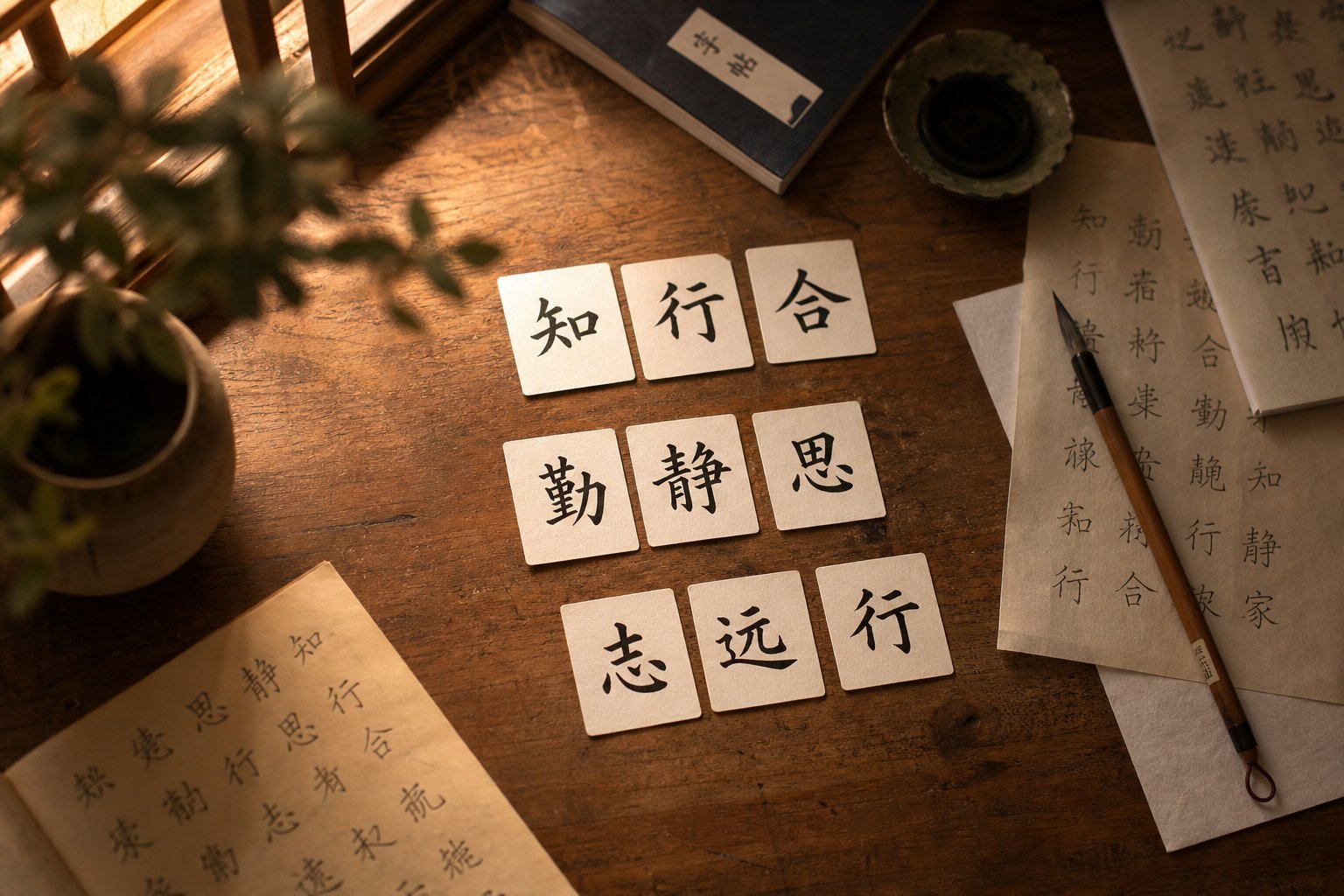
Knowing the patterns, the tonal rules, and the cultural context gives you a foundation. But sitting down to actually construct a three-character nickname for someone, whether you're a non-native speaker choosing a chinese game name or a parent naming a newborn, requires a more structured approach. Here's a framework that moves from raw material to finished nickname without stumbling into cultural pitfalls.
Step One — Choose Your Base Characters
Every nickname starts with meaning. Before you think about structure, you need characters that carry the right emotional weight. Your base characters are the core of the nickname, the part that gives it identity.
- Pull from the person's given name. The simplest approach: take one or two characters from their formal name and build around them. If someone's name contains 明 (míng, bright), that character becomes your starting point for forms like 小明明 or 明明子.
- Draw from personality traits or physical features. A cheerful person might inspire characters like 乐 (lè, happy) or 甜 (tián, sweet). A round-cheeked baby invites 圆 (yuán, round) or 胖 (pàng, chubby). Choose traits the person would feel good about, not ones that might sting.
- Use aspirational or symbolic characters. Parents often pick characters representing hopes: 星 (xīng, star), 龙 (lóng, dragon), 瑞 (ruì, auspicious). These work especially well for children's nicknames where the name carries a wish for their future.
- Consider nature, food, or animal imagery. Some of the most beloved cool chinese nicknames come from everyday objects: 小栗子 (xiǎo lìzi, "little chestnut"), 小橘子 (xiǎo júzi, "little tangerine"), 小老虎 (xiǎo lǎohǔ, "little tiger"). These feel warm and approachable because they connect the person to something tangible and familiar.
Step Two — Select a Formation Pattern
With your base characters chosen, match them to a structural pattern based on your relationship to the person and the tone you want to strike:
- For tender, family-oriented nicknames: Use 小 + reduplicated character (小乐乐, 小星星). The reduplication adds softness that suits parent-child relationships.
- For playful friend or peer nicknames: Use compound patterns or suffix-based forms (吃货王, 大长腿). These feel casual and humorous rather than precious.
- For romantic pet names: Use 小 + two-character endearment (小傻瓜, 小甜甜). The prefix creates intimacy while the base carries the emotional message.
- For online identities or gaming handles: Use compound three-character forms with dramatic or aesthetic imagery (夜未央, 风无声). Skip the diminutive prefixes — they feel too soft for digital personas. If you're building a chinese game name, lean toward characters that evoke strength, mystery, or beauty rather than cuteness.
- For southern or Cantonese-influenced contexts: Swap 小 for 阿 and consider the suffix 仔 (阿宝仔, 阿猫仔). This signals regional authenticity.
When translating chinese nicknames in english contexts, keep the pinyin accessible. A nickname like 小星星 becomes "Xiǎo Xīngxīng" in romanized form, which non-Chinese speakers can learn to pronounce with minimal coaching.
Step Three — Check Cultural Appropriateness
This is where many non-native speakers trip up. A nickname that sounds pleasant and carries nice meaning can still fail if it violates cultural naming taboos. Before finalizing your choice, run it through this checklist:
- Check for unfortunate homophones. Read the full nickname aloud and listen for whether it sounds like any inauspicious words. As naming experts warn, even characters with positive individual meanings can create problems when combined — like 思旺 (sī wàng) sounding dangerously close to 死亡 (sǐ wáng, death).
- Avoid characters associated with death, illness, or separation. Steer clear of anything that echoes 死 (sǐ), 病 (bìng), 苦 (kǔ), or 散 (sàn). This includes characters whose tones or initials might suggest these words in rapid speech.
- Watch for vulgar double meanings. Some characters carry colloquial connotations that dictionaries won't flag. Characters like 日 (rì, sun) and 草 (cǎo, grass) have vulgar secondary meanings in certain regional contexts.
- Don't duplicate a family member's name characters. In Chinese tradition, using the same character as an elder relative can be perceived as disrespectful. This applies even to nicknames.
- Avoid famous political or historical figures' names. Naming a child 小泽东 or anything echoing major political leaders creates awkwardness at best and offense at worst.
- Test the tonal flow. Say the three characters together quickly, multiple times. If your tongue stumbles or the tones feel monotonous (three falling tones in a row, for instance), try swapping one character for a synonym with a different tone.
- Consult a native speaker. This is non-negotiable. Even with careful research, subtle connotations, regional slang, and generational associations can escape non-native awareness. Ask at least one native Chinese speaker — ideally from the same region as the person being nicknamed — to confirm your choice sounds natural and carries no unintended baggage.
The consultation step matters more than any other. A native speaker will catch problems in seconds that might take hours of dictionary research to identify. They'll also tell you whether your nickname sounds like something a real person would actually say, or whether it reads like a textbook exercise. The difference between a nickname that lands and one that falls flat often comes down to that single gut-check from someone who grew up hearing these patterns daily.
Three-character nicknames aren't formulas to be solved. They're small creative acts that balance sound, meaning, relationship, and culture in a single breath. Get the balance right, and you'll produce something that feels as natural as the ones Chinese speakers have been giving each other for centuries.
Frequently Asked Questions About Three Character Chinese Nicknames
1. What is a three character Chinese nickname?
A three character Chinese nickname, or 三字小名 (san zi xiao ming), is an informal term of endearment built from exactly three Chinese characters. These nicknames typically follow specific formation patterns such as a diminutive prefix like 小 (xiao, little) combined with a two-character base, a reduplicated syllable with a prefix or suffix, or three meaningful characters forming a compound. They occupy a sweet spot between brevity and expressiveness, carrying enough structure to feel personal while remaining short enough for everyday speech. Examples include 小宝贝 (xiao baobei, little treasure) and 小明明 (xiao mingming).
2. How do you form a three character nickname in Chinese?
There are three core methods for forming three character Chinese nicknames. Prefix-based patterns attach 小 (xiao) or 阿 (a) before a two-character element, like 小胖墩 (xiao pangdun). Reduplication patterns double a syllable and add a prefix or suffix, such as 小乐乐 (xiao lele) or 豆豆儿 (doudour). Suffix-based patterns append 儿 (er), 子 (zi), or 仔 (zai) to a two-character base, like 花朵儿 (huaduor). Compound patterns combine three meaningful characters without a clear affix, such as 甜蜜蜜 (tianmimi). The choice depends on the relationship context and desired emotional tone.
3. What is the difference between 小 and 阿 prefixes in Chinese nicknames?
Both 小 (xiao) and 阿 (a) function as affectionate prefixes in Chinese nicknames, but they carry different regional associations. 小 literally means little and dominates in northern Mandarin regions like Beijing and the northeast, creating forms like 小明明 or 小宝贝. 阿 is preferred in southern China, particularly among Cantonese and Hokkien speakers, producing forms like 阿明明 or 阿宝仔. The emotional intent is the same, signaling warmth and familiarity, but using the regionally appropriate prefix makes the nickname feel more authentic to the speaker's dialect background.
4. Why do Chinese nicknames often use three characters instead of two or four?
Three characters hit a structural sweet spot in Mandarin. Two-character nicknames like 小明 feel generic and lack distinctiveness, while four or more characters start to feel like phrases rather than names and become unwieldy in fast conversation. Three syllables create two tonal transitions, producing a melodic contour that sounds musically complete. They also provide enough space to layer a prefix, a core meaning, and a softening element in a single breath. Mandarin speech naturally groups into rhythmic units of two or three syllables, making three-character forms feel instinctively right for calling someone across a room or whispering in private.
5. Can non-native speakers create culturally appropriate three character Chinese nicknames?
Yes, but it requires careful attention to cultural rules. Start by choosing base characters from the person's name, personality traits, or aspirational meanings. Then match them to a formation pattern appropriate for your relationship, such as 小 plus reduplication for family contexts or compound forms for gaming handles. Before finalizing, check for unfortunate homophones that echo words like 死 (si, death) or 苦 (ku, suffering), avoid characters that duplicate an elder relative's name, and test the tonal flow by saying it aloud multiple times. Most importantly, consult a native Chinese speaker from the same region as the person being nicknamed to catch subtle connotations that research alone cannot reveal.