The Chinese Character for Water Explained
The Chinese character for water is 水, pronounced shuǐ in Mandarin. It refers to water, any liquid or fluid, and can also describe a river, stream, or other body of water. As a pictograph that has been in continuous use for over three thousand years, 水 ranks among the most foundational building blocks in the entire Chinese writing system.
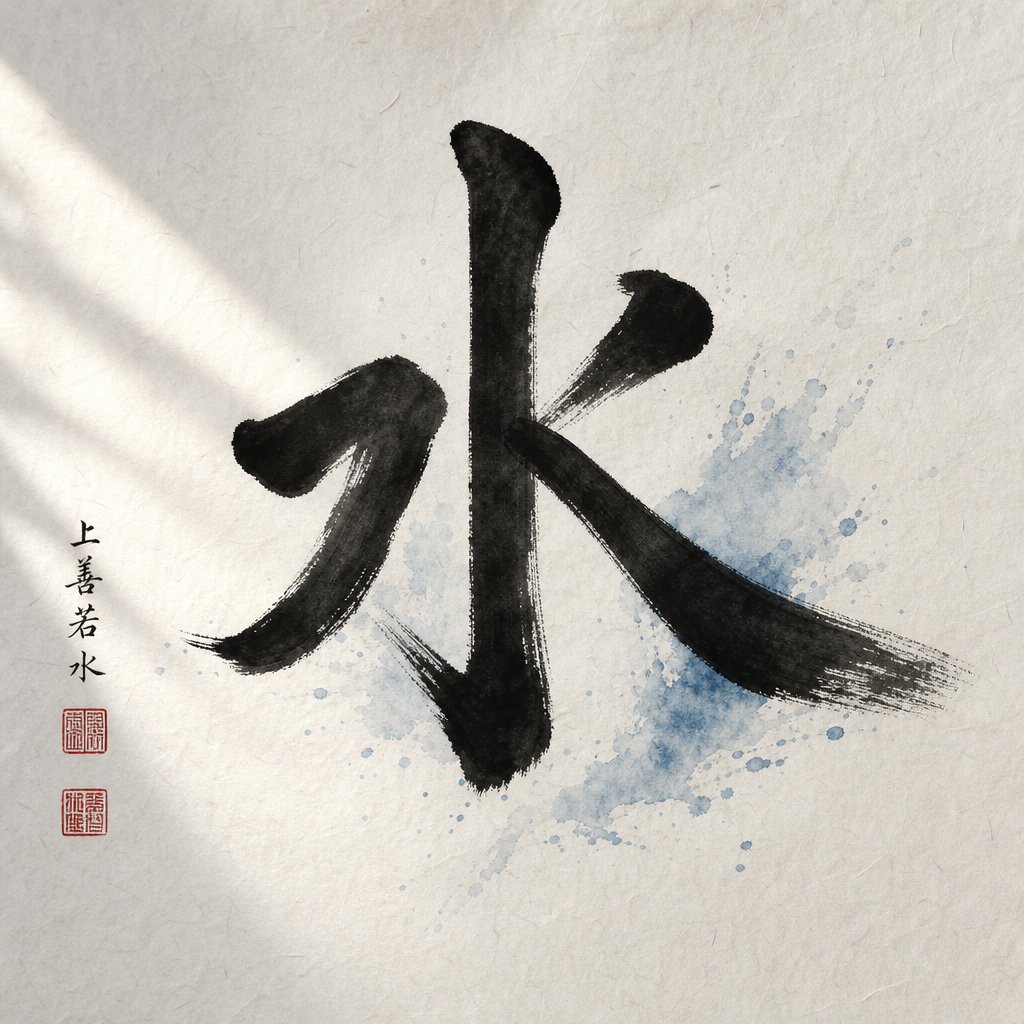
水 (shuǐ) — the Chinese symbol for water. A pictograph depicting flowing water, pronounced with a third-tone dip in Mandarin. Radical 85. Four strokes.
What Does 水 Mean and How Is It Pronounced
When you look up water in Chinese, you get a single elegant character: 水. Its meaning is straightforward, covering water in all forms, from drinking water to rivers to abstract liquid metaphors. The word shui in Chinese conversation appears constantly, whether someone is ordering hot water at a restaurant or describing a landscape painting.
Pronunciation trips up many learners, though. The shuǐ sound carries Mandarin's third tone, which is a low, dipping pitch. Imagine the skeptical "huh?" you might mutter when something surprises you. Your voice drops low and may rise slightly at the tail end. That low, compressed quality is the key to the third tone. It does not bounce dramatically like a question. Instead, think of it as your voice settling into its lowest comfortable register before releasing. In connected speech, the third tone often stays simply low without any rising tail, making it the flattest-sounding tone in natural Mandarin.
To say water in Mandarin correctly, start with the "sh" sound (tongue curled slightly back), glide through the "u" vowel with rounded lips, add a quick "ay" off-glide, and keep your pitch low throughout. Practice it alongside a word like shuǐguǒ (fruit) to feel how the tone behaves inside a real phrase.
Why This Character Matters for Chinese Learners
Learning the Chinese character water unlocks far more than a single vocabulary word. 水 functions as a radical, a meaning component that appears inside hundreds of other characters related to liquids, weather, and motion. Recognizing it gives you a built-in decoding tool every time you encounter an unfamiliar character in the water in Chinese language family.
Beyond vocabulary, 水 carries deep cultural weight. It forms half of the term 风水 (feng shui), anchors one of the Five Elements in classical philosophy, and appears in proverbs, idioms, and modern slang alike. Whether you are studying Mandarin, Japanese, or Korean, this single character connects you to a shared written heritage across East Asia.
In the sections ahead, you will trace how this character evolved from an ancient river pictograph to its modern form, learn to write it stroke by stroke, explore the radical it creates, build vocabulary from its compound words, and discover why water in Chinese thought represents wisdom, adaptability, and hidden strength.
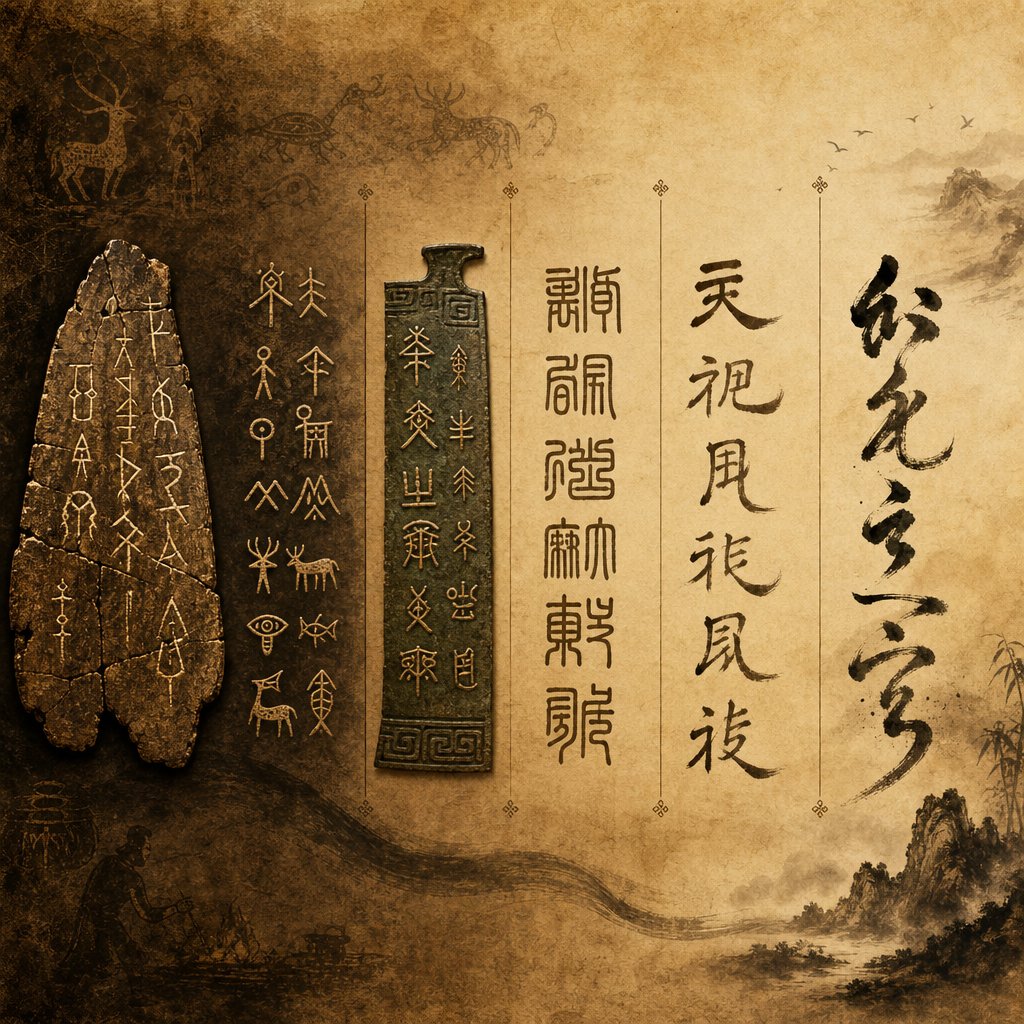
How the Water Character Evolved Over Thousands of Years
Every Chinese character has a backstory, but few are as visually intuitive as 水. Imagine standing on a riverbank three thousand years ago, watching a scribe scratch a picture of flowing water onto a piece of turtle shell. That image, simplified and refined across dynasties, is the same water Chinese character you see printed in textbooks today. The journey from river sketch to modern sinograms reveals how the Chinese writing system balances pictorial clarity with practical efficiency.
From River Pictograph to Oracle Bone Script
The earliest confirmed forms of the chinese character water appear on oracle bones from the late Shang Dynasty, roughly 1250 to 1000 BCE. These shells and animal bones were used for royal divination, and scribes carved characters into them using sharp tools. The oracle bone form of 水 depicted a central vertical stream with curved lines branching off on either side, representing splashing currents or tributaries feeding into a main channel.
Because carving into bone is physically demanding, scribes adapted their strokes for speed. Rounded shapes that might have appeared in brush writing became more angular. Thick, filled areas turned into thin outlines. Still, the water pictograph remained unmistakable: a flowing center flanked by smaller streams. You could glance at it and immediately think "river."
As Outlier Linguistics notes, oracle bone script is best understood as a simplified carving version of the popular brush script of its era. The underlying pictographic logic stayed intact even when the medium forced angular shortcuts.
How Bronze and Seal Scripts Shaped the Modern Form
When the Western Zhou Dynasty succeeded the Shang around 1046 BCE, bronze vessels became the primary medium for formal inscriptions. The water chinese character on these bronzes retained its central-stream-and-tributaries structure, but the lines grew smoother and more uniform. Bronze casting allowed for rounder, more flowing strokes than bone carving, so the character regained some of its original curvilinear quality. Over time, the side currents became shorter and more symmetrical, and the overall proportions stabilized.
By the Qin unification in 221 BCE, the formal script known as small seal script (小篆) standardized character forms across the empire. The seal script version of 水 smoothed every line into elegant, even-width curves. The central stream became a clean vertical with a gentle hook, and the side strokes settled into balanced, flowing arcs. This was the version recorded in the Shuowen Jiezi dictionary around 100 CE, cementing it as the classical reference form.
The final major shift came with regular script (楷书), which emerged from clerical script during the Han Dynasty and became dominant by the Tang Dynasty. Regular script prioritized speed and legibility for everyday brush writing. The flowing curves of seal script gave way to distinct, countable strokes with clear start and end points. The result is the 水 you write today: a vertical hook down the center, two strokes sweeping left, and one stroke rising to the right. Four strokes total, each with a defined direction.
| Script Period | Approximate Era | Visual Description | Key Changes |
|---|---|---|---|
| Oracle Bone (甲骨文) | ~1250-1000 BCE | Angular central line with branching side currents; thin, carved strokes | Pictograph adapted for carving on bone; rounded shapes made angular |
| Bronze (金文) | ~1000-300 BCE | Smoother central stream with rounder, more uniform side strokes | Casting allowed flowing curves; proportions became more balanced |
| Seal (篆书) | ~221 BCE-100 CE | Elegant, even-width curves; symmetrical and highly stylized | Standardized by Qin unification; all strokes equalized in thickness |
| Regular (楷书) | ~200 CE-present | Distinct vertical hook with separate left-falling and right-rising strokes | Curves replaced by countable strokes; optimized for brush speed and clarity |
Here is the mnemonic that ties it all together: when you look at the modern character 水, you are still seeing that ancient river. The central vertical hook is the main current flowing downward. The strokes on the left are splashes kicked up by the current. The stroke on the right is another tributary joining the flow. Three thousand years of simplification, and the picture of water never fully disappeared. It just learned to say more with fewer lines.
Writing 水 With Correct Stroke Order
Seeing the ancient river inside 水 is one thing. Putting brush or pen to paper and reproducing it correctly is another challenge entirely. The good news: this water in chinese symbol contains only four strokes. The catch is that each stroke has a specific direction, angle, and sequence that must be followed for the character to look balanced and natural.
Stroke Order for Writing 水 Step by Step
The 水 stroke order follows a logical top-to-center-to-sides progression. You'll notice that the central stroke anchors everything, and the remaining strokes radiate outward from it. Here is the complete sequence:
- Vertical hook (竖钩) — Start near the top center of your writing space. Draw a straight vertical line downward, then finish with a small hook curving to the left at the bottom. This stroke forms the spine of the character, representing that central river current. Keep it slightly left of the absolute center to leave room for the right-side stroke.
- Short left-falling stroke (横撇) — Begin this stroke where it touches the middle section of the vertical hook. It moves outward to the upper left at roughly a 45-degree angle. This is a short, quick stroke, not a long sweeping one. Think of it as a small splash kicking off the main current.
- Long left-falling stroke (撇) — Start from the same junction point on the vertical hook, slightly below where stroke two began. This stroke sweeps down and to the lower left at a steeper angle, extending further than the short stroke above it. Together, strokes two and three create the left-side splashes at different heights.
- Right-rising stroke (捺) — Begin at the same central junction area and sweep outward to the lower right. This is the longest lateral stroke in the character. It starts thin, gradually thickens in the middle, and tapers off at the end with a slight lift. The angle is roughly 45 degrees from horizontal, mirroring the long left stroke but in the opposite direction.
When written at natural speed, strokes two through four all branch from roughly the same point on the vertical hook, giving 水 its distinctive radiating shape. The character should feel like a small explosion of movement outward from a central axis, which is exactly what flowing water looks like when it hits a rock.
Common Mistakes and How to Avoid Them
Even experienced learners of chinese water calligraphy stumble on this character because its apparent simplicity hides some tricky proportional details. Watch out for these frequent errors:
- Making the side strokes symmetrical. The left side has two strokes (one short, one long) while the right side has only one. Many beginners mirror the left strokes on the right, producing five or six strokes instead of four. The character is intentionally asymmetrical.
- Starting the vertical hook too high. If the vertical stroke is too tall, the side strokes end up crowded near the bottom and the character looks top-heavy. The vertical hook should occupy roughly the upper two-thirds of the character height, leaving the lower third for the strokes to spread outward.
- Confusing the stroke count. Some learners count five strokes because they treat the hook at the bottom of stroke one as a separate stroke. It is not. The vertical line and its hook are a single continuous stroke. 水 has exactly four strokes total.
- Making the right-rising stroke too flat. The right stroke (捺) should angle downward at about 45 degrees before its final lift. Writing it nearly horizontal makes the character look like it is tipping over to the right.
- Forgetting the hook. The first stroke ends with a small leftward hook, not a blunt stop. Without the hook, the character loses its anchor point and the left-side strokes have nowhere natural to connect visually.
A helpful proportion tip: imagine the character fitting inside a square. The vertical hook sits just left of the vertical center line. The two left strokes stay within the left half of the square, and the single right stroke fills the right half. This slight offset gives 水 its sense of motion rather than static balance.
Practice writing 水 slowly at first, paying attention to where each stroke begins relative to the vertical hook. Speed comes naturally once the spatial relationships feel automatic. And once your hand knows this character, you already have muscle memory for the water radical 氵, which compresses these same structural ideas into three quick dots on the left side of hundreds of other characters.
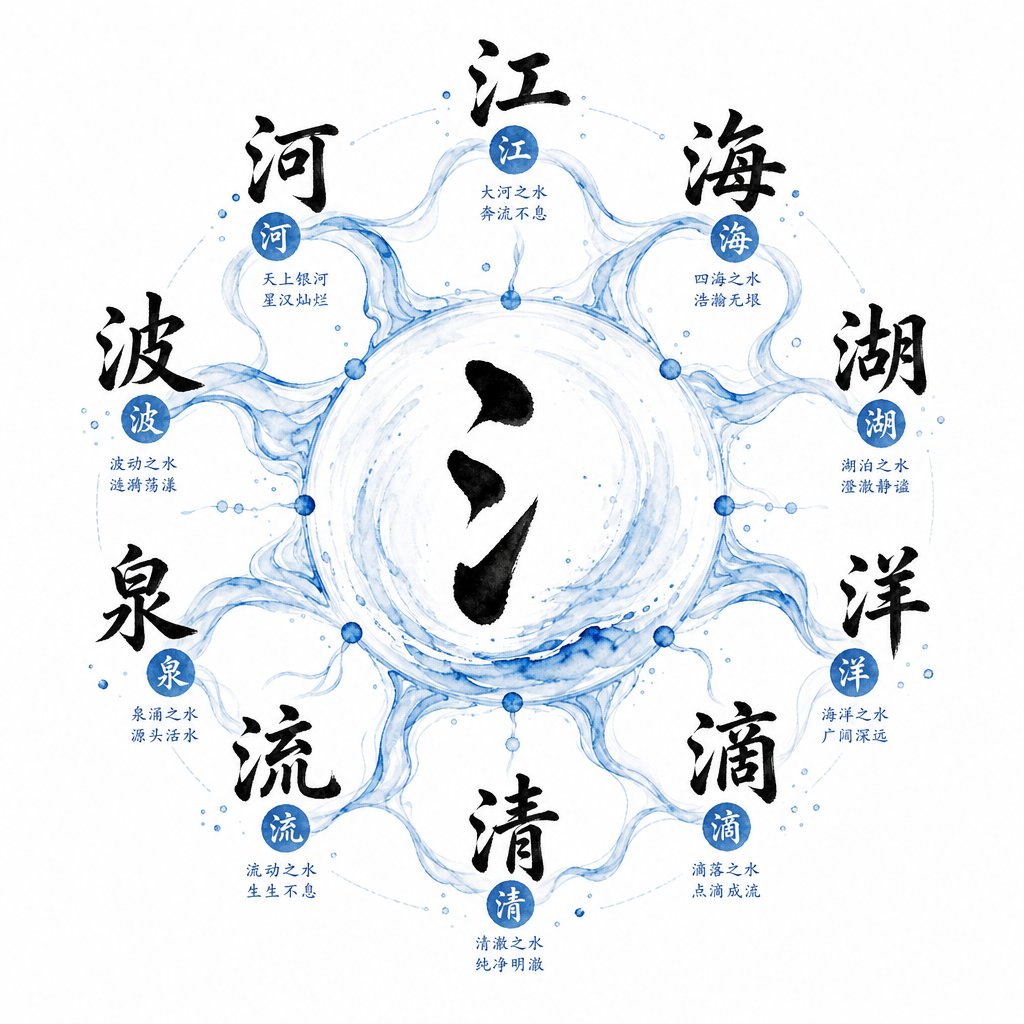
The Water Radical 氵 and the Characters It Creates
Your hand now knows how to write 水 as a standalone character. But in everyday reading, you will encounter its compressed form far more often. When 水 appears as a component inside another character, it transforms into 氵, three short strokes stacked vertically on the left side. This is the water radical chinese learners encounter constantly, and understanding how to recognize its simplified radical form is one of the fastest shortcuts to expanding your reading ability.
What Is Radical 85 and Why Does 水 Change Shape
In the traditional Kangxi classification system, 水 is listed as Radical 85. When it functions as a standalone character, it keeps its full four-stroke shape. But when it serves as a semantic component inside a compound character, it compresses into 氵, commonly called "three drops of water" (三点水, san dian shui). This compression is purely practical: squeezing a full four-stroke character into the left margin of another character would make everything cramped and illegible. The three-dot shorthand solves that problem while preserving the meaning signal.
Why does this matter? Because the Kangxi Dictionary lists 1,595 characters under Radical 85, making it the second most common radical in the entire system. That means nearly a quarter of the dictionary carries this water marker. Every time you spot 氵 on the left side of an unfamiliar character, you already have a strong clue about its meaning: it likely relates to water, liquid, fluid motion, or something metaphorically connected to those ideas.
One quick caution: do not confuse 氵 (three dots) with 冫 (two dots), which is the ice radical. The ice radical appears in characters like 冰 (ice) and 冷 (cold). Three dots mean water. Two dots mean ice. Counting the dots saves you from mixing up radical forms that look similar at a glance.
The original character 水 also occasionally appears as a radical at the bottom of characters rather than the left side. You can see this in 泉 (quan, spring) where the full 水 shape sits beneath the upper component. However, the vast majority of water-related characters use the 氵 form on the left, so that is where your pattern recognition should focus.
Characters Grouped by Their Semantic Connection to Water
Recognizing the water radical is powerful because it reveals built-in meaning categories. Characters containing 氵 cluster into predictable semantic groups. Once you learn to spot these patterns, encountering a new character with the radical 85 simplified form on its left side immediately narrows down its possible meaning. Imagine reading a character you have never seen before, noticing the three dots, and thinking: "This probably involves liquid, weather, or some kind of flow." That educated guess is correct more often than not.
Here are high-frequency characters organized by their thematic connection to water:
| Category | Character | Pinyin | Meaning |
|---|---|---|---|
| Bodies of Water | 河 | he | river |
| Bodies of Water | 湖 | hu | lake |
| Bodies of Water | 海 | hai | sea, ocean |
| Bodies of Water | 洋 | yang | ocean, vast |
| Liquids | 汁 | zhi | juice, liquid extract |
| Liquids | 液 | ye | liquid, fluid |
| Liquids | 酒 | jiu | alcohol (氵 variant in older forms) |
| Weather and Temperature | 汽 | qi | steam, vapor |
| Weather and Temperature | 温 | wen | warm, temperature |
| Weather and Temperature | 湿 | shi | wet, humid |
| Emotions and States | 泪 | lei | tears |
| Emotions and States | 满 | man | full, satisfied |
| Emotions and States | 清 | qing | clear, pure |
| Movement and Action | 流 | liu | to flow |
| Movement and Action | 游 | you | to swim, to travel |
| Movement and Action | 浮 | fu | to float |
| Movement and Action | 浪 | lang | wave |
Notice how the categories extend well beyond literal water. 泪 (tears) connects to liquid leaving the body. 满 (full, satisfied) evokes the image of a container filled to the brim with water. 清 (clear, pure) describes the quality of clean water and extends metaphorically to clarity of thought. The water radical acts as a semantic anchor, tying abstract concepts back to a physical experience everyone understands.
Spotting 氵 in an unfamiliar character is like finding a label that reads: "This word lives in the world of water, liquid, or flow." That single clue eliminates hundreds of wrong guesses instantly.
This pattern-recognition approach is exactly why experienced learners treat radicals as a decoding system rather than just a dictionary index. When you know that Radical 85 signals water-related meaning, every new character containing 氵 becomes partially transparent before you even look it up. The right side of the character typically hints at pronunciation, while the left side (the radical) hints at meaning. Together, they give you two independent clues working in parallel.
With the radical system as your guide, the next natural question becomes: what happens when 水 appears not as a radical component but as a full character inside compound words? That is where its meaning stretches even further, from literal river water to abstract concepts like quality, salary, and even fraud.
Essential Compound Words and Phrases Using 水
The radical 氵 tells you a character relates to water. But 水 itself does not retire once it lends its shape to other characters. It remains an active, productive word that combines with other characters to form dozens of compound terms you will hear in daily Mandarin. Some of these compounds are literal. Others stretch the water metaphor into surprisingly abstract territory. Together, they show why the chinese word for water is far more versatile than its English equivalent.
What is water in chinese compound words? It can mean the physical substance, a metaphor for flow and level, or even a marker of quality and authenticity. The table below organizes the most common compounds into four thematic groups so you can see the pattern clearly.
| Chinese | Pinyin | English Meaning | Category |
|---|---|---|---|
| 河水 | he shuǐ | river water | Nature |
| 雨水 | yǔ shuǐ | rainwater | Nature |
| 山水 | shan shuǐ | landscape (lit. mountains and water) | Nature |
| 水果 | shuǐ guǒ | fruit (lit. water fruit) | Nature |
| 泉水 | quan shuǐ | spring water | Nature |
| 喝水 | he shuǐ | to drink water | Daily Life |
| 热水 | re shuǐ | hot water | Daily Life |
| 自来水 | zi lai shuǐ | tap water (lit. self-coming water) | Daily Life |
| 水龙头 | shuǐ long tou | faucet (lit. water dragon head) | Daily Life |
| 矿泉水 | kuang quan shuǐ | mineral water | Daily Life |
| 水平 | shuǐ ping | level, standard | Abstract |
| 风水 | feng shuǐ | feng shui (lit. wind-water) | Abstract |
| 薪水 | xin shuǐ | salary | Abstract |
| 水货 | shuǐ huo | counterfeit or grey-market goods | Modern |
| 灌水 | guan shuǐ | to spam or pad content | Modern |
| 水军 | shuǐ jun | paid online commenters | Modern |
Nature and Geography Words With 水
The most intuitive compounds pair 水 with other nature words. 河水 (river water) and 雨水 (rainwater) are transparent: you see the chinese word water sitting next to "river" or "rain" and the meaning writes itself. 泉水 (spring water) works the same way.
Two entries deserve a closer look. 山水 literally means "mountains and water," but it refers to natural landscape in general and specifically to the classical Chinese painting tradition that depicts misty peaks and flowing rivers. When someone says a place has beautiful 山水, they mean the scenery is stunning. The word captures a core Chinese aesthetic idea: nature is defined by the interplay of solid earth and flowing water.
Then there is 水果, the chinese for water plus "fruit." Why does fruit contain the word for water? Because ripe fruit is juicy, full of liquid. The compound highlights the quality that makes fruit refreshing. This is your first hint that 水 in compounds often points to an essential quality rather than literal H2O.
Daily Life and Abstract Compound Words
In everyday conversation, the water in mandarin language shows up constantly. 喝水 (drink water) is one of the first verb-object phrases any learner encounters. 热水 (hot water) and 自来水 (tap water) appear on restaurant menus and utility bills. 水龙头 is a vivid compound: "water dragon head" describes a faucet, evoking the image of water pouring from a dragon's mouth. Even something as mundane as turning on a tap carries a trace of mythological imagery in Chinese.
The abstract compounds are where things get interesting. Consider these three:
- 水平 (shuǐ ping) — Literally "water level." Water always finds a perfectly flat surface, so 水平 came to mean "standard" or "level of skill." When someone asks about your Chinese 水平, they want to know your proficiency level. The metaphor is elegant: skill, like water, settles at its true level.
- 风水 (feng shuǐ) — "Wind and water." This term names the ancient practice of spatial arrangement for harmony and prosperity. The compound tells you that the philosophy is fundamentally about how invisible forces (wind) and visible flow (water) move through a space.
- 薪水 (xin shuǐ) — "Firewood and water." This is the formal word for salary. The origin traces back to an era when wages covered basic survival needs like fuel and water. Today it simply means your paycheck, but the compound preserves a historical memory of what money was originally for: keeping yourself warm and hydrated.
水 in compound words extends far beyond literal liquid. It becomes a metaphor for level, flow, quality, and even livelihood, revealing how deeply water imagery is woven into Chinese thinking.
The modern slang compounds (水货, 灌水, 水军) push the metaphor even further into abstract territory, using water's associations with dilution and flooding to describe fakeness and spam. These terms show that native speakers still feel the metaphorical weight of 水 in creative, evolving ways, a topic worth exploring on its own.
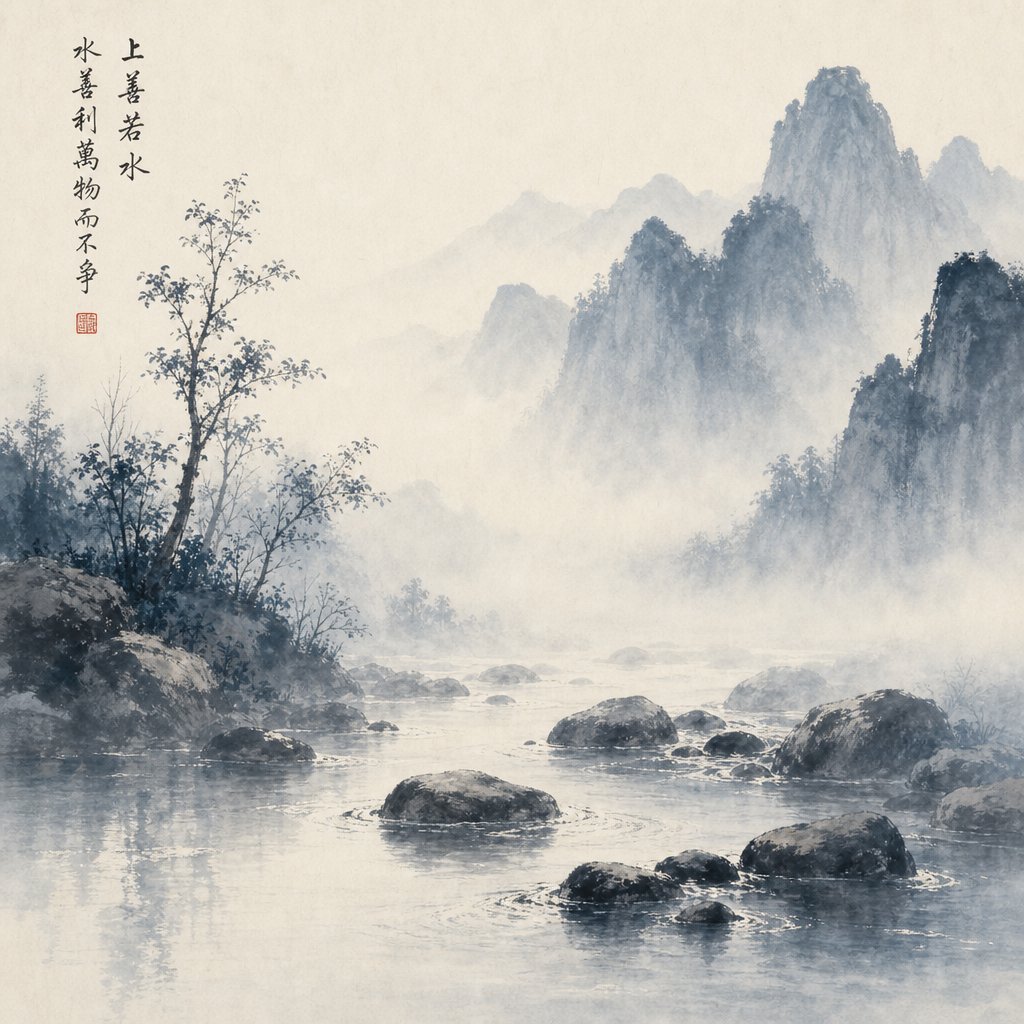
Water in Chinese Philosophy and Cultural Symbolism
Compound words show how 水 functions in everyday language. But the chinese symbol of water carries weight that goes far beyond vocabulary lists. For thousands of years, water has served as a central metaphor in Chinese philosophy, medicine, and spatial design. Three major frameworks treat it as a cosmic principle rather than a simple substance: Wu Xing theory, Taoist thought, and feng shui practice. Understanding these layers transforms 水 from a character you can read into a concept you can think with.
Water in Wu Xing Five Elements Theory
The Wu Xing system, originating over 2,000 years ago during the Han Dynasty, organizes all natural phenomena into five interconnected phases: Wood, Fire, Earth, Metal, and Water. Each element is not merely a physical substance but an energetic principle that governs cycles of change. Water occupies the final position in the sequence and represents the deepest, most introspective phase.
In Wu Xing cosmology, the chinese water symbol carries a specific set of correspondences that connect it to time, space, the body, and emotion:
- Season: Winter, a time of rest, conservation, and inward reflection
- Direction: North
- Color: Black (or very dark blue)
- Organ: Kidneys (in Traditional Chinese Medicine)
- Emotion: Fear, but also wisdom when balanced
- Quality: Fluidity, adaptability, and downward movement
People influenced by Water energy are described as introspective, intuitive, and adaptable. Just as water has no fixed shape and takes the form of whatever contains it, those aligned with this element navigate life with flexibility and grace. The shui meaning here extends well beyond "liquid." It points to a way of being: yielding, perceptive, and quietly powerful.
However, Wu Xing also warns about imbalance. Excessive Water energy can lead to stagnation, isolation, or emotional overwhelm, much like a flood that destroys rather than nourishes. The goal is always dynamic equilibrium among all five elements.
Taoist Symbolism and Feng Shui Connections
If Wu Xing treats water as one principle among five, Taoism elevates it to the supreme metaphor for the ideal life. Laozi's Tao Te Ching, written around the 6th century BCE, returns to water imagery repeatedly. The most famous passage appears in Verse 78:
Nothing in the world is as soft and yielding as water, yet for dissolving the hard and inflexible, nothing can surpass it. The soft overcomes the hard; the gentle overcomes the rigid.
This paradox sits at the heart of Taoist philosophy. Water does not fight obstacles. It flows around them, wears them down over time, and always finds the lowest point. Laozi uses this as a model for human conduct: true strength lies in yielding, not in force. The symbol for water in chinese thought becomes a shorthand for wu wei, the principle of effortless action through alignment with natural flow.
Feng shui takes this philosophical reverence and applies it to physical space. The term 风水 literally translates to "wind-water," placing chinese shui at the very foundation of the practice. In feng shui theory, water governs wealth, career, and social connections. Still water, like a calm lake, represents accumulated wisdom. Moving water, like a flowing river, represents how energy and opportunity circulate through your environment. Practitioners use fountains, mirrors, and dark colors to activate water energy in spaces that feel stagnant or financially blocked.
The shui chinese speakers use in 风水 is the same character you learned to write in four strokes. Yet here it carries the weight of an entire cosmological system, one where the placement of a fountain or the direction a building faces can redirect the flow of fortune. Whether you approach feng shui as literal practice or cultural metaphor, the underlying logic is consistent: water flows, and where it flows, life follows.
These philosophical dimensions explain why 水 resonates so deeply across Chinese culture. It is not just a word for a substance. It is a model for wisdom, a strategy for overcoming obstacles, and a principle for designing harmonious spaces. That same metaphorical richness spills into modern Mandarin, where speakers still reach for water imagery when they want to describe things that flood, dilute, or find their true level.
Modern Slang and Abstract Meanings of 水
Laozi praised water for its softness. Feng shui practitioners channel its flow for prosperity. But step into a Chinese internet forum or a tech startup conversation, and you will find 水 doing something entirely different. It describes fake reviews, diluted quality, and content that exists only to fill space. The philosophical reverence is gone, replaced by sharp, colloquial wit. Yet the underlying logic is the same: native speakers still reach for shui water imagery whenever they want to describe something that floods, dilutes, or lacks substance.
This is where the classical meaning of 水 water meets living, evolving Mandarin. The metaphors are not random. Each modern slang term draws on a specific physical property of water: its ability to dilute, to flood, or to settle at a uniform level. Recognizing these connections helps you understand not just vocabulary but how Chinese speakers think with this character in real time.
Slang and Internet Era Uses of 水
The table below collects the most common modern expressions where 水 carries abstract or negative connotations. Notice how each term maps onto a specific behavior of water:
| Term | Pinyin | Literal Meaning | Actual Usage |
|---|---|---|---|
| 水货 | shui huo | water goods | Counterfeit, grey-market, or substandard products |
| 水军 | shui jun | water army | Paid online commenters who flood platforms with fake opinions |
| 水平 | shui ping | water level | Standard, skill level, or degree of competence |
| 灌水 | guan shui | pour water | Padding content, spamming forums with low-quality posts |
| 水分 | shui fen | water content / moisture | Exaggeration or inflated claims ("there's a lot of water in those numbers") |
| 缩水 | suo shui | shrink water | To shrink in value, quality, or quantity (like fabric shrinking in water) |
Take 水货 first. The literal image is goods that have been watered down, diluted from their original quality. In practice, it refers to grey-market products imported through unofficial channels or outright counterfeits. When someone warns you that a product is 水货, they are saying its authenticity has been diluted, that something pure has been mixed with something unreliable. The shui in chinese meaning here is not about liquid at all. It is about trust dissolving.
水军 is perhaps the most vivid modern coinage. As documented in Chinese tech culture, 水军 refers to people paid to promote or criticize organizations, companies, or individuals online. The metaphor is a flood: these commenters pour into comment sections like a wave, overwhelming genuine voices with sheer volume. Any online translator will tell you 水军 means "navy," but the actual meaning is far more specific to digital manipulation. The water image captures both the volume (a flood of fake posts) and the lack of substance (each individual comment is as thin as water).
How the Water Metaphor Lives in Modern Mandarin
灌水 makes the flooding metaphor even more explicit. The verb 灌 means "to pour" or "to irrigate," so 灌水 literally describes pouring water into something. On internet forums, it means filling threads with meaningless posts, padding word counts, or spamming content that adds no value. Imagine pouring water into a container to make it look full when there is nothing of substance inside. That is exactly what 灌水 describes: the appearance of content without the reality of it.
水分 works similarly. When a business report has a lot of 水分, it means the numbers are inflated, padded with exaggeration the way a sponge is padded with water. Squeeze it and the real substance is much smaller than it appeared. Chinese speakers use this term for anything from inflated resumes to overhyped startup valuations.
水平 stands apart from the others because it carries no negative connotation. It draws on a different property of water: the fact that water always finds a perfectly horizontal surface. A lake does not slope. It levels itself. So 水平 became the standard word for "level" or "standard," whether you are talking about someone's language proficiency, a country's economic development, or the quality of a performance. The water shui metaphor here is about equilibrium and honest measurement rather than dilution.
What ties all these expressions together is a single insight: chinese water imagery in modern slang is not decorative. Speakers choose 水 because they genuinely feel its metaphorical weight. Water dilutes, so 水货 means fake. Water floods, so 水军 means paid trolls. Water fills empty space, so 灌水 means spam. Water levels itself, so 水平 means standard. Each term is a miniature poem built on physical observation.
This creative vitality is exactly what keeps 水 relevant across millennia. The same character that Laozi used to describe cosmic wisdom now describes internet trolls and counterfeit sneakers. The philosophical depth and the street-level slang are not contradictions. They are proof that the shui in chinese meaning remains alive, productive, and deeply felt by native speakers who continue inventing new ways to think with water.
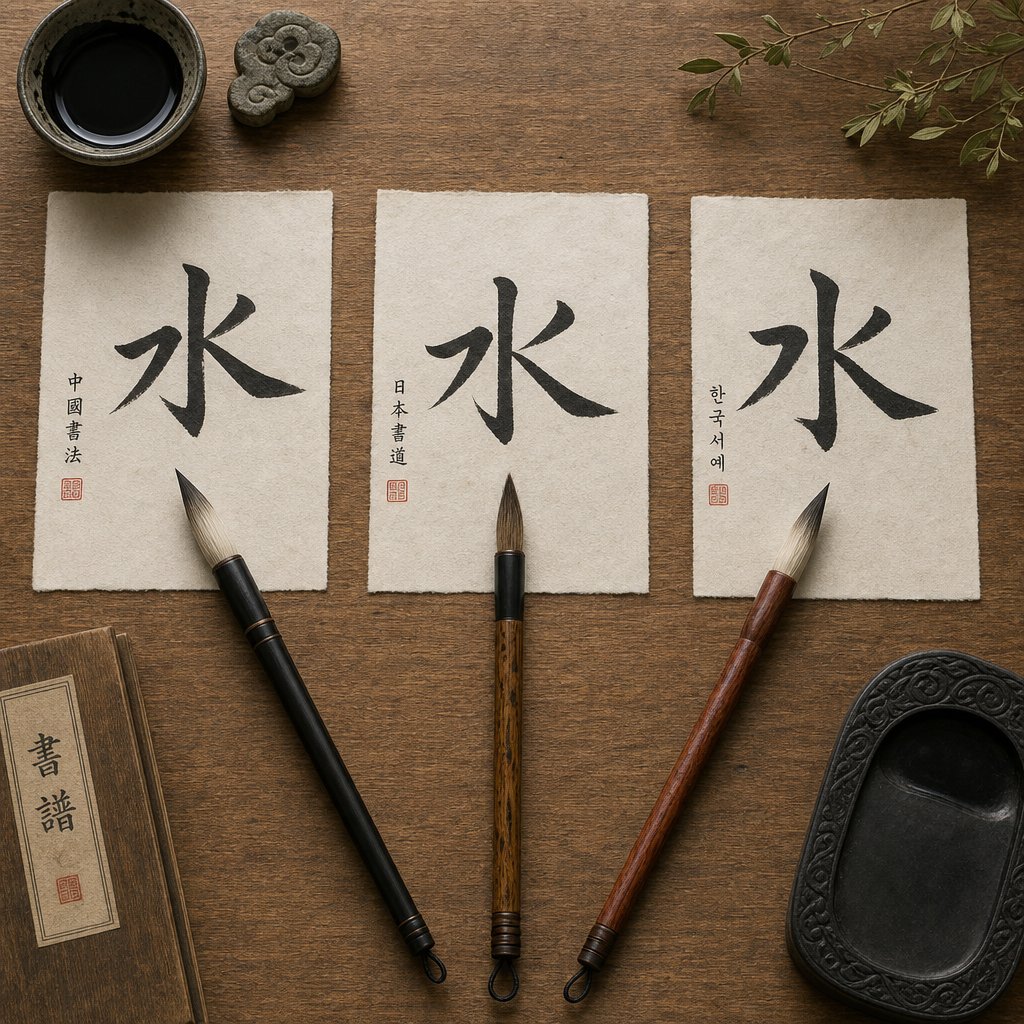
How 水 Is Used in Japanese and Korean
A character that describes internet trolls in Mandarin and cosmic wisdom in Taoist philosophy might seem uniquely Chinese. But 水 does not stop at China's borders. The same four-stroke character appears in Japanese and Korean with its core meaning fully intact. If you are studying more than one East Asian language, or even just curious about how the water kanji connects to words you already know, this cross-linguistic dimension makes 水 one of the highest-value characters you can learn.
The reason is historical. During the spread of Buddhism and Chinese literary culture between the 4th and 8th centuries CE, Japan and Korea adopted thousands of Chinese characters along with their pronunciations. Those borrowed readings evolved differently in each language over the centuries, but the underlying meaning of 水 as "water" never shifted. The japanese water symbol and the Korean hanja form are the same character, written with the same strokes, carrying the same semantic core.
Japanese Readings Sui and Mizu Explained
Japanese gives 水 two distinct pronunciations depending on context. This dual-reading system applies to most kanji and reflects the historical layering of borrowed Chinese vocabulary onto native Japanese words.
The first reading is the on'yomi (Chinese-derived reading): すい (sui). This pronunciation descends from Middle Chinese and appears primarily in compound words borrowed from or modeled on Chinese. You will encounter it in terms like:
- 水曜日 (すいようび, suiyoubi) — Wednesday. Each day of the week in Japanese is named after a classical element, and Wednesday belongs to water.
- 水泳 (すいえい, suiei) — swimming
- 水素 (すいそ, suiso) — hydrogen (literally "water element")
- 水道 (すいどう, suidou) — water supply, waterworks
- 水平 (すいへい, suihei) — horizontal, level (the same compound as Mandarin 水平)
The second reading is the kun'yomi (native Japanese reading): みず (mizu). This is the word Japanese speakers actually use when they mean "water" in everyday conversation. It comes from Old Japanese and is unrelated to the Chinese pronunciation. You will hear mizu when someone asks for a glass of water, talks about a flood, or describes water temperature. The water kanji japanese learners encounter in first grade is this character, taught as one of the most basic kanji in the curriculum.
A useful pattern to remember: when 水 appears alone or at the beginning of a native Japanese compound, it is usually read mizu. When it appears inside a Sino-Japanese compound (a word built from Chinese-style character combinations), it is usually read sui. This on/kun split is consistent across nearly all kanji, so mastering it with 水 gives you a template for hundreds of other characters.
The kanji for water also functions as a radical in Japanese exactly as it does in Chinese. The three-dot form 氵 (called さんずい, sanzui, in Japanese) appears in characters like 泳 (swim), 海 (sea), 湖 (lake), and 温 (warm). According to eJable, the water kanji appears as a radical or component in 101 kanji characters, including 20 Joyo kanji that every Japanese student must learn by the end of high school.
Korean Reading and Shared CJK Heritage
In Korean, 水 is read as 수 (su). Korean historically used Chinese characters (called hanja) for formal writing, and while modern Korean relies almost entirely on the Hangul alphabet, hanja readings persist in thousands of vocabulary words. The su reading appears in compounds that Korean speakers use daily without necessarily thinking about the underlying character:
- 수영 (水泳, suyeong) — swimming
- 수요일 (水曜日, suyoil) — Wednesday
- 홍수 (洪水, hongsu) — flood
- 수도 (水道, sudo) — waterworks, water supply
- 수준 (水準, sujun) — standard, level (parallel to Mandarin 水准)
Notice the pattern: Korean su, Japanese sui, and Mandarin shui all trace back to the same Middle Chinese source pronunciation. The differences reflect how each language's sound system adapted that original form over the centuries. As LanGo Institute's CJK correspondences research explains, these systematic sound shifts are predictable once you learn the patterns. Mandarin palatalized many initial consonants and lost final stops. Japanese added vowels to fit its syllable structure. Korean preserved certain consonant clusters but dropped initial /l/ sounds in many words.
The table below puts all three languages side by side so you can see the parallels at a glance:
| Language | Reading(s) | Example Word | Meaning |
|---|---|---|---|
| Mandarin Chinese | shui (shuǐ) | 水平 (shuiping) | level, standard |
| Japanese (on'yomi) | sui (すい) | 水曜日 (suiyoubi) | Wednesday |
| Japanese (kun'yomi) | mizu (みず) | 水 (mizu) | water (standalone) |
| Korean | su (수) | 수영 (suyeong) | swimming |
What makes this cross-linguistic consistency remarkable is its stability. The japanese symbol water learners study today carries the same meaning it carried when the character was first borrowed from China over 1,500 years ago. The water symbol japanese calligraphers practice is stroke-for-stroke identical to what Chinese and Korean writers produce. Three languages, three different sound systems, three distinct grammars, yet one shared character with one shared meaning.
For multilingual learners, this means that mastering 水 in any one of these languages gives you immediate recognition in the other two. You already know the character's shape, its radical behavior, and its core meaning. All that changes is the pronunciation. That kind of transferable knowledge is rare in language learning, and it is one of the strongest arguments for investing time in kanji for water and the broader system of shared CJK characters.
This shared heritage also means that the cultural associations explored earlier, the Five Elements, Taoist philosophy, and feng shui, resonate across all three cultures. A Japanese speaker who sees 水 thinks of Wednesday, swimming, and purity rituals at Shinto shrines. A Korean speaker connects it to floods, standards, and the classical elements. The character is a cultural bridge, not just a linguistic one.
With the cross-linguistic picture complete, the practical question becomes: how do you lock all of this knowledge into long-term memory? The answer lies in connecting the character's visual shape, its pronunciation, and its radical behavior into a single coherent mental image.
Memory Aids and Next Steps for Mastering 水
You now know how to say water in chinese, how to write it, where to spot its radical form, and why it matters across philosophy, slang, and multiple languages. That is a lot of information attached to four strokes. The challenge is making it stick. The good news: our brains retain images and stories far better than abstract stroke patterns. A well-built mnemonic turns 水 from something you have to recall into something you simply see.
A Visual Mnemonic for Remembering 水
Picture a river cutting through a narrow canyon. The central vertical hook is the main current rushing downward, fast and straight. On the left, two strokes splash outward at different angles, like water hitting a rock and spraying in two directions. On the right, a single stroke sweeps away, a tributary branching off to join another stream. Four strokes, one river scene.
See the central hook as the main current. The left strokes are splashes kicked up by rocks. The right stroke is a tributary joining the flow. You are not writing an abstract symbol. You are sketching a river in four moves.
For pronunciation, anchor the third tone to a physical sensation. When you say shuǐ, imagine your voice sinking to the bottom of that river, settling into the lowest, quietest point of your vocal range. The dipping tone mirrors water seeking its lowest level. That connection between meaning and sound gives you two memory hooks working together: the visual shape tells you what the character means, and the low-sinking tone tells you how to say water in mandarin correctly.
As Migaku's research on character mnemonics emphasizes, the best memory stories are personal and vivid. If a canyon does not resonate with you, swap it for a garden hose spraying outward, or a fountain splitting into streams. The key is connecting the strokes to a water image that feels real to you. Spend 30 seconds building your story, write the character three to five times while replaying it mentally, and the shape locks in.
Your Learning Pathway From Character to Fluency
Knowing how do you say water in chinese is just the entry point. The real power of 水 unfolds in stages, each building on the last. Here is the sequence that turns a single character into a system for reading hundreds of words:
- Recognize 水 on sight. Know that it means water, that it is pronounced shuǐ with a low dipping tone, and that it looks like a river splitting into streams.
- Write it from memory. Four strokes in the correct order: vertical hook, short left stroke, long left stroke, right-rising stroke. Practice until your hand moves without hesitation.
- Spot 氵 in unfamiliar characters. Every time you see three dots on the left side of a character, you know it connects to water, liquid, or flow. That single clue narrows your guesses dramatically.
- Build vocabulary through compounds. Learn words like 水平, 山水, and 自来水. Notice how water mandarin speakers use daily stretches from literal liquid to abstract metaphors of level, quality, and flow.
- Appreciate the cultural depth. Connect 水 to Wu Xing theory, Taoist philosophy, and feng shui. Understand why water in chinese mandarin carries connotations of wisdom, adaptability, and quiet power that no English translation fully captures.
- Transfer across languages. Recognize that the same character reads sui/mizu in Japanese and su in Korean, giving you instant comprehension across three writing systems.
Each step multiplies the value of the one before it. Recognizing the radical means every new 氵 character you encounter is partially decoded before you even open a dictionary. Building compound vocabulary means you start hearing mandarin for water references in conversations, songs, and news broadcasts. Appreciating the cultural layer means classical texts and modern slang both make more sense.
This is the real payoff of learning how do you say water in chinese language and then going deeper. A single character becomes a key that unlocks an entire network of meaning. As Hacking Chinese advises, the most effective learners treat characters not as isolated items to memorize but as nodes in a web, each one connected to components, compounds, and cultural context. 水 is one of the best starting nodes in that web because its connections run so wide and so deep.
So write it once more. Four strokes. A river in miniature. Then go find it in the wild, in a menu, a street sign, a news headline, or a poem. That real-world encounter is what turns knowledge into fluency.
Frequently Asked Questions About the Water Chinese Character
1. What is the Chinese character for water and how do you pronounce it?
The Chinese character for water is 水, pronounced shuǐ with a third tone in Mandarin. The third tone is a low, dipping pitch where your voice settles into its lowest comfortable register. The character is a pictograph with four strokes that has been in continuous use for over 3,000 years, making it one of the most fundamental building blocks in the Chinese writing system.
2. How many strokes does the water character 水 have and what is the correct stroke order?
水 has exactly four strokes written in this order: first a vertical hook down the center, then a short left-falling stroke from the middle of the hook, followed by a long left-falling stroke at a steeper angle, and finally a right-rising stroke that sweeps to the lower right. A common mistake is counting five strokes by treating the hook as separate from the vertical line, but they form one continuous stroke.
3. What is the difference between 水 and the water radical 氵?
水 is the standalone character meaning water, while 氵 (three dots of water) is its compressed radical form that appears on the left side of other characters. Called Radical 85, 氵 signals a semantic connection to water, liquids, or fluid motion. It appears in nearly 1,600 characters including 河 (river), 海 (sea), 泪 (tears), and 流 (flow). Recognizing this radical helps you decode unfamiliar characters by revealing their built-in meaning connection to water.
4. Why is water important in Chinese philosophy and feng shui?
Water holds deep significance across three major Chinese philosophical frameworks. In Wu Xing (Five Elements) theory, water represents wisdom, adaptability, winter, and the north direction. In Taoism, Laozi used water as the supreme metaphor for effortless strength, since it overcomes the hard by being soft. In feng shui, 水 literally forms half the term (风水 means wind-water) and governs wealth, career, and energy flow in spatial design.
5. Is the water character 水 the same in Japanese and Korean?
Yes, the character 水 is written identically in Chinese, Japanese, and Korean due to shared historical borrowing from Classical Chinese. In Japanese, it has two readings: sui (used in compounds like 水曜日 for Wednesday) and mizu (the everyday word for water). In Korean, it is read as su and appears in words like 수영 (swimming). The core meaning of water remains consistent across all three languages.