What It Really Means to Write Your Name in Korean
You have probably typed something like "what is my korean name" into a search bar at least once. Maybe you are learning Korean, planning a trip to Seoul, or just curious how your name looks in Hangul. Whatever the reason, seeing your name in korean characters feels personal in a way that few language exercises do.
But here is the thing most people miss: there are two completely different ways to get a Korean name, and they mean very different things. Picking the wrong approach can leave you with something that confuses native speakers or, worse, accidentally says something strange.
Transliteration vs. Korean Name Adoption
The first approach is transliteration. This takes the sounds of your existing name and writes them using Korean letters. "Jessica" becomes 제시카. "David" becomes 데이비드. Your identity stays the same; only the script changes. In Korean, foreign names are simply transliterated phonetically and written in Hangul, making this the standard method Koreans themselves use when writing non-Korean names.
The second approach is adopting an authentic Korean name, one built from Korean surname and given-name conventions, often rooted in Hanja characters that carry specific meanings. This is closer to choosing a new identity within Korean culture.
Transliteration preserves your original name's sound in Korean script, while a Korean name is a culturally meaningful new identity. These are not interchangeable, and each serves a different purpose.
Why People Want Their Name in Korean
The reasons vary widely. K-pop fans want their name on fan art. Language learners need it for classroom introductions. Professionals working with Korean companies want business cards that read naturally. Some people simply wonder "what would my korean name be" if they had been born in Korea, which is a different question entirely from how to render my name in korean script.
Research on name translation across English, Korean, and Chinese confirms that sound-based transliteration is the preferred method for personal names moving into Korean. Meaning-based translation, by contrast, tends to be favored in Chinese contexts. So if you are asking "what will be my korean name," the answer depends on whether you want a phonetic mirror of your existing name or a culturally grounded new one.
This article walks through both paths. You will learn how transliteration actually works at the phonetic level, what makes a write my name in korean generator reliable or unreliable, and how to decide which approach fits your situation. The goal is simple: get the korean for name conversion right the first time, so nothing gets lost or butchered in translation.
Understanding Hangul Before You Convert Your Name
Before you plug your name into any tool, it helps to understand what is actually happening on the other side of that conversion. Hangul is not a random collection of symbols. It is a phonetic writing system with a clear internal logic, and that logic directly determines how your korean name in hangul will look and sound.
Hangul consists of 24 basic letters: 14 consonants and 10 vowels. Add in 5 double consonants and 11 compound vowels, and you get a total system of 40 characters. That is far fewer than the thousands of characters in Chinese or even the 46 in Japanese hiragana. The simplicity is intentional. King Sejong the Great designed Hangul in 1443 specifically so ordinary people could learn to read and write quickly.
So what does this mean for your name? Every sound in your name needs to be captured using these 40 characters, arranged into neat syllable blocks. Understanding how those blocks work is the difference between a natural-looking result and something that feels off.
How Korean Syllable Blocks Are Built
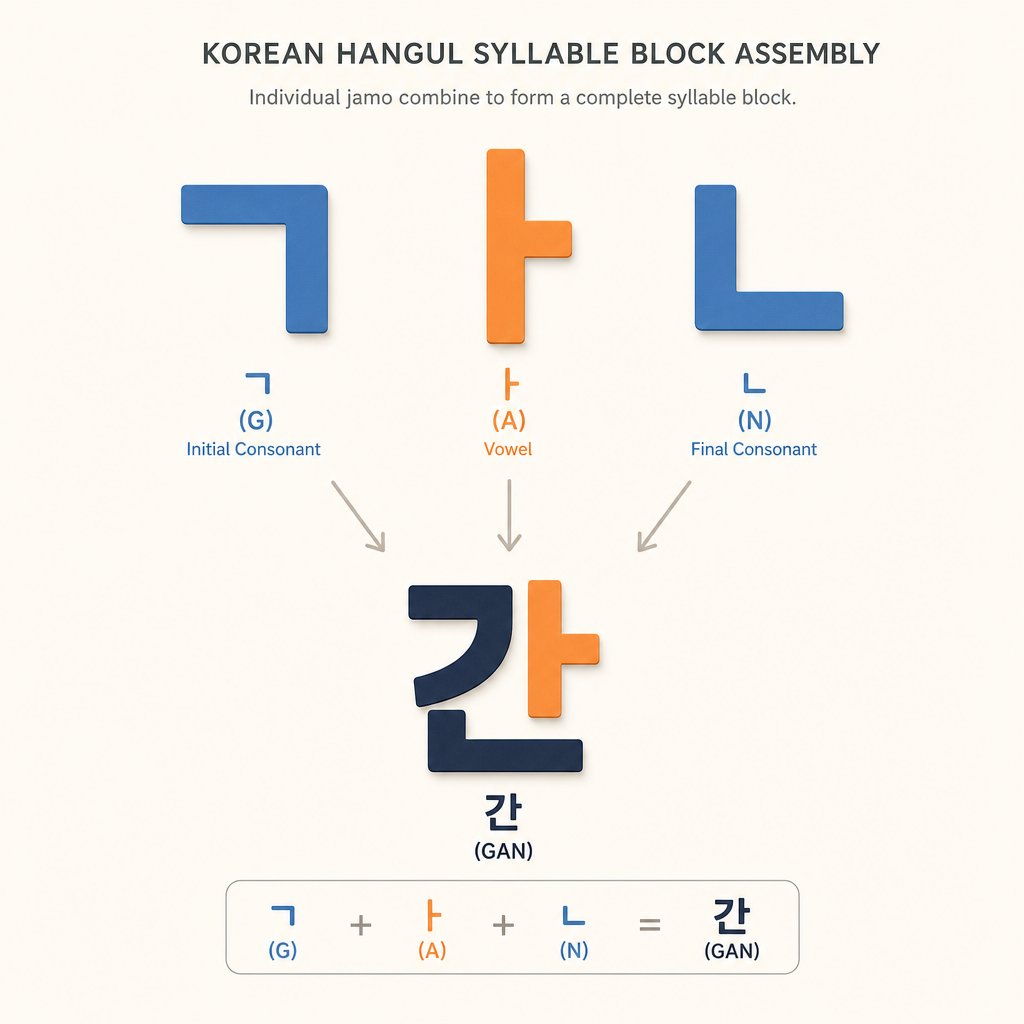
Imagine building with small Lego sets. Each Korean syllable is a compact block made from two or three components stacked together in a fixed pattern:
- Initial consonant (초성 | choseong) - always comes first
- Vowel (중성 | jungseong) - placed to the right or below the consonant
- Optional final consonant (종성 | jongseong) - sits at the bottom of the block
You cannot write korean words as a flat string of individual letters the way English works. The letters must be grouped into these blocks, and each block equals exactly one syllable. For example, the word 한 (han, meaning "one" or "Korean") is a single block built from three pieces: ㅎ + ㅏ + ㄴ. The consonant ㅎ sits top-left, the vowel ㅏ goes to the right, and the final consonant ㄴ tucks underneath.
Where the vowel sits depends on its shape. Vertical vowels like ㅏ, ㅓ, and ㅣ go to the right of the initial consonant. Horizontal vowels like ㅗ, ㅜ, and ㅡ go below it. This is not arbitrary; it is a consistent visual rule that keeps every block roughly square-shaped and easy to read.
Here is how the three main block patterns look in practice:
- Two-letter block (consonant + vowel): 가 = ㄱ + ㅏ (ga)
- Three-letter block (consonant + vowel + final consonant): 강 = ㄱ + ㅏ + ㅇ (gang)
- Four-letter block (consonant + vowel + double final consonant): 삶 = ㅅ + ㅏ + ㄹㅁ (sam, meaning "life")
When you write korean words for a name like "Sam," you are essentially building one of these blocks. The tool or person doing the conversion decides which consonant and vowel best match each sound in your name, then assembles them into the correct block structure.
Consonants and Vowels You Need to Know
You do not need to memorize every character to understand how your name gets converted. But knowing the core consonants and vowels gives you a sense of what is your name in hangul and why it looks the way it does. Here are the essential building blocks:
| Korean Consonant | Approximate English Sound |
|---|---|
| ㄱ | g / k |
| ㄴ | n |
| ㄷ | d / t |
| ㄹ | r / l |
| ㅁ | m |
| ㅂ | b / p |
| ㅅ | s |
| ㅇ | silent (initial) / ng (final) |
| ㅈ | j |
| ㅊ | ch |
| ㅋ | k (aspirated) |
| ㅌ | t (aspirated) |
| ㅍ | p (aspirated) |
| ㅎ | h |
| Korean Vowel | Approximate English Sound |
|---|---|
| ㅏ | ah (as in "father") |
| ㅓ | uh (as in "fun") |
| ㅗ | oh (as in "go") |
| ㅜ | oo (as in "food") |
| ㅡ | eu (no English equivalent; flat "uh") |
| ㅣ | ee (as in "feet") |
| ㅐ / ㅔ | eh (as in "bed") |
| ㅑ | ya |
| ㅕ | yuh |
| ㅛ | yo |
| ㅠ | yu |
Notice something important: ㅇ is silent when it appears at the start of a syllable block. It acts as a placeholder because every block must begin with a consonant. So if your name starts with a vowel sound, like "Anna," the first block still needs ㅇ in front: 안나 (an-na). The ㅇ is not pronounced; it just holds the structure together.
Also notice that some consonants pull double duty. ㄱ sounds like "g" at the start of a syllable but closer to "k" at the end. ㅂ sounds like "b" initially and "p" finally. This positional shift matters when korean words in korean are being read aloud, and it directly affects how natural your transliterated name sounds to a Korean speaker.
With these fundamentals in place, the real question becomes: how do the specific sounds in your English name map onto these Korean characters? That mapping process is where transliteration gets interesting, and where most generators either succeed or fall apart.
How English Sounds Become Korean Characters
The mapping between English and Korean is not a letter-to-letter swap. It is a sound-to-character conversion. This distinction trips up nearly everyone who tries to convert name into korean for the first time. You are not translating the spelling of your name. You are capturing its pronunciation using a different phonetic system.
Think about it this way: the name "Stephen" has seven letters, but only five sounds (stee-vuhn). A korean name converter ignores those silent letters and focuses entirely on what your ear actually hears. This pronunciation-first principle is the foundation of every accurate transliteration.
English Consonants and Their Korean Equivalents
Most English consonant sounds have a reasonably close match in Korean. The key is picking the right Korean character based on how the sound is actually produced in your mouth, not which English letter represents it. Here is the core mapping:
| English Sound | Korean Character | Example in a Name |
|---|---|---|
| b | ㅂ | Brian → 브라이언 |
| d | ㄷ | David → 데이비드 |
| g (hard) | ㄱ | Gary → 게리 |
| h | ㅎ | Hannah → 한나 |
| j | ㅈ | James → 제임스 |
| k | ㅋ | Kevin → 케빈 |
| m | ㅁ | Maria → 마리아 |
| n | ㄴ | Nancy → 낸시 |
| p | ㅍ | Paul → 폴 |
| r / l | ㄹ | Rachel → 레이첼 |
| s | ㅅ | Sarah → 사라 |
| t | ㅌ | Thomas → 토마스 |
| ch | ㅊ | Charles → 찰스 |
| sh | ㅅ (before ㅣ) | Shawn → 숀 |
A few things to notice. The aspirated consonants ㅋ, ㅌ, and ㅍ are used for English k, t, and p because these English sounds carry a puff of air that matches the Korean aspirated versions more closely than the plain ㄱ, ㄷ, or ㅂ. When you say "Kevin," that initial k has a breathy burst to it. That is why it maps to ㅋ rather than ㄱ.
Also, Korean uses a single character ㄹ for both r and l. This is not a limitation of the korean name translator; it reflects how Korean phonology genuinely treats these as one sound that shifts depending on position. More on this challenge in the next section.
Vowel Sounds Mapped to Korean Characters
English vowels are notoriously inconsistent. The letter "a" alone can sound like "ah" (father), "ay" (cake), "ae" (cat), or "uh" (about). Korean vowels, by contrast, are phonetically consistent. Each character produces one predictable sound. This actually makes the conversion clearer once you stop thinking about English spelling and focus on pronunciation.
Here is how the most common English vowel sounds map to Korean:
| English Vowel Sound | Korean Character | As Heard In |
|---|---|---|
| ah (father) | ㅏ | Mark → 마크 |
| ay (cake) | ㅔ이 | Kate → 케이트 |
| eh (bed) | ㅔ | Emma → 엠마 |
| ee (feet) | ㅣ | Lisa → 리사 |
| ih (sit) | ㅣ | Kim → 킴 |
| oh (go) | ㅗ | Tony → 토니 |
| oo (food) | ㅜ | Luke → 루크 |
| uh (fun) | ㅓ | Justin → 저스틴 |
| ow (how) | ㅏ우 | Howard → 하워드 |
| ai (my) | ㅏ이 | Tyler → 타일러 |
| oy (boy) | ㅗ이 | Roy → 로이 |
Notice that English diphthongs, vowel sounds that glide from one position to another, often require two Korean vowel characters or a vowel-plus-consonant combination. The "ay" in "Kate" is not a single clean vowel; it slides from "eh" toward "ee." Korean captures this with ㅔ이 (e-i). Similarly, the "ai" sound in "Tyler" becomes ㅏ이 (a-i) because Korean spells out each component of the glide.
One vowel that catches people off guard is ㅡ (eu). English does not have an exact equivalent, but it appears frequently in Korean transliterations as a "helper vowel." When English has a consonant cluster that Korean cannot replicate, ㅡ gets inserted to create a pronounceable syllable. The name "Chris" becomes 크리스 (keu-ri-seu) because Korean cannot start a syllable with "kr" or end one with just "s" in the middle of a word.
Step-by-Step Name Transliteration Example
Let's walk through converting an english name to korean from start to finish. Imagine you want to turn the name "Alexander" into Hangul.
Step 1: Identify the pronunciation, not the spelling.
"Alexander" is pronounced roughly as al-ig-ZAN-der. Four syllables. Forget the "x" in the spelling; it sounds like "gz" or "ks" depending on dialect.
Step 2: Break each syllable into its consonant and vowel components.
- al → vowel "a" (ㅏ) + final consonant "l" (ㄹ)
- ek → vowel "e" (ㅔ) + final consonant "k" (ㄱ)
- san → consonant "s" (ㅅ) + vowel "a" (ㅏ) + final consonant "n" (ㄴ)
- deo → consonant "d" (ㄷ) + vowel "eo" (ㅓ)
Step 3: Assemble each syllable into a Korean block.
- al → 알 (ㅇ + ㅏ + ㄹ) — remember, ㅇ is the silent placeholder for vowel-initial syllables
- ek → 렉 (ㄹ + ㅔ + ㄱ) — the "l" from the previous syllable often resyllabifies as the initial consonant here
- san → 산 (ㅅ + ㅏ + ㄴ)
- deo → 더 (ㄷ + ㅓ)
Step 4: Combine and verify.
The standard Korean rendering is 알렉산더 (al-rek-san-deo). You can verify this by checking how Korean media actually writes the name. Search any Korean news site for "Alexander" and you will find 알렉산더 consistently.
Here is a quicker example. The name "Emily":
- Pronunciation: EH-muh-lee (three syllables)
- eh → 에 (ㅇ + ㅔ)
- muh → 머 (ㅁ + ㅓ) — though commonly simplified to 밀 in practice
- lee → 리 (ㄹ + ㅣ)
- Result: 에밀리 (e-mil-ri)
This is exactly the process a reliable write my name in korean generator automates. It analyzes your name's phonetic structure, maps each sound to the closest Korean equivalent, and assembles the syllable blocks. The difference between a good tool and a bad one comes down to how accurately it handles the pronunciation step, particularly when your name contains sounds that do not exist in Korean at all.

Tricky Sounds and Common Transliteration Challenges
Some names convert into Korean cleanly. "Anna" becomes 안나. "Tom" becomes 톰. Simple, predictable, done. But what happens when your name contains sounds that Korean simply does not have? This is where the korean translation for names gets messy, and where most automated tools start producing questionable results.
English has roughly 44 distinct phonemes. Korean has around 40. The overlap is significant, but the gaps are brutal. Several common English sounds have no direct Korean equivalent, forcing every transliteration into a compromise. Understanding these compromises helps you evaluate whether a tool got your name right or just guessed.
Sounds Korean Does Not Have
Korean's consonant inventory simply skips over several sounds that English speakers use constantly. When you try to name translate in korean and your name contains any of these, the result will always be an approximation rather than a perfect match.
Here are the most problematic English sounds and how Korean handles them:
- F → ㅍ (p sound) — Korean has no labiodental fricative. "Frank" becomes 프랭크 (peu-raeng-keu), and "Sofia" becomes 소피아 (so-pi-a). The "f" is replaced by the closest Korean alternative: the aspirated bilabial ㅍ. If your name is "Fiona," expect 피오나 (pi-o-na). Pronunciation Studio confirms that Korean speakers naturally substitute /f/ with a sound closer to /p/ because the lip-teeth contact required for "f" does not exist in Korean phonology.
- V → ㅂ (b sound) — Same problem, different letter. "Victor" becomes 빅터 (bik-teo), and "Vivian" becomes 비비안 (bi-bi-an). The voiced labiodental fricative /v/ collapses into the plain bilabial ㅂ. This means "Vince" and "Bince" would look identical in Korean: 빈스.
- Th (voiceless, as in "think") → ㅅ (s sound) — The dental fricative /θ/ does not exist in Korean. "Theo" becomes 시오 (si-o) or sometimes 테오 (te-o) depending on the transliteration standard used. "Ethan" typically renders as 이선 (i-seon) or 이든 (i-deun).
- Th (voiced, as in "the") → ㄷ (d sound) — The voiced counterpart /ð/ gets replaced by /d/. So if your middle name in korean needs to capture something like "Heather," the "th" in the middle becomes a ㄷ sound: 헤더 (he-deo).
- Z → ㅈ (j sound) — Korean lacks a voiced alveolar fricative. "Zachary" becomes 재커리 (jae-keo-ri), and "Zoe" becomes 조이 (jo-i). The buzzing quality of "z" disappears entirely, replaced by the affricate ㅈ.
The pattern here is consistent: Korean rounds every missing sound down to the nearest available consonant. It is not random. Each substitution follows a phonetic logic based on where and how the sound is produced in the mouth. But the result is that names heavy in f's, v's, and th's will always sound noticeably different when read aloud in Korean.
The R and L Problem in Korean
This one deserves its own section because it affects an enormous number of English names. Korean has a single consonant, ㄹ, that covers both the English "r" and "l" sounds. It is not that Koreans cannot hear the difference. It is that their writing system treats these as positional variants of one phoneme rather than two separate ones.
Here is how ㄹ actually behaves:
- At the beginning of a syllable, ㄹ sounds closer to a light, flapped "r" (similar to the Spanish single r)
- At the end of a syllable (as batchim), ㄹ sounds closer to "l"
- When doubled (ㄹㄹ), it produces a clear "l" sound
So what does this mean for your name? "Rachel" and "Lachel" would be written identically: 레이첼. "Robert" and "Lobert" both start with ㄹ. The korean translation of names containing both r and l in the same name, like "Laurel" (로렐) or "Randall" (랜들), relies entirely on syllable position to hint at which sound was intended.
For most practical purposes, this collapse is unavoidable. A Korean reader will translate pronounce the ㄹ according to its position in the syllable block, and context does the rest. But if your name is something like "Larry" versus "Rally," both become 래리 in Korean. The distinction simply cannot be preserved in Hangul.
Handling Silent Letters and Consonant Clusters
English is full of letters that exist on paper but vanish in speech. A reliable name in korean translate process must ignore these entirely. "Knight" is not kuh-nig-ht. It is "nait," and it becomes 나이트 (na-i-teu). "Wren" is not wuh-ren. It is "ren," becoming 렌.
Consonant clusters pose a different challenge. Korean syllable structure is strict: one initial consonant, one vowel, and at most one or two final consonants (with limited combinations allowed as batchim). English, meanwhile, happily stacks consonants together. Words like "strength" (str- at the start, -ngth at the end) are structurally impossible in Korean.
The solution is vowel insertion. Korean adds the neutral vowel ㅡ (eu) between consonants that cannot cluster together:
- "Chris" → 크리스 (keu-ri-seu) — ㅡ inserted after ㅋ because Korean cannot begin a syllable with "kr"
- "Brent" → 브렌트 (beu-ren-teu) — ㅡ breaks up the "br" cluster and pads the final "t"
- "Steph" → 스텝 (seu-tep) — ㅡ separates the "st" cluster at the start
- "Schmidt" → 슈미트 (syu-mi-teu) — the "schm" cluster gets completely restructured
This vowel insertion is why transliterated names often end up longer in Korean than they are in English. A two-syllable name like "Grant" (one syllable in English, actually) becomes 그랜트 (geu-raen-teu), three syllables in Korean. Names with heavy clusters, like "Schwarzenegger," expand dramatically.
The batchim rules also limit which consonants can legally sit at the end of a syllable. Only seven distinct final sounds are permitted: [k], [n], [t], [l], [m], [p], and [ng]. If your name ends in a sound outside this set, Korean either maps it to the nearest allowed final or pushes it into a new syllable with a helper vowel. "George" ends with a "j" sound, which cannot be batchim, so it becomes 조지 (jo-ji) with the final sound opening a new syllable entirely.
For anyone trying to pronounce writer names, actor names, or any long Western name in Korean, these rules explain why the result sometimes feels like a different word altogether. The sounds are all there; they are just repackaged into a structure Korean phonology can handle. A good write my name in korean generator accounts for all of these constraints automatically. A bad one just maps letters one-to-one and produces something no Korean speaker would recognize.
These phonetic gaps and structural rules are universal. They apply whether your name is English, French, Spanish, or Arabic in origin. But the challenges become especially visible when you start looking at how Korean names themselves are built, where structure and meaning intertwine in ways that transliteration never touches.
How Korean Names Are Structured and What They Mean
Transliteration maps sound to script. It does not touch meaning. But korean names operate on a completely different principle: every syllable carries intentional significance, rooted in centuries of naming tradition. If you are considering adopting a Korean name rather than simply converting your existing one, understanding this structure is essential. Otherwise, you risk picking something that sounds fine but means nothing, or worse, something unintentionally awkward.
Korean name structure follows a consistent formula. A full name is typically three syllables total: one syllable for the family name, two syllables for the given name. That is it. No middle names, no hyphenated surnames, no four-word combinations. The brevity is deceptive, though, because each of those three syllables is doing serious cultural work.
Family Name Plus Given Name Structure
In Korean, the family name always comes first. This is not just a formatting preference; it reflects a cultural emphasis on lineage and collective identity over individual distinction. A name like 김민수 (Kim Min-su) breaks down as:
- 김 (Kim) — family name, one syllable, inherited from the father's line
- 민수 (Min-su) — given name, two syllables, chosen specifically for this individual
Korean women do not take their husband's surname after marriage, which means the family name stays with you for life. Children traditionally take their father's surname, though recent legal changes have made maternal surnames possible in some cases.
A small number of korean family names are two syllables, like 남궁 (Namgung) or 선우 (Seonwoo), but these are rare exceptions. The overwhelming majority are single-syllable surnames, and there are only about 286 distinct surnames recorded in the 2015 Korean census. Compare that to the tens of thousands of surnames found in countries like the United States, and you start to see why certain korean surnames dominate so heavily.
What further distinguishes families sharing the same surname is the bon-gwan (본관) system. This refers to the ancestral hometown or clan origin. Two people both named Kim might belong to entirely different clans: Gimhae Kim (김해 김씨) and Gyeongju Kim (경주 김씨) trace back to different historical lineages despite the identical surname. The bon-gwan acts as a deeper layer of identity that the surname alone cannot convey.
How Meaning Works in Korean Names
Here is where korean name meaning gets genuinely interesting. Most traditional given names are not just pleasant sounds. They are built from specific Hanja characters, each carrying a defined meaning. Parents select characters that express hopes, virtues, or aspirations for their child.
For example, the given name 민수 (Min-su) could be written with the Hanja 敏秀, where 敏 means "quick" or "clever" and 秀 means "excellent." The same pronunciation could also use different Hanja characters with entirely different meanings. This is why two Koreans with identical-sounding names might have names that mean completely different things.
Traditionally, one syllable of the given name served as a generational marker. Siblings and cousins within the same generation would share this syllable, chosen by the eldest family member or determined at the clan's bon-gwan. The remaining syllable was unique to the individual, often selected after consulting a naming center (jakmyungso, 작명소) that analyzed the child's birth date and horoscope to find an auspicious character combination.
This generational naming tradition has faded among younger Koreans. Many parents now prefer pure Korean names (고유어 이름) that do not rely on Hanja at all, or they simply choose characters they find personally meaningful without following the generational system. Still, in official documents, names continue to be recorded with their corresponding Hanja characters.
Why does this matter for foreigners? Because if you use a write my name in korean generator that offers you a "Korean name" rather than a transliteration, the quality of that name depends entirely on whether meaningful Hanja characters were selected. A random two-syllable combination might be pronounceable but carry no real korean name meaning, which a native speaker would immediately notice.
Popular Korean Surnames and Their Origins
If you have ever watched a Korean drama, you have probably noticed the same few surnames appearing constantly. That is not a coincidence. The concentration of common korean last names is extreme. According to the 2015 KOSIS Population and Housing Census, just five surnames account for roughly half the entire population of South Korea.
Here are the most common korean surnames with their frequency:
- 김 (Kim) — 10.6 million people, 21.5% of the population. Means "gold." Traces back to the Silla dynasty and Gaya confederacy.
- 이 (Lee/Yi) — 7.3 million people, 14.7%. Means "plum" or "plum tree."
- 박 (Park) — 4.1 million people, 8.4%. Derived from the Korean word "bak," meaning "gourd." Linked to King Hyeokgeose Park (57 B.C.).
- 최 (Choi) — 2.3 million people. Means "mountain" or "pinnacle."
- 정 (Jung/Jeong) — 2.1 million people. Means "young" or "upright."
- 강 (Kang) — 1.1 million people. Derives from "ginger."
- 조 (Cho/Jo) — 1.05 million people. Means "beginning" or "dynasty."
- 윤 (Yun/Yoon) — 1.02 million people. Means "governor."
- 장 (Jang) — 992,000 people. Means "archer."
- 임 (Im/Lim) — 823,000 people. Means "forest."
Many of these common korean surnames have royal origins. During the Joseon dynasty (1392-1910), commoners who previously lacked formal surnames adopted the names of powerful clans for social and economic advantage. The Kim surname exploded in popularity partly because it belonged to the largest clan at the time. This historical snowball effect explains why korean names and surnames show such extreme concentration compared to Western naming patterns.
For foreigners considering adopting a Korean name, choosing a surname is not strictly necessary. Many simply pick a given name and use it informally. But if you do select a surname, picking one of the common ones is perfectly acceptable and will not raise eyebrows. What matters far more is the given name: whether its Hanja characters carry coherent meaning and whether the overall sound flows naturally in Korean.
This structural depth is exactly what separates a thoughtfully chosen Korean name from a random syllable combination. It also raises a practical question: when does it actually make sense to go through this process versus simply transliterating your birth name? The answer depends heavily on context, and the cultural signals each choice sends are more nuanced than most people realize.
Transliterated Name or Korean Name and When Each Fits
You understand the mechanics. You know how syllable blocks work, how sounds map across languages, and how Korean names carry layered meaning. The practical question remains: which approach should you actually use? The answer is not universal. It depends on where you are, what you are doing, and what relationship you want to signal with Korean culture.
When to Transliterate Your Existing Name
Transliteration is the default for most situations. If you are traveling in Korea, studying the language casually, or filling out any official paperwork, your birth name rendered in Hangul is what people expect. South Korea's Ministry of Interior and Safety has even proposed standardized guidelines for writing foreign nationals' names in Hangeul on administrative documents, reinforcing that transliteration is the institutional norm.
Use your transliterated name when you are:
- Introducing yourself to Korean speakers in casual or professional settings
- Setting up social media profiles where followers know you by your real name
- Ordering coffee, making reservations, or handling everyday interactions
- Working at an international company where colleagues use birth names
Transliteration says: "I am who I am, and I respect your writing system enough to present my name in it." It is straightforward, honest, and carries zero risk of cultural misstep.
When to Choose an Authentic Korean Name
Creating a korean name makes sense when your involvement with Korean culture goes deeper than surface-level interaction. If you are working long-term at a Korean company where everyone uses Korean names internally, a Korean name smooths daily communication. If you are studying at a Korean university, classmates and professors may find a Korean name easier to remember and pronounce naturally.
K-pop fan communities often explore what would my name be in korean as a way to feel closer to the culture they love. That is a perfectly valid creative exercise, though it sits in a lighter, more playful category than someone formally adopting a name for professional use.
People who are serious about how to find your korean name typically consult a native speaker or a naming professional who can select Hanja characters that carry coherent meaning. Learning how to make a korean name properly means understanding that it is not just about picking syllables that sound nice. It is about choosing characters whose meanings align and whose phonetic combination flows naturally to a Korean ear.
What Your Choice Signals Culturally
Koreans are generally warm toward both approaches, but they read them differently. A transliterated name signals that you are a foreigner comfortable in your own identity. An adopted Korean name signals effort, integration, and a desire to belong. Neither is wrong, but the second carries more weight and more responsibility.
A Korean name adopted carelessly can feel like a costume. A Korean name chosen thoughtfully, with meaningful characters and proper structure, signals genuine cultural respect and is almost always received warmly.
The Smithsonian Center for Folklife and Cultural Heritage documents how names function as identity markers that carry emotional weight and cultural belonging. This applies in both directions. Just as Korean immigrants carefully navigate their names in English-speaking contexts, foreigners adopting Korean names are participating in the same negotiation of identity and perception.
If you decide to convert to korean name territory, commit to doing it well. Ask a native speaker to review your choice. Verify the Hanja meanings. Make sure the surname-given name structure follows convention. A half-hearted attempt is worse than simply using your transliterated name with confidence.
Whichever path you choose, the tool you use to get there matters. Generators vary wildly in quality, and understanding what happens behind the interface helps you spot the difference between a reliable result and a random syllable mashup.
How Korean Name Generators Actually Work
Most people treat a korean name generator like a black box. You type your name in, something Korean comes out, and you trust it. But the quality gap between tools is enormous, and the only way to tell a good result from a bad one is to understand what is actually happening inside that box.
How Name Generators Process Your Input
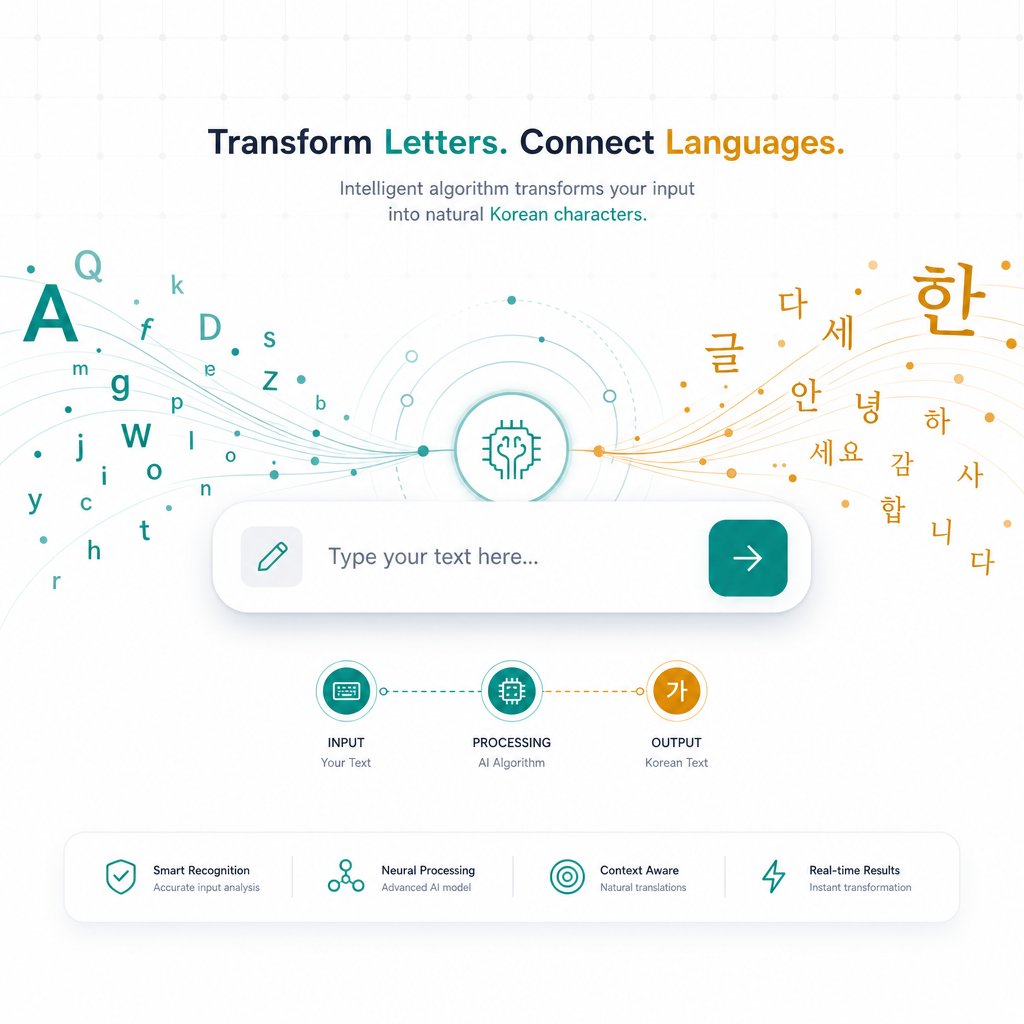
A korean name generator from english typically follows one of two processing paths, depending on what kind of output it promises.
The first path is pure transliteration. The tool takes your English input, runs it through a phonetic analysis layer that identifies how your name is pronounced (not how it is spelled), and then maps each sound to the closest Korean character using the rules covered earlier in this article. Better tools reference established transliteration standards like the Revised Romanization system or the Loanword Transcription Rules published by South Korea's National Institute of Korean Language. Simpler tools just do a naive letter-by-letter swap, which is where errors creep in.
The second path is meaning-based generation. These tools do not transliterate at all. Instead, they ask for additional inputs like your birth date, gender, or personality traits, then use those to select Korean syllables with Hanja meanings that supposedly match your profile. A korean names generator built this way might offer options tagged as korean name generator male or korean name generator female, adjusting the syllable choices based on naming conventions that lean masculine or feminine in Korean culture. Some incorporate elements of Korean fortune-telling traditions (사주, saju) that analyze birth year, month, day, and hour to recommend auspicious character combinations.
Why Different Tools Give Different Results
Type "Michael" into five different tools and you might get five slightly different outputs. Why? Several factors create variation:
- Pronunciation assumptions — Does the tool interpret your name using American English, British English, or Australian pronunciation? The vowel in "Michael" shifts across dialects, and that shift changes the Korean output.
- Transliteration standard — Some tools follow the Korean government's official loanword rules. Others use older McCune-Reischauer conventions. Still others use no formal standard at all.
- Syllable boundary decisions — Where exactly does one syllable end and the next begin? "Christina" could be split as keu-ri-seu-ti-na or keu-ri-seu-ti-na depending on how the tool handles the "st" cluster.
- Random element — A random korean name generator that creates culturally authentic names rather than transliterations will produce different results every time by design. Each click pulls from a pool of possible syllable combinations.
None of these variations necessarily means a tool is wrong. But they do mean you should not blindly accept the first result without understanding which decisions were made on your behalf.
What Makes a Generator Reliable
Not every name generator in korean deserves your trust. Here is how to evaluate whether a tool is producing quality results or just stringing syllables together:
- It distinguishes transliteration from name creation. A reliable tool clearly tells you whether it is converting your existing name's sound into Hangul or generating a new Korean name with cultural meaning. Tools that blur this line produce confusing results.
- It accounts for pronunciation, not spelling. Test it with a name like "Sean." If the output looks like 세안 (se-an) instead of 숀 (shon), the tool is reading letters rather than sounds. Walk away.
- It shows its work. The best tools display the romanization alongside the Hangul output so you can verify the pronunciation mapping yourself.
- It handles edge cases gracefully. Try names with silent letters ("Knight"), unusual clusters ("Schwartz"), or ambiguous vowels ("Aaron"). A korean name gen that produces clean results for tricky inputs is working from solid phonetic logic.
- It provides meaning breakdowns for generated names. If the tool creates an authentic Korean name rather than a transliteration, it should explain what each syllable means and which Hanja characters it draws from. Without this, you have no way to know if the name carries coherent meaning or is just random noise.
- It cites a transliteration standard. Tools that reference the National Institute of Korean Language guidelines or another recognized system are more trustworthy than those offering no methodology at all.
A generator is a starting point, not a final authority. Even the best tool cannot account for every regional pronunciation quirk or personal preference in how you say your own name. The real value of understanding how these tools work is that it equips you to catch mistakes, and mistakes in Korean name transliteration are far more common than most people realize.
Mistakes to Avoid When Writing Your Name in Korean
Knowing the rules and actually applying them correctly are two different things. People who learn how to write my name in korean often make the same handful of errors, and these mistakes are so predictable that you can spot them across forums, tattoo shops, and poorly built generators alike. The good news: once you know what to watch for, they are easy to avoid.
Most errors fall into one of three categories: treating spelling as pronunciation, mishandling syllable-final consonants, or failing to verify the result against how Korean speakers actually use the name. Let's break each one down.
Transliterating Spelling Instead of Sound
This is the single most common mistake. English spelling is famously inconsistent. The same letter can produce completely different sounds depending on the word. When people try to convert name in korean by looking at the letters rather than listening to the pronunciation, the result is often unrecognizable.
Consider the name "Michael." The letters suggest something like mi-cha-el. But nobody actually says it that way. The real pronunciation is closer to "mai-kul," two syllables. A correct korean name translation captures that sound: 마이클 (ma-i-keul). Someone transliterating the spelling might produce 미차엘 (mi-cha-el), which sounds like a completely different name to a Korean speaker.
The same problem hits names like:
- "George" — The spelling suggests "ge-or-ge," but the sound is "jorj." Correct: 조지 (jo-ji). Spelling-based error: 게오르게.
- "Katherine" — The "th" is not two separate sounds here. The pronunciation is "KA-thuh-rin." Correct: 캐서린 (kae-seo-rin). Spelling-based error: 카테리네.
- "Chloe" — The "ch" here sounds like "k," not like the "ch" in "church." Correct: 클로이 (keul-ro-i). Spelling-based error: 츨로에.
The fix is simple in principle: say your name out loud, slowly, and count the actual syllables you hear. That spoken version is what gets converted, never the written letters. If you are wondering how do i write my name in korean accurately, start by transcribing the sounds you make, not the letters on your birth certificate.
Ignoring Syllable-Final Consonant Rules
Korean's batchim (받침) system only permits seven distinct sounds at the end of a syllable: [k], [n], [t], [l], [m], [p], and [ng]. English has no such restriction. Names ending in sounds like "s," "z," "th," or "sh" cannot simply be dropped into a final consonant position. They need to either map to an allowed batchim or open a new syllable with a helper vowel.
People who skip this rule produce blocks that are structurally illegal in Korean. A name like "James" cannot end with ㅅ functioning as an "s" sound in batchim, because ㅅ in final position is pronounced [t], not [s]. The correct rendering, 제임스 (je-im-seu), pushes the final "s" into its own syllable with the helper vowel ㅡ.
Another common batchim error involves consonant clusters at the end of English names. "Hank" ends with the cluster "-nk." Korean can handle ㄴ as batchim, but the "k" needs to either join the same block (행크 uses ㅋ in a new syllable) or be restructured. Writing it as a single block with both ㄴ and ㅋ crammed into batchim position creates something unpronounceable.
Here is a comparison table showing what is the korean name of my name when done correctly versus common batchim-related errors:
| English Name | Incorrect (Batchim Error) | Correct Transliteration | Why It's Wrong |
|---|---|---|---|
| James | 제임ㅅ | 제임스 (je-im-seu) | ㅅ in final position sounds like [t], not [s] |
| Charles | 찰ㅅ | 찰스 (chal-seu) | Final "s" needs its own syllable |
| Smith | 스밋 | 스미스 (seu-mi-seu) | "th" cannot sit as batchim; maps to ㅅ in new syllable |
| Alex | 알렉ㅅ | 알렉스 (al-rek-seu) | "ks" cluster cannot both be batchim |
| Beth | 벧 | 베스 (be-seu) | "th" sound needs separate syllable treatment |
The underlying principle: if your name ends in a sound that is not one of the seven legal batchim sounds, do not force it. Let it breathe into a new syllable. Korean speakers will thank you.
How to Verify Your Transliteration Is Correct
Even after avoiding the mistakes above, you still need a reality check. The most reliable verification method is embarrassingly simple: search for your name on a Korean website. Korean news outlets, Wikipedia's Korean edition, and entertainment databases all contain thousands of transliterated foreign names. If your name matches a celebrity, athlete, or public figure, the established Korean rendering is almost certainly correct because it has been vetted by professional translators and editors.
Here is a practical verification process you can follow to convert your name to korean with confidence:
- Search Korean Wikipedia. Type your name into the Korean version of Wikipedia (ko.wikipedia.org). If a page exists for someone with your name, the Hangul rendering in the article title is your answer.
- Check Korean news sites. Search Naver News or Daum for your name in English. Articles about foreign public figures will show the accepted Korean transliteration.
- Cross-reference multiple generators. If three different tools give you the same output, that is a strong signal. If they all disagree, dig deeper into which pronunciation each one assumed.
- Ask a native speaker. Show them the Hangul version and ask them to read it back to you. If what they say sounds like your name, you are good. If it sounds like a different name entirely, something went wrong in the conversion.
- Read it aloud using Korean pronunciation rules. Remember that batchim consonants shift sound, that ㄹ between vowels sounds like a flapped "r," and that ㅅ before ㅣ sounds like "shi." Read your transliterated name with these rules applied and check if it still resembles your actual name.
A name to korean conversion is only as good as its final pronunciation test. Generators automate the process, but they cannot hear you say your own name. They guess based on common pronunciation patterns, and those guesses are wrong often enough that verification is not optional. It is essential.
The difference between a name that reads naturally and one that makes Korean speakers squint is often just one misplaced vowel or one ignored batchim rule. Getting it right the first time saves you from the awkward moment of handing someone your business card and watching their face register confusion. With the transliteration locked in, the next step is putting it to actual use, from handwriting practice to real-world introductions.
Next Steps After Getting Your Korean Name
You have your name in Hangul. It looks right, it follows the rules, and it passes the verification checks. What now? A Korean name sitting unused in a notes app does nothing for you. The value comes from actually using it, writing it by hand, typing it, and saying it out loud in real conversations.
Practice Writing Your Name in Hangul
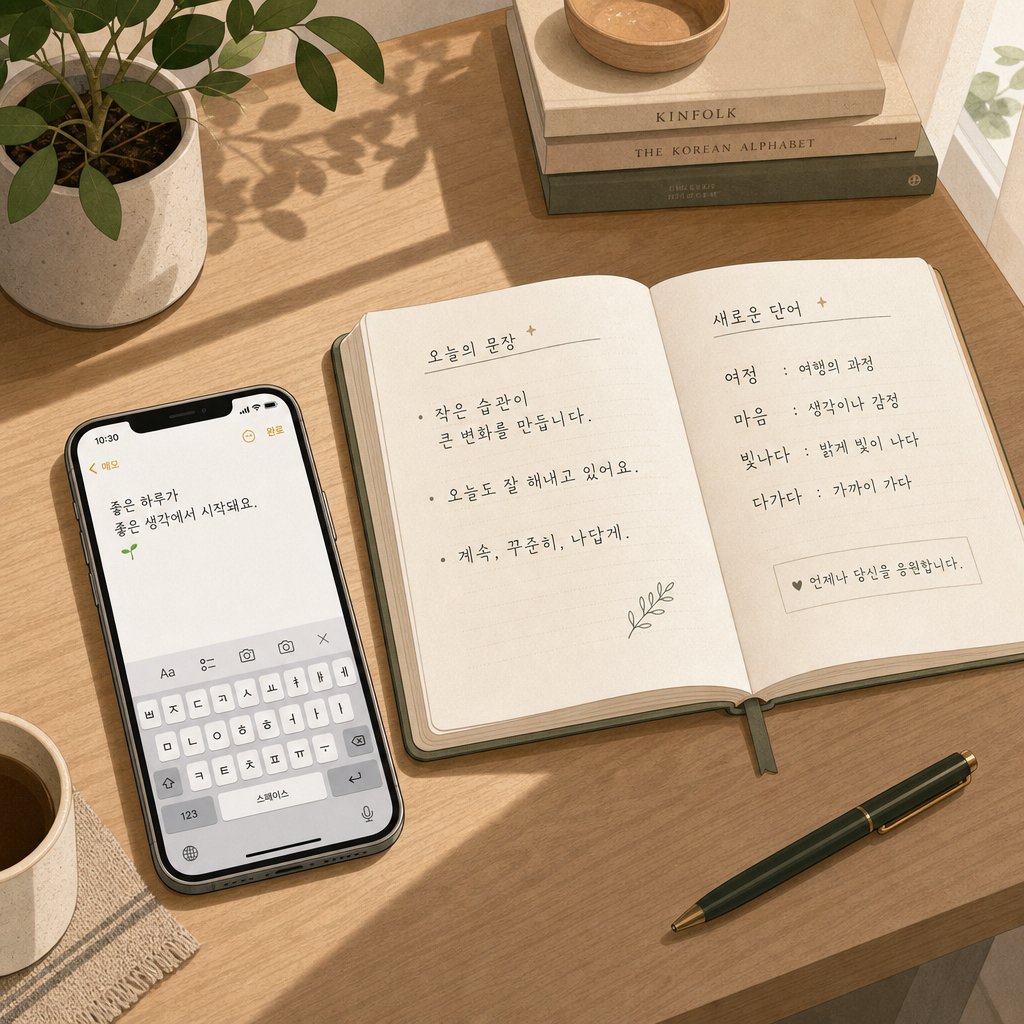
Hangul was designed for handwriting. The stroke order is logical: top to bottom, left to right, just like the reference charts from LingoDeer's Hangul guide demonstrate. Start by writing each syllable block of your name separately, paying attention to how the consonants and vowels fit together spatially. Then connect the blocks into your full name.
Grab grid paper or a Korean writing practice sheet. Write your name ten times slowly, focusing on proportions. The blocks should be roughly equal in size. After a few rounds, speed up. You will notice muscle memory kicking in faster than you expect because Hangul's geometric shapes are far simpler to reproduce than cursive English or Chinese characters.
For typing, enable the Korean keyboard on your phone or computer. On most devices, this takes about thirty seconds in language settings. The Korean keyboard layout (두벌식, dubeolsik) places consonants on the left and vowels on the right. Type your name a few times until you can do it without hunting for each character.
Using Your Korean Name in Real Life
Your transliterated name works anywhere a Korean speaker might encounter it. Add it to your social media bio in parentheses after your English name. Drop it into email signatures when corresponding with Korean colleagues. Use it when introducing yourself in Korean class or at language exchange meetups.
If you are wondering how do i say my name is in korean during an actual introduction, the phrase is straightforward: 제 이름은 [your name]입니다 (je ireumeun [your name] imnida). This is the standard formal pattern for stating your name in Korean. For slightly less formal situations, 저는 [your name]이에요 (jeoneun [your name] ieyo) works well. Knowing how to say in korean my name is gives you the confidence to use your Hangul name out loud, not just on paper.
And if someone asks you first? The korean for what is your name is 이름이 뭐예요? (ireumi mwoyeyo?) in polite speech, or the more formal 성함이 어떻게 되세요? (seonghami eotteoke doeseyo?) in professional contexts. Recognizing these questions means you will know exactly when to deploy your prepared answer.
Getting Native Speaker Verification
Generators give you a starting point. Native speakers give you certainty. Even if you followed every rule in this article, a quick check with a Korean speaker catches subtle issues no tool can flag, like whether your name accidentally sounds similar to an existing Korean word with an unfortunate meaning, or whether the rhythm feels natural when spoken at conversational speed.
Here is your complete action plan:
- Write your Korean name by hand ten times using proper stroke order until the blocks feel natural.
- Enable the Korean keyboard on your phone and practice typing your name without looking at a reference.
- Add your Hangul name to at least one social media profile or email signature this week.
- Practice saying 제 이름은 [your name]입니다 out loud until the sentence flows without hesitation.
- Ask a native Korean speaker to read your name back to you and confirm it sounds like your actual name.
- If anything sounds off, revisit the transliteration rules and adjust the specific syllable that is causing the mismatch.
The whole point of understanding the process behind a write my name in korean generator is independence. Tools break, produce inconsistent results, or make assumptions about your pronunciation that do not match reality. When you understand how Hangul works, how sounds map across languages, and what makes a transliteration correct, you stop relying on any single tool. You become your own quality check. And that means your name, however it is spelled in English, gets the Korean rendering it deserves: accurate, natural, and unmistakably yours.
Frequently Asked Questions About Writing Your Name in Korean
1. How do I write my name in Korean accurately?
To write your name in Korean accurately, focus on how your name sounds rather than how it is spelled. Break your name into individual syllables based on pronunciation, map each consonant and vowel sound to the closest Korean character (Hangul), and assemble them into syllable blocks following Korean structure rules. For example, 'Michael' follows the sound 'mai-kul' and becomes 마이클, not a letter-by-letter conversion. Always verify your result by searching Korean news sites or asking a native speaker to read it back to you.
2. What is the difference between transliterating my name and getting a Korean name?
Transliteration converts the sounds of your existing name into Korean script (Hangul), preserving your original identity in a different writing system. For instance, 'Jessica' becomes 제시카. An authentic Korean name, on the other hand, is a culturally meaningful new name built from Korean surname and given-name conventions, often using Hanja characters with specific meanings. Transliteration is appropriate for most everyday situations, while adopting a Korean name signals deeper cultural integration and is typically chosen by people living or working long-term in Korea.
3. Why do different Korean name generators give different results for the same name?
Variations occur because generators may assume different English dialects (American vs. British pronunciation), follow different transliteration standards (Revised Romanization vs. McCune-Reischauer), or make different decisions about where syllable boundaries fall in your name. Some tools also blur the line between phonetic transliteration and meaning-based name generation. To find the most reliable result, cross-reference at least three tools and check whether their output matches how Korean media actually writes the name.
4. What happens to sounds like F, V, and TH that don't exist in Korean?
Korean approximates these missing sounds using the closest available consonants. The 'f' sound becomes ㅍ (p), 'v' becomes ㅂ (b), voiceless 'th' (as in 'think') becomes ㅅ (s) or ㄷ (d), and 'z' becomes ㅈ (j). These substitutions follow consistent phonetic logic based on how each sound is produced in the mouth. Names heavy in these sounds will always sound slightly different when read aloud in Korean, but native speakers are accustomed to these standard approximations for foreign names.
5. How do I introduce myself using my Korean name in conversation?
The standard formal phrase is 제 이름은 [your name]입니다 (je ireumeun [your name] imnida). For slightly less formal situations, use 저는 [your name]이에요 (jeoneun [your name] ieyo). Practice saying the full sentence out loud until it flows naturally. When someone asks your name using 이름이 뭐예요? (ireumi mwoyeyo?) in polite speech, you can respond with either pattern. Having a native speaker confirm your pronunciation ensures the name sounds natural at conversational speed.