What Makes a Chinese Name Truly Auspicious
Confucius once argued that if names are not correct, language falls out of truth, and when language falls out of truth, nothing in society can be carried to success. This idea, known as zhengming (正名) or the rectification of names, shaped Chinese civilization for over two thousand years. It also planted a deep cultural belief: the right name does not merely label a person. It actively shapes their path.
赐子千金,不如教子一艺;教子一艺,不如赐子好名。
"Giving a child a thousand pieces of gold is not as good as teaching them a skill; teaching them a skill is not as good as giving them a good name."
So what does "auspicious" actually mean when applied to Chinese names? It is not just picking a character that sounds pleasant or carries a nice meaning. An auspicious name achieves harmony across multiple dimensions at once: the tonal flow of its pronunciation, the depth of its meaning, the elemental balance it brings to the bearer's birth chart, and the numerical structure hidden in its stroke count. Each layer reinforces the others.
Think of it as architecture rather than decoration. Common chinese names might sound appealing on the surface, but a truly fortunate name integrates metaphysics, linguistics, and cultural tradition into a single, deliberate structure.
Why Names Carry Weight in Chinese Culture
In Chinese tradition, a name is not passive. It is a force. The chinese for name, "mingzi" (名字), shares its first character with concepts like destiny (命) and life itself. A name related to luck in Chinese culture is one that compensates for what a person's birth chart lacks, avoids phonetic collisions with unlucky words, and aligns with generational and familial expectations. This guide walks you through the three major systems that practitioners use to achieve this balance:
- Five Elements (Wuxing/五行) — matching elemental energy to a child's birth data
- Stroke Count Numerology (Five Structures/五格) — calculating auspicious numerical patterns from character strokes
- Radical-Based Elemental Association — using character components to identify and strengthen specific elements
Who This Guide Is For
Whether you are a parent selecting a name for a newborn, an adult choosing a Chinese name for business or cultural integration, or a language learner seeking deeper cultural understanding, this guide gives you the framework behind the tradition. You will learn not just what makes chinese names auspicious, but why each system exists and how they work together to produce a name that carries real weight.
The process begins where all classical Chinese naming begins: with the five elements and the birth chart they emerge from.
How the Five Elements Theory Guides Name Selection
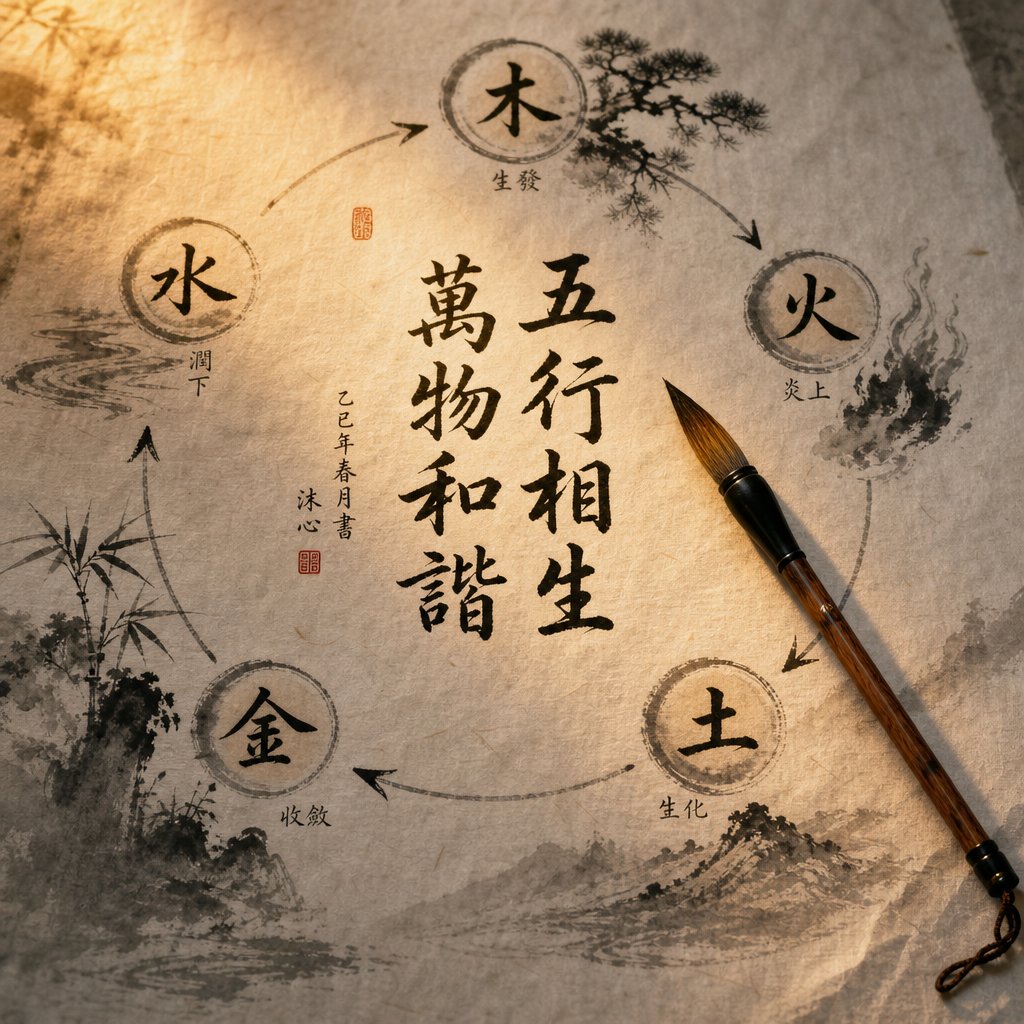
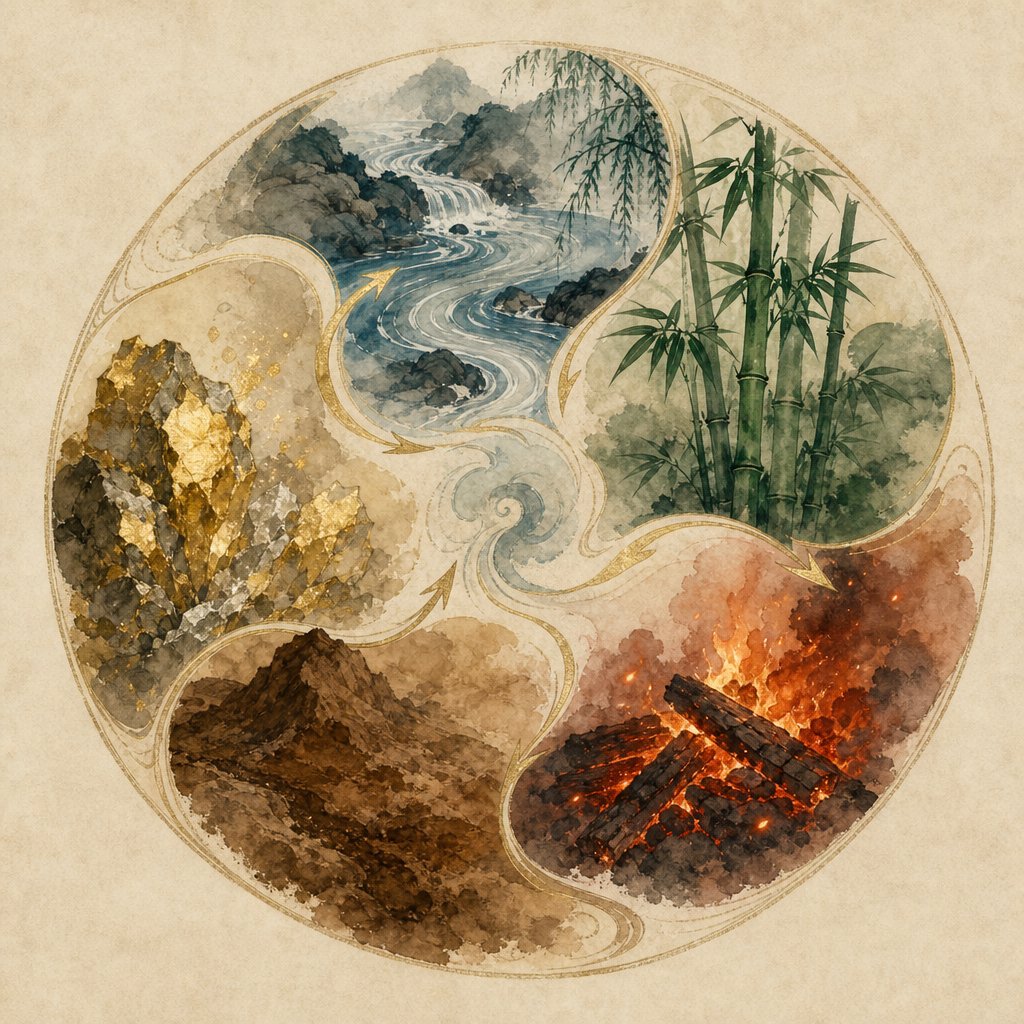
Five Elements theory, or Wuxing (五行), is the philosophical engine driving auspicious Chinese naming. It treats the universe as a system of five fundamental energies: Wood (木), Fire (火), Earth (土), Metal (金), and Water (水). These are not just physical substances. They represent patterns of movement and transformation. Wood grows upward and outward. Fire rises and illuminates. Earth stabilizes and nourishes. Metal contracts and refines. Water flows downward and adapts. When you select a name using this framework, you are choosing characters whose elemental energy compensates for imbalances in the bearer's birth chart.
The Five Elements and Their Character Associations
Each element carries a distinct personality signature and connects to specific Chinese characters through meaning, radical structure, or both. Names that mean sun or brightness, for instance, fall under the Fire element because of their association with warmth and radiance. Sun names like 晨 (chén, morning) and 昭 (zhāo, luminous) carry that upward, illuminating Fire energy. Names that mean sunshine often use the 日 radical to signal this connection visually.
Here is a breakdown of each element with representative naming characters:
| Element | Character | Pinyin | Meaning | Personality Traits |
|---|---|---|---|---|
| Wood (木) | 森 | sēn | Forest, abundant | Growth-oriented, flexible, compassionate |
| Wood (木) | 萱 | xuān | Daylily, carefree | Nurturing, creative, resilient |
| Fire (火) | 炎 | yán | Blazing, scorching | Passionate, dynamic, expressive |
| Fire (火) | 煜 | yù | Radiant, shining | Charismatic, warm, inspiring |
| Earth (土) | 坤 | kūn | Earth, receptive | Stable, dependable, grounded |
| Earth (土) | 培 | péi | Cultivate, nurture | Patient, supportive, trustworthy |
| Metal (金) | 鑫 | xīn | Prosperous (triple gold) | Disciplined, precise, determined |
| Metal (金) | 铭 | míng | Inscribe, remember | Principled, clear-minded, resolute |
| Water (水) | 淼 | miǎo | Vast waters | Adaptable, wise, intuitive |
| Water (水) | 涵 | hán | Contain, encompass | Deep-thinking, tolerant, fluid |
How Elemental Balance Shapes Name Choices
A child's birth date and time generate a BaZi chart that maps elemental strengths and weaknesses. Imagine a chart showing strong Wood and Fire but almost no Water. A practitioner would look for characters carrying Water energy to restore equilibrium. But here is the critical nuance most beginners miss: the goal is balance, not simple addition. If a chart already overflows with Fire, piling on more Fire characters does not make the name more powerful. It makes it volatile.
Think of it like seasoning a dish. A pinch of salt enhances flavor. A handful ruins it. The same logic applies to elemental naming. A child whose chart lacks Metal might benefit from 锋 (fēng, sharp edge) in their name, but only if that Metal does not clash destructively with other dominant elements already present.
Productive and Destructive Cycles Explained
The five elements interact through two fundamental cycles that every naming decision must respect:
The Productive Cycle (相生) flows like a chain of nourishment:
- Wood feeds Fire (wood burns to create flame)
- Fire creates Earth (ash returns to soil)
- Earth bears Metal (ore forms within rock)
- Metal collects Water (condensation on metal surfaces)
- Water nourishes Wood (rain makes trees grow)
The Destructive Cycle (相克) acts as a system of checks:
- Wood parts Earth (roots break soil)
- Earth dams Water (embankments block flow)
- Water extinguishes Fire
- Fire melts Metal
- Metal chops Wood
In naming practice, a name whose characters flow along the productive cycle is considered auspicious. For example, a surname carrying Water energy followed by a given name with Wood energy creates a "Water nourishes Wood" pattern. Conversely, placing a strong Metal character directly after a Wood-element surname creates a destructive clash: Metal chops Wood.
This is why experienced practitioners analyze the full sequence of elements across surname and given name together. A name like 林浩宇 (Lín Hàoyǔ) produces the chain Wood-Water-Earth. Water nourishes the Wood surname, which is favorable, but Earth controls Water in the destructive cycle, introducing tension. These interactions determine whether a name's energy flows smoothly or creates internal friction.
Elemental theory gives you the "what" of auspicious naming. But how do practitioners translate these elements into precise numerical calculations? That question leads directly into stroke count numerology and the Five Structures system that quantifies a name's fortune down to the last brushstroke.
Stroke Count Numerology and the Five Structures System
Elemental theory tells you which energies a name should carry. But how do you measure whether a specific combination of characters actually produces a fortunate result? That is where chinese name strokes enter the picture. The Five Structures system, or Wuge (五格), converts every character in a name into a number, then maps those numbers onto a grid that reveals patterns of fortune across an entire lifetime.
This method was formalized by the Japanese scholar Kumazaki Ken'o in 1918, drawing on Chinese Yijing numerology. By the 1990s, Chinese practitioners had integrated it with traditional Five Elements principles to create a comprehensive naming framework. Today it remains one of the most widely used tools for evaluating auspicious chinese names across Mainland China, Taiwan, Hong Kong, and Southeast Asian Chinese communities.
Understanding the Five Grid Positions
Imagine a name as a building with five structural zones. Each zone, or "grid," governs a different dimension of a person's fortune:
- Heaven Grid (天格) — derived from the surname. It reflects inherited family energy and early-life conditions. Since chinese surnames are passed down rather than chosen, this grid is considered fixed. Is surname last name? In Chinese naming, yes. The surname (姓) always comes first and forms the foundation of this grid.
- Personality Grid (人格) — the central axis of the name. It combines the surname's last character with the given name's first character, governing overall life destiny and core temperament.
- Earth Grid (地格) — calculated from the given name characters alone. It influences youth, relationships, and early career. The given meaning here is literal: this grid reflects what the parents deliberately chose.
- External Grid (外格) — represents the social environment, interpersonal relationships, and external opportunities.
- Total Grid (总格) — the sum of all strokes in the full name. It governs fortune from middle age onward, reflecting the cumulative trajectory of a life.
The Personality Grid and Total Grid carry the most weight in evaluation. Practitioners also analyze the "Three Talents" (三才), which examines how the Five Elements attributes of the Heaven, Personality, and Earth Grids interact. Mutual generation between these three is auspicious; mutual destruction signals friction.
Counting Strokes for Simplified and Traditional Characters
Here is a detail that trips up many beginners: even in regions that use simplified characters daily, naming numerology counts strokes according to the traditional forms defined in the Kangxi Dictionary. Why? The system was built on traditional character structures, and practitioners consider those forms to carry the original energetic signature of each character.
For example, the simplified character 华 has 6 strokes, but its traditional form 華 has 14. In Five Structures calculations, you would use 14. This distinction matters enormously because a single stroke difference can shift a grid number from auspicious to inauspicious territory.
The calculation rules differ slightly based on name structure:
- Single surname + two-character given name: Heaven Grid = surname strokes + 1. Personality Grid = surname strokes + first given-name character strokes. Earth Grid = sum of both given-name character strokes.
- Compound surname + two-character given name: Heaven Grid = sum of both surname character strokes. Personality Grid = second surname character strokes + first given-name character strokes.
Let's walk through a concrete example using the historical name Li Shimin (李世民):
| Grid Position | Calculation | Result | Element | Interpretation |
|---|---|---|---|---|
| Heaven Grid (天格) | 李 (7) + 1 | 8 | Metal | Inherited family foundation |
| Personality Grid (人格) | 李 (7) + 世 (5) | 12 | Wood | Core destiny and temperament |
| Earth Grid (地格) | 世 (5) + 民 (5) | 10 | Water | Youth and early relationships |
| Total Grid (总格) | 7 + 5 + 5 | 17 | Metal | Later-life fortune trajectory |
| External Grid (外格) | 17 - 12 + 1 | 6 | Earth | Social environment and opportunities |
The Three Talents here are Metal (Heaven), Wood (Personality), and Water (Earth). Metal controls Wood in the destructive cycle, which introduces tension in the inherited-to-personal relationship. Yet Water nourishes Wood in the productive cycle, meaning early-life circumstances support personal development. A practitioner would weigh these interactions together rather than judging any single grid in isolation.
Which Stroke Totals Are Considered Lucky
Not all numbers carry equal weight. The system classifies stroke totals from 1 to 81 into fortune categories. Sounds complex? Here is the essential breakdown:
Auspicious numbers (signaling soundness, happiness, and success): 1, 3, 5, 7, 8, 11, 13, 15, 16, 18, 21, 23, 24, 25, 31, 32, 33, 35, 37, 39, 41, 45, 47, 48, 52, 57, 61, 63, 65, 67, 68, 81.
Sub-auspicious numbers (some obstacles but ultimately favorable): 6, 17, 26, 27, 29, 30, 38, 49, 51, 55, 58, 71, 73, 75.
Inauspicious numbers (adversity, instability, hardship): 2, 4, 9, 10, 12, 14, 19, 20, 22, 28, 34, 36, 40, 42, 43, 44, 46, 50, 53, 54, 56, 59, 60, 62, 64, 66, 69, 70, 72, 74, 76, 77, 78, 79, 80.
Beyond simple auspicious or inauspicious labels, certain numbers carry specialized meanings. Numbers like 15, 16, 24, 29, 32, 33, 41, and 52 are specifically associated with wealth fortune. Numbers 3, 13, 16, 21, 23, 29, 31, 37, 39, 41, 45, and 47 indicate leadership potential. The number assigned to each grid determines its Five Elements attribute using a simple rule: digits ending in 1 or 2 belong to Wood, 3 or 4 to Fire, 5 or 6 to Earth, 7 or 8 to Metal, and 9 or 0 to Water.
This is why the system works alongside Five Elements theory rather than replacing it. The stroke count grid generates its own elemental map of the name, which practitioners then cross-reference against the bearer's birth chart elements. A name might contain characters with strong Water radicals (satisfying elemental naming), but if its grid numbers produce a Fire-dominant pattern, the two systems conflict. The strongest names achieve alignment across both layers.
Stroke counts give you the numerical skeleton of a name. But the characters themselves contain another layer of elemental information embedded directly in their visual structure: the radicals that form their building blocks.
Chinese Radicals as Elemental Building Blocks
With tens of thousands of mandarin characters in existence, how does anyone quickly determine which element a character belongs to? You do not need to memorize massive lists. The answer is hiding in plain sight, embedded in the visual structure of each character: its radical.
Chinese radicals (部首) are the semantic components that form the backbone of characters. There are 214 traditional radicals, and each one carries a core meaning. For naming purposes, five radicals matter most because they directly signal elemental association. When you spot one of these radicals inside a character, you immediately know which of the Five Elements that character strengthens. This turns the overwhelming question of how many chinese characters are there into a manageable pattern-recognition exercise.
Water Radical Characters for Fluid Prosperity
The water radical (氵), called "three drops of water" (三点水), is one of the most common radicals in Chinese, appearing in nearly 1,595 characters in the Kangxi Dictionary. Characters carrying this radical channel Water element energy: adaptability, wisdom, and flowing abundance.
Popular naming characters with the water radical include 汐 (xī, evening tide), 涵 (hán, to contain or encompass), 洁 (jié, pure and clean), 澜 (lán, great waves), and 沐 (mù, to bathe in grace). If a child's birth chart is deficient in Water, any of these characters instantly introduces that missing energy. Characters like 汐, 梦, and 瑶 frequently appear together in discussions of elegant girl names because they combine elemental function with poetic beauty.
Wood, Fire, Earth, and Metal Radical Families
The same logic applies across all five elements. Each elemental radical acts as a flag, marking every character that contains it as belonging to that element's family:
| Element | Radical | Character | Pinyin | Meaning |
|---|---|---|---|---|
| Water (水) | 氵 | 汐 | xī | Evening tide |
| Water (水) | 氵 | 涵 | hán | Contain, encompass |
| Water (水) | 氵 | 洁 | jié | Pure, clean |
| Wood (木) | 木 | 林 | lín | Forest, grove |
| Wood (木) | 木 | 桐 | tóng | Paulownia tree |
| Wood (木) | 木 | 梦 | mèng | Dream |
| Fire (火) | 火 / 灬 | 煜 | yù | Radiant, shining |
| Fire (火) | 火 / 灬 | 烨 | yè | Brilliant, splendid |
| Fire (火) | 火 / 灬 | 熙 | xī | Prosperous, bright |
| Earth (土) | 土 | 坤 | kūn | Earth, receptive |
| Earth (土) | 土 | 培 | péi | Cultivate, nurture |
| Earth (土) | 土 | 垚 | yáo | High, lofty (triple earth) |
| Metal (金) | 金 / 钅 | 铭 | míng | Inscribe, remember |
| Metal (金) | 金 / 钅 | 锦 | jǐn | Brocade, splendid |
| Metal (金) | 金 / 钅 | 鑫 | xīn | Prosperous (triple gold) |
Notice the fire radical takes two forms: 火 when it appears on the left or as a standalone component, and 灬 (four dots) when it sits at the bottom of a character. Similarly, the metal radical appears as 金 in traditional characters and 钅 in its simplified radical form. Recognizing both variants doubles your identification speed.
Using Radicals as a Shortcut for Element Identification
This radical-based approach transforms character selection from guesswork into a systematic process. Instead of consulting extensive reference tables for every candidate character, you simply look at its left side or bottom component. Spot 氵? Water. See 木? Wood. Find 灬 at the base? Fire.
The relationship between names and characters becomes intuitive once you internalize these five radical families. A parent who knows their child needs Earth energy can scan any character list and immediately filter for candidates containing the 土 radical. A practitioner balancing a Fire-deficient chart gravitates toward characters built on 火 or 灬 without needing to cross-reference external databases.
Of course, radicals reveal elemental association at the character level. But which elements a child actually needs depends on something deeper: the specific energies present at the moment of birth. That calculation requires reading the BaZi birth chart, where year, month, day, and hour each contribute their own elemental signature to the picture.
Reading a BaZi Birth Chart for Name Selection
Every auspicious Chinese name begins with a question: what does this specific person need? The answer lives in the BaZi (八字) birth chart, a diagnostic framework that maps the elemental energies present at the exact moment of birth. BaZi literally means "eight characters," and those eight characters form the foundation upon which practitioners build a name tailored to an individual's destiny rather than chosen at random.
The system works like this: your year, month, day, and hour of birth each generate two characters, one Heavenly Stem (天干) and one Earthly Branch (地支). Four time units, two characters each, eight characters total. Each of those characters carries the energy of one of the Five Elements: Wood, Fire, Earth, Metal, or Water. The unique combination that emerges is yours alone, shared by no one born at a different time or place.
The Four Pillars of a Birth Chart
The eight characters arrange themselves into four vertical columns called pillars (四柱). Each pillar captures a different dimension of life energy:
- Year Pillar (年柱) — reflects ancestral energy, the broader era, and external environment. Among chinese family names and lineage traditions, this pillar connects the individual to inherited conditions.
- Month Pillar (月柱) — governs seasonal energy and has a decisive influence on elemental balance. A child born in midsummer carries fundamentally different energy than one born in deep winter.
- Day Pillar (日柱) — the center of the chart. Its Heavenly Stem is the Day Master (日主), the single most important reference point for everything that follows.
- Hour Pillar (时柱) — influences output, investments, and the later stages of life.
These pillars do not operate in isolation. The elements within each pillar support, clash with, or regulate the elements in the others. A practitioner reads the entire web of interactions together, not any single pillar alone.
Reading Elemental Strengths and Weaknesses
The Day Master is your starting point. If the Day Master is Yang Wood (甲), then every other element in the chart is interpreted relative to Wood: Water supports it, Fire drains it, Metal controls it, Earth represents its wealth capacity. The critical question becomes whether the Day Master is strong or weak based on how much support it receives from the surrounding seven characters.
From this analysis emerges the Yong Shen (用神), or "useful god": the specific element the chart most needs to achieve balance. This is your naming target. If a child's chart shows a weak Fire Day Master with minimal Fire support across all four pillars, Fire becomes the Yong Shen. Every character selected for the name should reinforce or complement that element through its radical, sound, and meaning.
A name does not impose fortune from outside. It compensates for what the birth chart lacks from within.
This is the principle that separates BaZi naming from decorative naming. You are not choosing characters because they sound beautiful for boy and girl names alike. You are prescribing specific elemental medicine based on a diagnostic reading.
How Zodiac Year and Season Influence Naming
The Chinese zodiac year adds another layer. Each of the twelve zodiac animals corresponds to an Earthly Branch carrying a specific element. A child born in a Water-dominant year (like the Year of the Pig or Rat) already arrives with strong Water energy in the Year Pillar. Stacking more Water characters into the name risks elemental excess rather than balance.
Birth season matters just as much. The Month Pillar sets the "temperature" of the chart. A Wood Day Master born in spring, when Wood energy peaks naturally, is already strong. That same Day Master born in autumn, when Metal energy dominates and controls Wood, arrives weakened and needs support. Practitioners across asian names and surnames traditions factor seasonal context into every recommendation because the same character can be medicine for one chart and poison for another.
This is why experienced practitioners insist on knowing the exact birth time before suggesting any characters. The Hour Pillar carries roughly a quarter of the chart's elemental weight, and a two-hour difference can shift the Yong Shen entirely. For families choosing names for newborns, the BaZi chart cannot be cast until after delivery, making the naming process a deliberate, post-birth act rather than a pre-planned decision.
With the birth chart read and the target element identified, the next step is applying that knowledge to actual character selection. The following sections present curated name options for girls and boys, organized by elemental association and meaning, so you can see how theory translates into real naming choices.
Auspicious Chinese Girl Names With Powerful Meanings
Theory only matters when it produces real choices. With elemental targets identified and radical associations understood, the question becomes: which specific characters carry both auspicious energy and beautiful meaning for a daughter? Chinese girl names operate at the intersection of metaphysics and poetry. The best ones satisfy the birth chart's elemental needs while evoking qualities parents hope their child will embody.
What follows is a curated chinese names list female readers can use as a starting point, organized by meaning category and tagged with elemental associations. Each name works as a given name (名) paired with any common surname, and most are recognized across Mainland China, Taiwan, and overseas Chinese communities. Whether you are browsing asian names for girls with deep cultural roots or seeking a character that fills a specific elemental gap, these selections balance tradition with contemporary appeal.
Girl Names Meaning Wisdom and Brightness
Characters associated with intelligence and light tend to carry Fire or Wood energy. Fire illuminates and reveals; Wood grows toward knowledge. These chinese names for girls signal intellectual aspiration and clarity of mind, qualities valued across every Chinese-speaking community.
| Character | Pinyin | Meaning | Element | Auspicious Quality |
|---|---|---|---|---|
| 慧 | hui | Wisdom, intelligence | Water | Deep insight and perceptive mind |
| 明 | ming | Bright, clear | Fire | Clarity of purpose and illuminated path |
| 颖 | ying | Outstanding, clever | Wood | Exceptional talent rising above peers |
| 晗 | han | Dawn light | Fire | Hopeful new beginnings and warmth |
| 敏 | min | Quick, sharp | Water | Agile thinking and swift adaptability |
| 昕 | xin | Morning sunrise | Fire | Bright future and positive energy |
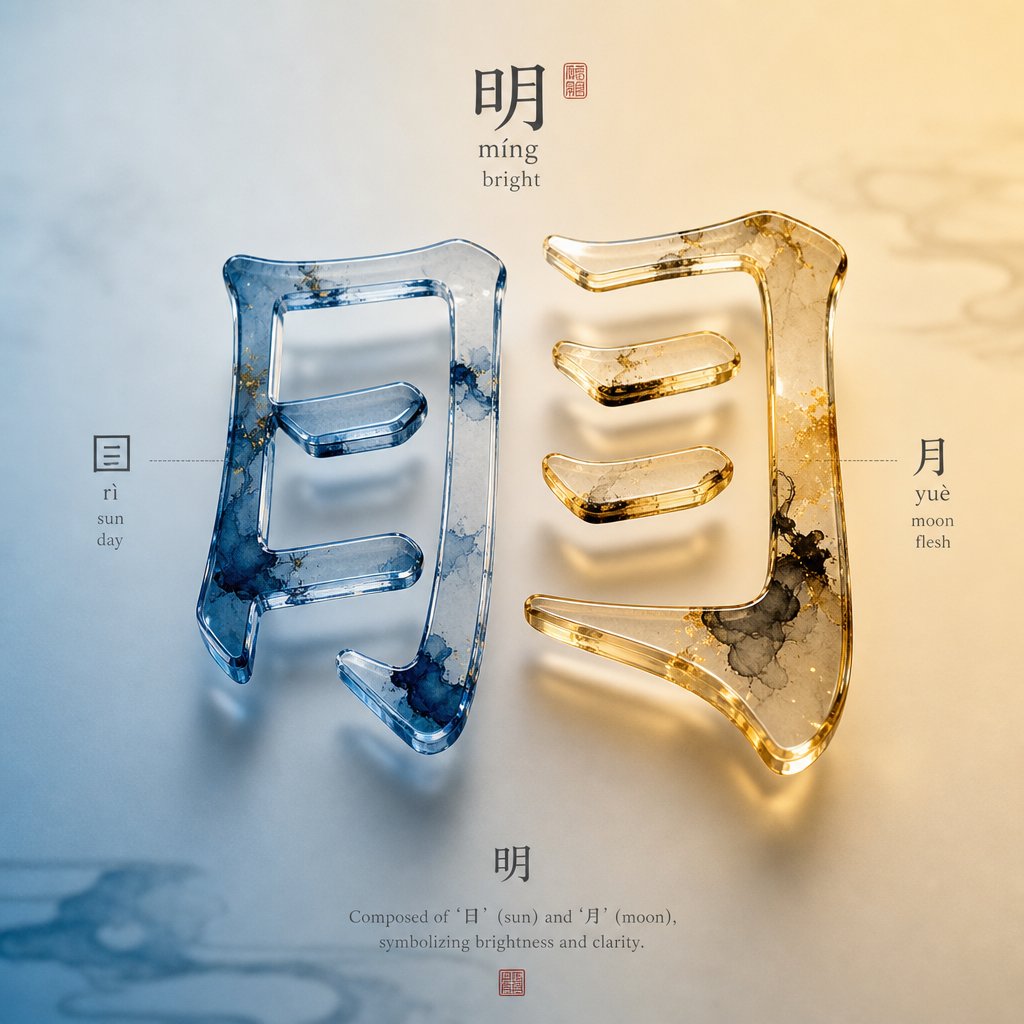
Notice that 慧 carries Water energy despite meaning "wisdom" because its traditional radical structure connects to the heart (心) and flowing thought. Meanwhile, 明 combines the sun (日) and moon (月) radicals, making it strongly Fire-aligned. This is why radical analysis matters more than surface meaning when matching chinese female names to a birth chart.
Nature-Inspired Auspicious Girl Names
Nature imagery dominates female chinese names because it simultaneously conveys beauty, resilience, and elemental energy. A jade character signals Earth. A tide character signals Water. A blossom character signals Wood. Parents get poetic elegance and metaphysical function in a single stroke.
| Character | Pinyin | Meaning | Element | Auspicious Quality |
|---|---|---|---|---|
| 瑶 | yao | Precious jade | Earth | Rare beauty and noble character |
| 梦 | meng | Dream | Wood | Imagination and boundless aspiration |
| 汐 | xi | Evening tide | Water | Gentle rhythm and flowing grace |
| 岚 | lan | Mountain mist | Earth | Ethereal presence and quiet strength |
| 萱 | xuan | Daylily (forget-worry herb) | Wood | Freedom from sorrow and carefree spirit |
| 澜 | lan | Great waves | Water | Broad-minded ambition and extraordinary bearing |
Among these, 汐 (xi) and 瑶 (yao) have surged in popularity across china female names trends. The combination 汐玥 (Xiyue) ranked among the most registered girl names in recent years, pairing Water energy (汐) with Earth energy (玥, sacred jade) to create a productive elemental flow. Similarly, 沐瑶 (Muyao) combines Water (沐, bathed in blessings) with Earth (瑶), producing the same nourishing cycle. These pairings show how asian girl names can be both trendy and elementally sound.
Girl Names Symbolizing Prosperity and Grace
Prosperity in Chinese naming is rarely about money alone. It encompasses smooth fortune, social harmony, and an elegant bearing that attracts opportunity. These characters carry Metal or Earth energy, elements associated with refinement, structure, and accumulated value.
| Character | Pinyin | Meaning | Element | Auspicious Quality |
|---|---|---|---|---|
| 瑞 | rui | Auspicious omen | Metal | Heaven-sent blessings and good fortune |
| 婉 | wan | Gentle, graceful | Earth | Soft strength and harmonious relationships |
| 锦 | jin | Brocade, splendid | Metal | A brilliant and prosperous future |
| 嘉 | jia | Excellent, praiseworthy | Wood | Virtue recognized and rewarded |
| 诺 | nuo | Promise, faith | Fire | Integrity and trustworthy character |
| 舒 | shu | Comfort, ease | Metal | Smooth life path and relaxed elegance |
The character 诺 (nuo) deserves special attention. The name 一诺 (Yinuo), meaning "one promise," has become one of the most popular chinese girl names in recent registration data, symbolizing sincerity and integrity. It works beautifully across all Chinese-speaking regions because its meaning is universally valued and its pronunciation flows cleanly in Mandarin, Cantonese, and Hokkien alike.
Cultural context shapes which names travel well. Characters like 嘉 (jia) appear frequently in Cantonese naming because their tonal quality sounds particularly elegant in that dialect. Meanwhile, names drawing from classical poetry, such as 舒窈 (Shuyao, from the Book of Songs), resonate strongly in Taiwan and among literary-minded families on the mainland. When selecting from any list of asian names for girls, consider not just elemental fit but also how the name sounds in the dialect your family actually speaks.
These selections represent starting points rather than final answers. The strongest name emerges when you cross-reference a character's element against the birth chart, verify its stroke count in the Five Structures grid, and test its pronunciation for tonal harmony with the surname. That same process applies equally when selecting auspicious names for boys, where different cultural expectations and meaning categories come into play.
Auspicious Chinese Boy Names for Strength and Wisdom
Chinese male names carry a distinct cultural weight. Where girl names often draw from nature and grace, chinese names for boys tend to project outward: ambition, moral strength, intellectual achievement, and the capacity to lead. These are not arbitrary preferences. They reflect centuries of Confucian ideals about masculine virtue, where a man's name signals the qualities his family hopes he will grow into. The best male chinese given names satisfy both this cultural expectation and the elemental requirements of the birth chart.
What follows is a selection of boy names with meaning rooted in classical tradition and elemental function. Each entry includes its character, pronunciation, element, and the specific auspicious quality it carries. Think of these as building blocks. The final name depends on which element the child's BaZi chart needs most.
Boy Names Conveying Strength and Ambition
Strength in Chinese naming is rarely about brute force. It is about willpower, resilience, and the determination to achieve something significant. These characters project masculine boy names energy through their meaning and elemental association, making them popular chinese first names male families have used across generations.
| Character | Pinyin | Meaning | Element | Auspicious Quality |
|---|---|---|---|---|
| 志 | zhi | Aspiration, will | Fire | Unwavering determination and clear purpose |
| 伟 | wei | Great, magnificent | Earth | Impressive achievements and towering stature |
| 毅 | yi | Perseverance, resolve | Wood | Strength to endure hardship without breaking |
| 刚 | gang | Firm, unyielding | Metal | Integrity that cannot be bent or corrupted |
| 鹏 | peng | Legendary giant bird | Water | Soaring ambition and boundless vision |
| 凯 | kai | Triumph, victory | Wood | Overcoming obstacles and achieving success |
Among these, 鹏 (peng) deserves special attention. It references the mythical Peng bird from Zhuangzi's philosophy, a creature so vast it transforms the sky when it flies. As a Water element character, it serves double duty for charts needing both ambition symbolism and Water energy. The name 浩宇 (Haoyu, meaning "vast universe") ranked among the most popular chinese boy names in recent years, combining Water (浩) with Earth (宇) in a productive elemental pairing.
Many of these work beautifully as one syllable boy names when used as the sole given-name character after a surname. 刚 (Gang), 毅 (Yi), and 凯 (Kai) each carry enough weight to stand alone, producing punchy, memorable names like 李刚 (Li Gang) or 王凯 (Wang Kai).
Scholar-Inspired Auspicious Boy Names
Scholarly achievement holds a unique place in Chinese culture. For over a thousand years, the imperial examination system made academic excellence the primary path to social mobility. That legacy lives on in naming conventions. Characters evoking literary talent, broad knowledge, and intellectual depth remain among the most sought-after asian male names because they signal both cultural refinement and practical ambition.
| Character | Pinyin | Meaning | Element | Auspicious Quality |
|---|---|---|---|---|
| 文 | wen | Literature, culture | Water | Literary talent and quiet intelligence |
| 博 | bo | Broad, learned | Water | Expansive knowledge and open-minded curiosity |
| 哲 | zhe | Wise, philosophical | Fire | Deep thinking and intellectual clarity |
| 睿 | rui | Perceptive, sagacious | Metal | Sharp insight that penetrates to truth |
| 翰 | han | Writing brush, literary | Water | Scholarly accomplishment and elegant expression |
| 铭 | ming | Inscribe, engrave | Metal | Wisdom remembered and principles upheld |
Notice how many scholar names carry Water energy. This is not coincidence. Water represents depth, flow, and the capacity to absorb and retain, qualities that mirror the learning process itself. The name 博文 (Bowen, meaning "extensive knowledge") combines two Water characters, making it particularly potent for charts deficient in that element. Meanwhile, 睿哲 (Ruizhe) pairs Metal perception with Fire wisdom, creating a name that cuts through confusion to reach understanding.
Two-character combinations like 致远 (Zhiyuan, meaning "achieves far-reaching goals") draw directly from classical literature. This particular phrase comes from Zhuge Liang's letter to his son: "Without tranquility, one cannot reach far." Names rooted in famous texts carry an additional layer of cultural prestige that single characters cannot match.
Generational Naming and Auspicious Constraints
Here is where chinese male names encounter a unique structural challenge. Many families follow generational naming conventions (辈分/字辈), where a shared character is designated for all children born in the same generation of a lineage. This character occupies one position in the given name, leaving only the remaining character available for auspicious optimization.
Imagine a family whose generational poem assigns the character 承 (cheng, meaning "inherit") to the current generation. Every male cousin shares 承 as the first character of their given name. The parents' task narrows to selecting a second character that balances the birth chart while harmonizing with 承's Fire element energy. If the child needs Water, they might choose 泽 (ze, meaning "benevolence" or "marshland"), producing 承泽. If Metal is needed, 铭 (ming) creates 承铭.
This system, documented in family genealogy books called Jiapu (家谱), has been practiced for centuries. It constrains the naming process but does not eliminate auspicious optimization. A skilled practitioner treats the generational character as a fixed variable and works around it, selecting the free character to compensate for whatever elemental imbalance the fixed character introduces or fails to address.
Generational naming is less strictly observed today than in previous centuries, particularly in urban areas and diaspora communities. But among families that maintain the tradition, it adds a meaningful layer of identity. When two people share the same first character in their given name, they are likely siblings or first cousins from the same lineage. The practice turns a name into a map of family relationships, connecting individuals across generations through a shared poetic thread.
Whether constrained by generational conventions or free to choose both characters, the selection process still requires one final check: testing the name against known taboos and common mistakes that can quietly undermine even the most elementally balanced choice.
Naming Taboos and Mistakes That Undermine Good Fortune
A name can score perfectly on elemental balance, hit auspicious stroke counts across all five grids, and still fail. How? By violating one of the cultural taboos that Chinese naming tradition has accumulated over thousands of years. These are not superstitions you can safely ignore. They are landmines embedded in the language itself, and stepping on one can turn an otherwise powerful name into a source of embarrassment or misfortune in the eyes of Chinese-speaking communities.
Here are the major taboo categories every namer should check against before finalizing a choice:
- Homophone collisions with unlucky words — characters that sound identical to negative terms when spoken aloud
- Historical villain associations — characters or combinations linked to disgraced or infamous figures
- Elder name avoidance (避讳) — using characters that appear in the names of living family members
- Excessive commonality — names so overused they lose personal identity
- Extreme rarity — characters so obscure they cause practical problems
- Tonal disharmony — clashing tones between surname and given name that make the name unpleasant to speak
Homophone Traps and Unlucky Sound Associations
Mandarin has roughly 1,600 distinct syllables (including tones) but over 50,000 characters. That means dozens of characters share identical pronunciations. When you choose a name, you are not just selecting the character you intend. You are also invoking every other character that sounds the same.
The most dangerous homophones involve words associated with death (死 si), suffering (苦 ku), loss (亡 wang), illness (病 bing), and poverty (穷 qiong). A name like 诗婷 (Shiting) looks elegant on paper, meaning "poetic grace." But spoken quickly, it can sound uncomfortably close to an unfortunate phrase. Similarly, the surname 梅 (Mei) paired with certain given names can produce unintended meanings when the full name is read aloud as a phrase.
The test is simple: say the full name quickly, in different tones of voice, and listen for any phonetic overlap with negative words. Ask native speakers from different dialect backgrounds to do the same, because a name that sounds clean in Mandarin might collide with an unlucky word in Cantonese, Hokkien, or Shanghainese.
Historical and Family Naming Taboos
Chinese culture carries a deep belief that names transmit fate. Characters associated with historical figures who met tragic or disgraceful ends are avoided because their negative destiny might echo forward. You will rarely encounter children named after infamous traitors or tyrants from Chinese history, regardless of how beautiful the individual characters might be.
The family-level taboo, called bihu (避讳), is equally strict. Naming a child using any character that appears in a living grandparent's, parent's, or uncle's name is considered deeply disrespectful. This rule extends beyond the immediate household. In families that maintain genealogy records, parents cross-reference several generations of ancestors to ensure no character repetition occurs. Among popular last names like Wang, Li, and Zhang, where millions share the same surname, the given name becomes the sole marker of individuality, making this taboo even more critical to observe.
During imperial China, bihu extended to the emperor's name. Characters in the reigning emperor's name were literally banned from public use, forcing scholars to find substitute characters in official documents. That extreme form has disappeared, but the family-level practice remains alive in most traditional households.
Tonal Harmony and Character Rarity Pitfalls
Imagine introducing yourself and watching people wince. That is what happens when a name's tones clash. Mandarin's four tones create a natural melody in speech, and a well-constructed name rides that melody smoothly. Three consecutive third-tone characters (like 李雨语, Li Yuyu) force the speaker into an awkward vocal pattern that sounds unnatural and labored. The ideal name varies its tones across all characters, creating a rhythm that flows when spoken across a crowded room.
On the rarity spectrum, two opposite mistakes cause problems. Overly common names sacrifice distinctiveness. When a classroom contains four children named 子涵 (Zihan), the name loses its identity function entirely. Parents seeking names that are unique sometimes overcorrect by choosing characters so rare that computer systems cannot render them, government databases reject them, and teachers cannot pronounce them. Characters outside the standard GB2312 encoding set create real administrative headaches in modern China, from bank accounts to airline tickets.
The sweet spot lies between these extremes. Unique names and surnames pairings work best when the characters are recognizable to educated readers but uncommon enough in combination to feel distinctive. You do not need obscure characters to achieve interesting last names and given name combinations. A fresh pairing of familiar characters often produces more elegance than a single rare character that nobody can read.
Avoiding these pitfalls is the final defensive layer in the naming process. But with taboos checked, elements balanced, and stroke counts verified, how do you actually decide which approach to prioritize? The answer depends on your situation, your access to practitioners, and which system resonates most with your goals.
Comparing Auspicious Naming Approaches and Next Steps
Three systems. Dozens of variables. Thousands of candidate characters. Which approach should you actually use? The answer depends on your goals, your resources, and how deeply you want to engage with the tradition. Each method carries its own philosophy and produces different results, yet the strongest auspicious Chinese names emerge when all three work together rather than in isolation.
Here is how the three approaches compare across the criteria that matter most:
| Criteria | Five Elements (Wuxing) | Stroke Count Numerology (Five Structures) | Meaning-Based Selection |
|---|---|---|---|
| Core Philosophy | Balance elemental energy based on birth chart | Achieve auspicious numerical patterns across name grids | Choose characters with positive symbolism and cultural resonance |
| Process | Cast BaZi chart, identify Yong Shen, select characters matching needed element | Calculate traditional stroke counts, map to five grids, verify against 81-number table | Research character meanings, test pronunciation, confirm cultural appropriateness |
| Complexity | High (requires accurate birth time and chart interpretation) | Medium-High (requires Kangxi Dictionary stroke counts and grid calculations) | Low-Medium (requires cultural knowledge but no metaphysical calculation) |
| Cultural Depth | Very deep (rooted in classical Chinese cosmology) | Deep (draws from Yijing numerology traditions) | Moderate (literary and historical awareness) |
| Accessibility | Low without a practitioner; moderate with online tools | Moderate (calculable independently with reference tables) | High (anyone with cultural research can attempt it) |
| Best Use Case | Parents seeking maximum metaphysical alignment for a newborn | Families wanting verifiable structural auspiciousness | Adults choosing a Chinese name for business, cultural integration, or personal identity |
| Limitation | Incorrect chart reading leads to wrong element selection | Rigid numbers may eliminate otherwise excellent characters | Ignores elemental balance and numerical structure entirely |
Traditional Five Elements Method Pros and Cons
The Five Elements approach is the most personalized of the three. It treats naming as a form of elemental prescription, tailored to one individual's birth data. Its strength lies in specificity: two children born hours apart may need completely different characters. Its weakness is that it demands accurate BaZi interpretation. As practitioner Sean Chan notes, most people assume a missing element should simply be added to the name, but blindly introducing an absent element can collapse the chart's structure rather than strengthen it. The method works best when a qualified practitioner reads the chart and identifies the true Yong Shen.
Pros
- Highly individualized to the child's exact birth moment
- Addresses root-level energetic imbalances
- Integrates with zodiac year and seasonal considerations
Cons
- Requires professional chart interpretation for accuracy
- Birth time must be precise (a two-hour error changes the Hour Pillar)
- Easy to misapply without deep BaZi training
Stroke Count Numerology Pros and Cons
The Five Structures system appeals to people who want something they can verify independently. You count strokes, plug numbers into formulas, and check results against established tables. It feels concrete. Families with common chinese last names like Li (李, 7 strokes), Wang (王, 4 strokes traditionally counted as 5), or Zhang (张/張, 11 strokes) can pre-calculate which stroke counts in the given name will produce auspicious grid numbers, then narrow their character search accordingly.
Pros
- Calculable without a practitioner using reference materials
- Produces clear pass/fail results for any name candidate
- Works as a verification layer on top of other methods
Cons
- Rigid adherence may eliminate beautiful, elementally appropriate characters
- Requires Kangxi Dictionary stroke counts, which differ from modern simplified forms
- Does not account for individual birth chart needs on its own
Among the most common chinese last names, single-character surnames like Chen (陈/陳, 16 strokes), Huang (黄/黃, 12 strokes), and Zhao (赵/趙, 14 strokes) each produce different Heaven Grid numbers, meaning the ideal given-name stroke counts shift depending on which asian surnames or asian last names the family carries. This is why no universal "best name" list exists. The surname is always the starting variable.
Combining All Three Systems for the Strongest Name
Serious practitioners never rely on a single system. The standard professional workflow looks like this: first, cast the BaZi chart and identify which elements the name should carry. Second, determine which stroke count combinations produce auspicious grid numbers given the fixed surname. Third, search for characters that satisfy both the elemental requirement and the stroke count requirement while carrying positive meaning and avoiding taboos. Each layer filters the candidate pool further until only the strongest options remain.
Which approach suits your situation? Consider these guidelines:
- You have access to a practitioner — use the full three-system method. Provide exact birth data and let the practitioner handle chart interpretation, then verify their suggestions against stroke count tables yourself.
- You are selecting independently — start with meaning-based selection, then verify stroke counts using the Five Structures formulas. Use radical analysis to ensure your chosen characters carry the element you intuitively feel the child needs.
- You are choosing a name for cultural integration or business — prioritize meaning and pronunciation. Chinese last names you adopt should feel natural with your given name choice. Elemental balance matters less when no birth chart drives the decision, but tonal harmony and homophone avoidance remain essential.
Regardless of which path you take, here are the actionable steps you can complete right now:
- Determine birth chart elements — use a free BaZi calculator online to identify the Day Master and spot obvious elemental gaps.
- Check radical associations — for any character you are considering, identify its radical and confirm which element it strengthens.
- Verify stroke counts — look up the traditional (Kangxi) stroke count for each character and calculate all five grid positions. Cross-reference against the auspicious number list.
- Test for homophone conflicts — say the full name aloud rapidly, in Mandarin and any other relevant dialect, listening for collisions with negative words.
- Check family taboos — confirm no character in the proposed name duplicates a character used by living elders in the family.
A name built through this process carries more than good intentions. It carries structural integrity across every layer the tradition recognizes: elemental balance from the birth chart, numerical auspiciousness from the stroke grid, semantic power from the characters' meanings, and cultural safety from taboo avoidance. That is what separates a pleasant-sounding name from one that truly works.
Frequently Asked Questions About Auspicious Chinese Names
1. How do you determine which element a Chinese name character belongs to?
The fastest method is radical identification. Characters containing the water radical (氵) belong to the Water element, the wood radical (木) signals Wood, fire radicals (火 or 灬) indicate Fire, the earth radical (土) marks Earth, and metal radicals (金 or 钅) represent Metal. Beyond radicals, a character's meaning and sound also contribute to its elemental classification. For example, characters related to brightness or warmth carry Fire energy even without a fire radical. Practitioners cross-reference radical structure, semantic meaning, and phonetic properties to confirm elemental assignment before recommending any character for a name.
2. What is the difference between Five Elements naming and stroke count numerology?
Five Elements naming focuses on balancing elemental energies based on a child's BaZi birth chart. It identifies which element the person lacks and selects characters that supply that energy. Stroke count numerology, or the Five Structures system, converts each character into a number based on its traditional stroke count, then maps those numbers onto five grid positions to evaluate fortune patterns. The Five Elements method is highly personalized to birth data, while stroke count numerology provides a structural verification layer that works independently of birth time. Most professional practitioners combine both systems to ensure a name is elementally balanced and numerologically sound.
3. Why do Chinese naming practitioners use traditional stroke counts instead of simplified ones?
The Five Structures numerology system was built on traditional character forms as cataloged in the Kangxi Dictionary. Practitioners consider these forms to carry the original energetic signature of each character because they preserve the full structural complexity that simplified reforms condensed. A single stroke difference can shift a grid number from an auspicious category to an inauspicious one. For this reason, even families in Mainland China who write simplified characters daily will use traditional stroke counts when calculating name numerology. The simplified character 华 has 6 strokes, but its traditional form 華 has 14, and the numerological calculation uses 14.
4. What are the most common mistakes to avoid when choosing a Chinese name?
The most critical mistakes include homophone collisions, where a name sounds like an unlucky word when spoken aloud; using characters from the names of living elders, which violates the bihu (避讳) taboo; choosing extremely rare characters that computer systems cannot process; creating tonal clashes where consecutive characters share the same tone and sound awkward; and selecting overly common combinations that lose distinctiveness. Testing a name by saying it quickly in Mandarin and relevant dialects helps catch phonetic problems. Checking family genealogy records prevents elder-name conflicts, and verifying characters exist in standard encoding sets avoids administrative issues.
5. Can adults choose an auspicious Chinese name for business or cultural purposes?
Yes, and the process differs slightly from naming a newborn. Adults choosing a Chinese name for business or cultural integration should prioritize meaning, pronunciation, and tonal harmony with their surname. Elemental balance based on a birth chart is less critical when the name serves social and professional functions rather than metaphysical ones. Focus on avoiding homophone conflicts with negative words, ensuring the name sounds natural in the dialect your contacts speak, and selecting characters whose meanings align with the professional image you want to project. Stroke count verification remains useful as a secondary check to confirm the name falls within auspicious numerical ranges.