What Is a Feng Shui Name Elements Calculator
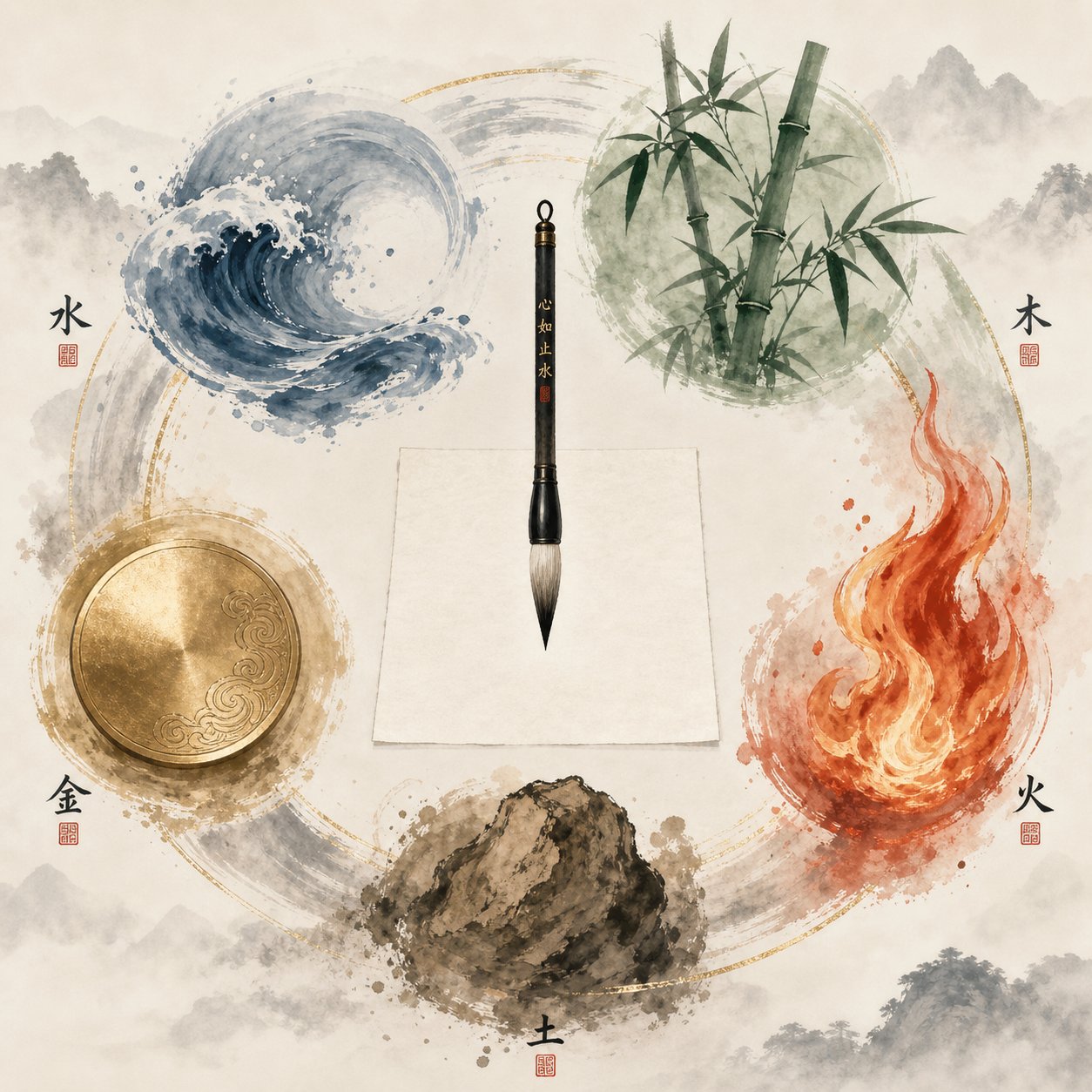
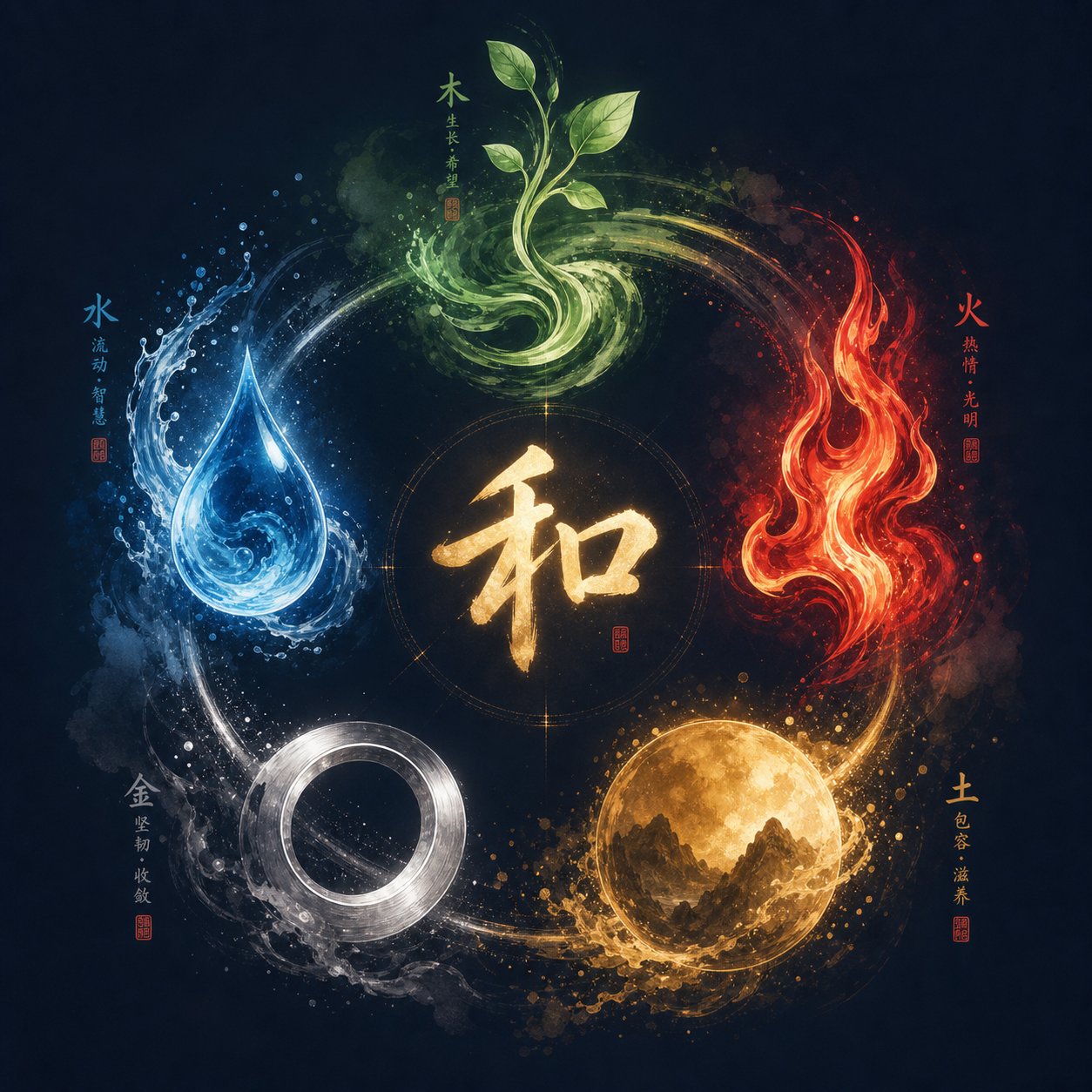
A feng shui name elements calculator is a tool that breaks down the elemental composition of a person's name using the Five Elements system: Wood, Fire, Earth, Metal, and Water. It cross-references those name elements against the elements present in your birth chart, then flags where imbalances exist. Think of it as a diagnostic lens that reveals whether your name energetically supports or conflicts with the elemental profile you were born with.
Most people encounter these calculators as simple input-output tools. You type in a name and birth date, and a result appears. But what's actually happening under the hood? This article walks you through the complete methodology so you can evaluate any feng shui calculator's output with confidence rather than treating it as a black box.
What a Feng Shui Name Elements Calculator Reveals
The core output of these tools typically includes three things: the elemental breakdown of your name (which feng shui elements are present and in what proportion), a balance assessment comparing those name elements to your birth chart, and recommendations for which elements to strengthen or reduce. A reliable feng shui elements chart within the tool will show you exactly how each character or syllable in your name maps to a specific element, giving you a clear picture of where the weight falls.
Why Elemental Balance in Names Matters
In Daoist cosmology, the Five Elements are not static categories. They represent dynamic phases of energy that interact, generate, and control one another. The wuxing system has served as a broad explanatory principle in Chinese philosophy and medicine since at least the 3rd century BCE, correlating these phases with seasons, directions, organs, and personality traits.
Names carry energetic signatures tied to the Five Elements system. A balanced elemental profile in your name is believed to support health, prosperity, and harmony throughout life.
This belief connects to a practical concern: if your birth chart already runs heavy in one feng shui element, say Fire, and your name also loads up on Fire, the result is excess. Excess creates imbalance, and imbalance, according to this tradition, invites friction in health, relationships, or career. A well-chosen name acts as a counterweight, filling gaps and softening dominance.
The real question, then, is how each element behaves, what it governs, and how elements interact when they share space in a single name.
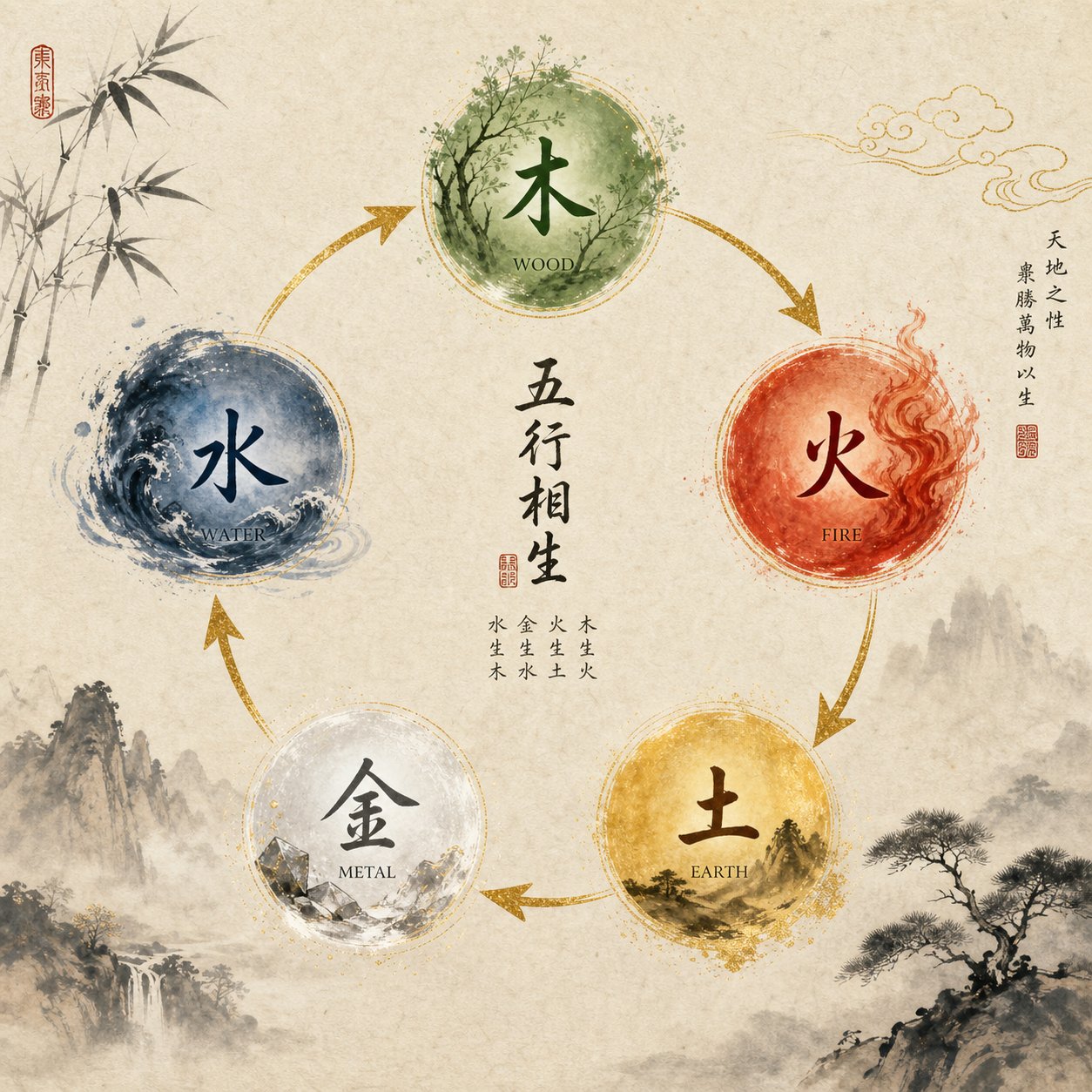
The Five Elements System and How They Shape Your Name
Each of the five elements of feng shui carries a distinct energetic signature that influences personality, health, career direction, and how you relate to others. When you look at a chinese five elements chart, you're not just seeing abstract categories. You're seeing a map of tendencies, strengths, and vulnerabilities that practitioners believe shape a person's life path.
Understanding what each element represents is the foundation for interpreting any calculator's output. Without this knowledge, a result like "your name is 60% Fire" means nothing. With it, you can immediately see the implications.
Wood Fire Earth Metal Water Personality Profiles
The chinese zodiac and elements system assigns each element a cluster of traits that extend far beyond personality. Here's a breakdown of how each element expresses itself across key life areas:
| Element | Personality Traits | Career Strengths | Health Associations | Favorable Relationships |
|---|---|---|---|---|
| Wood | Ambitious, decisive, confident, sometimes rigid under pressure | Leadership, entrepreneurship, planning, architecture | Liver, gallbladder, eyes, tendons | Pairs well with Water (nourishing) and Fire (productive outlet) |
| Fire | Charismatic, passionate, expressive, prone to restlessness | Public speaking, marketing, entertainment, sales | Heart, small intestine, tongue, circulation | Pairs well with Wood (fuel) and Earth (grounding) |
| Earth | Nurturing, stable, loyal, can become overly cautious or stubborn | Counseling, real estate, agriculture, mediation | Spleen, stomach, mouth, muscles | Pairs well with Fire (warmth) and Metal (structure) |
| Metal | Disciplined, precise, principled, sometimes inflexible | Finance, engineering, law, surgery | Lungs, large intestine, nose, skin | Pairs well with Earth (support) and Water (softening) |
| Water | Intuitive, adaptable, reflective, can become fearful or withdrawn | Research, philosophy, diplomacy, healing arts | Kidneys, bladder, ears, bones | Pairs well with Metal (generating) and Wood (direction) |
When comparing chinese zodiac elements wood vs earth, for instance, you'll notice Wood is expansive and action-oriented while earth element feng shui energy is consolidating and receptive. These aren't better-or-worse distinctions. They're different modes of operating, and a name that blends them thoughtfully can create internal balance.
How Elements Interact in Your Name
Elements don't sit in isolation. They relate to each other through two fundamental cycles that any feng shui element chart will reference.
The generating cycle (Sheng) describes how each element feeds the next in a continuous loop:
- Wood feeds Fire (wood fuels combustion)
- Fire creates Earth (ash becomes soil)
- Earth bears Metal (minerals form within rock)
- Metal collects Water (condensation on metal surfaces)
- Water nourishes Wood (plants grow with hydration)
The controlling cycle (Ke) describes how each element restrains another:
- Wood parts Earth (roots break soil apart)
- Earth absorbs Water (dams and banks contain flow)
- Water extinguishes Fire (the most intuitive example)
- Fire melts Metal (intense heat reshapes ore)
- Metal chops Wood (axes cut timber)
Why does this matter for naming? Imagine someone whose birth chart is dominated by Metal. If their name carries strong feng shui element wood energy, that creates a controlling relationship where Metal chops Wood. The name's elemental contribution is constantly being suppressed by the person's innate elemental makeup. A practitioner trained in five element theory would flag this as a source of friction, potentially manifesting as blocked creativity or difficulty following through on plans.
Conversely, giving that same Metal-dominant person a name rich in Water creates a generating relationship. Metal produces Water in the Sheng cycle, meaning the birth element naturally supports and strengthens the name's energy. The result is flow rather than friction.
These cycles turn name selection from guesswork into a structured decision. The question shifts from "which element sounds nice?" to "which element does my birth chart actually need, and will my name's elements generate or control it?" Answering that question accurately requires knowing exactly how your birth chart's elemental profile is determined, which involves a distinction many calculators gloss over.
Birth Element vs BaZi Elements and Why the Difference Matters
Here's where many people get tripped up: not all birth element calculations carry the same depth. Some feng shui name elements calculators ask only for your birth year, while others require your full birth date and exact time. These two approaches produce very different levels of detail, and the gap between them directly affects how accurate any name recommendation can be.
If you've ever asked yourself "what is my chinese astrology element?" and received a single-word answer like "Wood" or "Metal," you likely used the simplified year-based method. That answer isn't wrong, but it's incomplete. It's like describing your personality with one adjective when a full profile would take a page.
Year-Based Birth Element Using Heavenly Stems
The quickest way to identify your birth element uses the Heavenly Stems cycle, a sequence of ten stems that rotate through the Chinese calendar. Each stem corresponds to one of the Five Elements, and you can determine yours by looking at the last digit of your birth year:
| Last Digit of Birth Year | Heavenly Stem | Element | Yin/Yang |
|---|---|---|---|
| 0 | Geng | Metal | Yang |
| 1 | Xin | Metal | Yin |
| 2 | Ren | Water | Yang |
| 3 | Gui | Water | Yin |
| 4 | Jia | Wood | Yang |
| 5 | Yi | Wood | Yin |
| 6 | Bing | Fire | Yang |
| 7 | Ding | Fire | Yin |
| 8 | Wu | Earth | Yang |
| 9 | Ji | Earth | Yin |
So if you were born in 1987, the last digit is 7, which maps to Fire. Born in 1990? That's Metal. This method, as outlined by LoveToKnow, gives you the year pillar's Heavenly Stem element. It's a useful starting point and the basis of many chinese zodiac with elements calculators you'll find online.
One important caveat: the Chinese calendar year doesn't start on January 1. It follows the lunar calendar, so if you were born in January or early February, your birth year might actually fall under the previous year's element. Someone born on January 15, 1985, for example, would still belong to the 1984 year (Wood) because the Lunar New Year hadn't yet occurred.
The year-based method is fast and accessible, but it reveals only one element from one pillar. It tells you nothing about what other elements are strong, weak, or entirely absent in your chart. For name selection, that single data point isn't enough to make informed decisions.
Full BaZi Four Pillars Method
BaZi, sometimes called the Four Pillars of Destiny, takes a fundamentally different approach. Instead of extracting one element from your birth year, it uses four time coordinates: year, month, day, and hour. Each coordinate generates a "pillar" consisting of one Heavenly Stem and one Earthly Branch, producing eight characters total (ba = eight, zi = characters).
Imagine the difference this way. The year-based method gives you a single color swatch. A four pillars of destiny calculator gives you the entire palette, showing exactly how much of each element appears across all eight characters.
Here's what each pillar represents:
- Year Pillar - reflects ancestral influence and early life conditions
- Month Pillar - represents parents, career potential, and the dominant seasonal energy at birth
- Day Pillar - contains the Day Master (the Heavenly Stem of your birth day), which is considered your core self-element
- Hour Pillar - relates to children, later life, and inner aspirations
The Day Master is particularly significant. Many practitioners consider it the true representation of your personal element, not the year stem. Two people born in the same year can have completely different Day Masters depending on their birth day, which means their elemental needs for name balancing could be opposite.
When you use a bazi calculator online free or paid, the output typically shows all eight characters mapped to their respective elements. You'll see which elements appear multiple times, which show up once, and which are entirely missing. A complete profile might reveal something like: three Water characters, two Earth, two Wood, one Fire, and zero Metal. That missing Metal becomes a prime candidate for reinforcement through the name.
This is why serious feng shui name elements calculators request your full birth date and time rather than just the year. The year-based method might tell you you're a "Water person," but the full BaZi chart could reveal that Water only appears in your year pillar while Fire actually dominates your month, day, and hour pillars. The naming strategy for each scenario would be entirely different.
The takeaway is straightforward: if a calculator only asks for your birth year, treat its output as a rough approximation. If it asks for your complete birth data and uses an online ba zi calculator engine to generate all four pillars, you're working with a much more reliable foundation for name element analysis. The accuracy of any name recommendation is only as good as the birth chart data feeding it.
Knowing your elemental profile is half the equation. The other half is understanding how a name's characters actually translate into elements, which involves classification systems that most tools never explain to their users.
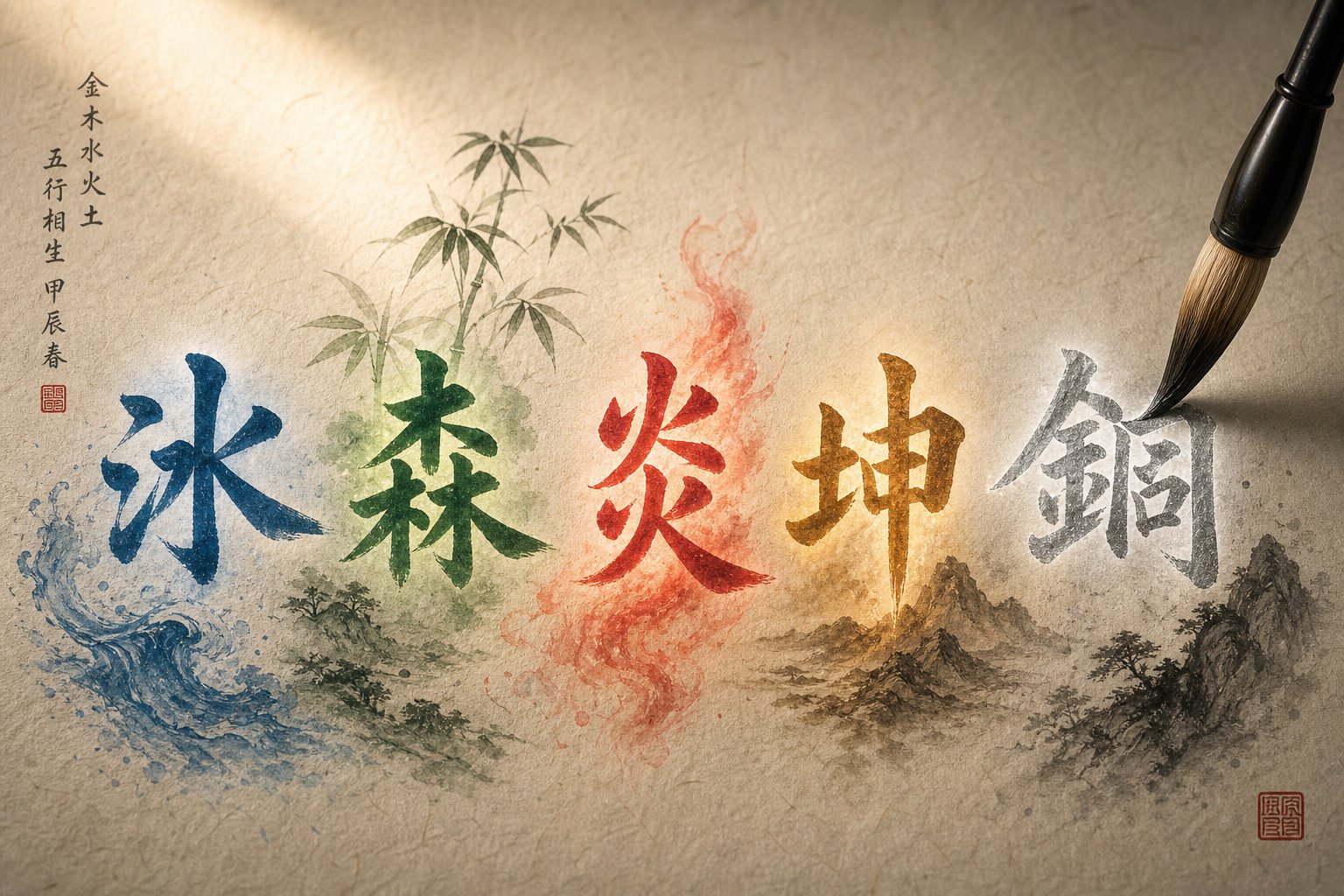
How Chinese Name Characters Map to the Five Elements
So you know your birth chart's elemental profile. You understand which elements are missing or excessive. The logical next question: how does a name actually carry elemental energy? When a chinese numerology calculator assigns "Wood" or "Metal" to a character in your name, what's it basing that on?
This is where most tools go silent. They show you a result but never explain the classification logic behind it. In reality, there are multiple systems for mapping Chinese characters to the Five Elements, and different calculators may use different methods, sometimes combining them. Understanding these systems lets you evaluate whether a tool's output makes sense or whether it's oversimplifying.
Four primary classification methods exist: stroke count numerology (Wu Ge), radical-based assignment, meaning-based assignment, and sound-based classification. The first three are covered here, with sound-based methods addressed separately due to their unique application to non-Chinese names.
Stroke Count Method and Wu Ge Numerology
The Wu Ge system, also called the Five Grids or Five Formations method, is the most widely used approach in any numerology calculator chinese naming tools employ. Originally developed by the Japanese scholar Kumazaki Ken'o in 1918 based on Chinese I Ching numerology, it was later brought to Taiwan in 1936 and eventually spread throughout East and Southeast Asia. By the 1990s, Chinese practitioners had integrated it with traditional I Ching principles to form a standardized naming analysis method.
The system works by counting the strokes in each character of a name, then organizing those counts into five numerical "grids." Each grid governs a different life domain, and each grid's number maps to a specific element. Here's how the five grids are calculated:
| Grid Name | Chinese Term | Calculation Method | Life Domain |
|---|---|---|---|
| Heaven Grid (Tian Ge) | 天格 | Surname stroke count + 1 (single surname) | Ancestral fortune, early life conditions |
| Personality Grid (Ren Ge) | 人格 | Last surname stroke count + first given name stroke count | Core destiny, character traits, overall fortune |
| Earth Grid (Di Ge) | 地格 | Sum of all given name stroke counts | Youth fortune, career development |
| External Grid (Wai Ge) | 外格 | Total Grid minus Personality Grid (+ 1 for single surnames) | Social relationships, external environment |
| Total Grid (Zong Ge) | 总格 | Sum of all strokes in the full name | Overall life trajectory, later life fortune |
Once you have the number for each grid, you assign its element using the last digit. This mapping follows the Heavenly Stems sequence:
- Last digit 1 or 2 = Wood
- Last digit 3 or 4 = Fire
- Last digit 5 or 6 = Earth
- Last digit 7 or 8 = Metal
- Last digit 9 or 0 = Water
Imagine a person with the surname Li (李, 7 strokes) and given name Shimin (世民, 5 + 5 strokes). The Heaven Grid equals 7 + 1 = 8, which ends in 8, so it's Metal. The Personality Grid equals 7 + 5 = 12, ending in 2, so it's Wood. The Earth Grid equals 5 + 5 = 10, ending in 0, so it's Water. The Total Grid equals 7 + 5 + 5 = 17, ending in 7, making it Metal. This gives you a chinese elements chart for the name showing Metal, Wood, Water, and Metal across the grids.
One critical detail: stroke counts in this system use traditional character forms based on the Kangxi Dictionary, not simplified characters. A character that appears to have 6 strokes in its simplified form might officially count as 9 in its traditional form. Using the wrong stroke count throws off every grid calculation downstream.
The Personality Grid is considered the most important of the five. It represents the core of personal destiny and carries the heaviest weight in element analysis. The Three Talents configuration, which examines the Five Elements relationship between the Heaven, Personality, and Earth Grids together, reveals whether these three domains support each other through generating cycles or create friction through controlling cycles.
Radical-Based and Meaning-Based Classification
The stroke count method is mathematical. The radical-based method is visual and structural. It assigns elements based on the component parts, called radicals, that make up each character. This approach is more intuitive because the connection between radical and element is often obvious.
Characters containing specific radicals carry the element associated with that radical:
- Water element - characters with the water radical 氵(three-dot water): 海 (sea), 河 (river), 清 (clear), 涵 (contain), 洋 (ocean), 泽 (marsh), 润 (moist)
- Wood element - characters with the wood radical 木: 林 (forest), 松 (pine), 柏 (cypress), 桦 (birch), 梅 (plum), 杰 (outstanding), 栋 (ridgepole)
- Fire element - characters with the fire radical 火 or four-dot base 灬: 炎 (flame), 烨 (brilliant), 煜 (shine), 灿 (radiant), 焕 (luminous), 熙 (bright)
- Earth element - characters with the earth radical 土: 坤 (earth/feminine), 城 (city), 培 (cultivate), 堃 (earth), 垚 (high ground), 墨 (ink)
- Metal element - characters with the metal radical 金 or 钅: 铭 (inscribe), 锋 (sharp edge), 钰 (precious jade), 鑫 (prosperous), 银 (silver), 铮 (clang)
This method is straightforward when a character contains an obvious elemental radical. But many characters don't have such clear markers. That's where meaning-based classification fills the gap.
Meaning-based assignment looks at what a character represents or describes, regardless of its radical structure. The chinese elements meaning of a character can override its structural components:
- Water by meaning - characters describing flowing, dark, cold, or deep things: 雨 (rain), 雪 (snow), 霖 (continuous rain), 云 (cloud), 冰 (ice). The character 雨 has 8 strokes and no water radical, yet it clearly carries Water energy.
- Wood by meaning - characters describing growth, greenness, or plant life: 芳 (fragrant), 茂 (lush), 荣 (flourish), 华 (splendid/flower), 蕾 (bud). These use the grass radical 艹 rather than the wood radical, but their meanings tie them to Wood.
- Fire by meaning - characters describing light, heat, or brightness: 晨 (morning), 昊 (vast sky), 曦 (dawn light), 旭 (rising sun), 明 (bright). The sun radical 日 connects these to Fire energy.
- Earth by meaning - characters describing mountains, stones, or stability: 岩 (rock), 峰 (peak), 崇 (lofty), 磊 (stacked stones), 岚 (mountain mist). The mountain radical 山 signals Earth.
- Metal by meaning - characters describing sharpness, hardness, or preciousness: 剑 (sword), 锐 (sharp), 坚 (firm), 玉 (jade), 珍 (precious). Some of these lack the metal radical entirely but carry Metal energy through their semantic content.
In practice, a thorough chinese element chart analysis often combines all three methods. The stroke count method provides the numerological framework through the five grids. The radical method offers a quick visual check. The meaning method catches characters that slip through the other two systems. When all three methods agree on an element assignment, confidence is high. When they conflict, a character like 淡 (bland/light, water radical, 11 strokes ending in 1 = Wood) creates ambiguity that different calculators resolve differently.
This layered approach is what separates a reliable chinese astrology elements chart tool from a superficial one. A calculator that only uses stroke counts will miss the elemental weight carried by radicals and meanings. One that only uses radicals can't account for characters without obvious elemental components. The most comprehensive tools, and the most skilled practitioners, weigh all available signals before making an assignment.
Understanding these classification systems also helps you run your own chinese elements wood fire earth test on any name. Look at the characters, count the strokes, check the radicals, consider the meanings. You don't need a tool to do this. You need the methodology, and the methodology is what transforms a black-box result into something you can verify yourself.
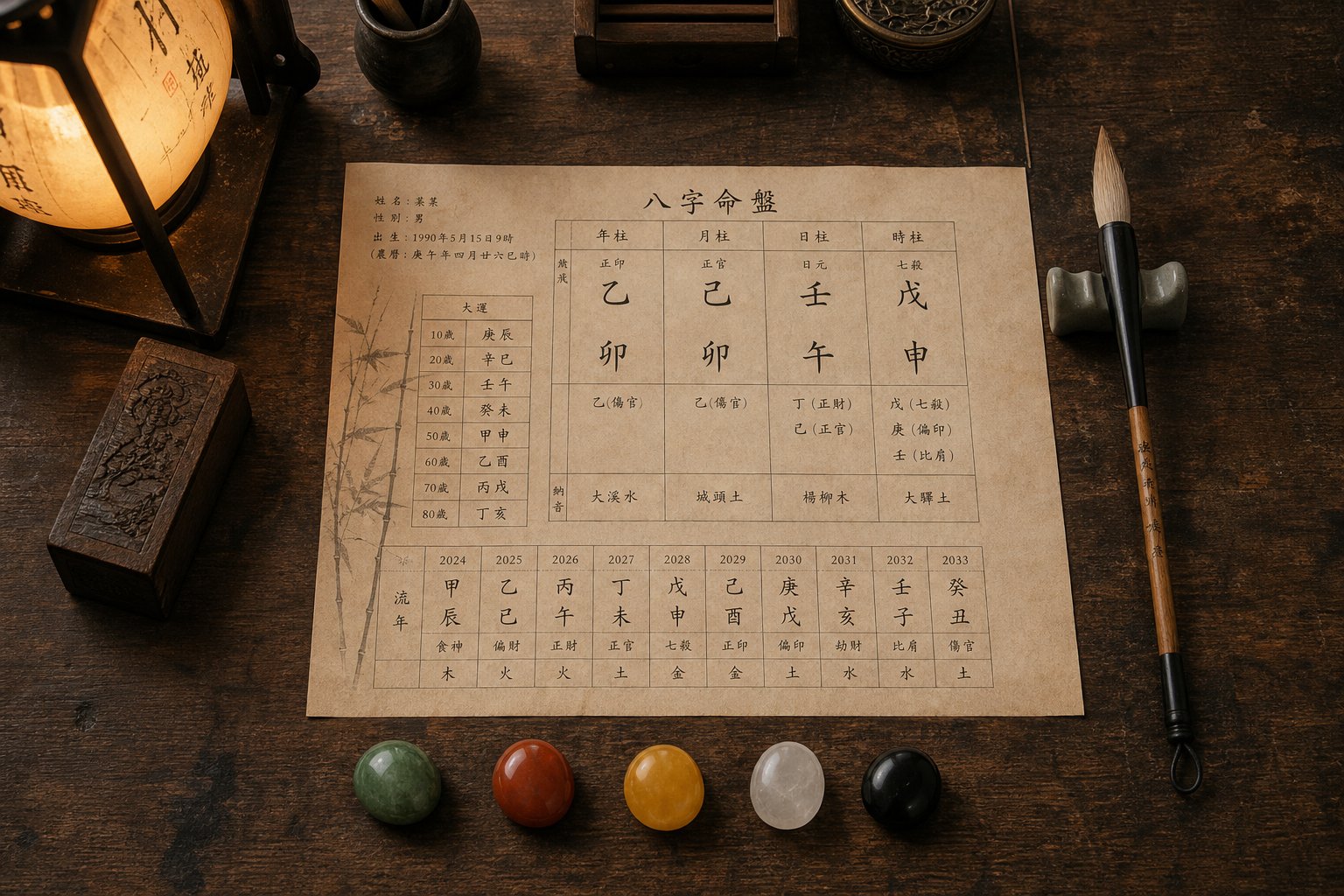
Step-by-Step Manual Method for Calculating Name Elements
You have the classification systems. You understand how strokes, radicals, and meanings each assign elements to characters. But how do you actually put all of this together into a coherent analysis? Most people rely on a chinese element calculator to do the heavy lifting, yet running through the process manually at least once gives you the ability to spot errors, verify tool outputs, and understand why a particular name scores the way it does.
Here's the complete workflow, broken into three stages. Each builds on the previous one, and skipping a step compromises everything downstream.
Step One: Determine Your Birth Element Profile
Before touching the name itself, you need a clear picture of what the birth chart demands. This is how to tell what element you are at a foundational level and, more importantly, which elements your chart needs reinforcement in.
- Identify your year element using the Heavenly Stems table from the previous section. Check the last digit of your birth year: 0/1 = Metal, 2/3 = Water, 4/5 = Wood, 6/7 = Fire, 8/9 = Earth. Remember to adjust for the lunar calendar if born in January or early February.
- Generate your full BaZi chart if possible. Use a four pillars calculator that accepts year, month, day, and hour of birth. This produces eight characters, each carrying an element. Tally how many times each element appears across all eight positions.
- Identify dominant, weak, and missing elements. If Water appears four times and Metal appears zero times, Water is dominant and Metal is absent. The absent or weakest elements become your primary candidates for name reinforcement.
Anyone asking "what is my element by birthday" typically gets only the year element. That single data point is a starting place, not a conclusion. The full tally across all four pillars reveals the actual landscape of surplus and deficit that a name should address.
Step Two: Count Character Strokes and Assign Grids
With your birth element profile mapped, shift focus to the name. This is where the Wu Ge numerology system from the previous section becomes a hands-on tool rather than abstract theory.
- Look up the traditional stroke count for each character in the name. Use the Kangxi Dictionary standard, not simplified stroke counts. A character like 华 counts as 14 strokes in its traditional form (華), not 6. Online stroke count databases indexed to the Kangxi standard can help verify counts you're unsure about.
- Calculate each of the five grids. Heaven Grid = surname strokes + 1. Personality Grid = last surname character strokes + first given name character strokes. Earth Grid = sum of all given name character strokes. Total Grid = all strokes in the full name combined. External Grid = Total Grid minus Personality Grid.
- Assign an element to each grid based on its last digit: 1/2 = Wood, 3/4 = Fire, 5/6 = Earth, 7/8 = Metal, 9/0 = Water.
- Check radicals and meanings as a secondary layer. Does the given name contain a water radical (氵)? A wood radical (木)? Do the characters describe fire, earth, or metal through their semantic content? Note these elemental signals alongside the grid results.
You now have a composite picture: the numerological elements from the five grids plus the structural and semantic elements from radicals and meanings. A thorough chinese elements calculator will weigh both layers. Doing it manually, you can see exactly where each element assignment comes from.
Step Three: Evaluate Element Balance
This is the step where birth chart meets name chart. You're comparing two elemental profiles and asking a specific question: does this name support what my birth chart needs?
- List your birth chart's weak or missing elements. These are your target elements for the name.
- Check whether the name's grid elements include those targets. If your birth chart lacks Metal and your Personality Grid (the most influential grid) carries Metal, that's a strong positive signal.
- Examine the cycle relationships. Does the name's dominant element generate what you need? A name heavy in Earth generates Metal through the Sheng cycle, indirectly supporting a Metal deficiency. Does the name's element control something already excessive in your chart? A Water-heavy name controls excess Fire, which can be beneficial.
- Flag controlling conflicts. If your birth chart is dominated by Fire and your name carries Metal, Fire melts Metal. The name's contribution is being suppressed by your innate elemental makeup. This is a red flag worth addressing.
- Assess the Three Talents configuration. Look at the Heaven, Personality, and Earth Grids together. Are their elements in a generating sequence (ideal), a neutral relationship (acceptable), or a controlling sequence (problematic)?
A critical point that trips up many users of any chinese zodiac and element calculator: element balance does not mean equal distribution. You are not trying to get 20% of each element in your name. You are trying to compensate for specific deficiencies and moderate specific excesses identified in your birth chart. A person missing Water and overloaded with Earth doesn't need a name with all five elements sprinkled evenly. They need targeted Water reinforcement and possibly Wood to control the excess Earth.
Think of it like nutrition rather than decoration. You don't eat equal portions of every food group regardless of your body's condition. You eat what your body currently needs more of. The same logic applies here. A chinese zodiac and elements calculator that produces useful results will frame its recommendations around your specific birth chart gaps, not around some universal ideal of elemental symmetry.
Running through these three steps manually even once transforms how you interact with automated tools. You'll know immediately whether a calculator is using stroke-based analysis, radical-based analysis, or both. You'll spot when a tool ignores cycle relationships or treats balance as equal distribution. And you'll understand why two calculators can produce different results for the same name: they may be weighting different classification methods or using different stroke count standards.
The methodology is the real asset. Any element calculator is only as good as the logic it applies, and you now have that logic in your hands.
Understanding Element Balance and Applying Calculator Results
Knowing the methodology is one thing. Knowing what to do with the results is another. Many people run their name through a feng shui name elements calculator, see a breakdown like "40% Fire, 30% Earth, 20% Wood, 10% Metal, 0% Water," and immediately assume the goal is to even those numbers out. That instinct is understandable but misguided. Balance in feng shui naming doesn't mean symmetry. It means strategic compensation.
The distinction matters because it changes every decision you make about a name. Equal distribution is a mathematical concept. Elemental balance is a relational one, defined entirely by what your specific birth chart needs.
What Balance Actually Means in Feng Shui Naming
Imagine two people who both ask "what is my element chinese?" and both receive the answer "Fire." Their year stems match. But one person's full BaZi chart shows Fire appearing in five of eight positions with zero Water anywhere, while the other has Fire in two positions with a healthy spread of the remaining elements. These two people need completely different names despite sharing the same year element.
The first person has overwhelming Fire. Their chart is scorching, with no Water to cool it and no Metal to contain it. For them, a name rich in Water elements provides direct control over the excess. Earth elements could also help by exhausting some of that Fire energy through the generating cycle (Fire creates Earth, draining Fire's intensity). A name that adds more Fire or Wood would amplify an already overheated chart.
The second person has moderate Fire with good distribution. Their naming needs are minimal. A name that gently supports their weakest element without disrupting the existing harmony is sufficient. No dramatic intervention required.
No single element is inherently better or worse than another. Water is not superior to Fire. Metal is not more desirable than Wood. The value of any element depends entirely on what the individual birth chart requires.
This principle is where many people go wrong. They read that Water represents wisdom or that Metal represents wealth and decide they want those elements in their name regardless of their chart. But adding Water to a chart already saturated with Water creates stagnation, not wisdom. Adding Metal to a chart dominated by Fire creates a controlling clash, not prosperity. What are my elements in excess matters just as much as what's missing.
A useful analogy: think of your birth chart as a garden's soil composition. Some soil is too acidic, some too alkaline. The "best" amendment depends entirely on what the soil already contains. Lime isn't universally good. It's good for acidic soil and harmful for alkaline soil. Elements work the same way in naming.
Applying Calculator Results to Name Decisions
Once you understand that balance means targeted support rather than equal distribution, you can follow a clear decision tree for any naming situation. Whether you're selecting a name for a newborn, evaluating your own name as an adult, or choosing a business name, the logic follows the same sequence:
- Determine the full birth element profile. Use a complete BaZi analysis rather than year-only calculations. Identify which elements are dominant (appearing three or more times), which are present but moderate, and which are weak or absent.
- Identify what's missing or excessive. Missing elements are candidates for direct reinforcement through the name. Excessive elements are candidates for control or exhaustion through the name.
- Determine which name elements create balance. Use the generating and controlling cycles. To reinforce a missing element, include it directly or include the element that generates it. To moderate an excessive element, include the element that controls it or the element it generates (to drain its energy).
- Select characters carrying those target elements. Use stroke count, radical, and meaning-based classification to find characters that deliver the needed elemental energy while also carrying positive semantic content.
This framework applies across the entire naming lifecycle. For prenatal name selection, parents can prepare a shortlist of characters aligned with multiple possible birth charts, then finalize once the exact birth time is known. For adult name evaluation, the process reveals whether your current name supports or conflicts with your chart, helping you understand patterns you may have noticed in your life. For name change considerations, it provides a clear rationale: if your existing name creates a controlling relationship with your dominant birth element, a new name that generates or supports that element could shift the energetic dynamic.
Business and brand naming follows the same logic with one addition. The elemental profile of a business name should align not only with the founder's birth chart but also with the industry's elemental nature. A technology company (Fire industry) led by a founder with excessive Fire might benefit from a brand name carrying Water or Earth elements to prevent burnout and create grounding. A real estate firm (Earth industry) led by a founder lacking Earth could use an Earth-dominant name to strengthen both personal and professional alignment.
What's my element in the context of business naming becomes a dual question: what does my personal chart need, and what does my industry's elemental nature demand? The strongest brand names satisfy both.
One final consideration that separates informed users from casual ones: a dominant element calculator result showing heavy concentration in one element isn't automatically a problem. Some charts are meant to be specialized. A person with strong Wood energy may thrive precisely because of that concentration, channeling it into leadership and decisive action. The name's role in such cases isn't to dilute the dominant element but to provide just enough supporting energy to prevent rigidity. A touch of Water to keep the Wood flexible. A hint of Fire to give the Wood a productive outlet. Subtle adjustments, not wholesale restructuring.
The calculators give you data. The methodology gives you interpretation. Together, they turn what could be a superstitious exercise into a structured, reasoned approach to naming. But all of this assumes you're working with Chinese characters. What happens when the name in question is English, transliterated, or from a completely different linguistic tradition? That question opens up a different set of tools entirely.
Sound-Based Elements and Non-Chinese Name Analysis
Strokes and radicals work beautifully for Chinese characters. But what if your name is Sarah, Mohammed, or Dmitri? What if you're part of the Chinese diaspora using a romanized name that never appears in character form? The feng shui name elements calculator tradition didn't develop in a vacuum, and practitioners have long recognized that sound itself carries elemental energy, independent of written form.
This is where the oldest and most overlooked classification system enters the picture: the Five Tones.
The Five Tones Sound-Based Element System
In traditional Chinese phonology, sounds are classified into five tonal categories called WuYin (五音), the Five Pentatonic Notes. Each note maps directly to an element:
- Gong (宫) - corresponds to Earth, the musical note C (Do)
- Shang (商) - corresponds to Metal, the musical note D (Re)
- Jiao (角) - corresponds to Wood, the musical note E (Mi)
- Zhi (徵) - corresponds to Fire, the musical note G (So)
- Yu (羽) - corresponds to Water, the musical note A (La)
These five notes connect to the Heavenly Stems through their combination and transformation cycles. Gong governs the stems Jia and Ji (which combine to form Earth). Shang governs Yi and Geng (combining into Metal). Jiao governs Ding and Ren (Wood). Zhi governs Wu and Gui (Fire). Yu governs Bing and Xin (Water).
Ancient Chinese metaphysics understood the fluctuation of Qi as sound. The musical scale wasn't just entertainment. It was a measurement system for different qualities of energy within nature and the human body. This concept, rooted in the principle of TianRen HeYi (天人合一, or Man and Nature as one), means that pronunciation carries elemental weight regardless of whether the sound is written in Chinese characters, Latin letters, or Arabic script.
For naming purposes, this opens a door. If sound itself holds elemental value, then any name in any language can theoretically be analyzed for its elemental composition based on how it sounds rather than how it's written.
Analyzing English and Transliterated Names
How do diaspora communities and non-Chinese speakers actually use these tools? Several approaches have emerged, each with different levels of traditional grounding and practitioner acceptance.
The most common systems available for non-Chinese name analysis include:
- Pinyin initial consonant mapping - assigns elements based on the starting sound of each syllable. Consonants beginning with c, q, r, s, x, or z carry Metal. Those starting with g or k carry Wood. B, f, h, m, and p carry Water. D, j, l, n, and t carry Fire. Vowel-initial sounds (a, w, y, e, o) carry Earth. This system, used by some Chinese naming practitioners, can be extended to English names by mapping their phonetic sounds to these categories.
- Letter-to-number conversion - converts each letter of an English name into a numerical value, then applies the same last-digit-to-element mapping used in Wu Ge numerology (1/2 = Wood, 3/4 = Fire, 5/6 = Earth, 7/8 = Metal, 9/0 = Water). Different systems use different numbering schemes, which is why results vary between tools.
- Phonetic transliteration method - converts an English name into its closest Chinese phonetic equivalent (similar to how foreign names appear in Chinese media), then analyzes those characters using standard stroke count and radical methods. "Sarah" might become 莎拉, which can then be analyzed like any Chinese name.
- Hybrid digital tools - modern calculators that combine multiple approaches, sometimes weighting phonetic analysis alongside numerological conversion. Some function like a feng shui simulator, letting users test different name spellings or pronunciations to see how elemental outputs shift.
Sounds complex? It is, and here's the honest reality: these adaptations are far less standardized than traditional character-based methods. Practitioners disagree on their validity. A purist trained in classical Wu Ge numerology might dismiss phonetic mapping entirely, arguing that the system was designed for Chinese characters and loses coherence when applied to alphabetic languages. A more progressive practitioner might counter that since WuYin predates written characters and operates on pure sound, it's actually the most universal of all classification methods.
If you encounter a fengshui generator or element calculator chinese tool that claims to analyze English names, ask what system it uses. Is it mapping your name's sounds to the Five Tones? Converting letters to numbers? Transliterating into Chinese characters first? Each approach produces different results, and none has achieved the consensus status that stroke-count analysis holds for Chinese names.
A chinese elements quiz that assigns you an element based solely on your English name's letters should be treated as entertainment rather than serious analysis. The methodology behind it matters. Without knowing which conversion system the tool applies, you can't evaluate whether its output is meaningful or arbitrary.
For non-Chinese speakers genuinely interested in elemental name analysis, the most defensible approach combines two strategies: get a proper BaZi reading based on your birth data (this part is language-independent and equally valid for anyone), then work with a practitioner who can either create an authentic Chinese name aligned with your chart or apply the phonetic mapping system with transparency about its limitations.
The sound-based system represents both the oldest and the most experimental frontier of this tradition. It's the bridge between cultures, but it's a bridge still under construction. Knowing that it exists, and knowing its limitations, puts you in a stronger position than blindly accepting any tool's output at face value, which brings up a broader question about reliability that applies to every calculator regardless of the language it analyzes.
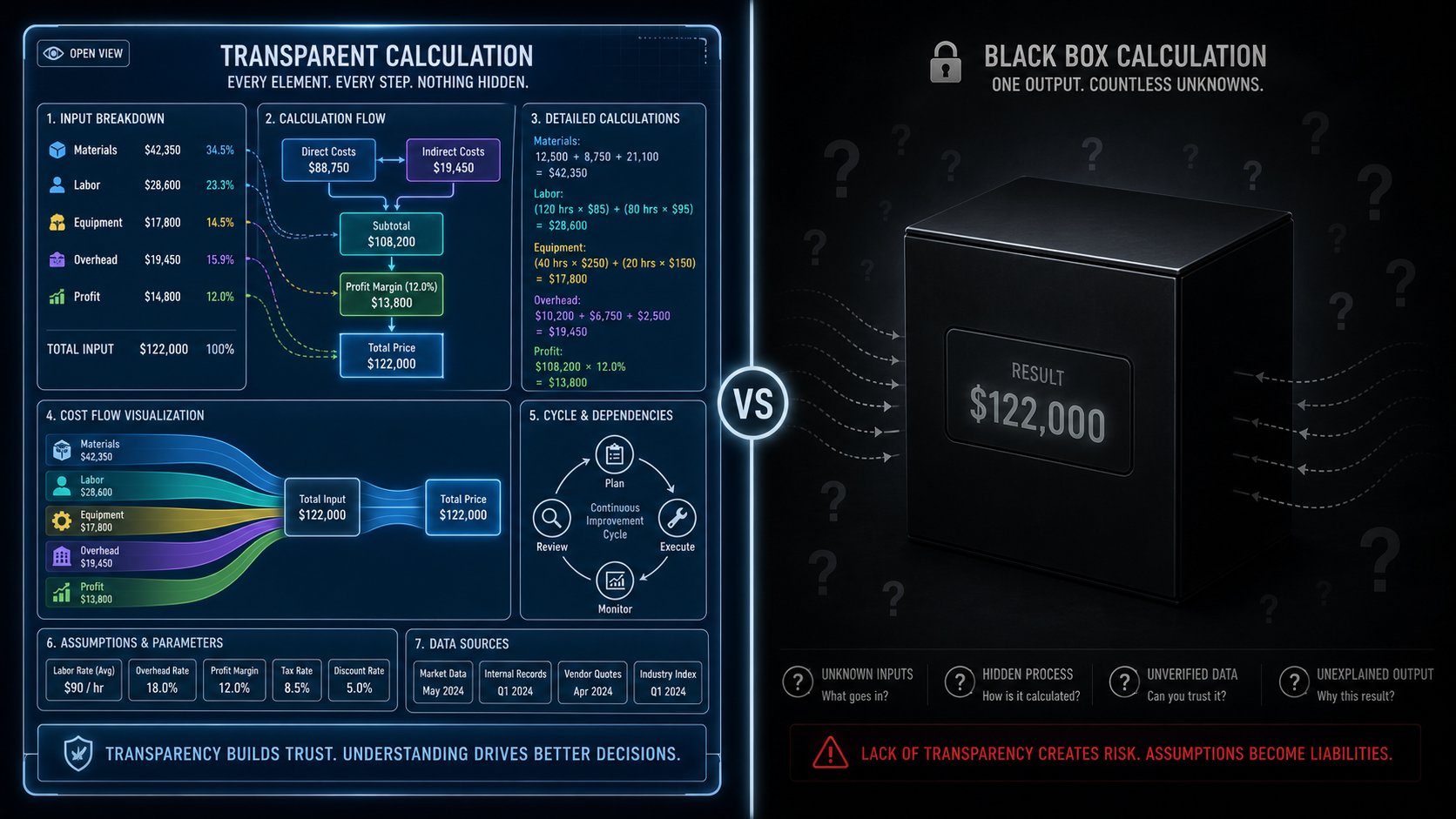
Common Misconceptions and Choosing Reliable Tools
Reliability is the elephant in the room with any feng shui name elements calculator. You've seen how many classification systems exist, how birth chart depth varies between tools, and how non-Chinese name analysis remains unstandardized. With that much complexity under the surface, misconceptions thrive. Some are harmless. Others lead to genuinely poor naming decisions based on flawed assumptions.
Clearing up these myths isn't about discouraging you from using calculators. It's about helping you use them with open eyes rather than blind trust.
Misconceptions That Lead to Poor Name Choices
Myth: Only Chinese names can be analyzed for elements. As the previous section on sound-based systems demonstrates, elemental analysis extends beyond Chinese characters. The Five Tones system operates on phonetics, making it language-agnostic in principle. The real limitation isn't language but standardization. Chinese character analysis has centuries of codified methodology behind it. English name analysis has competing systems with no consensus. The myth isn't that non-Chinese names can't be analyzed. It's that the analysis carries the same precision. It doesn't, but that doesn't make it worthless either.
Myth: One element is inherently superior to another. Water doesn't automatically mean wisdom. Metal doesn't guarantee wealth. These associations exist as tendencies, not guarantees, and their value depends entirely on what your birth chart needs. Chasing a "desirable" element without reference to your BaZi profile is like taking medication without a diagnosis. The element your chart lacks is the one that matters most for you, regardless of its general reputation.
Myth: Element calculation follows a single standardized system. You've already seen at least four distinct methods: stroke count (Wu Ge), radical-based, meaning-based, and sound-based. Different chinese astrology tools apply different systems, sometimes combining them, sometimes using only one. Two calculators can produce different elemental breakdowns for the same name and both be "correct" within their respective frameworks. The question isn't which result is right. It's which system the tool uses and whether that system is applied consistently.
Myth: A calculator alone can determine the ideal name. This is perhaps the most consequential misconception. As Master Sean Chan explains, calculators handle the mechanical computational layer well. They can correctly compute pillars, determine Day Masters, and calculate elemental compositions. What they cannot do is interpret those results within the full context of your chart, your life circumstances, and the nuanced judgment calls that classical practice requires. A calculator tells you what elements are present. A practitioner tells you what to do about it.
What to Look for in a Reliable Calculator
Not all chinese zodiac elements calculator tools are built equal. Some are rigorous implementations of classical methodology. Others are superficial generators that produce results without meaningful logic behind them. When evaluating any tool, whether it's a chinese zodiac calculator element tool, a chinese astrology chart calculator, or something marketed as a "what is my feng shui birth element calculator," look for these quality indicators:
- It specifies which system it uses. A reliable tool tells you upfront whether it's applying stroke-based Wu Ge analysis, radical classification, sound mapping, or a combination. If the methodology is invisible, you can't evaluate the output.
- It requires full birth date and time, not just year. Any tool that asks only for your birth year is giving you a single-pillar approximation. Quality tools request year, month, day, and hour to generate a complete BaZi profile before making name recommendations.
- It shows its work. The best tools display intermediate calculations: stroke counts per character, grid assignments, element mappings, and cycle relationships. You should be able to trace how the tool arrived at its conclusion rather than receiving only a final verdict.
- It accounts for generating and controlling cycles. A tool that simply tallies elements without analyzing how they interact misses the most important layer of the analysis. The relationship between name elements and birth elements matters more than the raw count.
Equally important is knowing what signals an unreliable tool. Watch for these red flags:
- The tool produces a result without asking for any birth data at all, analyzing the name in isolation without reference to a birth chart
- It claims one element is universally "lucky" or "best" regardless of individual charts
- It bundles results with aggressive product recommendations (amulets, crystals, paid "remedies") rather than educational explanation
- It uses simplified character stroke counts instead of the Kangxi Dictionary traditional standard
- It provides a single element assignment for the entire name rather than breaking down individual characters and grids
- It offers no explanation of methodology, treating the algorithm as proprietary when the underlying systems are centuries-old public knowledge
- It conflates unrelated systems, mixing a flying star feng shui calculator's spatial analysis with name element analysis as though they're interchangeable
A useful parallel: you wouldn't trust a feng shui house number calculator that gave you a "lucky" or "unlucky" verdict without explaining which numerological system it applied or how it weighted the digits. The same standard should apply to name analysis. Transparency of method is the minimum threshold for credibility.
Cross-checking is another practical safeguard. Run the same name through multiple tools and compare outputs. If three calculators agree on the elemental breakdown, the computational layer is probably correct. If they disagree, investigate which systems each uses. The disagreement itself becomes informative, revealing where methodological choices diverge and which approach aligns with the tradition you find most credible.
The deeper point here goes beyond any single tool. Understanding the methodology behind elemental name analysis, the stroke counts, the radicals, the cycles, the birth chart integration, empowers you to evaluate any calculator's output critically. You're no longer a passive consumer of results. You're an informed user who can spot when a tool oversimplifies, when it skips essential steps, and when its recommendations conflict with classical principles.
That's the real value of learning this system from the ground up. The calculator is a convenience. The knowledge is the asset. Whether you ultimately use an automated tool, consult a practitioner, or run the analysis manually, you now carry the framework to distinguish signal from noise in every result you encounter.
Frequently Asked Questions About Feng Shui Name Elements Calculators
1. How does a feng shui name elements calculator determine which elements are in my name?
These calculators typically use one or more classification systems: the Wu Ge stroke count method (which assigns elements based on the last digit of stroke totals across five grids), radical-based analysis (identifying elemental radicals like the water radical or wood radical within characters), and meaning-based classification (assigning elements based on what a character semantically represents). The most thorough tools combine all three approaches and cross-reference results against your birth chart to assess balance.
2. What is the difference between my birth year element and my full BaZi element profile?
Your birth year element uses only the last digit of your birth year mapped to the Heavenly Stems cycle, giving you a single element from one pillar. A full BaZi profile uses your year, month, day, and hour of birth to generate four pillars with eight characters total, revealing exactly how much of each element appears in your chart. Two people born in the same year can have completely different Day Masters and elemental needs, making the full BaZi method far more accurate for name element recommendations.
3. Can English or non-Chinese names be analyzed for Five Elements?
Yes, though with less standardization than Chinese character analysis. Methods include phonetic mapping based on the ancient Five Tones (WuYin) system, letter-to-number conversion applying Wu Ge numerology logic, and transliteration into Chinese characters for traditional analysis. Practitioners disagree on the validity of these adaptations, so results from English name calculators should be treated as approximations rather than definitive readings.
4. Does element balance in a name mean having equal amounts of all five elements?
No. Balance in feng shui naming means strategic compensation for your birth chart's specific deficiencies, not equal distribution. If your BaZi chart shows excessive Fire and missing Water, a balanced name would reinforce Water or Earth elements rather than spreading all five elements evenly. The goal is to support what your chart lacks and moderate what it has in excess, similar to how nutritional needs vary by individual rather than following a universal formula.
5. How do I know if a feng shui name elements calculator is reliable?
Look for four quality indicators: the tool specifies which classification system it uses (stroke-based, radical-based, or sound-based), it requires your full birth date and time rather than just the year, it shows intermediate calculations so you can trace how it reached its conclusions, and it accounts for generating and controlling cycle relationships between name elements and birth elements. Avoid tools that claim one element is universally lucky, produce results without any birth data, or bundle readings with aggressive product sales.