What Auspicious Really Means in Chinese Characters
In Chinese characters, "auspicious" refers to a state of divine favor, cosmic alignment, and positive energy flowing into a person's life. It goes far beyond the English words "lucky" or "fortunate." Where luck implies randomness, auspiciousness in Chinese culture signals harmony between human action and the natural order. Multiple characters carry this meaning — 吉 (ji), 祥 (xiang), 福 (fu), 瑞 (rui), and 禧 (xi) — each encoding a different shade of blessing, omen, or spiritual favor directly into its visual structure.
This layered quality is what makes Chinese characters for good luck and fortune so different from anything in alphabetic writing. Each character is not just a sound marker. It is a small architecture of meaning, built from components that reference spiritual rituals, natural phenomena, and thousands of years of cultural memory. When you see 福 on a red banner during Lunar New Year, you are reading a symbol that simultaneously communicates sound, image, and cultural history in a single brushstroke.
What Does Auspicious Mean in Chinese Characters
So what does auspicious mean in Chinese, exactly? The concept maps most closely to 吉祥 (jixiang), a compound word that pairs two characters — one rooted in divination and timing, the other in peaceful omens. English speakers searching for this term often land on "lucky" as a translation, but that flattens the meaning considerably. The difference between lucky and auspicious in Chinese is the difference between stumbling onto a winning lottery ticket and receiving a blessing that you, your family, and your community have cultivated through right action. Auspiciousness implies intentionality and cosmic reciprocity, not chance.
Why Chinese Characters Carry Symbolic Weight
The reason these characters hold so much power comes down to how Chinese writing works at a structural level. Unlike alphabetic scripts where letters represent sounds alone, Chinese is logographic — every character represents a unit of meaning. As a result, the visual form of a character is never arbitrary. Radicals, strokes, and component parts all contribute semantic information. A character containing the "altar" radical (示) signals something spiritual. A character built with "mouth" (口) often relates to speech or proclamation. This means auspicious meaning in Chinese culture is not just spoken or read — it is seen, embedded in the geometry of the writing itself.
"Auspicious" is not a synonym for "lucky" in Chinese. It describes a state where heaven, earth, and human intention align — a concept so central to Chinese thought that the writing system encodes it visually, phonetically, and historically all at once.
This article takes a linguistics-first approach to that encoding. Rather than listing characters and their translations, you will learn the structural logic that makes Chinese auspiciousness a coherent system — one where sound, shape, and history reinforce each other in ways no simple dictionary entry can capture.
Five Chinese Characters That Mean Auspicious and How They Differ
Imagine you want to wish someone well in Chinese. You look up "auspicious" and find five different characters staring back at you — 福, 吉, 祥, 瑞, and 禧. A dictionary might translate all of them as "good fortune" or "auspicious," but using them interchangeably would be like swapping "joy," "bliss," "delight," "elation," and "glee" in English without regard for tone or context. Each of these Chinese characters that mean auspicious occupies its own emotional territory, and choosing the wrong one can feel off — even if technically correct.
The difference between fu, ji, and xiang in Chinese comes down to what kind of goodness you are invoking, for whom, and under what circumstances. One points to material abundance. Another signals cosmic timing. A third whispers of peace and gentle omens. Understanding these distinctions is what separates surface-level translation from genuine cultural literacy.
福 吉 祥 瑞 禧 and Their Distinct Meanings
福 (fu, second tone) is the most widely recognized Chinese blessing character. It centers on material and spiritual fullness — having enough food, a stable family, good health, and divine favor all at once. You will see 福 hung on doors during Lunar New Year, often displayed upside-down because the word for "inverted" (倒, dao) sounds like "arrived" (到, dao), creating the pun "blessings have arrived." Its emotional register is warm, broad, and inclusive — a wish for wholeness in every dimension of life.
吉 (ji, second tone) carries a sharper, more specific energy. It relates to auspicious timing, favorable divination results, and the green light from the cosmos to proceed. In ancient China, 吉 appeared in oracle bone divination records to mark a reading as favorable. Its emotional register is decisive and forward-looking — less about what you already have and more about what is safe to begin. When a business opens or a journey starts, 吉 is the character that signals "the timing is right."
祥 (xiang, second tone) occupies quieter ground. It relates to good omens, peaceful signs, and an atmosphere of harmony. Where 吉 is a green light, 祥 is the calm sky that tells you no storm is coming. It carries connotations of gentleness, serenity, and the absence of misfortune. You will encounter 祥 in wishes for elders, in descriptions of peaceful communities, and in contexts where tranquility matters more than excitement.
瑞 (rui, fourth tone) is the most literary and formal of the five. It connects to rare, auspicious natural phenomena — an unusual cloud formation, the first snow of winter, a rare animal sighting. In classical Chinese texts, 瑞 described signs from heaven that validated a ruler's legitimacy. Its emotional register is elevated, almost reverent. You will find it in formal writing, poetic contexts, and names chosen to convey dignity and rare blessing.
禧 (xi, third tone) centers on celebratory joy and festive blessing. Its energy is social, communal, and tied to milestone events — especially weddings. The famous "double happiness" character 囍 is built from two 喜 characters (a close relative), and 禧 carries that same festive DNA. Its emotional register is jubilant and ceremonial, making it the natural choice for occasions where people gather to celebrate together.
How to Choose the Right Auspicious Character
So which Chinese character means good luck for your specific situation? The answer depends entirely on context. You would not use 瑞 on a casual greeting card any more than you would use 禧 to bless a business opening. Here is a practical framework for choosing correctly:
- General blessings and everyday wishes: 福 — safe, warm, universally appropriate
- New ventures, launches, and beginnings: 吉 — signals favorable timing and momentum
- Wishes for peace, health, and calm: 祥 — gentle, protective, elder-appropriate
- Formal, literary, or elevated contexts: 瑞 — dignified, rare, poetic
- Weddings and joyful celebrations: 禧 — festive, communal, ceremonial
The table below puts these distinctions side by side for quick reference:
| Character | Pinyin | Core Meaning | Primary Context | Emotional Register |
|---|---|---|---|---|
| 福 | fu (2nd tone) | Blessing, wholeness, divine favor | New Year, daily blessings, home decor | Warm, inclusive, broad |
| 吉 | ji (2nd tone) | Auspicious timing, favorable outcome | Business openings, new ventures, travel | Decisive, forward-looking, active |
| 祥 | xiang (2nd tone) | Good omen, peace, harmony | Elder blessings, peaceful wishes, community | Gentle, serene, protective |
| 瑞 | rui (4th tone) | Auspicious sign, rare blessing | Formal writing, names, literary contexts | Elevated, reverent, dignified |
| 禧 | xi (3rd tone) | Celebratory joy, festive blessing | Weddings, milestone celebrations | Jubilant, communal, ceremonial |
Notice how each character fills a gap the others leave open. 福 is too broad for a wedding-specific blessing. 吉 is too action-oriented for a wish of peace. 瑞 is too formal for a casual New Year greeting. This is not redundancy — it is precision. The Chinese language gives speakers five distinct tools where English offers roughly one word, and each tool is shaped for a different job.
That precision extends deeper than meaning alone. Each of these characters is built from component parts — radicals and structural elements — that visually encode why they carry the meanings they do. The architecture inside these characters reveals an even richer layer of logic.
Inside the Characters: How Radicals Build Auspicious Meaning
Knowing what each auspicious character means is one thing. Seeing why it means what it does — that is where the real insight lives. Chinese characters are not arbitrary symbols assigned to concepts. They are built from smaller components called radicals and phonetic elements, each contributing a layer of meaning or sound to the whole. When you learn how to break down Chinese characters into these parts, auspicious symbols stop being mysterious icons and start reading like sentences written in miniature.
Think of it like architecture. A building's facade tells you something about its purpose — a steeple signals a church, columns suggest a courthouse. Chinese character radicals work the same way. They signal the semantic category a character belongs to before you even know its pronunciation. And for auspicious characters, these structural clues point directly to the spiritual, natural, and social origins of Chinese blessing culture.
How Radicals Reveal Hidden Meaning in Auspicious Characters
The radical system organizes Chinese characters into roughly 214 categories based on shared meaning components. A radical usually sits on the left side, top, or bottom of a character and tells you its general semantic field — water, fire, speech, metal, spirit. The remaining component often provides a phonetic hint or adds a second layer of meaning. For auspicious characters, the radicals are remarkably revealing.
福 (fu) = 礻(altar/spirit) + 畐 (full vessel)
The left side of 福 is 礻, a compressed form of 示 (shi), which originally depicted an altar used in the worship of God. This radical appears in characters related to spiritual matters: 祈 (pray), 祝 (bless), 神 (god), 祭 (sacrifice). Its presence immediately signals that 福 belongs to the domain of the sacred.
The right side, 畐, originated from a pictogram showing a cup and wine jar held by two hands — offerings presented at the altar. The combination tells a complete story: spiritual fullness achieved through offerings to the divine. The original meaning in ancient times was literally "offerings to God" or "blessings from God." What we translate today as "good fortune" began as a depiction of sacred reciprocity between humans and heaven.
祥 (xiang) = 礻(altar/spirit) + 羊 (sheep)
The same spiritual radical appears on the left of 祥, anchoring it in sacred territory. The right component is 羊 (yang, sheep). In ancient China, sheep were the primary sacrificial animals — gentle, valuable, and offered to ensure peace and divine favor. The character 祥 literally encodes "the spiritual state achieved through sacrifice." This is why its meaning gravitates toward peaceful omens and gentle harmony rather than active luck. The sheep radical also appears in 美 (beauty) and 善 (goodness), reinforcing the cultural association between gentleness and virtue.
吉 (ji) = 士 (scholar/warrior) + 口 (mouth)
Unlike 福 and 祥, the character 吉 carries no spiritual radical. Its upper component 士 represents a person of standing — a scholar or warrior — while 口 below means mouth or speech. The combination suggests auspicious words spoken by an authority, or a favorable proclamation. In the context of oracle bone divination, 吉 marked a reading where the diviner's spoken interpretation was positive. Luck here is not passive blessing but active declaration — the right words spoken at the right time by the right person.
You'll notice a pattern. Characters with 礻connect auspiciousness to the divine. Characters without it ground their meaning in human action or natural phenomena. This single radical distinction explains why 福 and 祥 feel spiritual while 吉 feels more practical and timing-oriented.
From Oracle Bones to Modern Strokes
These structural meanings did not appear overnight. They evolved across more than three thousand years of continuous use, from the earliest known Chinese writing — oracle bone inscriptions carved into turtle shells and cattle bones during the Shang Dynasty — through bronze inscriptions, seal script, clerical script, and into the regular script used today.
A 2022 study published in PLOS ONE systematically analyzed this evolution using neural networks, confirming that Chinese characters maintain recognizable structural inheritance across periods despite significant visual changes. The research identified five distinct evolutionary stages: oracle bone inscriptions, bronze inscriptions, seal script, official (clerical) script, and regular script. Each stage simplified or stylized the forms while preserving core structural relationships.
The character 福 offers a perfect case study. Its journey from pictographic scene to modern brushstrokes shows how meaning persists even as visual form transforms dramatically:
- Oracle Bone Script (c. 1200 BCE): A clear pictograph showing two hands holding a jar of wine beside an altar table. The image is literal — you can see the offering scene depicted as a small drawing.
- Bronze Inscriptions (c. 800 BCE): The pictographic elements become more stylized. The hands and jar merge into a more abstract shape, but the altar component remains distinct on the left side.
- Seal Script (c. 200 BCE): Lines become uniform in width and more geometric. The altar and vessel components are still identifiable but have lost their pictographic immediacy. The character now looks like a symbol rather than a picture.
- Clerical Script (c. 100 CE): Angular strokes replace curved lines. The character flattens horizontally and gains the brush-driven aesthetic familiar in Chinese calligraphy. Component boundaries sharpen.
- Regular Script (c. 400 CE to present): The modern form 福 stabilizes. The altar radical compresses into 礻and the vessel component becomes 畐. The original pictographic meaning is invisible to untrained eyes but structurally intact.
What is remarkable about this evolution is not the change — it is the continuity. Across three millennia, the core meaning of divine blessing persisted even as the visual form shifted from recognizable picture to abstract symbol. The altar never disappeared from the left side. The vessel of abundance never left the right. Scholars who study oracle bone script auspicious characters can trace a direct line from Shang Dynasty carvings to the 福 character printed on red envelopes today.
This structural persistence matters because it reveals something fundamental about how Chinese culture treats auspicious meaning. These are not arbitrary labels that could be reassigned. The meaning is built into the bones of the character — literally, in the case of oracle bone inscriptions. When someone writes 福 in calligraphy for a New Year decoration, they are reproducing a visual argument about divine generosity that has been made in the same structural terms for over three thousand years.
The radical system and historical evolution explain how individual characters carry meaning. But auspicious Chinese characters do not operate in isolation. They exist within a broader logic system — one where sounds, colors, numbers, and natural phenomena all reinforce each other in ways that make the entire framework feel less like superstition and more like a coherent symbolic language.
The Hidden Logic System Behind Chinese Auspiciousness
Radicals and stroke history explain how meaning lives inside individual characters. But zoom out, and you will find something larger at work — a complete symbolic operating system where sounds, images, numbers, and colors all cross-reference each other. Chinese auspiciousness is not a scattered collection of superstitions. It is a network, and once you see how the nodes connect, the entire culture becomes more legible.
Four mechanisms drive this network: homophonic association (words that sound alike share symbolic energy), visual resemblance (objects that look alike inherit each other's meaning), historical and literary reference (stories that embed meaning into objects across generations), and numerological significance (numbers that carry fixed symbolic weight based on their pronunciation). These four channels operate simultaneously, layering meaning on top of meaning until a single object — a fish, a bat, a peach — can carry an entire paragraph of cultural information.
Homophones and the Sound Logic of Luck
Chinese is a tonal language with a relatively small number of distinct syllables. Mandarin has roughly 400 syllable shapes, compared to English's thousands. The result? An enormous number of homophones — words that share identical or near-identical pronunciation. Where English speakers might notice the occasional pun, Chinese speakers live inside a dense web of sound-based symbolism that shapes daily decisions, holiday rituals, and even architecture.
The bat offers the clearest example. In Western cultures, bats carry dark associations. In China, the bat (蝙蝠, bianfu) is a welcome symbol because the character 蝠 (fu) is a homophone of 福 (fu), meaning good fortune. A pair of bats doubles the blessing. Five bats together represent the Five Blessings (五福, wu fu): longevity, wealth, health, love of virtue, and a peaceful death. This is not folk whimsy — it is a systematic phonetic logic applied consistently across the culture.
The fish works the same way. Why is fish auspicious in Chinese culture? Because 鱼 (yu, fish) sounds identical to 余 (yu, surplus). Eating fish during the Spring Festival is not just tradition — it is a phonetic spell, a way of saying "may we have more than enough" through the act of dining. Goldfish (金鱼, jinyu) layer the symbolism further: 金 means gold, so a goldfish becomes "golden surplus." This sound-based symbolism in Chinese language explains why fish imagery appears on New Year decorations, wedding banquets, and business signage alike.
The same principle governs what people avoid. The number 4 (四, si) sounds like 死 (si, death), which is why many Chinese buildings skip the fourth floor entirely — similar to how some Western buildings omit the 13th. Pears (梨, li) are never split between lovers because 分梨 (fen li, dividing a pear) sounds exactly like 分离 (fen li, separation). The logic is consistent: if it sounds like something bad, it carries that energy. If it sounds like something good, it attracts that blessing.
This is Chinese homophone symbolism explained at its core — a culture that treats phonetic resemblance as a real channel of meaning, not a coincidence to be dismissed.
Numbers, Colors, and Directions in the Auspicious Framework
Sound logic extends powerfully into numbers. Why is 8 lucky in Chinese culture? The number 八 (ba) sounds like 发 (fa), the verb in 发财 (facai, "to get rich"). This single phonetic overlap makes 8 the most sought-after number in phone numbers, license plates, wedding dates, and business addresses. The Beijing Olympics opened on 08/08/2008 at 8:08 PM — a deliberate alignment with this belief at the national level.
Numbers form a ranked hierarchy of symbolic power in Chinese culture:
- 8 (八, ba) — Sounds like "prosper" (发, fa). The most commercially auspicious number, associated with wealth and business success.
- 9 (九, jiu) — Sounds like "long-lasting" (久, jiu). Represents longevity, eternity, and imperial authority. The Forbidden City's gates feature 81 (9x9) nails.
- 2 (二, er) — Represents pairs and balance. Good things come in doubles, reflected in the 双喜 (double happiness) wedding symbol.
- 6 (六, liu) — Sounds like "flow" (流, liu). Suggests smooth progress and things going well without obstruction.
- 4 (四, si) — Sounds like "death" (死, si). Actively avoided in addresses, phone numbers, and floor numbering.
Colors reinforce this numeric and phonetic system with their own fixed associations. Red (红色, hongse) symbolizes joy, vitality, and protection — it dominates weddings, New Year celebrations, and any context where fortune needs to be attracted or evil repelled. Gold represents wealth and nobility, connecting to the metal element (金, jin) in Chinese cosmology. Black carries depth and protective power rather than negativity, associated with the water element and the north.
Directional symbolism adds yet another layer. South represents warmth, growth, and prosperity — Chinese buildings traditionally face south to capture both sunlight and symbolic fortune. East connects to spring, renewal, and new beginnings. These are not decorative associations. They are structural principles that govern architecture, city planning, and ceremonial arrangement.
Here is where the system reveals its true sophistication: these channels do not operate in isolation. They interlock. Imagine a 福 character written in gold ink on red paper, hung above a south-facing door on the eighth day of the first lunar month. That single act layers phonetic meaning (福 = blessing), color symbolism (red = joy, gold = wealth), directional energy (south = prosperity), and numeric significance (eight = prosper) into one concentrated signal. Each element amplifies the others.
This interlocking quality is what makes lucky numbers and colors in Chinese culture feel systematic rather than random. It is not that Chinese people are "superstitious" about isolated symbols. They are operating within a coherent framework where sound, sight, number, color, and direction all speak the same symbolic language — and auspicious characters sit at the center of that conversation, connecting every channel through their written form.
These abstract principles become most visible when applied to real life. Weddings, business openings, and Lunar New Year celebrations each activate different combinations of characters, colors, and numbers — assembling the symbolic toolkit in ways specific to the occasion and its desired outcome.
Auspicious Characters for Weddings, New Year, and Business
Every major life event in Chinese culture has its own vocabulary of blessing — specific characters and phrases reserved for that occasion and no other. You would not use a business-opening phrase at a wedding any more than you would toast a bride with corporate jargon in English. The symbolic toolkit shifts depending on what kind of fortune you are calling in: marital harmony, seasonal renewal, or commercial prosperity. Knowing which characters belong where is practical cultural literacy that separates a thoughtful gesture from an awkward one.
Wedding Characters and Phrases for Double Happiness
Walk into any Chinese wedding banquet and one symbol dominates the room: 囍. This is the famous double happiness character, composed of two copies of 喜 (xi, joy) placed side by side. Its meaning is literal — doubled joy, shared between two people becoming one family. You will find it on invitations, table settings, wall hangings, and even carved into wedding cakes. The pronunciation is shuangxi, and its visual symmetry mirrors the balance a marriage is meant to achieve.
Why does 禧 (xi) appear in wedding contexts while 福 (fu) does not typically lead? It comes back to emotional register. 福 is broad and general — it covers health, wealth, family, and longevity all at once. Weddings demand something more specific: celebratory, communal joy focused on the union itself. 禧 carries exactly that festive, milestone-centered energy. The classic New Year greeting 恭贺新禧 (gonghe xinxi, "respectfully congratulating on new joy") uses 禧 precisely because it marks a specific occasion of shared celebration — the same emotional frequency a wedding operates on.
Beyond the single character, Chinese wedding blessings rely on four-character phrases that pack entire wishes into compact poetic form. The most common Chinese wedding characters and phrases include:
- 百年好合 (bai nian hao he) — "May you be happily together for a hundred years." This phrase uses 百年 (hundred years) to represent a full lifetime and 好合 (harmonious union) to describe the quality of that time together.
- 永结同心 (yong jie tong xin) — "Forever united in heart." 永 means eternal, 结 means to tie or bind, and 同心 means "same heart" or "of one mind." It is a vow of emotional unity compressed into four syllables.
- 白头偕老 (bai tou xie lao) — "Together until white-haired old age." The image of white hair (白头) symbolizes growing old side by side — the Chinese equivalent of "till death do us part."
- 早生贵子 (zao sheng gui zi) — "May you soon have a precious child." More traditional and direct, this phrase is still common at weddings, especially from older relatives.
These phrases appear on everything from red banners at the ceremony to custom chopsticks given as guest favors. Their power lies in compression — each one delivers a complete emotional wish in exactly four characters, making them easy to inscribe, recite, and remember.
New Year Blessings and Spring Festival Characters
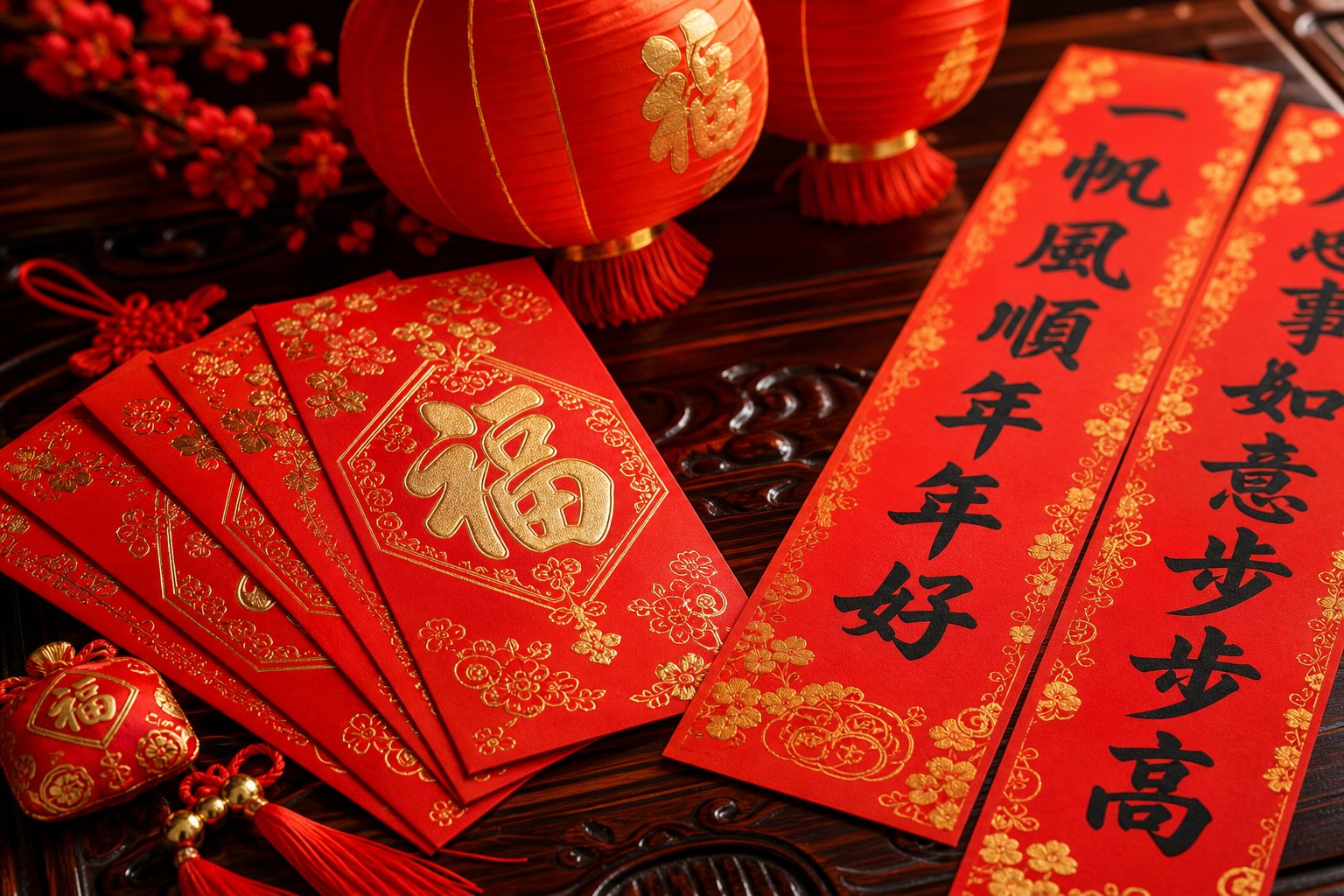
Lunar New Year shifts the symbolic palette entirely. Where weddings center on 禧 and 喜, the Spring Festival belongs to 福 (fu) — the character of broad, all-encompassing blessing. During the holiday, 福 appears on nearly every surface: doors, windows, red envelopes, lanterns, and paper cutouts.
The most distinctive tradition involves hanging 福 upside-down. As the Confucius Institute for Scotland explains, the word for "upside-down" (倒, dao) sounds identical to "arrived" (到, dao). So an inverted 福 creates the pun 福到 — "blessings have arrived." This is the sound-logic system from the previous section applied directly to holiday decoration. However, there are rules: 福 should only be inverted on certain surfaces. On water tanks, storage areas, or barns, keeping it right-side-up prevents the symbolic "pouring out" of good fortune.
The character 春 (chun, spring) also features prominently, representing renewal and fresh beginnings. It appears on spring couplets (春联, chunlian) — paired poetic phrases written on red paper and hung on either side of doorways.
The most recognized Chinese New Year blessing characters come embedded in phrases that people exchange verbally, write on cards, and print on decorations:
- 恭喜发财 (gong xi fa cai) — "Wishing you prosperity." This is the phrase behind the Cantonese "gong hei fat choi" heard worldwide during Lunar New Year. 恭喜 means "respectful congratulations" and 发财 means "to become wealthy." The gong xi fa cai meaning and characters together express a wish for financial flourishing in the coming year.
- 年年有余 (nian nian you yu) — "May you have surplus every year." This phrase activates the fish-surplus homophone (鱼/余, both pronounced yu), which is why fish is always served at New Year dinner.
- 新春大吉 (xin chun da ji) — "Great luck in the new spring." Here 吉 appears in its natural habitat — marking the auspiciousness of a new beginning, a fresh cycle of time.
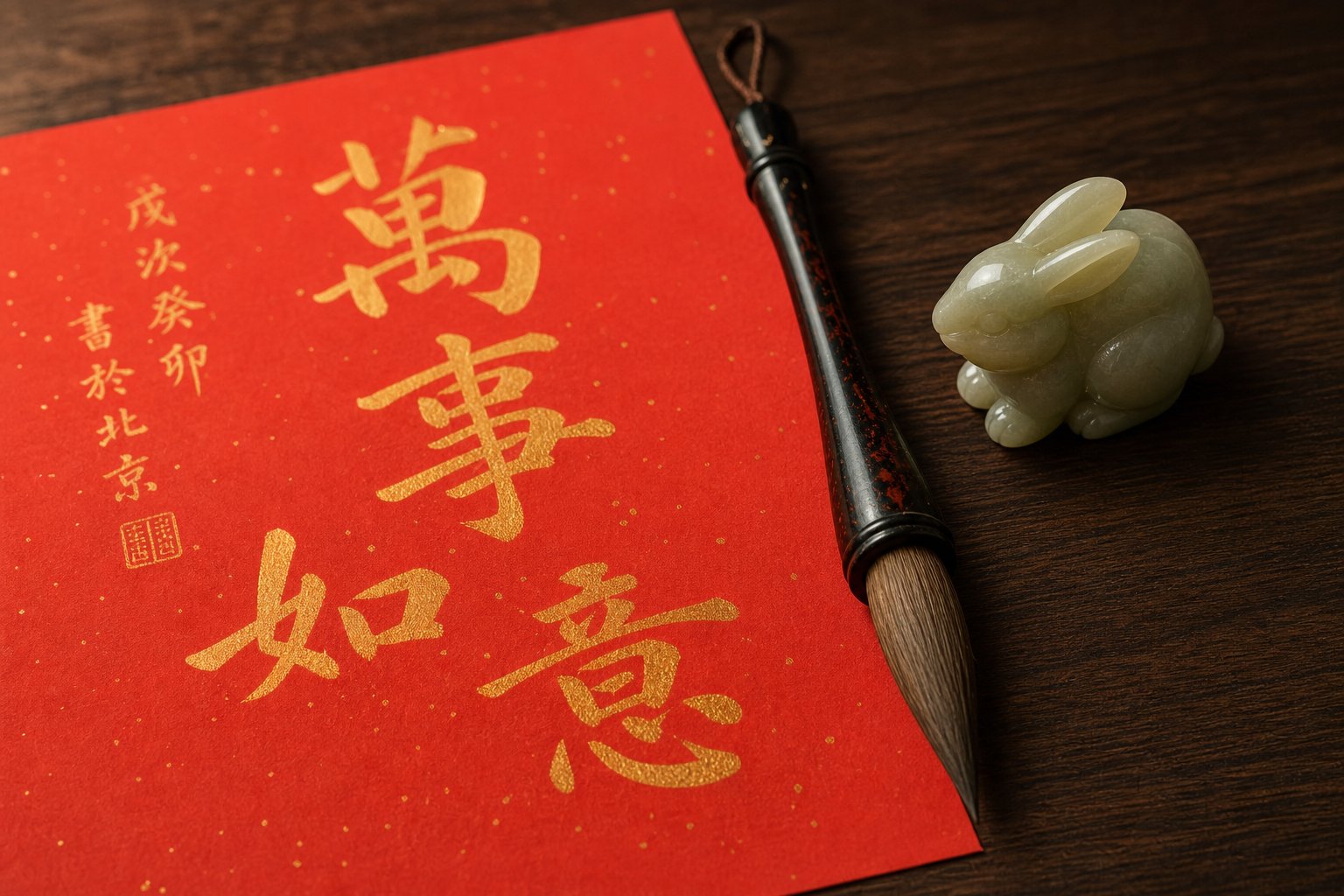
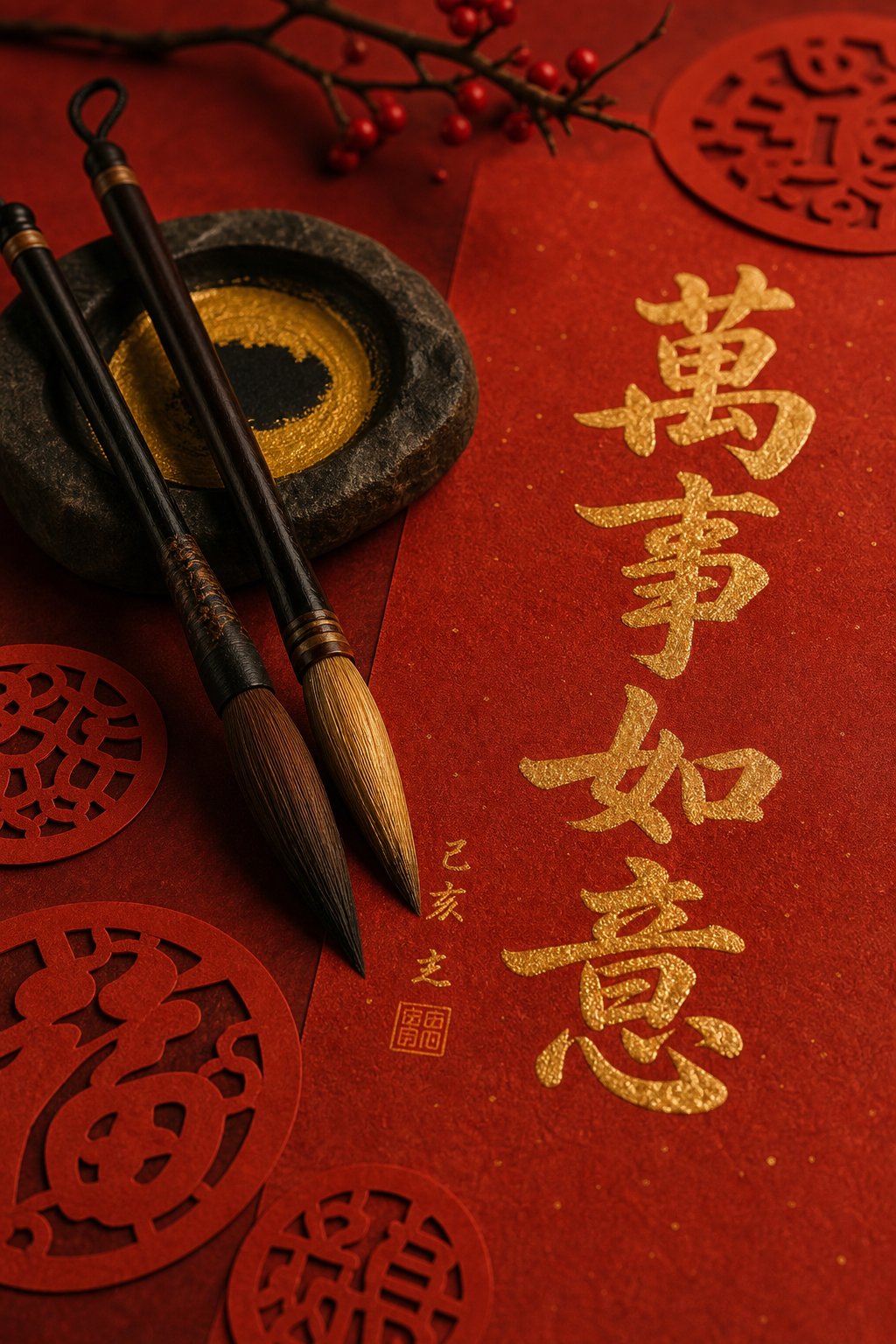
- 万事如意 (wan shi ru yi) — "May ten thousand things go as you wish." A broad, generous blessing covering every aspect of life.
Business and Wealth Characters for New Ventures
Opening a new business in Chinese culture is not just a commercial event — it is a symbolic threshold that demands its own set of auspicious phrases. The character 吉 dominates this context because business openings are fundamentally about timing. Is this the right moment to begin? Will the venture prosper from its first day? 吉 answers those questions with its divination-rooted energy of favorable timing and cosmic approval.
The most important auspicious phrases for business opening in Chinese include:
- 开业大吉 (kai ye da ji) — "Great luck on opening." 开业 means "to open a business" and 大吉 means "great auspiciousness." This phrase appears on flower arrangements, banners, and congratulatory cards sent to new business owners. It is the single most common business well-wishing idiom in Chinese culture.
- 招财进宝 (zhao cai jin bao) — "Ushering in wealth and treasure." 招 means to beckon or attract, 财 means wealth, 进 means to enter, and 宝 means treasure. The phrase describes fortune actively flowing toward the business, not just passively hoped for.
- 生意兴隆 (sheng yi xing long) — "May your business thrive and prosper." A direct wish for commercial success and growing trade.
- 财源广进 (cai yuan guang jin) — "May wealth flow in from all directions." 财源 means "source of wealth" and 广进 means "broadly entering" — a wish for diverse revenue streams.
Notice how 福 is largely absent from business contexts. Its energy is too domestic, too spiritual, too focused on family wholeness. Commerce demands 吉 (timing), 财 (wealth), and 发 (prosperity) — characters with forward momentum and material specificity.
The table below maps these characters and phrases to their proper occasions for quick reference:
| Event | Key Characters | Key Phrases | Cultural Notes |
|---|---|---|---|
| Wedding | 囍, 禧, 喜 | 百年好合, 永结同心, 白头偕老 | Red and gold dominate decor; phrases appear on banners, favors, and invitations |
| Lunar New Year | 福, 春, 吉 | 恭喜发财, 年年有余, 万事如意 | 福 often hung upside-down; fish served to activate surplus homophone |
| Birthday (elders) | 寿, 福, 祥 | 福如东海, 寿比南山, 长命百岁 | Peach imagery represents longevity; 寿 character appears on birthday cakes |
| Business Opening | 吉, 财, 发 | 开业大吉, 招财进宝, 财源广进 | 吉 dominates because openings are about auspicious timing; lion dances attract fortune |
Each row in this table represents a distinct symbolic register. Mixing them — using a business phrase at a wedding, or a wedding phrase at a funeral — would feel jarring to anyone fluent in the system. The characters themselves have not changed meaning, but their contextual deployment follows strict cultural grammar.
These individual characters and phrases gain even more power when they combine. Chinese has a rich tradition of pairing auspicious characters into compound phrases and four-character idioms that amplify meaning through repetition, contrast, and semantic reinforcement — a linguistic mechanism that turns single blessings into layered incantations.
Compound Phrases and Idioms That Amplify Auspicious Power
A single auspicious character carries meaning. Two of them together carry something more — not just doubled meaning, but a new kind of emphasis that neither character achieves alone. This is how Chinese compound words build meaning: by pairing near-synonyms or complementary concepts into fixed phrases that resonate more powerfully than their individual parts. And when those compounds extend to four characters, they become 成语 (chengyu) — the compact idioms that function as the highest-density units of meaning in the Chinese language.
Sounds complex? It is actually elegantly simple once you see the pattern. Think of it like musical harmony. A single note has a pitch. Two notes played together create a chord — something richer and more emotionally resonant than either note alone. Auspicious Chinese chengyu work the same way, combining characters whose meanings overlap just enough to reinforce each other while adding new dimensions neither carries independently.
Four-Character Idioms Built from Auspicious Characters
The most beloved auspicious idioms are not random assemblies of lucky words. They follow precise structural logic, pairing characters in ways that create semantic momentum — each component pushing the meaning forward or deepening it from a different angle.
吉祥如意 (ji xiang ru yi) — "Auspicious and as one wishes"
This is perhaps the most complete auspicious blessing in Chinese. The ji xiang ru yi meaning breakdown reveals two distinct halves working together. The first pair, 吉祥, combines 吉 (favorable timing, cosmic approval) with 祥 (peaceful omens, gentle harmony). Together they create a compound stronger than either alone — not just "lucky" and not just "peaceful," but a state where both active fortune and calm protection are present simultaneously. The second pair, 如意, means "according to one's wishes" — 如 (as, according to) plus 意 (intention, desire). The full phrase promises that auspicious conditions will align with your personal desires. It covers both external fortune and internal satisfaction.
福禄寿 (fu lu shou) — "Fortune, prosperity, longevity"
This three-character compound represents the three stellar gods of Chinese folk religion, each governing a different dimension of the good life. 福 (fu) covers blessings and spiritual wholeness. 禄 (lu) refers specifically to official salary and career prosperity — the material reward for service. 寿 (shou) means longevity. Together they define the complete scope of human flourishing: spiritual blessing, material success, and long life. You will find these three characters on everything from porcelain to embroidery, often accompanied by images of the three gods themselves — smiling elders carrying symbols of their respective domains.
万事如意 (wan shi ru yi) — "May ten thousand things go as you wish"
This phrase scales the 如意 concept to its maximum. 万 (wan, ten thousand) represents totality in Chinese — not literally ten thousand, but "everything without exception." 事 (shi) means matters or affairs. Combined with 如意, the phrase becomes an all-encompassing wish that leaves nothing uncovered. It is the broadest possible blessing, appropriate for nearly any occasion because it makes no specific promise — only the sweeping wish that reality will conform to desire across every domain of life.
大吉大利 (da ji da li) — "Great luck and great profit"
Here the structure uses repetition of 大 (da, great) to create rhythmic emphasis. 吉 (ji) brings its divination-rooted sense of favorable timing, while 利 (li) adds material benefit and advantage. The parallel construction — 大X大Y — is a common Chinese four character idiom pattern for good luck that doubles the intensity through structural symmetry. This phrase appears frequently in gaming culture, business contexts, and casual well-wishing alike.
How Characters Combine to Multiply Meaning
Why does 吉祥 feel stronger than 吉 or 祥 alone? The answer lies in a linguistic principle called semantic reinforcement. In Chinese compounds, pairing two characters with overlapping but non-identical meanings does not create redundancy — it creates emphasis and completeness. Each character fills a gap the other leaves open.
Research on semantic transparency in Chinese compound word processing confirms that native speakers actively retrieve and combine the meanings of individual morphemes when processing transparent compounds. The brain does not treat 吉祥 as a single opaque unit — it processes both 吉 and 祥 individually and then combines them, creating a richer semantic representation than either morpheme alone would trigger. This combinatorial processing is what gives transparent auspicious compounds their amplified emotional weight.
You will notice this principle at work across the most common auspicious compound phrases. Each one pairs characters whose meanings overlap partially but extend in different directions, creating a combined meaning that covers more ground than any single character could:
- 吉祥 (ji xiang) — 吉 (auspicious timing) + 祥 (peaceful omen). Combined meaning: complete auspiciousness covering both active fortune and passive harmony. Stronger than either alone because it addresses both what you pursue and what surrounds you.
- 福气 (fu qi) — 福 (blessing) + 气 (energy/vital force). Combined meaning: the tangible energy of good fortune — not just the abstract concept of blessing, but its felt presence in your life. 气 makes 福 experiential rather than theoretical.
- 祥瑞 (xiang rui) — 祥 (good omen) + 瑞 (auspicious sign from nature). Combined meaning: an omen so significant it manifests in the natural world. This compound elevates ordinary good signs into rare, heaven-sent confirmations. Used in formal and literary contexts.
- 如意 (ru yi) — 如 (as, according to) + 意 (intention). Combined meaning: reality conforming to desire. This compound became so culturally important that it names a physical object — the ruyi scepter, a curved ceremonial wand symbolizing authority and wish-fulfillment.
- 平安 (ping an) — 平 (level, even) + 安 (peaceful, settled). Combined meaning: safety and stability without disturbance. 平 addresses external conditions while 安 addresses internal state, together covering complete peace.
- 恭喜 (gong xi) — 恭 (respectful) + 喜 (joy/congratulations). Combined meaning: formal, respectful celebration of another's good fortune. The 恭 adds social propriety to raw joy, making the phrase appropriate for public and professional contexts.
Notice how each pair follows the same logic: character A covers one dimension of the concept, character B covers an adjacent dimension, and together they create a meaning that is both more complete and more emphatic than either component. This is not decorative repetition. It is precision engineering — the Chinese language building complex emotional states from modular semantic parts.
This combinatorial power explains why auspicious phrases feel so potent in practice. A single 福 on a red envelope is a blessing. But 福禄寿 on a birthday banner is a complete cosmology of human flourishing compressed into three syllables. The characters do not just add — they multiply, each one activating the others in a web of reinforcing meaning.
That multiplying effect extends beyond language into the physical world. When auspicious characters are inscribed on gold, carved into jade, or engraved on rings and pendants, the material itself becomes another layer of meaning — one where permanence, purity, and wealth amplify the blessing the character already carries.
Auspicious Characters in Gold Jewelry and Medallions
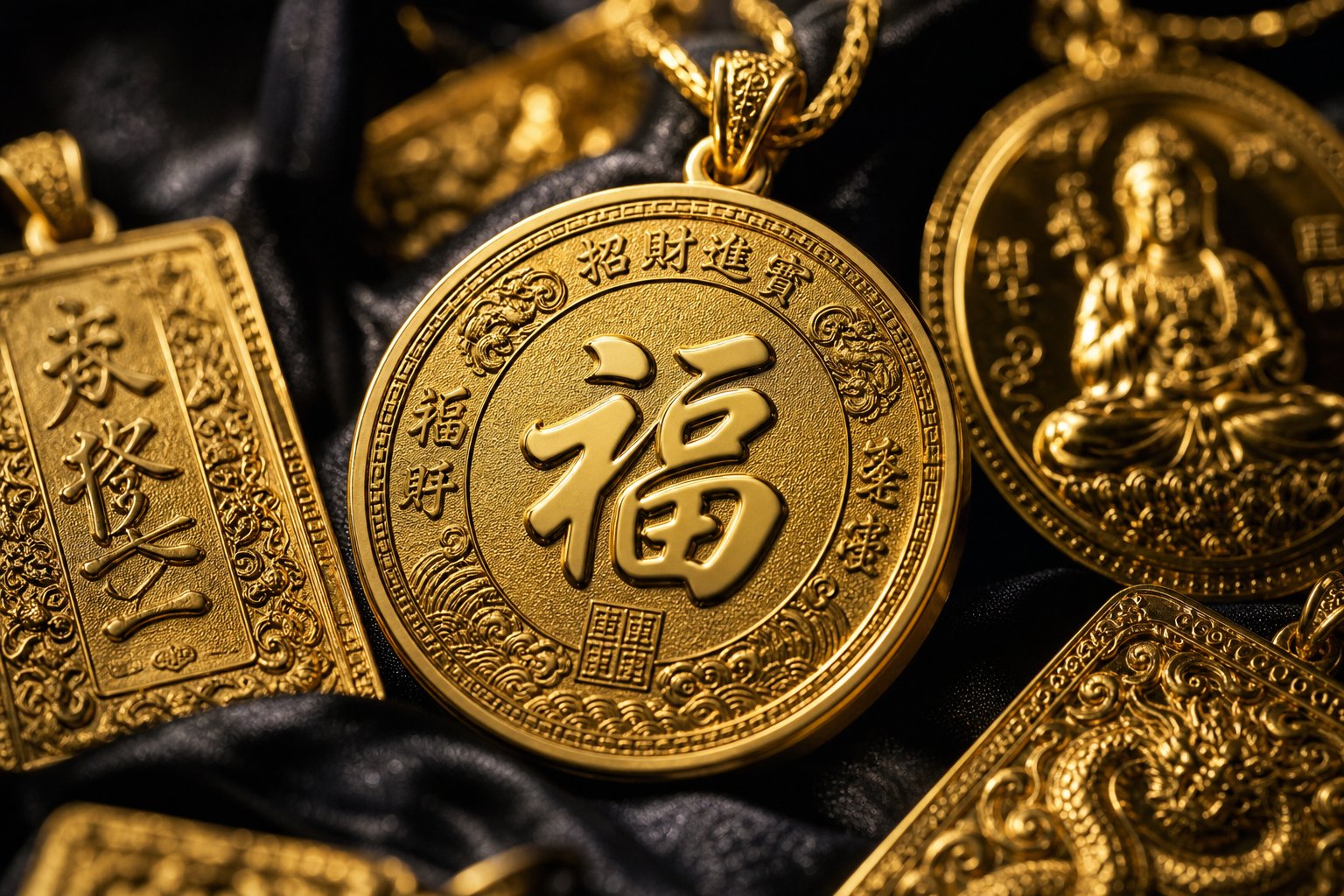
Gold is not a neutral canvas in Chinese culture. The metal itself carries symbolic weight — 金 (jin) represents the metal element in the Five Elements system, associated with strength, permanence, and accumulated wealth. When an auspicious character is engraved or cast in gold, the material does not merely display the blessing. It amplifies it. The character says "fortune." The gold says "this fortune is real, lasting, and valuable." Together, they create a layered statement that neither words on paper nor plain metal could achieve alone.
This is why Chinese character gold pendant meaning goes deeper than decoration. A 福 pendant is not just a pretty accessory — it is a portable blessing rendered in a material that culturally signifies everything the character itself promises. The medium reinforces the message.
Gold Pendants and Medallions with Auspicious Characters
Imagine receiving a round gold medallion engraved with 寿 (shou, longevity) on your grandmother's 80th birthday. The circular shape represents wholeness and eternity — a form with no beginning and no end. The gold communicates permanence and value. The character 寿 delivers the specific wish: long life. Three layers of meaning arrive simultaneously in a single object you can hold in your palm.
This layering explains why gold remains the preferred material for auspicious Chinese jewelry symbols across generations. The circular longevity symbol appears frequently on medallions, furniture, and fabric precisely because its round form pairs naturally with the cyclical philosophy embedded in the character's meaning. The circle emphasizes that longevity is not linear — it is about harmony, balance, and the continuous renewal of life.
Common medallion and pendant designs follow predictable gifting patterns. A fu character necklace meaning centers on broad blessing and divine favor — appropriate for nearly anyone, at nearly any occasion. A 寿 medallion targets birthday celebrations for elders specifically. A Chinese gold medallion for good luck featuring 吉 suits someone starting a new chapter — a graduate, a new business owner, or someone embarking on travel. The character determines the occasion; the gold determines the gravity.
For children, gold pendants featuring zodiac animals or simplified 福 characters are traditional Lunar New Year gifts from grandparents. These pieces serve a dual purpose: they function as wearable blessings and as a form of wealth transfer — gold that appreciates in value while carrying cultural meaning the child grows into understanding over time.
Rings, Bracelets, and Wearable Auspicious Symbols
Circular jewelry formats — rings and bangles — introduce their own symbolic dimension. A ring has no endpoint. A bangle forms a continuous loop around the wrist. In Chinese symbolism, this unbroken circularity represents eternity, completeness, and the wish that good fortune will never run out. When auspicious characters are engraved on these circular forms, the shape itself becomes part of the blessing.
Chinese character bracelet symbolism draws heavily on this principle. Gold bangles engraved with dragon and phoenix motifs are traditional wedding gifts in Si Dian Jin sets — the "four touches of gold" that a groom's family presents to the bride. The continuous loop of the bangle represents an unbroken marriage. The dragon and phoenix represent the balance of masculine and feminine energy. The gold represents lasting prosperity. Every element speaks.
Rings tend to feature smaller, more subtle character engravings — often on the inner band where the blessing sits against the skin, private and personal. This placement reflects a cultural preference for understated fortune. The blessing does not need to be displayed to the world. It needs to be close to the wearer.
The most common auspicious characters found on jewelry, along with their meanings and typical gifting occasions:
- 福 (fu) — Blessing, good fortune. The most versatile choice. Gifted during Lunar New Year, birthdays, and as everyday wear for general protection and prosperity.
- 寿 (shou) — Longevity. Reserved primarily for elder birthdays, especially milestone ages like 60, 70, and 80. Often rendered in the ornate circular form on medallions and pendants.
- 囍 (shuangxi) — Double happiness. Exclusively for weddings and engagements. Appears on bangles, charms, and bridal jewelry sets as a wish for shared joy.
- 吉 (ji) — Auspicious timing. Suited for new beginnings — graduations, business launches, or travel. Common on smaller pendants and charms.
- 平安 (ping an) — Peace and safety. Popular on children's jewelry and travel charms. Parents and grandparents gift these as protective blessings for young ones.
- 发 (fa) — Prosperity, to flourish. Found on rings and bracelets with wealth-attraction themes. Common in business-oriented gifting contexts.
What unites all these pieces is the principle that material, form, and character work as a single system. Gold is not chosen for aesthetics alone — it is chosen because its cultural associations (wealth, permanence, purity) align with and strengthen whatever blessing the character carries. A 福 rendered in silver would still mean "blessing," but it would lack the resonant alignment that gold provides. The medium is not separate from the message. In Chinese auspicious jewelry, the medium is part of the message.
This alignment between symbol and material reveals something important about how the auspicious system works as a whole. It is not just about what you say or write — it is about what you avoid. The same logic that makes gold and red and the number 8 powerful also makes certain characters, numbers, and combinations actively dangerous to use in the wrong context.
Inauspicious Characters and Taboos That Define the System
Every system of meaning needs a boundary. You cannot fully understand what Chinese culture considers auspicious until you see what it actively rejects. The unlucky Chinese characters to avoid are not random dislikes — they are the negative space that gives the positive symbols their shape. Death defines why longevity matters. Separation explains why togetherness is blessed. Emptiness reveals why abundance carries such weight. The taboos are not superstition bolted onto the system from outside. They are the system, viewed from its other face.
Characters and Numbers to Avoid and Why
The same homophonic logic that makes 福 (fu, blessing) powerful makes certain other words dangerous. If a sound can attract good fortune, it can also attract misfortune. Chinese cultural taboos in writing and speech operate on this principle with remarkable consistency.
The most avoided inauspicious words in Chinese language include:
- 死 (si, death) — The most universally avoided character. Its pronunciation contaminates anything that sounds similar, most notably the number 4 (四, si). You will not find this character on gifts, decorations, or anywhere near celebrations. Even indirect references to death are softened with euphemisms.
- 病 (bing, illness) — Carries the energy of physical decline and vulnerability. Avoided in names, blessings, and any context where health is being wished upon someone.
- 散 (san, to scatter or separate) — Represents the breaking apart of things that should stay whole — families, relationships, fortunes. Its opposite value is unity and togetherness, which explains why compound phrases emphasizing 合 (he, together) and 聚 (ju, gather) carry such positive weight.
- 梨 (li, pear) — The fruit itself is harmless, but its pronunciation creates problems. Sharing a pear (分梨, fen li) sounds identical to 分离 (fen li, separation). Couples and close friends avoid splitting pears for this reason — the act of dividing the fruit phonetically invokes dividing the relationship.
- 伞 (san, umbrella) — Sounds like 散 (san, scatter). Gifting an umbrella can imply you wish the relationship to dissolve. This is why umbrellas are considered inappropriate gifts despite being practical objects.
Numbers follow the same avoidance logic. Why is 4 unlucky in Chinese culture? Because 四 (si, four) shares its pronunciation with 死 (si, death). The association is strong enough to reshape physical infrastructure — many buildings in Chinese-speaking communities skip the 4th floor entirely, labeling it as 5 or simply omitting it from elevator panels. Some buildings also skip 14 (which in Cantonese can sound like "will certainly die") and 24. Phone numbers, license plates, and addresses containing 4 sell at discounts while those loaded with 8s command premiums.
The number 7 occupies more ambiguous territory. It is not universally unlucky, but it becomes sensitive in specific contexts — particularly around the seventh lunar month, traditionally associated with the Ghost Festival and remembrance of the dead. During this period, 7 absorbs associations with mourning and the spirit world that make it uncomfortable for celebrations or new ventures.
Beyond individual characters and numbers, certain combinations create taboos through their collective meaning. Gifting a clock (送钟, song zhong) sounds identical to 送终 (song zhong, attending someone's deathbed or sending them off to die). Giving shoes (送鞋, song xie) can sound like 送邪 (song xie, sending evil). These are not obscure rules known only to scholars — they are active social knowledge that governs gift-giving, naming practices, and daily speech across Chinese-speaking communities.
How Taboos Reinforce the Auspicious System
Step back from the individual examples and a clear pattern emerges. Every taboo points directly at a value the auspicious system protects:
- Avoiding 死 (death) reveals the supreme value placed on 寿 (longevity)
- Avoiding 散 (separation) reveals the importance of 合 (togetherness) and 聚 (gathering)
- Avoiding 病 (illness) highlights the centrality of 安 (peace) and 康 (health)
- Avoiding 空 (emptiness) underscores the desire for 满 (fullness) and 余 (surplus)
This binary structure is not coincidental. It is the architecture of the entire system. Auspicious characters gain their power partly from what they are — blessings, omens, divine favor — and partly from what they stand against. 福 means more because 祸 (huo, disaster) exists. 吉 carries weight because 凶 (xiong, misfortune) is its defined opposite. The positive and negative poles create tension that charges both sides with meaning.
Chinese auspiciousness operates as a complete symbolic ecosystem where positive and negative meanings define each other. You cannot understand what is blessed without understanding what is forbidden — the two halves form a single coherent logic.
This framework helps learners internalize the system rather than memorize isolated symbols. Instead of asking "which characters are lucky?" you can ask a more productive question: "what does this culture most want to protect and preserve?" The answer — life, togetherness, abundance, health, harmony — generates both the auspicious characters that attract those qualities and the taboo characters that repel their opposites. Two sides of one coin, operating through the same phonetic, visual, and associative channels.
Understanding this binary logic also explains why context matters so much. A character is not inherently dangerous — it becomes dangerous when placed in the wrong setting. 梨 is just a fruit in a grocery store. It becomes a taboo only when shared between people whose relationship could be symbolically threatened by the act of division. The system is not rigid superstition. It is context-sensitive symbolic grammar, activated by situation and relationship.
That context-sensitivity becomes even more visible when you look at how different Chinese-speaking regions interpret the same characters. A homophone that triggers avoidance in Cantonese may carry no negative weight in Mandarin, and vice versa. The underlying logic stays constant — sound shapes meaning — but the specific associations shift depending on which dialect is doing the speaking.
Regional Variations from Mainland China to the Diaspora
Cantonese speakers in Hong Kong hear different homophones than Mandarin speakers in Beijing. Hokkien-influenced communities in Taiwan preserve associations that mainland usage has largely forgotten. And in Southeast Asia, Chinese auspicious traditions blend with local symbolism in ways that create entirely new layers of meaning. The underlying logic of the system — sound shapes fortune, characters carry power — remains constant. But the specific outputs change depending on where you are and which dialect is doing the speaking.
These regional differences in Chinese symbolism are not minor footnotes. They determine which characters appear on wedding invitations, which numbers get avoided in phone numbers, and which phrases feel natural versus foreign in a given community. Understanding them is essential for anyone engaging with Chinese-speaking audiences across different regions.
Simplified vs Traditional Forms and Their Symbolic Impact
When the People's Republic of China introduced simplified characters in the 1950s, the goal was practical: reduce stroke counts to boost literacy. Simplified Chinese became the standard in Mainland China and Singapore, while traditional characters remained the norm in Taiwan, Hong Kong, and Macau. For everyday communication, the distinction is straightforward. For auspicious contexts, it gets more complicated.
Some simplifications stripped away components that carried symbolic weight. The most debated example is 爱 (love). In its traditional form, 愛 contains 心 (xin, heart) at its center. The simplified version removes it. Critics argue this erases the emotional core of the character — love without heart. Whether you find that argument compelling or overly romantic, it illustrates a real tension: simplification optimized for efficiency, not for symbolic preservation.
Here is what is fascinating, though. Even in Mainland China, where simplified characters dominate daily life, traditional forms persist stubbornly in ceremonial contexts. Walk into any Spring Festival market in Shanghai or Chengdu and you will find 福 and 寿 written in their traditional calligraphic forms on red paper, lanterns, and gold decorations. The simplified versions of these particular characters are identical to their traditional forms, but the broader principle holds — when the occasion is sacred or celebratory, traditional script carries more gravity. Wedding invitations, ancestral tablets, and temple inscriptions across Mainland China still favor traditional characters because their visual complexity signals respect, formality, and connection to history.
This creates a practical reality: simplified vs traditional Chinese auspicious characters are not an either-or choice. They coexist, with traditional forms reserved for moments that demand symbolic weight and simplified forms handling everything else.
Regional Preferences Across Chinese-Speaking Communities
The dialect spoken in a region reshapes the entire homophonic network that drives auspicious meaning. In Hong Kong, where Cantonese dominates, the sound associations differ dramatically from Mandarin-speaking regions.
Consider the most famous example. The New Year greeting 恭喜发财 is pronounced "gong hei fat choi" in Cantonese. The character 發 (fat in Cantonese, fa in Mandarin) carries its wealth-attracting power through both pronunciations, but Cantonese creates additional lucky words and phrases that Mandarin does not. The Cantonese word for "book" (书, syu) sounds like "lose" (输, syu), making books an awkward gift during celebrations. Meanwhile, lettuce (生菜, saang coi) sounds like "growing wealth" in Cantonese, which is why you will see lettuce hung from doorways during lion dances in Hong Kong — a practice that puzzles Mandarin speakers because the homophone does not exist in their dialect.
In Taiwan, Hokkien (Minnan) influence adds another layer. The Hokkien pronunciation of certain characters creates auspicious associations invisible to Mandarin speakers. Pineapple (凤梨, ong lai in Hokkien) sounds like "prosperity comes," making pineapple cakes a standard celebratory gift in Taiwanese culture. This association is so strong that pineapple imagery appears on Taiwanese business signage and wedding favors — a practice rooted entirely in Hokkien phonetics rather than Mandarin.
Southeast Asian Chinese communities add yet another dimension. Across Singapore, Malaysia, Indonesia, Thailand, and the Philippines, Chinese auspicious traditions in Southeast Asia blend with local customs to produce hybrid practices found nowhere else. Each country adds its own cultural imprint to celebrations like Lunar New Year — from Singapore's Yu Sheng prosperity toss to Indonesia's Grebeg Sudiro festival in Solo, which merges Javanese and Chinese traditions into something uniquely local.
Notable regional differences in auspicious character usage and interpretation include:
- Hong Kong: Cantonese homophones create unique taboos (books as gifts) and unique blessings (lettuce for wealth). Traditional characters are standard in all contexts, not just ceremonial ones.
- Taiwan: Hokkien-influenced associations make pineapple a prosperity symbol. Traditional characters are used exclusively. Certain folk religion practices preserve auspicious character usage tied to Taoist temple culture.
- Singapore and Malaysia: Communities often blend Hokkien, Teochew, Cantonese, and Mandarin associations depending on family dialect group. The Yu Sheng toss during New Year uses Cantonese-derived phrases regardless of the diners' native dialect.
- Indonesia: Chinese auspicious practices blend with Javanese symbolism. Milkfish replaces the standard whole fish at New Year in some communities, symbolizing careful prosperity. Celebrations like Grebeg Sudiro layer Chinese and local Javanese traditions together.
- Thailand: Trut Chin celebrations in Bangkok's Yaowarat district reflect centuries of Thai-Chinese cultural exchange, with auspicious characters appearing alongside Thai Buddhist symbolism.
- Mainland China: Simplified characters dominate daily use, but traditional forms persist on ceremonial items. Regional Mandarin dialects create minor variations in homophonic associations, though standard Mandarin norms prevail in formal contexts.
What unites all these variations is the underlying mechanism. Sound creates meaning. Characters carry power. Context determines appropriateness. The specific sounds and contexts shift from region to region, but the logic never changes. A Cantonese speaker in Hong Kong and a Hokkien speaker in Taipei are running the same symbolic software — just with different phonetic inputs generating different outputs.
This regional diversity also explains why no single "correct" list of auspicious characters exists. The system is alive, responsive to dialect, geography, and local culture. It adapts without breaking. And that adaptability — the ability to absorb local meaning while preserving structural logic — is precisely what has kept Chinese auspicious character traditions vital across thousands of years and thousands of miles of diaspora.
Frequently Asked Questions About Auspicious Chinese Characters
1. What is the difference between lucky and auspicious in Chinese culture?
In Chinese culture, 'lucky' implies random chance, while 'auspicious' (吉祥, jixiang) describes a state of cosmic alignment where heaven, earth, and human intention harmonize. Auspiciousness suggests intentionality and reciprocity — blessings cultivated through right action, proper timing, and respect for natural order. The concept is encoded across multiple characters (福, 吉, 祥, 瑞, 禧), each addressing a different dimension of divine favor, from material abundance to peaceful omens to celebratory joy.
2. Which Chinese character is best for good luck?
The best character depends on context. 福 (fu) works for general blessings and everyday wishes. 吉 (ji) suits new ventures and business openings because it signals favorable timing. 祥 (xiang) fits peaceful wishes for elders. 瑞 (rui) belongs in formal or literary settings. 禧 (xi) is reserved for weddings and milestone celebrations. Using the wrong character is not technically incorrect, but it can feel tonally off — like using corporate language at a family dinner.
3. Why is the character 福 hung upside down during Chinese New Year?
The tradition exploits a homophonic pun central to Chinese symbolic logic. The word for 'upside-down' (倒, dao) sounds identical to 'arrived' (到, dao). Inverting 福 on a door creates the phrase 福到 — 'blessings have arrived.' However, this practice has rules: 福 should only be inverted on certain surfaces like doors and windows. On storage containers or water tanks, keeping it upright prevents the symbolic 'pouring out' of accumulated fortune.
4. How do Chinese character radicals reveal auspicious meaning?
Radicals are semantic building blocks that signal a character's meaning category. The radical 礻(altar/spirit) appears in 福 and 祥, immediately marking them as spiritually connected. In 福, it pairs with 畐 (full vessel) to depict 'spiritual fullness through offerings.' In 祥, it pairs with 羊 (sheep, the primary sacrificial animal) to convey 'peace achieved through sacred ritual.' Characters without this radical, like 吉 (士 scholar + 口 mouth), ground their meaning in human action rather than divine connection.
5. Do auspicious Chinese characters differ between Cantonese and Mandarin speakers?
Yes, significantly. The same sound-based logic operates in both dialects, but different pronunciations create different symbolic associations. In Cantonese, lettuce (生菜, saang coi) sounds like 'growing wealth,' making it a lion dance staple in Hong Kong. Books (书, syu) sound like 'lose' (输, syu), making them awkward celebration gifts. In Hokkien-influenced Taiwan, pineapple (ong lai) sounds like 'prosperity comes,' turning pineapple cakes into standard celebratory gifts. The underlying mechanism stays constant — sound shapes fortune — but outputs vary by region.