Understanding Radicals and Their Role in Pig Zodiac Naming
Imagine picking a name for your child and discovering that a single hidden component inside a Chinese character could shape their fortune. That's the power of radicals in traditional Chinese naming, and it's exactly what most parents overlook when naming a Pig zodiac baby.
What Are Chinese Radicals in Naming
Chinese radicals, known as 部首 (bushou), are the foundational building blocks that give every Chinese character its structure and meaning. Think of them as the DNA of a character. Each radical carries a core concept, whether it's water, shelter, metal, or food, and that concept quietly influences the energy of any character it appears in. The radical 女 (woman), for example, signals that a character relates to femininity, while 氵 (water) ties a character to fluidity and flow.
In the context of naming, radicals do more than hint at meaning. Traditional Chinese nameology (姓名学) treats them as carriers of symbolic energy that interact with a person's birth data. A radical isn't just a visual element; it's a deliberate choice that channels specific elemental forces into a child's identity.
Radicals function as the symbolic DNA of a Chinese name. They don't just define what a character means on paper; they shape the energetic blueprint a person carries through life.
Why the Pig Zodiac Demands Specific Radicals
The Pig (亥) holds the twelfth position in the Chinese zodiac cycle, and its earthly branch belongs to the Water element. This elemental identity creates a specific set of relationships with every radical in the Chinese writing system. Some radicals nourish the Pig's Water nature, others remain neutral, and a few directly conflict with it.
Zodiac-based naming works on the principle that certain radicals align with an animal's natural habits, elemental associations, and astrological compatibility. For the Pig, radicals connected to shelter, food, and water all resonate with its nature as an animal that thrives in comfort and abundance. Meanwhile, radicals linked to blades, sacrifice, or clashing zodiac animals can introduce symbolic tension into the name.
How Radical Selection Differs From General Naming
General Chinese naming focuses on sound, meaning, and stroke count. You'll find parents choosing characters because they sound elegant or carry aspirational meanings like "wisdom" or "strength." Zodiac-specific radical selection adds another layer entirely. It asks: does this character's internal structure harmonize with the child's birth year animal?
A character might have a beautiful meaning but contain a radical that clashes with the Pig's earthly branch. Conversely, a seemingly simple character could carry deeply auspicious energy because its radical aligns perfectly with the Pig's elemental needs. This is the gap most parents miss. They focus on surface-level meaning while ignoring the structural components that traditional nameology considers most influential.
The methodology that follows goes well beyond a simple list of "good" and "bad" characters. It connects Five Elements theory, zodiac compatibility triangles, and elemental sub-types into a framework you can actually use, starting with the elemental foundation that governs every radical choice for a Pig year child.
Five Elements Theory and the Pig Water Connection
Every radical recommendation for a Pig zodiac name traces back to one governing system: Wu Xing (五行), the Five Elements theory. This ancient framework describes how Wood, Fire, Earth, Metal, and Water interact through cycles of support and control. For naming purposes, it tells you exactly which radicals strengthen a Pig year child and which ones create friction.
The Pig and Its Water Element Foundation
The Pig's earthly branch, 亥, is firmly rooted in the Water element. Water represents fluidity, wisdom, and deep contemplation. It's the energy of winter, stillness, and conservation. This isn't just philosophical decoration. In Wu Xing radical selection for pig names, the Pig's Water identity becomes the reference point for every decision. You're essentially asking: does this radical feed Water, reinforce Water, or work against it?
Because the Pig is a water zodiac, characters containing water element radicals for pig year babies naturally resonate with their innate energy. Radicals like 氵 (three-dot water), 水 (water), and 雨 (rain) all echo the Pig's core nature, reinforcing qualities of adaptability, intelligence, and emotional depth.
Productive Cycle Radicals That Strengthen Pig Names
The Five Elements operate in a generating cycle (相生) where each element nourishes the next. The key relationship here: Metal generates Water. Picture metal surfaces collecting condensation, or think of it as Metal providing the structure that allows Water to gather and flow.
This means metal radicals that support pig zodiac names are among the most powerful choices available. Characters built with 金 (gold/metal) or 钅 (metal radical) actively feed the Pig's Water element, creating a supportive "mother-child" relationship in Five Elements terminology. Water radicals themselves, like 氵 and 雨, reinforce what's already there, strengthening the Pig's natural foundation.
Wood radicals occupy a neutral-to-positive position. Water nourishes Wood in the generating cycle, so Wood doesn't harm the Pig. It simply channels the Pig's energy outward into growth and expression.
Destructive Cycle Radicals to Approach With Caution
The controlling cycle (相克) is where conflicts emerge. Two relationships matter most for five elements theory pig zodiac naming:
- Earth dams Water. In the destructive cycle, Earth absorbs and blocks Water's flow. Radicals like 土 (earth) and 山 (mountain) can symbolically restrict the Pig's natural energy, creating a sense of limitation or obstruction.
- Water extinguishes Fire. While Water controls Fire, this relationship creates tension rather than harmony. Fire radicals like 火 and 灬 (fire dots) sit in opposition to the Pig's element, potentially introducing restlessness or inner conflict.
Sounds like you should avoid Earth and Fire radicals entirely? Not quite. Context matters. A single Earth radical in an otherwise well-balanced name won't derail anything. The concern arises when multiple conflicting radicals stack up without any supportive elements to counterbalance them.
| Element | Relationship to Water (Pig) | Associated Radicals | Naming Recommendation |
|---|---|---|---|
| Metal (金) | Productive (generates Water) | 金, 钅 | Highly favorable |
| Water (水) | Same element (reinforces) | 氵, 水, 雨 | Favorable |
| Wood (木) | Draining (Water feeds Wood) | 木, 艹 | Neutral to positive |
| Fire (火) | Destructive (Water controls Fire) | 火, 灬 | Use with caution |
| Earth (土) | Destructive (Earth dams Water) | 土, 山 | Use with caution |
This elemental map gives you the big picture, but the Pig's naming story doesn't end with Wu Xing alone. The animal's natural habits and cultural symbolism unlock an entire category of radicals that Five Elements theory doesn't fully capture: shelter and enclosure radicals, where the Pig finds its deepest sense of prosperity.
Shelter and Enclosure Radicals for Pig Prosperity
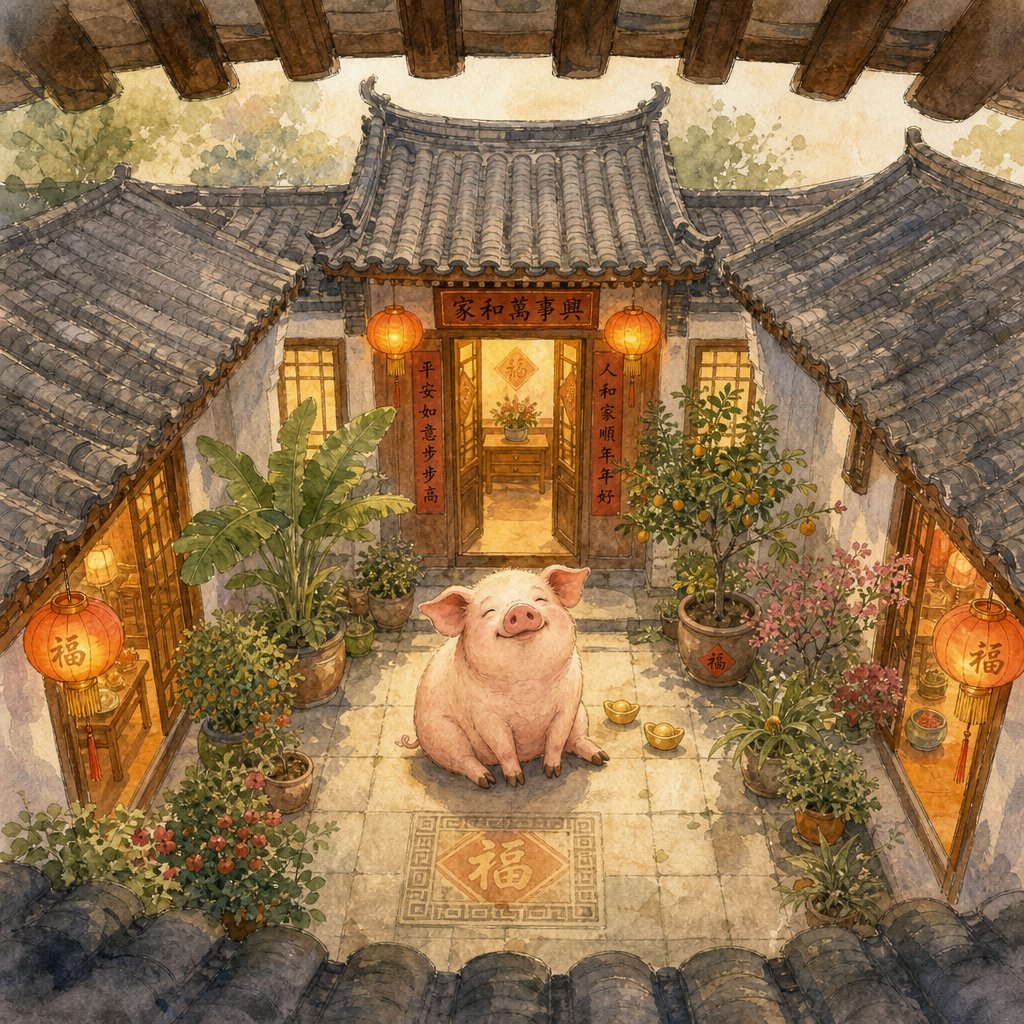
Picture a pig in its ideal environment: sheltered, well-fed, content. In Chinese culture, that image isn't just pastoral charm. It's a symbol of wealth and domestic harmony so powerful that it became embedded in one of the language's most fundamental characters. Shelter and enclosure radicals rank as the single most auspicious category of roof radical characters for pig zodiac baby names, and the reasoning is both cultural and linguistic.
Roof Radical 宀 and Its Prosperity Symbolism
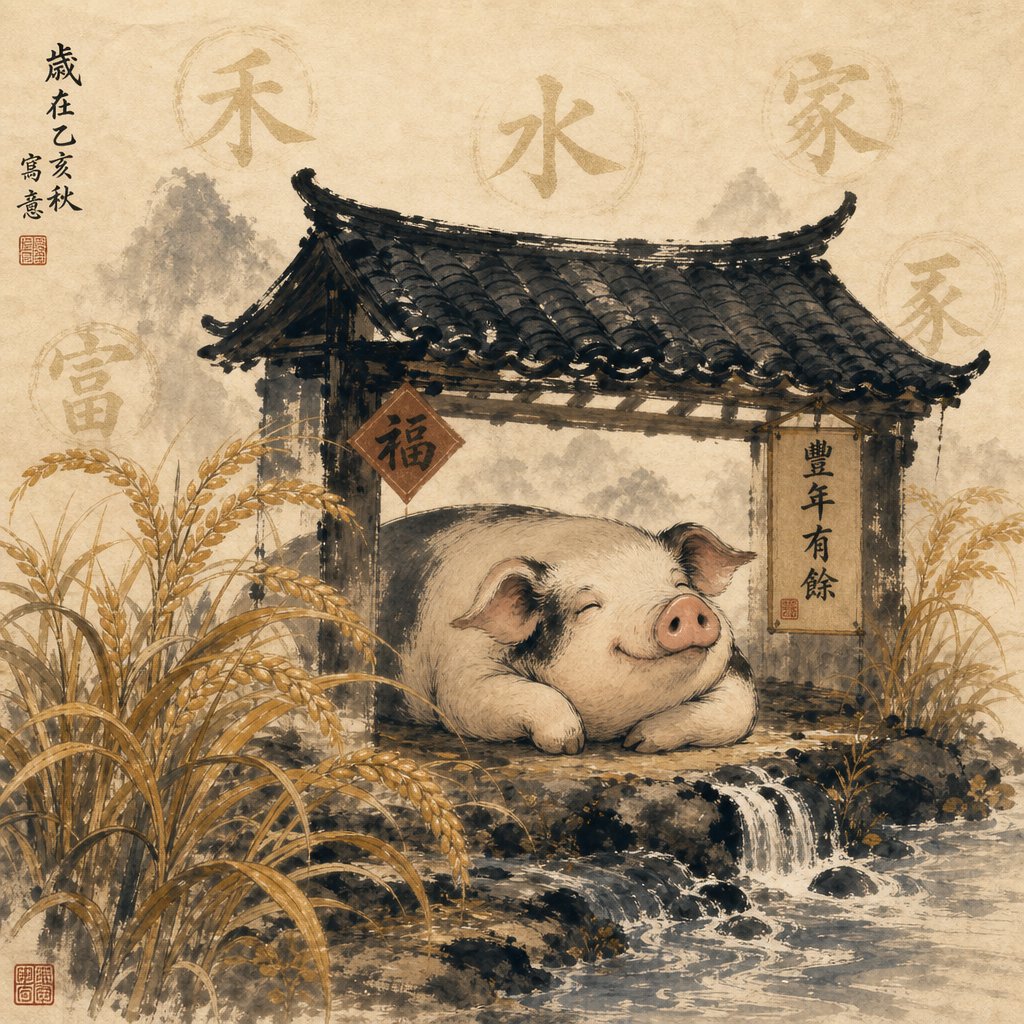
The roof radical 宀 (mian) represents a covered structure, a home, a place of safety. Its connection to the Pig zodiac is written directly into the Chinese language. The character 家 (jia), meaning "home" or "family," combines 宀 (roof) with 豕 (pig). A pig under a roof. In ancient agrarian China, pigs were domesticated animals that lived inside the household. They were easy to raise, fertile, and provided food, fertilizer, and wealth. A house with a pig in it meant a thriving, prosperous family.
This isn't just etymology trivia. It reveals a deep cultural truth: the Pig finds its highest expression when sheltered. Characters containing 宀 signal that the named person will find security, abundance, and a stable foundation. For Pig year children, this radical resonates on every level, matching the animal's nature with thousands of years of symbolic weight.
Gate and Cover Radicals for Protection
Beyond the roof radical, three other enclosure radicals carry similar protective energy for shelter radicals pig year names:
- 门 (men) - Gate radical: Represents a doorway or entrance. It implies a defined, protected space with controlled access, suggesting the Pig is welcomed and guarded within a household.
- 冖 (mi) - Cover radical: A simpler form of covering or canopy. It conveys concealment and protection from above, reinforcing the idea of being cared for and shielded.
- 广 (guang) - Shelter radical: Depicts a cliff-side shelter or open-roofed structure. It suggests expansive protection, a broad space where the Pig can roam comfortably without exposure to harm.
Each of these radicals echoes the same core metaphor: the Pig thrives when it has a place to belong. They signal safety, belonging, and the kind of settled abundance that allows growth without struggle.
Example Characters With Shelter Radicals
Here are auspicious enclosure radicals pig zodiac parents can consider, organized by radical type:
Roof radical 宀 characters:
- 宇 (yu) - meaning "universe" or "eaves." Suggests expansive vision and a broad, sheltered world. Works for Pig names because it combines protection with limitless potential.
- 安 (an) - meaning "peace" or "tranquility." A woman under a roof, signaling domestic harmony. Reinforces the Pig's desire for comfort and stability.
- 宏 (hong) - meaning "grand" or "magnificent." Implies greatness achieved within a secure foundation. Pairs the Pig's sheltered nature with ambition.
- 宜 (yi) - meaning "suitable" or "appropriate." Suggests a life where things fall naturally into place, a fitting energy for the easygoing Pig personality.
Gate radical 门 characters:
- 闻 (wen) - meaning "to hear" or "reputation." Implies knowledge and renown flowing through the gate. Gives the Pig social recognition within a protected context.
- 阔 (kuo) - meaning "broad" or "wide." Suggests spaciousness and generosity, qualities that align with the Pig's open-hearted nature.
Cover radical 冖 characters:
- 冠 (guan) - meaning "crown" or "champion." Implies being the best under a canopy of achievement. Adds distinction to the Pig's comfortable nature.
- 军 (jun) - meaning "army" or "military." Suggests disciplined strength under a unified banner, balancing the Pig's softness with structure.
Shelter radical 广 characters:
- 庆 (qing) - meaning "celebration" or "festivity." Implies joyful gatherings under a broad shelter. Perfectly matches the Pig's sociable, generous spirit.
- 康 (kang) - meaning "health" or "well-being." Suggests robust vitality within a protected space, one of the best roof radical names for pig year children seeking longevity symbolism.
You'll notice a pattern across all these examples: shelter radicals don't just protect. They create the conditions for flourishing. A Pig under a roof isn't hiding. It's thriving in exactly the environment where its nature can fully express itself, surrounded by abundance and free from threat.
Of course, shelter alone doesn't complete the picture. A protected Pig still needs sustenance, and that's where food, grain, and abundance radicals enter the framework, adding another layer of nourishment to the name's symbolic architecture.
Food and Abundance Radicals That Nourish Pig Energy
A sheltered pig is safe. A well-fed pig is prosperous. In Chinese culture, the image of a pig surrounded by grain and food doesn't suggest gluttony. It signals a life where material needs are met effortlessly, where abundance flows without struggle. That cultural logic makes food radicals for pig zodiac names some of the most powerful choices available to parents, second only to shelter radicals in their symbolic weight.
When you think about it, the Pig's entire cultural identity revolves around sustenance and satisfaction. A pig that eats well grows strong, produces wealth for the household, and symbolizes a family that lacks nothing. Characters built with grain, bean, rice, and plant radicals carry that same promise into a child's name.
Grain and Food Radicals for Abundance
Four radicals form the core of this category, each connected to a different aspect of nourishment:
- 禾 (he) - Grain radical: Represents cereal crops and harvest. Characters with this radical suggest a life of steady provision, where hard work yields reliable rewards. The Pig in a field of grain is the Pig at its most content.
- 米 (mi) - Rice radical: Rice is the staple of Chinese life, and this radical signals fundamental sustenance. Rice radical names for pig zodiac children carry the energy of daily abundance, the kind that never runs dry.
- 豆 (dou) - Bean radical: Beans represent simple, wholesome nourishment. This radical suggests a grounded, unpretentious prosperity that aligns with the Pig's honest, generous personality.
- 艹 (cao) - Grass/plant radical: Covers all vegetation, from herbs to flowers to leafy greens. It signals growth, vitality, and a connection to the natural world that feeds the Pig's earthy contentment.
The reference source Your Chinese Astrology notes that characters with these radicals "endow the sense of abundance" and bless the named person "to have no need to worry about food and clothing in the whole life." That's the promise these grain radical characters carry for a pig year baby.
Here are example characters parents frequently choose from each radical group:
- 秀 (xiu) - meaning "elegant" or "outstanding." Contains 禾 (grain). Suggests someone who blossoms beautifully, like a healthy crop reaching its peak.
- 秉 (bing) - meaning "to hold" or "to grasp." Contains 禾. Implies someone who holds principles firmly, a person of integrity nourished by steady values.
- 精 (jing) - meaning "refined" or "essence." Contains 米 (rice). Suggests the purest, most concentrated form of something, distilled excellence.
- 菊 (ju) - meaning "chrysanthemum." Contains 艹 (grass). Symbolizes resilience and nobility, a flower that blooms in autumn when others fade.
- 苏 (su) - meaning "to revive" or "to awaken." Contains 艹. Carries the energy of renewal and fresh starts, perfect for the Pig's optimistic nature.
- 樱 (ying) - meaning "cherry blossom." Contains 木 with plant associations. Evokes beauty, spring, and the fleeting preciousness of life.
The mouth radical 口 (kou) also belongs in this category. Why? Because a pig with an open mouth is a pig that's eating. Characters with 口 indicate good fortune in having food, reinforcing the abundance theme from a different angle. Examples include 回 (hui, "to return"), 国 (guo, "nation"), and 固 (gu, "solid"), all of which contain the enclosing mouth shape that suggests satisfaction and completeness.
Metal Radicals That Generate Water Energy
Metal radicals operate on a different principle than food radicals, but they're equally important for pig zodiac naming. While food radicals work through cultural symbolism, metal radicals pig zodiac naming draws its power directly from Five Elements theory.
The logic is straightforward: Metal generates Water in the productive cycle. Since the Pig's earthly branch 亥 belongs to Water, Metal radicals actively feed and strengthen the Pig's innate element. Think of it as a parent element nurturing its child. Characters with 金 (jin, gold/metal) or 钅 (the metal radical) channel this generative energy into the name.
Strong metal radical choices include:
- 铭 (ming) - meaning "to inscribe" or "to engrave." Suggests leaving a lasting mark, being remembered. The metal element carries a sense of refinement and clarity that complements the Pig's depth.
- 锋 (feng) - meaning "sharp edge" or "vanguard." Implies decisiveness and leadership, adding a cutting clarity to the Pig's naturally gentle disposition.
- 钟 (zhong) - meaning "bell" or "clock." Suggests resonance, something that rings true and carries far. A name with depth and reach.
- 铃 (ling) - meaning "bell" (small). Evokes a clear, pleasant sound. Often used in female names for its musical quality and bright energy.
- 镇 (zhen) - meaning "to calm" or "to stabilize." Implies someone who brings order and steadiness, a grounding force with metal's inherent strength.
Metal radicals are particularly valuable because they serve double duty. They strengthen the Pig's Water element through elemental generation while also adding qualities of precision, strength, and endurance that balance the Pig's softer, more indulgent tendencies.
Field and Nature Radicals for Grounded Prosperity
The field radical 田 (tian) deserves its own spotlight. Imagine a pig roaming freely through cultivated land, eating the five cereals at leisure. That's the image this radical evokes, and it's deeply auspicious. A pig in a field isn't wild or struggling. It's living in a managed environment of plenty, where food grows all around it.
Characters with 田 that work well for Pig zodiac names include 甲 (jia, "first" or "armor"), 留 (liu, "to stay" or "to remain"), 当 (dang, "to serve as" or "to be"), and 畴 (chou, "farmland" or "domain"). Each carries the grounded energy of cultivated abundance.
Here's a comprehensive reference table organizing all abundance radicals chinese names pig year parents should consider:
| Category | Radical | Representation | Example Characters | Symbolic Meaning for Pig Zodiac |
|---|---|---|---|---|
| Food/Grain | 禾 | Grain crops | 秀, 秉, 种, 梁 | Steady harvest, lifelong provision without want |
| Food/Grain | 米 | Rice | 精, 粮, 籽 | Fundamental sustenance, daily abundance that never depletes |
| Food/Grain | 豆 | Bean | 豊, 丰, 登 | Simple, wholesome prosperity aligned with Pig's honest nature |
| Food/Plant | 艹 | Grass/vegetation | 菊, 苏, 麦, 樱, 莉 | Growth, vitality, natural abundance from the earth |
| Food/Mouth | 口 | Mouth/enclosure | 回, 国, 固, 围, 图 | Good fortune in eating, satisfaction, completeness |
| Metal | 金/钅 | Gold/metal | 铭, 锋, 钟, 铃, 镇 | Generates Water element, adds strength and clarity |
| Nature/Field | 田 | Field/farmland | 甲, 留, 当, 畴 | Pig roaming in cultivated plenty, leisurely abundance |
You'll notice that these radicals work on two distinct levels. Food and field radicals operate through cultural metaphor: they paint a picture of the Pig in its ideal state of nourished contentment. Metal radicals work through elemental mechanics: they actively generate the Water energy that defines the Pig's astrological identity. The strongest Pig zodiac names often combine both approaches, pairing a food radical character with a metal radical character to create layered symbolic support.
Radicals that nourish and radicals that shelter form the foundation. But there's a third source of auspicious energy that most naming guides overlook entirely: the Pig's zodiac compatibility relationships. The animals that form harmony triangles with the Pig bring their own set of radicals into play, opening up naming options that go far beyond food and shelter alone.
Zodiac Compatibility Radicals From San He and Liu He
Elemental theory and cultural symbolism aren't the only forces shaping radical selection. The Chinese zodiac itself contains a built-in compatibility map, a network of alliances between animals that traditional nameologists use to unlock an entirely different category of auspicious radicals. These are the san he compatibility radicals pig zodiac practitioners consider essential, yet most parents never hear about them.
The logic is intuitive once you see it. If certain zodiac animals are natural allies of the Pig, then radicals and character components associated with those allies carry harmonious energy into a Pig year child's name. It's like embedding a friendship directly into the name's structure.
San He Triangle With Rabbit and Sheep
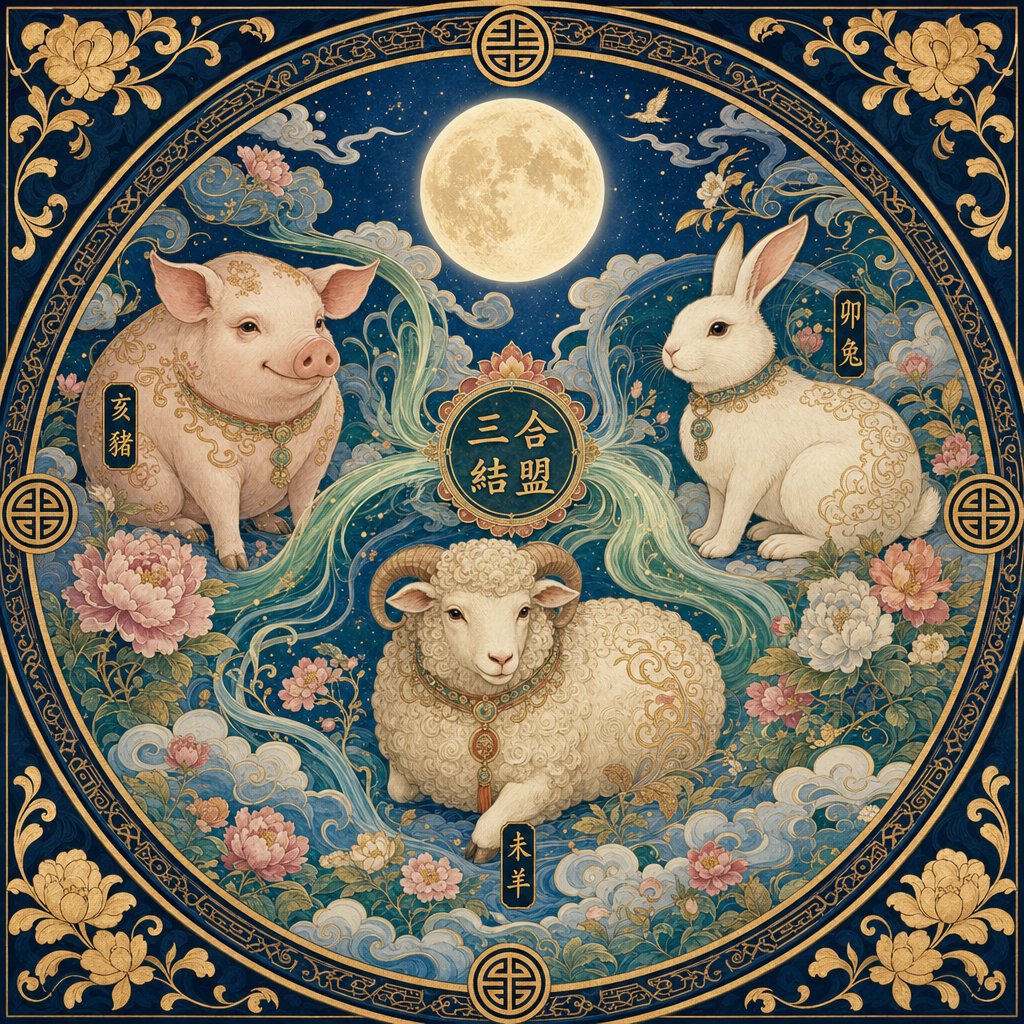
San He (三合), or the Three Harmonies, groups the twelve zodiac animals into four compatible triads. Each triad shares similar temperaments and values, creating a natural flow of mutual support. The Pig's triad partners are the Rabbit (卯) and Sheep (未), forming what's known as the Wood Frame harmony triangle.
Why does this matter for naming? These three animals are described as sharing compassion, creativity, and sensitivity. They prioritize harmony and excel at fostering peaceful, supportive environments. When you include radicals associated with the Rabbit or Sheep in a Pig year child's name, you're symbolically inviting that cooperative energy into their life, attracting allies, mentors, and harmonious relationships.
The pig rabbit sheep zodiac naming radicals derived from this triangle include:
- 月 (yue) - Moon/meat radical: The Rabbit is associated with the moon in Chinese mythology (the Jade Rabbit lives on the moon). Characters containing 月 carry Rabbit energy, bringing creativity, gentleness, and artistic sensitivity into the name. Examples: 朋 (peng, "friend"), 朗 (lang, "bright/clear"), 育 (yu, "to nurture"), 胜 (sheng, "victory").
- 卯-related components: Characters that contain structural elements echoing the Rabbit's earthly branch 卯 subtly invoke this alliance. The radical 卩 (seal) and characters with similar angular structures can carry this resonance.
- 未/羊 (sheep) components: The Sheep's presence in the triad means characters containing 羊 (yang, sheep) or its derivatives are auspicious. Examples: 美 (mei, "beautiful," which contains 羊 at the top), 善 (shan, "good/virtuous"), 祥 (xiang, "auspicious"), 洋 (yang, "ocean/vast").
- 艹 (grass radical): Since sheep eat grass, this radical carries a secondary Sheep association beyond its food symbolism. It does double duty for Pig names, working as both a nourishment radical and a compatibility radical.
Notice how 美 (beautiful) literally places a sheep (羊) at the top of the character. For a Pig year child, this character doesn't just mean beauty on the surface. It carries the embedded energy of the Pig's San He ally, quietly attracting the kind of harmonious relationships that the Sheep-Pig bond represents.
Liu He Secret Friend the Tiger
Liu He (六合), or the Six Harmonies, operates differently from San He. Instead of triads, it pairs the twelve zodiac animals into six deeply compatible duos. Think of it as a one-on-one bond rather than a group dynamic. The Pig's Liu He partner is the Tiger (寅), making this pairing what traditional practitioners call a "secret friend" relationship.
The liu he tiger pig radical connection is particularly interesting because the Tiger and Pig seem like opposites on the surface. The Tiger is bold, charismatic, and action-oriented. The Pig is generous, sincere, and open-hearted. Yet in classical Chinese astrology, their opposite traits create balance. One's strength offsets the other's shadow, producing a complementary dynamic that benefits both.
For naming purposes, Tiger-associated radicals bring courage, leadership, and decisive energy into a Pig year child's name, qualities that complement the Pig's natural gentleness without conflicting with it. Key radicals include:
- 木 (mu) - Wood radical: The Tiger's earthly branch 寅 belongs to the Wood element. Characters with 木 channel Tiger energy while also sitting in a neutral-to-positive position with the Pig's Water element (Water generates Wood). Examples: 林 (lin, "forest"), 柏 (bai, "cypress"), 桐 (tong, "paulownia tree"), 杰 (jie, "outstanding").
- 山 (shan) - Mountain radical: Tigers are king of the mountain. While 山 carries Earth element energy (which can conflict with Water), its Tiger association provides a counterbalancing benefit. Use it selectively when the name needs strength and authority. Examples: 岳 (yue, "great mountain"), 峰 (feng, "peak").
- 王 (wang) - King radical: The Tiger is traditionally called the king of beasts. However, this radical requires careful consideration for Pig names because 王 can also suggest jade offerings and sacrifice. Context and surrounding characters determine whether it reads as Tiger-allied strength or sacrificial risk.
- 衣/衤 (yi) - Clothing radical: A dressed tiger is a tiger of status and dignity. Characters with the clothing radical suggest refinement and social standing, qualities the Tiger's Liu He bond brings to the Pig. Examples: 裕 (yu, "abundant/wealthy"), 褀 (qi, "auspicious garment").
Compatibility Radicals in Practice
Here's where zodiac harmony radicals for pig year names become genuinely practical. You don't need to use all of them. The goal is to weave one or two compatibility-derived radicals into the name alongside your primary shelter or food radicals, creating a layered effect that addresses multiple dimensions of fortune.
A quick reference of all compatibility-derived radicals and their zodiac reasoning:
- 月 (moon/meat) - Rabbit alliance via San He. Brings creativity, social grace, and artistic talent.
- 羊 components (美, 善, 祥) - Sheep alliance via San He. Attracts kindness, virtue, and harmonious relationships.
- 木 (wood) - Tiger alliance via Liu He. Adds courage, growth energy, and leadership potential.
- 艹 (grass) - Sheep association plus food symbolism. Double benefit of nourishment and compatibility.
- 衤 (clothing) - Tiger dignity association. Suggests social status and refinement through the secret friend bond.
The practical impact? A name that includes compatibility radicals doesn't just align with the Pig's elemental needs. It symbolically programs the child's social world, attracting supportive people and cooperative dynamics throughout life. In traditional nameology, this is considered one of the most overlooked advantages because it addresses relationships rather than just individual fortune.
Compatibility radicals tell you who the Pig's friends are. But every zodiac animal also has adversaries, and the radicals associated with those adversaries carry a very different kind of energy. Understanding what to avoid is just as critical as knowing what to include, especially when some of the most commonly used characters in Chinese names contain hidden conflict radicals that most parents never recognize.
Radicals to Avoid and Common Pig Zodiac Naming Mistakes
Knowing which radicals to include is only half the equation. The other half, the part that catches parents off guard, is recognizing which radicals carry hidden conflict energy for a Pig year child. Some of the most popular characters in Chinese naming contain components that traditional nameology flags as problematic for the Pig zodiac. These aren't obscure characters either. They show up in everyday names, looking perfectly harmless on the surface while carrying symbolic tension underneath.
The radicals to avoid pig zodiac names fall into three distinct categories: zodiac clash radicals, sacrifice and blade radicals, and altar radicals. Each operates through a different mechanism, and understanding why they conflict matters more than memorizing a list.
Snake Clash Radicals to Avoid
The most significant conflict in the Pig's zodiac map is the 巳亥相冲 (Snake-Pig Clash), one of the six classical branch clashes in Chinese astrology. The Snake (巳) sits directly opposite the Pig (亥) on the earthly branch axis, creating what practitioners call a fire-water season-transition clash. The Snake represents yang fire and early summer, while the Pig represents yang water and early winter. When these two energies meet, they disrupt each other's natural momentum.
What does this mean for naming? Any radical or character component that evokes the Snake's form or energy introduces this clash dynamic into the name. The snake clash radicals pig year baby names should avoid include:
- 辶 (chuo) - Movement/walking radical: This radical's flowing, serpentine shape visually echoes the Snake's body. Characters built with 辶 include common ones like 道 (dao, "way"), 远 (yuan, "far"), 进 (jin, "advance"), and 连 (lian, "connect"). While these characters carry positive meanings, their radical structure invokes Snake energy that clashes with the Pig's branch.
- 弓 (gong) - Bow radical: The curved shape of a bow mirrors the Snake's coiled posture. Characters like 强 (qiang, "strong"), 张 (zhang, a common surname), and 弘 (hong, "grand") contain this radical. The bow also carries an implicit threat, something drawn taut and ready to strike, which conflicts with the Pig's peaceful nature.
- 廴 (yin) - Long stride radical: Another radical with an elongated, snake-like form. Found in characters like 建 (jian, "to build") and 延 (yan, "to extend"). Its stretched shape carries serpentine associations.
- 虫 (chong) - Insect/reptile radical: While literally meaning "insect," this radical covers all crawling creatures including snakes. Characters like 蛇 (she, "snake") obviously contain it, but so do less obvious ones like 虹 (hong, "rainbow") and 蝶 (die, "butterfly").
The Monkey (申) also holds a negative relationship with the Pig, classified as a "harm" (害) interaction rather than a direct clash. Monkey-associated radicals are less severe than Snake radicals but still worth noting. The Monkey connects to the Metal element and is associated with cleverness and restlessness. Radicals like 申 itself and characters with strong Monkey symbolism can introduce friction, though the effect is milder than the Snake clash.
Sacrifice and Blade Radicals That Harm Pig
Here's where cultural context becomes critical. In traditional Chinese society, pigs were among the primary animals offered in ritual sacrifices. The "three sacrificial animals" (三牲) used in ceremonies to honor ancestors and deities included the pig alongside the ox and sheep. This cultural reality means certain radicals carry a deeply unfortunate symbolism specifically for Pig zodiac names, even though they look perfectly fine for other zodiac signs.
The sacrifice radicals to avoid pig year names include:
- 王/玉 (wang/yu) - King/jade radical: Jade was the material of ritual offerings. A pig associated with jade or kingship isn't being honored. It's being prepared as an offering. Characters like 珍 (zhen, "precious"), 瑞 (rui, "auspicious"), and 琪 (qi, "fine jade") are extremely popular in Chinese names, but for Pig zodiac children, they carry the shadow of sacrificial symbolism. The pig becomes the offering rather than the beneficiary.
- 刀/刂 (dao) - Blade/knife radical: The connection is visceral and direct. Blades and pigs together evoke slaughter. Characters containing 刂 include 利 (li, "sharp/benefit"), 刚 (gang, "firm/strong"), 创 (chuang, "to create"), and 则 (ze, "rule"). These are common, well-meaning characters, but their blade radical introduces an energy of cutting and harm that conflicts with the Pig's need for safety.
- 示/礻 (shi) - Altar/ritual radical: This radical originally depicted an altar table used for sacrificial ceremonies. Characters with 示 or its variant 礻 include 祝 (zhu, "to wish/bless"), 祥 (xiang, "auspicious"), 福 (fu, "fortune"), and 礼 (li, "ritual/courtesy"). The irony is striking: 福 means "fortune" and 祥 means "auspicious," yet their radical places the Pig on the altar. For other zodiac signs, these characters are wonderful. For the Pig, they carry a double edge.
Notice how many beloved naming characters appear in these lists. That's precisely why this category of unlucky radicals for pig zodiac naming catches so many parents off guard. Characters like 瑞, 福, and 利 seem universally positive until you examine them through the lens of Pig-specific symbolism.
| Radical | Reason for Avoidance | Conflict Type | Severity Level |
|---|---|---|---|
| 辶 (movement) | Serpentine shape invokes Snake energy | 巳亥 Direct Clash (六冲) | High |
| 弓 (bow) | Curved form mirrors Snake's coiled body | Snake Association | Moderate-High |
| 虫 (insect/reptile) | Covers crawling creatures including snakes | Snake Association | Moderate |
| 廴 (long stride) | Elongated serpentine shape | Snake Association | Moderate |
| 王/玉 (king/jade) | Jade offerings; pig becomes the sacrifice | Sacrificial Symbolism | High |
| 刀/刂 (blade) | Evokes slaughter and butchering | Harm Symbolism | High |
| 示/礻 (altar) | Altar for ritual sacrifice; pig as offering | Sacrificial Symbolism | Moderate-High |
| 申 (Monkey branch) | Harm relationship with Pig | Zodiac Harm (害) | Moderate |
Common Misconceptions About Unfavorable Radicals
Does finding one problematic radical in a name you love mean you need to abandon it entirely? This is the most common pig zodiac naming mistake to avoid: treating radical analysis as an all-or-nothing system.
Traditional nameology doesn't work like a single veto. It operates on balance. A name with one moderate-conflict radical surrounded by two strongly auspicious radicals isn't "ruined." The supportive elements can outweigh and contain the tension. Think of it like a recipe: a pinch of salt doesn't make a cake salty. It's the overall proportion that determines the outcome.
Here's what actually matters in practice:
- Severity stacking is the real danger. One blade radical alone is manageable. A blade radical combined with a snake radical and no shelter or food radicals to counterbalance? That's where genuine concern arises. Multiple high-severity conflicts without supportive radicals create cumulative symbolic pressure.
- Position affects impact. A conflict radical in the surname (which parents can't change) carries less weight than one deliberately chosen for the given name. Nameologists focus their analysis on the characters parents actually select.
- Character meaning provides context. The character 利 contains a blade radical, but its meaning is "benefit" or "advantage." Some practitioners argue that positive semantic meaning partially offsets radical-level conflict. Others disagree. The point is that reasonable practitioners hold different views on borderline cases.
- The full BaZi chart matters more than the zodiac sign alone. A child's complete birth chart (year, month, day, and hour pillars) may reveal elemental needs that override general zodiac recommendations. A Pig year child whose chart desperately needs Fire energy might actually benefit from a Fire radical that general Pig naming rules would flag as cautionary.
The practical takeaway? Avoid stacking multiple high-severity conflict radicals in a single name. Prioritize eliminating blade and sacrifice radicals from your shortlist since their symbolism is the most viscerally negative for the Pig. Treat snake-associated radicals as a secondary filter. And if a character you love contains one moderate-conflict radical, look at the full name's balance before discarding it.
These avoidance principles apply broadly to all Pig year children. But not every Pig year is the same. The heavenly stem paired with the Pig's earthly branch creates five distinct elemental sub-types, each with slightly different radical needs and tolerances. A Wood Pig and a Fire Pig don't respond to the same radicals in identical ways, and that distinction is where truly personalized naming begins.
Element Sub-Types and Personalized Radical Selection
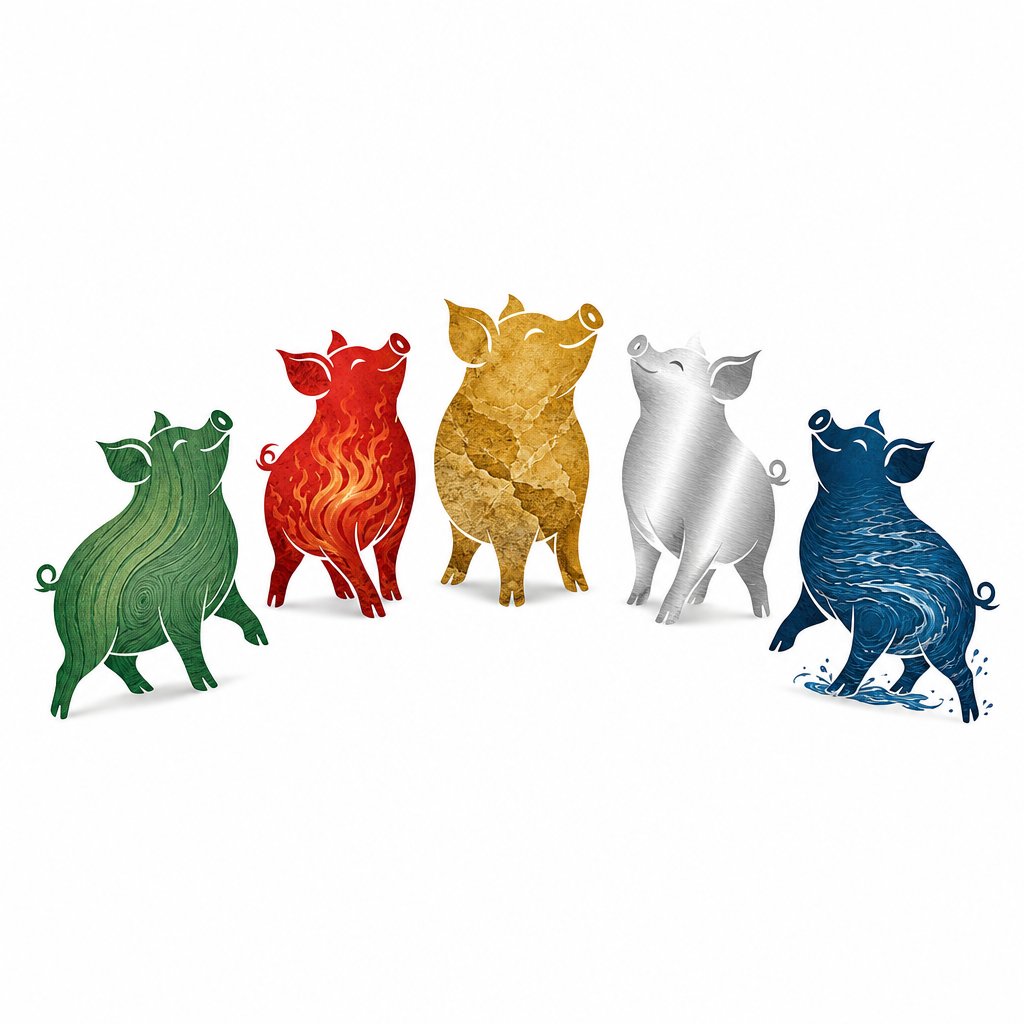
Not all Pig years carry the same elemental fingerprint. The heavenly stem paired with the Pig's earthly branch 亥 rotates through a sixty-year cycle, producing five distinct sub-types: Wood Pig, Fire Pig, Earth Pig, Metal Pig, and Water Pig. Each sub-type layers an additional element on top of the Pig's base Water nature, creating internal dynamics that shift radical priorities in meaningful ways.
Imagine two children both born in Pig years. One is a Wood Pig (1995, 2055) whose heavenly stem adds Wood energy to the Water foundation. The other is a Fire Pig (2007, 2067) whose stem introduces Fire, an element that Water naturally controls. These two children have different internal elemental tensions, and their names should reflect that. This is the pig zodiac element sub-type naming guide that most resources skip entirely.
Wood Pig and Fire Pig Radical Adjustments
The Wood Pig carries a naturally harmonious internal structure. Water feeds Wood in the productive cycle, so the base Water element nourishes the heavenly stem's Wood without conflict. The result? A personality described as determined, sympathetic, and socially connected. For wood pig year radical recommendations, the priority is maintaining strong Water flow so it can continue feeding the Wood element. Water radicals (氵, 雨) become especially important here because they sustain the generative relationship. Metal radicals (金, 钅) are equally valuable since Metal generates the Water that feeds Wood, creating a three-element productive chain: Metal → Water → Wood.
Wood radicals (木, 艹) sit in a unique position for this sub-type. They reinforce the heavenly stem directly, strengthening the Pig's outward expression of growth and creativity. For a Wood Pig specifically, grass and plant radicals do triple duty: food symbolism, Sheep compatibility, and direct elemental reinforcement.
The Fire Pig presents a trickier puzzle. Fire and Water exist in a controlling relationship, meaning the Fire Pig carries internal tension between its heavenly stem and earthly branch. People born in Fire Pig years (1947, 2007) are described as ambitious and hospitable but sometimes reliant on others during emergencies. The fire pig naming radicals to use should prioritize balance over reinforcement. Metal radicals become critical here because Metal generates Water (supporting the base) while also being controlled by Fire (giving the Fire stem something to engage with productively). Water radicals help anchor the Pig's foundation against the Fire stem's draining influence. Wood radicals can serve as a bridge element since Water feeds Wood and Wood feeds Fire, creating a smooth productive flow that resolves the internal tension rather than amplifying it.
What should a Fire Pig deprioritize? Additional Fire radicals (火, 灬). The sub-type already carries Fire energy from its heavenly stem. Stacking more Fire into the name intensifies the internal Water-Fire conflict rather than resolving it.
Earth Pig and Metal Pig Radical Preferences
The metal pig earth pig radical differences come down to how each sub-type's stem interacts with the base Water element.
Earth Pig children (2019, 2079) face an internal challenge: Earth dams Water in the controlling cycle. The heavenly stem's Earth energy restricts the earthly branch's Water flow, creating a personality that's industrious and grounded but sometimes overly cautious. To counteract this restriction, Earth Pig names benefit most from strong Metal radicals. Why? Metal weakens Earth (Earth generates Metal, draining Earth's controlling force) while simultaneously generating Water (freeing the Pig's base element). It's an elegant two-for-one solution. Water radicals also help by directly reinforcing what Earth is suppressing. Earth radicals (土, 山) should be deprioritized since they amplify the existing internal restriction.
The Metal Pig (1971, 2031) enjoys the most internally harmonious structure of all five sub-types. Metal generates Water in the productive cycle, meaning the heavenly stem actively feeds the earthly branch. These individuals are described as outgoing, broad-minded, and generous. Their naming is the most straightforward: both Metal and Water radicals reinforce an already-supportive internal dynamic. The Metal Pig can afford to be more adventurous with radical selection because the internal foundation is so stable. Wood radicals work well here as an outlet for the strong Water energy, channeling it into growth and expression rather than letting it pool.
Tiered Recommendation System for All Pig Types
Rather than treating every radical as equally important, think in three tiers:
- Tier 1 - Essential (all Pig sub-types): Shelter radicals (宀, 冖, 门, 广) and food radicals (禾, 米, 豆, 艹, 口, 田). These work universally because they align with the Pig's animal nature regardless of elemental sub-type.
- Tier 2 - Element-specific (based on birth year): Radicals that address the unique internal dynamic of each sub-type. A Fire Pig needs Metal and Water. An Earth Pig needs Metal. A Wood Pig benefits from Water and Wood. These are the personalized adjustments that fine-tune a name beyond generic recommendations.
- Tier 3 - Bonus (compatibility-based): San He radicals (月, 羊 components) and Liu He radicals (木, 衤). These add relational fortune and social harmony. They're beneficial for all sub-types but carry less weight than Tier 1 and Tier 2 selections.
| Pig Sub-Type | Years | Internal Dynamic | Priority Radicals to Add | Radicals to Deprioritize |
|---|---|---|---|---|
| Wood Pig (乙亥) | 1995, 2055 | Water feeds Wood (harmonious) | 氵, 雨, 金/钅, 木, 艹 | 火, 灬 (Fire drains Wood) |
| Fire Pig (丁亥) | 2007, 2067 | Water controls Fire (tense) | 金/钅, 氵, 木 (bridge element) | 火, 灬 (amplifies internal conflict) |
| Earth Pig (己亥) | 2019, 2079 | Earth dams Water (restrictive) | 金/钅, 氵, 雨 | 土, 山 (amplifies restriction) |
| Metal Pig (辛亥) | 1971, 2031 | Metal generates Water (very harmonious) | 金/钅, 氵, 木 (outlet for Water) | 火 (melts Metal, disrupts flow) |
| Water Pig (癸亥) | 1983, 2043 | Double Water (intensified) | 木, 艹 (drains excess Water), 金/钅 | 土 (dams Water), excess 氵 (overflow) |
The Water Pig deserves a quick note. With double Water energy from both the heavenly stem and earthly branch, these individuals carry intensified Water qualities: cleverness, eloquence, and strong social instincts, but also potential stubbornness. Their names benefit from Wood radicals that channel the abundant Water into productive growth, preventing the energy from becoming stagnant or overwhelming. Too many additional Water radicals can tip the balance toward excess.
This tiered system gives you a decision-making framework rather than a flat list. Start with Tier 1 universals, layer in Tier 2 adjustments based on your child's specific birth year element, and add Tier 3 compatibility radicals as the finishing touch. The result is a name calibrated not just to the Pig zodiac in general, but to your child's particular elemental composition.
Knowing which radicals to prioritize at each tier is the strategic foundation. The next challenge is assembling those radicals into an actual name, balancing two characters that complement each other while respecting positional weight, gender conventions, and the practical constraints of building a name that sounds as good as it reads.
Building Balanced Names With Multiple Auspicious Radicals
Having a toolkit of favorable radicals is one thing. Assembling them into a name that actually works, where characters complement each other, sound pleasing together, and carry layered meaning, is where theory meets craft. Most parents stall at this stage because they're unsure how to combine radicals pig zodiac naming principles recommend into a cohesive two-character given name that feels natural rather than formulaic.
Here's the reality: a Chinese given name is typically one or two characters long, with two-character given names making up more than 80% of Chinese names today. Each character position carries distinct symbolic weight, and understanding that positional logic transforms radical selection from a guessing game into a deliberate, structured process.
Pairing Radicals for Two-Character Given Names
The strongest Pig zodiac names don't rely on a single auspicious radical repeated twice. They pair radicals from different categories to create complementary energy. Think of it like a meal: you wouldn't serve two starches. You'd pair a grain with a protein for balance.
Effective two character name radicals pig year parents use tend to follow these pairing patterns:
- Shelter + Food: A 宀 (roof) character paired with a 禾 (grain) or 米 (rice) character. The first provides safety, the second provides sustenance. Example: 宏秀 (hong xiu) combines "grand" (shelter radical) with "elegant" (grain radical), creating a name that means "magnificently refined" while embedding both protection and abundance.
- Shelter + Metal: A 宀 character paired with a 钅 (metal) character. Protection meets elemental generation. Example: 安铭 (an ming) pairs "peace" (roof radical) with "inscribed" (metal radical), suggesting someone whose tranquil nature leaves a lasting impression.
- Food + Compatibility: A 艹 (grass) character paired with a 月 (moon) character. Nourishment meets Rabbit alliance energy. Example: 芳朗 (fang lang) combines "fragrance" (grass radical) with "bright" (moon radical), blending natural vitality with social clarity.
- Metal + Water: A 钅 character paired with a 氵 (water) character. The productive cycle in action, Metal generating Water. Example: 锦泽 (jin ze) pairs "brocade" (metal radical) with "marsh/grace" (water radical), creating a name that means "splendid grace" while the elemental relationship flows naturally from parent to child element.
The key principle? Each character should bring something different to the table. Doubling up on the same radical category (two food radicals, for instance) isn't harmful, but it misses the opportunity to cover more symbolic ground.
Positional Influence of First Versus Second Characters
In traditional Chinese nameology, the two positions in a given name aren't interchangeable. The first given name character (the one immediately following the surname) represents the person's external presentation, how they appear to the world, their social persona, and outward personality. The second character represents inner nature, private values, emotional core, and the self that only close relationships see.
This positional logic has practical implications for radical placement:
- First position (external): Shelter and metal radicals work powerfully here. They project stability, strength, and security outward. A roof radical in the first position signals to the world that this person is grounded and protected. A metal radical here suggests someone who presents as sharp, clear, and decisive.
- Second position (internal): Food, water, and compatibility radicals shine in this spot. They nourish the inner self. A grain radical in the second position suggests someone whose private life is abundant and satisfied. A water radical here reinforces the Pig's deep emotional intelligence and intuitive nature at the core level.
Consider the name 宇泽 (yu ze). The first character 宇 (universe/eaves) carries the roof radical 宀, projecting expansive protection outward. The second character 泽 (grace/marsh) carries the water radical 氵, reinforcing the Pig's Water element at the deepest internal level. The name reads as "someone whose broad, sheltered presence conceals deep reserves of grace." Both radicals are auspicious for the Pig, and their positions amplify their respective strengths.
Contrast this with reversing the order: 泽宇 (ze yu). Still a valid name, still containing the same auspicious radicals, but the symbolic emphasis shifts. Water now leads externally (projecting fluidity and adaptability) while shelter anchors internally (suggesting a private need for security). Neither arrangement is wrong, but they tell different stories about the person.
Gender Considerations in Radical Choice
Traditional Chinese naming has long associated certain radicals with masculine or feminine energy. Research on Chinese naming patterns shows that characters connoting strength and ambition historically skew male, while characters evoking beauty and elegance skew female. For gender specific radicals pig year baby names, these conventions still influence many families' choices, though modern naming increasingly crosses these boundaries.
Traditional masculine preferences for Pig zodiac names:
- Metal radicals (金, 钅): Characters like 铭 (inscribe), 锋 (vanguard), and 钧 (ancient unit of weight) carry assertive, decisive energy traditionally associated with male names.
- Wood radicals (木): Characters like 杰 (outstanding), 林 (forest), and 柏 (cypress) suggest upright strength and endurance.
- Shelter radicals with grandeur: 宏 (grand), 宇 (universe), and 冠 (champion) project ambition within a protected framework.
Traditional feminine preferences for Pig zodiac names:
- Grass/plant radicals (艹): Characters like 芳 (fragrance), 莉 (jasmine), 菲 (luxuriant), and 蕊 (pistil) evoke natural beauty and delicacy.
- Water radicals (氵): Characters like 洁 (pure), 涵 (contain/cultivate), and 淑 (gentle/virtuous) suggest refined, flowing femininity.
- Moon radical (月): Characters like 朦 (hazy moonlight) and names incorporating lunar imagery carry soft, artistic associations.
That said, these boundaries are softening. The same research notes that after the 1980s, gender-neutral radicals became increasingly common, with daughters receiving characters previously reserved for sons, like 佳 (excellent) and 晓 (knowing). For Pig zodiac naming specifically, the auspicious quality of a radical matters more than its gendered associations. A girl named 安铭 (peaceful inscription) carries just as much zodiac harmony as a boy with the same name. The radicals don't care about gender; they respond to the earthly branch.
The pig zodiac naming step by step method that brings all of this together looks like this:
- Identify the birth year element. Determine whether your child is a Wood, Fire, Earth, Metal, or Water Pig. This sets your Tier 2 radical priorities from the previous framework.
- Select a primary radical category. Choose your anchor: shelter, food, metal, or water. This becomes the dominant energy in the name. For most Pig sub-types, shelter (宀) or metal (钅) makes the strongest primary choice.
- Choose a complementary secondary radical. Pair your primary with a radical from a different category. If your primary is shelter, complement with food or water. If your primary is metal, complement with shelter or a compatibility radical. Avoid doubling the same category unless you have a specific reason.
- Verify no clash radicals are present. Check both characters for hidden snake radicals (辶, 弓), blade radicals (刂), and sacrifice radicals (王/玉, 示/礻). A single moderate-conflict radical isn't fatal, but two or more without counterbalance should prompt reconsideration.
- Check stroke count harmony. Total the strokes in the full name (surname plus given name). Traditional numerology assigns auspicious or inauspicious values to certain totals. While this is a secondary consideration, it's worth a quick check before finalizing.
- Test sound and meaning together. Read the full name aloud. Does it flow? Does the tonal pattern avoid awkward combinations? Does the combined meaning of both characters create a coherent aspiration rather than a contradictory message?
Here's this method applied to a complete name construction. Imagine naming an Earth Pig girl (born 2019). Her Tier 2 priority is Metal radicals to counteract Earth's restriction on Water:
- Surname: 林 (lin) - inherited, contains 木 (wood radical). Neutral for Pig, positive as Tiger/Liu He association.
- First given name character: 安 (an) - "peace." Contains 宀 (roof radical). Tier 1 shelter energy in the external position. Projects calm stability to the world.
- Second given name character: 铃 (ling) - "bell." Contains 钅 (metal radical). Tier 2 element-specific choice addressing the Earth Pig's need for Metal. Placed internally, it generates Water at the core level while adding clarity and brightness.
- Full name: 林安铃 (Lin Anling). Radical analysis: Wood (surname, neutral-positive) + Shelter (first position, Tier 1) + Metal (second position, Tier 2). No clash radicals present. The name means "peaceful bell in the forest," evoking a serene, clear-toned presence sheltered by nature.
Another example for a Metal Pig boy (born 1971 or 2031):
- Surname: 王 (wang) - inherited. Contains the king/jade radical, which is flagged as sacrificial for Pig. Since it's a surname and can't be changed, the given name must compensate with strong supportive radicals.
- First given name character: 宏 (hong) - "grand." Contains 宀 (roof radical). Tier 1 shelter energy counterbalances the surname's sacrificial association by placing the Pig firmly under protective cover.
- Second given name character: 泽 (ze) - "grace/marsh." Contains 氵 (water radical). Reinforces the Pig's base Water element internally. For a Metal Pig whose stem already generates Water, this creates a flowing, abundant internal reservoir.
- Full name: 王宏泽 (Wang Hongze). Radical analysis: King/jade (surname, compensated) + Shelter (first position, Tier 1) + Water (second position, elemental reinforcement). The shelter radical in the first given name character acts as a buffer, symbolically placing the Pig under a roof before any sacrificial association can take hold. The name means "grand grace of the Wang family."
These examples show how the method works in practice: each decision traces back to a specific principle, whether it's elemental sub-type needs, positional logic, or clash avoidance. The name isn't assembled randomly. It's engineered layer by layer, with each radical earning its place through a clear rationale.
Of course, not every family wants or needs this level of traditional rigor. Some parents prefer a lighter touch, keeping just the most impactful rules while focusing primarily on meaning and sound. The question becomes: how much of this system do you actually need to follow for it to matter? That depends on where you fall on the spectrum between strict traditional practice and modern flexibility.
Practical Framework for Modern Pig Zodiac Naming
Every family sits somewhere different on the tradition spectrum. Some want full classical rigor. Others just want to avoid obvious pitfalls. Both approaches are valid, and neither requires you to become a nameology scholar overnight. What matters is choosing a level of engagement that feels right for your family and applying it consistently. Here's a practical chinese naming framework pig year parents can use at any depth.
Strict Traditional Naming Approach
The full traditional method treats naming as a multi-dimensional optimization problem. You're satisfying radical harmony, elemental sub-type needs, zodiac compatibility, positional logic, stroke count numerology, tonal flow, and literary meaning all at once. Families who follow this path typically consult a professional nameologist or spend weeks cross-referencing candidates against every rule covered in this guide.
At this level, stroke count numerology pig year names become a serious filter. Traditional Chinese naming practice assigns auspicious or inauspicious values to the total stroke count of a full name (surname plus given name combined). Favorable totals include 3, 5, 6, 7, 8, 11, 13, 15, 16, 17, 18, 21, 23, 25, 29, 31, 32, 33, 37, 39, 45, 47, 48, 52, 63, 65, 67, 68, 73, and 81. The name must also balance Yin and Yang through its stroke pattern: characters with even strokes are Yin, odd strokes are Yang, and the three characters should follow patterns like Yang-Yang-Yin or Yin-Yang-Yang rather than all-Yin or all-Yang combinations.
This approach produces names that satisfy every classical criterion. It's thorough, but it dramatically narrows the pool of viable characters.
Moderate and Minimal Compliance Options
Most modern parents land in the moderate zone. The moderate approach keeps the highest-impact rules while relaxing the more granular ones. In practice, this means: prioritize shelter radicals (宀, 门, 冖, 广) and food radicals (禾, 米, 豆, 艹) as your primary selection pool, include at least one Metal or Water radical for elemental support, and avoid high-severity clash radicals (辶, 刂, 王/玉 in combination with 示). Skip stroke count numerology unless a candidate name happens to hit a favorable total naturally.
The minimal approach distills everything into one simple radical rule pig zodiac baby parents can remember: avoid sacrifice and blade radicals. That's it. If you do nothing else, eliminating characters with 刂 (blade), 示/礻 (altar), and 王/玉 (jade/king) from your shortlist removes the most symbolically harmful components for a Pig year child. This single filter catches the worst conflicts while leaving you maximum creative freedom for meaning, sound, and personal preference.
Stroke Count Numerology Basics
For parents curious about stroke count but not ready to commit fully, here's the quick version. Count every stroke in your child's full name, surname included. If the total lands on one of the traditionally favorable numbers listed above, consider it a bonus. If it doesn't, don't panic. Stroke count is one layer among many, and comprehensive naming practice treats it as a secondary consideration behind sound, meaning, form, and elemental balance.
The Yin-Yang stroke pattern matters slightly more than the raw total. Aim for alternation rather than uniformity. A name where all three characters have odd stroke counts (Yang-Yang-Yang) lacks balance. Mixing even and odd across the three positions creates the rhythmic contrast that traditional numerology values.
Radical selection is one component of a holistic naming practice. It works best when combined with sound, meaning, visual balance, and personal intention rather than treated as the sole deciding factor.
Regardless of which tier you choose, keep this essential radicals list as your quick reference:
- Shelter radicals (宀, 门, 冖, 广): The single most auspicious category. A pig under a roof is a pig that prospers.
- Food radicals (禾, 米, 豆, 艹, 口, 田): Signal lifelong abundance and material comfort.
- Metal radicals (金, 钅): Generate the Pig's Water element through the productive cycle.
- Water radicals (氵, 水, 雨): Reinforce the Pig's innate elemental identity.
- Compatibility radicals (月, 木, 羊 components): Attract harmonious relationships through San He and Liu He alliances.
- Avoid with priority: Blade (刂), altar/sacrifice (示/礻), jade (王/玉), and snake-form (辶, 弓) radicals.
The best name for a Pig year child isn't the one that checks every traditional box. It's the one that balances cultural wisdom with personal meaning, sounds beautiful when spoken aloud, looks elegant when written, and carries an aspiration the child can grow into. Radicals provide the structural foundation. Sound, meaning, and parental intention build the rest. Use this modern pig zodiac naming guide for parents as a compass rather than a cage, and you'll land on a name that honors tradition without being imprisoned by it.
Frequently Asked Questions About Chinese Name Radicals for Pig Zodiac
1. What are the most auspicious radicals for a Pig zodiac baby name?
Shelter radicals (宀, 门, 冖, 广) rank as the single most favorable category because a pig under a roof symbolizes prosperity in Chinese culture. The character 家 (home) itself combines a roof with a pig. Food radicals (禾, 米, 豆, 艹) come second, signaling lifelong abundance. Metal radicals (金, 钅) are also highly beneficial because Metal generates the Pig's Water element through the Five Elements productive cycle, actively strengthening the child's innate elemental identity.
2. Which radicals should be avoided in Pig zodiac names and why?
Three categories carry the highest risk. Blade radicals (刀, 刂) evoke slaughter imagery. Altar and sacrifice radicals (示, 礻) place the Pig symbolically on a ceremonial offering table. Jade radicals (王, 玉) suggest the pig is being prepared as a ritual offering rather than being honored. Snake-associated radicals like 辶 (movement) and 弓 (bow) trigger the Snake-Pig direct clash (巳亥相冲), introducing conflict energy. However, one moderate-conflict radical surrounded by supportive ones does not ruin a name — overall balance matters more.
3. How does the Five Elements theory affect radical selection for Pig year names?
The Pig's earthly branch 亥 belongs to the Water element, which becomes the reference point for all radical decisions. In the productive cycle, Metal generates Water, making Metal radicals powerful supporters. Water radicals reinforce the Pig's innate nature directly. In the destructive cycle, Earth dams Water and creates restriction, while Fire sits in a controlling tension with Water. This means Earth and Fire radicals should be used cautiously, especially when multiple conflict radicals appear without supportive counterbalance in the same name.
4. Does the specific Pig year element (Wood Pig, Fire Pig, etc.) change which radicals to use?
Yes, significantly. Each sixty-year cycle produces five Pig sub-types with different internal elemental dynamics. An Earth Pig (2019) benefits most from Metal radicals because Metal weakens the restrictive Earth stem while generating Water. A Fire Pig (2007) needs Metal and Water radicals to resolve internal Water-Fire tension, and should avoid adding more Fire radicals. A Water Pig (1983) already carries double Water energy and benefits from Wood radicals that channel excess Water into growth. Identifying your child's sub-type allows you to fine-tune beyond generic Pig recommendations.
5. Can I use a character with an unfavorable radical if it has a positive meaning?
Traditional nameology operates on balance rather than a single-veto system. A character like 利 (benefit) contains a blade radical, but some practitioners argue its positive meaning partially offsets the radical-level conflict. The real danger is severity stacking — combining multiple high-conflict radicals without supportive ones to counterbalance. If you love a character with one moderate-conflict radical, evaluate the full name's radical composition. Surround it with strongly auspicious radicals from shelter, food, or metal categories to maintain overall harmony.