What Are Chinese Animal Nicknames and Why They Matter
When you hear "chinese animal nicknames," you might picture someone naming their golden retriever "Bao Bao." That's not quite what we're talking about here. Chinese animal nicknames are a linguistic phenomenon baked into the language itself, where animals earn playful, descriptive, or culturally loaded names that Chinese speakers use every day in conversation, online posts, and literature.
What Makes Chinese Animal Nicknames Unique
Chinese constructs animal names in ways English simply doesn't. Rather than borrowing Latin roots or adopting foreign words wholesale, Mandarin often builds animal names from vivid, character-by-character descriptions. The result? Names that paint a picture the moment you read them.
Consider 河马 (he ma) - literally "river horse." That's the standard Chinese word for hippopotamus. Two characters, one instant mental image. English borrowed "hippopotamus" from Greek (which also means river horse), but the meaning is buried. In Chinese, it's right there on the surface.
This descriptive quality means that many animal names in Chinese already function like nicknames, blurring the line between formal terminology and colloquial expression in ways that surprise language learners.
Formal Names vs Everyday Nicknames
Chinese distinguishes between formal written names (学名/书面语) and colloquial nicknames (昵称/绰号). Much like how vernacular names (俗名) differ from scientific names (学名) in taxonomy, everyday Chinese speakers toggle between registers depending on context. A pet in Chinese conversation might be called 毛孩子 (furry child) online but referenced by its species name in a veterinary clinic.
This layered naming system means Chinese pets and their wild counterparts carry multiple identities. A single animal might have a formal name for textbooks, a folk name from centuries of oral tradition, and a brand-new internet nickname coined last week on Douyin. Understanding how these layers work gives you a window into Chinese culture that vocabulary lists alone never provide.
What follows covers the full spectrum: the linguistic patterns that shape these names, the folklore and zodiac traditions behind them, the explosion of internet-era slang for every chinese pet imaginable, and the surprisingly sharp metaphors Chinese speakers use when they turn animal names into commentary on human behavior.
Linguistic Patterns Behind Chinese Animal Nicknames
Every language has its own logic for naming animals, but Mandarin takes a particularly visual approach. Instead of borrowing scientific Latin or importing foreign words, Chinese builds animal names in mandarin from smaller meaningful parts, almost like assembling a tiny poem. These naming patterns fall into four distinct categories, and once you recognize them, you'll start decoding unfamiliar animal names on sight.
Descriptive Compound Nicknames
The most common pattern stacks two or three characters together, each describing a physical trait, habitat, or behavior. You already saw 河马 (he ma, river-horse) for hippopotamus. This isn't an exception; it's the rule. Chinese speakers look at an animal, identify its most striking features, and compress that observation into a compact compound.
Imagine seeing a giraffe for the first time. What stands out? The impossibly long neck. Chinese captures exactly that: 长颈鹿 (chang jing lu) breaks down to "long-neck-deer." A porcupine becomes 豪猪 (hao zhu), literally "quill-pig." Each name tells a micro-story about the animal's appearance or where it lives.
Onomatopoeic and Sound-Based Names
Some animals earn their chinese pet names directly from the sounds they make. The cuckoo bird is called 布谷鸟 (bu gu niao), where 布谷 mimics its distinctive two-note call and 鸟 simply means "bird." Similarly, the cat's formal name 猫 (mao) itself echoes the onomatopoeic sound 喵 (miao) that cats produce. These sound-based names stick because they're instantly memorable. You hear the animal inside the word.
Metaphorical Animal Names
The third pattern gets creative. Rather than describing what an animal looks like objectively, it compares the animal to something else entirely. An owl becomes 猫头鹰 (mao tou ying): "cat-head-eagle." Look at an owl's flat face and round eyes, and you'll see the cat resemblance immediately. A bat is 蝙蝠 (bian fu), but colloquially referenced through its parts that evoke "flat-blessing" in folk etymology. These metaphorical pet names in chinese reveal how speakers perceive animals through cultural and visual associations rather than strict biology.
A fourth, less common pattern involves abbreviations, where longer formal names get clipped for everyday use. 鳄鱼 (e yu, crocodile) is sometimes shortened to just 鳄 in compound expressions, and modern breed names frequently get trimmed in casual speech.
| Pattern Type | Chinese | Pinyin | Literal Breakdown | Actual Animal |
|---|---|---|---|---|
| Descriptive Compound | 长颈鹿 | chang jing lu | long + neck + deer | Giraffe |
| Descriptive Compound | 河马 | he ma | river + horse | Hippopotamus |
| Descriptive Compound | 豪猪 | hao zhu | quill + pig | Porcupine |
| Descriptive Compound | 食蚁兽 | shi yi shou | eat + ant + beast | Anteater |
| Onomatopoeic | 布谷鸟 | bu gu niao | bu-gu (call) + bird | Cuckoo |
| Onomatopoeic | 知了 | zhi liao | zhi-liao (call sound) | Cicada |
| Metaphorical | 猫头鹰 | mao tou ying | cat + head + eagle | Owl |
| Metaphorical | 狮子狗 | shi zi gou | lion + dog | Pekingese/Shih Tzu |
| Abbreviation | 鳄 | e | short for 鳄鱼 | Crocodile |
| Abbreviation | 犀 | xi | short for 犀牛 | Rhinoceros |
You'll notice these patterns often overlap. 猫头鹰 is both metaphorical (comparing an owl's face to a cat) and descriptive (noting it's a raptor like an eagle). That layering is part of what makes these names so rich. They pack cultural perception, physical observation, and linguistic economy into just a few characters.
These structural patterns didn't appear in a vacuum, though. Many trace back centuries to folklore, mythology, and the Chinese zodiac, where animals accumulated layers of personality and symbolism that still shape how they're named today.

Traditional Nicknames From Folklore and Chinese Zodiac
Centuries before the internet coined new slang, Chinese folklore and classical literature were already giving animals vivid alternate identities. These traditional nicknames carry mythological weight, moral lessons, and personality archetypes that remain deeply embedded in how Chinese speakers talk about animals today. If you've ever encountered asian pet names drawn from mythology, chances are they trace back to these roots.
Animal Nicknames From Chinese Mythology
Chinese mythology assigned certain animals elevated, almost sacred nicknames that set them apart from their everyday counterparts. The most iconic example is the 玉兔 (yu tu, Jade Rabbit), the mythical rabbit said to live on the moon, grinding herbs with a mortar and pestle. This nickname is so culturally embedded that China named its first lunar rover "Jade Rabbit" in direct homage. When someone says 玉兔, they're not talking about a regular bunny. They're invoking a celestial symbol of grace and quiet devotion.
Other mythological animal nicknames include 神龟 (shen gui, divine turtle), representing longevity and cosmic wisdom, and 凤凰 (feng huang, phoenix), the queen of all birds and a symbol of virtue and harmony. Dragons carry the nickname 神龙 (shen long, divine dragon), but the snake earns a fascinating alternate identity: 小龙 (xiao long, little dragon), elevating a creature many cultures fear into something almost noble.
Foxes, meanwhile, earned a far less flattering mythological nickname. 狐狸精 (hu li jing) literally means "fox spirit" and refers to a shape-shifting seductress in countless folk tales. Call someone a 狐狸精 today and you're calling them a manipulative temptress. The nickname stuck so firmly that it jumped from mythology straight into modern insult vocabulary.
Tigers hold a special place in classical literature too. In the 14th-century novel Water Margin (水浒传), tigers are called 大虫 (da chong, big bug), an archaic nickname that sounds almost comically understated for such a fearsome predator. This classical term persists as a literary reference, reminding readers that chinese animal nicknames often carry historical layers invisible to casual learners.
Zodiac Animals and Their Personality Nicknames
The Chinese zodiac assigns each of its twelve animals a distinct personality profile, and these associations function as built-in nicknames. When someone is born in a particular year, they inherit that animal's cultural reputation, almost like a personality tag. Many people searching for asian names for pets draw directly from these zodiac archetypes, choosing names that reflect desired traits like loyalty, cleverness, or strength.
- 鼠 (shu, Rat) - The clever schemer. Symbolizes intelligence, resourcefulness, and wealth.
- 牛 (niu, Ox) - The tireless worker. Represents diligence, honesty, and quiet perseverance.
- 虎 (hu, Tiger) - The bold leader. Embodies courage, vitality, and sometimes a wild temperament.
- 兔 (tu, Rabbit) - The gentle soul. Associated with graciousness, kindness, and elegance.
- 龙 (long, Dragon) - The supreme symbol. Carries power, imperial authority, and extraordinary good fortune.
- 蛇 (she, Snake) - The quiet mystic. Known as 小龙 (little dragon), linked to wisdom and foresight.
- 马 (ma, Horse) - The noble spirit. Represents faithfulness, freedom, and tireless energy.
- 羊 (yang, Goat/Sheep) - The peaceful artist. Symbolizes good luck, creativity, and gentleness.
- 猴 (hou, Monkey) - The mischievous genius. Tied forever to the Monkey King, Sun Wukong (孙悟空), embodying cleverness and rebellion.
- 鸡 (ji, Rooster) - The proud announcer. Stands for honesty, confidence, and moral courage.
- 狗 (gou, Dog) - The loyal companion. Represents sincere friendship and unwavering support.
- 猪 (zhu, Pig) - The joyful optimist. Symbolizes wealth, prosperity, and a carefree spirit.
These zodiac personality nicknames aren't just trivia. They actively shape how Chinese speakers describe people, choose oriental pet names, and even make life decisions. Some families time pregnancies to land on favorable zodiac years, particularly the Dragon, while avoiding years like the Goat that carry less desirable associations in popular belief.
What's remarkable is how these ancient archetypes didn't fade with modernization. Instead, they evolved. The same zodiac personalities and mythological nicknames that filled classical poetry now fuel a completely different creative engine: Chinese internet culture, where animals have been rebranded with an entirely new generation of slang.
Modern Internet Slang and Social Media Animal Nicknames
Chinese internet culture didn't just adopt the old zodiac archetypes. It built an entirely new vocabulary from scratch, one that treats pets as alien visitors, owners as servants, and huskies as lovable idiots. If you spend five minutes scrolling Weibo or Douyin, you'll encounter chinese animal nicknames that no textbook has ever taught you, terms so widely used they've essentially replaced formal animal names in casual online conversation.
Internet Slang Nicknames for Cats and Dogs
The two most iconic examples set the tone for everything that followed. Cats became 喵星人 (miao xing ren), which breaks down to "meow-planet-person." Dogs became 汪星人 (wang xing ren), or "woof-planet-person." The joke? Pets are aliens from distant planets who've infiltrated human homes. It sounds absurd, and that's exactly the point. The humor signals affection. When Chinese speakers call a cute chinese dog a 汪星人, they're wrapping their love in playful absurdity rather than straightforward sentimentality.
Then there's 二哈 (er ha), the universally recognized chinese dog name for huskies. 二 (er) here doesn't mean "two" in the mathematical sense. It's slang for "silly" or "dopey," and 哈 is clipped from 哈士奇 (ha shi qi, the phonetic transliteration of "husky"). So 二哈 essentially means "the silly husky," a nickname that perfectly captures the breed's reputation for dramatic facial expressions and chaotic energy. Any husky owner scrolling through cute asian dog names on Chinese social media will find 二哈 dominating the conversation.
Social Media Pet Culture Vocabulary
Beyond individual animal nicknames, Chinese internet culture generated an entire ecosystem of pet-related slang. These terms describe the relationship between humans and animals in ways that feel fresh and emotionally specific.
铲屎官 (chan shi guan) is perhaps the most beloved. It translates literally to "poop-shoveling officer," and it's what pet owners call themselves. The term is self-deprecating on purpose. You're not a proud pet parent in this framing. You're a humble servant whose primary job is cleaning up after your furry overlord. The nickname flips the power dynamic, positioning the pet as royalty and the human as staff.
毛孩子 (mao hai zi, "furry child") takes a different emotional angle. It frames pets as family members, specifically as children. Parents who use this term are signaling that their pet holds the same emotional weight as a human kid. Meanwhile, 神兽 (shen shou, "divine beast") gets used with heavy irony. Originally a term for mythological creatures, it now refers humorously to mischievous pets or unruly children during school holidays, the implication being that these little monsters are as hard to control as legendary beasts.
| Nickname | Pinyin | Literal Translation | Actual Meaning | Platform of Origin |
|---|---|---|---|---|
| 喵星人 | miao xing ren | meow-planet-person | Cat (as an alien visitor) | Weibo / forums |
| 汪星人 | wang xing ren | woof-planet-person | Dog (as an alien visitor) | Weibo / forums |
| 二哈 | er ha | silly husky | Husky (affectionately dumb) | Weibo / Douyin |
| 铲屎官 | chan shi guan | poop-shoveling officer | Pet owner | Weibo / Tieba |
| 毛孩子 | mao hai zi | furry child | Pet (as a family member) | WeChat / Weibo |
| 神兽 | shen shou | divine beast | Mischievous pet or child | Weibo / Douyin |
| 主子 | zhu zi | master / boss | Cat (as household ruler) | Weibo / Bilibili |
| 小可爱 | xiao ke ai | little cutie | Any adorable pet | Douyin / Xiaohongshu |
Why These Nicknames Went Viral
What makes these terms spread so fast? Three factors converge. First, they're compact. Chinese internet slang thrives on brevity, and two-to-three character nicknames fit perfectly into comment sections and video captions. Second, they carry emotional coding. Calling your dog a 汪星人 instead of just 狗 (gou, dog) signals that you belong to pet-lover culture. It's an in-group marker, a way of saying "I get it, I'm one of you." Third, they're inherently shareable. The humor in terms like 铲屎官 makes people want to repost and tag friends.
Context matters too. Chinese speakers don't use these nicknames everywhere. In a vet's office, you'd say 狗 or 猫 (mao, cat). In a biology class, you'd use the formal species name. But the moment you open Douyin, post a photo on Xiaohongshu, or chat with friends on WeChat about your pet, the internet vocabulary takes over completely. The switch is automatic and socially calibrated. Using formal names in casual pet conversations would feel stiff, almost cold, like calling your best friend by their full legal name.
This internet slang layer keeps growing. New nicknames emerge every few months as viral videos introduce fresh jokes and memes. But certain breeds have accumulated so many nicknames that they deserve their own breakdown, starting with the dogs that dominate Chinese social media feeds.
Popular Chinese Nicknames for Dogs by Breed
Some breeds don't just have one chinese dog name. They accumulate layers of nicknames, shortened forms, and personality-driven labels that tell you exactly how Chinese speakers perceive them. Whether it's a husky's chaotic energy or a corgi's stubby-legged charm, each breed's reputation gets compressed into a few characters that everyone instantly recognizes.
Breed-Specific Dog Nicknames in Chinese
Chinese dog names follow a pattern you'll notice quickly: the more popular a breed becomes online, the more nicknames it collects. Formal breed names tend to be phonetic transliterations from English or descriptive compounds, but everyday conversation clips these down to punchy two-character shortcuts. Here's how the most popular breeds break down:
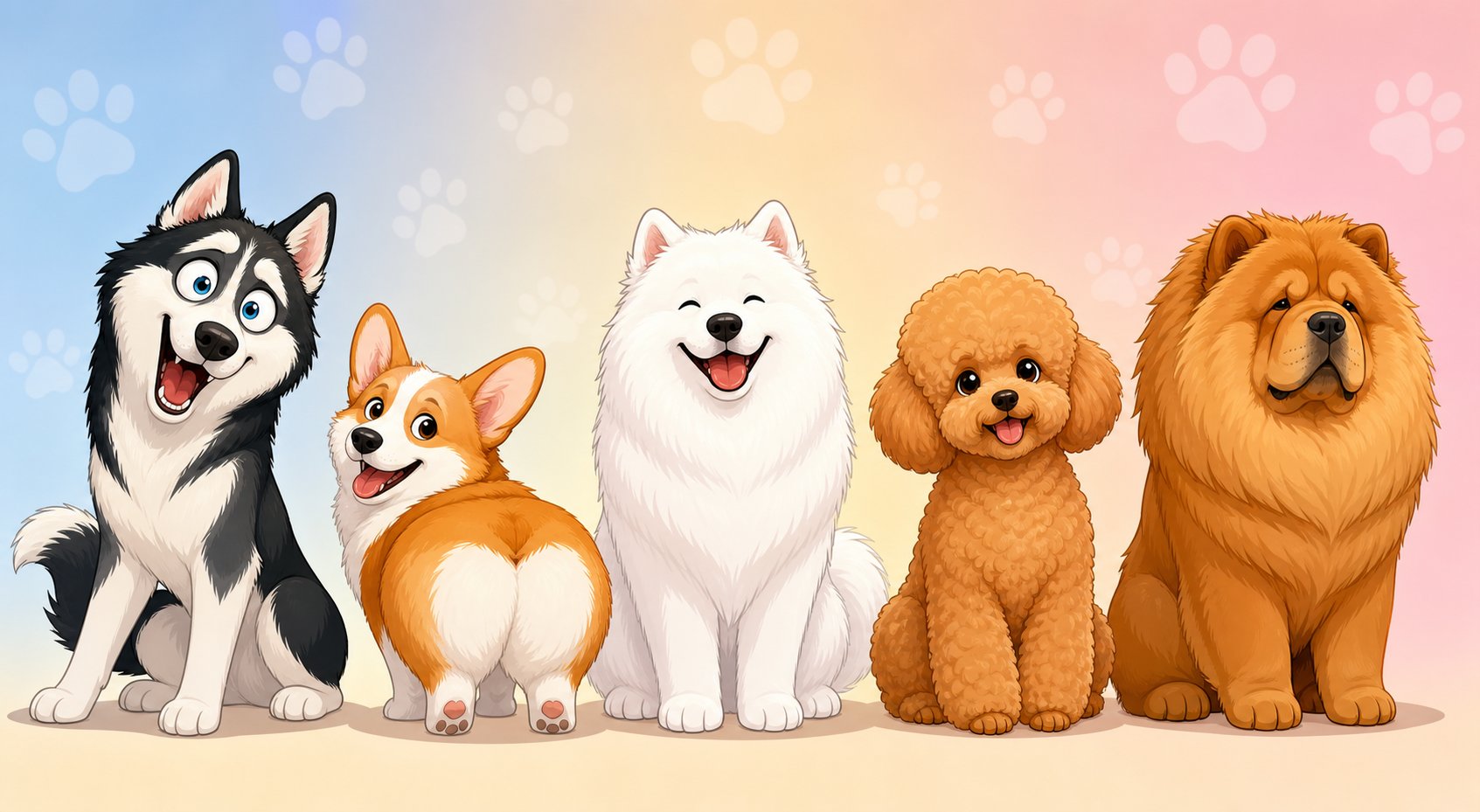
- Husky - 二哈 (er ha): Clipped from 哈士奇 (ha shi qi, phonetic for "husky"). 二 (er) means "silly/dopey" in slang, so the nickname translates to "the goofy one." Huskies earned this dog chinese name through countless viral videos of them howling dramatically, destroying furniture, and making absurd facial expressions.
- Corgi - 柯基 (ke ji): A phonetic transliteration that's become the standard casual name. Corgis also get called 小短腿 (xiao duan tui, "little short-legs") and 电臀 (dian tun, "electric butt") for their famously bouncy rear ends. Their playful personality and compact build made them icons of Chinese pet culture on Douyin.
- French Bulldog - 法斗 (fa dou): Shortened from the full formal name 法国斗牛犬 (fa guo dou niu quan, "French bullfighting dog"). Young urban professionals in Shanghai and Beijing favor this breed, and the abbreviated nickname reflects how casually it's discussed in daily life.
- Poodle - 泰迪 (tai di): While the formal name is 贵宾犬 (gui bin quan, "distinguished dog"), almost nobody uses it in conversation. Instead, poodles go by 泰迪, borrowed from "teddy," because their fluffy coats make them look like stuffed teddy bears. This is one of the most common chinese puppy names you'll hear on the street.
- Golden Retriever - 金毛 (jin mao): Literally "golden fur." Simple, descriptive, and universally understood. Golden retrievers also earn the affectionate label 大暖男 (da nuan nan, "big warm guy") for their gentle, people-pleasing temperament.
- Shih Tzu - 狮子狗 (shi zi gou): Translates to "lion-dog," a traditional nickname referencing the breed's resemblance to Chinese guardian lion statues. This is one of the oldest breed-specific chinese names for dogs still in active use.
- Pekingese - 京巴 (jing ba): Shortened from 京巴狗 (jing ba gou). The 京 (jing) references Beijing, the breed's imperial hometown. Also called 狮子犬 (shi zi quan, "lion dog") due to its flowing mane-like fur that echoes the stone lions guarding Chinese temples and palaces.
- Chow Chow - 松狮 (song shi): Literally "pine-lion," describing the breed's thick, mane-like coat that resembles both pine tree texture and a lion's ruff. The nickname captures the Chow Chow's dignified, almost aloof bearing in just two characters.
- Samoyed - 萨摩耶 (sa mo ye): A phonetic transliteration, but Samoyeds also get called 微笑天使 (wei xiao tian shi, "smiling angel") because their upturned mouths create a permanent happy expression.
- Bichon Frise - 比熊 (bi xiong): A loanword-style name that's easy to remember. These fluffy white dogs also earn the nickname 棉花糖 (mian hua tang, "cotton candy") for their round, cloud-like appearance after grooming.
You'll notice a pattern here. Breeds with strong visual quirks or exaggerated personalities collect the most nicknames. A husky's chaos earns it 二哈. A corgi's proportions earn it 小短腿. The nickname always latches onto whatever trait makes the breed most recognizable or meme-worthy.
Affectionate Nicknames Chinese Owners Use for Dogs
Beyond breed-specific labels, Chinese dog owners layer on additional affectionate terms that work across all breeds. The most common technique is the 小 (xiao, "little/small") prefix, a diminutive that adds warmth and intimacy to any name. A dog named 豆豆 (Dou Dou, "little bean") might become 小豆 (Xiao Dou) in baby-talk moments. This 小 prefix works universally across chinese puppy names regardless of the dog's actual size, because it signals emotional closeness rather than physical description.
Gender plays a role in naming patterns too. When Chinese owners browse chinese names for dogs female, they tend toward softer, more elegant characters like 美美 (Mei Mei, "beautiful"), 小仙女 (xiao xian nu, "little fairy"), or flower-based names like 桃花 (Tao Hua, "peach blossom"). Chinese female dog names often draw from nature imagery and gentle personality traits, reflecting cultural associations between femininity and grace. For male dogs, owners lean toward bolder sounds: 大壮 (Da Zhuang, "big and strong"), 旺财 (Wang Cai, "prosperous wealth"), or 黑豹 (Hei Bao, "black panther").
There's also the doubling pattern, where a single character gets repeated to create a cute, rhythmic chinese name dog owners love: 乐乐 (Le Le, "happy-happy"), 球球 (Qiu Qiu, "ball-ball"), 多多 (Duo Duo, "plenty-plenty"). This reduplication signals affection and informality. You'd never see it in a formal context, but in the living room or at the dog park, it's everywhere.
For those specifically searching for chinese dog names for females, the trend leans heavily toward characters with positive connotations: 福 (fu, blessing), 甜 (tian, sweet), 雪 (xue, snow), and 月 (yue, moon). These choices reflect a desire to project personality onto the pet through the name itself, turning the act of naming into a small creative statement about who the dog is, or who the owner hopes she'll be.
What's interesting is how these individual pet names interact with the breed nicknames. A husky named 妞妞 (Niu Niu) by her owner is still a 二哈 to the internet. The breed nickname captures collective cultural perception, while the personal name captures the private bond. Both layers coexist, and Chinese speakers switch between them effortlessly depending on whether they're talking about their specific dog or dogs in general.
Cats, as it turns out, have developed an equally rich (and arguably even more irreverent) nickname ecosystem, one where the animals aren't just named but crowned.
Chinese Cat Nicknames From Traditional to Trendy
Crowned is the right word. In Chinese internet culture, cats don't just receive cute labels. They're elevated to royalty, treated as alien overlords, and categorized by coat color with the precision of a meme taxonomy. If you're exploring chinese cat names beyond the basics, the nickname ecosystem around cats reveals just how deeply feline worship runs in modern Chinese-speaking communities.
Internet Nicknames Chinese Speakers Use for Cats
The most telling cat chinese name in online culture isn't a name at all. It's a title. 主子 (zhu zi) means "master" or "boss," and it's what millions of Chinese cat owners call their cats daily. The implication is clear: the cat rules the household, and the human exists to serve. Pair it with 猫 and you get 猫主子 (mao zhu zi, "cat master"), the full honorific that frames every feline as a tiny emperor surveying its domain from the couch.
You already know 喵星人 (miao xing ren, "meow-planet-person") from the internet slang chapter. For cats specifically, this remains the dominant playful label, positioning cats as extraterrestrial visitors who've graciously chosen to cohabitate with humans. But the vocabulary doesn't stop there. Chinese cat culture generated an entire behavioral lexicon around feline obsession.
吸猫 (xi mao) literally translates to "sniffing cats" or "inhaling cats." It describes the compulsive need to bury your face in a cat's fur, scroll through cat content endlessly, or simply obsess over cats in general. The term went viral because it captures something specific that English lacks: that almost addictive pull cats exert on their devoted fans. Related terms include 撸猫 (lu mao, "stroking/petting cats") for the physical act of extended cat-petting sessions, and 云吸猫 (yun xi mao, "cloud cat-sniffing") for people who satisfy their cat obsession entirely through online videos because they can't own one themselves.
Here are the most commonly used chinese names for cats ranked by popularity across Chinese online communities:
- 主子 (zhu zi) - "master/boss." The single most used cat nickname online. Character breakdown: 主 (master/lord) + 子 (suffix denoting a person or thing).
- 喵星人 (miao xing ren) - "meow-planet-person." The alien-visitor framing. 喵 (meow) + 星 (star/planet) + 人 (person).
- 猫主子 (mao zhu zi) - "cat master." The full title version. 猫 (cat) + 主子 (master).
- 小猫咪 (xiao mao mi) - "little kitty." The universal affectionate diminutive. 小 (little) + 猫 (cat) + 咪 (soft meow sound).
- 毛球 (mao qiu) - "fur ball." Used for particularly fluffy cats. 毛 (fur/hair) + 球 (ball).
- 咪咪 (mi mi) - A baby-talk cat name in chinese that mimics a soft meow sound. Reduplication of 咪 (a gentle meow).
Color and Pattern-Based Cat Nicknames
Chinese internet communities developed a precise color-coding system for cats that doubles as personality profiling. The most famous example is 橘猫 (ju mao, "orange cat"). On the surface, it's just a color descriptor: 橘 (orange/tangerine) + 猫 (cat). But in Chinese online culture, 橘猫 carries an automatic stereotype. Orange cats are fat. Not just chubby. Legendarily, inevitably, hilariously round. The running joke "十橘九胖" (shi ju jiu pang, "nine out of ten orange cats are fat") is so widespread it's practically a proverb. Posting a photo of a slim orange cat is treated as breaking news.
Other color-based cat nicknames follow similar logic. 奶牛猫 (nai niu mao) means "milk-cow cat," describing black-and-white tuxedo cats whose patches resemble Holstein dairy cows. 奶 (milk) + 牛 (cow) + 猫 (cat). These cats carry their own stereotype too: they're considered 神经质 (shen jing zhi, "neurotic"), the unpredictable clowns of the cat world. 三花猫 (san hua mao, "three-flower cat") refers to calico cats, with 三 (three) + 花 (flower/pattern) + 猫 (cat) describing their tri-color coats. And 狸花猫 (li hua mao, "tabby cat") is the classic Chinese domestic tabby, often celebrated as the toughest, most street-smart chinese name cat enthusiasts associate with independence and survival instincts.
What makes these color nicknames special is how they function as personality shorthand. Say 橘猫 and everyone pictures a lazy, overfed loaf. Say 奶牛猫 and people brace for chaos. The nickname isn't just describing appearance. It's loading an entire behavioral expectation into two or three characters, turning coat color into character destiny.
This habit of projecting personality onto animals through nicknames doesn't stay confined to actual cats and dogs, though. Chinese speakers take the same instinct and aim it directly at people, using animal metaphors to label personality types, relationship dynamics, and social roles with surprising precision.

Animal Nicknames Chinese Speakers Use to Describe People
The same instinct that turns orange cats into lazy stereotypes and huskies into lovable idiots gets pointed squarely at humans. Chinese speakers routinely reach for animal metaphors when describing personality types, relationship roles, and social situations, creating a parallel vocabulary where calling someone a "rabbit" or a "dog" communicates something instantly specific. These aren't random insults thrown in anger. They're culturally calibrated labels with precise emotional registers, and knowing them unlocks an entire layer of Chinese conversation that textbooks rarely cover.
Animal Nicknames That Describe Personality Types
Some of these terms have roots stretching back centuries. Others emerged from internet culture within the last decade. What they share is efficiency: a two-or-three character animal metaphor that replaces an entire personality description.
小白兔 (xiao bai tu, "little white rabbit") describes someone who's innocent, naive, and easily taken advantage of. Picture a fresh college graduate entering a cutthroat workplace, wide-eyed and trusting. That's a 小白兔. The term isn't necessarily negative. It can signal genuine sweetness. But it often carries a warning undertone: this person doesn't yet understand how the world works.
On the opposite end sits 老狐狸 (lao hu li, "old fox"), referring to someone highly cunning, scheming, and experienced in manipulation. In Chinese culture, foxes have always symbolized sharpness and slyness, and the 老 (old) prefix amplifies this. An 老狐狸 isn't just clever. They've spent years perfecting their craft. You'll hear this in workplace gossip, political commentary, and family warnings about untrustworthy business partners.
Then there's 社畜 (she chu, "corporate livestock"). This one stings. 社 (she) is short for 社会 (society/company) and 畜 (chu) means livestock or domesticated animal. Together, they describe an overworked employee who's been reduced to a beast of burden, grinding through long hours with no autonomy and little reward. The term exploded on Chinese social media as young workers expressed frustration with 996 culture (9am to 9pm, 6 days a week). Calling yourself a 社畜 is self-deprecating solidarity. Calling someone else one can feel like pity or critique, depending on tone.
铁公鸡 (tie gong ji, "iron rooster") targets a different flaw entirely. Since you can't pluck feathers from an iron rooster, the nickname describes someone impossibly stingy, a person who won't part with a single cent. It's humorous but pointed, the kind of label that sticks once applied.
Romantic and Relationship Animal Nicknames
Where things get really interesting is in how Chinese speakers use animal metaphors to categorize romantic partners and relationship dynamics. These terms function almost like personality archetypes in dating culture, and they've become essential vocabulary for anyone exploring chinese pet names for lovers.
小奶狗 (xiao nai gou, "little milk dog" or "puppy") describes a boyfriend type: younger, sweet, clingy, eager to please, and emotionally expressive. Think of a golden retriever in human form, someone who texts back immediately, plans surprises, and wears his heart on his sleeve. When Chinese women discuss chinese pet names for boyfriend types, 小奶狗 represents the soft, devoted partner who makes you feel adored.
小狼狗 (xiao lang gou, "little wolf-dog") is the contrasting archetype. This boyfriend type is outwardly cool, possessive, fiercely loyal but not openly affectionate, with an edge of danger. He's protective rather than cuddly, intense rather than sweet. The wolf element signals that beneath the composed exterior, there's something untamed. Both terms emerged from Chinese dating discourse and spread rapidly through Weibo and Xiaohongshu as shorthand for romantic preferences.
单身狗 (dan shen gou, "single dog") takes a more self-deprecating angle. As Chinese internet culture established, this term emphasizes someone's single status with humorous resignation. It originated from self-mockery and is most commonly used around Valentine's Day or Chinese Valentine's Day (七夕), when single people jokingly declare themselves 单身狗 while watching couples celebrate. The tone is light, but the underlying emotion is real: loneliness dressed up as comedy.
For those searching for chinese pet names for girlfriend, animal-based endearments tend toward the cute and small. 小猫咪 (xiao mao mi, "little kitty") works as both a literal cat reference and a flirtatious term for a girlfriend who's playful and slightly aloof. 小兔子 (xiao tu zi, "little bunny") signals someone gentle and adorable. These overlap with actual animal nicknames, which is precisely why the line between naming pets and naming people blurs so easily in Chinese.
| Nickname | Pinyin | Literal Meaning | Figurative Meaning | Usage Context |
|---|---|---|---|---|
| 小白兔 | xiao bai tu | little white rabbit | Naive, innocent person | Neutral / slightly cautionary |
| 老狐狸 | lao hu li | old fox | Cunning, scheming person | Negative |
| 单身狗 | dan shen gou | single dog | Single person (self-deprecating) | Neutral / humorous |
| 社畜 | she chu | corporate livestock | Overworked employee | Negative / self-deprecating |
| 小奶狗 | xiao nai gou | little milk dog | Sweet, clingy boyfriend type | Positive / affectionate |
| 小狼狗 | xiao lang gou | little wolf-dog | Cool, intense boyfriend type | Positive / admiring |
| 铁公鸡 | tie gong ji | iron rooster | Extremely stingy person | Negative / humorous |
| 小猫咪 | xiao mao mi | little kitty | Cute, playful girlfriend | Positive / flirtatious |
| 狐狸精 | hu li jing | fox spirit | Seductive, manipulative woman | Negative / insulting |
| 乌鸦嘴 | wu ya zui | crow's mouth | Jinx; person who speaks bad luck into existence | Negative / teasing |
What's striking about this entire system is how precisely calibrated the emotional register is. 小奶狗 is warm and approving. 社畜 is bitter but bonding. 老狐狸 is a genuine warning. 单身狗 is funny when you say it about yourself but slightly rude when aimed at others. Chinese speakers navigate these distinctions instinctively, choosing the right animal metaphor not just for accuracy but for the exact social temperature they want to set.
These metaphors also reveal cultural values in motion. The popularity of 社畜 reflects widespread frustration with work culture. The 小奶狗 versus 小狼狗 debate mirrors shifting expectations around masculinity. And the persistence of terms like 狐狸精 shows how deeply traditional folklore still shapes modern judgment. Every animal nickname aimed at a person carries both a personality observation and a cultural commentary, compressed into a handful of characters.
Of course, not all Chinese speakers use these terms identically. Regional dialects and local internet communities put their own spin on animal metaphors, creating variations that can confuse even native speakers from different parts of the Chinese-speaking world.
Regional Dialect Variations Across Chinese-Speaking Areas
A 二哈 in Beijing is still a 二哈 in Guangzhou, right? Not always. Chinese-speaking regions carry their own pronunciation systems, local slang, and platform-specific vocabularies that reshape how animals get nicknamed. If you've ever browsed asian names for dogs across different Chinese communities, you've likely noticed that the same breed can carry entirely different labels depending on where the speaker grew up.
Mandarin vs Cantonese Animal Nicknames
The biggest split runs between Mandarin-speaking northern China and Cantonese-speaking southern regions like Guangdong and Hong Kong. While written Chinese largely overlaps, spoken nicknames diverge sharply. Cantonese speakers use distinct colloquial characters and tones that create a parallel nickname ecosystem.
- Dog (general) - Mandarin: 狗狗 (gou gou). Cantonese: 狗仔 (gau2 zai2, "little dog"), where 仔 functions as the Cantonese diminutive instead of Mandarin's reduplication pattern.
- Cat (affectionate) - Mandarin: 猫咪 (mao mi). Cantonese: 猫咪 (maau1 mi1), same characters but the Cantonese pronunciation gives it a softer, drawn-out quality.
- Stray dog - Mandarin: 流浪狗 (liu lang gou). Cantonese slang: 唐狗 (tong4 gau2, "Tang dog"), referring to local mixed-breed dogs with a cultural pride undertone, framing them as authentically Chinese rather than abandoned.
- Cockroach - Mandarin: 蟑螂 (zhang lang). Cantonese nickname: 小强 (siu2 koeng4, "Little Strong"), popularized by Stephen Chow's films, implying cockroaches are indestructible.
- Taiwanese Mandarin pet terms - Taiwan uses 毛小孩 (mao xiao hai, "furry little kid") more frequently than mainland's 毛孩子, and 浪浪 (lang lang) as a shortened, affectionate term for strays (from 流浪, "wandering").
- Shanghainese - Cats are colloquially 咪咪 (mi mi) in Shanghainese conversation, used more broadly than in standard Mandarin where it's considered baby talk.
These differences mean that someone searching for oriental dog names might encounter completely different results depending on whether their source draws from Hong Kong forums, Taiwanese blogs, or mainland platforms. A Cantonese speaker calling a mixed-breed 唐狗 is making a cultural statement that doesn't translate into Mandarin slang at all.
Regional Internet Communities and Local Slang
Platform geography reinforces these splits. Taiwan's PTT forums and Hong Kong's LIHKG breed local animal slang that stays regional for years before crossing over, if it ever does. Mainland platforms like Douyin and Weibo dominate by sheer user volume, which means their nicknames (二哈, 喵星人, 铲屎官) become the de facto standard. But Cantonese-language YouTube channels and Taiwanese pet influencers on Instagram maintain distinct vocabularies that their audiences recognize instantly.
Migration and cross-platform exposure are slowly blending these differences. Young Cantonese speakers in Shenzhen increasingly adopt mainland internet slang alongside their dialect terms. Taiwanese users pick up 铲屎官 from Xiaohongshu. Yet certain oriental names for dogs and local animal terms persist stubbornly because they carry regional identity. Calling a mutt a 唐狗 in Hong Kong isn't just a name. It's a statement about local heritage that no amount of internet homogenization can replace.
This regional complexity adds one more layer to an already rich system. Knowing which nickname belongs to which context, whether that's a dialect region, an internet platform, or a social register, is ultimately what separates textbook knowledge from genuine conversational fluency.
How to Use Chinese Animal Nicknames in Real Conversations
Knowing that a husky is called 二哈 or that 社畜 means "corporate livestock" is one thing. Knowing when to deploy these terms without sounding awkward, forced, or accidentally rude is something else entirely. The difference between a language learner who memorizes vocabulary and one who actually communicates naturally often comes down to register awareness: understanding which version of a word fits which situation.
When to Use Formal vs Colloquial Animal Names
Think of it like a dial, not a switch. On one end sits 书面语 (shu mian yu, written/formal language). On the other sits 网络用语 (wang luo yong yu, internet slang). Most real-life conversations land somewhere in between, and the animal name you choose signals exactly where you're positioning yourself on that spectrum.
Here's how this plays out in practice. Imagine you're talking about a cat:
- Academic paper or news report: 猫 (mao) or the full species name 家猫 (jia mao, "domestic cat"). Clean, neutral, zero personality.
- Casual conversation with friends: 猫咪 (mao mi, "kitty"). Warm, familiar, appropriate for any informal setting.
- Social media post or group chat: 喵星人 (miao xing ren) or 主子 (zhu zi). Signals you're plugged into pet culture and speaking the community's language.
- Baby-talking to your own cat at home: 咪咪 (mi mi) or a personal chinese name for cat like 橘子 (Ju Zi, "little orange"). Maximum intimacy, minimum audience.
The same logic applies to dogs. A veterinarian discussing breed health uses 犬 (quan, the formal character for dog) or the full breed name 哈士奇 (ha shi qi). A Douyin creator filming their husky destroying a couch uses 二哈 without hesitation. A pet shop listing might split the difference with 狗狗 (gou gou), the reduplicated form that's friendly but not slangy. Choosing the wrong register doesn't cause misunderstanding exactly, but it creates social friction. Using 铲屎官 in a formal essay about pet ownership would feel jarring. Using 犬 in a WeChat group chat about your puppy would feel cold and distant.
For anyone choosing a chinese name for dog or browsing names for chinese dogs, this register awareness matters too. A name like 旺财 (Wang Cai, "prosperous wealth") works perfectly as a playful, culturally rooted pet name. But naming your dog 犬类动物 (quan lei dong wu, "canine animal") would be like naming your child "Human Offspring." Context is everything.
Tips for Recognizing Nicknames in Chinese Media
Language learners often hit a wall when they encounter these nicknames in the wild. You've studied 猫 and 狗 for months, then you open Weibo and see 喵星人, 汪星人, and 毛孩子 everywhere with zero textbook preparation. Here's how to decode unfamiliar animal nicknames faster:
- Look for sound clues. Characters like 喵 (miao), 汪 (wang), and 咩 (mie, sheep sound) are onomatopoeic. If you spot them in a compound word, an animal is almost certainly involved.
- Watch for the 小 (xiao) prefix. It signals affection and informality. 小奶狗, 小白兔, 小猫咪 all use this diminutive to soften the tone and mark the term as colloquial rather than formal.
- Notice reduplication. Doubled characters like 狗狗, 猫猫, or personal names like 球球 indicate casual, affectionate speech. You won't find this pattern in formal writing.
- Check for metaphorical compounds. When you see an unexpected combination like 猫头 + 鹰 (cat-head + eagle) or 河 + 马 (river + horse), the name is building a visual metaphor. Break it into parts and the animal usually reveals itself.
- Follow context, not just characters. 神兽 (divine beast) could mean a mythological creature in a history documentary or a mischievous child in a parenting post. The platform and surrounding text tell you which reading applies.
Watching Chinese pet content on Douyin or Bilibili with subtitles is one of the fastest ways to absorb this vocabulary naturally. You'll see nicknames repeated in comments, video titles, and hashtags until they become second nature. The repetition does the memorization work for you.
Mastering chinese animal nicknames isn't about expanding your vocabulary list. It's about proving you understand how Chinese speakers actually talk, joke, and bond. When you casually drop 铲屎官 in conversation or laugh at a 二哈 video with the right reference, you're signaling cultural fluency that no textbook certification can replicate.
Throughout this article, you've seen how these nicknames operate across multiple dimensions: descriptive compounds that paint visual pictures, onomatopoeic names that echo animal sounds, mythological titles carrying centuries of folklore, internet slang that reinvents the relationship between humans and pets, breed-specific labels shaped by viral memes, metaphors that turn animals into personality archetypes, and regional variations that reflect local identity. Each layer builds on the others, creating a naming system that's simultaneously ancient and constantly evolving.
The best way to stay current? Spend time where these nicknames are born. Follow pet accounts on Xiaohongshu. Browse the comment sections under viral animal videos on Douyin. Join WeChat groups where cat owners share photos of their 橘猫 getting progressively rounder. New nicknames emerge every few months as fresh memes take hold, and the only way to catch them is to be present in the communities that create them. The language is alive, playful, and waiting for you to join the conversation.
Frequently Asked Questions About Chinese Animal Nicknames
1. What does 二哈 (er ha) mean in Chinese?
二哈 is the widely used Chinese internet nickname for huskies. It combines 二 (er), slang for 'silly' or 'dopey,' with 哈, clipped from the phonetic transliteration 哈士奇 (ha shi qi). The nickname reflects the husky's reputation for dramatic expressions, chaotic behavior, and comedic energy that dominates Chinese social media platforms like Douyin and Weibo.
2. Why do Chinese speakers call pet owners 铲屎官?
铲屎官 (chan shi guan) translates literally to 'poop-shoveling officer' and is a self-deprecating term Chinese pet owners use for themselves. The nickname intentionally flips the human-pet power dynamic, positioning the pet as royalty and the owner as a humble servant whose main duty is cleaning up. It originated on platforms like Weibo and Tieba and has become standard vocabulary in Chinese online pet culture.
3. What are common Chinese animal nicknames used to describe people?
Chinese speakers frequently use animal metaphors for personality types. 小白兔 (little white rabbit) describes a naive person, 老狐狸 (old fox) means someone cunning, 社畜 (corporate livestock) refers to an overworked employee, and 单身狗 (single dog) humorously labels single people. In dating culture, 小奶狗 (puppy) describes a sweet, clingy boyfriend while 小狼狗 (wolf-dog) refers to a cool, intense partner type.
4. How do Chinese animal names differ from English animal names linguistically?
Chinese builds animal names from meaningful character components that create instant visual descriptions. For example, 河马 (river-horse) for hippopotamus and 长颈鹿 (long-neck-deer) for giraffe paint a picture character by character. English typically borrows from Latin or Greek roots where the meaning is buried, while Chinese keeps the descriptive logic transparent on the surface, making many standard animal names function like built-in nicknames.
5. What is 吸猫 and why is it popular in Chinese internet culture?
吸猫 (xi mao) literally means 'sniffing cats' or 'inhaling cats' and describes the compulsive obsession with cats, whether burying your face in their fur or endlessly scrolling cat content online. The term went viral because it captures a specific addictive feeling that English lacks a single word for. Related terms include 撸猫 (extended cat-petting sessions) and 云吸猫 (satisfying cat obsession through online videos when you cannot own one).