What Are Chinese Calligraphy Radicals and Why They Matter
When you pick up a brush for the first time, where do you actually start? Most learners jump straight into copying full characters. But the real foundation sits one level deeper, in the recurring structural components that make up every character you will ever write.
Chinese calligraphy radicals are the fundamental graphic components of Chinese characters that serve as both a classification system for organizing written language and, critically, as the core practice units for developing brush control, stroke technique, and compositional balance in calligraphy.
Defining Radicals in a Calligraphic Context
So what is a Chinese radical, exactly? In a purely linguistic sense, radicals are section headings used to index characters in a dictionary. The Chinese term 部首 (bushou) literally means "section head." As Outlier Linguistics points out, the concept of radicals did not even exist when most Chinese characters were originally created. Their primary purpose is organizational, not structural.
But calligraphy practitioners approach the chinese radical definition from a completely different angle. For someone holding a brush, radicals are not just lookup tools. They are the repeating visual units you encounter in character after character, each one demanding specific brush movements, pressure shifts, and spatial awareness. When you master the three-dot water radical (氵), you have not just learned one component. You have trained your hand for hundreds of characters that contain it.
Why Calligraphers Think About Radicals Differently
If you have searched "what are chinese radicals" or "what are radicals in chinese," you have likely found resources focused on meaning and dictionary use. That is only half the picture. The radicals meaning for a calligrapher goes beyond semantics. It is about muscle memory, proportion, and rhythm.
Language learners ask: what does this radical tell me about the character's meaning? Calligraphers ask: how does my brush move through this shape, and how does that shape compress when it sits beside another component? This distinction is the gap most resources ignore entirely. The pages ahead bridge that gap, treating chinese radicals not as abstract categories but as the hands-on building blocks of brush skill that they become the moment ink meets paper.
The Historical Evolution of Radicals Through Script Styles
Every radical you practice today carries over three thousand years of visual history in its strokes. The system that organizes these components into a learnable framework, however, is far more recent. Understanding where that system came from, and how radical shapes shifted across centuries of brushwork, gives you context that transforms rote copying into informed practice.
Origins of the 214 Kangxi Radical System
How many chinese radicals are there? The standard answer is 214, a number that traces back to the Kangxi Dictionary (康熙字典), commissioned by the Kangxi Emperor and completed in 1716. This massive chinese radical dictionary organized over 47,000 characters under 214 section headings, each one a radical. The system was not invented from scratch. It refined earlier classification attempts, most notably the 540-radical system in the Shuowen Jiezi (说文解字) from 100 CE. But the Kangxi structure proved so practical that it became the dominant list of chinese radicals still referenced today.
Why does this matter for calligraphy? Because classical copybooks, known as 法帖 (fatie), are frequently organized around these same groupings. When you study historical model texts, you encounter characters clustered by shared radicals. A chinese dictionary with radicals built on the Kangxi system is not just a reference for looking up meanings. It is a map of the structural patterns your brush will repeat across thousands of characters. Calligraphy students working through historical texts, whether Tang dynasty regular script models or Song dynasty running script masterpieces, benefit from recognizing how these chinese language radicals anchor the visual logic of each page.
How Radical Forms Evolved Across Centuries of Brushwork
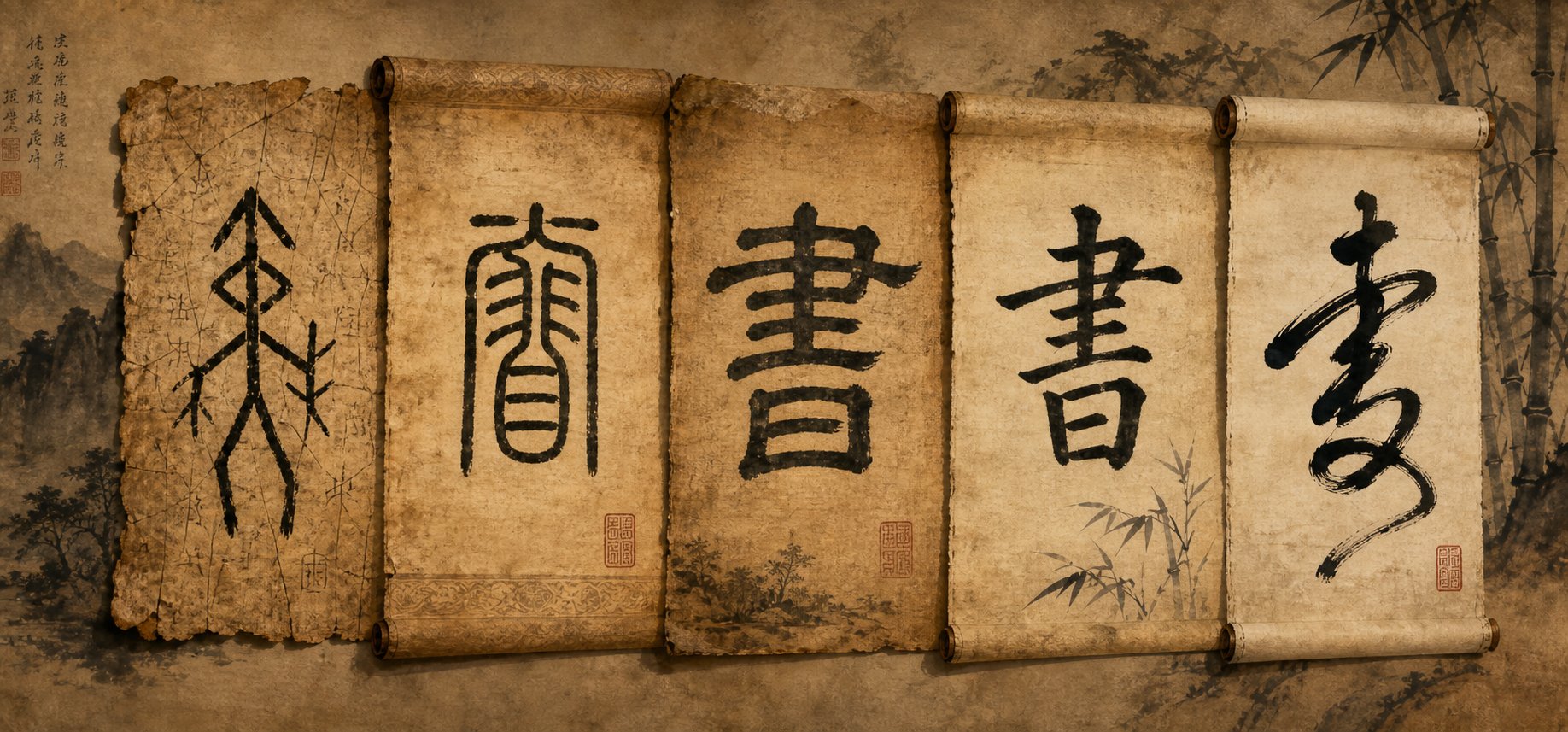
The radicals you see in modern printed text look nothing like their earliest ancestors. Each stage in the evolution of Chinese script reshaped these components, sometimes dramatically. Imagine the radical for "water" (水). In its oldest form, it was a pictographic stream with flowing curves. By the time it reached standard script, it had become a compact set of angular strokes. That transformation did not happen overnight. It unfolded across distinct eras, each with its own tools, materials, and aesthetic priorities.
The five major script types used in Chinese calligraphy, as outlined by Khan Academy's introduction to Chinese calligraphy, each left a unique imprint on radical forms. Here is how those forms shifted chronologically:
- Oracle bone script (甲骨文, c. 1200 BCE) - The earliest known Chinese characters called "jiaguwen" were carved into turtle shells and animal bones. Radicals at this stage were highly pictographic, with recognizable images of natural objects. Strokes were thin, angular, and dictated by the carving tool rather than a brush.
- Bronze script (金文, c. 1000-200 BCE) - Cast into ritual bronze vessels, these characters became rounder and more uniform. Radicals gained a sense of weight and solidity, with thicker, more consistent line widths reflecting the casting process.
- Seal script (篆書, solidified during Qin dynasty, 221-207 BCE) - The first standardized script unified radical forms across the empire. Strokes are even in thickness, execution is slow and deliberate, and each character fits within an imaginary square. Radicals retain some pictographic quality but are highly regularized.
- Clerical script (隸書, height in Eastern Han, 25-220 CE) - A major turning point. Characters became squatter, and strokes began showing modulations and inflections, particularly the elegant flaring movement in horizontal strokes. Radicals lost their pictographic curves and became more angular and abstract, reflecting the brush's expressive potential.
- Standard script (楷書, zenith in Tang dynasty, 618-907 CE) - The name of chinese script most learners encounter first. Radicals reached their most structured and legible form, built from a standardized repertoire of orthogonal strokes. This is where radical shapes stabilized into the forms used in modern practice.
- Running script (行書, flourished in Song dynasty, 960-1279 CE) - Radicals begin to simplify and connect. Strokes flow into one another, and rigid structures loosen while remaining recognizable. Speed of execution increases, and radical forms compress or merge with adjacent components.
- Cursive script (草書, matured 4th century CE onward) - The most expressive transformation. Radicals are reduced to abbreviated gestures, sometimes just a few swift strokes suggesting the original form. Two or more characters may connect through ligatures, and radical boundaries blur entirely.
Each stage in this progression did not simply replace the last. Calligraphers have always moved between styles, and studying how a single radical transforms from seal script's measured symmetry to cursive script's abbreviated energy builds a deeper understanding of why each brushstroke exists. The Kangxi radicals provide the shared vocabulary, but the script style determines how that vocabulary sounds on paper. This interplay between fixed structure and stylistic variation is exactly what makes radical practice so rich, and it raises a practical question: how does a single radical physically reshape itself depending on where it sits within a character?
How Radicals Change Shape by Position Within Characters
A radical in chinese calligraphy is not a fixed shape. It morphs, compresses, and restructures itself depending on where it lands inside a character. This concept, called 偏旁 (pianpang), refers to the positional variants that radicals adopt when they move from standalone characters into compound structures. For calligraphers, each variant demands a distinct set of brush movements, and treating them as identical is one of the fastest ways to produce unbalanced writing.
Understanding Positional Variants in Calligraphy
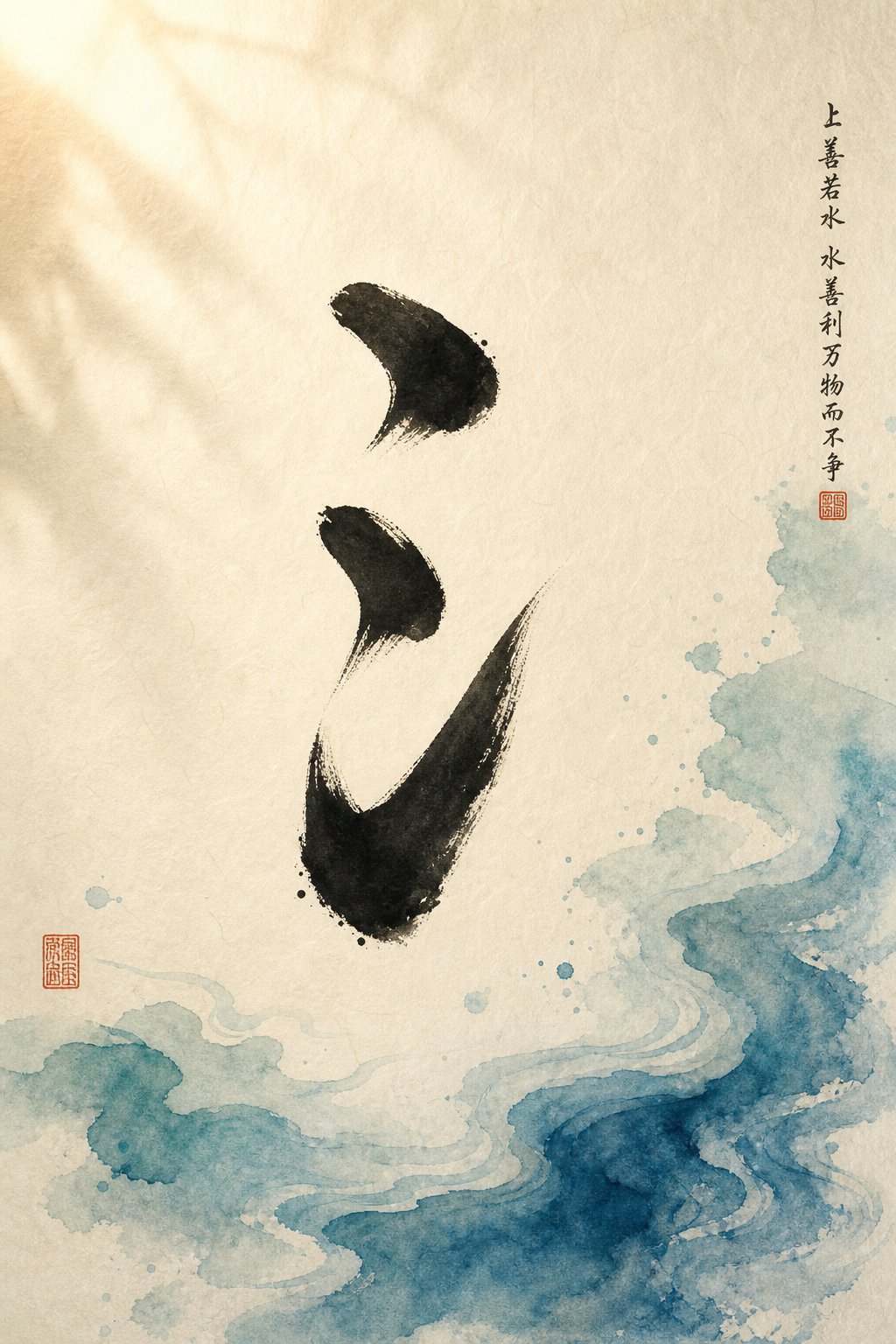
Imagine writing the character 水 (water) on its own. Your brush executes a full vertical stroke down the center, flanked by sweeping strokes on either side. The character occupies the entire square grid. But when that same radical appears on the left side of a compound character like 法 or 河, it transforms into 氵, three compact dots stacked vertically. The sweeping horizontal energy disappears entirely, replaced by tight, controlled press-and-lift motions that occupy roughly one-third of the character's width.
This is not just a visual shorthand. The brush technique changes fundamentally. Writing standalone 水 involves a long downward press for the central stroke, followed by broad diagonal sweeps. Writing 氵 requires three separate press-pause-lift sequences, each dot angled slightly differently, with the brush barely traveling across the paper. Your wrist stays compact, your movements stay small, and the ink deposits are concentrated rather than spread. These are examples of radicals behaving as entirely different calligraphic challenges depending on context.
How Left-Side Radicals Compress and Reshape
The left position is the most common location for radicals in chinese characters, and it forces the most dramatic transformations. When a radical sits on the left, it must compress horizontally to leave room for the right-side component. This compression changes stroke angles, shortens horizontal movements, and often converts full strokes into abbreviated gestures.
Consider these common transformations and what they mean for your brush:
- 人 → 亻 (person): The balanced two-stroke figure becomes a single narrow stroke with a leftward hook. Your brush moves in one continuous downward motion with a slight curve, rather than two separate diagonal strokes meeting at a peak.
- 心 → 忄 (heart): The wide, three-dot-plus-hook structure flattens into a vertical arrangement of two dots and a vertical stroke. The sweeping hook vanishes, replaced by a straight downward press with a sharp lift at the base.
- 刀 → 刂 (knife): This one shifts to the right side rather than the left, but the principle holds. The enclosed curve of 刀 opens into two parallel vertical strokes. Your brush executes two distinct downward movements instead of one continuous turning motion.
Each transformation is not arbitrary. It follows the logic of spatial balance. Radical chinese characters maintain visual harmony by giving each component proportional space, and the brush must adapt accordingly.
Top and Bottom Radical Transformations
Radicals that move to the top or bottom of a character face a different constraint. Instead of compressing horizontally, they flatten vertically. The radical must become shorter and wider to sit above or below the remaining components without making the overall character feel top-heavy or stretched.
The clearest example is 火 → 灬. As a standalone character, 火 is written with a central dot, two diverging strokes, and a sweeping rightward press. When it drops to the bottom of characters like 热 or 然, it becomes 灬, four dots spread horizontally across the base. Your brush shifts from vertical, angular movements to a rhythmic sequence of four press-lift dots moving left to right. The energy changes from upward and outward to grounded and lateral.
The following table summarizes how common radicals of chinese characters reshape across positions, along with the calligraphic adjustment each variant requires:
| Radical | Standalone Form | Left Position Form | Top/Bottom Position Form | Calligraphic Adjustment |
|---|---|---|---|---|
| Water | 水 | 氵 (left) | — | Replace sweeping strokes with three compact press-lift dots; reduce width to one-third of character space |
| Fire | 火 | — | 灬 (bottom) | Convert angular upward strokes into four horizontal dots; shift brush rhythm from vertical to lateral |
| Person | 人 | 亻 (left) | — | Merge two balanced diagonals into one narrow downward stroke with leftward hook; keep brush close to vertical |
| Heart | 心 | 忄 (left) | 心 (bottom, as in 想) | Left: flatten wide hook into vertical dots-and-stroke. Bottom: compress height while retaining the sweeping hook |
| Knife | 刀 | — | — | 刂 (right): open the enclosed curve into two parallel verticals; execute as two separate downward presses |
| Hand | 手 | 扌 (left) | — | Shorten horizontal strokes and convert the hook into a sharp upward flick; compress total width significantly |
You will notice that each positional shift is not merely cosmetic. It rewires the sequence of brush movements your hand must execute. Practicing a radical only in its standalone form leaves you unprepared for the compressed, reshaped versions you will encounter far more frequently in actual characters. This is why experienced calligraphy teachers drill positional variants separately, treating 氵 and 水 as distinct practice targets even though they share the same semantic origin.
The positional logic holds across all chinese characters radicals, but it plays out differently depending on which script style you are writing in. A left-side radical in regular script follows strict proportional rules, while the same radical in running script might merge fluidly into its neighbor. That stylistic dimension adds another layer to how radicals behave on paper.
Radicals Across the Five Major Calligraphy Scripts
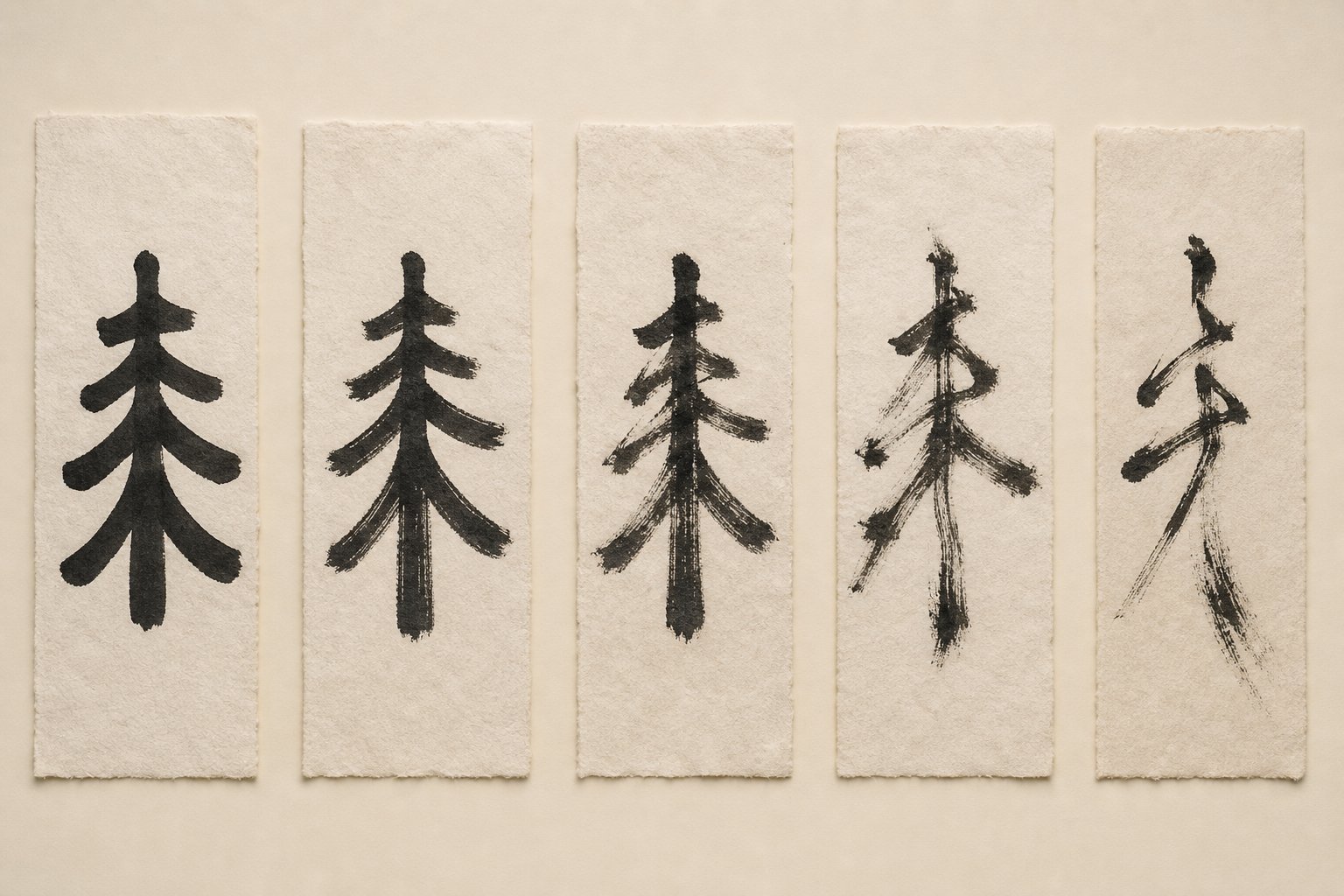
Script style does not just change how a character looks. It fundamentally alters how your brush builds each radical character from the ground up. The five core styles of Chinese calligraphy, known as 五体 (wuti), each impose their own rules on stroke thickness, speed, connection, and spatial logic. A radical like 木 (wood) written in seal script bears almost no visual resemblance to the same radical dashed off in cursive. For anyone studying mandarin chinese radicals with a brush in hand, understanding these stylistic shifts prevents the confusion of mixing incompatible forms.
Radical Forms in Seal and Clerical Scripts
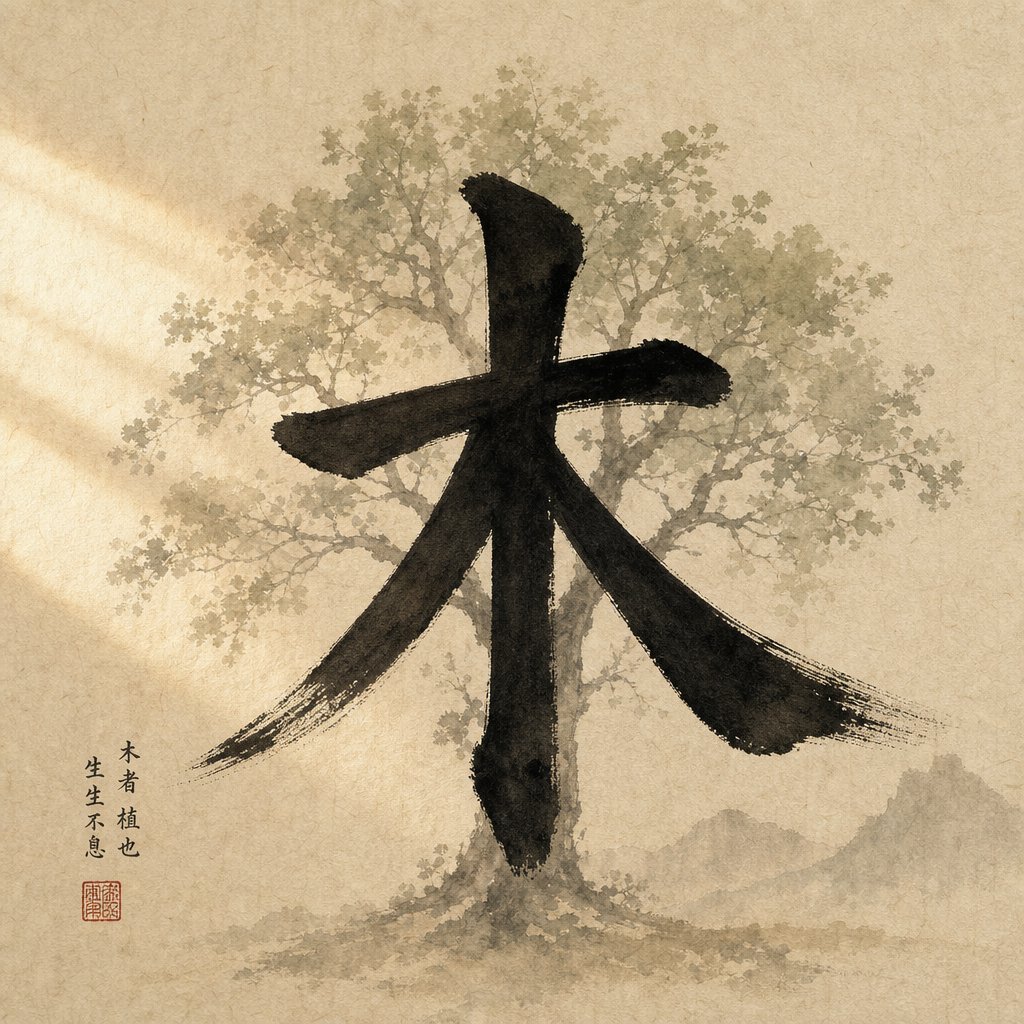
Seal script (篆書 zhuanshu) treats every radical as a balanced, symmetrical design. Strokes maintain even thickness throughout, with no sharp corners or dramatic pressure changes. The radical 木, for instance, appears as a gently curving vertical trunk with two smooth, arching branches flowing outward. There is no hook at the base, no tapering at the tips. Your brush moves at a steady, unhurried pace, maintaining constant contact and consistent ink flow. As the Skritter Blog notes, seal script emphasizes left-to-right symmetry using mainly curves and dots with no sharp corners.
Clerical script (隸書 lishu) introduces modulation. The same 木 radical now features a horizontal stroke with a distinctive wave-like flare at its end, a hallmark of this style. Verticals become straighter, and the overall shape flattens from tall to wide. Your brush must now execute deliberate press-and-release movements at stroke endings, a technique absent in seal script. The chinese writing and meaning relationship becomes more abstract here, as radicals lose their pictographic curves and settle into angular, structured forms.
Regular Script Radicals as the Foundation
There is a reason nearly every calligraphy teacher starts students in regular script (楷書 kaishu). This is the name of chinese script that offers the clearest structural logic for learning radicals. Each stroke has a defined beginning, middle, and end. Press, turn, and lift are all visible and deliberate. The radical 水, for example, shows a crisp central vertical with a hook, flanked by distinct diagonal strokes that each begin with a visible entry point and end with a controlled taper or press.
Regular script radicals teach you where your brush should pause, where it should accelerate, and where pressure shifts occur. The chinese character semantic components are fully legible and distinct from one another, making it easy to identify where one radical ends and another begins. This clarity is why kaishu functions as the training ground before moving into faster, more connected styles.
How Radicals Simplify in Running and Cursive Styles
Running script (行書 xingshu) loosens the rigid boundaries of regular script. Radicals chinese calligraphers practice in kaishu begin to merge with adjacent strokes. The radical 木 might see its horizontal and left-falling stroke executed in one continuous motion rather than two separate lifts. Stroke endings connect to the next stroke through visible trailing threads of ink, and the overall form compresses slightly as writing speed increases.
Cursive script (草書 caoshu) takes this further. Radicals reduce to abbreviated gestures, sometimes just a single sweeping motion suggesting the original multi-stroke form. The radical 水 in cursive might become a quick downward curve with a flick, barely recognizable without training. Speed and expression dominate, but there is still a codified system of forms called 草法 (caofa) that prevents cursive from becoming illegible shorthand.
The table below compares how common radicals appear and are executed across all five styles:
| Radical | Seal Script (篆書) | Clerical Script (隸書) | Regular Script (楷書) | Running Script (行書) | Cursive Script (草書) |
|---|---|---|---|---|---|
| 木 (wood) | Even-width curved branches, symmetrical trunk, no hooks or tapers | Flattened shape with wave-flared horizontal, straight vertical, angular branches | Crisp horizontal with defined press start, vertical hook, balanced left-sweep and right-press | Horizontal and left-sweep often connected in one motion, slight rightward lean | Reduced to a swift vertical with one or two abbreviated flicks suggesting branches |
| 水 (water) | Flowing pictographic stream, rounded curves of uniform thickness | Central vertical with modulated side strokes, wider and flatter overall | Sharp central vertical with hook, distinct left dot and right-sweeping press stroke | Central stroke and right sweep merge, dots connect through trailing ink threads | Single downward curve with a quick lateral flick, highly abbreviated |
| 心 (heart) | Rounded bowl shape with soft dots, resembling a vessel | Flattened hook with wave-like ending, dots become angular dashes | Wide sweeping hook with three distinct dots, each placed with deliberate press-lift | Hook and dots flow together, final dot often connects to next character | One continuous looping stroke suggesting the hook-and-dot structure |
| 火 (fire) | Symmetrical flame-like curves radiating from center, even line weight | Angular strokes replacing curves, central dot more defined, flatter proportions | Central dot, two diverging strokes, right-press with clear entry and exit points | Strokes connect fluidly, right-press abbreviated, overall form tilts rightward | Rapid downward motion with a single flick, barely distinguishable from other radicals without context |
You will notice a clear pattern: as you move from seal to cursive, stroke count effectively decreases while the demand on rhythm and internalized structure increases. This is precisely why regular script serves as the foundation. It gives you the complete structural map of each radical character before you learn to abbreviate. Skipping kaishu and jumping into running or cursive script is like trying to write shorthand before learning to spell. The abbreviations only make sense when you know what they are abbreviating.
With a clear picture of how radicals behave across script styles, the next practical question becomes which radicals deserve your attention first, and how to sequence them by the brush techniques they develop rather than by stroke count alone.
Categorizing Radicals by Calligraphic Difficulty Level
Stroke count alone does not determine how hard a radical is to write with a brush. A three-stroke radical that demands a precise hook-and-lift sequence can be far more challenging than a four-stroke radical built entirely from straight horizontals. When you look at all chinese radicals through the lens of brush technique rather than linguistic complexity, a different hierarchy emerges, one based on the types of movements your hand must execute, the pressure transitions involved, and the spatial precision required.
Most lists of radicals organize by frequency or semantic category. That approach serves language learners well, but it leaves calligraphy students practicing difficult brush movements too early or spending weeks on simple shapes that teach very little. The tiers below group the most common chinese radicals by what they actually demand from your brush hand.
Beginner Radicals for First Brush Practice
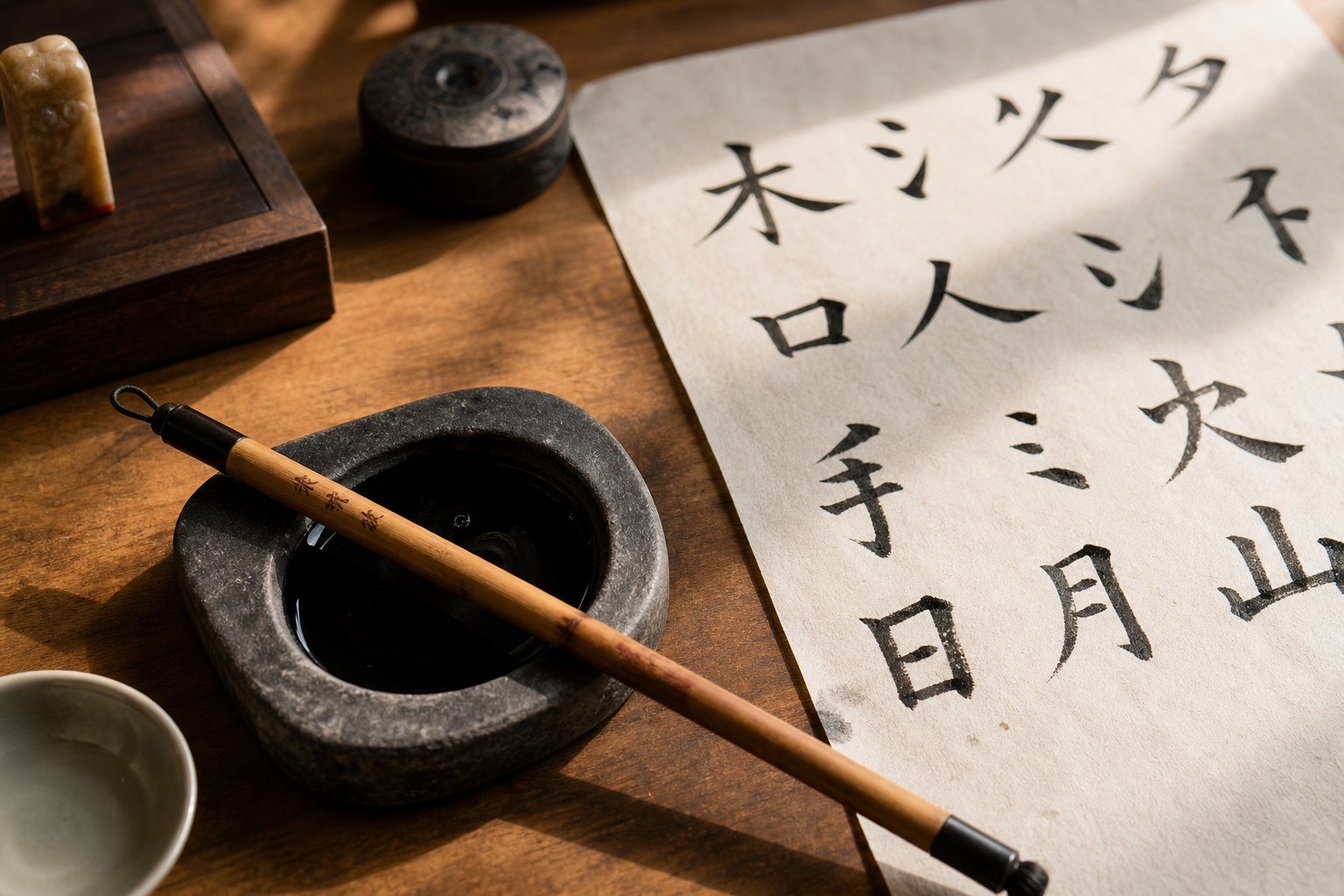
These radicals use one to three strokes and involve primarily linear movements: horizontals, verticals, and simple dots. The brush techniques here are foundational. You are learning to control entry angle, maintain even pressure across a stroke, and execute clean lift-offs. Sounds simple? The challenge is consistency. Writing one clean horizontal is easy. Writing ten identical ones in a row reveals every wobble in your grip and posture.
- 一 (one): A single horizontal stroke. Teaches controlled press at entry, steady travel, and defined pause-and-lift at the end. The most basic movement, yet the benchmark for all horizontal strokes to come.
- 丨 (line/stick): A single vertical stroke. Develops downward pulling motion with consistent pressure. Trains your arm to move in a straight path without lateral drift.
- 丶 (dot): A single press-and-lift. Teaches the fundamental press-pause-release sequence that appears in nearly every radical. Angle and weight of the dot vary, building early wrist control.
- 二 (two): Two horizontal strokes of different lengths. Introduces spacing and proportion between parallel strokes. Your eye must judge even gaps while your hand repeats the same motion.
- 十 (ten): One horizontal crossing one vertical. Practices the intersection of two strokes and teaches you to maintain stroke integrity where lines meet without ink pooling.
- 口 (mouth): Three strokes forming an enclosure. Introduces turning corners and closing shapes. The challenge is keeping the box square and proportional without rounding the corners.
- 日 (sun): Four strokes forming a divided rectangle. Builds on 口 by adding an internal horizontal. Teaches you to place a stroke inside an enclosed space with balanced margins.
- 八 (eight): Two diverging strokes. Introduces symmetrical diagonal movement, training both leftward and rightward brush angles in a single radical.
- 人 (person): Two strokes meeting at a peak. Practices the left-falling stroke (撇 pie) and right-pressing stroke (捺 na) as a pair, building the foundation for diagonal control.
These beginner radicals cover the core stroke types you will encounter everywhere. Master them, and you have the vocabulary of movements needed for everything that follows. Rush past them, and every subsequent radical will feel unstable.
Intermediate Radicals That Build Core Techniques
At this level, radicals introduce hooks, turns, and multi-directional transitions within a single stroke sequence. The brush must change direction mid-movement, shift pressure rapidly, or execute strokes that curve rather than travel in straight lines. Chinese radical meanings become easier to internalize at this stage because the radicals are visually distinctive and semantically rich, but the real focus remains on what your hand is learning.
- 木 (wood): Four strokes combining horizontal, vertical with hook, left-sweep, and right-press. The hook at the base of the vertical is the key challenge, requiring a pause, directional change, and controlled flick without losing brush contact.
- 火 (fire): Four strokes with a central dot, two diverging diagonals, and a right-press. Demands precise dot placement and balanced diagonal energy radiating from center. The right-press stroke requires gradual pressure increase followed by a slow lift.
- 心 (heart): Four strokes including a wide sweeping hook and three dots. The hook travels a long curved path with increasing then decreasing pressure. Dot placement must feel rhythmic rather than mechanical.
- 手 (hand): Four strokes with multiple horizontals and a vertical hook. Teaches stacking horizontal strokes at decreasing widths while maintaining even spacing, then finishing with a strong downward hook.
- 水 (water): Four strokes with a hooked vertical, a left dot, and a right sweeping press. The central hook anchors the composition while the flanking strokes must balance asymmetrically. Brush speed varies between the slow hook and the quicker side strokes.
- 言 (speech): Seven strokes building a stacked structure. Introduces the challenge of writing multiple horizontal strokes at slightly different lengths while maintaining vertical alignment. Patience and spatial planning are tested here.
- 糸 (silk): Six strokes with twisting, turning movements that mimic thread. Requires rapid directional changes and light, controlled pressure throughout. One of the first radicals where the brush must "dance" rather than march.
- 走 (walk): Seven strokes ending in a long sweeping base stroke. The final stroke must extend far to the right with a gradual press, supporting the entire structure above it. Teaches how a single stroke can anchor a character's visual weight.
- 食 (food): Nine strokes combining dots, turns, and enclosures. A compound challenge that tests your ability to transition between different stroke types within a tight vertical space.
The intermediate tier is where most calligraphy students spend the bulk of their practice time. These radicals appear constantly across chinese radicals and meanings charts because they form the semantic backbone of thousands of characters. More importantly for your brush development, they introduce every major technique transition you will need.
Advanced Radicals Requiring Full Brush Control
Advanced radicals combine high stroke counts with demanding sequences of hooks, multi-directional turns, and intricate internal spacing. Writing them well requires all the skills from the previous tiers working together simultaneously. Your brush must navigate complex paths while maintaining consistent ink flow, balanced proportions, and rhythmic stroke timing.
- 馬 (horse): Ten strokes with a dense internal structure of horizontals, a vertical, hooks, and four bottom dots. The challenge is fitting many strokes into a compact space without crowding. Each internal horizontal must be slightly shorter than the last, and the four base dots require even spacing and consistent pressure.
- 魚 (fish): Eleven strokes combining an upper enclosure, internal cross strokes, and a four-dot base (灬). Demands smooth transitions between the angular upper section and the rhythmic dot sequence below. Proportion between the two halves determines whether the character feels balanced or top-heavy.
- 鳥 (bird): Eleven strokes with curves, hooks, internal dots, and a complex lower section. The internal eye-dot must sit precisely within the enclosure, and the sweeping tail stroke requires confident, accelerating brush movement.
- 龍 (dragon): One of the most complex traditional radicals. Multiple interlocking components demand that you plan spatial distribution before your brush touches paper. Every technique from dots to hooks to sweeps appears in a single character.
- 門 (gate): Eight strokes forming a symmetrical double enclosure. The difficulty is achieving mirror-image balance between left and right halves. Any inconsistency in vertical height or hook angle becomes immediately visible.
- 頁 (page/head): Nine strokes with a horizontal top, internal structure, and a lower section requiring precise small strokes. Tests your ability to maintain fine detail work after executing broader structural strokes.
- 骨 (bone): Ten strokes with an upper enclosure containing a horizontal, sitting above a lower component with a vertical and base structure. Requires managing two distinct sub-structures that must align vertically while maintaining independent proportions.
- 鬼 (ghost): Ten strokes including a sweeping top, internal strokes, and a distinctive curving tail. The final stroke demands a long, controlled curve that defines the character's personality. Hesitation or wobble here ruins the entire composition.
These advanced radicals are not just harder because they have more strokes. They require you to hold a mental map of the entire structure while executing each individual movement. Your brush must know where it is going three strokes ahead, adjusting spacing and proportion in real time. This is where isolated radical practice pays its greatest dividends, because attempting these forms without solid fundamentals produces characters that feel cramped, uneven, or lifeless.
Categorizing radicals by difficulty gives you a roadmap, but a roadmap is not a route. The specific order in which you tackle these components, and the brush techniques each one develops, matters just as much as the tier it belongs to.
Brush Technique Principles for Writing Radicals
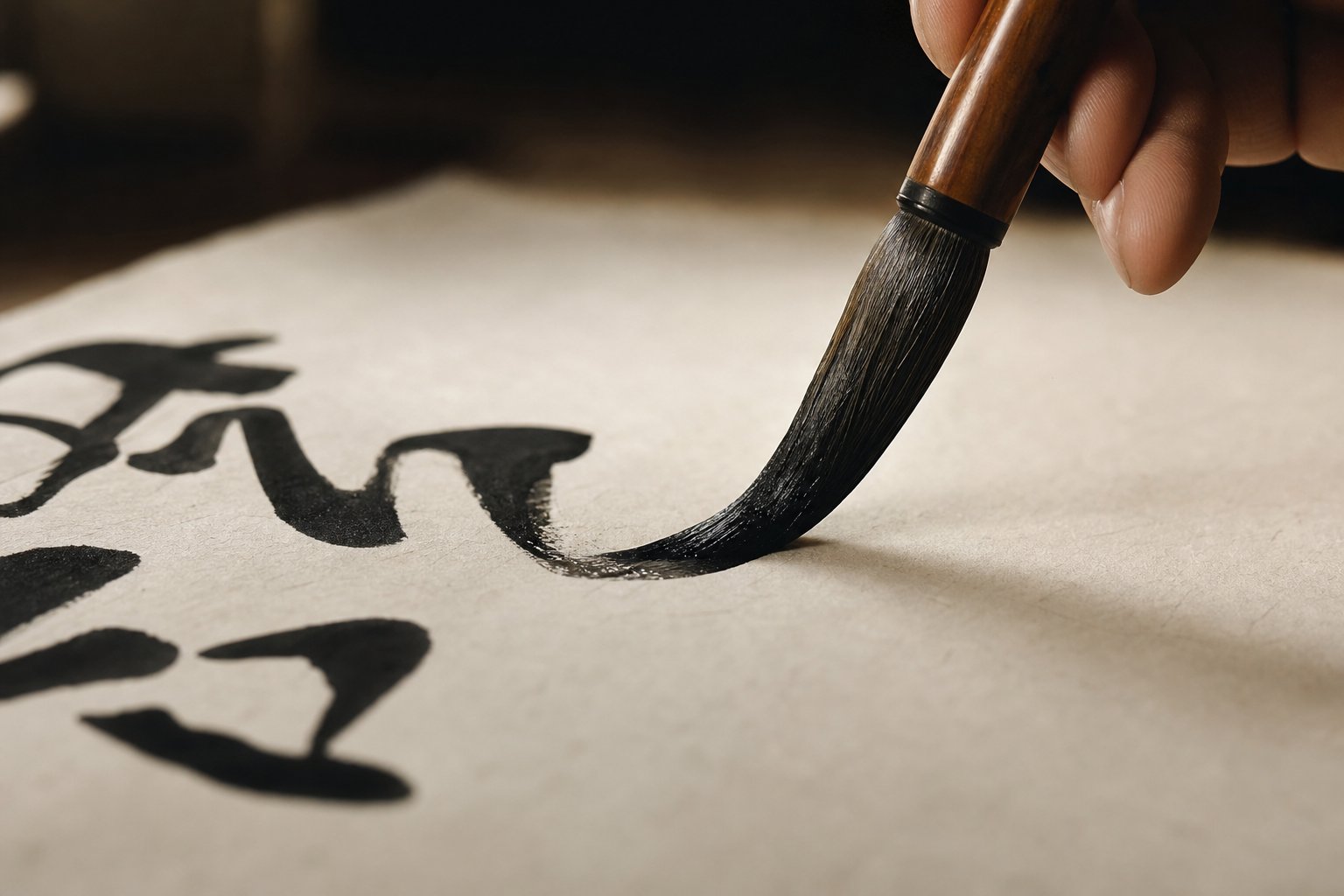
Knowing which radicals to practice and in what order gives you a plan. But a plan without technique is just a list. The moment your brush touches paper, four fundamental movements govern everything that happens: press, lift, turn, and pause. These are not abstract concepts. They are the physical actions your hand performs dozens of times within a single chinese character radical, and understanding how they interact is what separates deliberate practice from mindless repetition.
Press, Lift, Turn, and Pause in Radical Strokes
Every stroke in brush calligraphy is built from combinations of four core actions. Think of them as the alphabet of movement that produces every radical shape you will ever write.
The four pillars of brush technique are press (按 an), lift (提 ti), turn (转 zhuan), and pause (顿 dun). Every stroke in every radical is a sequence of these four actions in varying combinations, pressures, and speeds.
Here is what each one does and why it matters for radical practice:
- Press (按 an): Pushing the brush downward into the paper, spreading the bristles and creating a thicker, darker mark. Press controls stroke width. A heavy press at the start of a horizontal gives it a defined head. A gradual press along a right-falling stroke (捺 na) creates the characteristic thickening that anchors characters visually.
- Lift (提 ti): Raising the brush away from the paper while still in contact, narrowing the bristles and thinning the line. Lift creates tapers, transitions, and the fine trailing threads that connect strokes in running script. In radical practice, lift determines how cleanly a stroke ends and how smoothly you transition to the next one.
- Turn (转 zhuan): Rotating the brush tip to change stroke direction without lifting off the paper. Turns produce curves, hooks, and corners. The difference between a rounded turn and a sharp angular turn defines whether a radical feels soft or structured. In regular script radicals, turns are deliberate and visible. In cursive, they become fluid and continuous.
- Pause (顿 dun): A momentary stop where the brush presses slightly and holds position before continuing. Pauses create the visible "joints" in strokes, the small thickenings at corners, endpoints, and directional changes that give calligraphy its characteristic rhythm. Without pauses, strokes look rushed and weightless.
These four actions rarely occur in isolation. A single dot stroke involves press-pause-lift in rapid succession. A hook requires travel-pause-turn-lift. When you practice any radical on a chinese writing chart, you are really practicing specific sequences of these four movements arranged in patterns your muscle memory must internalize.
Stroke-by-Stroke Breakdowns of Essential Radicals
Theory becomes tangible when you apply it to specific radicals. Below are detailed breakdowns of three commonly practiced radicals, describing exactly how press, lift, turn, and pause operate within each stroke. Read these with a brush in hand if possible, tracing the movements in the air to feel the rhythm before committing ink to paper.
氵 (three-dot water radical)
This radical appears in hundreds of characters (河, 海, 法, 清) and is one of the first positional variants most students encounter. Despite having only three strokes, it demands precise control over dot angle and spacing.
- First dot (upper right): Begin with the brush tip approaching from the upper left at roughly 45 degrees. Press down-right with moderate pressure, pause briefly at the base to create a rounded bottom, then lift sharply upward and to the right. The dot should be small and compact, sitting highest in the vertical stack.
- Second dot (middle right): Same motion as the first, positioned slightly lower and slightly to the left. Press down-right, pause, lift. Keep the angle consistent with the first dot. The spacing between dots one and two should equal the spacing between dots two and stroke three.
- Third stroke (rising sweep): Begin with a light press angled downward to the left, then immediately transition into a rising motion toward the upper right, gradually lifting as you go. The stroke starts thick and ends thin, creating a sense of upward energy that visually connects this radical to the right-side component of the character.
木 (wood radical)
A four-stroke radical that teaches the critical hook technique and balanced diagonal strokes. When you look up chinese dictionary strokes for characters containing 木 (林, 森, 村, 材), you will find this radical everywhere.
- Horizontal stroke (一): Enter from the left with a slight downward press to create a defined head. Travel rightward with steady, even pressure, keeping the brush at a consistent angle. At the endpoint, pause briefly, press slightly downward, then lift cleanly. This stroke establishes the character's width.
- Vertical stroke with hook: Start at the center of the horizontal. Press downward to create a visible entry point, then pull straight down with consistent moderate pressure. Near the base, pause, press slightly deeper, then turn the brush leftward and upward in a quick flicking motion while lifting. The hook should be short and sharp, not sweeping.
- Left-falling stroke (撇 pie): Begin at the intersection of horizontal and vertical. Press lightly, then sweep down-left with gradually decreasing pressure, lifting the brush off the paper as the stroke tapers to a point. The motion accelerates slightly as you lift, giving the stroke a sense of natural release.
- Right-pressing stroke (捺 na): Begin at the same intersection point. Press lightly at the start, travel down-right while gradually increasing pressure. At the lowest point, pause with full press to create the characteristic thick "foot," then lift slowly to the right, tapering to a fine exit. This stroke is the slowest in the radical and carries the most visual weight.
心 (heart radical)
One of the most technically demanding intermediate radicals. The sweeping hook and precisely placed dots require coordination between large arm movements and fine wrist adjustments.
- Left dot: A quick press-pause-lift angled slightly to the left. Keep it small and positioned above the starting point of the hook. This dot sets the vertical height for the radical.
- Sweeping hook (卧钩 wogou): The defining stroke. Begin with a press at the left, then travel rightward and slightly downward in a long, shallow curve. Maintain moderate pressure throughout the curve, keeping the line width consistent. As you reach the rightmost point, pause, press deeper, then turn the brush sharply upward and to the left in a hooking motion while lifting. The curve should feel like the bottom of a shallow bowl, not a sharp V.
- Middle dot: Positioned above the center of the hook's curve. Press down-right at a steeper angle than the first dot, pause, lift. This dot should be slightly larger than the left dot, creating a sense of visual progression.
- Right dot: Positioned above the right portion of the hook, near where the upward flick begins. Same press-pause-lift motion, angled to match the first two dots. All three dots should feel rhythmically spaced, like three beats in a measure.
Why Stroke Order Matters More With a Brush
You might wonder why stroke order deserves special attention when you already know the standard sequences from pen writing or textbook study. The answer lies in what a brush does that a pen cannot: it responds to momentum, ink load, and the physical trail of the previous stroke.
In brush calligraphy, stroke order is not merely a convention for consistency. It is a mechanical necessity that governs ink flow, brush angle recovery, and the invisible connective energy between strokes called 笔势 (bishi).
When you write with a ballpoint pen, each stroke is independent. You can write them in any order and the visual result barely changes. A brush behaves differently. After completing a leftward sweep, your brush tip is oriented in a specific direction with a specific amount of ink remaining on the bristles. The next stroke must account for that orientation. If you follow the correct chinese dictionary stroke order, your brush naturally arrives at the starting position of the next stroke with minimal repositioning. Break that order, and you are constantly fighting the brush's momentum.
As Eastern Stillness explains, correct stroke order creates a natural path where the hand moves smoothly with less hesitation and less repositioning. When the order is random, movement becomes inefficient, flow breaks, and strokes compete rather than support each other.
Consider the radical 木 again. The standard order is horizontal, vertical-with-hook, left-sweep, right-press. After the hook flicks leftward, your brush is already positioned and angled perfectly to begin the left-falling stroke. After that leftward sweep lifts off the paper, the brush's return motion naturally carries it back toward the center, right where the right-pressing stroke begins. Each stroke sets up the next. Reverse any two, and you will feel the awkwardness immediately as your wrist contorts to compensate.
This connective logic applies to every radical you practice. Stroke order in brush calligraphy is not a rule to memorize. It is a physical sequence that, when followed, makes your movements more efficient and your results more consistent. The more radicals you internalize with correct order, the more automatic this flow becomes, freeing your attention for the higher-level concerns of proportion and composition that turn isolated radicals into complete, balanced characters.
Which Radicals to Master First for Calligraphy Practice
If you open a mandarin radical dictionary, you will find radicals ordered by stroke count or grouped by semantic category. That ordering makes sense for looking up words. It does not make sense for building brush skill. A calligraphy student who follows a language-learning sequence will practice 女 (woman) and 子 (child) early because they appear in high-frequency vocabulary, but neither radical introduces a hook, a sweeping press, or a multi-directional turn. Weeks pass, and fundamental techniques remain untrained.
Calligraphy prioritization works on three different criteria: how often a radical appears across the full chinese radicals list, how many distinct brush techniques it forces you to practice, and how transferable those techniques are to other radicals and characters. A radical that teaches you the right-pressing stroke (捺 na) earns its place early because that same movement reappears in dozens of other components. One that only uses horizontals and verticals, no matter how common semantically, can wait.
Radicals That Teach the Most Brush Techniques
When you compare a typical chinese radical list organized for language learners against one sequenced for brush development, the differences are striking. Language learners prioritize radicals in mandarin that unlock the most vocabulary. Calligraphers prioritize radicals that unlock the most movements. The radical 心 (heart), for example, ranks relatively low in beginner vocabulary lists but extremely high in calligraphic value because it teaches the sweeping hook, rhythmic dot placement, and asymmetrical balance in a single form.
The ideal sequence introduces one or two new techniques per radical while reinforcing skills from previous ones. Each entry on the chinese characters radicals list below was chosen because it adds something your brush has not yet done, building a cumulative toolkit of movements.
A Recommended Practice Sequence for Beginners
The following radicals chinese list is ordered by technique progression, not stroke count or meaning frequency. Work through them in sequence, spending multiple sessions on each before moving forward.
- 一 (one): Horizontal stroke control, even pressure, clean entry and exit.
- 丨 (vertical): Downward pulling motion, straight-line consistency.
- 丶 (dot): Press-pause-lift in a single compact motion.
- 十 (ten): Stroke intersection, maintaining integrity where lines cross.
- 口 (mouth): Turning corners, closing enclosures with even proportions.
- 人 (person): Left-falling stroke (撇) paired with right-pressing stroke (捺).
- 木 (wood): Vertical hook technique plus balanced diagonals.
- 氵 (water, left form): Dot rhythm and the rising sweep connecting to adjacent components.
- 土 (earth): Stacking horizontals of different lengths with vertical anchoring.
- 心 (heart): Sweeping horizontal hook (卧钩) and multi-dot placement.
- 扌 (hand, left form): Short horizontals with a sharp upward flick, compressed proportions.
- 火 (fire): Central dot with radiating diagonals, asymmetrical balance.
- 辶 (walk, enclosing form): Long sweeping base stroke supporting structure above.
- 糸 (silk): Rapid directional changes, light pressure threading.
- 言 (speech): Multiple stacked horizontals with vertical alignment discipline.
- 竹 (bamboo, top form): Paired left-falling strokes with short hooks, top-position compression.
- 食 (food): Complex transitions between dots, turns, and enclosures in tight space.
- 馬 (horse): Dense internal structure, four-dot base rhythm, full spatial planning.
Notice how the sequence builds cumulatively. By the time you reach 心 at position ten, you have already trained dots, verticals, and basic hooks individually. The sweeping hook of 心 combines those skills into a single demanding stroke. By the time you reach 馬, every technique from the mandarin radicals before it feeds into the complex internal spacing that radical demands.
This progression differs fundamentally from a language-learning approach because it treats each radical as a technique lesson rather than a vocabulary key. Both paths have value, but conflating them slows progress in both directions. A calligrapher who sequences practice by brush development will find that complete characters come together faster, because the component skills are already in place when it is time to combine radicals into full compositions.
From Radical Drills to Complete Character Composition
Sequencing radicals by technique gives your brush hand a growing vocabulary of movements. But individual radicals are not the end goal. They exist to serve complete characters. The real question is: how does isolated radical practice translate into writing full, balanced compositions where two or three components share space harmoniously? The answer lies in a structural concept that governs every chinese character radicals combine to form: 间架结构 (jianjia jiegou), the framework of proportional balance.
How Radical Practice Builds Muscle Memory
When you drill a radical in isolation, you are not just learning its shape. You are encoding a motor pattern. Your hand learns the pressure sequence, the directional shifts, the rhythm of pauses and lifts. After enough repetitions, these patterns become automatic. You no longer think about how to execute the three dots of 氵. Your hand simply does it.
This automation is critical because writing a complete character demands attention on multiple levels simultaneously. You must think about where the radical sits, how much space it occupies, how it relates to the component beside it, and how the overall character fits within its imaginary square. If you are still consciously managing the brush movements for each individual radical, you have no mental bandwidth left for these higher-level decisions.
Think of it like typing. A beginner stares at the keyboard, hunting for each letter. A skilled typist thinks in words and sentences because individual keystrokes are automatic. Radical drills serve the same function for calligraphy. They push component execution below the level of conscious effort, freeing your attention for composition. As Eastern Stillness emphasizes, character practice connects strokes, structure, and movement into real writing, but that connection only works when the underlying strokes are already internalized.
Proportional Balance Between Radicals in Complete Characters
Every chinese character tree of components follows spatial rules. A left-right character like 林 does not simply place two identical 木 radicals side by side. The left 木 compresses, its right-pressing stroke (捺) converts to a dot, and its overall width shrinks to roughly 40% of the total character space. The right 木 expands slightly, its strokes extending to fill the remaining area. This is 间架结构 in action: the internal framework that dictates how radicals negotiate space.
The China Daily outlines five core requirements for compositional beauty in Chinese calligraphy: straight and even, well-balanced, uneven and not uniform, coherent, and dynamic. These principles apply directly to how radicals interact within characters. "Well-balanced" means that characters with fewer strokes use thicker lines while dense characters use thinner ones. "Uneven and not uniform" means that even within a balanced structure, strokes vary in length and weight to avoid mechanical rigidity.
What does this mean practically? When you write chinese characters with meanings built from multiple radicals, each component must adjust its proportions based on its neighbors. A top-bottom character like 想 places 相 above 心. The upper component compresses vertically to leave room for the sweeping hook of 心 below. A left-right character like 清 gives roughly one-third of the width to 氵 and two-thirds to 青. These ratios are not arbitrary. They follow centuries of refined aesthetic logic that your eye learns to recognize and your hand learns to reproduce through repetition.
Radical mastery is not preparation for character composition. It is character composition, practiced one component at a time until the parts assemble themselves through trained proportion and internalized spatial logic.
The proportional relationships between radicals follow patterns you can study systematically. Left-side radicals almost always occupy less horizontal space than right-side components. Top radicals flatten while bottom radicals anchor. Enclosing radicals like 门 or 囗 must leave precise internal space for their enclosed components. Every entry on a chinese character list demonstrates these relationships, and recognizing them transforms your practice from copying shapes to understanding architecture.
Why Radical Drills Outperform Full Character Copying
Many beginners skip radical isolation entirely. They open a copybook, pick a character, and start reproducing it stroke by stroke. This feels productive because you are writing "real" characters from day one. But the results tell a different story. Characters written without radical fluency tend to show inconsistent proportions, uneven spacing, and components that do not relate to each other spatially.
The problem is cognitive overload. When you copy a complex character like 謝 without having drilled 言, 身, and 寸 individually, you are simultaneously trying to learn three sets of brush movements while also managing their spatial relationships. Your brain cannot optimize for technique and composition at the same time. Something suffers, usually both.
Radical drills solve this by separating the two challenges. First, you master each component until it requires minimal conscious effort. Then, you combine components into full characters, focusing entirely on proportion and balance. This mirrors how traditional calligraphy teachers have structured instruction for centuries: radical drills first, character practice second. The approach described by Eastern Stillness reinforces this progression, noting that jumping straight into complex characters causes loss of control and development of bad habits.
Consider the difference in outcomes. A student who spends two weeks drilling the twenty most common radicals before attempting full characters will write those characters with stable, consistent components from the start. A student who copies full characters from day one may produce recognizable shapes sooner, but their components will lack the precision and consistency that only isolated repetition builds. Over months, the radical-first student pulls ahead decisively because every new character they encounter is assembled from already-mastered parts.
Chinese characters and their meanings become more accessible through this method as well. When you can identify and execute each radical within a character confidently, the semantic structure becomes visible. You see 氵 and know water. You see 木 and know wood. The character is no longer an opaque block of strokes but a readable assembly of familiar, meaningful components. Radical drills build both the physical skill and the structural literacy that make every chinese character feel approachable rather than overwhelming.
This structured approach raises a practical question: how do you actually organize daily practice to move efficiently from isolated radicals into full character work without losing the benefits of either?
Building Your Radical-Based Calligraphy Practice Routine
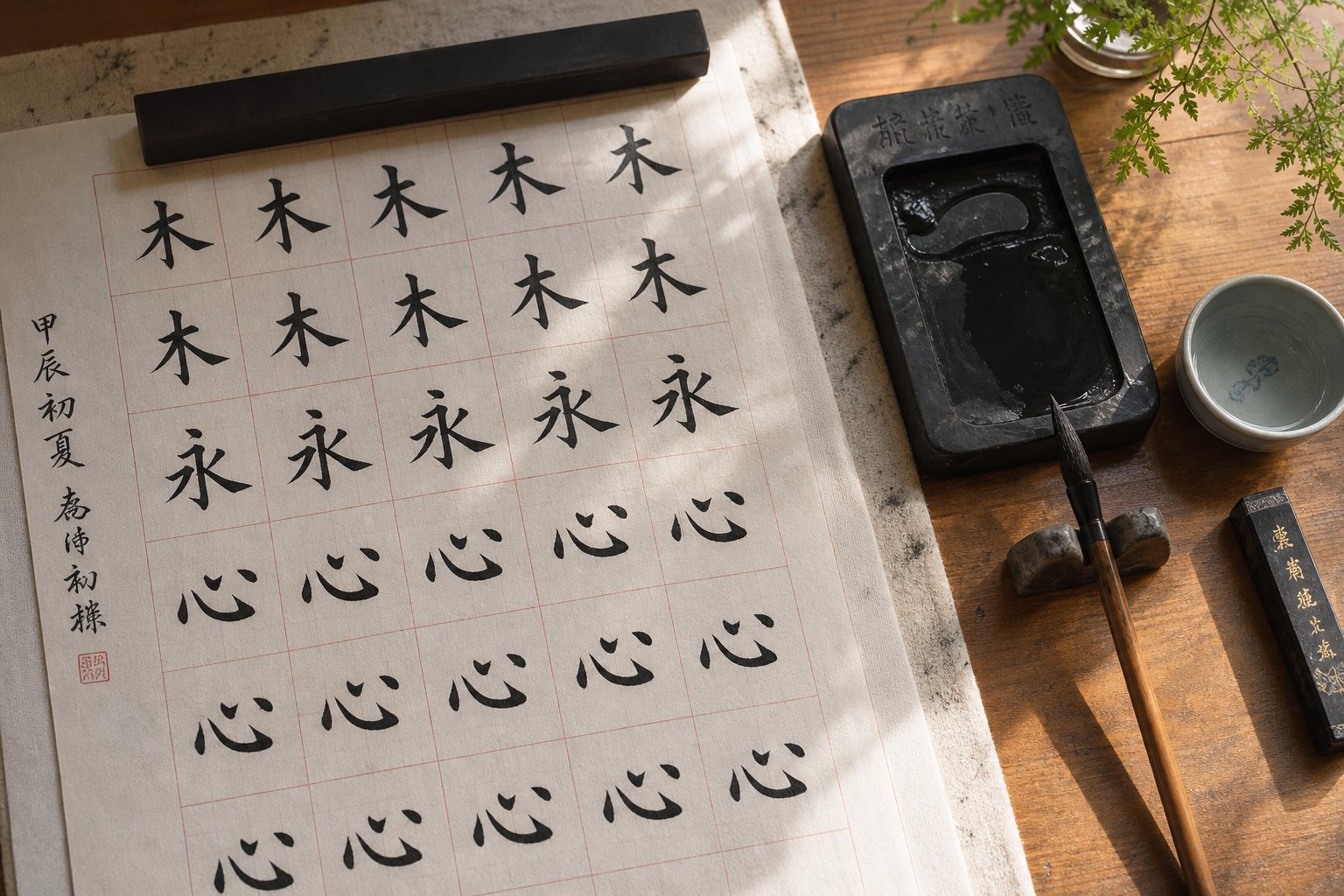
Knowing which radicals to practice and why radical drills outperform full character copying gives you the strategy. What you need now is a daily structure that turns that strategy into consistent, measurable progress. The good news? An effective session does not require hours. It requires clarity, repetition, and a framework simple enough that you never waste time deciding what to do next.
Structuring a Daily Radical Practice Session
A productive session follows the same three-part structure every day. Only the specific radical changes. This consistency removes decision fatigue and lets you focus entirely on brush movement. As Eastern Stillness emphasizes, a short focused session is more valuable than a long distracted one, and the key to daily practice is making it easy to start.
Here is what each session looks like:
- Warm-up with basic strokes (5 minutes): Write horizontal lines, vertical lines, and dots slowly and deliberately. This is not about producing beautiful work. It is about waking up your hand, settling your grip, and bringing your attention into the brush. Focus on smooth movement, consistent pressure, and a relaxed arm. Think of it as tuning an instrument before playing.
- Focused radical practice (10-15 minutes): Choose one radical for the session. Write it repeatedly, slowly, observing what happens with each repetition. Pay attention to entry angles, pressure transitions, and spacing. Aim for 20-30 repetitions, not rushing through them but treating each one as a chance to refine. If the radical has a positional variant (like 水 and 氵), practice both forms in the same session to feel the contrast.
- Application in full characters (5-10 minutes): Select two or three characters that contain the radical you just drilled. Write each character several times, noticing how the radical compresses, reshapes, or interacts with its neighboring components. This stage connects your isolated practice to real writing and reveals whether your radical execution holds up under compositional pressure.
That is a 20-to-30-minute session. Short enough to maintain daily, long enough to produce real improvement over weeks. The structure stays identical whether you are working through beginner radicals or tackling advanced ones like 馬 or 魚. Only the content inside each phase changes.
This framework serves both audiences equally. If you are a language learner exploring calligraphy, the application phase reinforces character recognition while building brush skill. If you are a calligraphy practitioner wanting to deepen your understanding of the semantic system, the focused radical phase naturally teaches you how meaning components recur across the characters you write in the application stage.
Tracking Progress Through the Radical System
A radical chart or radical index becomes essential once you move past the first few sessions. With 214 Kangxi radicals in the full system, you need a way to see where you have been, where you are, and what comes next. Without tracking, practice drifts. You revisit comfortable radicals and avoid difficult ones without realizing it.
The simplest approach is a printed or handwritten table of radicals organized by the technique-based sequence from the previous chapter. Mark each radical with a date when you first practice it and a second date when you feel confident executing it in both standalone and positional forms. Many practitioners keep a dedicated radical table in their practice notebook, adding sample characters beside each entry as they progress. Some prefer a downloadable list of chinese radicals pdf that they can print, annotate, and pin above their desk as a visual reminder of the full system.
A chinese dictionary radical lookup tool also helps during the application phase. When you finish drilling a radical, use a radical index to find characters containing it. This gives you fresh application material each session without needing to plan ahead. Over time, your radical list becomes a progress map showing exactly which brush techniques you have internalized and which still need work.
Systematic radical practice feels slower at the start. You are writing components, not characters. You are repeating the same shape dozens of times instead of filling pages with varied writing. But this patience compounds. Each radical you master becomes a permanent tool in your brush vocabulary. Characters that once looked impossibly complex become assemblies of familiar, practiced parts. Both your calligraphy skill and your character recognition accelerate together, built on the same foundation of deliberate, structured repetition.
Frequently Asked Questions About Chinese Calligraphy Radicals
1. What are Chinese radicals and how are they used in calligraphy?
Chinese radicals are the 214 fundamental graphic components that make up every Chinese character. In calligraphy, they serve a dual purpose: they classify characters for dictionary lookup, and more importantly, they function as core practice units for developing brush control, pressure modulation, and spatial composition. Calligraphers treat each radical as a distinct set of brush movements to master before combining them into full characters.
2. How many Chinese radicals are there and where did they come from?
The standard system contains 214 radicals, established by the Kangxi Dictionary in 1716. This system refined an earlier 540-radical classification from the Shuowen Jiezi (100 CE). The 214 Kangxi radicals remain the dominant organizational framework used in dictionaries, calligraphy copybooks, and character reference materials today.
3. Why do radicals change shape depending on their position in a character?
Radicals adopt positional variants to maintain visual balance within compound characters. A left-side radical compresses horizontally to leave room for the right component, while a top radical flattens vertically. For example, the standalone character for water (水) uses broad sweeping strokes, but its left-position variant (氵) becomes three compact dots. Each variant requires entirely different brush techniques, making them separate practice targets for calligraphers.
4. Which radicals should calligraphy beginners practice first?
Beginners should sequence radicals by brush technique progression rather than stroke count or meaning frequency. Start with single-stroke forms like 一 (horizontal control) and 丶 (dot press-lift), then progress to multi-stroke radicals that introduce hooks (木), sweeping strokes (心), and directional changes (糸). This approach systematically builds every core movement needed for complex characters.
5. Is it better to practice radicals in isolation or copy full characters from the start?
Practicing radicals in isolation first produces faster long-term progress. Full character copying forces beginners to manage brush technique and spatial composition simultaneously, leading to cognitive overload and inconsistent results. Radical drills automate component execution through repetition, freeing mental bandwidth for proportional balance when you later combine radicals into complete characters. Traditional calligraphy instruction has followed this radical-first approach for centuries.