Understanding the Chinese Cousin Naming System
Imagine you are at a Chinese family gathering. A relative introduces you to several cousins, and you need to greet each one properly. In English, you would simply say "cousin" and move on. In Mandarin, that single word does not exist. Instead, you are expected to choose from eight distinct terms, each encoding a specific piece of information about the relationship.
This is the reality of kinship in Chinese. Where English lumps all cousins under one umbrella, Mandarin demands precision. The term you select tells everyone within earshot exactly how you are connected to that person.
Why Chinese Has Eight Words for Cousin
The Sudanese kinship system, also called the descriptive system, assigns a unique label to nearly every relative based on their distance, lineage, and gender. Chinese follows this model and adds the dimension of relative age. The result: eight cousin terms built from three binary factors.
- Paternal vs. maternal side - Is this cousin connected through your father's brothers, or through any other path?
- Older vs. younger - Is this cousin older or younger than you?
- Male vs. female - Is this cousin a man or a woman?
Three questions, two options each, eight possible combinations. That is the entire framework behind Chinese cousin naming conventions.
What Makes the Chinese Kinship System Descriptive
In English, one word covers all cousins. In Chinese, the term you use reveals the exact relationship path, relative age, and gender.
When you learn family members in Chinese, you quickly notice that every title carries built-in context. Saying "cousin in Chinese" is never vague. The word itself tells listeners whether the connection runs through your father or mother, whether you should show deference or expect it, and whether you are speaking about a man or a woman. Understanding family in Mandarin means understanding that each label is a compressed description, not just a name.
This article is a focused deep-dive into those eight terms for relatives in Chinese. Rather than covering the entire family in Chinese, we zero in on the cousin layer, where most learners get stuck, and give you a repeatable method to always pick the right word.
The logic starts with one cultural question: why does the system care which side of the family a cousin comes from in the first place?

The Cultural Logic Behind Paternal and Maternal Distinctions
The answer lies in how traditional Chinese society defined belonging. A person's identity was not just personal. It was clan-based, inherited through the father, and tied to a shared surname. This patrilineal structure shaped everything from property rights to ancestor worship, and it is the single reason Chinese cousin naming conventions split into two categories rather than one.
Patrilineal Clan Structure and Surname Inheritance
In the traditional Chinese family structure, children belonged to their father's clan, known as 宗族 (zongzu). They carried his surname, worshipped his ancestors, and were recorded in his genealogical register. Sons continued the lineage. Daughters, upon marriage, were described as "marrying out" using the phrase 嫁出去 (jia chuqu), literally meaning to leave one's family and join the husband's clan.
This created a clear dividing line. Your father's brothers' children share your surname through an unbroken male line. They are part of your 宗族. Your mother's siblings' children, on the other hand, carry a different surname entirely. They belong to a different clan. The same applies to your father's sisters' children, because those sisters married out and their kids inherited their husbands' surnames.
Chinese family customs encoded this distinction directly into language. Cousins who share your surname and clan membership are called 堂 (tang) cousins. Everyone else is 表 (biao). The naming system is not arbitrary. It maps perfectly onto surname inheritance.
Why Paternal and Maternal Lines Are Distinguished
Think of it this way. In a society where your clan determines your social network, your obligations, and even where you are buried, knowing whether someone is "inside" or "outside" your clan matters enormously. Chinese clans maintained shared resources, collective responsibilities, and mutual aid systems. A 堂 cousin was not just a relative. They were a fellow clan member with shared duties toward the same ancestors.
A 表 cousin, while still family, belonged to a different social unit. They had their own ancestral obligations, their own clan elders, their own surname. Chinese family traditions reflected this reality by giving each group a separate linguistic marker. The distinction was practical, not merely symbolic.
As StudyCLI notes, the difference between family members who married in from outside and those who belong to the core patrilineal line is deeply embedded in Chinese vocabulary for relatives. You can see the same logic in how maternal grandparents are called 外公 and 外婆, where 外 (wai) literally means "outside."
The Ancestral Hall as Family Identity
The ancestral hall, or 祠堂 (citang), was the physical center of clan life. This is where families gathered for ceremonies, recorded births and deaths, and honored their shared forebears. Only members of the patrilineal clan had a place in the hall. If you shared the surname and descended through the male line, you belonged there.
The ancestral hall defined who was "inner family." If your cousin could stand beside you in that hall as a fellow clan member, they are 堂. If they belonged to a different hall, they are 表.
This is the cultural engine behind the entire system. Chinese culture family roles were organized around this inside-outside boundary, and the cousin terms preserve that logic in everyday speech. Even in modern China, where few families maintain active ancestral halls, the language remembers the structure. Every time someone says 堂哥 or 表妹, they are echoing a centuries-old distinction rooted in clan membership and china social structure.
The terminology carries history. But for learners, the real question is how to remember which prefix goes where. That is where the characters themselves become your best allies, because 堂 and 表 are not random labels. Their original meanings tell you exactly what they represent.
Etymology That Makes the Terms Unforgettable
The beauty of Chinese writing is that characters often carry their meaning on their face. When you study the chinese character for family terms, you are not memorizing arbitrary symbols. You are reading compressed stories. The two prefixes in the cousin system, 堂 and 表, are perfect examples. Their original meanings double as built-in memory hooks that make the entire system click into place.
The Meaning of 堂: Same Hall, Same Clan
The character 堂 (tang) means "hall." Specifically, it refers to the main hall of a house or, in a clan context, the ancestral hall where family members gathered for ceremonies, banquets, and worship. In traditional Chinese society, the ancestral hall (祠堂, citang) was the heart of clan identity. Only people who shared the patrilineal surname could claim a place inside it.
So when you call someone your 堂哥 or 堂妹, you are literally saying: "This person shares my hall." They belong to the same ancestral space, the same surname, the same unbroken father-to-son lineage. The character itself tells you the relationship is internal to your clan.
As a memory hook, think of it this way: if you and your cousin could both walk into the same ancestral hall and belong there, they are 堂. Tanghao plaques (堂号), which display a clan's ancestral hall name, are still hung outside homes in Chinese communities across Southeast Asia as markers of shared lineage. The word 堂 in your cousin's title carries that same weight of shared belonging.
The Meaning of 表: Outside the Patrilineal Line
The character 表 (biao) means "outside," "external surface," or "to express outwardly." Think of it as the outer layer of something, the part that faces away from the core. In family in chinese letters, this character signals a relationship that exists outside the patrilineal boundary.
A 表 cousin is connected to you through a woman who either married into your family (your mother) or married out of it (your father's sister). Their children carry a different surname. They belong to a different clan. They are family, absolutely, but they stand on the outside of your ancestral hall looking in.
堂 means "same hall" and marks cousins inside your patrilineal clan. 表 means "outside" and marks cousins connected through lines that cross clan boundaries.
This single pair of characters is the entire first decision in the system. Once you internalize that 堂 equals inside and 表 equals outside, you have already solved the hardest part of choosing the correct term. The rest comes down to age and gender, which use characters you may already know from learning siblings in Chinese.
Age and Gender Markers Explained
The second half of each cousin term uses the exact same characters that describe siblings. If you have already learned how to say older brother in Chinese or younger sister in Chinese, you already know these building blocks.
- 哥 (ge) - older brother. Used for a male cousin who is older than you. The full sibling form is 哥哥 (gege), but in cousin terms it appears as a single character after the prefix: 堂哥, 表哥.
- 姐 (jie) - older sister. Used for a female cousin who is older than you. The character for older sister in Chinese carries a sense of seniority and respect. Cousin forms: 堂姐, 表姐.
- 弟 (di) - younger brother. Used for a male cousin who is younger than you. Saying younger brother in Chinese, whether for a sibling or a cousin, always uses this character. Cousin forms: 堂弟, 表弟.
- 妹 (mei) - younger sister. Used for a female cousin who is younger than you. The character for younger sister in Chinese implies someone you look after. Cousin forms: 堂妹, 表妹.
Notice the pattern. Each cousin term is exactly two characters long: one prefix (堂 or 表) plus one age-gender marker (哥, 姐, 弟, or 妹). The prefix tells you the lineage path. The suffix tells you relative age and gender. Together, they form a complete description in just two syllables.
This is what makes chinese writing family terms so efficient. There is no ambiguity, no need for extra context. When someone says 表妹, every listener immediately knows: this is a female cousin, younger than the speaker, connected through a line outside the patrilineal clan. Two characters, four pieces of information.
With the building blocks clear, the practical question becomes: how do you assemble them in real time? When you are face-to-face with a cousin at a family dinner, which three questions do you ask yourself to land on the right term every time?
The Three Questions Method for Choosing the Right Term
You know the building blocks. You understand the cultural logic. But in the moment, standing in front of a cousin you have not seen in years, theory can freeze up. What you need is a repeatable decision path, something fast enough to run in your head between the handshake and the greeting. That is exactly what the Three Questions Method gives you.
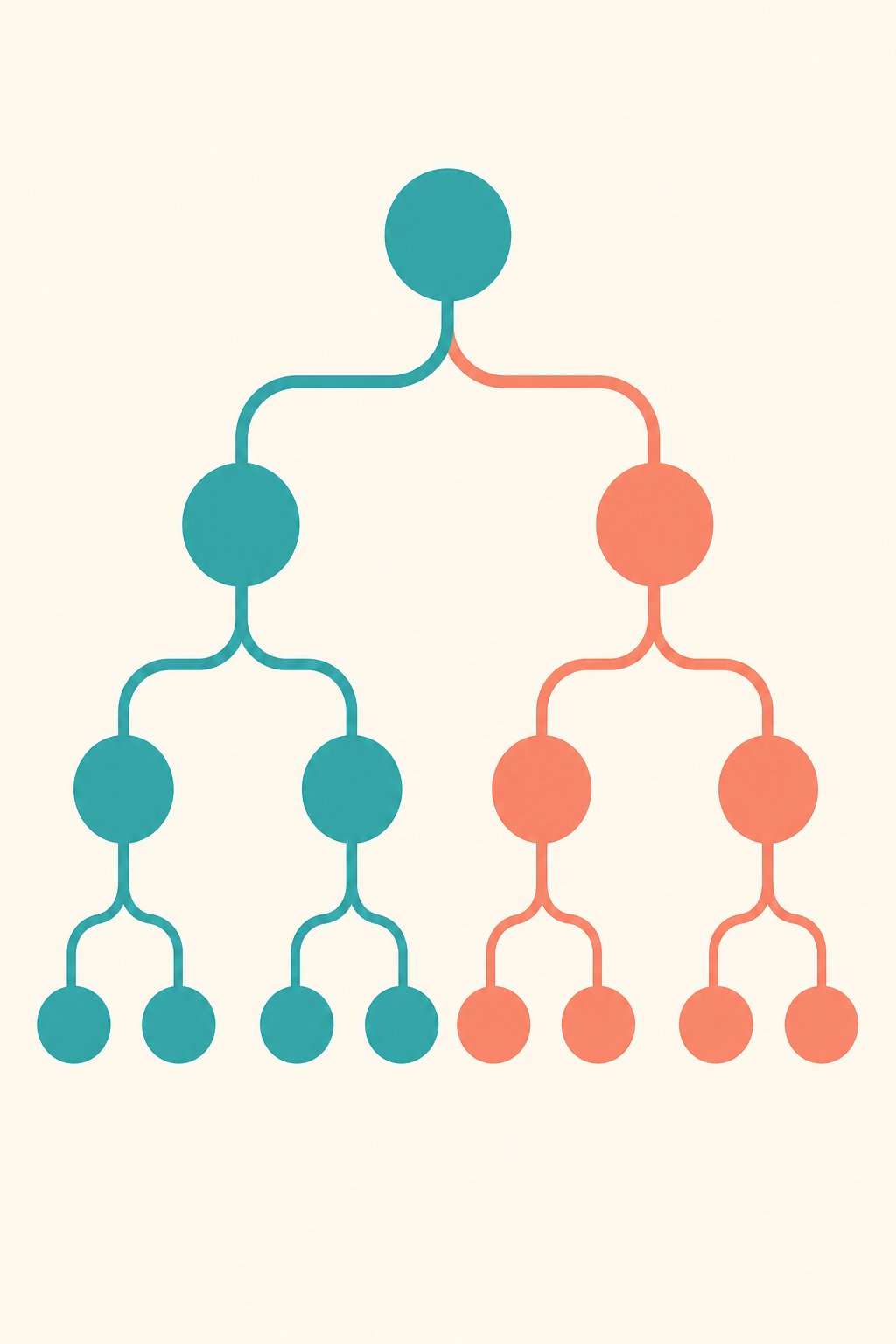
Every branch of the chinese family tree, no matter how sprawling, funnels into the same three binary choices. Answer them in order, combine the results, and you land on the correct term every single time.
The Three Questions You Always Ask
- Is this cousin from your father's brother's family?
If YES → use 堂 (tang). If NO → use 表 (biao).
This is the lineage question. Remember, 堂 only applies when the cousin descends from your father's brother, meaning they share your surname through an unbroken male line. Every other cousin path, whether through your mother's side or your father's sister, leads to 表. - Is this cousin older or younger than you?
If OLDER → the suffix will be 哥 (male) or 姐 (female). If YOUNGER → the suffix will be 弟 (male) or 妹 (female).
This is the age question. Compare your birth years. The older person gets the senior marker, the younger person gets the junior marker. - Is this cousin male or female?
If MALE → use 哥 (older) or 弟 (younger). If FEMALE → use 姐 (older) or 妹 (younger).
This is the gender question. It selects the final character and completes the two-character term.
Three questions, three binary answers, one correct term. The order matters: lineage first, then age, then gender. Think of it as narrowing from the broadest category down to the specific person.
Applying the Method With Real Examples
Seeing the method in action makes it stick. Let's walk through two scenarios you might encounter at any family gathering, tracing each step on the chinese language family tree.
Example A: Your mother's older sister has a son. He is three years older than you. What do you call him?
Step 1: Is he from your father's brother's family? No, he is from your mother's sister's family. That means 表 (biao). Step 2: Is he older or younger than you? He is older. That points toward 哥 or 姐. Step 3: Is he male or female? Male. The suffix is 哥. Combine them: 表哥 (biaoge), your older male cousin from outside the patrilineal line.
Example B: Your father's younger brother has a daughter. She was born two years after you. What do you call her?
Step 1: Is she from your father's brother's family? Yes, your father's younger brother is still your father's brother. That means 堂 (tang). Step 2: Is she older or younger than you? She is younger. That points toward 弟 or 妹. Step 3: Is she male or female? Female. The suffix is 妹. Combine them: 堂妹 (tangmei), your younger female cousin from within the patrilineal clan.
Notice how the method handles both examples identically. The relationship path does not matter beyond that first yes-or-no gate. Whether the cousin comes through your mother's brother, your mother's sister, or your father's sister, the answer to Question 1 is always "no," and you always land on 表. The only path to 堂 is through your father's brother. That single rule simplifies the entire family tree in Chinese cousin naming down to one decisive question followed by two straightforward observations.
With the method locked in, the next step is seeing all eight terms laid out together so you can confirm your answers at a glance and practice the pronunciation of each chinese family tree name.
Complete Reference for All Eight Chinese Cousin Terms
Here is your full family members in chinese list for the cousin layer. Each of the eight terms below combines one prefix with one suffix, and together they give you a precise, unambiguous label. Think of this section as a reference card you can return to whenever you need a quick confirmation.
The Four 堂 Cousin Terms for Paternal Uncle Lines
The 堂 group is the smaller, more restricted category. These chinese kinship terms apply exclusively to children of your father's brothers, whether those brothers are older (伯伯, bobo) or younger (叔叔, shushu) than your father. The key test: these cousins share your surname through an unbroken father-to-father line.
- 堂哥 (tanggē) - "hall" + "older brother." Your father's brother's son who is older than you. Example: 我堂哥今年大学毕业。(My tanggē graduates from university this year.)
- 堂姐 (tangjiě) - "hall" + "older sister." Your father's brother's daughter who is older than you. Example: 堂姐教我怎么包饺子。(My tangjiě taught me how to wrap dumplings.)
- 堂弟 (tangdì) - "hall" + "younger brother." Your father's brother's son who is younger than you. Example: 堂弟刚上高中。(My tangdì just started high school.)
- 堂妹 (tangmèi) - "hall" + "younger sister." Your father's brother's daughter who is younger than you. Example: 我和堂妹一起长大的。(My tangmèi and I grew up together.)
A critical point that trips up many learners: your father's sister's children do not qualify as 堂 cousins. Even though they are on the paternal side of the family, your father's sister married out of the clan. Her children carry her husband's surname, not yours. They belong to the 表 group below.
The Four 表 Cousin Terms for All Other Lines
The 表 group covers every cousin path that falls outside the father's-brother line. This includes children of your mother's brothers, your mother's sisters, and your father's sisters. All of these cousins carry a different surname from yours, which is the simplest way to confirm they are 表.
- 表哥 (biǎogē) - "outside" + "older brother." An older male cousin from any non-堂 line. Example: 表哥从上海来看我们了。(My biǎogē came from Shanghai to visit us.)
- 表姐 (biǎojiě) - "outside" + "older sister." An older female cousin from any non-堂 line. Example: 表姐的婚礼在下个月。(My biǎojiě's wedding is next month.)
- 表弟 (biǎodì) - "outside" + "younger brother." A younger male cousin from any non-堂 line. Example: 表弟比我小三岁。(My biǎodì is three years younger than me.)
- 表妹 (biǎomèi) - "outside" + "younger sister." A younger female cousin from any non-堂 line. Example: 我经常和表妹视频聊天。(I often video-call my biǎomèi.)
Notice that the 表 category is broader. In most families, you will have more 表 cousins than 堂 cousins simply because multiple relationship paths feed into it. Among all chinese words for family members, these four 表 terms are the ones you will likely use most often.
Quick Reference Table With All Eight Terms
The table below puts all eight mandarin family members cousin terms side by side for easy comparison. Use it as a pronunciation guide and a relationship-path cheat sheet.
| Chinese | Pinyin | Literal Breakdown | Relationship Path | Example Sentence |
|---|---|---|---|---|
| 堂哥 | tanggē | hall + older brother | Father's brother's son, older than you | 堂哥带我去打篮球。(Tanggē took me to play basketball.) |
| 堂姐 | tangjiě | hall + older sister | Father's brother's daughter, older than you | 堂姐在北京工作。(Tangjiě works in Beijing.) |
| 堂弟 | tangdì | hall + younger brother | Father's brother's son, younger than you | 堂弟今天过生日。(Tangdì's birthday is today.) |
| 堂妹 | tangmèi | hall + younger sister | Father's brother's daughter, younger than you | 堂妹喜欢画画。(Tangmèi likes to draw.) |
| 表哥 | biǎogē | outside + older brother | Mother's sibling's or father's sister's son, older than you | 表哥教我骑自行车。(Biǎogē taught me to ride a bike.) |
| 表姐 | biǎojiě | outside + older sister | Mother's sibling's or father's sister's daughter, older than you | 表姐送了我一本书。(Biǎojiě gave me a book.) |
| 表弟 | biǎodì | outside + younger brother | Mother's sibling's or father's sister's son, younger than you | 表弟下个月来我家玩。(Biǎodì is visiting my home next month.) |
| 表妹 | biǎomèi | outside + younger sister | Mother's sibling's or father's sister's daughter, younger than you | 表妹刚学会游泳。(Biǎomèi just learned to swim.) |
For pronunciation, pay attention to the tones. 堂 is second tone (rising), so tanggē rises then stays high on gē (first tone). 表 is third tone (dipping), so biǎogē dips low before the high-level gē. Practicing these chinese family terms in pairs, saying 堂哥 then 表哥 back to back, helps your ear lock onto the tonal contrast between the two prefixes.
This complete set of family members in chinese language for the cousin category gives you everything you need for identification. But identification assumes you already know one thing: whether a given cousin is older or younger than you. In practice, that is not always obvious, especially when you are meeting relatives for the first time. How do Chinese families actually determine who is the "older" and who is the "younger" cousin?

How Age Comparison Works Between Cousins in Practice
You have the eight terms memorized. You know the lineage prefix. You can identify gender at a glance. But then you meet a cousin at a Spring Festival dinner who looks roughly your age, and the system stalls on one question: are they older or younger than you? This is not a rare edge case. It is one of the most common real-world stumbling blocks in using chinese cousin naming conventions correctly.
The answer is simpler than you might expect, but it comes with a few nuances worth understanding.
Birth Year vs Birth Date vs Generational Rank
In most Chinese families, the older-or-younger designation between cousins is determined by birth year. If your cousin was born in 1995 and you were born in 1997, they are your 哥 or 姐 regardless of the specific month or day. Birth year is the default tiebreaker across the majority of families in mainland China, Taiwan, and overseas communities.
Some families do use exact birth date when cousins share the same birth year. Imagine you and a cousin were both born in 1998, but she arrived in March and you arrived in October. In that household, she would be your 姐 (older sister) because her birthday comes first. Other families in the same situation might simply treat same-year cousins as equals and let either term slide. There is no single national rule here. Family preference wins.
A separate concept that sometimes confuses learners is 辈分 (beifen), which refers to generational rank within the clan hierarchy. Generational seniority is determined by your position on the family tree, not by your age. A cousin could technically be ten years younger than you but belong to a higher generation if the family branches diverged unevenly. However, for the eight cousin terms specifically, actual age is what determines whether you use 哥/姐 or 弟/妹. Generational rank affects how you address uncles, aunts, and elders, but among chinese siblings and cousins of the same generation, birth year is the deciding factor.
For the eight cousin terms, actual age decides the suffix. Generational rank (辈分) governs other kinship titles but does not override age when choosing between 哥/姐 and 弟/妹.
How to Ask About Relative Age Politely
So what happens when you genuinely do not know? Maybe you are meeting a cousin for the first time at a wedding, or reconnecting with a relative you last saw as a toddler. You need to figure out who is the big brother in chinese terms and who is the little brother in mandarin chinese terms before you can even say hello properly.
The good news: asking directly is completely normal. In Chinese social culture, clarifying relative age is expected, not awkward. Here are the most common phrases people use:
- 你是哪年的? (Ni shi na nian de?) - "What year were you born?" This is the most casual and widely used question among younger people. It gets straight to the point without feeling intrusive.
- 你比我大还是小? (Ni bi wo da haishi xiao?) - "Are you older or younger than me?" Direct and efficient. Works well when you have already shared your own age or birth year.
- 你多大了? (Ni duo da le?) - "How old are you?" Slightly more general, but perfectly acceptable between cousins meeting for the first time.
- 你属什么的? (Ni shu shenme de?) - "What is your Chinese zodiac animal?" Since each zodiac animal corresponds to a specific birth year, this is an indirect way to determine age without asking for a number outright.
Among younger generations, the first two options are by far the most common. There is no social penalty for asking. In fact, people expect the question because they know the correct term of address depends on the answer. Asking shows you care about getting it right, which signals respect rather than rudeness.
When You Genuinely Cannot Determine Who Is Older
Occasionally, you hit a true gray zone. Same birth year, no one remembers exact dates, and the family has no strong opinion either way. What then?
In practice, most families default to one of two solutions. The first is to let the parents sort it out. Your father or mother will often know (or quickly calculate) who was born first, especially if the cousins grew up in the same city. The second is to simply pick the term that feels socially appropriate. If your cousin acts as the older brother chinese families expect, taking the lead, looking after younger relatives, the family may naturally slot him into the 哥 role regardless of a few months' difference.
For learners, the practical takeaway is this: if you cannot determine relative age and no one around you can clarify, defaulting to the "older" term (哥 or 姐) is the safer choice. Calling someone older brother or big sister in chinese carries a tone of respect. Calling someone who is actually older than you 弟 or 妹, on the other hand, can feel dismissive. When in doubt, round up.
This age-determination step is the last piece of the puzzle for using the eight terms correctly. But even with the method mastered, certain relationship paths still trip people up, especially the ones that look paternal but are actually 表. The most common mistakes follow a predictable pattern, and knowing them in advance saves you from the awkward correction at the dinner table.
Common Mistakes Learners Make and How to Fix Them
The eight-term system is logical, but logic does not prevent mistakes. Certain relationship paths create an almost magnetic pull toward the wrong prefix, and learners fall into the same traps over and over. The errors below account for the vast majority of mix-ups. Recognizing them now means you will not be the person at the family gathering who accidentally demotes a cousin to the wrong side of the clan line.
The Most Common 堂 vs 表 Confusion
The number one mistake is straightforward: using 堂 for any cousin on the maternal side. It feels intuitive because 堂 sounds like the "important" or "close" prefix, and your mother's family certainly feels close. But closeness has nothing to do with it. The distinction is purely structural.
- Mistake 1: Using 堂 for your mother's brother's children. Your uncle in chinese on the maternal side is 舅舅 (jiujiu). His children might be your favorite cousins, the ones you grew up with, the ones you see every weekend. It does not matter. They carry your mother's maiden surname or your uncle's surname, not your father's surname. They are 表, never 堂. Correction: your 舅舅's son who is older than you is 表哥, not 堂哥.
- Mistake 2: Using 堂 for your mother's sister's children. Your aunt in chinese on the maternal side is 姨妈 (yima) or 阿姨 (ayi). Same logic applies. Her children belong to her husband's clan and carry his surname. They are 表 cousins regardless of how close the relationship feels. Correction: your 姨妈's daughter who is younger than you is 表妹, not 堂妹.
The underlying error in both cases is the same: confusing emotional closeness or frequency of contact with clan membership. The system does not care how often you see someone. It cares about one thing only: surname inheritance through the father-to-father line.
The Father's Sister Trap
This is the mistake that catches even intermediate learners. Your father's sister, called 姑姑 (gugu) in Mandarin, is undeniably on the paternal side of your family. She shares your surname by birth. She grew up in the same household as your father. So her children must be 堂 cousins, right?
Wrong. This is the single most deceptive error in the entire system.
- Mistake 3: Using 堂 for your father's sister's children. Your auntie in chinese on the paternal side is 姑姑, and her husband is 姑父 (gufu). When she married, she joined her husband's clan. Her children carry her husband's surname, not yours. They do not belong to your ancestral hall. They are 表 cousins. Correction: your 姑姑's son who is older than you is 表哥, not 堂哥.
This trips people up because the connection runs through your father's side. The instinct says "paternal side equals 堂." But that shortcut is dangerously incomplete. The correct rule is narrower: 堂 applies only to children of your father's brothers. Your father's sister's children, despite being paternal-side relatives, fall outside the patrilineal line the moment her surname changed through marriage.
- Mistake 4: Assuming all paternal-side cousins are 堂. This is the generalized version of the father's sister trap. Learners hear "paternal equals 堂, maternal equals 表" and apply it as a blanket rule. The accurate version is: father's brother's children equals 堂. Father's sister's children equals 表. Mother's anything equals 表. Only one specific path leads to 堂.
Think of it this way. When you learn uncle in chinese language, you discover that your father has two types of brothers (伯伯 for older, 叔叔 for younger) and one type of sister (姑姑). Only the children of 伯伯 and 叔叔 qualify as your 堂 cousins. The children of 姑姑 join the 表 group alongside all maternal cousins. The aunt chinese term 姑姑 marks a boundary: her marriage moved her children outside your hall.
A Simple Surname Test to Never Get It Wrong
Every mistake above collapses into one diagnostic question. Forget the relationship path for a moment and ask yourself this:
Does this cousin share my surname through an unbroken father-to-father line? If yes, they are 堂. If no, they are 表.
That is the entire test. It works because the 堂/表 distinction was built on surname inheritance in the first place. The surname is the visible proof of shared clan membership. If your cousin's last name matches yours because their father and your father are brothers who inherited the same surname from the same grandfather, you are looking at a 堂 relationship. Every other scenario, no matter how the family tree branches, produces 表.
Here is the test applied to each common mistake:
- Mother's brother's child - different surname from yours → 表 ✓
- Mother's sister's child - different surname from yours → 表 ✓
- Father's sister's child - different surname from yours (carries father's sister's husband's surname) → 表 ✓
- Father's brother's child - same surname as yours through patrilineal descent → 堂 ✓
One question. Four correct answers. No exceptions.
A bonus mistake worth mentioning: confusing the age suffix by using generational position instead of actual birth year. If your aunt in mandarin (姨妈) is your mother's older sister, that does not make her children automatically your 哥 or 姐. Their position as "older" or "younger" depends on their age relative to yours, not their parent's age relative to your parent. A chinese for aunt term tells you the aunt's position. The cousin term tells you the cousin's position. These are independent calculations.
With these corrections locked in, you have a mistake-proof framework for the standard system. But language is never static. The terms described so far reflect standard Mandarin usage, and Chinese is spoken across a vast geography with significant regional variation. How do these conventions shift when you move from Beijing to Guangzhou, or from formal family gatherings to casual group chats among younger cousins?
Regional Variations and Modern Usage Across Chinese Communities
The eight-term system you have learned so far reflects standard Mandarin as spoken in mainland China. But Chinese is not one language. It is a family of related languages and dialects spread across a massive geography, from Taipei to Toronto, from Guangzhou to Singapore. The cousin naming structure remains remarkably consistent across all these communities, but pronunciation, formality, and everyday usage shift depending on where you are and who you are talking to.
Cantonese and Regional Pronunciation Differences
If you are building a family tree in Cantonese, you will find the same eight-term framework intact. The logic is identical: 堂 for paternal uncle's children, 表 for everyone else, with age and gender markers completing the term. What changes is how each character sounds.
In Hong Kong and Guangdong Province, Cantonese speakers use Jyutping romanization rather than pinyin. The 堂 prefix becomes tong4, and 表 becomes biu2. The age-gender suffixes also shift: 哥 is go1, 姐 is ze1, 弟 is dai2, and 妹 is mui2. Cantonese cousin terms on the paternal side sometimes appear in expanded form, such as 堂阿哥 (tong4 aa3 go1) for an older male paternal cousin, or 堂家姐 (tong4 gaa1 ze1) for an older female paternal cousin. These longer forms are common in spoken Cantonese but carry the same meaning as their Mandarin equivalents.
The table below compares all eight terms across Mandarin and Cantonese pronunciation, giving you a quick reference for either mandarin family tree or cantonese family tree contexts.
| Chinese | Mandarin Pinyin | Cantonese Jyutping | Meaning |
|---|---|---|---|
| 堂哥 | tanggē | tong4 go1 | Older male cousin (father's brother's son) |
| 堂姐 | tangjiě | tong4 ze1 | Older female cousin (father's brother's daughter) |
| 堂弟 | tangdì | tong4 dai2 | Younger male cousin (father's brother's son) |
| 堂妹 | tangmèi | tong4 mui2 | Younger female cousin (father's brother's daughter) |
| 表哥 | biǎogē | biu2 go1 | Older male cousin (all other lines) |
| 表姐 | biǎojiě | biu2 ze2 | Older female cousin (all other lines) |
| 表弟 | biǎodì | biu2 dai2 | Younger male cousin (all other lines) |
| 表妹 | biǎomèi | biu2 mui2 | Younger female cousin (all other lines) |
In Taiwan, Mandarin pronunciation follows the same pinyin system used in mainland China, though some families retain Hokkien or Hakka terms in daily speech. An uncle in cantonese might be 叔叔 (suk1 suk1) on the paternal side, mirroring the Mandarin structure with different phonetics. Regardless of dialect, the underlying logic of the chinese family hierarchy never changes. The 堂/表 split, the age markers, and the gender suffixes all function identically whether you are speaking Mandarin, Cantonese, Hokkien, or Hakka.
Formal Usage vs Modern Casual Shortcuts
Here is where generational differences come into play. Among older family members, using the full two-character term is not optional. It is expected. When you greet your cousin at a Lunar New Year dinner with grandparents present, saying 表哥 or 堂姐 signals that you understand your place in the family structure. It shows respect for the mandarin for family conventions that elders grew up with.
Among younger generations, especially in urban areas, the system often gets compressed. Cousins who are close in age and see each other frequently may drop the 堂/表 prefix entirely and just use 哥哥, 姐姐, 弟弟, or 妹妹, the same terms used for biological siblings. In group chats and casual conversation, the lineage distinction can feel overly formal when everyone already knows the relationship. A cousin you grew up with might simply be 哥 in your phone contacts, not 表哥.
This simplification is especially common in families affected by China's one-child policy era. When you have no biological siblings, your cousins often fill that role emotionally. Calling them by sibling terms rather than cousin terms reflects that closeness. It is not a sign of ignorance about the system. It is a deliberate choice to signal intimacy over formality.
That said, context matters. The same person who texts their cousin "哥, 你在哪?" will switch to "表哥" without hesitation when introducing that cousin to an elder or speaking at a family banquet. Chinese family life operates on a spectrum of formality, and knowing when to use the full term versus the shortcut is itself a social skill.
Why the Full System Still Matters Today
Despite casual shortcuts, the complete eight-term system remains actively understood and used across all Chinese-speaking regions. Family gatherings, wedding invitations, funeral arrangements, and legal documents all rely on precise kinship terminology. When a family discusses inheritance, property, or caregiving responsibilities, the difference between 堂 and 表 can carry real practical weight, echoing the clan-based distinctions that created the system centuries ago.
Overseas Chinese communities in Southeast Asia, North America, and Europe maintain the system with varying degrees of formality. Families that prioritize cultural transmission often insist that children learn the correct terms, viewing it as a connection to heritage. Others let the distinctions fade as English or local languages become dominant at home. But even in heavily assimilated families, the terms tend to resurface at large gatherings where multiple generations interact.
The Chinese kinship system has survived dynastic collapses, political revolutions, mass migration, and the rise of nuclear families. Its persistence speaks to something deeper than habit. The terms encode a way of understanding relationships that remains meaningful even when the patrilineal clan structure that created them has loosened. Knowing where you stand relative to your cousins, whether inside or outside the ancestral hall, older or younger, male or female, still shapes how Chinese families organize themselves, distribute respect, and maintain bonds across distance and time.
Frequently Asked Questions About Chinese Cousin Naming Conventions
1. What is the difference between 堂 and 表 cousins in Chinese?
堂 (tang) cousins are children of your father's brothers only. They share your surname through an unbroken patrilineal line and belong to the same ancestral clan. 表 (biao) cousins include everyone else: children of your mother's siblings and your father's sisters. The simplest test is surname inheritance. If the cousin carries your family name through a father-to-father connection, they are 堂. All other cousins are 表, regardless of how close the relationship feels emotionally.
2. How many words for cousin are there in Chinese?
Chinese has exactly eight words for cousin, built from three binary factors: lineage (堂 or 表), relative age (older or younger than you), and gender (male or female). The eight terms are 堂哥, 堂姐, 堂弟, 堂妹, 表哥, 表姐, 表弟, and 表妹. Each two-character term encodes the complete relationship path, making it far more specific than the single English word 'cousin.'
3. Are my father's sister's children 堂 or 表 cousins?
They are 表 cousins, not 堂. This is the most common mistake learners make. Even though your father's sister (姑姑) is on the paternal side, she married into another clan. Her children carry her husband's surname, not yours. The 堂 prefix applies exclusively to children of your father's brothers (伯伯 or 叔叔). Any cousin who does not share your surname through patrilineal descent defaults to 表.
4. How do you determine if a Chinese cousin is older or younger than you?
Most Chinese families use birth year as the deciding factor. If your cousin was born in an earlier year, they receive the older suffix (哥 or 姐). If born in a later year, they get the younger suffix (弟 or 妹). When cousins share the same birth year, some families compare exact birth dates while others treat them as equals. Asking directly with phrases like '你是哪年的?' (What year were you born?) is completely normal and expected in Chinese social settings.
5. Do Cantonese speakers use the same cousin naming system as Mandarin speakers?
Yes, the structural logic is identical across all Chinese dialects. Cantonese uses the same 堂/表 distinction and the same age-gender suffixes. Only the pronunciation differs: 堂 becomes tong4, 表 becomes biu2, 哥 is go1, 姐 is ze1, 弟 is dai2, and 妹 is mui2. Cantonese may also use expanded spoken forms like 堂阿哥 or 堂家姐, but the underlying eight-term framework and the cultural logic behind it remain consistent across all Chinese-speaking regions.