Understanding Chinese Generational Naming and How It Works
Chinese generational naming, known as 字辈 (zibei), is a system where one character in a person's given name is shared by all members of the same generation within a clan. Siblings, cousins, and even distant relatives born into the same generational tier carry this identical character in their names, making kinship visible at a glance. It is not a relic locked in history books. Families across China and the diaspora are quietly reviving this practice, adapting it to fit contemporary life.
What Is Chinese Generational Naming
Imagine meeting someone for the first time and knowing immediately how they relate to your family tree, just from hearing their name. That is exactly what generational names accomplish. The shared character acts as a built-in marker, signaling which generation a person belongs to within their extended family. As the My China Roots research team explains, these generation characters are decided in advance by forefathers, both in terms of the pool of characters and the order they follow. Siblings and patrilineal cousins of the same generation all carry the same marker. For example, if cousins share the character "Zhen" in their names, you'll notice names like Jia Zhenni, Jia Zhenhai, and Jia Zhenhua all belong to the same generational cohort.
The Three-Part Structure of Chinese Names
So how are Chinese names structured when generational naming is in play? A full name typically follows a clear three-part pattern:
- Surname (family name) - Comes first, representing the entire lineage. Common examples include Wang, Li, and Zhang.
- Generation character - The shared element linking all clan members of the same generation. This character is predetermined, often decades or centuries in advance.
- Individual character - The unique element chosen by parents to reflect personal hopes, aspirations, or auspicious meaning for the child.
This chinese name structure means a name like "Wang Ming Zhi" tells you three things at once: the family (Wang), the generation (Ming), and the individual (Zhi). Not every modern family still follows this convention, and some have shifted the generation character's position or use it only informally. But the underlying logic remains the same, a naming architecture designed to encode family relationships directly into language.
The real question is how these generation characters get assigned in the first place, and the answer lies in an elegant literary device that has governed Chinese clan naming for centuries.
How Generation Poems Work Across Successive Generations
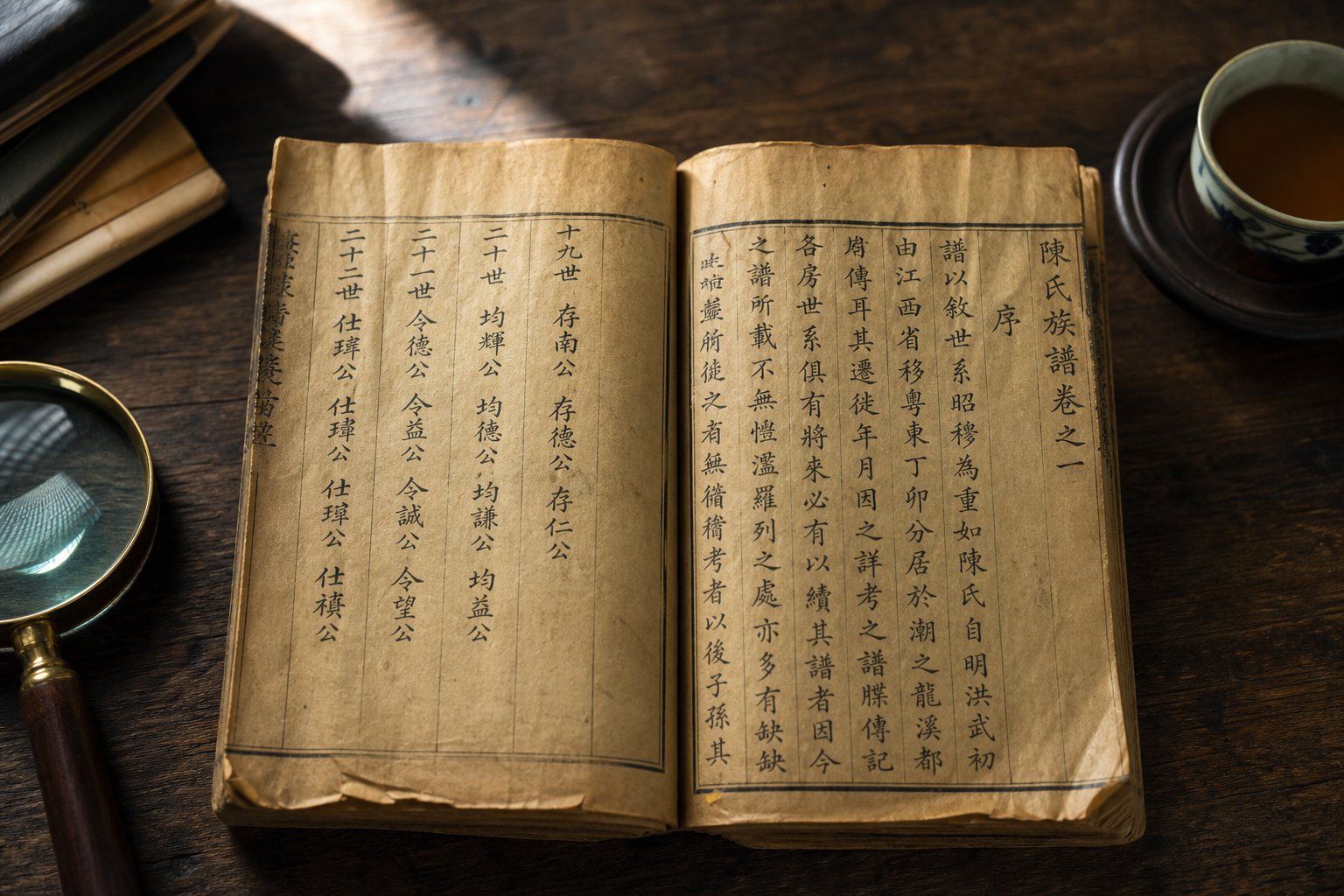
That elegant literary device is the generation poem, or 字辈诗 (zibei shi). A clan founder or respected elder composed a short poem, typically between 20 and 50 characters long, and this poem became the naming blueprint for every generation that followed. Each character in the poem corresponds to one generation. The first generation after the poem's creation takes the first character, the next generation takes the second, and so on down the line. It is both a naming system and a piece of family literature, encoding values, hopes, and identity into a sequence that can span centuries.
How a Generation Poem Assigns Characters
Picture a poem with the following five characters as its opening line: 仁 (Ren, benevolence), 义 (Yi, righteousness), 礼 (Li, propriety), 智 (Zhi, wisdom), 信 (Xin, trust). These characters are arranged in ordered lines, usually in sets of 5 or 7, and each provides the generation marker for one successive cohort of the clan.
Here is how it plays out across generations in a hypothetical Chen family:
- Generation 1 - All children receive 仁 (Ren) as their generation character. Names might be Chen Renhua, Chen Renjie, Chen Renli.
- Generation 2 - The next character, 义 (Yi), becomes the shared marker. Names like Chen Yiming, Chen Yifang, Chen Yiqiang appear.
- Generation 3 - 礼 (Li) takes its turn. Chen Liwen, Chen Lihao, Chen Lijun.
- Generation 4 - 智 (Zhi) marks this cohort. Chen Zhiyuan, Chen Zhigang.
- Generation 5 - 信 (Xin) completes the first line. Chen Xinrui, Chen Xinmei.
When the poem's final character is reached, some clans cycle back to the beginning. Others commission a new poem. Either way, the system creates an unbroken thread linking ancestors to descendants through language itself. The characters chosen are rarely random. They typically convey virtues like loyalty, respect, or wisdom, expressing the hopes a family held for each future generation.
Reading Your Place in the Generational Sequence
So what are the generational names for your specific family tier? Determining your place in the sequence requires one key piece of information: a known ancestor whose generation position is already established. Imagine your grandfather's name contains the character 礼 (Li), and you know that character is the third in your clan's poem. Your father's generation would use the fourth character, 智 (Zhi), and your own generation would use the fifth, 信 (Xin).
This counting method works both forward and backward. If you meet a distant relative whose name contains 仁 (Ren), you immediately know they belong to a generation two steps above your grandfather. The generation character functions like a built-in coordinate system, making kinship distance visible without needing to trace every branch of the family tree. The generation character most often appears as the first given character, though some clans place it second, creating variation while preserving the shared link across relatives.
Researching Your Own Clan Poem
Many families today have lost direct knowledge of their generation poem, especially after decades of disruption in the 20th century. But the poem often still exists, waiting to be found. Even if your family's genealogy record does not include a written poem, you can often recognize repeating patterns in names across generations. Children and cousins in the same generation commonly share a character, which acts like a hidden poem even if it was never formally recorded.
If you want to discover your own clan's generational characters, here are practical steps to follow:
- Ask elder family members directly. Grandparents, great-aunts, and uncles often remember at least a few characters from the poem, even if they cannot recite the whole sequence. Record whatever fragments they recall.
- Look for repeating characters in family names. Open your family tree and examine names across siblings and cousins of the same generation. A shared character appearing consistently is likely your generation marker.
- Search for your clan's jiapu (家谱/族谱). A jiapu is a clan genealogy book that often contains the full generation poem alongside detailed lineage records. These books may be held in your ancestral village, local libraries, or clan associations in Southeast Asia.
- Use digital genealogy databases. FamilySearch hosts over 65,000 Chinese jiapu that can be searched by surname, ancestral hall, or keywords from the generation poem. Even a handful of generation characters can act like a fingerprint, helping you locate your family's specific records.
- Contact your ancestral village leadership. If you know your family's hometown in China, reaching out to village officials with photographs and ancestor names can help confirm whether a zupu still exists locally.
- Check clan associations abroad. In countries like Malaysia, Singapore, and other Southeast Asian nations, local clan associations sometimes collect and preserve family genealogy books for their members.
Because each clan's poem is unique, even a partial sequence of characters can narrow down your specific lineage among thousands of families sharing the same surname. The poem is not just a naming tool. It is a key that unlocks genealogical records stretching back centuries.
This system did not emerge in a vacuum. Some of the most powerful lineages in Chinese history used generation poems as instruments of political legitimacy and social order, none more famously than the descendants of Confucius himself.
Famous Lineages and the Historical Roots of the Tradition
The Kong family, direct descendants of Confucius (551-479 BC), offers the most striking proof that generational naming is far more than folk custom. Their generation poem has governed naming across dozens of successive generations, making it the longest continuously maintained generational naming system in documented history. When you hear a surname like Kong paired with a specific generation character, you can pinpoint exactly where that person sits in a lineage stretching back over 2,500 years.
The Confucius Lineage and Its Generation Poem
The Kong clan's generation poem was not simply a family decision. Imperial courts actively bestowed and extended the poem's characters, tying the naming system to political legitimacy. Emperors recognized that honoring the Confucius lineage reinforced the Confucian moral order underpinning their own authority. By granting official generation characters to the Kong family, the state elevated a private naming tradition into a matter of public record and national significance.
The Kong family's generational naming system represents the longest continuously documented generation poem in Chinese history, with characters assigned and periodically extended by imperial decree across multiple dynasties.
Kong Weike, a 78th-generation descendant of Confucius and a Shandong painter, illustrates how deeply this lineage identity persists. During the Cultural Revolution, his Kong surname and its unmistakable connection to Confucius made him a target for bullying and even expulsion from school. As he told the South China Morning Post, "At that time, I really wanted to change my surname." Yet the tradition survived. With the revival of Confucianism in recent decades, Kong's burden has eased, and he now expresses gratitude for knowing his family history through the eons-old practice of updating the genealogy book, or zupu.
This single example reveals something important about the chinese name origin of generational systems: they were never purely decorative. They carried weight, both social and political, that could protect or endanger a family depending on the era.
Social Functions of Generational Naming in Imperial China
Why did clans invest so much effort in maintaining these poems across centuries? The answer lies in the practical problems generational naming solved. Sociologist Fei Xiaotong's foundational work on Chinese social structure, From the Soil, frames the Chinese family as the central organizing unit of society, with kinship relationships forming the bedrock of moral and economic life. Within that framework, generational naming served several concrete functions:
- Preventing incest and regulating marriage. In large clans spread across multiple villages, generation characters made kinship distance immediately visible. Two people sharing the same generation character knew they were generational peers, while the sequence revealed whether someone was an elder or junior relative. This clarity helped enforce marriage prohibitions within the patrilineal clan.
- Maintaining clan cohesion across distance. Extended families often spanned dozens of villages. A traditional chinese name carrying the correct generation character allowed strangers sharing a surname to instantly establish their relationship, even meeting for the first time hundreds of miles from their ancestral home.
- Encoding Confucian values. The characters chosen for generation poems were rarely neutral. They expressed filial piety, loyalty, benevolence, and continuity. Each generation literally carried a virtue in their name, reinforcing the moral expectations the clan placed on its members.
- Establishing hierarchy and respect. Because the poem's sequence is fixed, a person's generation character immediately signals their rank within the family. Younger generations could identify elders deserving of deference without needing to memorize complex genealogical charts.
As one academic study on chinese family names and meanings notes, the practice of stating surname before given name itself reflects a core principle: a person's primary public identity derives from lineage affiliation, and individual interests are subordinate to those of the larger group. Generational naming deepened this principle by embedding generational rank directly into the name's structure.
These functions thrived in a world of large, stable, patrilineal clans rooted in ancestral villages. But the 20th century dismantled nearly every condition that made the system work, from the extended family networks to the political legitimacy of Confucian values themselves.
Why Generational Naming Declined and What Drives Its Return
The conditions that sustained generational naming for centuries did not disappear gradually. They were dismantled in waves across a single turbulent century. Understanding why the practice nearly vanished makes its quiet return all the more remarkable, because the forces now reviving it are fundamentally different from those that created it.
Forces Behind the Twentieth-Century Decline
The first blow came during the Republican era (1912-1949), when intellectuals associated clan structures with feudal backwardness. Modernizers pushed for individual identity over lineage affiliation, and traditional chinese naming customs began losing their cultural prestige among educated urban families. But the system still held in rural areas where clans remained intact.
The Cultural Revolution (1966-1976) struck far deeper. Genealogy was classified as one of the "Four Olds" - old customs, old culture, old habits, and old ideas - and targeted for destruction. Guo Yiping, a retired tutor who later spent years rebuilding his family records, told Sixth Tone that all of his family's genealogical documents had been burned during this period. His experience was not unusual. Across China, clan genealogy books containing generation poems were destroyed, ancestral halls were repurposed or demolished, and the social infrastructure supporting generational naming collapsed.
Urbanization compounded the damage. As millions migrated from ancestral villages to cities for work, extended family networks fractured. A generation character only carries meaning when you regularly encounter the cousins and clan members who share it. In a high-rise apartment thousands of kilometers from your ancestral village, that shared character becomes invisible.
The one-child policy (1979-2015) delivered the final structural blow. With only one child per family, there were no sibling sets to make the generation character visible in daily life. A single child named with a generation character had no brothers, sisters, or same-generation cousins nearby to mirror the pattern. The chinese name conventions that depended on cohorts of same-generation relatives lost their practical context. As research from Nanyang Technological University summarizes, China transformed from a large clan society to a small husband-and-wife family society within two generations, and the one-child policy "wiped out the foundation of large clans."
| Period | Social Force | Impact on Generational Naming |
|---|---|---|
| 1912-1949 | Republican-era modernization | Intellectuals rejected clan customs as feudal; urban families began abandoning generation characters |
| 1966-1976 | Cultural Revolution | Genealogy books burned; ancestral halls destroyed; clan structures suppressed as "Four Olds" |
| 1950s-present | Mass urbanization | Extended family networks fragmented; generation characters lost daily visibility |
| 1979-2015 | One-child policy | No sibling cohorts to display shared characters; clan foundation eroded |
| 1978-present | Reform and opening-up | Economic growth enabled genealogy revival; cultural confidence grew |
| 2015-present | Birth policy relaxation (two-child, then three-child) | Sibling sets return; parents seek shared naming markers for multiple children |
Why Generational Naming Is Experiencing a Revival
Despite decades of erosion, the practice never fully disappeared. In some rural communities, it persisted quietly throughout the disruptions. A village in Jinhua, Zhejiang Province, home to descendants of the ancient strategist Zhuge Liang, still assigns every villager's name from an 80-character poem. Each character rotates every five years, so all individuals born within a certain period share that specific character. Village leader Zhuge Kunheng describes his name not as a token for showing off, but as "a reminder of my responsibility as a descendant: to protect and preserve my family's heritage."
Several converging forces are now pushing the practice back toward broader relevance. The genealogy revival movement, known as 寻根 (xungen, or "searching for roots"), has gained momentum since the reform era. Retirees with time and savings have become the movement's driving force. Tu Jincan, who runs a genealogy publishing business in Beijing, publishes more than 300 books for some 500 customers every year, with steady growth over the past decade. Wang Heming, a genealogy expert at Shanghai Library, attributes the revival partly to increasing affluence: families "are starting to become more aware of the importance of respecting ancestors in this way and are more willing to spend money on it."
Government encouragement of traditional culture has also shifted the landscape. Where the state once suppressed clan customs, it now actively promotes cultural heritage revival. This political shift gives families social permission to embrace practices that were stigmatized just decades ago. Young parents from the post-1990 generation are naming their children with cultural allusions drawn from classical texts and historical references, reflecting what cultural sociologist Xu Shumin calls "reclaiming traditional Chinese culture as a living aesthetic in everyday life."
Birth Policy Changes and Their Naming Impact
Perhaps the most concrete driver of renewed interest in the chinese naming convention of generational characters is simple: families are having more than one child again. The relaxation to a two-child policy in 2015, followed by a three-child policy in 2021, has recreated the sibling sets that make generation names visible and meaningful.
When parents have two or three children, the question naturally arises: should their names share a connecting element? The generation poem offers a ready-made answer. Rather than inventing a naming theme from scratch, parents can draw on their clan's existing poem, giving siblings a shared character that links them not only to each other but to an entire lineage. The generation character becomes a thread connecting the new sibling set to cousins, to grandparents, and to ancestors stretching back centuries.
This does not mean families are returning to the system exactly as it existed before. The revival is selective, personal, and often negotiated between generations. Some parents embrace the generation character enthusiastically. Others acknowledge it but use it in quieter ways, honoring the tradition without letting it override their own creative preferences for their children's names.
One group conspicuously absent from most historical generation poems, however, is daughters. The traditional system assumed only male descendants would carry the lineage forward, an assumption that modern families are increasingly unwilling to accept.
Women and Generational Naming in Modern Chinese Families
For most of its history, the generational naming system operated on a simple assumption: daughters leave. In the patrilineal clan structure, a woman married into her husband's family, took on his surname's lineage obligations, and her children belonged to his clan. Her birth family's generation poem had no place for her because she would not produce descendants who carried the family name forward. The Gom Benn genealogical Book of Wongs illustrates this starkly: it records the names of sons but not daughters. Only a few daughters are known at all, and only through informal family recollections rather than official genealogical records.
This exclusion was not accidental or an oversight. It was structural. The entire architecture of the generation poem assumed a continuous male line. Each character in the poem corresponded to one generation of sons, grandsons, and great-grandsons. Daughters simply did not factor into the count.
Why Women Were Historically Excluded
The logic was rooted in how Chinese name order and kinship worked within the patrilineal system. A daughter's children would carry her husband's surname, not hers. Her connection to her birth clan was considered temporary, severed upon marriage. Investing a generation character in a daughter was seen as pointless because that character would lead nowhere genealogically. It would not pass to the next generation.
This created a self-reinforcing cycle. Because daughters were excluded from the poem, they were also excluded from the genealogy books that recorded the poem's usage. Because they were absent from the records, their existence within the lineage became invisible over time. The meaning of chinese last names and their generational markers was, for centuries, a meaning that applied exclusively to men.
How Modern Families Include Daughters in the System
That exclusion is breaking down. A 2015 survey by researchers Li Zhonghua and Edwin D. Lawson found a surprising result: among the students they polled, roughly 30% of female students had a generational name, compared to about 20% of male students. Daughters are not just being included in the system. In some cohorts, they are being included at higher rates than sons.
What is driving this shift? Several forces are converging at once:
- Legal surname equality. Since 1980, Chinese Marriage Law has allowed a child to take either parent's surname. Research by Xu Qi at Nanjing University found that while 98% of children born between 1986 and 2005 still took their father's surname, maternal and compound surnames show a clear upward trend. Legal equality creates the foundation for daughters to be treated as full lineage members.
- Smaller families making every child count. When a couple has only one or two children, and one or both are daughters, excluding them from the generation poem means the poem effectively dies. Families that want their naming tradition to survive have a practical incentive to include daughters. As sociologist Shen Yang of Shanghai Jiao Tong University observes, parents now pour savings, time, and energy into helping their child irrespective of gender, a non-discriminatory attitude that is "totally different from the past."
- Changed gender expectations. Young women with stronger awareness of gender equality no longer accept that lineage identity belongs only to brothers. Some families now give a second child the mother's surname specifically so her family line continues, a practice gaining ground in cities like Shanghai and in Jiangsu and Zhejiang provinces.
- Desire for sibling name cohesion. Parents with both sons and daughters often want their children's names to share a visible connection. Giving all siblings the same generation character, regardless of gender, creates that bond naturally. Excluding a daughter from the shared character would make her feel like an outsider within her own sibling set.
Consider the practical scenario: a family has a son and a daughter. The clan's generation poem assigns the character 礼 (Li) to their generation. Giving the son a name like Chen Liwei but naming the daughter something entirely unrelated, say Chen Yuxin, creates an asymmetry that feels increasingly uncomfortable to modern parents. Naming her Chen Lixuan instead keeps both children visibly connected to each other and to their generational cohort.
This inclusion does create tension with the traditional poem structure. Generation poems were composed with a fixed number of characters, each meant to cover one generation of male descendants. If daughters are now included, and if some of those daughters pass their surname to their own children, the poem's generational count could become muddled. A daughter who gives her child her maiden surname and her generation's next character is, in effect, extending the poem through a matrilineal line that the original poet never anticipated.
Most families resolve this pragmatically rather than theoretically. They include daughters in the current generation's character without worrying about whether those daughters' future children will continue the sequence. The generation character becomes a marker of belonging in the present rather than a strict genealogical accounting tool for the future. It is a subtle but meaningful shift in what the meaning of chinese surnames and their generational layers actually signifies: from patrilineal record-keeping to family identity in a broader sense.
This flexibility points to a larger pattern in how the tradition is adapting. Families are not simply restoring the old system unchanged. They are negotiating new forms, keeping what resonates and quietly discarding what does not. For diaspora communities separated from their ancestral villages by oceans and generations, that negotiation takes on additional layers of complexity.
How Diaspora Communities Preserve Generational Naming Across Borders
Negotiating tradition within a single country is one thing. Doing it across oceans, languages, and legal naming systems introduces challenges the original creators of generation poems never imagined. For the millions of ethnic Chinese living in Southeast Asia, North America, Europe, and beyond, generational naming exists in a space between cultural memory and practical compromise. Some communities have maintained the practice with remarkable consistency. Others have watched it fade within a single generation.
Generational Naming in Southeast Asian Chinese Communities
Southeast Asia represents the strongest diaspora stronghold for generational naming. In Malaysia, Singapore, Indonesia, and Thailand, Chinese communities emigrated in waves over centuries, often settling in clusters organized by surname and ancestral village. Clan associations in these countries became the institutional backbone for preserving genealogy books and generation poems. A Hokkien Chen clan association in Penang or a Cantonese Wong association in Singapore might hold copies of the same jiapu that exists in the ancestral village back in Fujian or Guangdong.
Because these communities maintained dense kinship networks, the generation character remained visible in daily life. Cousins attended the same schools, worshipped at the same ancestral halls, and recognized each other's generational position through their names. The practice persisted not as a conscious revival effort but as an unbroken continuation, sustained by proximity and institutional support.
Even here, though, erosion is underway. Younger generations educated in Malay, English, or Bahasa Indonesia may not read the Chinese characters in their own names. The generation character still appears on identity documents, but its meaning as a kinship marker fades when the surrounding cultural literacy disappears.
Navigating Dual Naming Systems Abroad
In North America and Europe, the challenge is more structural. Are chinese names last name first? Yes, in Chinese convention the surname precedes the given name. But Western legal systems reverse this order, placing the family name last. When a child receives both a Chinese generational name and an English or local name, families must decide where the generation character lives within the official record.
Several common patterns emerge. Some families register the full Chinese given name, including the generation character, as a legal middle name. A child might be officially "Emily Liwen Zhang" on a birth certificate, where "Liwen" contains the generation character "Li" shared with siblings and cousins. Others keep the Chinese name entirely separate from legal documents, using it only within family contexts: on red envelopes at New Year, in conversations with grandparents, or inscribed in the family genealogy book.
As Dr. Ying Y. Petersen, a Chinese professor at the University of California, Irvine, explained in an interview, "There is so much meaning placed on Chinese names that it's a very big deal to pick the right characters." That weight does not disappear in diaspora. If anything, the chinese middle name carrying a generation character becomes more precious precisely because it is the only remaining thread connecting a child born in Toronto or London to a lineage stretching back to a specific village in Guangdong or Hunan.
The dual naming reality also creates identity layers. Anthropologist Laura Duthie's research found that Chinese professionals abroad do not see adopting English names as abandoning their Chinese identity. Rather, they are "challenging the boundaries of Chineseness" and redefining what it means to be modern Chinese. The generation character, even when hidden behind an English first name, anchors that identity in something older and more specific than nationality alone.
Digital Genealogy Platforms Connecting Diaspora Families
The greatest obstacle for overseas families has always been access. Generation poems live inside jiapu, and jiapu historically lived in ancestral villages or clan association offices thousands of miles away. A family in Vancouver wanting to know their generation character might have no living relative who remembers it and no way to reach the physical book.
Digital platforms are dissolving that barrier. FamilySearch hosts over 65,000 digitized Chinese jiapu that can be searched by surname, ancestral hall name, or hometown location. The platform's dedicated Chinese Jiapu Search tool allows users to input their family details and browse scanned pages of genealogy books that may contain their clan's generation poem. For diaspora families, this means the names in chinese and meanings encoded in those poems are accessible from anywhere with an internet connection.
The practical steps for a diaspora family are straightforward: gather your surname in Chinese characters, identify your family's hometown down to the village level if possible, and search digital archives for matching jiapu. Even partial information helps. A known ancestral hall name or a few remembered generation characters can act as identifiers, narrowing results among thousands of families sharing the same surname.
Beyond FamilySearch, private genealogy platforms and WeChat-based clan groups have emerged as connective tissue between overseas descendants and mainland relatives. A second-generation Chinese-American might join a surname-specific WeChat group, post what they know of their grandfather's name, and receive confirmation of their generation poem from a distant cousin still living in the ancestral village. The technology is simple, but the effect is profound: it restores access to a naming tradition that physical distance had made unreachable.
This digital reconnection does not guarantee that families will actively use the generation character in their children's names. Many discover their poem out of curiosity or genealogical interest without incorporating it into daily naming practice. The character becomes something known and acknowledged rather than something worn publicly, a quiet anchor rather than a visible badge. That distinction between active use and quiet acknowledgment turns out to be one of the most interesting adaptations the tradition is undergoing.
The Latent Generation Name as a Modern Compromise
Not every family that knows its generation character actually uses it in a child's daily name. This gap between knowledge and active use has a name in academic research: the latent generation name. Researchers Li Zhonghua and Edwin D. Lawson define it as a generation name that a person knows but does not use in everyday life. And this category is growing fast. In the pre-Mao era, only 6.8% of men had latent generation names. By the Post-Mao period, that figure had jumped to 24.8%, a statistically very highly significant increase. Among women, the numbers are even more striking: 44.4% of female respondents in the Post-Mao period reported having latent generation names.
What does this mean in practice? It means a growing number of families are choosing a middle path. They honor the tradition by acknowledging the generation character, recording it, and passing knowledge of it to their children, but they do not let it dictate the name the child actually goes by.
What Latent Generation Names Look Like in Practice
Imagine a young couple in Chengdu expecting their second child. They know their clan's generation poem assigns the character 德 (De, meaning "virtue") to their children's generation. But they also want a name that sounds modern, carries favorable tonal balance, and reflects their personal hopes for the child. Rather than building the entire name around 德, they might:
- Record 德 as the child's generation character in the family genealogy book, even though the child's legal name on their ID card uses different characters entirely.
- Use 德 as a known "inner name" that grandparents and extended family use when addressing the child at family gatherings, while the child's school friends and colleagues know them by a different name.
- Place 德 in the middle position of a three-character name on official documents but call the child by a nickname or the individual character alone in daily conversation.
In each scenario, the generation character exists. It carries the chinese meaning of names rooted in lineage and belonging. But it operates in the background rather than the foreground of the child's identity. The child grows up knowing what their chinese name means within the family hierarchy without being constrained by it socially.
The Generation Character as Cultural Anchor Rather Than Daily Name
This latent approach resolves a real tension. Generation characters are predetermined, sometimes centuries in advance. A character that sounded dignified in the Qing Dynasty might feel heavy or old-fashioned to parents today. It might clash tonally with the surname, or its stroke count might be considered inauspicious in name fortune analysis. Forcing parents to build around a fixed character limits their creative freedom at a moment when naming has become deeply personal and expressive.
The latent generation name sidesteps that conflict entirely. Parents get full creative control over the name their child uses every day. The clan gets continuity in its records. The child gets a connection to lineage that they can choose to embrace more visibly later in life, or simply carry as quiet knowledge of where they come from.
The latent generation name represents a modern negotiation between tradition and individual expression: the character is known, recorded, and respected, but it no longer demands to be the name a person wears in public life.
This pattern mirrors how many Chinese cultural practices are evolving more broadly. Ancestral rites, festival customs, and clan gatherings increasingly function as symbolic touchpoints rather than binding daily obligations. The meaning of chinese names in this context shifts from strict functional marker to cultural anchor, something that grounds identity without restricting it.
Li and Lawson's research suggests this is not a transitional phase on the way to extinction. The simultaneous increase in both active generation names and latent generation names in the Post-Mao period indicates that the tradition is diversifying rather than simply dying. Some families use it fully. Others hold it in reserve. Both approaches keep the poem alive.
For parents weighing whether to use their clan's generation character actively or latently, the decision often comes down to a set of very practical considerations: how the character sounds, what it means alongside the individual name, and whether it fits the aesthetic and symbolic goals they hold for their child.
How Modern Parents Navigate the Generational Naming Decision
Those practical considerations are where theory meets reality. A generation character might carry beautiful meaning on paper, but if it produces an awkward tonal sequence with the surname, or if its stroke count triggers unfavorable results in name fortune analysis, parents face a genuine dilemma. The decision is rarely a simple yes or no. It is a negotiation between what the clan poem prescribes and what sounds right, feels right, and works in a child's daily life.
Balancing Tradition with Personal Naming Preferences
When parents sit down to choose a name, they are juggling multiple systems at once. The meaning chinese names carry matters deeply, but so does phonetic harmony, visual elegance of the written characters, and compatibility with modern naming aesthetics. A generation character like 德 (De) might pair beautifully with some surnames but create a flat, monotone sequence with others. A character like 昌 (Chang, meaning "prosperous") might feel dated to parents who prefer the literary, poetic style trending among post-1990 generation families.
Then there is stroke count. As ThoughtCo notes, some families believe the number of strokes in a name directly influences the owner's fate. If the predetermined generation character has a stroke count that clashes with the child's Eight Characters (八字, the birth date and time used in fortune analysis), parents may feel caught between honoring the clan poem and protecting their child's luck. A generation character with 15 strokes might be considered inauspicious for a child born in a specific year, creating tension that did not exist when families simply accepted whatever the poem dictated.
Modern parents also weigh how a name will function across contexts. Will it work on a resume? Does it sound natural when called out in a classroom? Can it be romanized cleanly for international use? These questions never occurred to the ancestors who composed the poem, but they matter enormously to families raising children in a globalized world.
Practical Steps for Parents Considering Generational Naming
If you are weighing whether to incorporate your clan's generation character, a structured approach helps cut through the complexity. Here is a decision-making framework that balances respect for tradition with personal naming goals:
- Consult elder family members first. Before making any decision, ask grandparents or senior relatives whether a generation character exists for your child's cohort. Their knowledge may include not just the character itself but context about its meaning, its position in the poem, and how strictly the family has followed the system in recent generations.
- Locate and verify the clan poem. Confirm the specific character assigned to your generation through the family genealogy book, a clan association, or digital archives like FamilySearch. Misremembered characters or skipped generations are common after decades of disruption.
- Evaluate the character on its own merits. Look at the generation character's meaning, tonal value, and stroke count. Does it carry a name meaning chinese families would find auspicious? Does it pair well with your surname phonetically? Say the full name aloud repeatedly to test how it sounds in conversation.
- Check for naming taboo conflicts. Determine whether the generation character shares any characters with living elders in the family, which would violate the 避讳 (bihuì) taboo. Also check whether it sounds like inauspicious words in your regional dialect.
- Consider flexible approaches if the character does not fit. If the generation character clashes with your preferences, you still have options: use it latently (recorded in genealogy but not on the ID card), place it in the middle position where it is less phonetically prominent, adapt it phonetically by choosing a homophone with better stroke count, or honor its meaning through a synonym character.
- Decide on the level of commitment. Full active use means the generation character appears in the child's legal name and daily identity. Latent use means it is known and recorded but not the public-facing name. Either approach keeps the tradition alive.
This framework is not prescriptive. Some families will reach step two and discover their poem has been lost entirely, freeing them to create a new shared naming element for their children. Others will find a generation character so perfectly suited to their hopes that it becomes the centerpiece of the name without any compromise needed.
When Naming Taboos Conflict with Generation Characters
One of the trickiest scenarios arises when the predetermined generation character violates the chinese name interpretation rules that families hold sacred. The most significant is 避讳 (bihuì), the taboo against using the same characters as a direct ancestor, especially grandparents or great-grandparents. Using an elder's character in a child's name is considered deeply disrespectful in traditional practice.
But what happens when the generation poem assigns a character that a living grandparent already carries? This conflict is rare but not impossible, especially in families where the poem has cycled back to earlier characters or where a grandparent was named outside the poem system. When it occurs, families typically resolve it through one of several strategies:
- Using a homophone character with the same pronunciation but different written form, preserving the poem's phonetic sequence while avoiding the visual duplication.
- Shifting the generation character to a less prominent position in the name, reducing the perceived disrespect.
- Consulting the elder directly. In many modern families, grandparents are honored rather than offended when a grandchild's name echoes theirs, especially if the connection comes through the clan poem rather than direct copying.
- Adopting the latent approach, recording the generation character in family documents while giving the child a different daily name.
The broader point behind the name chinese families choose is this: the system was never as rigid as it might appear from the outside. Even historically, families made pragmatic adjustments when characters conflicted with taboos, sounded awkward, or carried unintended meanings in local dialect. The difference today is that parents have more options and more cultural permission to adapt.
What remains constant is the impulse behind the practice. A generation character is not just a syllable. It is a statement that this child belongs to something larger than themselves, that their identity is woven into a fabric stretching back through time. Whether that character sits at the center of a name or rests quietly in a genealogy book, it carries the same message: you are not alone in history. Your family was here before you, and through your name, they walk forward with you.
Frequently Asked Questions About Chinese Generational Naming
1. How do Chinese generational names work?
Chinese generational names use a system called zibei, where a clan elder composes a poem of 20 to 50 characters. Each character in the poem is assigned to one successive generation. All children born into the same generational tier share that character as part of their given name, typically placed between the surname and an individual character chosen by parents. This shared element makes kinship distance immediately visible when two people compare names.
2. What is a Chinese generation poem and how do I find mine?
A generation poem (zibei shi) is a literary sequence composed by a clan founder that serves as a naming blueprint for all future generations. To find yours, start by asking elder relatives if they remember any characters from the poem. Then search for your clan's genealogy book (jiapu) through digital platforms like FamilySearch, which hosts over 65,000 digitized Chinese jiapu. You can also contact ancestral village officials or clan associations in Southeast Asia that may hold copies of your family records.
3. Are Chinese generational names still used today?
Yes, though in evolving forms. Some families use generation characters actively in legal names, while others practice what researchers call latent generation naming, where the character is known and recorded in family genealogy but not used as the child's everyday name. The relaxation of birth policies since 2015 has renewed interest, as parents with multiple children seek shared naming elements that connect siblings to each other and to their lineage.
4. Do Chinese daughters receive generational names?
Historically, daughters were excluded because the patrilineal system assumed they would marry out of the clan. However, modern practice is shifting significantly. A 2015 survey found that roughly 30% of female students had a generational name compared to about 20% of males. Factors driving this change include legal surname equality, smaller family sizes making every child's lineage connection more valued, and parents wanting sibling name cohesion regardless of gender.
5. How do overseas Chinese families maintain generational naming traditions?
Diaspora families face unique challenges including dual naming systems and physical distance from genealogy records. Many register the Chinese generational name as a legal middle name alongside a Western first name. Digital genealogy platforms now bridge the access gap, allowing overseas families to search digitized jiapu remotely. WeChat-based clan groups also connect diaspora descendants with mainland relatives who can confirm generation poems and share genealogical records.