Chinese Names Carry Centuries of Class Information
Imagine two children born in the same village during the Tang dynasty. One receives a name drawn from the Book of Songs, layered with philosophical allusion. The other is simply called "Number Three." Before either child speaks a word, their social fate is already written into the characters of their names. This is not coincidence. It is a system.
Chinese names are not just labels. They are encoded social documents, carrying information about family wealth, education level, clan prestige, and regional standing. When you ask what is a Chinese name, the answer goes far beyond pronunciation or translation. Each name is a compressed biography of the family that created it, revealing who had access to classical learning, who belonged to powerful lineages, and who aspired to climb the social ladder through the careful selection of characters.
Names as Social Documents in Chinese Culture
What are Chinese names, really? At their core, they are acts of cultural positioning. Parents do not simply pick pleasant sounds. They select from a vast inventory of characters, each carrying historical weight, literary resonance, and social connotation. As research on Chinese naming practices confirms, the Chinese system grants far more opportunity for creativity in naming than Western cultures, precisely because it does not restrict the inventory of possible given names. That freedom makes every choice a statement.
The relationship between Chinese name and social class operates on multiple levels simultaneously. Character complexity signals education. Surname rarity signals lineage power. The presence or absence of generational markers signals clan organization. Even the number of names a person carries has historically mapped onto their position in the hierarchy.
Names are not just markers. They carry the fervent hopes of parents for their children's destinies, and in doing so, they reproduce the very class structures those parents inhabit.
Why Social Class and Naming Are Inseparable in China
Most discussions of Chinese people names focus on etiquette or linguistics. How do you address someone properly? What do common chinese names mean? These are useful questions, but they miss the deeper story. Chinese names and meanings cannot be separated from the social conditions that produced them. A name chosen by a scholar-official family in the Song dynasty and a name chosen by a farming household in the same era come from entirely different worlds of reference, even when both parents wanted the best for their child.
This article takes a different approach. Rather than treating naming as a matter of taste or tradition alone, it examines how naming practices functioned as mechanisms of class reproduction across Chinese history. From the character pools available to different social strata, to the multiple name types reserved exclusively for elites, to the imperial taboo systems that enforced hierarchy through naming restrictions, the connection between social position and naming runs deep.
The arc spans dynasties to the present day. You will see how ancient generational naming systems preserved clan prestige across centuries, how gender and class intersected to determine who even received a formal name, and how modern naming trends in China still correlate with parental education and urban versus rural origin. The chinese name definition that emerges is not a simple one. It is a living system of social signaling that has adapted across millennia without losing its core function: telling the world exactly where you stand.
How Chinese Name Structure Encodes Social Position
So how are Chinese names structured, and why does that structure matter for social standing? The basic architecture is deceptively simple: surname first, given name second. A person named Li Wei is from the Li family, and Wei is their personal name. But within that two- or three-character frame, every element carries class information that would have been immediately legible to anyone in traditional Chinese society.
Surname Placement and What It Signals About Lineage
Are Chinese names last name first? Yes. The chinese last name comes before the given name, a convention reflecting the Confucian priority of family over individual. This chinese name order is not merely grammatical. It is ideological. The surname announces lineage before identity, clan before self.
The surname itself carries its own class weight. Common surnames like Wang, Li, and Zhang each belong to tens of millions of people. As FamilySearch's research on Chinese surnames notes, out of roughly 12,000 family names recorded throughout history, only about 25 percent remain in use today. The ancient poem Baijiaxing (Hundred Surnames), compiled during the Song dynasty, catalogued 504 surnames and became so well known that it gave rise to the expression laobaixing, meaning "ordinary folk." The term literally translates to "one hundred old surnames," equating common surnames with common people.
Rarer surnames, by contrast, often trace back to specific aristocratic lineages, regional elite families, or even foreign origins adopted during periods of cultural exchange. The surname Zhong, for instance, traces to a single ancestor who relocated his family to the Zhongli Mountains during the late Qin dynasty. Knowing a rare surname's origin story signaled membership in a traceable, documented clan, something commoners with ubiquitous surnames could rarely claim.
Given Name Complexity as a Class Indicator
The given name is where class signals become most visible. When you look at first name last name chinese conventions, you notice that the given name slot offered enormous creative freedom. Chinese given names can theoretically draw from over 100,000 characters, and that freedom made character selection a direct reflection of the family's education and resources.
Elite families chose characters with high stroke counts, literary allusions, and layered meanings. Commoner families gravitated toward simple, recognizable characters conveying straightforward wishes: strength, prosperity, or birth order. The chinese last name first convention meant that listeners processed lineage before encountering the given name, but it was the given name's sophistication that confirmed or complicated the class signal the surname had already sent.
| Naming Element | Elite Pattern | Commoner Pattern |
|---|---|---|
| Number of characters (given name) | Two characters (more common) | One or two characters, often single |
| Surname origin type | Rare or traceable to specific clan ancestor | Common (Wang, Li, Zhang) |
| Given name complexity | High stroke count, literary allusions | Simple characters, direct meanings |
| Generational markers | Present, drawn from clan poetry | Absent or informal |
| Character source | Classical texts, philosophy, poetry | Everyday vocabulary, nature, numbers |
These chinese naming conventions meant that a name's structure alone, before anyone even parsed its meaning, broadcast social position. The number of characters, the visual density of those characters on paper, the presence of a generational element linking the bearer to a documented lineage: all of it functioned as a quick-read class indicator. Chinese name structure was never neutral. It was, and remains, a system where form carries as much social information as content.
Character selection, though, tells an even more granular story. The specific characters families chose, and the literary traditions they drew from, reveal not just whether a family was educated but exactly how educated, and in what tradition.
Character Selection as a Window Into Social Standing
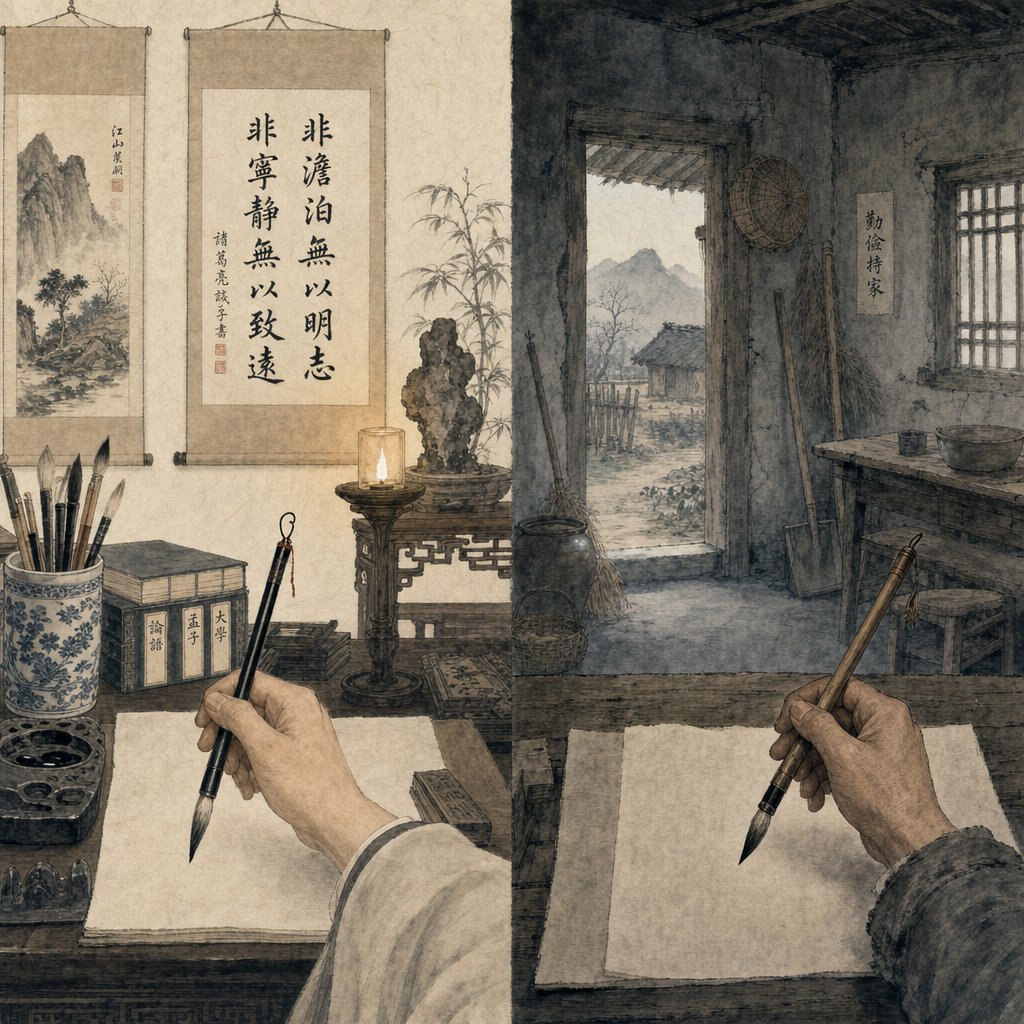
The characters a family chose for a child's name functioned like a credential, visible to anyone literate enough to read it. In a society where education was expensive and restricted, the very act of selecting a sophisticated character proved you had access to books, tutors, and leisure time for study. Chinese characters for names were never drawn from a single shared pool. They came from entirely different worlds depending on who was doing the choosing.
Literary Allusions and Rare Characters in Elite Names
Educated families treated naming as an intellectual exercise. They drew from classical texts, selecting characters with layered literary resonance that only other educated readers would fully appreciate. The primary sources were the foundational works of Chinese civilization: the Book of Songs (Shijing), the Analects of Confucius, Tang dynasty poetry, and the philosophical writings of the Warring States period.
Consider the Book of Songs. As BBC Culture notes, this anthology was "the classic of the human heart and the human mind," functioning not just as literature but as part of the elite curriculum that solidified into the Five Classics of imperial Confucianism. When a scholar-official family named a daughter using a phrase from the Airs section, or embedded a son's name with an allusion to the Court Hymns, they were demonstrating mastery of a text that required years of study to understand at its deeper levels. The name in chinese meaning was never just the surface definition of the character. It was the entire web of associations that character carried from its classical source.
This practice intensified under the imperial examination system. Columbia University's Asia for Educators project explains that the examination system was "squarely based upon the Confucian classics and upon recognized commentaries on those classics." Only those from wealthier families or showing exceptional promise with wealthy sponsors could continue their studies and compete. The result was a literate elite, perhaps 40 percent of males at a basic level but far fewer at the classical level, who shared a common textual vocabulary. Naming chinese characters from these shared texts became a form of in-group signaling. If you recognized the allusion in someone's name, you belonged to the same educated class.
A name like Yongsi, for example, might reference a specific line from the Book of Songs about longing and moral reflection. The character si (meaning "to think" or "to long for") appears across dozens of classical poems, but its pairing with yong ("eternal") would point a knowledgeable reader toward a particular passage. The meaning chinese names carried at this level was not a single definition but a conversation with centuries of commentary.
Simple Nature and Number Names Among Common People
Commoner naming operated under entirely different constraints. Most farming families had no access to classical texts. Even basic literacy was a luxury. The chinese meaning of names in these households reflected immediate, practical concerns: a wish for the child's health, a reference to the season of birth, or simply a marker of birth order.
Imagine a family with five sons. The eldest might be called Da Niu (Big Ox), the second Er Niu (Second Ox), and so on. These were not names chosen for literary depth. They were functional identifiers, easy to remember and requiring no education to create. Number-based names like San (Three) or Xiao Wu (Little Five) were common among peasant families well into the twentieth century. The contrast with elite naming could not be sharper: one family spends weeks selecting a character that references a Tang poem about autumn moonlight, while another simply counts.
The imperial examination system deepened this divide. As the examination curriculum demanded absolute mastery of Confucian texts, scholars who passed even at the lowest prefectoral level became part of a recognized educated class. These degree holders, the xiucai, "took positions of leadership in their villages and towns and also became school teachers, maintaining the very educational system in which they themselves had achieved success." Their naming choices reflected their training. A xiucai naming his child would naturally reach for characters encountered during years of classical study, characters that a neighboring farmer would never have seen in print.
The result was two parallel naming cultures existing side by side in the same village. Chinese name meanings split along class lines not because of any formal rule, but because access to the raw materials of sophisticated naming, the classical texts themselves, was restricted by economics and opportunity.
- Elite character choices:
- Characters drawn from the Book of Songs, Analects, or Tang poetry (e.g., yi meaning "righteousness" from Confucian ethics, or lan meaning "orchid" from Qu Yuan's poetry)
- Rare characters with high stroke counts that demonstrated calligraphic education (e.g., xuan meaning "brilliant jade")
- Philosophical or moral concepts requiring interpretive knowledge (e.g., ren meaning "benevolence," zhi meaning "wisdom")
- Paired characters creating internal literary echoes or tonal balance (e.g., Mingzhe, combining "bright" with "philosophical insight")
- Commoner character choices:
- Birth order numbers or simple sequence markers (e.g., San for "third child," Xiao Si for "little fourth")
- Animals associated with strength or good fortune (e.g., Niu for "ox," Hu for "tiger")
- Seasons or natural features marking time of birth (e.g., Chun for "spring," Dong for "winter")
- Direct auspicious wishes with common characters (e.g., Fu for "fortune," Qiang for "strong," Cai for "wealth")
- Humble or deflecting names meant to ward off evil spirits (e.g., Goudan, literally "dog egg," used to make a child seem unworthy of a demon's attention)
That last category, the deliberately humble name, reveals something important about names in chinese and meanings across social strata. Peasant families sometimes chose ugly or lowly names as a protective superstition, believing that spirits would overlook an unimpressive child. Elite families never did this. Their confidence in medical care, spiritual protection through proper ritual, and social standing meant they could afford to give children beautiful, ambitious names without fear. Even superstition operated differently across class lines.
The names and characters available to each stratum created a self-reinforcing cycle. Educated families produced names that signaled education, which opened doors to further education and official positions. Commoner families produced names that marked them as uneducated, which limited social mobility before a child ever sat for an examination. The naming system did not just reflect class. It actively participated in reproducing it, generation after generation, through the seemingly simple act of choosing which characters to write on a birth record.
Character selection, however, was only one dimension of the naming hierarchy. Beyond what characters appeared in a name, the question of how many names a person carried, and what types of names they were permitted to hold, created an even more explicit system of class distinction.
Courtesy Names and Art Names Reserved for the Elite
A peasant in imperial China had one name. A scholar might carry four or five. That numerical gap was not a quirk of personal preference. It was a structural feature of the social hierarchy, built into ritual, reinforced by custom, and visible to everyone. The layered naming system of traditional chinese names created a world where the sheer number of names you possessed announced your rank before you ever opened your mouth.
Courtesy Names as Markers of Scholarly Achievement
The chinese courtesy name, or zi, was the most important of these additional layers. When a young man from the gentry class reached twenty, he underwent the capping ceremony (guanli), a formal rite of passage marking his entry into adulthood. At this ceremony, he received his zi, a name that would become his primary form of public address for the rest of his life. As Skritter's analysis of ancient Chinese naming explains, using someone's birth name (ming) in public was considered a grave insult, while using their courtesy name was the polite standard among peers.
Here is the class dimension: commoners rarely received a courtesy name. The capping ceremony was a ritual of the gentry and scholar class, requiring resources, social standing, and a community that recognized the ritual's legitimacy. If you had no zi, everyone knew it. The absence of a courtesy name was itself a class marker, as legible as any character on a page. When someone addressed you directly by your ming with no zi available as an alternative, it signaled that you had never undergone the rite, never been recognized as a member of the educated class.
The zi was also carefully crafted to complement or contrast with the birth name, demonstrating literary sophistication. The strategist Zhuge Liang (meaning "bright") carried the courtesy name Kongming (meaning "exceedingly bright"). The poet Han Yu (meaning "to advance") received the zi Tuizhi (meaning "to retreat"). Creating these elegant pairings required classical education, reinforcing the system's exclusivity. Understanding chinese name origins means recognizing that each naming layer demanded a different kind of cultural knowledge to produce.
Art Names and Posthumous Names as Elite Privileges
Beyond the courtesy name, the educated elite could accumulate additional identities. The art name, or hao, functioned as a self-chosen creative alias. Unlike the zi, which was bestowed by elders or teachers, the hao was personally crafted, allowing literati to build public intellectual personas. The poet Tao Yuanming called himself Wuliu Xiansheng, "Mr. Five Willows," after the trees near his home. The scholar Ouyang Xiu adopted Liuyi Jushi, "Hermit of the Six Ones," referencing his collection of books, inscriptions, a qin, a chess set, a flask of wine, and himself. These were not casual nicknames. They were carefully constructed identities that came into vogue during the Tang dynasty and remained standard practice among the literati through the early twentieth century.
Art names could change throughout a person's life, marking shifts in career, residence, or philosophy. Tang Yin of the Ming dynasty had more than ten hao. By the Song dynasty, the majority of literati addressed each other by their art names rather than any other form. The title mr in chinese, rendered as xiansheng, frequently appeared within these art names, signaling scholarly identity. Calling someone by their hao, even without them present, was considered polite, while using their birth name was an act of open disrespect.
Posthumous names occupied the highest tier. These were granted after death to emperors, empresses, and the most distinguished officials, summarizing their life's achievements or moral character in one or two carefully chosen characters. A farmer never received a posthumous name. A minor official might not either. This naming layer existed exclusively for those at the apex of political power, making it the ultimate class-restricted naming privilege in the system of ancient chinese names.
The more names a person carried, the higher their social position. A commoner had one name. A scholar had three. An emperor had five or more. The naming system itself was a visible hierarchy, where each additional layer required education to create, ritual to bestow, and social standing to justify.
This layered system reveals something fundamental about chinese honorifics and naming as cultural capital. Each additional name required a different form of investment: the zi required a family with the standing to perform the capping ceremony, the hao required the literary education to craft a meaningful alias, and the posthumous name required a lifetime of achievement recognized by the state. These were not names anyone could simply adopt. They were earned, bestowed, and accumulated, functioning as a portfolio of social credentials that grew richer with each layer added.
The naming hierarchy did not operate in a vacuum, though. It existed within a broader system of state power that actively regulated which characters could appear in names at all, enforcing social boundaries not just through ritual and custom but through imperial law.
Imperial Naming Taboos That Enforced Social Hierarchy
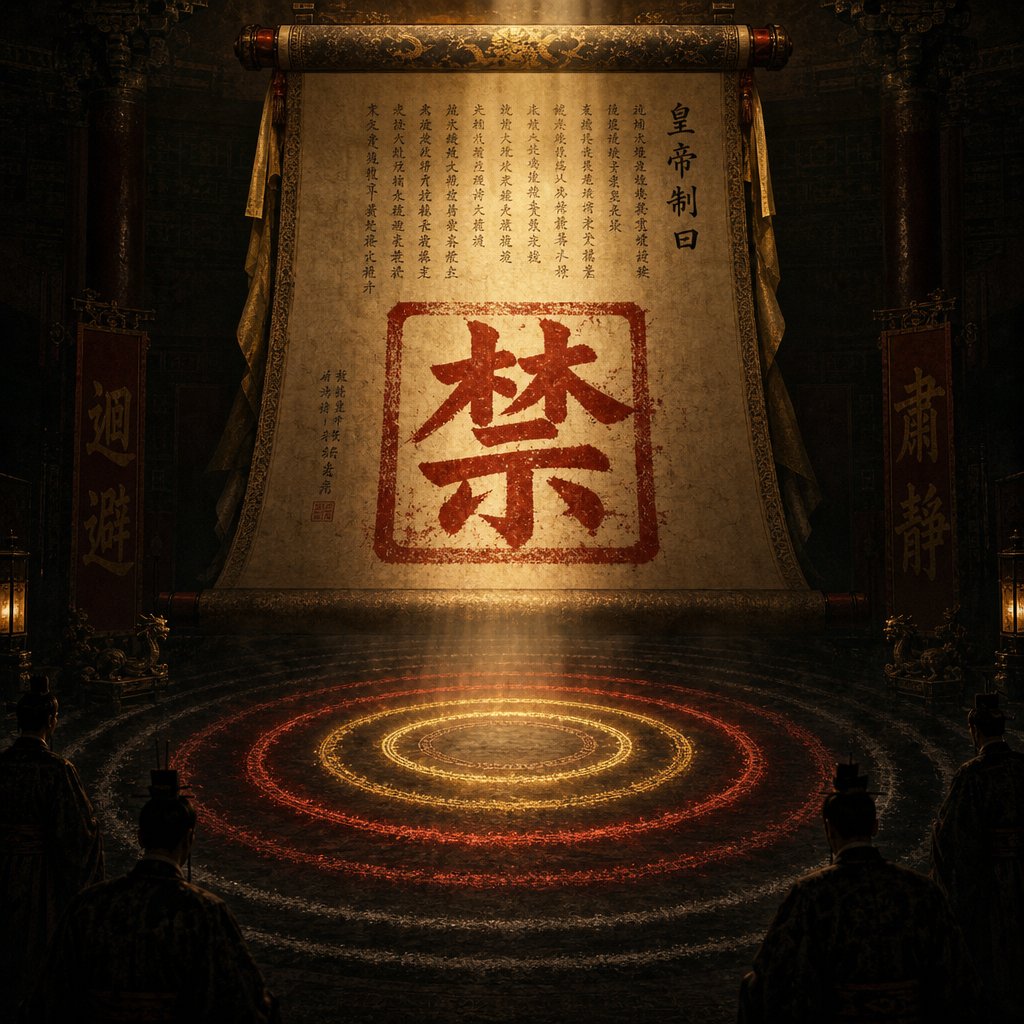
Imagine choosing a name for your child, only to discover that one of the characters you selected was also used in the emperor's personal name. Overnight, that character becomes illegal. You must rename your child, alter official documents, and even avoid saying the sound aloud in public. This was not a hypothetical scenario. It was daily reality across imperial China for over two thousand years. The system of naming taboos, called bihui (避讳), transformed the act of writing chinese names into a minefield where a single wrong character could destroy a family.
What makes bihui relevant to class is not just that it existed, but how it operated differently depending on where you stood in the social hierarchy. The closer your position to the emperor, the more taboo restrictions applied to you, and the more knowledge you needed simply to name your children without committing a crime. Chinese name conventions around taboo created concentric rings of prohibition that mapped directly onto the social order.
How Imperial Taboos Restricted Character Usage by Class
The core mechanism was straightforward: when a new emperor took the throne, the name chinese characters in his personal name became forbidden for general use. Everyone in the empire, from princes to peasants, had to avoid those characters in speech and writing. But the burden was not distributed equally.
As Piotr Adamek's research at Leiden University demonstrates, the practice of bihui "affected and determined social values for centuries and was important for commoners and emperors alike." The system recognized three distinct categories of taboo, each tied to a different social sphere:
- State taboo (guohui 国讳): The emperor's personal name and those of his ancestors. This applied to the entire population. Violation could bring severe punishment, including execution during certain dynasties.
- Clan taboo (jiahui 家讳): The names of one's own ancestors, typically going back seven generations. This applied within families and between clans in formal correspondence. Elite families with documented genealogies observed this rigorously; commoners with no written records often could not.
- Sage taboo (shengren hui 圣人讳): The names of revered figures like Confucius. This applied primarily in scholarly and official contexts, affecting those who participated in the examination system and literary culture.
You'll notice the pattern: each layer of taboo required progressively more literacy and social awareness to observe correctly. A farmer might learn the emperor's name through local proclamation and avoid it. But tracking seven generations of ancestral names, plus the names of sages, plus the names of local officials? That demanded written records, education, and constant attention to court affairs. The system inherently punished the illiterate and rewarded the educated.
Dynasty-Specific Taboo Systems and Their Class Impact
Different dynasties enforced these restrictions with varying intensity, but the class dimension remained constant. During the Qin dynasty, the First Emperor's personal name Zheng (政) forced the entire population to alter the pronunciation of the first month of the year, Zhengyue (正月), because the character zheng sounded identical to his name. The month was eventually renamed Duanyue (端月) entirely. Every person in the empire who needed to reference the calendar had to remember this substitution.
The Tang dynasty illustrates how taboo enforcement scaled with proximity to power. Emperor Taizong's given name, Shimin (世民), contained two extremely common characters. Recognizing the burden this placed on the population, he initially decreed that avoidance was only required when both characters appeared together. But after his death, his son Emperor Gaozong reversed this leniency, requiring complete avoidance of each character individually. The chancellor Li Shiji was forced to drop a character from his own name, becoming simply Li Ji. When you held high office, the taboo applied with full force. A distant farmer might never be checked.
The Han dynasty offers another revealing case. Emperor Xuan's birth name, Bingyi (病已), contained two characters so common that enforcing their avoidance would have paralyzed daily communication. His solution was to change his own name to Xun (询), a far rarer character, explicitly stating he did so to ease the burden on his people. This act of imperial consideration reveals how deeply the system affected ordinary life, and how the choice of name chinese characters at the highest level rippled outward through every social stratum.
The most extreme consequences fell during the Qing dynasty's Literary Inquisition. In 1775, the scholar Wang Xihou compiled a dictionary in which he inadvertently wrote the complete personal names of the Kangxi, Yongzheng, and Qianlong emperors without the required stroke modifications. The penalty was devastating: Wang Xihou was executed in 1777, his property confiscated, his books burned, and his sons and grandsons killed or sent as slaves to Heilongjiang. Several provincial officials were dismissed for failing to catch the transgression. Writing chinese names, even in a scholarly reference work, carried mortal risk when imperial characters were involved.
A generation earlier, the examiner Zha Siting selected a verse from the Classic of Poetry as an examination topic. Someone noticed that two characters in the verse, when written together, resembled the Yongzheng Emperor's name with their top portions removed, as if "decapitated." Zha Siting was arrested, died in prison, and his corpse was publicly dismembered. His wife was exiled, and provincial examinations in his home region were suspended for years.
These cases reveal how the taboo system functioned as class discipline. Elite families needed constant awareness of court affairs to navigate the restrictions safely. They needed literacy to recognize taboo characters in their variant forms. They needed social networks to learn which characters had become newly forbidden. A chinese name in chinese language was never just a personal identifier. It was a site where state power, class knowledge, and individual survival intersected.
The practical methods for avoiding taboo characters also varied by education level. Literate elites could substitute synonyms, omit final strokes from characters, or leave deliberate blanks in texts. These techniques required knowing which character was taboo, understanding its graphic structure well enough to modify it, and possessing the calligraphic skill to execute the modification convincingly. For the illiterate majority, avoidance was limited to the spoken word, and even that depended on hearing the correct information through informal channels.
The chinese name origin of many modern characters and pronunciations traces directly back to these taboo substitutions. Characters that replaced forbidden ones sometimes permanently displaced the originals. Place names, official titles, and even plant names were altered across centuries of successive taboo regimes, each new emperor adding fresh restrictions to the existing layers. The cumulative effect was a naming environment where historical knowledge itself became a class resource. Families who tracked which characters had been taboo under which dynasty, and which substitutions had become permanent, possessed a form of cultural literacy that directly protected their social standing.
Imperial taboos regulated which characters could not appear in names. But another system operated in parallel, determining which characters must appear. Generational naming, maintained through clan genealogy books, created an equally powerful mechanism for marking social position, one that families controlled themselves rather than having it imposed from above.
Generational Names and Clan Genealogy as Status Markers
Imperial taboos told you which characters were forbidden. Generational naming told you which character was required. For families embedded in powerful clan structures, a child's name was not a free choice at all. It was predetermined decades or even centuries before the child was born, locked into a sequence that only organized, literate, and wealthy families could maintain. The generational name, or zibei (字辈), is one of the clearest markers separating families with documented lineage from those without.
How Generational Name Poems Preserved Clan Identity
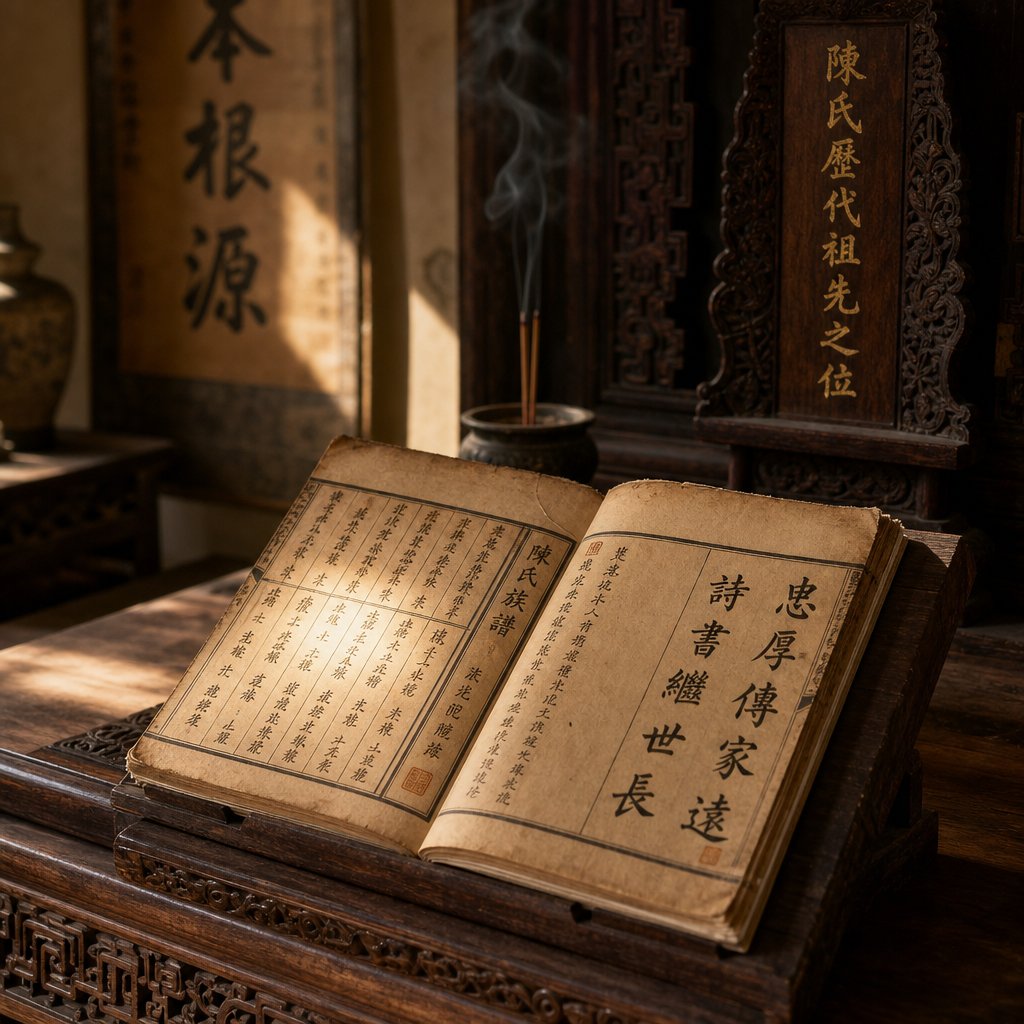
Here is how the system worked. A clan's elders would compose a poem, sometimes a dozen characters long, sometimes stretching to a hundred or more. Each successive character in that poem became the generational marker for one generation of the family. Every male born into that generation shared the same character as part of his given name. As My China Roots explains, "each successive character of the generational poem represents the generational name of every male sibling or patrilineal cousin within one generation." Once the last character was reached, the poem could be repeated or extended by the clan association.
Think about what this required. Someone had to compose the poem, which meant literary education. Someone had to record it, which meant access to writing materials and a tradition of documentation. Someone had to enforce it across scattered family branches, which meant organizational infrastructure. And someone had to maintain it across twenty, thirty, or even forty generations, which meant institutional continuity spanning centuries. Only wealthy, organized clans could sustain this kind of multigenerational planning.
The poems themselves were not random sequences. They typically expressed virtuous goals and ideals for clan members to follow. Characters like jun (俊, meaning "talented") or hao (豪, meaning "heroic") appeared frequently, embedding moral aspiration into the naming structure itself. Generation poems were usually composed by a committee of family elders whenever a new lineage was established through geographical emigration or social elevation. Those who set off to form new clan branches attributed special importance to the generational poem, as it provided their new lineage with a sense of legitimacy.
The practical effect was immediate legibility. Two strangers sharing the same chinese surname could determine their exact generational relationship by comparing which character from the poem appeared in their names. If your generational character came three positions after mine in the poem, I was your senior by three generations, and social protocol adjusted accordingly. The system turned every chinese last name into a sortable, hierarchical identifier, but only for those families organized enough to maintain it.
Clan Genealogy Books as Class-Conscious Naming Systems
The generational poem did not exist in isolation. It was recorded in the clan genealogy book, or zupu (族谱), alongside generation charts, surname origin stories, clan rules, and biographical records of distinguished ancestors. These books were the institutional backbone of the entire system.
Before the Song dynasty (960-1279 CE), lineage determined a person's social class in China, and genealogy records were used as official documents by the imperial court to prove the identity of a member of the ruling class and justify his position. The zupu was not a family keepsake. It was a legal instrument of social stratification. Even after the Song dynasty democratized genealogy recording somewhat, the practice remained concentrated among families with the resources to commission, maintain, and revise these complex documents.
The meaning of chinese surnames within these genealogy books went far beyond etymology. Each zupu contained a chapter tracing the surname's origin, often linking it to ancient kings or noble lines that glorified the clan and affirmed their social status. Chinese surname meanings were not just linguistic curiosities. They were claims to power, documented and defended across generations. A surname in chinese carried one weight when it stood alone and an entirely different weight when backed by a genealogy book tracing it to a Zhou dynasty feudal lord.
Compiling a zupu was itself a class-restricted activity. The work demanded scholars or clan members with in-depth knowledge of classical texts. Compilers had to verify information, cross-reference historical sources, and maintain provenance across multiple editions. Unverified information was flagged for future generations to confirm when new sources surfaced. This was scholarly labor, and it required the same education that produced sophisticated given names and courtesy names. Families without access to literate compilers simply could not participate.
The genealogy book also functioned as a gatekeeping tool. It documented legitimate lineage and excluded those outside the clan structure. If your name did not appear in the zupu, you had no claim to clan membership, no access to clan resources like ancestral hall funds or donated lands, and no recognized place in the generational hierarchy. The book drew a hard line between insiders and outsiders, and that line mapped directly onto social standing.
| Naming Practice | Major Clan Families | Unaffiliated Commoner Families |
|---|---|---|
| Generational characters | Mandatory, drawn from clan poem | Absent or coincidental |
| Genealogy documentation | Formal zupu revised every 20-30 years | No written records |
| Naming ceremony formality | Ritual event with elder involvement | Informal family decision |
| Character source texts | Clan-composed poetry, classical allusions | Oral tradition, local custom |
| Surname origin knowledge | Documented to specific ancestor and location | General or unknown |
| Cross-branch coordination | Maintained through clan associations | None |
| Name verification | Checked against zupu to avoid duplication | No formal system |
The combination of a rare chinese surname plus a recognizable generational character created a layered identity marker that was almost impossible to fake. You could not simply claim membership in a prestigious clan. Your generational character had to match the correct position in the poem, your name had to appear in the genealogy book, and your branch had to be traceable through the generation chart. Chinese family names and meanings operated within this verification system as credentials, not just identifiers.
Families sharing a common generation poem are considered to share a common ancestor and have typically originated from a common geographical location. This meant that generational naming also encoded regional information. Character surnames combined with specific generational poems could pinpoint not just which clan you belonged to but which branch, which village, and which migration wave your ancestors had joined. The system was remarkably information-dense.
After 1949, the People's Republic of China launched social reforms that deliberately targeted these clan structures. Land reform dismantled the economic base of ancestral halls. The Cultural Revolution destroyed countless genealogy books. Character simplification altered the visual form of generational characters. The explicit goal was to break the old class system, and attacking clan naming infrastructure was part of that project.
Yet the system proved resilient. Since the 1980s, many families have reconstructed their genealogy books from memory, surviving fragments, and overseas copies maintained by diaspora communities. Generational naming has declined significantly in urban areas, where nuclear families have replaced clan structures. But in rural regions and among overseas Chinese communities, the practice persists. Some families still consult their generational poem when naming children, maintaining a thread of continuity that connects a child born today to a poem composed by ancestors three hundred years ago.
The persistence or absence of generational naming in a modern Chinese family still communicates something about that family's relationship to traditional clan structures, their regional origins, and their self-understanding as members of a documented lineage. It remains one of the quieter but more reliable indicators of how a family positions itself within the broader landscape of chinese last names and their histories.
Generational naming, though, operated primarily along patrilineal lines. The question of who received a formal name at all, and what kind of name they received, depended not just on clan membership but on gender, and the intersection of gender with class produced its own distinct patterns of inclusion and erasure.
Gender and Class Intersections in Chinese Naming
A scholar's daughter in the Song dynasty might carry a name drawn from classical poetry, recorded in the family genealogy alongside her brothers. A farmer's daughter born the same year might never receive a formal name at all, known only as "Second Girl" until marriage, after which she became simply "Wife of the Zhang family." Gender alone does not explain this gap. Class does. The intersection of gender and social standing determined not just what kind of name a woman received, but whether she received one worth recording.
Elite Women's Names Versus Commoner Women's Names
Among aristocratic and gentry families, daughters were named with genuine care. Their chinese first names female drew from the same classical sources as their brothers' names, though typically from a different character pool emphasizing virtue, beauty, and moral refinement. These names appeared in clan genealogies, were used in formal correspondence, and survived in historical records. A woman like Li Qingzhao, the celebrated Song dynasty poet, carried a name meaning "clear illumination" that reflected her family's literary sophistication.
Commoner women occupied a different reality entirely. Research on gender discrimination in Chinese female names confirms that lower-class women were frequently unnamed in official records or given simple sequential identifiers. As the Vancouver Public Library's genealogy guide documents, Chinese women historically "lost their given names at marriage, after which their names were commonly written as their maiden surnames, followed by Shih, Shee, or See," meaning simply "a married woman who came from the Wong clan." Access to naming itself was a gendered class privilege. Elite women had formal names preserved across generations. Commoner women vanished into their husband's surname.
This erasure was not universal across all women. It was specific to women without class standing. The distinction matters because it reveals that gender discrimination in naming operated through class mechanisms. A noblewoman's name survived because her family had a genealogy book to record it in. A peasant woman's name disappeared because no such infrastructure existed for her family.
How Class Shaped Gendered Character Choices
When women did receive formal names, the characters chosen varied dramatically by social stratum. Elite families selected chinese feminine names from a curated vocabulary of refinement: characters suggesting literary accomplishment, moral virtue, and aesthetic grace. Commoner families, when they named daughters at all, favored characters expressing practical hopes, often revealing a preference for male children through the names given to girls.
The same class divide shaped chinese masculine names and chinese names male conventions, though less starkly. A chinese male name in an elite family drew from philosophical and literary traditions. Chinese names for boys in commoner families referenced strength, animals, or birth order. But the critical difference is that chinese first names male were always given and always recorded, regardless of class. Boys received names. The question for girls was whether they received names at all, and that question was answered by class position.
- Elite women's naming patterns:
- Characters suggesting literary refinement (e.g., wen 文 meaning "literary," shu 淑 meaning "virtuous")
- Floral and natural imagery from classical poetry (e.g., lan 兰 meaning "orchid," mei 梅 meaning "plum blossom")
- Moral qualities prized in educated women (e.g., hui 慧 meaning "intelligent," zhen 贞 meaning "chaste")
- Names recorded in genealogy books alongside brothers
- Commoner women's naming patterns:
- Sequential birth markers (e.g., Er Nü 二女 meaning "Second Girl," Xiao Mei 小妹 meaning "Little Sister")
- Characters expressing desire for a male child (e.g., Zhaodi 招弟 meaning "beckoning a younger brother," Laidi 来弟 meaning "a brother will come")
- Simple fertility or luck characters (e.g., Duo 多 meaning "plenty," Xi 喜 meaning "happiness")
- Names rarely recorded, replaced at marriage by husband's surname plus shi (氏)
- Chinese male given names across classes:
- Elite: philosophical and literary characters (e.g., Zhiyuan 志远 meaning "far-reaching ambition")
- Commoner: strength and fortune characters (e.g., Tiegen 铁根 meaning "iron root")
- Both classes: names always formally given and socially recognized
The naming pattern Zhaodi, meaning "beckoning a younger brother," deserves particular attention. This name was given almost exclusively to daughters of lower-class families, encoding disappointment at a girl's birth directly into her identity. Elite families did not use such names. Their daughters carried names of beauty and accomplishment because the family's status did not depend on a single son's labor. Class insulated elite women from the most explicit forms of naming discrimination, even as gender norms still constrained their character pools relative to their brothers.
The gendered class divide in naming has not fully disappeared. Modern naming trends show that educated urban parents now choose chinese first names female with the same care and ambition they bring to naming sons, while rural families in some regions still favor names for daughters that reference traditional feminine virtues or, less commonly now, the hope for a male sibling. The gap has narrowed considerably, but its historical depth reveals how deeply class and gender intertwined in determining something as fundamental as whether a person's name would survive them.
These historical patterns, from character selection to the very existence of a recorded name, did not vanish with the end of imperial China. They transformed. Modern naming in China still carries class signals, but the markers have shifted from classical allusions and clan poems to new forms of distinction shaped by education, geography, and economic reform.
Modern Chinese Names Still Signal Socioeconomic Status
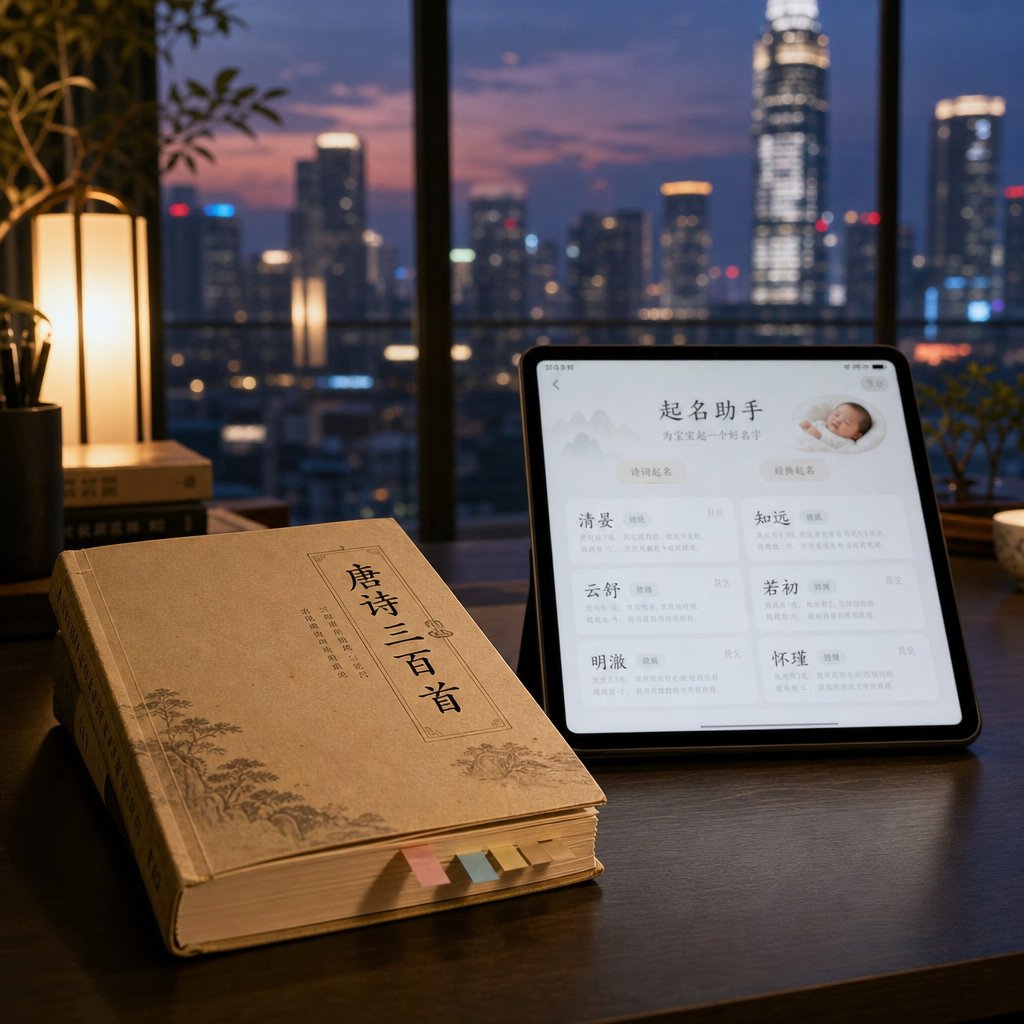
The old system of clan poems and courtesy names may have faded, but the connection between naming and class did not disappear. It adapted. In contemporary China, the markers have shifted from generational characters and imperial taboo awareness to a new set of signals: character rarity, literary sophistication, and the cultural confidence to break from trend cycles. If you have ever wondered how do chinese names work as social indicators today, the answer lies in the gap between what educated urban parents choose and what everyone else defaults to.
How Education and Geography Shape Modern Name Choices
University-educated parents in cities like Beijing, Shanghai, and Chengdu increasingly treat naming as a creative and intellectual act. A Global Times report on recent naming trends found that post-1990 generation parents are drawing directly from classical texts to name their children. One mother in Chengdu named her daughter Chirou, pulling from Chapter 43 of the Tao Te Ching, a passage about the quiet power of softness. Another popular name, Yanzhou, references a Northern Song dynasty poem by Zeng Gong comparing an inkstone to a boat carrying thought. These are not typical chinese names from a decade ago. They require genuine literary knowledge to create and recognize.
Cultural sociologist Xu Shumin described this shift as young parents "reclaiming traditional Chinese culture as a living aesthetic in everyday life." The key word is aesthetic. These parents have the education to access classical sources, the cultural confidence to select unusual references, and the social environment where such choices are recognized and rewarded. A common chinese name like Ziyu or Haoyu might appear on trending lists, but the parents reaching for Yanzhou or Fusu are signaling something different: depth of reading, independence from mass trends, and a relationship with tradition that goes beyond surface familiarity.
Rural and less-educated parents tend to follow different patterns. They are more likely to select from whatever chinese first names are currently popular, cycling through trend waves driven by television dramas, social media, or local naming consultants. The result is clusters of identical names within age cohorts, the opposite of the uniqueness that educated parents pursue. Research from the Chinese Academy of Sciences using 2.1 million names confirmed that name uniqueness has risen steadily since the 1970s, with characters rare in daily life appearing more frequently in given names. This trend toward uniqueness correlates with rising education levels and urbanization, suggesting that the drive for distinctive chinese baby names is itself a class-linked behavior.
The consequences are real. Employers reviewing resumes notice names. A name built from a rare classical allusion signals a family background of education and cultural investment. A name following the most popular chinese names of a given birth year signals conformity, or at minimum, a family that did not prioritize distinction through naming. When someone asks what is my chinese name really saying about me, the honest answer is: it communicates your parents' education level, their access to cultural resources, and their aspirations for your social position.
Post-Reform Naming Trends and New Class Signals
The People's Republic disrupted traditional naming in deliberate ways. Character simplification altered the visual form of classical characters. Land reform and the Cultural Revolution dismantled clan structures that had maintained generational naming. Political naming surged: children born in the 1950s and 1960s received names like Jianguo ("build the country"), Yongjun ("support the army"), and Aimin ("love the people"). These names erased class distinction by design, replacing literary allusion with ideological commitment. For a generation, common chinese first names were political statements rather than cultural credentials.
But new stratification emerged almost immediately. By the 1980s, as reform and opening-up reshaped the economy, naming trends began reflecting the new class landscape. Parents of the post-1980 generation favored characters like wei ("great"), qiang ("powerful"), and jie ("excellence"), often as single-character given names reflecting the pioneering spirit of the era. The post-1990 generation shifted toward romanticized characters influenced by Hong Kong and Taiwanese media: meng ("dream"), yu ("rain"), han ("cultivation"). Each wave carried its own class coding, legible to anyone who lived through the same period.
The current wave represents something new. Educated parents are not just choosing pleasant characters. They are performing a classical revival, selecting names that require footnotes to fully appreciate. The name Fusu, for instance, appears in the Book of Songs and was also the name of Emperor Qinshihuang's eldest son. Choosing it signals familiarity with both the poetic source and the historical reference, a double layer of cultural knowledge that functions as class credentialing in a society where traditional markers have been officially abolished.
Naming practices both reflect existing class and actively reproduce class distinctions across generations. Parents with cultural capital invest it in their children's names, creating advantages that compound before a child ever enters school or the job market.
Contemporary aspirational naming also includes Western-influenced structures, like four-character names that break the traditional two- or three-character pattern, or characters chosen partly for how they transliterate into English. These choices signal cosmopolitan orientation, international education plans, and economic resources. They are the modern equivalent of the Tang dynasty art name: a crafted identity that communicates social position through its very form.
The old question of which characters a family could access has been replaced by a new one: which cultural references a family can deploy. The pool of available characters is technically the same for everyone. But the knowledge required to select a name from the Tao Te Ching versus selecting whatever appears on a trending baby name list is not equally distributed. Class still shapes naming. The mechanism has simply moved from restricted access to texts toward restricted access to the education needed to use those texts meaningfully.
Names as Cultural Capital Across Generations
From dynasty-era generational poems to modern parents mining the Tao Te Ching for rare characters, one pattern holds constant: families pass down not just surnames but naming knowledge itself. The literary references, the clan structures, the awareness of which characters carry weight and which fall flat — all of it functions as inherited cultural wealth. Sociologist Pierre Bourdieu called this cultural capital, and few systems illustrate the concept more precisely than chinese naming customs across two millennia.
Naming as Cultural Capital in Chinese Society
Cultural capital works because it compounds invisibly. A family that maintained a generational poem for thirty generations did not just preserve a list of characters. They preserved the organizational infrastructure, the literacy, and the social networks required to keep that list alive. Their children entered the world already embedded in a documented lineage, carrying a chinese name meaning that connected them to centuries of recorded achievement. That head start was not purchased. It was inherited, as surely as land or money.
The same logic applies today. Parents who name a child from a classical source invest their own education into that child's identity. The name becomes a credential the child carries before ever earning one independently. Every chinese naming convention discussed in this article, from character complexity to name-type layering to taboo awareness, operated through this same mechanism: knowledge that advantaged those who possessed it and excluded those who did not.
From Historical Patterns to Contemporary Understanding
The relationship between chinese names and surnames and social position operates at multiple levels simultaneously. Whether you examine chinese first and last names through the lens of structure, character selection, or social perception, the class dimension is always present. Here are the core dynamics at work across the historical-to-modern spectrum:
- Character complexity and literary depth in given names have always correlated with family education level, from Tang dynasty poetry allusions to modern classical revival names.
- The meaning of chinese last names gains or loses social weight depending on whether a family can document its lineage through genealogy books or generational poems.
- Multiple name types (courtesy names, art names, posthumous names) historically created a visible hierarchy where more names meant higher status.
- Imperial taboo systems required class-specific knowledge to navigate, punishing the illiterate and rewarding the educated.
- Gender intersected with class to determine not just name quality but whether a person received a recorded name at all.
- Modern naming trends reproduce class distinctions through new markers: uniqueness, classical reference depth, and independence from trend cycles.
Understanding chinese names first last ordering, character selection, and naming layers as a unified system reveals something remarkable. A single name, just two or three characters, can encode family education, regional origin, clan membership, generational position, gender expectations, and socioeconomic aspiration all at once. Few naming systems anywhere in the world pack this much social information into so compact a form. The chinese name meaning you carry is never just a definition. It is a status code, inherited before you drew your first breath, still legible to anyone who knows how to read it.
FAQs About Chinese Names and Social Class
1. How do Chinese names indicate social class?
Chinese names signal social class through multiple layers. Character complexity reveals family education level, as elite families historically chose characters from classical texts like the Book of Songs or Confucian Analects, while commoner families used simple characters referencing nature, animals, or birth order. Surname rarity indicates lineage power, with uncommon surnames often tracing to specific aristocratic ancestors. The presence of generational markers shows clan organization, and historically, the number of name types a person carried (birth name, courtesy name, art name) directly correlated with their social rank. Even today, name uniqueness and classical reference depth correlate with parental education and urban versus rural background.
2. What is the difference between a courtesy name and a regular Chinese name?
A courtesy name (zi) was a secondary name bestowed during the capping ceremony when a young man from the gentry class turned twenty. Unlike the birth name (ming), which was given at birth and considered too intimate for public use, the courtesy name became the standard form of address among peers and in formal settings. The critical class distinction is that commoners rarely received courtesy names because the capping ceremony was a ritual exclusive to the scholar and gentry class. The absence of a courtesy name was itself a visible class marker, immediately signaling that a person had never been recognized as a member of the educated elite.
3. Why did some Chinese children receive ugly or humble names?
Peasant families in traditional China sometimes gave children deliberately ugly or lowly names, such as Goudan (literally 'dog egg'), as a protective superstition. The belief was that evil spirits would overlook a child with an unimpressive name, considering them unworthy of attention. This practice was almost exclusively confined to lower-class families. Elite families never used such names because they had access to medical care, proper ritual protection, and the social confidence to give children beautiful, ambitious names without fear. This difference in naming superstition itself operated as a class marker.
4. How do modern Chinese naming trends still reflect social status?
In contemporary China, university-educated urban parents increasingly select names from classical texts like the Tao Te Ching or Song dynasty poetry, treating naming as an intellectual and creative act. These choices require genuine literary knowledge to create and recognize. Rural or less-educated parents tend to follow popular trend cycles driven by television dramas or social media, resulting in clusters of identical names within age cohorts. Employers and institutions often perceive names as education markers, meaning a classically-inspired name can signal family cultural investment while a trending name suggests conformity. The mechanism has shifted from restricted access to texts toward restricted access to the education needed to use those texts meaningfully.
5. What were imperial naming taboos and how did they affect different social classes?
Imperial naming taboos (bihui) made characters appearing in an emperor's personal name forbidden for general use. The system created three tiers: state taboo covering the emperor's name (affecting everyone), clan taboo covering ancestral names going back seven generations (requiring written genealogy records), and sage taboo covering revered figures like Confucius (affecting scholars). Each tier demanded progressively more literacy and court awareness to observe correctly. Elite families needed constant knowledge of court affairs and calligraphic skill to modify forbidden characters, while illiterate commoners could only avoid taboo sounds they heard through informal channels. Violations could result in execution during certain dynasties, making naming a site where state power and class knowledge intersected with survival.