Why Chinese Name Etiquette Matters More Than You Think
Imagine you are at your first business meeting in Shanghai. You confidently greet your new contact by their given name, thinking you are being friendly. The room goes quiet. You have just caused everyone involved to lose face, and you did not even realize it. This scenario plays out more often than you might expect, and it stems from a gap in understanding chinese name conventions that runs deeper than simple formality.
Why Getting Names Right Matters in Chinese Culture
So what are chinese names, really? They are far more than labels. Chinese names carry layers of family heritage, philosophical meaning, and social positioning. Each character in a name is deliberately chosen to reflect parental hopes, generational continuity, and cultural values. A person's name tells the story of their lineage and aspirations, making it something deeply personal. When you mispronounce or misuse someone's name, you are not just making a small social slip. You are signaling a lack of regard for their identity and, by extension, their family.
Chinese naming conventions are rooted in Confucian principles of hierarchy, respect, and social harmony. The way you address someone communicates your understanding of your relationship to them, their status, and the formality of the situation. Getting it wrong disrupts that harmony for both parties. The person addressed incorrectly feels disrespected, and the speaker appears culturally unaware. Both lose standing in the eyes of others present.
The Role of Mianzi in Name Etiquette
The concept driving all of this is mianzi, often translated as "face." In Chinese culture, mianzi refers to a person's social standing, reputation, and respect within their community or professional network. It operates in every interaction, but name usage is one of the most visible and immediate ways face is given or taken away.
A single name mistake in a professional setting can undo weeks of relationship-building. It signals to your Chinese counterpart that you have not invested the effort to understand them, and in a culture where relationships are everything, that perception is difficult to reverse.
Giving face through correct address means using appropriate titles, respecting surname conventions, and following the unspoken rules about when familiarity is welcome. Causing someone to lose face by using their name incorrectly, especially in front of others, can damage trust quickly. The chinese name definition of respect is not just knowing what to call someone. It is knowing why you call them that way.
This guide walks you through the practical knowledge you need, from how common chinese names are structured to how address evolves as relationships deepen. Whether you are preparing for a first meeting or navigating ongoing professional ties, understanding these chinese naming customs gives you a genuine advantage that most foreigners never develop.
How Chinese Names Are Structured
Understanding the cultural weight behind names is one thing. Knowing how to actually identify which part of a name is which? That is where most foreigners get tripped up. Chinese name structure follows a logic that is essentially the reverse of what English speakers are used to, and once you see the pattern, everything clicks into place.
Surname First Then Given Name
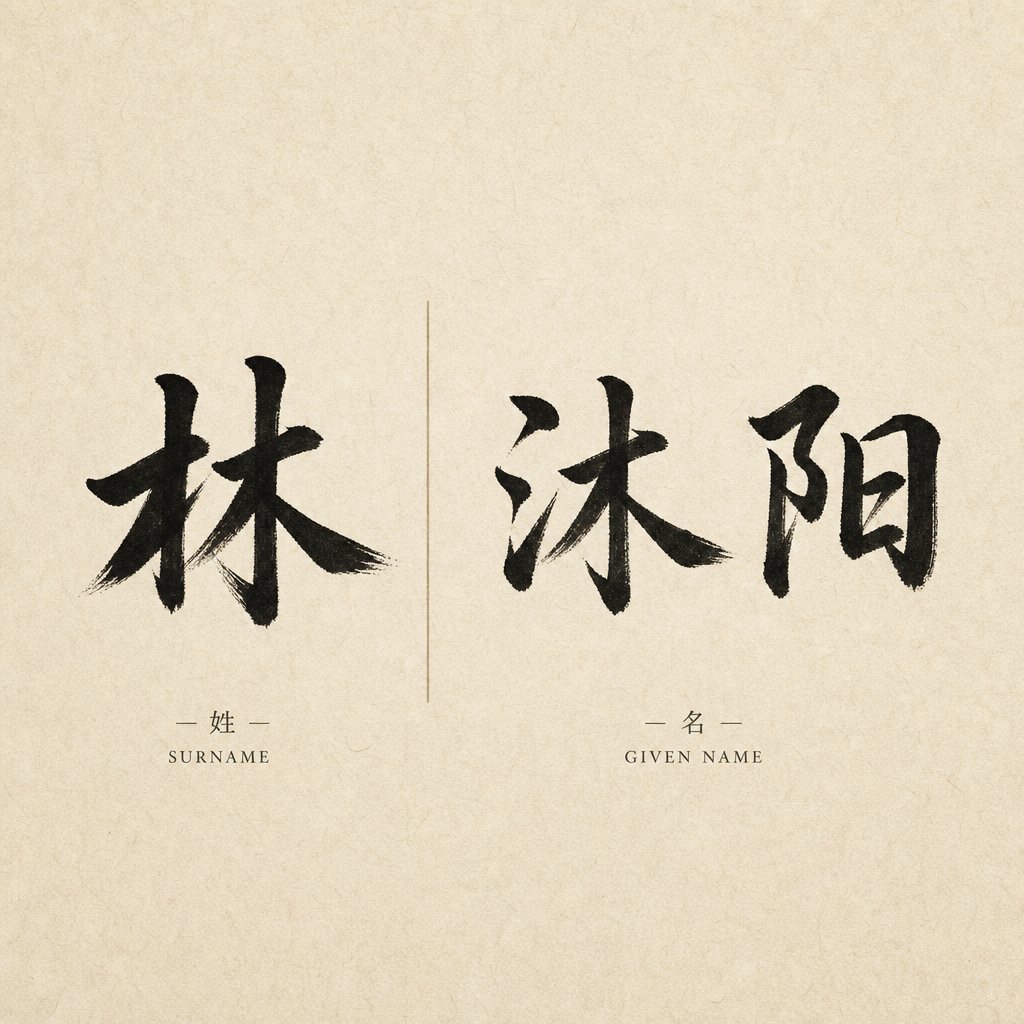
Here is the core rule of chinese name order: the surname (family name) always comes first, followed by the given name. If you see the name Wang Xiaoming, Wang is the family name and Xiaoming is the personal name. This is the opposite of English naming conventions, where John Smith puts the given name before the surname.
Think of it this way. In Chinese culture, the collective comes before the individual. Your family identity precedes your personal identity, and the name structure reflects that philosophy directly. The chinese last name first convention is not just a formatting quirk. It is a reflection of values.
A few practical details to keep in mind:
- The surname is almost always a single character (one syllable). All of the top 100 Chinese family names have only one syllable, and these cover about 85 percent of China's citizens.
- The given name is one or two characters (one or two syllables).
- There are no spaces between surname and given name when written in Chinese characters. In romanized form, a space typically separates them.
- Women do not change their surnames after marriage.
Two-Character vs Three-Character Names
Most Chinese names you will encounter are either two or three characters total. A two-character name has a one-character surname plus a one-character given name, like Wang Xiu. A three-character name has a one-character surname plus a two-character given name, like Zhang Xiaoming.
When you see a three-syllable name, the split is almost always one-plus-two. The single syllable at the front is the surname, and the remaining two syllables form the given name. This pattern holds true for the vast majority of Chinese people you will meet in professional settings.
There are exceptions. A small number of Chinese surnames are compound, meaning they have two characters, such as Ouyang, Zhuge, or Shangguan. These are relatively rare, with only about 81 compound surnames among the roughly 400 family names in active use. If you encounter a four-syllable name, it may be a two-character surname plus a two-character given name.
How do chinese names work in terms of given name choices? Parents select characters that carry meaning, often expressing hopes for the child. Names like Kang (healthy), Yong (brave), or Mei (beautiful) are chosen deliberately. In some traditional families, siblings share a generation character in their given names, a practice planned well in advance and recorded in family histories.
Why Name Order Gets Confusing Internationally
Here is where things get complicated for foreigners. When Chinese people operate in international contexts, they often rearrange their names to match Western conventions. The same person might present their name differently depending on the platform, the audience, or personal preference. This creates real confusion around chinese first name last name identification.
Consider someone named Zhang Wei. In a Chinese context, you know Zhang is the surname. But in an international setting, they might write Wei Zhang, putting the given name first to match English expectations. Some people capitalize their surname (ZHANG Wei or Wei ZHANG) to signal which is which. Others adopt an English first name entirely, becoming something like David Zhang.
The table below shows how the same names appear in different formats:
| Traditional Chinese Order | Westernized Order | With English Name | Surname | Given Name |
|---|---|---|---|---|
| Wang Xiaoming | Xiaoming Wang | James Wang | Wang | Xiaoming |
| Li Na | Na Li | Nancy Li | Li | Na |
| Zhang Wei | Wei Zhang | David Zhang | Zhang | Wei |
| Chen Jing | Jing Chen | Jenny Chen | Chen | Jing |
You will notice that in the first name last name chinese format, the surname moves to the end. This is purely an adaptation for Western audiences. The person's actual Chinese name remains surname-first in Chinese-language contexts. Many Chinese professionals capitalize their surname on business cards specifically to prevent confusion, a practice worth watching for.
The scale of potential mix-ups becomes clear when you consider how concentrated Chinese surnames are. The three most common surnames in mainland China, Li, Wang, and Zhang, are shared by more than 270 million people. When you encounter chinese names first last in an unfamiliar order, knowing these dominant surnames helps you quickly identify which part is the family name. If you see Wang, Li, Zhang, Liu, or Chen in any position within a name, there is a strong chance it is the surname.
The key takeaway on chinese name structure is straightforward: always clarify. If you are unsure whether someone has given you their name in traditional or Westernized order, it is perfectly acceptable to ask. A simple "Which is your family name?" shows attentiveness rather than ignorance. And that attentiveness is exactly what builds the kind of respect that matters in Chinese professional culture.
Common Chinese Surnames and Their Meanings
Knowing that the surname comes first is useful. But what happens when you walk into a meeting room and three of the five people share the same family name? For foreigners, this can feel disorienting. For Chinese people, it is completely normal. The pool of chinese surnames in active use is remarkably concentrated, and understanding why helps you navigate professional settings without confusion.
The Most Frequent Chinese Surnames
China has a population of over 1.4 billion, yet only about 6,150 surnames are currently in use. Compare that to the United States, where the 2000 census recorded more than 6.2 million surnames. The concentration is striking: the top 100 surnames account for roughly 85% of the entire population. The top five alone, Wang, Li, Zhang, Liu, and Chen, each represent more than 70 million people.
Here are the ten most common chinese last names you are likely to encounter, along with their approximate populations and original meanings:
- Wang (王) — approximately 95 million bearers. Means "king" or "monarch." Originally a title of nobility adopted as a surname by descendants of royalty.
- Li (李) — approximately 93 million. Means "plum" or "plum tree." One of the oldest surnames, linked to the legendary philosopher Laozi.
- Zhang (张/張) — approximately 90 million. Means "to draw a bow." Traditionally bestowed upon fletchers and archers by the Yellow Emperor.
- Liu (刘/劉) — approximately 68 million. Means "to kill" or "battle-axe" in its ancient form. The imperial surname of the Han dynasty.
- Chen (陈/陳) — approximately 61 million. Refers to the ancient State of Chen. Carries connotations of "old" or "established."
- Yang (杨/楊) — approximately 43 million. Means "poplar tree." Derived from a place name in what is now Shanxi province.
- Huang (黄/黃) — approximately 33 million. Means "yellow." Connected to the ancient State of Huang in present-day Henan.
- Wu (吴/吳) — approximately 27 million. Named after the ancient State of Wu in the Yangtze Delta region.
- Zhao (赵/趙) — approximately 27 million. Derived from the State of Zhao during the Warring States period.
- Zhou (周) — approximately 25 million. Named after the Zhou dynasty, one of the longest-ruling dynasties in Chinese history.
These numbers mean that in any sizable Chinese company, you will almost certainly meet multiple people named Wang or Li. This is not a source of awkwardness for Chinese colleagues. They differentiate using full names, titles, or context, and you should do the same.
Origins and Meanings Behind Common Surnames
Chinese last names and meanings are deeply intertwined with history. Unlike many Western surnames that evolved from occupations (Smith, Baker, Cooper), chinese family names trace back to ancient states, noble titles, geographic features, and even imperial decrees.
The origins fall into several broad categories. State names account for many of the most common chinese surnames: Chen, Wu, Zhao, and Zhou all derive from ancient kingdoms. Titles of nobility produced Wang (king) and Hou (marquis). Official positions gave rise to Sima (minister of horses, essentially a defense minister) and Shi (historian). Occupations contributed Tao (potter) and Tu (butcher). Some surnames even originated from seniority markers within families, like Meng, which indicated the eldest son born to a secondary wife.
The li surname, for instance, has a particularly rich backstory. Historical records connect it to Laozi, and it later became the imperial surname of the Tang dynasty (618-907 AD), when emperors bestowed it upon loyal subjects as an honor. This practice of imperial surname-granting explains why Li remains so widespread today. Similarly, Liu spread during the Han dynasty and Zhao during the Song dynasty through the same mechanism.
Understanding these origins is not just academic. When a Chinese colleague shares the meaning behind their surname, they are offering a window into their family heritage. Showing genuine interest in chinese surnames and meanings signals cultural awareness that strengthens professional rapport.
Why So Many People Share the Same Last Name
Foreigners often wonder: how did China end up with so few surnames for so many people? The answer lies in a combination of historical consolidation and cultural continuity.
The Song dynasty text Baijiaxing, or Hundred Family Surnames, compiled during the 10th century, listed 504 surnames. It became a standard educational text for teaching children to read, and the phrase laobaixing (old hundred surnames) is still used today to mean "ordinary people" or "common folk." While roughly 12,000 surnames have been recorded throughout Chinese history, only about 25 percent remain in active use. Surname extinction occurred through imperial naming taboos, character simplification, political upheaval, and the gradual absorption of ethnic minorities into Han Chinese culture.
The Chinese expression "Zhang San Li Si" (third son of Zhang, fourth son of Li) captures this reality perfectly. It means "just anybody" or "any random person," reflecting how ubiquitous these names are in daily life. The most common chinese surnames are so dominant that the top three, Wang, Li, and Zhang, together number close to 300 million people, a combined population larger than Indonesia.
Regional patterns add another layer. Surname distribution differs significantly across Chinese-speaking regions:
- Mainland China: Wang leads nationally at 7.17%, followed by Li and Zhang. Northern China skews heavily toward Wang, while southern provinces favor Chen and Huang.
- Taiwan: Chen is the most common surname at 11.14%, followed by Lin (8.31%) and Huang (6.05%). The top ten surnames cover over 52% of the population.
- Hong Kong and Macau: Chan (the Cantonese romanization of Chen) dominates, followed by Lam (Lin) and Wong (which can represent either Wang or Huang depending on the character).
- Singapore: Tan (the Hokkien romanization of Chen) leads at 9.5%, followed by Lim (Lin) and Lee (Li).
This regional variation explains why the same Chinese character can appear as Chen, Chan, Tan, or Chin depending on where a person's family originates. The most common chinese last names look different on paper across diaspora communities, but they often trace back to the same characters. Recognizing these romanization patterns helps you connect the dots when meeting Chinese professionals from different backgrounds.
The practical lesson here is simple: never assume two people with the same surname are related, and never be surprised when multiple colleagues share a family name. Instead, pay attention to full names and titles. That attention to detail is exactly what separates a culturally fluent foreigner from one who is still guessing.

How to Address Chinese People in Different Settings
Recognizing surnames and given names on paper is one skill. Knowing what to actually call someone when you are standing in front of them is another entirely. The rules shift depending on the setting, your relationship, and the level of formality expected. Get this right, and you give face. Get it wrong, and you risk creating an awkward moment that lingers far longer than you would expect.
One critical rule before anything else: never use a chinese surname alone as a form of address. Calling someone "Wang" or "Li" by itself, without a title or honorific attached, sounds abrupt and disrespectful in Chinese. It is roughly equivalent to barking someone's last name at them in English. Always pair the surname with a title, a professional rank, or an appropriate honorific.
First Meetings and Business Card Exchanges
Your first interaction sets the tone for the entire relationship. Chinese business culture treats introductions as a ritual, not a casual exchange. When you meet someone for the first time, especially in a professional context, follow this sequence:
- Wait for the most senior person on the Chinese side to initiate introductions. Hierarchy determines who speaks first.
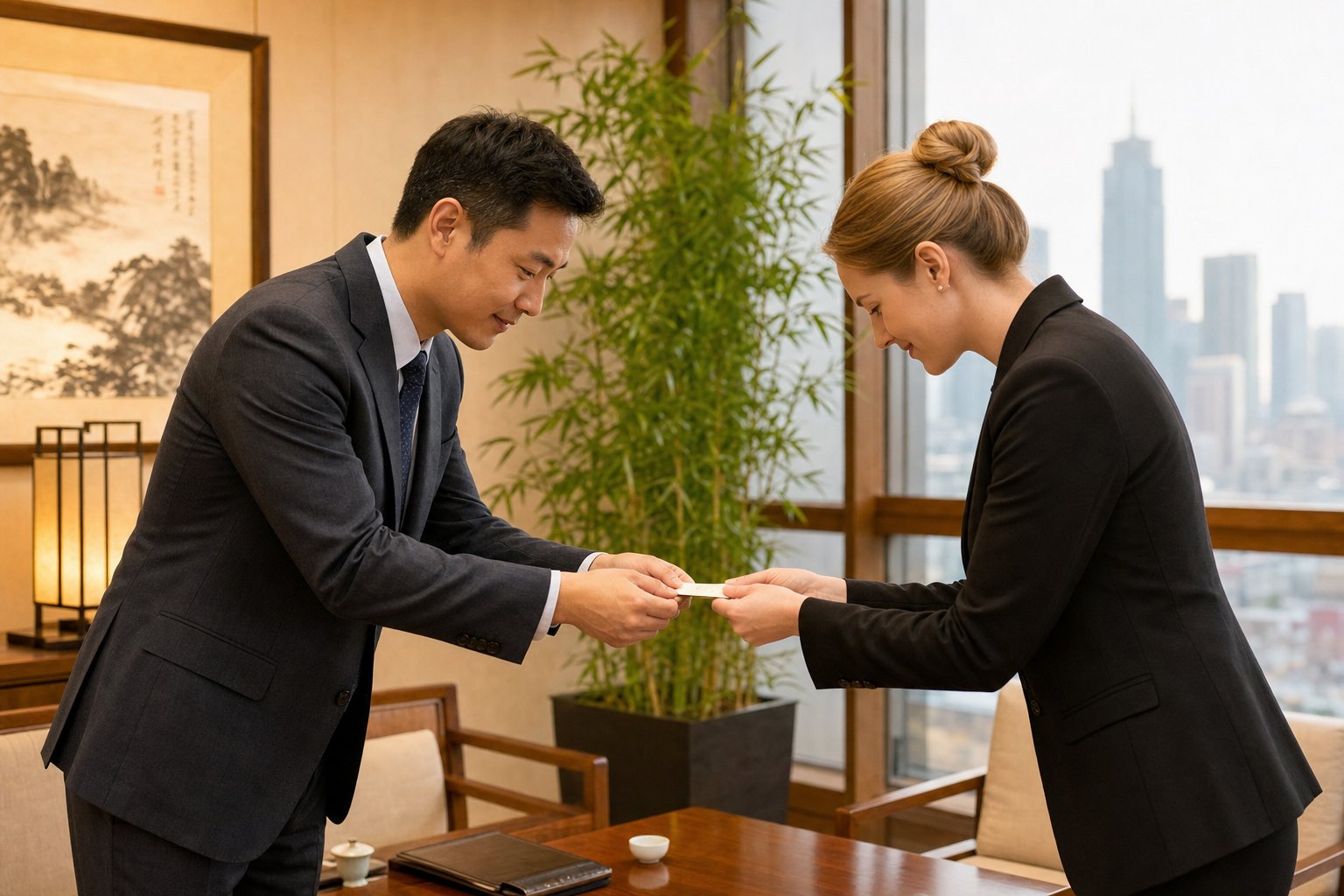
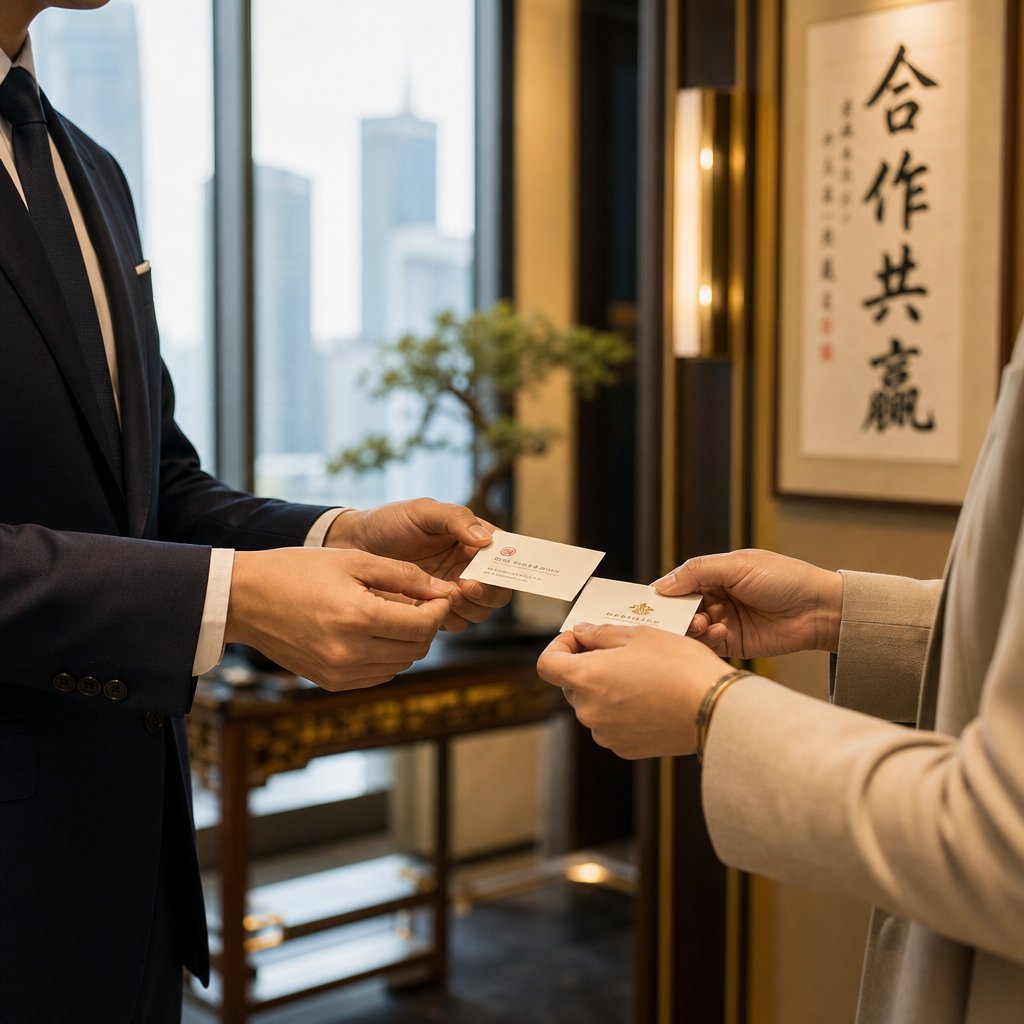
- When receiving a business card, accept it with both hands and read it carefully. The card tells you the person's full name, title, and company position.
- Address the person using their surname plus their professional title. For example, "Wang Jingli" (Manager Wang) or "Li Zong" (Director Li). If no title is apparent, default to "Xiansheng" (Mr.) or "Nushi" (Ms.) after the surname.
- Place the business card on the table in front of you during the meeting. Never put it directly into your pocket or write on it.
- Use the same formal address throughout the meeting. Do not switch to a given name for chinese contacts unless they explicitly invite you to.
The term "Xiansheng" (先生), meaning Mr. in Chinese, is the safest default chinese honorifics choice for men you have just met. For women, "Nushi" (女士) works in virtually all professional situations. Avoid "Xiaojie" (Miss) unless you hear others using it first, as it carries different connotations depending on context and region.
Professional Settings and Workplace Address
In ongoing professional relationships, the most common pattern is surname plus job title. Chinese workplaces are hierarchical, and how you address someone signals your awareness of their position. A few examples:
- Surname + Manager: Wang Jingli (王经理)
- Surname + Director: Zhang Zhuren (张主任)
- Surname + Chief/Boss: Li Zong (李总)
- Surname + Teacher: Chen Laoshi (陈老师) — used broadly for anyone with expertise, not just educators
The title "Zong" (总) has expanded significantly in modern Chinese business culture. Originally short for "Zong Jingli" (General Manager), it is now used as a respectful address for anyone holding a relatively senior position. When in doubt about someone's exact rank, "surname + Zong" is a safe and flattering choice.
Understanding first name and last name in chinese professional contexts means recognizing that the given name is reserved for closer relationships. Using someone's full name without a title, like saying "Wang Ming" directly to them, is acceptable among peers of equal rank who have an established rapport. But it still carries a slightly serious tone, similar to a parent using a child's full name to get their attention.
Social Settings and Evolving Familiarity
As relationships deepen, address naturally becomes less formal. The progression typically follows this path:
- Stage 1 (Strangers/New contacts): Surname + title or honorific. "Wang Xiansheng," "Li Jingli."
- Stage 2 (Established colleagues): Full name without title, or "Lao" (old) / "Xiao" (young) + surname. "Lao Wang" signals friendly respect for someone older or more senior. "Xiao Li" is affectionate toward someone younger.
- Stage 3 (Close friends): Given name only, or a nickname. This level of familiarity is an invitation, never something you should assume.
The shift from formal to informal is not something you initiate. Wait for your Chinese counterpart to signal that a less formal address is welcome. They might say "Just call me Xiaoming" or start using your first name and last name for chinese colleagues in a more relaxed way. Until that happens, stay formal. Erring on the side of respect never causes loss of face, but premature familiarity absolutely can.
In casual social settings, like dinners or after-work gatherings, you will hear Chinese people use the "Lao/Xiao" pattern frequently. "Lao" does not literally mean "old" in a negative sense. It conveys warmth and seniority. "Xiao" conveys youth and approachability. These prefixes attached to the last name in chinese social contexts are signs of genuine camaraderie, and being addressed this way yourself is a clear signal that you have been accepted into the group.
The underlying principle across all these scenarios is the same: let the Chinese side set the pace. Your job is to match their level of formality, not to push past it. That patience communicates respect more powerfully than any perfectly pronounced name ever could.
When Chinese People Use English Names and What to Do
You have learned the formal rules of address. You know to pair a surname with a title and wait for permission before shifting to familiarity. Then you receive an email from someone named "Coco Wang" and a LinkedIn request from "David Chen." Suddenly the rules feel less clear. Are these their real names? Should you use the English name or their Chinese one? And what happens when the name on their video call display does not match the name in their email signature?
This is one of the most common points of confusion for foreigners navigating chinese names for english names in professional and social contexts. The good news: there is a logic behind it, and once you understand the reasons, the etiquette becomes intuitive.
Why Many Chinese People Adopt English Names
The practice of Chinese people choosing English names is widespread, and it is not a sign of abandoning cultural identity. It serves several practical and personal purposes that make cross-cultural communication smoother for everyone involved.
The most common reason is simple accessibility. English is a phonetic language, while Chinese is logographic. These two systems are fundamentally different, and an English name acts as a bridge between the two language systems, giving non-Chinese speakers something easier to pronounce and remember. Many Chinese professionals working internationally recognize that their colleagues struggle with tones and unfamiliar sounds, so they offer an English alternative as a courtesy.
A second driver is the English learning experience itself. In China, English teachers commonly assign students English names during their first classes to make language practice more immersive. For many people, that classroom name simply sticks. Some keep the name their teacher gave them. Others, like many adults, eventually choose their own english name chinese name pairing that better reflects their personality or aspirations.
There is also a deeper cultural dimension at play. China has a long tradition of multiple names. In classical society, a person might have a given name, a courtesy name bestowed during a coming-of-age ceremony, and a self-chosen literary name expressing personal ideals. Adopting an English name fits naturally within this tradition of identity through naming. It is not about replacing one identity with another. It is about adding a layer that functions in a different social context.
Finally, for some individuals, choosing an English name represents self-expression and agency. Birth names are given by parents or grandparents, carrying their hopes and values. An English name chosen in adulthood is entirely self-directed, reflecting who the person has become rather than who their family hoped they would be.
How to Ask About Name Preferences Without Awkwardness
When you meet someone who introduces themselves with an English name, use that name. When someone introduces themselves with their Chinese name, use their Chinese name. The simplest rule is: follow their lead.
But what about situations where you are unsure? Maybe you received an email from "Jenny Liu" but her WeChat display shows names in chinese characters you cannot read. Or perhaps a colleague introduced herself as "Mei" in person but signs emails as "May Chen." These mismatches are common, and asking for clarification is not rude. It is respectful.
Here are natural ways to ask without creating awkwardness:
- "What would you like me to call you?" — Direct, warm, and puts the choice entirely in their hands.
- "I noticed your email signature says [X]. Would you prefer I use that, or the name you introduced yourself with?" — Shows you are paying attention.
- "Do you have a preferred name for day-to-day communication?" — Works well in workplace onboarding situations.
Avoid asking "What is your real name?" or "What is your actual Chinese name?" These phrasings imply that their English name is somehow fake or less legitimate. Both names are real. Both are theirs. The question is simply which one they prefer in a given context.
Some Chinese professionals use their English name with Western colleagues and their Chinese name with Chinese colleagues, switching fluidly between the two. Others use a hybrid format, like "David (Xiaoming) Zhang," signaling that either name works. If someone offers you both, it is perfectly fine to ask which they would like you to use going forward.
Navigating Name Formats Across Platforms
Digital communication adds another layer of complexity. The same person might appear under different names depending on the platform, and understanding these patterns prevents confusion when you need to translate name chinese formats across your professional tools.
| Platform | Common Name Format | Example |
|---|---|---|
| English first name + Chinese surname, or full Westernized order | David Chen / Xiaoming Wang | |
| Email Signature | English name with Chinese name in parentheses, or bilingual format | Jenny Liu (刘静) |
| Nickname, English name, or Chinese characters | Coco / 小明 / a random phrase | |
| Video Calls (Zoom, Teams) | Varies widely: full Chinese name, English name, or company-set format | Wang Xiaoming / James W. |
| Business Cards | Chinese name on one side, English format on the other | 王小明 / Xiaoming Wang |
WeChat deserves special mention. Unlike LinkedIn or corporate email, WeChat display names are entirely user-chosen and often playful. You might see an emoji, a poetic phrase, or a nickname that bears no resemblance to the person's actual name. Never assume someone's WeChat name is how they want to be addressed professionally. If you connect with a new contact on WeChat after a meeting, use the name they gave you in person, regardless of what their profile displays.
For email signatures in Chinese business communication, many professionals include both their Western-format name and their chinese names in chinese characters. This dual-language approach helps both sides identify the correct person, especially in larger organizations where multiple colleagues may share a surname. If you are setting up your own email signature for Chinese counterparts, including a Chinese version of your name (if you have one) signals effort and cultural awareness.
When someone's display name on a video call differs from how they introduced themselves, default to the introduction. Display names are often set by IT departments or auto-generated from HR systems. The name someone actively chooses to give you in conversation is always the one that matters most.
The spectrum of how Chinese people present their names in chinese and international contexts ranges from fully traditional (surname-first Chinese name only) to fully adopted English names with no Chinese reference at all. Most professionals fall somewhere in between, using formats like:
- Full Chinese name in traditional order: Wang Xiaoming
- Westernized order: Xiaoming Wang
- English first name + Chinese surname: David Wang
- English name only: David (no surname used casually)
- Hybrid with both: David (Xiaoming) Wang
Each format tells you something about how that person navigates their cross-cultural identity. Someone using their full Chinese name in traditional order may prefer you make the effort to use it correctly. Someone offering an English name is making communication easier for you. Neither choice is more or less authentic. Your role is simply to respect whichever format they present and use it consistently.
The underlying principle remains the same one that governs all chinese name etiquette for foreigners: let the other person set the terms, pay attention to what they offer you, and when in doubt, ask. That combination of attentiveness and humility works in every scenario, whether you are reading a business card, scanning a LinkedIn profile, or joining a video call with a name you have never seen before.

How to Choose or Adopt a Chinese Name
Knowing how to use someone else's name correctly is half the equation. The other half? Having a name they can use for you. If you are building long-term relationships in China, working with Chinese teams, or living in a Chinese-speaking environment, the question of how to get a chinese name will come up sooner than you think. Sometimes a colleague will offer to give you one. Other times, you will sense that having one would smooth interactions considerably. Either way, understanding what makes a good Chinese name, and what makes a terrible one, saves you from becoming a cautionary tale.
When Having a Chinese Name Is Expected vs Optional
Not every foreigner needs a Chinese name. If you are attending a single conference or having a short business trip, your English name with clear pronunciation guidance is perfectly sufficient. Nobody expects a visitor to arrive with a fully formed Chinese identity.
The calculus changes in these situations:
- Living in China: A Chinese name becomes nearly essential for daily life. Bank accounts, phone contracts, and delivery services all work more smoothly with a name that fits the system.
- Long-term business relationships: Chinese partners and clients appreciate the effort. It signals commitment to the relationship rather than a transactional mindset.
- Studying Mandarin: Language teachers typically assign or help choose a name early in the learning process. It makes classroom interaction more natural.
- Working in a Chinese company: If your colleagues all use Chinese names internally, having one helps you integrate rather than remaining the perpetual outsider.
In short, the longer and deeper your engagement with Chinese culture, the more a Chinese name shifts from optional courtesy to practical necessity.
What Makes a Good Chinese Name for a Foreigner
A good Chinese name balances sound, meaning, and cultural naturalness. There are two main approaches to how to make a chinese name, and they produce very different results.
The first approach is phonetic transliteration. This means selecting name chinese characters whose pronunciation approximates the sounds of your original name. For example, "Michael" becomes 迈克尔 (Maikeer) and "Sarah" becomes 莎拉 (Shala). Transliterations are immediately recognizable as foreign names rendered in Chinese. They are functional, but they often sound awkward to native speakers because the characters were chosen purely for sound, not meaning. The resulting chinese name interpretation can feel random or hollow.
The second approach is a meaning-based name, where you choose characters for their significance rather than their phonetic similarity to your English name. This is what most serious Mandarin learners and long-term residents eventually adopt. A meaning-based name feels authentic. It reads like a real Chinese name rather than a transliteration, and it gives Chinese colleagues something meaningful to connect with.
The preferred method for foreigners integrating into Chinese professional life is actually a hybrid: keep a surname that phonetically echoes your real surname (choosing from actual common Chinese surnames that sound similar), then pair it with a given name selected for its mandarin name meaning. For instance, someone with the surname "Harris" might adopt 何 (He), a real Chinese surname that sounds close enough. Their full name might become 何志远 (He Zhiyuan), meaning "aspiration reaches far."
What makes a chinese name meaning resonate? The same principles that guide Chinese parents apply to foreigners:
- Characters should carry positive or aspirational meanings, like wisdom, strength, grace, or clarity.
- The two characters of a given name should work together as a natural phrase, not feel like two unrelated words jammed together.
- The full name should sound pleasant when spoken aloud. Chinese families say a name many times before committing to it.
- The name should be gender-appropriate by Chinese cultural standards, unless you intentionally want a gender-neutral choice.
Understanding names in chinese and meanings behind them is what separates a name that earns genuine compliments from one that earns polite smiles hiding confusion.
Common Mistakes Foreigners Make When Choosing Names
The freedom to choose your own name is exciting, but it comes with real pitfalls. Every character in Chinese carries semantic weight shaped by thousands of years of use. A cautionary example comes from one learner who named himself 金才宇 (Jin Caiyu), meaning roughly "Golden Skill Universe." The name was technically composed of real characters with positive individual meanings. In practice, it came across as absurdly grandiose, causing embarrassment for everyone who had to use it.
Here are the most common mistakes to avoid:
- Choosing characters only by sound without checking meaning: A character that sounds right might mean something unfortunate. Characters that sound like 死 (si, death) or 苦 (ku, suffering) in any tone create negative associations.
- Using overly grandiose or imperial characters: Names containing 龙 (dragon), 凤 (phoenix), 帝 (emperor), or 圣 (saint) sound pretentious rather than impressive. Chinese people avoid these for the same reason English speakers would not name a child "King Supreme."
- Selecting rare or overly complex characters: A beautifully literary character that nobody can read or type is a daily inconvenience. Practicality matters.
- Ignoring how the full name sounds spoken aloud: Characters might look elegant on paper but create an unfortunate homophone when combined. The full name might accidentally sound like an existing word or phrase with negative or humorous connotations.
- Copying online generators without verification: A chinese name from english name tool can provide a starting point, but automated results often produce combinations that feel unnatural to native speakers.
- Using an ancestor's name characters: In Chinese culture, reusing characters from a direct ancestor's name is considered disrespectful, a taboo called 避讳 (bihui). While this applies more to Chinese families, being aware of it shows cultural literacy.
The single best piece of advice for avoiding these mistakes? Ask a Chinese friend, colleague, or teacher to help you select your name. This is not a sign of weakness or laziness. It is the culturally appropriate approach. Chinese people understand that naming requires native intuition about character combinations, tonal flow, and cultural connotations that no dictionary can fully convey. Most will be genuinely honored that you asked, and they will take the task seriously.
A well-chosen name becomes a conversation starter, a relationship builder, and a signal that you respect the culture enough to participate in it on its own terms. A poorly chosen one becomes a story people tell about you when you are not in the room. The difference between the two often comes down to one simple choice: doing it yourself with a dictionary, or doing it with someone who grew up hearing how names are supposed to sound.
Pronouncing Chinese Names with Confidence
A well-chosen name or a perfectly memorized title means little if you cannot say it out loud. Chinese name pronunciation is where many foreigners freeze up, worried that a mangled attempt will cause more offense than silence. The reality is the opposite. Making a genuine effort, even an imperfect one, signals respect. Saying nothing or avoiding someone's name entirely signals indifference. The bar is not perfection. It is willingness to try.
The good news? You do not need to master all of Mandarin phonology. A handful of consonant sounds account for the vast majority of pronunciation mistakes foreigners make, and learning those specific sounds unlocks most common surnames.
Pinyin Sounds That Trip Up English Speakers
Pinyin is the romanization system used in mainland China to spell Chinese sounds with Latin letters. The catch is that pinyin does not map one-to-one to English sounds. Several letters represent sounds that have no direct English equivalent, and these are exactly the ones that appear in the most common surnames.
Here are the consonants that cause the most trouble when you are learning how to say chinese names:
- Zh — Sounds like the "j" in "jerk" but with the tongue curled back. Think of saying "judge" and stopping before the "dge." This is the opening sound in Zhang and Zhao.
- Q — Sounds like "ch" in "cheese" but with the tongue flat and low, pressed behind the lower teeth. It appears in names like Qian and Qin.
- X — Sounds like "sh" in "sheep" but lighter, with the tongue positioned behind the lower front teeth rather than curled back. You will hear it in Xie, Xu, and Xiao.
- C — Sounds like the "ts" in "boots" or "bits." It is never a soft "s" or a hard "k." Appears in Cai and Cui.
- Z — Sounds like the "ds" in "goods," used as a starting sound. It opens names like Zhao (after the zh) and Zou.
- R — Closer to the "s" in "pleasure" or "vision" than the English "r." The tongue curls up against the roof of the mouth. Appears in names like Ren and Rui.
A useful shortcut from ASU's School of International Letters and Cultures: think of "zh," "ch," and "sh" as their English equivalents ("j," "ch," "sh") but with the tongue curled backward. Then think of "j," "q," and "x" as similar sounds but with the tongue flat and forward. That single distinction covers six consonants at once.
How to Pronounce the Most Common Surnames
You will encounter these surnames constantly. Rather than memorize abstract rules, use this table as a quick reference for the names you are most likely to pronounce zhang, chen, or other common surnames incorrectly:
| Surname (Pinyin) | Approximate English Sound | Common Mistake |
|---|---|---|
| Wang | "Wahng" (rhymes with "song," not "rang") | Pronouncing it like English "wang" with a flat "a" |
| Zhang | "Jahng" (like "John" + "g") | Saying "zang" or "chang" |
| Li | "Lee" (straightforward) | Rarely mispronounced |
| Chen | "Chuhn" (the "e" sounds like "again," not "hen") | Saying it like "Chen" in "chenille" with a flat "e" |
| Liu | "Lyo" (like "Leo" but quicker) | Saying "loo" or "lie-oo" |
| Huang | "Hwahng" (the "u" creates a "w" glide) | Dropping the "H" or saying "hang" |
| Xu | "Shyu" (like "shoe" but with lips rounded tighter) | Saying "zoo" or "ex-oo" |
| Zhou | "Joe" (close enough for most contexts) | Saying "zoo" or "zow" |
| Zhao | "Jow" (rhymes with "cow" but starts with "j") | Saying "zay-oh" |
| Qian | "Chee-en" (two quick syllables blended) | Saying "kee-an" or "kwee-an" |
The li surname is one of the few that English speakers get right instinctively since it sounds exactly like "Lee." The last name Chen, on the other hand, trips people up because the vowel is not the flat "e" of English "hen." It sits closer to the "u" in "but" or the "a" in "again," giving it a slightly deeper, more neutral quality.
Worth noting: wong in chinese contexts is actually the Cantonese romanization of the character 王, which is "Wang" in Mandarin pinyin. Similarly, the tan last name you might encounter among Singaporean or Malaysian Chinese is the Hokkien pronunciation of 陈, the same character that Mandarin speakers romanize as "Chen." These are not different surnames. They are the same characters pronounced through different Chinese language systems. Recognizing these connections helps you avoid treating the same person's name as two different identities depending on which romanization you encounter first.
What to Do When You Cannot Pronounce a Name
Even with preparation, you will encounter names that stump you. Maybe it is an unusual given name with sounds you have never practiced, or a combination that your mouth simply will not cooperate with on the first try. Here is what matters: how you handle the moment.
Avoid guessing loudly and confidently. A wrong pronunciation delivered with certainty is harder to correct than a tentative attempt followed by a check-in. Instead, try these approaches:
- Attempt and verify: "I want to make sure I say your name correctly. Is it [your best attempt]?" This shows effort and invites gentle correction.
- Ask for guidance: "Could you help me with the pronunciation of your name? I want to get it right." Direct, respectful, and appreciated.
- Request a repeat: "Would you mind saying your name once more? I want to make sure I remember it properly." Framing it as memory rather than inability feels less awkward for both parties.
These scripts work because they center the other person's name as something worth getting right. You are not apologizing for incompetence. You are demonstrating that their name matters enough to you that you will ask rather than guess.
Most Chinese people are genuinely patient with pronunciation attempts from foreigners. They grew up in a culture where their own language has multiple dialect groups that mispronounce each other's names constantly. What causes loss of face is not a stumbled syllable. It is the impression that you did not care enough to try, or worse, that you gave up and started avoiding their name altogether.
Practice the surnames you know you will encounter before a meeting. Say them out loud a few times. If you have a Chinese colleague you are comfortable with, ask them to listen and correct you. That five minutes of preparation before a first meeting communicates more respect than any business gift ever could.

Presenting Your Name and Building Cross-Cultural Rapport
You have spent time learning how to pronounce their names. But what about the other direction? When a Chinese colleague asks "what is your name in chinese" or simply needs to introduce you to others, how you present yourself matters just as much. A clear, thoughtful self-introduction removes friction and shows that you understand the exchange goes both ways.
How to Introduce Your Own Name to Chinese People
The question of how do I say my name in chinese comes down to a practical choice: do you offer your English name with pronunciation guidance, or do you use a Chinese name you have adopted? The answer depends on context and relationship depth.
For short-term interactions, introduce yourself with your English name spoken slowly and clearly. Break it into syllables. If your name is difficult for Mandarin speakers, offer a simplified version or a nickname. For example, "Christopher" might become "Chris," since shorter names with simpler consonant clusters are easier to remember and reproduce.
If you have a Chinese name, use it when speaking Mandarin or when your counterpart clearly prefers operating in Chinese. Offering your name in chinese language alongside your English name shows cultural investment. A natural introduction might sound like: "I'm Sarah, and my Chinese name is 苏睿 (Su Rui)." This gives the other person options and signals flexibility.
When introducing yourself in writing, consider including both names in your email signature or business card. The transliteration of foreign names into Chinese often produces longer, less natural-sounding results than a carefully chosen meaning-based name. If your transliterated name runs to four or more syllables, a shorter adopted name will serve you better in daily use. Chinese information density favors brevity, and names longer than three syllables feel unwieldy to native speakers.
One practical tip: when someone asks how to say my name is chinese in a group setting, spell it out clearly and offer a memory hook. "My surname is Martin, like 马 (Ma) in Chinese" gives people an anchor. You are not asking them to master English phonology. You are meeting them halfway.
Regional Differences in Name Conventions
Not all Chinese-speaking communities handle formality the same way. The conventions you learn for mainland China may not apply perfectly in Taiwan, Hong Kong, or diaspora communities in Southeast Asia. These differences are worth knowing before you assume one set of rules covers everyone.
Mainland China: Formality follows the patterns covered throughout this article. Title plus surname is standard in professional settings. Younger professionals in tech and international companies tend toward more casual address, sometimes using English names or first name chinese conventions even among Chinese colleagues. Generationally, people born after 1990 are often more relaxed about naming formality than their parents.
Taiwan: Slightly more formal on average, with stronger emphasis on titles in business. The honorific system is similar, but Taiwanese professionals are often more accustomed to interacting with foreigners and may switch to English-language conventions more readily. Romanization follows different systems (Wade-Giles or Tongyong Pinyin rather than Hanyu Pinyin), so the same characters produce different spellings.
Hong Kong and Macau: Cantonese pronunciation creates entirely different romanizations. English names are extremely common due to the colonial legacy, and many Hong Kongers use their English name as their primary professional identity. Formality levels in business tend to mirror British conventions more than mainland Chinese ones.
Overseas diaspora (Singapore, Malaysia, North America): Naming conventions vary enormously depending on generation and community. Third-generation Chinese Australians may have no Chinese name at all. Singaporean Chinese often use dialect-specific romanizations (Hokkien, Teochew, Cantonese) that differ from Mandarin pinyin. The safest approach is always to follow the individual's lead rather than assuming regional norms.
The key insight across all regions: younger generations and internationally experienced professionals tend toward less formality, while older generations and domestic-focused professionals maintain traditional conventions. When in doubt, start formal and let the other person set the pace downward.
Building Lasting Relationships Through Name Respect
Everything in this guide, from understanding surname structure to choosing your own chinese for name use in professional settings, points toward one underlying truth:
Investing in name etiquette signals that you see your Chinese counterparts as individuals worth understanding, not just contacts to manage. That perception opens doors that no amount of technical competence or business acumen can unlock on its own.
The effort compounds over time. A colleague who watches you correctly address their senior leader by title and surname notices. A client who hears you pronounce their name properly on the first video call remembers. A partner who sees your thoughtfully chosen name in chinese on your business card feels respected. These small moments accumulate into something larger: trust.
As your relationships deepen, the way you address people will naturally evolve. Here is how that progression typically looks across the full arc of a professional relationship:
| Relationship Stage | How You Address Them | How They May Address You |
|---|---|---|
| First meeting (strangers) | Surname + title (Wang Jingli, Li Zong) | Your surname + Mr./Ms. or your English name |
| Established working relationship | Surname + title, or full name if peers | Your first name chinese style, or English name |
| Trusted colleague | Lao/Xiao + surname, or given name if invited | Your Chinese name, nickname, or first name |
| Close friend | Given name, nickname, or terms of endearment | Your Chinese nickname or given name |
Notice that each stage requires an invitation from the other side before you move forward. You never promote yourself to a more familiar level of address. You earn it through consistent respect, genuine interest, and time spent building the relationship.
The foreigners who thrive in Chinese professional and social circles are rarely the ones with perfect Mandarin or flawless cultural knowledge. They are the ones who demonstrate, through small consistent actions, that they care enough to get the details right. Name etiquette is the most visible of those details, and it is the one people notice from the very first handshake. Start there, and the rest of the relationship has room to grow.
Frequently Asked Questions About Chinese Name Etiquette
1. Is it rude to call a Chinese person by their surname alone?
Yes, using a surname without a title or honorific is considered abrupt and disrespectful in Chinese culture. Always pair the surname with a professional title (like Jingli for Manager), or an honorific such as Xiansheng (Mr.) or Nushi (Ms.). Saying just 'Wang' or 'Li' by itself is roughly equivalent to barking someone's last name at them in English and can cause loss of face for both parties.
2. How do I know which part of a Chinese name is the surname and which is the given name?
In traditional Chinese order, the surname always comes first and is typically a single syllable, while the given name follows and consists of one or two syllables. For a three-syllable name like Wang Xiaoming, the first syllable (Wang) is the surname and the remaining two (Xiaoming) form the given name. In international contexts, some Chinese people reverse this order to match Western conventions, so when unsure, simply ask which is their family name.
3. Should I use a Chinese person's English name or their Chinese name?
Follow their lead. If someone introduces themselves with an English name like 'David,' use David. If they offer their Chinese name, use that. When names differ across platforms like email, LinkedIn, or WeChat, default to whatever name they used when they introduced themselves to you directly. If you are genuinely unsure, asking 'What would you like me to call you?' is always appropriate and shows respect.
4. Do I need a Chinese name if I work with Chinese colleagues?
It depends on the depth of your engagement. For short business trips or conferences, your English name is sufficient. However, if you are living in China, building long-term business relationships, studying Mandarin, or working within a Chinese company, having a Chinese name becomes increasingly valuable. It signals commitment and helps you integrate more naturally into professional and social circles.
5. What should I do if I cannot pronounce a Chinese colleague's name correctly?
Make an honest attempt and then verify. Saying something like 'I want to make sure I say your name correctly - is it [your best attempt]?' shows effort and invites gentle correction. Most Chinese people are patient with pronunciation attempts from foreigners. What causes loss of face is not a stumbled syllable but the impression that you did not care enough to try, or that you started avoiding their name altogether.