How Religion Shapes Every Chinese Name You Encounter
When a Chinese parent selects characters for a child's name, they are rarely making a purely aesthetic choice. Behind every stroke lies centuries of religious thought, philosophical tradition, and spiritual aspiration woven into the fabric of the language itself. A name like Huilian (慧莲) might sound modern and elegant, but it carries Buddhist DNA: 慧 (wisdom) and 莲 (lotus) both trace directly to Buddhist scripture. This is the hidden reality of Chinese names and religion. They have never been separate domains.
Imagine encountering a Chinese name and being able to read its spiritual ancestry, to identify whether it draws from Taoist cosmology, Confucian ethics, Buddhist devotion, or even Christian faith translated into Chinese characters. That layer of meaning exists in millions of names used today, often without the bearers themselves fully recognizing the sacred roots of the characters their families chose.
The concept at work here is what scholars of religion call theophoric naming: embedding references to the divine, the sacred, or the spiritually significant directly into personal names. Research into divine naming across polytheistic traditions shows that Chinese deities, much like Greek gods, bore names and titles signifying their divine functions, and this practice filtered down into how ordinary people named their children. In Chinese culture, theophoric elements are not always obvious. They hide inside characters that reference heaven, virtue, purity, or the Way, making religious Chinese naming traditions far more pervasive than most people realize.
Why Chinese Names Carry Religious Meaning
So what is the religion for China when it comes to naming? The answer is not singular. Chinese religions have never operated as a winner-take-all system. Instead, multiple traditions coexist, overlap, and blend, each contributing distinct character choices and naming philosophies. A family might draw on Confucian virtue concepts for a son's name while selecting Buddhist-inspired characters for a daughter, all without perceiving any contradiction. This layered approach reflects how Chinese and religion interact: not as a single doctrine but as a living ecosystem of spiritual influences shaping daily life, including the deeply personal act of naming a child.
The Major Traditions That Influence Naming
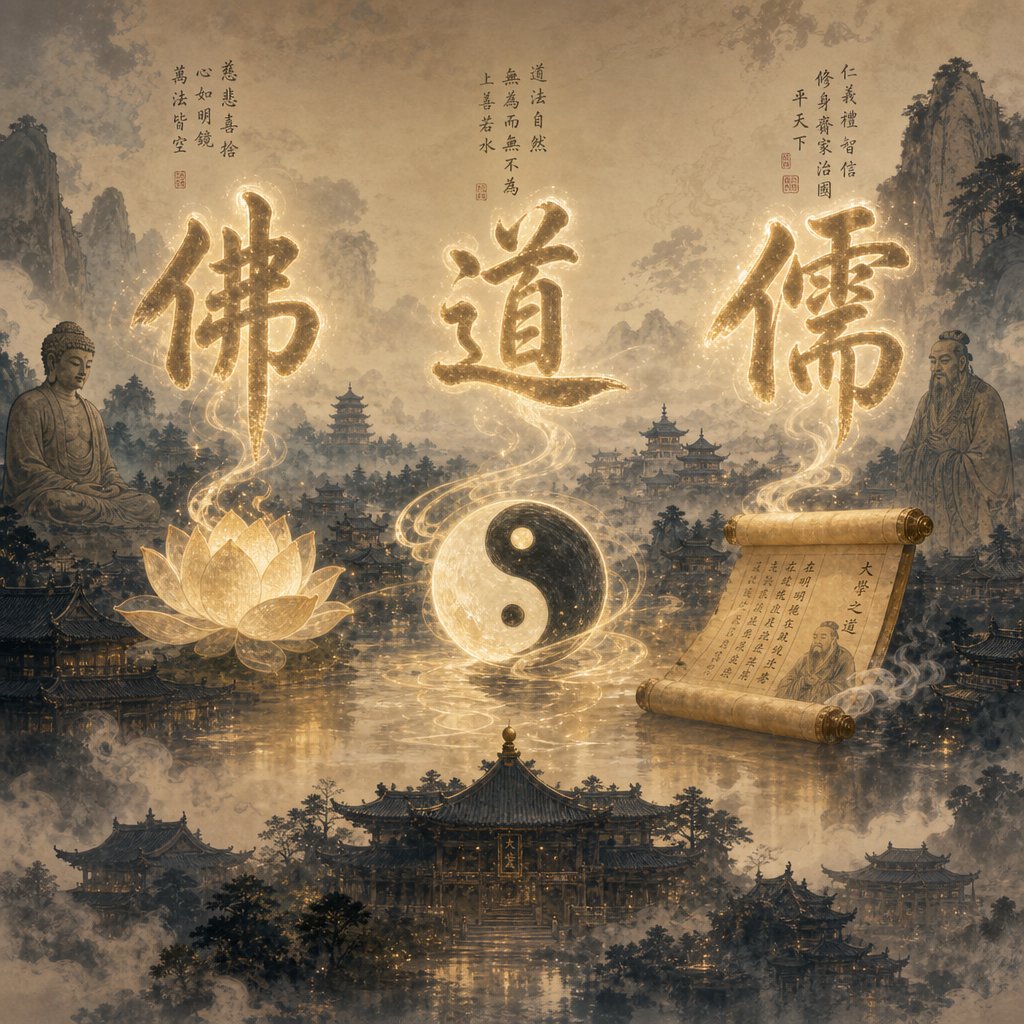
When you ask what is the china religion that shapes naming conventions, you'll find at least six major traditions leaving their fingerprints on character selection:
- Confucianism - Supplies virtue-based characters like 仁 (benevolence), 义 (righteousness), and 礼 (propriety), emphasizing moral character and social harmony in names
- Taoism (Daoism) - Contributes characters referencing nature, cosmic balance, and spiritual cultivation, such as 道 (the Way), 清 (clarity), and 玄 (mystery)
- Buddhism - Introduces characters tied to enlightenment, compassion, and spiritual purity, including 慈 (compassion), 莲 (lotus), and 觉 (awakening)
- Chinese folk religion - Blends local deity references, ancestral reverence, and auspicious symbolism into naming through characters connected to fortune, heaven, and protective spirits
- Christianity - Brings translated biblical concepts into Chinese characters, with names incorporating 恩 (grace), 信 (faith), and 光 (light)
- Islam - Creates distinct naming patterns among Hui and Uyghur communities through Arabic-origin names transliterated into Chinese characters
These six traditions, often called the pillars of Chinese spiritual life, have shaped naming culture across thousands of years. Confucianism, Taoism, and Buddhism alone are considered the three foundational philosophies of ancient Chinese society, and their influence on naming has been continuous since their emergence. The remaining traditions add further layers, particularly in specific communities and historical periods.
Throughout this article, you'll see how each tradition operates differently, how they sometimes compete and sometimes merge, and how the religious story encoded in a Chinese name can reveal family history, regional identity, and personal faith all at once. The journey begins where all Chinese naming does: in the deep past, where heaven and earth first shaped how people chose to be called.
Historical Evolution of Religious Naming Across Dynasties
The deep past of China is not silent on naming. From the earliest oracle bone inscriptions of the Shang dynasty to the digital birth registries of today, religious belief has shaped which characters parents place into their children's names. Each dynasty carried its own spiritual priorities, and those priorities left permanent marks on naming culture.
Ancient Origins and the Concept of Shangdi
The religion of ancient China centered on two supreme powers: Shangdi (上帝, the Supreme Ruler) and Tian (天, Heaven). During the Shang dynasty (c. 1600-1046 BCE), Shangdi was understood as the highest ancestral deity whose influence governed fertility, harvests, and the fate of clans. Tian then rose to prominence in the Zhou dynasty (1046-256 BCE), gradually assimilating Shangdi's role as the supreme cosmic authority.
How did this shape naming? Early Chinese rulers were called Son of Heaven (天子, tianzi), and their authority was believed to flow directly from Tian. This xia celestial framework filtered into aristocratic and eventually common naming practices. Characters referencing heaven, celestial bodies, and divine mandate became markers of aspiration and legitimacy. Names incorporating 天 (heaven), 帝 (emperor/deity), or 昊 (vast sky) carried implicit claims of cosmic connection. Ancient china religion was inseparable from political power, and naming reflected that fusion perfectly.
The Tang Dynasty Buddhist Naming Boom
Fast forward to the Tang dynasty (618-906 CE), and the naming landscape transforms dramatically. Buddhism, introduced to China around the second century via Silk Road traders and monks, had by this point become deeply embedded in Chinese life. Buddhist temples and shrines spread across the country, enjoying substantial state support. Lay people donated to monasteries to accrue spiritual merit, and Buddhist vocabulary saturated everyday language.
The Tang dynasty represents the peak of Buddhist influence on naming. Families chose characters like 慧 (wisdom), 莲 (lotus), 空 (emptiness), and 禅 (meditation) for their children, signaling devotion or simply reflecting the cultural atmosphere. Individuals entering monastic life sacrificed their family names entirely, a radical act in a society where lineage defined identity. Even those who remained laypeople often adopted Buddhist-inflected names to express piety or seek spiritual protection for their children.
The Song dynasty (960-1279) shifted the balance. Buddhism moved out of official state sponsorship and into popular religion, while Confucian values reasserted dominance in elite naming. Virtue characters like 仁 (benevolence), 德 (virtue), and 学 (learning) became the preferred markers of educated families. Religion in the china of this era was never monolithic; it was a rotating emphasis among coexisting traditions, and naming conventions tracked those rotations closely.
From Suppression to Modern Revival
The most dramatic rupture came in the twentieth century. After 1949, the Chinese Communist Party treated religious naming as a relic of feudalism. During the Cultural Revolution (1966-1976), all temples and churches were shut down or destroyed, and any form of religious activity was prohibited. Names referencing Buddhist, Taoist, or folk religious concepts became politically dangerous. Revolutionary names containing 红 (red), 军 (army), or 东 (east, referencing Mao Zedong) replaced centuries of sacred naming tradition almost overnight.
The post-reform era beginning in the late 1970s slowly reversed this suppression. As the party permitted a far-reaching revival of religion in the china of the reform period, religiously-influenced naming quietly returned. Today, with nearly half the population engaging in some form of religious activity, sacred naming traditions have re-emerged, though often in subtler forms than their historical predecessors.
| Dynasty/Era | Dominant Religious Influence | Common Naming Patterns |
|---|---|---|
| Shang (c. 1600-1046 BCE) | Shangdi worship, ancestor veneration | Celestial references (天, 帝), clan ancestor characters |
| Zhou (1046-256 BCE) | Tian (Heaven), early Confucianism | Mandate of Heaven references, virtue beginnings (德) |
| Tang (618-906 CE) | Buddhism (state-supported) | Buddhist vocabulary (慧, 莲, 空, 禅, 净) |
| Song (960-1279 CE) | Neo-Confucianism, popular Buddhism | Virtue and scholarship characters (仁, 义, 学, 德) |
| Ming (1368-1644 CE) | Confucianism, folk religion blend | Moral cultivation names, generational poems |
| Mao Era (1949-1976) | State atheism, Mao cult | Revolutionary names (红, 军, 东, 建国) |
| Post-Reform (1978-present) | Gradual religious revival | Subtle sacred references, traditional characters returning |
This timeline reveals something essential: religious naming in China has never disappeared. It has only shifted form, gone underground, or re-emerged wearing different clothes. The specific mechanisms through which each tradition stamps its identity onto names, however, vary enormously. Buddhist naming, for instance, operates through an entirely separate system of dharma names that exist parallel to a person's legal identity.
Buddhist Naming Traditions and Dharma Names
Buddhism is often considered the largest religion in China by number of active practitioners, and its influence on naming runs deeper than any other imported tradition. Unlike Confucian or folk religious naming, which blends seamlessly into secular name choices, Buddhism created an entirely parallel naming system. When a person takes refuge in the Buddha, they receive a dharma name (法名, faming) that exists alongside their birth name, creating a dual identity that bridges the sacred and the everyday.
How Dharma Names Are Chosen and Structured
A dharma name is not something you pick for yourself. It is bestowed by a monastic teacher during an initiation ceremony, whether that ceremony marks full ordination into monkhood or a layperson's formal commitment to Buddhist practice. The structure follows a consistent pattern: a shared surname, a generation character, and a unique personal character.
For ordained monks and nuns in China, the surname automatically becomes Shi (释), derived from Shijiamouni (释迦牟尼), the Chinese transliteration of Shakyamuni Buddha. This signals that all monastics belong to one spiritual family regardless of their birth lineage. The generation character comes next, drawn from a lineage poem that assigns one character per generation. At Shaolin Temple, for example, a seventy-word poem composed by Abbot Xueting Fuyu in the thirteenth century still determines generational names today. The 32nd generation uses Xing (行), the 33rd uses Yong (永), and so on. The final character is chosen by the master based on the disciple's personal qualities or spiritual aspirations.
Lay Buddhist names work differently. When a layperson takes the Three Refuges, they receive a two-character dharma name from their teacher. In some Pure Land sects, all lay disciples share a common first character, such as Jing (净) in the Shandao lineage, while the second character is individually selected. If no personal teacher is available, some traditions assign the temporary name Miao-Yin until a master can provide a personalized one.
The key distinction? Monastic names replace the family surname entirely, a radical break in a culture where surname continuity defines clan identity. Lay dharma names, by contrast, coexist with legal names. A businesswoman named Zhang Wei on her passport might be Shi Miaohui in her Buddhist community. Both identities are real, operating in different spheres of her life.
Buddhist Characters in Everyday Chinese Names
You don't need to be a Buddhist convert to carry Buddhist DNA in your name. Centuries of cultural exchange between Buddhist and Taoist traditions, along with folk religion, have scattered Buddhist-origin characters throughout mainstream Chinese naming. Parents choose these characters for their beauty and meaning, sometimes unaware of the religious roots. Among the religions from China that have shaped naming culture, Buddhism contributed some of the most poetically resonant characters still popular today:
- 慈 (ci, compassion) - Directly references the Buddhist concept of loving-kindness (慈悲, cibei). Common in women's names, it evokes the compassion of Guanyin, the Bodhisattva of Mercy.
- 莲 (lian, lotus) - The lotus grows from mud yet blooms pure, a central Buddhist metaphor for spiritual awakening amid worldly suffering. Extremely popular in female names.
- 觉 (jue, awakening) - The character at the heart of the word for Buddha (觉者, the awakened one). Found in both dharma names and secular given names, it signals spiritual awareness.
- 净 (jing, purity) - Connected to Pure Land Buddhism (净土宗) and the concept of a purified mind. Appears frequently in both monastic generation names and lay names.
- 慧 (hui, wisdom) - Refers to prajna, the transcendent wisdom that perceives the true nature of reality. One of the most common Buddhist-influenced characters in everyday names.
- 禅 (chan, meditation/Zen) - Directly references Chan Buddhism. Less common in personal names but appears in artistic and courtesy names.
- 空 (kong, emptiness) - Represents sunyata, the Buddhist teaching that all phenomena lack inherent existence. Rare in given names but powerful when used.
What makes Buddhist naming distinct from Taoist naming is this dual-track system. While taoism vs buddhism debates often focus on philosophical differences, the practical naming difference is structural. Taoist practitioners also receive religious names, but Buddhist naming created a more formalized, lineage-based architecture that tracks spiritual genealogy across generations. A monk's dharma name tells you exactly where he sits in a lineage stretching back centuries, something no secular name can do.
This parallel identity raises a fascinating question: what happens when religious naming collides with state authority, political identity, or conversion between traditions? The answer varies dramatically depending on whether you practice in a monastery, a living room, or a country where the government monitors religious expression.
Taoist and Confucian Approaches to Naming
Buddhism built a parallel naming identity through dharma names. Taoism does something similar but with a distinctly different flavor, one rooted in cosmic harmony rather than monastic lineage. And Confucianism? It shaped more Chinese names than any other tradition, yet whether it qualifies as a religion at all remains one of the most debated questions in Chinese philosophy.
Taoist Religious Names and Their Cosmic Roots
When a Taoist practitioner is formally initiated, they receive a religious name called a daohao (道号). Unlike Buddhist dharma names that track generational lineage through poetry, Taoist religious names tend to reflect the practitioner's relationship with cosmic forces. A Zhengyi (Orthodox Unity) Taoist priest, who can marry and live among laypeople while performing rituals, might carry a daohao referencing celestial phenomena or the fundamental principles of Taoist cosmology.
The characters that populate Taoist naming draw directly from the tradition's core vocabulary:
- 道 (dao, the Way) - The foundational concept of Taoism itself, representing the ultimate principle underlying all reality. Appears in both religious names and secular names inspired by Taoist philosophy.
- 玄 (xuan, mystery) - References the mysterious and ineffable nature of the Tao, the dark depth from which all things emerge. Popular in names suggesting profundity and hidden wisdom.
- 清 (qing, clarity/purity) - Evokes the Taoist ideal of a clear, still mind unclouded by worldly desires. One of the most common Taoist-influenced characters in everyday Chinese names.
- 仙 (xian, immortal) - Refers to transcendent beings who have achieved spiritual immortality through cultivation. During the Han dynasty, individuals who were "divinified" could be venerated as xian, and the character carries aspirations of longevity and spiritual elevation.
- 云 (yun, cloud) - Symbolizes the wandering, unattached spirit of the Taoist sage. Clouds and mist imagery pervades Taoist art and naming alike.
Taoism's influence on naming extends far beyond initiated priests. Because Taoist imagery saturates Chinese poetry, painting, and folk culture, characters like 清, 云, and 玄 appear in millions of names belonging to people with no formal Taoist practice. The boundary between "Taoist name" and "name influenced by Taoist aesthetics" is genuinely blurry, and that blurriness intensifies when Chinese folk religion enters the picture.
China popular religion has never drawn a clean line between Taoist liturgy and local spiritual practice. Village temples might honor a Taoist deity one day and a deified local hero the next. Names referencing protective spirits, dragon kings (龙王), or earth gods (土地) emerge from this folk-Taoist blend. In northern China, entire villages derive their names from local deities or temples, and personal naming follows the same logic. A child born during a temple festival might receive a name honoring the celebrated deity, embedding chinese folk religion directly into their identity without any formal conversion or ceremony.
In Chinese folk religion, there is no requirement to "believe" in an official doctrine to participate. The primary criterion is to "belong" to a local community. This same principle applies to naming: sacred characters enter personal names not through theological commitment but through cultural belonging, making the boundary between secular and sacred naming almost impossible to locate.
Confucian Virtue Names and the Deity Question
Is Confucianism a religion? The question matters for naming because it determines whether virtue-based names count as "religious" at all. Confucianism has temples, rituals, sacred texts, and organized churches. A Holy Confucian Church was established in 2015, and movements like Shanrendao (the Universal Church of the Way and Its Virtue) once encompassed roughly 25% of Manchuria's population. Yet Confucianism lacks a creator deity in the Western sense, which leads many to classify it as philosophy rather than religion.
The name of god in Confucianism is not straightforward. Confucius himself spoke of Tian (天, Heaven) as a moral force governing the universe, but whether Tian is a personal deity or an impersonal principle remains debated. The concept of a confucianism name of deity does not map neatly onto Abrahamic categories. What Confucianism does provide, unambiguously, is a naming vocabulary built on the Five Constant Virtues (五常, wuchang) articulated during the Han dynasty:
- 仁 (ren, benevolence) - The supreme Confucian virtue, meaning to form one body with others and act in their interest
- 义 (yi, righteousness) - Doing what is proper and refusing what would be shameful or degrading
- 礼 (li, propriety) - Performing social rituals with reverence and respect
- 智 (zhi, wisdom) - Understanding character, assessing situations, and knowing the best means to virtuous ends
- 信 (xin, trustworthiness) - Commitment to reality in a consistent and reliable way, considered the foundation supporting all other virtues
These five characters, along with related concepts like 孝 (xiao, filial piety) and 德 (de, virtue), form what might be called the china main religion of naming. Whether or not you classify Confucianism as religious, its ethical vocabulary dominates Chinese given names more than any single tradition. A name like Zhiren (志仁, aspiring to benevolence) or Mingyi (明义, understanding righteousness) carries Confucian DNA as clearly as a lotus name carries Buddhist origins.
The practical difference? Confucian naming never requires initiation, ceremony, or a separate identity. It operates entirely within the secular name itself, encoding moral aspiration into the characters a child carries for life. This makes Confucian influence simultaneously the most pervasive and the least visible form of religious naming in Chinese culture. You encounter it everywhere precisely because it never announces itself as sacred.
Where Taoism and Confucianism shaped naming through indigenous Chinese concepts, the arrival of Christianity and Islam introduced an entirely different challenge: how to translate foreign sacred names into a writing system built for a different spiritual world.
Christian and Islamic Names in Chinese Culture
Translating a foreign god's name into Chinese characters is not a simple phonetic exercise. It is a theological decision. When missionaries first arrived in China, they faced a writing system with no alphabet, no shared Semitic roots, and thousands of years of indigenous spiritual vocabulary already embedded in every character. Christianity in China and Islam in China each solved this translation problem differently, and those solutions created naming patterns that remain distinct from anything produced by Buddhism, Taoism, or Confucianism.
Christian Names Translated Into Chinese Characters
How do you write Christ in Chinese? The answer reveals the core challenge. Jesus in Chinese characters becomes 耶稣 (Yesu), a purely phonetic transliteration that carries no inherent meaning in Chinese. Unlike Buddhist terms that were translated semantically (慈悲 for compassion, 般若 for wisdom), the name of Jesus in Chinese writing functions as a sound-loan. The characters 耶 and 稣 were selected solely for their pronunciation, not their individual meanings. This phonetic approach extends to most biblical proper names: Abraham becomes 亚伯拉罕 (Yabolahan), Moses becomes 摩西 (Moxi), and Mary becomes 玛利亚 (Maliya).
But here is where it gets interesting. While proper names were transliterated phonetically, the concepts behind Christian faith were translated semantically into Chinese characters. And those concept-characters are exactly what Chinese Christians draw on when naming their children. You won't find many Chinese Christians naming a child 耶稣 directly, just as Western Christians rarely name a child "God." Instead, they embed theological concepts into given names using characters like:
- 恩 (en, grace) - References divine grace, the unmerited favor of God. Extremely common in Christian Chinese names, appearing in combinations like 恩典 (Endian, grace) or 天恩 (Tian'en, heavenly grace).
- 信 (xin, faith) - Carries the dual meaning of faith and trustworthiness. Christian families use it to signal belief, while it simultaneously functions as a Confucian virtue character, providing useful ambiguity.
- 光 (guang, light) - Evokes the biblical metaphor of divine light entering darkness. Names like 光明 (Guangming, brightness) or 恩光 (Enguang, light of grace) mark Christian identity subtly.
- 爱 (ai, love) - Represents agape love as translated in Chinese scripture. Combined with other characters, it signals Christian values without being overtly religious.
- 望 (wang, hope) - One of the three theological virtues (faith, hope, love), used in names to express eschatological hope.
The growing Protestant and Catholic communities in China handle naming with slightly different emphases. Catholics, whose presence dates back to Jesuit missions in the sixteenth century, maintain a tradition of baptismal names. A Catholic convert receives a saint's name during baptism, transliterated into Chinese. A woman baptized as Teresa becomes 德肋撒 (Delesa) in her parish records, though she continues using her legal Chinese name in all other contexts. Protestants, whose community has expanded rapidly since the 1980s, tend to skip formal saint names and instead choose given names for their children that embed theological meaning directly into the legal name itself.
This creates a practical difference. A Catholic might carry three names: a legal Chinese name, a baptismal saint name, and possibly an English name for international contexts. A Protestant family is more likely to encode their faith into the single legal name, choosing characters like 恩 or 光 that signal Christian identity to those who know how to read it while remaining unremarkable to secular observers.
Islamic Naming Traditions Among Chinese Muslims
Islam in China presents a fundamentally different naming challenge. China's Muslim population includes two major groups with entirely distinct linguistic backgrounds: the Hui people, who speak Mandarin as their native language, and the Uyghurs, who speak a Turkic language and use Arabic script. Their naming practices diverge accordingly.
Hui Muslims have lived in China for over a thousand years and are largely assimilated linguistically. They typically carry standard Chinese surnames (Ma 马 is the most common, likely derived from Muhammad) combined with given names that may or may not signal Islamic identity. Some Hui families choose Arabic-origin names transliterated into Chinese characters: Yibulaxin (伊布拉欣, Ibrahim), Aisha (阿依夏), or Musa (穆萨, Moses). Others select Chinese characters with meanings that align with Islamic values, such as 清 (qing, purity) or 德 (de, virtue), creating names that function in both Islamic and mainstream Chinese contexts.
Uyghur naming operates on entirely different principles. Approximately 80 to 85 percent of Uyghur names are of Arabic or Persian origin, reflecting Islam's deep integration into Uyghur cultural identity. Names like Fatima, Aisha, Nesrulla, and Shemshiddin have been used by Uyghur parents for generations. These names are not borrowed from a foreign tradition; they are indigenous to Uyghur culture, inseparable from the community's Islamic heritage.
The transliteration problem compounds the difficulty. There is no official standardized system for converting Uyghur names into Chinese characters. A single name can be rendered multiple ways: the common female name Ruqiya, for instance, might appear as 如合牙 (Ruheya), 茹克亚 (Rukeya), 鲁克雅 (Lukeya), or 肉赫娅 (Rouheya) depending on which official processes the registration. These transliterations are then printed on identity documents, becoming the bearer's official name in a form that may sound considerably different from the intended pronunciation.
The political dimension cannot be ignored. In 2017, regional regulations in Xinjiang banned 29 names deemed expressions of religious extremism, including Islam, Quran, Mecca, Imam, Hajj, Medina, Fatima, and Aisha. Parents with children bearing banned names were told their children could not register for household registration (hukou), attend school, or access healthcare. Imams who traditionally preside over naming ceremonies were ordered to enforce the restrictions. The Uyghur Human Rights Project described these measures as "an assault on the Uyghur culture," noting that the restricted names are not foreign to Uyghur tradition but have been used for generations.
This state intervention into Muslim in China naming practices highlights a tension absent from Christian naming: while Christian Chinese names embed faith subtly into standard Chinese characters, Uyghur Islamic names exist in a separate linguistic system that resists easy assimilation into Mandarin conventions. The dual naming system that Uyghurs navigate, maintaining both a Uyghur-language name and a Chinese-character transliteration, creates friction that purely phonetic or purely semantic translation cannot resolve.
| Tradition | Translation Method | Naming Practice | Example |
|---|---|---|---|
| Catholicism | Phonetic transliteration of saint names | Baptismal name separate from legal name; saint names used in parish life | Teresa → 德肋撒 (Delesa) |
| Protestantism | Semantic embedding of theological concepts | Faith-signaling characters woven into legal given names | 天恩 (Tian'en, heavenly grace) |
| Islam (Hui) | Phonetic transliteration or semantic equivalents | Arabic names in Chinese characters, or Chinese characters with Islamic-compatible meanings | Ibrahim → 伊布拉欣; Ma Deming (马德明) |
| Islam (Uyghur) | Phonetic transliteration into Chinese; original name in Uyghur script | Dual naming system; Arabic/Persian-origin names dominant in community use | Fatima → 法蒂玛 (Fadima) |
What unites these Abrahamic naming traditions in China is the translation problem itself. Each community must decide whether to prioritize sound (preserving the original name's pronunciation) or meaning (finding Chinese characters that carry equivalent spiritual weight). Christianity in China largely chose meaning for concepts and sound for proper nouns. Islam among the Hui blended both approaches. And Uyghur naming maintained its own linguistic integrity, creating a parallel system that coexists uneasily with Chinese character conventions.
These translation choices raise a deeper question: when multiple traditions compete to name the divine in Chinese characters, which word for God wins? The answer, it turns out, depends entirely on which tradition is speaking.
The Chinese Word for God and Divine Name Elements
How do you say god in Chinese? The answer depends entirely on who you ask. A Protestant pastor, a Catholic priest, a Hui imam, and a Taoist monk would each give a different response, and each would be correct within their own tradition. This lack of a single, universal term for the divine is not a quirk of translation. It is a centuries-old theological battleground that shaped Bible translations, split missionary communities, and left permanent marks on how Chinese god names appear in personal naming today.
Competing Words for God in Chinese
The Chinese word for god is not one word but several, each carrying distinct theological weight and historical baggage. When Abrahamic religions entered China, they appropriated existing terms or coined new compounds to express their theology. The result is a landscape where the god in chinese symbol you encounter depends on which tradition produced it.
- 上帝 (Shangdi, Supreme Sovereign) - The oldest term, originating in the Shang dynasty as the name of the highest ancestral deity. Protestant missionaries like Walter Medhurst and Karl Gutzlaff adopted it, arguing that ancient Chinese who wrote about Shangdi were monotheists describing the same God found in the Bible. Today it appears in some Protestant Chinese Bibles and remains the most culturally resonant term for a supreme deity.
- 神 (Shen, God/spirit/divine being) - A generic term meaning god, spirit, or soul. Used in many Protestant Chinese Bibles as the translation of Hebrew Elohim and Greek Theos. Its flexibility allows it to express plurality, which proponents argue makes it better suited to conveying the Trinity. The popular name for China itself, Shen Zhou (神州, "God's Country"), demonstrates that Shen does not inherently refer to lesser spirits.
- 天主 (Tianzhu, Lord of Heaven) - The Catholic term for God, proposed by Matteo Ricci during the first Jesuit missions to China in the sixteenth century. Catholicism in Chinese is literally called Tianzhu jiao (天主教, "religion of the Lord of Heaven"). Korean and Vietnamese Catholics also use cognates of this term.
- 真主 (Zhenzhu, True Lord) - The term used by Chinese Muslims for Allah. Interestingly, this same term was first used by Nestorian Christians who arrived in China around 635 AD, centuries before Islam became established in the region.
- 主 (Zhu, Lord) - Used by both Catholics and Protestants in less formal prayers and worship. Lord in chinese is simply Zhu, and it functions as the most common devotional address for God across Chinese Christian communities.
- 天 (Tian, Heaven) - The Zhou dynasty replacement for Shangdi, used interchangeably with it for centuries. Confucians, Taoists, and folk religionists all reference Tian as a moral or cosmic authority, making it the most ecumenical divine term in Chinese.
The controversy between Shangdi and Shen, known as the "Term Question," consumed Protestant missionaries throughout the nineteenth century. Proponents of Shangdi argued it connected Chinese audiences immediately to a supreme, singular God. Opponents countered that Shangdi was the name of a particular pagan deity and could not express the plurality essential to Trinitarian theology. The debate grew so heated that Protestant organizations ultimately published two versions of the Bible, one using each term, a split that persists today.
The political dimension made things worse. As Thomas H. Reilly documents, Shangdi was associated with the imperial title and the Mandate of Heaven. Using it in a Christian context implied that Chinese emperors were guilty of blasphemy, a charge with overt political overtones that missionaries like Medhurst were fully aware of and even embraced.
Hidden Religious Roots in Common Names
These competing divine terms did not stay confined to scripture and theology. They filtered into personal naming, often so thoroughly that bearers no longer recognize the sacred origins of their characters. When you encounter a chinese symbol for god in someone's name, it rarely announces itself as religious. Instead, it hides behind layers of cultural familiarity.
Consider these common name characters and their divine etymology:
- 天 (tian) - Appears in names like Tianming (天明, heaven's brightness) or Tianci (天赐, heaven's gift). Most bearers think of it as meaning "sky" or "nature," but its original meaning was the supreme deity of the Zhou dynasty, the cosmic lord who granted or revoked the mandate to rule.
- 帝 (di) - Found in historical names and literary references. Originally the personal name of the supreme being in Shang dynasty religion, it later became the word for "emperor" precisely because rulers claimed divine authority. Anyone named with this character carries an echo of China's oldest god name.
- 神 (shen) - Rarely used directly in given names, but appears in compound surnames and place-derived names. Its presence signals divine or spiritual power.
- 灵 (ling, spirit/divine efficacy) - Common in female names like Lingyun (灵韵) or Lingxi (灵犀). The character originally described the numinous power of deities and sacred objects before softening into a general sense of cleverness or grace.
- 圣 (sheng, holy/sage) - Used in names like Shengze (圣泽, holy beneficence). In Confucian tradition, it described the sage-kings; in Christian Chinese, it translates "holy" as in Holy Spirit (圣灵). Either way, it carries sacred weight.
- 恩 (en, grace) - One of the most popular characters in modern Chinese names. While it functions as a general term for kindness or favor, its prominence in naming correlates directly with Christian influence. Families with no Christian background now use it freely, unaware that its surge in popularity traces partly to Christian naming patterns.
The china god name question, then, is not merely academic. It shapes which characters carry sacred resonance, which names signal religious identity to insiders while passing unnoticed by outsiders, and which divine concepts have become so culturally absorbed that their religious origins have effectively vanished. A name containing 天 today reads as poetic rather than theological, yet it descends from the same character that once meant the supreme deity of all Chinese civilization.
This invisible sacred layer raises a practical question for anyone navigating Chinese religious identity: what happens when a person converts and their existing name suddenly carries the wrong spiritual associations, or no spiritual associations at all?
Religious Conversion and the Politics of Naming
Conversion changes what you believe. In China, it can also change what you are called. But the relationship between new faith and new name is not uniform across traditions. Some religions in China grant converts an entirely separate identity through naming. Others encourage embedding faith into the name you already carry. And in a country where the ruling party is officially atheist, the decision to publicly bear a religiously-marked name is never purely spiritual. It is also political.
What Happens to Your Name When You Convert
When a Chinese person converts to Buddhism and formally takes the Three Refuges, they receive a dharma name from their refuge master. This name does not replace their legal identity. As the Dharma Drum Mountain organization explains, a dharma name "has no legal effect, and you don't actually use it in your daily life." It functions instead as a token of remembrance, a marker that you have committed to the Buddhist path under the witness of a specific teacher. Some practitioners accumulate multiple dharma names from different refuge masters over a lifetime, creating a layered spiritual identity that exists entirely parallel to their government-issued name.
Christian conversion works differently. A Catholic convert receives a baptismal saint name during the sacrament, transliterated into Chinese characters. This name lives in parish records and is used during worship, but it never appears on an identity card. Protestant converts, by contrast, rarely receive a formal religious name at all. Instead, they may choose to rename their children using characters that signal faith, like 恩 (grace) or 望 (hope), encoding conversion into the next generation's legal identity rather than creating a separate naming layer for themselves.
Islamic conversion among Han Chinese who join the Hui community typically involves adopting an Arabic name for use within the mosque community. This name, called a jingming (经名, scripture name), is given by an imam and used during prayer and religious gatherings. Outside the mosque, the convert's Chinese legal name remains unchanged.
For many Chinese converts, religious naming creates not a replacement identity but a parallel one. You become two people in name: the person your family made and the person your faith made. These identities coexist, each activated by different social contexts, and the tension between them is itself a form of spiritual practice.
This dual-identity system means that conversion in China rarely produces visible naming conflict in daily life. The friction emerges not between the convert and their family name, but between the convert and the state.
State Policy and Religious Name Expression
Understanding what religion of china the government permits, and how that permission shapes naming, requires grasping a basic fact: the Chinese Communist Party is officially atheist. Its roughly ninety-eight million members are prohibited from holding religious beliefs, and families of party members are discouraged from publicly participating in religious ceremonies. The state recognizes only five religions: Buddhism, Catholicism, Daoism, Islam, and Protestantism. Practicing any other faith is formally prohibited, though often tolerated in the case of folk traditions.
How does this affect naming? For party members and government officials, choosing overtly religious characters for a child's name carries career risk. A cadre who names his daughter Enguang (恩光, light of grace) signals Christian affiliation in a system that demands atheism from its members. The safer path is ambiguity: selecting characters that carry religious resonance for insiders while reading as purely aesthetic to secular observers. This is why characters like 恩, 慧, and 清 thrive in modern naming. They are spiritually legible to those who share the faith but politically invisible to those who might object.
The situation is far more severe for Uyghur Muslims, where the state has directly banned specific religiously-marked names. But even for Han Chinese practitioners of recognized religions, the political calculus is real. Under Xi Jinping's sinicization policies, all religious groups face pressure to conform to CCP doctrines and Han Chinese cultural norms. Religious naming that appears too foreign, too devout, or too visible can attract unwanted attention from local officials tasked with monitoring religious activity.
The result is a naming culture shaped as much by political caution as by spiritual aspiration. China's religion landscape is officially open but practically constrained, and naming reflects that contradiction perfectly. Converts learn to read the political weather before deciding how loudly their names should speak their faith. For diaspora communities outside mainland China, these constraints dissolve entirely, producing dramatically different naming patterns shaped by local freedoms rather than state surveillance.
Chinese Diaspora and Religious Naming Around the World
Outside the mainland's political constraints, Chinese communities developed naming traditions shaped by local religious freedoms, colonial histories, and contact with entirely different spiritual worlds. The result? A single Chinese surname can carry vastly different religious naming logic depending on whether the family lives in Taipei, Hong Kong, Jakarta, or Los Angeles.
Taiwan and Hong Kong Religious Naming Practices
Taiwan preserved what the mainland suppressed. Because the Republic of China never experienced a Cultural Revolution, folk religion naming traditions continued unbroken on the island. Taiwanese families routinely consult temple oracles, fortune tellers, and Taoist priests when selecting characters for a newborn. The practice of asking a deity to approve or reject proposed name characters through divination blocks (筊杯, jiaobei) remains common, particularly in southern Taiwan where temple culture is strongest. Characters referencing Mazu (妈祖), the sea goddess, or local earth gods appear in names with a frequency unthinkable on the mainland.
The republic of china religion landscape also maintained stronger Buddhist institutional naming. Taiwanese Buddhist organizations like Fo Guang Shan and Tzu Chi have millions of lay followers who carry dharma names actively, using them in community life rather than keeping them hidden. Religious identity in Taiwanese naming is public, celebrated, and culturally mainstream.
Hong Kong tells a different story. British colonial rule created a Christian-influenced naming culture where dual naming became standard practice. A Hong Kong Christian might be baptized as "Matthew," carry the Chinese name 志恩 (Zhi'en, aspiring to grace), and use both interchangeably depending on context. This triple-layer system, with an English Christian name, a Chinese name carrying subtle religious meaning, and sometimes a separate Chinese baptismal name, is distinctly Hong Kong. The city's Catholic and Anglican schools reinforced this pattern for generations, making Christian-inflected naming socially prestigious regardless of personal belief.
Southeast Asian Chinese and Western Diaspora Naming
Southeast Asian Chinese communities navigate something more complex: blending Chinese religious naming with the dominant religion of asian societies around them. In Indonesia, Chinese families who converted to Islam during periods when Chinese religion was banned adopted Muslim names while retaining Chinese surnames. A person might be called Muhammad Tan or Fatimah Lim, fusing Islamic given names with Chinese lineage markers. In Thailand, Chinese-Thai families blend Buddhist naming from both Theravada Thai and Mahayana Chinese traditions, creating hybrid names that honor two distinct Buddhist cultures simultaneously.
Malaysian and Singaporean Chinese maintain perhaps the most religiously diverse naming landscape. Within a single extended family, you might find names reflecting Taoism, Christianity, Buddhism, and Islam, each branch having adopted the faith most prevalent in their social circle. The religions in chinese diaspora life are not competing systems but coexisting options, and naming reflects that pluralism openly.
In Western countries like the United States, Canada, and Australia, generational shifts reshape religious naming dramatically. First-generation immigrants often maintain traditional naming practices, consulting feng shui masters or Buddhist teachers for character selection. Their children, raised between cultures, may carry names chosen for cross-linguistic compatibility rather than religious significance. By the third generation, the religious layer in Chinese names often fades entirely, replaced by aesthetic preferences or family tradition disconnected from its spiritual origins.
The key differences across diaspora regions break down like this:
- Taiwan - Active folk religion and Buddhist naming; temple consultation for name selection remains standard; no political suppression of religious in chinese naming practices
- Hong Kong - Dual English-Chinese religious names normalized by colonial Christian institutions; Catholic and Protestant naming coexist with folk traditions
- Southeast Asia - Hybrid naming blending Chinese religious heritage with local dominant faiths (Islam in Indonesia and Malaysia, Theravada Buddhism in Thailand)
- Western diaspora - Generational erosion of religious naming; first generation maintains traditions, subsequent generations prioritize cross-cultural functionality over sacred meaning
What connects all these diaspora patterns is a shared tension between preservation and adaptation. Each community negotiates how much religious meaning to carry forward in names and how much to release in exchange for belonging in a new context. That same negotiation is now playing out on the mainland itself, as contemporary Chinese families weigh tradition against modernity in an era of rapid social change.
Modern Families and the Future of Religious Naming
The negotiation between preservation and adaptation is no longer confined to diaspora communities. Inside China itself, a new generation of parents is rewriting the rules of naming, pulling from classical texts, religious traditions, and modern aesthetics simultaneously. The question facing these families is not whether religious influence belongs in a name. It is how much sacred weight a name can carry in a society where tradition is reviving, government regulations are tightening, and global connectivity demands names that travel well across languages.
Balancing Tradition and Modernity in Name Choices
Imagine you are a young parent in Chengdu or Shanghai. You want your child's name to honor your family's Buddhist heritage, but you also want it to sound elegant in English, pass government registration without triggering scrutiny, and avoid the generic popularity that plagues names like Zihan or Yuxi. This is the daily calculus millions of Chinese families now perform.
A growing number of post-1990 generation parents are turning to classical Chinese texts for naming inspiration. One mother in Chengdu named her daughter Chirou (驰柔), drawn from Chapter 43 of the Tao Te Ching, which speaks to the quiet power of softness. She described the name as a "first life gift" that "carries cultural tradition beyond value." This trend shows up in newborn name lists across multiple provinces, where names like Yanzhou (砚舟, referencing a Song dynasty poem) and Jincheng (锦程, from a classical idiom meaning splendid prospects) have gained cross-regional popularity.
What makes this trend religiously significant? Many of these classical sources are themselves religious or philosophical texts. The Tao Te Ching is Taoism's foundational scripture. The Book of Songs, which inspired the popular name Fusu, was canonized as one of Confucianism's Five Classics. Parents reaching into these texts are, whether consciously or not, drawing from the same wells that produced centuries of religiously-influenced naming. Cultural sociologist Xu Shumin describes this phenomenon as young parents "reclaiming traditional Chinese culture as a living aesthetic in everyday life," noting that naming children from classical texts is another form of expressing cultural identity, much like wearing Hanfu.
Yet this revival operates within real constraints. When people ask what main religion in china shapes naming today, the honest answer is: all of them, but none too loudly. China's naming laws explicitly ban names that "exaggerate religious fervor." Characters must be inputtable on government computer systems. Names cannot contain non-Chinese symbols. And for the roughly ninety-eight million Communist Party members, overtly religious naming remains a career liability. The result is a culture of strategic ambiguity, where parents select characters with sacred resonance that can plausibly be read as purely literary or aesthetic.
The five-elements (五行, wuxing) tradition illustrates this ambiguity perfectly. Many contemporary parents consult wuxing analysis to determine which elemental energy (wood, fire, earth, metal, water) their child's birth chart lacks, then select characters containing the corresponding radical. Is this religious? It draws from Taoist cosmology and folk metaphysics. Is it secular? Many families treat it as cultural tradition rather than spiritual practice. The boundary simply does not exist in the way Western categories demand.
Families also face the ancestor question. Generational naming poems, where each generation shares a designated character from a family poem, remain active in some lineages. In one village in Jinhua, Zhejiang Province, every villager's name derives from an 80-character poem linked to their descent from the ancient strategist Zhuge Liang. Each character rotates every five years, binding personal identity to ancestral continuity. For these families, naming is not a choice between tradition and modernity. It is an obligation to lineage that predates any individual preference.
Reading the Religious Story Behind Any Chinese Name
Whether you are encountering Chinese names professionally, studying Chinese culture, or choosing a name for your own child, understanding the religious layers encoded in characters transforms a string of syllables into a story. The major religion in china that influenced any given name can often be identified through specific character patterns, though overlap between traditions makes certainty impossible without knowing the family's background.
Here are practical takeaways for reading or choosing Chinese names with religious significance:
- Look for Buddhist markers - Characters like 慧 (wisdom), 莲 (lotus), 净 (purity), 觉 (awakening), and 禅 (meditation) signal Buddhist influence, whether intentional or inherited from cultural diffusion.
- Identify Taoist cosmology - Names containing 道 (the Way), 玄 (mystery), 清 (clarity), 仙 (immortal), or 云 (cloud) often trace to Taoist aesthetics, even when the bearer has no formal Taoist practice.
- Recognize Confucian virtue encoding - The Five Constants (仁, 义, 礼, 智, 信) and related characters like 德 (virtue) and 孝 (filial piety) represent what is the major religion in china for naming purposes, whether or not you classify Confucianism as religion.
- Spot Christian grace language - Characters like 恩 (grace), 光 (light), and 望 (hope) in combination often signal Christian family background, particularly when paired with 天 (heaven) in compounds like 天恩.
- Notice celestial references - Characters referencing heaven (天), stars (星), or cosmic phenomena may trace back to China's oldest religious layer: the worship of Shangdi and Tian as supreme deities.
- Consider regional context - A name from Taiwan is more likely to carry active folk religion significance. A name from a Hui community may embed Islamic values in seemingly standard Chinese characters. Geography matters.
- Respect ambiguity - Many characters serve multiple traditions simultaneously. 信 means faith to Christians and trustworthiness to Confucians. 清 signals purity in both Taoist and Islamic contexts. Do not assume a single religious origin without additional context.
The future of religious naming in China points toward continued complexity rather than simplification. As traditional culture revives, as Christianity and Buddhism grow, and as government policy oscillates between tolerance and restriction, the sacred code hidden in Chinese names will keep evolving. What remains constant is the underlying truth that started this exploration: in Chinese culture, naming has never been purely secular. Every character carries the weight of the traditions that shaped it, whether the bearer knows it or not. The names people carry are not just labels. They are, as one parent put it, life's first gift, and that gift always arrives wrapped in layers of meaning far older than any single generation.
Frequently Asked Questions About Chinese Names and Religion
1. How does Buddhism influence Chinese names?
Buddhism influences Chinese names through two main channels. First, formal converts receive dharma names (法名) during initiation ceremonies, structured with a generation character from a lineage poem and a personal character chosen by a master. Second, Buddhist-origin characters like 慧 (wisdom), 莲 (lotus), 觉 (awakening), and 净 (purity) have entered mainstream naming culture. Many parents choose these characters for their beauty and meaning without realizing their Buddhist roots, making Buddhist influence one of the most pervasive yet often unrecognized forces in Chinese naming.
2. What is the Chinese word for God and how does it appear in names?
There is no single Chinese word for God. Protestants use either 上帝 (Shangdi, Supreme Sovereign) or 神 (Shen, God/spirit), Catholics use 天主 (Tianzhu, Lord of Heaven), and Chinese Muslims use 真主 (Zhenzhu, True Lord). These terms and their component characters filter into personal names. For example, 天 (heaven) appears in names like Tianming or Tianci, while 恩 (grace) signals Christian influence. Many bearers carry characters with divine etymology without recognizing their sacred origins, as centuries of cultural use have softened their religious associations.
3. Do Chinese people change their names when they convert to a religion?
Chinese converts typically receive a parallel religious name rather than replacing their legal name. Buddhist converts get a dharma name used within their spiritual community. Catholic converts receive a transliterated saint name during baptism recorded in parish documents. Protestant converts rarely get a formal religious name but may encode faith into their children's legal names using characters like 恩 (grace). Hui Muslim converts adopt an Arabic scripture name (经名) for mosque use. In all cases, the legal name remains unchanged, creating a dual-identity system where different names activate in different social contexts.
4. Why are some Islamic names banned in China?
In 2017, regional regulations in Xinjiang banned 29 names deemed expressions of religious extremism, including common names like Islam, Quran, Fatima, and Aisha. Parents with children bearing these names were told their children could not access household registration, schooling, or healthcare. Human rights organizations have criticized these measures as an assault on Uyghur culture, noting that the restricted names are not foreign imports but have been used by Uyghur families for generations. The bans reflect broader state policies aimed at controlling religious expression among ethnic minorities.
5. How do Confucian values show up in Chinese names?
Confucianism shapes more Chinese names than any other single tradition through its Five Constant Virtues: 仁 (benevolence), 义 (righteousness), 礼 (propriety), 智 (wisdom), and 信 (trustworthiness). Related characters like 德 (virtue) and 孝 (filial piety) also appear frequently. Unlike Buddhist or Christian naming, Confucian naming requires no initiation or ceremony. It operates entirely within the secular legal name, encoding moral aspiration into characters a child carries for life. This makes Confucian influence the most widespread yet least visible form of religious naming in Chinese culture.