Chinese Nicknames for Sister and Why They Matter
Try translating "sister" into Chinese and you'll hit a wall immediately. There is no single, generic word for it. The language forces you to make a choice: is she older or younger than you? Are you being formal or playful? Talking to family or posting on social media? Each answer leads to a different word, a different tone, a different relationship dynamic. This is why Chinese nicknames for sister form such a rich and layered system rather than a simple one-to-one translation.
Why Chinese Has So Many Ways to Say Sister
The two foundational terms are 姐姐 (jiějie), meaning older sister, and 妹妹 (mèimei), meaning younger sister. Every other nickname branches out from this core split. When you ask how to say sister in Chinese, the first question back is always: older or younger? This isn't optional. It's baked into the grammar, the culture, and the social expectations of every interaction.
Age hierarchy is embedded in every Chinese sister nickname. You cannot refer to a sister without revealing whether she is above or below you in the family order.
The Chinese for sister goes far beyond these two standard terms, though. Families use diminutives, doubled characters, and childhood pet names that stick for life. Internet culture has spawned viral slang. Regional dialects offer completely different words. The result is dozens of ways to say sisters in Chinese, each carrying its own emotional weight and social context.
What This Guide Covers
This guide walks through the full spectrum of sister nicknames in Chinese. You'll find formal kinship titles with full pinyin and tone marks, affectionate names that real families use behind closed doors, modern internet slang from platforms like Douyin and Weibo, and dialect-specific terms from Cantonese to Hokkien. We also cover the cultural logic behind these choices, common mistakes non-native speakers make, and practical guidance on which terms to use in which situations. Whether you're learning Mandarin, joining a Chinese family, or just curious about how the language handles sibling relationships, the layers here go deeper than any textbook will show you.
Older Sister Nicknames From Formal to Casual
The older sister in Chinese isn't just one word with one feeling. It's a sliding scale from respectful to relaxed, and the term you pick signals exactly how close you are, how formal the moment is, and what kind of energy you're bringing to the conversation. Here's a breakdown of the four main ways to say older sister in Mandarin, each with its own personality.
姐姐 Jiějie and Its Variations
The table below lays out the core Chinese older sister terms side by side. You'll notice the characters stay consistent between simplified and traditional for these particular words, which makes them easier to recognize across different Chinese texts.
| Simplified | Traditional | Pinyin (Tone Marks) | Tone Numbers | Phonetic Guide | Usage Context |
|---|---|---|---|---|---|
| 姐姐 | 姐姐 | jiějie | jie3jie0 | jee-eh jee-eh (falling then neutral) | Standard term for older sister; used by children, in introductions, and as a polite address |
| 姐 | 姐 | jiě | jie3 | jee-eh (short, falling tone) | Casual shorthand between close siblings or when calling out at home |
| 大姐 | 大姐 | dàjiě | da4jie3 | dah-jee-eh | Eldest sister in families with multiple siblings; also a respectful term for older women |
| 老姐 | 老姐 | lǎojiě | lao3jie3 | lao-jee-eh | Informal, slightly cheeky term used among close siblings; common in casual speech |
The distinction between 姐姐 (jiějie) and the standalone 姐 (jiě) is one of the first things you'll feel in real conversation. Jie jie in Chinese is the full, proper form. It's what a child uses when learning to speak, what you'd say when introducing your older sister to someone else, and what carries a sense of warmth and respect. The single-character 姐 is what happens when formality drops away. It's the version you shout down the hallway or tack onto a surname in the workplace, like 王姐 (Wang jiě).
大姐 (dàjiě) literally means "big sister" in Chinese. Within a family, it specifically refers to the eldest sister when there are several. Outside the family, it can be used as a polite address for older women, though context matters. As EverydayChinese notes, calling a younger woman 大姐 can come across as implying she looks old, so tread carefully with strangers.
老姐 (lǎojiě) sits at the most casual end of the spectrum. The character 老 (lǎo) here doesn't literally mean "old" in a negative sense. It functions more like saying "my sis" in English, carrying a tone of familiarity and mild teasing. You'd hear this between siblings who are close in age and comfortable enough to drop all formality.
How to Use Older Sister Terms in Conversation
Imagine you're at home and dinner is ready. A younger sibling calling their older sister chinese style might say:
"姐, 吃饭了!" (Jiě, chīfàn le!) — "Sis, time to eat!"
Short, direct, no doubling needed. That single 姐 is enough when you're face to face with someone you see every day.
Now picture that same younger sibling talking to a friend about their older sister in Chinese language terms:
"我姐姐在北京工作。" (Wǒ jiějie zài Běijīng gōngzuò.) — "My older sister works in Beijing."
Here, the full 姐姐 returns because you're referring to her in the third person, giving her the proper title she deserves in front of others.
For families with multiple daughters, birth order gets specific:
"大姐说她明天回来。" (Dàjiě shuō tā míngtiān huílái.) — "Our eldest sister said she's coming back tomorrow."
And between siblings who love to joke around:
"老姐, 你又拿我衣服了?" (Lǎojiě, nǐ yòu ná wǒ yīfu le?) — "Sis, did you take my clothes again?"
The pattern is clear. The more formal the situation or the more distance between speaker and listener, the more likely you'll hear the full 姐姐. The closer and more relaxed the relationship, the shorter and more playful the term becomes. This same logic of closeness shaping word choice carries over into younger sister terms, where the range of nicknames opens up even further.
Younger Sister Nicknames and How Meimei Is Really Used
Older sister terms lean toward respect and hierarchy. Younger sister nicknames flip the dynamic entirely. They carry warmth, protectiveness, and often a playful tenderness that reflects how Chinese families treat their youngest members. The word for little sister in Chinese isn't just a label. It's loaded with affection.
妹妹 Meimei and Related Younger Sister Terms
The core younger sister in Chinese terms mirror the older sister pattern: one formal standard, one casual shorthand, and a couple of variations that shift meaning depending on who's speaking and where. Here's the full breakdown.
| Simplified | Traditional | Pinyin (Tone Marks) | Tone Numbers | Phonetic Guide | Usage Context |
|---|---|---|---|---|---|
| 妹妹 | 妹妹 | meimei | mei4mei0 | may-may (falling then neutral) | Standard term for younger sister; used within family, by parents, and in introductions |
| 妹 | 妹 | mei | mei4 | may (short, falling tone) | Casual shorthand; often paired with a surname or used by close family members |
| 小妹 | 小妹 | xiaomei | xiao3mei4 | shee-ow may | Youngest sister in multi-sibling families; also an affectionate diminutive |
| 妹子 | 妹子 | meizi | mei4zi0 | may-dzuh | Colloquial term for a young woman; used among friends and in casual speech, not strictly familial |
The mei mei meaning at its most basic is simply "younger sister." But the meimei meaning runs deeper than a dictionary definition suggests. In Chinese, repeating a character often softens it, making the word sound smaller, cuter, more endearing. So while 妹 (mei) on its own is a straightforward noun, 妹妹 (meimei) wraps it in affection. Parents use it when speaking to or about their younger daughter. Older siblings use it as a default address at home. It's the Chinese for younger sister that feels like a warm blanket rather than a cold label.
小妹 (xiaomei) adds the character 小 (xiao, meaning "small" or "little") in front. This is how families with three or more children distinguish the youngest daughter. It's also how parents sometimes address their little one regardless of family size, the way an English speaker might say "baby sis." The term carries a protective quality, implying someone who is looked after.
妹子 (meizi) is where things get interesting. In mei mei Chinese family contexts, the term stays firmly within kinship. But 妹子 has drifted far from its original meaning. Today it functions as a casual, colloquial way to refer to any young woman, roughly equivalent to "girl" in relaxed English. You'll hear it in conversation between friends, in online comments, and across regional dialects, particularly in southern and central China. It's friendly but not familial. Using 妹子 to address your actual sister would sound oddly detached, like calling your sibling "that girl."
Dialogue Examples for Younger Sister Nicknames
Context shapes everything. Here's how these terms sound in real life.
An older brother calling his younger sister to come downstairs:
"妹, 下来!" (Mei, xialai!) — "Sis, come down!"
Quick, casual, no fuss. The single-character 妹 works perfectly when you're shouting across the house to someone you see every day.
A mother introducing her daughters to a neighbor:
"这是我的妹妹, 她今年上大学了。" (Zhe shi wo de meimei, ta jinnian shang daxue le.) — "This is my younger daughter. She started college this year."
Here the full meimei carries its proper weight, giving the younger sister her rightful title in a social setting.
A father speaking gently to his youngest:
"小妹, 过来让爸爸看看。" (Xiaomei, guolai rang baba kankan.) — "Little one, come let Dad take a look."
That 小妹 is pure tenderness. It's the kind of term that sticks well into adulthood in many families, even when the "little sister" is thirty years old.
A group of college friends spotting someone across the cafeteria:
"那个妹子是谁?" (Nage meizi shi shei?) — "Who's that girl?"
No family connection here at all. Meizi in this context mei mei means nothing more than "young woman." It's casual, slightly playful, and completely detached from sibling relationships.
This split between familial and social usage is one of the trickiest parts of younger sister terms for learners. The characters look similar, the sounds overlap, but the social meaning shifts dramatically based on which form you choose. Getting it right signals that you understand not just vocabulary but the cultural weight behind each word. And that cultural weight, rooted in Confucian family hierarchy, is exactly what determines why these distinctions exist in the first place.
The Cultural Weight Behind Every Sister Nickname
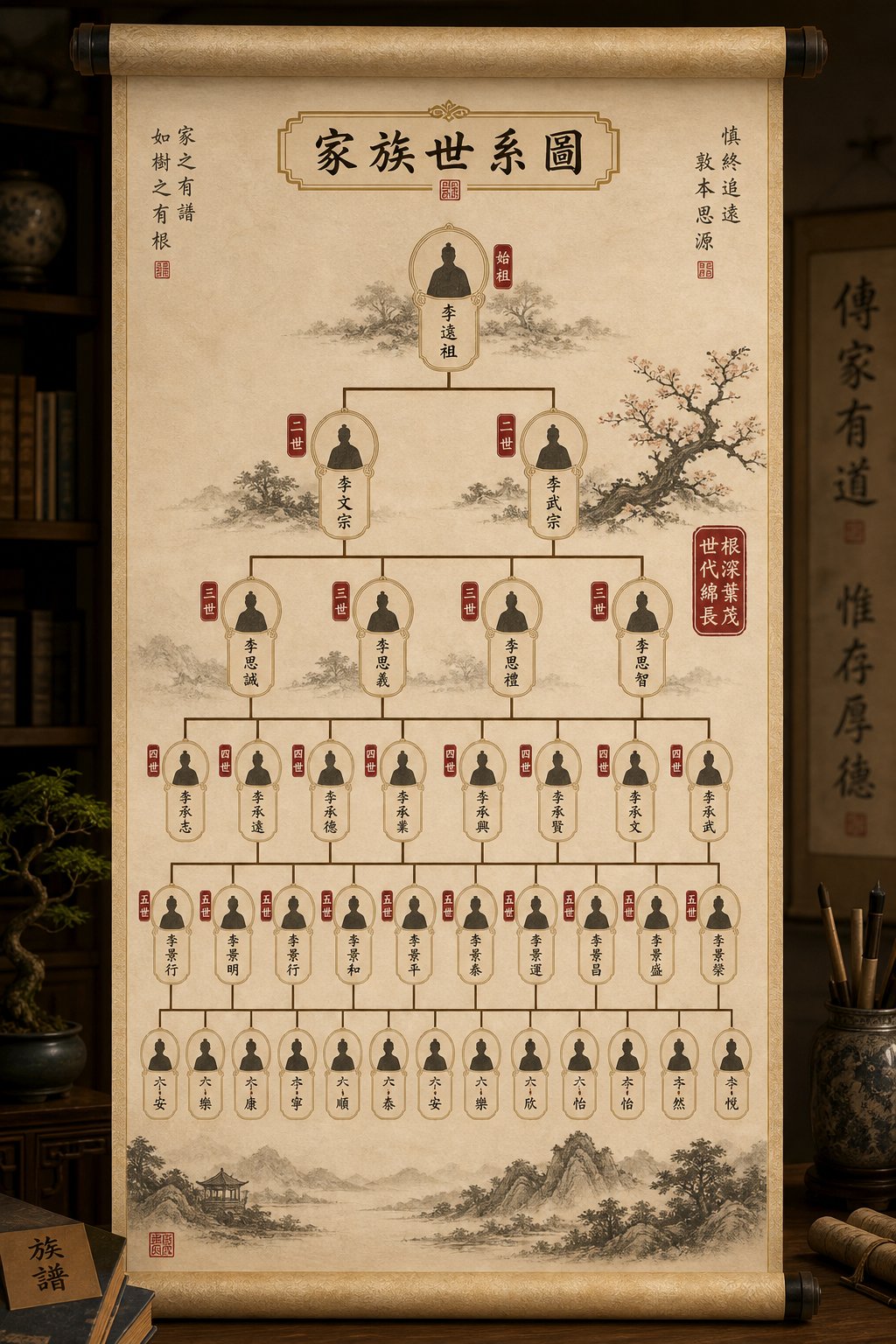
Chinese siblings don't just have different names. They have different roles, different expectations, and different emotional contracts, all encoded into the words themselves. The reason you can't simply say "sister" without specifying older or younger isn't a quirk of grammar. It's a direct reflection of Confucian family philosophy that has shaped Chinese society for over two thousand years.
Confucian Hierarchy in Sister Terms
Confucianism places family at the center of social order. Within that order, every relationship has a defined direction: parent over child, elder over younger, husband over wife. Siblings in Chinese culture are no exception. The term 兄弟姐妹 (xiongdi jiemei) means "siblings," but even this collective word preserves the hierarchy. It literally lists older brother, younger brother, older sister, younger sister, in descending order of seniority.
When you call someone 姐姐, you're not just identifying her as female and older. You're acknowledging a set of cultural expectations. She is supposed to look out for you, guide you, and in many families, sacrifice for you. When you call someone 妹妹, you're signaling that she is under your care, that you hold a degree of responsibility for her wellbeing. These aren't just nicknames. They're social contracts spoken aloud.
Here are the core principles that govern which nickname to use:
- Age always comes first. Before gender, before closeness, before anything else, you must establish who is older. The wrong direction is not a small mistake; it restructures the entire relationship dynamic.
- Seniority implies responsibility. An older sister (姐姐) is culturally expected to be protective, patient, and sometimes self-sacrificing toward younger siblings.
- Youth implies deference. A younger sister (妹妹) is expected to show respect and follow the lead of older siblings, even in adulthood.
- Family side matters. Paternal and maternal relatives use entirely different prefix characters, reflecting which branch of the family tree you belong to.
- Formality scales with distance. The more distant the relationship or the more public the setting, the more precise and formal the title must be.
Getting the age direction wrong in a Chinese sister nickname isn't like mispronouncing a name. It's like calling your boss by a junior title. The disrespect isn't in the sound but in the implied demotion of someone's place in the family order.
This system extends beyond sisters. The word for brother in Chinese follows the same logic: 哥哥 (gege) for older brother and 弟弟 (didi) for younger brother. No generic "brother" exists in daily speech either. The entire sibling vocabulary is built on the same hierarchical framework, making family in Mandarin one of the most structurally precise kinship systems in any language.
People searching for family in Chinese letters or chinese kanji for family often expect a single elegant character. The character 家 (jia) does mean "family" or "home," but it tells you nothing about who stands where within that family. The real complexity lives in the relational terms, and sister nicknames are a perfect example of how much meaning Chinese packs into a two-syllable word.
Paternal vs Maternal Cousin-Sister Nicknames
The hierarchy doesn't stop at immediate siblings. In extended Chinese families, a cousin in Chinese is never just "cousin." The system splits along two axes: which parent's side the cousin comes from, and whether she is older or younger than you. This produces four distinct cousin-sister terms, each functioning as a nickname within the family.
| Term | Pinyin | Meaning | Family Side | Age Relation |
|---|---|---|---|---|
| 堂姐 | tangjiě | Older female cousin | Paternal (father's brother's daughter) | Older than you |
| 堂妹 | tangmei | Younger female cousin | Paternal (father's brother's daughter) | Younger than you |
| 表姐 | biǎojiě | Older female cousin | Maternal (mother's side, or father's sister's daughter) | Older than you |
| 表妹 | biǎomei | Younger female cousin | Maternal (mother's side, or father's sister's daughter) | Younger than you |
The prefix 堂 (tang) originally referred to the main family hall, the ancestral space shared by the paternal clan. Cousins who are 堂 share your surname because they descend from your father's brothers. The prefix 表 (biǎo) means "outside" or "external," marking cousins who come from the maternal side or from your father's sisters, who married out of the family line.
In practice, these terms work exactly like 姐姐 and 妹妹 within extended families. At a Spring Festival dinner, you'd greet your father's older brother's daughter as 堂姐 and your mother's younger sister's daughter as 表妹. That's Mandarin notes that Chinese distinguishes cousins based on the parent's side, age, and gender, producing eight distinct cousin terms in total. Getting these right during family gatherings is considered a basic form of politeness.
For Chinese siblings and their extended networks, these cousin-sister nicknames aren't academic vocabulary. They're what you actually call people at the dinner table. A 堂姐 who is close to you might eventually just become 姐 in casual conversation, but the formal distinction remains important when introducing family members or navigating large gatherings where multiple cousins are present.
This layered system of hierarchy and precision is exactly what makes Chinese sister nicknames feel so different from English. Every term carries information about age, family branch, and social expectation. But within the privacy of home, families often soften these formal structures with affectionate pet names that break all the rules, turning rigid hierarchy into something warm and personal.
Affectionate Pet Names Chinese Families Actually Use
Formal kinship titles tell you where someone sits in the family tree. Pet names tell you how much they're loved. Inside Chinese households, the rigid hierarchy of 姐姐 and 妹妹 softens into something far more personal. These are the nicknames that never appear in textbooks but get used every single day, the ones that make a sister look up from her phone and smile.
Diminutives and Playful Pet Names
Chinese families have a toolkit of patterns for turning a standard sister title into something affectionate. You'll notice these strategies repeat across households, even though the specific nicknames end up unique to each family.
The most common approach is adding 小 (xiao, "little" or "small") before a name or title. A sister named 芳 (Fang) becomes 小芳 (Xiao Fang). This isn't about physical size. It's a diminutive that signals closeness and tenderness, the same way English speakers might say "little sis" to a sister who's taller than them. Parents use it for daughters well into adulthood. Siblings use it to keep the childhood feeling alive.
Then there's character doubling. Repeating a single character from a sister's name creates an instant pet name with a soft, childlike quality. If your sister's given name is 丽华 (Lihua), family members might call her 华华 (Huahua) or 丽丽 (Lili). This doubling pattern is deeply embedded in Chinese phonology. It's the same reason 妹妹 sounds warmer than 妹 and why babies are called 宝宝 (baobao) instead of just 宝 (bao). The repetition rounds out the sound and makes it feel gentler.
Treasure-based endearments add another layer. Terms like 宝贝姐 (baobei jie, "treasure older sister") or 宝贝妹 (baobei mei, "treasure younger sister") combine the universal Chinese endearment 宝贝 (baobei, "baby" or "treasure") with a sister title. Parents often use these when speaking to one daughter about another: "Go tell your 宝贝姐 that dinner is ready." It wraps the sibling relationship in explicit affection.
Some families go further with playful suffixes. Adding 仔 (zai, "little one") or 儿 (er, a diminutive suffix common in northern Mandarin) to a sister's name creates nicknames like 妹仔 (meizai) or 姐儿 (jie'er). These feel casual, warm, and distinctly familial. They're the kind of names that outsiders rarely hear because they only come out at home.
How Families Create Personal Sister Nicknames
Every Chinese family develops its own naming logic, but the patterns are remarkably consistent. Here are the most common methods for building affectionate sister nicknames:
- Take the second character of her given name and double it. A sister named 美玲 (Meiling) becomes 玲玲 (Lingling). A sister named 雪梅 (Xuemei) becomes 梅梅 (Meimei). This is the single most popular pattern in Chinese families.
- Add 小 (xiao) before her name or a character from her name. 小雪 (Xiao Xue), 小梅 (Xiao Mei), 小姐姐 (xiao jiejie). The prefix shrinks the formality instantly.
- Attach 宝 (bao, treasure) or 贝 (bei, precious) as a suffix. Her name plus 宝 creates something like 玲宝 (Ling Bao) or 梅宝 (Mei Bao). This pattern mirrors how couples create personalized pet names by adding suffixes like 宝 or 仔 to a partner's name.
- Use a childhood nickname that has nothing to do with her real name. Maybe she loved peaches as a toddler and became 桃子 (Taozi, "little peach"). Maybe she was round-cheeked and got called 圆圆 (Yuanyuan, "round-round"). These stick for decades.
- Play on homophones or near-homophones for wordplay. This is where the relationship between 美 (mei, beautiful) and 妹 (mei, younger sister) becomes relevant. The two characters share nearly identical pronunciation, differing only in tone: mei in Chinese carries a third tone (mei) for "beautiful" and a fourth tone (mei) for "younger sister." Families exploit this overlap constantly. Calling a younger sister 美美 (Meimei, "beautiful-beautiful") instead of 妹妹 (meimei, "younger sister") is a common piece of wordplay that flatters and endears at the same time.
The mei meaning in Chinese names often draws on this exact connection. Parents who name a daughter with the character 美 (mei, beautiful) are sometimes making a deliberate echo with 妹 (mei, sister). The meaning of the name Mei, whether written as 美, 梅 (plum blossom), or 玫 (rose), always carries positive feminine associations. When a family's younger sister happens to have 美 in her name, the wordplay writes itself. She becomes 美妹 (mei mei) in a double sense: beautiful sister. The mei meaning name connection runs deep in Chinese naming culture, where sound, character, and symbolism all intertwine.
What separates these pet names from the formal titles covered in most guides is their specificity. 姐姐 and 妹妹 are universal. Every family uses them. But 玲宝, 小桃子, or 美美 belong to one family and one sister. They carry shared memories, inside jokes, and years of accumulated affection. They're the names that make a sister feel like a sister rather than just a position in the family hierarchy.
The mei meaning chinese learners encounter in textbooks is usually limited to 美 (beautiful) or 没 (not have). But within families, mei becomes a playground for affection. A younger sister might be 小美 (Xiao Mei), 美宝 (Mei Bao), or simply 美儿 (Mei'er), each version carrying a slightly different shade of warmth depending on who's speaking and when.
These private nicknames rarely stay frozen in time, either. As sisters grow up, move away, and build their own lives, the names evolve. A childhood 小妹 might become an ironic 老妹 (lao mei, "old younger sis") between adult siblings. A doubled name like 华华 might get shortened back to a single character in text messages. The nicknames breathe and shift alongside the relationship itself, which is exactly what makes them feel alive rather than formulaic.
Of course, families aren't the only ones creating new sister terms. Chinese internet culture has taken these same patterns of doubling, shortening, and wordplay and accelerated them into viral slang that spreads across millions of users overnight.

Modern Internet Slang and Trending Sister Nicknames
Platforms like Weibo, Douyin, and Xiaohongshu move fast. A single livestream mispronunciation or a viral C-drama moment can mint a brand-new sister nickname overnight, one that millions of users adopt before any dictionary catches up. The result is a constantly shifting layer of slang built on top of the traditional terms, where saying chinese sister in the right internet-native way signals that you're plugged into the culture rather than reading from a textbook.
Social Media Slang for Sister
The biggest shift in recent years has been 小姐姐 (xiaojiějie). Literally "little older sister," this term originally described a young woman slightly older than the speaker. Online, it evolved into a general compliment for any attractive or stylish woman, regardless of actual age. Scroll through Douyin comments on a fashion video and you'll see 小姐姐好美 ("xiaojiějie, so beautiful") repeated hundreds of times. It's flattering without being creepy, friendly without being overly familiar. The term works precisely because it borrows the warmth of a family title and applies it to strangers.
Then there's 集美 (jimei). This one started as a viral mispronunciation of 姐妹 (jiěmei, "sisters") by a livestreamer whose accent turned the word into something new. The internet ran with it. Now 集美 functions as a casual, affectionate way to address female friends or followers online, roughly equivalent to "besties" or "girls" in English. It's playful, self-aware, and carries zero hierarchical weight, which is exactly why younger users prefer it over the more structured 姐妹.
Here are the trending internet sister nicknames you'll encounter most often, along with where they come from and what they actually mean now:
- 小姐姐 (xiaojiějie) — Originated on Douyin and Weibo. Shifted from "young lady" to a complimentary address for attractive women of any age. Now used across all platforms.
- 集美 (jimei) — Born from a livestream mispronunciation of 姐妹. Became slang for "bestie" or "girl friend" in group chats and comment sections.
- 姐姐们 (jiějie men) — Fan culture address meaning "sisters" (plural). Used by audiences and fan communities to collectively address female idols or content creators.
- 老姐 (laojiě) — Casual internet speak for "my sis." Common in text messages and social media posts where users talk about their actual older sisters in a relaxed, slightly humorous tone.
- 姐妹 (jiěmei) — The classic "sisters" used between close female friends online. Functions like "girl" or "sis" in English internet culture. No biological relationship implied.
- 美眉 (meimei) — A homophone play on 妹妹 using the characters for "beautiful eyebrows." Popular in earlier internet eras (early 2000s forums), now considered slightly dated but still recognized.
How C-Dramas and Fan Culture Shaped Sister Terms
Chinese entertainment has turbocharged the spread of sister in Mandarin slang. When a female idol appears on a variety show or drama, fans collectively call her 姐姐 as a term of admiration and closeness. The 2020 reality show "Sisters Who Make Waves" (乘风破浪的姐姐) turned this into a cultural moment, reframing 姐姐 as a badge of confidence for women over thirty. Suddenly the term carried connotations of power, independence, and self-assurance rather than just "older female relative."
Fan communities on Weibo now routinely address their favorite actresses as 姐姐们, creating a parasocial bond through kinship language. When viewers watch a C-drama and fall for the lead actress, calling her 姐姐 in the comments feels more intimate than using her actual name. It's a deliberate borrowing of family warmth to express fandom.
The meimei chinese pop culture presence extends beyond Mandarin-language media too. Western audiences searching for meimei anime often encounter the term through Japanese media that borrows Chinese naming conventions, while characters like Mei Mei in Kung Fu Panda introduced the sound to English-speaking viewers as a recognizable name. More recently, fans discussing Mei Mei in Apothecary Diaries have brought renewed attention to how the term functions as both a name and a title across East Asian storytelling traditions. These cross-cultural appearances reinforce how deeply the chinese mei mei concept resonates beyond China's borders.
Regional differences add another layer. In Mainland China, 小姐姐 is universally positive. In Taiwan, the preferred casual term for a chinese sister figure online leans more toward 姐 or 學姐 (xuejie, "senior schoolmate-sister"), and the tone is slightly less flirtatious. Hong Kong internet culture, shaped by Cantonese, uses 家姐 (gaa1 ze2) in local forums and mixes English loanwords like "sis" into Cantonese text. The same underlying impulse exists everywhere, using sister language to build connection, but the specific slang shifts depending on which platform and which region you're in.
What stays consistent across all these variations is the pattern: take a traditional family term, strip away its hierarchical weight, and repurpose it for warmth, humor, or admiration among strangers. Internet culture didn't invent new words so much as it bent old ones into new shapes. But these online terms still carry a Mandarin accent. Step outside the Mandarin-speaking internet and into regional dialect communities, and the sister vocabulary transforms into something almost unrecognizable.
Regional Dialect Variations Beyond Mandarin
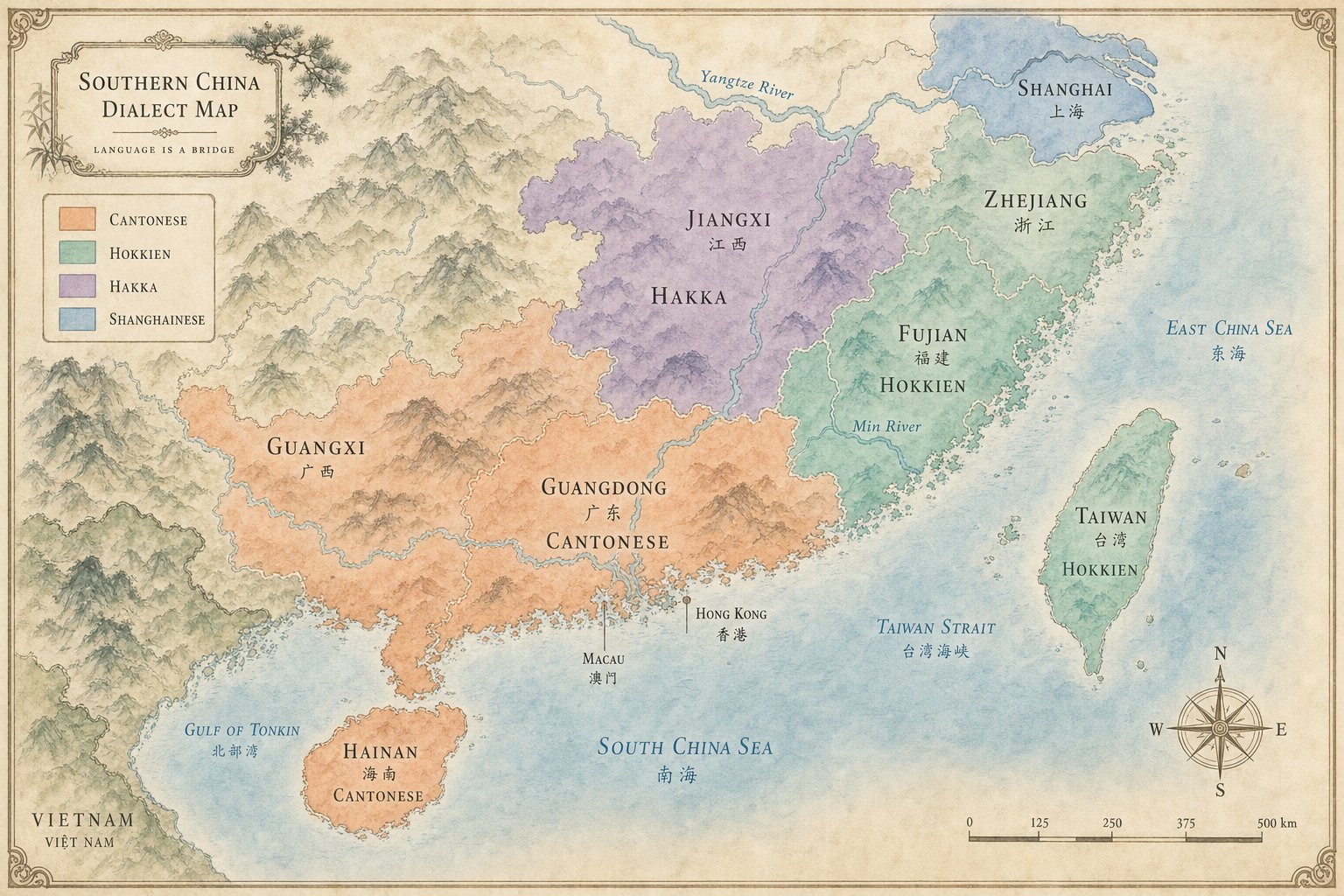
Mandarin is the lingua franca, but it's not what every Chinese family speaks at home. Cantonese, Hokkien, Shanghainese, and Hakka each carry their own sister vocabulary, and these aren't just pronunciation swaps. The preferred characters, the word structure, and even the logic of which term feels "default" shift dramatically from one dialect group to the next. If you're visiting family in Guangdong, watching a Hong Kong film without subtitles, or communicating with overseas Chinese communities in Southeast Asia, you'll need a completely different set of words.
Cantonese Sister Nicknames
Cantonese is where the differences hit hardest for Mandarin learners. The standard older sister in Chinese Cantonese isn't the expected 姐姐 in daily speech. It's 家姐 (gaa1 ze2), a term that literally combines "family" with "elder sister." You'll hear 姐姐 (ze2 ze2) in formal contexts or from young children, but among siblings and in casual conversation, 家姐 is the natural choice. It signals familiarity and everyday closeness in a way that the doubled form doesn't quite capture in Cantonese phonology.
For younger sister in Cantonese, the go-to casual term is 細妹 (sai3 mui6). The character 細 (sai3) means "small" or "thin" in Cantonese, functioning the same way 小 does in Mandarin but with a distinctly southern flavor. You'll also hear 妹妹 (mui6 mui6) in more formal or tender moments, like a parent addressing a young daughter. But between siblings at home, 細妹 carries the right weight of casual affection.
Imagine watching a TVB drama and hearing an older brother shout "細妹, 過嚟!" (sai3 mui6, gwo3 lai4 — "Little sis, come here!"). That's sister Cantonese in its most natural habitat. The sound is completely different from Mandarin's xiaomei, even though the underlying meaning overlaps.
Hokkien, Shanghainese, and Hakka Variations
Hokkien (Minnan), spoken across Fujian, Taiwan, and much of Southeast Asia's Chinese diaspora, uses its own character preferences. Older sister becomes 阿姊 (a-chí), where 姊 is an older literary character for "elder sister" that Mandarin speakers rarely encounter in daily life. Younger sister is 小妹 (sió-muē), phonetically distant from Mandarin's xiǎomèi despite sharing the same characters. The prefix 阿 (a) in Hokkien functions as a familiar address marker, softening whatever follows it into something warm and approachable.
Shanghainese (Wu dialect) takes yet another path. Older sister is commonly 阿姐 (a-jia in Shanghainese romanization), while younger sister appears as 妹妹 (me-me, with a distinctly flatter tonal contour than Mandarin). The Wu dialect's softer consonants and flowing tones give these terms a gentler sound that speakers often describe as more melodic than their Mandarin equivalents.
Hakka, spoken in pockets across Guangdong, Fujian, Taiwan, and diaspora communities worldwide, uses 阿姐 (a-ze) for older sister and 老妹 (lo-moi) for younger sister. That 老 prefix in Hakka doesn't carry the teasing edge it does in Mandarin's 老姐. It's simply the standard, neutral way to say "younger sister" in many Hakka-speaking households.
Here's how these terms compare side by side:
| Meaning | Mandarin | Cantonese (Jyutping) | Hokkien (POJ) | Hakka |
|---|---|---|---|---|
| Older sister (formal) | 姐姐 jiějie | 姐姐 ze2 ze2 | 阿姊 a-chí | 阿姐 a-ze |
| Older sister (casual) | 姐 jiě | 家姐 gaa1 ze2 | 阿姊 a-chí | 阿姐 a-ze |
| Younger sister (formal) | 妹妹 mèimei | 妹妹 mui6 mui6 | 小妹 sió-muē | 老妹 lo-moi |
| Younger sister (casual) | 小妹 xiǎomèi | 細妹 sai3 mui6 | 小妹 sió-muē | 老妹 lo-moi |
You'll notice that each dialect has its own romanization system: Jyutping for Cantonese, POJ (Pe̍h-ōe-jī) for Hokkien, and various systems for Hakka. This isn't just academic trivia. If you're trying to look up pronunciation guides or communicate with family members who speak these dialects, knowing which romanization system to search for saves real frustration.
When might you actually encounter these terms? If your partner's family speaks Cantonese at home, you'll hear 家姐 and 細妹 at every family dinner. If you're connecting with Hokkien-speaking relatives in Malaysia, Singapore, or the Philippines, 阿姊 is what the older cousins get called. Hakka communities in Taiwan and parts of Guangdong use 老妹 without a second thought. And anyone watching Hong Kong cinema or Cantonese-language YouTube will pick up 細妹 quickly from context alone.
These dialect terms aren't dying out, either. Younger generations in diaspora communities often mix dialect sister nicknames with Mandarin or English in the same sentence, creating hybrid forms that feel natural within their specific family culture. A Cantonese-American household might use 家姐 at home and switch to "jiejie" when speaking Mandarin with friends. The nickname adapts to the linguistic environment, but the underlying affection stays constant.
Dialect or Mandarin, formal or slang, the common thread across all these variations is that sister terms in Chinese never exist in isolation. They always imply a relationship, a context, and an audience. That relational quality is exactly what makes these nicknames so useful beyond biological family, extending into friendships, workplaces, and interactions with complete strangers.
Using Sister Nicknames Beyond Biological Family
Sister terms in Chinese don't stay inside the family. They spill outward into friendships, workplaces, and encounters with total strangers. If you've ever wondered how do you say sister in Chinese to someone who isn't actually your sister, the answer depends entirely on the relationship you're trying to build. The same words that define blood ties also function as social tools for creating warmth, showing respect, or signaling closeness with people you've never shared a dinner table with.
Sister Nicknames for Close Friends and Strangers
The term 姐妹 (jiěmèi) literally combines "older sister" and "younger sister" into a single word meaning "sisters." Between close female friends, it works exactly like "besties" or "girls" in English. A group chat full of college friends might be titled 姐妹群 (jiěmèi qún, "sisters group"). No one in that chat is biologically related. The word borrows family warmth and applies it to chosen bonds.
Addressing strangers follows a different logic. Calling an older woman 姐姐 on the street or in a shop is a politeness strategy that implies she looks young and approachable. It flatters without being excessive. A vendor at a market might call a female customer 姐姐 to build rapport, even if the customer is clearly younger. The term creates instant familiarity where none existed before.
In the workplace, 姐 gets appended to a colleague's surname as a respectful but friendly address. A coworker named 李 (Li) becomes 李姐 (Li jiě). This sits perfectly between overly formal titles and overly casual first names. It says: "I respect your seniority, but we're also on the same team." You'll hear this in offices across China every single day.
Fan culture takes it further. When audiences call a female performer 姐姐, they're creating a parasocial family bond. It's more intimate than using her stage name and more respectful than treating her like a peer. The sister in Chinese Mandarin vocabulary gives fans a ready-made framework for expressing admiration through kinship language.
Here's a quick guide to which term fits which scenario:
- Close female friends your age: 姐妹 (jiěmèi) — signals sisterly bond, no age hierarchy implied
- A female stranger slightly older than you: 姐姐 (jiějie) — polite, warm, mildly flattering
- A female colleague older than you: Surname + 姐 (e.g., 王姐 Wang jiě) — professional yet friendly
- A female idol or content creator: 姐姐 (jiějie) or 小姐姐 (xiǎojiějie) — admiration wrapped in family language
- A younger woman you want to be friendly with: 妹妹 (mèimei) or 小妹 (xiǎomèi) — protective, warm, implies you're looking out for her
- A group of female friends online: 姐妹们 (jiěmèi men) or 集美 (jíměi) — casual, inclusive, no hierarchy
As China Culture Corner notes, these terms create an emotional response because they carry the implied meaning of family closeness. Calling someone 妹妹 suggests she is young and attractive. Calling someone 姐姐 implies warmth and respect. The emotional weight of siblings in Mandarin vocabulary transfers directly into social interactions, making these terms powerful relationship-building tools.
A Guide for Non-Chinese Speakers Joining Chinese Families
Imagine you're meeting your Chinese partner's older sister for the first time. What do you call her? Or picture a mixed-culture household where the kids need to address their Chinese mother's siblings correctly. These situations come up constantly for non-Chinese speakers, and getting the term right makes a genuine impression.
The good news: Chinese families generally appreciate any effort to use the correct kinship terms. The key is matching the term to your actual relationship position. If your partner's sister is older than your partner, she's 姐姐 to your partner and likely expects you to use the same term or her surname plus 姐. If she's younger, she's 妹妹 to your partner, and you'd follow that lead.
For language learners who want to sound natural rather than textbook-stiff, the shift from full 姐姐 to casual 姐 signals growing comfort. Early on, use the full doubled form. As the relationship warms up and she tells you to relax, dropping to the single character shows you're paying attention to social cues.
A few practical pointers drawn from real cross-cultural experience:
- Start formal, then follow their lead. Use 姐姐 or 妹妹 until the family signals that something more casual is welcome.
- Pay attention to what your partner calls them. Mirror their usage. If your partner says 老姐, you're probably safe with 姐姐 or 姐 but not 老姐 yourself until you're much closer.
- Don't skip the term entirely. In English, you might just use a first name. In Chinese families, dropping the kinship title can feel cold or disrespectful, especially with older relatives.
- Ask if unsure. A simple "我应该怎么称呼她?" (Wǒ yīnggāi zěnme chēnghu tā? — "What should I call her?") shows respect and avoids awkwardness.
- For children in mixed households: Teaching kids the correct chinese symbol sister terms early, even just 姐姐 and 妹妹, helps them connect with Chinese-speaking relatives and signals cultural respect from the family.
The underlying principle is simple. These terms aren't just vocabulary. They're relationship markers. Using them correctly tells a Chinese family that you understand the structure, respect the hierarchy, and care enough to get it right. Using them warmly, with the right level of formality for your closeness, tells them you belong.
Of course, the flip side of all this nuance is that mistakes happen easily, especially around tones, age direction, and terms that sound similar but carry very different social weight. Knowing the most common errors in advance saves real embarrassment.

Common Mistakes to Avoid With Sister Nicknames
Knowing the right terms is half the battle. The other half is not accidentally saying something awkward, confusing, or outright offensive. Non-native speakers tend to make the same handful of errors with Chinese sister nicknames, and most of them are completely avoidable once you know what to watch for. Here's where learners trip up most often and how to correct course.
Tone Mistakes That Change the Meaning
Mandarin has four tones plus a neutral tone, and sister terms sit in a minefield of near-homophones. The most common tonal error? Pronouncing mèimei (fourth tone, 妹妹, younger sister) as méimei (second tone, 没没 or 梅梅). That second tone turns "younger sister" into nonsense or, at best, a completely different word. 没 (méi) means "not have" or "without." So instead of affectionately calling someone your little sister in Mandarin, you're producing a sound that means nothing familial at all.
When learning how to pronounce mei, focus on the sharp downward drop of the fourth tone. It should feel like you're giving a firm, decisive command. The second tone, by contrast, rises like a question. Mixing these up doesn't just sound wrong. It signals to native speakers that you haven't internalized the word yet.
The same issue hits 姐 (jiě, third tone). Flatten it into a first tone (jīe) or push it into a fourth tone (jiè) and you've lost the meaning entirely. The third tone dips down and then rises slightly, a shape that takes practice but becomes natural with repetition.
Age Direction Errors and How to Avoid Them
This is the mistake that carries real social weight. Calling someone older than you 妹妹 implies they look younger, which might sound like a compliment in English but in Chinese can feel like you're demoting their position. Conversely, calling someone younger 姐姐 when you're clearly older can create confusion about who holds seniority in the relationship.
The rule is straightforward: always confirm who is older before choosing a term. If you're unsure, 姐姐 is the safer default when addressing a woman whose age you can't determine. It errs on the side of respect. No one is offended by being called older sister, but being called younger sister when you're clearly senior stings.
Beyond age direction, learners also stumble on formality calibration and dangerous look-alike terms. Here's a quick-reference table covering the most frequent errors:
| Common Mistake | Correct Usage | Why It Matters |
|---|---|---|
| Using 妹妹 (mèimei) for someone older than you | Use 姐姐 (jiějie) for anyone older, regardless of how young they look | Implies you're placing them below you in hierarchy; can feel disrespectful |
| Pronouncing mèimei with a rising second tone (méimei) | Use a firm falling fourth tone: mèi (drops sharply downward) | Wrong tone produces a meaningless sound or a different word entirely |
| Using full 姐姐 in very casual settings with close family | Switch to single 姐 (jiě) once the relationship is comfortable | Over-formality can feel stiff or distant; close siblings rarely double the character |
| Saying 小姐 (xiǎojiě) thinking it means "young lady" | Use 小姐姐 (xiǎojiějie) for the complimentary internet meaning | 小姐 in Mainland China can imply a sex worker; the extra 姐 completely changes the connotation |
| Using 堂姐/堂妹 (paternal cousin) for maternal-side cousins | Use 表姐/表妹 (biǎojiě/biǎomèi) for mother's side or father's sister's children | Mixing these up confuses which family branch you're referencing; signals you don't understand the family structure |
| Writing 妹妹 when you mean to write how to write little sister in chinese formally | 妹妹 is correct for "little sister"; ensure stroke order is accurate for the 未 component inside 妹 | The character 妹 combines 女 (woman) + 未 (not yet); writing 末 instead of 未 produces a wrong character |
The 小姐 versus 小姐姐 distinction deserves extra emphasis. In Taiwan and in historical usage, 小姐 (xiǎojiě) is a perfectly polite way to address a young woman, equivalent to "Miss." In Mainland China, however, the term shifted to carry strong associations with prostitution during the 1990s and 2000s. Using it to address a stranger in a Mainland Chinese city can provoke anything from an awkward silence to genuine offense. The internet-born 小姐姐 sidesteps this entirely by adding the familial 姐 suffix, transforming the term into something warm and complimentary. One extra syllable makes all the difference.
For learners wondering how to say older sister in Chinese without making errors, the safest path is: confirm age first, use the full 姐姐 in new or formal situations, and only shorten to 姐 once the other person signals comfort. For how to say little sister in Chinese correctly, lock in that fourth tone on mèi and remember that 妹妹 is exclusively for someone younger than the speaker.
If you're practicing how to write sister in Chinese by hand, pay close attention to the right half of both 姐 and 妹. The character 姐 contains 且 (qiě) on the right side, while 妹 contains 未 (wèi). Swapping these components produces characters that don't exist or mean something unrelated. The left radical 女 (nǚ, woman) stays the same in both, which is the one consistent anchor.
Here's the encouraging truth: Chinese speakers are remarkably forgiving of tonal mistakes and minor usage errors from non-native speakers. The effort itself communicates respect. If you accidentally call your partner's older sister 妹妹, a quick correction and a laugh will smooth things over. If you stumble on the tone, most listeners will fill in the correct meaning from context. The goal isn't perfection. It's showing that you understand the system well enough to care about getting it right, even when you occasionally miss.
Frequently Asked Questions About Chinese Sister Nicknames
1. What is the difference between jiejie and meimei in Chinese?
Jiejie (姐姐) refers exclusively to an older sister, while meimei (妹妹) means younger sister. Chinese requires speakers to specify age hierarchy in every sibling reference. Using jiejie acknowledges someone's seniority and implies they hold a protective role, whereas meimei signals that the person is younger and under the care of older family members. You cannot use a generic word for sister without indicating this age relationship.
2. How do you address your partner's older sister in Chinese?
Start with the full form 姐姐 (jiejie) when meeting her for the first time. This shows respect and proper understanding of family hierarchy. As the relationship grows more comfortable and she signals informality, you can shorten it to 姐 (jie) or use her surname plus 姐, such as 王姐 (Wang jie). Mirror whatever term your partner uses as a guide, and avoid skipping the kinship title entirely, as using only a first name can feel disrespectful in Chinese family culture.
3. What does xiaojiejie mean on Chinese social media?
小姐姐 (xiaojiejie) literally translates to 'little older sister' but has evolved into an internet compliment for any attractive or stylish woman online. It originated on platforms like Douyin and Weibo and carries a warm, flattering tone without being overly familiar. It differs significantly from 小姐 (xiaojie), which can carry offensive connotations in Mainland China. The added 姐 suffix transforms the term into something positive and socially safe.
4. How do you say sister in Cantonese versus Mandarin?
Cantonese uses different terms from Mandarin for daily sister references. Older sister in casual Cantonese is 家姐 (gaa1 ze2) rather than the Mandarin 姐姐 (jiejie). Younger sister is 細妹 (sai3 mui6) instead of Mandarin's 妹妹 (meimei). While the doubled forms 姐姐 and 妹妹 exist in Cantonese for formal contexts, the dialect-specific terms are what families actually use at home and in everyday conversation.
5. Why can't you just say 'sister' in Chinese without specifying older or younger?
Chinese kinship language is built on Confucian hierarchy, which requires every family relationship to reflect age-based seniority. Calling someone jiejie acknowledges her authority and protective role, while meimei signals deference and being cared for. Omitting this distinction would erase the social expectations embedded in the relationship. The collective term 姐妹 (jiemei) exists for 'sisters' as a group, but when addressing or referring to a specific sister, the age direction is always required.