Understanding the Chinese Patrilineal Surname System
When you hear a Chinese name like Wang Lei or Li Na, the family name comes first. That single character at the front of every name carries a lineage stretching back thousands of years, passed down from father to child in an unbroken chain. This is the Chinese patrilineal surname system in action, and it governs how over 1.4 billion people identify themselves today.
What Is the Chinese Patrilineal Surname System
The Chinese patrilineal surname system is the practice of transmitting family names exclusively through the father's line, where children inherit their father's surname by default, forming one of the oldest continuous naming conventions in human history with over 4,000 years of documented use.
In practical terms, this means a surname in Chinese culture functions as far more than a label. It signals membership in a patrilineal descent group, connecting a person to ancestors, property rights, ritual obligations, and an entire network of kin. The system operates on a simple but powerful principle: family membership, along with all kinds of property and ritual duties, pass patrilineally from father to son. An important structural reinforcement of this principle is patrilocal residence, where a woman moves to her husband's family at the time of marriage, effectively transferring her primary affiliation to his lineage.
Chinese surnames have been remarkably well preserved through generations. Research using data from 1.28 billion Chinese citizens identified 7,184 distinct surnames still in active use, with the most common 100 surnames covering roughly 85% of the population. This concentration reflects millennia of patrilineal consolidation rather than coincidence.
Why Patrilineal Surnames Matter in Chinese Culture
Imagine a naming system so deeply embedded in social life that it determines where you live after marriage, which ancestors you honor, and how your relatives address one another. That is what the Chinese patrilineal surname system accomplishes. A surname in Chinese society is not simply inherited; it is an institutional marker that organizes kinship, property, and social hierarchy.
The ordering of Chinese names itself reflects this priority. The family name appears first, followed by the given name. In the name Wang Lei, Wang is the family name and Lei is the personal name. As naming convention research notes, this structure indicates that a person belongs to a lineage before being recognized as an individual. Chinese family names serve primarily to identify lineage rather than to distinguish individuals, which makes the given name particularly important for personal identification.
This article takes a different approach from broad overviews of Chinese names or Chinese surnames. Rather than cataloging naming customs, it examines the patrilineal surname system as an institution: how it emerged, how it functions mechanically, and how it has adapted under modern pressures. The system is not merely a cultural curiosity. It is a living framework that has shaped Chinese family structure, inheritance law, and social organization for longer than almost any comparable institution on earth.
The roots of that institution, however, tell a surprising story. The earliest Chinese last name characters contain linguistic evidence pointing not to fathers but to mothers, suggesting the system we know today was not always patrilineal at all.
From Matrilineal Clans to Patrilineal Dominance
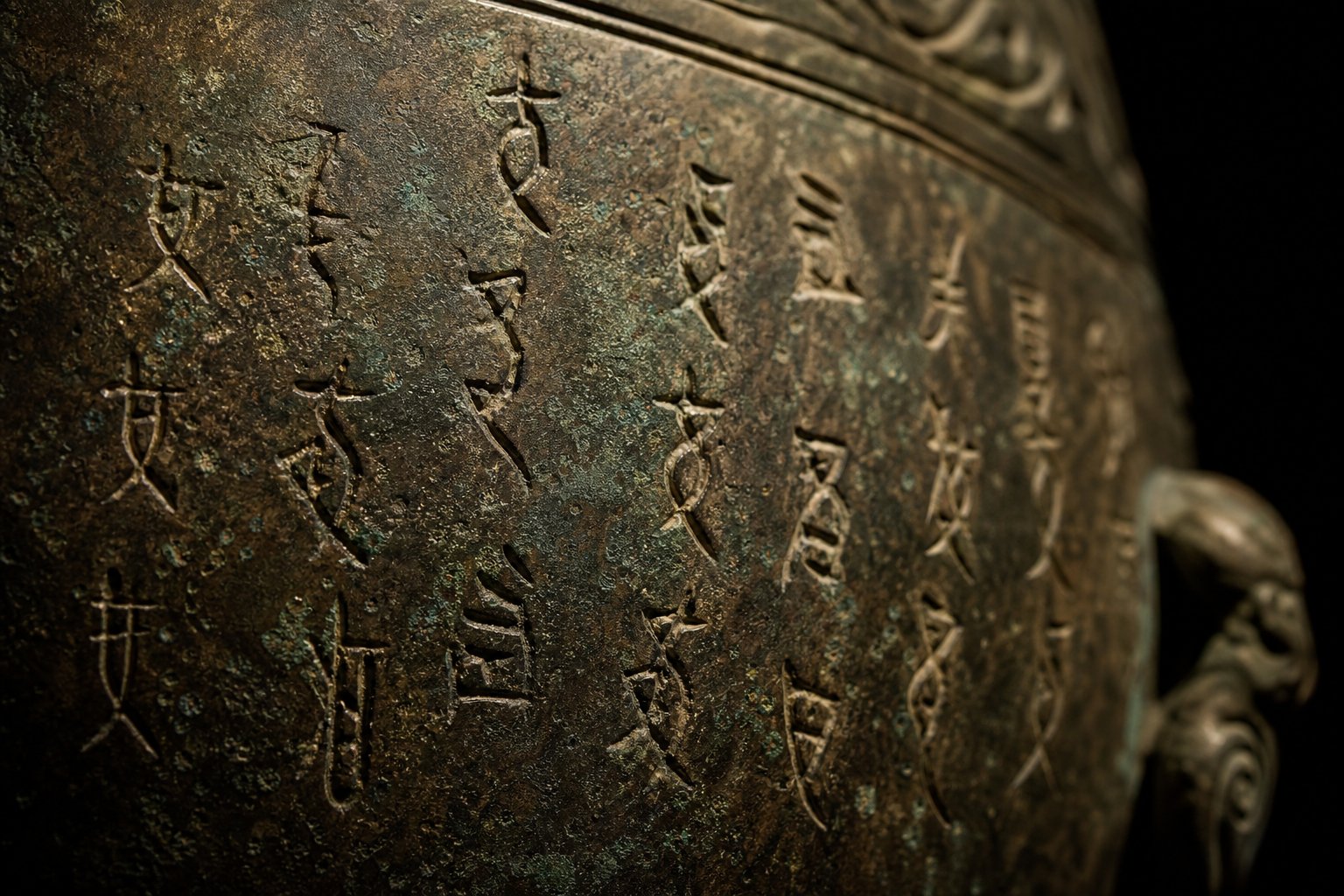
Look closely at some of the oldest ancient Chinese names still in use, and you will notice something unexpected. The characters themselves contain a hidden story about where surnames originate from, one that contradicts the patrilineal norm most people assume has always existed.
Matrilineal Evidence in Ancient Chinese Surnames
The Chinese word for surname, xing (姓), is itself a composite of two elements: 女 (woman) and 生 (birth). Literally interpreted, it means "born of a woman." This is not a coincidence. During the matrilineal clan period, identity and lineage passed through the mother. Children belonged to the mother's clan, and the earliest surnames functioned as markers of maternal bloodline to prevent intermarriage between people sharing the same ancestor.
The linguistic proof runs deeper than a single character. The ancient eight surnames, considered the foundational surnames of Chinese civilization, almost all contain the 女 (woman) radical:
- 姬 (Ji) - the royal surname of the Zhou dynasty
- 姜 (Jiang) - originating from the Yan Emperor Shennong, born by the Jiang River
- 姚 (Yao) - linked to Emperor Shun, named after Yao Mound where he was born
- 嬴 (Ying) - the surname of the Qin dynasty rulers, traced to Shao Hao
- 妫 (Gui) - sharing origins with Emperor Shun, named after the Gui River
- 姒 (Si) - the royal surname of the Xia dynasty, associated with Yu the Great
Each of these characters embeds the radical for "woman" directly into its structure. For an ancient Chinese family living in this period, clan membership was determined by who your mother was, not your father. This was the reality of family life in ancient China before roughly 1000 BCE.
How Patrilineal Dominance Emerged Across Dynasties
The shift did not happen overnight. It unfolded across centuries as political structures evolved and power consolidated around male-line inheritance. Here is how the transition played out:
- Shang Dynasty (c. 1600-1046 BCE): Matrilineal surnames (xing) still functioned as primary clan identifiers. The royal house carried the Zi (子) surname. Scattered settlements were beginning to coalesce into more rigid hierarchies, but maternal clan identity remained dominant in naming.
- Western Zhou Dynasty (c. 1046-771 BCE): The feudal system introduced a critical distinction. The Zhou kings enfeoffed their sons and loyal ministers with land, and these men adopted new lineage-branch names called shi (氏) based on their fiefdoms. The Ji surname alone produced 53 enfeoffed states, which later evolved into 411 modern surnames. Shi became a mark of aristocratic patrilineal identity, while the older xing faded into the background.
- Warring States Period (475-221 BCE): Social upheaval broke down rigid class barriers. As Taiwan Panorama reports, Confucius spread education without class distinctions, and ordinary people rose to become high officials. The old distinction between matrilineal xing and patrilineal shi began to collapse.
- Qin and Han Dynasties (221 BCE-220 CE): The Qin unification dismantled feudalism entirely. An imperial bureaucratic system replaced hereditary fiefdoms, and shi no longer indicated rank or power. The two terms, xing and shi, merged into a single concept: the patrilineal family name passed from father to child. The state of Qin also pioneered household registers recording family names, origin, and household members, institutionalizing surname transmission through official documentation.
- Tang Dynasty (618-907 CE): The codification reached its peak. Tang household registers required recording the names of the grandfather and great-grandfather of each household head, explicitly tracing patrilineal descent across generations. Registers were revised every three years, sealed, and archived in triplicate. The system made patrilineal surname continuity not just a cultural norm but an administrative requirement enforced by the state.
What drove this transformation? The answer lies in property and political control. As land became the primary source of wealth and power, inheritance systems favoring a single male line proved more efficient for concentrating resources. The Zhou feudal system rewarded loyalty through land grants tied to patrilineal succession. Once the state began registering households under the father's name, the cultural norm hardened into institutional fact.
Tracing your chinese roots through this history reveals a paradox: the very system that defined patrilineal identity for millennia grew out of a matrilineal world. The woman radical embedded in ancient surname characters is a fossil record of that earlier era, preserved in the script even as the social reality it represented was overwritten. Understanding these chinese roots helps explain why the patrilineal system carries such deep cultural weight. It was not simply inherited. It was actively constructed, dynasty by dynasty, through political decisions, administrative systems, and deliberate institutional design.
The mechanics of how that system actually operates within a family, however, involve far more than just passing down a single character. A complex architecture of kinship terms, generational poems, and residence rules reinforces patrilineal identity at every level of daily life.
How Patrilineal Surname Transmission Works
So the patrilineal system was built over centuries. But how does it actually function inside a family? How do Chinese names work on a day-to-day level to maintain an unbroken male-line identity across dozens of generations? The answer involves three interlocking mechanisms: a unified surname inherited from the father, generational poems that encode patrilineal descent into given names, and a kinship vocabulary that structurally separates paternal kin from maternal kin.
How Chinese Names Work Under Patrilineal Rules
In the modern system, every child receives the father's surname by default. This single character, placed at the front of the full name, signals which patrilineal descent group the child belongs to. The ancient distinction between xing (姓, the broad clan surname) and shi (氏, the lineage branch name) no longer applies in everyday life. As Panda Analysis explains, the Warring States period saw these two concepts gradually merge, and by the Western Han Dynasty the fusion was complete. Today, what people call their surname is the unified descendant of both terms: a single patrilineal marker passed from father to child.
A structural reinforcement of this naming rule is virilocal residence, the practice where a bride moves into her husband's household upon marriage. In Chinese, the phrase 嫁出去 (jia chuqu) literally means "to marry out," reflecting the idea that a woman leaves her natal family and joins her husband's lineage. Once she resides in his household, her children naturally carry his surname, grow up surrounded by his relatives, and participate in his family's ancestral rites. The residence pattern and the naming convention reinforce each other in a closed loop.
Beyond the surname itself, many families historically used generational poems, called zibei (字辈), to track patrilineal descent within given names. A generational poem is a sequence of characters, sometimes a dozen long, sometimes hundreds, composed by family elders when a new lineage branch was established. Each successive character in the poem becomes the generational marker shared by all males (and sometimes females) born into that generation. If your generation's character is "jun" (俊, meaning talented), then every patrilineal cousin in your generation carries that same character in their given name. When the poem's last character is reached, it can be repeated or extended by the clan association. Families sharing a common generational poem are considered to share a common ancestor and typically originated from the same geographical location.
Imagine a family reunion where you can determine exactly how everyone is related just by looking at one character in their name. That is what zibei accomplishes. It makes patrilineal descent visible and legible across generations without needing to consult a genealogy book.
Kinship Terms That Reinforce Patrilineal Identity
The Chinese kinship system goes further than naming. It encodes patrilineal priority directly into the language people use every day to address their relatives. In English, you call your mother's mother and your father's mother by the same word: "grandmother." In Chinese, these are entirely different terms, and the distinction is not neutral.
Consider how kin in Chinese are classified. Your father's mother is 奶奶 (nainai), a term that signals belonging to the inner, patrilineal family. Your mother's mother is 外婆 (waipo), where the character 外 (wai) literally means "outside." The same pattern applies across the entire kinship vocabulary. As CLI notes, this use of 外 highlights the idea that maternal relatives belong to the family only through marriage rather than through the core patrilineal line.
The asymmetry extends to cousins, uncles, and aunts. Here is a comparison of key Chinese kinship terms showing how the language structurally separates paternal from maternal relatives:
| Relationship | Paternal Side (Inner) | Maternal Side (Outer) |
|---|---|---|
| Grandmother | 奶奶 (nainai) | 外婆 (waipo) |
| Grandfather | 爷爷 (yeye) | 外公 (waigong) |
| Uncle (older) | 伯伯 (bobo) - father's older brother | 舅舅 (jiujiu) - mother's brother |
| Uncle (younger) | 叔叔 (shushu) - father's younger brother | 舅舅 (jiujiu) - mother's brother |
| Aunt (by blood) | 姑姑 (gugu) - father's sister | 姨妈/阿姨 (yima/ayi) - mother's sister |
| Male cousin | 堂兄/堂弟 (tangxiong/tangdi) | 表哥/表弟 (biaoge/biaodi) |
| Female cousin | 堂姐/堂妹 (tangjie/tangmei) | 表姐/表妹 (biaojie/biaomei) |
| Nephew (brother's son) | 侄子 (zhizi) | 外甥 (waisheng) - sister's son |
You'll notice a clear pattern. Paternal-side cousins use the prefix 堂 (tang, meaning "hall," referencing the ancestral hall), while maternal-side cousins use 表 (biao, meaning "outside" or "surface"). A sister's son is 外甥 (waisheng), again marked with 外 for "outside." The entire Chinese kinship system is built around a single organizing principle: who belongs to the patriline and who does not.
This is not merely linguistic trivia. These kinship terms shape how people think about obligation, inheritance, and closeness. When every word you use to describe kin in Chinese reinforces the distinction between inner patrilineal family and outer maternal connections, the patrilineal surname system is not just a naming rule. It becomes a cognitive framework embedded in daily speech.
The combined effect of surname inheritance, generational poems, virilocal residence, and asymmetric kinship terminology creates a self-reinforcing system. Each element points in the same direction: identity flows through the father's line. But which specific surnames have dominated this system, and how did certain patrilineal lines grow to encompass tens of millions of people while others remained rare? The answer lies in the historical forces that made some surnames expand and others contract.
Common Chinese Surnames and Their Meanings
A handful of surnames dominate the Chinese population so thoroughly that just three of them, Li, Wang, and Zhang, account for close to 300 million people. That concentration is not random. It reflects centuries of patrilineal expansion, where certain lineages grew through imperial favor, territorial control, and sheer demographic momentum while others shrank or disappeared entirely. Understanding chinese last names and meanings requires looking at the specific historical forces behind each one.
Most Common Chinese Surnames and Their Patrilineal Origins
The most common chinese surnames today trace their dominance to distinct origin stories. Some descend from royal houses whose patrilineal lines branched across entire regions. Others grew because commoners adopted the name of their state after its fall, creating massive surname populations overnight. Here are the five most common chinese last names and how they reached their current scale:
| Surname | Character Meaning | Approximate Population | Patrilineal Origin |
|---|---|---|---|
| Wang (王) | King, ruler | ~93 million | Descendants of Zhou dynasty royal lineages; princes whose patrilineal lines lost power but retained the title-derived surname |
| Li (李) | Plum tree | ~92 million | Imperial surname of the Tang dynasty; emperors granted the Li surname to loyal subjects, massively expanding the patriline |
| Zhang (张) | To draw a bow; to open up | ~88 million | Traced to Huangdi's grandson Hui, who invented the bow; descendants took Zhang as their lineage name from the ancestral occupation |
| Liu (刘) | To kill; a type of weapon | ~72 million | Imperial surname of the Han dynasty (400+ years); patrilineal expansion through royal grants and branch lineages across the empire |
| Chen (陈) | To arrange; to display; old | ~63 million | Named after the state of Chen, a Zhou dynasty fiefdom; commoners adopted the state name as their patrilineal surname after its fall |
You'll notice a pattern. The most common chinese last names cluster around two origin types: imperial clan surnames and state-derived surnames. Wang literally means "king" because its bearers descend from royal patrilines. The chen surname traces to an entire state population adopting a single patrilineal identity. When the Tang emperors granted the Li surname to generals, officials, and even foreign allies as a political reward, they were artificially expanding their own patriline, turning unrelated people into nominal kin.
This distinction between imperial and commoner surnames matters. Imperial clan surnames like Li and Liu grew through deliberate political action: emperors extending their patrilineal identity as a tool of governance. State-derived surnames like Chen, Song (宋), and Wu (吴) grew because entire populations of commoners adopted their fallen state's name as a marker of national and ethnic identity. Both mechanisms produced massive surname populations, but through fundamentally different patrilineal dynamics.
Regional distribution reinforces these historical patterns. In northern China, Wang dominates at 9.9 percent of the population. In the south, the chen surname is most common at 10.6 percent. These geographic concentrations reflect where specific patrilineal lines originally took root and expanded over centuries of localized reproduction.
The Baijiaxing as a Tool of Patrilineal Culture
How did ordinary people learn and internalize this system? One answer is the Baijiaxing (百家姓), or Hundred Family Surnames, a Song Dynasty text composed around 960 CE. Containing 504 surnames arranged in 564 characters, it was structured as a rhyming poem designed for memorization. For centuries, it served as one of the first texts children encountered in their education, alongside the Thousand Character Classic and the Three Character Classic.
The Baijiaxing was not a neutral reference. Its opening line, "Zhao, Qian, Sun, Li" (赵钱孙李), placed the Song imperial surname Zhao first, a deliberate assertion of political hierarchy through patrilineal identity. Every child who memorized this poem absorbed a message: surnames have rank, lineages have status, and patrilineal identity is worth cataloging and preserving.
The text's cultural impact went beyond education. The colloquial expression laobaixing (老百姓), meaning "old hundred surnames," became the standard Chinese term for ordinary people or commoners. When Chinese speakers say laobaixing, they are unconsciously referencing a patrilineal framework: the people are defined by their surnames, and their surnames define their place in a patrilineal order. The Baijiaxing transformed chinese surnames and meanings from private family knowledge into shared cultural infrastructure, giving every literate person a mental map of the patrilineal landscape.
Yet cataloging surnames in a poem is only one layer of the institutional machinery that kept patrilineal lines intact. Behind the names themselves stood physical infrastructure: ancestral halls where lineage members gathered, genealogy books that recorded every male-line descendant, and entire villages where every resident shared a single patrilineal ancestor.
Institutions That Preserved Patrilineal Surnames
A surname alone cannot hold a lineage together across forty or fifty generations. It needs physical spaces where descendants gather, written records that document every male-line birth, and shared property that gives members a material stake in the group's survival. The Chinese patrilineal surname system endured not because of cultural inertia but because an entire institutional ecosystem was built to sustain it.
These institutions operated as interlocking parts of a single machine. Each reinforced the others, creating redundancy that allowed patrilineal identity to survive wars, famines, migrations, and political upheaval. Here are the key components:
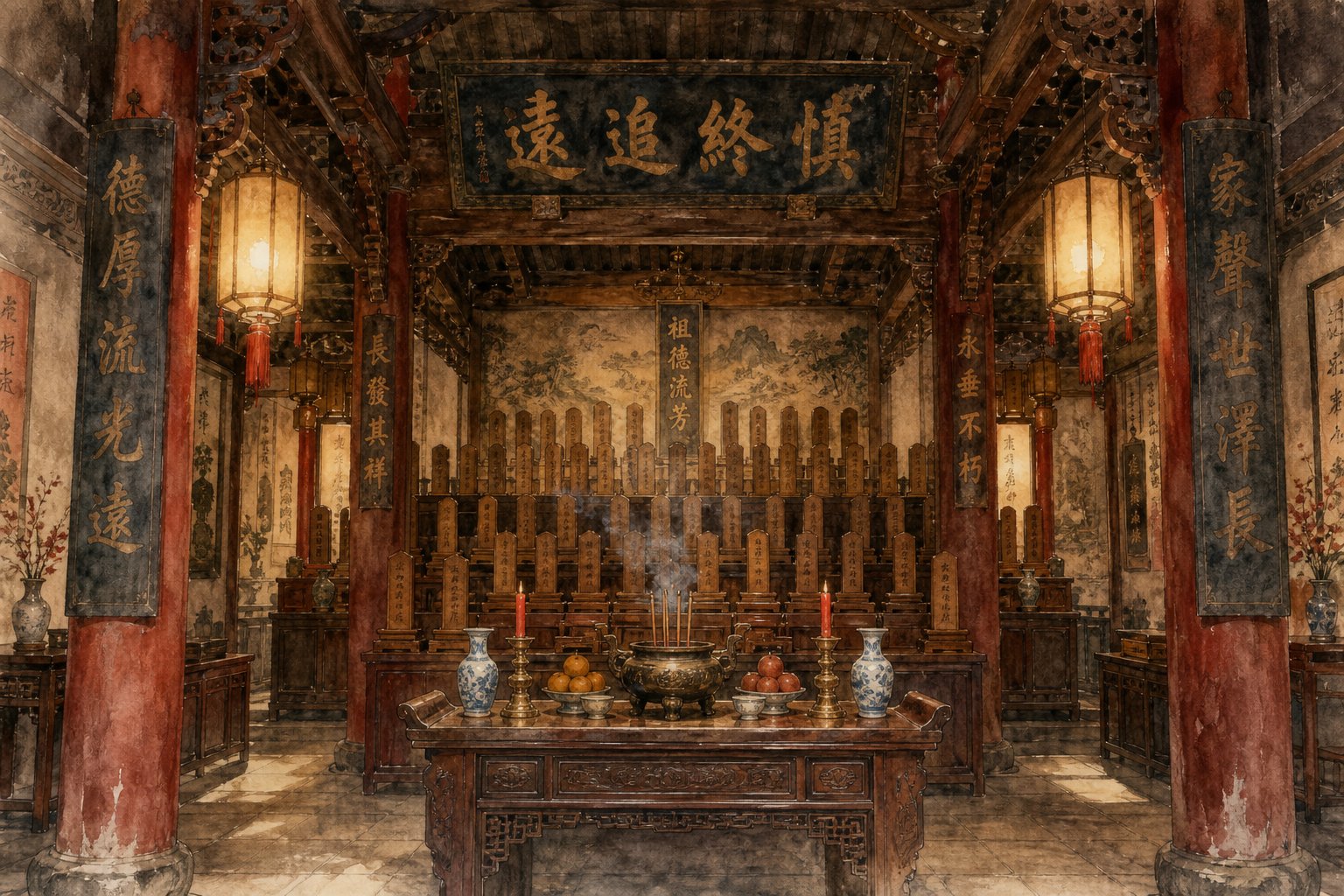
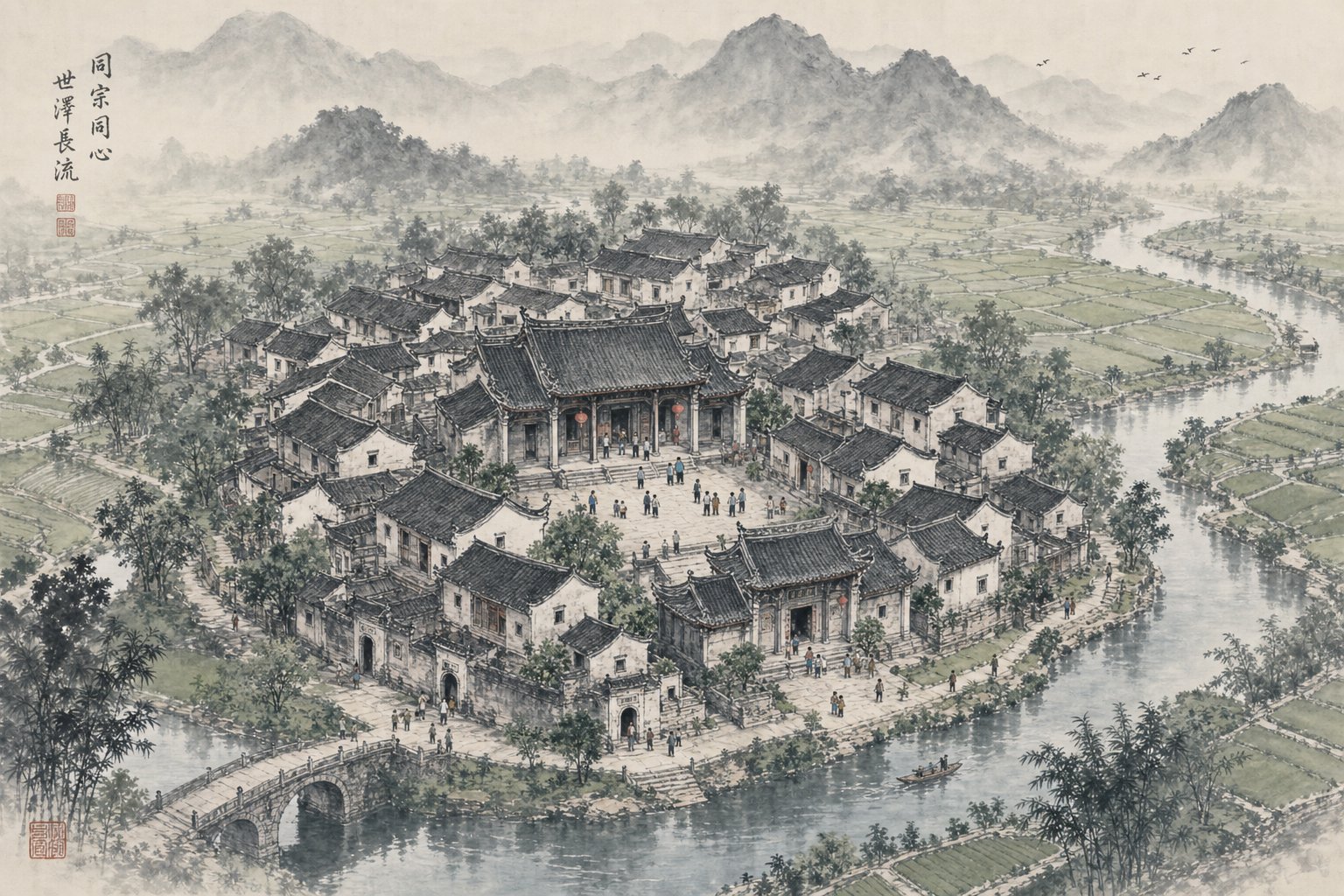
- Ancestral halls (祠堂, citang): Purpose-built structures where lineage members gathered to worship ancestors in chinese tradition through collective rites. They housed spirit tablets, ancestral portraits, and genealogical records, serving as both sacred space and administrative headquarters for the lineage.
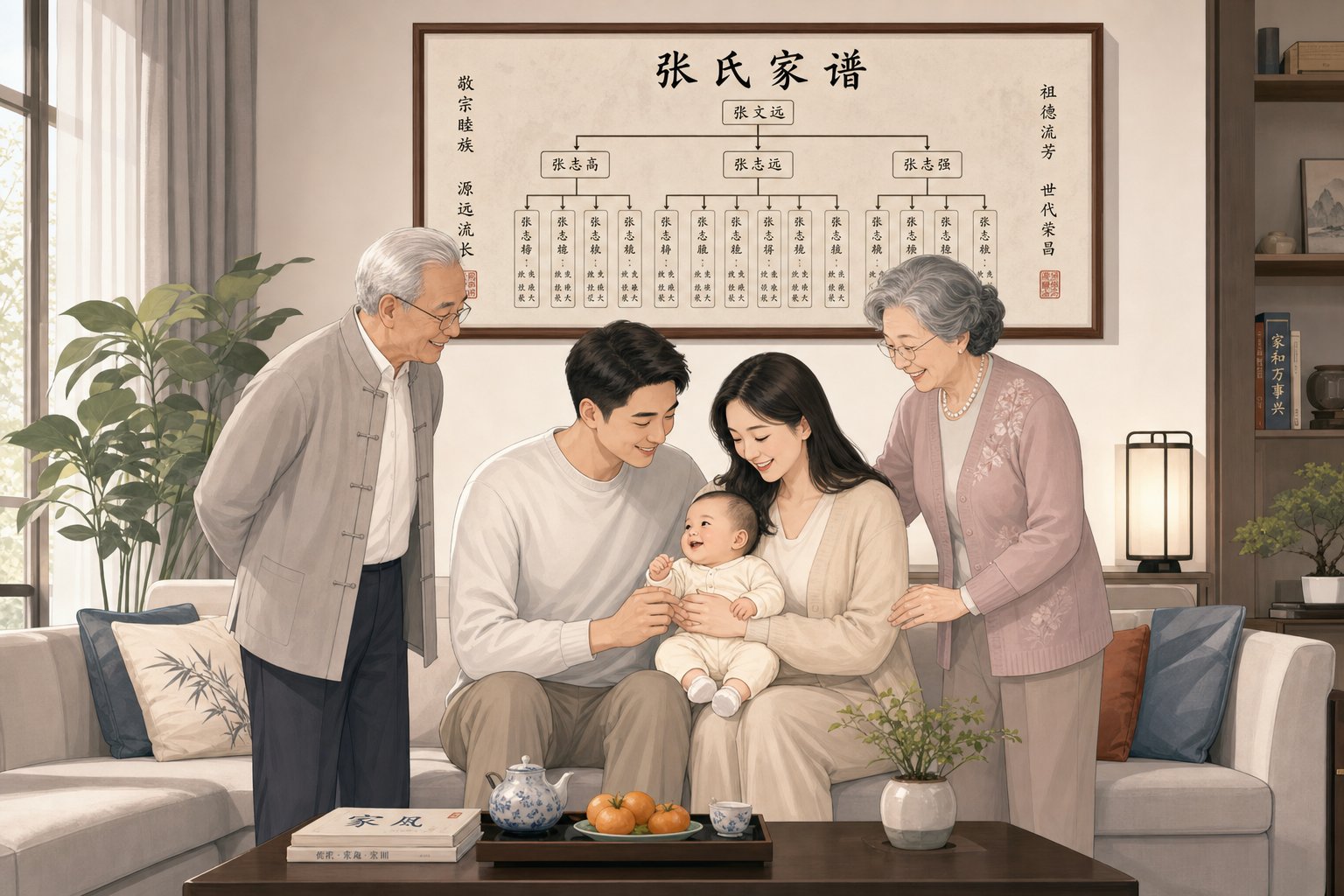
- Genealogy books (族谱, zupu): Written registers documenting every male-line descendant from the founding ancestor forward. These records tracked births, deaths, marriages, official titles, and burial locations across generations.
- Lineage trusts (族产, zuchan): Communal property holdings, often farmland or rental properties, managed collectively by the lineage. Income funded ancestral rites, maintained the hall, supported lineage schools, and provided welfare for poorer members.
- Ancestral rites (祭祀, jisi): Sacrificial ceremonies performed exclusively through the male line, where offerings of food and wine were presented to ancestors and blessings distributed according to seniority.
- Surname villages (单姓村, danxingcun): Single-surname settlements where all residents traced descent from a common patrilineal ancestor, physically embodying the lineage as a geographic community.
Ancestral Halls and Lineage Trusts
The ancestral hall was the physical heart of any china clan organization. Popularized during the Ming and Qing dynasties after the Song-era Confucian scholar Zhu Xi proposed in his Family Rituals that commoners should have dedicated spaces to venerate their ancestors, these halls spread rapidly across southern China. Research on Fujian Province documents that "a lineage often boasts dozens of ancestral halls, or even in a village, many ancestral halls are looking at each other, and the grand ancestral ritual honor more than 21 generations of ancestors."
What happened inside these halls? They functioned as communication channels between the living and the dead. Spirit tablets inscribed with ancestors' names lined the rear wall. Portraits hung on display. Plaques beneath the eaves recorded scholarly achievements and official titles earned by lineage members across centuries. As one villager in Fujian described during fieldwork interviews: "The ancestral hall is a sacred space. Upon crossing its threshold, I am confronted with the spirit tablets and portraits of ancestors, which makes me feel their palpable presence."
The lineage head (族长, zuzhang), typically the eldest main-line son or a respected elder chosen by the community, presided over rituals and managed hall affairs. His authority derived directly from his position within the patriline. During ceremonies, he acted as intermediary between living descendants and deceased ancestors, reciting eulogies, distributing blessings, and enforcing lineage rules. This role made the patrilineal hierarchy tangible: power flowed through the male line, and the hall was where that power was exercised.
Lineage trusts provided the economic foundation. Communal landholdings generated rental income that funded everything from hall maintenance to scholarships for promising young men preparing for imperial examinations. As scholars have noted, a lineage functioned as a corporation in the sense that members derived benefits from jointly owned property and shared resources. Surplus income from ancestral shrines was reinvested by managers or shared out in yearly dividends. This gave every member a financial incentive to maintain their patrilineal affiliation. Walking away from your surname meant walking away from material support.
Zupu Genealogy Books and Surname Villages
If the ancestral hall was the lineage's body, the zupu was its memory. These genealogy books constitute the major source material for anyone researching chinese genealogy today. FamilySearch notes that a researcher who can connect into a lineage genealogy can often determine their pedigree quickly and accurately back to the 1600s and, typically, much further.
How are zupu records structured? A typical genealogy in chinese lineage tradition contains several standard sections:
- Origin narrative: The story of the founding ancestor, how the surname originated, and the migration path that brought the lineage to its current location.
- Generation charts (世系图): Linked patrilineal tables showing every male descendant from the founder forward. The firstborn son and his descendants appear on the right, with younger brothers listed laterally to the left.
- Biographical entries: Individual records including personal names, style names, birth and death dates, burial locations, official appointments, examination degrees, wife's surname and her father's name, and sons listed by birth order.
- Lineage rules (族规): Behavioral codes governing everything from marriage prohibitions to property disputes, enforced by the lineage head within the ancestral hall.
- Generational poems (字辈): The character sequences used to mark each generation in given names, ensuring patrilineal descent remains visible.
The detail recorded for each individual could be remarkably comprehensive. Standard entries might include up to seventeen categories of information: personal names, relationship to father, education and government service, exact birth and death dates down to the hour, burial location, wife's surname and native place, sons sired by birth order, and even daughters' husbands identified by village and personal name. Women's records were typically briefer, reflecting the patrilineal focus, though their presence was noted to document marriage alliances between lineages.
Most surviving zupu date from the Qing dynasty (1644 onward), though some trace origins to before the Song dynasty. Existing published and manuscript genealogies may cover as much as 25 percent of the historical population since the 1600s. That figure would approach 60 percent if more had survived the Cultural Revolution, when many genealogies stored in ancestral halls were destroyed. Those that remain are scattered across libraries in mainland China, Taiwan, Hong Kong, Japan, and the United States, with the Shanghai Library, Peking University, Cornell University, and Toyo Bunko holding major collections.
Surname villages brought all these institutions together in one place. In these single-surname settlements, particularly common in southern China, every resident shared a patrilineal ancestor. The ancestral hall stood at the village center. The zupu recorded every household. Communal land surrounded the settlement. Chinese clans in these villages were not abstract kinship categories but lived realities: your neighbors were your patrilineal cousins, your landlord was your lineage trust, and your local school was funded by ancestors in chinese tradition whose tablets watched from the rear wall of the hall.
Kinship structures in these concentrated settlements tended to be especially strong, reinforced by ties to the ancestral village, common property, and often a shared spoken dialect unintelligible to outsiders. In northern China, where chinese ancestors were more likely to be dispersed across multiple villages, clan structures were correspondingly weaker, with members who did not usually share property or reside together.
For modern researchers, these institutions offer a practical pathway into genealogy in chinese family history. A zupu, if located, can compress years of research into days. An ancestral hall, if still standing, may contain inscriptions, plaques, and tablets that confirm lineage connections. And surname villages, many of which still exist, can provide living oral traditions that supplement written records.
These institutions preserved patrilineal identity with remarkable consistency across the Han Chinese majority. But the same surname, transmitted faithfully through the male line, could sound completely different depending on which dialect community carried it. A single patrilineal lineage might be recorded as Chen, Chan, Tan, or Chin, depending on where its branches settled and which romanization system local authorities adopted.
Regional Dialect Variations in Patrilineal Surnames
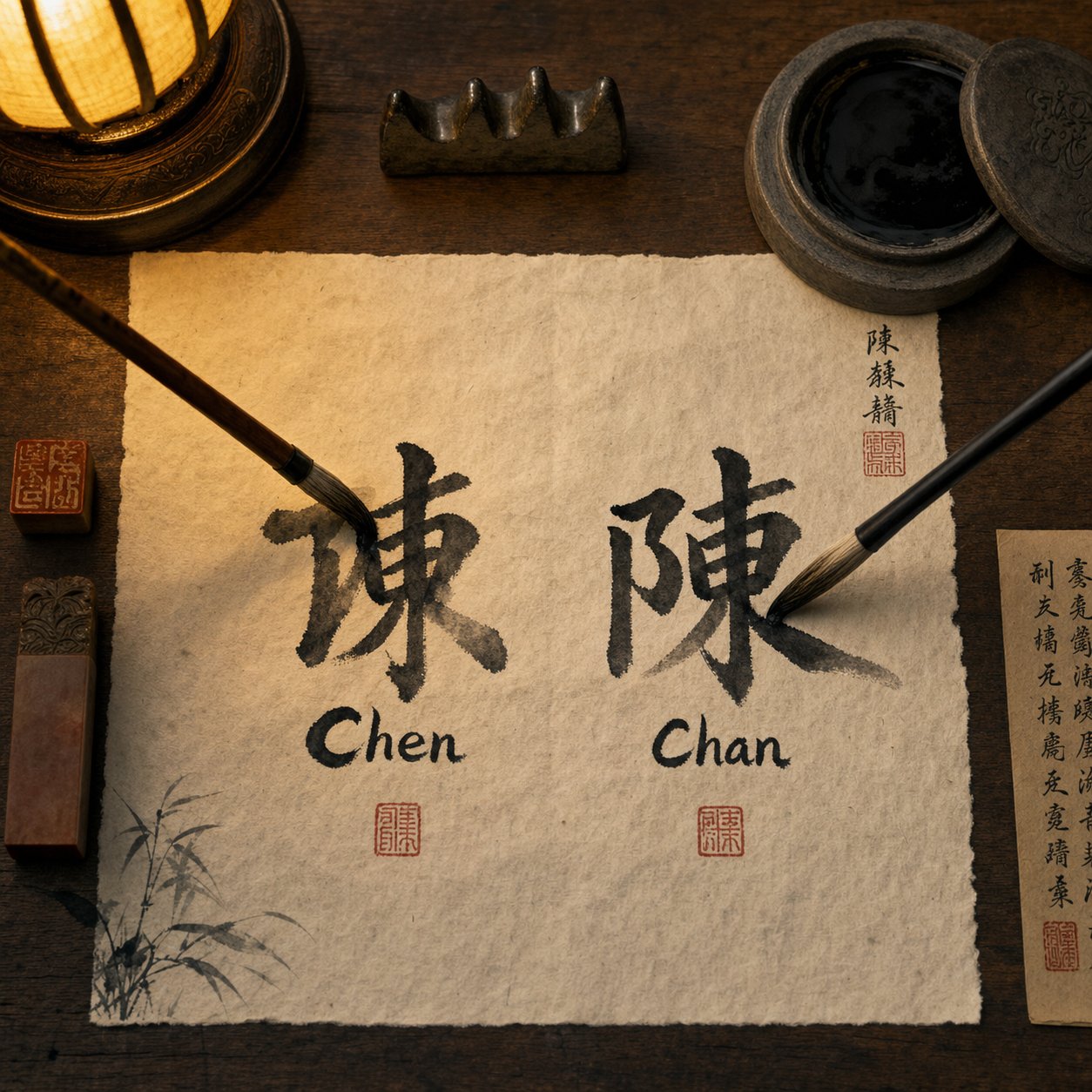
Picture two people named Chan and Tan meeting at a conference in Singapore. Their surnames look nothing alike in English. Yet both descend from the same patrilineal lineage, the ancient state of Chen, and both carry the identical character 陈 (陳 in traditional script) on their identity documents. The difference is purely phonetic: one family passed through Cantonese-speaking Guangdong, the other through Hokkien-speaking Fujian. The patrilineal thread is unbroken. Only the sound changed.
One Surname Many Romanizations Across Dialects
Chinese is not a single spoken language. Mandarin, Cantonese, Hokkien, Teochew, and Hakka each pronounce the same written characters differently, sometimes radically so. When these dialect communities emigrated or when colonial and national governments imposed romanization systems, a single patrilineal surname fractured into multiple English spellings. The chen last name origin traces to the Zhou-era state of Chen in modern Henan, but its descendants now appear in phone books as Chen, Chan, Tan, Chin, or Ding depending on dialect and location.
The same fragmentation applies across all major surnames. As the Asia Media Centre explains, in territories with a sizeable Chinese diaspora such as Singapore and Malaysia, the way a family name is spelled functions as a signifier of the region a person's ancestors come from. A person surnamed Wong is understood to have Cantonese heritage, likely tracing ancestral relations to Guangdong province or Hong Kong. The wong last name origin is the character 王 (king), identical to Mandarin Wang, but the Cantonese pronunciation immediately signals a southern patrilineal line.
Here is how several major surnames appear across the four main dialect groups:
| Character | Mandarin | Cantonese | Hokkien/Teochew | Hakka |
|---|---|---|---|---|
| 陈 (陳) | Chen | Chan | Tan | Chin |
| 王 | Wang | Wong | Ong / Heng | Wong |
| 李 | Li | Lee / Lei | Lee | Lee / Lei |
| 张 (張) | Zhang | Cheung / Cheong | Teo / Teoh | Chong |
| 刘 (劉) | Liu | Lau | Low / Lau | Liew / Lew |
| 林 | Lin | Lam | Lim | Lim |
| 黄 | Huang | Wong | Ng / Ooi | Vong |
Every row in this table represents a single patrilineal lineage. The character is the same, the ancestor is the same, and the male-line transmission is the same. Only the romanization differs. This is why the chan last name origin and the chen last name origin are not two separate stories but one story told in two dialects.
Taiwanese and Cantonese Surname Conventions
Taiwan and Hong Kong illustrate how regional systems developed their own romanization standards while preserving patrilineal continuity underneath. In Hong Kong, cantonese surnames follow a Cantonese romanization system distinct from mainland Mandarin Pinyin. The most common cantonese last names in Hong Kong are Chan (陳), Leung (梁), Cheung (張), Lau (劉), and Li (李). These spellings reflect Cantonese pronunciation and have become fixed through generations of official documentation, identity cards, and birth certificates.
Taiwanese last names use a different romanization system again. While the characters remain identical to those used on the mainland, taiwan last names historically followed Wade-Giles romanization rather than Hanyu Pinyin. Chen is the most common of all taiwanese surnames, covering 11.14 percent of Taiwan's population. Other common taiwanese last names include Lin, Huang, Zhang (often spelled Chang in Wade-Giles), and Li. The patrilineal inheritance rule operates identically regardless of which romanization system is used. Children still receive the father's surname by default.
For diaspora communities in Southeast Asia, North America, and Oceania, the romanized spelling became permanently fixed at the moment of immigration. A Hokkien-speaking family that emigrated to Malaysia in the 1800s carries the surname Tan today, even if younger generations now speak Mandarin or English. The spelling fossilized at the point of departure, preserving a phonetic snapshot of the ancestor's dialect. This means that cantonese surnames in Vancouver, Hokkien surnames in Penang, and Hakka surnames in Mauritius all function as geographic markers of patrilineal migration routes.
The underlying logic never changed. Regardless of whether the name is written as Chen, Chan, or Tan, it passes from father to child, it connects the bearer to a specific patrilineal ancestor, and it carries obligations to that lineage. Dialect variation is a surface phenomenon. The patrilineal structure beneath it remained remarkably rigid for centuries. Only in exceptional circumstances, through specific institutional mechanisms, could that structure be bent or broken.
Exceptions and Edge Cases in Patrilineal Naming
Every rule reveals its strength through its exceptions. The patrilineal system dominated Chinese naming for millennia, but it was never absolute. Specific mechanisms existed to bend, bypass, or even weaponize surname transmission when circumstances demanded it. These edge cases are not footnotes. They illuminate exactly how much cultural weight the patrilineal norm carried, because each exception required formal justification, negotiation, or coercion to override it.
Here are the primary ways the patrilineal rule was historically modified:
- Uxorilocal marriage (入赘, ruzhui): A man marries into his wife's family, moves into her household, and their children take the maternal surname. This reversed the standard virilocal pattern and was typically arranged when a family had no sons to continue the patriline.
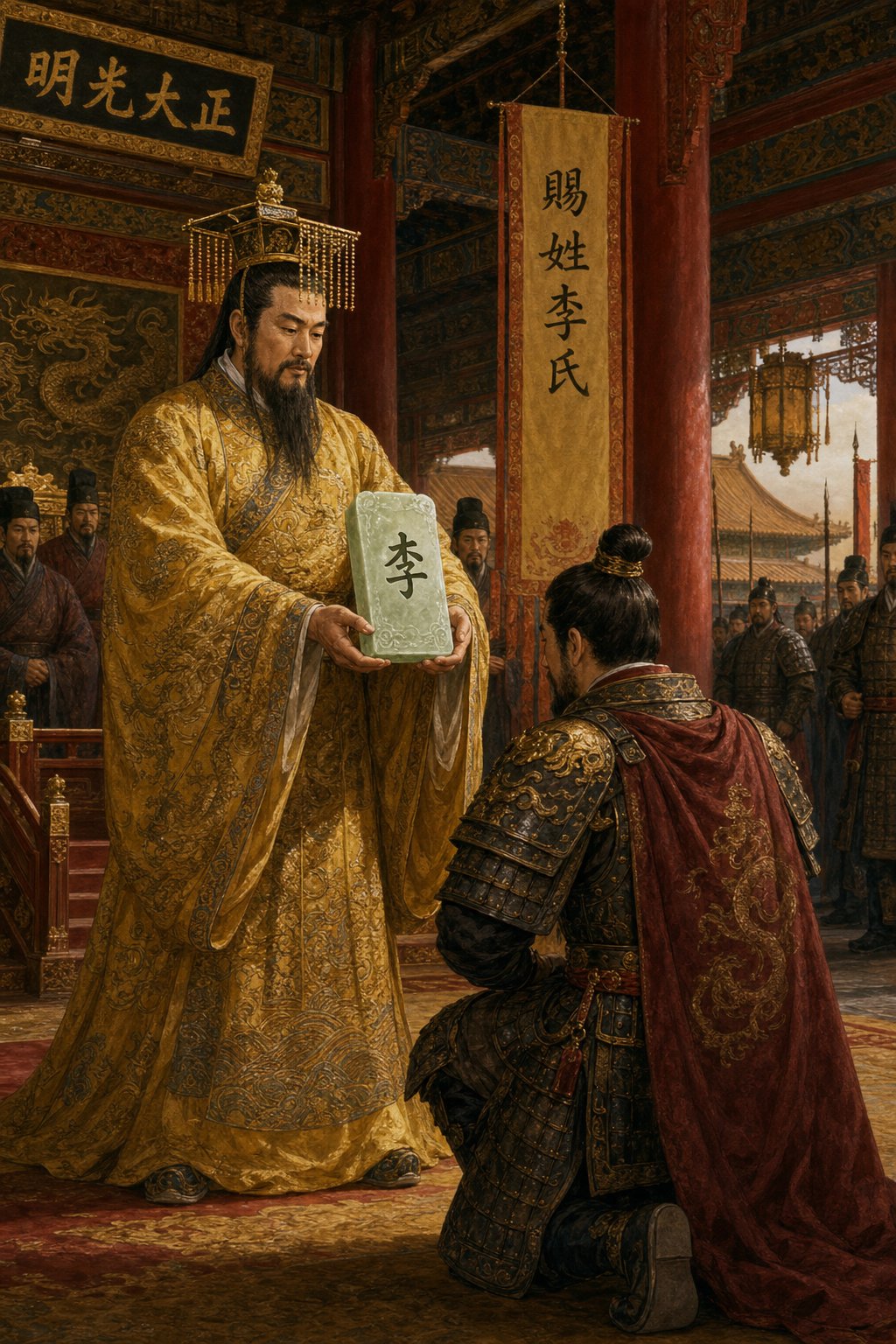
- Imperial surname grants (赐姓, cixi): Emperors bestowed their own royal surname on loyal generals, officials, or foreign allies as a political reward, absorbing unrelated individuals into the imperial patriline.
- Surname changes as punishment (贬姓, bianxing): Rulers stripped disgraced officials or rebels of their surnames and imposed degrading replacement characters, effectively severing them from their patrilineal ancestors.
- Adoption naming conventions: Adopted sons typically took the adoptive father's surname, transferring patrilineal affiliation from one lineage to another. In some cases, families without male heirs adopted a nephew from a brother's line to maintain surname continuity.
- Ethnic minority surname sinification: Non-Han peoples adopted Chinese-style patrilineal surnames during periods of assimilation, converting complex multi-syllable names into single-character Chinese surnames.
Uxorilocal Marriage and Maternal Surname Exceptions
Imagine a proud family with wealth, property, and an ancestral hall, but no sons. Under strict patrilineal rules, their surname dies with them. Ruzhui offered a solution. In this arrangement, a man agreed to join his wife's household rather than the reverse, and their children carried her family's chinese surname instead of his.
The practice was never casual. As documented in real-life accounts, ruzhui had to be discussed and agreed upon before marriage. When a family demanded it after the wedding without prior negotiation, it could destroy the relationship entirely. The arrangement typically involved a wealthier family with only daughters seeking a man from more modest circumstances. In exchange for joining her household and surrendering his patrilineal naming rights, the man gained access to her family's property and social standing.
The terms varied. Sometimes all children took the wife's surname. Sometimes the couple split: the firstborn carried the maternal surname to continue her line, while subsequent children took the father's name. As one family member explained in a documented case, "Sometimes, all the children have the wife's surname. Sometimes one has the wife's surname and the other has the husband's surname. It depends on the couple." Men who agreed to ruzhui were often from rural backgrounds or economically disadvantaged positions, making the trade-off practical rather than ideological.
Culturally, ruzhui carried stigma. Many Chinese men viewed it as an affront to their identity. One man stated plainly that if his wife's parents had asked for ruzhui, he "probably wouldn't have married her." The negative connotation persisted across diaspora communities as well. Yet the practice never disappeared, precisely because the patrilineal system's own logic created the demand: families facing surname extinction needed a mechanism to survive, even if it meant inverting the norm.
Imperial Grants and Surname Changes as Political Tools
If ruzhui bent the patrilineal rule from below, imperial surname grants reshaped it from above. Chinese emperors understood that surnames were not merely family markers but instruments of political loyalty. Granting the imperial surname to a subject was one of the highest honors available, equivalent to declaring someone an honorary member of the royal patriline.
The Tang dynasty provides the clearest example. Emperor Gaozu and his successors granted the Li (李) surname to dozens of generals, ministers, and even foreign leaders who demonstrated exceptional loyalty. These recipients were not biologically related to the Li imperial house, yet they and their descendants carried the surname as if they were. This practice partly explains why Li became one of the most common chinese surnames: political expansion supplemented biological reproduction.
The reverse was equally powerful. Surname demotion, or bianxing, stripped a person of their patrilineal identity as punishment. Emperors imposed deliberately humiliating characters on disgraced families. The Empress Wu Zetian of the Tang dynasty famously changed the surnames of her political rivals to degrading alternatives like "snake" (蝮) or "owl" (枭), symbolically severing them from their ancestors. These rare last names were not inherited traditions but imposed marks of shame, designed to make the bearer's disgrace visible to everyone who heard their name.
Some uncommon surnames in modern China trace their origins to exactly these political interventions. A family carrying an unusual or unfamiliar character may descend from a lineage that was granted, punished, or forcibly renamed centuries ago. These last names uncommon in frequency today sometimes preserve the memory of a single political act that redirected an entire patriline.
Adoption followed a related logic. When a lineage lacked a male heir, adopting a son from a brother's line or a closely related patrilineal branch was preferred over bringing in an outsider. The adopted son took the adoptive father's surname, effectively transferring his patrilineal affiliation. This kept the surname within the broader clan even if the direct biological line had ended. Formal adoption required registration in the zupu, and the adopted son's original surname was typically noted to prevent future confusion about biological origins.
Ethnic minorities experienced surname transformation on a much larger scale. During periods of political unification and cultural assimilation, non-Han peoples converted their native naming systems into Chinese-style single-character patrilineal surnames. The Xianbei people of the Northern Wei dynasty (386-534 CE) underwent one of the most systematic conversions, with Emperor Xiaowen ordering Xianbei aristocrats to adopt Chinese surnames. Multi-syllable Xianbei clan names like Tuoba became the single character Yuan (元). The Manchu rulers of the Qing dynasty similarly saw their complex clan names gradually compressed into Chinese surnames after 1911. This process of sinicization extended beyond language to naming itself, converting diverse kinship systems into the patrilineal single-surname model that defined Han Chinese identity.
Each of these exceptions reinforced the rule by requiring extraordinary circumstances to justify deviation. Ruzhui needed economic incentive. Imperial grants needed political loyalty. Punishment required state authority. Adoption needed clan approval. And ethnic assimilation required the pressure of an entire civilization's institutional weight. The patrilineal norm was not fragile. It was so strong that breaking it demanded formal mechanisms with their own rituals, negotiations, and documentation.
These exceptions operated within a single cultural sphere. But the Chinese patrilineal model did not exist in isolation. It radiated outward across East Asia, shaping how neighboring civilizations organized their own surname systems, sometimes in parallel and sometimes in strikingly different directions.
East Asian Surname Systems: How Asian Family Names Compare
China's patrilineal naming model did not stay within its borders. Over centuries of cultural exchange, imperial influence, and direct colonization, neighboring civilizations absorbed elements of the Chinese system and adapted them to local conditions. The result is a family of related but distinct surname traditions across East Asia. When you look at popular asian last names today, Kim, Nguyen, Tanaka, and Wang, you are seeing the descendants of a shared institutional ancestor filtered through very different historical paths.
Korean and Vietnamese Patrilineal Surname Parallels
Korea adopted patrilineal surnames under direct Chinese cultural influence, and the system it built is in some ways even more rigid than the Chinese original. As Ancestry documents, Korean family names pass to children from the father's side, and the family name is placed first to show respect and honor to one's ancestors and lineage. But Korea's surname pool is remarkably small. Only 288 family names exist across the entire population, with just three, Kim, Lee, and Park, covering nearly half of all South Koreans.
How do Koreans distinguish between millions of unrelated people sharing the same surname? Through the bon-gwan (clan-seat) system, which pairs a surname with a specific ancestral hometown. Two people both named Kim are not considered kin unless they share the same bon-gwan. This system traces 36,744 distinct clans from just 288 surnames. Korean families also maintain jokpo, patrilineal genealogy books that function much like Chinese zupu, recording generations of male-line descent.
Vietnam tells a different story with the same patrilineal logic. Vietnamese surnames originated during Chinese colonial administration, when Chinese administrators designated family names to keep tax records, drawing from a limited pool of Chinese-derived words. The result is extreme concentration: Nguyen alone accounts for roughly 40 percent of all Vietnamese people. Why? The last ruling dynasty, the Nguyen family (1802-1945), inspired mass adoption of the royal surname as a show of loyalty. As one scholar noted, "the tradition of showing loyalty to a leader by taking the family name is probably the origin of why there are so many Nguyens." This mirrors the Tang dynasty's practice of granting the Li surname, but on a far larger scale relative to population.
How the Japanese System Diverged
Japan breaks the pattern. While asian last names in China, Korea, and Vietnam share deep structural similarities, Japanese surnames developed along a fundamentally different timeline. Before 1875, only aristocrats and samurai carried hereditary family names. Commoners, roughly 90 percent of the population, had no surnames at all. When the Meiji government mandated universal surname registration, millions of families invented names on the spot, often based on geographic features near their homes: Yamamoto (base of the mountain), Tanaka (middle of the rice field), Watanabe (crossing point).
This late, mass adoption produced a surname landscape unlike anything else in Asia. Japan has over 100,000 distinct surnames, dwarfing China's 7,000 and Korea's 288. And because Japanese surnames were not inherited through millennia of patrilineal descent but created in a single generation, they lack the deep genealogical documentation that characterizes Chinese and Korean systems. Japanese naming also proved less strictly patrilineal in practice: the mukoyoshi tradition of adopting a son-in-law into the wife's family and giving him her surname was far more socially acceptable than its Chinese equivalent, ruzhui.
Here is how the four major systems compare across key features:
| Feature | Chinese | Korean | Vietnamese | Japanese |
|---|---|---|---|---|
| Approximate number of surnames | ~7,000 | ~288 | ~100 | ~100,000+ |
| Documented history | 4,000+ years | ~2,000 years | ~1,000 years | ~150 years (commoners) |
| Patrilineal strictness | Very high | Very high | High | Moderate |
| Surname placement | First | First | First | First |
| Concentration | Top 3 cover ~22% | Top 3 cover ~45% | Top 1 covers ~40% | Top 3 cover ~5% |
| Clan-seat or lineage tracking | Zupu genealogy books | Bon-gwan + jokpo | Limited records | Minimal before 1875 |
| Uxorilocal marriage acceptance | Stigmatized but practiced | Historically rare | Uncommon | Common (mukoyoshi) |
What makes the Chinese system distinctive among surnames in asia is not any single feature but the combination of all of them: extreme antiquity, a large but concentrated surname pool, and an unmatched depth of genealogical documentation stretching back centuries. Korean and Vietnamese systems inherited the patrilineal principle but lack the sheer volume of recorded lineage history. Japan inherited the surname-first format but not the deep patrilineal infrastructure.
These comparisons across asian names and surnames highlight something important. The Chinese patrilineal model was not just a naming convention. It was an exportable institutional package, complete with genealogy books, ancestral rites, and clan organizations, that neighboring cultures adopted selectively based on their own political needs. Yet even within China itself, this ancient system now faces pressures that no previous dynasty encountered: demographic shifts, legal reforms, and genetic science that together are reshaping what patrilineal inheritance means in the modern world.
Modern Challenges and the Future of Patrilineal Surnames
For thousands of years, the question of what family obligations did a chinese person have was answered largely through the patrilineal surname: maintain the line, produce a male heir, honor the ancestors. Demographic upheaval in the twentieth century made fulfilling those obligations impossible for millions of families, and the system that survived dynastic collapses, foreign invasions, and civil wars now faces its most fundamental challenge from within.
Legal Reforms and the Rise of Maternal Surnames
China's one-child policy (1980-2015) created an unprecedented crisis for patrilineal continuity. When a couple produced only a daughter, the father's surname faced what families called "extinction" (绝后, juéhòu). No son meant no one to carry the name forward, no one to perform ancestral rites, and no male-line entry in the zupu. For chinese families deeply invested in lineage continuity, this was not an abstract concern but an existential one.
Two responses emerged. Some families began giving children the mother's surname, effectively using daughters to continue the maternal grandfather's patriline. Others created compound surnames combining both parents' names into a new double-character surname. Research using China's 1% National Population Sample Survey found that matrilineal naming was more common in eastern villages and among families where the wife had no brothers and the husband had lower socioeconomic status. In other words, maternal surnames became a strategic tool to preserve a lineage through daughters when no sons were available, similar in logic to the traditional ruzhui arrangement.
Compound surnames follow a different pattern. They appear more frequently in modernized cities and households where the mother is well-educated, regardless of whether brothers exist on either side. This suggests compound naming reflects genuine attitudinal change brought by modernization rather than lineage anxiety alone. As one sociologist framed it, the choice of family names in China today results from "the clash, confrontation, and coexistence of traditional concepts and modern needs."
The legal framework now explicitly permits both approaches. The PRC Civil Code, adopted in 2020, codifies the right to choose either parent's surname:
A natural person shall have the surname of his or her father or mother. In limited circumstances, a person may take a surname other than the father's or mother's, such as that of an elder direct blood relative. Ethnic minorities may follow their own ethnic traditions and customs. (Civil Code, Article 1015)
This provision does not abolish patrilineal naming. It simply removes the legal presumption that the father's surname is the only option. In practice, the vast majority of children in china still receive the paternal surname. But the legal door is open, and the trend is accelerating. Chinese family structure is adapting to a reality where strict patrilineal transmission is no longer the only socially or legally acceptable path.
Genetics Research and Patrilineal Surname Fidelity
While social norms shift, genetic science has provided a surprising validation of how faithfully the patrilineal system actually operated over centuries. Because both the Y chromosome and the surname pass from father to son, researchers can test whether men sharing a surname also share Y-chromosome markers, confirming or disproving common patrilineal ancestry.
A 2019 study published in the Journal of Human Genetics examined 292 males with the surname Ye (叶) using high-resolution Y-chromosome genotyping and sequencing. The results were striking: 67 percent of Ye-surnamed individuals clustered into three major Y-chromosome branches descending from a single ancestral node. The coalescent ages of these branches, estimated at 1,775 to 1,925 years ago, aligned precisely with the historical migration of the Ye surname from northern to southern China after the Yongjia Rebellion in the Jin Dynasty (311 CE). Genetic data confirmed what genealogy books had recorded for centuries.
These findings carry two implications. First, they demonstrate that patrilineal surname fidelity was remarkably high across dozens of generations. The system worked as advertised: fathers passed their surnames to sons, and those sons stayed genetically connected to a common ancestor. Second, the remaining 33 percent of Ye-surnamed men who did not share the dominant Y-chromosome lineage reveal the historical exceptions discussed earlier: adoptions, ruzhui marriages, imperial grants, and other mechanisms that introduced unrelated males into an existing surname group.
For chinese family culture, this genetic evidence reframes the patrilineal system as neither myth nor perfect record but something in between: a remarkably faithful transmission mechanism with a measurable error rate that accumulated over millennia.
Using Patrilineal Knowledge for Genealogical Research
Understanding how the patrilineal system operates is not merely academic. It has direct practical value for anyone researching chinese family traditions and ancestry. The system's logic provides a research roadmap: if you know your patrilineal surname, you can search for zupu records, locate ancestral halls, identify surname villages, and potentially connect with a documented lineage stretching back centuries.
Here is how patrilineal knowledge translates into genealogical strategy:
- Surname as search key: Your patrilineal surname narrows the field immediately. Combined with a known ancestral province or county, it can point to specific zupu collections in libraries across China, Taiwan, and the United States.
- Generational poems as connectors: If your family preserves a zibei sequence, matching it against published genealogies can confirm which branch of a larger lineage you belong to and where your ancestors split off.
- Y-DNA testing as verification: Commercial Y-chromosome tests can now confirm or challenge patrilineal connections claimed in written records, identifying breaks in the chain that written sources may have concealed.
- Dialect romanization as geographic marker: Whether your surname is spelled Chen, Chan, or Tan tells you which dialect region your patrilineal ancestors emigrated from, directing research toward specific provincial archives.
The chinese family traditions surrounding patrilineal naming were never just about identity for its own sake. They were a system for organizing knowledge across time: who belongs to whom, who owes what to whom, and where everyone came from. That organizational logic remains useful today, even as the social norms around it evolve. Whether a child carries the father's surname, the mother's surname, or a compound of both, the underlying question persists: how do we remember where we came from? The patrilineal system offered one answer for four thousand years. The next generation is writing new ones.
Frequently Asked Questions About the Chinese Patrilineal Surname System
1. Why do Chinese surnames come before given names?
Chinese names place the family name first because the patrilineal system prioritizes lineage identity over individual identity. The surname signals membership in a descent group stretching back thousands of years, so it takes precedence in the name order. This structure reflects a cultural value where belonging to a family line is recognized before personal distinction, reinforcing the collective nature of Chinese kinship organization.
2. How did Chinese surnames change from matrilineal to patrilineal?
The shift occurred gradually between roughly 1600 BCE and 200 BCE. Early clan surnames contained the woman radical, indicating maternal lineage tracking. As the Zhou dynasty's feudal system granted land to sons, patrilineal branch names called shi emerged alongside older matrilineal xing. During the Warring States period, social upheaval collapsed class barriers, and by the Qin-Han unification, the two terms merged into a single patrilineal surname passed from father to child. State household registers then institutionalized this practice as administrative law.
3. Why are there so few common Chinese surnames for such a large population?
The top 100 surnames cover about 85% of China's 1.4 billion people due to centuries of patrilineal consolidation. Imperial clan surnames like Li and Liu expanded through political grants where emperors bestowed their surname on loyal subjects. State-derived surnames like Chen grew when entire populations adopted their fallen state's name. These mechanisms concentrated millions of people under a handful of patrilineal lines, while smaller lineages shrank or were absorbed over time.
4. Can Chinese children legally take their mother's surname?
Yes. The PRC Civil Code Article 1015, adopted in 2020, explicitly allows children to take either parent's surname. In limited circumstances, a child may even take the surname of an elder direct blood relative. While the vast majority of children still receive the paternal surname in practice, maternal surnames have increased, particularly in families where the mother has no brothers or in modernized urban households where both parents prefer a compound surname combining both family names.
5. Why is the same Chinese surname spelled differently in different countries?
Chinese dialect groups pronounce identical characters differently. The character 陈 is Chen in Mandarin, Chan in Cantonese, Tan in Hokkien, and Chin in Hakka. When families emigrated, local romanization systems fixed the spelling at the point of departure. A Cantonese family in Hong Kong became Chan, while a Hokkien family in Malaysia became Tan. All descend from the same patrilineal lineage and write the same character, but the romanized spelling preserves a phonetic snapshot of their ancestor's dialect region.