The Chinese Surname That Literally Means King
Imagine discovering that your last name carries a royal title. For over 106 million people worldwide, that is not a hypothetical. The most popular surname in the world is not Smith, Garcia, or Mohamed. It is Wang, a Chinese surname that directly translates to "king."
Why the World's Most Common Surname Means King
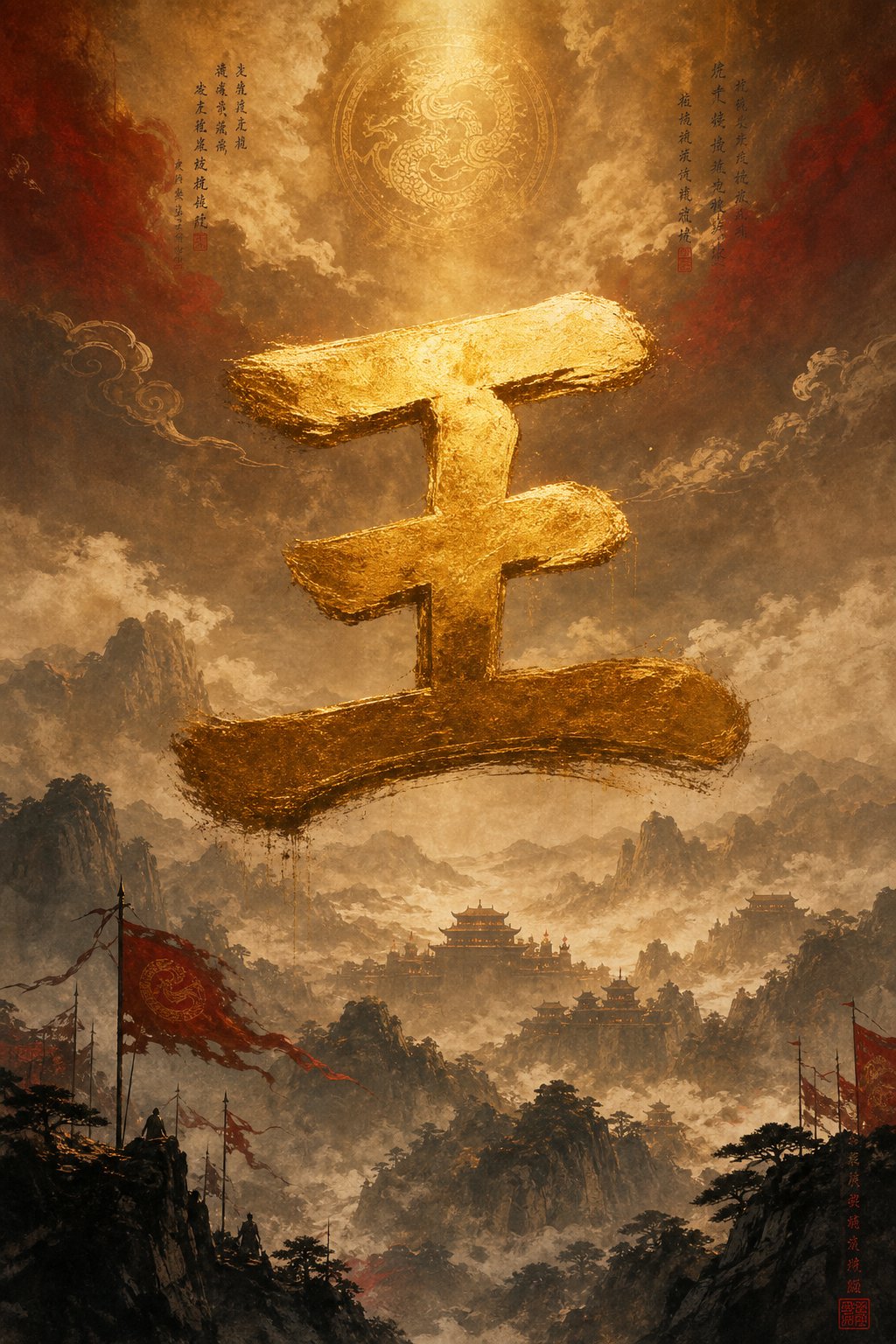
The character behind this surname is 王, and its wang meaning is straightforward: king, monarch, or ruler. Unlike many Chinese last names that reference occupations, geography, or physical traits, this one points straight to the throne.
王 (wang): A Chinese character meaning "king" or "ruler," now the most common surname on Earth, shared by more than 106 million people.
How did a word reserved for royalty end up as an everyday family name? The short answer involves fallen dynasties, scattered descendants, and centuries of cultural evolution. When ancient Chinese kingdoms collapsed, the children and grandchildren of deposed rulers still carried their royal identity. Over time, that identity crystallized into a surname. The connection between wang and king is not metaphorical. It is literal and genealogical.
Within China alone, Wang stands as the number one surname in at least 16 provinces, with the highest concentration in Shandong. Wangs comprise over 7.1% of China's total population. Globally, no other single family name comes close to those numbers.
What This Article Covers
This article goes beyond a simple definition. You will learn how the ancient pictograph for 王 evolved from oracle bone carvings into the modern character you see today. We will trace the royal dynasties whose descendants adopted this surname, explore why wang chinese naming traditions produced so many spelling variants like Wong, Ong, Vong, and even the English surname King, and compare 王 against other Chinese surnames with noble meanings like emperor, marquis, and duke.
Whether you are researching your own ancestry, studying chinese wang characters, or simply curious about why a single surname dominates global population records, you will find the answers here. The story of 王 is ultimately a story about how power, language, and identity intertwine across thousands of years of Chinese history.
That story begins with the character itself, carved into animal bones over three thousand years ago.
How the Character 王 Evolved From Ancient Pictographs
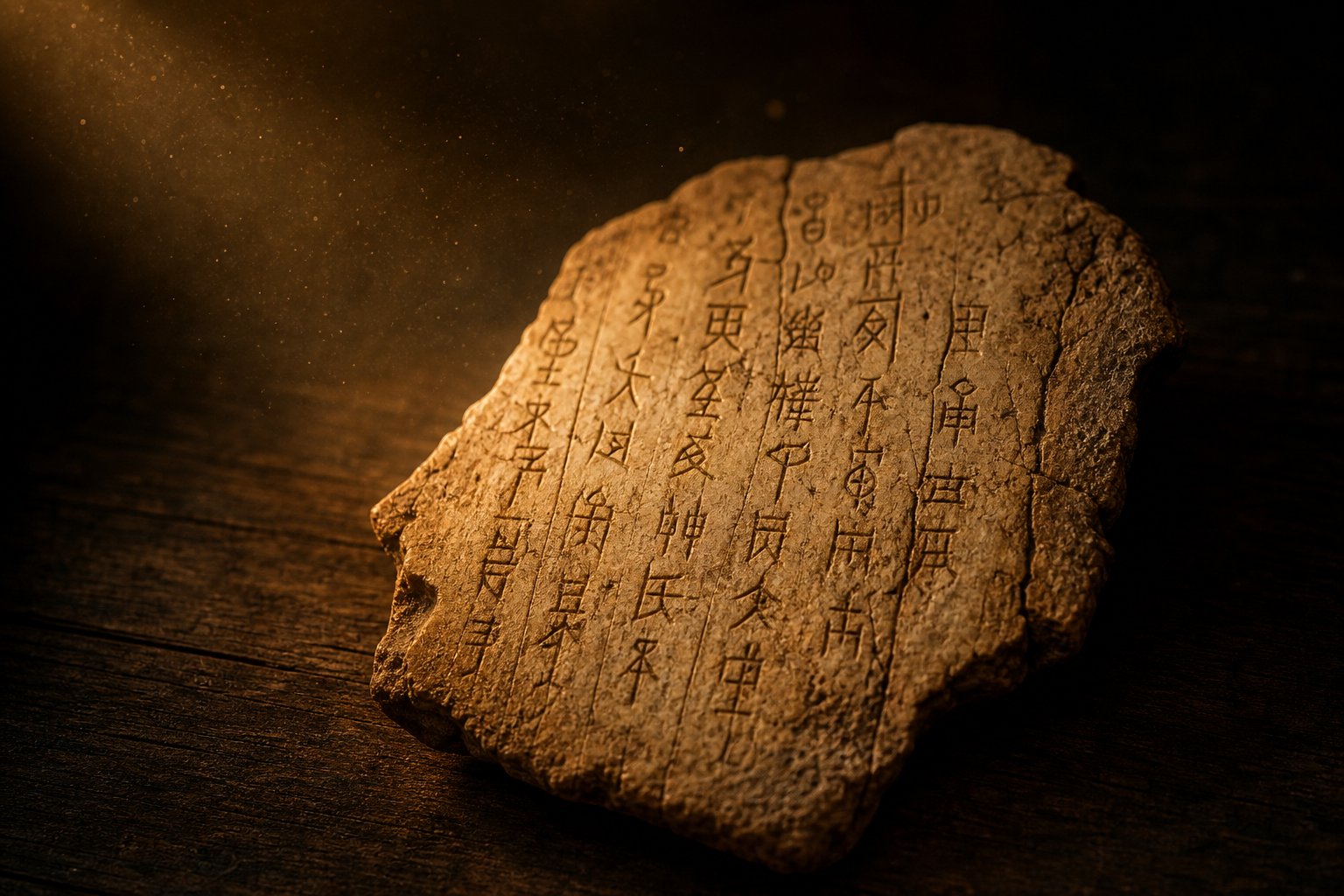
The chinese character king we recognize today as 王 looks deceptively simple: three horizontal strokes crossed by one vertical line. But this clean geometry hides over three thousand years of transformation. Each stage of its evolution tells a different story about how ancient Chinese people understood royal power.
Oracle Bone Script and the Original King Symbol
The oldest surviving form of 王 dates to roughly 1250-1000 BC, scratched into turtle shells and animal bones during the Shang dynasty. What did it look like? Scholars remain divided, but the dominant interpretation identifies the oracle bone form as a pictograph of an axe head, a symbol of the king's military authority. Picture a broad, triangular blade resting on a horizontal base. The axe was not a tool for chopping wood. It was a ceremonial weapon, the kind a ruler held during sacrificial rites and military commands.
A competing theory sees something different in the same scratches. Some scholars believe the early form depicts a person standing tall, positioned beneath heaven and above the earth. Still others read it as a figure seated on a throne. The ambiguity itself is revealing. Whether axe, standing figure, or enthroned ruler, every interpretation circles back to one concept: supreme authority.
From Bronze Inscriptions to Modern 王
By the late Shang dynasty (around 1100 BC), the king chinese symbol appeared on bronze ritual vessels. The form grew more structured. The axe-head shape flattened, and the three horizontal lines became more distinct. During the seal script period (around 100 AD in the Shuowen dictionary), the character settled into a recognizable pattern: three even horizontal strokes joined by a single vertical one.
This is where Confucius offered his famous interpretation of the char in chinese writing. He described 王 as "yi guan san wei wang" - the one vertical stroke that connects three realms. The top line represents heaven, the middle line represents humanity, and the bottom line represents earth. The king is the vertical force uniting all three, a ruler who bridges the cosmic and the human.
From clerical script in the Eastern Han dynasty (25-220 AD) through to the regular script used today, the character barely changed. The wang in chinese writing stabilized into the four clean strokes you can write in under a second. Simple on the surface, layered with meaning underneath.
That layered meaning did not stay abstract for long. Real royal families turned this symbol of cosmic authority into something deeply personal: a family name passed down through generations of actual kings and their descendants.
Royal Dynasties That Gave Birth to the Wang Surname
A single character meaning "king" became a family name not once, but multiple times across Chinese history. Different royal houses, separated by centuries and geography, all converged on the same surname. Understanding the wang surname origin means tracing at least three major dynastic bloodlines, each with its own story of power gained and lost.
Zhou Dynasty Descendants and the Ji Lineage
The most widely cited wang last name origin traces back to the Zhou dynasty (1046-256 BC), specifically to the royal Ji family. The story centers on a prince named Wang Zijin, the son of King Ling of Zhou. According to historical accounts, Wang Zijin was known for his intelligence and musical talent, but he clashed with his father over a flood-control policy. The prince was stripped of his title and exiled from court.
Here is where the surname crystallizes. Wang Zijin's son, Zongjing, still held a government post after his father's exile. The imperial court continued to refer to him simply as "Wang," meaning "the king's descendant." Zongjing eventually adopted Wang as his permanent family name. His descendants multiplied across what is now Shanxi, Henan, and Shandong, forming the largest and most influential branch of the surname wang lineage.
This Ji-surname branch became so dominant that many Wang clan genealogies today trace their ancestry directly to Wang Zijin. He appears as the founding ancestor in family history books across China and Southeast Asia.
Shang Dynasty Royalty and Other Royal Houses
The Zhou dynasty was not the first to produce Wangs. An older origin story reaches back to the Shang dynasty (1600-1046 BC) and a figure named Bigan. He was the uncle of King Zhou, the notoriously cruel last ruler of the Shang. Bigan dared to criticize the king's behavior and was executed for his honesty. After the Shang collapsed, Bigan's descendants chose the clan name Wang to honor his royal blood. This branch established itself in Henan and became known as the Jijun Wang Clan, later migrating throughout Gansu, Hebei, Shanxi, and Shandong.
A third lineage connects to the legendary Emperor Shun, who ruled before the Xia dynasty. Shun bore the surname Gui, and his descendants held noble titles for generations. When those titles eventually faded, the family preserved their identity by adopting the surname Wang. This Gui-surname branch is less documented than the Ji or Zi lineages, but it appears in classical genealogical texts as evidence that the wang surname origin is not a single thread but a braided rope of royal histories.
How Fallen Dynasties Became Surname Lineages
Notice the pattern? In each case, the surname did not emerge while a family sat on the throne. It appeared after they lost power. A ruling king does not need a surname meaning "king." He simply is the king. But once a dynasty falls, once the palace gates close and the descendants scatter into ordinary life, the word "wang" transforms from a title into a memory. It becomes a way of saying: we were once rulers.
This is why multiple unrelated royal families all landed on the same surname. The logic was identical even when the bloodlines were not. Neighbors and officials would refer to these displaced royals as "the wang family," the king's people. Over generations, that informal label hardened into a formal surname passed from parent to child.
The result is a surname with not one founding ancestor but many. Each branch carries a different dynastic origin, a different geographic homeland, and a different story of how royal power slipped away. Yet all share the same character on their family register: 王.
This multi-origin structure raises an obvious question. If the surname wang started with actual royalty, does that mean every person named Wang today carries royal blood? The answer is far more complicated than a simple yes or no.
Did Everyone Named Wang Descend From Kings
Over 106 million people share the wang last name today. Could all of them really trace their ancestry back to a throne? The math alone makes that unlikely. Three royal lineages, no matter how fertile, cannot account for a population larger than most countries. The truth is that the surname spread far beyond royal bloodlines through a combination of social forces that had nothing to do with genealogy.
Beyond Royal Blood — How Wang Spread to Millions
Several mechanisms drove the expansion of the last name wang well past its aristocratic origins:
- Ethnic assimilation: As Chinese empires expanded, non-Han peoples along the borders were absorbed into the dominant culture. Many adopted prestigious Chinese surnames to ease integration. Xianbei, Xiongnu, and other northern groups frequently chose Wang because of its high status and simple character.
- Imperial surname grants: Emperors sometimes bestowed the Wang surname on loyal officials, military heroes, or foreign dignitaries as a mark of honor. Receiving a surname meaning "king" from the emperor himself was a powerful political reward.
- Voluntary adoption: During periods of social upheaval, war, famine, or dynastic collapse, commoners sometimes abandoned their original surnames and adopted more prestigious ones. A family fleeing conflict might reinvent itself under the wang family name to claim higher social standing in a new region where nobody knew their history.
- Clan merging: Smaller family groups occasionally merged with larger Wang clans for mutual protection and economic advantage. Over time, the adopted surname replaced the original one entirely.
Each of these pathways added thousands, then millions, of people to the wang family tree who had no biological connection to Zhou princes or Shang royalty. Multiply these processes across two thousand years of Chinese history, and you begin to understand how a royal surname became an everyman surname.
Imperial Grants and Surname Adoption Practices
Population growth compounded the effect. China's population exploded from roughly 60 million during the Han dynasty to over 400 million by the Qing dynasty. Even if only a small percentage of the population carried the Wang surname at any given point, exponential growth over centuries turned that fraction into an enormous absolute number. China's Ministry of Public Security confirmed that Wang remains the most common surname in the country, followed by Li and Zhang, with 85.9% of the registered population bearing one of the top 100 surnames.
A surname meaning "king" does not guarantee royal ancestry. For most of the 106 million people named Wang today, the connection to ancient thrones is cultural rather than genetic, a shared symbol rather than a shared bloodline.
This gap between meaning and ancestry is not unique to the Wang surname. It reflects a broader pattern in Chinese naming culture where surnames functioned as social identifiers, political tools, and survival strategies, not just biological markers. The wang family name became so common precisely because it was useful. It carried prestige, it was easy to write, and it connected its bearer to a narrative of power, whether or not that power ran in their veins.
What makes this story even more layered is that the same character, 王, does not always sound like "Wang." Depending on where a family settled, which dialect they spoke, and which romanization system recorded their name, that single character fractured into a dozen different spellings, each carrying the same royal meaning into a completely different linguistic world.
Wang, Wong, Ong, King — One Character Many Spellings
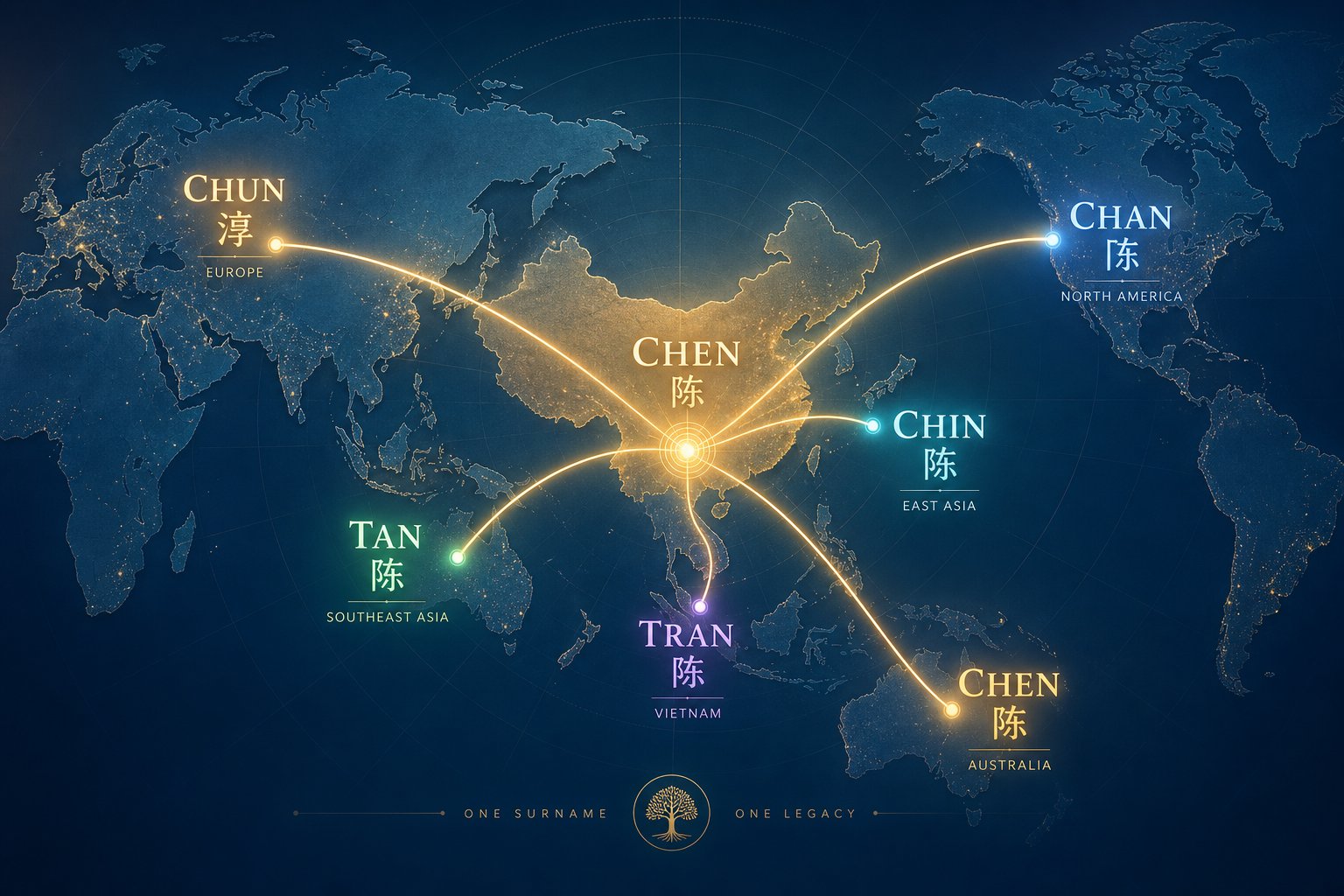
You might meet a Wong in San Francisco, an Ong in Singapore, a Vong in Macau, and a King in Sydney, and never realize they all share the same ancestral character: 王. The single Chinese character fractured into over a dozen romanized spellings as families migrated across regions where different dialects, colonial administrations, and transliteration systems shaped how their name appeared on paper.
Mandarin, Cantonese, and Hokkien Variations
In Mandarin, the standard pinyin romanization gives us Wang, the form most familiar in mainland China and Taiwan. Cross into Guangdong province or Hong Kong, and the Cantonese pronunciation shifts the vowel. Wong in chinese Cantonese dialect sounds closer to "wohng," which is why the wong surname dominates among families with roots in southern China. If your wong last name traces back to Hong Kong, Macau, or the Pearl River Delta, Cantonese is almost certainly the dialect behind it.
Move further south into Fujian province and Southeast Asia, and the sound changes again. Hokkien speakers pronounce 王 as "Ong" or sometimes "Heng," depending on the sub-dialect. Teochew, a closely related dialect spoken in eastern Guangdong and parts of Thailand, produces similar variants: Ong or Heng. These forms are especially common in Malaysia, Singapore, the Philippines, and Indonesia, where Hokkien and Teochew communities established deep roots centuries ago.
Hakka-speaking communities, concentrated in northeastern Guangdong and scattered across Southeast Asia, pronounce the character as Vong. If you encounter the vong spelling in a family name, Hakka heritage is the likely explanation.
Vietnamese, Hmong, and English Transliterations
The character 王 traveled beyond Chinese dialect groups entirely. In Vietnam, it became Vuong (Vương), a last name found among Vietnam's Chinese community that carries the same meaning: king or monarch. Most Vương families who settled overseas in the past four centuries originated from Guangdong and Fujian provinces. The vuong last name appears frequently in Vietnamese diaspora communities across the United States, France, and Australia.
Among Hmong communities in Laos, Thailand, and the American Midwest, the same character surfaces as Vang. The vang last name is one of the most common Hmong surnames, and while its pronunciation diverged significantly from Mandarin, its written origin traces back to 王. Some families also adopted the direct English translation, registering their surname simply as King when immigrating to English-speaking countries.
| Dialect / Language | Romanization of 王 | Primary Region |
|---|---|---|
| Mandarin (Pinyin) | Wang | Mainland China, Taiwan |
| Cantonese (Jyutping) | Wong | Hong Kong, Macau, Guangdong |
| Hokkien | Ong, Heng | Fujian, Malaysia, Singapore, Philippines |
| Teochew | Ong, Heng | Eastern Guangdong, Thailand |
| Hakka | Vong | Northeastern Guangdong, Southeast Asia |
| Vietnamese | Vuong (Vương) | Vietnam, Vietnamese diaspora |
| Hmong | Vang | Laos, Thailand, United States |
| English (translation) | King | English-speaking countries |
Every spelling in this table points back to the same character and the same meaning. The surname wong, whether written as Wong, Ong, or Vang on a passport, still carries the weight of that ancient royal title. What separates these variants is not meaning but migration: which port a family departed from, which dialect they spoke at home, and which colonial clerk first wrote their name in Roman letters.
The sheer number of variants raises a broader question. If 王 is the dominant "royal" surname, what about other Chinese characters that also carry noble meanings? Several exist, though none come close to matching Wang's population numbers.
Other Chinese Surnames With Royal and Noble Meanings
王 is not the only Chinese surname that echoes the halls of power. Several other family names carry meanings tied to emperors, dukes, marquises, and lords. Yet none of them come anywhere close to Wang's population dominance. Why? The answer reveals something fundamental about how Chinese social hierarchies shaped naming practices over millennia.
Surnames Meaning Emperor, Marquis, and Duke
Think of Chinese noble titles as a ladder. At the top sits the emperor (皇, huang), followed by the king (王, wang), then a descending order of aristocratic ranks: marquis (侯, hou), duke (公, gong), and lord (君, jun). Each of these titles eventually became a surname, but the circumstances varied widely.
The huang surname is where things get interesting, and a little confusing. Two completely different characters share the same romanization in Mandarin: 皇 (meaning emperor) and 黄 (meaning yellow). The huang family name you encounter most often is 黄, which ranks among China's top ten surnames with over 30 million bearers. It traces its origin to ancient fiefdoms and has no royal meaning at all. The other character, 皇 (emperor), exists as a surname but is extraordinarily rare. So if someone tells you their last name is Huang, the odds overwhelmingly favor the "yellow" character, not the "emperor" one. In Vietnamese romanization, this surname appears as Hoang, a spelling common among Vietnamese diaspora communities worldwide.
侯 (hou) means marquis, a rank just below king in the ancient Chinese peerage system. Curious about how to pronounce marquess in English? It sounds like "MAR-kwiss," but the Chinese equivalent, 侯, is pronounced "hoh" in Mandarin. As a surname, Hou traces back to descendants of the Marquis of Jin during the Spring and Autumn period. It ranks around 77th among Chinese surnames today.
公 (gong) translates to duke or lord, the title given to high-ranking nobles who governed territories under the king. As a surname, Gong is uncommon, ranking well outside the top 200. Its rarity reflects the fact that fewer ducal families converted their title into a permanent family name.
君 (jun) means lord or sovereign, a term used broadly for rulers and gentlemen alike. The word for prince in chinese can also involve this character in certain historical contexts, though 王子 (wangzi) is the more direct translation. Jun as a surname is extremely rare, appearing mostly in historical records rather than modern census data.
Comparing Prevalence and Origins of Noble Surnames
When you line these surnames up side by side, the population gap between Wang and everything else is staggering:
| Character | Meaning | Approx. Prevalence Rank | Primary Historical Origin | Common Romanizations |
|---|---|---|---|---|
| 王 | King | 1st | Zhou, Shang, and Gui royal descendants | Wang, Wong, Ong, Vong, Vang, King |
| 皇 | Emperor | Extremely rare (500+) | Descendants of ancient rulers who used the imperial title | Huang |
| 黄 | Yellow (not royal) | 7th | Ancient fiefdom in Henan; unrelated to nobility | Huang, Wong (Cantonese), Hoang (Vietnamese) |
| 侯 | Marquis | ~77th | Descendants of the Marquis of Jin, Spring and Autumn period | Hou, Hau (Cantonese) |
| 公 | Duke | ~200+ | Descendants of ducal houses; also a compound surname element | Gong, Kung |
| 君 | Lord / Sovereign | Extremely rare | Scattered noble lineages; mostly historical | Jun, Kwan (rare) |
Why does 王 dwarf all the others? Three reasons stand out. First, the king in chinese language and culture occupied a unique middle position. Emperors were too exalted, their title too dangerous to claim openly. Marquises and dukes were too numerous and too localized. But "king" hit a sweet spot: prestigious enough to carry weight, common enough that multiple dynasties produced descendants who adopted it. Second, the multi-origin structure of the Wang surname meant it drew from several unrelated royal houses simultaneously, multiplying its population base from the start. Third, the character 王 is visually simple and easy to write, which mattered in an era when literacy was limited and complex characters were harder to preserve across generations.
The rarity of 皇 as a surname is especially telling. Claiming descent from an emperor was politically risky throughout most of Chinese history. A family openly bearing the surname "Emperor" could attract suspicion, persecution, or forced name changes from whatever dynasty currently held power. The title of king, by contrast, was safer. It acknowledged noble origins without directly challenging the sitting emperor's legitimacy.
This hierarchy of risk and reward shaped which noble titles survived as surnames and which faded into obscurity. The result is a naming landscape where "king" thrives while "emperor," "duke," and "lord" remain curiosities. But carrying any of these surnames, whether common or rare, raises a deeper question: what did it actually feel like to walk through life with a name that announced royal status to everyone who heard it?

The Cultural Weight of a Surname Meaning King
Walking through imperial China with a surname that literally announced royal heritage was not always a privilege. Depending on the era, it could be a source of quiet pride, a social advantage, or a liability that attracted unwanted attention from the ruling court. The meaning of wang never changed, but the cultural weight it carried shifted dramatically across dynasties.
Historical Perceptions of the Wang Surname
During the Zhou dynasty's decline, bearing the Wang surname was a mark of legitimate aristocratic descent. Families used it to maintain social standing even after losing political power. Neighbors deferred to them. Marriage prospects improved. The wang definition as "king" functioned almost like a built-in letter of recommendation.
That dynamic grew more complicated under unified empires. When a single emperor claimed absolute authority, a family surname meaning "king" could feel like a quiet challenge to the throne. Most Wang families were far too common and too powerless to attract suspicion, but prominent Wang clans occasionally faced scrutiny. Wang Mang's usurpation of the Han dynasty in 9 AD did not help. After he seized the throne and failed spectacularly, the surname carried a faint whiff of political ambition for generations.
In Chinese culture, a surname does not just identify you. It positions you within a social narrative that stretches back centuries, whether you actively claim that narrative or not.
By the Tang and Song dynasties, the sheer number of Wangs diluted any political edge. The name became so ordinary that its royal meaning faded into background noise for most bearers. Modern Chinese speakers generally understand the wang meaning in english as "king," but few treat it as a genuine claim to royalty. It is more like a cultural inheritance, an interesting fact about your family name rather than a statement of status. If you wang define the character today, dictionaries still list "king" or "ruler" as the primary definition wang carries, yet socially it registers no differently than any other common surname.
The English Surname King and Its Chinese Connections
Here is where two naming traditions intersect in an unexpected way. English speakers with the surname King sometimes discover a direct link to 王 when researching their family history. Some Chinese immigrants to English-speaking countries translated their surname rather than romanizing it, choosing "King" as the English equivalent of Wang or Wong. If your last name is King and you have Chinese ancestry, the wang wang meaning behind your English surname may trace back to the same ancient character.
The reverse also applies. Chinese families researching the meaning wang carries sometimes encounter the English surname King in their genealogical records, particularly among diaspora communities in Australia, Canada, and the United States where translation was preferred over transliteration during the 19th and early 20th centuries. The wang def in both languages points to the same concept: sovereign authority.
Whether the name reads as Wang on a Chinese household register or King on an immigration document, the cultural DNA is identical. The difference is purely linguistic. And that shared meaning has connected real people to real power throughout history, sometimes in dramatic fashion.
Famous Figures Who Carried the King Surname
A surname meaning "king" is one thing. Actually seizing a throne is another. Yet across Chinese history, several people named Wang turned that etymological promise into political reality, while others channeled their ambitions into art, philosophy, and reform. Their stories illustrate how the surname's royal weight played out in real lives.
Wang Mang — When a King Surname Became a King
No figure embodies the surname's meaning more literally than Wang Mang. Born into one of China's oldest noble families around 45 BC, he rose through the ranks as a Confucian scholar and ascetic before serving as regent for a succession of young emperors. In 9 AD, he seized the throne outright, ending the Former Han Dynasty and proclaiming his own Xin ("new") dynasty.
Wang Mang's 14-year reign was dramatic. He nationalized land, redistributed it to peasant farmers, imposed taxes on slave owners, and introduced government monopolies on iron and salt. Some modern scholars describe his policies as proto-socialist. Others see him as a Confucian idealist trying to recreate the ancient Zhou system. Either way, his reforms provoked the devastating Red Eyebrow Rebellion, and he was killed in 23 AD when rebels stormed his palace in Chang'an.
The irony is hard to miss. A man whose surname literally meant "king" became an actual emperor, then lost everything because his radical vision outpaced what his empire could absorb. Wang Mang remains one of China's most controversial rulers, celebrated by some as a visionary and condemned by others as a tyrant.
Scholars, Artists, and Leaders Named Wang
Wang Mang was not the only bearer of this surname to leave a mark on history. Across dynasties, Wangs shaped Chinese culture in fields ranging from calligraphy to statecraft:
- Wang Xizhi (303-361 AD) — Known as the "Sage of Calligraphy," his Preface to the Orchid Pavilion is considered the greatest work of Chinese calligraphy ever produced. His brushwork influenced every generation of writers that followed.
- Wang Anshi (1021-1086) — A Song dynasty chancellor who launched sweeping economic reforms including state loans to farmers, government price controls, and a restructured tax system. His "New Policies" remain studied in Chinese political history.
- Wang Tong (584-617) — A Sui dynasty Confucian scholar whose teachings influenced the founding intellectuals of the Tang dynasty. His students called him a modern sage.
- Wang Lang (died 228 AD) — A late Han and Wei dynasty official who served as Minister of Works under Cao Cao. He appears prominently in the Romance of the Three Kingdoms tradition.
- Wang Ke — A name shared by multiple historical figures, including a Qin dynasty general who conquered the state of Chu, demonstrating how the surname recurred at the highest levels of military command.
In modern times, the pattern continues. Figures like Wang Xiaohong, who rose to lead China's Ministry of Public Security, and Wang Xiaodong, known for his nationalist intellectual writings, show the surname still surfaces at the intersection of power and public life. In the diaspora, names like Amy Xiang Wang appear in academic and professional circles, while Wang George represents the blended naming conventions common among Chinese families in English-speaking countries.
What connects all these figures is not a shared bloodline but a shared label. The surname placed them within a narrative of authority before they ever achieved anything on their own. Some lived up to it. Others transcended it entirely, proving that a name meaning "king" could belong just as easily to a calligrapher, a philosopher, or a reformer as to someone who actually wore the crown.
These individual stories, impressive as they are, represent only a fraction of the 106 million people who carry this surname today. For most, the royal connection is not about famous ancestors or political power. It is about understanding where the name came from and what it still means within the broader story of Chinese identity.
Understanding Your Connection to the King Surname
From an axe carved into oracle bones to a name shared by 106 million people, the journey of 王 spans over three thousand years of dynastic rise, collapse, migration, and reinvention. Whether your family spells it Wang, Wong, Ong, Vong, Vang, or King, the wong surname meaning remains unchanged: royalty, authority, a link to ancient thrones that once governed millions.
But knowing the meaning is only the starting point. The real question for many readers is personal: which branch do I belong to? Can I trace my own lineage back to a specific dynasty or region?
Tracing Your Own Wang Lineage
Pinpointing your family's specific origin within the wang family name requires some detective work. The surname emerged from multiple royal houses, spread through dozens of provinces, and fractured into dialect-based spellings as families migrated overseas. Here is a practical path forward:
- Identify your dialect group. The romanization of your surname is your first clue. Wong suggests Cantonese roots in Guangdong or Hong Kong. Ong points toward Hokkien or Teochew heritage in Fujian or Southeast Asia. Vang indicates Hmong ancestry. Start by confirming which dialect your family spoke, as this narrows the geographic origin significantly.
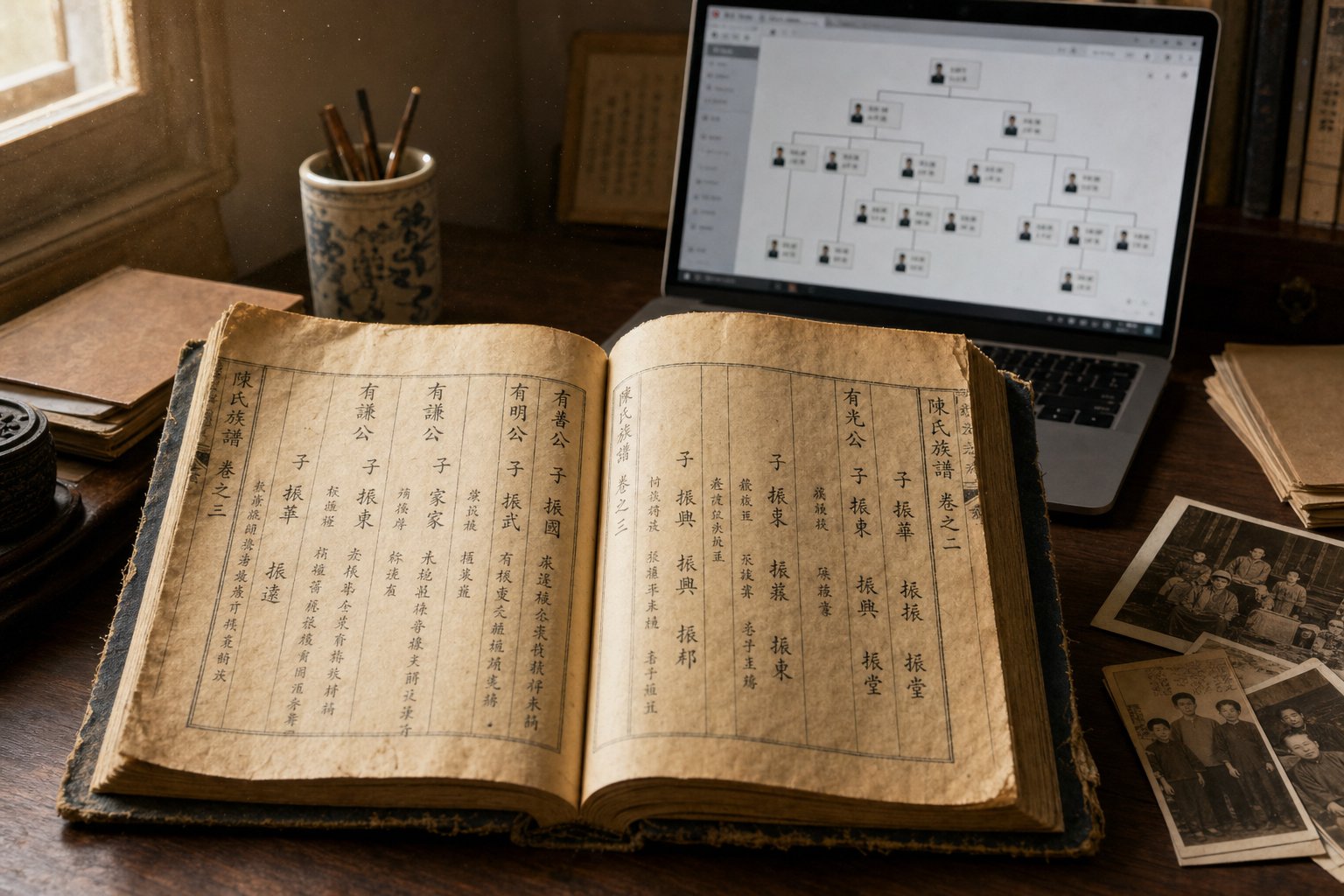
- Search for your family's jiapu (家谱). Chinese families traditionally maintained genealogical books called jiapu that record lineage from father to son, sometimes stretching back thousands of years. FamilySearch offers free access to digitized jiapu collections searchable by surname, province, and ancestral hall name.
- Gather key details from living relatives. Ask older family members about your ancestral village, any generation poems (字辈) used in naming, and whether the family maintained an ancestral hall. These details help match your branch to a specific jiapu record.
- Determine your ancestral hall name (堂号). Wang clans across China maintained different ancestral halls. The Taiyuan Wang clan traces to Shanxi province and the Ji lineage. The Langya Wang clan connects to Shandong. Knowing your hall name tells you which dynastic branch your family likely descends from.
- Cross-reference with historical migration patterns. If your wong last name origin traces to Southeast Asia, research which waves of Chinese migration brought families to that region. Hokkien speakers arrived in the Philippines and Indonesia as early as the Song dynasty, while Cantonese migration to North America peaked during the 19th century Gold Rush era.
Resources like FamilySearch's Chinese surname guides and local Chinese clan associations can help fill gaps where family memory runs thin. Many diaspora communities maintain membership records that connect overseas families back to specific villages in China.
Why Understanding Surname Meanings Matters
Researching the wong surname origin or vang last name origin is not just an academic exercise. For diaspora families separated from their ancestral homeland by generations of migration, a surname is often the strongest surviving thread connecting them to a deeper history. The ong last name origin in Singapore tells a different migration story than the Wong in San Francisco, yet both carry the same royal character on their family register.
Chinese surnames continue to carry cultural meaning in communities worldwide. Young people in Melbourne, Toronto, and Houston are rediscovering their wang family name not through dusty archives alone, but through DNA testing, online genealogy platforms, and renewed interest in heritage languages. The character 王 still functions the way it always has: as a bridge between past and present, connecting living people to ancestors they will never meet but whose choices shaped everything that followed.
Your last name holds a royal secret. Whether that secret leads you to a Zhou dynasty prince, a Shang dynasty martyr, or a family that simply chose a powerful name during turbulent times, the story belongs to you now. The king surname is not just history. It is an inheritance still being written.
Frequently Asked Questions About Chinese Surnames Meaning King
1. What Chinese surname means king?
The Chinese surname 王 (Wang) directly translates to king or ruler. It is the most common surname in the world, shared by over 106 million people. The character originated as a pictograph of an axe, symbolizing royal military authority, and was adopted as a family name by descendants of multiple fallen Chinese dynasties including the Zhou and Shang.
2. Why are Wang and Wong the same surname?
Wang and Wong both represent the same Chinese character 王 but are romanized differently based on dialect. Wang comes from Mandarin pinyin pronunciation, while Wong reflects Cantonese pronunciation common in Hong Kong and Guangdong province. Other variants include Ong (Hokkien), Vong (Hakka), Vang (Hmong), and Vuong (Vietnamese). The spelling depends on which dialect a family spoke and which romanization system recorded their name.
3. Does everyone named Wang descend from royalty?
No. While the Wang surname originated with descendants of the Zhou, Shang, and other royal dynasties, most of today's 106 million bearers do not have direct royal ancestry. The surname spread through ethnic assimilation of non-Han peoples, imperial grants to loyal officials, voluntary adoption during social upheaval, and clan merging. For most Wangs today, the royal connection is cultural rather than genetic.
4. What other Chinese surnames have royal or noble meanings?
Beyond 王 (king), several Chinese surnames carry noble meanings: 皇 (huang, emperor) is extremely rare, 侯 (hou, marquis) ranks around 77th in prevalence, 公 (gong, duke) falls outside the top 200, and 君 (jun, lord) is nearly extinct as a surname. Wang vastly outnumbers all others because claiming the title of king was prestigious yet politically safer than claiming to be an emperor.
5. How can I trace my Wang, Wong, or Ong family lineage?
Start by identifying your dialect group through your surname's spelling, as this narrows your geographic origin. Search for your family's jiapu (genealogical book) through resources like FamilySearch. Ask older relatives about your ancestral village, generation poems, and ancestral hall name. The Taiyuan Wang clan traces to Shanxi province while the Langya Wang clan connects to Shandong. Local Chinese clan associations and online genealogy platforms can help connect overseas families to specific villages in China.