The Art and Poetry Behind Chinese Girl Names
Imagine condensing an entire wish for your child's future into just two or three characters. That's exactly what Chinese parents do when they name a daughter. Beautiful chinese girl names are far more than pleasant sounds or trendy picks from a list. Each character carries its own meaning, visual elegance, and tonal music, and when combined, they form something closer to a line of poetry than a simple label.
In Chinese culture, naming is a deliberate, deeply personal act. A person's name tells the story of their parents' ideals and hopes for them — aspirations the bearer often embraces throughout life. Characters might evoke moonlight on water, the resilience of bamboo, or the quiet strength of jade. Parents select each one for its meaning, its sound, and even the beauty of its brushstrokes on paper. The result is a name that functions as a tiny, meaningful phrase, a compressed expression of love and intention.
Why Chinese Girl Names Carry Deep Meaning
Chinese names are generally made up of two to four characters, and each character has its own significance. Unlike English names, where meaning often fades into the background, chinese girl names keep their meaning front and center. A girl named 美兰 (Měilán) doesn't just have a pretty name — she carries "beautiful orchid" with her every day, a reminder of refinement and grace. This layering of meaning is what makes chinese names so rich. Parents consider phonetics, visual form, cultural resonance, and even philosophical tradition before settling on the right combination.
Writer Wendy Chen describes how her own Chinese name held several stories at once: a reference to flowers, a link to her sister through a shared generational character, and a nod to her family's immigration history. That density of meaning in just two or three characters is typical, not exceptional.
A Chinese name is compressed poetry. Two or three characters, chosen with care, create layered meaning — carrying a family's hopes, a cultural philosophy, and a vision of who a child might become, all in a single breath.
What Makes This Guide Different
Most lists of beautiful chinese names give you a romanized spelling and a one-word translation. That barely scratches the surface. This guide provides the full picture for every name: the original Chinese character(s), pinyin with accurate tone marks, character-by-character meaning breakdowns, and the cultural or literary context that gives each name its resonance.
Whether you're a parent searching for unique chinese girl names that honor heritage, a writer building authentic characters, or simply someone drawn to the artistry of chinese names for girls, you'll find more than a catalog here. You'll find the stories, traditions, and poetic logic behind the names — the kind of context that turns a list into a genuine understanding of how girl chinese names work and why they sound the way they do.
Chinese girls names reflect thousands of years of literary tradition, philosophical thought, and evolving cultural values. The characters available for naming draw from nature, virtue, history, and aspiration. Understanding that foundation is what separates choosing a name with confidence from picking one at random.
That foundation starts with structure — how a Chinese name is built, character by character, from surname to given name.
How Chinese Names Are Structured
Every Chinese name follows a specific architecture. Understanding that structure is essential before you can appreciate how individual characters work together to create meaning. Think of it like reading a poem — you need to know the form before you can feel the rhythm.
Surname First and Given Name Second
In Chinese naming convention, the family name always comes first. If you see a three-syllable name like Wang Xiaoming, "Wang" is the surname and "Xiaoming" is the given name. This order reflects a cultural priority: family and lineage before the individual.
Chinese surnames are inherited from the father's side, and women do not change their surnames after marriage. There are roughly 400 different chinese surnames in active use, with the top three — Li (李), Wang (王), and Zhang (张) — shared by over 270 million people. Most asian surnames in the Chinese tradition are a single character, though compound surnames like Ouyang (欧阳) and Zhuge (诸葛) exist as well. If you're researching asian surnames names for a character or a family tree, you'll notice that the vast majority are monosyllabic — one character, one syllable.
The given name, by contrast, is where all the creative intention lives. Chinese first names are typically one or two characters, each chosen for meaning, sound, and the visual beauty of the written form. This is where parents pour their hopes, literary references, and philosophical values into a child's identity.
How Characters Combine to Create Meaning
When selecting chinese given names female, parents don't just pick characters that sound nice individually. They consider how two characters interact — whether their meanings complement, contrast, or build upon each other. A name like 婉清 (Wǎnqīng) pairs "gentle" with "clear," creating a poetic image of quiet clarity. Each character contributes its own layer, and together they form something greater than the sum of parts.
Some families also use generational names (字辈), where siblings and cousins share one character in their given name. For example, siblings named Jia Zhenni and Jia Zhenhai both carry the generational character "Zhen," linking them visibly within the family line. This practice creates unity across a generation, though not all families maintain it today.
Here's how the structure works in practice with chinese female names and surnames broken down character by character:
| Full Name | Surname | Given Name Characters | Individual Meanings | Combined Poetic Significance |
|---|---|---|---|---|
| 林雨桐 (Lín Yǔtóng) | 林 Lín (forest) | 雨 Yǔ + 桐 Tóng | Rain + Paulownia tree | Rain nourishing a noble tree — growth and resilience |
| 张诗涵 (Zhāng Shīhán) | 张 Zhāng (stretch/bow) | 诗 Shī + 涵 Hán | Poetry + Contain/nurture | A spirit that holds poetry within — cultured depth |
| 王月琴 (Wáng Yuèqín) | 王 Wáng (king) | 月 Yuè + 琴 Qín | Moon + Stringed instrument | Moonlit music — elegance and artistic soul |
| 李思颖 (Lǐ Sīyǐng) | 李 Lǐ (plum) | 思 Sī + 颖 Yǐng | Thought + Clever/outstanding | A brilliant, thoughtful mind |
You'll notice how each surname anchors the name in family identity, while the given name characters do the expressive work. Understanding chinese family names and meanings alongside given name choices gives you the full picture of how a name communicates.
Traditional Naming Considerations and the Five Elements
Beyond meaning and sound, traditional Chinese naming draws on metaphysical systems that many families still respect. The most prominent is the Five Elements theory (五行) — Metal, Wood, Water, Fire, and Earth. Parents may consult a child's birth chart (based on the exact date and time of birth) to determine which elements are strong or lacking. A name can then be chosen to supplement what the destiny lacks, balancing the child's elemental profile.
Stroke count also matters. Each character has a specific number of brushstrokes, and nameology traditions assign auspicious or inauspicious qualities to different totals. Some families consult the Kangxi Dictionary standard for traditional stroke counts, since simplified characters can alter the calculation entirely.
The Chinese zodiac adds another layer. Characters are evaluated for compatibility with the child's birth year animal. A baby born in the Year of the Snake, for instance, might benefit from characters containing the "grass" radical (艹) — suggesting shelter and comfort — while avoiding the "sun" radical (日). These considerations don't override meaning and beauty, but they inform the final selection in families that honor traditional practice.
Surnames asian families carry forward are fixed, but the given name is where all these systems converge: meaning, sound, visual form, elemental balance, stroke count, and zodiac harmony. It's a remarkably layered process — and it explains why pronunciation matters just as much as the characters themselves.
A Pronunciation Guide for Non-Chinese Speakers
A name's meaning lives in its characters, but its identity lives in its sound. Mandarin Chinese is a tonal language, which means the pitch pattern you use when saying a syllable determines which word you're actually saying. Get the tone wrong, and you haven't just mispronounced a name — you've said an entirely different one. For anyone exploring female mandarin names, understanding tones is the difference between choosing a name that means "beautiful" and one that means "coal."
Understanding the Four Tones With English Analogies
Mandarin has four tones, each changing the pitch of a syllable in a distinct way. If you've never encountered a tonal language, think of it this way:
- First tone (high and flat): Imagine the steady "aah" you say when a doctor checks your throat. Your pitch stays level and relatively high. In pinyin, it's marked with a flat line: mā.
- Second tone (rising): Think of the upward inflection when you ask a one-word question in English — "What?" Your voice climbs from middle to high. Marked with a rising stroke: má.
- Third tone (low and dipping): Picture the drawn-out, skeptical "reeeally?" where your voice drops low before slightly rising at the end. Marked with a small v-shape: mǎ.
- Fourth tone (falling): Say "No!" firmly to a child reaching for something dangerous. Your pitch drops sharply from high to low. Marked with a falling stroke: mà.
These aren't just academic distinctions. As linguist Olle Linge explains, tones in Mandarin are roughly as important as vowels in English. You can no more ignore them than an English speaker can ignore the difference between "bit" and "beat."
How Tones Change Name Meanings Entirely
Here's where this becomes critical for chinese name meaning. The same romanized syllable, spoken with a different tone, produces a completely different character and a completely different mandarin name meaning. Consider the syllable "mei" — one of the most popular sounds in Chinese girl names:
| Pinyin | Tone | Character | Meaning | Name Example |
|---|---|---|---|---|
| mēi | 1st (high flat) | 咪 | Sound of a cat / squint | Rarely used in names |
| méi | 2nd (rising) | 梅 | Plum blossom | 梅玲 Méi Líng (plum + delicate jade sound) |
| měi | 3rd (dipping) | 美 | Beautiful | 美华 Měihuá (beautiful + splendid) |
| mèi | 4th (falling) | 妹 | Younger sister | Not typically used as a given name |
A name like Mei Ling could carry very different chinese name interpretations depending on tone. With méi (second tone), you get 梅玲 — "plum blossom with a clear, jade-like sound." With měi (third tone), you get 美玲 — "beautiful and delicate." Both are lovely, but they reference different imagery entirely. The same logic applies across all syllable meanings in Mandarin. Take "ming" — the ming meaning shifts from "bright" (明, míng, second tone) to "life/fate" (命, mìng, fourth tone). Or consider yi mei as a name combination: 怡梅 (Yí Méi) means "joyful plum blossom," while 艺美 (Yì Měi) means "artistic beauty." Tone determines everything.
Tricky Pinyin Sounds for English Speakers
Beyond tones, several pinyin consonants don't map to English sounds the way you'd expect. Pinyin is not English — guessing pronunciation based on English spelling habits will lead you astray. Here are the most common trouble spots:
- Q — Sounds like "ch" in "cheese," but lighter and with the tongue pressed forward. 琴 (Qín, stringed instrument) sounds closer to "chin" than "kin."
- X — Between English "sh" and "s," with the tongue flat behind the lower teeth. 秀 (Xiù, refined) sounds roughly like "shyo" to English ears.
- Zh — Similar to English "j" in "judge," but with the tongue curled back (retroflex). 珍 (Zhēn, precious) is not "zen" — the tongue position is different.
- C — A sharp "ts" sound, like the end of "cats." 翠 (Cuì, jade green) starts with that "ts" burst, not a "k" sound.
One more thing worth noting: if you encounter Chinese names in a Cantonese-speaking context (Hong Kong, parts of Guangdong, or many overseas communities), the pronunciation shifts significantly. The character 美 is "mei" in Mandarin but "mei" in Cantonese as well — though with a different tonal system entirely (Cantonese has six to nine tones depending on classification). The character 月 (moon) is "yuè" in Mandarin but "jyut" in Cantonese. If you're researching a specific family's naming tradition, it helps to know which dialect they speak at home.
Pronunciation is the gateway to understanding how each name actually sounds and feels when spoken aloud. But sound is only half the story — the imagery a name evokes matters just as much, and nowhere is that imagery richer than in names drawn from the natural world.
Nature-Inspired Chinese Girl Names With Characters and Pinyin
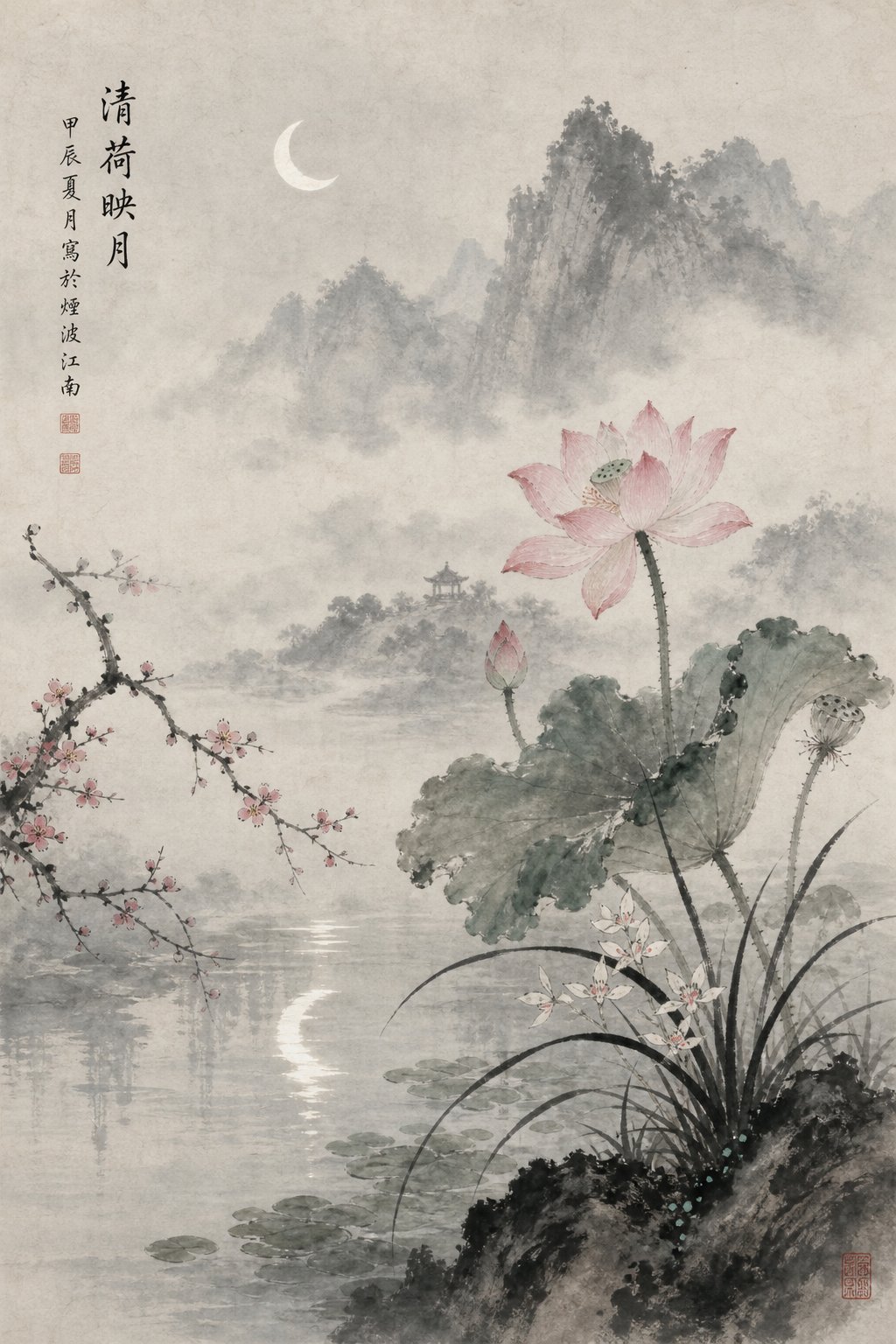
Chinese culture doesn't just admire nature — it reads character into it. A lotus isn't simply a flower; it's a moral statement about rising above difficult circumstances. An orchid isn't just fragrant; it represents someone whose worth doesn't depend on being noticed. When parents choose nature-inspired names, they're encoding these philosophies into their child's identity. The connection between nature and meaning in Chinese naming runs thousands of years deep, rooted in poetry, painting, and Confucian thought.
What follows is a curated collection of flower girl names, water names, and celestial names — each with full characters, pinyin, and the cultural story behind them.
Flower-Inspired Names and Their Symbolism
Chinese tradition recognizes the "Four Gentlemen" (四君子) — four plants that embody noble character traits: plum blossom, orchid, bamboo, and chrysanthemum. Several of these appear frequently in girl names, alongside other beloved flowers. Each carries specific symbolism that goes far beyond appearance.
- 莲 (Lián) — Lotus. Symbolizes purity and moral integrity. The lotus grows from mud but blooms immaculately above the water, making it a Buddhist metaphor for rising above suffering with grace. It also sounds identical to 连 (lián, "to connect"), adding a layer of meaning about lasting family bonds.
- 兰 (Lán) — Orchid. Represents refinement, humility, and quiet virtue. Orchids grow in secluded valleys, blooming whether anyone notices or not. The phrase 兰心蕙质 (lán xīn huì zhì) describes someone with a pure heart and refined character — exactly what parents wish for when choosing this name.
- 梅 (Méi) — Plum blossom. Embodies courage and hope in adversity. While other flowers wait for spring, plum blossoms open during winter's coldest days. This is a name for resilience, for finding beauty when circumstances seem bleak.
- 芙蓉 (Fúróng) — Hibiscus. Evokes radiant beauty and warmth. The flower meanings of hibiscus in Chinese culture connect to splendor and feminine grace. The character 蓉 (Róng) alone appears in names like 蓉花 (Rónghuā), meaning "hibiscus flower."
- 牡丹 (Mǔdān) — Peony. Known as the "king of flowers" in China, it symbolizes prosperity, honor, and bold beauty. A name carrying 丹 (Dān) suggests someone destined for distinction.
- 菊 (Jú) — Chrysanthemum. Represents nobility and longevity, associated with autumn and the poet Tao Yuanming's famous love of simple, principled living.
You'll notice these aren't just decorative choices. Each flower encodes a specific philosophy about how to live well.
Names Drawn From Water and Streams
Water holds a special place in Chinese philosophy. Laozi wrote that "the highest good is like water" — it nourishes everything without competing. Names that mean water carry this sense of adaptability, quiet strength, and life-giving generosity.
- 清 (Qīng) — Clear, pure. Evokes transparent water, moral clarity, and an unclouded mind. Often paired in names like 婉清 (Wǎnqīng, "gentle clarity") or 清欢 (Qīnghuān, "pure joy").
- 溪 (Xī) — Stream, brook. Suggests something graceful and unhurried, flowing naturally through a landscape. The name 灵溪 (Líng Xī) means "spiritual stream."
- 涵 (Hán) — To contain, to nurture (as water contains). Implies depth, tolerance, and inner richness. One of the most popular characters in modern Chinese girl names.
- 沁 (Qìn) — To seep, to refresh. Carries the image of cool water penetrating and reviving — a name suggesting someone whose presence refreshes others.
- 雨 (Yǔ) — Rain. Symbolizes nourishment and renewal. Names like 小雨 (Xiǎo Yǔ, "little rain") and 雨彤 (Yǔ Tóng, "rain and red glow") are both popular and poetic.
These names that mean water work beautifully in combination with other characters, creating images of mist over rivers, rain on blossoms, or moonlight reflected on a still lake.
Celestial Names Meaning Moon and Stars
If water names ground a child in earthly wisdom, celestial names connect her to something boundless. The moon, stars, and sky appear constantly in Chinese poetry and naming — suggesting ethereal beauty, vast potential, and timeless grace. For parents seeking names that mean moon, Chinese offers particularly rich options.
- 月 (Yuè) — Moon. One of the most beloved characters in Chinese girl names. It appears in combinations like 明月 (Míng Yuè, "bright moon"), 秋月 (Qiū Yuè, "autumn moon"), and 心月 (Xīn Yuè, "heart moon"). The moon in Chinese culture represents reunion, beauty, and feminine grace.
- 星 (Xīng) — Star. Suggests brilliance and aspiration. The name 星月 (Xīng Yuè, "star and moon") and 星辰 (Xīng Chén, "stars and celestial bodies") both carry a sense of cosmic wonder.
- 月华 (Yuè Huá) — Moon blossom. Literally "moon radiance" or "moonlight flower," this name merges celestial imagery with floral beauty, creating something luminous and delicate.
- 曦 (Xī) — Morning sunlight, dawn's first rays. For parents looking for names with meaning of sun, 曦 captures that golden moment when light breaks the horizon. Names like 月曦 (Yuè Xī, "moonlight at dawn") blend lunar and solar imagery.
- 云 (Yún) — Cloud. Implies freedom, imagination, and gentle movement. 彩云 (Cǎi Yún, "colorful clouds") and 云溪 (Yún Xī, "cloud stream") are both evocative combinations.
- 晴 (Qíng) — Clear sky, fine weather. A name radiating optimism and brightness, often paired as 紫晴 (Zǐ Qíng, "purple sky") or 沐晴 (Mù Qíng, "bathed in sunshine").
Names with sun meaning tend to carry warmth and vitality, while moon names lean toward mystery and quiet beauty. Many parents combine both — pairing dawn with dusk, or starlight with flowing water — to create names that hold an entire landscape within them.
Nature gives Chinese names their imagery, but it's not the only source of beauty. Some of the most enduring names draw their power from something more abstract — the ideals of elegance, grace, and refinement that Chinese culture has celebrated for centuries.
Elegant Chinese Girl Names That Mean Grace and Beauty
Nature provides imagery, but elegance is an ideal. It's the quality Chinese culture has spent millennia defining, refining, and celebrating — in calligraphy, in poetry, in the way a person carries herself through the world. When parents choose elegant girl names rooted in grace and beauty, they're drawing on one of the deepest wells in Chinese aesthetics. These aren't surface-level compliments. They're aspirations toward a way of being: composed, refined, and quietly powerful.
This category represents some of the most beloved beautiful chinese names for girl with meaning — characters that have appeared in poetry, philosophy, and naming traditions for centuries without losing their resonance.
Single-Character Names Meaning Grace and Beauty
Some characters carry so much weight on their own that they need no partner. These single-character elegant female names each contain a complete aesthetic philosophy. You'll find them standing alone as given names or serving as building blocks in longer combinations.
- 雅 (Yǎ) — Elegant, refined. Originally referred to the "correct" or "standard" style in the Book of Songs (诗经), where the Yǎ section contained court poetry. To be 雅 is to embody cultivated taste — not flashy, but deeply assured.
- 婷 (Tíng) — Graceful, poised. Describes the way someone stands and moves with natural ease. The character contains the radical 女 (woman) alongside 亭 (pavilion), suggesting a figure as balanced and pleasing as a well-proportioned structure.
- 美 (Měi) — Beautiful. One of the most direct and widely recognized characters for beauty. It combines 羊 (sheep, symbolizing goodness) with 大 (large), reflecting an ancient idea that beauty is abundance and virtue made visible.
- 秀 (Xiù) — Refined, outstanding. Originally described grain that flowers and bears fruit — something that fulfills its potential gracefully. A person who is 秀 excels without force, blooming naturally into their best self.
- 丽 (Lì) — Lovely, radiant. Carries a sense of brightness and splendor. The character appears in classical texts describing sunlight, fine scenery, and striking beauty. Names like 丽蓉 (Lìróng) combine this radiance with the lotus flower for layered meaning.
- 娴 (Xián) — Refined, skillful. Implies someone who is both graceful and competent — elegance expressed through mastery rather than mere appearance.
- 姝 (Shū) — Beautiful, fair. A literary character that appears in classical poetry, carrying a more understated, dignified beauty than the bolder 美.
Each of these characters works as a standalone given name, but their real versatility shows when paired with a second character to create layered meaning.
Two-Character Combinations for Layered Elegance
This is where Chinese naming becomes genuinely poetic. Two characters placed together don't just add their meanings — they multiply them, creating imagery that neither character achieves alone. The following pretty chinese girl names demonstrate how pairing works to build depth and nuance.
| Chinese Characters | Pinyin | Literal Meaning | Poetic / Cultural Significance |
|---|---|---|---|
| 雅琳 | Yǎlín | Elegant + Beautiful jade | Refined beauty with inner substance — jade represents integrity that endures |
| 婉清 | Wǎnqīng | Gentle + Clear | Soft-spoken clarity — someone whose gentleness reveals rather than conceals truth |
| 静雅 | Jìngyǎ | Serene + Elegant | Quiet refinement — grace that doesn't need to announce itself |
| 雅婷 | Yǎtíng | Elegant + Graceful | A timeless combination symbolizing poise in both character and movement |
| 美琳 | Měilín | Beautiful + Fine jade | Beauty with purity of heart — outward loveliness matched by inner worth |
| 秀颖 | Xiùyǐng | Refined + Clever | Graceful intelligence — someone who excels with natural ease |
| 慧妍 | Huìyán | Wisdom + Beautiful | Beauty born from insight — attractiveness rooted in understanding |
| 婷安 | Tíng'ān | Graceful + Peaceful | Poised tranquility — a calm presence that puts others at ease |
Notice how these combinations work in pairs: one character often provides the quality (elegant, gentle, serene) while the other provides the medium or manifestation (jade, clarity, peace). The result reads almost like a tiny couplet — two brushstrokes painting a complete portrait.
The Cultural Values Behind Elegance Names
Why does Chinese naming tradition place such emphasis on grace? The answer reaches back to Confucian ideals of 礼 (lǐ, propriety) and the literary tradition of the Book of Songs, where feminine beauty was inseparable from moral character. In classical Chinese thought, true elegance wasn't cosmetic — it was ethical. A woman described as 雅 or 婉 possessed not just pleasing manners but genuine inner cultivation.
This is the cultural logic behind so many beautiful chinese female names: beauty and virtue are treated as the same quality expressed in different registers. The character 秀, for instance, doesn't distinguish between "looking refined" and "being refined." They're one thing.
That said, modern Chinese parents are expanding what elegance means. The trend toward what naming experts call 大气 (dàqì) — "atmospheric" or "broad-spirited" — names reflects a shift. Parents still value grace, but they increasingly pair it with characters suggesting independence and capability. A name like 毅宁 (Yì Níng, "perseverance and peace") or 卓然 (Zhuó Rán, "outstanding and natural") carries elegance without softness. Pretty female chinese names no longer need to signal delicacy alone — they can signal ambition wrapped in grace.
Chinese female names in this category reflect a culture in conversation with itself: honoring classical ideals of refinement while making room for strength, intellect, and self-determination. The most compelling chinese names girl families choose today often hold both qualities in tension — gentle and resolute, beautiful and formidable.
That duality points toward an entire category of names that lean fully into strength, courage, and power — names inspired by warriors, philosophers, and women who reshaped history.
Strong and Powerful Chinese Girl Names
Grace and beauty are only part of the story. Chinese naming tradition holds an equally rich vocabulary for strength, courage, and intellectual power — qualities that famous chinese women have embodied across every dynasty. Parents who choose these names aren't rejecting elegance. They're expanding it, giving their daughters characters that carry the weight of ambition, resilience, and moral conviction.
These strong female names draw from philosophy, history, and the lived examples of women who refused to be defined by limitation.
Names Meaning Wisdom and Intelligence
In Chinese culture, wisdom isn't just about being clever. It's about clarity — seeing through confusion and making sound decisions. The character 智 (Zhì) combines "knowledge" with "sun," suggesting light cutting through darkness. Parents who choose wisdom-related characters are hoping their daughter will navigate life with insight, not just intellect.
- 慧 (Huì) — Wise, intelligent. One of the most popular female chinese names for expressing intellectual aspiration. It implies quick understanding and perceptive judgment. Often paired as 慧敏 (Huìmǐn, "wise and sharp") or 慧心 (Huìxīn, "wise heart").
- 智 (Zhì) — Wisdom, discernment. Carries a deeper, more philosophical weight than 慧. Confucius taught that "the wise are not confused" — this character embodies that clarity.
- 敏 (Mǐn) — Quick, clever, agile of mind. Suggests someone who grasps things rapidly and responds with precision. The name 敏慧 (Mǐnhuì) doubles down on intellectual sharpness.
- 颖 (Yǐng) — Clever, outstanding. Originally described the sharp tip of a grain stalk — the point that emerges first. A name for someone destined to stand out through brilliance.
- 思 (Sī) — Thought, contemplation. Less about speed and more about depth. 思远 (Sīyuǎn, "far-reaching thought") and 思慧 (Sīhuì, "contemplative wisdom") both suggest a reflective, philosophical mind.
These names tell a daughter that her mind is her greatest asset — a message that resonates powerfully in modern China, where education and intellectual achievement are deeply valued.
Warrior and Strength Names From History
Some of the most famous female chinese names belong to women who reshaped history through sheer force of will. Their stories give weight and context to characters associated with courage and power.
花木兰 (Huā Mùlán) — the legendary warrior who disguised herself as a man to take her aging father's place in the army — remains one of the most recognized names of chinese female heroes. Her name itself is poetic: 花 means "flower" and 木兰 means "magnolia." Strength wrapped in beauty, a warrior named for blossoms.
武则天 (Wǔ Zétiān), the only female emperor in Chinese history, ruled during the Tang Dynasty with political brilliance and iron determination. Her surname 武 literally means "martial" or "military" — a character that carries undeniable power when used in naming.
These historical figures inspire female warrior names that parents still choose today:
- 英 (Yīng) — Heroic, outstanding. Originally described the finest flower on a plant — the one that rises above the rest. 英华 (Yīnghuá, "heroic brilliance") and 英慧 (Yīnghuì, "heroic wisdom") both carry commanding energy.
- 毅 (Yì) — Resolute, unwavering. Implies the kind of determination that doesn't bend under pressure. 毅然 (Yìrán, "resolutely") as a name suggests someone who acts with conviction.
- 瑞 (Ruì) — Auspicious strength, good fortune. Combines the idea of power with blessing — strength that brings prosperity rather than destruction.
- 勇 (Yǒng) — Brave, courageous. The character shows "strength" rising from "purpose." It's not blind boldness but strength applied with intention.
- 威 (Wēi) — Dignified power, authority. Suggests someone whose presence commands respect naturally, without aggression.
These badass girl names carry real historical weight. They connect a child to a lineage of women who led armies, governed empires, and broke every convention their era imposed.
Virtue Names Rooted in Confucian Philosophy
Confucian thought provides another category of powerful names — ones that express moral strength rather than physical or intellectual force. These characters have shaped Chinese ethics for over 2,500 years, and they carry that accumulated gravity into any name they appear in.
- 德 (Dé) — Virtue, moral character. The character contains the radical for "walk," suggesting that virtue is a path, not a destination. Names like 明德 (Míngdé, "clear virtue") express the aspiration toward integrity as a lifelong practice.
- 信 (Xìn) — Trust, faithfulness. Built from "person" standing beside "speech" — when you give your word, you become that word. It represents reliability and honor in relationships.
- 仁 (Rén) — Benevolence, humanity. The foundational Confucian virtue. The character combines "person" with "two," expressing that true humanity exists in how we treat others. Confucius taught 仁者爱人 (rénzhě àirén): the benevolent person loves others.
- 义 (Yì) — Righteousness, justice. Implies doing what is right regardless of personal cost. A name carrying 义 signals moral courage.
- 诚 (Chéng) — Sincerity, authenticity. Combines "speech" with "complete" — words that are whole reflections of actual thought. No gap between what you say and what you mean.
What makes these virtue names powerful rather than merely pious is their philosophical depth. A child named 仁慧 (Rénhuì, "benevolent wisdom") or 德馨 (Déxīn, "virtue's fragrance") carries a moral framework embedded in her identity — a daily reminder of who she's meant to become.
Modern Chinese parents increasingly blend these categories, pairing virtue characters with beauty or nature characters to create names that hold both strength and grace. The names of strong woman figures from history prove these qualities were never mutually exclusive — and today's naming trends reflect that understanding more openly than ever.
Strength, of course, doesn't exist in a vacuum. It's shaped by the era that produces it. The names Chinese families have chosen across dynasties reveal shifting definitions of power, beauty, and aspiration — a story that stretches from Tang poetry to today's maternity wards.
Ancient and Literary Chinese Names Through History
Chinese girl names don't exist outside of time. They carry the fingerprints of the era that produced them — the poetry being read, the politics being lived, the values being celebrated or imposed. Tracing how ancient chinese names evolved across dynasties reveals something remarkable: naming is a form of cultural autobiography, written one generation at a time.
Classical Names From Tang and Song Poetry
The Tang Dynasty (618-907 CE) and Song Dynasty (960-1279 CE) represent the golden age of Chinese literature, and their poetry remains the richest source of ancient chinese girls names still in use today. Parents have drawn from these verses for over a thousand years, choosing characters that carry the weight of literary tradition alongside personal meaning.
Consider 清照 (Qīng Zhào), the name of Li Qingzhao — widely regarded as the greatest female poet in Chinese history. Her name means "clear radiance," and it has inspired countless parents seeking ancient chinese names female that evoke both intellect and luminous beauty. The Song Dynasty poet's legacy makes this name resonate with literary achievement and emotional depth.
Other famous chinese names drawn directly from classical poetry include:
- 静姝 (Jìng Shū) — From the Book of Songs (诗经), China's earliest poetry anthology. Means "quiet and beautiful lady." The poem describes an ideal woman whose beauty is inseparable from her composure.
- 蓁蓁 (Zhēn Zhēn) — Also from the Book of Songs, meaning "lush, thriving plants." Used to describe a bride's vitality and the hope she brings to a new family.
- 若兰 (Ruò Lán) — Meaning "as graceful as an orchid," this name appears in the Ballad of Mulan and the Book of Jin, connecting it to both warrior courage and refined virtue.
- 舒窈 (Shū Yǎo) — From the Book of Songs, meaning "graceful and quiet." It paints an image of elegant posture and gentle temperament in just two characters.
- 易安 (Yì Ān) — The art name Li Qingzhao chose for herself, drawn from Tao Yuanming's prose. It means "peaceful contentment" — a philosophical aspiration compressed into two syllables.
What makes these ancient chinese names girl choices so enduring is their dual nature: they're beautiful on their own terms, and they connect the bearer to a specific literary moment that educated Chinese speakers recognize instantly.
How Naming Trends Shifted Across Generations
Zoom out from individual poems, and you'll see naming patterns that mirror China's political and social upheavals with startling clarity. Research covering nearly 1.2 billion Han Chinese individuals born between 1930 and 2008 reveals how dramatically popular chinese names shifted with each generation.
Before the 1960s, typical chinese names for girls emphasized traditional feminine virtues. Characters like 淑 (Shū, gentle and virtuous), 贞 (Zhēn, chaste), 玉 (Yù, jade), and 芳 (Fāng, fragrance) dominated. These names reflected Confucian ideals of womanhood — purity, beauty, and moral refinement.
Then came the revolutionary era. As writer Wendy Chen describes from her own family history, names in the 1960s and 1970s were "heavily influenced by the nationalistic fervor of the time." Characters like 红 (Hóng, red — the color of revolution), 军 (Jūn, army), and even direct references to Mao Zedong appeared in girls' names. The family's wishes gave way to the nation's ideology. One's love for the country was expected to override personal expression, and names became political declarations.
The 1980s brought another shift. With economic reform and the one-child policy, parents poured all their aspirations into a single child. Chinese names popular during this decade leaned toward individual achievement: 慧 (Huì, wisdom), 佳 (Jiā, excellent), and 晓 (Xiǎo, knowing). By the 1990s and 2000s, aesthetic and aspirational names took over — 诗 (Shī, poetry), 梦 (Mèng, dream), 涵 (Hán, nurture), and 欣 (Xīn, joy) became dominant choices.
| Era | Example Names | Characters and Meaning | Historical Context | Modern Usage |
|---|---|---|---|---|
| Pre-1960s (Classical) | 淑芳, 玉兰 | 淑 Shū (gentle) + 芳 Fāng (fragrance); 玉 Yù (jade) + 兰 Lán (orchid) | Confucian feminine ideals of virtue and natural beauty | Considered traditional; still used in literary contexts |
| 1960s-1970s (Revolutionary) | 红梅, 建华 | 红 Hóng (red) + 梅 Méi (plum); 建 Jiàn (build) + 华 Huá (China/splendid) | Cultural Revolution nationalism; names served political identity | Rarely chosen today; seen as dated |
| 1980s-1990s (Reform Era) | 慧敏, 佳欣 | 慧 Huì (wise) + 敏 Mǐn (sharp); 佳 Jiā (excellent) + 欣 Xīn (joy) | Economic opening; one-child policy focused all hopes on one name | Common among millennials; still in active use |
| 2000s-Present (Aesthetic) | 诗涵, 梦琪 | 诗 Shī (poetry) + 涵 Hán (nurture); 梦 Mèng (dream) + 琪 Qí (fine jade) | Globalization, internet culture, return to literary aesthetics | Highly popular; dominant in current naming trends |
This table reveals something striking: each generation's names encode the anxieties and aspirations of their parents' world. Revolutionary parents named daughters for the state. Reform-era parents named them for personal success. Today's parents name them for beauty, depth, and imagination.
Rare Ancient Characters Making a Modern Comeback
Here's where the story takes an interesting turn. As modern parents search for names that stand out from the crowd — avoiding the "market names" problem where calling out a common name turns many heads — they're reaching back into classical texts for rare, forgotten characters.
The shift away from single-character names (which peaked in the 1980s) happened precisely because too many people shared the same name. Two-character given names returned as the norm, and parents began mining ancient poetry for unusual combinations that feel fresh yet rooted.
Characters experiencing revival include:
- 韫 (Yùn) — To contain, to treasure within. Appears in the ancient name 道韫 (Dào Yùn), belonging to a famous Eastern Jin Dynasty poet. It suggests hidden brilliance — talent that doesn't need to announce itself.
- 琼 (Qióng) — Fine jade, precious beauty. From the Book of Songs phrase 琼华 (Qióng Huá, "brilliant jade"), this character carries imperial elegance and is returning in combinations like 琼瑶 (Qióng Yáo, "precious jade").
- 窈 (Yǎo) — Graceful, secluded. From the famous Book of Songs line 窈窕淑女 (yǎotiǎo shūnǚ, "graceful and virtuous lady"). Once considered too literary for everyday use, it's now appearing in names like 舒窈 (Shū Yǎo).
- 昭 (Zhāo) — Bright, illustrious. Connected to the legendary beauty Wang Zhaojun (王昭君), one of the Four Great Beauties of ancient China. The character suggests someone whose virtue shines visibly.
- 蕊 (Ruǐ) — Flower bud, pistil. An ancient character that captures potential — beauty about to bloom but not yet fully revealed. It's gaining popularity among parents who want something poetic but uncommon.
This revival reflects a broader cultural pattern: as China's confidence in its own heritage grows, parents feel freer to draw from deep literary history rather than following whatever names happen to be trending. The result is a generation of girls carrying ancient chinese names female poets and scholars would recognize — names that feel simultaneously timeless and new.
Ancient names carry the past forward, but many families face a different challenge entirely: choosing names that honor Chinese heritage while functioning smoothly in English-speaking environments. That balancing act requires its own set of strategies.
Choosing Chinese Names for Bicultural Families
For families living between two languages, naming a daughter isn't just about meaning or beauty — it's about navigation. How do you honor Chinese heritage while giving your child a name that flows naturally at school, at work, and in everyday English-speaking life? This is the question that keeps bicultural parents up at night, and it's one that millions of Chinese American girl names reflect in their careful construction.
The challenge is real. As writer Cecilia Huang describes, she and her husband spent weeks deciding not just what names to give their daughter, but how those names would fit together — Anglo first name, middle name, and Chinese name, each serving a different function in their child's multicultural identity. The process involved merging two sets of values, balancing tradition with individualism, and thinking carefully about how their daughter would carry these names through different cultural spaces.
Chinese Names That Sound Natural in English
The simplest strategy for asian american girl names is phonetic overlap — choosing Chinese characters whose pronunciation already resembles a familiar English name or word. This gives a child one name that functions in both worlds without translation or explanation.
Consider 美 (Měi). Spoken aloud, it sounds almost identical to the English name "May." But in Chinese, it means "beautiful" — a complete, meaningful given name with deep cultural resonance. A girl named Mei can introduce herself in English without hesitation, while her Chinese relatives hear a name rich with intention.
Other examples of this phonetic bridge:
- 丽 (Lì) — Sounds like "Lee" in English. Means "lovely, radiant." Works seamlessly as both a Chinese given name and an English-friendly first name.
- 安 (Ān) — Sounds like "Ann." Means "peace, tranquility." A gender-neutral option that reads naturally in any context.
- 琳 (Lín) — Sounds like "Lynn." Means "beautiful jade." Familiar to English speakers while carrying the weight of jade symbolism in Chinese culture.
- 乐 (Lè) — Sounds close to "Le" or "Leh." Means "joy, happiness." Short, bright, and easy to pronounce across languages.
- 瑞 (Ruì) — Sounds similar to "Ray." Means "auspicious, fortunate." Carries strength and good fortune in Chinese while sounding effortless in English.
These aren't compromises. Each name is fully Chinese in meaning and fully accessible in English pronunciation. The key is that the phonetic similarity happens naturally — you're not forcing a transliteration but finding genuine overlap between the two sound systems.
Strategies for Pairing Chinese and English Names
Not every family wants a single name that does double duty. Many choose separate English and Chinese names, each complete on its own terms. The question then becomes: how do you make them feel like they belong to the same person?
Three approaches work particularly well when selecting chinese baby names alongside English ones:
Meaning echo. Choose an English name and a Chinese name that share thematic resonance without being literal translations. A girl named Grace might carry the Chinese name 雅 (Yǎ, elegant) — not a translation, but a parallel aspiration. Lily pairs naturally with 莲 (Lián, lotus) — both are flowers, both suggest purity, but each belongs fully to its own language.
Sound harmony. Even when names are separate, they should flow together when spoken in sequence. If the surname is Chen, a name like "Sophia Chen" has a natural rhythm, and a Chinese name like 诗雅 (Shīyǎ, "poetic elegance") echoes the "sh" sound of Sophia without being a transliteration.
Chinese name as legal middle name. Some families place the Chinese given name in the middle name position on legal documents. This keeps it visible and official while allowing the English first name to lead in daily life. Huang's family debated this exact question — whether to include Chinese characters on legal documents or keep the Chinese name informal. Her conclusion: making it official signals to the child that this name is a real part of who she is.
Here are example pairings that demonstrate these strategies with common asian girl names and surnames:
- Lily Chen / 陈莲心 (Chén Liánxīn) — English flower name paired with "lotus heart" in Chinese. Both evoke purity and natural beauty.
- Grace Wang / 王雅婷 (Wáng Yǎtíng) — "Grace" echoed by "elegant and poised" in Chinese. Parallel meaning, independent names.
- May Lin / 林美 (Lín Měi) — Phonetic overlap where "May" mirrors 美 (Měi, beautiful). The English and Chinese names are essentially the same sound with the same spirit.
- Sophia Zhang / 张诗涵 (Zhāng Shīhán) — "Sophia" (wisdom) paired with "poetry and depth." Both suggest intellectual richness.
- Iris Li / 李兰 (Lǐ Lán) — Both names reference flowers (iris and orchid), creating thematic unity across languages.
- Joy Liu / 刘乐欣 (Liú Lèxīn) — "Joy" directly echoed by 乐 (Lè, joy) and 欣 (Xīn, happiness). Meaning alignment without forced translation.
- Claire Huang / 黄清月 (Huáng Qīngyuè) — "Claire" (clear, bright) paired with "clear moonlight." Both names carry luminous clarity.
- Vivian Zhou / 周薇 (Zhōu Wēi) — "Vivian" (lively) paired with 薇 (Wēi, fern/flourishing plant). Both suggest vitality and growth.
- Jade Wu / 吴玉琳 (Wú Yùlín) — The English name "Jade" directly connects to 玉 (Yù, jade) in the Chinese name. A rare case where literal overlap works beautifully.
- Serena Yang / 杨静雅 (Yáng Jìngyǎ) — "Serena" (serene) paired with "serene elegance." The meaning carries across perfectly.
Balancing Heritage and Practicality for Diaspora Families
The practical concerns are real. As one bicultural parent discovered, even a well-chosen Chinese name can create awkward moments if English speakers can't pronounce it — or worse, if it accidentally sounds like something unfortunate in the other language. "Charlotte" in Chinese sounds eerily close to 杀了他 (shā le tā) — "kill him." These phonetic collisions matter.
For diaspora families choosing an asian girl name alongside an English one, a few practical guidelines help:
First, test pronunciation with speakers of both languages. A name that sounds elegant in Mandarin might hit English ears strangely, and vice versa. Run your choices past friends and family in both linguistic communities — crowdsourcing feedback catches problems that a single perspective misses.
Second, consider which dialect the family actually speaks. A Cantonese family choosing chinese baby girl names will pronounce characters differently than a Mandarin-speaking one. The character 月 (moon) is "yuè" in Mandarin but "jyut" in Cantonese — and the English approximation shifts accordingly. Choose based on how the name will actually be spoken at home.
Third, don't underestimate the power of a name that's easy to spell. Asian female names that require constant spelling corrections can become a source of frustration rather than pride. Names with simple pinyin romanizations — Mei, Lin, An, Lan — tend to travel well across forms, databases, and introductions.
Finally, remember that a name's relationship to identity evolves. Huang's friend, who never adopted an English name and kept his Chinese given name through school despite mispronunciations, ultimately chose not to put his own daughter's Chinese name on legal documents. His reasoning was simple: "Just because someone has a Chinese name, it doesn't mean that they will learn to speak Chinese." The name matters, but it's one thread in a larger tapestry of cultural connection — not the whole fabric.
The best chinese baby names for bicultural families aren't compromises. They're names chosen with full awareness of both worlds the child will inhabit, designed to give her confidence and connection in each. Whether that means one name doing double duty or two names working in concert, the goal is the same: a name she's proud to carry everywhere she goes.
Choosing well, though, requires knowing what to avoid. Chinese naming carries specific taboos and cultural pitfalls that can turn a well-intentioned name into an embarrassing one — and those rules aren't always obvious to families making decisions across cultural boundaries.

Naming Taboos and Cultural Pitfalls to Avoid
A name can carry all the right meaning, reference the perfect poem, and balance the five elements beautifully — and still be wrong. Chinese naming culture has firm boundaries that families take seriously, and crossing them can turn a well-intentioned name into a source of embarrassment or even perceived bad luck. Understanding chinese name meanings requires knowing not just what characters signify, but what they accidentally imply.
These aren't arbitrary rules. They reflect centuries of cultural logic about respect, phonetic awareness, and the belief that a name shapes destiny. If you're choosing chinese female first names — whether for a child, a character, or yourself — these are the pitfalls that trip up even native speakers who haven't done their homework.
Homophones and Hidden Negative Meanings to Avoid
Mandarin is full of homophones — different characters that share the same pronunciation. This creates a minefield for naming. A character might look elegant on paper but sound identical to something unfortunate when spoken aloud. Chinese families instinctively screen for these collisions, and you should too.
- Avoid sounds resembling 死 (sǐ, death). Any character or combination that sounds close to "si" in the fourth or third tone raises immediate red flags. The number four (四, sì) is avoided in addresses and phone numbers for this exact reason — the same logic applies to names.
- Watch for 失 (shī, loss/failure) and 苦 (kǔ, suffering). A name like 诗涵 (Shīhán) is fine because context and tone distinguish it clearly. But a name where the full-name sound echoes 失败 (shībài, failure) or 苦难 (kǔnàn, hardship) would never pass a Chinese ear.
- Check the full name spoken quickly. Individual characters might be fine, but when combined with the surname and spoken at conversational speed, they can form unintended words. The surname 杨 (Yáng) paired with 伟 (Wěi) creates 杨伟 — which sounds like a slang term for impotence. These collisions aren't obvious until you say the name out loud repeatedly.
- Test across dialects. A name that sounds perfectly fine in Mandarin might carry unfortunate associations in Cantonese, Hokkien, or Shanghainese. If the family has roots in southern China or Hong Kong, verify pronunciation in the relevant dialect. The character 书 (shū, book) is elegant in Mandarin but sounds like "lose" in some southern dialects.
- Beware of overly grandiose characters. Characters like 帝 (dì, emperor), 圣 (shèng, saint), or 天 (tiān, heaven) used directly can be seen as inviting bad luck — the logic being that such lofty names create expectations the bearer cannot fulfill, attracting misfortune through hubris. Subtlety is preferred over grandeur.
The underlying principle is simple: say the full name aloud dozens of times, in different speeds and contexts. If it ever sounds like something you wouldn't want shouted across a playground, reconsider.
Family Hierarchy Rules and Generational Conflicts
One of the most important taboos in Chinese naming — and one that surprises many Western families — is the prohibition against using characters that appear in an elder relative's name. This practice, called 避讳 (bìhuì, name taboo), reflects deep Confucian respect for family hierarchy.
- Never duplicate a grandparent's or parent's name character. If a grandmother's name contains 芳 (Fāng, fragrance), that character is off-limits for granddaughters — even in a different combination. Using it would imply placing yourself on the same level as your elder, which is considered deeply disrespectful.
- Extend the check to great-grandparents and uncles/aunts. In traditional families, the taboo reaches several generations back. Before finalizing any common chinese girl names, consult older family members about which characters are "taken."
- Generational names (字辈) must follow sequence. In families that maintain generational naming, each generation has a designated shared character. Skipping ahead or reusing a previous generation's character disrupts the family's naming order — a serious breach in traditional households.
- Avoid characters used by respected public figures in some contexts. Historically, using the same characters as an emperor or revered teacher was forbidden. This extreme form of 避讳 is rare today, but some families still avoid characters associated with recently deceased elders in the broader clan.
For diaspora families, this rule creates a practical challenge: you need to know your family tree before you can name a child. A quick call to grandparents or a look at the family registry (族谱) saves potential embarrassment. Many chinese women's names that seem perfectly available might already belong to an aunt or great-grandmother you've never met.
Surname Pairing and Phonetic Harmony Tips
Even after clearing homophones and family conflicts, there's one more layer: how the given name sounds alongside the specific surname. Chinese last names for girls aren't interchangeable backdrops — each surname has its own tonal character, and the given name must complement it rhythmically.
Here's how tonal pairing works with the most common chinese name surnames:
- 王 (Wáng, second tone — rising): Pairs well with given names starting in first or fourth tone, creating tonal contrast. 王静雅 (Wáng Jìngyǎ) flows naturally because the tones move through different pitches. Avoid two consecutive second-tone characters after Wáng — three rising tones in a row sounds monotonous.
- 李 (Lǐ, third tone — dipping): Third tone followed by another third tone triggers a tone change rule (the first becomes second tone in speech). 李美 (Lǐ Měi) actually sounds like "Lí Měi" when spoken — which is fine, but parents should know it happens. Pairing with first or fourth tone characters like 李诗涵 (Lǐ Shīhán) creates clearer contrast.
- 张 (Zhāng, first tone — high flat): Works beautifully with fourth-tone characters that create a satisfying high-to-falling arc. 张慧 (Zhāng Huì) and 张月 (Zhāng Yuè) both have natural rhythm. Avoid pairing with another first-tone character immediately — 张诗 (Zhāng Shī) can sound flat.
- 刘 (Liú, second tone): Similar to Wáng in tonal behavior. Given names beginning with third or fourth tone create pleasing movement: 刘美琳 (Liú Měilín) rises, dips, then rises again — musical and memorable.
- 陈 (Chén, second tone): Pairs naturally with characters starting in fourth tone for a rise-then-fall pattern. 陈雅 (Chén Yǎ) works well, as does 陈诗颖 (Chén Shīyǐng).
Beyond tones, consider the mouth feel of consonant transitions. A surname ending in "-ng" (like Wáng or Zhāng) flows more smoothly into given names starting with vowels or soft consonants (y, l, m) than into hard stops (b, d, g). Say the full name five times fast — if your tongue trips, listeners' ears will too.
One final consideration that applies to all chinese first names female families choose: stroke count balance. A surname with very few strokes (like 丁, two strokes) looks visually unbalanced next to a complex given name character (like 馨, twenty strokes). The reverse is also true — a dense surname like 魏 (seventeen strokes) paired with minimalist given name characters can look top-heavy when written. The best chinese names female and meanings align across all dimensions: sound, meaning, visual form, and cultural appropriateness.
Naming taboos might seem like restrictions, but they're actually guardrails. They protect a name's integrity across contexts — spoken quickly, written formally, heard in different dialects, and received by family members who carry their own naming history. A name that clears every one of these checks isn't just safe. It's strong — built to last across a lifetime of introductions, documents, and the quiet moments when a person sees her own name written and feels it fits.
Frequently Asked Questions About Beautiful Chinese Girl Names
1. How do I choose a Chinese name for my daughter if I don't speak Chinese?
Start by understanding that each Chinese character carries its own meaning, tone, and visual form. Focus on themes that resonate with you — nature, elegance, strength, or wisdom — then select characters within that theme. Use pinyin with tone marks to learn correct pronunciation, and test the full name aloud with native speakers. Consider consulting a Chinese naming expert or family elder who can check for homophone conflicts, stroke count balance, and cultural appropriateness across dialects.
2. What are the most popular Chinese girl name characters and what do they mean?
Some of the most frequently used characters in modern Chinese girl names include 涵 (Han, to nurture/contain), 诗 (Shi, poetry), 梦 (Meng, dream), 雅 (Ya, elegant), 慧 (Hui, wise), and 美 (Mei, beautiful). Nature characters like 月 (Yue, moon), 兰 (Lan, orchid), and 莲 (Lian, lotus) remain timeless choices. Each character is selected not just for meaning but for how it pairs with other characters to create layered poetic significance.
3. Why do tones matter when choosing a Chinese girl name?
Mandarin Chinese has four tones, and the same syllable spoken with a different tone produces an entirely different character and meaning. For example, 'mei' with a rising second tone means plum blossom (梅), while 'mei' with a dipping third tone means beautiful (美). Choosing the wrong tone doesn't just mispronounce a name — it changes the name's identity completely. Tones also affect how a name flows rhythmically when paired with the family surname.
4. What Chinese naming taboos should I be aware of?
Key taboos include avoiding characters that sound like negative words when spoken aloud (especially homophones of death, loss, or suffering), never using characters from an elder relative's name (which signals disrespect in Confucian tradition), and steering clear of overly grandiose characters like emperor or saint that are believed to invite bad luck. Always test the full name — surname plus given name — spoken quickly to catch unintended word formations, and verify pronunciation across relevant Chinese dialects.
5. Can a Chinese name work alongside an English name for a bicultural child?
Absolutely. Three proven strategies exist: phonetic overlap (choosing Chinese characters that naturally sound like English names, such as 美 Mei sounding like May), meaning echo (pairing names with parallel themes, like Grace with 雅 Ya for elegance), and using the Chinese name as a legal middle name to keep it official. The best pairings feel natural in both languages without forcing translation, giving the child confidence and cultural connection in each world she navigates.