What Makes Chinese Nicknames So Uniquely Adorable
When you call someone "honey" in English, the meaning is straightforward. But nicknames in Chinese operate on a completely different level. They blend tonal wordplay, cultural symbolism, and layered emotional meaning into a single word or phrase. A Chinese nickname can reference food, animals, ancient poetry, or even a person's birth order, and each choice signals a specific degree of closeness between the speaker and the listener.
Why Chinese Nicknames Are Unlike Any Other Language
Chinese terms of endearment draw power from the language itself. Mandarin's four tones mean that repeating a single character twice, like 宝宝 (bǎobǎo, "baby"), creates a melodic, soothing sound that feels inherently affectionate. The 小 (xiǎo) prefix, meaning "little," transforms almost any noun into something tender. And food-based names like 小汤圆 ("little rice ball") carry cultural warmth because they reference shared meals and family traditions. These structural tools give Chinese nicknames a built-in expressiveness that simple translations can never capture.
In Chinese culture, the nickname someone uses for you reveals exactly how close they consider the relationship. A term reserved for family would feel jarring from a coworker, and a playful friend nickname would sound too casual from a new partner. Intimacy level dictates which nickname is appropriate, making Chinese endearments a social map as much as a sign of affection.
Who Uses Cute Chinese Nicknames and When
From couples texting 亲爱的 (qīn'aide, "dear") on WeChat to grandparents calling a toddler 崽崽 (zǎizǎi, "little one"), these terms of endearment in Chinese show up everywhere. Gamers adopt cool tags, pet owners pick food-inspired names for cats and dogs, and Gen Z speakers invent entirely new internet slang. Whether you are learning Mandarin, navigating a cross-cultural relationship, or simply curious about Chinese naming culture, understanding how these nicknames work opens a window into how Chinese speakers express love, humor, and belonging.
This guide covers romantic partners, friends, family, children, pets, and digital spaces, giving you the patterns and context to use cute Chinese nicknames with confidence.

How Chinese Nicknames Are Actually Formed
Every cute Mandarin nickname you hear follows a pattern. Once you recognize these patterns, you stop memorizing random words and start understanding the logic behind them. Think of it like learning a recipe instead of ordering takeout: you can create something new anytime you want.
A Chinese nickname is built from a small set of structural formulas. Five core methods account for the vast majority of affectionate names used across romantic, family, friendship, and pet contexts. Each method carries its own emotional flavor, from playful to deeply intimate.
Reduplication and the Power of Repeated Sounds
Reduplication means repeating a single character to form a two-syllable nickname. In Mandarin, this repetition creates a soft, rhythmic sound that feels inherently gentle. You will notice this pattern everywhere, from parents calling a child 甜甜 (tiántián, "sweet-sweet") to couples whispering 宝宝 (bǎobǎo, "baby-baby").
Why does it work? Repeated syllables mimic the babbling sounds of early childhood, triggering a sense of warmth and closeness. The effect is universal across Chinese dialects. A single character like 乖 (guāi, "well-behaved") sounds like a plain adjective, but 乖乖 (guāiguāi) instantly becomes an affectionate nickname.
Common reduplicated nicknames include:
- 宝宝 (bǎobǎo) - treasure, used for babies and romantic partners
- 甜甜 (tiántián) - sweet in Chinese, used for girls and children
- 乖乖 (guāiguāi) - good one, used for children and pets
- 毛毛 (máomáo) - fluffy, popular for pets and toddlers
- 豆豆 (dòudòu) - little bean, used across all relationships
Reduplication is the simplest way to form a nick name in Chinese, and it is often the first pattern learners pick up naturally.
The 小 Prefix and 儿 Suffix Explained
The character 小 (xiǎo), meaning "little," is the single most productive nickname prefix in Mandarin. Place it before almost any noun, adjective, or surname, and you instantly create an affectionate name. 小猫 (xiǎo māo, "little cat"), 小明 (xiǎo míng, a common childhood name), 小胖 (xiǎo pàng, "little chubby") - the possibilities are endless.
What makes 小 so versatile is its emotional range. Between friends, it sounds casual and playful. From a parent to a child, it sounds protective. Between lovers, it sounds tender. The context shapes the feeling, but the structure stays the same.
The 儿 (ér) suffix works differently. Rather than being a separate syllable, it blends into the preceding sound, creating what linguists call 儿化 (érhuà). This phonetic shift adds a diminutive, affectionate tone to any word. In Chinese culture, people use 儿 to express endearment or cuteness, particularly when referring to children or loved ones. If someone's name is 张芳 (Zhāng Fāng), a family member might affectionately call them 芳儿 (Fāngr). Similarly, 宝贝儿 (bǎobèir) sounds softer and more intimate than the standard 宝贝 (bǎobèi).
The 儿 suffix is especially common in northern Mandarin and Beijing dialect. Speakers in southern China and Taiwan use it less frequently, preferring other patterns like reduplication or the 小 prefix instead.
Food and Animal Naming Conventions
Imagine calling your partner "little rice ball" or your child "little dumpling." Sounds odd in English, but in Chinese, food-based nicknames are everywhere. They carry cultural warmth because food represents love, nourishment, and family gatherings in Chinese society. A nickname like 小汤圆 (xiǎo tāngyuán, "little glutinous rice ball") references the sweet dessert eaten during family reunions, layering the name with emotional meaning.
Popular food-inspired nicknames include 糖糖 (tángtáng, "candy-candy"), 小馒头 (xiǎo mántou, "little steamed bun"), and 果果 (guǒguǒ, "fruit-fruit"). Each one sounds cute in Mandarin because it combines the softness of reduplication or the 小 prefix with a familiar, comforting food image.
Animal-based nicknames follow the same logic but lean more playful. Calling someone 小猪 (xiǎo zhū, "little pig") is not an insult in Chinese. It is affectionate, implying the person is adorable and perhaps a little lazy in an endearing way. 小兔子 (xiǎo tùzi, "little rabbit") suggests someone gentle and cute. 小熊 (xiǎo xióng, "little bear") works for someone cuddly and warm.
The table below summarizes all five formation patterns so you can see the structure at a glance:
| Pattern Name | Structure | Example (Characters) | Pinyin | English Meaning |
|---|---|---|---|---|
| Reduplication | Character + Same Character | 宝宝 | bǎobǎo | Baby / Treasure |
| Reduplication | Character + Same Character | 甜甜 | tiántián | Sweetie |
| 小 Prefix | 小 + Noun/Adjective | 小胖 | xiǎo pàng | Little Chubby |
| 小 Prefix | 小 + Animal | 小猪 | xiǎo zhū | Little Pig |
| 儿 Suffix | Name Character + 儿 | 芳儿 | fāngr | Little Fang (affectionate) |
| 儿 Suffix | Noun + 儿 | 花儿 | huār | Little Flower |
| Food-Based | 小 + Food Item | 小汤圆 | xiǎo tāngyuán | Little Rice Ball |
| Food-Based | Food + Reduplication | 糖糖 | tángtáng | Candy-Candy |
| Animal-Based | 小 + Animal | 小兔子 | xiǎo tùzi | Little Rabbit |
| Animal-Based | 小 + Animal | 小熊 | xiǎo xióng | Little Bear |
You will notice that many nicknames combine multiple patterns. 小豆豆 (xiǎo dòudòu) uses both the 小 prefix and reduplication. 糖糖儿 (tángtángr) layers reduplication with the 儿 suffix. This mixing and matching is exactly how native speakers create personalized Chinese nicknames that feel fresh yet familiar.
These five patterns are the building blocks. Every nickname Mandarin speakers use, whether for a lover, a best friend, a toddler, or a pet, traces back to one or more of these structures. The real fun begins when you apply them to specific relationships, where context and emotional tone shape which pattern fits best.
Romantic Chinese Nicknames for Lovers and Partners
Romantic relationships bring out the most creative side of Chinese naming culture. Couples in China do not just pick one pet name and stick with it. They cycle through different nicknames depending on mood, setting, and how long they have been together. A new couple might start with something safe like 亲爱的 (qīn'aide, "dear"), then graduate to playful terms like 小猪 (xiǎo zhū, "little pig") as intimacy deepens. Understanding which chinese pet names for lovers fit which stage helps you avoid sounding too formal or too familiar at the wrong moment.
Gender also plays a role, though younger generations are blurring these lines. Some terms are traditionally directed at women, others at men, and a growing number work for anyone. Here is a breakdown organized by who typically uses each term and when.
Nicknames for Your Girlfriend in Chinese
When looking for chinese nicknames for girlfriend options, you will find that many emphasize beauty, sweetness, or preciousness. These reflect cultural ideals around femininity, though plenty of modern couples use them more loosely.
- 老婆 (lǎopó) - Literally "wife," but dating couples use it freely to signal commitment. A boyfriend might text: "老婆,今天想吃什么?" (Wife, what do you want to eat today?)
- 小公主 (xiǎo gōngzhǔ) - "Little princess." Used to pamper and dote. Common in text messages: "小公主早安!" (Good morning, little princess!)
- 甜甜 (tiántián) - "Sweetie." A reduplicated form that sounds melodic and warm. Works well as a daily greeting name.
- 娘子 (niángzi) - An old-fashioned term meaning "lady" or "missus." It carries a chivalrous, almost poetic tone, popular among couples who enjoy playful formality.
- 小傻瓜 (xiǎo shǎguā) - "Little silly melon." Affectionate teasing when she does something innocent or goofy.
- 媳妇儿 (xífùr) - "Little wife," with the 儿 suffix adding northern Chinese warmth. Common in casual, everyday conversation.
Chinese girlfriend nicknames tend to lean softer and more protective in tone. The 小 prefix appears frequently because it frames the person as someone to be cherished and looked after. Among chinese pet names for girlfriend choices, 老婆 remains the most universally recognized, used by couples at nearly every stage of a relationship.
Nicknames for Your Boyfriend in Chinese
Terms for boyfriends in Chinese often play with strength, reliability, or gentle humor. Calling your boyfriend in Chinese by a special name signals closeness without the formality of his full name.
- 老公 (lǎogōng) - Literally "husband," but widely used by unmarried couples. It implies a vision of a shared future. Example: "老公,你到哪了?" (Hubby, where are you?)
- 小哥哥 (xiǎo gēge) - "Little older brother." Despite the literal meaning, it is a flirty, youthful term popular among younger women. It emphasizes playfulness rather than actual family ties.
- 老头子 (lǎo tóuzi) - "Old man." Sounds teasing in English, and it works the same way in Chinese. It is affectionate ribbing, like calling your partner an endearing grump.
- 熊熊 (xióngxióng) - "Bear-bear." A reduplicated animal nickname for someone cuddly, strong, or both.
You will notice that lover in chinese language contexts often uses terms that sound like family titles. 老公 and 老婆 literally mean husband and wife, yet dating couples adopt them early. This reflects a cultural tendency to frame romantic commitment in familial terms, signaling seriousness and long-term intention.
Gender-Neutral Romantic Pet Names
Many of the most popular chinese couple nicknames work regardless of gender. These are the terms you hear most often in everyday life because they fit any dynamic.
| Nickname (Characters) | Pinyin | Literal Meaning | Who Uses It | Example Sentence |
|---|---|---|---|---|
| 宝贝 | bǎobèi | Treasure / Baby | Anyone to a partner | 宝贝,我想你了。(Baby, I miss you.) |
| 亲爱的 | qīn'aide | Dear / Darling | Anyone to a partner | 亲爱的,晚安。(Darling, good night.) |
| 宝宝 | bǎobǎo | Baby-baby | Anyone, playful tone | 宝宝乖,别生气。(Baby, don't be mad.) |
| 心肝 | xīngān | Heart and liver | Anyone, deeply intimate | 你是我的心肝。(You are my dearest.) |
| 甜心 | tiánxīn | Sweetheart | Anyone, casual | 甜心,今天开心吗?(Sweetheart, happy today?) |
| 亲亲 | qīnqīn | Kissy / Kiss-kiss | Anyone, texting | 亲亲,早上好!(Kissy, good morning!) |
| 傻瓜 | shǎguā | Silly melon / Fool | Anyone, teasing | 傻瓜,我当然爱你。(Silly, of course I love you.) |
A few of these deserve extra context. 宝贝 (bǎobèi) became the dominant romantic nickname in China partly through pop culture. It appears constantly in songs, TV dramas, and advertisements, making it feel natural and modern. 心肝 (xīngān), on the other hand, has literary roots stretching back centuries. Calling someone your "heart and liver" in Chinese means they are essential to your survival, the organs you cannot live without. It is deeply poetic and reserved for moments of genuine emotional intensity.
傻瓜 (shǎguā) surprises many learners because it literally means "fool" or "idiot." Yet between lovers, it functions like saying "you're so silly" with a smile. The affection lives in the tone of voice and the relationship context, not the dictionary definition. This is one of those terms where understanding Chinese culture matters more than understanding the translation.
Younger generations are increasingly mixing these categories. A boyfriend might call his partner 宝宝 just as easily as a girlfriend would. Same-sex couples adopt whichever terms feel right without following traditional gender assignments. The trend is moving toward personal preference over prescribed roles, especially in urban areas and online spaces where language evolves fastest.
Romantic nicknames carry weight precisely because they are chosen, not assigned. Picking the right term for your partner, whether it is a classic like 亲爱的 or something playful like 小猪, becomes a small act of intimacy in itself. That personal quality extends beyond couples, though. Friends and family members in Chinese culture have their own rich vocabulary of affectionate names, shaped by hierarchy, region, and generational style.
Sweet Nicknames for Friends and Family Members
Romantic partners are not the only ones who get affectionate names. In Chinese culture, friendships and family bonds each come with their own nickname vocabulary, shaped by closeness, hierarchy, and even geography. The word for friend in Mandarin, 朋友 (pengyou), is just the starting point. Real intimacy between friends shows up in the nicknames they choose for each other.
Affectionate Nicknames Between Friends
Chinese friendships have distinct naming conventions depending on gender and closeness level. A casual acquaintance stays 朋友, but a true confidant earns something more personal.
- 哥们儿 (gēmenr) - The go-to term for close male friends, equivalent to "bro" in English. Common in northern China. Example: "哥们儿,我们去喝一杯吧。" (Bro, let's grab a drink.)
- 闺蜜 (guīmì) - A female best friend you share everything with. The term implies years of trust and emotional closeness.
- 死党 (sǐdǎng) - Your "ride or die," regardless of gender. This slang describes someone inseparable from you since childhood.
- 兄弟 (xiōngdì) - "Brother." Emphasizes loyalty and brotherhood. In northern China, men use it casually even with strangers to signal friendliness.
- 老铁 (lǎotiě) - Modern slang for a trusted, reliable friend. Literally "old iron," implying someone solid and dependable. Popular among younger male speakers.
You will also hear friends use the 小 prefix with each other's surnames or traits. If your friend's last name is 王 (Wang), calling them 小王 (xiǎo Wáng) feels casual and warm, like a built-in Mandarin for friend shorthand that signals familiarity without being overly intimate.
Cute Nicknames Chinese Parents Give Their Children
Chinese nicknames for children often follow the reduplication and food patterns covered earlier, but family context adds another layer. Parents choose names that express hopes, physical traits, or simply sound adorable when repeated dozens of times a day.
- 宝宝 (bǎobǎo) - "Baby." The universal default for infants and toddlers.
- 崽崽 (zǎizǎi) - "Little one." Playful and slightly rustic in tone.
- 小胖 (xiǎo pàng) - "Little chubby." Affectionate, not critical. Chubby babies are considered lucky in Chinese culture.
- 丫头 (yātou) - "Little girl." A warm, slightly old-fashioned term fathers use for daughters.
- 臭臭 (chòuchòu) - "Stinky-stinky." Sounds strange in English, but it is a playful, teasing nickname parents use for mischievous toddlers.
Family titles also double as nicknames in ways that confuse learners. So what does gege mean when it is not referring to an actual older brother? 哥哥 (gēge) literally means "older brother," but in nickname contexts, children use it for any older male they admire or feel close to, including cousins, neighbors, or family friends. The gege meaning in Chinese extends beyond blood relations into a broader expression of respect and affection. Similarly, the nainai meaning shifts depending on context. 奶奶 (nǎinai) is "paternal grandmother" in its literal sense, but young children sometimes use it affectionately for any elderly woman they trust, much like "granny" in English.
This pattern of using family titles as nicknames reflects Confucian values. Addressing someone as 哥哥 or 姐姐 (jiějie, "older sister") signals warmth and respect simultaneously. It pulls non-relatives into the family circle, which is one of the highest compliments in Chinese social culture.
Regional Variations Across Mainland China, Taiwan, and Hong Kong
Nickname preferences shift noticeably across Chinese-speaking regions. What sounds natural in Beijing might feel unfamiliar in Taipei or Hong Kong.
- Mainland China (Northern) - Heavy use of the 儿 suffix and terms like 哥们儿 and 老铁. Reduplication is universal.
- Mainland China (Southern) - Less 儿化 (erhua). Speakers prefer the 小 prefix and 阿 (ā) prefix instead. 阿明 (ā Míng) or 阿姨 (āyí) feel more natural here.
- Taiwan - Taiwanese speakers lean toward softer, more playful nicknames. The 阿 prefix is extremely common. Couples often use Japanese-influenced cute speech patterns. Family terms like 阿公 (āgōng) for grandfather replace the mainland 爷爷 (yéye).
- Hong Kong - Cantonese nicknames follow their own rules. A popular Hong Kong nickname pattern uses 阿 (aa3) before a name character, like 阿明 or 阿仔 (aa3 zai2, "little guy"). Cantonese nicknames also feature unique terms like 靓仔 (leng3 zai2, "handsome boy") and 靓女 (leng3 neoi5, "pretty girl"), used casually even between strangers at markets or restaurants.
Cantonese nicknames deserve special attention because they operate in a different tonal system entirely. Cantonese has six to nine tones depending on the analysis, which creates even more possibilities for playful sound combinations. Terms like 细佬 (sai3 lou2, "little brother") and 肥仔 (fei4 zai2, "chubby boy") carry affection in Hong Kong that their literal translations completely miss.
These regional differences matter if you are learning Chinese or building a cross-cultural relationship. Using a Beijing-style 儿 suffix with a Cantonese speaker might sound odd, while dropping a Cantonese 靓仔 in a mainland context could confuse people. Matching your nickname style to the region shows cultural awareness, and that awareness extends into another space entirely: naming pets.
Cute Chinese Names for Cats and Dogs
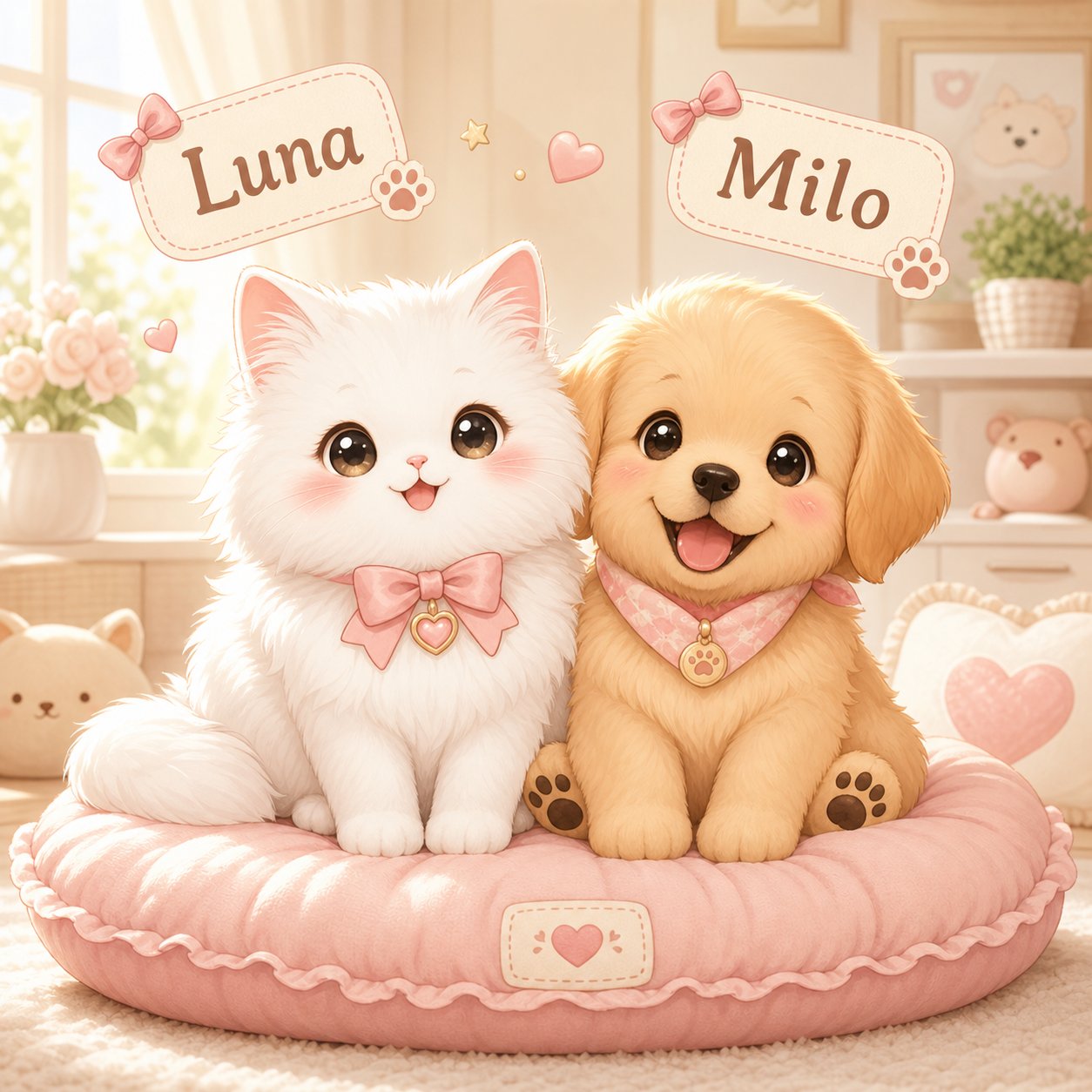
The same formation patterns that make human nicknames so charming in Chinese work beautifully for pets. Reduplication, the 小 prefix, food references, and animal imagery all carry over. The difference is that chinese pet names tend to lean even more playful and whimsical, since there is no social hierarchy to worry about. Your cat will not be offended if you call it "little fatty."
In Chinese culture, a pet's name often reflects the owner's wishes for the animal's life. Lucky names invite prosperity, food-inspired names express warmth and affection, and appearance-based names celebrate what makes the animal visually distinctive. Choosing a chinese name cat owners love means balancing sound, meaning, and personality.
Adorable Chinese Names for Cats
Cats in China earn names that match their independent, graceful, and sometimes mischievous personalities. When browsing cat names in chinese, you will notice that sound-based and appearance-based options dominate. A fluffy white cat becomes 雪儿 (Xueer, "Snowy"), while a vocal cat earns 咪咪 (Mimi, "Meow-Meow"), a classic sound-imitation name that has been popular for decades.
Food-inspired cat names chinese speakers love include 小布丁 (Xiao Buding, "Little Pudding") and 糖糖 (Tangtang, "Candy-Candy"). These reduplicated forms sound melodic when called out, which matters because cats respond better to names with clear, repeated vowel sounds.
For a cat with attitude, 大王 (Dawang, "King") fits perfectly. If your cat rules the household like royalty, this name captures that energy. Meanwhile, 灵猫 (Lingmao, "Spirit Cat") suits the mysterious type who vanishes for hours and reappears without explanation.
Popular Chinese Names for Dogs
Chinese names for dogs often emphasize loyalty, energy, or good fortune. The most iconic is 旺财 (Wangcai, "Prosperous Wealth"), a traditional name reflecting the belief that dogs bring luck to a household. It is down-to-earth and widely recognized, especially for easygoing local breeds.
Playful chinese puppy names lean toward the cute and cuddly. 毛毛 (Maomao, "Fluffy") works for any long-haired breed, while 小熊 (Xiao Xiong, "Little Bear") suits a round, huggable puppy. For a well-trained dog that follows every command, 乖乖 (Guaiguai, "Well-Behaved") is both a name and a compliment.
Bigger, more energetic dogs earn names like 大壮 (Da Zhuang, "Big and Strong") or 小狼 (Xiao Lang, "Little Wolf") for breeds with a wild streak. These chinese names for dogs balance affection with a nod to the animal's physical presence.
Choosing a Name Based on Meaning and Sound
The best chinese cat names and dog names share a few qualities: they are easy to call out, pleasant to repeat, and carry a meaning that resonates with the pet's character. The table below organizes popular options by category so you can find the right fit.
| Name (Characters) | Pinyin | Meaning | Best For |
|---|---|---|---|
| 豆豆 | Doudou | Little Bean | Either (small pets) |
| 花花 | Huahua | Flower / Multi-colored | Either (spotted or colorful) |
| 旺财 | Wangcai | Prosperous Wealth | Dog |
| 咪咪 | Mimi | Meow-Meow | Cat |
| 毛毛 | Maomao | Fluffy | Either (long-haired) |
| 小虎 | Xiao Hu | Little Tiger | Cat (feisty) |
| 雪儿 | Xue'er | Snowy | Either (white fur) |
| 大壮 | Da Zhuang | Big and Strong | Dog (large breeds) |
| 小宝 | Xiao Bao | Little Treasure | Either |
| 皮皮 | Pipi | Mischievous | Either (playful pets) |
| 阿福 | A Fu | Lucky | Dog |
| 小馒头 | Xiao Mantou | Little Steamed Bun | Either (round, cuddly) |
Notice how every name in this table traces back to the patterns from earlier: reduplication (豆豆, 花花, 毛毛), the 小 prefix (小虎, 小宝, 小馒头), the 儿 suffix (雪儿), food references (小馒头), and animal imagery (小虎). The same structural toolkit that creates chinese names for cats also generates names for dogs, hamsters, and birds. The only variable is which meaning category fits your pet's personality.
One cultural note worth remembering: avoid names that sound like unlucky words. The number four, 四 (si), sounds similar to 死 (si, "death"), so names containing that sound are generally skipped. Stick with bright, auspicious sounds, and your pet's name will feel as natural as calling them over for dinner.
Pet naming is personal and low-stakes, which makes it a perfect playground for experimenting with Chinese nickname patterns. Digital spaces take that creative freedom even further, where younger speakers invent entirely new naming conventions that break traditional rules altogether.

Chinese Internet Slang and Digital Nicknames
Chinese digital culture has spawned an entirely separate nickname ecosystem. On platforms like WeChat, Weibo, and Douyin, younger speakers have invented naming conventions that would puzzle anyone relying on a textbook. Numbers replace words, pinyin abbreviations stand in for full phrases, and code names for crushes chinese speakers use online add layers of secrecy that make digital flirting feel like cracking a cipher.
WeChat and Texting Nicknames Between Couples
WeChat is where most Chinese couples communicate daily, and contact names become a form of digital intimacy. Changing your partner's display name to something special signals commitment. Common choices include:
- 520 (wǔ èr líng) - Sounds like 我爱你 (wǒ ai nǐ, "I love you"). Couples use it in contact names, red envelope amounts, and even celebrate May 20th as an unofficial Valentine's Day.
- 1314 (yī sān yī sì) - Sounds like 一生一世 (yīshēng yīshì, "forever"). Often combined as 5201314, meaning "I love you forever."
- 猪猪 (zhūzhū) - "Piggy-piggy." A playful WeChat display name that couples set for each other, leaning into the affectionate "little pig" tradition.
- 笨蛋 (bèndàn) - "Dummy." Like 傻瓜, this insult-turned-endearment thrives in texting because the teasing tone reads clearly between people who are close.
- 集美 (jíměi) - Internet slang for "bestie," originally a mispronunciation of 姐妹 (jiěmèi, "sisters") that went viral on Douyin. Close female friends and couples both use it.
Number-based nicknames work because Mandarin's tonal system creates natural homophones between digits and emotional phrases. A simple string like 99 (jiǔ jiǔ) sounds like 久久 (jiǔ jiǔ, "a long time"), turning a pair of numbers into a wish for lasting love. Even 88 (bā bā) doubles as "bye-bye," making it a casual sign-off between friends.
Gaming Usernames and Cool Chinese Tags
Gaming culture has its own naming logic. Cool chinese nicknames in games tend to draw from martial arts fiction, mythology, or poetic imagery. If you are choosing chinese names for games, the goal is usually to sound powerful, mysterious, or stylish rather than cute.
Popular chinese gamertags follow a few patterns:
- Poetic four-character phrases - Names like 风花雪月 (fēng huā xuě yuè, "wind, flowers, snow, moon") or 一剑封喉 (yī jiàn fēng hóu, "one sword seals the throat") reference classical literature and wuxia novels.
- Edgy single-word tags - 孤 (gū, "solitary"), 影 (yǐng, "shadow"), or 墨 (mò, "ink") project a lone-wolf aesthetic popular in RPGs.
- Humorous self-deprecation - Chinese usernames like 躺平大师 (tǎng píng dàshī, "master of lying flat") or 摸鱼专家 (mōyú zhuānjiā, "slacking expert") use internet slang to signal a laid-back personality.
- Couple gaming tags - Partners create matching chinese gamertags like 左手 / 右手 (zuǒshǒu / yòushǒu, "left hand / right hand") or 星星 / 月亮 (xīngxīng / yuèliang, "stars / moon").
The difference between chinese usernames for social media and gaming is tone. Social platforms reward warmth and relatability, while gaming rewards mystique and cleverness. A name that works on Weibo would feel out of place in a competitive MOBA lobby.
Generational Shifts in Nickname Trends
How Chinese speakers nickname each other online has shifted dramatically across generations. Older millennials still lean on straightforward terms like 亲 (qīn, "dear"), popularized by Taobao customer service in the early 2010s. Gen Z speakers find 亲 outdated and prefer pinyin abbreviations like plmm (漂亮妹妹, "pretty girl") or reaction slang like awsl (啊我死了, "I'm dead from cuteness").
Code names for crushes represent another generational innovation. Rather than using someone's real name in group chats, younger speakers assign secret labels. A crush might become 那个人 (nà ge rén, "that person"), a specific emoji, or even a number only the inner circle understands. This coded language lets people discuss romantic interests openly without revealing identities, a digital evolution of passing notes in class.
The speed of change matters here. Internet slang cycles fast in Chinese digital culture. A term like yyds (永远的神, "eternal god / the GOAT") can dominate for a year and then feel stale. Staying current means watching what trends on Douyin and Weibo rather than memorizing a fixed list. The underlying nickname patterns remain stable, but the specific words riding those patterns rotate constantly.
Digital nicknames prove that Chinese naming creativity is not slowing down. It is accelerating, generating new forms faster than any textbook can document. Still, whether you are texting 520 to a partner or picking a four-character gaming tag, pronunciation determines whether your nickname lands or falls flat.
How to Pronounce Chinese Nicknames Correctly
A nickname only works if the person hearing it recognizes what you are saying. You could pick the perfect romantic word in Chinese, but if your tones are off, your partner might hear an insult instead of a compliment. Mandarin pronunciation hinges on four tones, and each one changes a syllable's meaning completely. The good news: once you internalize how these tones feel, pronouncing any nickname from this guide becomes straightforward.
Understanding the Four Tones in Plain English
Imagine you are humming a single note. That steady, flat pitch is the first tone. It does not rise or fall. It just holds, like singing one note on a piano and letting it ring. When you say ma in first tone (mā), you are saying "mother."
The second tone rises, like the inflection in your voice when you ask "what?" Start at a mid-level pitch and slide upward. That rising sound turns ma (má) into "hemp" or "numb."
Third tone is the tricky one. It dips down to a low pitch and then curves back up, like a small valley. Think of the grumbling sound you make when you are skeptical: "hmm...really?" That dip-and-rise pattern makes ma (mǎ) mean "horse."
Fourth tone drops sharply and quickly, like giving a firm command. Picture yourself saying "Stop!" with authority. That decisive downward punch turns ma (mà) into "scold."
Getting tones wrong does not just sound awkward. It changes meaning entirely. Calling someone mā (mother) versus mà (scold) is the difference between affection and aggression. In the context of romantic words in chinese, mispronouncing 亲爱的 can turn "darling" into nonsense. Tones are not optional decoration. They are the meaning itself.
There is also a neutral tone, which is light and unstressed, like the second syllable in "mama" when spoken casually in English. Several nicknames use neutral tones on their second syllable, so listen for that soft, quick sound that does not commit to any particular pitch.
Pronunciation Walkthrough for the Most Popular Nicknames
Knowing the theory is one thing. Applying it to actual nicknames is where it clicks. Below is a walkthrough of the most popular terms from earlier sections, broken down so you can practice each one with confidence. If you have ever wondered how do you say sweetheart in chinese, or how to say my love in chinese without stumbling, this table gives you the roadmap.
| Nickname | Pinyin | Tone Description in Plain English | Common Mispronunciation to Avoid |
|---|---|---|---|
| 宝贝 (Baby/Treasure) | bǎobèi | First syllable dips low then rises (3rd tone). Second syllable drops sharply (4th tone). | Saying both syllables flat. The dip on "bǎo" is essential, otherwise it sounds robotic. |
| 亲爱的 (Darling) | qīn'àide | "Qīn" holds steady and high (1st tone). "Ài" drops sharply (4th tone). "De" is neutral, light and quick. | Pronouncing "qīn" with a rising tone, which changes it from "dear" to a different word entirely. |
| 老婆 (Wife) | lǎopó | "Lǎo" dips down then rises (3rd tone). "Pó" rises from mid to high (2nd tone). | Making "pó" fall instead of rise. A falling tone here sounds like you are saying something else. |
| 老公 (Husband) | lǎogōng | "Lǎo" dips and rises (3rd tone). "Gōng" holds steady and high (1st tone). | Rushing through "lǎo" without letting it dip. The low point gives the word its warmth. |
| 甜心 (Sweetheart) | tiánxīn | "Tián" rises from mid to high (2nd tone). "Xīn" holds steady (1st tone). | Flattening "tián" so it loses its upward lift. The rise is what makes it sound sweet. |
| 小猪 (Little Pig) | xiǎo zhū | "Xiǎo" dips low then rises (3rd tone). "Zhū" holds steady and high (1st tone). | Pronouncing "zhū" with a falling tone, which turns "pig" into "candle" (zhú, 2nd tone) or worse. |
| 宝宝 (Baby-Baby) | bǎobǎo | Both syllables are 3rd tone. In natural speech, the first shifts to a rising 2nd tone (tone sandhi), so it sounds like "báobǎo." | Forcing both syllables to dip. Native speakers automatically raise the first one. Follow that flow. |
| 心肝 (Heart and Liver / Dearest) | xīngān | "Xīn" holds steady (1st tone). "Gān" also holds steady (1st tone). Both are high and flat. | Adding a dip or rise to either syllable. Keep both level and smooth, like two sustained musical notes. |
| 傻瓜 (Silly Melon / Fool) | shǎguā | "Shǎ" dips and rises (3rd tone). "Guā" holds steady (1st tone). | Saying "shà" with a sharp drop (4th tone), which sounds harsh rather than playful. |
| 豆豆 (Little Bean) | dòudòu | Both syllables drop sharply (4th tone). Quick, decisive, and punchy. | Softening the drops into flat tones. The sharpness is what gives this pet name its bouncy energy. |
A few patterns emerge from this table. Third tone appears constantly in nicknames because the dip-and-rise contour sounds inherently gentle and affectionate. The 小 prefix always carries that third-tone dip, which is why it softens everything it touches. Meanwhile, how to say girlfriend in chinese (女朋友, nǚ péngyou) also starts with a third tone on "nǚ," giving it that same tender quality.
One critical rule to remember: when two third tones appear back-to-back, the first one shifts to a second tone in natural speech. This is called tone sandhi, and it happens automatically for native speakers. So 宝宝 (bǎobǎo) actually sounds closer to "báobǎo" in conversation. Do not fight this shift. Embrace it, and you will sound far more natural.
The word for darling in Chinese, 亲爱的 (qīn'àide), trips up many learners because of the apostrophe between "qīn" and "ài." That mark signals a brief pause, preventing the two syllables from blending into one sound. Without the pause, the word becomes unclear. Think of it as a tiny breath between "dear" and "love."
Pronunciation is the bridge between knowing a nickname and actually using it. But even perfect tones will not save you if you use the wrong nickname in the wrong setting. Context and etiquette determine whether your carefully pronounced term of endearment lands as charming or deeply awkward.
Common Mistakes and Nickname Etiquette to Know
Knowing dozens of adorable nicknames means nothing if you deploy them at the wrong moment. Chinese social culture operates on a finely tuned system of context, hierarchy, and face (面子, miànzi). A nickname that melts hearts in a private text can cause genuine embarrassment when spoken in front of the wrong audience. Some mistakes are simply awkward. Others can damage relationships or make you the subject of funny chinese nicknames stories people retell for years.
Nicknames That Can Accidentally Offend
Tonal errors top the list. As covered in the pronunciation section, mispronouncing a tone can flip a term of endearment into something vulgar or nonsensical. But beyond tones, certain nicknames carry hidden risks:
- Using 小姐 (xiǎojiě) as a cute address - While it historically meant "Miss" or "young lady," in parts of mainland China it now carries connotations of sex work. Stick to 美女 (měinǚ) for casual polite address instead.
- Calling someone 小胖 (xiǎo pàng) outside family - "Little chubby" is affectionate between parents and children, but using it for a friend or colleague can feel like body-shaming, especially in professional settings.
- Using 老 (lǎo) with someone sensitive about age - The prefix implies seniority and experience, but calling a woman 老王 when she is only in her thirties might not land well, depending on her personality.
- Regional mismatches - A Cantonese term like 肥仔 ("chubby boy") is warmly affectionate in Hong Kong but sounds like a straight insult to a Mandarin speaker unfamiliar with the convention.
What seems like a funny chinese name to you might feel like mockery to the recipient. The safest approach is to mirror what the other person already uses or explicitly invites.
When and Where to Use Chinese Nicknames
Timing matters as much as word choice. Using 宝贝 (bǎobèi) on a first date can feel presumptuous, while sticking to someone's full name after months of dating signals emotional distance. Chinese nickname etiquette follows a general escalation pattern:
- First meeting or early dating - Use their name or a polite address. No pet names yet.
- After mutual comfort is established - Light terms like 亲爱的 (qīn'aide) or playful teasing names become appropriate.
- Established relationship - Intimate terms like 老婆/老公, 宝宝, or personalized nicknames feel natural.
In online dating contexts, moving to nicknames too quickly is a common misstep. Chinese dating culture generally values a slower build of familiarity. Jumping straight to 宝贝 in your second message can read as insincere or overly forward, especially to someone who values traditional pacing.
Context Rules for Workplace, Family Meetings, and Public Settings
Even established nicknames have boundaries. Imagine calling your partner 小猪猪 ("little piggy") in front of their boss during a company dinner. That is a face-losing moment for everyone involved. Chinese address etiquette demands that you match formality to the setting.
Here is a quick reference for navigating different environments:
- Workplace - Use surname + title (王经理) or the 小/老 + surname formula (小李, 老张). Never use romantic or overly casual nicknames in front of colleagues.
- Meeting your partner's parents for the first time - Address them with proper family titles (叔叔, 阿姨). Call your partner by their given name, not a pet name. Switching to 宝贝 in front of traditional parents signals a lack of respect for the family hierarchy.
- Public settings with mixed company - Dial back to neutral. If friends are present, light nicknames are fine. If elders or authority figures are around, keep it formal.
- Group chats and social media - More relaxed, but remember that screenshots travel. Anything you post can become one of those chinese funny names stories shared without your consent.
The underlying principle is simple: nicknames signal intimacy, and displaying intimacy in the wrong context makes others uncomfortable. In Chinese culture, 小名 (xiǎomíng) are deeply personal and typically reserved for family and very close friends. Using someone's childhood nickname in front of strangers can embarrass them, since many of these names sound deliberately silly or childish.
A reliable rule of thumb: if you would not kiss your partner in a given setting, do not use your most intimate nickname there either. Save 心肝 for private moments and default to their name or a mild term in public. This awareness protects both your face and theirs, which is ultimately what Chinese social etiquette is designed to do.
Avoiding mistakes is half the equation. The other half is channeling everything you have learned into creating something personal, a nickname that belongs only to your relationship and carries meaning no generic list can provide.

Build Your Own Custom Chinese Nickname
Lists are useful, but the nicknames that stick are the ones you create yourself. A personalized term of affection carries emotional weight that no generic option can match. Whether you are crafting chinese names for boyfriend use, inventing pet names in chinese for a close friend, or finding a chinese name for my love that feels truly yours, the process follows a handful of repeatable formulas.
Simple Formulas for Creating Your Own Nickname
Think of these as fill-in-the-blank templates. Each formula produces cute chinese names that sound natural to native speakers while feeling personal to your relationship.
- 小 + [trait, animal, or food] - Pick something that reminds you of the person. Are they soft-spoken? Try 小猫 (little cat). Do they love snacks? 小饼干 (little cookie) works perfectly.
- [Character] + [same character] reduplication - Take one meaningful character from their name or a word that describes them, then double it. If their name contains 乐 (le, happy), they become 乐乐 (Lele).
- 阿 + [first syllable of their name] - This formula works especially well for chinese nicknames for lovers in southern China and Taiwan. If your partner's name is 明辉, calling them 阿明 (A Ming) feels warm and familiar.
- [Food item] + 儿 - Combine a cute food reference with the diminutive suffix. 糖儿 (tangr, "candy"), 果儿 (guor, "fruit"), or 桃儿 (taor, "peach") all sound sweet and intimate.
- [Adjective] + 宝 - Pair a descriptive word with 宝 (treasure). A cheerful person becomes 甜宝 (tian bao, "sweet treasure"). Someone brave becomes 勇宝 (yong bao, "brave treasure").
Mixing and Matching Patterns for Unique Results
The real magic happens when you combine formulas. The table below shows how different inputs produce distinct results, giving you a starting point to experiment.
| Formula | Input | Output (Characters) | Pinyin | English Meaning |
|---|---|---|---|---|
| 小 + food | Mochi (a favorite snack) | 小麻薯 | Xiao Mashu | Little Mochi |
| Reduplication | Name character: 安 (peace) | 安安 | An'an | Peaceful one |
| 阿 + name syllable | Name: 志远 | 阿志 | A Zhi | Dear Zhi |
| Food + 儿 | Peach (their rosy cheeks) | 桃儿 | Taor | Little Peach |
| Adjective + 宝 | Warm personality | 暖宝 | Nuan Bao | Warm Treasure |
You can translate these chinese nicknames in english to check that the meaning resonates, but remember that the emotional impact lives in the sound and context, not the literal translation. 暖宝 does not need to make poetic sense in English. It needs to make your person smile.
A few reminders before you finalize your creation. Revisit the etiquette section: make sure your nickname does not accidentally sound like an unlucky word, and match the intimacy level to your actual relationship stage. Test it privately before using it in front of others. And most importantly, choose something rooted in a shared experience or inside joke. The best chinese terms of affection are not borrowed from a list. They are built from moments only the two of you understand.
Frequently Asked Questions About Cute Chinese Nicknames
1. What is the most common Chinese nickname for a romantic partner?
宝贝 (baobei, meaning 'treasure' or 'baby') is the most widely used romantic nickname in Chinese. It works for any gender and any relationship stage, from new couples to long-married partners. Its popularity grew through Chinese pop culture, TV dramas, and music, making it feel modern and universally understood. Other common options include 亲爱的 (qin'aide, 'darling') for a slightly more formal tone and 老婆/老公 (laopo/laogong, 'wife/husband') for couples signaling long-term commitment, even before marriage.
2. How do you create a personalized Chinese nickname for someone?
Chinese nicknames follow repeatable formulas you can customize. The most popular methods include adding 小 (xiao, 'little') before a trait, food, or animal that reminds you of the person, doubling a meaningful character from their name (reduplication), using 阿 (a) plus the first syllable of their name, or combining a food word with the 儿 (er) suffix. For example, if someone loves peaches, you could call them 桃儿 (taor, 'little peach'). The key is choosing something rooted in a shared experience or personal trait rather than picking a generic term from a list.
3. Is calling someone 小猪 (little pig) an insult in Chinese?
No, 小猪 (xiao zhu) is an affectionate nickname in Chinese, not an insult. It implies the person is adorable, perhaps a little lazy or cuddly in an endearing way. Couples frequently use it as a playful pet name, and it appears often in WeChat display names between partners. The cultural context differs significantly from English, where calling someone a pig would be offensive. However, context still matters. Using it with someone you are not close to, or in a formal setting, could cause confusion or embarrassment.
4. What are the differences between Chinese nicknames in mainland China, Taiwan, and Hong Kong?
Regional differences are significant. Northern mainland speakers favor the 儿 (er) suffix and terms like 哥们儿 (gemenr, 'bro'). Southern mainland and Taiwanese speakers prefer the 阿 (a) prefix, such as 阿明 or 阿公. Taiwan also incorporates Japanese-influenced cute speech patterns. Hong Kong uses Cantonese-specific terms like 靓仔 (leng zai, 'handsome boy') and 靓女 (leng neoi, 'pretty girl'), which operate in a completely different tonal system. Using a Beijing-style nickname with a Cantonese speaker may sound odd, so matching your style to the region shows cultural awareness.
5. When is it inappropriate to use a Chinese nickname?
Chinese nickname etiquette depends heavily on setting and relationship stage. Avoid using intimate pet names in front of your partner's parents, boss, or colleagues, as this causes loss of face (面子). On early dates, jumping to terms like 宝贝 too quickly can seem insincere or overly forward. In professional settings, stick to surname plus title or the 小/老 plus surname formula. A reliable rule: if you would not kiss your partner in a given setting, do not use your most intimate nickname there either. Save deeply personal terms for private moments and default to neutral address in public.