Why East and West Think About Names So Differently
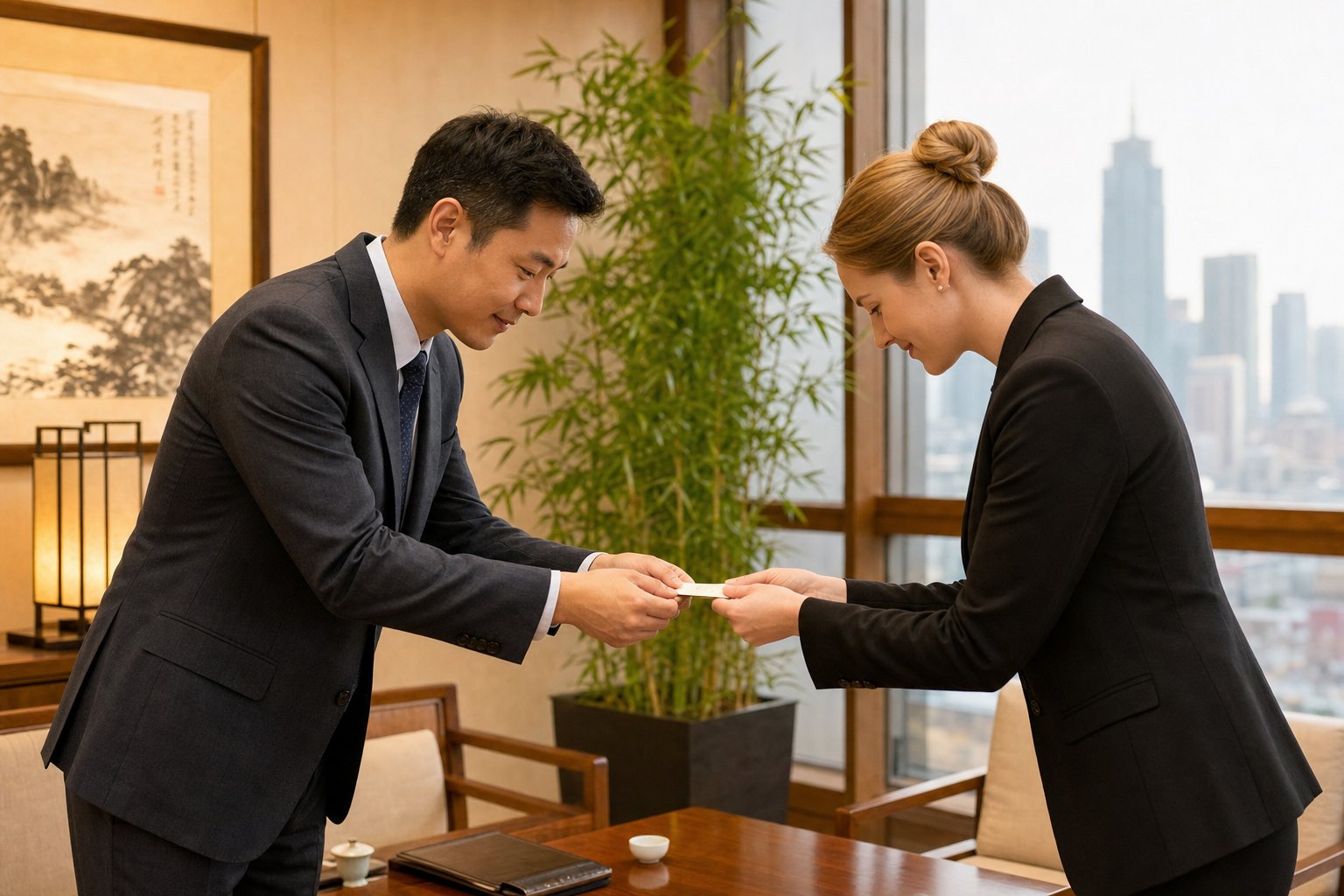
Imagine booking an international flight under the name "Wei Zhang" only to find your boarding pass reads "Zhang Wei" because the airline's system assumed Western naming order. Or picture a new colleague from Seoul introducing herself as "Kim Minji" while you spend the next three months calling her "Kim" thinking it's her given name. These aren't hypothetical mix-ups. Inconsistent names on travel documents can literally prevent passengers from boarding flights, and workplace name confusion quietly erodes professional relationships every day.
Why Naming Order Causes Global Confusion
The root of global naming convention confusion is deceptively simple: some cultures place the family name first, others place it last, and still others don't use family names at all. In China, Japan, Korea, and Vietnam, surnames precede given names. In most Western countries, given names come first. Yet the friction goes far deeper than word order. Names encode values, hierarchy, lineage, and identity in fundamentally different ways depending on where you are in the world.
A name is never just a label. It's a compressed cultural statement about whether identity begins with the individual or the group, whether lineage outweighs personal distinction, and how respect is signaled before a single word of conversation is spoken.
What This Guide Covers
This article provides a systematic breakdown of east vs west naming culture differences, examining each major system for its structure, cultural significance, and practical implications in professional and digital contexts. You'll find coverage of Chinese, Japanese, and Korean conventions alongside Western traditions, patronymic systems, and a side-by-side comparison to clarify why naming order differs across cultures and what you can do about it.
How We Evaluated These Naming Systems
Comparing naming conventions across civilizations isn't as straightforward as lining up word order. A meaningful comparison requires a consistent framework, one that accounts for how naming systems reflect cultural values at structural, social, and practical levels. Without that lens, you're left with surface-level observations that miss the deeper logic behind why billions of people organize identity differently.
Evaluation Criteria for Each Naming System
To compare naming systems across cultures in a way that's both fair and useful, each convention in this guide is evaluated along five dimensions:
- Naming order structure - Whether the family name or given name appears first, and how that sequence signals cultural priorities around group identity versus individual distinction.
- Cultural significance embedded in names - The extent to which names carry meaning beyond identification: moral aspirations, generational markers, religious references, or clan affiliations woven into the name itself.
- Honorific systems - How titles, suffixes, or contextual name forms regulate social interaction and signal relationships between speakers.
- Legal and official document implications - How each system interacts with passports, immigration forms, and government databases that often assume a single "first name / last name" structure.
- Modern adaptation challenges - The friction points that arise when people from one naming tradition operate in contexts designed around another, from international business cards to CRM software.
Sources and Cultural Frameworks Referenced
This analysis draws heavily on Hofstede's 6-D model of national culture, particularly the individualism dimension. Hofstede's research maps how societies fall on a spectrum between collectivism and individualism in naming traditions and broader social behavior. In collectivist cultures, people "know their place" within larger social units, and identity is interdependent. In individualist cultures, personal choices and self-definition take priority. You'll notice this distinction maps almost directly onto naming order: collectivist societies tend to place the family name first, anchoring identity in the group before the individual.
The framework also incorporates research on analytic versus holistic thinking styles, originally proposed by Nisbett et al. to explain cognitive differences between Eastern and Western cultures. Holistic thinkers tend to perceive objects in relation to their surrounding context, while analytic thinkers focus on isolating individual elements from the field. Applied to naming, this maps onto a fundamental question: does a person's identity start with the broader context (family, clan, generation) or with the individual standing apart from it? Cultures favoring holistic cognition tend to build names outward from the collective. Cultures favoring analytic cognition tend to foreground the person first.
These cultural dimensions of naming conventions aren't rigid rules. They're patterns, tendencies that help explain why certain systems developed the way they did and why cross-cultural friction is so predictable when those systems collide in airports, HR departments, and software platforms. With this framework in place, each naming tradition can be examined on its own terms while still allowing meaningful comparison across all of them.
Chinese Naming Conventions and Generational Markers
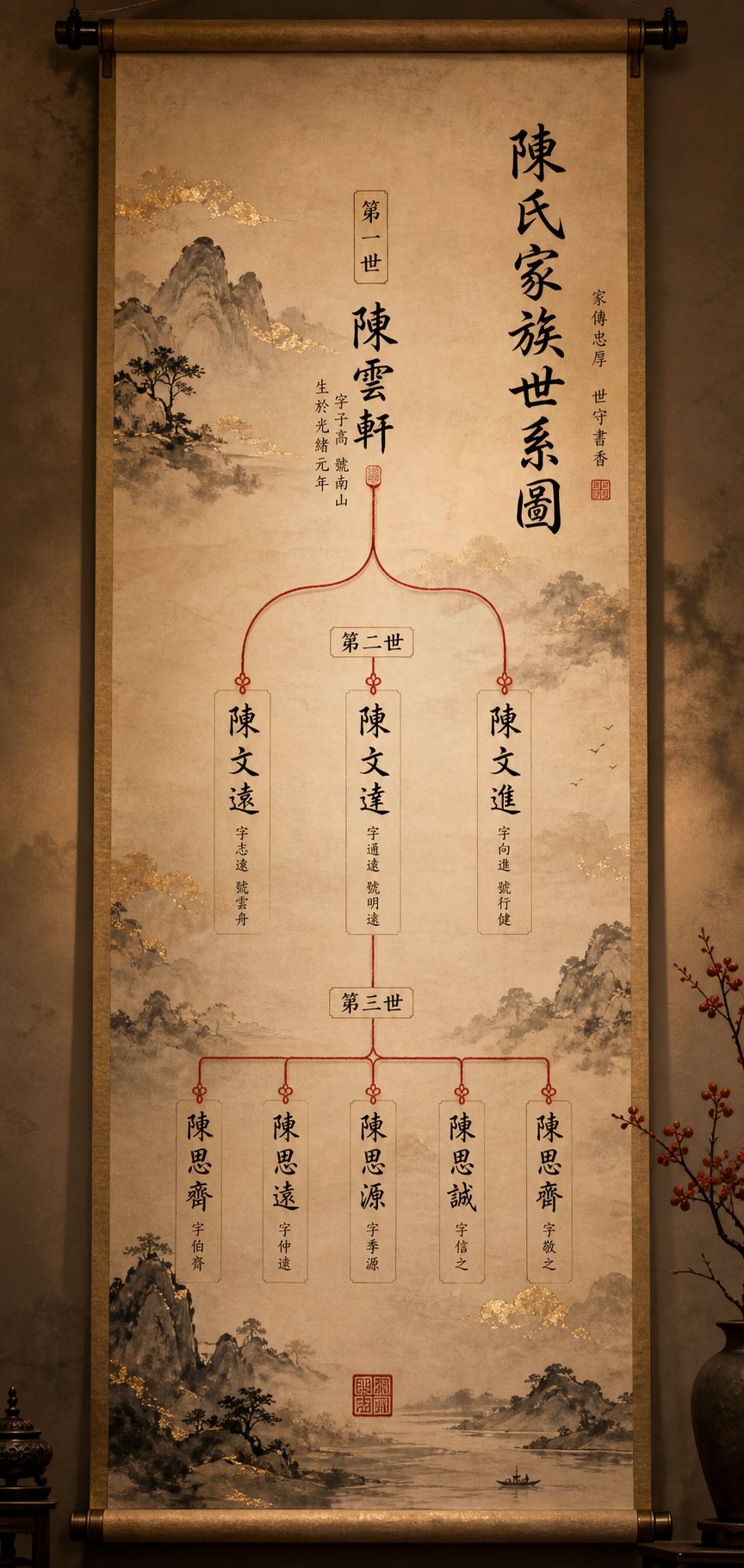
The Chinese surname-first naming convention is the most widely used family-name-first system on the planet, shaping identity for over a billion people. Understanding why Chinese names put family name first requires looking beyond word order into the Confucian values that treat family as the foundational unit of society. A person exists first as part of a lineage, then as an individual within it.
Surname-First Structure and Family Hierarchy
In Chinese naming culture, the family name (xing) always comes first. If you meet someone named Chen Wei, "Chen" is the surname and "Wei" is the given name. Addressing this person as "Mr. Wei" would be incorrect and, in a business context, signal a poor grasp of Chinese naming culture.
Most Chinese surnames are a single syllable. The top 100 Chinese family names are all one syllable and cover roughly 85 percent of the population. The three most common surnames in mainland China, Li, Wang, and Zhang, are shared by more than 270 million people. This concentration means that given names carry the real burden of individual distinction.
Children bear the father's family name, and women do not change their surnames after marriage. This stands in sharp contrast to many Western traditions where a bride adopts her husband's surname. The Chinese approach reinforces the idea that your birth lineage is permanent, a thread connecting you to ancestors stretching back centuries.
Generational Names and Moral Virtue Encoding
So how do Chinese generational names work? Many traditional families use a system called zibi (字辈), where males of the same generation share a specific character in their given names. These generational characters are often determined in advance, sometimes written into a family poem that maps out naming characters for generations to come. Siblings and patrilineal cousins might all share the syllable "Zhen," for example, while each uses a different second character to distinguish themselves individually.
Beyond generational markers, given names are chosen with intense deliberation. Parents select characters that encode aspirations and moral qualities: Kang (healthy), Yong (brave), Mei (beautiful), Ling (wise). The process reflects a belief that a name can influence a person's destiny. Names chosen for boys often symbolize strength and power, while girls' names frequently represent beauty and kindness. Even the tonal pronunciation matters. A character pronounced in the wrong tone can shift meaning entirely, turning a name that means "smart and inquisitive" into one that means "mosquito."
Married Names and Modern Adaptations
Chinese naming culture in western workplaces creates a unique navigation challenge. Many Chinese professionals adopt an English given name, introducing themselves as "David Chen" or "Lisa Wang" to simplify interactions with Western colleagues. Others reverse their name order without explanation, leaving counterparts unsure whether the first or second element is the surname.
A practical tip from cross-cultural business guides: if you see a three-syllable Chinese name like Wang Xiaoming, the two-syllable portion (Xiaoming) is almost certainly the given name, and the single syllable (Wang) is the family name. When in doubt, it's perfectly acceptable to ask which name is the surname. Doing so demonstrates respect rather than ignorance.
The common mistake Westerners make is assuming the first written element is a given name, mirroring their own convention. This leads to calling someone by their family name as if it were their first name, an error that feels roughly equivalent to a stranger calling you by your last name while thinking they're being friendly.
Pros of the Chinese Naming System in Global Contexts
- Immediately signals family lineage and generational position within a name
- Preserves maternal identity since women retain their birth surnames after marriage
- Embeds cultural values and parental aspirations directly into personal identity
- Generational naming creates visible family cohesion across extended relatives
Cons of the Chinese Naming System in Global Contexts
- Surname-first order is routinely reversed or misread in Western databases and forms
- Small surname pool (roughly 400 total) creates frequent duplication in large organizations
- Adopting English names for international use can create split-identity friction
- Tonal pronunciation nuances are lost entirely in romanized written forms
The Chinese system illustrates how deeply collectivism shapes naming architecture. Identity radiates outward from family to generation to individual, each layer encoded in a name that rarely exceeds three syllables. Yet this elegant compression creates real friction when it collides with systems, both human and digital, that assume identity starts with the person standing alone.
Japanese Naming Conventions and Honorific Systems
Chinese names compress identity into family-first order and virtue-laden characters. Japanese naming shares that surname-first structure but layers on something entirely different: an elaborate honorific system that turns every act of addressing someone into a social signal. In Japan, how you say a name matters as much as the name itself.
Surname-First Order and Kanji Selection
How does Japanese naming order work? Like Chinese, the family name comes first. Tanaka Yuki means Tanaka is the surname and Yuki is the given name. You'd address this person as Tanaka-san in most situations, not Yuki. Getting this reversed is one of the most common mistakes foreigners make, since Western name order puts the given name first, and many Japanese people don't correct the error out of politeness.
Where Japanese naming diverges sharply from Chinese is in character selection. Parents choose kanji characters for given names not only for meaning but also for visual aesthetics, stroke count (sometimes guided by fortune-telling), and the multiple possible readings each character carries. A single kanji can have several pronunciations, meaning two children with identical written names might pronounce them differently.
Japan's government maintains an official list of approved kanji for use in names, called the jinmeiyou kanji. Parents must select from roughly 2,999 approved characters, a legal constraint designed to ensure names remain readable and functional within official systems. This creates a bounded creative space: meaningful, but regulated in ways that Chinese and Western naming traditions are not.
The Honorific System as Part of Naming Culture
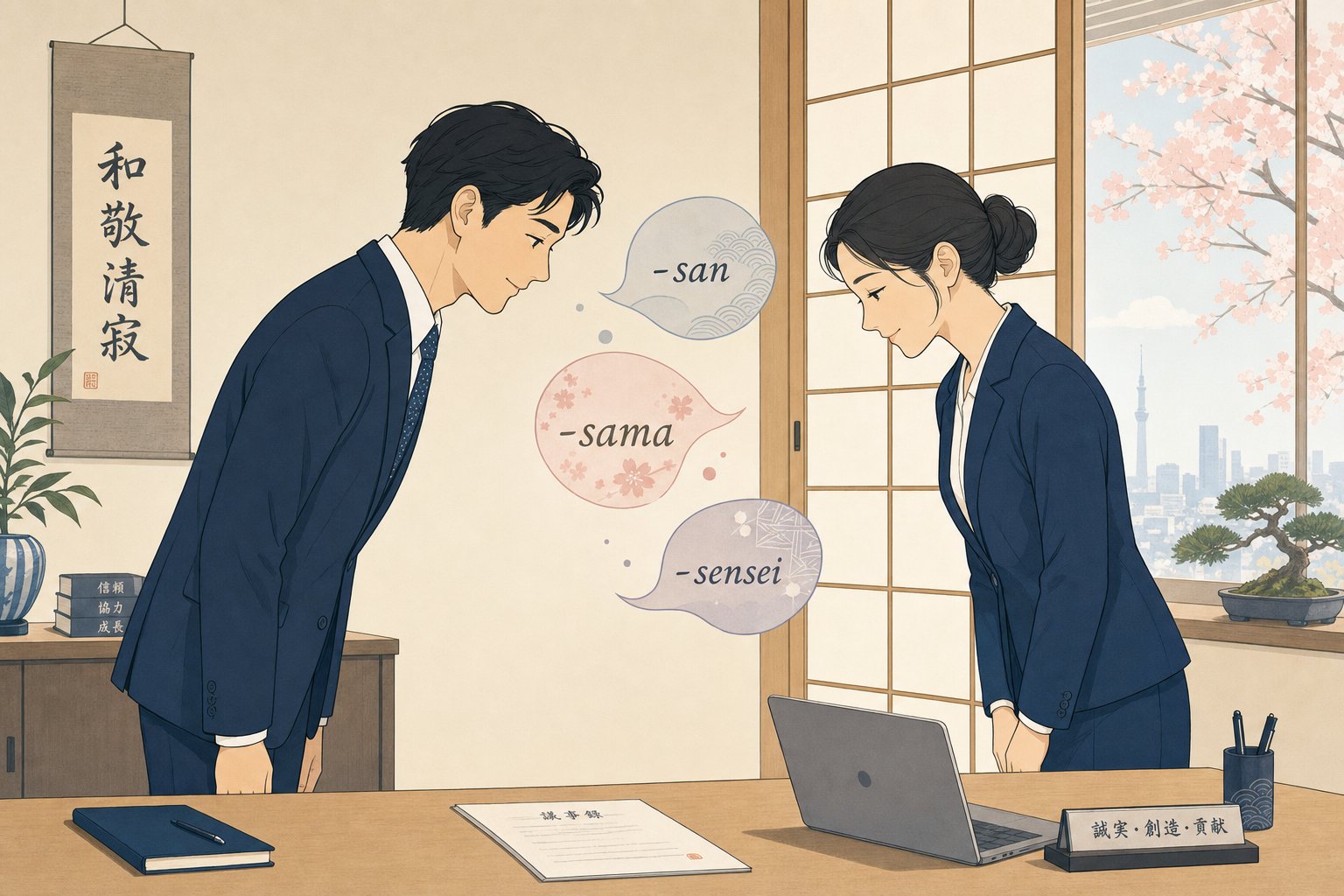
The Japanese honorific system of san, sama, kun, and chan isn't a separate etiquette layer. It's fused directly into how names function. You rarely use a name without attaching a suffix, and the suffix you choose broadcasts your relationship to that person, your relative social position, and the formality of the context.
Here are the core honorifics and when to use each:
- San (さん) - The universal default. Gender-neutral, polite without being stiff. Works for colleagues, acquaintances, strangers, and anyone you're unsure about. Equivalent to "Mr./Ms." but used far more broadly in everyday Japanese conversation.
- Sama (さま) - The formal, highly respectful form. Reserved for customers (okyaku-sama), clients in business correspondence, and people of significantly higher status. Using it casually can sound sarcastic.
- Kun (くん) - Typically used for younger males or juniors by someone of higher status. A boss might call a young male employee "Satou-kun." Occasionally used for young women in professional settings, though less common.
- Chan (ちゃん) - Expresses affection and closeness. Used for children, close friends, romantic partners, and pets. Using chan with someone you've just met would feel inappropriately intimate.
- Sensei (先生) - For teachers, doctors, lawyers, accomplished artists, and anyone recognized as a master in their field. Often used without a name attached: simply "Sensei" signals respect for expertise.
The critical point for Westerners: these aren't optional flourishes. Dropping the suffix entirely, called yobisute, signals deep intimacy or deliberate rudeness. When unsure, default to the person's surname plus san. You'll never offend anyone with that choice.
Professional vs Personal Name Usage Rules
When is it appropriate to use a first name in Japanese culture? Almost never, unless explicitly invited. Even colleagues who have worked together for years often stick to surname-plus-san in the office. First-name usage signals a personal closeness that most Japanese professionals keep separate from work relationships.
This clashes directly with Western workplace norms, where first-name basis is the default and using someone's surname can feel cold or overly formal. A Western manager calling a Japanese colleague by their given name on day one, thinking they're being friendly, may actually be creating discomfort. The Japanese colleague likely won't say anything, but the social misstep registers.
Practical japanese name etiquette for westerners in professional settings comes down to a few reliable principles: use the family name plus san until told otherwise, mirror how your Japanese counterparts address each other, and understand that in business contexts, job titles sometimes replace honorifics entirely. A department head might be addressed as "Tanaka-buchou" rather than "Tanaka-san," with the title itself functioning as the respect marker.
For foreign professionals working with Japanese teams, there's a useful nuance to know. Japanese colleagues may attach san to your first name rather than your surname, adapting to what they perceive as Western convention. This isn't disrespect. It's an attempt to meet you halfway. The gesture itself reveals how deeply the honorific instinct runs: even when adjusting for foreign norms, the suffix stays.
Where Chinese naming culture embeds identity in lineage and virtue, Japanese naming culture embeds identity in relationship. Every interaction recalibrates the social signal through suffix choice, name form, and context. It's a system built for a society where your position relative to others is never assumed to be static or obvious, but must be actively acknowledged each time you speak.
Korean Naming Conventions and Clan Identity
Japanese naming weaves identity into the social fabric through honorifics and relational suffixes. Korean naming takes a different path. It anchors identity in bloodline, clan origin, and generational continuity with a precision that makes family history readable directly from a person's name. The structure looks similar on the surface, surname first followed by a two-syllable given name, but the underlying logic is distinct.
Clan Names and the Dollimja Generational System
Korean names follow the same surname-first order as Chinese and Japanese names. If you meet someone named Park Jimin, "Park" is the family name and "Jimin" is the given name. Sounds familiar so far. But here's where Korean naming conventions diverge: the given name itself often contains a shared syllable that links an individual to every cousin, sibling, and relative of the same generation.
This is the korean dollimja generational naming system. Within an extended family, all members of the same generation share one syllable in their given name, while the second syllable distinguishes them individually. For example, if the generational syllable is "Su," siblings might be named Park Jang-su and Park Tae-su. The shared element instantly signals that these two people belong to the same generational tier within their family tree.
The order of the generational syllable and the personal syllable can vary by family preference. Some clans place the dollimja first, others second. Either way, the system creates a visible thread connecting relatives across households and even continents. If you know the generational character, you can identify someone's approximate position in the family hierarchy at a glance.
This practice originated in China and was adopted into Korean culture centuries ago, but it functions differently in Korea. In South Korea, the generational syllable is shared across the entire extended family of the same generation, not just immediate siblings. In North Korea, it tends to be shared only among siblings. The distinction is subtle but meaningful: South Korean dollimja casts a wider net of kinship identity.
How Korean Names Encode Family Lineage
Why do so many Koreans share the same surname? The answer lies in a remarkably concentrated surname pool. Only about 250 Korean family names are currently in use, and three of them, Kim, Lee, and Park, account for nearly half the population. More than 20% of all Koreans are surnamed Kim alone. At first glance, this seems like it would make names nearly useless for identification. But the system has a deeper layer.
Each surname is subdivided into clans called bon-gwan, which indicate the family's geographical origin. Two people both named Kim might belong to entirely different clans: the Gimhae Kim clan or the Gyeongju Kim clan, for instance. These clans trace their lineage to different patrilineal ancestors and different regions of the Korean peninsula. The bon-gwan is what truly identifies family lineage, not the surname alone.
Korean surnames began over 1,500 years ago as markers of royal and noble status. During the Goryeo and Joseon Dynasties, as government record-keeping expanded, more people adopted surnames. Many chose prestigious names like Kim, Lee, or Park to elevate their social standing. Over centuries, this concentration solidified into the pattern visible today. The result is a system where the surname signals broad clan membership, the bon-gwan pinpoints specific lineage, and the given name encodes generational position.
A few other structural details set Korean naming apart from its East Asian neighbors:
- Given names are traditionally composed of hanja (Chinese characters in Korean pronunciation), though South Korea restricts approved characters to a list of 5,038.
- A married woman does not change her family name to her husband's, similar to Chinese convention but unlike most Western traditions.
- Middle names do not exist in the Western sense. The two syllables of a given name function as a single unit, though non-Korean forms often split them into "first name" and "middle name" fields for convenience.
- Since the late 1970s, some parents have chosen native Korean words as given names instead of hanja-based ones, such as Haneul (sky), Iseul (dew), or Seulgi (wisdom).
Modern Trends and Western Name Adoption
When comparing korean naming conventions vs chinese and japanese systems, the most visible modern difference is how aggressively Korean professionals adopt English names for international contexts. While Chinese professionals often choose English given names ("David Chen") and Japanese professionals rarely do, Korean professionals frequently select Western names for business cards, email signatures, and LinkedIn profiles.
This creates a layered identity navigation challenge. A person might be Park Soo-yeon at home, "Susan Park" at work with international clients, and "Soo-yeon" among Korean colleagues abroad. Each context demands a different name form, and switching between them isn't just linguistic. It involves shifting cultural frames, deciding how much of one's Korean identity to foreground in each interaction.
The Asia Media Centre's naming guide notes that when using Korean names in English, some Koreans keep the original surname-first order while others reverse it to match Western convention. This inconsistency means you genuinely cannot tell from a written name alone whether "Kim Minji" or "Minji Kim" places the surname first or last without additional context. When Kim is the most common surname on the peninsula, the ambiguity compounds quickly.
For Westerners working with Korean colleagues, the safest approach mirrors the guidance for Chinese and Japanese names: use the family name plus a respectful title until invited to do otherwise. In Korean business culture, hierarchy matters, and jumping to first-name familiarity too quickly can feel presumptuous.
Pros of the Korean Naming System in Cross-Cultural Settings
- Dollimja generational syllables make family relationships immediately visible within a name
- The bon-gwan clan system provides precise lineage identification beyond the surname
- Women retaining birth surnames preserves maternal family identity across generations
- The trend toward native Korean given names adds cultural distinctiveness and modern flexibility
Cons of the Korean Naming System in Cross-Cultural Settings
- Extremely concentrated surname pool creates constant duplication in international databases and workplaces
- Inconsistent romanization (Lee vs. Yi vs. Rhee for the same surname) causes matching errors in digital systems
- Splitting two-syllable given names into "first" and "middle" name fields distorts the name's intended unity
- Frequent adoption of Western names creates identity fragmentation and confusion about which name to use in which context
Korean naming reveals how a system can share surface-level structure with Chinese and Japanese conventions while encoding identity through entirely different mechanisms. The clan system, the generational syllable, and the concentrated surname pool all point to a culture where knowing exactly where you fit within a family's multi-generational story is built into the two or three syllables you carry for life. Yet these same features, elegant within their own cultural logic, generate friction the moment they encounter systems that assume names are unique identifiers rather than positional markers within a lineage. That tension between identity-as-position and identity-as-individual only sharpens when naming traditions fall outside the East-West binary entirely.
Patronymic Systems Beyond the East-West Divide
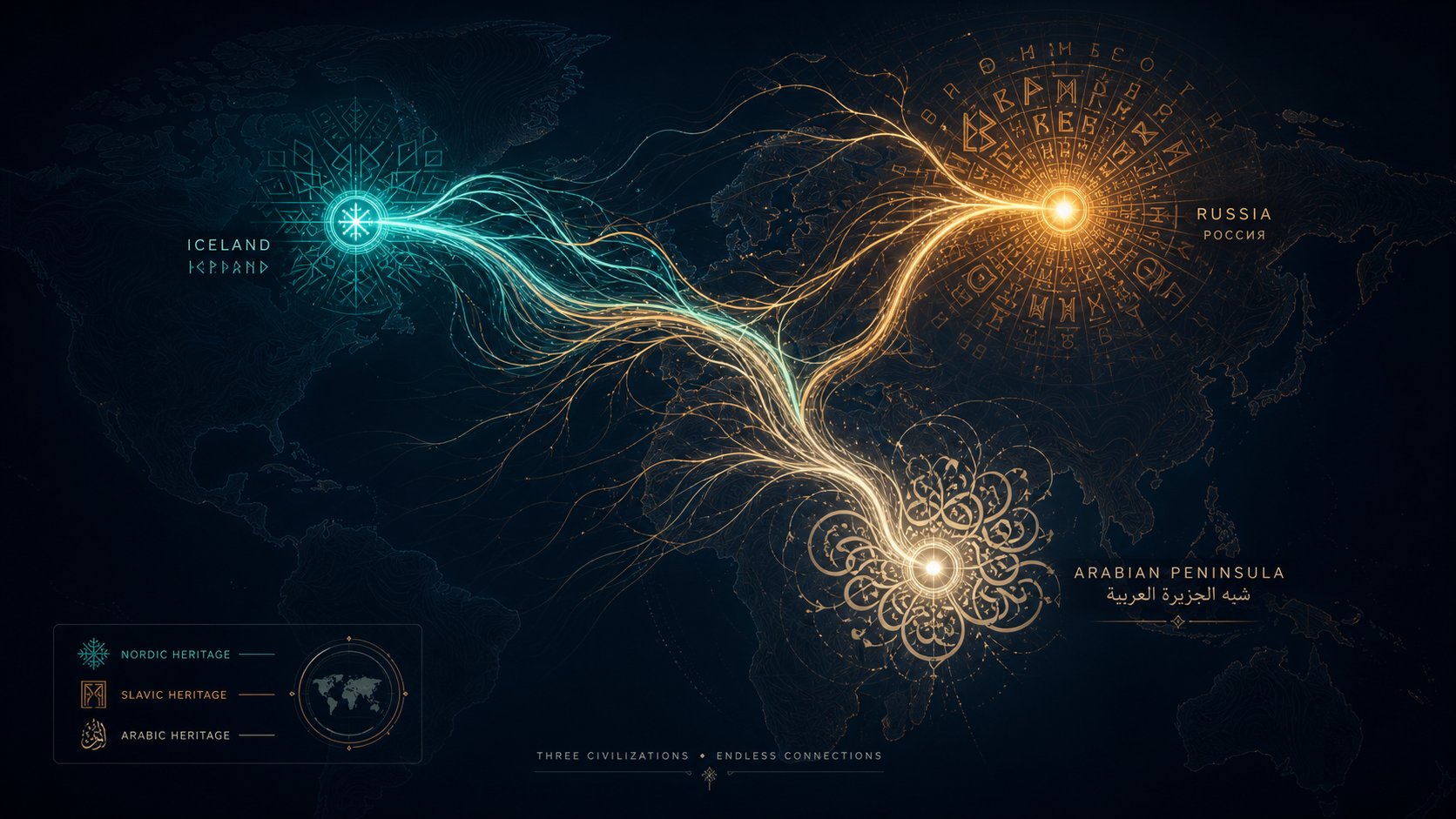
Not every naming tradition fits the surname-first or given-name-first framework. Patronymic naming systems around the world operate on a completely different principle: your "last name" isn't inherited from a family line at all. It's generated fresh each generation from a parent's given name. These systems challenge the entire premise of the east-west binary and create some of the most stubborn friction points in global administrative systems.
Icelandic Patronymics and the Absence of Surnames
The icelandic naming system no surnames explained in simple terms works like this: your last name is your father's (or mother's) first name plus a gendered suffix. If a man named Jon has a son named Einar, the son's full name is Einar Jonsson, literally "Einar, son of Jon." A daughter named Eva would be Eva Jonsdottir, "Eva, daughter of Jon." The next generation starts over entirely. Einar's children won't carry "Jonsson" forward. They'll carry "Einarsson" or "Einarsdottir."
This means siblings share a last name, but parents and children never do. There's no family surname passed down through generations, no shared identifier linking grandparents to grandchildren by name alone. Iceland even maintains an official Name Committee that approves given names based on whether they conform to Icelandic grammar, ensuring names can decline properly across the language's case system.
The practical result? Icelanders are listed by first name in phone directories. You'd look up "Einar" not "Jonsson." Outside Iceland, though, this system collides with every database, airline booking system, and immigration form that assumes a stable, inheritable surname field.
Russian Patronymic Middle Names
Russian naming takes a different approach to patronymics. Rather than replacing the surname entirely, Russian names insert a patronymic as a mandatory middle name. A Russian person's full legal name has three parts: given name, patronymic, and family surname. The patronymic is formed from the father's first name plus a gendered suffix: -ovich/-evich for sons, -ovna/-evna for daughters.
If a man named Sergei has a daughter named Anna, her full name is Anna Sergeevna [Surname]. The patronymic isn't optional or decorative. It's a legal component of identity, required on official documents, and used in formal address. Calling someone by their given name plus patronymic ("Anna Sergeevna") is the standard polite form in professional settings, roughly equivalent to "Ms. Smith" in English but carrying a warmer, more personal tone.
Where this creates global friction is in the "middle name" field. Western systems treat middle names as optional and largely irrelevant. Russian patronymics are neither optional nor irrelevant. They're a core identity marker that gets truncated to an initial, dropped entirely, or confused with a Western-style middle name in international contexts.
Arabic Naming Chains and the Nasab System
The arabic nasab naming chain structure is the most expansive patronymic system still in active use. Rather than a single patronymic element, Arabic names can chain multiple generations of descent into a single name. The nasab component uses "ibn" (son of) or "bint" (daughter of) followed by the father's name, and this can extend backward through grandfather, great-grandfather, and beyond.
A full Arabic name can include five distinct components: the ism (given name), kunya (parental reference like "Abu" meaning father of), nasab (patrilineal chain), nisba (geographic or tribal origin), and laqab (honorific title). The famous traveler Ibn Battuta's full name chains six generations of nasab alone: Muhammad ibn Abd Allah ibn Muhammad ibn Ibrahim ibn Muhammad ibn Yusuf al-Lawati al-Tanji.
In modern practice, most Arabic-speaking countries have standardized names into shorter forms for official documents. But the underlying logic remains: identity is constructed through layers of relational and geographic information, not a simple given-name-plus-surname pair. When someone from this tradition encounters a form with two name fields, they face an impossible compression problem.
The table below highlights how patronymic names cause problems in databases and administrative systems designed around fixed surname assumptions:
| Culture | Structure | Example | Key Challenge in Global Systems |
|---|---|---|---|
| Icelandic | Given name + [Parent's name + gendered suffix] | Einar Jonsson (son of Jon) | No inheritable surname exists. "Last name" changes every generation, breaking family-matching logic in databases. |
| Russian | Given name + Patronymic + Family surname | Anna Sergeevna Ivanova | Patronymic is misread as an optional middle name, truncated to an initial, or dropped entirely in international forms. |
| Arabic | Ism + Kunya + Nasab chain + Nisba + Laqab | Abu Ja'far Muhammad ibn Jarir al-Tabari | Multi-part names exceed character limits, get split unpredictably across fields, and lack a single stable "surname" element. |
What unites these three systems is a shared rejection of the assumption baked into most global infrastructure: that every person has exactly one fixed family name and one given name, neatly separable into two fields. Research into administrative barriers faced by people with non-Anglo naming structures shows that databases, concession cards, and online forms routinely fail these populations. As one cross-cultural consultant noted, most databases designed for English-speaking countries simply "don't have the boxes that are needed for names that come from a lot of non-Anglo cultures."
These patronymic traditions remind us that the east vs west naming culture differences framework, while useful, doesn't capture the full global picture. Identity can be relational without being hierarchical, generational without being fixed, and deeply meaningful without fitting into any two-field form. The question then becomes: how do Western naming conventions themselves hold up when examined with the same critical lens?
Western Naming Conventions and Individual Identity
Western naming systems are often treated as the invisible default, the baseline that global forms, databases, and software platforms are built around. But "Western naming" is far from monolithic. The given-name-first convention explained in broad strokes masks significant internal variation, from Spanish double surnames to Scandinavian patronymic reforms to German title stacking. What these traditions share is a structural emphasis on the individual as the starting point of identity, with family lineage trailing behind rather than leading.
Given-Name-First Order and Individual Identity
In English, French, German, and most other Western European traditions, the given name comes first. John Smith, Marie Dupont, Hans Mueller. The person is named before the family is identified. This order reflects the individualist orientation that Hofstede's research consistently maps onto Western European and Anglophone cultures: you are yourself first, a member of a family second.
This isn't just a structural quirk. It shapes how people think about identity from birth. Parents in Western cultures typically choose given names for personal resonance, sound, or family tribute rather than to encode moral virtues or generational position. A child named "James" after a grandfather carries a sentimental link, not a systematic generational marker visible to outsiders. The name identifies the person, not their place within a lineage hierarchy.
The practical consequence is that Western systems treat the given name as the primary identifier in casual contexts. Colleagues default to first names within days of meeting. Customer service scripts address people by given name to create warmth. This assumption of first-name familiarity, so natural within individualist cultures, is precisely what creates friction when exported to naming traditions where surname-first order signals respect and given-name usage signals deep intimacy.
Religious and Historical Naming Traditions
Western given names carry centuries of religious and historical layering, even when modern parents choose them for sound alone. The majority of traditional English names trace back to biblical sources (John, Mary, James, Sarah), Germanic roots (William, Richard, Robert), or saints' names mandated by the Catholic Church during baptism. In France, until 1993, parents were legally required to choose from an approved list of saints' names and historical figures. Germany still restricts names that could harm a child's welfare or create gender ambiguity.
These religious naming traditions created a relatively bounded pool of given names across Western Europe for centuries. The result is a naming landscape where millions of people share identical given names, and surnames carry the real identification burden, the inverse of the Chinese system where a small surname pool pushes distinctiveness into given names.
Middle names add another layer unique to Western convention. Americans often use middle initials (John Q. Public), while the British may have one or more middle names rarely used in daily life. Filipinos use a middle initial representing the mother's maiden name. As the W3C's internationalization guide notes, forms designed in the USA often assume middle initials are universal practice, confusing users from cultures where middle names don't exist or function entirely differently.
Married Names and Hyphenation Across Western Cultures
Married name traditions across western cultures reveal just how much variation hides under the "Western" umbrella. The English-speaking tradition of a wife taking her husband's surname traces back to the legal doctrine of coverture, which treated a married woman as legally absorbed into her husband's identity. According to a 2023 Pew Research survey, roughly 80% of American women in opposite-sex marriages still take their husband's last name, though alternatives like hyphenation and name retention are growing.
The spanish double surname naming system operates on entirely different logic. In Spain, every person carries two surnames by law: the father's first surname followed by the mother's first surname. This tradition dates back to the 1500s under Isabella and Ferdinand, originally established to trace family lineages and prevent inheritance disputes. Since 2000, Spanish parents can register their children's two surnames in whichever order they prefer. The system means that children don't fully share surnames with either parent, and married women never change their names at all.
Portuguese and Brazilian naming follows a similar dual-surname structure but reverses the order: maternal surname first, then paternal. Brazilians may carry three or four family names drawn from multiple ancestors. Scandinavian countries underwent deliberate naming reforms in the 20th century, transitioning from patronymic systems (where "Andersson" literally meant "son of Anders") to fixed hereditary surnames, though Iceland famously refused this shift.
These internal differences matter because they break the assumption that "Western" equals "one given name plus one surname." When a Spanish person named Maria Jose Carreno Quinones encounters an international form asking for "first name" and "last name," the system often misinterprets her first surname as a middle name and her second surname as her actual family name. As one Spanish traveler described it: the Anglo-Saxon system asks for a name, a middle initial, and a surname, but most Spaniards have no middle name and two surnames, so "the system understands that your first surname is your middle name, and your second surname is your real surname. That is chaos."
How western naming assumptions affect software design is a problem that compounds at scale. The W3C internationalization guidelines document the cascading failures: forms that reject single-character names, databases that truncate names exceeding arbitrary character limits, validation rules that refuse hyphens or apostrophes, and CRM systems that force every human identity into exactly two fields. These aren't edge cases. They affect billions of people whose names don't conform to the Anglo-American "John Smith" template that most English-language software was built around.
Pros of Western Naming Conventions in Global Contexts
- Given-name-first order aligns with the majority of global software and form designs, reducing administrative friction for Western users
- Flexible naming rules allow creative expression and cultural blending in name choices
- The Spanish double-surname system preserves both parental lineages without requiring either parent's name to disappear
- Growing acceptance of name retention, hyphenation, and non-traditional choices reflects evolving gender equality
Cons of Western Naming Conventions in Global Contexts
- The assumption that Western name structure is "default" creates exclusionary software design affecting billions of non-Western users
- Married name traditions rooted in coverture still carry gendered expectations despite legal reforms
- Internal variation (Spanish double surnames, Scandinavian reforms, German title conventions) is often invisible to system designers who treat "Western" as uniform
- First-name familiarity norms export poorly to cultures where given-name usage implies intimacy or disrespect
Western naming conventions aren't wrong or inferior. They're simply one set of solutions to the universal problem of encoding identity into language. The real issue emerges when one system's assumptions get baked into global infrastructure as if they were universal truths. Every "first name / last name" form, every database schema with exactly two name fields, every algorithm that splits names on whitespace carries an implicit cultural argument about how identity should be structured. Recognizing that argument is the first step toward building systems, and professional habits, that work for everyone.
Side-by-Side Comparison of All Naming Systems
Each naming tradition examined so far operates on its own internal logic, elegant within its cultural context but friction-prone the moment it crosses borders. Seeing these systems laid out together reveals patterns that individual deep dives can obscure: where the real collision points are, which assumptions cause the most damage, and why no single structure deserves to be treated as the global default.
Feature Comparison Across All Systems
This naming systems comparison table east vs west consolidates the key structural differences across every convention covered in this guide. Each row captures how a system handles the core dimensions that matter most in cross-cultural and digital contexts.
| Naming System | Naming Order | Honorific Complexity | Generational Encoding | Legal Document Challenges | Digital System Compatibility |
|---|---|---|---|---|---|
| Chinese | Surname first | Low (titles used, no mandatory suffixes) | High (zibi generational characters) | Name reversal confusion on passports and visas | Small surname pool causes duplication; romanization inconsistencies |
| Japanese | Surname first | Very high (san, sama, kun, chan, sensei) | Low (no systematic generational markers) | Multiple kanji readings create matching errors across documents | Character encoding issues; name order reversal in international systems |
| Korean | Surname first | Moderate (hierarchical speech levels, titles) | High (dollimja shared syllables) | Romanization varies wildly (Lee/Yi/Rhee); given name split across fields | Extreme surname concentration breaks uniqueness assumptions |
| Icelandic | Given name first | Low | None (patronymic resets each generation) | No inheritable surname; family matching impossible | "Last name" field has no stable value across generations |
| Russian | Given name first (formal: surname first) | Moderate (patronymic used in formal address) | Patronymic encodes father's name only | Patronymic misclassified as optional middle name | Three-part names truncated or split incorrectly |
| Arabic | Given name first (with nasab chain) | Moderate (kunya, laqab honorifics) | Very high (multi-generational nasab chain) | No single stable surname element; names exceed field limits | Character limits, whitespace splitting, and field overflow failures |
| Western (English) | Given name first | Low (Mr./Ms./Dr.) | None (sentimental, not systematic) | Treated as default; rarely causes friction in Anglo-designed systems | High compatibility since most systems are built around this model |
| Western (Spanish) | Given name first | Low (Don/Doña in formal use) | None | Two surnames misread as middle name + surname | Second surname dropped or misassigned in single-surname fields |
Where Each System Creates Global Friction
Which naming conventions cause most global friction? The answer depends on the context. In legal documents, naming order differences create the sharpest problems. A Chinese passport issued as "Zhang Wei" gets reinterpreted as given-name "Zhang" and surname "Wei" by airline systems built on Western assumptions. Multiply that by millions of international travelers and you get a systemic failure, not an isolated glitch.
In professional settings, honorific mismatches generate the most interpersonal friction. Dropping a Japanese colleague's suffix or jumping to first-name familiarity with a Korean executive signals disrespect that no amount of good intention can undo. These aren't just etiquette preferences. They're social infrastructure.
For technology platforms, digital system compatibility for different name formats remains the deepest structural problem. Systems that assume two name fields, reject single-character entries, or split on whitespace fail predictably for Arabic naming chains, Korean two-syllable given names, and Icelandic patronymics alike. The friction isn't caused by any one naming tradition being "difficult." It's caused by building global infrastructure around a single cultural assumption.
No naming system is the default. Every convention, whether it places family first or individual first, whether it chains six generations or resets each one, is a culturally coherent answer to the same question: how do we encode identity into language?
The comparison makes one thing clear: friction doesn't come from naming diversity itself. It comes from systems, both human and digital, that refuse to accommodate it. Recognizing where each tradition collides with global infrastructure is useful, but only if it leads to concrete action.
Best Practices for Handling International Names in Work and Software
Knowing where naming systems collide is only half the equation. The other half is doing something about it. Whether you're addressing a colleague from a different naming culture, designing a registration form, or simply introducing yourself in a multinational meeting, small adjustments carry outsized impact. The recommendations below translate everything covered in this guide into actions you can take today.
Professional Etiquette Across Naming Cultures
Cross-cultural naming etiquette in the workplace doesn't require memorizing every convention on earth. It requires one foundational habit: pause before assuming. Most naming missteps happen because people project their own system onto someone else's name without realizing they're doing it.
A few reliable principles work across nearly every cultural context:
- Mirror what you hear. If a Japanese colleague introduces herself as "Tanaka-san," use "Tanaka-san" back. If a Chinese colleague says "Call me David," use David. The person has already told you what they prefer.
- Default to formality. When you're unsure, use the family name plus a respectful title. You can always move toward informality later. Moving the other direction, from too casual back to formal, is awkward in every culture.
- Don't guess which part is the surname. If you're looking at a name on a roster or email signature and can't tell which element is the family name, ask. As intercultural communication experts note, letting people know how you'd like to be addressed, and asking the same of them, eliminates the guessing game before it starts.
- Respect honorific systems even when they feel unfamiliar. Adding "-san" to a Japanese colleague's name costs you nothing and signals awareness. Skipping it because "we don't do that in my culture" prioritizes your comfort over their norms.
One insight from ADP's research on preferred names at work applies directly here: if you make a mistake, correct yourself briefly and move on. Don't turn it into a lengthy apology or a joke at the other person's expense. The goal is getting it right going forward, not performing guilt about getting it wrong.
Designing Inclusive Name Fields in Digital Systems
Inclusive name field design for global software starts with abandoning the assumption that every person on earth has exactly one given name and one family name. That two-field model works for a fraction of the world's population and fails everyone else. If you're building or specifying any system that collects names, these principles prevent the most common failures:
- Use a single "full name" field as the primary input, with optional structured fields for systems that need to parse components.
- Never reject names for being "too short." Single-character surnames exist across multiple cultures.
- Allow hyphens, apostrophes, spaces, and diacritical marks. O'Brien, Nguyễn, and Carreno-Quinones are all valid.
- Don't force a "middle name" field. Billions of people don't have one, and others (like Russians) have a patronymic that doesn't function like a Western middle name.
- Add a "preferred name" or "display name" field separate from the legal name. This lets people control how they appear in emails, directories, and meeting invitations without altering official records.
- Remove character limits that truncate Arabic naming chains or long Spanish double surnames.
- Include a "name order" indicator or let users specify which part of their name is the family name rather than assuming position.
These aren't edge-case accommodations. They're baseline requirements for any system serving an international user base. The W3C internationalization guidelines have documented these recommendations for years, yet most software still ships with rigid two-field forms that silently break for non-Anglo names.
When in Doubt Ask Rather Than Assume
Every recommendation above reduces to a single principle: ask. How would you like to be addressed? Which part of your name is your family name? Do you prefer your full name or a shortened form? These questions aren't awkward. They're respectful. They signal that you recognize naming isn't universal and that you'd rather get it right than guess.
Here are the most impactful actions ranked by immediate effect:
- Ask every new contact how they prefer to be addressed rather than defaulting to your own cultural assumptions about name order or formality level.
- Add a "preferred name" field to any internal system, meeting tool, or directory your team controls. This single change reduces daily friction for everyone with a name that doesn't map cleanly to Anglo conventions.
- Learn the surname-first convention for the cultures you interact with most frequently. If you work with Chinese, Japanese, or Korean colleagues regularly, knowing that the first element is likely the family name prevents the most common error.
- Audit your forms and databases for rigid assumptions: mandatory middle names, character limits under 40, whitespace-based name splitting, and validation rules that reject non-ASCII characters.
- Practice correct pronunciation of colleagues' names. Mispronouncing someone's name repeatedly, especially after correction, communicates that their identity isn't worth your effort.
Respecting how someone's name works isn't a minor courtesy. It's an acknowledgment that their entire cultural framework for identity, family, and social relationships is legitimate. Every naming convention explored in this guide, from Chinese generational characters to Icelandic patronymics to Spanish double surnames, represents centuries of cultural logic about what matters most when a person is identified. Getting someone's name right, in the order and form they prefer, signals that you respect not just the individual but the civilization that shaped them.
Frequently Asked Questions About East vs West Naming Culture Differences
1. Why do East Asian names put the family name first?
East Asian naming conventions in China, Japan, and Korea place the family name before the given name because these cultures prioritize collective identity over individual distinction. Rooted in Confucian values and collectivist social structures, the surname-first order signals that a person belongs to a family lineage before they exist as an individual. This contrasts with Western individualist cultures where the given name leads, emphasizing personal identity as the starting point.
2. How do you correctly address someone from a different naming culture in a professional setting?
The safest approach is to default to formality by using the family name plus a respectful title (Mr., Ms., or culture-specific honorifics like -san in Japanese). Mirror how the person introduces themselves. If a colleague says 'Call me David,' use David. If they introduce themselves surname-first, follow that order. When uncertain which part of a name is the surname, simply ask. This signals cultural awareness rather than ignorance and prevents the common mistake of using someone's family name as if it were their first name.
3. What problems do non-Western names cause in digital systems and databases?
Most software is built around the Anglo-American two-field model of one given name and one surname. This creates systematic failures for people with single-character names that get rejected by validation rules, Arabic naming chains that exceed character limits, Korean two-syllable given names that get split into separate fields, Icelandic patronymics that change every generation, and Spanish double surnames where the second surname is misidentified as the only family name. These aren't edge cases but affect billions of users globally.
4. What is the difference between Chinese, Japanese, and Korean naming systems?
While all three use surname-first order, their underlying logic differs significantly. Chinese names embed moral virtues and use generational characters (zibi) shared among same-generation relatives. Japanese names focus on kanji character aesthetics and pair with an elaborate honorific suffix system (san, sama, kun, chan) that signals social relationships. Korean names use the dollimja system of shared generational syllables and are tied to clan origins (bon-gwan) that distinguish families sharing the same concentrated surname pool.
5. How should software forms be designed to accommodate international names?
Inclusive name field design should use a single full name field as the primary input rather than forcing a first-name/last-name split. Allow single-character entries, hyphens, apostrophes, spaces, and diacritical marks. Remove arbitrary character limits that truncate longer names. Add a separate preferred name or display name field. Never make middle name fields mandatory. Include a name-order indicator letting users specify which component is their family name rather than assuming position determines function.