What Is a Feng Shui Name Elements Chart
Imagine choosing a name that does more than sound pleasant. In Chinese naming tradition, every character carries an energetic signature tied to one of five cosmic phases: Wood (木), Fire (火), Earth (土), Metal (金), and Water (水). A feng shui name elements chart is the reference tool that maps this connection, showing which Chinese characters, radicals, and stroke counts correspond to each element so parents and practitioners can select names that restore balance to a person's birth chart.
Think of it as a bridge between diagnosis and action. Your BaZi (八字) birth chart reveals which elements are strong, weak, or missing entirely. The feng shui elements chart then tells you exactly which characters can fill those gaps, turning abstract metaphysical insight into a concrete naming decision.
What a Feng Shui Name Elements Chart Actually Shows
At its core, this feng shui chart organizes characters by their elemental classification using two primary methods: the radical embedded in the character (for example, the water radical 氵 signals Water energy) and the total stroke count of the character in its traditional form. Together, these two layers give every Chinese character a clear elemental identity that practitioners can cross-reference against a person's birth element needs.
Why Element Balance in Names Matters
Chinese culture treats a name as far more than a label. A well-chosen name is believed to influence the flow of Qi throughout a person's life, shaping health, relationships, and opportunity. The feng shui element chart provides the structure for ensuring that influence is positive rather than accidental.
A name carries elemental energy that interacts with your birth chart every time it is spoken, written, or thought. When that energy compensates for what your chart lacks, the name becomes a lifelong source of balance.
The real power of this system lies in its specificity. Rather than guessing which characters "feel right," you'll follow a structured process: identify your birth element, pinpoint imbalances, and then use the chart to select characters that bring harmony. The sections ahead walk through each step, from determining your personal element to reading the cycles that govern how elements interact inside a multi-character name.
The Five Elements and Their Meaning in Names
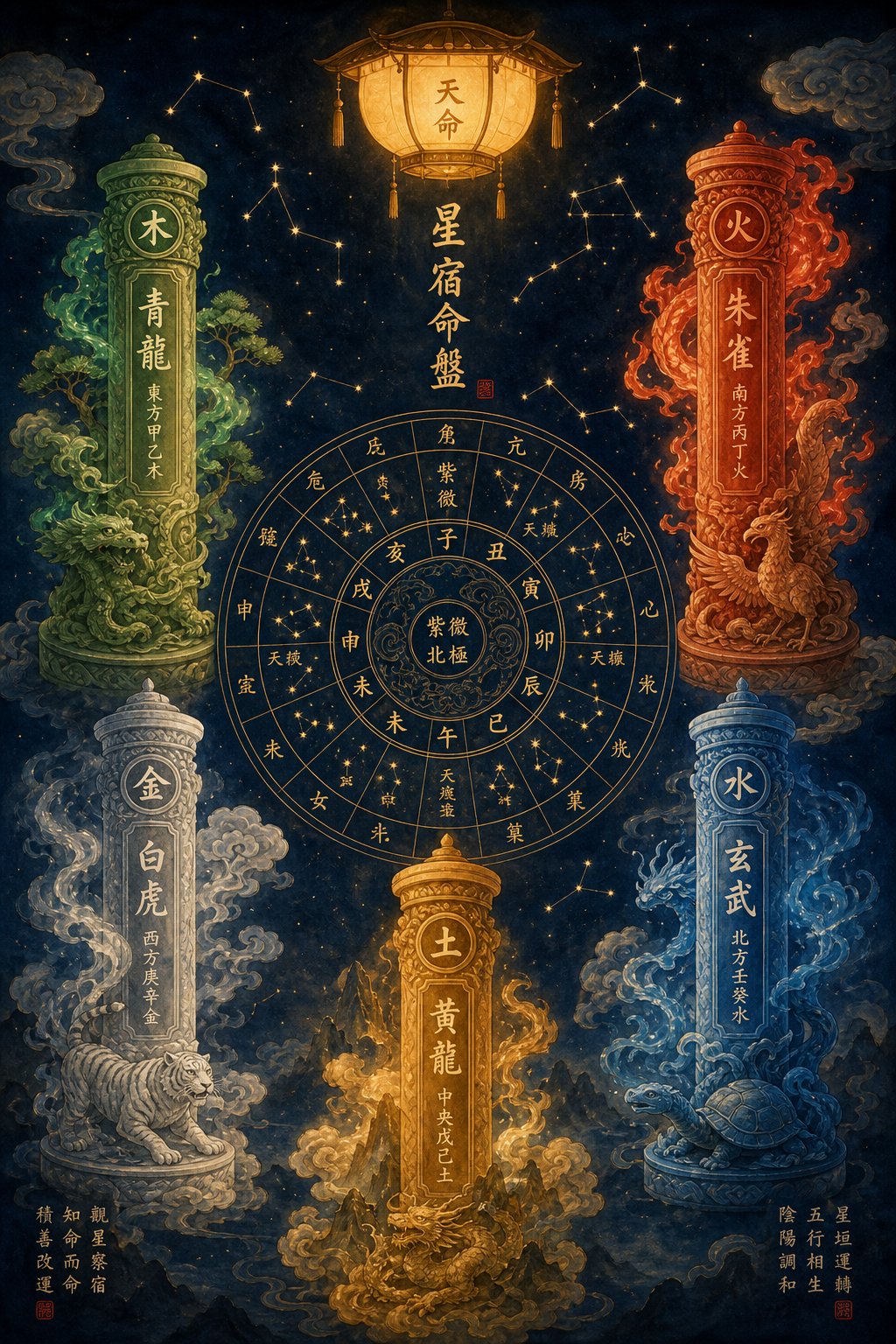
Every Chinese character chosen for a name carries the energetic fingerprint of one of the five feng shui elements. But what does each element actually bring to a person's identity when it lives inside their name? Understanding the core qualities of Wood, Fire, Earth, Metal, and Water in a naming context helps you move from chart reading to meaningful character selection.
In traditional Chinese philosophy, these 5 elements of feng shui are not static categories. They represent dynamic phases of energy, each with distinct personality signatures that color how a name resonates throughout a person's life. When a specific element appears in your name, it continuously reinforces certain traits and tendencies, almost like a quiet affirmation repeated every time someone calls you.
Wood Element Names and Their Personality Influence
Wood (木, Mu) embodies growth, vitality, and flexibility. Picture a young bamboo shoot pushing through stone: determined yet adaptable. When Wood energy is present in a name, it nurtures qualities like ambition, creativity, and an instinct for expansion. People with strong Wood characters in their names often project a sense of forward momentum, someone who initiates rather than waits.
Characters containing the wood radical or classified as Wood through stroke count tend to suggest strength and development. If your birth chart reveals a Wood deficiency, a name carrying this element can supply the upward, generative energy you lack, encouraging resilience and the capacity to bend without breaking.
Fire, Earth, Metal, and Water Element Traits in Names
Fire (火, Huo) is passion, warmth, and visibility. A Fire-element name radiates brightness and enthusiasm. It suits someone whose chart needs more spark, more confidence in self-expression. Think of it as adding a lamp to a dim room. Names with Fire energy often carry meanings tied to light, brilliance, or excitement, and they encourage boldness and social magnetism.
Earth (土, Tu) represents stability, nourishment, and grounding. When Earth appears in a name, it anchors the person with reliability and patience. Missing Earth in your chart can manifest as restlessness or difficulty following through. An Earth-element name acts as a counterweight, fostering dependability and a calm, centered presence that others trust instinctively.
Metal (金, Jin) brings clarity, discipline, and precision. A Metal name sharpens focus and reinforces integrity. People lacking Metal may struggle with boundaries or decisiveness. Characters aligned with this element introduce fortitude, a sense of structure, and the ability to cut through confusion with purpose.
Water (水, Shui) flows with adaptability, wisdom, and depth. A Water-element name encourages intelligence, emotional fluidity, and resourcefulness. If Water is your missing element, a name carrying its energy can enhance intuition and the capacity to navigate change gracefully, like a stream finding its path around every obstacle.
How Element Energy Shapes Identity Through Naming
You'll notice that these elements in feng shui are not about rigid personality boxes. Each person already contains traces of all five phases. A name simply amplifies what is needed and softens what is excessive. The goal is harmony, not dominance of a single element.
The table below summarizes how each element translates into naming energy:
| Element | Chinese Character | Personality Traits in Naming Context | Qualities Brought to a Name |
|---|---|---|---|
| Wood | 木 (Mu) | Ambitious, creative, adaptable | Growth, vitality, forward momentum |
| Fire | 火 (Huo) | Passionate, expressive, confident | Brightness, warmth, social magnetism |
| Earth | 土 (Tu) | Reliable, patient, grounded | Stability, nourishment, trustworthiness |
| Metal | 金 (Jin) | Disciplined, precise, principled | Clarity, fortitude, decisiveness |
| Water | 水 (Shui) | Wise, adaptable, intuitive | Fluidity, intelligence, emotional depth |
Each element also connects to the others through generative and controlling relationships. A Wood-element character paired with a Water-element character, for instance, creates a nurturing flow because Water feeds Wood. Choosing characters that work together rather than against each other is where the productive and destructive cycles come into play, and understanding those cycles turns a good name into a truly balanced one.
How to Determine Your Birth Element
Knowing what each element brings to a name is only useful if you first know which element you actually need. Your birth element acts as the starting point for every naming decision, revealing which energies are already abundant in your chart and which ones require reinforcement through carefully chosen characters.
So how do you figure out what chinese element you are? Two methods exist, one quick and accessible, the other deeply precise. Both lead to the same destination: clarity about your elemental makeup so you can select name characters that restore balance.
The Birth-Year Last-Digit Method Explained
The simplest way to identify your element by birthday is to look at the last digit of your birth year. This method has been used for generations as a fast reference and works well as a starting point for anyone new to the feng shui name elements chart system.
Here is how the last-digit-to-element mapping works:
- 0 or 1 — Metal (金)
- 2 or 3 — Water (水)
- 4 or 5 — Wood (木)
- 6 or 7 — Fire (火)
- 8 or 9 — Earth (土)
For example, if you were born in 1987, your last digit is 7, making Fire your birth element. Born in 1990? Your last digit is 0, placing you under Metal. This approach gives you a quick birthdate element identification that points you toward the characters your name might benefit from.
The method is straightforward, but it only reveals one layer of your elemental profile. It tells you the dominant element of your birth year without accounting for the month, day, or hour you were born, each of which carries its own elemental influence.
The Ba Zi Four-Pillar Method for Precise Element Analysis
For a complete picture, practitioners turn to the Ba Zi (八字) system, also called the Four Pillars of Destiny. Rather than relying on a single digit, this method analyzes four time markers: your birth year, month, day, and hour. Each marker produces a "pillar" composed of a Heavenly Stem and an Earthly Branch, giving you eight characters total that map your full elemental composition.
Within this framework, the most critical piece is your Day Master, the Heavenly Stem of your birth day. This represents your core self and determines how every other element in the chart relates to you. A feng shui birth element calculator based on Ba Zi will identify not just your dominant element but also which of the five phases are excessive, balanced, or entirely absent from your chart.
Why does this matter for naming? Because the last-digit method might tell you that you are a Water person, but a full Ba Zi reading could reveal that your chart already overflows with Water while lacking Fire and Earth entirely. In that scenario, adding more Water characters to your name would deepen the imbalance rather than correct it. The four-pillar method shows you exactly where the gaps are, so name characters can be chosen with surgical precision.
Why the February Solar Cut-Off Date Changes Your Element
Here is a detail that catches many people off guard: the Chinese calendar year does not begin on January 1. For Ba Zi calculations, the new year starts around February 4 or 5, aligned with the Li Chun (立春) solar term rather than the Gregorian calendar. This means someone born on January 28, 1990, actually belongs to the 1989 year in elemental terms.
The distinction is not trivial. If your birthday falls in January or early February, using the wrong year shifts your entire element assignment. A person who assumes they are Metal (1990, last digit 0) might actually be Earth (1989, last digit 9). That single miscalculation would lead to selecting name characters that reinforce an element already present rather than supplying what is genuinely missing.
When using either method, always check whether your birth date falls before or after the solar new year transition for your birth year. Most Ba Zi calculators handle this automatically, but if you are working manually with the last-digit approach, verify the exact Li Chun date for the year in question.
With your birth element clearly identified and your chart's strengths and weaknesses mapped, the next question becomes practical: how do you determine which element a specific Chinese character actually carries? That classification depends on two structural features of the character itself, its stroke count and its radical, each offering a distinct pathway to elemental assignment.
The Stroke-Count Method for Mapping Characters to Elements
A Chinese character's elemental identity is not arbitrary. One of the oldest and most systematic ways to classify characters on a chinese five elements chart relies on something surprisingly mathematical: the total number of strokes required to write the character. This stroke-count method forms a core pillar of traditional naming numerology, connecting the physical structure of written language to the energetic framework of the five elements.
The logic is elegant. Every Chinese character can be broken down into individual brush strokes, and that total stroke number carries a specific Five Elements vibration. When practitioners build a name, they calculate the strokes in each character and use the resulting numbers to verify that the name's elemental composition supports the person's birth chart.
Stroke Count Rules for Element Assignment
The system works by looking at the last digit of a character's total stroke count. Each pair of ending digits corresponds to one of the five elements, following the sequence of the Heavenly Stems (天干) in Chinese cosmology. Here is the mapping:
| Last Digit of Stroke Count | Assigned Element | Chinese Name | Example Stroke Totals |
|---|---|---|---|
| 1 or 2 | Wood | 木 (Mu) | 1, 2, 11, 12, 21, 22 |
| 3 or 4 | Fire | 火 (Huo) | 3, 4, 13, 14, 23, 24 |
| 5 or 6 | Earth | 土 (Tu) | 5, 6, 15, 16, 25, 26 |
| 7 or 8 | Metal | 金 (Jin) | 7, 8, 17, 18, 27, 28 |
| 9 or 0 | Water | 水 (Shui) | 9, 10, 19, 20, 29, 30 |
So a character with 14 strokes carries Fire energy (last digit 4), while one with 18 strokes belongs to Metal (last digit 8). A 20-stroke character? Water. The pattern repeats infinitely, making it applicable to even the most complex characters in the chinese elements chart system.
This mapping also extends beyond individual characters. In the Five Formations (五格) system, practitioners calculate composite stroke values for different positions in a name, such as the Human Formation (人格) or Total Formation (总格), and then assign elements to those totals using the same last-digit rule. The element of each formation reveals how energy flows through different life areas like career, relationships, and overall fortune.
Traditional vs Simplified Character Stroke Differences
Here is where many people stumble: stroke counting in feng shui naming always uses the traditional (繁体) form of a character, not the simplified (简体) version used in mainland China today. Why does this matter? Because simplification often reduces stroke counts significantly, which can shift a character into an entirely different elemental category.
Consider the character for "dragon." In simplified form, 龙 has 5 strokes, placing it under Earth. In its traditional form, 龍 has 16 strokes, which also maps to Earth. In this case, both forms happen to land on the same element. But that is not always true. The character 华 (splendor) has 6 strokes simplified (Earth) versus 14 strokes traditional (Fire). Choosing the wrong form for your calculation could mean selecting a character you believe supplies Earth energy when it actually carries Fire.
Practitioners insist on traditional forms because the stroke-count system was developed centuries before character simplification existed. The energetic associations were calibrated to the original written structures. As one naming numerology resource notes, some characters may have different stroke counts across different systems, so consulting professional references or tools ensures accurate calculation.
Stroke count gives you a clean, numerical pathway to element classification, but it is not the only signal a character sends. Many characters contain embedded components called radicals that carry their own elemental identity independent of stroke totals, and sometimes these two methods point in different directions.
Chinese Radicals and Their Element Associations
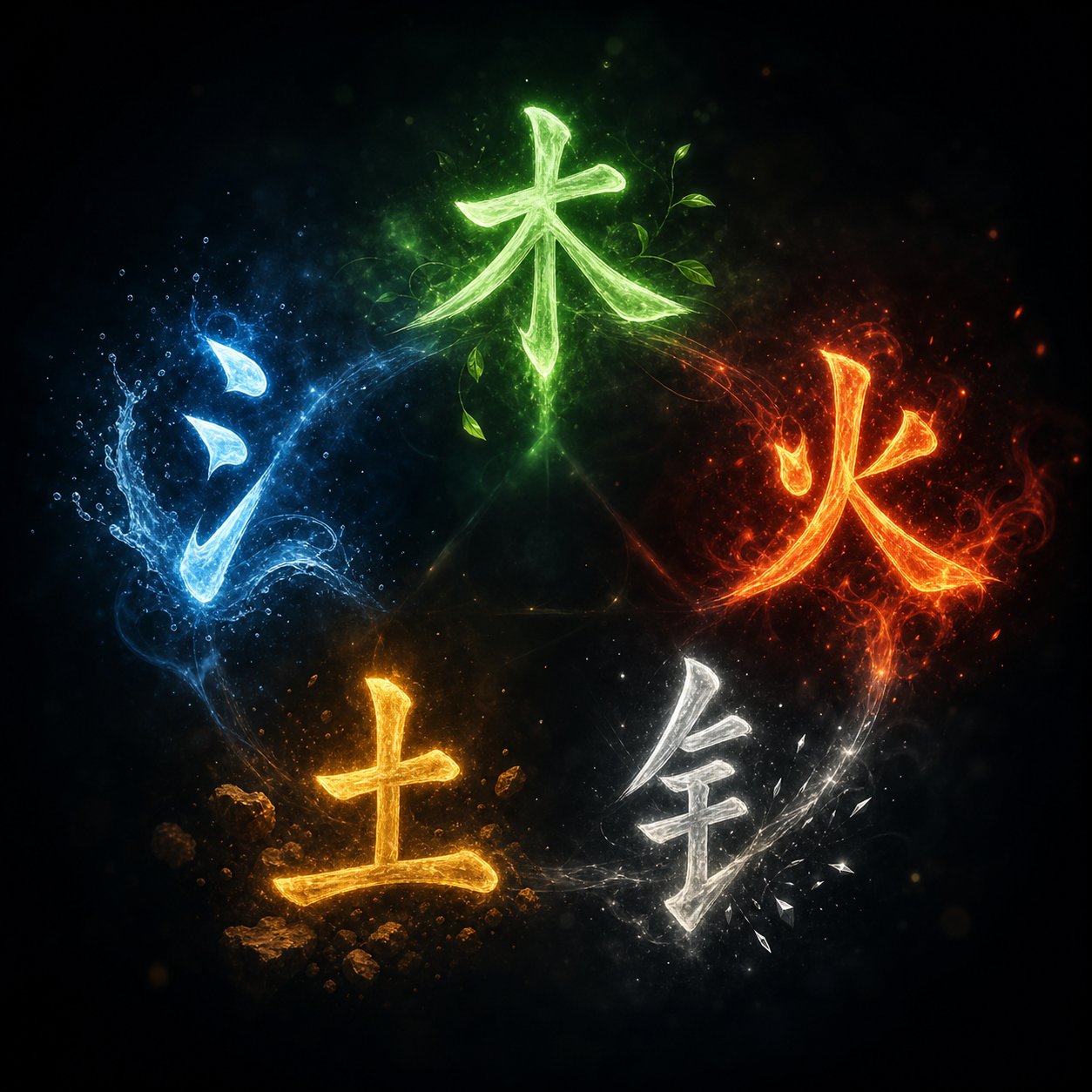
Radicals are the building-block components embedded inside Chinese characters, and they carry elemental energy that is visible at a glance. Unlike the stroke-count method, which requires calculation, the radical approach lets you identify a character's element simply by recognizing a familiar component within its structure. For practitioners working with a feng shui name elements chart, radicals offer the most intuitive and historically grounded pathway to elemental classification.
Why do radicals matter so much? Chinese is a logographic language. When ancient scribes created characters, they embedded meaning directly into the visual form. A character built around the water radical was designed to reference something related to water. That semantic DNA does not disappear when the character enters a name. It continues broadcasting its elemental signature every time the name is written or read.
Water and Wood Radicals in Name Characters
The water radical 氵(three dots on the left side of a character) is one of the most recognizable signals in Chinese naming. Characters containing it almost always belong to the Water element regardless of their stroke count. Popular name characters like 涵 (han, meaning inclusive), 清 (qing, meaning clear), 淼 (miao, meaning vast water), and 浩 (hao, meaning grand) all carry this radical and deliver Water energy into a name. The ice radical 冫 and the rain radical 雨 also point to Water, appearing in characters like 冰 (ice) and 霖 (sustained rain).
The feng shui element wood is equally straightforward to spot. The wood radical 木 appears in characters like 林 (lin, forest), 森 (sen, dense forest), and 桐 (tong, paulownia tree). Beyond the obvious 木 radical, the grass radical 艹 and bamboo radical 竹 also signal Wood energy. Name characters such as 萱 (xuan, daylily), 芳 (fang, fragrant), and 筠 (yun, bamboo skin) all belong to the Wood family through their radicals, reinforcing qualities of growth, vitality, and resilience.
Fire, Earth, and Metal Radicals for Naming
The fire element in feng shui manifests through two primary radicals: 火 (fire) and its variant 灬 (four dots at the bottom of a character). Characters like 焱 (yan, flames), 煜 (yu, brilliant), and 烨 (ye, splendid) use the fire radical directly. The sun radical 日 also carries Fire associations, giving characters like 晨 (chen, morning) and 昭 (zhao, luminous) their fiery classification.
The earth element in feng shui shows up through the radicals 土 (earth), 山 (mountain), and 石 (stone). Name characters such as 坤 (kun, earth/feminine principle), 培 (pei, to nurture), 峰 (feng, peak), 岩 (yan, cliff), and 磊 (lei, stacked stones) all draw their elemental identity from these components. They bring grounding, stability, and dependability into a name.
The feng shui metal element is signaled by the radicals 金 (gold/metal) and its simplified form 钅. Characters frequently chosen for names include 鑫 (xin, prosperous), 铭 (ming, inscription), 锋 (feng, sharp edge), and 钰 (yu, precious jade-metal). These characters introduce clarity, strength, and precision.
The table below maps common radicals to their corresponding elements with example name characters:
| Element | Primary Radicals | Additional Radicals | Example Name Characters |
|---|---|---|---|
| Water (水) | 氵 | 冫, 雨 | 涵, 清, 淼, 浩, 冰, 霖 |
| Wood (木) | 木 | 艹, 竹 | 林, 森, 萱, 芳, 筠, 桐 |
| Fire (火) | 火, 灬 | 日 | 焱, 煜, 烨, 晨, 昭 |
| Earth (土) | 土 | 山, 石 | 坤, 培, 峰, 岩, 磊 |
| Metal (金) | 金, 钅 | — | 鑫, 铭, 锋, 钰, 銮 |
When Radical and Stroke-Count Methods Disagree
Here is where things get interesting. A character like 萱 contains the grass radical 艹, clearly pointing to Wood. But its traditional Kangxi stroke count is 15, and a last digit of 5 maps to Earth under the numerical method. Two systems, two different answers. Which one wins?
Traditional naming practice follows a clear hierarchy of priority: the radical and meaning-based method takes precedence over stroke-count numerology when the two conflict. The reasoning is rooted in how Chinese characters work as a writing system. Characters are fundamentally semantic, built to convey meaning through their visual components. A radical directly encodes what category of thing the character represents. Stroke count, while useful, is a more abstract numerical overlay added later as a systematic framework.
In practice, the resolution follows these principles:
- When the radical and character meaning both point to the same element, that classification is definitive, even if the stroke count suggests otherwise.
- When a character has no obvious elemental radical (think 文, 嘉, or 德), the stroke-count method and meaning-based analysis become the primary tools.
- When multiple methods agree, confidence in the classification is highest. A character like 浩 (water radical, meaning relates to water, stroke count 11 maps to Wood) still belongs to Water because radical and meaning align.
This hierarchy matters because choosing the wrong element for a character can undermine the entire balance you are trying to create. If your birth chart needs Water and you select 淼 believing it supplies Water energy, you are correct, regardless of what its stroke count might suggest numerically. The radical tells the truth about what that character fundamentally is.
With both classification methods now in hand, the next layer of complexity emerges: how do the elements within a multi-character name interact with each other? Two characters side by side do not simply coexist. They generate or control one another according to ancient cyclical relationships that determine whether a name flows harmoniously or creates internal friction.
Productive and Destructive Cycles in Name Selection
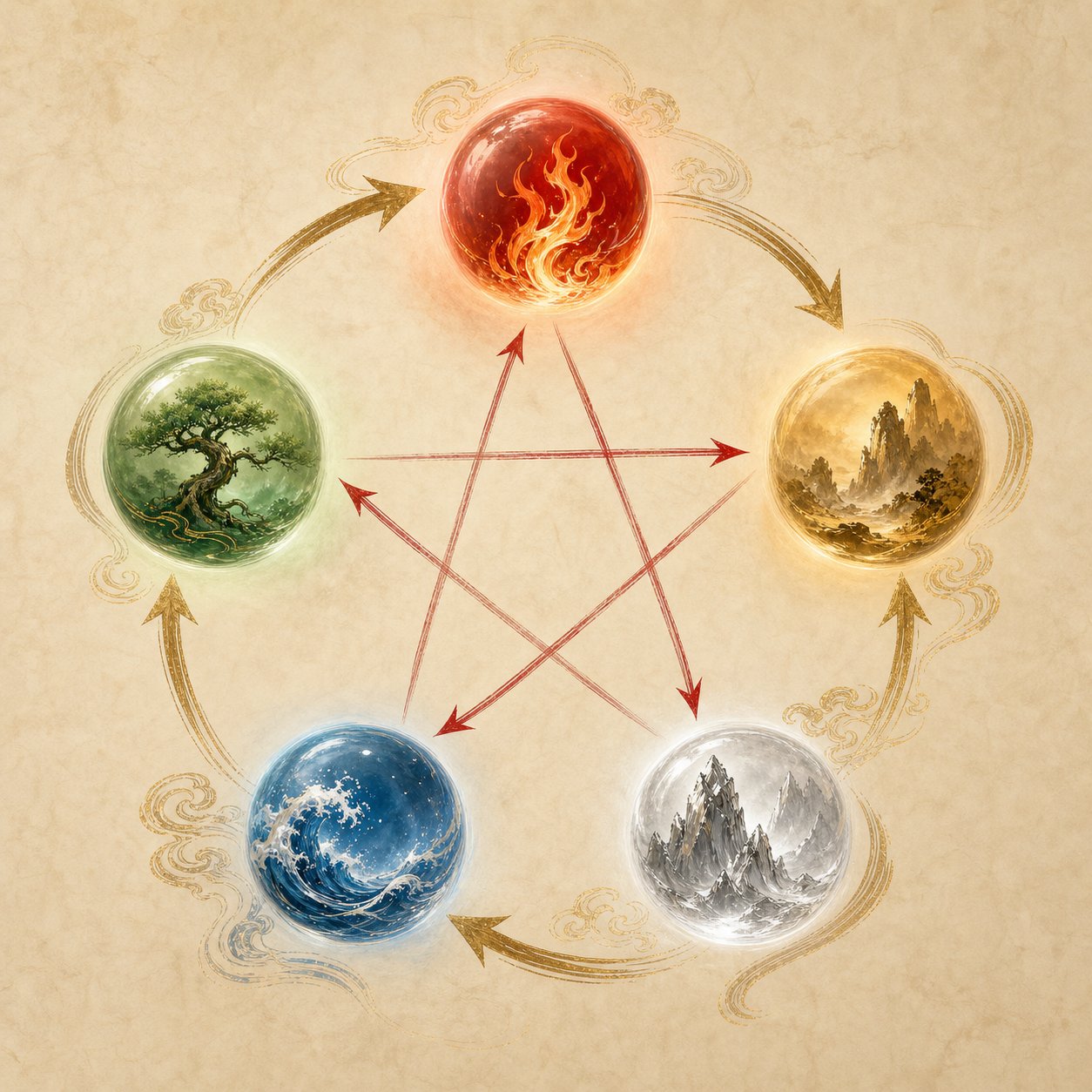
Two characters sitting next to each other in a name do not exist in isolation. They interact. One element either feeds the other, creating a smooth flow of energy, or it attacks the other, generating tension that practitioners believe follows a person throughout life. These interactions follow two ancient patterns known as the productive cycle (相生, xiang sheng) and the destructive cycle (相克, xiang ke), and understanding them is essential for anyone using a feng shui name elements chart to build a balanced name.
Imagine placing a candle beside a bucket of water. You feel the conflict intuitively. The same principle applies when a Water-element character sits directly beside a Fire-element character in a name. The feng shui five elements are not just labels. They are forces that relate to each other in predictable, directional ways, and those relationships determine whether a multi-character name carries harmony or friction.
The Productive Cycle for Harmonious Name Pairs
The productive cycle, also called the generating cycle (生, sheng), describes how each element nurtures and gives rise to the next in a continuous loop. When two adjacent characters in a name follow this cycle, energy flows forward naturally, like a river feeding into the sea. The element in the first position supports the element in the second, creating a sense of momentum and mutual reinforcement.
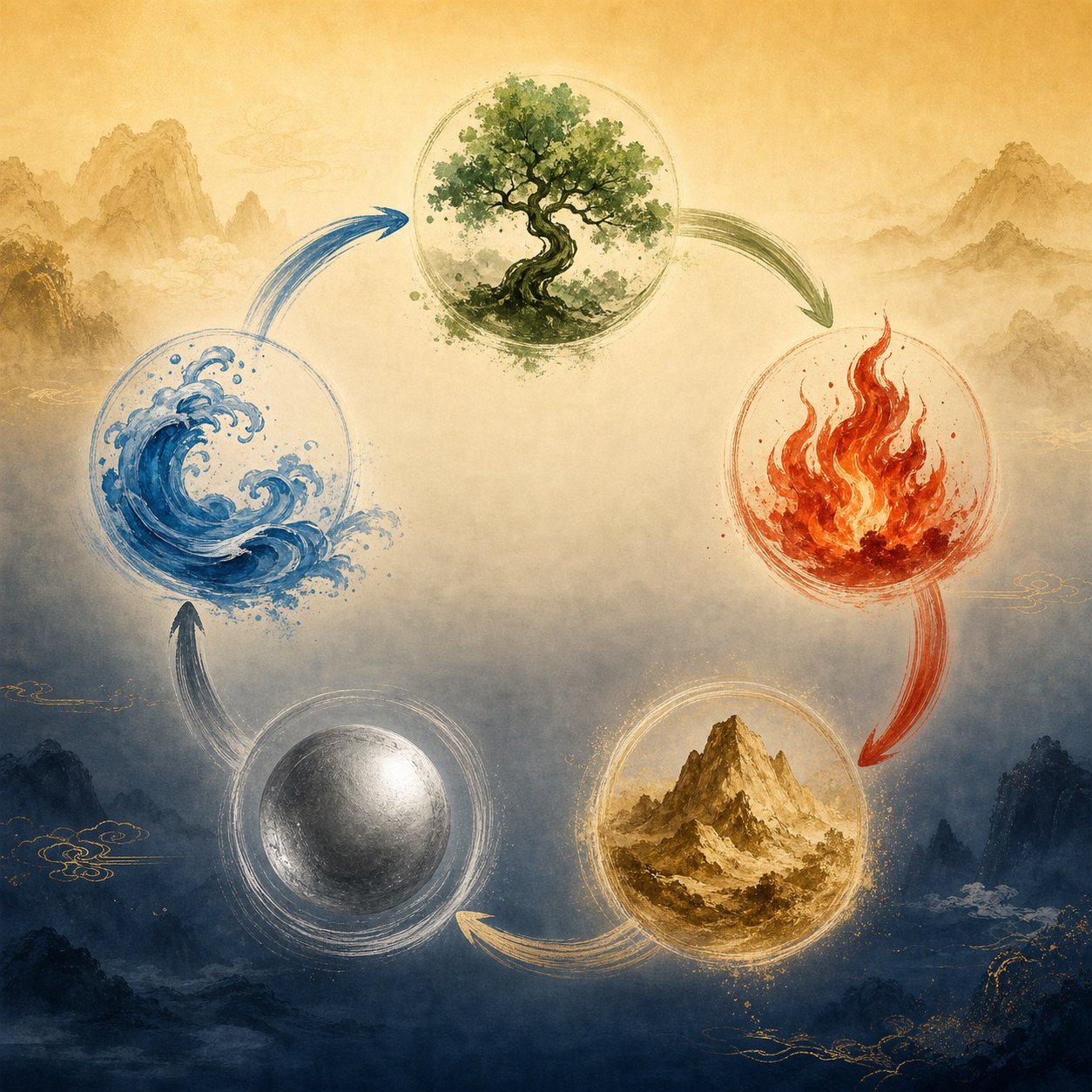
Here is the complete element cycle in its productive sequence:
- Wood feeds Fire (木 → 火) — Wood burns to create fire. A Wood character followed by a Fire character generates warmth and expansion.
- Fire creates Earth (火 → 土) — Fire produces ash, which becomes soil. Fire followed by Earth builds stability from passion.
- Earth bears Metal (土 → 金) — Metals are mined from the earth. Earth followed by Metal produces clarity from a grounded foundation.
- Metal collects Water (金 → 水) — Metal surfaces attract condensation. Metal followed by Water encourages wisdom flowing from discipline.
- Water nourishes Wood (水 → 木) — Water feeds trees and plants. Water followed by Wood fosters growth nurtured by deep intelligence.
When you select name characters that follow this sequence, the energy between them is cooperative. A name containing a Metal-element character in the first given-name position and a Water-element character in the second position rides the productive flow: Metal collects Water. The person carrying that name benefits from an internal energetic relationship where structure (Metal) naturally gives rise to adaptability (Water).
This principle extends to same-element pairings as well. Two Wood characters side by side do not conflict. They reinforce each other, doubling the growth energy. Same-element combinations are considered neutral to mildly positive, though they lack the dynamic forward motion that a productive pair generates.
The Destructive Cycle and Name Combinations to Avoid
The destructive cycle, sometimes called the controlling or overcoming cycle (克, ke), describes how each element restrains another. In nature, this cycle maintains balance by preventing any single force from growing unchecked. In a name, however, placing two elements in a destructive relationship creates internal opposition, an energetic tug-of-war that practitioners advise against.
The destructive pairings to watch for:
- Water extinguishes Fire (水 克 火) — Water puts out flames. A Water character paired with a Fire character suppresses warmth and confidence.
- Fire melts Metal (火 克 金) — Intense heat destroys metal's structure. Fire beside Metal undermines clarity and discipline.
- Metal chops Wood (金 克 木) — An axe cuts a tree. Metal next to Wood restricts growth and creative expansion.
- Wood depletes Earth (木 克 土) — Roots break through soil and drain nutrients. Wood beside Earth destabilizes grounding energy.
- Earth dams Water (土 克 水) — Earth absorbs and blocks water flow. Earth next to Water stifles adaptability and intuition.
Does this mean a name with Earth and Water characters is automatically harmful? Not necessarily. Context matters. The severity depends on which position each element occupies, whether other characters in the name mediate the conflict, and how the name interacts with the person's birth chart. A person whose chart already overflows with Water might actually benefit from a mild Earth control to prevent excess. Still, as a general naming guideline, avoiding direct destructive pairings between adjacent characters keeps the name's internal energy cooperative rather than combative.
Reading Element Flow Across a Full Name
A typical Chinese name has two or three characters: one surname character and one or two given-name characters. Reading the element flow means tracing the relationship from one character to the next in sequence, checking whether each transition follows the productive cycle, sits in a neutral same-element pairing, or falls into a destructive clash.
Consider a three-character name where the surname carries Earth energy, the first given-name character carries Metal, and the second given-name character carries Water. The flow reads: Earth → Metal → Water. Each step follows the productive cycle (Earth bears Metal, Metal collects Water). Energy moves smoothly from beginning to end, creating what practitioners call a "flowing name" with no internal resistance.
Contrast that with a name flowing Earth → Water → Fire. The first transition is destructive (Earth dams Water), and the second is also destructive (Water extinguishes Fire). Every connection fights the next, producing a name that works against itself energetically.
The ideal scenario places all adjacent characters in productive relationships. When that is not possible, a neutral same-element pairing between two positions is acceptable. The combination to actively avoid is a destructive relationship between the two given-name characters, since these represent the most personal energy in the name, the part that defines the individual rather than the family lineage.
Practically, this means your naming process gains a clear filter. After identifying which elements your birth chart needs, you check candidate characters not only for their individual elemental classification but also for how they relate to each other in sequence. A character that supplies the right element but clashes with its neighbor may do more harm than good. The productive cycle becomes your guide for pairing: wood, earth, fire, water, metal all have a natural partner that receives their energy gracefully.
This sequential reading of element flow becomes even more structured when you apply the Three Talent framework, which assigns cosmic significance to each character position in a name, connecting the surname to Heaven, the first given character to Humanity, and the second to Earth.
The Three Talent Configuration in Chinese Names
Sequential element flow gives you a practical filter for pairing characters, but traditional Chinese naming goes a step further. It assigns each character position a cosmic role, turning a three-character name into a miniature model of the universe. This framework is called the Three Talents, or 天地人 (Tian Di Ren), and it elevates personal feng shui naming from simple element matching to a structured alignment of Heaven, Humanity, and Earth.
Sounds abstract? Picture it this way. A three-character Chinese name is not just three sounds strung together. It is a vertical axis connecting the sky above, the ground below, and the person standing between them. Each position in the name corresponds to one of these cosmic layers, and the elemental relationship between them determines whether the name channels balanced energy or creates friction between forces that should be working together.
Heaven, Earth, and Human Positions in a Name
In the Three Talent system, the positions break down like this:
- Heaven position (天, Tian) — represented by the surname. This reflects ancestral energy, inherited fortune, and the larger forces beyond personal control. Since you do not choose your family name, the Heaven element is fixed.
- Human position (人, Ren) — represented by the first given-name character. This is the core of personal identity, the element that shapes your character, drives your ambitions, and defines how you engage with the world.
- Earth position (地, Di) — represented by the second given-name character. This reflects your foundation, early life conditions, and the support system beneath you.
The chinese elemental chart used in this framework assigns each position its Five Elements value based on the stroke-count method described earlier. Practitioners calculate the relevant stroke totals for each position, check the last digit, and determine whether the element is Wood, Fire, Earth, Metal, or Water. The resulting three-element sequence, read from top to bottom, reveals the cosmic energy pattern embedded in the name.
The Three Talent configuration treats a name as a living axis between Heaven and Earth, with the person at its center. When all three positions flow in productive harmony, the name becomes a channel for balanced cosmic energy rather than a source of internal resistance.
How Element Flow Works Across Three Characters
Once you know the element at each position, you read the relationships between them using the same productive and destructive cycles covered earlier, but with positional significance layered on top.
Two relationships matter most:
- Heaven to Human (surname element → first given-name element): Does the ancestral energy support or suppress the individual? A productive relationship here, where Heaven generates or nurtures the Human element, suggests that inherited conditions aid personal development. A destructive relationship implies external pressure or inherited challenges that require extra effort to overcome.
- Human to Earth (first given-name element → second given-name element): Does the individual's core energy harmonize with their foundation? A productive flow here indicates stable roots and a solid base for growth. Conflict at this junction suggests instability in early life or tension between personal drive and grounding circumstances.
The ideal Three Talent configuration shows a continuous productive flow from Heaven through Human to Earth. For example, a surname carrying Metal energy, a first given name carrying Water, and a second given name carrying Wood creates the sequence Metal → Water → Wood. Each step follows the generative cycle: Metal collects Water, Water nourishes Wood. Energy cascades smoothly from the cosmic down to the personal foundation.
Contrast that with a configuration like Fire → Metal → Wood. Heaven (Fire) destroys Human (Metal), and Human (Metal) chops Earth (Wood). Both transitions are destructive. In the Three Talent framework, this pattern signals a name where cosmic forces press down on the individual, and the individual in turn destabilizes their own foundation. Practitioners would flag this combination as one to avoid.
What about mixed results? A configuration like Earth → Metal → Fire gives you Earth generating Metal (productive) at the top, but Metal being destroyed by Fire (destructive) at the bottom. The reference material describes this type of half-and-half pattern as carrying both support and tension, requiring further analysis of the specific numerical values before reaching a final assessment.
The Three Talent framework does not replace individual character analysis. It adds a structural layer that ensures the name works as a unified system rather than a collection of isolated elements. When you combine this positional reading with the radical-based and stroke-count classifications from earlier sections, you gain a comprehensive view of how energy moves through every layer of a name.
Yet even within a single element, not all expressions are equal. A Water character can evoke the power of an ocean or the gentleness of morning dew. These Yin and Yang variations within each element add one more dimension to character selection, letting you fine-tune not just which element appears in your name but how that element shows up.
Yin and Yang Variations Within the Five Elements
Selecting the right element is only half the decision. Each of the five elements in chinese astrology expresses itself in two distinct modes: Yang (outward, assertive, expansive) and Yin (inward, receptive, subtle). These polarities give rise to the Ten Heavenly Stems in chinese five element astrology, and they matter deeply when choosing name characters because a Yang expression of Water feels nothing like its Yin counterpart.
Imagine the difference between a roaring ocean and a drop of morning dew. Both are Water. Both carry Water's adaptive, intelligent energy. But the ocean commands attention and overwhelms obstacles through sheer force, while the dew nourishes quietly, penetrating where brute strength cannot reach. When your birth chart calls for Water, the question becomes: which kind of Water does your life actually need?
Yang vs Yin Expressions of Each Element
Every energy element splits into these two faces, each with its own imagery, temperament, and naming implications. Yang expressions tend to be large-scale, visible, and dominant. Yin expressions are refined, gentle, and internally focused. Neither is better. They serve different purposes depending on what the person's chart requires and what qualities the parents or practitioner want the name to reinforce.
| Element | Yang Expression | Yang Qualities | Yin Expression | Yin Qualities |
|---|---|---|---|---|
| Wood (木) | Tall tree, towering timber | Leadership, boldness, unyielding strength | Flower, vine, grass | Flexibility, grace, quiet persistence |
| Fire (火) | Blazing sun, bonfire | Charisma, intensity, commanding presence | Candle flame, starlight | Warmth, inspiration, gentle illumination |
| Earth (土) | Mountain, boulder | Immovability, authority, massive stability | Garden soil, clay | Nurturing, receptive, quietly supportive |
| Metal (金) | Sword, axe, iron beam | Decisiveness, power, cutting clarity | Jewelry, needle, fine gold | Precision, elegance, refined discipline |
| Water (水) | Ocean, river, waterfall | Overwhelming force, depth, unstoppable flow | Morning dew, mist, spring | Subtlety, intuition, quiet nourishment |
In the Heavenly Stems system, Yang Wood is represented by 甲 (Jia) and Yin Wood by 乙 (Yi). Yang Fire is 丙 (Bing), Yin Fire is 丁 (Ding). This pattern continues through all five elements, giving each polarity its own cosmological identity that practitioners reference when analyzing a birth chart's specific needs.
Choosing Between Yin and Yang Element Characters
When you know your chart needs a particular element, the Yin-Yang distinction helps you fine-tune the character selection to match personality goals and life circumstances. A person who needs Metal energy for decisiveness in a leadership role might benefit from a Yang Metal character like 锋 (feng, sharp edge) or 钢 (gang, steel). Someone who needs Metal for quiet inner discipline and refinement might choose a Yin Metal character like 钰 (yu, precious gem-metal) or 铃 (ling, small bell).
Gender considerations often intersect with this choice, though not rigidly. Traditionally, Yang expressions were favored for male names and Yin expressions for female names. A boy needing Wood might receive 松 (song, pine tree, Yang Wood imagery) while a girl needing Wood might receive 芷 (zhi, angelica herb, Yin Wood imagery). Contemporary practice is more flexible, recognizing that a woman in a competitive field might benefit from Yang Metal's cutting clarity, while a man seeking emotional intelligence might be well served by Yin Water's quiet depth.
The key principle: match the polarity to the life you want the name to support, not to assumptions about gender alone. A name built with the right element in the right polarity delivers energy that feels natural rather than forced, like choosing the right tool for a specific task rather than simply grabbing the biggest one available.
With element, cycle, position, and polarity all accounted for, the final step is pulling these layers together into a coherent process for identifying what your chart actually lacks and selecting characters that supply exactly that.
Balancing Missing Elements Through Name Selection
Every concept covered so far, element classification, productive cycles, Three Talent positioning, Yin-Yang polarity, serves a single practical purpose: finding what your chart lacks and filling that gap through your name. This is where theory becomes action. A five elements chart is only useful if you can translate its information into a specific naming decision, so let's walk through the complete process from start to finish.
Identifying Weak and Missing Elements in Your Chart
A Ba Zi chart contains eight characters spread across four pillars. Each character carries a feng shui element, which means your chart holds a specific distribution of Wood, Fire, Earth, Metal, and Water. Some people have three or four characters carrying the same element while another element appears nowhere at all. Others show a more even spread with one element slightly underrepresented.
The critical insight: a completely absent element is not the only problem worth solving. An element that appears only once in a weak position (hidden inside an Earthly Branch rather than visible as a Heavenly Stem) can be functionally deficient even though it technically exists. The Day Master serves as your reference point. Every other element in the chart is interpreted through its relationship to this central identity, so weakness is always relative to what the Day Master needs for balance.
Here is what to look for when scanning your chart for imbalances:
- Elements that appear zero times across all eight characters — these are fully missing and typically the highest priority for name compensation.
- Elements that appear only in hidden Stems within Earthly Branches — present but buried, offering minimal active influence.
- Elements that the Day Master specifically needs based on the Useful God (用神) analysis — even an element that appears in the chart can still be the one your name should reinforce if it serves as your Useful God.
The goal is not to flood your name with whatever is missing. Balance means all five elements of feng shui have adequate representation in the combined system of birth chart plus name. Overloading a single element, even a missing one, can tip the scales too far in the opposite direction.
Selecting Name Characters to Restore Balance
With your weak or missing elements identified, character selection follows a structured sequence. Each step narrows your options until you arrive at characters that satisfy elemental, cyclical, and positional requirements simultaneously.
- Determine your birth element — Use the last-digit method for a quick reference or a full Ba Zi calculator for precision. Confirm the solar calendar cut-off if your birthday falls in January or early February.
- Map your complete four-pillar chart — Identify the element of every Heavenly Stem and Earthly Branch across all four pillars. Count how many times each element appears and note which positions they occupy.
- Identify the Useful God element — Based on your Day Master's strength and chart pattern, determine which element most benefits your overall configuration. This is your primary target for name compensation.
- Select candidate characters by radical first — Search for characters whose radicals match your needed element. Radical-based classification is the most reliable indicator, so start here.
- Verify stroke-count alignment — Check whether the stroke count of each candidate character supports or contradicts the radical classification. When both agree, confidence is highest.
- Test productive cycle flow — Arrange your candidate characters in name order and read the element sequence. Confirm that adjacent characters follow the productive cycle or at minimum sit in a neutral same-element relationship.
- Check Three Talent configuration — Calculate the Heaven, Human, and Earth positions for your full name and verify that the elemental flow from top to bottom is harmonious.
- Choose Yin or Yang polarity — Based on personality goals and life context, select characters that express the needed element in the appropriate polarity.
This sequence ensures you are not just picking a character that carries the right feng shui element in isolation. You are verifying that it works within the full architecture of the name, from individual classification through inter-character relationships to cosmic positioning.
Applying Element Principles to Western Names
What if you do not use Chinese characters in daily life? The five elements framework can still inform Western name choices, though the methods shift from visual radicals and stroke counts to meaning, sound, and association.
Western names carry elemental energy through their etymological roots and the imagery they evoke. A name like Sylvia (from Latin "silva," meaning forest) resonates with Wood energy. Blaze or Ignatius carries obvious Fire associations. Peter (from Greek "petra," meaning rock) aligns with Earth. Names referencing precious metals or sharpness, like Sterling or Brand, lean toward Metal. Marina, Brooks, or Morgan (from Welsh "mor," meaning sea) channel Water.
Some practitioners also analyze the phonetic qualities of names. Hard, percussive consonants (K, T, G) are associated with Metal and Fire energy. Flowing sounds (S, L, M) lean toward Water and Wood. Grounded, open vowels suggest Earth. While less codified than the Chinese radical system, these associations offer a pathway for parents choosing English-language names with elemental intention.
The underlying principle remains the same regardless of language: identify what your chart needs, then choose a name whose energy supplies it. Whether that name is written in Chinese characters with verifiable radicals or in English letters with meaningful etymology, the five elements chart provides the diagnostic framework that tells you where to aim.
Putting the Feng Shui Name Elements Chart Into Practice
You now have every layer of the system laid out: birth element identification, radical and stroke-count classification, productive and destructive cycles, Three Talent positioning, and Yin-Yang polarity. Individually, each concept makes sense. The real challenge is applying them together in a single, coherent naming decision. So here is your consolidated roadmap, a checklist that moves from diagnosis to final selection without skipping a step.
Your Step-by-Step Name Element Checklist
When you sit down to evaluate or choose a name using the five elements feng shui framework, follow this sequence from beginning to end:
- Confirm your birth element — Use the last-digit method for a quick read or a full Ba Zi four-pillar analysis for precision. If your birthday falls in January or early February, verify the Li Chun solar cut-off date before assigning your year.
- Map your full elemental distribution — Count how many times each element appears across all eight characters in your Ba Zi chart. Note which elements are missing, buried, or overrepresented.
- Identify your Useful God element — Determine which element most benefits your Day Master. This is your primary target for name compensation, even if it is not the element that is completely absent.
- Search for characters by radical — Find characters whose radicals match your needed element. Radical classification is the most reliable indicator and should guide your initial shortlist.
- Verify stroke-count alignment — Calculate each candidate character's stroke count using traditional forms. Confirm the last digit maps to the same element as the radical. When both agree, your classification is solid.
- Test the productive cycle between characters — Arrange candidates in name order and read the element sequence. Confirm adjacent characters follow the generative cycle or sit in a neutral same-element pairing. Avoid destructive relationships between given-name characters.
- Check the Three Talent configuration — Calculate the Heaven, Human, and Earth positions for the complete name. Verify that elemental flow from surname through both given-name characters follows a harmonious pattern.
- Select the appropriate Yin or Yang polarity — Based on personality goals and life context, choose characters that express the needed element in the right intensity, whether that is the commanding force of Yang or the quiet refinement of Yin.
Each step narrows your options. By the time you reach the end, you are not choosing from thousands of characters. You are selecting from a focused shortlist that satisfies elemental need, cyclical harmony, positional balance, and tonal fit simultaneously.
When to Consult a Feng Shui Naming Practitioner
Self-study using a 5 elements chart gives you a strong foundation, and many parents successfully apply these principles on their own for straightforward cases. But certain situations benefit from professional guidance:
- Your Ba Zi chart shows multiple missing elements or conflicting needs between the Useful God and other chart factors.
- Your surname element creates a destructive relationship with the elements your chart needs most, limiting your options for a smooth Three Talent flow.
- You want to balance naming across siblings, ensuring each child's name complements the others within the family system.
- You are choosing between several strong candidates and need a practitioner's experience to weigh subtle differences in character energy.
A qualified practitioner, someone trained in Ba Zi analysis and classical naming methods, can navigate these complexities with the depth that comes from years of case experience. As Feng Shui Mastery Academy notes, the process involves analyzing favorable and unfavorable elements, selecting characters that introduce supportive energy, and validating the final name against the child's complete chart.
Whether you handle the process yourself or work with a specialist, the five elements of feng shui reward ongoing study. Each name you analyze sharpens your ability to read elemental relationships at a glance. Over time, what once required careful step-by-step calculation becomes intuitive, and the chart transforms from a reference tool into a lens through which you naturally perceive the energetic architecture of language itself.
Frequently Asked Questions About Feng Shui Name Elements Chart
1. How do I find my feng shui birth element?
You can determine your birth element using two methods. The quick approach uses your birth year's last digit: 0-1 is Metal, 2-3 is Water, 4-5 is Wood, 6-7 is Fire, and 8-9 is Earth. For a more precise reading, the Ba Zi four-pillar method analyzes your birth year, month, day, and hour to reveal your complete elemental profile, including your Day Master and which elements are weak or missing. If your birthday falls in January or early February, check the Li Chun solar cut-off date since the Chinese calendar year starts around February 4-5, not January 1.
2. What is the difference between the radical method and stroke-count method for assigning elements?
The radical method identifies a character's element by the visual component embedded within it, such as the water radical (氵) signaling Water or the wood radical (木) signaling Wood. The stroke-count method assigns elements based on the last digit of a character's total strokes in traditional form: 1-2 for Wood, 3-4 for Fire, 5-6 for Earth, 7-8 for Metal, and 9-0 for Water. When these two methods disagree, traditional practice gives priority to the radical and meaning-based classification because radicals directly encode semantic identity, while stroke count is a more abstract numerical overlay.
3. Can feng shui element principles be applied to English or Western names?
Yes, though the methods shift from radicals and stroke counts to meaning, sound, and etymology. Names like Sylvia (forest origin) carry Wood energy, while Marina or Brooks channel Water. Practitioners also analyze phonetic qualities: hard consonants like K and T lean toward Metal and Fire, while flowing sounds like S and L suggest Water and Wood. The underlying principle stays the same regardless of language. You identify what your birth chart needs and choose a name whose energy supplies that missing element.
4. What are the productive and destructive element cycles in naming?
The productive cycle shows how elements nurture each other in sequence: Wood feeds Fire, Fire creates Earth, Earth bears Metal, Metal collects Water, and Water nourishes Wood. Placing adjacent name characters in this order creates harmonious energy flow. The destructive cycle shows how elements control each other: Water extinguishes Fire, Fire melts Metal, Metal chops Wood, Wood depletes Earth, and Earth dams Water. Avoiding destructive pairings between given-name characters prevents internal energetic conflict within the name.
5. What is the Three Talent configuration in Chinese naming?
The Three Talent (天地人, Tian Di Ren) framework assigns cosmic roles to each character position in a three-character Chinese name. The surname represents Heaven (ancestral energy), the first given-name character represents the Human position (personal identity), and the second given-name character represents Earth (foundation and support). Practitioners analyze the elemental flow between these three positions using productive and destructive cycles. The ideal configuration shows a continuous generative flow from Heaven through Human to Earth, ensuring the name channels balanced cosmic energy from top to bottom.