Understanding the Five Elements Generation Cycle
When you first encounter Wu Xing theory, the sheer number of terms can feel overwhelming. Generation cycle, creative cycle, sheng cycle, mother cycle — are these different concepts or the same thing with different labels? This confusion around five elements generation cycle names trips up beginners and even experienced practitioners who switch between disciplines. The terminology matters because using the wrong name in the wrong context signals a misunderstanding of the tradition you're working within.
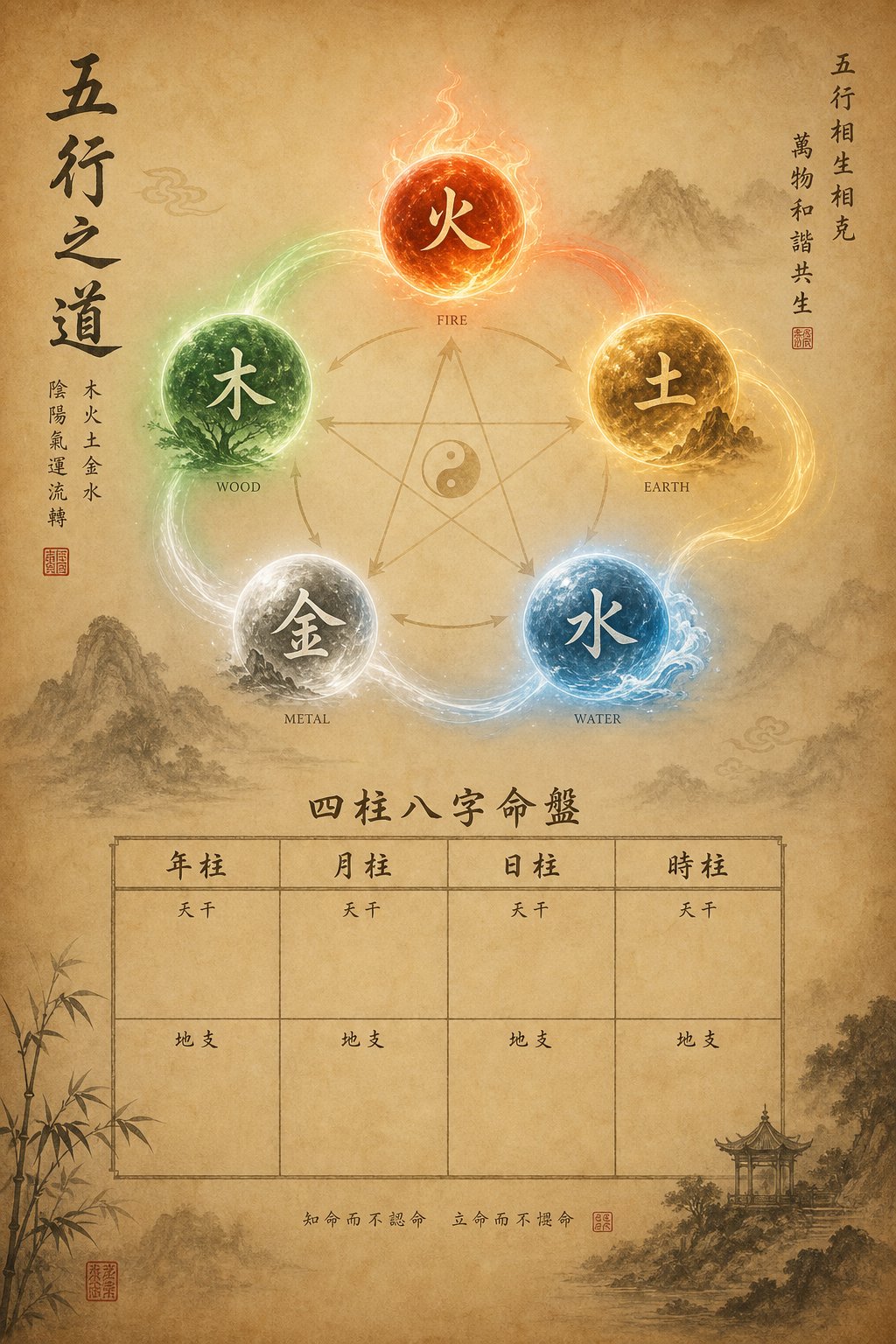
So what are the five elements? They are Wood, Fire, Earth, Metal, and Water — five dynamic phases of energy that ancient Chinese philosophers identified as the fundamental forces driving all natural change. These aren't static "elements" in the Western sense. They represent movement, transformation, and relationship.
What Is the Five Elements Generation Cycle
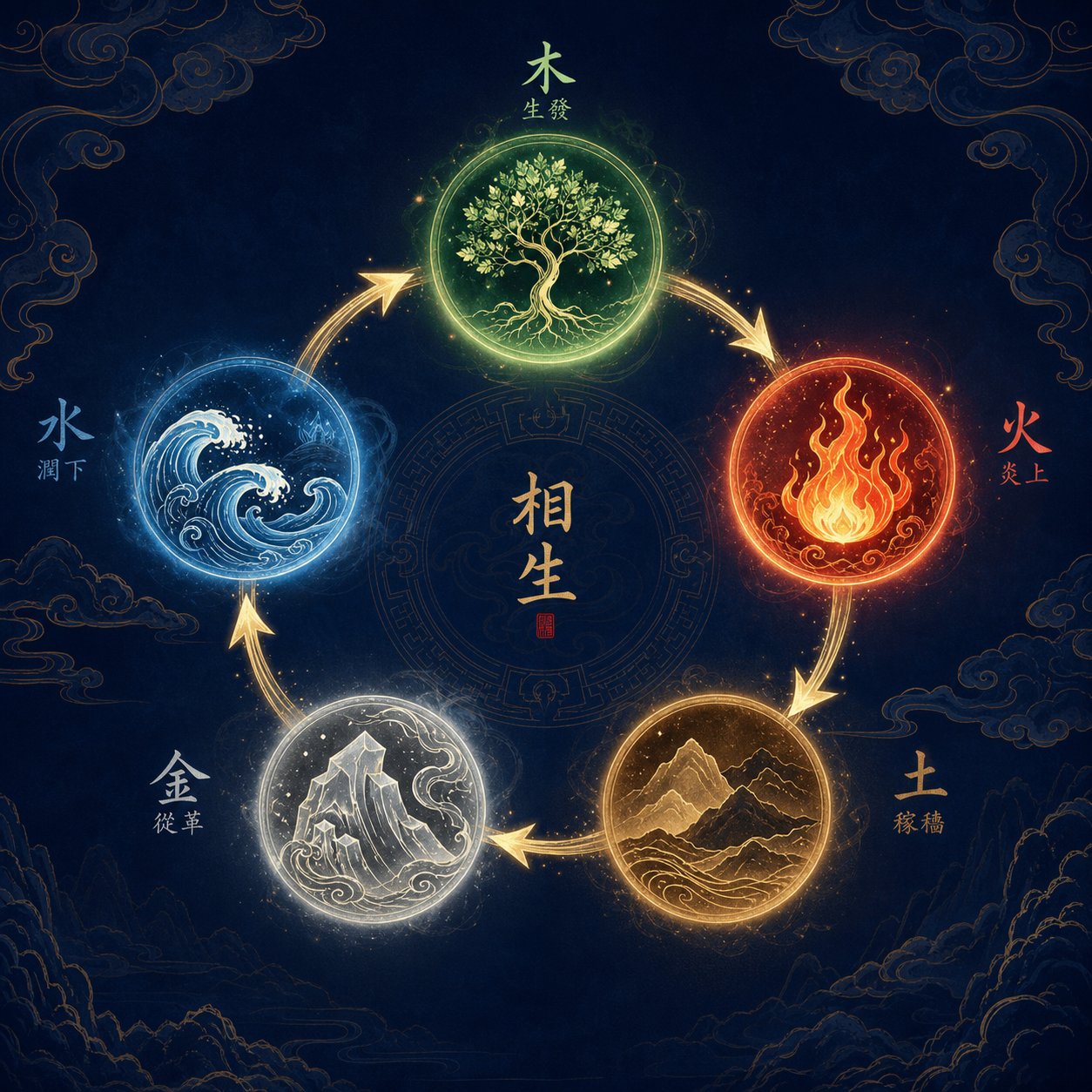
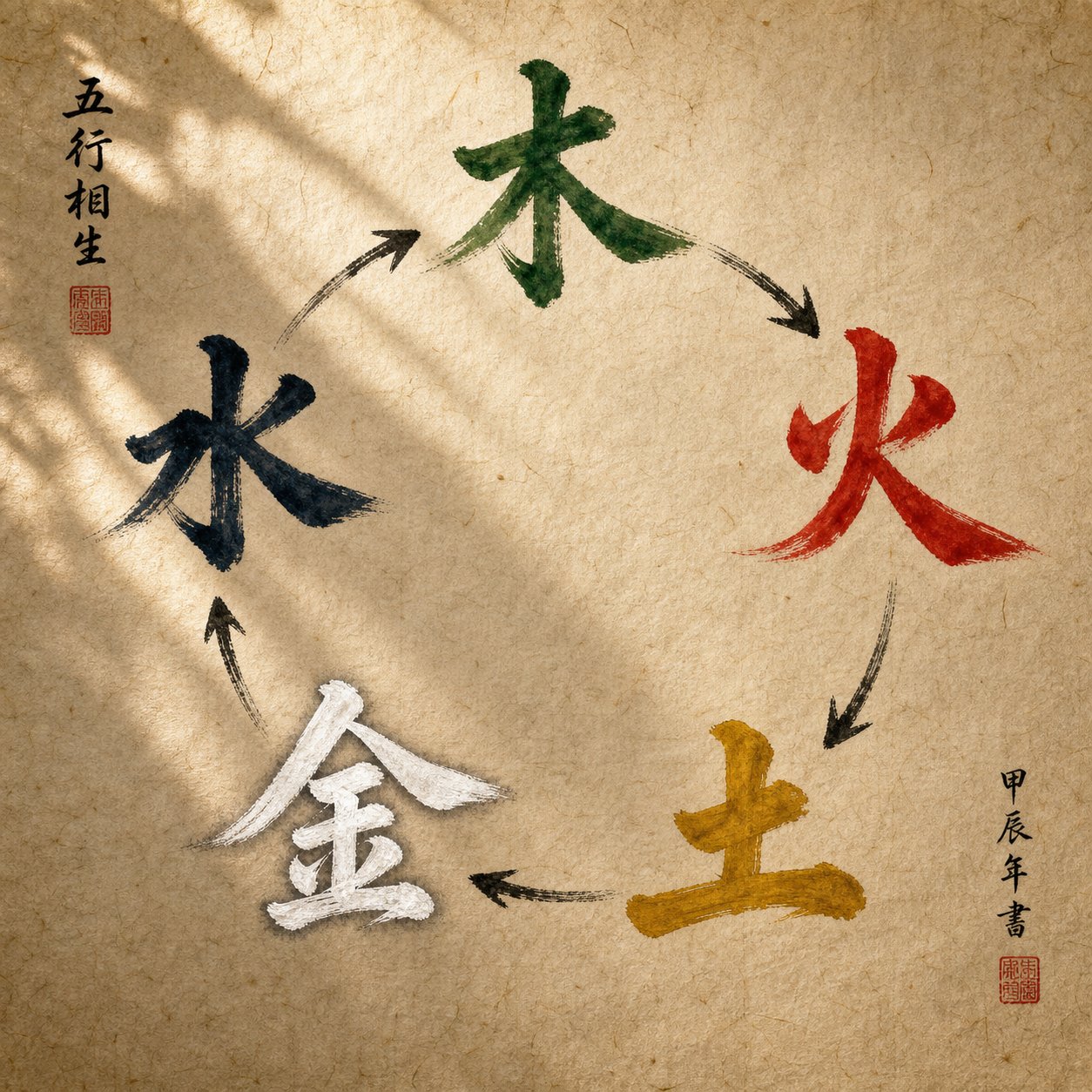
The generation cycle, known in Chinese as 相生 (xiangsheng), describes a specific sequence in which each element produces, nourishes, or gives rise to the next. Imagine a continuous loop: Wood feeds Fire, Fire creates Earth, Earth bears Metal, Metal collects Water, and Water nourishes Wood — then the cycle begins again. Each element acts as a "mother" to the one it generates, sustaining an endless chain of creative energy.
Xiangsheng (相生) literally translates to "mutual generation" — the relationship in which each of the five elements produces and nourishes the next element in sequence, forming a self-sustaining cycle of creation within Wu Xing theory.
This cycle isn't just an abstract diagram. It reflects real patterns the 5 elements display in nature: rain feeds trees, burning wood leaves ash that enriches soil, compressed earth yields metal ore. The generation cycle codifies these observations into a systematic framework that has guided Chinese medicine, philosophy, and cosmology for over two thousand years.
Why the Names Matter for Understanding Wu Xing
Here's where most students stumble. The generation cycle goes by at least six different English names depending on which book you pick up or which tradition you study. A TCM textbook might call it the "nourishing cycle." A feng shui manual might label it the "productive cycle." An academic translation of classical texts might use "engendering cycle." Each name carries slightly different connotations, and mixing them carelessly can blur the meaning you're trying to communicate.
What is five elements theory without precise language? It becomes a vague soup of overlapping ideas. This article serves as a terminology-first reference — a single place where you can find every English translation, every Chinese character, and every contextual distinction for the generation cycle and its five pairs. Whether you're a student memorizing the five elements for an exam, a practitioner explaining relationships to a client, or a researcher comparing classical sources, the naming conventions covered here will give you clarity that scattered resources simply don't provide.
The sequence itself never changes. Wood, Fire, Earth, Metal, Water — always in that order, always cycling back to the beginning. But the words we wrap around that sequence? Those shift depending on tradition, translation era, and discipline. Understanding why they shift is the first step toward mastering the framework rather than just memorizing it.
Alternative Names and Translations for the Generation Cycle
The sequence of transformations stays constant — Wood to Fire to Earth to Metal to Water and back again. Yet open five different English-language textbooks and you'll encounter five different labels for this same cycle. That inconsistency isn't a sign of sloppy scholarship. It reflects decades of translation choices, disciplinary preferences, and philosophical nuance baked into a single Chinese term: 相生 (xiangsheng).
If you've ever felt confused reading one source that says "creative cycle" and another that says "generating cycle," you're not alone. These are the same concept wearing different coats. Let's lay out every version so you can recognize them on sight.
Every English Name for the Sheng Cycle
The wu xing generation cycle has accumulated a surprising number of English translations. Each one emphasizes a slightly different facet of the xiangsheng relationship, but all describe the identical order of transformations — one element giving rise to the next in an unbroken loop.
- Generating Cycle — The most literal translation of 相生. Preferred in TCM textbooks because it captures the active, ongoing nature of one element producing another.
- Creative Cycle — Common in introductory texts and popular wellness writing. Emphasizes the idea that each element "creates" the next, though some scholars argue this overstates the relationship.
- Sheng Cycle — A transliteration rather than a translation. Used by practitioners who want to preserve the original Chinese term without committing to a single English interpretation.
- Nourishing Cycle — Favored in clinical TCM contexts where the emphasis falls on sustaining and feeding rather than producing from scratch. Reflects the mother-child dynamic.
- Productive Cycle — The go-to term in feng shui literature. Highlights the output-oriented relationship between elements when arranging spatial energy.
- Producing Cycle — A close variant of "productive," often found in older English translations of the five phases framework.
- Mother-Son Cycle — Used almost exclusively in TCM diagnosis. Frames each generating pair as a parent-child relationship where the "mother" element nourishes the "son."
- Engendering Cycle — The academic and sinological choice. Appears in scholarly translations of classical texts where precision matters more than accessibility.
All eight names point to the same wuxing sequence. Recognizing them as synonyms — rather than separate concepts — eliminates a major source of confusion for students moving between disciplines.
Why Different Sources Use Different Terms
So why can't everyone just pick one name and stick with it? The answer traces back to how classical Chinese texts entered the English-speaking world.
The earliest translations of foundational works like the Huangdi Neijing (Yellow Emperor's Inner Classic) and the Nan Jing (Classic of Difficult Issues) — both rooted in the Han dynasty period — were produced by scholars with different goals. Medical translators prioritized clinical accuracy, choosing words like "generating" and "nourishing" that mapped onto therapeutic logic. Philosophers and historians leaned toward "engendering" or "producing" to preserve the cosmological scope of the five phases theory.
Discipline shapes vocabulary in predictable ways. TCM practitioners talk about nourishing deficient organs, so "nourishing cycle" and "mother-son cycle" feel natural in that clinical context. Feng shui consultants focus on enhancing productive energy in a space, making "productive cycle" their default. Academic sinologists, translating for precision rather than practice, often settle on "engendering" because it mirrors the generative meaning of 生 (sheng) without implying physical creation.
You'll also notice generational drift. Older English texts from the mid-20th century tend toward "creative cycle," while contemporary TCM programs increasingly standardize around "generating cycle." Neither is wrong — they simply reflect the era and audience of their authors.
The practical takeaway? When you encounter an unfamiliar label, check whether it describes the same Wood-Fire-Earth-Metal-Water sequence. If it does, you're looking at the xiangsheng cycle regardless of which English word sits in front of it. Matching your terminology to your audience — clinical language for TCM discussions, spatial language for feng shui, scholarly language for academic papers — shows fluency rather than confusion.
Each of these names, though, only labels the cycle as a whole. The individual pairs within the sequence — Wood generates Fire, Fire generates Earth, and so on — carry their own naming conventions, complete with Chinese characters and pinyin that most English resources never bother to consolidate in one place.
The Complete List of Five Generation Pair Names
Knowing the cycle's overall label is one thing. Being able to name each individual generating pair — in English, Chinese characters, and pinyin — is where real fluency begins. Most resources scatter these pairs across disconnected paragraphs or skip the Chinese entirely. Here, you'll find all five generation pairs consolidated into a single reference you can bookmark and return to whenever you need them.
The five element cycle follows one fixed sequence: Wood, Fire, Earth, Metal, Water. Each element generates the one that follows it, and the last element loops back to generate the first. That gives us exactly five generating pairs, each with a standardized Chinese name built from the same grammatical structure — [Mother Element] + 生 (shēng, "generates") + [Son Element].
All Five Generation Pairs in English and Chinese
The chinese element cycle uses a beautifully simple naming pattern. Every pair follows the format of the generating element, the character 生 meaning "to give life to," and the element being generated. Once you recognize this structure, reading the five elements in chinese becomes intuitive rather than intimidating.
Here's the complete set in the five elements generating cycle wood fire earth metal water order:
| Element Pair | English Name | Chinese Characters | Pinyin | Direction of Flow |
|---|---|---|---|---|
| Wood → Fire | Wood generates Fire | 木生火 | Mù shēng Huǒ | 1st → 2nd |
| Fire → Earth | Fire generates Earth | 火生土 | Huǒ shēng Tǔ | 2nd → 3rd |
| Earth → Metal | Earth generates Metal | 土生金 | Tǔ shēng Jīn | 3rd → 4th |
| Metal → Water | Metal generates Water | 金生水 | Jīn shēng Shuǐ | 4th → 5th |
| Water → Wood | Water generates Wood | 水生木 | Shuǐ shēng Mù | 5th → 1st |
Notice how the cycle closes itself. Water generates Wood, and Wood generates Fire — the loop has no beginning or end. This is what makes the 5 element cycle a true cycle rather than a linear progression. Each element simultaneously receives nourishment from one partner and provides nourishment to another.
Pinyin Pronunciation Guide for Each Pair
If you're studying Wu Xing in a clinical or academic setting, correct pronunciation matters. The word 生 (shēng) carries a first tone — high and flat — in every pair. Mispronouncing it with a rising or falling tone changes the meaning entirely in Mandarin.
A few pronunciation notes to keep in mind:
- Mù (木, Wood) — Fourth tone, falling sharply. Rhymes roughly with "moo" but cut short with a downward pitch.
- Huǒ (火, Fire) — Third tone, dipping then rising. Fire in chinese is written with a character that visually resembles flames, making it one of the easier ones to remember.
- Tǔ (土, Earth) — Third tone, same dip-and-rise pattern as Huǒ. The character depicts a mound of soil with a sprout.
- Jīn (金, Metal) — First tone, high and level. Also means "gold," which helps explain why Metal is associated with value and refinement.
- Shuǐ (水, Water) — Third tone. Water in chinese is 水, and water in mandarin is pronounced with that characteristic dipping tone that many English speakers find tricky at first.
The connecting character 生 (shēng) stays constant across all five pairs. Once you can say "shēng" cleanly — first tone, like sustaining a high musical note — you only need to learn the five element names themselves to pronounce every generating pair correctly.
For quick memorization, try speaking the full sequence aloud as a rhythm: "Mù shēng Huǒ, Huǒ shēng Tǔ, Tǔ shēng Jīn, Jīn shēng Shuǐ, Shuǐ shēng Mù." Repeating it as a five-beat chant locks the order into muscle memory far faster than silent reading.
These five pairs form the backbone of every application — from diagnosing organ imbalances to arranging a room's color palette. But the names alone don't explain why Wood generates Fire or why Metal generates Water. The reasoning behind each pair draws on direct observation of the natural world, and those metaphors are what give the sequence its intuitive staying power.
Natural Metaphors That Explain Each Generation Relationship
You can memorize the five generation pairs in an afternoon. But memorization without understanding is fragile — one stressful exam or client question and the sequence falls apart. What makes the five elements generation cycle names stick permanently is grasping the natural logic underneath them. Each pair isn't an arbitrary pairing dreamed up by philosophers in a vacuum. It's a direct observation of how the physical world actually behaves.
Imagine standing outdoors and watching the elemental wheel turn through a single landscape: a forest catches fire, the fire leaves behind enriched soil, that soil compresses into ore over millennia, metal surfaces bead with morning dew, and that water feeds the roots of new trees. The entire cycle plays out in nature without human intervention. Ancient Chinese thinkers simply gave it a name.
The Natural Metaphor Behind Each Generating Pair
Each relationship in the cycle maps onto a process you can observe — or at least visualize — without any specialized knowledge. Here's the reasoning behind each pair, presented in cycle order:
- Wood generates Fire (木生火) — This is the most immediately intuitive pair. Wood serves as fuel. Place a dry branch into a flame and combustion transforms the solid material into heat and light. Without wood or similar organic fuel, fire cannot sustain itself. The relationship is one of feeding: Wood gives its substance so Fire can exist.
- Fire generates Earth (火生土) — When fire burns through a forest or a volcanic eruption cools, what remains? Ash anditeiteiteiteiteiteiteiteiteiteite enriched soil. Fire reduces material to its mineral components, which settle and become part of the earth. Think of fertile volcanic soil — some of the richest farmland on the planet exists precisely because fire created it.
- Earth generates Metal (土生金) — Dig deep enough into the earth and you find ore — gold, iron, copper compressed within rock over geological time. Earth doesn't just sit passively; it bears metal within itself the way a mother carries a child. Mining is simply the act of extracting what Earth has already generated through pressure and time.
- Metal generates Water (金生水) — This one puzzles students most often. Picture a cold metal surface on a humid morning: water droplets form through condensation. Ancient observers also noted that underground springs often emerge near mineral-rich rock formations. As one classical interpretation explains, metal can be smelted into liquid, and water flows from underground springs associated with metallic earth. The connection is subtle but physically real.
- Wood & Water — Water generates Wood (水生木) — What does water represent in this final pair? Life-giving nourishment. Rain soaks into soil, roots absorb moisture, and trees grow. Without water, no seed germinates, no forest thrives. This is perhaps the most universally understood relationship in the entire cycle — every gardener knows it instinctively.
How Observation of Nature Shaped the Cycle Names
Notice that none of these metaphors require belief in mysticism or abstract philosophy. They require only open eyes. The 5 elements of life — wood, fire, earth, metal, water — earned their generating relationships through centuries of watching how the natural world transforms one substance into another.
This is what separates Wu Xing from arbitrary classification systems. The Sheng cycle uses metaphors from the natural world to illustrate each relationship: rain nourishing a tree, burning wood creating fire, ash becoming soil. The names aren't labels slapped onto random pairings. They're descriptions of processes that repeat endlessly in the environment.
That grounding in observable reality is also why the cycle extends so naturally beyond raw elements into broader systems of correspondence. The same generative logic that links Wood to Fire through combustion also links spring to summer through seasonal progression — a pattern that reveals even deeper layers of structure within the framework.
Seasonal and Planetary Correspondences in the Cycle
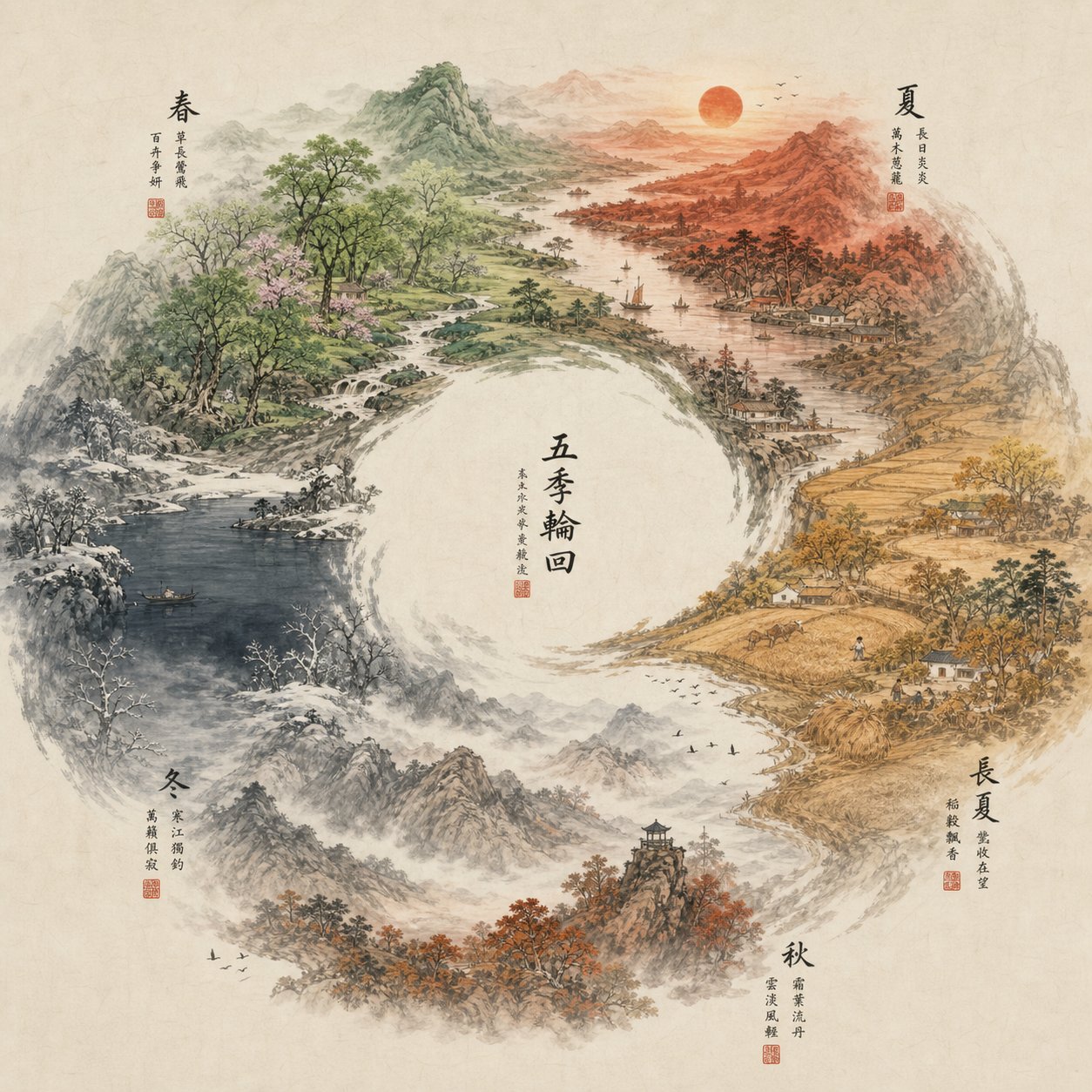
Spring growth fuels summer heat. Summer heat ripens the late summer harvest. Autumn's contraction draws inward toward winter stillness, and winter's deep reserves feed the next spring's expansion. The generation cycle isn't just an abstract diagram — it maps directly onto the seasonal rhythm you experience every year. Each zodiac element carries a seasonal identity that reinforces why the generating sequence flows in one specific direction and no other.
Seasonal Flow and the Generation Sequence
When you overlay the five elements onto the calendar, the generating order suddenly feels inevitable. Wood corresponds to Spring — the season of upward growth and new shoots. That rising energy naturally feeds Fire, which corresponds to Summer's peak heat. Fire's intensity settles into Earth, aligned with Late Summer (sometimes called the harvest transition). Earth's consolidation yields Metal, paired with Autumn's inward-drawing quality. And Metal's stillness deepens into Water, the element of Winter's storage and rest. Water then nourishes Wood again as winter melts into spring.
Think of it as an earth seasons diagram written by nature itself. The generation cycle doesn't impose an order on the seasons — it describes the order the seasons already follow. That's why rearranging the sequence (say, putting Metal before Earth) would contradict observable reality. Harvest cannot precede ripening any more than autumn can precede late summer.
This seasonal logic also clarifies a common confusion around chinese zodiac elements wood vs earth. Students sometimes wonder why Earth sits in the middle of the sequence rather than at the beginning. The answer is positional: Earth corresponds to Late Summer, the transitional pivot between the expanding phases (Wood, Fire) and the contracting phases (Metal, Water). Its central placement reflects its role as the stabilizing axis of the entire cycle.
Planetary Associations That Enrich the Naming Context
Beyond seasons, ancient Chinese astronomers mapped the five visible planets onto the same framework — adding another layer of chinese meanings and symbols to each element's identity:
| Element | Season | Planet | Direction | Color |
|---|---|---|---|---|
| Wood | Spring | Jupiter (岁星) | East | Green |
| Fire | Summer | Mars (荧惑) | South | Red |
| Earth | Late Summer | Saturn (镇星) | Center | Yellow |
| Metal | Autumn | Venus (太白) | West | White |
| Water | Winter | Mercury (辰星) | North | Blue/Black |
These planetary pairings aren't decorative. Jupiter's expansive orbit matched Wood's growth energy. Mars's red appearance aligned with Fire. Saturn's slow, grounding movement mirrored Earth's stability. Venus's bright white presence fit Metal's clarity, and Mercury's swift, fluid path echoed Water's flowing nature.
The five element correspondence system extends even further — into colors, directions, emotions, and organ pairs — but the seasonal and planetary layers are what anchor the generation cycle in observable, repeatable phenomena. They confirm that the naming sequence isn't arbitrary. It's a reflection of how energy actually moves through time and space.
These macro-level correspondences set the stage for something more intimate: the way the same generating relationships play out inside the human body, where each element governs specific organs and the "mother-son" terminology becomes a clinical tool rather than a poetic metaphor.
The Mother-Son Relationship in Traditional Chinese Medicine
Inside the body, the generation cycle stops being a philosophical diagram and becomes a diagnostic language. TCM practitioners don't typically say "Wood generates Fire" when discussing a patient's condition. They say "the mother is deficient" or "sedate the child." This parent-child terminology — used interchangeably with the five elements generation cycle names — transforms abstract elemental relationships into actionable clinical decisions.
The logic is straightforward. Every element in the cycle occupies two roles simultaneously: it is the "mother" of the element it generates and the "son" (or "child") of the element that generates it. Wood is the mother of Fire and the son of Water. Fire is the mother of Earth and the son of Wood. This dual identity gives practitioners a relational vocabulary for describing how organ systems support or deplete each other.
Mother-Son Terminology in TCM Diagnosis
The clinical rule built on this naming convention is elegantly simple: in cases of deficiency, tonify the mother; in cases of excess, sedate the child. Imagine a patient presenting with Kidney deficiency — frequent urination, low back pain, fatigue. The Kidney belongs to Water. Water's mother is Metal (Lung). So a five elements acupuncture approach might involve tonifying the Metal point on the Kidney meridian (KD 7) to strengthen the Kidney through its mother relationship.
This principle shows up across the entire chinese meridian chart. A practitioner treating Liver (Wood) deficiency might strengthen the Kidney (Water) system — because Water is Wood's mother. Spleen (Earth) weakness? Look to the Heart (Fire), since Fire generates Earth. The generation cycle names aren't just labels here. They're a decision-making framework that tells you where to direct treatment.
Points like the spleen 6 acupuncture point (SP 6) are frequently used in clinical practice for their broad influence on the Spleen, Liver, and Kidney meridians — three Yin organs whose mother-son relationships form a connected chain within the generation cycle. While SP 6 isn't technically a mother-child point itself, its ability to tonify multiple elements simultaneously demonstrates how deeply the generating relationships permeate point selection.
Organ Pairs and Their Generation Relationships
Each element governs one Yin organ (Zang) and one Yang organ (Fu). The Zang organs are solid and store vital substances, while the Fu organs are hollow and responsible for transformation and drainage. Together, each pair expresses its element's energy both internally and externally through the body's channel system.
Here's how the chinese 5 elements map onto the organ pairs and their mother-son relationships:
| Element | Yin Organ (Zang) | Yang Organ (Fu) | Mother Element | Son Element |
|---|---|---|---|---|
| Wood | Liver | Gallbladder | Water (Kidney) | Fire (Heart) |
| Fire | Heart | Small Intestine | Wood (Liver) | Earth (Spleen) |
| Earth | Spleen | Stomach | Fire (Heart) | Metal (Lung) |
| Metal | Lung | Large Intestine | Earth (Spleen) | Water (Kidney) |
| Water | Kidney | Bladder | Metal (Lung) | Wood (Liver) |
Reading this table clinically: if the Lung (Metal) is weak, you might tonify the Spleen (Earth) because Earth is Metal's mother. If the Liver (Wood) shows excess, you might sedate the Heart (Fire) because Fire is Wood's child. Every treatment decision traces back to the same generating sequence — just expressed through organ names instead of element names.
You'll notice that the Fire element actually governs additional organ pairs in some systems — the Pericardium and Triple Heater. These supplementary Fire organs follow the same mother-son logic but add complexity that varies between classical and modern TCM curricula.
The beauty of this naming system is its bidirectional utility. A practitioner can start from a symptom, identify the affected organ, locate its element, and then trace the generation cycle in either direction — backward to find the mother for tonification, or forward to find the child for sedation. The five elements generation cycle names, reframed as mother-son relationships, become a clinical navigation tool rather than a memorization exercise.
This internal, organ-level application of the generation cycle operates alongside another set of relationships that students often confuse with it: the control cycle. Where the generation cycle nurtures, the control cycle restrains — and mixing up their terminology leads to fundamentally different (and potentially incorrect) clinical reasoning.
How Generation Names Differ from Control and Pathological Cycles
The generation cycle nurtures. The control cycle restrains. Confuse the two, and your understanding of Wu Xing collapses into a tangle of contradictory relationships. Yet students mix up these terms constantly — partly because the full system of 五行相生相克 (five elements mutual generation and mutual control) is often taught as a single unit, blurring the boundaries between fundamentally different types of interaction.
The five elements generation cycle names describe one specific dynamic: support flowing forward in a fixed sequence. But that's only half the picture. A healthy system also needs checks and balances. That's where the control cycle enters — and where two additional pathological cycles describe what happens when the system breaks down.
Generation Cycle vs Control Cycle Terminology
The generation cycle (相生, xiangsheng) and the control cycle (相克, xiangke) work together like a gas pedal and a brake. Generation feeds energy forward: Wood nourishes Fire, Fire nourishes Earth, and so on. Control sends energy across the cycle to keep any single element from growing unchecked.
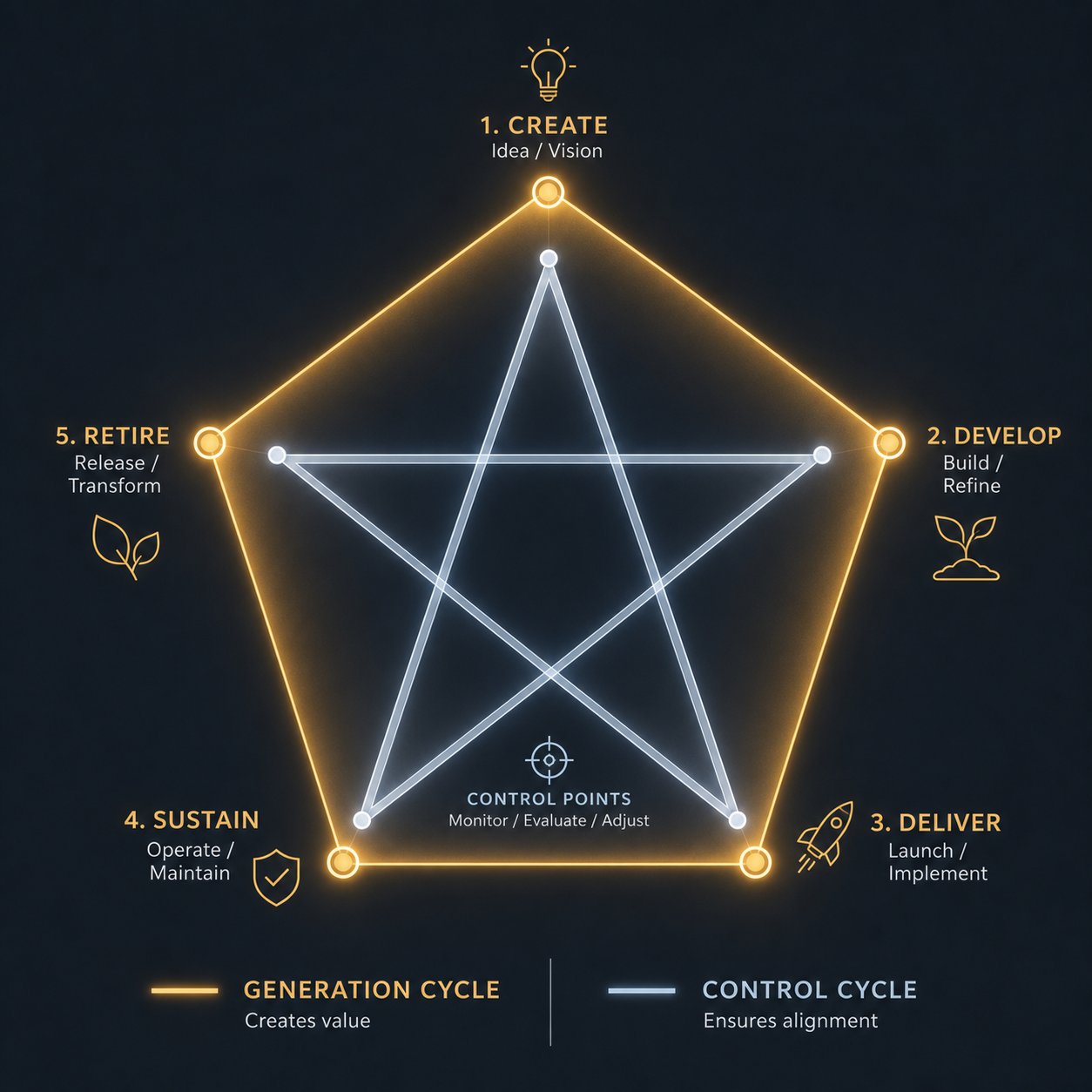
In the control cycle, each ke element restrains the element two positions ahead of it in the generating sequence. Wood controls Earth (roots break soil). Earth controls Water (dams contain floods). Water controls Fire (water extinguishes flame). Fire controls Metal (heat melts ore). And in the five elements controlling cycle metal controls wood — an axe cuts a tree. This cross-pattern creates a star shape when drawn on the traditional circular diagram, distinct from the generation cycle's smooth ring.
The terminology difference matters clinically. "Generating" implies support — you strengthen something by feeding its mother. "Controlling" implies regulation — you calm something by activating its controller. A practitioner who confuses the two might tonify when they should restrain, or sedate when they should nourish. The names aren't interchangeable, and treating them as such leads to errors in reasoning.
Consider metal wuxing as an example. In the generation cycle, Metal is the child of Earth and the mother of Water — a nurturing chain. In the control cycle, Metal controls Wood (cutting) and is itself controlled by Fire (melting). Same element, completely different relational role depending on which cycle you're referencing. The name of the cycle tells you which relationship is active.
Pathological Cycles and Their Relationship to Generation Names
When the system is healthy, generation and control maintain equilibrium. When it's not, two pathological cycles emerge — and their names describe specific types of dysfunction:
- Overacting (乘, Cheng) — This occurs when a controlling relationship becomes excessive. Instead of gently restraining, the controlling element dominates and damages the element it's supposed to regulate. For example, Wood normally controls Earth. In an overacting pattern, excessive Wood energy overwhelms Earth, causing Spleen damage (worry, digestive collapse). The direction follows the normal control cycle but with pathological intensity.
- Insulting (侮, Wu) — This is the reverse of control. The element that should be controlled rebels and attacks its controller instead. Water normally controls Fire — but if Fire becomes excessively strong, it "insults" Water by overpowering it. The direction flips, which is why some texts call this the "reverse ke" or "counteracting" cycle.
The insulting cycle is particularly important for understanding 五行 相生相克 as a complete framework. It shows what happens when the generation cycle overproduces without adequate control — one element grows so strong that it reverses the natural restraining order.
Here's how all five interaction types compare side by side:
| Cycle Name | Chinese Term | Pinyin | Function | Direction |
|---|---|---|---|---|
| Generating | 相生 | Xiāng shēng | Nourishing / producing the next element | Forward around the circle (adjacent) |
| Controlling | 相克 | Xiāng kè | Restraining / regulating to prevent excess | Across the circle (skipping one element) |
| Overacting | 相乘 | Xiāng chéng | Excessive control causing damage | Same as control, but pathological intensity |
| Insulting | 相侮 | Xiāng wǔ | Reversed control — the weak rebels against its controller | Opposite to control direction |
| Weakening | 相泄 | Xiāng xiè | Draining the mother by over-demanding generation | Reverse of generation direction |
Notice the pattern: generation and control are physiological (healthy). Overacting, insulting, and weakening are pathological (dysfunctional). The five elements generation cycle names specifically describe the first category — the nurturing, forward-flowing relationships that sustain balance. Every other cycle name describes what happens when that balance fails.
This distinction gives you a diagnostic vocabulary. When you hear "sheng," think support. When you hear "ke," think restraint. When you hear "cheng" or "wu," think pathology. Keeping these categories separate in your mind prevents the kind of terminological confusion that leads students to misidentify relationships — and it positions the generation cycle clearly within the larger framework of Wu Xing interactions.
With the full naming taxonomy mapped out — generation, control, and their pathological variants — the next question becomes practical: how do different disciplines actually use these generation cycle names in their daily work? The answer varies more than you might expect.
How Different Disciplines Apply the Generation Cycle Names
A TCM practitioner, a feng shui consultant, a Ba Zi astrologer, and a martial arts instructor walk into the same conversation about the 5 chinese elements. They all agree on the sequence — Wood, Fire, Earth, Metal, Water — yet each one uses a different name for the generating relationship. This isn't confusion. It's specialization. Each discipline has adapted the same underlying cycle into vocabulary that serves its specific goals, and knowing which term belongs where marks the difference between a generalist and someone fluent in a tradition.
The generating sequence never changes. Wood still feeds Fire, Fire still creates Earth, Earth still bears Metal, Metal still collects Water, and Water still nourishes Wood. What shifts is the lens through which each field interprets that flow — and the terminology it wraps around it.
Generation Cycle Names in Feng Shui Practice
In feng shui, the generation cycle becomes a spatial design tool. Practitioners arrange rooms, buildings, and landscapes so that elemental energies flow in the productive direction. You'll rarely hear a feng shui consultant say "mother-son cycle." Instead, they reach for terms like "productive cycle" or "supportive cycle" because the emphasis falls on output — creating environments where energy builds momentum rather than stagnating.
When working with the feng shui bagua — the octagonal map that divides a space into life sectors — practitioners use the generation cycle to determine which elements to place in adjacent areas. A room's south sector (Fire) benefits from Wood elements nearby because Wood feeds Fire in the productive sequence. Placing Water features in that same spot would invoke the control cycle instead, dampening the sector's energy. The terminology choice reflects this spatial logic: "productive" implies building something tangible in a physical environment.
Even the thunder bagua trigram (Zhen, associated with Wood and the east direction) connects to this framework. Its placement in the bagua map follows the same elemental logic — Wood energy in the east generates Fire energy in the south, mirroring the generation cycle's directional flow across physical space.
Feng shui also draws heavily on taoism symbols and cosmological imagery to communicate elemental relationships to clients. The taijitu (yin-yang symbol), the bagua trigrams, and the five element circular diagram all serve as visual shorthand for the same generating relationships. These taoism symbols encode the productive cycle in a form that practitioners can point to during consultations, making abstract relationships tangible.
How Ba Zi and Martial Arts Apply the Same Terminology
Ba Zi (Four Pillars of Destiny) uses the generation cycle as a chart-reading framework. When a Ba Zi practitioner analyzes a birth chart, they examine how the elements in each pillar interact through producing and controlling cycles. The generating relationship tells the reader which elements support the Daymaster and which drain it. In Ba Zi vocabulary, you'll encounter terms like "resource element" (the element that generates your Daymaster) and "output element" (the element your Daymaster generates) — both derived directly from the generation cycle but renamed to fit chart-reading logic.
A person with a Wood Daymaster, for instance, looks to Water as their resource element because Water generates Wood. Fire becomes their output element because Wood generates Fire. The cycle names transform into positional labels — resource, output, wealth, authority, companion — that describe how each chinese 5 element functions relative to the individual's chart center.
Martial arts traditions apply the same sequence differently again. Internal arts like Xingyiquan (Form-Intention Boxing) map five core fist techniques onto the five elements and use the generation cycle to understand how one technique flows naturally into the next. The generating relationship describes energy transfer between movements: a chopping strike (Metal) flows into a drilling strike (Water) because Metal generates Water. Practitioners call this "elemental flow" or "phase transition" rather than "productive cycle" — language that emphasizes kinetic continuity over spatial arrangement or clinical diagnosis.
Here's how each discipline's preferred terminology and application compare:
- Traditional Chinese Medicine — Preferred terms: "generating cycle," "nourishing cycle," "mother-son relationship." Application: diagnosing organ deficiencies and selecting acupuncture points or herbal formulas based on which element needs support from its mother.
- Feng Shui — Preferred terms: "productive cycle," "supportive cycle," "creative cycle." Application: arranging elemental colors, materials, and shapes in physical spaces so energy flows in the generating direction across rooms and sectors.
- Ba Zi (Chinese Astrology) — Preferred terms: "producing relationship," "resource element," "output element." Application: reading birth charts to identify which elements strengthen or drain the Daymaster, and timing major decisions around favorable elemental periods.
- Martial Arts (Xingyiquan, Tai Chi) — Preferred terms: "elemental flow," "phase transition," "generating sequence." Application: linking combat techniques in a natural progression where each movement's energy feeds the next, and understanding which technique counters which through the control cycle.
- Chinese Calligraphy and Art — Preferred terms: "creative cycle," "nourishing sequence." Application: selecting ink colors and compositional flow so that visual elements support each other according to the generating order.
Despite these naming differences, every discipline agrees on the same non-negotiable foundation: the sequence is Wood, Fire, Earth, Metal, Water, looping back to Wood. No field rearranges the order. No tradition skips an element. The generating direction is always forward, never backward. What varies is only the vocabulary layered on top — shaped by whether the practitioner is treating a body, designing a space, reading a destiny chart, or throwing a punch.
This cross-disciplinary consistency is precisely what makes the generation cycle so powerful as a unifying framework. A student who masters the sequence and its logic in one field can transfer that understanding to any other — adjusting only the terminology to match the new context. The underlying pattern remains the same whether you call it productive, nourishing, generating, or flowing.
That adaptability raises a final question: can you express each generating relationship in multiple registers simultaneously — formal, simplified, and metaphorical — and understand how the generation cycle fits within the complete Wu Xing interaction framework? Doing so represents the deepest level of terminological fluency.
Mastering the Full Naming Framework of Wu Xing Interactions
Fluency in the five chinese elements isn't about picking one "correct" name for each generating pair. It's about holding multiple registers in your mind at once — knowing when to say "Wood generates Fire" in a formal paper, "Wood is the mother of Fire" in a clinical discussion, and "Wood feeds Fire" when explaining the concept to a beginner. Each register serves a different audience and context, and moving between them effortlessly is what separates a student from a practitioner.
The generation cycle sits within a larger system of five interaction types that together describe how the wu xing elements relate to each other in both health and disease. Generating (sheng) and overcoming (ke) maintain balance. Weakening (xie), overacting (cheng), and counteracting (wu) describe what happens when balance fails. The generation cycle names specifically occupy the nurturing, creative layer of this framework — the foundation everything else builds upon.
Three Ways to Express Each Generation Relationship
Every generating pair can be stated in at least three distinct registers. Formal language mirrors academic and classical translation conventions. Simplified language uses the mother-son framework common in TCM clinics. Metaphorical language draws on the natural imagery that makes each relationship intuitive and memorable.
Here's how all five pairs sound across these three registers:
| Element Pair | Formal | Simplified (Mother-Son) | Metaphorical |
|---|---|---|---|
| Wood → Fire | Wood generates Fire | Wood is the mother of Fire | Wood feeds Fire |
| Fire → Earth | Fire generates Earth | Fire is the mother of Earth | Fire creates Earth (through ash) |
| Earth → Metal | Earth generates Metal | Earth is the mother of Metal | Earth bears Metal (within its depths) |
| Metal → Water | Metal generates Water | Metal is the mother of Water | Metal collects Water (through condensation) |
| Water → Wood | Water generates Wood | Water is the mother of Wood | Water nourishes Wood (through roots) |
You'll notice the formal column uses "generates" consistently — a direct translation of 生 (sheng). The simplified column replaces that verb with a relational noun ("mother"), shifting the frame from action to identity. The metaphorical column swaps in a vivid verb unique to each pair — feeds, creates, bears, collects, nourishes — grounding the relationship in its specific natural process.
Which register should you use? Match it to your context. Writing an academic paper on wuxing elements? Formal. Explaining a treatment principle to a patient? Simplified. Teaching a first-year student who needs the concept to stick? Metaphorical. The ability to code-switch between all three signals genuine command of the material.
The Generation Cycle as Part of the Complete Wu Xing Framework
The 5 chinese elements interact through five distinct relationship types, and the generation cycle is just one of them — though it's the most foundational. As the Internet Encyclopedia of Philosophy notes, Han dynasty thinkers used the "mutual production" (xiangsheng) series alongside the "mutual conquest" (xiangke) series to account for an ordered sequence of change in nature, politics, and medicine. The generating cycle provided the creative engine; the controlling cycle provided the regulatory brake.
Understanding the five elements generation cycle names at all three levels — linguistic precision, relational logic, and embodied metaphor — gives you something no single-register memorization can. It gives you flexibility. You can read a classical text that says "engendering," hear a clinician say "mother-son," and watch a martial artist demonstrate "elemental flow" — and recognize instantly that all three are describing the same Wood-Fire-Earth-Metal-Water sequence moving in the same forward direction.
That recognition is mastery. Not memorizing one name, but holding the full naming framework of the chinese five elements in your mind and deploying the right term at the right moment. The cycle itself is ancient and unchanging. The language we wrap around it keeps evolving — and staying fluent in all its forms is what keeps Wu Xing theory alive across centuries, disciplines, and languages.
Frequently Asked Questions About Five Elements Generation Cycle Names
1. What is the five elements generation cycle called in Chinese?
The five elements generation cycle is called xiangsheng (相生) in Chinese, which literally translates to 'mutual generation.' This term describes the relationship where each element produces and nourishes the next in a continuous loop: Wood to Fire, Fire to Earth, Earth to Metal, Metal to Water, and Water back to Wood. In English, this same concept goes by at least eight different names including the Sheng Cycle, Creative Cycle, Nourishing Cycle, Productive Cycle, and Mother-Son Cycle, depending on which discipline or translation tradition is being referenced.
2. What is the correct order of the five elements generation cycle?
The fixed order is Wood generates Fire, Fire generates Earth, Earth generates Metal, Metal generates Water, and Water generates Wood. This sequence never changes regardless of which discipline applies it. In Chinese, the pairs are expressed as Mu sheng Huo (木生火), Huo sheng Tu (火生土), Tu sheng Jin (土生金), Jin sheng Shui (金生水), and Shui sheng Mu (水生木). The cycle forms a closed loop with no beginning or end, meaning each element simultaneously receives nourishment from one partner and provides it to another.
3. What is the difference between the generation cycle and the control cycle in Wu Xing?
The generation cycle (xiangsheng/相生) describes nurturing relationships where each element feeds the next adjacent element in sequence, like a parent supporting a child. The control cycle (xiangke/相克) describes restraining relationships where each element regulates another element two positions ahead, preventing excess. For example, Wood generates Fire (nurturing) but Wood controls Earth (restraining). Both cycles work together to maintain balance in the system, functioning like a gas pedal and brake. When these relationships become excessive or reversed, pathological cycles called Overacting (cheng) and Insulting (wu) emerge.
4. Why do different sources use different names for the same generation cycle?
Different names arose because translators working across different eras and disciplines prioritized different aspects of the Chinese term 相生 (xiangsheng). TCM translators chose 'generating' or 'nourishing' to reflect clinical logic. Feng shui authors preferred 'productive' to emphasize spatial energy output. Academic sinologists selected 'engendering' for philosophical precision. Older mid-20th century texts tend toward 'creative cycle' while modern TCM programs standardize around 'generating cycle.' All these terms describe the identical Wood-Fire-Earth-Metal-Water sequence and are functionally synonymous.
5. How is the mother-son relationship used in Traditional Chinese Medicine?
In TCM, each element is simultaneously the 'mother' of the element it generates and the 'son' of the element that generates it. This creates a clinical rule: tonify the mother to treat deficiency in the son, or sedate the son to treat excess in the mother. For example, if the Kidney (Water) is deficient, a practitioner might strengthen the Lung (Metal) because Metal is Water's mother in the generation cycle. This mother-son terminology transforms the abstract generation cycle into a practical decision-making framework for selecting acupuncture points and herbal formulas.