Why Chinese Surnames Have Multiple Spellings
Imagine looking at a family tree and finding one branch spelled "Chang" while another spells it "Zhang." Same family, same Chinese character, completely different English spellings. If you've ever been confused by this, you're not alone. The reason traces back to two competing romanization systems that have been converting Chinese characters into the Latin alphabet for over a century.
Why the Same Family Has Different Surname Spellings
You'll notice this pattern everywhere once you start looking. The Chinese Nationalist leader known internationally as Chiang Kai-shek would be written as Jiang Jieshi in today's standard romanization. Mao Tse-tung, the name printed in mid-century Western newspapers, became Mao Zedong under the newer system. These aren't errors or personal preferences. They reflect a fundamental split in how Mandarin sounds get written in English letters.
For families in the Chinese diaspora, this split creates real headaches. A grandfather who emigrated from Taiwan in the 1960s might carry a surname spelled one way, while his mainland-born cousin uses a completely different spelling for the identical character. Genealogy researchers, immigration officers, and even family members themselves can struggle to connect the dots.
Two Systems One Language
The two dominant systems behind this confusion are Wade-Giles, developed by British diplomats in the 19th century, and Pinyin, adopted by mainland China in 1958. Wade-Giles held sway for over a hundred years in Western academia and government records. Pinyin eventually replaced it as the international standard, but millions of people, particularly in Taiwan and older diaspora communities, still carry Wade-Giles spellings on their passports and legal documents.
When comparing Wade-Giles vs Pinyin side by side, the differences can look dramatic. Yet most of the confusion comes down to a surprisingly small set of consonant shifts between the two systems.
Most surname confusion between Pinyin and Wade-Giles traces back to just a handful of consonant mapping rules, particularly around sounds like zh/ch, x/hs, and ts/c.
This article ranks the most confusing surname pairs by how dramatically their spellings differ across these two systems, starting with the pairs that cause the greatest ambiguity and working through the specific phonetic rules that drive each difference.
How We Selected and Ranked These Surname Pairs
Not all spelling differences between the two systems are equally confusing. Some surnames look nearly identical across both romanizations, while others are so different they appear to belong to entirely separate families. The pairs ranked in this article were chosen based on one key factor: how much visual and phonetic distance the two spellings create for English readers unfamiliar with the underlying rules.
The Consonant Shifts That Create Surname Confusion
The Wade-Giles system, developed by British diplomats Thomas Wade and Herbert Giles in the 19th century, uses apostrophes to distinguish between aspirated and unaspirated consonants. Pinyin, on the other hand, assigns completely different letters to these sounds. This single design choice is responsible for the majority of surname confusion between the two systems.
Here are the key phonetic shift categories that affect surnames most dramatically:
- Zh/Ch vs Ch/Ch' — Pinyin uses "zh" for the unaspirated retroflex sound and "ch" for the aspirated version. Wade-Giles romanization writes both as "ch," distinguishing them only with an apostrophe (ch vs ch'). This means Wade-Giles "Chang" could be either "Zhang" or "Chang" in Pinyin.
- B/P vs P/P' — Pinyin "b" corresponds to Wade-Giles "p" (unaspirated), while Pinyin "p" corresponds to Wade-Giles "p'" (aspirated). A surname like "Bai" becomes "Pai" in Wade-Giles.
- D/T vs T/T' — Pinyin "d" maps to Wade-Giles "t," and Pinyin "t" maps to Wade-Giles "t'." The surname "Deng" appears as "Teng" in the older system.
- G/K vs K/K' — Pinyin "g" becomes Wade-Giles "k," while Pinyin "k" becomes "k'." So "Guo" turns into "Kuo."
- X vs Hs — Pinyin's "x" sound is written as "hs" in Wade-Giles, creating visually dramatic differences like Xu/Hsu and Xie/Hsieh.
- Z/C vs Ts/Ts' — Pinyin "z" and "c" correspond to Wade-Giles "ts" and "ts'," producing pairs like Cai/Tsai and Zeng/Tseng.
As the reference table from ChinaKnowledge shows, the Wade-Giles system marks aspiration exclusively through apostrophes rather than distinct letters. In practice, these apostrophes are frequently dropped in casual writing, on immigration forms, and in everyday use, which compounds the confusion significantly.
How We Ranked These Surname Pairs
The ranking in this article considers three factors: how visually different the two spellings appear, how common the surname is among Chinese populations worldwide, and how much real-world ambiguity the difference creates for genealogy research and document identification.
Historical context matters here too. When mainland China officially adopted Hanyu Pinyin in 1958, it created a clean break. People born and documented in the People's Republic use Pinyin on passports and official records. Taiwan, however, continued using the Wade-Giles system for decades, and many Taiwanese citizens still carry Wade-Giles surnames on their identity documents. Diaspora communities add another layer: a family that emigrated from Guangdong in the 1920s might use postal romanization, someone who left Taiwan in the 1970s likely carries a Wade-Giles spelling, and a recent immigrant from Shanghai almost certainly uses Pinyin.
The result is that pinyin and Wade-Giles spellings coexist across generations, geographies, and government systems. Knowing which consonant shift you're looking at is the first step toward decoding any unfamiliar surname, and the pairs that follow are organized from the most ambiguous to the most straightforward.
Zhang vs Chang and the Biggest Ambiguity Problem
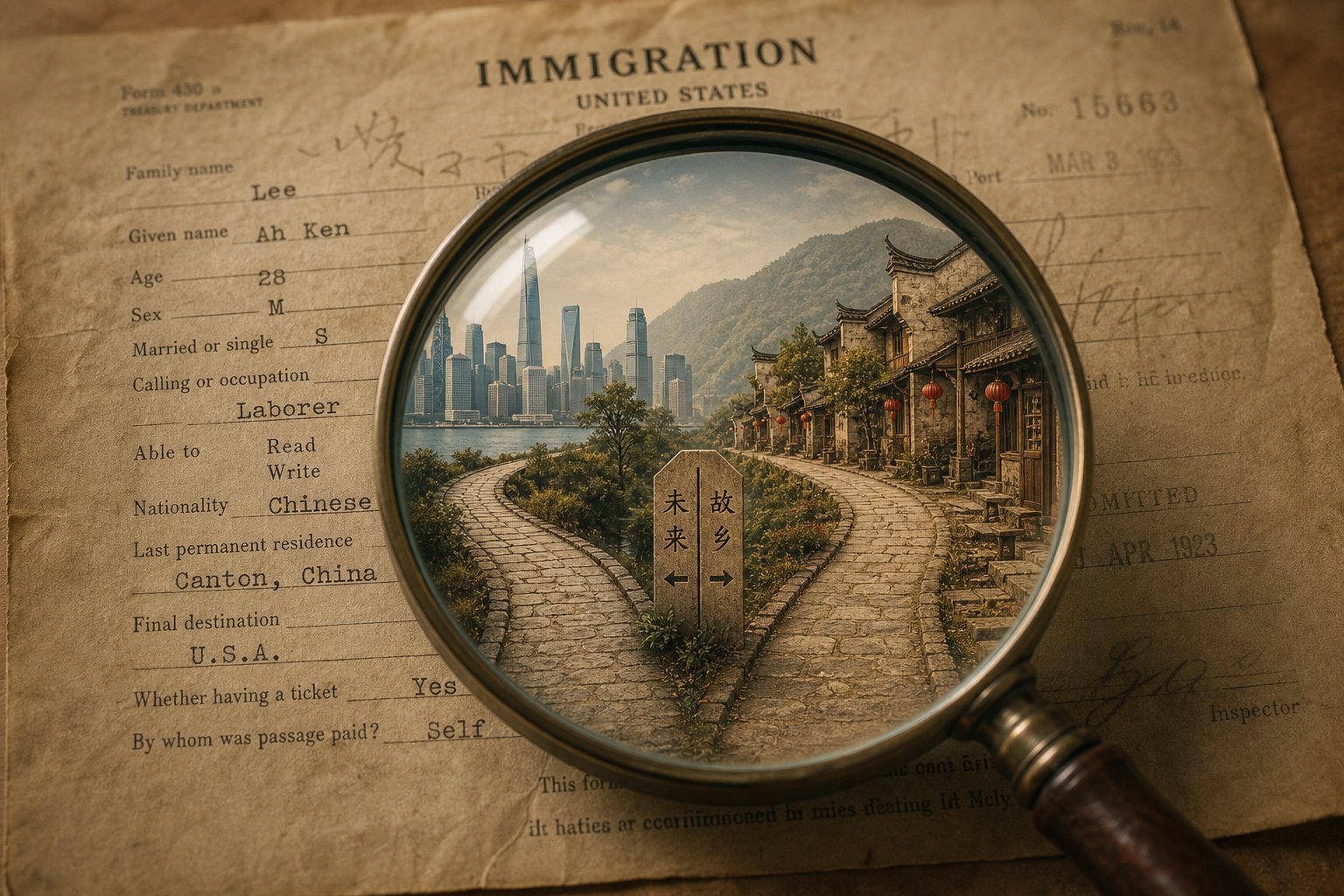
Picture this: you're searching immigration records and find a "Chang" listed on a 1965 arrival document. Is this person a Zhang or a Chang? Without seeing the original Chinese character, you genuinely cannot tell. This single spelling collision sits at the top of our ranking because it affects one of the most common Chinese surnames in the world and creates a one-to-many mapping problem that no amount of context can always resolve.
Why Chang Could Be Two Different Surnames
In Wade-Giles romanization, the spelling "Chang" maps to at least two completely distinct Chinese characters with different Pinyin representations. The surname 張 (Pinyin: Zhang) and the surname 常 (Pinyin: Chang) both appear as "Chang" under the older system. These are not variant spellings of the same name. They are entirely different families, different characters, and different etymologies collapsed into one English spelling.
The reason comes down to how Wade-Giles handles the "ch" consonant. As the Wade-Giles reference from KongMing.net demonstrates, Wade-Giles "chang" without an apostrophe corresponds to Pinyin "zhang," while "ch'ang" with an apostrophe corresponds to Pinyin "chang." In practice, that critical apostrophe gets dropped constantly, on typed forms, in handwritten records, and in casual English usage. The moment it disappears, two unrelated surnames become indistinguishable.
For genealogy researchers, this creates a serious identification problem. If you encounter "Chang" in a family record or a pinyin cross reference table, you need additional context, either the Chinese character itself, the person's region of origin, or corroborating documents, to determine which surname you're actually looking at.
The Zh vs Ch Aspiration Rule
The underlying phonetic rule is straightforward once you see it laid out. In Mandarin Chinese, "zh" and "ch" are two different sounds. The first is unaspirated (no puff of air), and the second is aspirated (a distinct burst of breath). Pinyin assigns them separate letter combinations. Wade-Giles uses the same base letters for both, relying solely on an apostrophe to mark the difference:
- Wade-Giles "ch" (no apostrophe) = Pinyin "zh" (unaspirated)
- Wade-Giles "ch'" (with apostrophe) = Pinyin "ch" (aspirated)
When converting from Wade-Giles to Pinyin, the presence or absence of that apostrophe determines whether you're reading a "zh" sound or a "ch" sound. This rule applies across all syllables, not just surnames, but surnames are where the real-world confusion hits hardest because they appear on legal documents, academic citations, and family records where precision matters most.
The table below shows how "Chang" in Wade-Giles splits into distinct surnames once you apply the correct pinyin to Wade-Giles conversion:
| Wade-Giles Spelling | Chinese Character | Pinyin Spelling | Approximate Meaning |
|---|---|---|---|
| Chang (no apostrophe) | 張 | Zhang | To stretch, to open |
| Chang (no apostrophe) | 章 | Zhang | Chapter, seal |
| Ch'ang (with apostrophe) | 常 | Chang | Constant, ordinary |
| Ch'ang (with apostrophe) | 昌 | Chang | Prosperous, flourishing |
Zhang (張) ranks among the top three most common Chinese surnames, carried by tens of millions of people. When that apostrophe vanishes in everyday usage, all four of these characters funnel into the same five-letter English spelling. Anyone working with a wade giles to pinyin conversion on historical documents needs to treat every "Chang" as ambiguous until verified against the original characters.
This ambiguity doesn't just affect dusty archives. Families reconnecting across the Taiwan Strait, researchers building databases, and immigration officials processing paperwork all face the same question: which Chang is this? The answer often requires looking beyond the romanized spelling entirely, which is why understanding the aspiration rule is so valuable. It tells you what to look for and what questions to ask when a single spelling hides multiple identities.
Xu vs Hsu and the Dramatic Hs- Prefix Family
The Zhang/Chang collision relies on a missing apostrophe to create confusion. The next pair on our list needs no such subtlety. When you see "Hsu" and "Xu" side by side, they barely look like they belong to the same language, let alone the same surname. This is the X-to-Hs shift, and it produces some of the most visually dramatic differences in the entire wade giles pinyin divide.
The X vs Hs Shift Explained
Pinyin uses the letter "x" to represent a palatal fricative, a hissing sound made with the tongue near the roof of the mouth. English doesn't have this exact sound, so Pinyin simply borrowed "x" and assigned it a new phonetic value. Wade-Giles took a different approach, using the two-letter combination "hs" to approximate the same sound.
The result? A surname like 徐 becomes "Xu" in Pinyin but "Hsu" in Wade-Giles. To an English reader unfamiliar with either system, these look like completely unrelated names. Yet they represent the same character, the same family, and the same pronunciation in spoken Mandarin.
As the Library of Congress Pinyin Conversion FAQ notes, syllables beginning with "Hs" are a clear marker of Wade-Giles romanization, since Pinyin syllables never start with that combination. This makes the Hs- prefix one of the easiest identification signals when you're trying to determine which system a name uses.
The shift affects a whole cluster of common surnames. You'll encounter it in names like Lao Nai-hsuan (a Qing dynasty scholar whose romanized name showcases the pattern clearly) and across modern Taiwanese families who carry these spellings on passports and academic publications.
Identifying Wade-Giles Surnames in the Wild
Spotting an Hs- surname in a document or citation is an immediate signal that you're looking at a Wade-Giles spelling. This is particularly relevant for Taiwanese names, since Taiwan used Wade-Giles as its standard romanization system for decades. The surname 許/徐 (Hsu) ranks 11th in Taiwan, making it extremely common in Taiwanese academic papers, business cards, and government records.
Here are the most common Hs- prefix surnames and their Pinyin equivalents:
- Hsu → Xu (徐, ranked 11th in mainland China, 20th in Taiwan)
- Hsu → Xu (許, ranked 26th in mainland China, 11th in Taiwan)
- Hsieh → Xie (謝, ranked 23rd in mainland China, 13th in Taiwan)
- Hsiao → Xiao (蕭, ranked 33rd in mainland China, 28th in Taiwan)
- Hsung → Xiong (熊)
- Hsing → Xing (邢)
Notice that both 徐 and 許 romanize to "Hsu" in Wade-Giles, creating yet another one-to-many mapping problem similar to the Chang ambiguity. In Pinyin, both also happen to be "Xu," so this particular collision persists across systems. The only way to distinguish them is by tone (徐 is second tone, 許 is third tone) or by seeing the original character.
If you encounter a surname starting with "Hs" in any context, whether on an old immigration form, a Taiwanese journal article, or a family genealogy chart, you can confidently identify it as a Wade-Gile romanization rather than Pinyin. From there, converting to the Pinyin equivalent is straightforward: replace "Hs" with "X" and you'll have the modern standard spelling. This simple rule unlocks an entire family of surnames that might otherwise look unrecognizable to researchers accustomed to Pinyin-only references.
Cai vs Tsai and the Ts- Prefix Surnames
The Hs- prefix signals Wade-Giles immediately because Pinyin never uses that letter combination. The Ts- prefix works the same way. If you spot a surname starting with "Ts," you're almost certainly looking at a Wade-Giles spelling, since Pinyin never begins a syllable with that cluster. This makes the Ts- family of surnames one of the most reliable markers for identifying which romanization system is in play.
The Ts- to C- and Z- Conversion Rule
In the Wade-Giles system, the letters "ts" represent an unaspirated alveolar affricate, while "ts'" (with the apostrophe) marks the aspirated version. Pinyin splits these into entirely different letters:
- Wade-Giles "ts" (no apostrophe) = Pinyin "z" (unaspirated)
- Wade-Giles "ts'" (with apostrophe) = Pinyin "c" (aspirated)
So when you consult any pinyin cross reference chart, you'll see that "tsai" converts to "zai," while "ts'ai" converts to "cai." The surname 蔡 (Cai) is aspirated, meaning its strict Wade-Giles form is "Ts'ai." But just like the Chang/Ch'ang problem, that apostrophe routinely disappears in everyday use, leaving "Tsai" as the common spelling in Taiwan and older diaspora records.
The same logic applies to the Z- conversions. The surname 鄒 (Zou) appears as "Tsou" in Wade-Giles because the unaspirated "ts" maps directly to Pinyin "z." And 曾 (Zeng) becomes "Tseng," a spelling you'll encounter frequently in Taiwanese academic citations and historical documents. Scholars like Jui Heng Tseng, for instance, carry this Wade-Giles spelling in their published work, making the Ts- prefix a familiar sight in research databases.
Real World Examples From Taiwan and Mainland China
The Tsai/Cai split offers one of the clearest illustrations of how geography determines surname spelling. Former Taiwanese President Tsai Ing-wen is known worldwide by her Wade-Giles surname. On the mainland, the same character 蔡 appears exclusively as "Cai" on passports, academic papers, and government records. Same family name, same character, two completely different English spellings depending on which side of the Taiwan Strait issued the documents.
This geographic pattern holds across the entire Ts- family of surnames. A "Tseng" on a Taiwanese business card and a "Zeng" on a mainland Chinese LinkedIn profile are the same surname. A "Tsou" in an older immigration file and a "Zou" in a recent visa application point to the same character.
| Wade-Giles Spelling | Chinese Character | Pinyin Spelling | Notable Bearer |
|---|---|---|---|
| Tsai (Ts'ai) | 蔡 | Cai | Tsai Ing-wen (former President of Taiwan) |
| Tseng | 曾 | Zeng | Tseng Kuo-fan (Qing dynasty statesman) |
| Tsou | 鄒 | Zou | Tsou Jung (revolutionary writer) |
| Tsao (Ts'ao) | 曹 | Cao | Tsao Hsueh-chin (author of Dream of the Red Chamber) |
| Tsung | 宗 | Zong | Common in genealogical records |
Notice the pattern: every surname in the table looks dramatically different across the two systems. A researcher unfamiliar with the Wade-Giles system might never connect "Tsao" to "Cao" or "Tsou" to "Zou" without understanding the Ts-to-Z and Ts'-to-C conversion rules. Yet once you recognize the Ts- prefix as a Wade-Giles marker, the conversion becomes mechanical. Strip the "Ts," check for aspiration context, and assign either "Z" (unaspirated) or "C" (aspirated) as the Pinyin initial.
The apostrophe problem resurfaces here too. Strictly speaking, 蔡 should be "Ts'ai" and 曹 should be "Ts'ao" in proper Wade-Giles notation. But since most people drop the apostrophe, you end up with "Tsai" and "Tsao" looking identical in format to unaspirated forms like "Tseng" and "Tsou." The aspiration distinction collapses, and only the original character or additional context can clarify whether you're dealing with a C- or Z- surname in Pinyin.
Still, compared to the Chang ambiguity, the Ts- surnames carry one advantage: the prefix itself is unmistakable. No Pinyin surname starts with "Ts," so identification is instant even when the apostrophe is missing. The challenge shifts from "which system is this?" to "is this aspirated or unaspirated?" And that second question, while still important for precise conversion, at least narrows the possibilities rather than leaving them wide open.
The Apostrophe Problem and Identical Spelling Traps
The Ts- prefix at least gives you a clear system marker. You see "Tsai" and you know it's Wade-Giles. But what happens when the only difference between two entirely unrelated surnames is a tiny punctuation mark that most people forget to write? That's the apostrophe problem, and it sits at the heart of why Wade-Giles surnames are so frequently misread, mistyped, and misidentified.
How the Apostrophe Changes Everything
In Wade-Giles romanization, the apostrophe isn't decorative. It carries phonetic weight equivalent to an entirely different letter. The mark distinguishes aspirated consonants (produced with a puff of air) from unaspirated ones (produced without). Drop it, and you've changed the surname to something else entirely.
The most consequential example is Ch'en versus Chen. The surname 陳, one of the most common in the Chinese-speaking world, is properly written as "Ch'en" in Wade-Giles. That apostrophe tells you the initial consonant is aspirated, corresponding to Pinyin "Chen." Remove the apostrophe and you get plain "Chen," which in strict Wade-Giles notation represents an unaspirated sound, mapping to Pinyin "Zhen" (甄), a completely different and far less common surname.
In Wade-Giles, the apostrophe is not optional punctuation. It is the sole marker distinguishing aspirated from unaspirated consonants, and dropping it silently transforms one surname into another.
The Library of Congress FAQ on romanization differences confirms this distinction, noting that Wade-Giles uses apostrophes (technically ayns) to indicate aspiration, while Pinyin does not use this device at all. The examples they provide, such as "Ch'en, Chin-an" in Wade-Giles versus "Chen, Jin'an" in Pinyin, illustrate how the apostrophe functions as a critical phonetic signal rather than a stylistic choice.
Here's where the real-world damage happens. Typewriters couldn't always produce the correct mark. Email systems sometimes strip special characters. Handwritten forms leave the apostrophe ambiguous. Database fields may not accept punctuation. Over decades of document processing, the apostrophe has been systematically erased from millions of records. The result is that "Chen" appears everywhere, but you often can't tell whether it represents 陳 (Ch'en → Pinyin Chen) or 甄 (Chen → Pinyin Zhen) without seeing the original character.
This problem extends well beyond the Ch'en/Chen pair. Consider these additional cases where the apostrophe is the only distinguishing feature:
- Ch'eng (程, Pinyin: Cheng) vs Cheng (鄭, Pinyin: Zheng) — two common surnames collapsed into one spelling when the apostrophe vanishes
- T'ang (唐, Pinyin: Tang) vs Tang (鄧, Pinyin: Deng) — the apostrophe separates a Tang dynasty surname from the family of Deng Xiaoping
- K'ung (孔, Pinyin: Kong) vs Kung (龔, Pinyin: Gong) — Confucius's family name (Kong) depends on that apostrophe to stay distinct from Gong
- T'ing (丁, Pinyin: Ding) vs Ting — names like T'ing Chung rely on the apostrophe to signal the correct initial consonant
Every one of these pairs becomes ambiguous the moment informal usage strips away the aspiration marker. For genealogy researchers working with older records, this means treating any Wade-Giles surname that starts with Ch, T, K, or P as potentially ambiguous unless the apostrophe is clearly present or absent.
When Both Systems Produce the Same Spelling
The apostrophe problem creates confusion through omission. But there's a different kind of trap that catches researchers off guard: surnames that look identical in both Pinyin and Wade-Giles yet map to multiple unrelated Chinese characters.
The li surname is the clearest example. "Li" appears the same whether you're reading Pinyin or Wade-Giles. There's no consonant shift, no prefix change, no apostrophe to worry about. The spelling is stable across both systems. And yet "Li" can represent several distinct Chinese characters, each belonging to a different family lineage:
| Chinese Character | Pinyin | Wade-Giles | Meaning | Approximate Rank |
|---|---|---|---|---|
| 李 | Li | Li | Plum tree | 2nd most common surname |
| 黎 | Li | Li | Black, numerous | Less common |
| 厲 (厉) | Li | Li | Stern, severe | Rare |
| 栗 | Li | Li | Chestnut | Rare |
When you encounter the li chinese character in a genealogy database or historical record, the romanized spelling alone tells you nothing about which family you're tracing. The character 李 is overwhelmingly the most common, ranking as the second most frequent surname in China with over 90 million bearers. But if you're researching a less common branch, the identical romanization across both systems means neither Pinyin nor Wade-Giles can help you distinguish between lineages without the original character.
This creates a fundamentally different challenge from the Zhang/Chang or Xu/Hsu pairs. Those surnames are confusing because the two systems produce wildly different spellings for the same character. The li in chinese character form presents the opposite problem: perfect spelling consistency that masks underlying diversity. A researcher who sees "Li" on a document knows exactly how to pronounce it and can confirm it matches both romanization systems, but still cannot determine which family it belongs to without additional evidence.
Other surnames fall into this identical-spelling category as well. "Wang" (王) looks the same in both systems. "Lin" (林) is unchanged. "Ma" (馬) stays consistent. These stable spellings might seem like a relief after the chaos of the apostrophe-dependent pairs, but they carry their own quiet ambiguity. The li character chinese researchers encounter most often is 李, yet assuming that default without verification can lead genealogists down the wrong family branch entirely.
The practical takeaway is this: when a surname differs dramatically between systems (like Xu/Hsu or Cai/Tsai), at least you know which romanization system produced it. When a surname looks identical in both systems, you lose that identification signal. You can't tell from the spelling alone whether the document uses Pinyin or Wade-Giles, and you can't tell which character is intended. Context, region of origin, and access to the original Chinese text become your only tools for disambiguation.

Lee vs Li and the Dialect Romanization Factor
The identical-spelling trap with "Li" already complicates things when you're working within Pinyin and Wade-Giles alone. But here's the twist: millions of people carrying the character 李 don't spell it "Li" at all. They spell it "Lee." And that spelling doesn't come from either of the two major romanization systems. It comes from dialect pronunciation, a third layer of complexity that catches researchers off guard when they assume every Chinese surname must fit neatly into the Pinyin or Wade-Giles framework.
Lee Li and Dialect Romanization Overlap
The chinese last name Lee is one of the most recognizable surnames in the English-speaking world. Bruce Lee, Ang Lee, Lee Kuan Yew, Lee Teng-hui. You've seen it on movie credits, political headlines, and business directories across Southeast Asia, North America, and beyond. Yet "Lee" appears in neither the Pinyin nor the Wade-Giles conversion table for 李. Both systems render this character as "Li."
So where does "Lee" come from? The answer lies in regional Chinese dialects. In Cantonese, the character 李 is pronounced closer to "lei" or "lee" than the Mandarin "li." Teochew and Hainanese speakers also produce a pronunciation that English ears transcribe as "Lee." When Cantonese-speaking emigrants left southern China for Hong Kong, Singapore, Malaysia, and the United States in the 19th and early 20th centuries, they romanized their surnames based on how they actually spoke, not based on any standardized Mandarin system.
This means the lee chinese character is the exact same 李 that Pinyin and Wade-Giles both render as "Li." The spelling difference isn't a system difference. It's a dialect difference. And because Cantonese emigration predates the widespread adoption of either Mandarin romanization standard, "Lee" became entrenched in English long before "Li" gained international traction through Pinyin.
The My China Roots Li family history project documents this pattern clearly, noting that the surname 李 appears as Lee, Lei, or Lie depending on the dialect and country of origin. Hokkien speakers in the Philippines and Indonesia often spell it "Ly," "Lie," or even "Dee" and "Dy." Hakka communities typically use "Li," which happens to align with both Mandarin systems. Each spelling reflects a genuine pronunciation in the speaker's native dialect rather than an error or inconsistency.
Tracing One Character Across Multiple Systems
Imagine you're a genealogy researcher trying to connect branches of a single family that emigrated to different countries across different decades. The grandfather who left Guangdong for San Francisco in 1910 is recorded as "Lee." His nephew who stayed in mainland China appears in modern records as "Li" (Pinyin). A cousin who moved to Taiwan in 1949 is also "Li" (Wade-Giles). Another relative who settled in the Philippines through Hokkien-speaking networks is documented as "Ly." Same character, same bloodline, four different spellings, and none of them are wrong.
The table below shows how the single character 李 fragments across romanization systems and dialect traditions:
| System / Dialect | Spelling of 李 | Region of Common Use | Notable Example |
|---|---|---|---|
| Pinyin (Mandarin) | Li | Mainland China, post-1979 international use | Li Na (tennis player) |
| Wade-Giles (Mandarin) | Li | Taiwan, pre-1979 Western scholarship | Li Teng-hui (Lee Teng-hui) |
| Cantonese | Lee, Lei | Hong Kong, Guangdong diaspora, Singapore | Bruce Lee, Lee Kuan Yew |
| Hokkien | Lie, Ly, Dee, Dy | Philippines, Indonesia, parts of Malaysia | Common in Filipino-Chinese communities |
| Teochew | Lee | Thailand, Cambodia, parts of Malaysia | Widespread in Southeast Asian business |
| Hainanese | Lee | Hainan diaspora communities | Regional usage in Southeast Asia |
| Korean (same character) | Lee, Yi, Rhee | Korea | Syngman Rhee, Samsung's Lee family |
| Vietnamese (same character) | Ly | Vietnam | Ly dynasty founders |
This fragmentation goes far beyond what any Pinyin-to-Wade-Giles converter can handle. Standard conversion tools assume you're working within Mandarin romanization. They'll correctly tell you that Wade-Giles "Li" equals Pinyin "Li." But they won't flag that the person you're searching for might be filed under "Lee" in one archive and "Ly" in another, because those spellings exist outside the Mandarin romanization framework entirely.
For anyone researching the lee in chinese letters or trying to verify whether a "Lee" in their family tree connects to a "Li" in mainland records, the key insight is this: spelling alone cannot confirm or deny a family connection. You need to look at the original chinese character lee (李) on source documents, or use contextual clues like ancestral village, dialect group, and emigration era to bridge the gap between spellings.
The lee in chinese character form is always 李 regardless of how it's romanized. A family association in San Francisco might call itself the "Lee Family Association" while its counterpart in Beijing uses "Li." The World Li Clan Conference brings together descendants who spell their name Lee, Li, Ly, and Lei, all tracing back to the same ancient lineage. The character unites what the romanizations divide.
This dialect dimension adds a critical lesson for anyone working with Chinese surnames in English: the Pinyin vs Wade-Giles framework explains most spelling variations for Mandarin-based names, but it doesn't account for the millions of people whose surnames were romanized from Cantonese, Hokkien, Teochew, or other regional languages. When you encounter a spelling that doesn't fit either system's conversion rules, dialect romanization is almost always the explanation. And nowhere is that pattern more visible than in the world's most widely scattered surname, 李, appearing as Lee on marquees from Hollywood to Singapore.
Complete Surname Comparison Reference Table
Dialect romanization adds a wild card that no conversion chart can fully capture. But for the majority of Mandarin-based surname research, the Pinyin vs Wade-Giles framework covers the ground you need. The table below brings together the 20 most common Chinese surnames ranked by population, showing exactly how each one appears in both systems and how much trouble each pairing causes in practice.
Some of these surnames pass through both systems unchanged. Others shift just slightly. And a handful transform so dramatically that you'd never guess they represent the same family without a reference guide. Knowing which category a surname falls into tells you instantly whether you need to worry about cross-system confusion or not.
Surnames That Look Identical in Both Systems
A surprising number of top surnames survive the transition between systems with their spelling intact. The li last name (李), the second most common surname in China, looks the same whether you're reading Pinyin or Wade-Giles. So does Wang (王), the most common surname overall. These stable spellings occur because the initial consonants (w, l, m, y, h, s) don't participate in the aspiration shifts that drive most cross-system differences.
For genealogy researchers, these identical-spelling surnames are a mixed blessing. You won't misidentify the romanization system, but as discussed earlier with the li family name, you also can't use the spelling to determine which system produced the document. The chinese last name li could appear on a 1960s Taiwanese passport or a 2024 mainland ID card and look exactly the same in both cases.
Surnames With the Most Dramatic Spelling Differences
The surnames that cause real research headaches are those where the two systems produce spellings that look completely unrelated. Zhang/Chang, Xu/Hsu, and Zhou/Chou represent the extreme end of this spectrum. If you encounter any of these in a document and don't recognize the system behind it, you could easily misidentify the family or fail to connect related records across archives.
The following table covers all 20 surnames with a difficulty rating from 1 (identical, no confusion risk) to 5 (dramatically different, high confusion risk):
| Rank | Chinese Character | Pinyin | Wade-Giles | Match? | Difficulty |
|---|---|---|---|---|---|
| 1 | 王 | Wang | Wang | Identical | 1 |
| 2 | 李 | Li | Li | Identical | 1 |
| 3 | 張 | Zhang | Chang | Different | 5 |
| 4 | 劉 | Liu | Liu | Identical | 1 |
| 5 | 陳 | Chen | Ch'en | Different | 4 |
| 6 | 楊 | Yang | Yang | Identical | 1 |
| 7 | 黃 | Huang | Huang | Identical | 1 |
| 8 | 趙 | Zhao | Chao | Different | 5 |
| 9 | 吳 | Wu | Wu | Identical | 1 |
| 10 | 周 | Zhou | Chou | Different | 4 |
| 11 | 徐 | Xu | Hsu | Different | 5 |
| 12 | 孫 | Sun | Sun | Identical | 1 |
| 13 | 馬 | Ma | Ma | Identical | 1 |
| 14 | 胡 | Hu | Hu | Identical | 1 |
| 15 | 朱 | Zhu | Chu | Different | 4 |
| 16 | 郭 | Guo | Kuo | Different | 3 |
| 17 | 何 | He | Ho | Different | 2 |
| 18 | 林 | Lin | Lin | Identical | 1 |
| 19 | 高 | Gao | Kao | Different | 3 |
| 20 | 羅 | Luo | Lo | Different | 2 |
A few patterns jump out immediately. Nine of the top 20 surnames are identical across both systems, meaning nearly half of the most common Chinese surnames cause zero cross-system confusion. These include the li chinese last name, Wang, Liu, Yang, Huang, Wu, Sun, Ma, and Hu. If you encounter any of these in a document, the romanization system is irrelevant to identification.
The moderate-difficulty surnames (rated 2-3) involve predictable consonant swaps that are easy to decode once you know the rules. He/Ho and Luo/Lo differ only in vowel representation. Guo/Kuo and Gao/Kao follow the straightforward G-to-K shift. These won't fool anyone who has spent five minutes with a conversion chart.
The high-difficulty surnames (rated 4-5) are where real confusion lives. Zhang/Chang and Zhao/Chao both collapse into "Ch-" spellings that could represent multiple characters. Xu/Hsu looks like two entirely different names. Zhu/Chu and Zhou/Chou share the same Wade-Giles initial, creating yet another collision. Chen/Ch'en depends entirely on whether that apostrophe survived the document's journey through typewriters, databases, and immigration forms.
For anyone building a family tree or cross-referencing records, the last name li presents the lowest barrier since it never changes form. But surnames rated 4 or 5 on this scale demand extra verification. When you encounter a "Chang" or "Chu" in an older record, you're potentially looking at two or three different families compressed into one spelling. The reference table above gives you the starting point, but confirming the correct character still requires checking the original source document or using contextual clues like birthplace and emigration date.

How to Identify and Convert Surnames You Encounter
A reference table is useful when you already know which system you're dealing with. But what about the moment you first encounter an unfamiliar surname on a document, in a citation, or on a family record? The real skill is identifying the romanization system before you attempt any conversion. Fortunately, both systems leave distinct fingerprints that make identification faster than you might expect.
Quick Identification Markers for Each System
The Library of Congress romanization FAQ lays out the clearest rule of thumb: certain letter combinations exist in only one system and never the other. When you spot these markers, you can identify the system instantly without needing a wade giles converter or any specialized tool.
Telltale markers that confirm Wade-Giles:
- Hs- prefix — Surnames starting with "Hs" (Hsu, Hsieh, Hsiao) are always Wade-Giles. Pinyin never uses this combination.
- Ts- prefix — Surnames starting with "Ts" (Tsai, Tseng, Tsou) signal Wade-Giles. Pinyin syllables cannot begin with "Ts."
- Apostrophes marking aspiration — If you see Ch'en, T'ang, K'ung, or any consonant followed by an apostrophe, you're reading Wade-Giles.
- Hyphenated given names — A personal name like "Wang T'ieh-jen" or "Tsai Ing-wen" with a hyphen between given-name syllables follows Wade-Giles conventions.
Telltale markers that confirm Pinyin:
- X- initial — Surnames starting with "X" (Xu, Xie, Xiao) are always Pinyin. Wade-Giles never begins a syllable with X.
- Zh- initial — Surnames starting with "Zh" (Zhang, Zhao, Zhou, Zhu) are exclusively Pinyin.
- Q- initial — Surnames like Qian, Qiu, or Qin use a letter that Wade-Giles never employs as a syllable initial.
- B-, D-, G- initials — Surnames beginning with B (Bai), D (Deng, Ding), or G (Guo, Gao) indicate Pinyin, since Wade-Giles maps these sounds to P, T, and K respectively.
- Joined given-name syllables — A name written as "Wang Tieren" or "Mao Zedong" with syllables joined rather than hyphenated follows Pinyin conventions.
When a surname doesn't contain any of these exclusive markers, like "Li," "Wang," or "Lin," you're looking at one of the surnames that appears identical in both systems. In those cases, check the given name or surrounding text for clues. A document that writes "Lin Hsien-tang" is clearly Wade-Giles, while "Lin Xiantang" is clearly Pinyin, even though the surname li or Lin itself looks the same in both.
Practical Steps for Genealogy and Document Research
Knowing the markers is the first step. Applying them systematically across a stack of documents, immigration files, or genealogy databases requires a repeatable process. Here's a step-by-step approach that works whether you're tracing the surname li through Ellis Island records or connecting a Taiwanese academic paper to a mainland Chinese database entry:
- Check the surname initial for exclusive markers. Does it start with Hs-, Ts-, X-, Zh-, Q-, B-, D-, or G-? If yes, you've identified the system immediately.
- Look for apostrophes. Any apostrophe after a consonant (Ch', T', K', P', Ts') confirms Wade-Giles. Note whether the apostrophe is present or potentially dropped.
- Examine the given name format. Hyphenated given names suggest Wade-Giles. Joined syllables suggest Pinyin. Separated syllables with spaces could be either system or a library cataloging convention.
- Check the document's origin. Taiwanese passports and government records issued before 2009 predominantly use Wade-Giles. Mainland Chinese documents from 1958 onward use Pinyin. Hong Kong documents often use Cantonese romanization, which is neither system.
- Cross-reference with the original character. If the document includes Chinese characters alongside the romanization, use them as your definitive source. The romanized spelling is always secondary to the character itself.
- Use contextual clues for ambiguous cases. When a surname like "Chang" or "Chu" could map to multiple characters, look at the person's birthplace, emigration date, and family context to narrow possibilities. A "Chang" from Taiwan in the 1970s is almost certainly 張 (Zhang in Pinyin). A "Chang" from a mainland Chinese document is likely already Pinyin for 常.
For academic writers citing sources across both systems, consistency matters. If you're writing about a historical figure whose name is established in Wade-Giles (like Chiang Kai-shek), use that form and note the Pinyin equivalent parenthetically on first reference. The Binghamton University library guide confirms that well-established Wade-Giles personal names are not converted to Pinyin in library records, meaning researchers should search under both forms when looking for source materials.
For diaspora families reconnecting across naming conventions, the chinese character for lee or any other surname is your anchor point. Romanized spellings shift with systems, dialects, and decades, but the character remains constant. If you're trying to verify whether a "Hsu" in a Taiwanese family registry connects to an "Xu" in a mainland database, confirming that both entries use the character 徐 settles the question definitively. No conversion tool or phonetic rule can substitute for that character-level verification when the stakes are high, whether you're filing immigration paperwork, merging genealogy records, or simply making sure a family reunion invitation reaches the right people.
Frequently Asked Questions About Pinyin vs Wade-Giles Surnames
1. Why do some Chinese families spell their surname differently from each other?
Different spellings of the same Chinese surname typically result from two competing romanization systems: Pinyin (adopted by mainland China in 1958) and Wade-Giles (developed by British diplomats in the 19th century and still used in Taiwan and older diaspora communities). A family member who emigrated from Taiwan might carry a Wade-Giles spelling like 'Chang' on their passport, while a mainland-born relative uses the Pinyin spelling 'Zhang' for the identical character. Dialect romanization from Cantonese, Hokkien, or Teochew adds further variation, producing spellings like 'Lee' for the same character that both Mandarin systems render as 'Li.'
2. How can I tell if a Chinese surname uses Pinyin or Wade-Giles?
Each system has exclusive letter combinations that act as instant identifiers. Wade-Giles markers include the Hs- prefix (Hsu, Hsieh), the Ts- prefix (Tsai, Tseng), and apostrophes after consonants (Ch'en, T'ang). Pinyin markers include X- initials (Xu, Xie), Zh- initials (Zhang, Zhao), Q- initials (Qian, Qin), and B-, D-, G- initials (Bai, Deng, Guo). If the surname contains none of these exclusive markers, like 'Li' or 'Wang,' check the given name or document origin for additional clues.
3. What is the difference between Chang and Zhang in Chinese?
Chang and Zhang can represent the same Chinese character (張), with 'Zhang' being the Pinyin spelling and 'Chang' being the Wade-Giles spelling. However, 'Chang' in Wade-Giles also maps to the Pinyin surname 'Chang' (常), which is a completely different character and family. This one-to-many collision occurs because Wade-Giles uses 'ch' for both zh and ch sounds, distinguishing them only with an apostrophe that is frequently dropped in everyday use. Verifying the original Chinese character is the only reliable way to resolve this ambiguity.
4. Is Lee the same as Li in Chinese?
Yes, 'Lee' and 'Li' typically represent the same Chinese character 李, but they come from different linguistic sources. 'Li' is the standard spelling in both Pinyin and Wade-Giles (based on Mandarin pronunciation), while 'Lee' derives from Cantonese, Teochew, or other southern Chinese dialect pronunciations of the same character. This is why Bruce Lee and Li Na share the same surname character despite different English spellings. The spelling reflects dialect and emigration history rather than a different family name.
5. How do I convert Wade-Giles surnames to Pinyin for genealogy research?
Start by identifying the consonant shift pattern. Replace Hs- with X- (Hsu becomes Xu), Ts- with Z- or C- (Tseng becomes Zeng, Ts'ai becomes Cai), and apply the aspiration rules: Wade-Giles ch without apostrophe becomes Pinyin zh, ch' becomes ch; p becomes b, p' becomes p; t becomes d, t' becomes t; k becomes g, k' becomes k. For ambiguous cases where the apostrophe may have been dropped, cross-reference with the person's region of origin and emigration era. Taiwanese documents from before 2009 almost always use Wade-Giles, while mainland Chinese records from 1958 onward use Pinyin.