Understanding the Heavenly Stems and Earthly Branches Naming System
You have probably seen characters like "Jiazi" or "Bingwu" on a Chinese calendar, in a horoscope reading, or stamped across a Lunar New Year couplet. These are not random labels. They belong to one of the oldest naming systems still in active use, a framework that has organized time, destiny, and natural cycles across East Asia for roughly 5,000 years.
What Are the Heavenly Stems and Earthly Branches
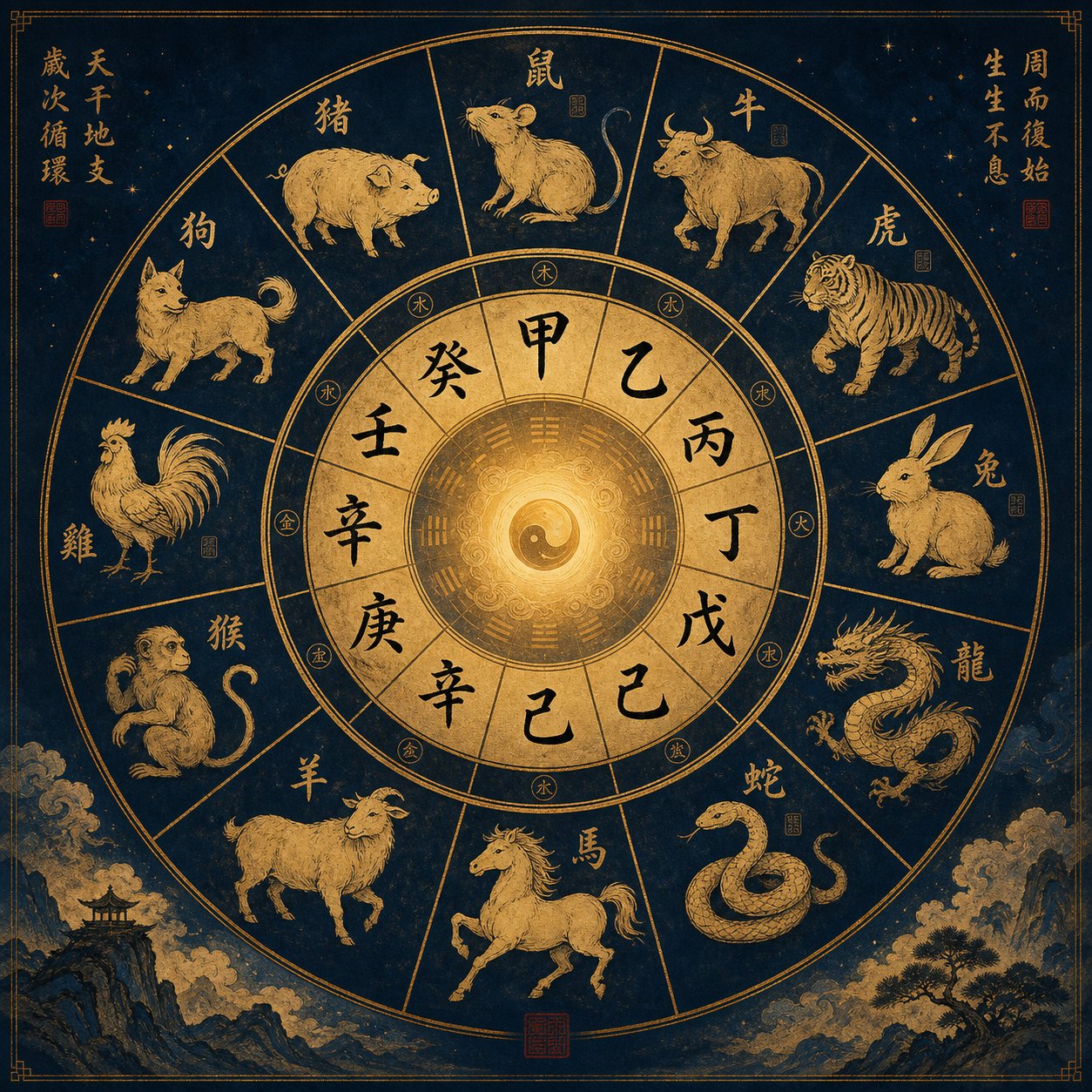
The heavenly stems and earthly branches, known in Chinese as Tiangan Dizhi or simply "Ganzhi," form a dual-component naming system at the heart of traditional Chinese cosmology. It pairs 10 Heavenly Stems with 12 Earthly Branches. Each stem carries an elemental energy tied to the Five Elements. Each branch corresponds to a zodiac animal, a compass direction, a season, and a two-hour time period. Together, these stems and branches interlock like two gears of different sizes, cycling through 60 unique combinations before the pattern repeats.
The Heavenly Stems and Earthly Branches system is a foundational Chinese calendrical framework that combines 10 Stems (Tiangan) and 12 Branches (Dizhi) into a 60-unit sexagenary cycle used for recording years, months, days, and hours, as well as for astrology, feng shui, and cultural naming across East Asia.
This 60-unit cycle, called the sexagenary cycle or "Sixty Jiazi," has been the backbone of Chinese timekeeping since at least the Shang Dynasty. Oracle bone inscriptions dating back over 3,000 years already used heavenly stems earthly branches pairings to record days. The system later expanded to mark years, months, and hours, embedding itself into medicine, architecture, military strategy, and personal destiny analysis.
Why This Naming System Still Matters Today
These 22 names are not museum relics. They remain active in Bazi (Four Pillars) chart reading, feng shui consultations, traditional Chinese medicine, and official year designations throughout China, Japan, Korea, and Vietnam. When someone says 2025 is the Year of the Wood Snake, they are referencing a specific stem-branch pairing: Yi Si. The heavenly stems and earthly branches give that year its elemental character, its yin-yang polarity, and its place within the larger 60-year rhythm.
What most references miss is what these names actually mean. The characters themselves encode imagery drawn from nature, from seeds breaking soil to fruits ripening on the vine. Each of the 22 names tells a story about growth, transformation, and cyclical return. The sections ahead unpack every stem and branch individually, revealing the original meanings, elemental associations, and practical applications that make this ancient code readable today.

The Ten Heavenly Stems and Their Original Meanings
Each of the ten heavenly stems is a single Chinese character, but these are not arbitrary symbols. They originated as descriptions of stages in a plant's life cycle, from the first crack of a seed shell to the quiet gestation of new life underground. The ancient historian Sima Qian recorded these meanings in the Records of the Grand Historian, noting that each stem captures a specific phase of natural transformation. Understanding what the 10 heavenly stems originally meant turns a memorization exercise into something intuitive.
The Ten Heavenly Stems with Pinyin and Meanings
Here is the complete reference for all ten heavenly stems, combining their Chinese characters, pinyin pronunciation, literal meaning, Five Element association, and yin-yang polarity in one unified table:
| Number | Chinese Character | Pinyin | Original Meaning | Element | Yin/Yang |
|---|---|---|---|---|---|
| 1 | 甲 | Jiǎ | Shell splitting open; a seed breaking through its casing | Wood | Yang |
| 2 | 乙 | Yǐ | A sprout bending as it pushes through soil | Wood | Yin |
| 3 | 丙 | Bǐng | Brightness; the plant becoming visible and radiant | Fire | Yang |
| 4 | 丁 | Dīng | Robust growth; a plant strong enough to stand firm | Fire | Yin |
| 5 | 戊 | Wù | Luxuriant abundance; full flourishing | Earth | Yang |
| 6 | 己 | Jǐ | Identifying and ordering; distinguishing forms clearly | Earth | Yin |
| 7 | 庚 | Gēng | Changing; the fruit hardening and transforming | Metal | Yang |
| 8 | 辛 | Xīn | New; renewal through cutting away the old | Metal | Yin |
| 9 | 壬 | Rén | Bearing; carrying new life within, like pregnancy | Water | Yang |
| 10 | 癸 | Guǐ | Measuring; estimating when the new cycle will emerge | Water | Yin |
You will notice the sequence tells a story. It begins with a seed cracking open (Jia) and ends with the quiet anticipation of rebirth (Gui). This is not coincidence. The heavenly stems map the arc of creation from emergence to dormancy, then back again.
Yin and Yang Pairings Within the Stems
The ten heavenly stems divide neatly into five element pairs, each containing one Yang stem and one Yin stem. The Yang expression of an element is always expansive, powerful, and outward-facing. The Yin expression is refined, flexible, and inward-turning. Think of it this way:
- Wood: Jia is a towering oak tree, deeply rooted and unyielding. Yi is a climbing vine, adaptable and graceful, bending without breaking.
- Fire: Bing is the blazing sun at noon, impossible to ignore. Ding is a candle flame, steady and intimate, illuminating just what is needed.
- Earth: Wu is a mountain or vast plateau, immovable and commanding. Ji is fertile farmland, nurturing and productive, quietly sustaining life.
- Metal: Geng is a forged sword or raw steel, sharp and decisive. Xin is polished jewelry or a fine needle, precise and elegant.
- Water: Ren is a rushing river or the open ocean, powerful and unstoppable. Gui is morning dew or a hidden spring, gentle and nourishing from below.
These analogies are not just poetic decoration. In Bazi chart reading, a person whose Day Master is Jia Wood is interpreted very differently from someone with Yi Wood, even though both belong to the same element. The Yang version suggests leadership and rigidity. The Yin version suggests diplomacy and resilience. The same logic applies across all five element pairs.
With the heavenly stems mapped out, the natural question becomes: what do their counterparts, the 12 Earthly Branches, bring to the table? Where stems carry pure elemental energy, branches layer in animal symbolism, directional meaning, and time itself.
The Twelve Earthly Branches and Their Associations
Where the heavenly stems describe pure elemental energy in a linear growth sequence, the twelve earthly branches map that energy onto space and time. Each branch anchors itself to a zodiac animal, a compass direction, a season, and a specific two-hour window of the day. This layered quality is what makes the earthly branches so rich in practical application and so much more complex than the stems alone.
The Twelve Earthly Branches with Zodiac Animals
The twelve earthly branches form a cycle that begins at midnight and moves through the full day, the full year, and the full compass. Each branch carries a dominant element, but unlike the stems, most branches also contain hidden secondary elements beneath the surface. The table below captures the core associations you need as a naming reference:
| Number | Chinese Character | Pinyin | Zodiac Animal | Element | Direction | Time Period |
|---|---|---|---|---|---|---|
| 1 | 子 | Zǐ | Rat | Water | North | 11:00pm - 1:00am |
| 2 | 丑 | Chǒu | Ox | Earth | North-Northeast | 1:00am - 3:00am |
| 3 | 寅 | Yín | Tiger | Wood | East-Northeast | 3:00am - 5:00am |
| 4 | 卯 | Mǎo | Rabbit | Wood | East | 5:00am - 7:00am |
| 5 | 辰 | Chén | Dragon | Earth | East-Southeast | 7:00am - 9:00am |
| 6 | 巳 | Sì | Snake | Fire | South-Southeast | 9:00am - 11:00am |
| 7 | 午 | Wǔ | Horse | Fire | South | 11:00am - 1:00pm |
| 8 | 未 | Wèi | Goat | Earth | South-Southwest | 1:00pm - 3:00pm |
| 9 | 申 | Shēn | Monkey | Metal | West-Southwest | 3:00pm - 5:00pm |
| 10 | 酉 | Yǒu | Rooster | Metal | West | 5:00pm - 7:00pm |
| 11 | 戌 | Xū | Dog | Earth | West-Northwest | 7:00pm - 9:00pm |
| 12 | 亥 | Hài | Pig | Water | North-Northwest | 9:00pm - 11:00pm |
A few patterns jump out immediately. Earth appears four times (Chou, Chen, Wei, Xu), positioned at the transitional points between seasons. Wood, Fire, Metal, and Water each appear twice. This distribution reflects how the ancient Chinese saw Earth as the stabilizing pivot between the other four elements, grounding each seasonal shift.
The characters themselves encode meaning in their written forms. The character 子 (Zi) originally depicted a swaddled infant, suggesting new beginnings at the darkest hour. 午 (Wu) shows a pestle striking downward, capturing the peak force of midday. 酉 (You) is a pictograph of a wine vessel, referencing the fermentation process associated with autumn harvest. Even 亥 (Hai), the final branch, contains the radical for a boar's skeletal structure, linking the written form directly to its zodiac animal.
Time Periods and Directional Associations
Each earthly branch governs a two-hour period called a "shi" in traditional Chinese timekeeping. The cycle begins with the zi hour, spanning 11:00pm to 1:00am, when midnight sits at the center of the time block rather than at its boundary. This placement is deliberate. Midnight represents the moment when Yin energy reaches its peak and Yang energy begins its return, so the Rat, a creature active in darkness, anchors this pivotal transition.
Imagine you are living in Tang Dynasty Chang'an. The night watchman strikes his drum at the xu hour, 7:00pm to 9:00pm, signaling the curfew. That xu hour corresponds to the Dog, an animal associated with guarding and loyalty, fitting perfectly with the evening's protective energy. These are not arbitrary pairings. The animals, times, and directions reinforce each other through a coherent symbolic logic.
Directionally, the branches divide the compass into twelve segments of 30 degrees each. Zi points due North, Wu points due South, Mao points due East, and You points due West. The four cardinal branches also mark the midpoints of the four seasons: Zi anchors winter, Wu anchors summer, Mao anchors spring, and You anchors autumn. Every feng shui compass (Luopan) uses these branch-direction correspondences as its foundational ring.
The seasonal groupings follow a clear triad pattern. Spring belongs to Yin, Mao, and Chen (Tiger, Rabbit, Dragon). Summer belongs to Si, Wu, and Wei (Snake, Horse, Goat). Autumn belongs to Shen, You, and Xu (Monkey, Rooster, Dog). Winter belongs to Hai, Zi, and Chou (Pig, Rat, Ox). Within each triad, the first branch initiates the season's energy, the second branch represents its peak, and the third branch transitions toward the next season.
This layered architecture, where each branch simultaneously encodes time, space, season, element, and animal symbolism, is precisely what gives the earthly branches their diagnostic power in Chinese metaphysics. The stems tell you what element is present. The branches tell you when, where, and through what symbolic lens that element expresses itself. The real depth of the system emerges when you see how the Five Elements thread through both stems and branches simultaneously, binding the 22 names into a single integrated framework.

Five Elements Integration with Stems and Branches
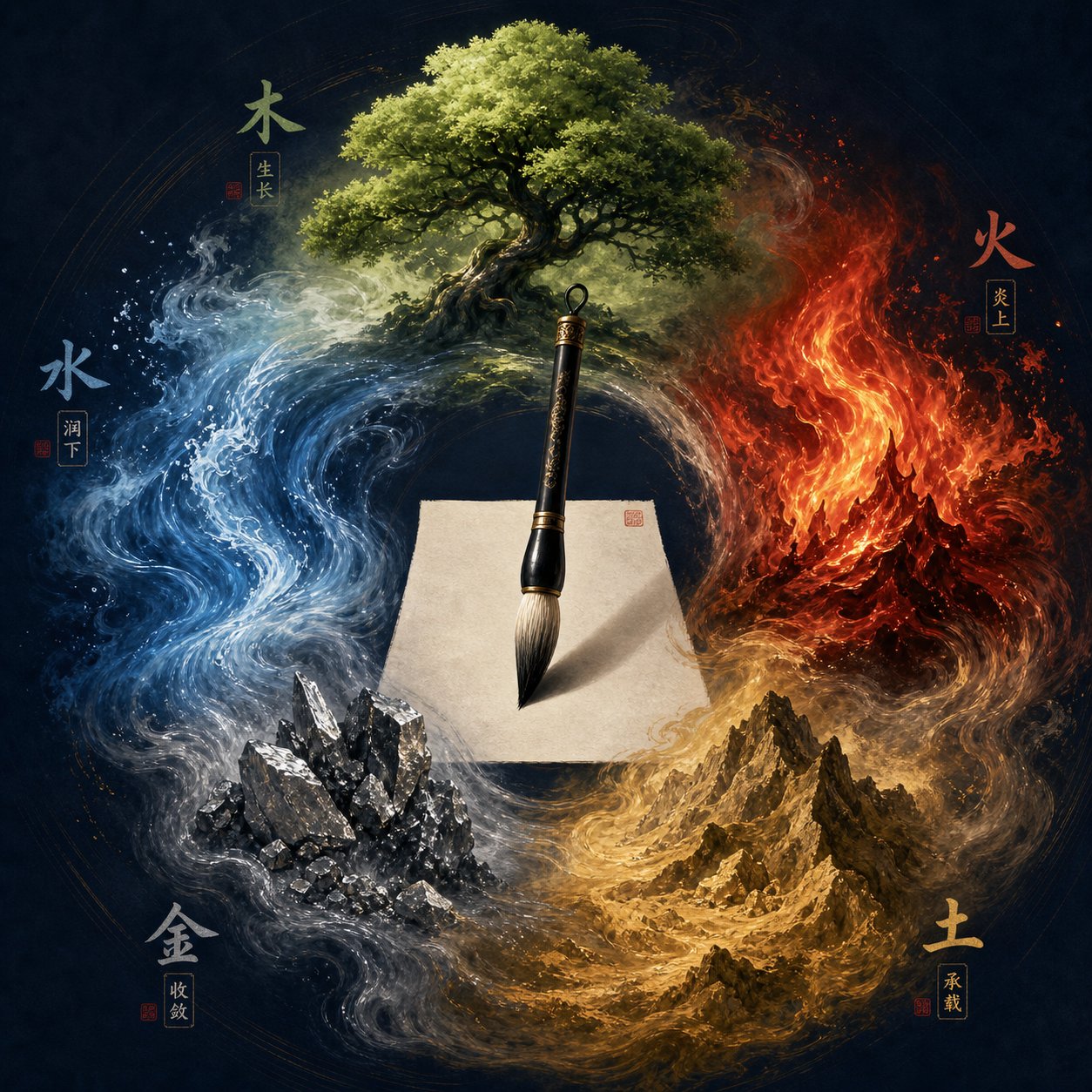
The Five Elements are not a separate layer bolted onto the naming system. They are the connective tissue running through every stem and every branch, giving each of the 22 names its energetic identity. Without the Wuxing framework, the earthly branches and heavenly stems would be an arbitrary list. With it, they become a living map of how energy transforms, supports, and challenges itself across time and space.
How Five Elements Connect Stems to Branches
Here is the key distinction most references gloss over: stems and branches carry elemental energy differently. A heavenly stem expresses one element in pure, undiluted form. Jia is Wood, period. Bing is Fire, nothing else. The stems are transparent, single-note carriers of elemental force.
The chinese earthly branches work differently. Each earth branch blends its dominant element with hidden secondary elements stored beneath the surface. The Tiger branch (Yin) is labeled Wood, but it also contains hidden Fire and Earth within it. The Monkey branch (Shen) is labeled Metal, yet it stores Water and Earth internally. This means a single branch can activate multiple elemental dynamics simultaneously.
Heavenly Stems carry pure elemental energy in a single, visible expression. Earthly Branches blend element with animal symbolism, seasonal timing, and hidden secondary forces, making them the more complex half of every stem-branch pairing.
Here is how the Five Elements distribute across both systems:
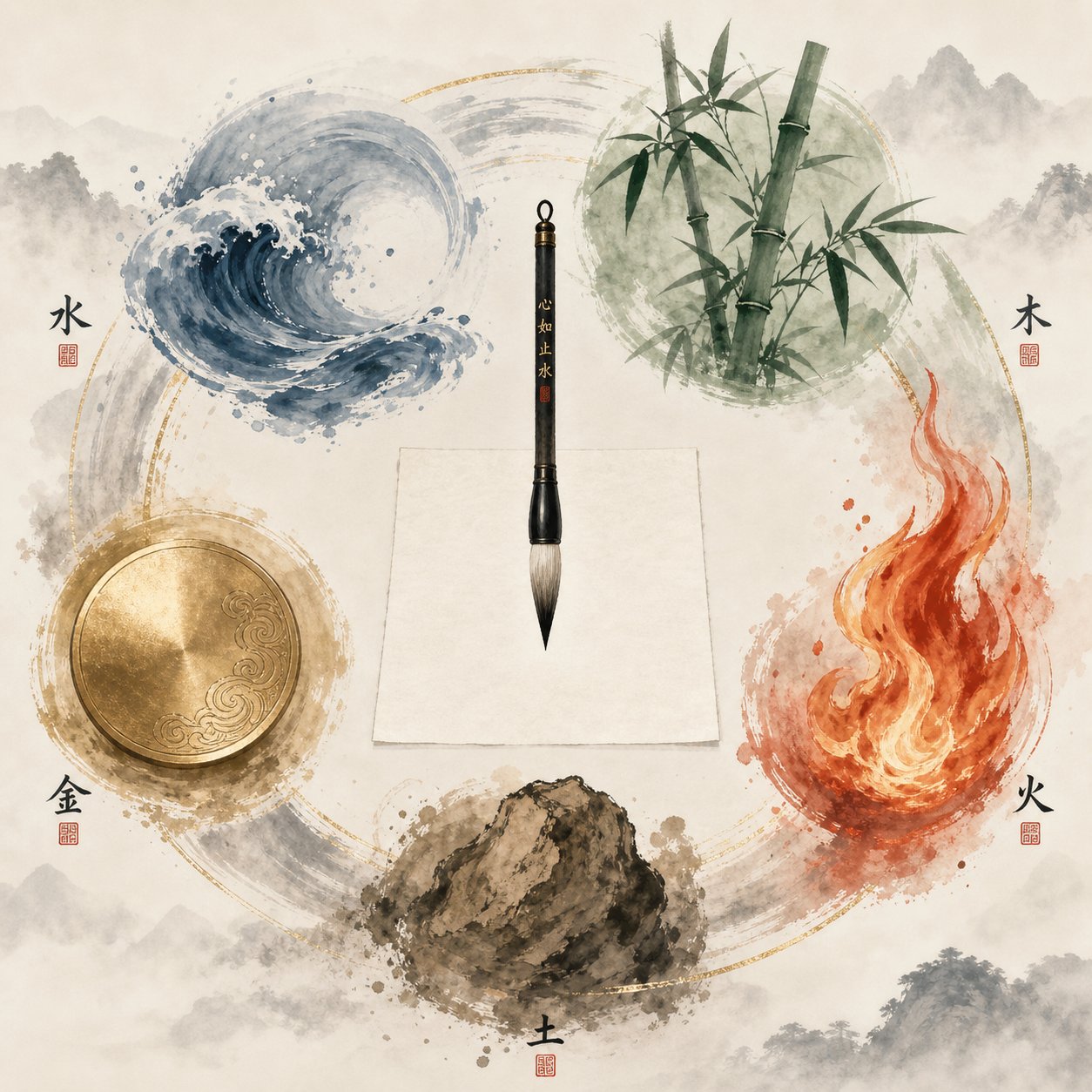
- Wood: Stems Jia (Yang) and Yi (Yin). Branches Yin/Tiger (Yang Wood) and Mao/Rabbit (Yin Wood). Wood governs the East, spring, and the energy of growth and expansion.
- Fire: Stems Bing (Yang) and Ding (Yin). Branches Si/Snake (Yin Fire) and Wu/Horse (Yang Fire). Fire governs the South, summer, and the energy of radiance and transformation.
- Earth: Stems Wu (Yang) and Ji (Yin). Branches Chou/Ox, Chen/Dragon, Wei/Goat, and Xu/Dog. Earth governs the Center, the transitional periods between seasons, and the energy of stability and grounding.
- Metal: Stems Geng (Yang) and Xin (Yin). Branches Shen/Monkey (Yang Metal) and You/Rooster (Yin Metal). Metal governs the West, autumn, and the energy of contraction and refinement.
- Water: Stems Ren (Yang) and Gui (Yin). Branches Zi/Rat (Yang Water) and Hai/Pig (Yin Water). Water governs the North, winter, and the energy of storage and potential.
Notice that Earth claims four branches while every other element gets only two. This is not an imbalance. It reflects the traditional view that Earth acts as the mediator between seasons, appearing at each transitional juncture to stabilize the shift from one elemental phase to the next. Imagine Earth as the landing between flights of stairs: you pass through it every time you move from one level to another.
Productive and Destructive Element Cycles in the System
The Five Elements do not sit in static isolation. They interact through two fundamental cycles that give stem-branch pairings their relational meaning.
The productive cycle (also called the generating or nourishing cycle) flows like this: Wood feeds Fire, Fire creates Earth (ash), Earth yields Metal (ore), Metal collects Water (condensation), and Water nourishes Wood. Think of it as a parent-child chain. Each element gives life to the next. When a stem-branch pairing places a Wood stem above a Fire branch, the stem is feeding the branch beneath it, like a parent supporting a child.
The destructive cycle (also called the controlling or restraining cycle) moves differently: Wood penetrates Earth (roots breaking soil), Earth dams Water, Water extinguishes Fire, Fire melts Metal, and Metal chops Wood. This is not aggression for its own sake. It is regulation. Without the controlling cycle, any single element would grow unchecked and overwhelm the system. Imagine a garden where nothing prunes the vines or channels the water. The destructive cycle is the gardener's shears.
These two cycles operate simultaneously within every stem-branch combination. When you pair the stem Ren (Yang Water) with the branch Yin (Tiger, Yang Wood), the productive cycle is active: Water nourishes Wood. That pairing carries an inherent sense of support and flow. Pair Ren Water with the branch Wu (Horse, Yang Fire), and the destructive cycle activates: Water controls Fire. That pairing carries tension, restraint, and the potential for conflict or discipline depending on context.
This dual integration is what transforms the naming system from a simple list into a diagnostic tool. Every one of the 60 sexagenary pairings encodes a specific elemental relationship between its stem and branch. Practitioners of Bazi, feng shui, and traditional Chinese medicine read these relationships to assess balance, identify deficiencies, and predict how energy will shift across time. The names themselves are not just labels. They are shorthand for elemental stories playing out between heaven and earth.
The productive and destructive cycles also explain why certain stem-branch combinations recur in historical naming. The pairing matters because the relationship between its two elements shapes the character of that year, month, day, or hour. And when you line up all 60 possible pairings in sequence, a larger pattern emerges: the sexagenary cycle itself, where mathematical logic and elemental philosophy merge into a single, self-renewing structure.

The Sixty-Year Sexagenary Cycle Explained
Ten stems. Twelve branches. You might expect 120 possible combinations if you paired every stem with every branch. But the system does not work that way. Instead of exhausting all permutations, the stems and branches advance in lockstep, one position at a time, producing exactly 60 unique pairings before the cycle resets. This is the sexagenary cycle, and its elegant mathematical logic has kept Chinese calendars running for over three millennia.
How 60 Unique Pairings Are Formed
The pairing rule is simple: start with the first stem and the first branch together, then advance both by one position simultaneously. Jia pairs with Zi (1,1). Yi pairs with Chou (2,2). Bing pairs with Yin (3,3). This continues until you reach Gui paired with You (10,10), at which point the stems have been exhausted. The rule is to loop back to the beginning of whichever set runs out first, just like numbers on a clock. So the next pairing is Jia with Xu (1,11), then Yi with Hai (2,12), then Bing cycles back to Zi (3,1).
Why does this produce exactly 60 combinations and not some other number? The answer lies in the least common multiple (LCM) of 10 and 12. Since 10 = 2 x 5 and 12 = 2 x 2 x 3, their LCM is 60. The cycle must run through 60 pairings before both the stem sequence and the branch sequence simultaneously return to their starting positions. Any fewer, and one set would be out of alignment.
There is another constraint built into this lockstep advancement. Because both counters move forward together, odd-numbered stems always pair with odd-numbered branches, and even-numbered stems always pair with even-numbered branches. Yang stems meet Yang branches. Yin stems meet Yin branches. You will never see a pairing like Jia Chou (Yang Wood with Yin Earth branch) in the sexagenary system. This halves the theoretical 120 combinations down to 60 valid ones.
Here are the first 12 pairings of the cycle, illustrating how the pattern unfolds:
| Number | Chinese | Pinyin | Stem Element | Zodiac Animal |
|---|---|---|---|---|
| 1 | 甲子 | Jiǎ Zǐ | Yang Wood | Rat |
| 2 | 乙丑 | Yǐ Chǒu | Yin Wood | Ox |
| 3 | 丙寅 | Bǐng Yín | Yang Fire | Tiger |
| 4 | 丁卯 | Dīng Mǎo | Yin Fire | Rabbit |
| 5 | 戊辰 | Wù Chén | Yang Earth | Dragon |
| 6 | 己巳 | Jǐ Sì | Yin Earth | Snake |
| 7 | 庚午 | Gēng Wǔ | Yang Metal | Horse |
| 8 | 辛未 | Xīn Wèi | Yin Metal | Goat |
| 9 | 壬申 | Rén Shēn | Yang Water | Monkey |
| 10 | 癸酉 | Guǐ Yǒu | Yin Water | Rooster |
| 11 | 甲戌 | Jiǎ Xū | Yang Wood | Dog |
| 12 | 乙亥 | Yǐ Hài | Yin Wood | Pig |
Notice how the stems reset at position 11 (Jia returns) while the branches keep advancing. By position 13, the branches will also reset (Zi returns), but paired with Bing instead of Jia. The two sequences chase each other through the full 60 positions before both land on their starting characters simultaneously.
Historical Origins from Oracle Bones to Modern Calendars
The sexagenary cycle is not a theoretical construct invented by philosophers. It emerged from practical record-keeping during the Shang Dynasty (c. 1600-1050 BCE), where diviners carved stem-branch date labels onto oracle bones made from ox scapulae and turtle plastrons. Over 10,000 of these inscribed bones have been recovered from the site of Anyang alone, and student scribes at divination workshops practiced by copying ganzhi date tables as their first curriculum exercise. The sexagenary day cycle recorded on these bones has continued without interruption for more than 2,700 years, making it one of the longest unbroken counting sequences in human history.
The system initially tracked days. Its expansion to years came later, likely during the Han Dynasty, and it eventually encompassed months and two-hour time periods as well. The most recent sexagenary year cycle began with Jia Zi in 1984 and will complete its full rotation in 2043.
What makes these names more than calendar labels is how deeply they embedded themselves into historical memory. Major events across Chinese history are named by their sexagenary year designation rather than by a Western date. The Xinhai Revolution of 1911, which overthrew the Qing Dynasty and established the Republic of China, takes its name from the year Xin Hai (辛亥), pairing the Yin Metal stem with the Pig branch. The Wuxu Reform of 1898, a failed modernization movement, is named for the year Wu Xu (戊辰), Yang Earth paired with the Dog branch. The First Sino-Japanese War of 1894 is called the Jiawu War (甲午战争) after its year Jia Wu, Yang Wood paired with the Horse branch.
These are not obscure historical footnotes. Every educated Chinese speaker recognizes "Xinhai" as shorthand for the revolution, just as English speakers recognize "9/11" without needing further explanation. The sexagenary names function as cultural timestamps, compressing an entire year's identity into two characters.
The 2025 Chinese sexagenary year is Yi Si (乙巳), pairing the Yin Wood stem with the Snake branch. This is why 2025 is called the Year of the Wood Snake. The stem Yi tells you the element and polarity. The branch Si tells you the zodiac animal. Together, they place 2025 at position 42 within the current 60-year cycle, carrying the specific energetic signature of flexible, adaptive Wood expressed through the intuitive, transformative Snake.
This naming convention is not limited to China. The same 60-unit structure traveled across East Asia, adopted and adapted by cultures that gave the stems and branches their own native pronunciations while preserving the underlying mathematical and cosmological architecture.
Stem and Branch Names Across East Asian Cultures
The 60-unit cycle did not stay within China's borders. As the system spread through celestial China's cultural sphere, Japan, Korea, and Vietnam each absorbed the same structural logic but dressed it in native pronunciation and, in one notable case, swapped out an animal entirely. The heavenly symbols and mathematical relationships remained intact. Only the sounds changed.
Japanese Jikkan Junishi Naming Conventions
In Japanese, the system is called Jikkan Junishi (十干十二支), literally "ten stems, twelve branches." What makes the Japanese adaptation distinctive is its dual reading system. Each stem has a Sino-Japanese pronunciation (onyomi) borrowed from Chinese, plus a native Japanese reading (kunyomi) that describes the element and its yin-yang polarity in plain language.
For example, the first stem Jia becomes ko in onyomi, but its kunyomi reading is kinoe, meaning "elder brother of wood" (木の兄). The second stem Yi becomes kinoto, "younger brother of wood" (木の弟). This elder/younger brother pattern repeats across all five elements: hinoe/hinoto for Fire, tsuchinoe/tsuchinoto for Earth, kanoe/kanoto for Metal, and mizunoe/mizunoto for Water. The kunyomi readings essentially translate the yin-yang polarity into a family metaphor, making the system immediately intuitive for Japanese speakers.
The branches follow the same dual-reading approach. Zi becomes ne (ね), Chou becomes ushi (うし), Yin becomes tora (とら), and so on, using the native Japanese animal names. The Japanese Boshin War of 1868 takes its name from the stem-branch year 戊辰 (boshin, Yang Earth Dragon), demonstrating how these names still mark historical memory.
Korean and Vietnamese Adaptations of the System
Korean uses Sino-Korean readings that stay phonetically close to the original Chinese. The system is called ganji (간지), and the stems follow a recognizable pattern: gap, eul, byeong, jeong, mu, gi, gyeong, sin, im, gye. The Korean tradition of celebrating a person's 60th birthday, called hwangap (환갑), literally means "return of the cycle," marking the moment when a person's birth year stem-branch combination comes around again.
Vietnamese calls the system Can Chi (干支) or Thien Can Dia Chi (天干地支). The stems use Sino-Vietnamese pronunciations: giap, at, binh, dinh, mau, ky, canh, tan, nham, quy. The most famous divergence from the Chinese original appears in the branches: Vietnam substitutes the Cat (meo) for the Rabbit in the fourth position. The Vietnamese famine of 1945 is historically known as Nan doi At Dau, named after its can chi year designation At Dau (乙酉, Yin Wood Rooster).
The table below compares selected stems and branches across all four traditions:
| Character | Chinese (Pinyin) | Japanese (Kunyomi) | Korean (Romanized) | Vietnamese |
|---|---|---|---|---|
| 甲 | Jia | kinoe | gap | giap |
| 丙 | Bing | hinoe | byeong | binh |
| 庚 | Geng | kanoe | gyeong | canh |
| 壬 | Ren | mizunoe | im | nham |
| 子 (Rat) | Zi | ne | ja | ty |
| 卯 (Rabbit/Cat) | Mao | u | myo | mao (Cat) |
| 午 (Horse) | Wu | uma | o | ngo |
| 酉 (Rooster) | You | tori | yu | dau |
Despite the surface-level differences in pronunciation, every culture preserves the same underlying architecture: 10 stems cycling through 5 elements, 12 branches cycling through zodiac animals, and 60 unique pairings governing time. The names sound different in Tokyo, Seoul, and Hanoi, but the elemental relationships, yin-yang polarities, and cyclical mathematics remain identical. A Jia Zi year is a kinoe-ne year in Japan, a gapja year in Korea, and a Giap Ty year in Vietnam. Same structure, different voices.
This cross-cultural consistency hints at something deeper than mere calendar convention. The system encodes relationships between elements, animals, and time that practitioners across all four traditions actively use in daily life, from selecting auspicious dates to reading personal destiny charts.

Practical Applications of Stem and Branch Names Today
Knowing the names is one thing. Seeing them at work in living systems is another. The heavenly stems and earthly branches are not historical curiosities preserved under glass. They remain active operational tools in several disciplines practiced daily across East Asia, from personal destiny analysis to spatial design to clinical medicine. Each application reads the same 22 names through a different lens, extracting different layers of meaning from the same elemental code.
Reading Stems and Branches in Bazi Charts
Bazi, literally "eight characters," is the most direct application of stem-branch names. Your birth year, month, day, and hour each produce one stem-branch pairing, giving you four pillars with eight characters total. These eight characters form a structural map of the elemental forces present at the moment you were born.
The most important character in any Bazi chart is the Day Stem, also called the Daymaster. This is the Heavenly Stem sitting atop your Day Pillar, and it represents your core elemental identity. There are ten possible Daymasters, one for each heavenly stem, and every other character in the chart is interpreted in relationship to this single reference point. A person with a Jia Wood Daymaster reads the surrounding elements differently than someone with a Geng Metal Daymaster, even if the rest of their chart looks similar.
Sounds complex? The blind man formula for bazi day stem calculation simplifies identification. Traditional practitioners memorized lookup methods that derive the day stem from the date of birth using fixed reference points and modular arithmetic. The day stem cycles every 10 days without interruption, so once you anchor a known reference date, you can count forward or backward to find any day's stem. Modern online calculators handle this instantly, but understanding the logic reveals why the system works: the day stem cycle has never been broken since the Shang Dynasty.
The Hour Pillar adds another layer. To determine the hour stem, you need to know the day stem first, because the two are linked through a fixed relationship. The bazi hour stem table follows a pattern called the "Five Rats Crossing the Hour" method. On a Jia or Ji day, the Zi hour (11pm-1am) always begins with Jia as its stem. On a Yi or Geng day, the Zi hour begins with Bing. On a Bing or Xin day, it begins with Wu. This pattern means that knowing how to calculate chinese hour pillar from day stem requires just one lookup rule and then counting forward through the stems sequentially from that starting point.
Within the chart, the Earthly Branches interact through specific relationships that shape how energy flows between pillars:
- Six Combinations (Liu He): Specific branch pairs that merge to produce a new elemental energy. For example, Zi (Rat) and Chou (Ox) combine to produce Earth. These combinations can redirect elemental force toward or away from a needed area.
- Six Clashes (Liu Chong): Direct opposition between branches sitting 180 degrees apart on the cycle. Zi clashes with Wu, Mao clashes with You. A clash disrupts the elemental forces those branches carry, which can break stagnation or destabilize something that was working.
- Six Harms (Liu Hai): Subtler friction that occurs when one branch interferes with an existing combination. These create unresolved tension rather than outright confrontation.
- Three Punishments (San Xing): Groupings of two or three branches that, when converging in a chart, create intense elemental friction and amplify existing dynamics.
None of these interactions are inherently good or bad. A clash in one chart might be the disruption needed to break through a structural ceiling. The same clash in another chart might destabilize a quadrant that was performing well. Context determines meaning, which is why practitioners read branch interactions relative to the Daymaster and the overall elemental balance.
Applications in Feng Shui and Chinese Medicine
Beyond personal destiny charts, stem-branch names operate across several other domains:
- Feng Shui spatial design: Each earthly branch maps to a compass direction. Practitioners use the annual stem-branch pairing to identify which directions carry favorable or challenging energy in a given year. The branch of the current year activates specific sectors of a building, and the stem tells you which element is influencing that activation. Adjustments in decor, color, and material placement follow directly from reading the year's stem-branch combination against the building's orientation.
- Traditional Chinese Medicine (TCM): The twelve branches correspond to the twelve primary meridians in the body. Each two-hour period governed by a branch is the time when its associated meridian reaches peak activity. The Zi hour (11pm-1am) activates the Gallbladder meridian. The Wu hour (11am-1pm) activates the Heart meridian. TCM practitioners use this correspondence to time treatments, recommend rest periods, and diagnose patterns of imbalance based on when symptoms worsen or improve.
- Official year naming: Government documents, commemorative events, and cultural celebrations across China, Taiwan, Japan, and Korea still reference the sexagenary year name. The stem-branch designation carries more cultural weight than the Gregorian number in many traditional contexts, particularly for selecting auspicious dates for weddings, business openings, and construction projects.
- Date selection (Ze Ri): Choosing favorable dates for important activities relies entirely on reading the stem-branch combination of a specific day against the person's chart. The day stem determines the elemental character of that day, while the day branch reveals potential clashes or harmonies with the person's natal branches.
What ties all these applications together is a single principle: the 22 names are not just labels but carriers of elemental information. When a feng shui master says to avoid the South sector this year, they are reading the branch-direction correspondence. When a TCM doctor recommends sleep before the Zi hour, they are reading the branch-meridian correspondence. When a Bazi practitioner identifies your favorable element, they are reading how your Day Stem relates to every other stem and branch in your chart through the productive and destructive cycles.
The system's practical power comes from this consistency. The same names, the same elemental logic, and the same cyclical mathematics apply whether you are reading a person's birth chart, orienting a building, timing a medical treatment, or naming a year. Mastering the names means gaining a single key that opens multiple doors. The challenge, of course, is remembering all 22 names and their associations clearly enough to use them fluently, which is exactly where structured memory techniques prove their value.
Memory Aids for Learning All 22 Names
Twenty-two names, five elements, twelve animals, and a web of yin-yang polarities. Faced with all of that at once, most learners stall. The trick is not brute-force repetition. It is recognizing the patterns already built into the system and using them as scaffolding.
Memorizing the Ten Stems by Element Pairs
The ten heavenly stems are not ten isolated items. They are five pairs, and each pair shares one element. Learn the element sequence first, and the stems fall into place around it:
- Wood: Jia (Yang), Yi (Yin)
- Fire: Bing (Yang), Ding (Yin)
- Earth: Wu (Yang), Ji (Yin)
- Metal: Geng (Yang), Xin (Yin)
- Water: Ren (Yang), Gui (Yin)
The element order never changes: Wood, Fire, Earth, Metal, Water. Within each pair, Yang always comes first. This means odd-numbered stems (1, 3, 5, 7, 9) are always Yang, and even-numbered stems (2, 4, 6, 8, 10) are always Yin. You do not need to memorize polarity separately. Position tells you everything.
Jia Yi Wood, Bing Ding Fire, Wu Ji Earth, Geng Xin Metal, Ren Gui Water. Five pairs, fixed order, Yang always leads.
Once this sequence clicks, answering the common question "what is my chinese zodiac heavenly element" becomes straightforward. Your birth year's heavenly stem determines your heavenly element. If your year stem is Bing or Ding, your element is Fire. If it is Geng or Xin, your element is Metal. The pair structure gives you the answer instantly without needing a lookup chart.
Learning the Twelve Branches Through Seasonal Groups
The 12 earthly branches organize naturally into four seasonal triads. Each triad contains three consecutive branches that share a season:
- Spring (Wood): Yin/Tiger, Mao/Rabbit, Chen/Dragon
- Summer (Fire): Si/Snake, Wu/Horse, Wei/Goat
- Autumn (Metal): Shen/Monkey, You/Rooster, Xu/Dog
- Winter (Water): Hai/Pig, Zi/Rat, Chou/Ox
Within each triad, the pattern holds consistent: the first earthly branch initiates the season's energy, the second represents its peak, and the third transitions toward the next season. The third branch in every group (Chen, Wei, Xu, Chou) always belongs to Earth, acting as the seasonal pivot. Spot that pattern once, and you will never confuse which branches carry Earth energy.
Another useful recognition strategy: the yin-yang polarity of each branch alternates strictly. Zi is Yang, Chou is Yin, Yin is Yang, Mao is Yin, and so on through the entire sequence without exception. If you know a branch's position number, you know its polarity. Odd positions are Yang, even positions are Yin, mirroring the same rule that governs the stems.
Combine both techniques and you can reconstruct the full system from memory. The stems give you five element pairs in fixed order. The branches give you four seasonal triads with Earth transitions. The yin-yang alternation rule applies identically to both sets. These three patterns, working together, reduce 22 separate memorization tasks to a handful of structural principles that generate the correct answers on demand.
With the naming logic internalized this way, the system stops feeling like a foreign vocabulary list and starts functioning as a coherent language, one where every name carries its own built-in coordinates of element, polarity, and position within the cycle.
Bringing the Naming System Together
Every piece of the framework connects back to the same core architecture. Ten stems carry elemental energy. Twelve branches anchor that energy in time, space, and animal symbolism. Together, they generate 60 unique pairings that cycle endlessly through years, months, days, and hours. The entire system fits into a single reference structure:
Quick Reference Summary of the Complete System
| Component | Count | Mapped To | Key Principle |
|---|---|---|---|
| Heavenly Stems | 10 | 5 Elements (2 stems per element) | Yang stem leads, Yin stem follows within each pair |
| Earthly Branches | 12 | 12 Zodiac Animals, directions, seasons, time periods | 4 seasonal triads with Earth transitions between them |
| Sexagenary Cycle | 60 | Unique stem-branch combinations | LCM of 10 and 12; Yang pairs with Yang, Yin pairs with Yin |
You now have the vocabulary, the elemental logic, the mathematical structure, and the memory scaffolding to read any stem-branch pairing you encounter. Whether it appears on a Chinese calendar, in a Bazi chart, on a feng shui compass, or in a historical text, the same 22 names decode the same way every time.
Next Steps for Deeper Study
If this naming system has sparked your curiosity, two paths offer the richest continuation. The first is deeper Bazi analysis, where you move beyond identifying stems and branches toward reading the dynamic relationships between all four pillars of a chart. Branch interactions like combinations, clashes, and punishments create layered narratives that shift across different life periods. The Day Stem remains your anchor, but the surrounding characters tell the fuller story.
The second path leads to Zi Wei Dou Shu, often called Purple Star Astrology. This system uses the heavenly stem of your birth year to assign four transformations (sihua) to specific stars in your chart. Each Zi Wei Dou Shu heavenly stem assignment follows a fixed table: the stem Jia triggers one set of star transformations, the stem Yi triggers another, and so on through all ten. The Zi Wei Dou Shu four hua table by year stem is the key reference that connects your birth year's heavenly stem to the stars receiving Hua Lu (abundance), Hua Quan (power), Hua Ke (recognition), and Hua Ji (challenge) in your natal chart.
Both disciplines reward patience. As experienced practitioners consistently emphasize, there is no shortcut that replaces careful study of the foundational naming system. The stems and branches are not a preliminary step you rush past. They are the language in which every advanced technique is written.
Mastering the 22 heavenly stems and earthly branches names does not give you one skill. It gives you the shared alphabet of Bazi, Zi Wei Dou Shu, feng shui, date selection, and traditional Chinese medicine. Learn the names deeply, and every door in Chinese metaphysics opens with the same key.
Frequently Asked Questions About Heavenly Stems and Earthly Branches Names
1. What are the 10 heavenly stems in Chinese?
The 10 heavenly stems are Jia, Yi, Bing, Ding, Wu, Ji, Geng, Xin, Ren, and Gui. They form five element pairs in fixed order: Wood (Jia/Yi), Fire (Bing/Ding), Earth (Wu/Ji), Metal (Geng/Xin), and Water (Ren/Gui). Each pair contains one Yang stem followed by one Yin stem, and the original characters describe stages in a plant's life cycle from seed to dormancy.
2. How do the 12 earthly branches relate to the Chinese zodiac animals?
Each of the 12 earthly branches corresponds to one zodiac animal in fixed order: Zi (Rat), Chou (Ox), Yin (Tiger), Mao (Rabbit), Chen (Dragon), Si (Snake), Wu (Horse), Wei (Goat), Shen (Monkey), You (Rooster), Xu (Dog), and Hai (Pig). Beyond animal symbolism, each branch also carries an element, a compass direction, a season, and a two-hour time period, making them far more layered than simple zodiac labels.
3. Why does the sexagenary cycle have exactly 60 combinations instead of 120?
Although 10 stems multiplied by 12 branches equals 120, the system advances both counters in lockstep rather than exhausting all permutations. This means Yang stems only pair with Yang branches and Yin stems only pair with Yin branches, halving the possibilities. The least common multiple of 10 and 12 is 60, which is the exact number of steps needed before both sequences return to their starting positions simultaneously.
4. How do I find my heavenly element from my birth year?
Your heavenly element comes from the heavenly stem of your birth year. Since stems cycle in pairs through five elements in fixed order, you can identify yours by the last digit of your birth year: 4 or 5 means Wood, 6 or 7 means Fire, 8 or 9 means Earth, 0 or 1 means Metal, and 2 or 3 means Water. The odd digit in each pair indicates Yang polarity, while the even digit indicates Yin polarity.
5. Are the heavenly stems and earthly branches used the same way in Japan, Korea, and Vietnam?
All four cultures preserve the identical mathematical structure of 10 stems, 12 branches, and 60 cycle combinations. The differences are primarily linguistic. Japan uses native kunyomi readings like kinoe (elder brother of wood) for Jia. Korea uses Sino-Korean pronunciations like gap for Jia. Vietnam uses Sino-Vietnamese readings like giap and notably substitutes the Cat for the Rabbit in the fourth branch position. The elemental relationships and cyclical logic remain the same across all traditions.